Chapter 6

  B2B Exchanges, Directories,
  and Other Support Services


      © 2008 Pearson Prentice Hall, Electronic Commerce 2008, Efraim Turban, et al.
Learning Objectives

 1. Define exchanges and describe their
    major types.
 2. Describe the various ownership and
    revenue models of exchanges.
 3. Describe B2B portals.
 4. Describe third-party exchanges.
 5. Distinguish between purchasing
    (procurement) and selling consortia.
                                           6-2
Learning Objectives
 1. Define dynamic trading and describe B2B
    auctions.
 2. Describe partner relationship management
    (PRM).
 3. Discuss integration issues of e-marketplaces
    and exchanges.
 4. Discuss B2B networks.
 5. Discuss issues in managing exchanges,
    including the critical success factors of
    exchanges.
                                                   6-3
B2B Electronic Exchanges—
An Overview
  public e-marketplace (public exchange)
   A many-to-many e-marketplace. Trading
   venues open to all interested parties (sellers
   and buyers); usually run by third parties. Some
   are also known as trading exchanges
  market maker
   The third party that operates an exchange
   (and in many cases, also owns the exchange)


                                                 6-4
B2B Electronic Exchanges—
An Overview


                            6-5
B2B Electronic Exchanges—
An Overview


                            6-6
B2B Electronic Exchanges—
An Overview
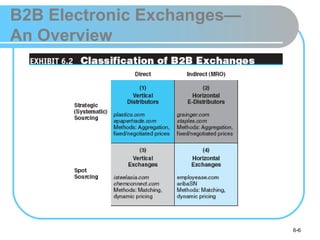
  vertical exchange
   An exchange whose members are in
   one industry or industry segment. It
   trades only in materials/services unique
   for that industry
  horizontal exchange
   An exchange that handles materials
   used by companies in different industries

                                           6-7
B2B Electronic Exchanges—
An Overview
  dynamic pricing
  A rapid movement of prices over time
  and possibly across customers, as a
  result of supply and demand matching


                                         6-8
B2B Electronic Exchanges—
An Overview
  The typical process that results in dynamic pricing in
   most exchanges:
    1. A company posts a bid to buy a product or an offer to sell
       one
    2. An auction (forward or reverse) is activated
    3. Buyers and sellers can see the bids and offers that usually
       remain anonymous
    4. Buyers and sellers interact with bids and offers in real time
       Sometimes group purchasing is used to obtain a volume
       discount price
    5. A deal is struck when there is an exact match between a
       buyer and a seller on price, volume, and other variables,
       such as location or quality
    6. The deal is consummated, and payment and delivery are
       arranged


                                                                       6-9
B2B Electronic Exchanges—
An Overview
  Functions of Exchanges
    Matching buyers and sellers
    Facilitating transactions
    Maintaining exchange policies and
     infrastructure


                                         6-10
B2B Electronic Exchanges—
An Overview
  Ownership of Exchanges
    One company, usually an industry giant
    A neutral entrepreneur
    The consortium (or co-op)
  Governance and Organization
    Membership
    Site access and security
    Services provided by exchanges

                                              6-11
B2B Electronic Exchanges—
An Overview
  Advantages of Exchanges
    Making markets more efficient, providing
     opportunities for sellers and buyers to find
     new business partners
    Cutting the administrative costs of ordering
     MROs
    Expediting trading processes
    Facilitating global trade
    Creating communities of informed buyers
     and sellers

                                                    6-12
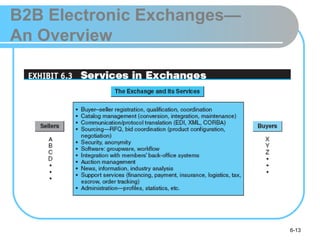
B2B Electronic Exchanges—
An Overview


                            6-13
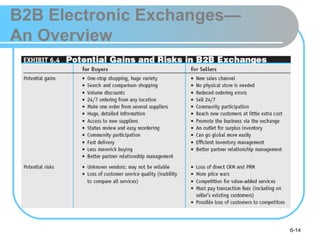
B2B Electronic Exchanges—
An Overview


                            6-14
B2B Electronic Exchanges—
An Overview
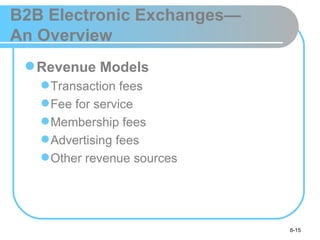
  Revenue Models
    Transaction fees
    Fee for service
    Membership fees
    Advertising fees
    Other revenue sources


                             6-15
B2B Portals and Directories

  B2B portals
   Information portals for businesses
  vortals
   B2B portals that focus on a single
   industry or industry segment; “vertical
   portals”


                                             6-16
B2B Portals and Directories

  Directory Services and Search
   Engines
    Directory services can help buyers and
     sellers manage the task of finding
     specialized products, services, and potential
     partners
    Specialized search engines are becoming a
     necessity in many industries due to the
     information glut

                                                 6-17
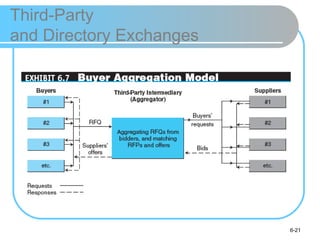
Third-Party
and Directory Exchanges
  Third-party exchanges are characterized
   by two contradicting properties
    They are neutral because they do not favor
     either sellers or buyers
    Because they do not have a built-in
     constituency of sellers or buyers, they
     sometimes have a problem attracting
     enough buyers and sellers to attain financial
     viability

                                                 6-18
Third-Party
and Directory Exchanges
  market liquidity
   The degree to which something can be
   bought or sold in a marketplace without
   significantly affecting its price. It is
   determined by the number of buyers and
   sellers in the market and the transaction
   volume


                                           6-19
Third-Party
and Directory Exchanges


                          6-20
Third-Party
and Directory Exchanges


                          6-21
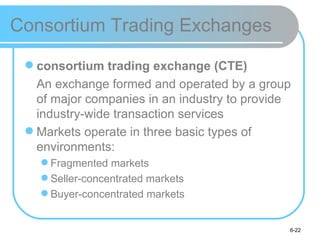
Consortium Trading Exchanges

  consortium trading exchange (CTE)
   An exchange formed and operated by a group
   of major companies in an industry to provide
   industry-wide transaction services
  Markets operate in three basic types of
   environments:
    Fragmented markets
    Seller-concentrated markets
    Buyer-concentrated markets


                                              6-22
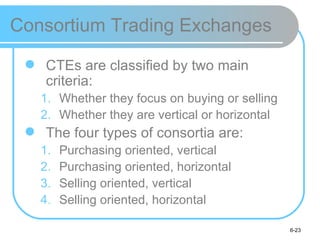
Consortium Trading Exchanges

  CTEs are classified by two main
   criteria:
   1. Whether they focus on buying or selling
   2. Whether they are vertical or horizontal
  The four types of consortia are:
   1.   Purchasing oriented, vertical
   2.   Purchasing oriented, horizontal
   3.   Selling oriented, vertical
   4.   Selling oriented, horizontal

                                                6-23
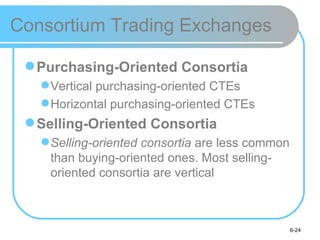
Consortium Trading Exchanges

  Purchasing-Oriented Consortia
    Vertical purchasing-oriented CTEs
    Horizontal purchasing-oriented CTEs
  Selling-Oriented Consortia
    Selling-oriented consortia are less common
     than buying-oriented ones. Most selling-
     oriented consortia are vertical


                                                  6-24
Consortium Trading Exchanges

  Legal Issues for Consortia
    Legal challenges for B2B consortia
    Critical success factors for consortia
       Appropriate business and revenue models
       Size of the industry
       Ability to drive user adoption
       Elasticity
       Standardization of commodity-like products
       Management of intensive information flow
       Smoothing of supply chain inefficiencies
       Harmonized shared objectives


                                                     6-25
Consortium Trading Exchanges

    elasticity
     The measure of the incremental spending
     (demand) by buyers as a result of price
     changing
    Combining consortia and third-party
     exchanges


                                               6-26
Dynamic Trading:
Matching and Auctions
  dynamic trading
   Trading that occurs in situations when
   prices are changing continuously, being
   determined by supply and demand (e.g.,
   in auctions)


                                         6-27
Dynamic Trading:
Matching and Auctions
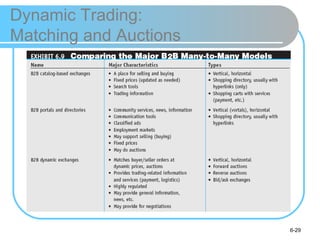
  Matching
    The matching process may be more
     complex than buying and selling in regular
     auctions due to the need to match both
     prices and quantities, and many cases,
     quality, delivery times, and locations
  Auctions
    An exchange may offer auction services as
     one of its many activities
    An exchange is fully dedicated to auctions

                                                  6-28
Dynamic Trading:
Matching and Auctions


                        6-29
Partner and Supplier
Relationship Management
  partner relationship management (PRM)
   Business strategy that focuses on providing
   comprehensive quality service to business
   partners
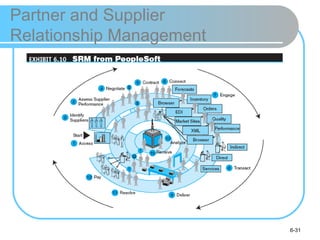
  supplier relationship management (SRM)
   A comprehensive approach to managing an
   enterprise’s interactions with the organizations
   that supply the goods and services it uses


                                                  6-30
Partner and Supplier
Relationship Management


                          6-31
Partner and Supplier
Relationship Management
  E-Communities and PRM
    B2B applications involve many participants: buyers
     and sellers, service providers, industry
     associations, and others, which creates a
     community
    E-communities connect personnel, partners,
     customers, and any combination of the three
    E-communities offer a powerful resource for e-
     businesses to leverage online discussions and
     interaction in order to maximize innovation and
     responsiveness

                                                      6-32
Building and Integrating
E-Marketplaces and Exchanges

   Building E-Marketplaces
   The Integration Issue
     External communications
      Web/client access
      Data exchange
      Direct application integration
      Shared procedures


                                        6-33
Building and Integrating
E-Marketplaces and Exchanges

   The Integration Issue
     Process and information coordination in
      integration
     Use of Web services in integration
     System and information management in
      integration


                                                6-34
B2B Networks
  Company-Centered (Private) Networks
    Provide the infrastructure for e-marketplaces
    Allow suppliers to communicate effectively and efficiently with
     sub-suppliers along several tiers
    Increase the visibility of buyers, sellers, and other partners
     along the supply chain and around the globe
    Operate on a large scale
    Foster collaboration and closer relationships among business
     partners
    Enable industry-wide resource planning
    Provide support services, especially financial ones for the
     benefit of trading partners
    Provide insurance, financial derivatives, and so on to reduce
     risks in certain markets


                                                                   6-35
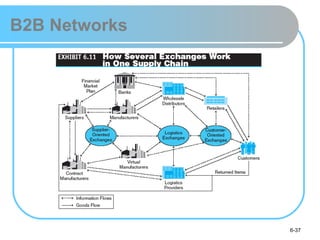
B2B Networks

  Public Industrywide (Vertical)
   Networks
  Transindustry And Global Networks
    Networks of exchanges (E2E)
    Global networks


                                       6-36
B2B Networks


               6-37
Other B2B Implementation Issues

  Private Marketplaces versus Public
   Exchanges
    private marketplaces
    E-marketplaces that are owned and
    operated by one company. Also known as
    company-centric marketplaces


                                             6-38
Other B2B Implementation Issues

  Problems with Public Exchanges
    Transaction fees
    Sharing information
    Cost savings
    Recruiting suppliers
    Too many exchanges
  Supply Chain Improvers
  Problems with Private Exchanges

                                     6-39
Other B2B Implementation Issues

  Software Agents in B2B Exchanges
    Software agents provide an efficient
     infrastructure to provide real-time, tighter
     integration between buyers and sellers and
     to facilitate management of multiple trading
     partners and their transactions across
     multiple virtual industry exchanges
  Disintermediation and
   Reintermediation

                                                    6-40
Managing and the
Future of Exchanges
 Evaluating Exchanges
 Centralized Management
 Critical Success Factors for
  Exchanges
  1.   Early liquidity
  2.   The right owners
  3.   The right governance
  4.   Openness
  5.   A full range of services

                                  6-41
Managing and the
Future of Exchanges
 New Directions for B2B Marketplaces
   Critical success factors for exchanges
      Importance of domain expertise
      Targeting inefficient industry processes
      Targeting the right industries
      Brand building
      Exploiting economies of scope
      Choice of business/revenue models
      Blending content, community, and commerce
      Managing channel conflict
      Maximize the benefits for all participants
      Other factors


                                                    6-42
Managerial Issues

1. Have we done our homework?
2. Can we use the Internet?
3. Which exchange to join?
4. Will joining an exchange force restructuring?
5. Will we face channel conflicts?
6. What are the benefits and risks of joining an
   exchange?
7. Can we trust new trading partners?


                                                   6-43

Done2

  • 1.
    Chapter 6 B2B Exchanges, Directories, and Other Support Services © 2008 Pearson Prentice Hall, Electronic Commerce 2008, Efraim Turban, et al.
  • 2.
    Learning Objectives 1.Define exchanges and describe their major types. 2. Describe the various ownership and revenue models of exchanges. 3. Describe B2B portals. 4. Describe third-party exchanges. 5. Distinguish between purchasing (procurement) and selling consortia. 6-2
  • 3.
    Learning Objectives 1.Define dynamic trading and describe B2B auctions. 2. Describe partner relationship management (PRM). 3. Discuss integration issues of e-marketplaces and exchanges. 4. Discuss B2B networks. 5. Discuss issues in managing exchanges, including the critical success factors of exchanges. 6-3
  • 4.
    B2B Electronic Exchanges— AnOverview  public e-marketplace (public exchange) A many-to-many e-marketplace. Trading venues open to all interested parties (sellers and buyers); usually run by third parties. Some are also known as trading exchanges  market maker The third party that operates an exchange (and in many cases, also owns the exchange) 6-4
  • 5.
  • 6.
  • 7.
    B2B Electronic Exchanges— AnOverview  vertical exchange An exchange whose members are in one industry or industry segment. It trades only in materials/services unique for that industry  horizontal exchange An exchange that handles materials used by companies in different industries 6-7
  • 8.
    B2B Electronic Exchanges— AnOverview  dynamic pricing A rapid movement of prices over time and possibly across customers, as a result of supply and demand matching 6-8
  • 9.
    B2B Electronic Exchanges— AnOverview  The typical process that results in dynamic pricing in most exchanges: 1. A company posts a bid to buy a product or an offer to sell one 2. An auction (forward or reverse) is activated 3. Buyers and sellers can see the bids and offers that usually remain anonymous 4. Buyers and sellers interact with bids and offers in real time Sometimes group purchasing is used to obtain a volume discount price 5. A deal is struck when there is an exact match between a buyer and a seller on price, volume, and other variables, such as location or quality 6. The deal is consummated, and payment and delivery are arranged 6-9
  • 10.
    B2B Electronic Exchanges— AnOverview  Functions of Exchanges  Matching buyers and sellers  Facilitating transactions  Maintaining exchange policies and infrastructure 6-10
  • 11.
    B2B Electronic Exchanges— AnOverview  Ownership of Exchanges  One company, usually an industry giant  A neutral entrepreneur  The consortium (or co-op)  Governance and Organization  Membership  Site access and security  Services provided by exchanges 6-11
  • 12.
    B2B Electronic Exchanges— AnOverview  Advantages of Exchanges  Making markets more efficient, providing opportunities for sellers and buyers to find new business partners  Cutting the administrative costs of ordering MROs  Expediting trading processes  Facilitating global trade  Creating communities of informed buyers and sellers 6-12
  • 13.
  • 14.
  • 15.
    B2B Electronic Exchanges— AnOverview  Revenue Models  Transaction fees  Fee for service  Membership fees  Advertising fees  Other revenue sources 6-15
  • 16.
    B2B Portals andDirectories  B2B portals Information portals for businesses  vortals B2B portals that focus on a single industry or industry segment; “vertical portals” 6-16
  • 17.
    B2B Portals andDirectories  Directory Services and Search Engines  Directory services can help buyers and sellers manage the task of finding specialized products, services, and potential partners  Specialized search engines are becoming a necessity in many industries due to the information glut 6-17
  • 18.
    Third-Party and Directory Exchanges  Third-party exchanges are characterized by two contradicting properties  They are neutral because they do not favor either sellers or buyers  Because they do not have a built-in constituency of sellers or buyers, they sometimes have a problem attracting enough buyers and sellers to attain financial viability 6-18
  • 19.
    Third-Party and Directory Exchanges  market liquidity The degree to which something can be bought or sold in a marketplace without significantly affecting its price. It is determined by the number of buyers and sellers in the market and the transaction volume 6-19
  • 20.
  • 21.
  • 22.
    Consortium Trading Exchanges  consortium trading exchange (CTE) An exchange formed and operated by a group of major companies in an industry to provide industry-wide transaction services  Markets operate in three basic types of environments:  Fragmented markets  Seller-concentrated markets  Buyer-concentrated markets 6-22
  • 23.
    Consortium Trading Exchanges  CTEs are classified by two main criteria: 1. Whether they focus on buying or selling 2. Whether they are vertical or horizontal  The four types of consortia are: 1. Purchasing oriented, vertical 2. Purchasing oriented, horizontal 3. Selling oriented, vertical 4. Selling oriented, horizontal 6-23
  • 24.
    Consortium Trading Exchanges  Purchasing-Oriented Consortia  Vertical purchasing-oriented CTEs  Horizontal purchasing-oriented CTEs  Selling-Oriented Consortia  Selling-oriented consortia are less common than buying-oriented ones. Most selling- oriented consortia are vertical 6-24
  • 25.
    Consortium Trading Exchanges  Legal Issues for Consortia  Legal challenges for B2B consortia  Critical success factors for consortia  Appropriate business and revenue models  Size of the industry  Ability to drive user adoption  Elasticity  Standardization of commodity-like products  Management of intensive information flow  Smoothing of supply chain inefficiencies  Harmonized shared objectives 6-25
  • 26.
    Consortium Trading Exchanges  elasticity The measure of the incremental spending (demand) by buyers as a result of price changing  Combining consortia and third-party exchanges 6-26
  • 27.
    Dynamic Trading: Matching andAuctions  dynamic trading Trading that occurs in situations when prices are changing continuously, being determined by supply and demand (e.g., in auctions) 6-27
  • 28.
    Dynamic Trading: Matching andAuctions  Matching  The matching process may be more complex than buying and selling in regular auctions due to the need to match both prices and quantities, and many cases, quality, delivery times, and locations  Auctions  An exchange may offer auction services as one of its many activities  An exchange is fully dedicated to auctions 6-28
  • 29.
  • 30.
    Partner and Supplier RelationshipManagement  partner relationship management (PRM) Business strategy that focuses on providing comprehensive quality service to business partners  supplier relationship management (SRM) A comprehensive approach to managing an enterprise’s interactions with the organizations that supply the goods and services it uses 6-30
  • 31.
  • 32.
    Partner and Supplier RelationshipManagement  E-Communities and PRM  B2B applications involve many participants: buyers and sellers, service providers, industry associations, and others, which creates a community  E-communities connect personnel, partners, customers, and any combination of the three  E-communities offer a powerful resource for e- businesses to leverage online discussions and interaction in order to maximize innovation and responsiveness 6-32
  • 33.
    Building and Integrating E-Marketplacesand Exchanges  Building E-Marketplaces  The Integration Issue  External communications Web/client access Data exchange Direct application integration Shared procedures 6-33
  • 34.
    Building and Integrating E-Marketplacesand Exchanges  The Integration Issue  Process and information coordination in integration  Use of Web services in integration  System and information management in integration 6-34
  • 35.
    B2B Networks Company-Centered (Private) Networks  Provide the infrastructure for e-marketplaces  Allow suppliers to communicate effectively and efficiently with sub-suppliers along several tiers  Increase the visibility of buyers, sellers, and other partners along the supply chain and around the globe  Operate on a large scale  Foster collaboration and closer relationships among business partners  Enable industry-wide resource planning  Provide support services, especially financial ones for the benefit of trading partners  Provide insurance, financial derivatives, and so on to reduce risks in certain markets 6-35
  • 36.
    B2B Networks Public Industrywide (Vertical) Networks  Transindustry And Global Networks  Networks of exchanges (E2E)  Global networks 6-36
  • 37.
  • 38.
    Other B2B ImplementationIssues  Private Marketplaces versus Public Exchanges  private marketplaces E-marketplaces that are owned and operated by one company. Also known as company-centric marketplaces 6-38
  • 39.
    Other B2B ImplementationIssues  Problems with Public Exchanges  Transaction fees  Sharing information  Cost savings  Recruiting suppliers  Too many exchanges  Supply Chain Improvers  Problems with Private Exchanges 6-39
  • 40.
    Other B2B ImplementationIssues  Software Agents in B2B Exchanges  Software agents provide an efficient infrastructure to provide real-time, tighter integration between buyers and sellers and to facilitate management of multiple trading partners and their transactions across multiple virtual industry exchanges  Disintermediation and Reintermediation 6-40
  • 41.
    Managing and the Futureof Exchanges  Evaluating Exchanges  Centralized Management  Critical Success Factors for Exchanges 1. Early liquidity 2. The right owners 3. The right governance 4. Openness 5. A full range of services 6-41
  • 42.
    Managing and the Futureof Exchanges  New Directions for B2B Marketplaces  Critical success factors for exchanges  Importance of domain expertise  Targeting inefficient industry processes  Targeting the right industries  Brand building  Exploiting economies of scope  Choice of business/revenue models  Blending content, community, and commerce  Managing channel conflict  Maximize the benefits for all participants  Other factors 6-42
  • 43.
    Managerial Issues 1. Havewe done our homework? 2. Can we use the Internet? 3. Which exchange to join? 4. Will joining an exchange force restructuring? 5. Will we face channel conflicts? 6. What are the benefits and risks of joining an exchange? 7. Can we trust new trading partners? 6-43