Bret Sibley
Elizabeth Marconi
Southern Nevada Regional
Professional Development Program
This presentation was adapted from Measured Progress January 2008
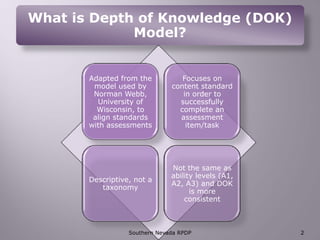
What is Depth of Knowledge (DOK)
Model?
Adapted from the
model used by
Norman Webb,
University of
Wisconsin, to
align standards
with assessments
Focuses on
content standard
in order to
successfully
complete an
assessment
item/task
Descriptive, not a
taxonomy
Not the same as
ability levels (A1,
A2, A3) and DOK
is more
consistent
Southern Nevada RPDP 2
Why Depth of Knowledge?
No Child Left Behind (NCLB) requires
assessments to “measure the depth
and breadth of the state academic
content standards for a given grade
level”
(U.S. Department of Education, 2003, p. 12)
Southern Nevada RPDP 3
Why Depth of Knowledge?
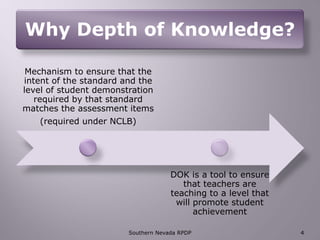
Mechanism to ensure that the
intent of the standard and the
level of student demonstration
required by that standard
matches the assessment items
(required under NCLB)
DOK is a tool to ensure
that teachers are
teaching to a level that
will promote student
achievement
Southern Nevada RPDP 4
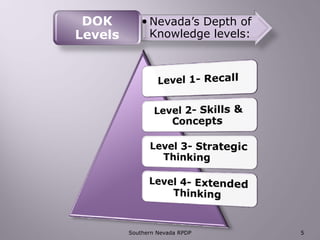
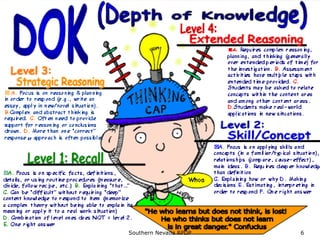
• Nevada’s Depth of
Knowledge levels:
DOK
Levels
Southern Nevada RPDP 5
Southern Nevada RPDP 6
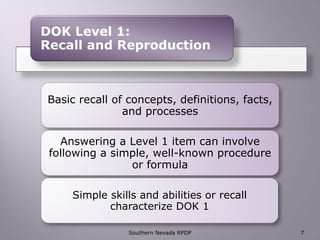
DOK Level 1:
Recall and Reproduction
Basic recall of concepts, definitions, facts,
and processes
Answering a Level 1 item can involve
following a simple, well-known procedure
or formula
Simple skills and abilities or recall
characterize DOK 1
Southern Nevada RPDP 7
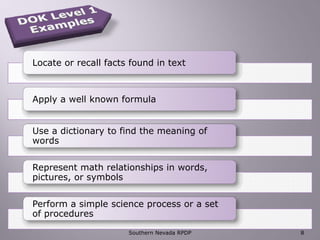
Locate or recall facts found in text
Apply a well known formula
Use a dictionary to find the meaning of
words
Represent math relationships in words,
pictures, or symbols
Perform a simple science process or a set
of procedures
Southern Nevada RPDP 8
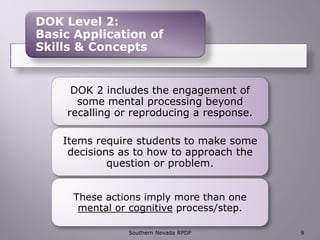
DOK 2 includes the engagement of
some mental processing beyond
recalling or reproducing a response.
Items require students to make some
decisions as to how to approach the
question or problem.
These actions imply more than one
mental or cognitive process/step.
Southern Nevada RPDP 9
DOK Level 2:
Basic Application of
Skills & Concepts
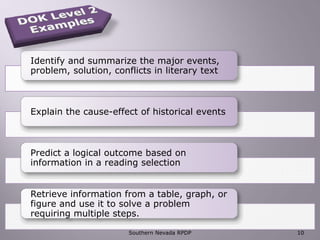
Identify and summarize the major events,
problem, solution, conflicts in literary text
Explain the cause-effect of historical events
Predict a logical outcome based on
information in a reading selection
Retrieve information from a table, graph, or
figure and use it to solve a problem
requiring multiple steps.
Southern Nevada RPDP 10
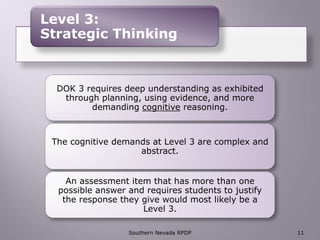
DOK 3 requires deep understanding as exhibited
through planning, using evidence, and more
demanding cognitive reasoning.
The cognitive demands at Level 3 are complex and
abstract.
An assessment item that has more than one
possible answer and requires students to justify
the response they give would most likely be a
Level 3.
Southern Nevada RPDP 11
Level 3:
Strategic Thinking
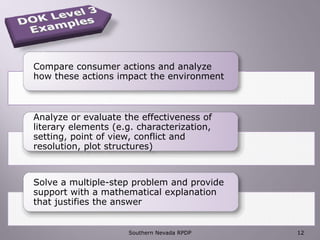
Compare consumer actions and analyze
how these actions impact the environment
Analyze or evaluate the effectiveness of
literary elements (e.g. characterization,
setting, point of view, conflict and
resolution, plot structures)
Solve a multiple-step problem and provide
support with a mathematical explanation
that justifies the answer
Southern Nevada RPDP 12
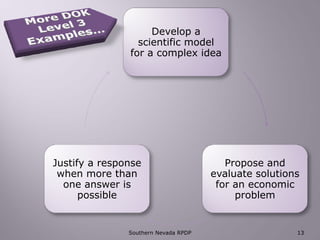
Develop a
scientific model
for a complex idea
Propose and
evaluate solutions
for an economic
problem
Justify a response
when more than
one answer is
possible
Southern Nevada RPDP 13
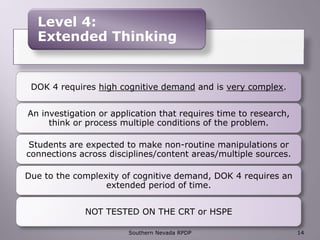
DOK 4 requires high cognitive demand and is very complex.
An investigation or application that requires time to research,
think or process multiple conditions of the problem.
Students are expected to make non-routine manipulations or
connections across disciplines/content areas/multiple sources.
Due to the complexity of cognitive demand, DOK 4 requires an
extended period of time.
NOT TESTED ON THE CRT or HSPE
Southern Nevada RPDP 14
Level 4:
Extended Thinking
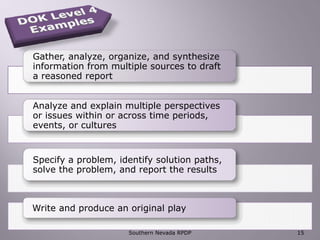
Gather, analyze, organize, and synthesize
information from multiple sources to draft
a reasoned report
Analyze and explain multiple perspectives
or issues within or across time periods,
events, or cultures
Specify a problem, identify solution paths,
solve the problem, and report the results
Write and produce an original play
Southern Nevada RPDP 15
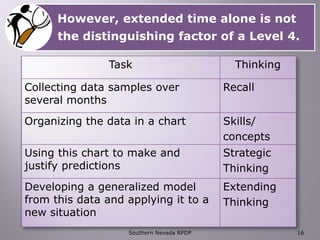
However, extended time alone is not
the distinguishing factor of a Level 4.
Task Thinking
Collecting data samples over
several months
Recall
Organizing the data in a chart Skills/
concepts
Using this chart to make and
justify predictions
Strategic
Thinking
Developing a generalized model
from this data and applying it to a
new situation
Extending
Thinking
Southern Nevada RPDP 16
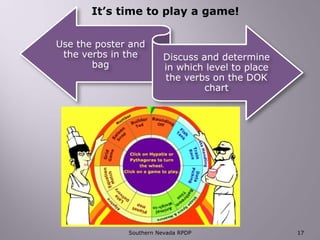
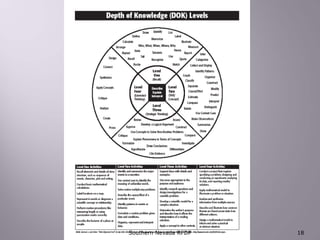
Use the poster and
the verbs in the
bag
Discuss and determine
in which level to place
the verbs on the DOK
chart
Southern Nevada RPDP 17
It’s time to play a game!
Southern Nevada RPDP 18
Is DOK different from
Bloom’s Taxonomy?
The Depth of Knowledge is NOT
determined by the verb, but the context
in which the verb is used and the depth
of thinking required.
Southern Nevada RPDP 19
DOK 3- Describe a model that you might use
to represent the relationships that exist
within the rock cycle. (Requires deep
understanding of rock cycle and a
determination of how best to represent it)
DOK 2- Describe the difference between
metamorphic and igneous rocks. (Requires
cognitive processing to determine the
differences in the two rock types)
DOK 1- Describe three characteristics of
metamorphic rocks. (Simple recall)
Same verb—used at all three DOK levels
Southern Nevada RPDP 20
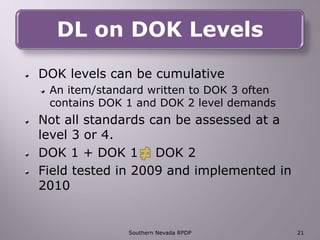
DL on DOK Levels
DOK levels can be cumulative
An item/standard written to DOK 3 often
contains DOK 1 and DOK 2 level demands
Not all standards can be assessed at a
level 3 or 4.
DOK 1 + DOK 1 DOK 2
Field tested in 2009 and implemented in
2010
Southern Nevada RPDP 21
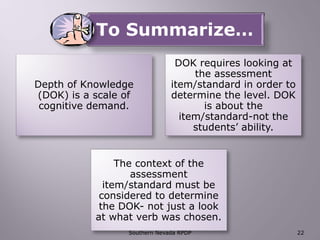
To Summarize…
Depth of Knowledge
(DOK) is a scale of
cognitive demand.
DOK requires looking at
the assessment
item/standard in order to
determine the level. DOK
is about the
item/standard-not the
students’ ability.
The context of the
assessment
item/standard must be
considered to determine
the DOK- not just a look
at what verb was chosen.
Southern Nevada RPDP 22

Dok all levels_presentation

  • 1.
    Bret Sibley Elizabeth Marconi SouthernNevada Regional Professional Development Program This presentation was adapted from Measured Progress January 2008
  • 2.
    What is Depthof Knowledge (DOK) Model? Adapted from the model used by Norman Webb, University of Wisconsin, to align standards with assessments Focuses on content standard in order to successfully complete an assessment item/task Descriptive, not a taxonomy Not the same as ability levels (A1, A2, A3) and DOK is more consistent Southern Nevada RPDP 2
  • 3.
    Why Depth ofKnowledge? No Child Left Behind (NCLB) requires assessments to “measure the depth and breadth of the state academic content standards for a given grade level” (U.S. Department of Education, 2003, p. 12) Southern Nevada RPDP 3
  • 4.
    Why Depth ofKnowledge? Mechanism to ensure that the intent of the standard and the level of student demonstration required by that standard matches the assessment items (required under NCLB) DOK is a tool to ensure that teachers are teaching to a level that will promote student achievement Southern Nevada RPDP 4
  • 5.
    • Nevada’s Depthof Knowledge levels: DOK Levels Southern Nevada RPDP 5
  • 6.
  • 7.
    DOK Level 1: Recalland Reproduction Basic recall of concepts, definitions, facts, and processes Answering a Level 1 item can involve following a simple, well-known procedure or formula Simple skills and abilities or recall characterize DOK 1 Southern Nevada RPDP 7
  • 8.
    Locate or recallfacts found in text Apply a well known formula Use a dictionary to find the meaning of words Represent math relationships in words, pictures, or symbols Perform a simple science process or a set of procedures Southern Nevada RPDP 8
  • 9.
    DOK 2 includesthe engagement of some mental processing beyond recalling or reproducing a response. Items require students to make some decisions as to how to approach the question or problem. These actions imply more than one mental or cognitive process/step. Southern Nevada RPDP 9 DOK Level 2: Basic Application of Skills & Concepts
  • 10.
    Identify and summarizethe major events, problem, solution, conflicts in literary text Explain the cause-effect of historical events Predict a logical outcome based on information in a reading selection Retrieve information from a table, graph, or figure and use it to solve a problem requiring multiple steps. Southern Nevada RPDP 10
  • 11.
    DOK 3 requiresdeep understanding as exhibited through planning, using evidence, and more demanding cognitive reasoning. The cognitive demands at Level 3 are complex and abstract. An assessment item that has more than one possible answer and requires students to justify the response they give would most likely be a Level 3. Southern Nevada RPDP 11 Level 3: Strategic Thinking
  • 12.
    Compare consumer actionsand analyze how these actions impact the environment Analyze or evaluate the effectiveness of literary elements (e.g. characterization, setting, point of view, conflict and resolution, plot structures) Solve a multiple-step problem and provide support with a mathematical explanation that justifies the answer Southern Nevada RPDP 12
  • 13.
    Develop a scientific model fora complex idea Propose and evaluate solutions for an economic problem Justify a response when more than one answer is possible Southern Nevada RPDP 13
  • 14.
    DOK 4 requireshigh cognitive demand and is very complex. An investigation or application that requires time to research, think or process multiple conditions of the problem. Students are expected to make non-routine manipulations or connections across disciplines/content areas/multiple sources. Due to the complexity of cognitive demand, DOK 4 requires an extended period of time. NOT TESTED ON THE CRT or HSPE Southern Nevada RPDP 14 Level 4: Extended Thinking
  • 15.
    Gather, analyze, organize,and synthesize information from multiple sources to draft a reasoned report Analyze and explain multiple perspectives or issues within or across time periods, events, or cultures Specify a problem, identify solution paths, solve the problem, and report the results Write and produce an original play Southern Nevada RPDP 15
  • 16.
    However, extended timealone is not the distinguishing factor of a Level 4. Task Thinking Collecting data samples over several months Recall Organizing the data in a chart Skills/ concepts Using this chart to make and justify predictions Strategic Thinking Developing a generalized model from this data and applying it to a new situation Extending Thinking Southern Nevada RPDP 16
  • 17.
    Use the posterand the verbs in the bag Discuss and determine in which level to place the verbs on the DOK chart Southern Nevada RPDP 17 It’s time to play a game!
  • 18.
  • 19.
    Is DOK differentfrom Bloom’s Taxonomy? The Depth of Knowledge is NOT determined by the verb, but the context in which the verb is used and the depth of thinking required. Southern Nevada RPDP 19
  • 20.
    DOK 3- Describea model that you might use to represent the relationships that exist within the rock cycle. (Requires deep understanding of rock cycle and a determination of how best to represent it) DOK 2- Describe the difference between metamorphic and igneous rocks. (Requires cognitive processing to determine the differences in the two rock types) DOK 1- Describe three characteristics of metamorphic rocks. (Simple recall) Same verb—used at all three DOK levels Southern Nevada RPDP 20
  • 21.
    DL on DOKLevels DOK levels can be cumulative An item/standard written to DOK 3 often contains DOK 1 and DOK 2 level demands Not all standards can be assessed at a level 3 or 4. DOK 1 + DOK 1 DOK 2 Field tested in 2009 and implemented in 2010 Southern Nevada RPDP 21
  • 22.
    To Summarize… Depth ofKnowledge (DOK) is a scale of cognitive demand. DOK requires looking at the assessment item/standard in order to determine the level. DOK is about the item/standard-not the students’ ability. The context of the assessment item/standard must be considered to determine the DOK- not just a look at what verb was chosen. Southern Nevada RPDP 22