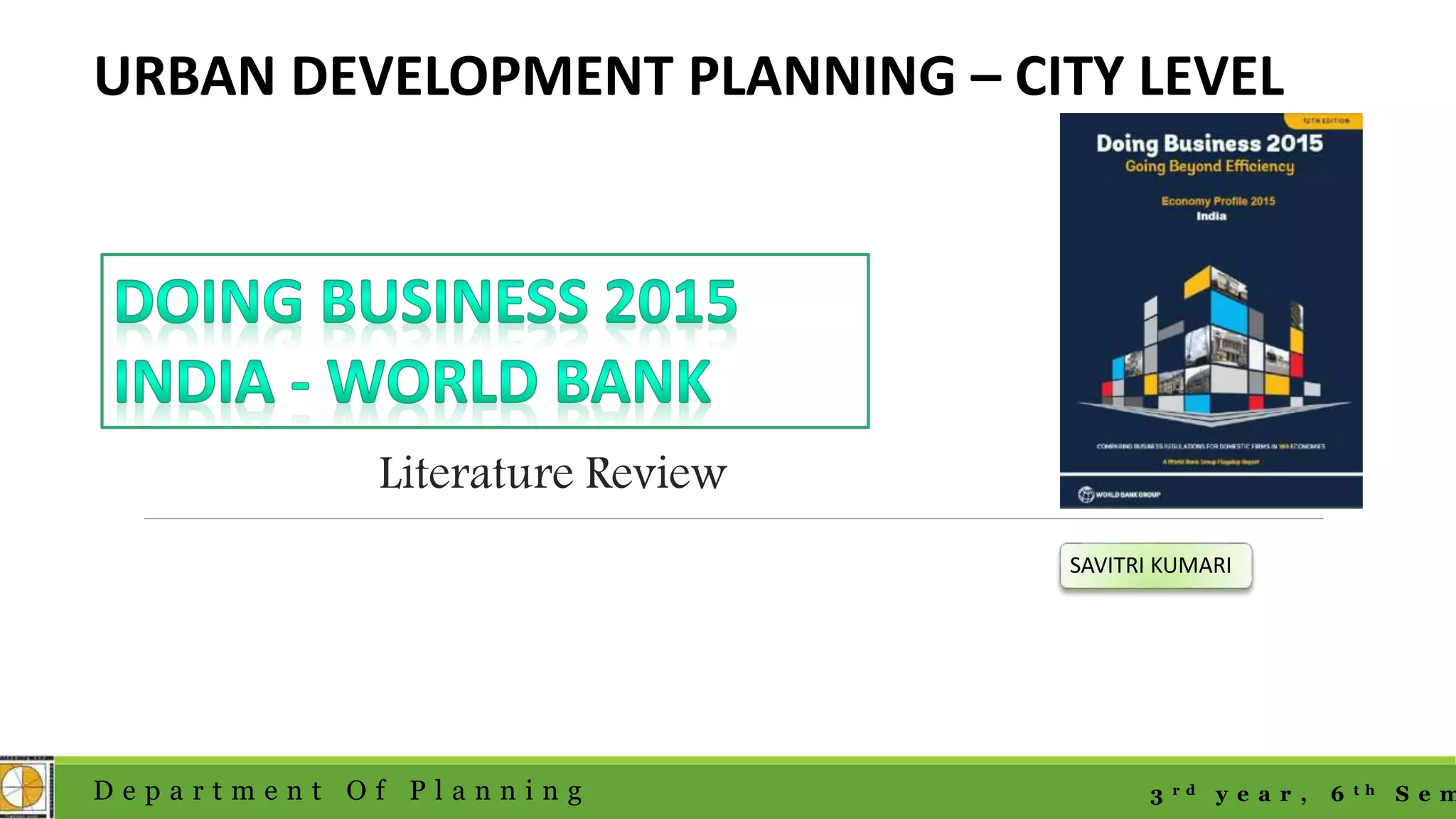
URBAN DEVELOPMENT PLANNING – CITY LEVEL
SAVITRI KUMARI
Literature Review
D e p a r t m e n t O f P l a n n i n g 3 r d y e a r , 6 t h S e m
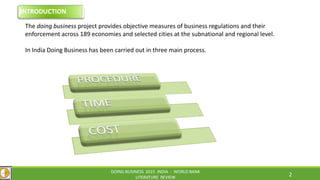
The doing business project provides objective measures of business regulations and their
enforcement across 189 economies and selected cities at the subnational and regional level.
In India Doing Business has been carried out in three main process.
DOING BUSINESS 2015 INDIA - WORLD BANK
LITERATURE REVIEW
2
INTRODUCTION
DOING BUSINESS 2015 INDIA - WORLD BANK
LITERATURE REVIEW
3
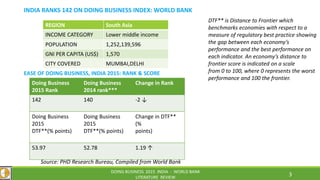
REGION South Asia
INCOME CATEGORY Lower middle income
POPULATION 1,252,139,596
GNI PER CAPITA (US$) 1,570
CITY COVERED MUMBAI,DELHI
INDIA RANKS 142 ON DOING BUSINESS INDEX: WORLD BANK
EASE OF DOING BUSINESS, INDIA 2015: RANK & SCORE
Doing Business
2015 Rank
Doing Business
2014 rank***
Change in Rank
142 140 -2 ↓
Doing Business
2015
DTF**(% points)
Doing Business
2015
DTF**(% points)
Change in DTF**
(%
points)
53.97 52.78 1.19 ↑
DTF** is Distance to Frontier which
benchmarks economies with respect to a
measure of regulatory best practice showing
the gap between each economy’s
performance and the best performance on
each indicator. An economy’s distance to
frontier score is indicated on a scale
from 0 to 100, where 0 represents the worst
performance and 100 the frontier.
Source: PHD Research Bureau, Compiled from World Bank
DOING BUSINESS 2015 INDIA - WORLD BANK
LITERATURE REVIEW
4
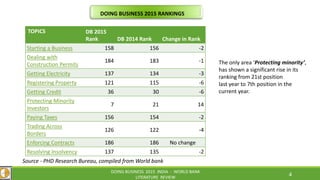
TOPICS DB 2015
Rank DB 2014 Rank Change in Rank
Starting a Business 158 156 -2
Dealing with
Construction Permits
184 183 -1
Getting Electricity 137 134 -3
Registering Property 121 115 -6
Getting Credit 36 30 -6
Protecting Minority
Investors
7 21 14
Paying Taxes 156 154 -2
Trading Across
Borders
126 122 -4
Enforcing Contracts 186 186 No change
Resolving Insolvency 137 135 -2
Source - PHD Research Bureau, compiled from World bank
DOING BUSINESS 2015 RANKINGS
The only area ‘Protecting minority’,
has shown a significant rise in its
ranking from 21st position
last year to 7th position in the
current year.
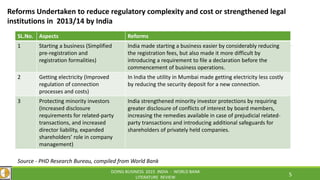
Reforms Undertaken to reduce regulatory complexity and cost or strengthened legal
institutions in 2013/14 by India
DOING BUSINESS 2015 INDIA - WORLD BANK
LITERATURE REVIEW
5
SL.No. Aspects Reforms
1 Starting a business (Simplified
pre-registration and
registration formalities)
India made starting a business easier by considerably reducing
the registration fees, but also made it more difficult by
introducing a requirement to file a declaration before the
commencement of business operations.
2 Getting electricity (Improved
regulation of connection
processes and costs)
In India the utility in Mumbai made getting electricity less costly
by reducing the security deposit for a new connection.
3 Protecting minority investors
(Increased disclosure
requirements for related-party
transactions, and increased
director liability, expanded
shareholders’ role in company
management)
India strengthened minority investor protections by requiring
greater disclosure of conflicts of interest by board members,
increasing the remedies available in case of prejudicial related-
party transactions and introducing additional safeguards for
shareholders of privately held companies.
Source - PHD Research Bureau, compiled from World Bank
DOING BUSINESS 2015 INDIA - WORLD BANK
LITERATURE REVIEW
6
 The indicators are used to analyze economic outcomes and identify what reforms have
worked, where and why.
 Procedures should be simple ,time and cost should be minimised to attract entrepreneur
to the market.
LESSON LEARNT
 An economy’s proximity to large markets,
 The quality of its infrastructure services (other than those related to trading across borders
and getting electricity),
 The security of property from theft and looting,
 The transparency of government procurement,
 Macroeconomic conditions or the underlying strength of Institutions.
LIMITATIONS
DOING BUSINESS 2015 INDIA - WORLD BANK
LITERATURE REVIEW
7
THANK YOU

Doing business literature review

  • 1.
    URBAN DEVELOPMENT PLANNING– CITY LEVEL SAVITRI KUMARI Literature Review D e p a r t m e n t O f P l a n n i n g 3 r d y e a r , 6 t h S e m
  • 2.
    The doing businessproject provides objective measures of business regulations and their enforcement across 189 economies and selected cities at the subnational and regional level. In India Doing Business has been carried out in three main process. DOING BUSINESS 2015 INDIA - WORLD BANK LITERATURE REVIEW 2 INTRODUCTION
  • 3.
    DOING BUSINESS 2015INDIA - WORLD BANK LITERATURE REVIEW 3 REGION South Asia INCOME CATEGORY Lower middle income POPULATION 1,252,139,596 GNI PER CAPITA (US$) 1,570 CITY COVERED MUMBAI,DELHI INDIA RANKS 142 ON DOING BUSINESS INDEX: WORLD BANK EASE OF DOING BUSINESS, INDIA 2015: RANK & SCORE Doing Business 2015 Rank Doing Business 2014 rank*** Change in Rank 142 140 -2 ↓ Doing Business 2015 DTF**(% points) Doing Business 2015 DTF**(% points) Change in DTF** (% points) 53.97 52.78 1.19 ↑ DTF** is Distance to Frontier which benchmarks economies with respect to a measure of regulatory best practice showing the gap between each economy’s performance and the best performance on each indicator. An economy’s distance to frontier score is indicated on a scale from 0 to 100, where 0 represents the worst performance and 100 the frontier. Source: PHD Research Bureau, Compiled from World Bank
  • 4.
    DOING BUSINESS 2015INDIA - WORLD BANK LITERATURE REVIEW 4 TOPICS DB 2015 Rank DB 2014 Rank Change in Rank Starting a Business 158 156 -2 Dealing with Construction Permits 184 183 -1 Getting Electricity 137 134 -3 Registering Property 121 115 -6 Getting Credit 36 30 -6 Protecting Minority Investors 7 21 14 Paying Taxes 156 154 -2 Trading Across Borders 126 122 -4 Enforcing Contracts 186 186 No change Resolving Insolvency 137 135 -2 Source - PHD Research Bureau, compiled from World bank DOING BUSINESS 2015 RANKINGS The only area ‘Protecting minority’, has shown a significant rise in its ranking from 21st position last year to 7th position in the current year.
  • 5.
    Reforms Undertaken toreduce regulatory complexity and cost or strengthened legal institutions in 2013/14 by India DOING BUSINESS 2015 INDIA - WORLD BANK LITERATURE REVIEW 5 SL.No. Aspects Reforms 1 Starting a business (Simplified pre-registration and registration formalities) India made starting a business easier by considerably reducing the registration fees, but also made it more difficult by introducing a requirement to file a declaration before the commencement of business operations. 2 Getting electricity (Improved regulation of connection processes and costs) In India the utility in Mumbai made getting electricity less costly by reducing the security deposit for a new connection. 3 Protecting minority investors (Increased disclosure requirements for related-party transactions, and increased director liability, expanded shareholders’ role in company management) India strengthened minority investor protections by requiring greater disclosure of conflicts of interest by board members, increasing the remedies available in case of prejudicial related- party transactions and introducing additional safeguards for shareholders of privately held companies. Source - PHD Research Bureau, compiled from World Bank
  • 6.
    DOING BUSINESS 2015INDIA - WORLD BANK LITERATURE REVIEW 6  The indicators are used to analyze economic outcomes and identify what reforms have worked, where and why.  Procedures should be simple ,time and cost should be minimised to attract entrepreneur to the market. LESSON LEARNT  An economy’s proximity to large markets,  The quality of its infrastructure services (other than those related to trading across borders and getting electricity),  The security of property from theft and looting,  The transparency of government procurement,  Macroeconomic conditions or the underlying strength of Institutions. LIMITATIONS
  • 7.
    DOING BUSINESS 2015INDIA - WORLD BANK LITERATURE REVIEW 7 THANK YOU