The Literal Rule
• By the literal rule, words in a statute must be
given their plain, ordinary or literal meaning.
• The objective of the court is to discover the
intention of Parliament as expressed in the
words used.
• This approach will be used even if it produces
absurdity or hardship, in which case the remedy
is for Parliament to pass an amending statute.
• One of the leading statements of the literal rule
was made by Tindal CJ in the Sussex Peerage Case
(1844) 11 Cl&Fin 85
“… the only rule for the construction of Acts of
Parliament is, that they should be construed
according to the intent of the Parliament which
passed the Act.
If the words of the statute are in themselves
precise and unambiguous, then no more can be
necessary than to expound those words in their
natural and ordinary sense. The words
themselves alone do, in such case, best declare
the intention of the lawgiver.”
• Lord Esof in R v Judge of the City [1892] 1 QB
273 said:
• “If the words of an Act are clear then you
must follow them even though they lead to a
manifest absurdity. The court has nothing to
do with the question whether the legislature
has committed an absurdity.”
Cutter v Eagle Star Insurance Co. Ltd
[1998] 4 All ER 417, House of Lords
Facts
• In the case Mr C, the Claimant, was injured in
a car.
• The Defendant’s insurance only covered him
under the Road Traffic Act 1988 for the use of
his car ‘on any highway and any other road to
which the public has access’.
Issue
• The question for the court to determine,
therefore, was whether the multi-storey car
park was a road?
Held
• The HL held that the car park was not a road
because a road provides for cars to move
along it to a destination.
• Therefore, the insurance company was not
liable to pay out on the driver’s policy because
the claimant had not been injured due to the
use of the car on a “road”.
Inland Revenue Commissioners v
Hinchy (1960) aka Tax penalty case
Issue
• Concerned the construction of s.25 (3) of the
Income Tax Act 1952
• The Act stated that anyone convicted should
be subject to a fixed penalty and treble the tax
which he ought to have been charged under
the Act
• The Court had to decide whether the amount
should be based on the whole amount that
was liable under the statute of just the unpaid
amount
• The Court decided that on the literal rule he
was liable to pay the whole amount, even
though this was a harsh decision
Midland Trust Co Ltd v Green [1981] 1
All ER 153 aka Green hill case
Facts:
• In 1961 Mr. Walter Green(Father) granted an
option to purchase Gravel Hill farm to his son
Geoffrey Green(Son). The option, although
registrable as a land charge under the Land
Charges Act 1925, was not registered.
• In 1967 there was a disagreement in the family
and Mr. Walter (Father) sold the farm to his wife
for £500 (it was worth around £40,000) in a
deliberate attempt to defeat the option granted to
his son.
• The wife then changed her will so as to leave the
farm to all five of her children including Mr.
Geoffrey.
• Geoffrey learnt of the sale and sought to enforce
the option.
Issue
• The question for the court was whether the
option was binding on the wife or whether she
took the farm free of the option.
Provision
• S 13 (2) of the Land Charges Act 1925 provided
that a land charge would be void against a
purchaser of the land unless registered and
where an estate contract was under
consideration it would only be void against a
purchaser of a legal estate for money or money’s
worth.
• Purchaser was also defined in s.20(8) as a
purchaser who for valuable consideration takes
any interest in land.
• The trial judge found for the wife and held that
the option was not binding on the wife
• This was reversed by the Court of Appeal with
Lord Denning holding that the sale was not for
money or money’s worth and that the protection
of the Act was not available in cases of fraud
where there was a deliberate attempt to defeat
an interest.
• The wife’s representative appealed to the House
of Lords.
Held
• Lord Wilberforce stated that the decision of
Lord Dennings as 'muddying clear waters'.
• Delivering a unanimous reversal of the Court
of Appeal's majority decision, he said:
'Thus the case appears to be a plain one . . . In
my opinion this appearance is also the
reality. The case is plain; the Act is clear and
definite. Intended as it was to provide a
simple and understandable system for the
protection of title to land, it should not be
read down or glossed; to do so would destroy
the usefulness of the Act.'
• The appeal was allowed. There was no
requirement of good faith for a purchaser
under the Land Charges Act 1925.
• The options should have been registered
under the Land Charges Act 1972
• Good faith was irrelevant to the Land Charges
Act 1972.
Whiteley v Chappell (1868) LR 4 QB
147 aka Dead person case
Facts:
• Defendant was arrested for impersonating a
dead person in order to cast an extra vote
Provision:
• A statute aimed at preventing election rigging
made it an offence to impersonate “…any
person entitled to vote” at an election.
Issue:
• Was he guilty or not guilty of casting an extra
vote?
Held
• He was found not guilty as dead people are
clearly not entitled to vote!
London and North Eastern Railway
v Berriman [1946] AC 278
Facts
• A railway worker was knocked down and killed
by a train whilst oiling parts of the line. His
wife was trying to claim compensation for his
death.
Provision
• The relevant statute said that compensation
was available for workers who were ‘..killed
whilst repairing the line…’
Issue
• Whether the widow is entitled for the
compensation.
• The court held that in the ordinary sense of
the word, ‘repairing’ did not include oiling as
this was merely maintenance.
Maqbool Hussain v. St of Bom.(AIR
1953 SC325) aka Gold Confiscated
case
Facts
• A citizen of India, on arrival at an airport did
not declare that he had bought gold with him.
• Gold found in his possession during search in
violation of govt. notification, was confiscated
u/s.167(8) of Sea Customs Act, 1878.
• The appellant could be proceeded against under
section 167(8) of the Sea Customs Act as also
under section 23 of the Foreign Exchange
Regulation Act in respect of the said act.
• Proceedings were in fact taken under section
167(8) of the Sea Customs Act which resulted in
the confiscation of the gold.
• Further proceedings were taken under section 23
of the Foreign Exchange Regulation Act by way of
filing the complaint aforesaid in the Court of the
Chief Presidency Magistrate, Bombay.
Issue
• whether by reason of the proceedings taken by
the Sea, Custom Authorities the appellant could
be said to have been prosecuted and punished
for the same offence with which he was charged
in the Court of the Chief Presidency Magistrate,
Bombay.
• The plea which was taken by the accused in bar
of the prosecution in the Court of the Chief
Presidency Magistrate, was that he had already
been prosecuted and punished for the same
offence and by virtue of the provisions of article
20(2) of the Constitution he could not be
prosecuted and punished again.
Held
• The Customs Officers are not required to act judicially
on legal evidence tendered on oath and they are not
authorised to administer oath to any witness.
• Sea Customs Authorities are merely constituted
administrative machinery for the purpose of adjudging
confiscation, increased rates of duty and penalty
prescribed in the Act.
• We are of the opinion that the Sea Customs Authorities
are not a judicial tribunal and the adjudging of
confiscation, increased rate of duty or penalty under
the provisions of the Sea Customs Act do not constitute
a judgment or order of a court or judicial tribunal
necessary for the purpose of supporting a plea of
double jeopardy.
Shriram v. St. of Mah.(AIR 1961 SC
674) aka Witness Case
Facts
• The Magistrate framed charges against the
appellant on the basis of documents produced
before him.
• The Magistrate did not examine any eye
witness cited by the prosecution.
• The session court convicted the appellant and
the HC confirmed the conviction.
Issue
• Now the appellant urges the SC that the act of
Magistrate committing him for trail was illegal because
the Mag. had not examined the eye-witness as was
required u/s.207-A(4) of CrPC.
Provision
• 207-A(4)- The Magistrate shall then proceed to take
the evidence of such persons, if any, as may be
produced by the prosecution as witnesses to the
actual commission of the offence alleged, and if the
Magistrate is of opinion that it is necessary in the
interests of justice to take the evidence of any one or
more of the other witnesses for the prosecution, he
may take such evidence also.
Held
• SC rejected the argument and held that the
use of the word shall imposes a duty on the
Mag. but that duty is limited to the witnesses
produced by the prosecution .
Motipur Zamindary Company Pvt. Ltd.
V. St of Bihar (AIR 1962 SC 660)
Facts
• Green vegetable are exempted of the sales
tax within Bihar Sales Tax Act, 1947
Issue
• Whether sugarcane fall within the term green
vegetable?
Held:
• That sugar cane was not a green vegetable
and was not exempted under the notification.
• The word "vegetables" in taxing statutes was
to be understood as in common parlance i.e.
denoting class of vegetables which were
grown in a kitchen garden or in a farm and
were used for the table.
• The dictionaries defined sugar cane as a
"grass."
State Of West Bengal & Ors vs Washi
Ahmed
(AIR 1977 SC 1638)
• Whether Green ginger is a vegetable?
• The Sales Tax Authorities levied sales tax on
"green ginger" sold by the respondents, taking
the view that green ginger is used to add
flavour and taste to food.
Held:
• Green ginger is included. within the meaning
of the words "vegetables---commonly known
as subji, tarkari- or sak."
Advantages Disadvantages
Respects Parliamentary Supremacy and
leaves law making to those elected to the
job
There can be disagreement as to what
amounts to the ordinary or natural
meaning
Provides no scope for judges to use their
own opinions or prejudices
Creates awkward precedents which
require Parliamentary time to correct
Restricts the role of judges to applying the
law to the facts of the case
Fails to recognise the complexities and
limitations of English language and
assumes every Act is perfectly drafted
Undermines public confidence in the law
Creates loopholes in the law
Leads to injustice
• The Facial Whiskers (Fictitious) Act 2010
states that:
“Men with beards and moustaches are prohibited
from being in the park”
Pandey has been arrested in the park, is he guilty of
the offence?
Pandey
What about Gorra
Veerapan?
What about
Imtiaz?
• What about Mr.Jon?
• Under the Animal Registration (Fictitious) Act
1987 it is a requirement that “…all domestic
animals are registered with the local animal
authority.”
• Consider the following and whether they need
to be registered:
Domestic Animal:
a relatively docile animal kept by humans for
work or food or as a pet.
Dempsey aka Pitt Bull Case
The Dangerious Dogs Act ,1991,
• It is illegal to own any Specially Controlled Dogs
without specific exemption from a court.
• The dogs have to be muzzled and kept on a lead in
public, they must be registered and insured, neutered,
tattooed and receive microchip implants.
• The Act also bans the breeding, sale and exchange of
these dogs, even if they are on the Index of Exempted
Dogs.
• Four types in particular were identified by the Act:
– Pit Bull Terrier
– Japanese Tosa
– Dogo Argentino
– Fila Brasileiro
Pit Bull Terrier
Fila Brasileiro
Dogo Argentino
Japanese Tosa
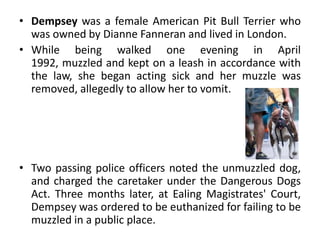
• Dempsey was a female American Pit Bull Terrier who
was owned by Dianne Fanneran and lived in London.
• While being walked one evening in April
1992, muzzled and kept on a leash in accordance with
the law, she began acting sick and her muzzle was
removed, allegedly to allow her to vomit.
• Two passing police officers noted the unmuzzled dog,
and charged the caretaker under the Dangerous Dogs
Act. Three months later, at Ealing Magistrates' Court,
Dempsey was ordered to be euthanized for failing to be
muzzled in a public place.
• Appeals took three years before the Crown
Court, the High Court and the House of Lords,
during which time the media covered the story,
leading activist Brigitte Bardot offered the dog
sanctuary at her home in France, to avoid British
law.
• The case was dismissed in November 1995 on
a legal technicality, as it emerged that Dempsey's
owner, not involved in the original incident, was
unaware the court hearing was taking place. This
legal loophole meant the case was thrown out.
• Dempsey was reprieved, and died at the age of
17 in 2003.

Literal rule

  • 1.
  • 2.
    • By theliteral rule, words in a statute must be given their plain, ordinary or literal meaning. • The objective of the court is to discover the intention of Parliament as expressed in the words used. • This approach will be used even if it produces absurdity or hardship, in which case the remedy is for Parliament to pass an amending statute.
  • 3.
    • One ofthe leading statements of the literal rule was made by Tindal CJ in the Sussex Peerage Case (1844) 11 Cl&Fin 85 “… the only rule for the construction of Acts of Parliament is, that they should be construed according to the intent of the Parliament which passed the Act. If the words of the statute are in themselves precise and unambiguous, then no more can be necessary than to expound those words in their natural and ordinary sense. The words themselves alone do, in such case, best declare the intention of the lawgiver.”
  • 4.
    • Lord Esofin R v Judge of the City [1892] 1 QB 273 said: • “If the words of an Act are clear then you must follow them even though they lead to a manifest absurdity. The court has nothing to do with the question whether the legislature has committed an absurdity.”
  • 5.
    Cutter v EagleStar Insurance Co. Ltd [1998] 4 All ER 417, House of Lords
  • 6.
    Facts • In thecase Mr C, the Claimant, was injured in a car. • The Defendant’s insurance only covered him under the Road Traffic Act 1988 for the use of his car ‘on any highway and any other road to which the public has access’. Issue • The question for the court to determine, therefore, was whether the multi-storey car park was a road?
  • 7.
    Held • The HLheld that the car park was not a road because a road provides for cars to move along it to a destination. • Therefore, the insurance company was not liable to pay out on the driver’s policy because the claimant had not been injured due to the use of the car on a “road”.
  • 8.
    Inland Revenue Commissionersv Hinchy (1960) aka Tax penalty case
  • 9.
    Issue • Concerned theconstruction of s.25 (3) of the Income Tax Act 1952 • The Act stated that anyone convicted should be subject to a fixed penalty and treble the tax which he ought to have been charged under the Act • The Court had to decide whether the amount should be based on the whole amount that was liable under the statute of just the unpaid amount
  • 10.
    • The Courtdecided that on the literal rule he was liable to pay the whole amount, even though this was a harsh decision
  • 11.
    Midland Trust CoLtd v Green [1981] 1 All ER 153 aka Green hill case
  • 12.
    Facts: • In 1961Mr. Walter Green(Father) granted an option to purchase Gravel Hill farm to his son Geoffrey Green(Son). The option, although registrable as a land charge under the Land Charges Act 1925, was not registered. • In 1967 there was a disagreement in the family and Mr. Walter (Father) sold the farm to his wife for £500 (it was worth around £40,000) in a deliberate attempt to defeat the option granted to his son. • The wife then changed her will so as to leave the farm to all five of her children including Mr. Geoffrey. • Geoffrey learnt of the sale and sought to enforce the option.
  • 13.
    Issue • The questionfor the court was whether the option was binding on the wife or whether she took the farm free of the option. Provision • S 13 (2) of the Land Charges Act 1925 provided that a land charge would be void against a purchaser of the land unless registered and where an estate contract was under consideration it would only be void against a purchaser of a legal estate for money or money’s worth. • Purchaser was also defined in s.20(8) as a purchaser who for valuable consideration takes any interest in land.
  • 14.
    • The trialjudge found for the wife and held that the option was not binding on the wife • This was reversed by the Court of Appeal with Lord Denning holding that the sale was not for money or money’s worth and that the protection of the Act was not available in cases of fraud where there was a deliberate attempt to defeat an interest. • The wife’s representative appealed to the House of Lords.
  • 15.
    Held • Lord Wilberforcestated that the decision of Lord Dennings as 'muddying clear waters'. • Delivering a unanimous reversal of the Court of Appeal's majority decision, he said: 'Thus the case appears to be a plain one . . . In my opinion this appearance is also the reality. The case is plain; the Act is clear and definite. Intended as it was to provide a simple and understandable system for the protection of title to land, it should not be read down or glossed; to do so would destroy the usefulness of the Act.'
  • 16.
    • The appealwas allowed. There was no requirement of good faith for a purchaser under the Land Charges Act 1925. • The options should have been registered under the Land Charges Act 1972 • Good faith was irrelevant to the Land Charges Act 1972.
  • 17.
    Whiteley v Chappell(1868) LR 4 QB 147 aka Dead person case
  • 18.
    Facts: • Defendant wasarrested for impersonating a dead person in order to cast an extra vote Provision: • A statute aimed at preventing election rigging made it an offence to impersonate “…any person entitled to vote” at an election. Issue: • Was he guilty or not guilty of casting an extra vote?
  • 19.
    Held • He wasfound not guilty as dead people are clearly not entitled to vote!
  • 20.
    London and NorthEastern Railway v Berriman [1946] AC 278
  • 21.
    Facts • A railwayworker was knocked down and killed by a train whilst oiling parts of the line. His wife was trying to claim compensation for his death. Provision • The relevant statute said that compensation was available for workers who were ‘..killed whilst repairing the line…’ Issue • Whether the widow is entitled for the compensation.
  • 22.
    • The courtheld that in the ordinary sense of the word, ‘repairing’ did not include oiling as this was merely maintenance.
  • 23.
    Maqbool Hussain v.St of Bom.(AIR 1953 SC325) aka Gold Confiscated case
  • 24.
    Facts • A citizenof India, on arrival at an airport did not declare that he had bought gold with him. • Gold found in his possession during search in violation of govt. notification, was confiscated u/s.167(8) of Sea Customs Act, 1878.
  • 25.
    • The appellantcould be proceeded against under section 167(8) of the Sea Customs Act as also under section 23 of the Foreign Exchange Regulation Act in respect of the said act. • Proceedings were in fact taken under section 167(8) of the Sea Customs Act which resulted in the confiscation of the gold. • Further proceedings were taken under section 23 of the Foreign Exchange Regulation Act by way of filing the complaint aforesaid in the Court of the Chief Presidency Magistrate, Bombay.
  • 26.
    Issue • whether byreason of the proceedings taken by the Sea, Custom Authorities the appellant could be said to have been prosecuted and punished for the same offence with which he was charged in the Court of the Chief Presidency Magistrate, Bombay. • The plea which was taken by the accused in bar of the prosecution in the Court of the Chief Presidency Magistrate, was that he had already been prosecuted and punished for the same offence and by virtue of the provisions of article 20(2) of the Constitution he could not be prosecuted and punished again.
  • 27.
    Held • The CustomsOfficers are not required to act judicially on legal evidence tendered on oath and they are not authorised to administer oath to any witness. • Sea Customs Authorities are merely constituted administrative machinery for the purpose of adjudging confiscation, increased rates of duty and penalty prescribed in the Act. • We are of the opinion that the Sea Customs Authorities are not a judicial tribunal and the adjudging of confiscation, increased rate of duty or penalty under the provisions of the Sea Customs Act do not constitute a judgment or order of a court or judicial tribunal necessary for the purpose of supporting a plea of double jeopardy.
  • 28.
    Shriram v. St.of Mah.(AIR 1961 SC 674) aka Witness Case
  • 29.
    Facts • The Magistrateframed charges against the appellant on the basis of documents produced before him. • The Magistrate did not examine any eye witness cited by the prosecution. • The session court convicted the appellant and the HC confirmed the conviction.
  • 30.
    Issue • Now theappellant urges the SC that the act of Magistrate committing him for trail was illegal because the Mag. had not examined the eye-witness as was required u/s.207-A(4) of CrPC. Provision • 207-A(4)- The Magistrate shall then proceed to take the evidence of such persons, if any, as may be produced by the prosecution as witnesses to the actual commission of the offence alleged, and if the Magistrate is of opinion that it is necessary in the interests of justice to take the evidence of any one or more of the other witnesses for the prosecution, he may take such evidence also.
  • 31.
    Held • SC rejectedthe argument and held that the use of the word shall imposes a duty on the Mag. but that duty is limited to the witnesses produced by the prosecution .
  • 32.
    Motipur Zamindary CompanyPvt. Ltd. V. St of Bihar (AIR 1962 SC 660)
  • 33.
    Facts • Green vegetableare exempted of the sales tax within Bihar Sales Tax Act, 1947 Issue • Whether sugarcane fall within the term green vegetable?
  • 34.
    Held: • That sugarcane was not a green vegetable and was not exempted under the notification. • The word "vegetables" in taxing statutes was to be understood as in common parlance i.e. denoting class of vegetables which were grown in a kitchen garden or in a farm and were used for the table. • The dictionaries defined sugar cane as a "grass."
  • 35.
    State Of WestBengal & Ors vs Washi Ahmed (AIR 1977 SC 1638)
  • 36.
    • Whether Greenginger is a vegetable? • The Sales Tax Authorities levied sales tax on "green ginger" sold by the respondents, taking the view that green ginger is used to add flavour and taste to food.
  • 37.
    Held: • Green gingeris included. within the meaning of the words "vegetables---commonly known as subji, tarkari- or sak."
  • 38.
    Advantages Disadvantages Respects ParliamentarySupremacy and leaves law making to those elected to the job There can be disagreement as to what amounts to the ordinary or natural meaning Provides no scope for judges to use their own opinions or prejudices Creates awkward precedents which require Parliamentary time to correct Restricts the role of judges to applying the law to the facts of the case Fails to recognise the complexities and limitations of English language and assumes every Act is perfectly drafted Undermines public confidence in the law Creates loopholes in the law Leads to injustice
  • 40.
    • The FacialWhiskers (Fictitious) Act 2010 states that: “Men with beards and moustaches are prohibited from being in the park” Pandey has been arrested in the park, is he guilty of the offence? Pandey What about Gorra Veerapan? What about Imtiaz?
  • 41.
  • 42.
    • Under theAnimal Registration (Fictitious) Act 1987 it is a requirement that “…all domestic animals are registered with the local animal authority.” • Consider the following and whether they need to be registered:
  • 43.
    Domestic Animal: a relativelydocile animal kept by humans for work or food or as a pet.
  • 44.
  • 45.
    The Dangerious DogsAct ,1991, • It is illegal to own any Specially Controlled Dogs without specific exemption from a court. • The dogs have to be muzzled and kept on a lead in public, they must be registered and insured, neutered, tattooed and receive microchip implants. • The Act also bans the breeding, sale and exchange of these dogs, even if they are on the Index of Exempted Dogs. • Four types in particular were identified by the Act: – Pit Bull Terrier – Japanese Tosa – Dogo Argentino – Fila Brasileiro
  • 46.
    Pit Bull Terrier FilaBrasileiro Dogo Argentino Japanese Tosa
  • 47.
    • Dempsey wasa female American Pit Bull Terrier who was owned by Dianne Fanneran and lived in London. • While being walked one evening in April 1992, muzzled and kept on a leash in accordance with the law, she began acting sick and her muzzle was removed, allegedly to allow her to vomit. • Two passing police officers noted the unmuzzled dog, and charged the caretaker under the Dangerous Dogs Act. Three months later, at Ealing Magistrates' Court, Dempsey was ordered to be euthanized for failing to be muzzled in a public place.
  • 48.
    • Appeals tookthree years before the Crown Court, the High Court and the House of Lords, during which time the media covered the story, leading activist Brigitte Bardot offered the dog sanctuary at her home in France, to avoid British law. • The case was dismissed in November 1995 on a legal technicality, as it emerged that Dempsey's owner, not involved in the original incident, was unaware the court hearing was taking place. This legal loophole meant the case was thrown out. • Dempsey was reprieved, and died at the age of 17 in 2003.