1
Tél : +33 (0)1 58 56 10 00
Fax : +33 (0)1 58 56 10 01
www.octo.com© OCTO 2013
50, avenue des Champs-Elysées
75008 Paris - FRANCE
PaaS Interoperability
Thomas Lacroix
&
Ludovic Piot
2
Agenda
CONTEXT AND PROJECT1
CLOUD COMPUTING AND PAAS2
STANDARDIZATION4
INTEROPERABILITY, PORTABILITY3
TECHNOLOGIES5
CAMP2DOCKER6
3
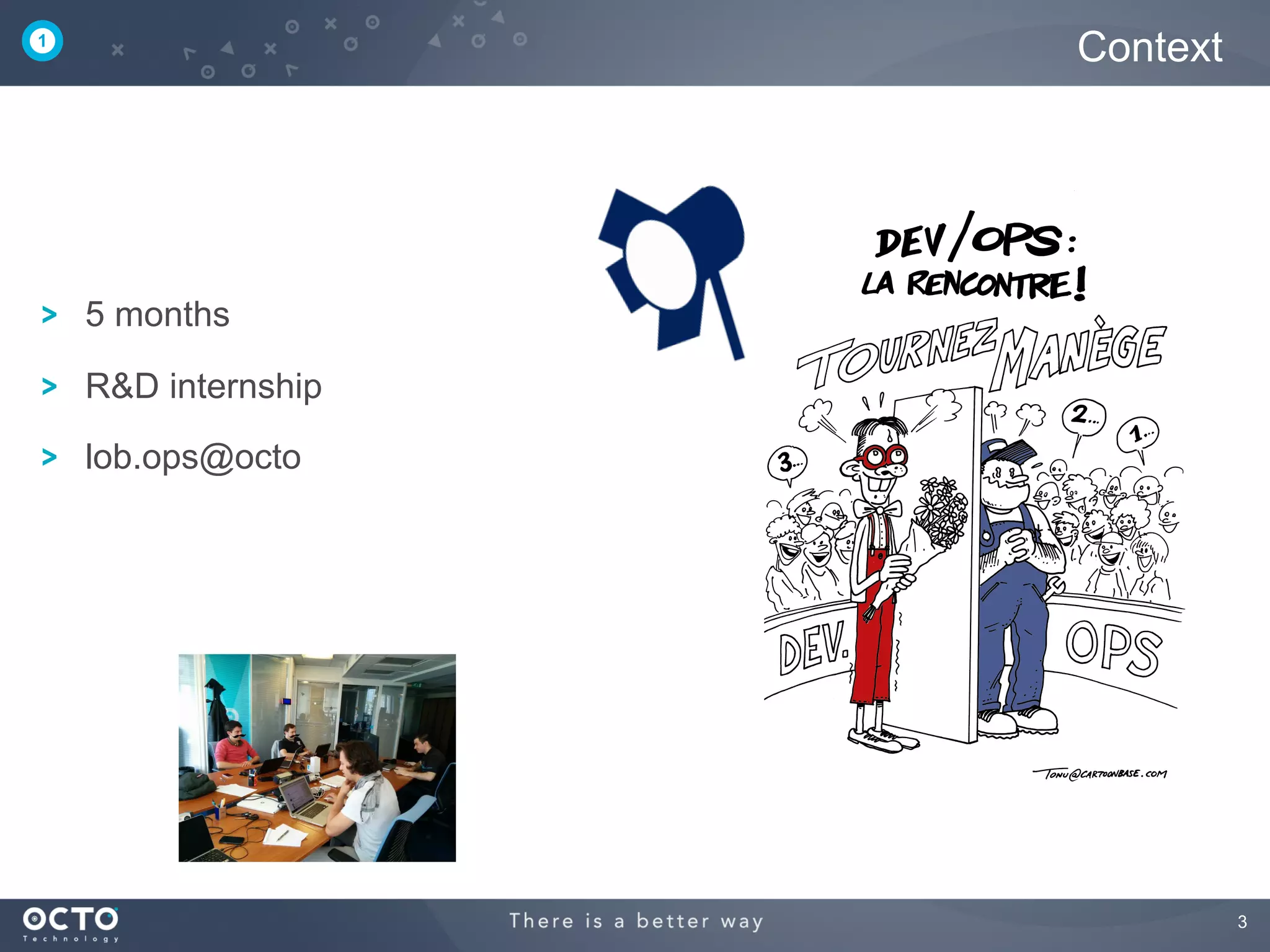
5 months
R&D internship
lob.ops@octo
Context1
4
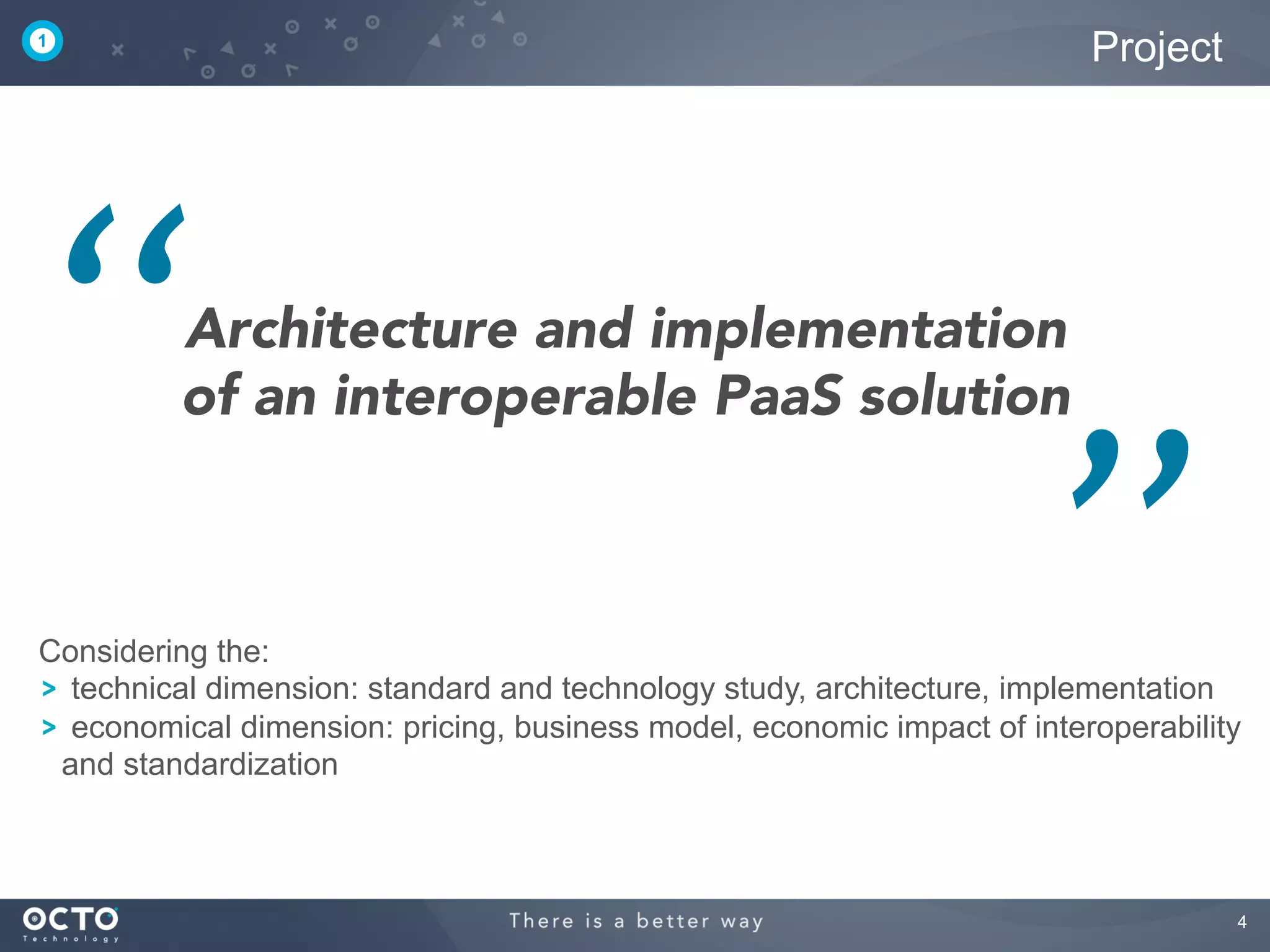
Architecture and implementation
of an interoperable PaaS solution
Project
‘‘
’’Considering the:
  technical dimension: standard and technology study, architecture, implementation
  economical dimension: pricing, business model, economic impact of interoperability
and standardization
1
5
Cloud computing1 2
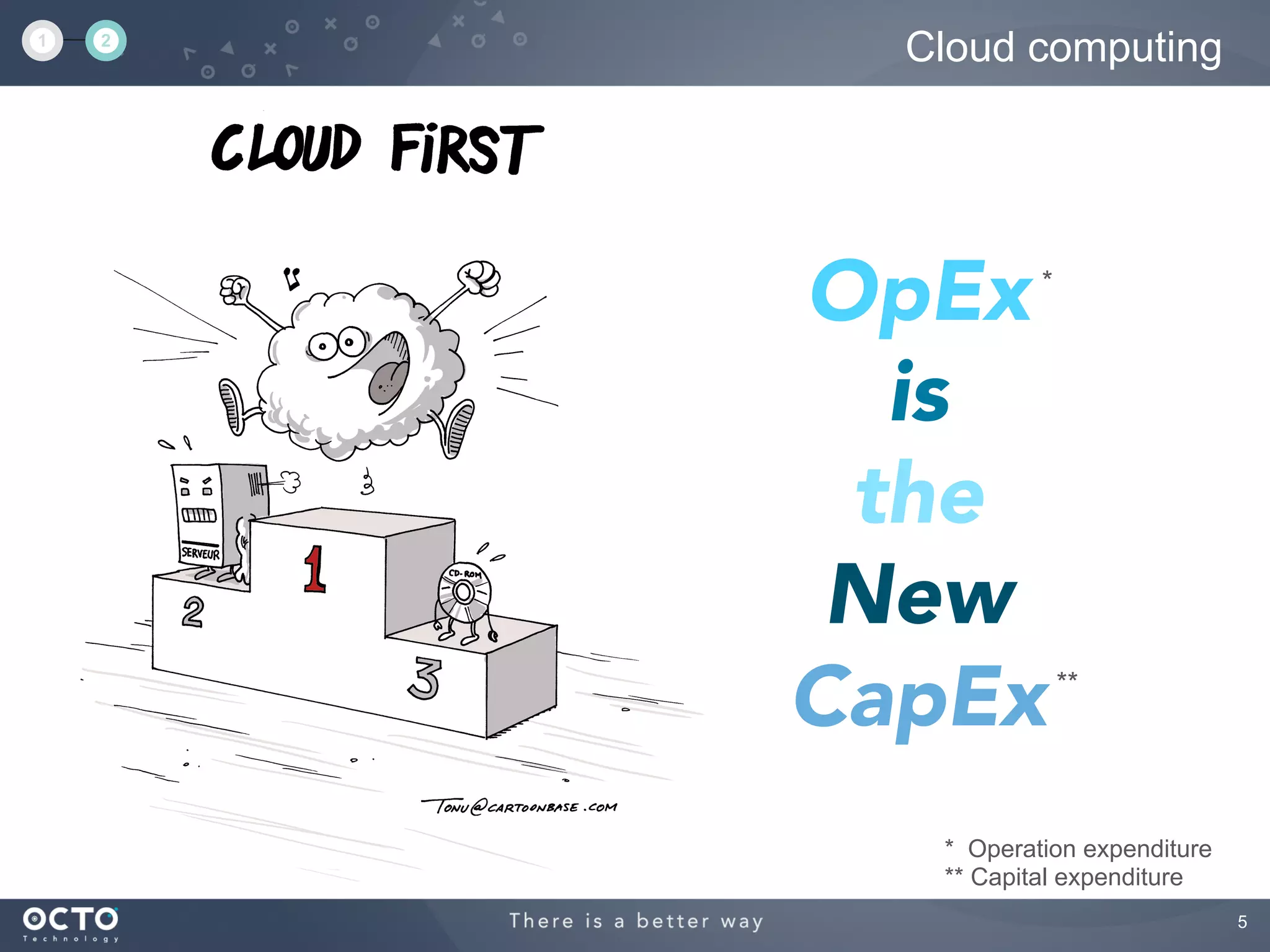
OpEx
is
the
New
CapEx
* Operation expenditure
** Capital expenditure
*
**
6
Definition1 2
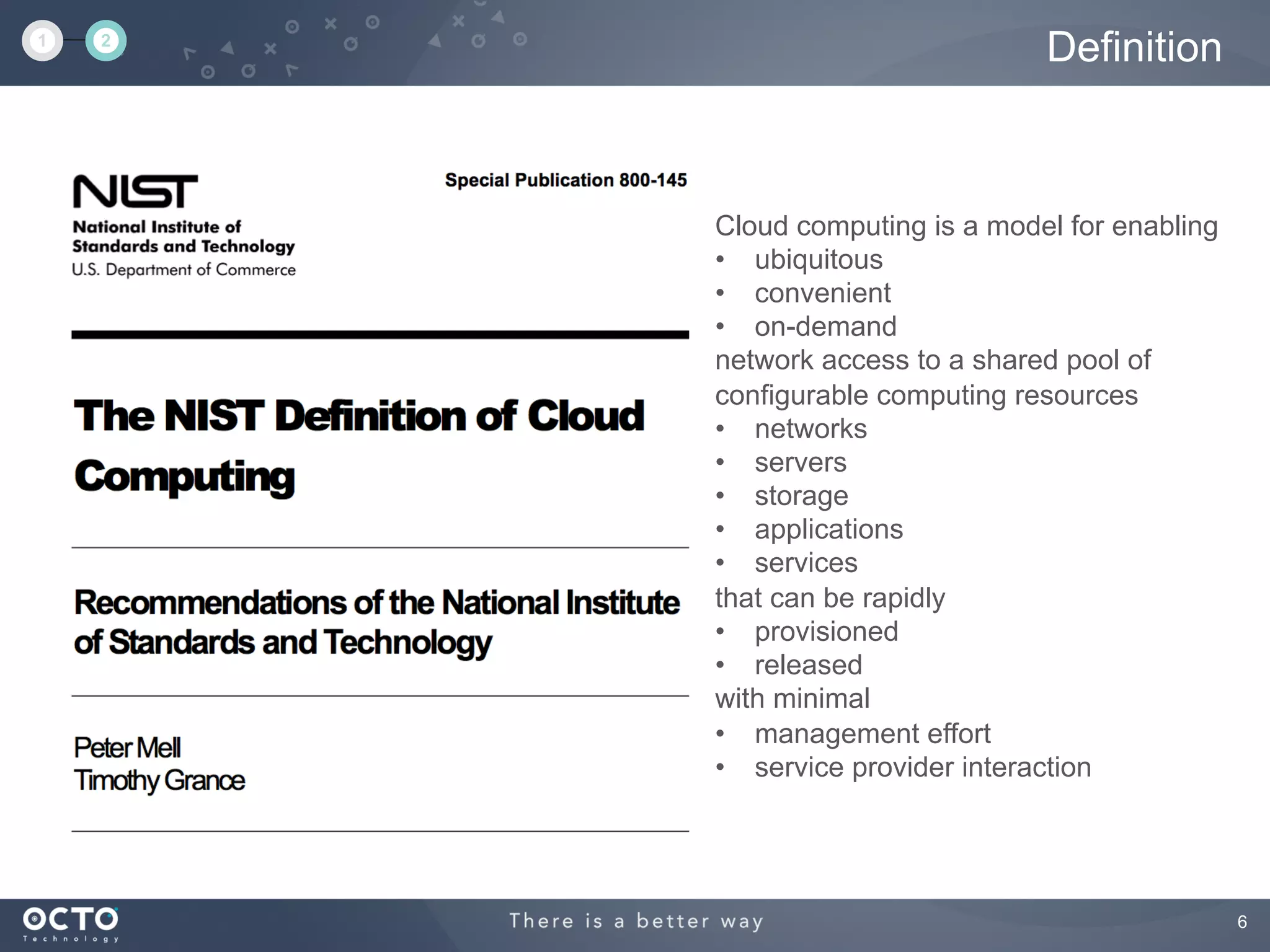
Cloud computing is a model for enabling
•  ubiquitous
•  convenient
•  on-demand
network access to a shared pool of
configurable computing resources
•  networks
•  servers
•  storage
•  applications
•  services
that can be rapidly
•  provisioned
•  released
with minimal
•  management effort
•  service provider interaction
7
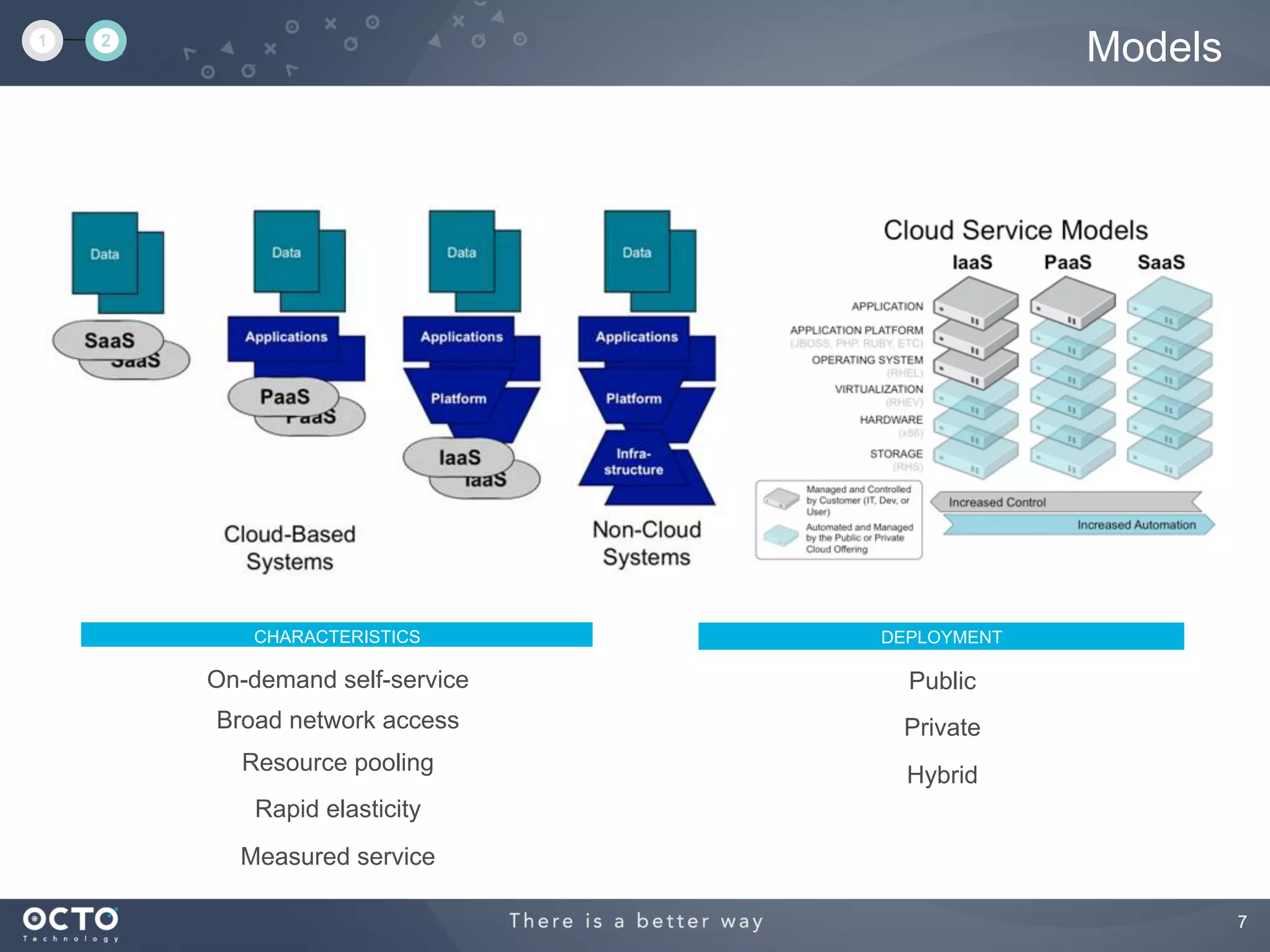
Models
CHARACTERISTICS
Public
Private
Hybrid
DEPLOYMENT
1 2
On-demand self-service
Broad network access
Resource pooling
Rapid elasticity
Measured service
8
PaaS
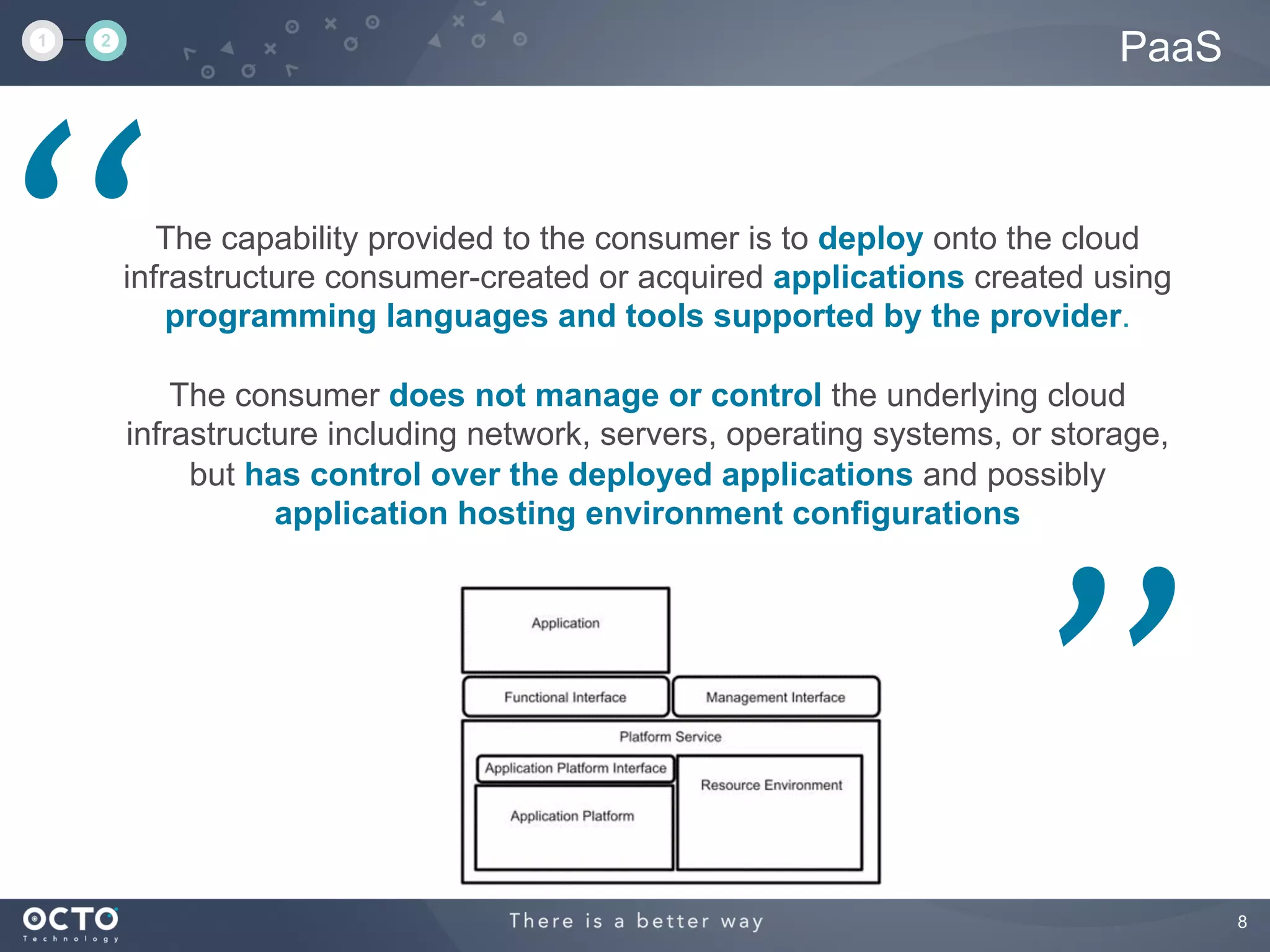
The capability provided to the consumer is to deploy onto the cloud
infrastructure consumer-created or acquired applications created using
programming languages and tools supported by the provider.
The consumer does not manage or control the underlying cloud
infrastructure including network, servers, operating systems, or storage,
but has control over the deployed applications and possibly
application hosting environment configurations
‘‘
’’
1 2
9
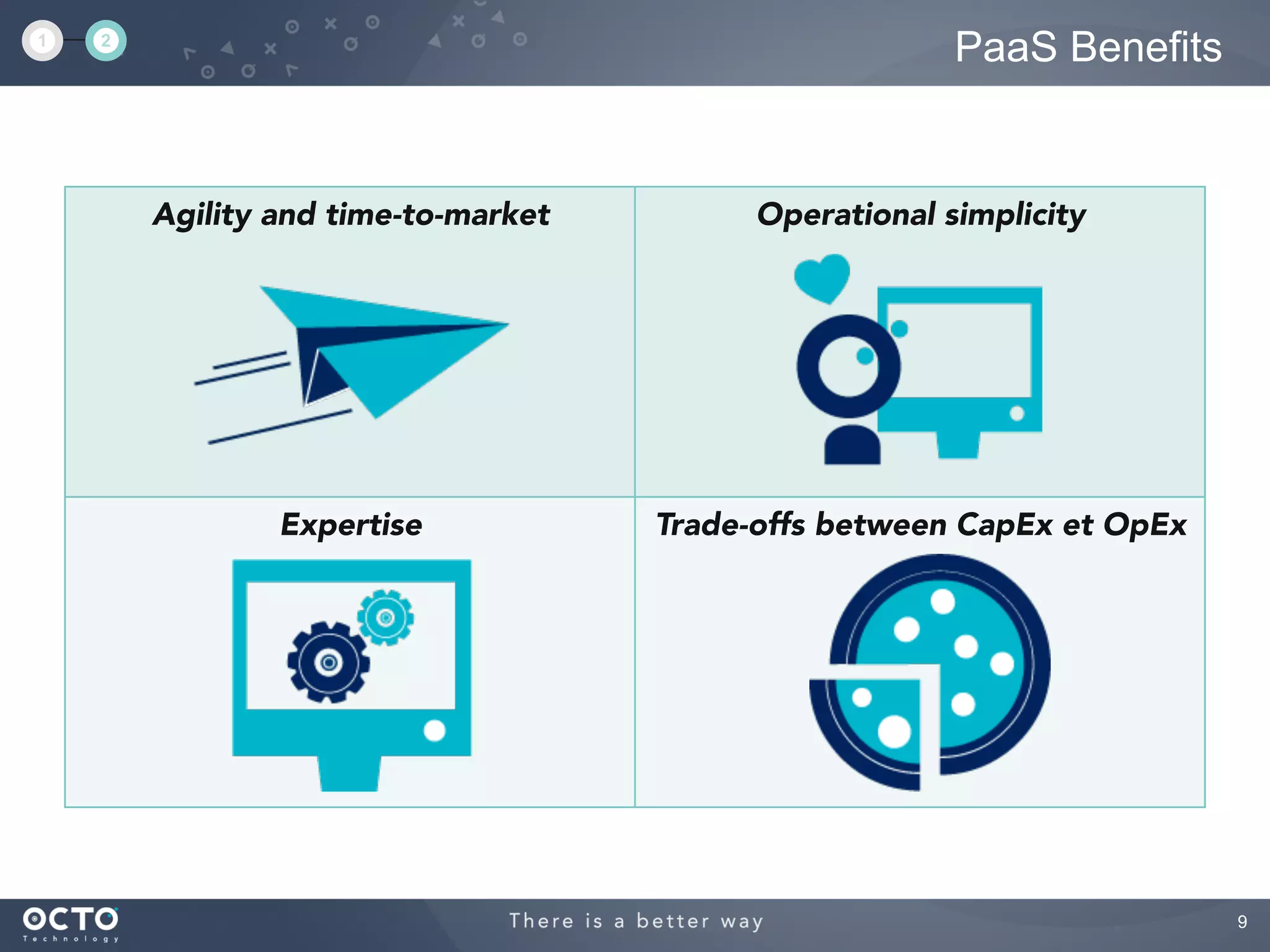
Agility and time-to-market Operational simplicity
Expertise Trade-offs between CapEx et OpEx
PaaS Benefits1 2
10
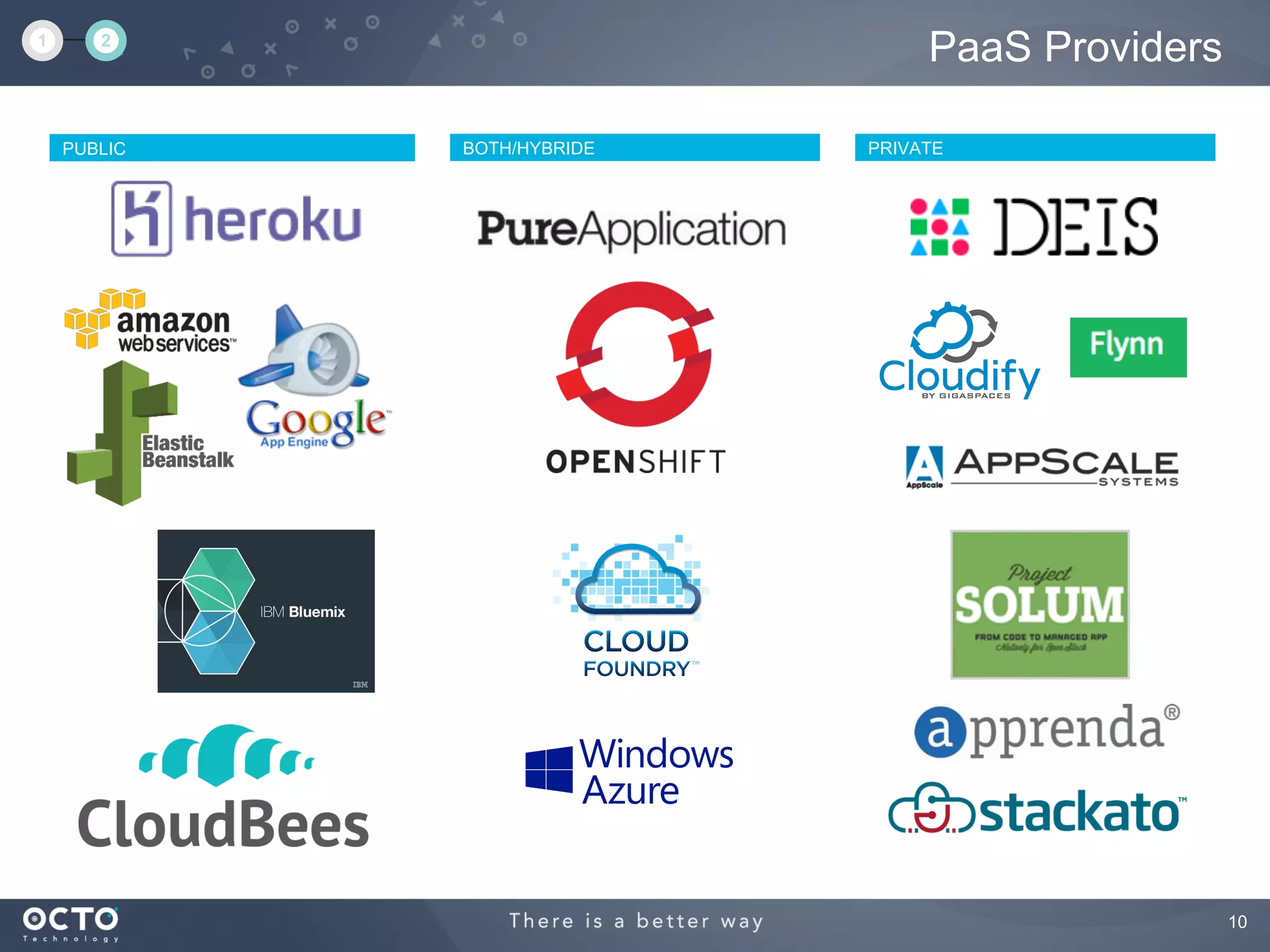
PaaS Providers
PUBLIC BOTH/HYBRIDE PRIVATE
1 2
11
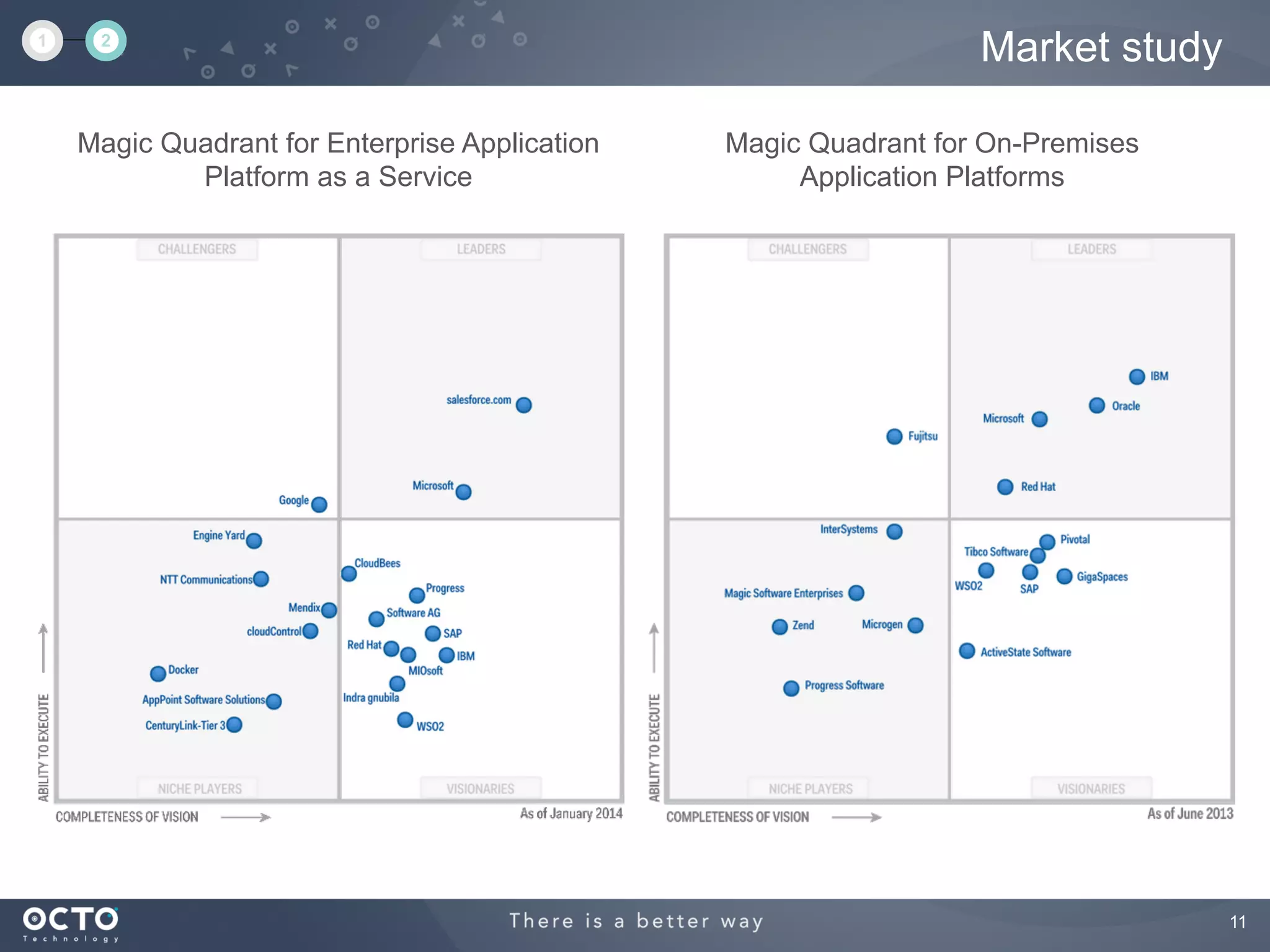
Market study
Magic Quadrant for Enterprise Application
Platform as a Service
Magic Quadrant for On-Premises
Application Platforms
1 2
12
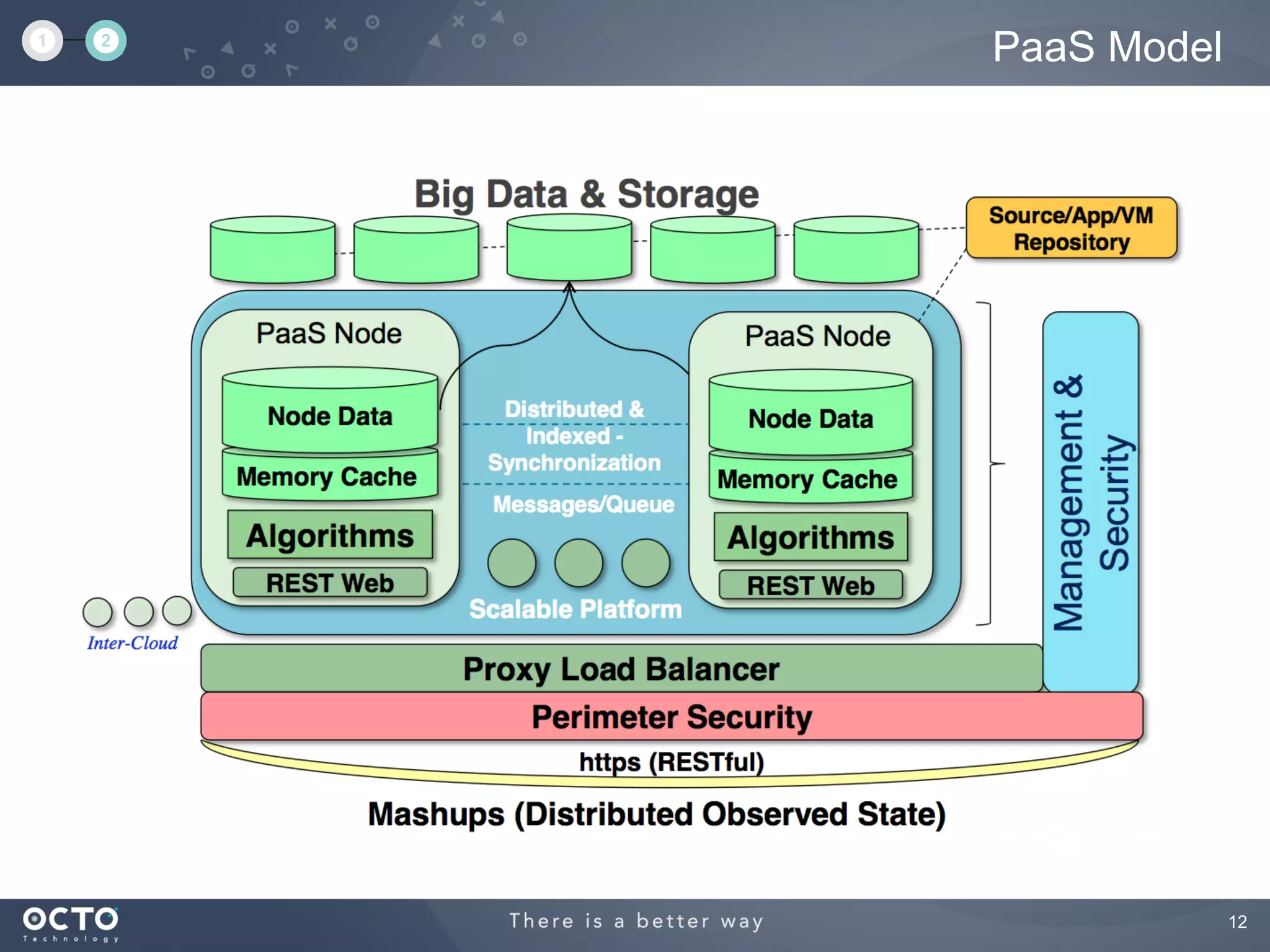
PaaS Model1 2
13
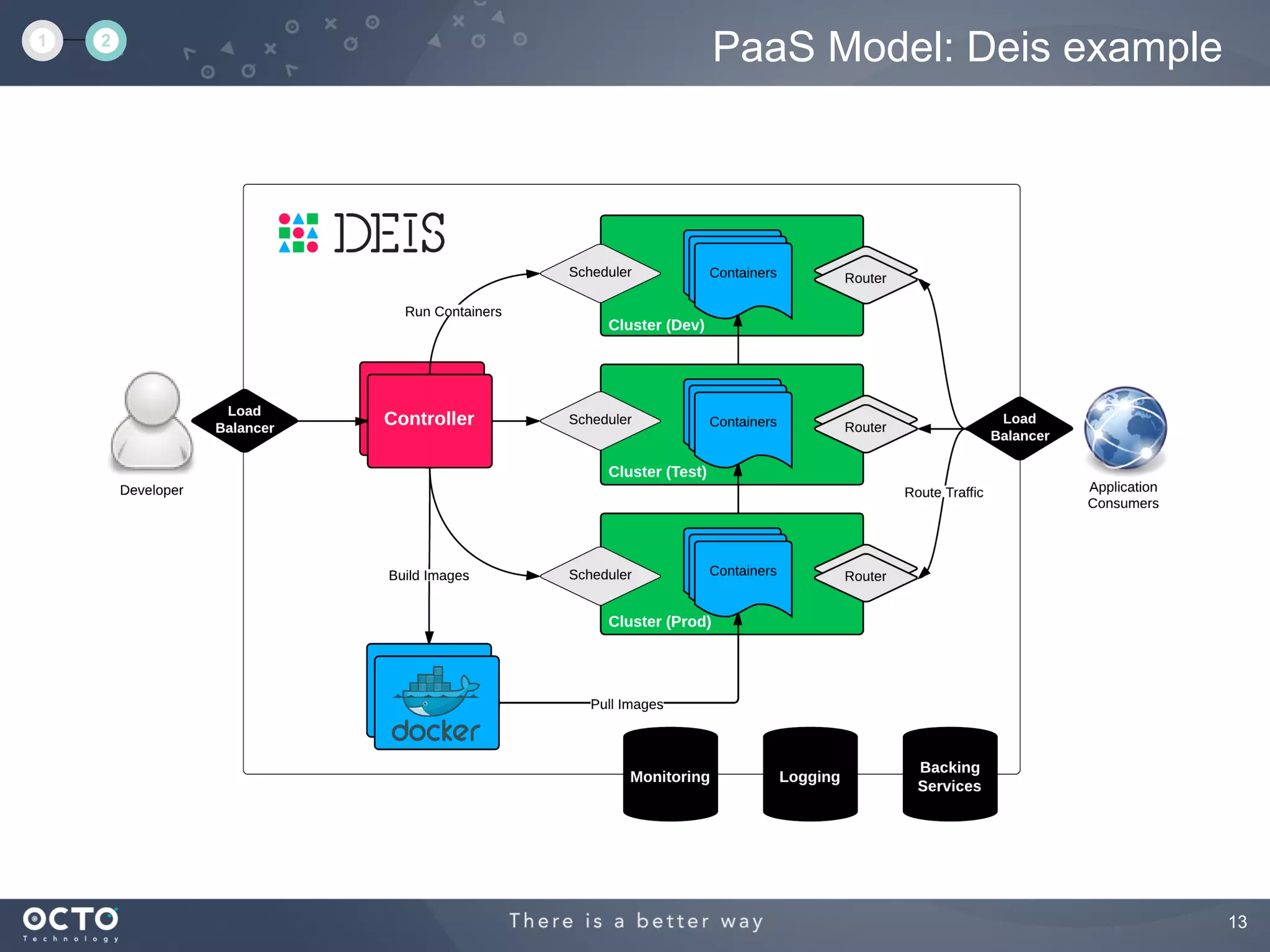
PaaS Model: Deis example1 2
14
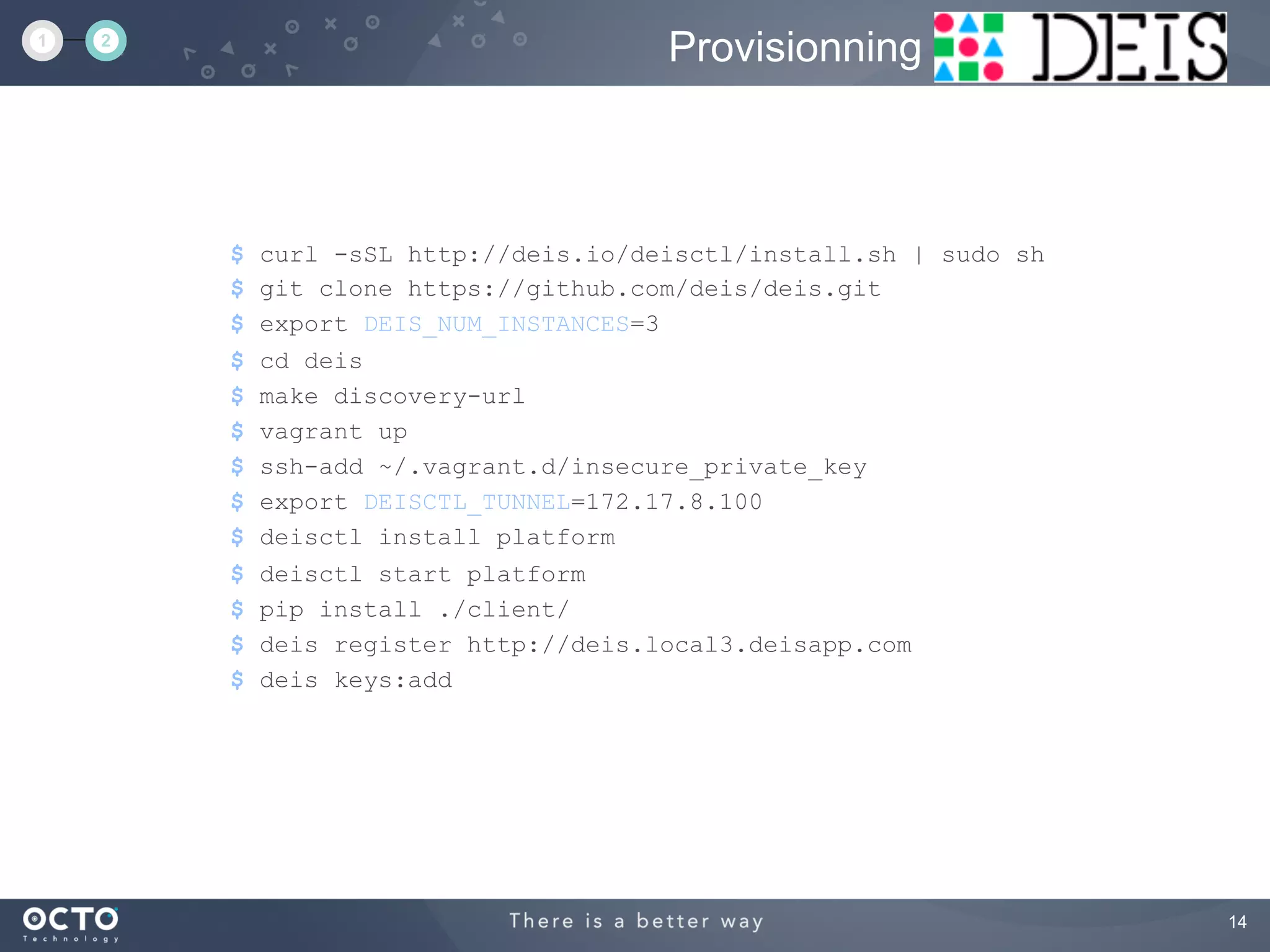
$ curl -sSL http://deis.io/deisctl/install.sh | sudo sh
$ git clone https://github.com/deis/deis.git
$ export DEIS_NUM_INSTANCES=3
$ cd deis
$ make discovery-url
$ vagrant up
$ ssh-add ~/.vagrant.d/insecure_private_key
$ export DEISCTL_TUNNEL=172.17.8.100
$ deisctl install platform
$ deisctl start platform
$ pip install ./client/
$ deis register http://deis.local3.deisapp.com
$ deis keys:add
Provisionning1 2
15
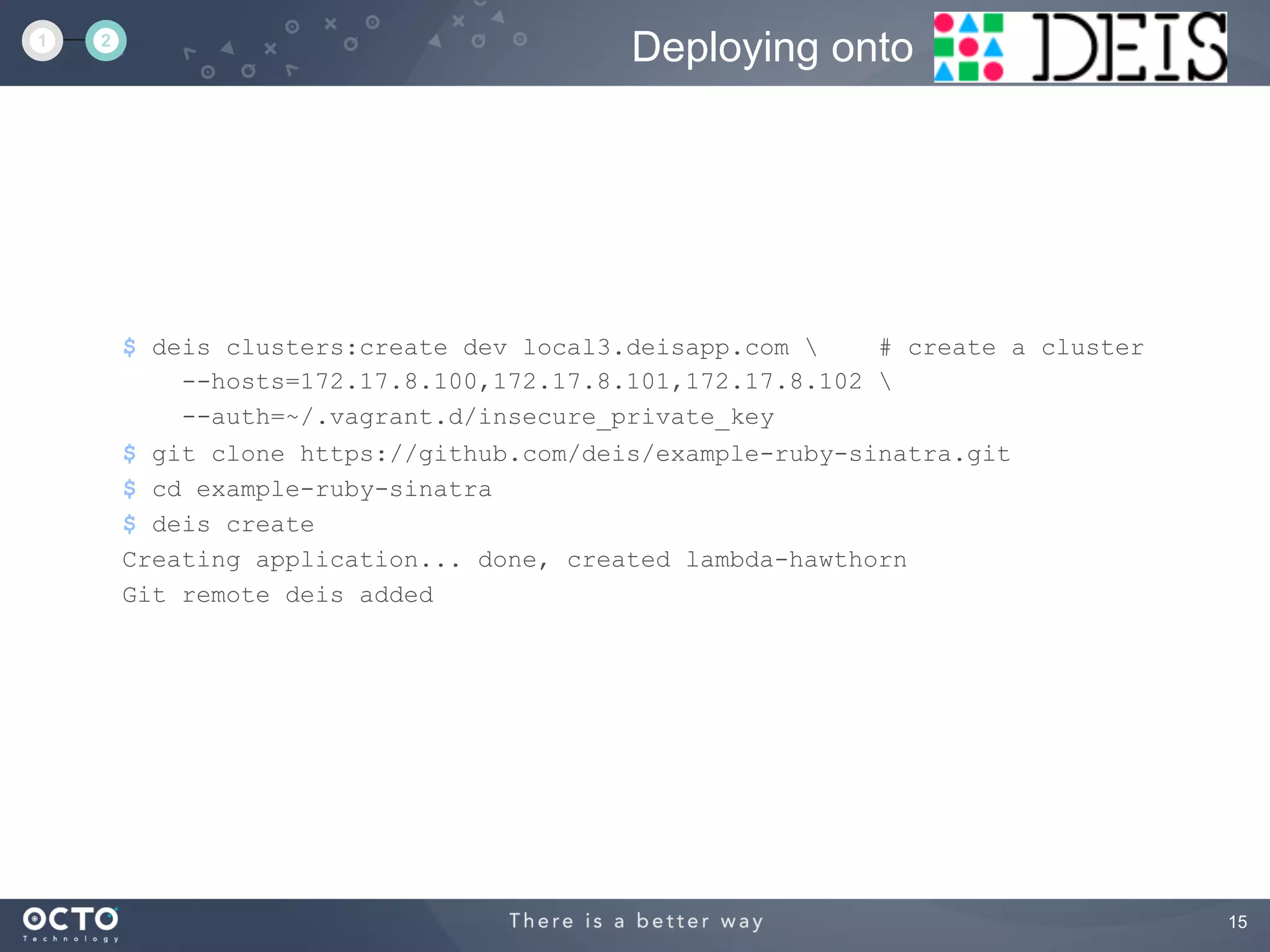
$ deis clusters:create dev local3.deisapp.com  # create a cluster
--hosts=172.17.8.100,172.17.8.101,172.17.8.102 
--auth=~/.vagrant.d/insecure_private_key
$ git clone https://github.com/deis/example-ruby-sinatra.git
$ cd example-ruby-sinatra
$ deis create
Creating application... done, created lambda-hawthorn
Git remote deis added
Deploying onto1 2
16
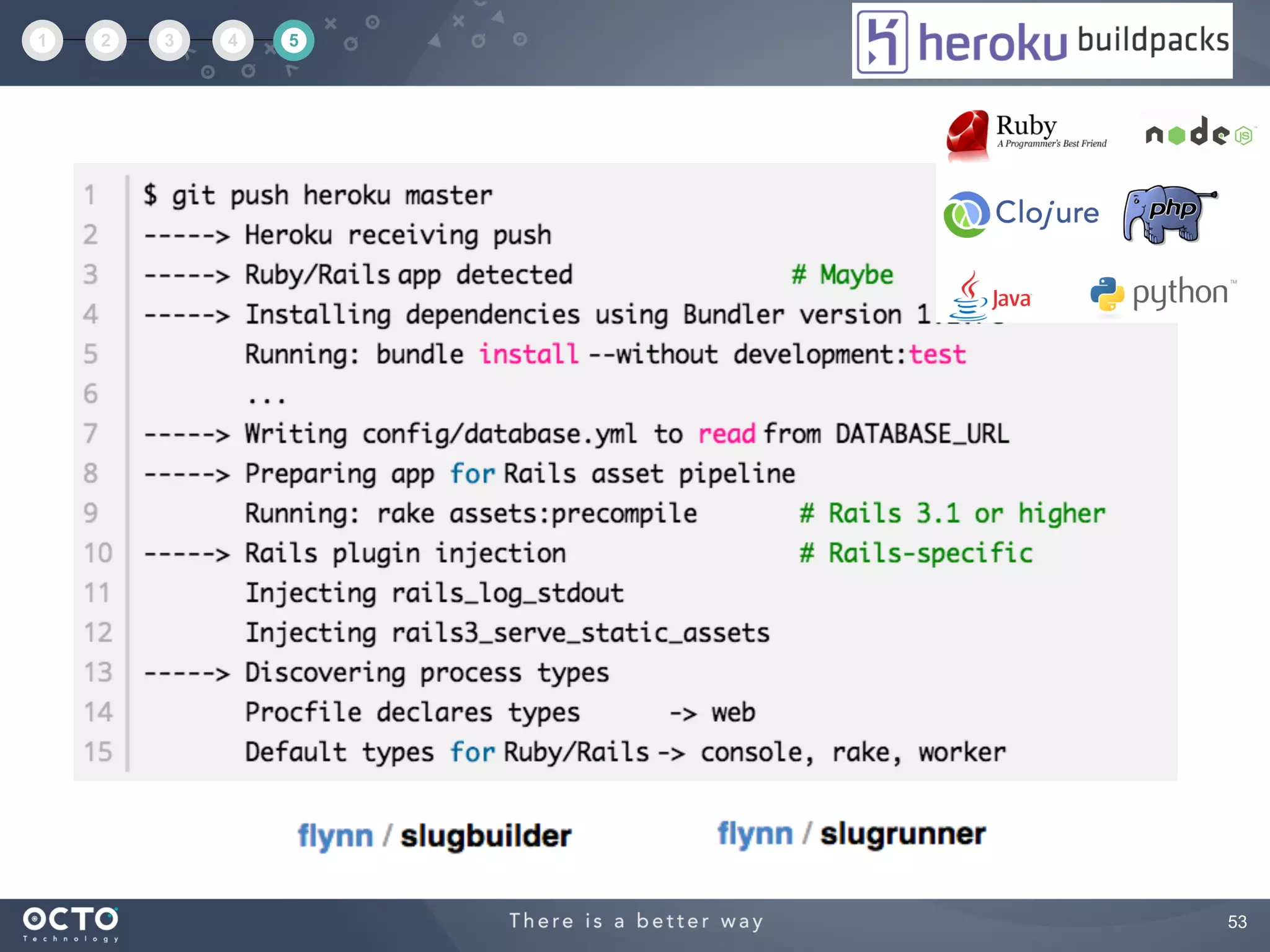
$ git push deis master
Counting objects: 92, done.
Delta compression using up to 4 threads.
Compressing objects: 100% (87/87), done.
Writing objects: 100% (92/92), 19.29 KiB | 0
bytes/s, done.
Total 92 (delta 40), reused 0 (delta 0)
-----> Ruby app detected
-----> Compiling Ruby/Rack
-----> Using Ruby version: ruby-1.9.3
-----> Installing dependencies using 1.5.2
Running: bundle install --without
development:test
...
-----> Discovering process types
Procfile declares types -> web
Default process types for Ruby ->
rake, console, web
-----> Compiled slug size is 12M
-----> Building Docker image
Uploading context 11.81 MB
…
Deploying onto1 2
Step 3 : ENTRYPOINT ["/runner/init"]
---> Running in 94eb867135db
---> f49031ecd6c1
Successfully built f49031ecd6c1
-----> Pushing image to private registry
Launching... done, v2
-----> lambda-hawthorn deployed to Deis
http://lambda-
hawthorn.local3.deisapp.com
To learn more, use `deis help` or
visit http://deis.io
To ssh://git@local3.deisapp.com:2222/lambda-
hawthorn.git
* [new branch] master -> master
17
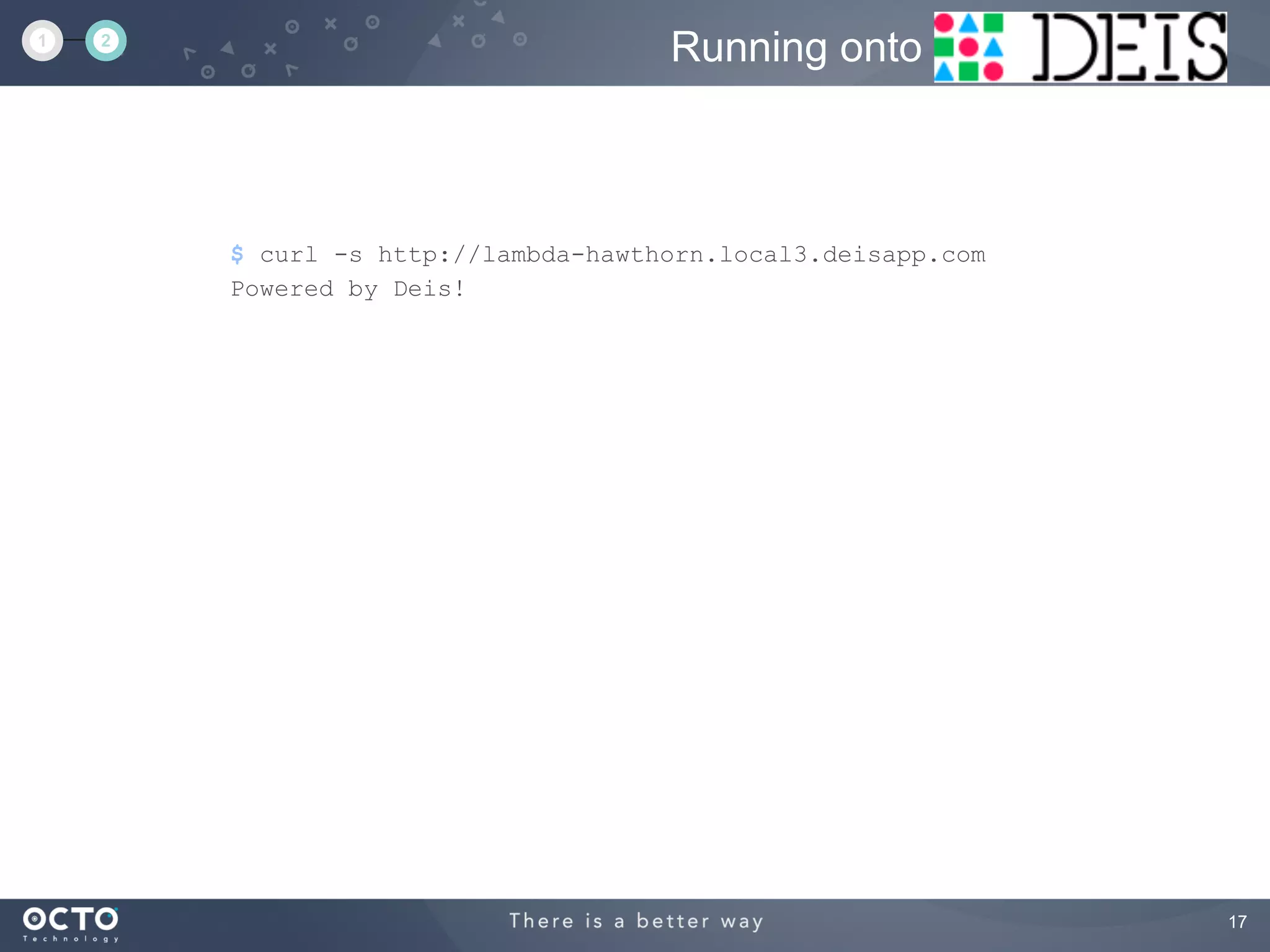
$ curl -s http://lambda-hawthorn.local3.deisapp.com
Powered by Deis!
Running onto1 2
18
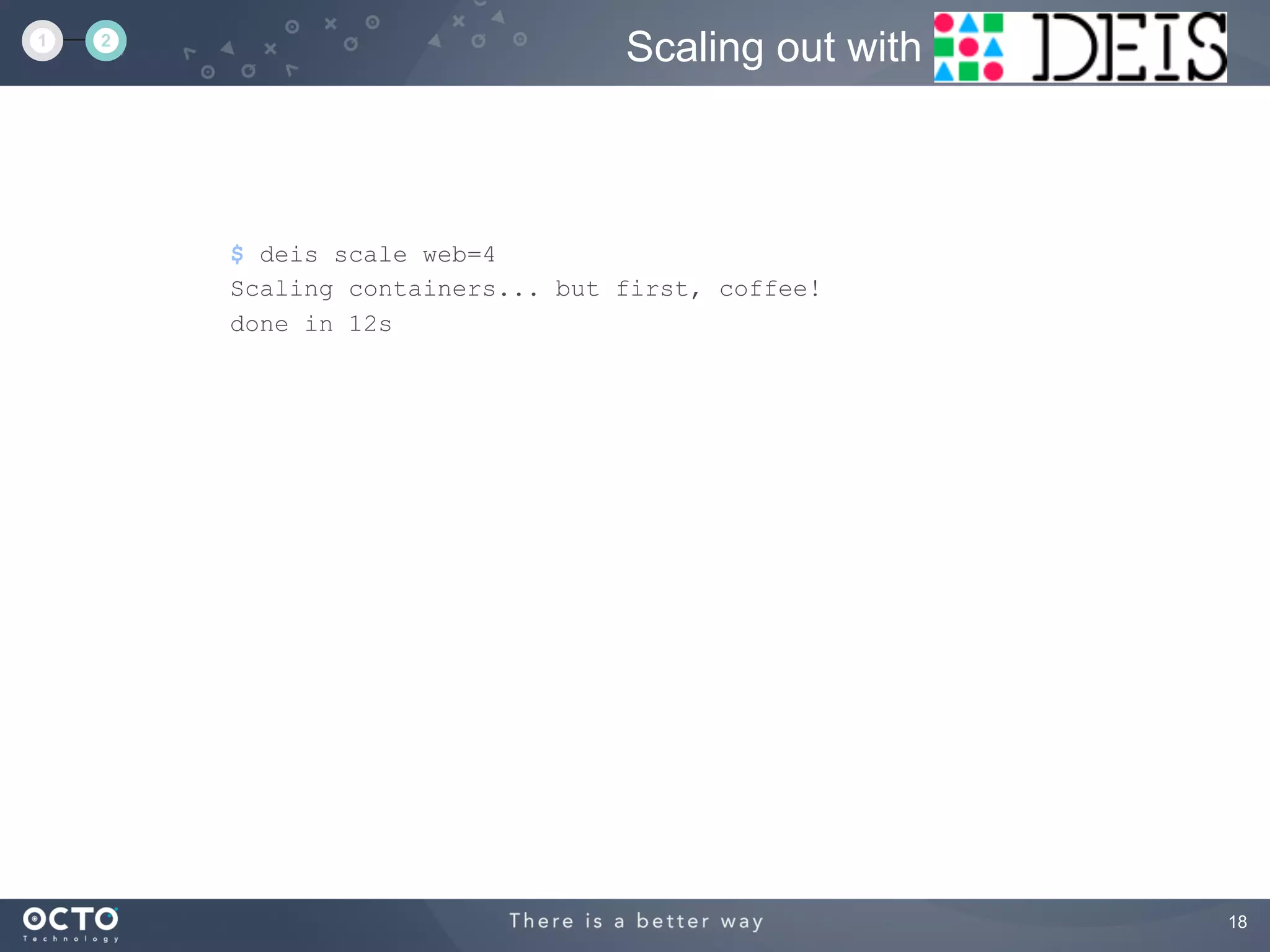
$ deis scale web=4
Scaling containers... but first, coffee!
done in 12s
Scaling out with1 2
19
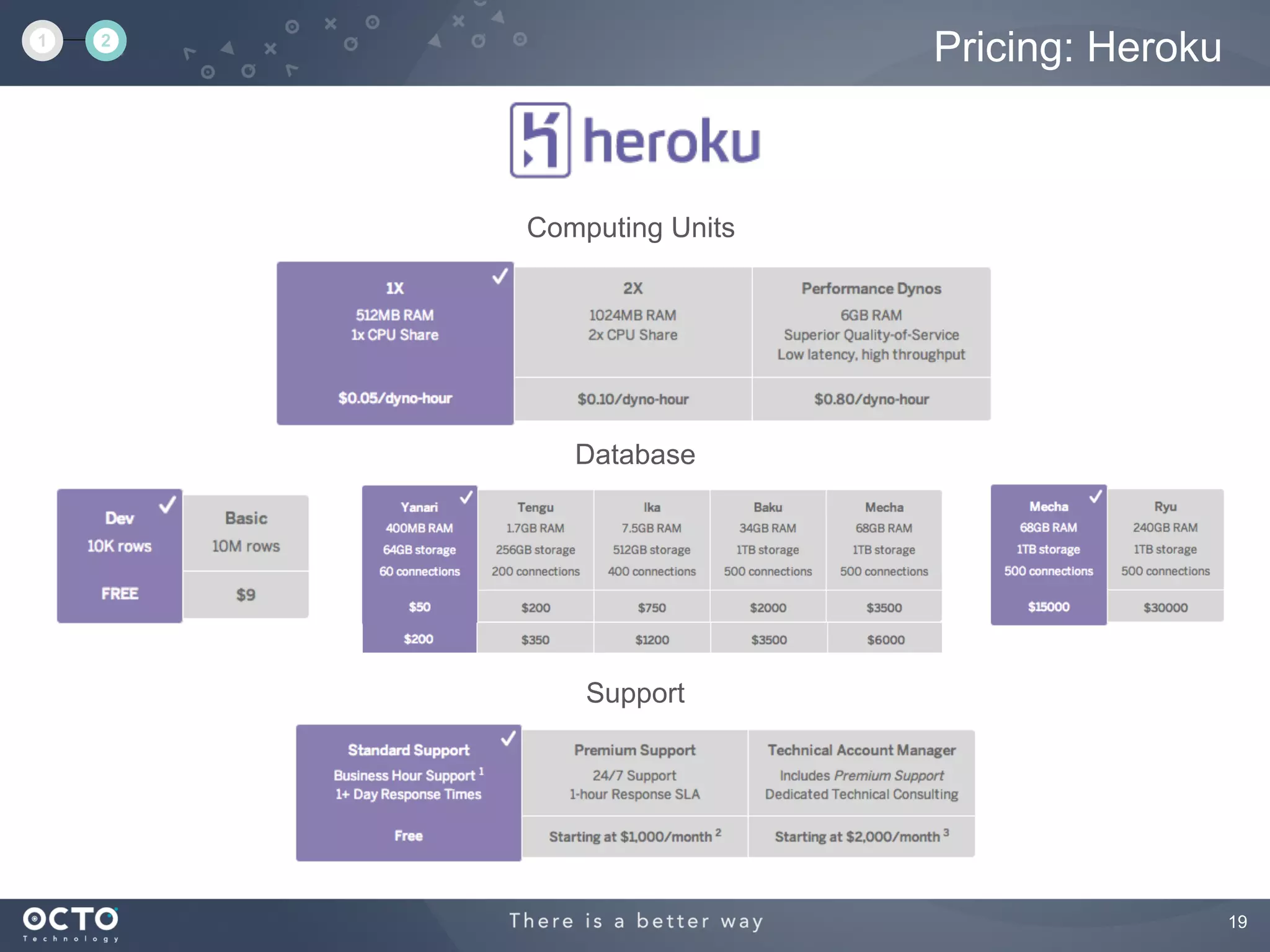
Pricing: Heroku
Computing Units
Database
Support
1 2
20
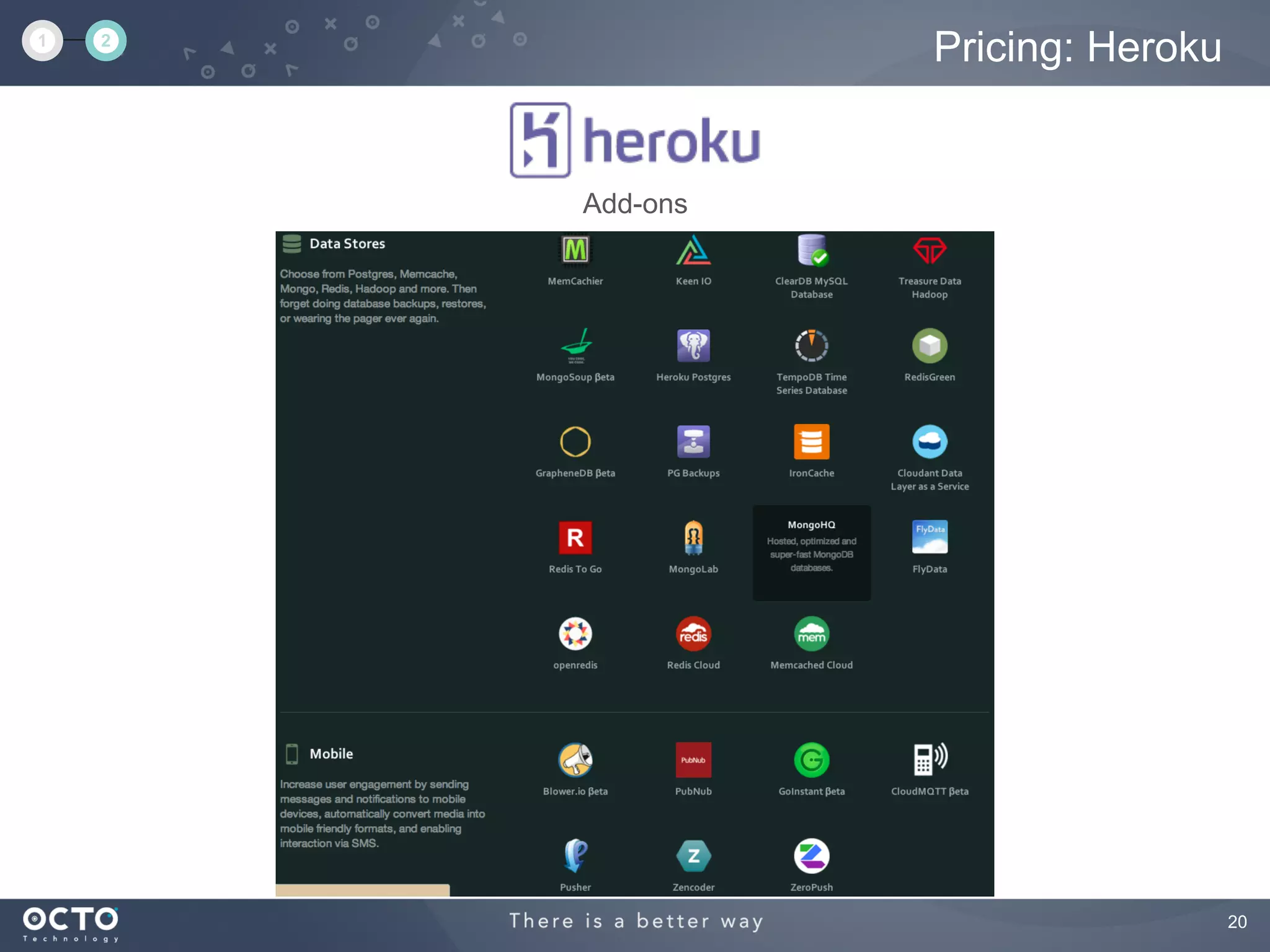
Pricing: Heroku
Add-ons
1 2
21
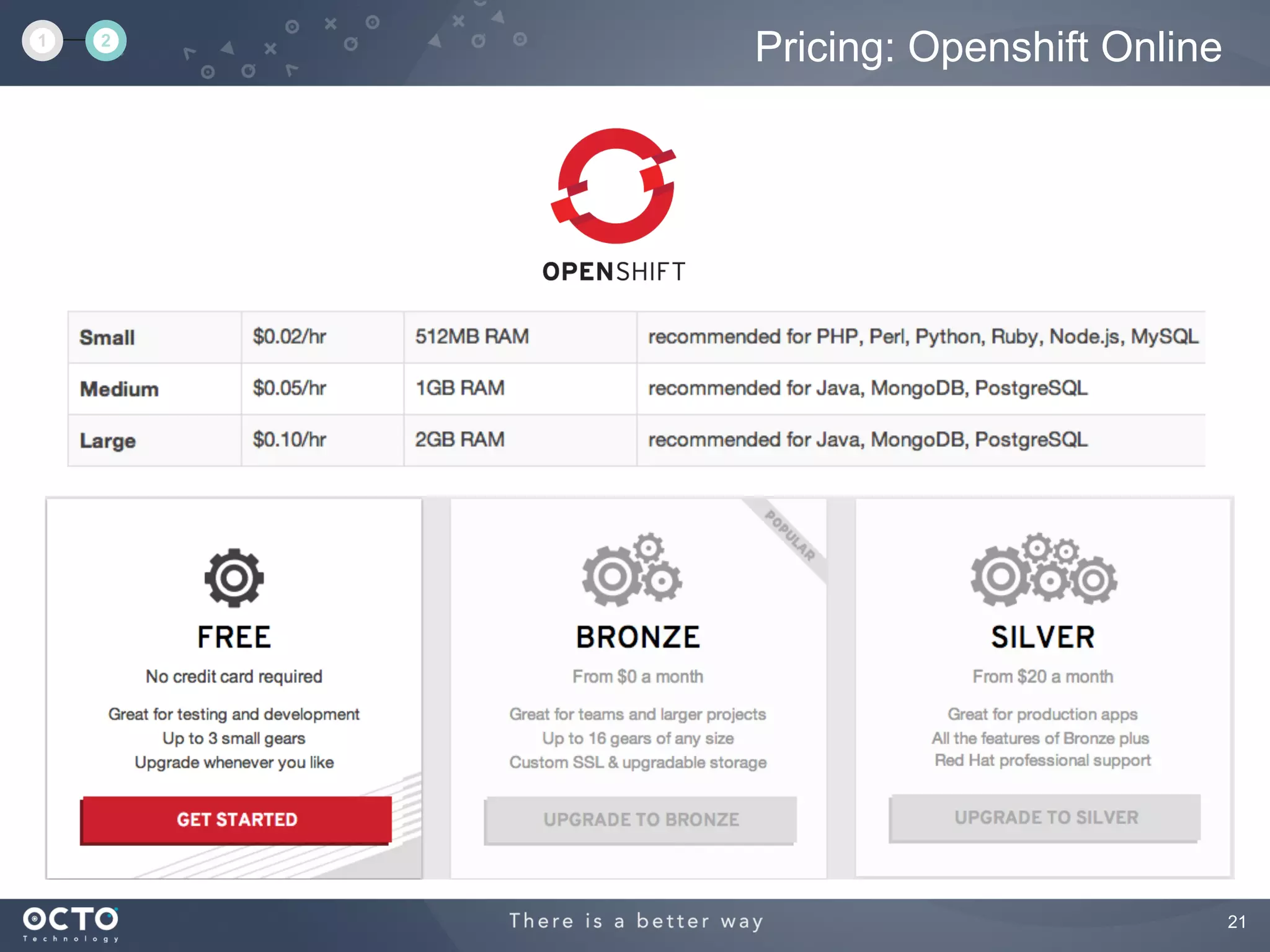
Pricing: Openshift Online1 2
22
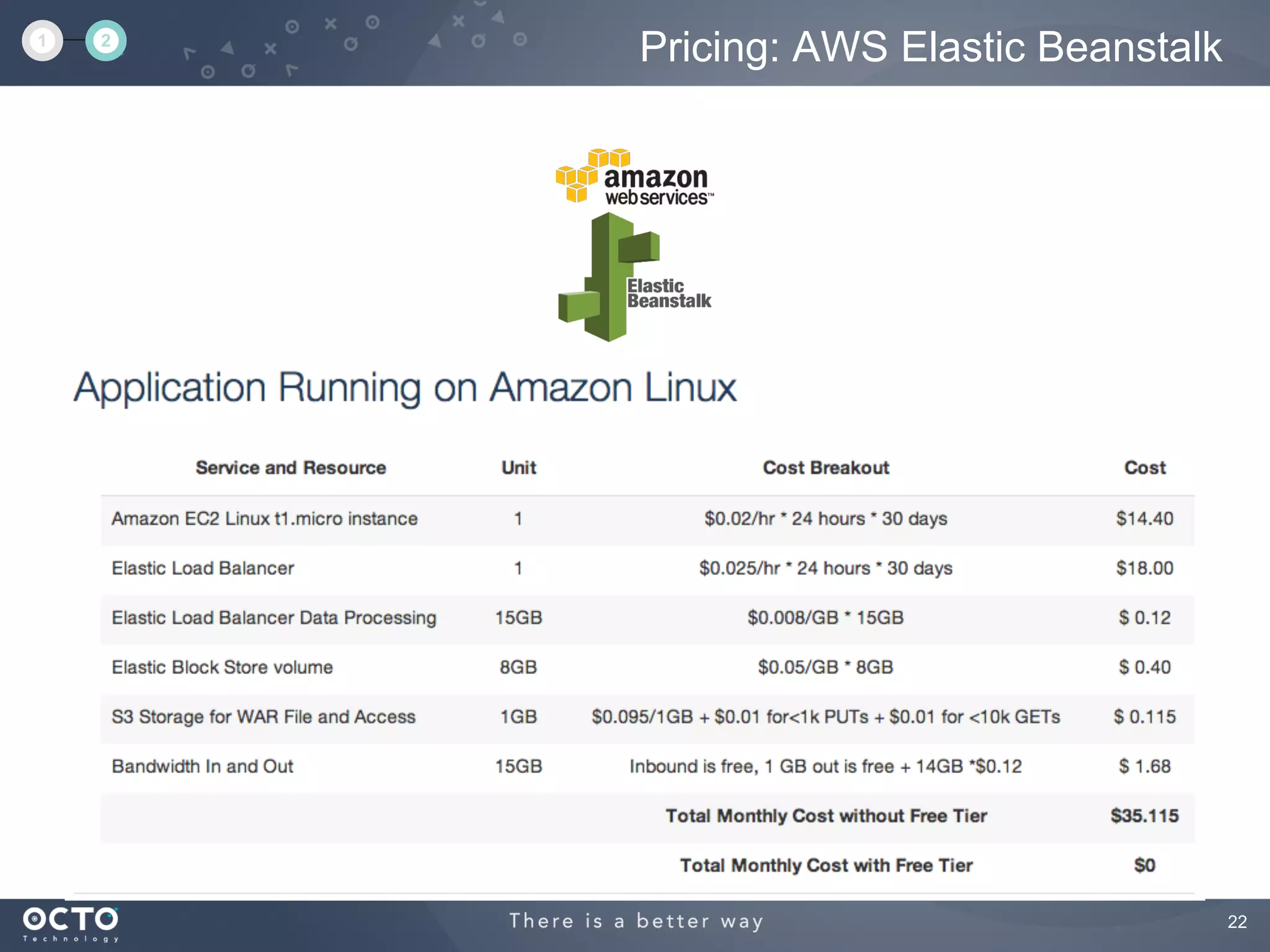
Pricing: AWS Elastic Beanstalk1 2
23
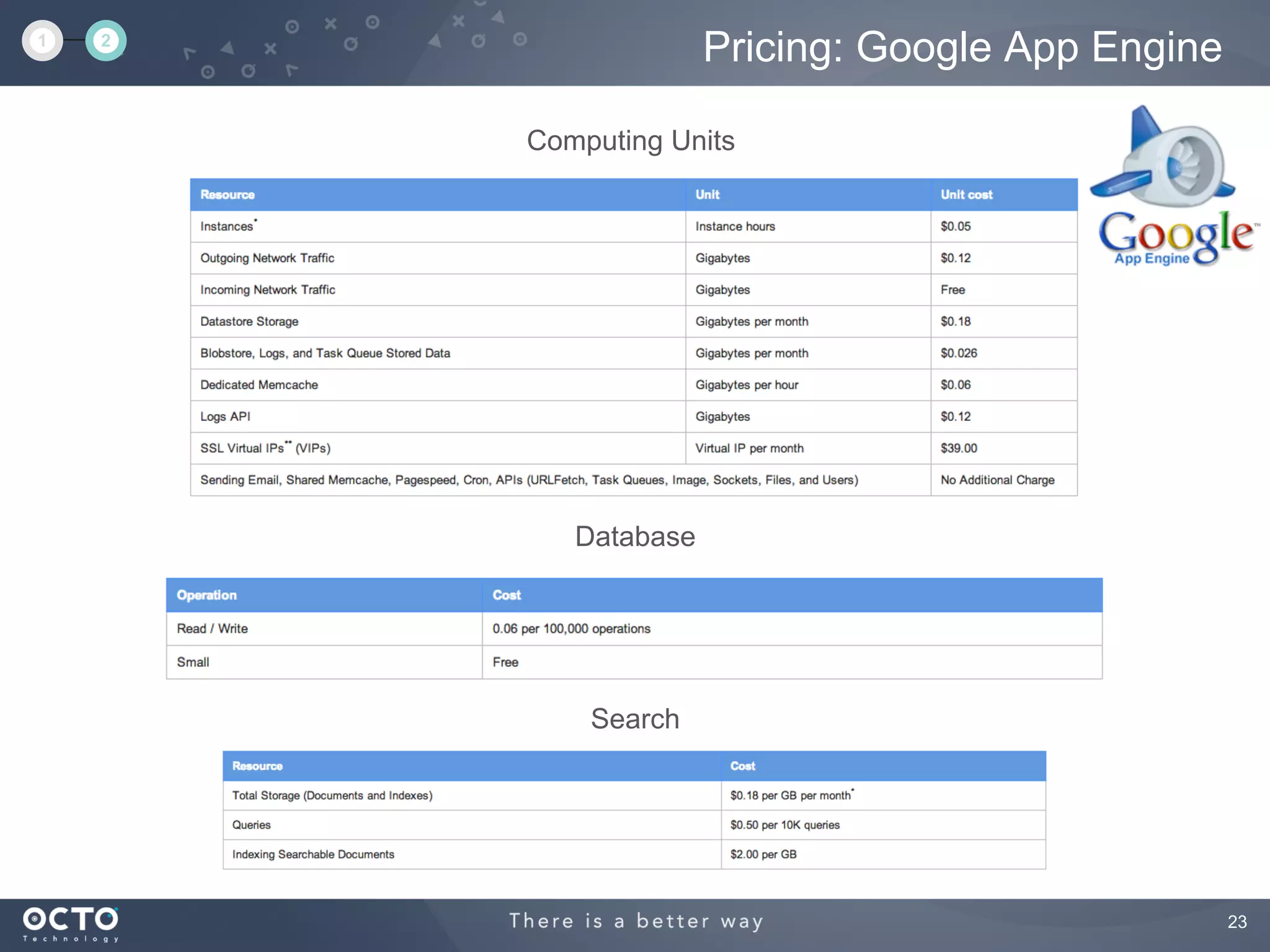
Pricing: Google App Engine
Computing Units
Database
Search
1 2
24
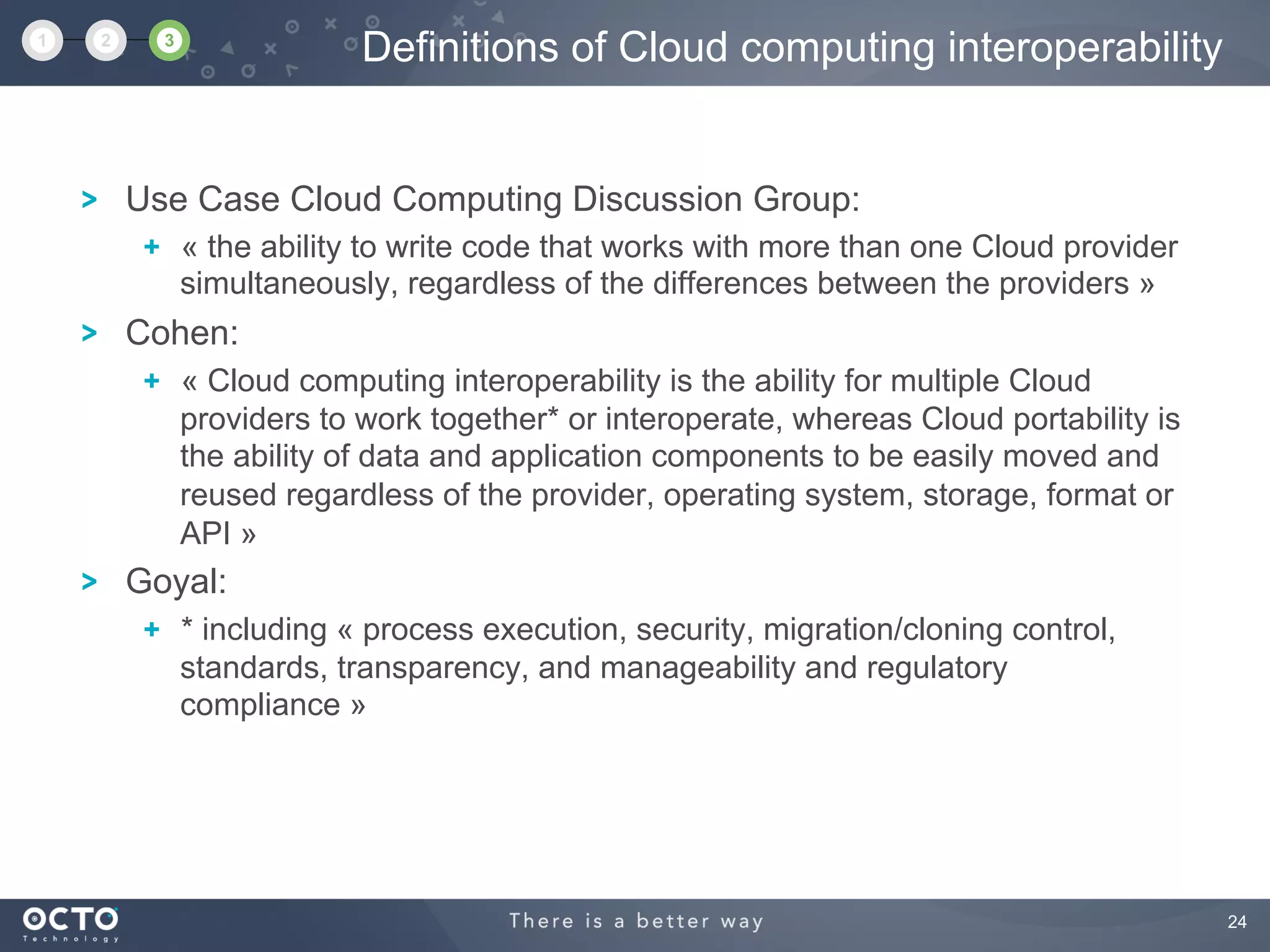
Use Case Cloud Computing Discussion Group:
  « the ability to write code that works with more than one Cloud provider
simultaneously, regardless of the differences between the providers »
Cohen:
  « Cloud computing interoperability is the ability for multiple Cloud
providers to work together* or interoperate, whereas Cloud portability is
the ability of data and application components to be easily moved and
reused regardless of the provider, operating system, storage, format or
API »
Goyal:
  * including « process execution, security, migration/cloning control,
standards, transparency, and manageability and regulatory
compliance »
Definitions of Cloud computing interoperability1 2 3
25
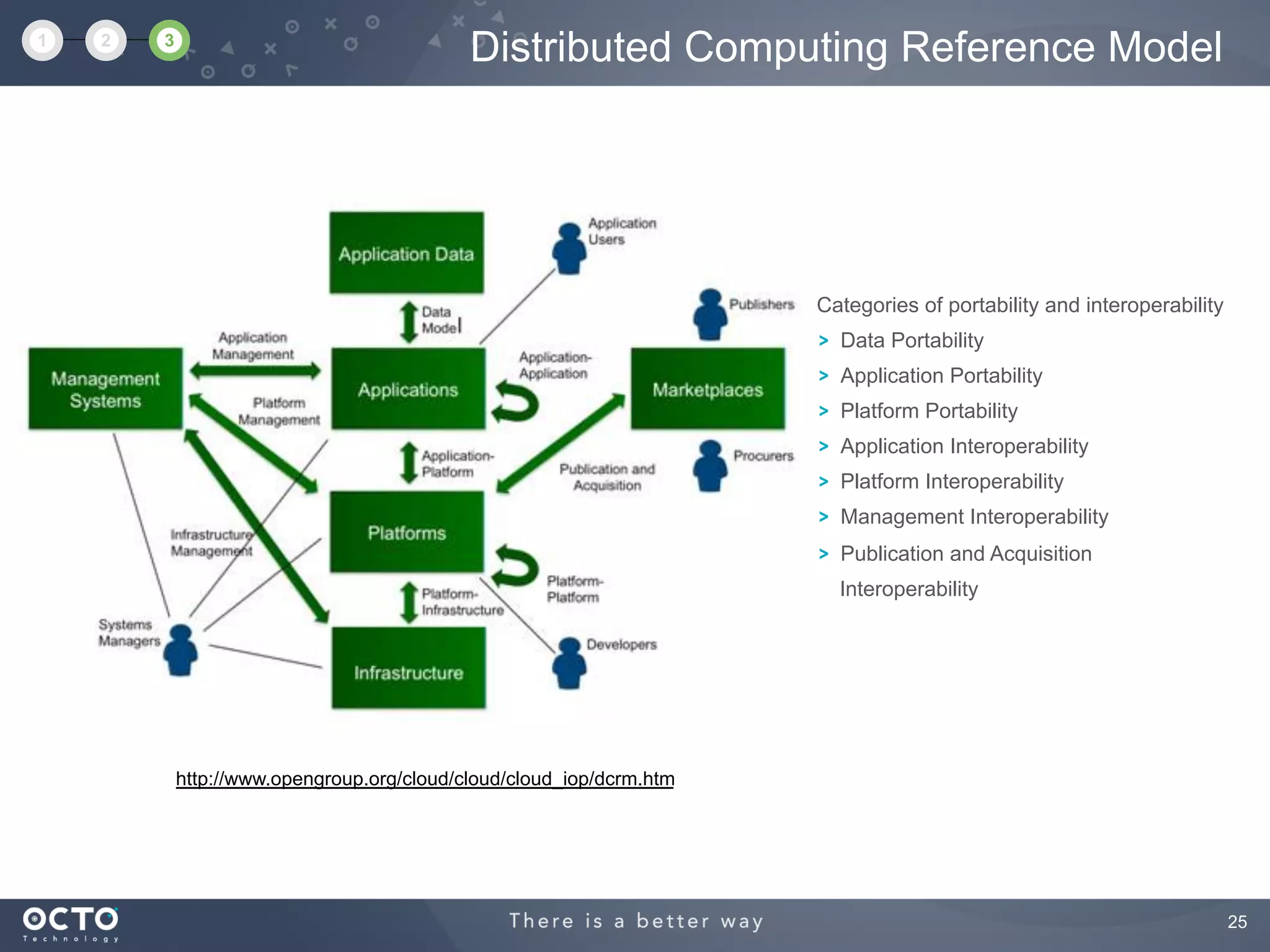
Distributed Computing Reference Model
http://www.opengroup.org/cloud/cloud/cloud_iop/dcrm.htm
Categories of portability and interoperability
  Data Portability
  Application Portability
  Platform Portability
  Application Interoperability
  Platform Interoperability
  Management Interoperability
  Publication and Acquisition
Interoperability
1 2 3
26
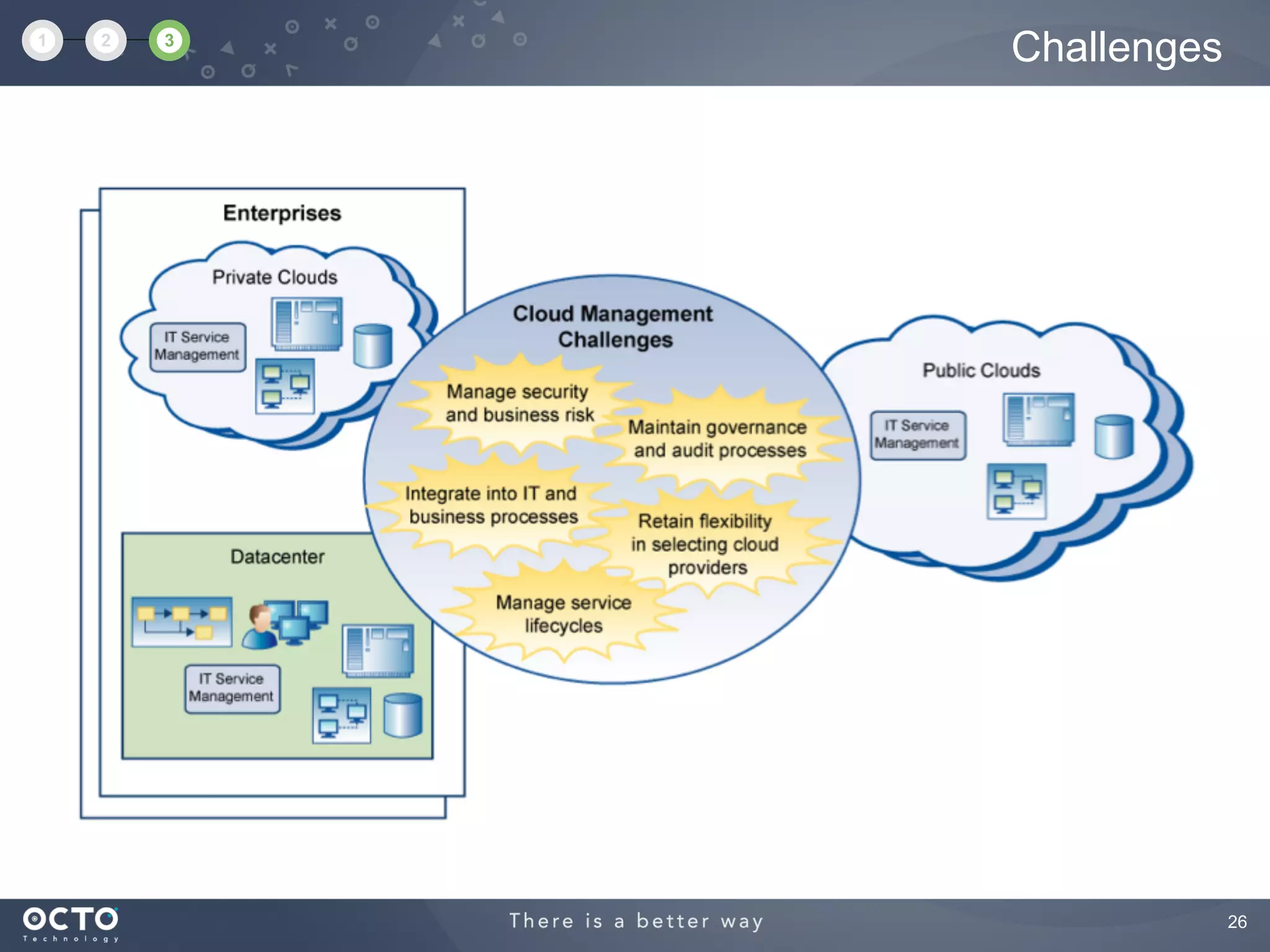
Challenges1 2 3
27
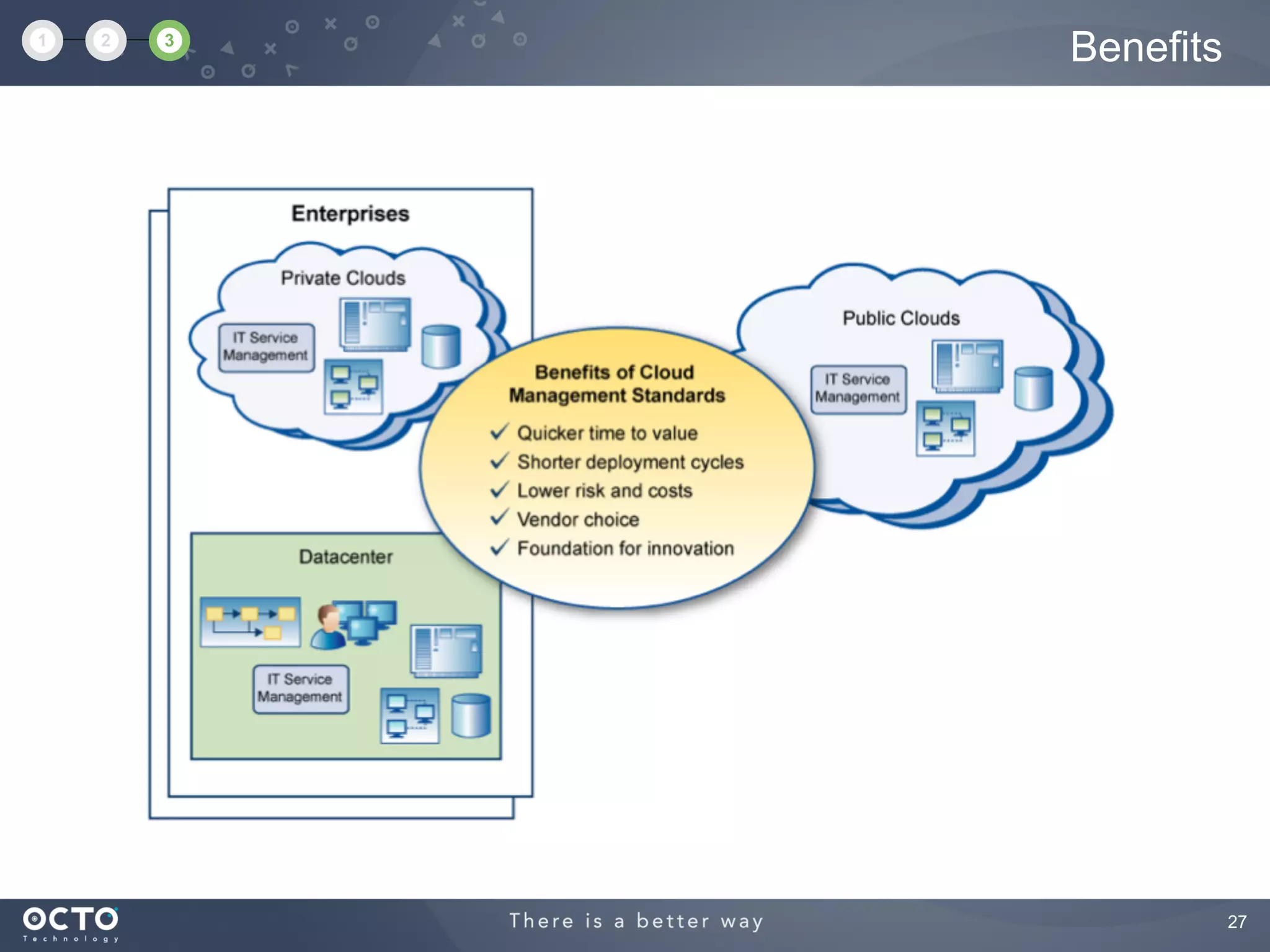
Benefits1 2 3
28
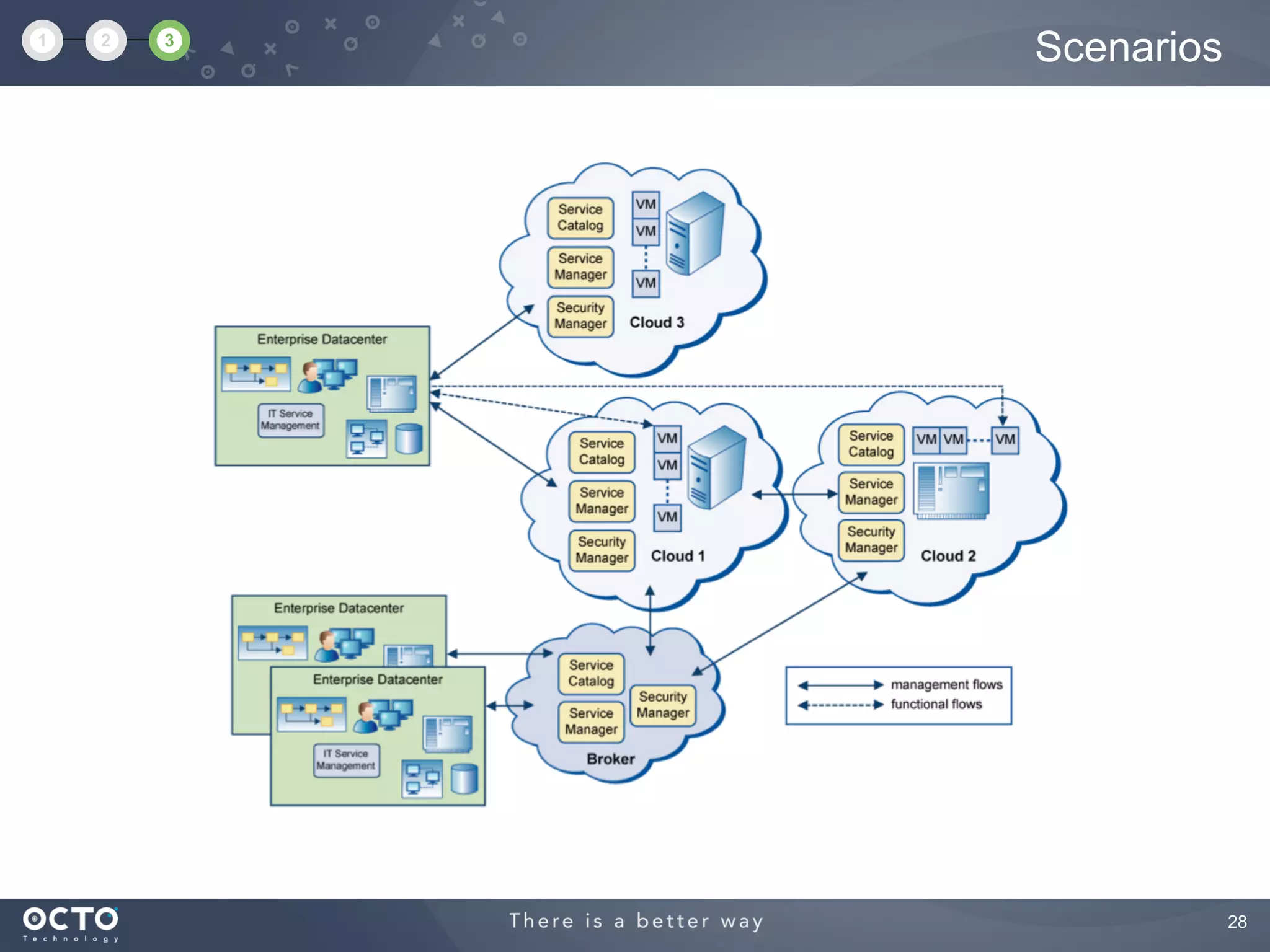
Scenarios1 2 3
29
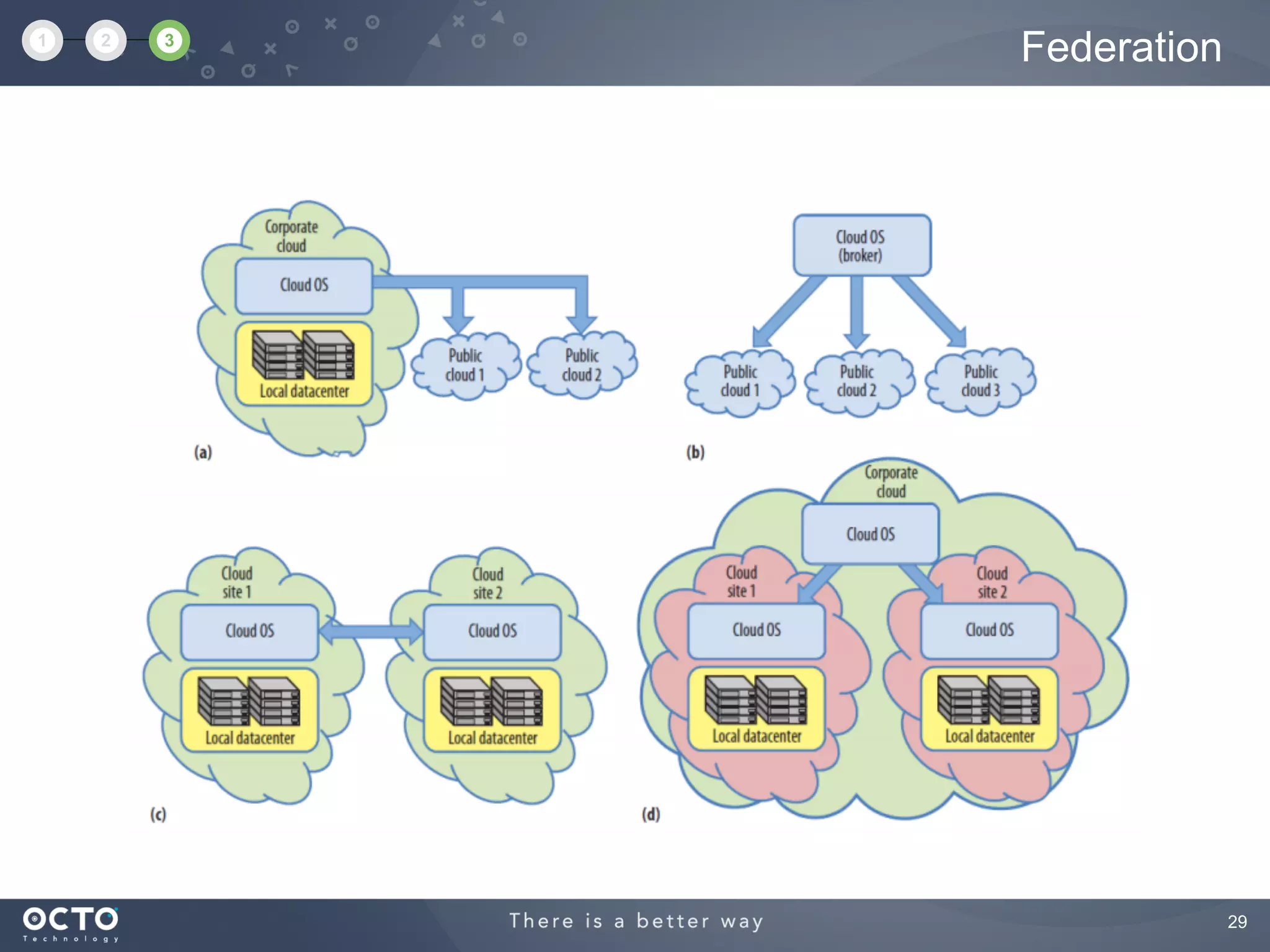
Federation1 2 3
30
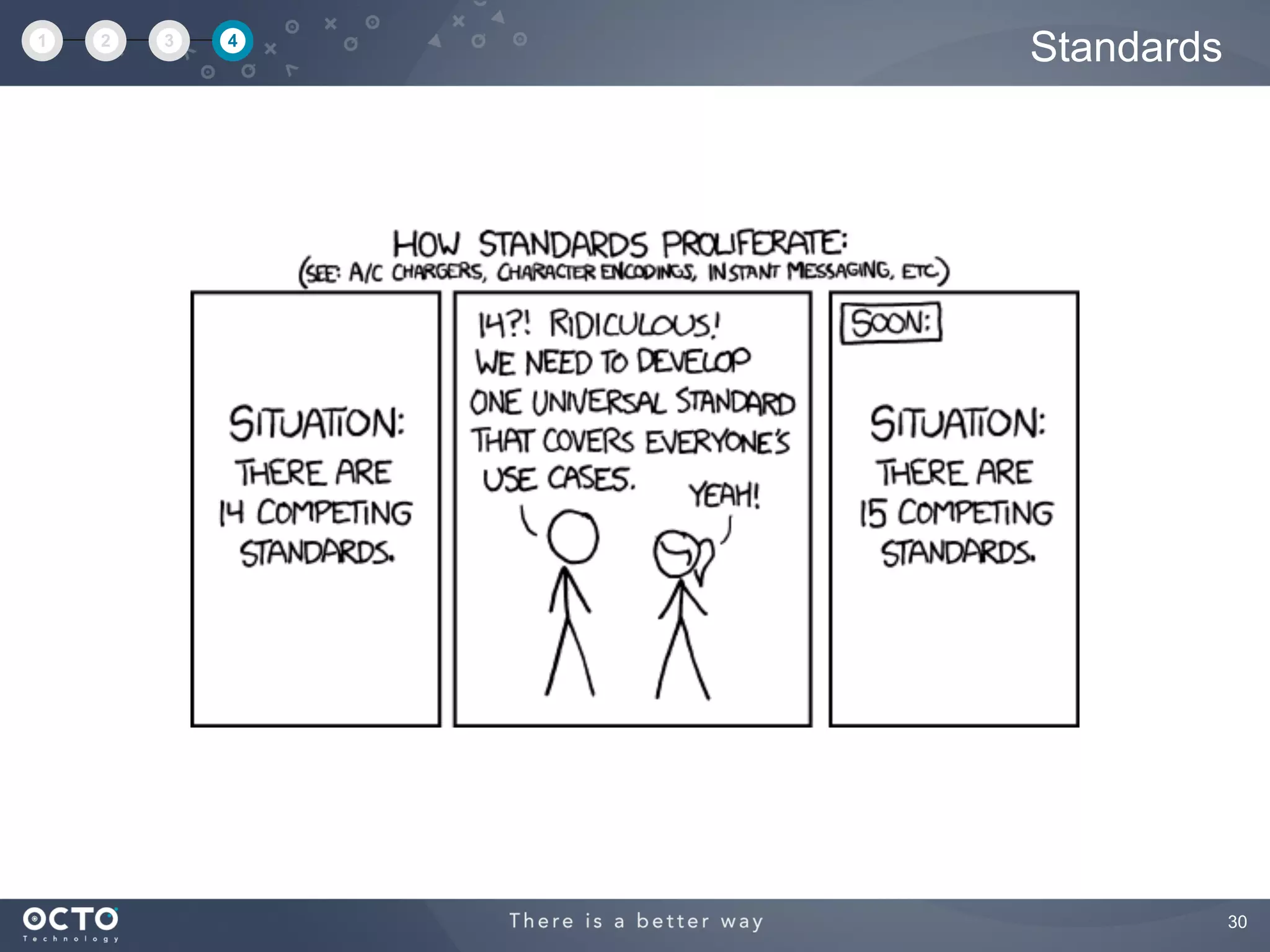
Standards1 2 3 4
31
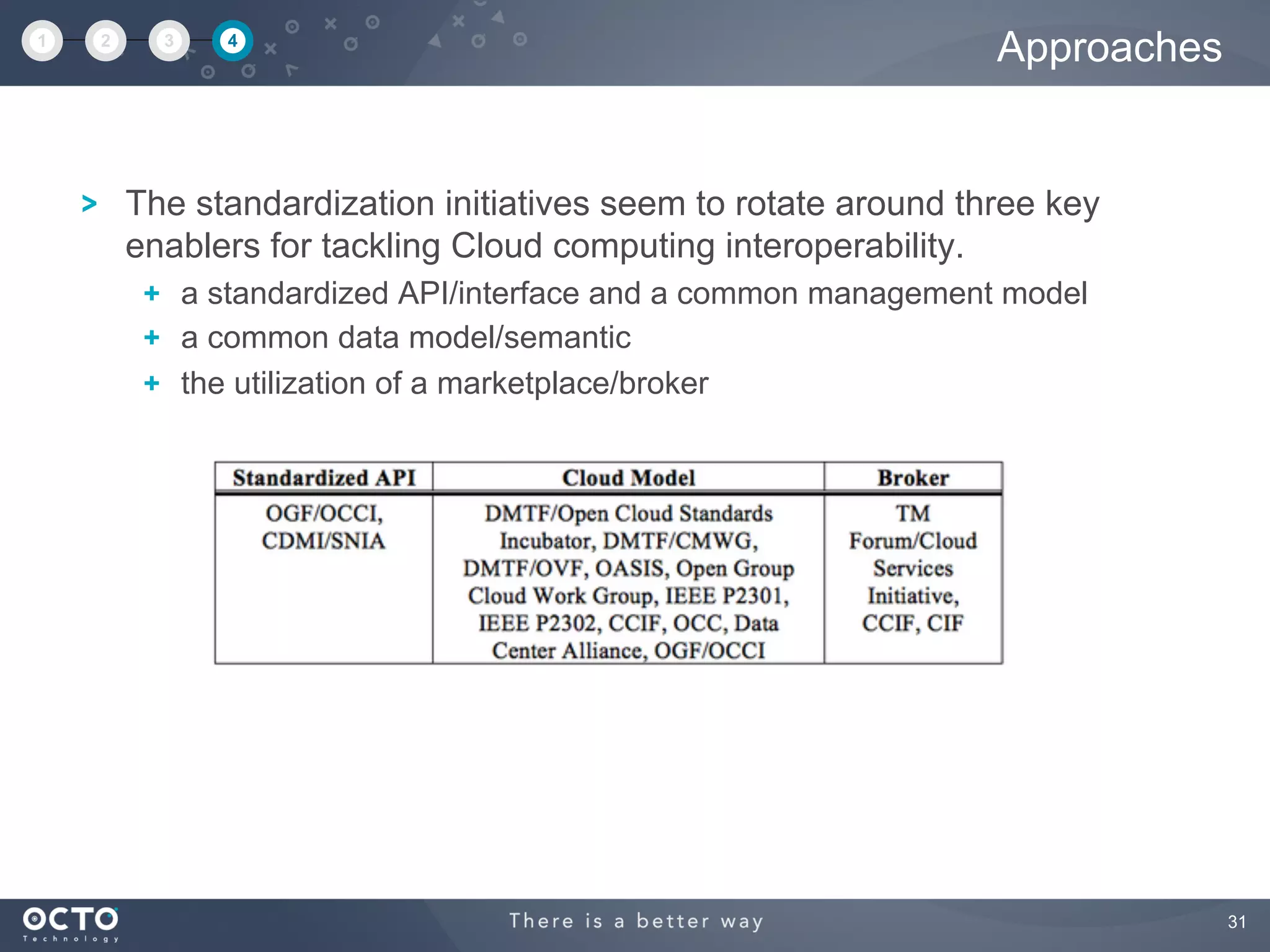
The standardization initiatives seem to rotate around three key
enablers for tackling Cloud computing interoperability.
  a standardized API/interface and a common management model
  a common data model/semantic
  the utilization of a marketplace/broker
Approaches1 2 3 4
32
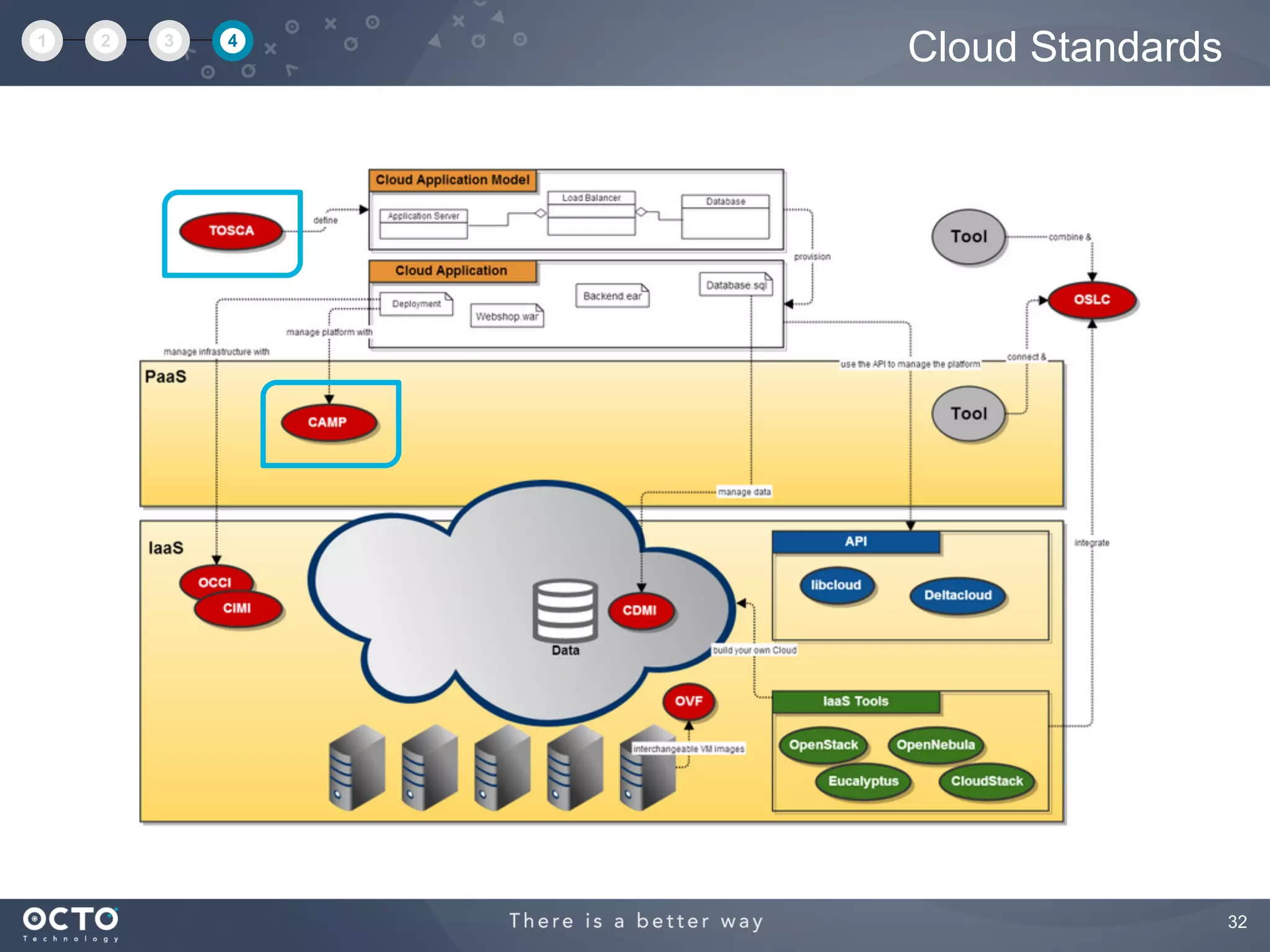
Cloud Standards1 2 3 4
33
Official description:
  The OASIS TOSCA TC works to enhance the portability of cloud
applications and services.
  TOSCA will enable the interoperable description of application and
infrastructure cloud services, the relationships between parts of the
service, and the operational behavior of these services (e.g., deploy,
patch, shutdown)--independent of the supplier creating the service, and
any particular cloud provider or hosting technology.
Formed in January 2012
OASIS Topology and Orchestration Specification for Cloud
Applications (TOSCA)
1 2 3 4
34
TOSCA: Members1 2 3 4
35
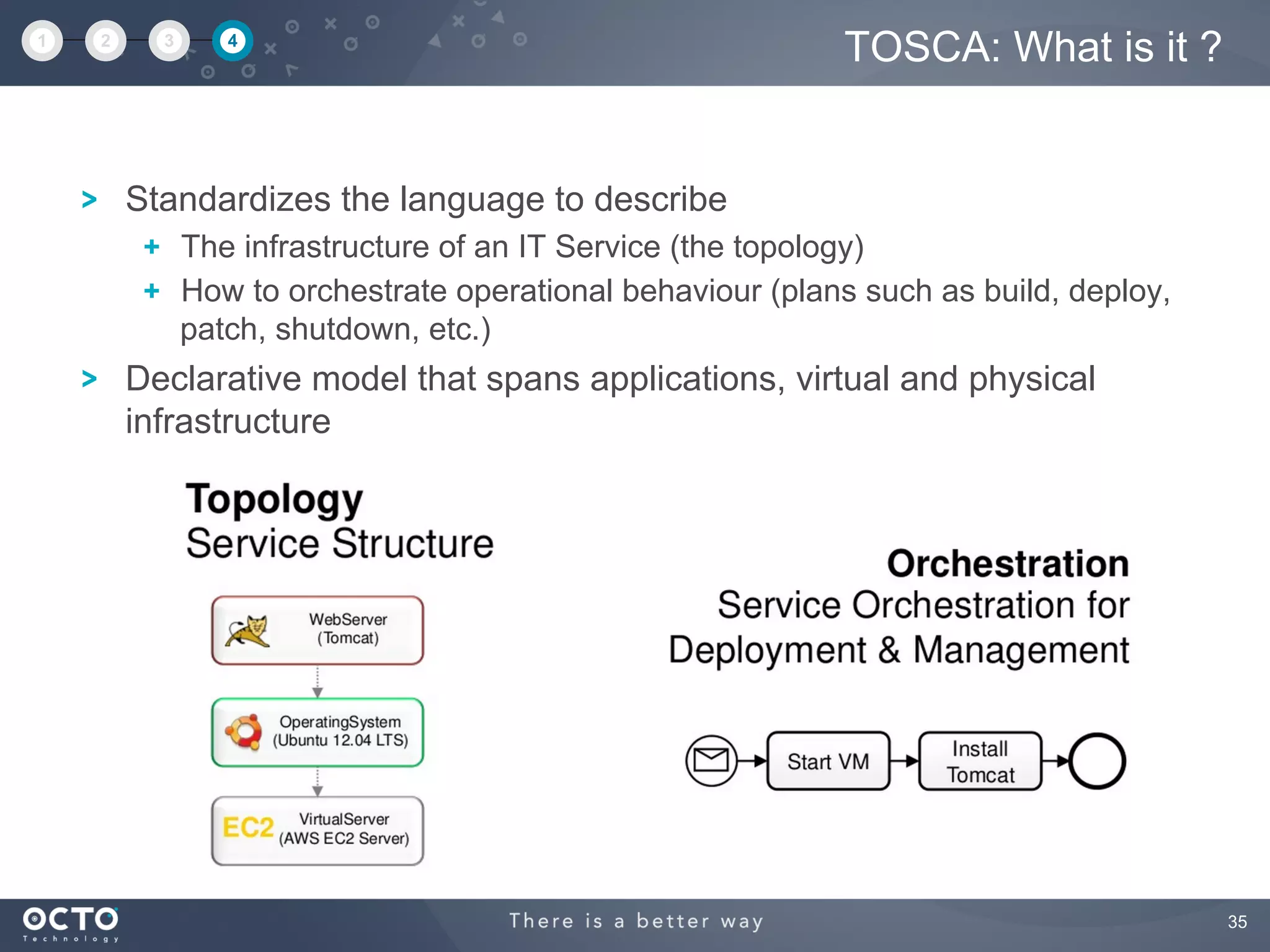
Standardizes the language to describe
  The infrastructure of an IT Service (the topology)
  How to orchestrate operational behaviour (plans such as build, deploy,
patch, shutdown, etc.)
Declarative model that spans applications, virtual and physical
infrastructure
TOSCA: What is it ?1 2 3 4
36
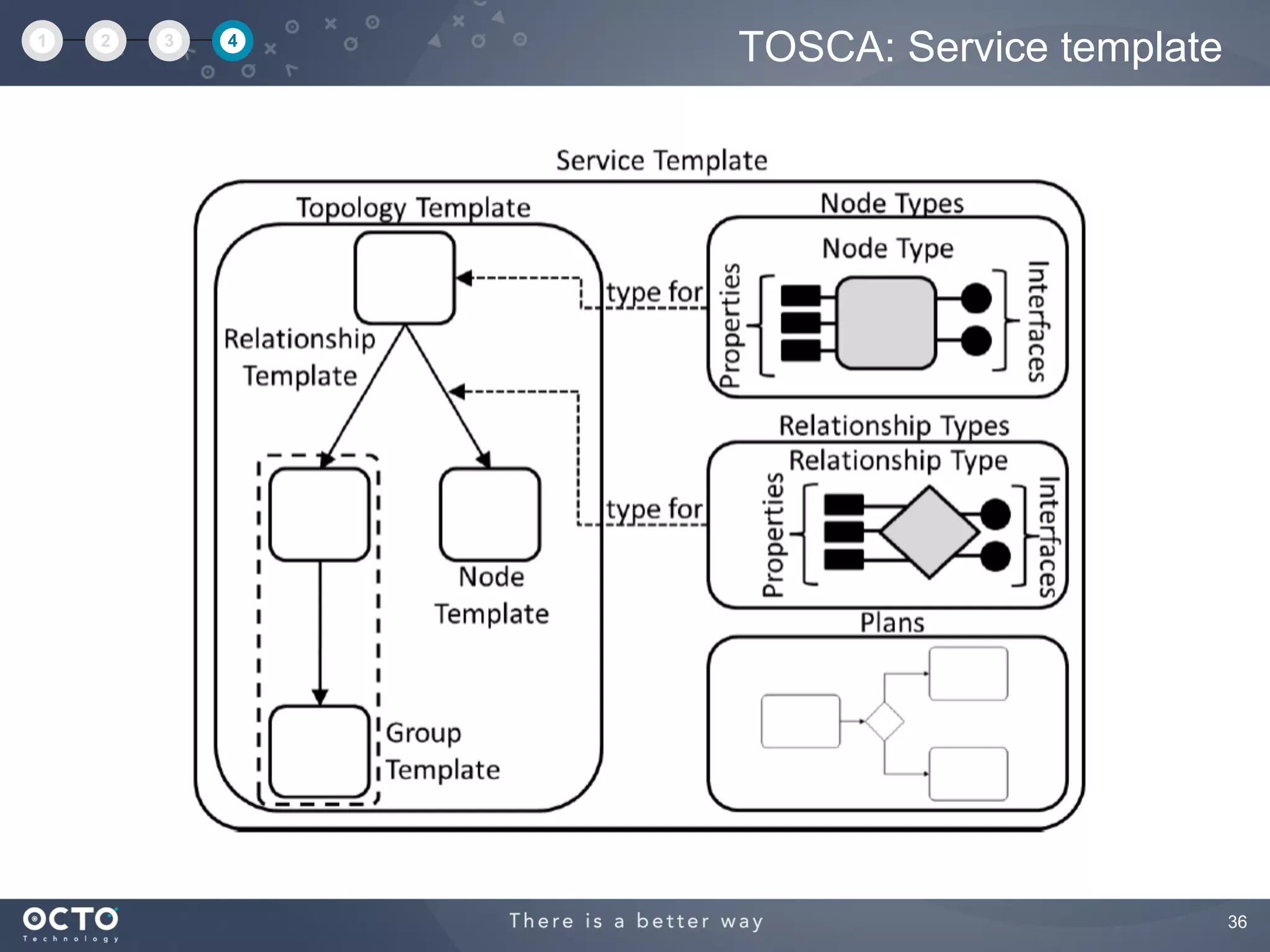
TOSCA: Service template1 2 3 4
37
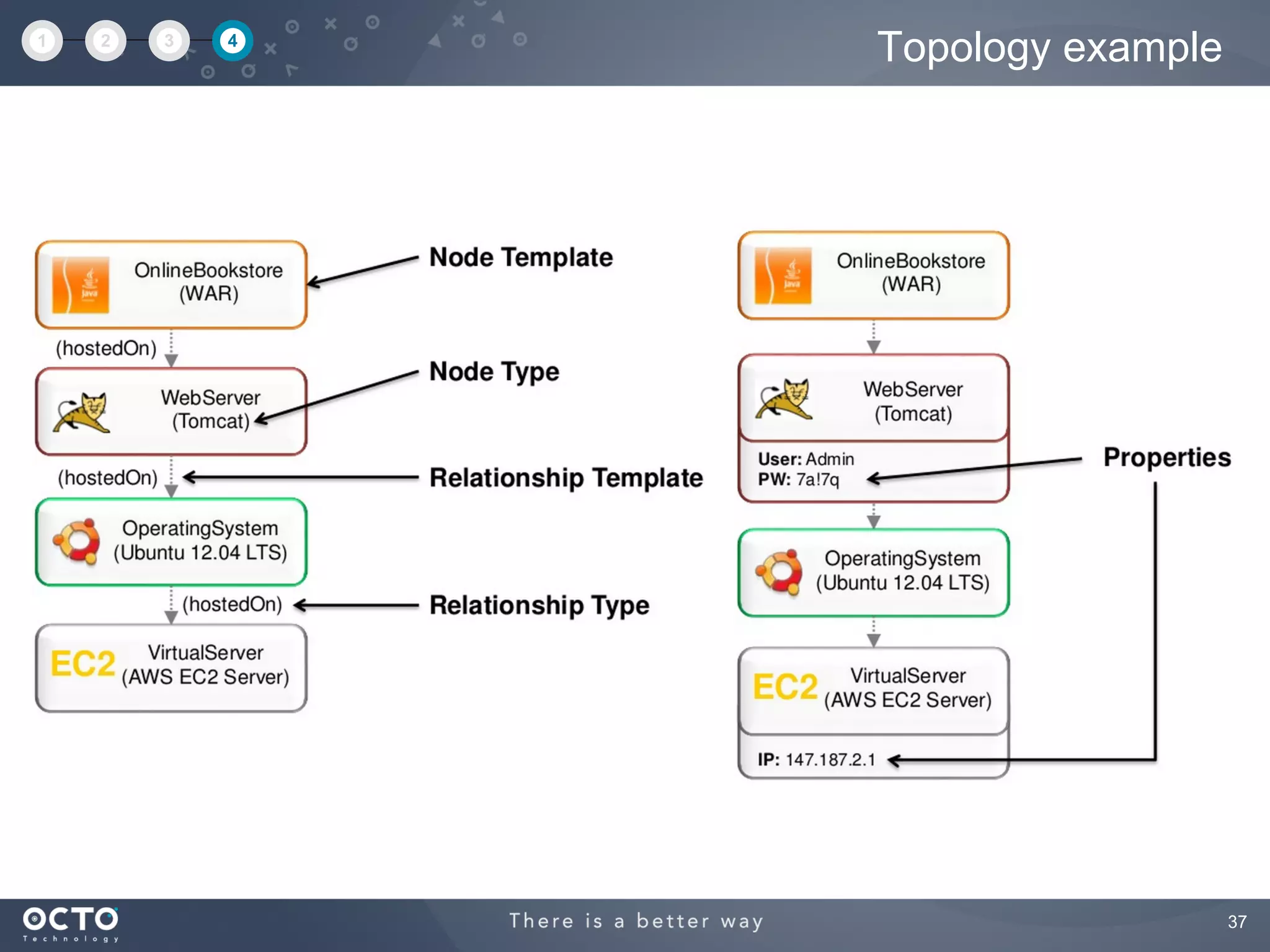
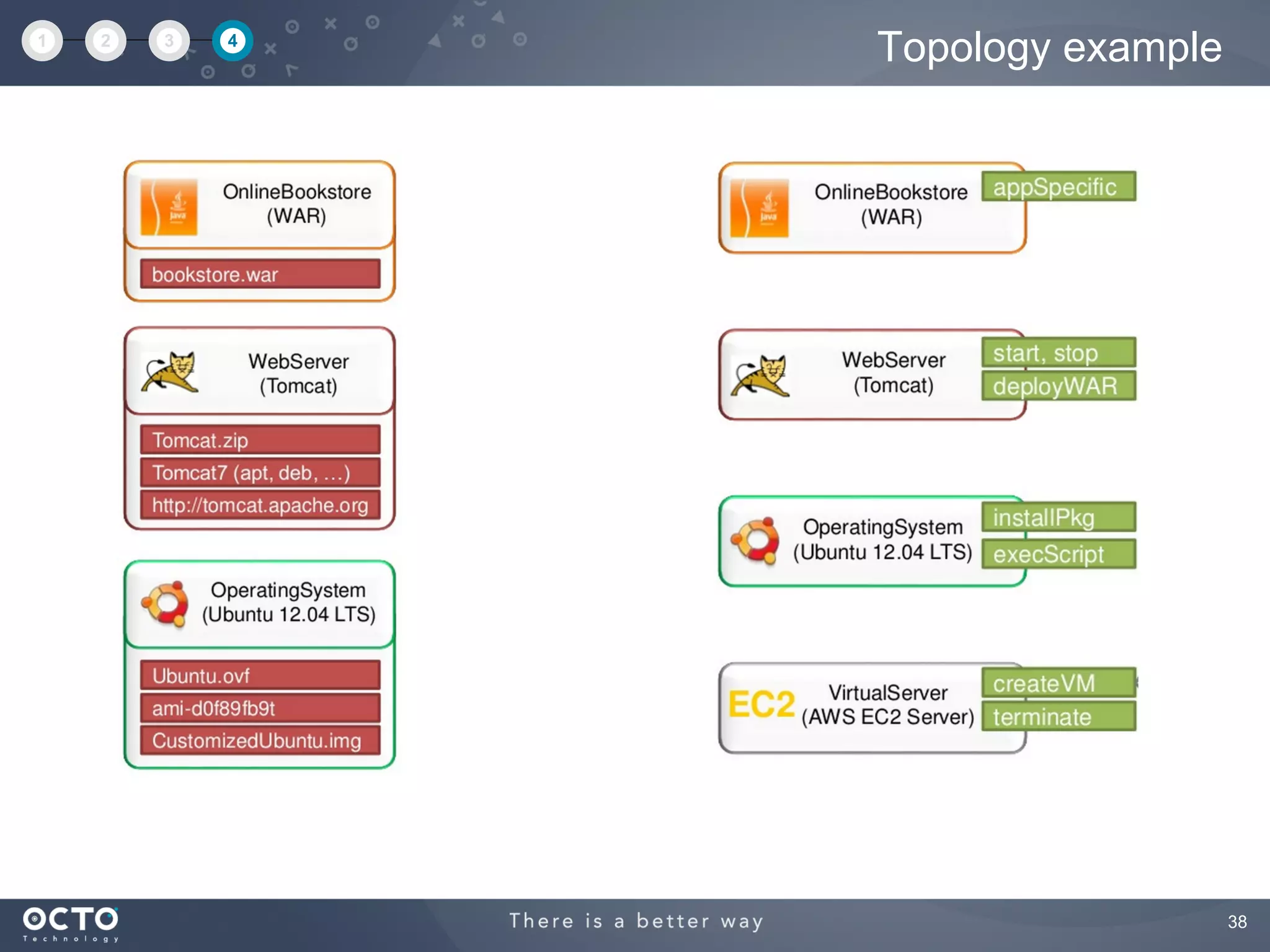
Topology example1 2 3 4
38
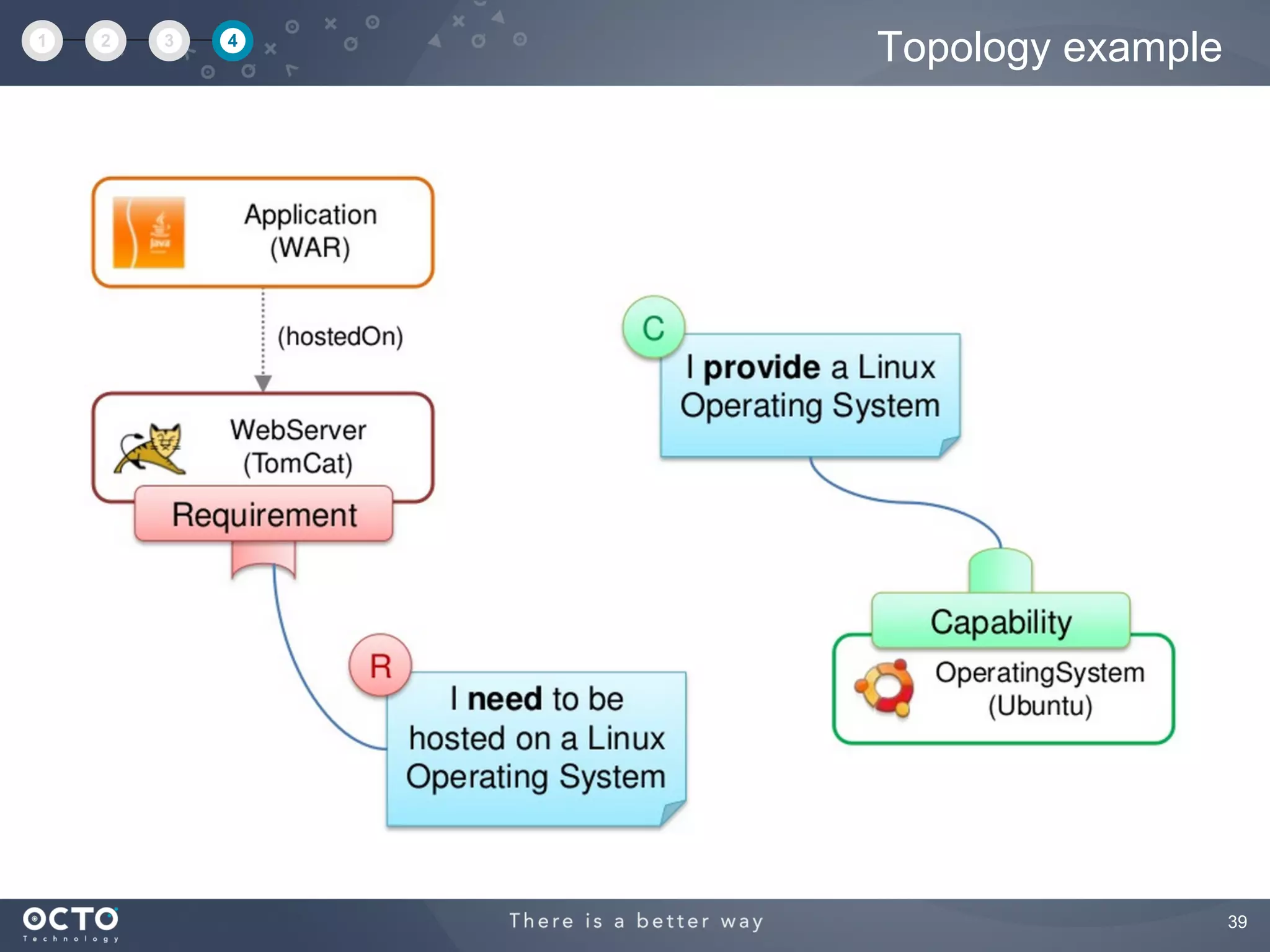
Topology example1 2 3 4
39
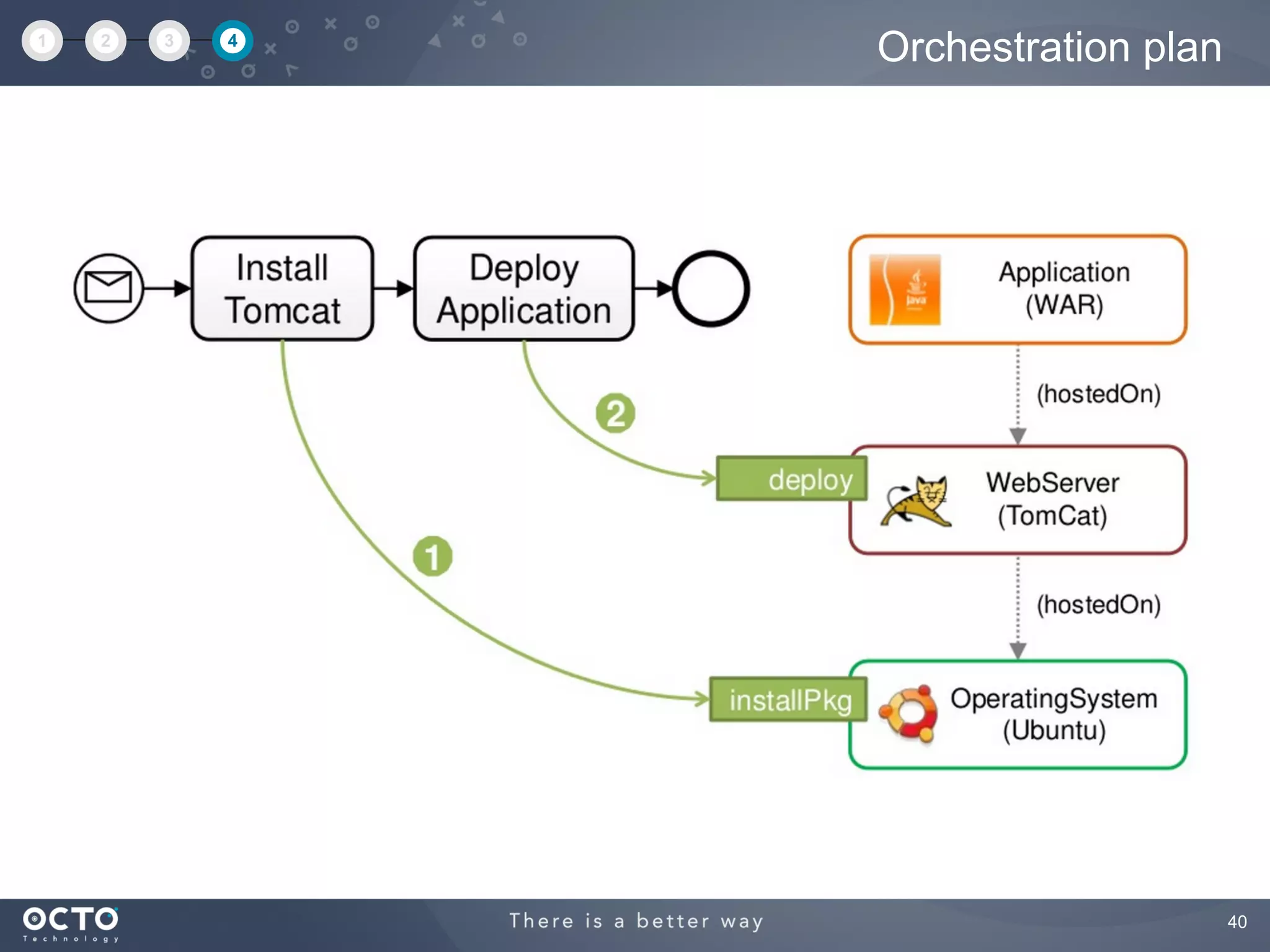
Topology example1 2 3 4
40
Orchestration plan1 2 3 4
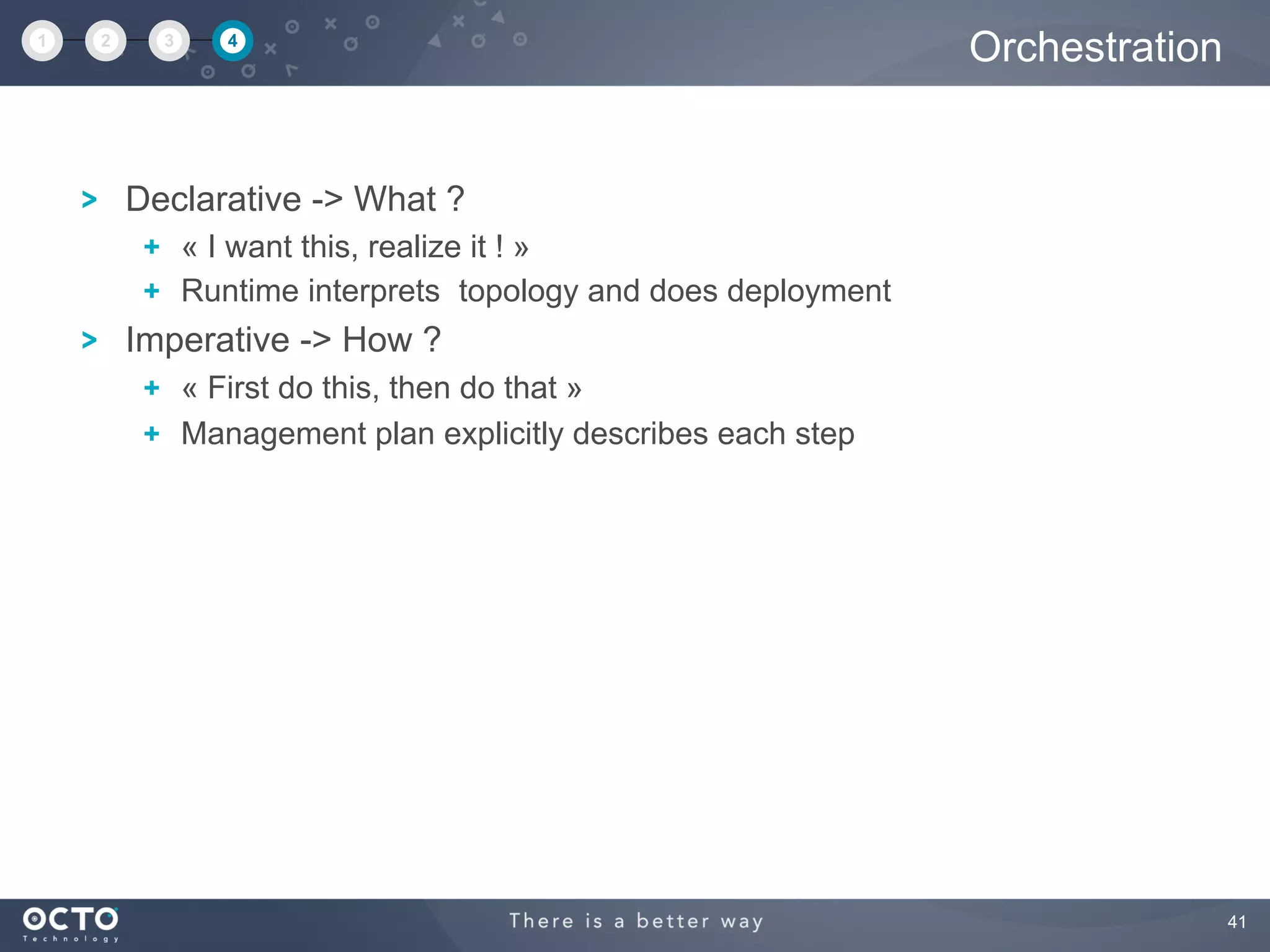
41
Declarative -> What ?
  « I want this, realize it ! »
  Runtime interprets topology and does deployment
Imperative -> How ?
  « First do this, then do that »
  Management plan explicitly describes each step
Orchestration1 2 3 4
42
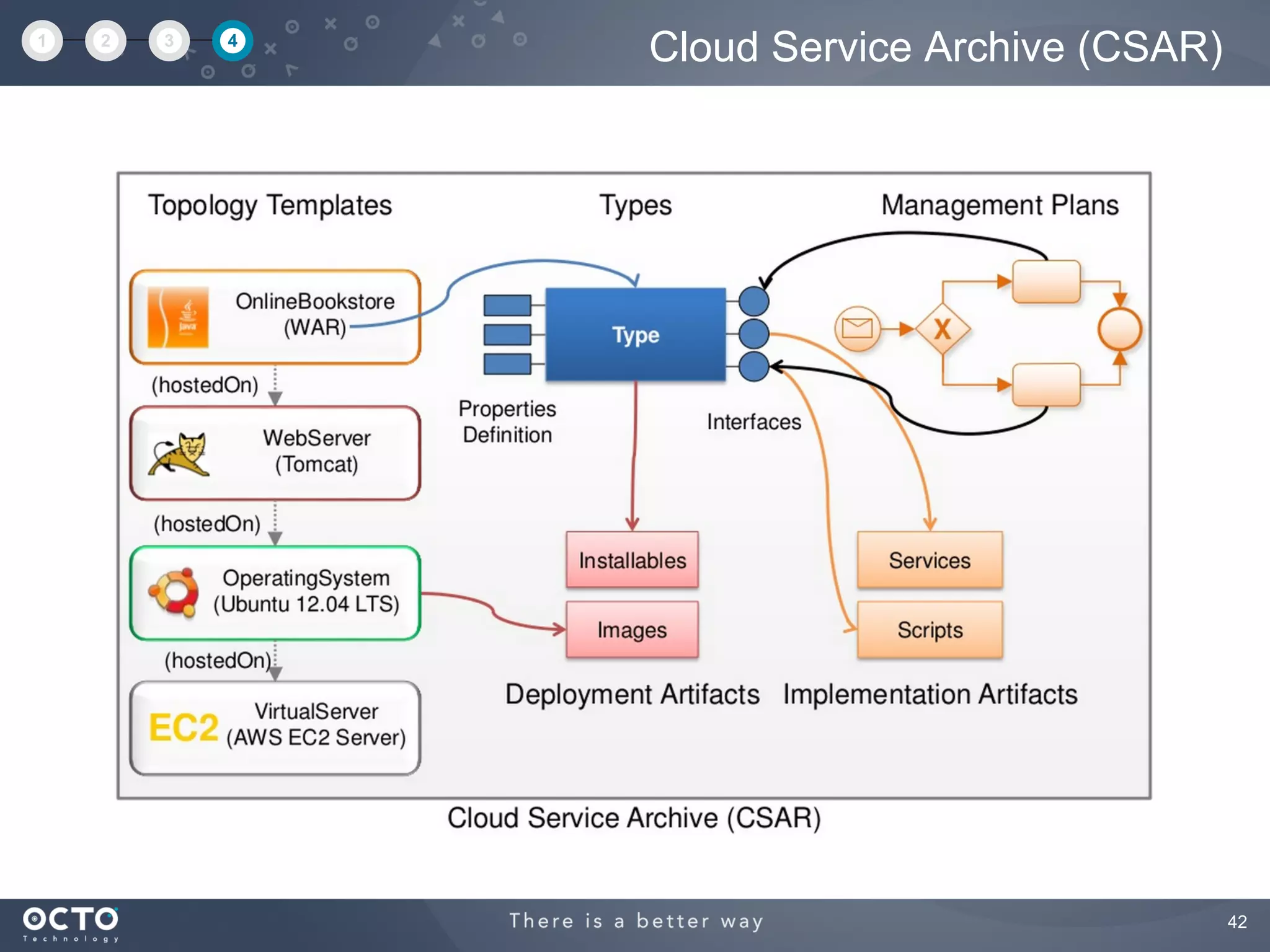
Cloud Service Archive (CSAR)1 2 3 4
43
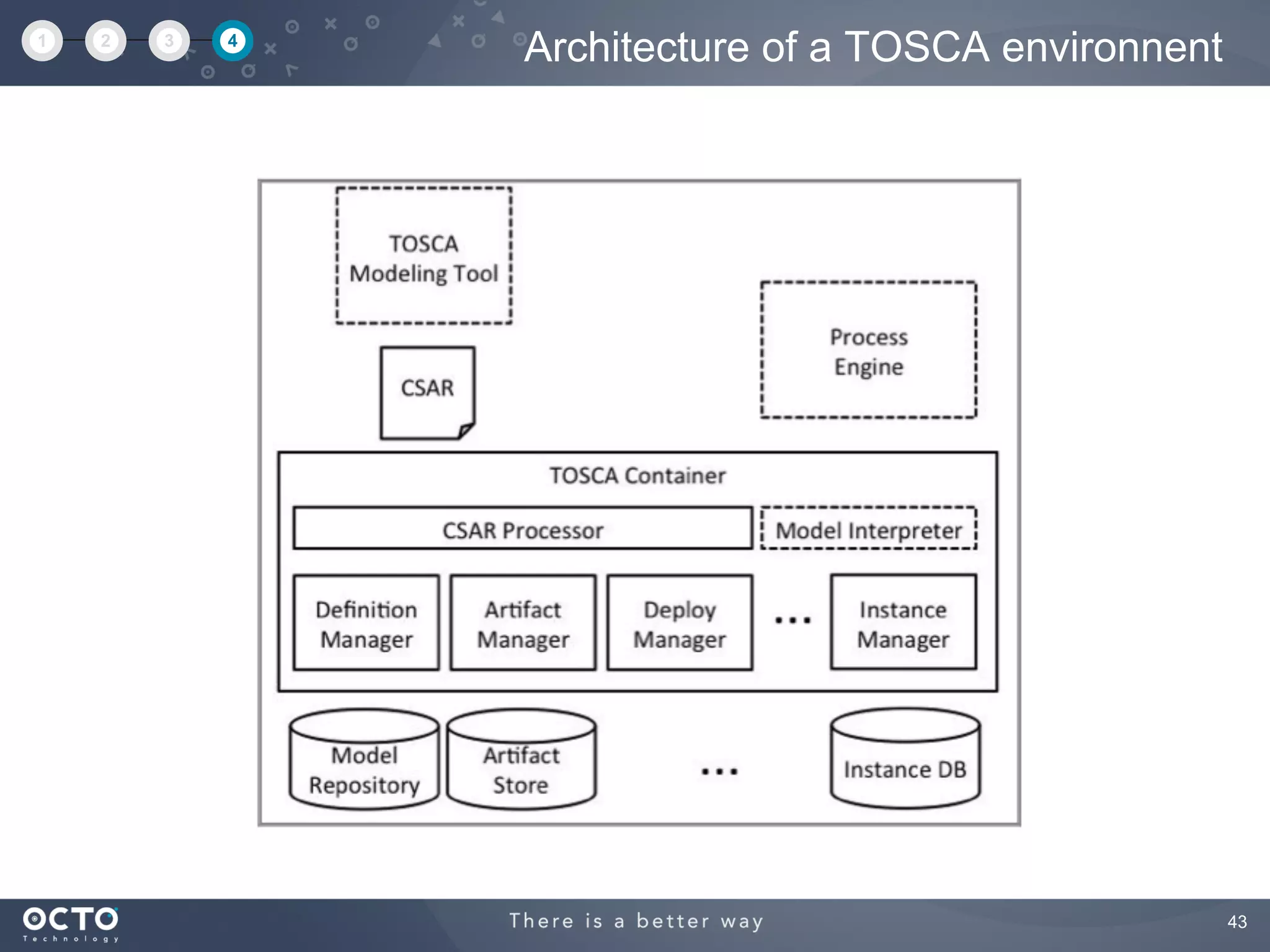
Architecture of a TOSCA environnent1 2 3 4
44
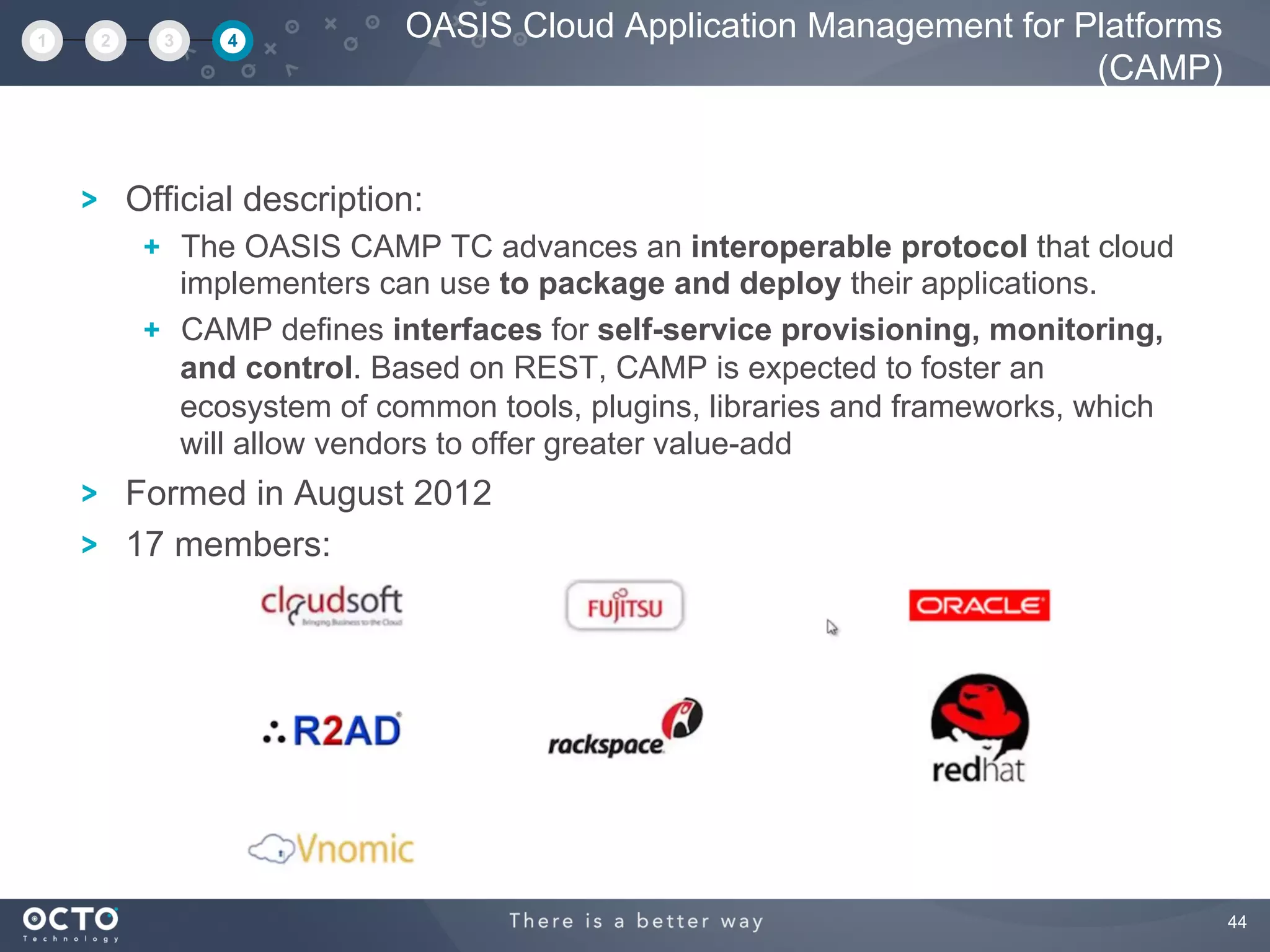
Official description:
  The OASIS CAMP TC advances an interoperable protocol that cloud
implementers can use to package and deploy their applications.
  CAMP defines interfaces for self-service provisioning, monitoring,
and control. Based on REST, CAMP is expected to foster an
ecosystem of common tools, plugins, libraries and frameworks, which
will allow vendors to offer greater value-add
Formed in August 2012
17 members:
OASIS Cloud Application Management for Platforms
(CAMP)
1 2 3 4
45
Resource Model and Interface
  RESTfull API
  JSON serialization
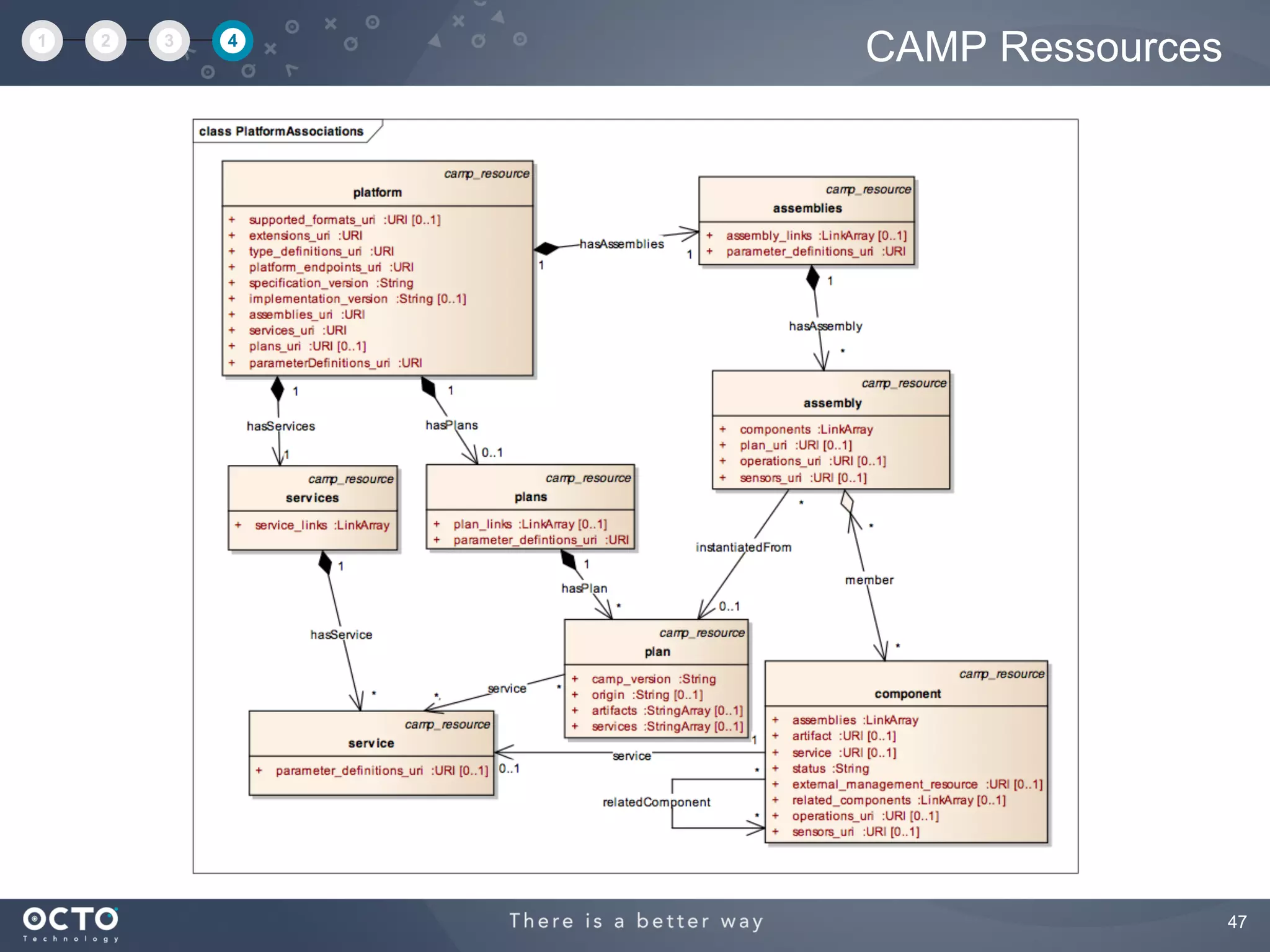
  Models applications, components, services and their relationships
  Extensible
Application description and packaging
  ZIP, TAR or TGZ
  YAML metadata
  Extensible
Language, framework and platform agnostic
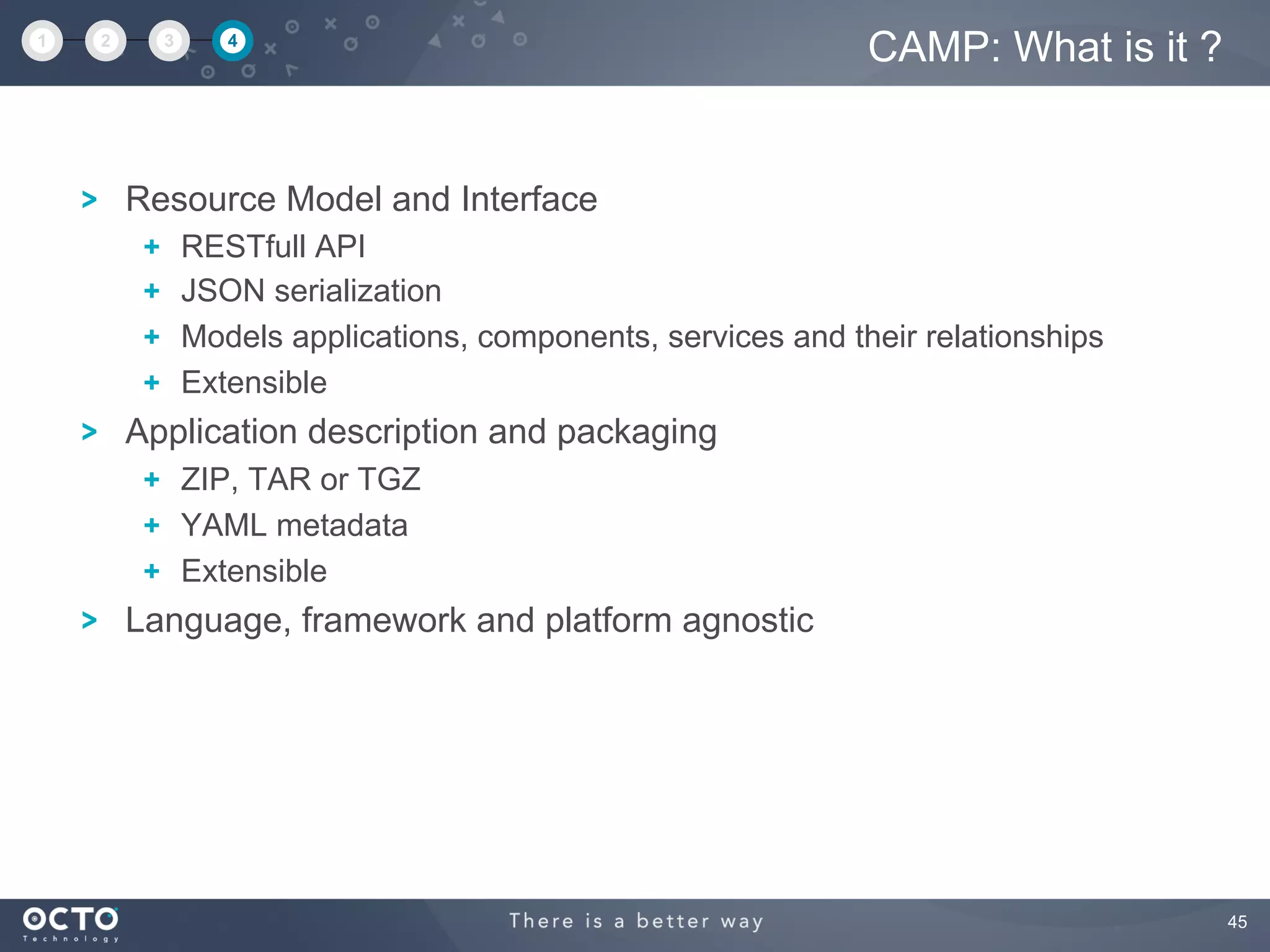
CAMP: What is it ?1 2 3 4
46
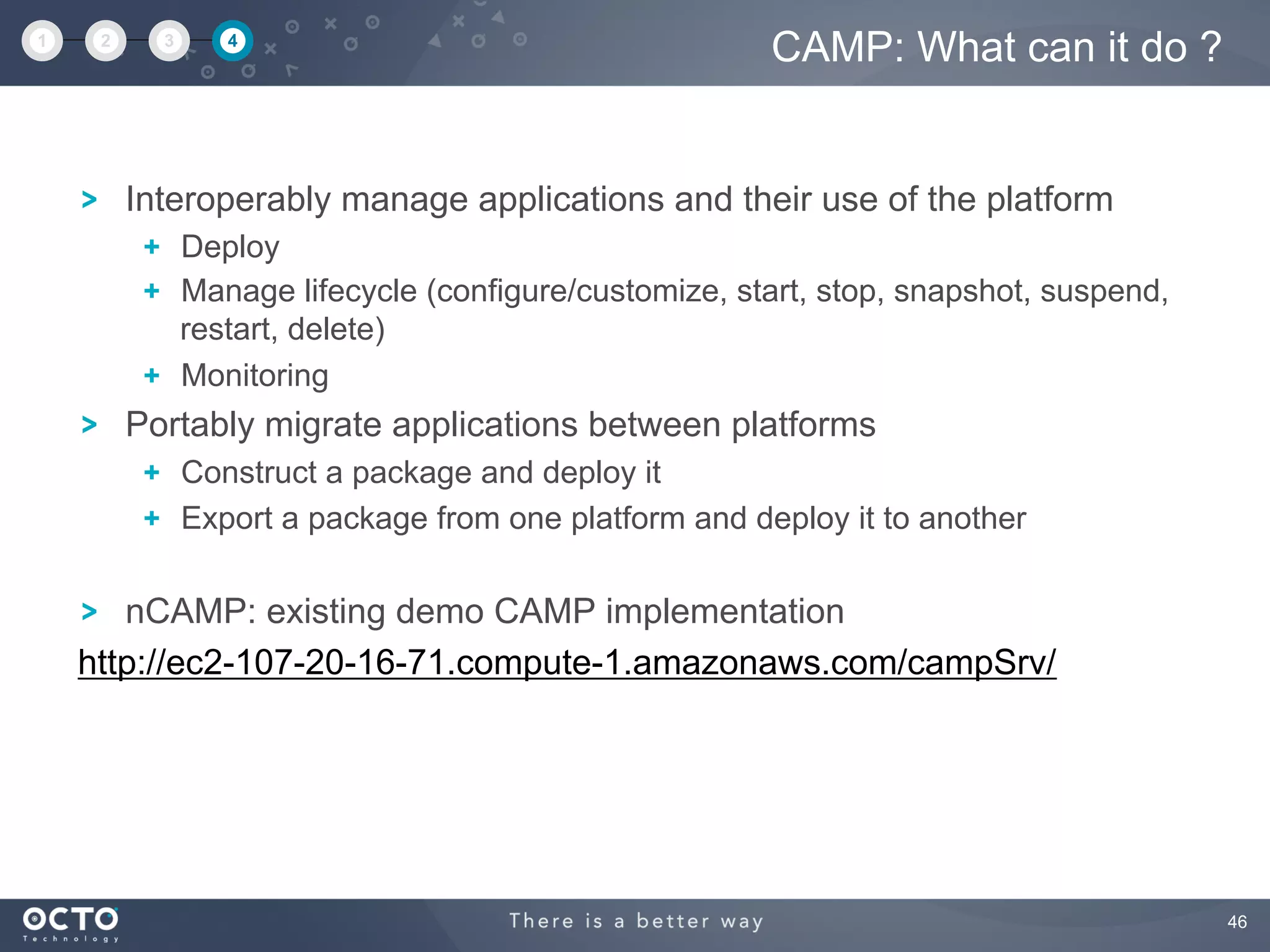
Interoperably manage applications and their use of the platform
  Deploy
  Manage lifecycle (configure/customize, start, stop, snapshot, suspend,
restart, delete)
  Monitoring
Portably migrate applications between platforms
  Construct a package and deploy it
  Export a package from one platform and deploy it to another
nCAMP: existing demo CAMP implementation
http://ec2-107-20-16-71.compute-1.amazonaws.com/campSrv/
CAMP: What can it do ?1 2 3 4
47
CAMP Ressources1 2 3 4
48
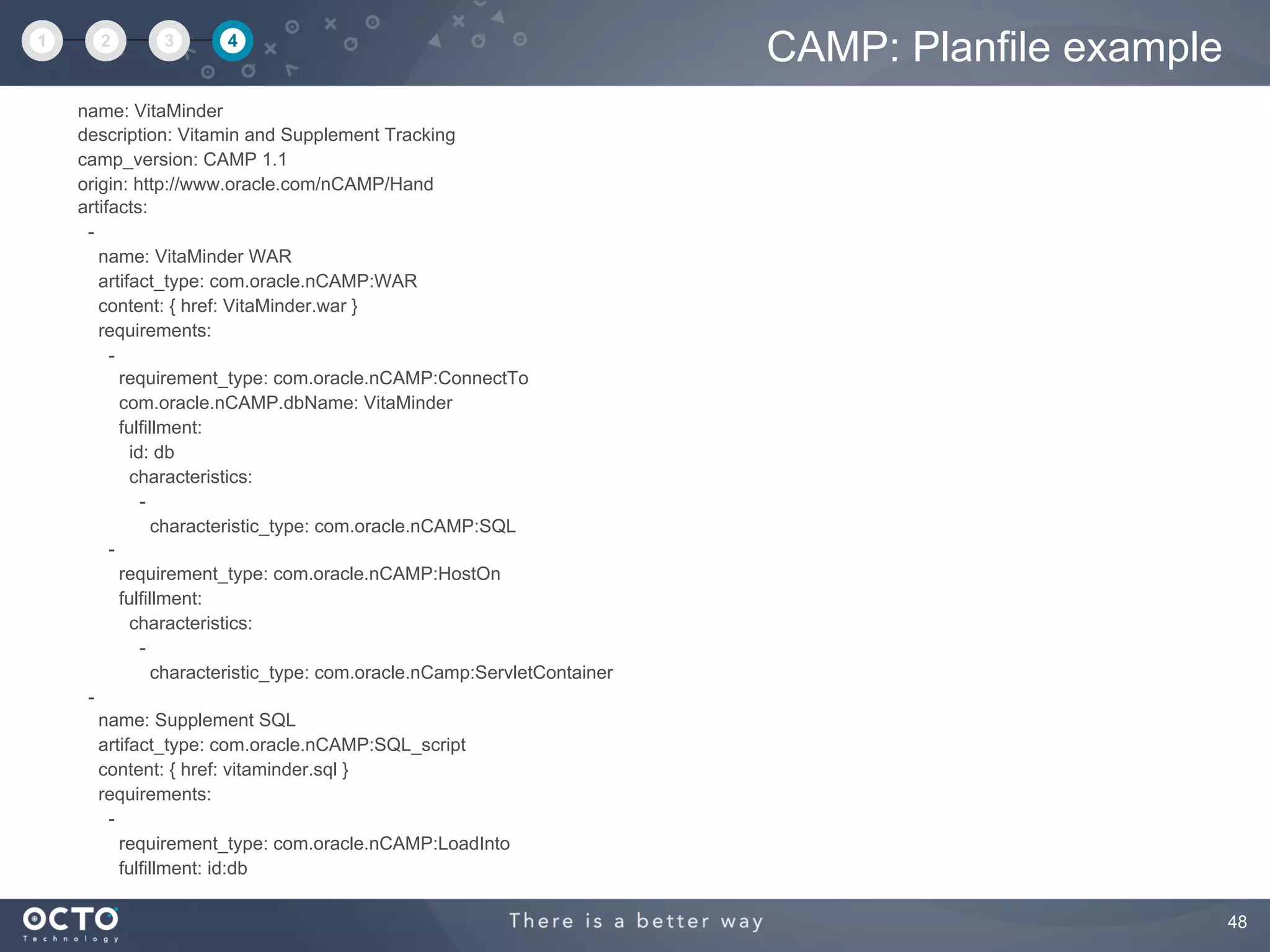
name: VitaMinder
description: Vitamin and Supplement Tracking
camp_version: CAMP 1.1
origin: http://www.oracle.com/nCAMP/Hand
artifacts:
-
name: VitaMinder WAR
artifact_type: com.oracle.nCAMP:WAR
content: { href: VitaMinder.war }
requirements:
-
requirement_type: com.oracle.nCAMP:ConnectTo
com.oracle.nCAMP.dbName: VitaMinder
fulfillment:
id: db
characteristics:
-
characteristic_type: com.oracle.nCAMP:SQL
-
requirement_type: com.oracle.nCAMP:HostOn
fulfillment:
characteristics:
-
characteristic_type: com.oracle.nCamp:ServletContainer
-
name: Supplement SQL
artifact_type: com.oracle.nCAMP:SQL_script
content: { href: vitaminder.sql }
requirements:
-
requirement_type: com.oracle.nCAMP:LoadInto
fulfillment: id:db
CAMP: Planfile example1 2 3 4
49
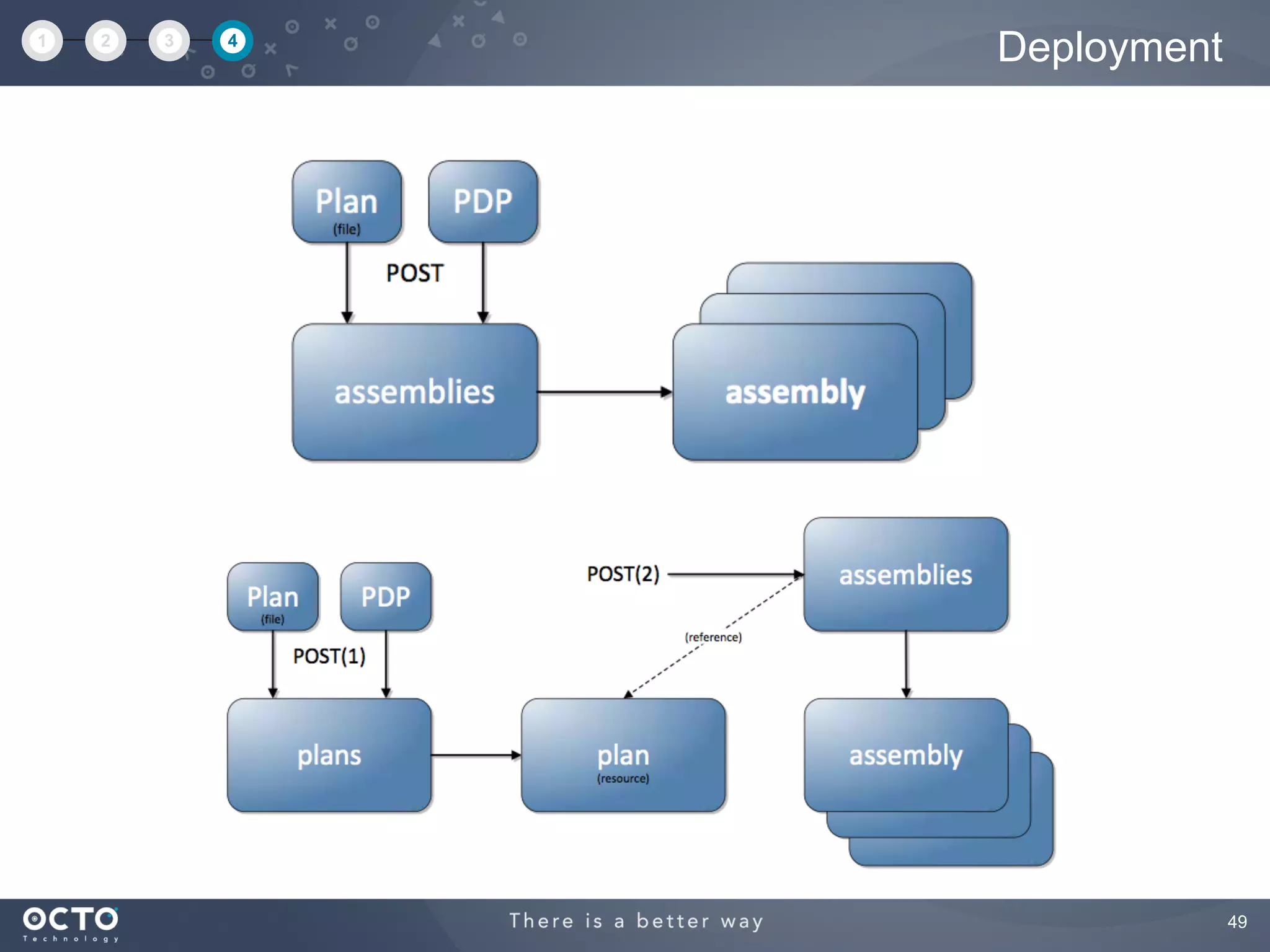
Deployment1 2 3 4
50
Technologies1 2 3 4 5
51
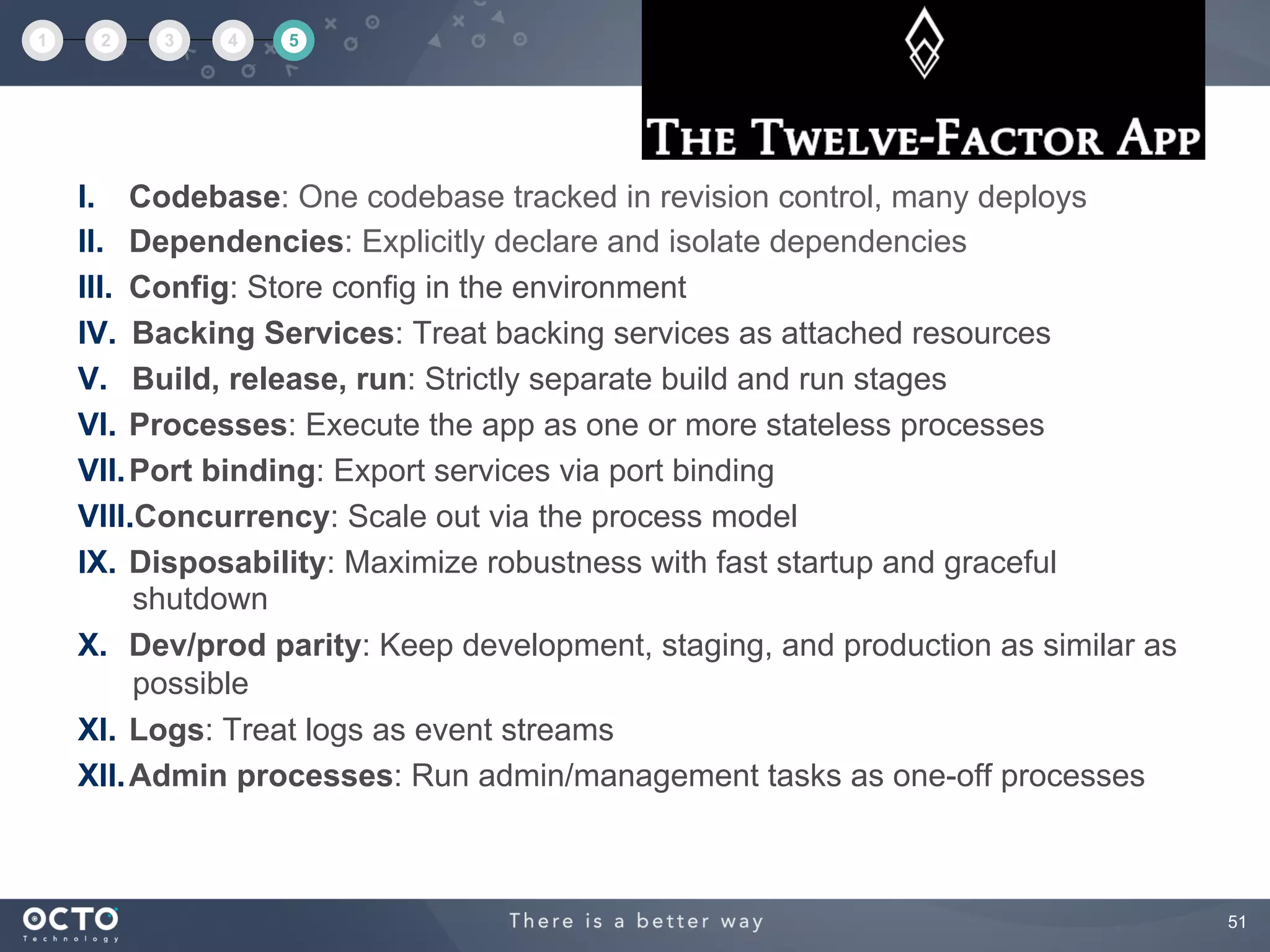
I.  Codebase: One codebase tracked in revision control, many deploys
II.  Dependencies: Explicitly declare and isolate dependencies
III.  Config: Store config in the environment
IV.  Backing Services: Treat backing services as attached resources
V.  Build, release, run: Strictly separate build and run stages
VI.  Processes: Execute the app as one or more stateless processes
VII. Port binding: Export services via port binding
VIII. Concurrency: Scale out via the process model
IX.  Disposability: Maximize robustness with fast startup and graceful
shutdown
X.  Dev/prod parity: Keep development, staging, and production as similar as
possible
XI.  Logs: Treat logs as event streams
XII. Admin processes: Run admin/management tasks as one-off processes
1 2 3 4 5
52
1 2 3 4 5
53
1 2 3 4 5
54
1 2 3 4 5
55
Docker containers orchestration
Using a configuration file
Used with Orchard (CaaS solution)
Bought by Docker in July 2014.
1 2 3 4 5
56
libswarm is a toolkit for composing network services.
It defines a standard interface for services in a distributed system to
communicate with each other. This lets you:
  Compose complex architectures from reusable building blocks
  Avoid vendor lock-in by swapping any service out with another
1 2 3 4 5
57
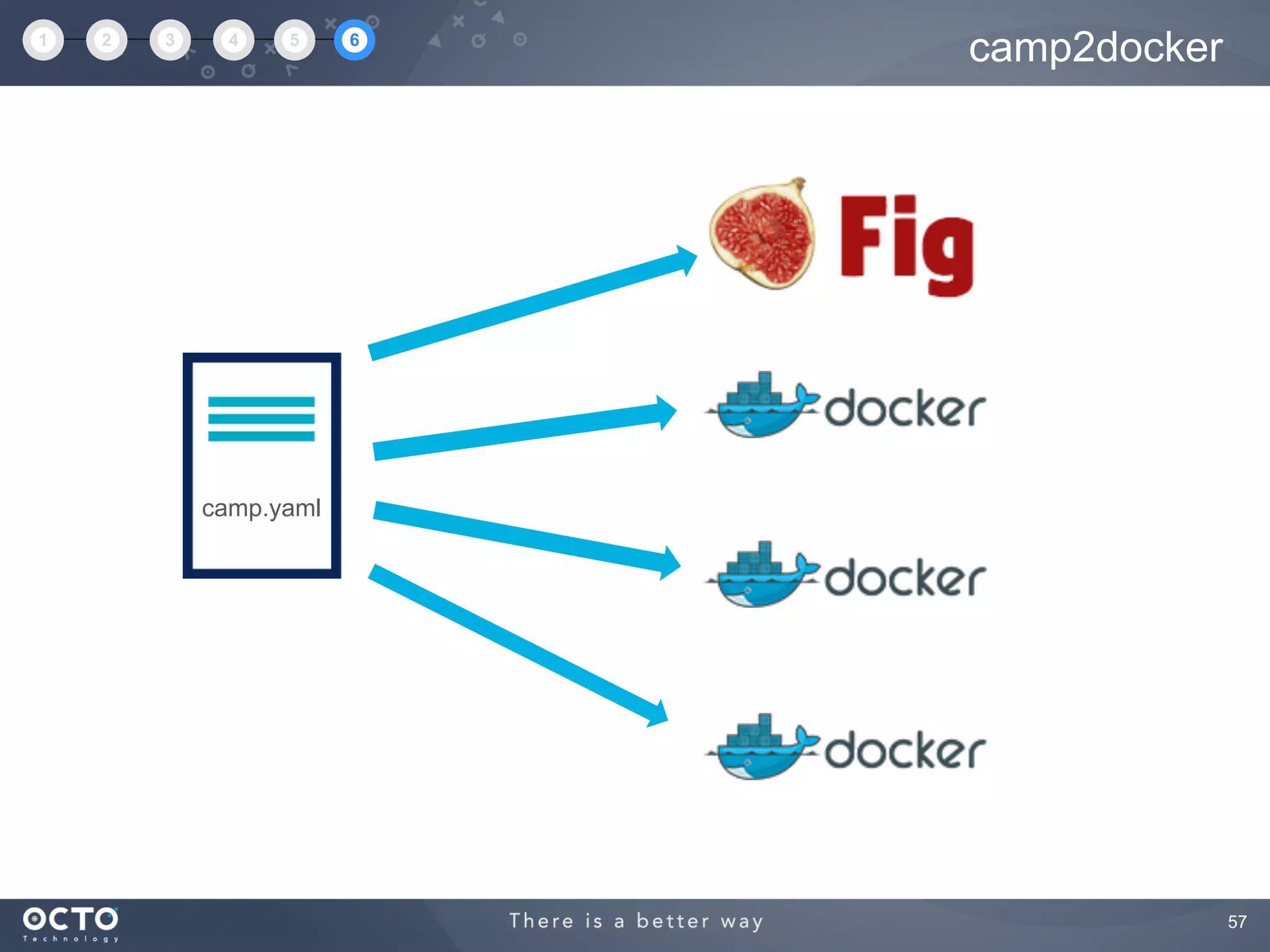
camp2docker1 2 3 4 5 6
camp.yaml
58
59
BACKUP
60
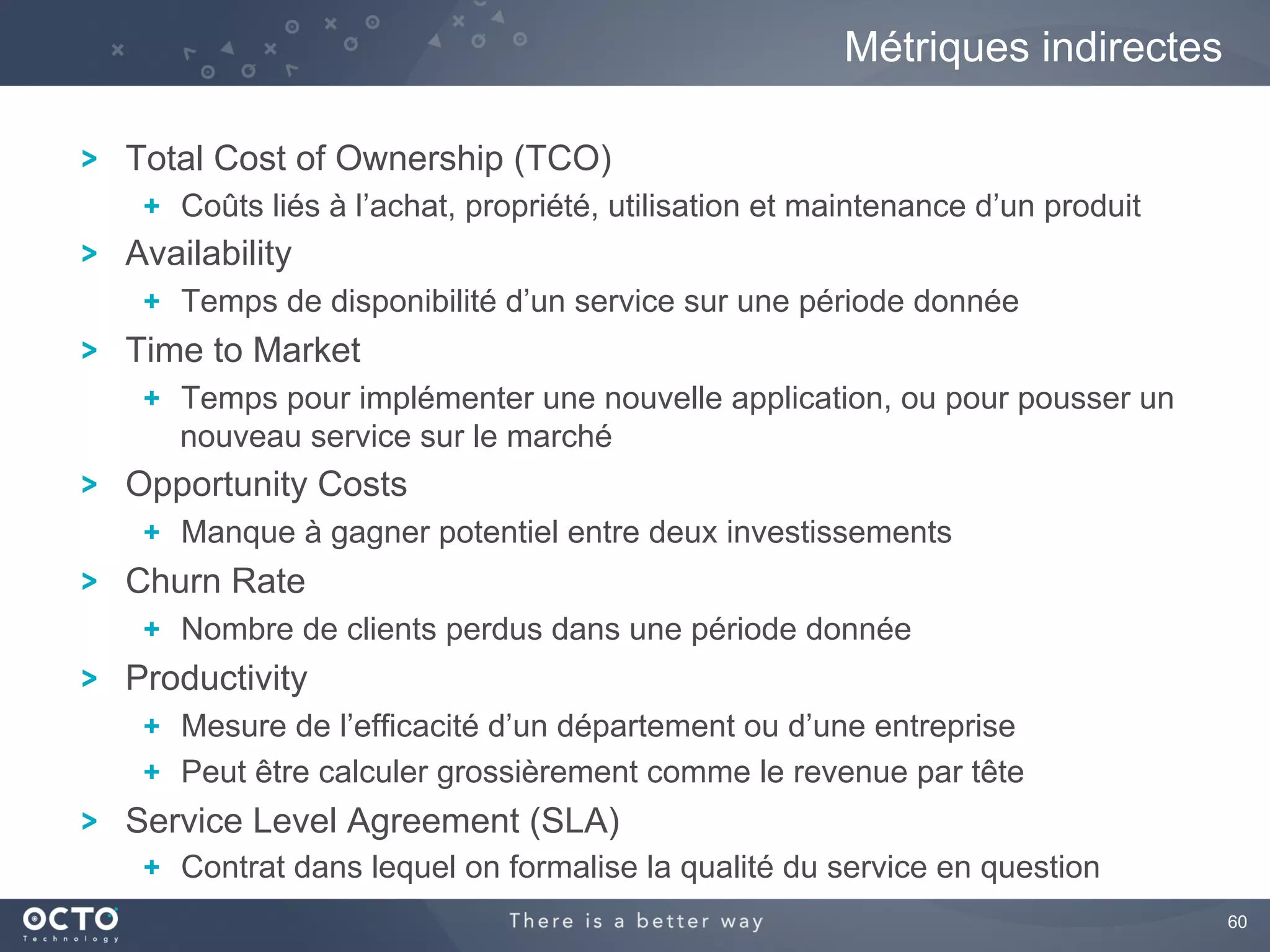
Total Cost of Ownership (TCO)
  Coûts liés à l’achat, propriété, utilisation et maintenance d’un produit
Availability
  Temps de disponibilité d’un service sur une période donnée
Time to Market
  Temps pour implémenter une nouvelle application, ou pour pousser un
nouveau service sur le marché
Opportunity Costs
  Manque à gagner potentiel entre deux investissements
Churn Rate
  Nombre de clients perdus dans une période donnée
Productivity
  Mesure de l’efficacité d’un département ou d’une entreprise
  Peut être calculer grossièrement comme le revenue par tête
Service Level Agreement (SLA)
  Contrat dans lequel on formalise la qualité du service en question
Métriques indirectes
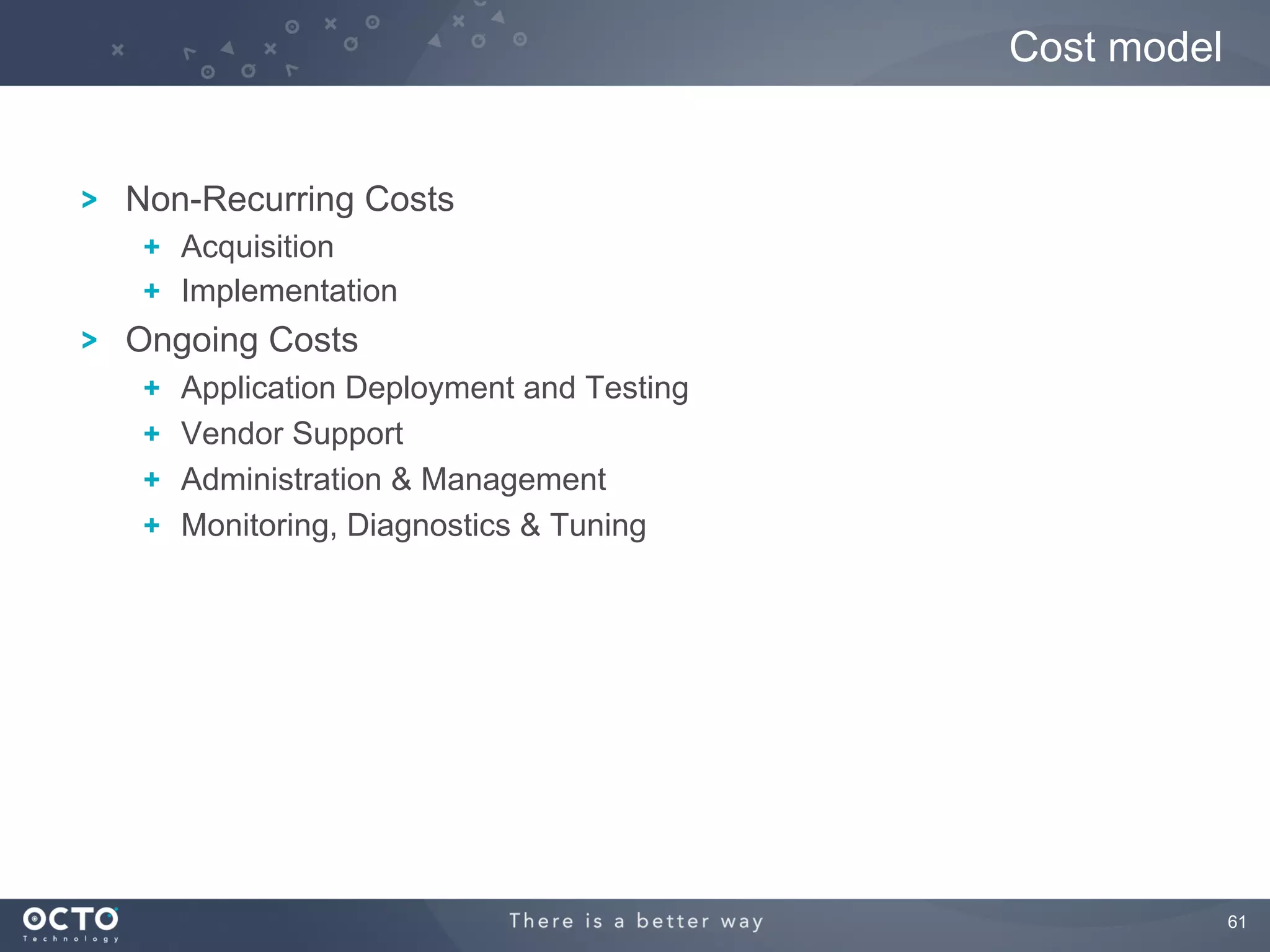
61
Non-Recurring Costs
  Acquisition
  Implementation
Ongoing Costs
  Application Deployment and Testing
  Vendor Support
  Administration & Management
  Monitoring, Diagnostics & Tuning
Cost model
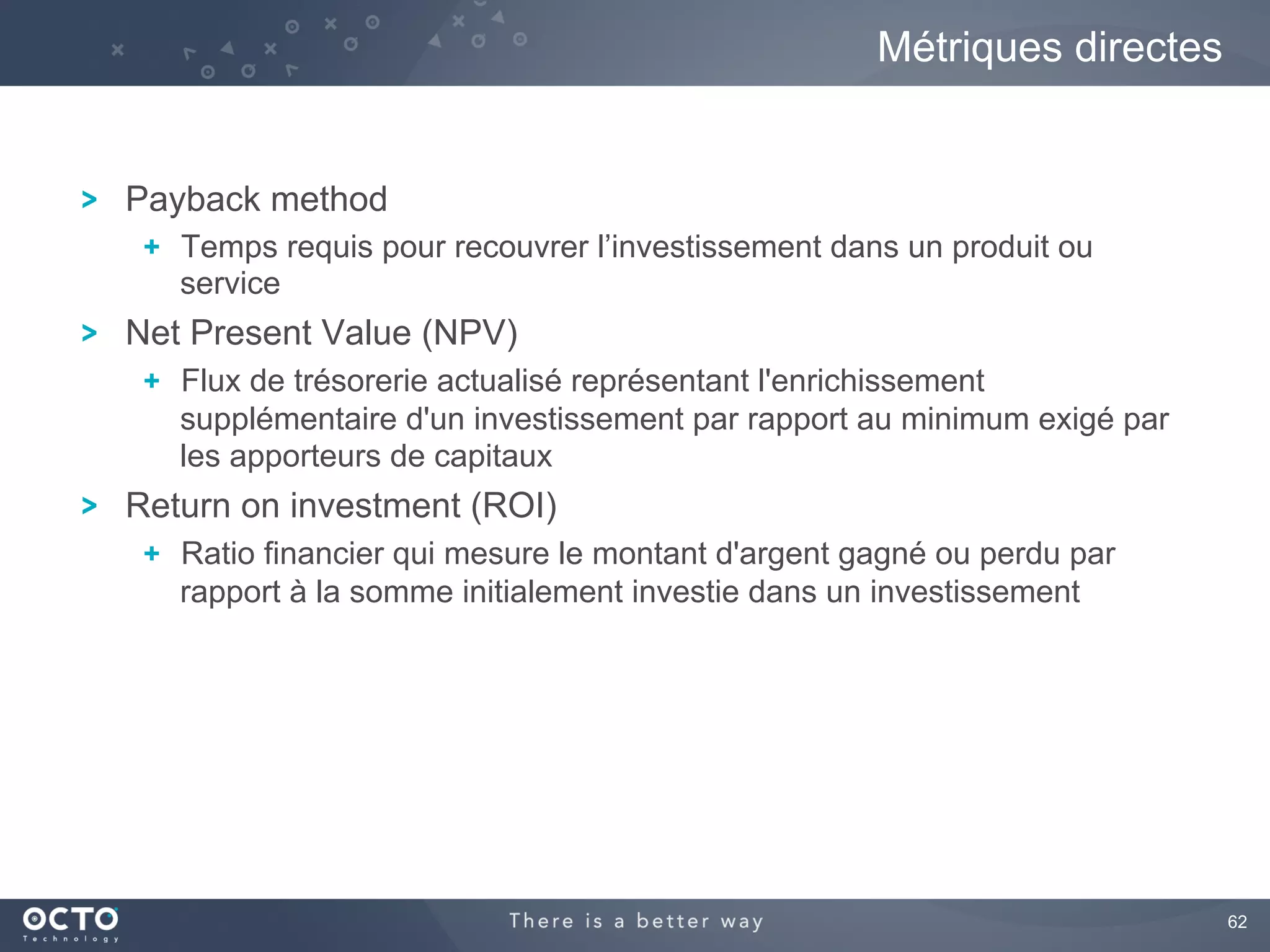
62
Payback method
  Temps requis pour recouvrer l’investissement dans un produit ou
service
Net Present Value (NPV)
  Flux de trésorerie actualisé représentant l'enrichissement
supplémentaire d'un investissement par rapport au minimum exigé par
les apporteurs de capitaux
Return on investment (ROI)
  Ratio financier qui mesure le montant d'argent gagné ou perdu par
rapport à la somme initialement investie dans un investissement
Métriques directes

Docker meetup - PaaS interoperability

  • 1.
    1 Tél : +33(0)1 58 56 10 00 Fax : +33 (0)1 58 56 10 01 www.octo.com© OCTO 2013 50, avenue des Champs-Elysées 75008 Paris - FRANCE PaaS Interoperability Thomas Lacroix & Ludovic Piot
  • 2.
    2 Agenda CONTEXT AND PROJECT1 CLOUDCOMPUTING AND PAAS2 STANDARDIZATION4 INTEROPERABILITY, PORTABILITY3 TECHNOLOGIES5 CAMP2DOCKER6
  • 3.
  • 4.
    4 Architecture and implementation ofan interoperable PaaS solution Project ‘‘ ’’Considering the:   technical dimension: standard and technology study, architecture, implementation   economical dimension: pricing, business model, economic impact of interoperability and standardization 1
  • 5.
    5 Cloud computing1 2 OpEx is the New CapEx *Operation expenditure ** Capital expenditure * **
  • 6.
    6 Definition1 2 Cloud computingis a model for enabling •  ubiquitous •  convenient •  on-demand network access to a shared pool of configurable computing resources •  networks •  servers •  storage •  applications •  services that can be rapidly •  provisioned •  released with minimal •  management effort •  service provider interaction
  • 7.
    7 Models CHARACTERISTICS Public Private Hybrid DEPLOYMENT 1 2 On-demand self-service Broadnetwork access Resource pooling Rapid elasticity Measured service
  • 8.
    8 PaaS The capability providedto the consumer is to deploy onto the cloud infrastructure consumer-created or acquired applications created using programming languages and tools supported by the provider. The consumer does not manage or control the underlying cloud infrastructure including network, servers, operating systems, or storage, but has control over the deployed applications and possibly application hosting environment configurations ‘‘ ’’ 1 2
  • 9.
    9 Agility and time-to-marketOperational simplicity Expertise Trade-offs between CapEx et OpEx PaaS Benefits1 2
  • 10.
  • 11.
    11 Market study Magic Quadrantfor Enterprise Application Platform as a Service Magic Quadrant for On-Premises Application Platforms 1 2
  • 12.
  • 13.
  • 14.
    14 $ curl -sSLhttp://deis.io/deisctl/install.sh | sudo sh $ git clone https://github.com/deis/deis.git $ export DEIS_NUM_INSTANCES=3 $ cd deis $ make discovery-url $ vagrant up $ ssh-add ~/.vagrant.d/insecure_private_key $ export DEISCTL_TUNNEL=172.17.8.100 $ deisctl install platform $ deisctl start platform $ pip install ./client/ $ deis register http://deis.local3.deisapp.com $ deis keys:add Provisionning1 2
  • 15.
    15 $ deis clusters:createdev local3.deisapp.com # create a cluster --hosts=172.17.8.100,172.17.8.101,172.17.8.102 --auth=~/.vagrant.d/insecure_private_key $ git clone https://github.com/deis/example-ruby-sinatra.git $ cd example-ruby-sinatra $ deis create Creating application... done, created lambda-hawthorn Git remote deis added Deploying onto1 2
  • 16.
    16 $ git pushdeis master Counting objects: 92, done. Delta compression using up to 4 threads. Compressing objects: 100% (87/87), done. Writing objects: 100% (92/92), 19.29 KiB | 0 bytes/s, done. Total 92 (delta 40), reused 0 (delta 0) -----> Ruby app detected -----> Compiling Ruby/Rack -----> Using Ruby version: ruby-1.9.3 -----> Installing dependencies using 1.5.2 Running: bundle install --without development:test ... -----> Discovering process types Procfile declares types -> web Default process types for Ruby -> rake, console, web -----> Compiled slug size is 12M -----> Building Docker image Uploading context 11.81 MB … Deploying onto1 2 Step 3 : ENTRYPOINT ["/runner/init"] ---> Running in 94eb867135db ---> f49031ecd6c1 Successfully built f49031ecd6c1 -----> Pushing image to private registry Launching... done, v2 -----> lambda-hawthorn deployed to Deis http://lambda- hawthorn.local3.deisapp.com To learn more, use `deis help` or visit http://deis.io To ssh://git@local3.deisapp.com:2222/lambda- hawthorn.git * [new branch] master -> master
  • 17.
    17 $ curl -shttp://lambda-hawthorn.local3.deisapp.com Powered by Deis! Running onto1 2
  • 18.
    18 $ deis scaleweb=4 Scaling containers... but first, coffee! done in 12s Scaling out with1 2
  • 19.
  • 20.
  • 21.
  • 22.
  • 23.
    23 Pricing: Google AppEngine Computing Units Database Search 1 2
  • 24.
    24 Use Case CloudComputing Discussion Group:   « the ability to write code that works with more than one Cloud provider simultaneously, regardless of the differences between the providers » Cohen:   « Cloud computing interoperability is the ability for multiple Cloud providers to work together* or interoperate, whereas Cloud portability is the ability of data and application components to be easily moved and reused regardless of the provider, operating system, storage, format or API » Goyal:   * including « process execution, security, migration/cloning control, standards, transparency, and manageability and regulatory compliance » Definitions of Cloud computing interoperability1 2 3
  • 25.
    25 Distributed Computing ReferenceModel http://www.opengroup.org/cloud/cloud/cloud_iop/dcrm.htm Categories of portability and interoperability   Data Portability   Application Portability   Platform Portability   Application Interoperability   Platform Interoperability   Management Interoperability   Publication and Acquisition Interoperability 1 2 3
  • 26.
  • 27.
  • 28.
  • 29.
  • 30.
  • 31.
    31 The standardization initiativesseem to rotate around three key enablers for tackling Cloud computing interoperability.   a standardized API/interface and a common management model   a common data model/semantic   the utilization of a marketplace/broker Approaches1 2 3 4
  • 32.
  • 33.
    33 Official description:   TheOASIS TOSCA TC works to enhance the portability of cloud applications and services.   TOSCA will enable the interoperable description of application and infrastructure cloud services, the relationships between parts of the service, and the operational behavior of these services (e.g., deploy, patch, shutdown)--independent of the supplier creating the service, and any particular cloud provider or hosting technology. Formed in January 2012 OASIS Topology and Orchestration Specification for Cloud Applications (TOSCA) 1 2 3 4
  • 34.
  • 35.
    35 Standardizes the languageto describe   The infrastructure of an IT Service (the topology)   How to orchestrate operational behaviour (plans such as build, deploy, patch, shutdown, etc.) Declarative model that spans applications, virtual and physical infrastructure TOSCA: What is it ?1 2 3 4
  • 36.
  • 37.
  • 38.
  • 39.
  • 40.
  • 41.
    41 Declarative -> What?   « I want this, realize it ! »   Runtime interprets topology and does deployment Imperative -> How ?   « First do this, then do that »   Management plan explicitly describes each step Orchestration1 2 3 4
  • 42.
  • 43.
    43 Architecture of aTOSCA environnent1 2 3 4
  • 44.
    44 Official description:   TheOASIS CAMP TC advances an interoperable protocol that cloud implementers can use to package and deploy their applications.   CAMP defines interfaces for self-service provisioning, monitoring, and control. Based on REST, CAMP is expected to foster an ecosystem of common tools, plugins, libraries and frameworks, which will allow vendors to offer greater value-add Formed in August 2012 17 members: OASIS Cloud Application Management for Platforms (CAMP) 1 2 3 4
  • 45.
    45 Resource Model andInterface   RESTfull API   JSON serialization   Models applications, components, services and their relationships   Extensible Application description and packaging   ZIP, TAR or TGZ   YAML metadata   Extensible Language, framework and platform agnostic CAMP: What is it ?1 2 3 4
  • 46.
    46 Interoperably manage applicationsand their use of the platform   Deploy   Manage lifecycle (configure/customize, start, stop, snapshot, suspend, restart, delete)   Monitoring Portably migrate applications between platforms   Construct a package and deploy it   Export a package from one platform and deploy it to another nCAMP: existing demo CAMP implementation http://ec2-107-20-16-71.compute-1.amazonaws.com/campSrv/ CAMP: What can it do ?1 2 3 4
  • 47.
  • 48.
    48 name: VitaMinder description: Vitaminand Supplement Tracking camp_version: CAMP 1.1 origin: http://www.oracle.com/nCAMP/Hand artifacts: - name: VitaMinder WAR artifact_type: com.oracle.nCAMP:WAR content: { href: VitaMinder.war } requirements: - requirement_type: com.oracle.nCAMP:ConnectTo com.oracle.nCAMP.dbName: VitaMinder fulfillment: id: db characteristics: - characteristic_type: com.oracle.nCAMP:SQL - requirement_type: com.oracle.nCAMP:HostOn fulfillment: characteristics: - characteristic_type: com.oracle.nCamp:ServletContainer - name: Supplement SQL artifact_type: com.oracle.nCAMP:SQL_script content: { href: vitaminder.sql } requirements: - requirement_type: com.oracle.nCAMP:LoadInto fulfillment: id:db CAMP: Planfile example1 2 3 4
  • 49.
  • 50.
  • 51.
    51 I.  Codebase: Onecodebase tracked in revision control, many deploys II.  Dependencies: Explicitly declare and isolate dependencies III.  Config: Store config in the environment IV.  Backing Services: Treat backing services as attached resources V.  Build, release, run: Strictly separate build and run stages VI.  Processes: Execute the app as one or more stateless processes VII. Port binding: Export services via port binding VIII. Concurrency: Scale out via the process model IX.  Disposability: Maximize robustness with fast startup and graceful shutdown X.  Dev/prod parity: Keep development, staging, and production as similar as possible XI.  Logs: Treat logs as event streams XII. Admin processes: Run admin/management tasks as one-off processes 1 2 3 4 5
  • 52.
  • 53.
  • 54.
  • 55.
    55 Docker containers orchestration Usinga configuration file Used with Orchard (CaaS solution) Bought by Docker in July 2014. 1 2 3 4 5
  • 56.
    56 libswarm is atoolkit for composing network services. It defines a standard interface for services in a distributed system to communicate with each other. This lets you:   Compose complex architectures from reusable building blocks   Avoid vendor lock-in by swapping any service out with another 1 2 3 4 5
  • 57.
    57 camp2docker1 2 34 5 6 camp.yaml
  • 58.
  • 59.
  • 60.
    60 Total Cost ofOwnership (TCO)   Coûts liés à l’achat, propriété, utilisation et maintenance d’un produit Availability   Temps de disponibilité d’un service sur une période donnée Time to Market   Temps pour implémenter une nouvelle application, ou pour pousser un nouveau service sur le marché Opportunity Costs   Manque à gagner potentiel entre deux investissements Churn Rate   Nombre de clients perdus dans une période donnée Productivity   Mesure de l’efficacité d’un département ou d’une entreprise   Peut être calculer grossièrement comme le revenue par tête Service Level Agreement (SLA)   Contrat dans lequel on formalise la qualité du service en question Métriques indirectes
  • 61.
    61 Non-Recurring Costs   Acquisition  Implementation Ongoing Costs   Application Deployment and Testing   Vendor Support   Administration & Management   Monitoring, Diagnostics & Tuning Cost model
  • 62.
    62 Payback method   Tempsrequis pour recouvrer l’investissement dans un produit ou service Net Present Value (NPV)   Flux de trésorerie actualisé représentant l'enrichissement supplémentaire d'un investissement par rapport au minimum exigé par les apporteurs de capitaux Return on investment (ROI)   Ratio financier qui mesure le montant d'argent gagné ou perdu par rapport à la somme initialement investie dans un investissement Métriques directes