MOOCs Grow Up
But Are They Fulfilling Their Original Promise?
technologies that corporations need talent
in.” In fields where learning objectives
are measurable, he says, “we might see
some increase in recruiting directly from
MOOC participants, as well.”
The following looks at how MOOCs
have developed since 2012 and where
they may be headed in coming years.
The Evolution Of MOOCs
History tells us the term “MOOC”
first emerged from a 2008 non-
credit “Connectivism and Connective
Knowledge” course the University of
Manitoba offered on campus but that
2,200 online students also enrolled in
for free. In 2011, Stanford professors
Sebastian Thrun (also founder of Google
MOOC supporters counter that
although completion rates are low, they
aren’t necessarily the best means for
judging the worth of MOOCs. Advocates
argue MOOCs are still young, and
many students who have taken them
have realized real career and educational
benefits, especially students in developing
countries with less education and a lower
socioeconomic status.
Something most people seemingly
agree on is that MOOCs have great
potential to help students learn the skills
that companies are currently seeking. As
Merrill Cook, founder of Online Course
Report (www.onlinecoursereport.com),
says, “MOOCs will be continually used
to bolster interest and expertise in core
In 2012, when Udacity, Coursera, and
edX launched platforms for providing
MOOCs (massive open online courses),
there was talk MOOCs had the potential
to radically disrupt the traditional higher
learning university system. Providing
anyone, no matter their location or
socioeconomic status, with free access to
the same course curriculum taught on
campus at Harvard, MIT, Stanford, and
other top universities was seen as a great
educational equalizer. All students needed
to enroll was the motivation and an
Internet connection.
Fast-forward to 2016, and MOOCs
have made a significant impact on
learning, and there’s even been progress
in terms of students receiving university
credits for completing MOOCs. Still,
although enrollments have reached into
the tens of millions, studies indicate
only about 4 to 5% of those who enroll
in MOOCs actually complete them.
Further, rather than democratizing access
to higher education, for the most part,
the primary users of MOOCs have been
affluent people who already hold degrees.
Such developments have produced rifts
within the education community.
MOOC detractors suggest that
in addition to cheap access to higher
learning largely failing to serve the
disadvantaged, low completion rates
for MOOCs indicate students are less
motivated when not on campus where
instructor and peer support is more
readily available. As Aldemaro Romero
Jr., Ph. D, former dean of the College
of Arts and Sciences at Southern Illinois
University, Edwardsville, says, “There’s
no real substitute for one-on-one
teaching when done by good professors,
especially when it comes to the traditional
population age of college students, 18 to
24 years old.”
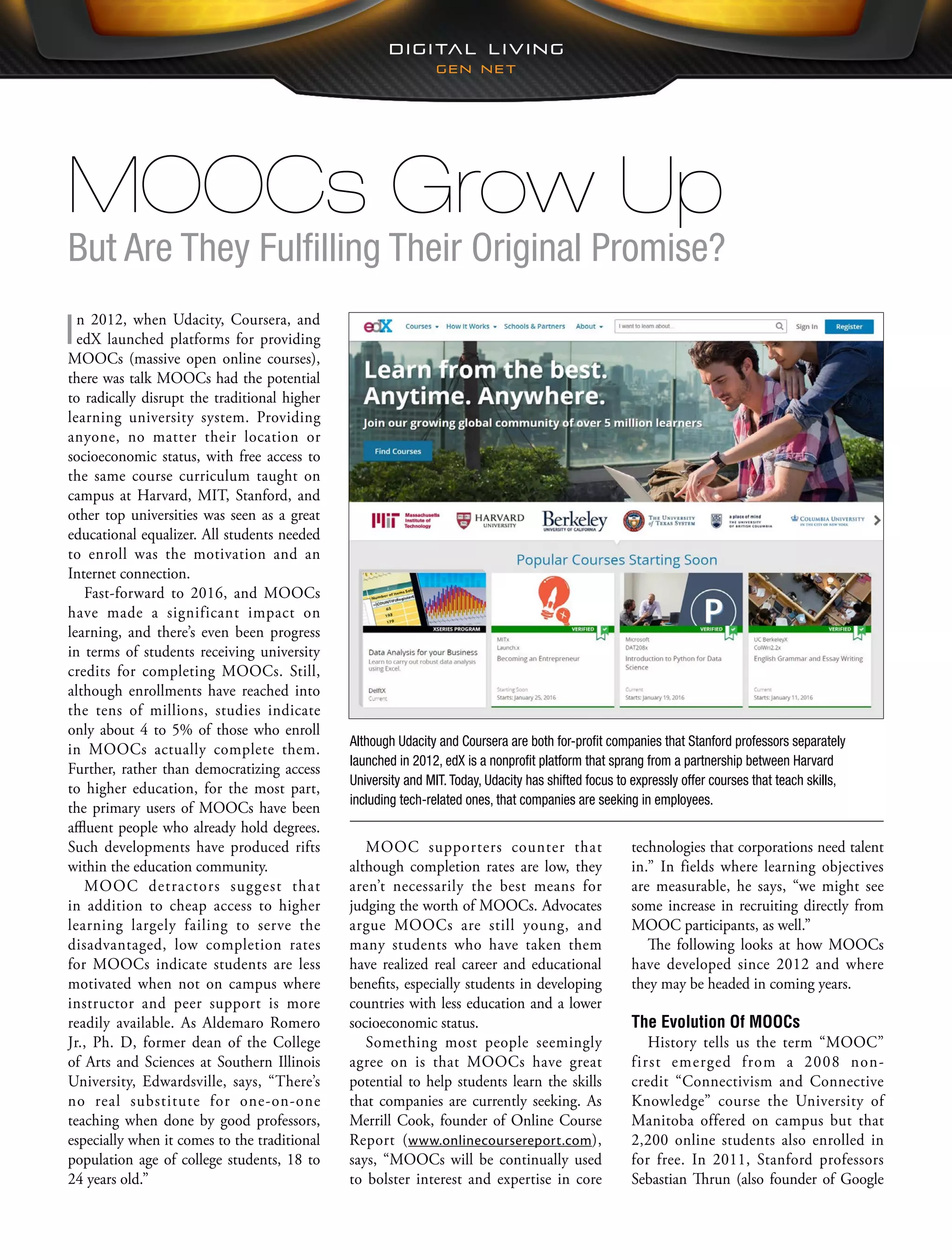
Although Udacity and Coursera are both for-profit companies that Stanford professors separately
launched in 2012, edX is a nonprofit platform that sprang from a partnership between Harvard
University and MIT. Today, Udacity has shifted focus to expressly offer courses that teach skills,
including tech-related ones, that companies are seeking in employees.
educators becoming less interested
in “massiveness” and more focused on
engagement and outcomes, there’s been a
huge increase in the number and variety
of online learning options overall, “no
matter what you call them.” CourseTalk
catalogs 40,000-plus online classes from
more than 65 providers. “To get a sense
for the vast spectrum of topics covered,
just look at our 10 highest-rated courses,”
he says. “They range from programming
to astronomy, accounting, and beyond.”
Loonam also notes MOOCs have
progressed from consisting of simple
lectures posted online to fully interactive
experiences with discussions, assessments,
real-world assignments, and more.
Interactivity is a common reason students
rate courses highly at CourseTalk, he says.
Oakley says although many MOOCs still
use approaches that don’t fully utilize the
power of MOOCs (talking heads with
bullet points, for example), a few breakout
annual growth rate of 46% from 2015 to
2019.
Barbara Oakley, Ph. D., an Oakland
University engineering professor and co-
instructor of “Learning How To Learn,”
which Online Course Report ranks the
most popular MOOC of all time with 1.2
million-plus students enrolled, says one
way MOOCs have evolved since 2012 is
that there are now a lot of them (“some
4,200”) and enrollments are accelerating.
Class Central states enrollments from
2014 to 2015 doubled to 35 million.
That’s still a tiny percentage of potential
“MOOCers,” Oakley says. Many people
who could most enjoy and benefit from
MOOCs “haven’t even heard of the
term,” she says.
Similarly, Don Loonam, CEO of
CourseTalk (www.coursetalk.com), a
review site for online learning providers,
says while the term MOOC has lost some
relevancy over the years due to online
X) and Peter Norvig (now director
of Google Research) created “The
Introduction to AI” MOOC, which
160,000 students enrolled in. About
the same time, fellow Stanford professor
Andrew Ng created a “Machine Learning”
MOOC, which about 1.1 million
students have enrolled in to date.
In 2012, Thrun founded Udacity,
while Ng (now chief scientist of Baidu)
and Stanford colleague Daphne Koller
co-founded Coursera. Both for-profit
companies went about working with
universities to design MOOCs for their
respective platforms. Later in 2012,
Harvard University and MIT partnered to
create edX, a nonprofit open platform for
MOOCs. Today, Coursera is considered
the leading MOOC provider, accounting
for reportedly about half of all MOOC
student enrollments. Overall, the entire
MOOC market is thriving. Technovia, for
example, recently projected a compound
Superheroes Rise Up Within The MOOC Universe
Curious as to why and how superheroes began to surface in 1938
and later experienced a Golden Age during WWII? Intrigued about
when and how comic book artwork became an acceptable true
American art form? Does obtaining first-hand insight from comic
book pioneer Stan Lee get your superpowers revved up? If yes, head
to the nearest phone booth, slip on your cape and mask, and get
ready to learn.
Through a partnership with the Smithsonian Institution, MOOC
provider edX offers a MOOC called “The Rise of Superheroes
and Their Impact On Pop Culture.” The course is free, but those
who successfully complete it can optionally obtain a $49 verified
certificate that includes digital artwork (created by a current comic
book artist especially for the course) and also includes digital
signatures from Lee and Michael Uslan, who lends his expertise.
Beyond being a professor at Indiana University’s Media School, Uslan
is an executive producer of “Batman v Superman: Dawn of Justice,”
“The Lego Movie,” and the Dark Knight trilogy movies.
“The Rise of Superheroes” course is one of three MOOCs edX
announced in March 2015 with the Smithsonian Institution as
developed by the National Museum of American History. edX states
the course covers the history and origins of the first superheroes
and comic books and how they’ve evolved since, and it also
provides perspective of how American society has evolved since the
Depression era as viewed through the comic book genre and how
to apply historical examples to create present-day superheroes.
Students also design their own superheroes, villains, and story
scenes to create a personal comic book.
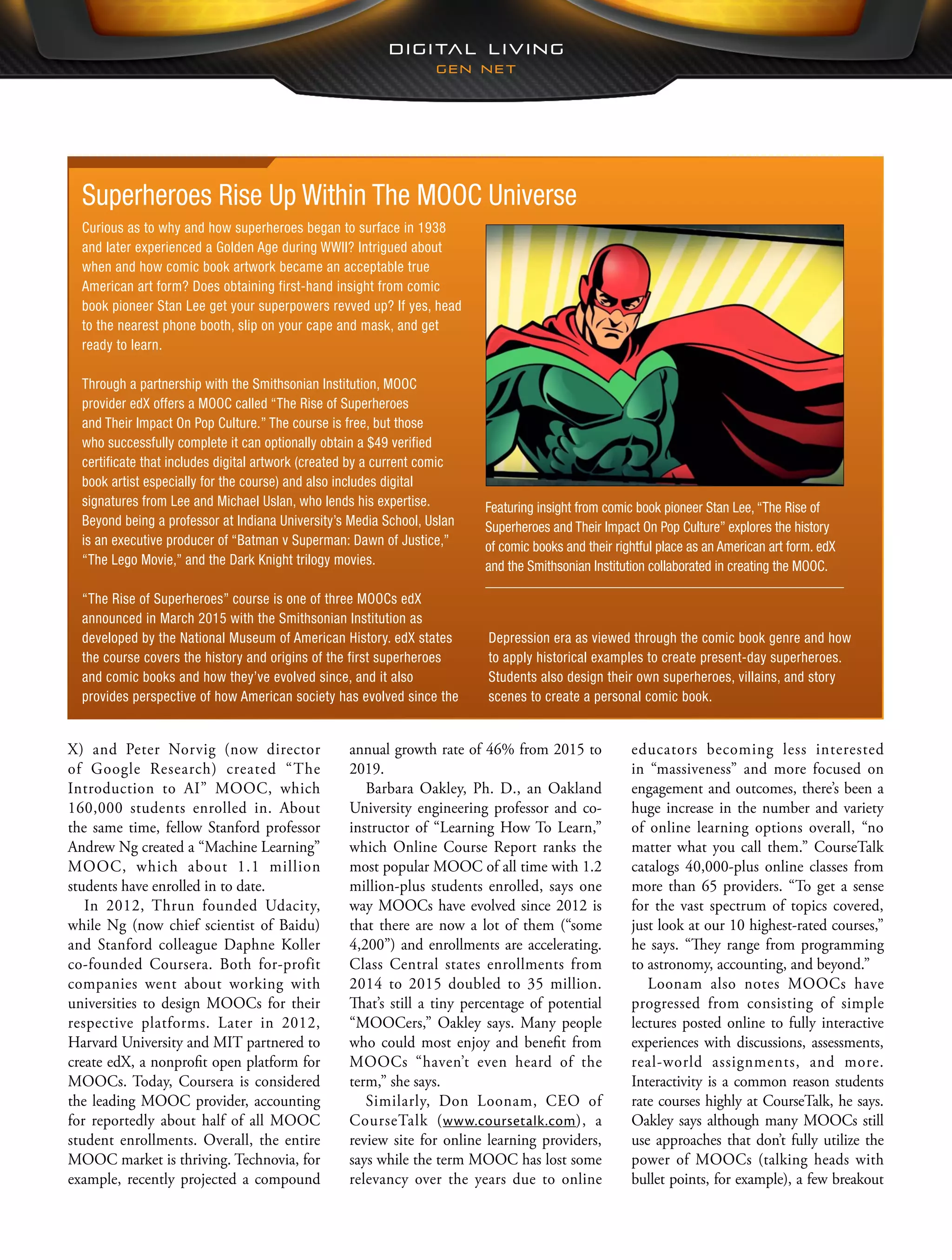
Featuring insight from comic book pioneer Stan Lee, “The Rise of
Superheroes and Their Impact On Pop Culture” explores the history
of comic books and their rightful place as an American art form. edX
and the Smithsonian Institution collaborated in creating the MOOC.
who doesn’t already “know how to take
and pass a university course is not in a
position to complete a MOOC.”
Notably, since 2012, Udacity has shifted
entirely from working with universities
to design MOOCs to now working
with companies to design career-minded
courses, particularly for the tech sector.
Thrun, in fact, stresses that Udacity is “not
a MOOC provider.” Instead, Udacity
teams “with the very best Silicon Valley
companies, since they know best what it
takes to get a job in the tech industry.”
The single-digit completion rates for
MOOCs, he says, indicate MOOCs are
“only suitable as an educational method
for very highly motivated individuals—
those who would likely be able to learn
from books.” Overall, he says, “most of the
interesting evolution is taking place outside
the MOOCs.”
Who Is Really Benefiting?
Joint research from MIT and Harvard
that explored about 70 certificate-granting
MOOCs and 1.7 million participants
through 2014 revealed among other
things that in some cases, as many as
39% of MOOC learners were teachers.
That, researchers told MIT News, “forces
us to broaden our conceptions of who
MOOCs serve and how they might make
a difference in improving learning.” The
study found that, although MOOCs
have provided greater access to learning
opportunities, those benefiting are
“disproportionately those who already have
college and graduate degrees.”
From a separate study using the same
data focused on access and usage patterns
in MOOCs, Justin Reich, executive
director of MIT’s PK-12 Initiative, told
MIT News that while providing greater
access to academic experiences “previously
reserved for the elite” might democratize
education, history shows it’s those with
the “social, technical, and financial
capital” who benefit from emerging
learning technologies, even free ones.
Reich concluded MOOCs and other
online-learning techniques “don’t yet
live up to their promise to democratize
education. Closing this digital divide is
because most students require an expert
to review their work regularly and provide
detailed feedback.
“That kind of education is not
scalable,” Devlin says. Nevertheless, he
was intrigued enough to launch a MOOC
to explore what he could do with the
medium. “On the whole, I think it
worked better than I had expected,” he
says. Overall, Devlin says MOOCs have
evolved as he expected they would. “In
particular, narrowing down to more
homogeneous student bodies who already
have a higher education experience and
are motivated, or obliged, to complete
the course, such as professional training
courses, was an obvious way to go,” he
says. He also isn’t surprised data indicates
most students completing MOOCs
already have degrees, noting someone
courses have juxtaposed “academia with
Silicon Valley and with Hollywood in a
way that people find riveting.”
Keith Devlin—NPR’s “Math Guy,” co-
founder and executive director of Stanford’s
H-STAR Institute, and co-founder of
Stanford’s Media X network—launched
the first mathematics MOOC ever with
“Introduction To Mathematical Thinking.”
Devlin says he didn’t buy into the initial
hype around MOOCs. He says Thrun,
Norvig, Ng, and Koller developed their
computer science-focused MOOCs to make
their teaching of introductory-level courses
more efficient, something possible because
much of the material is routine; teachable
via lectures; and by nature, computing
course assignments are machine-gradable.
Mathematics and other courses beyond the
first-year level are different, he says, partly
MOOCs Expand Beyond Computers
One constant running through all MOOCs is the need for an Internet connection to participate.
MOOC providers, however, have expanded MOOCs from Internet-connected desktops to mobile
devices. Udacity, Udemy, Coursera, and other online course providers collectively make tens of
thousands of courses available via iOS and Android apps, some with offline capabilities.
As Udemy states, such accessibility lets students
squeeze in lectures during commutes, before bed, at
lunch, or whenever they can find time. Udemy’s iOS app
had already been downloaded more than 1 million times
as of January 2014. About 50% of its iOS app downloads
stemmed from outside the United States.
edX, which also offers iOS and Android apps,
recently announced a partnership with Qualcomm
Education that will see Qualcomm Education providing
engineering resources and licensing parts of its SDK
code that edX will make available to its Open edX
community. edX CEO Anant Agarwal says that the
various capabilities mobile lends to MOOCs represent
“the next frontier for learning worldwide.”
On an entirely different mobile front, Coursera extended
the reach of its MOOCs into the sky last year by
partnering with JetBlue to enable passengers to soak
in lectures taken from full MOOCs. Thus, in lieu of an
in-flight movie, would-be entrepreneurs can take in a
lecture from the “Introduction to Marketing” course from
the University of Pennsylvania’s Wharton School.
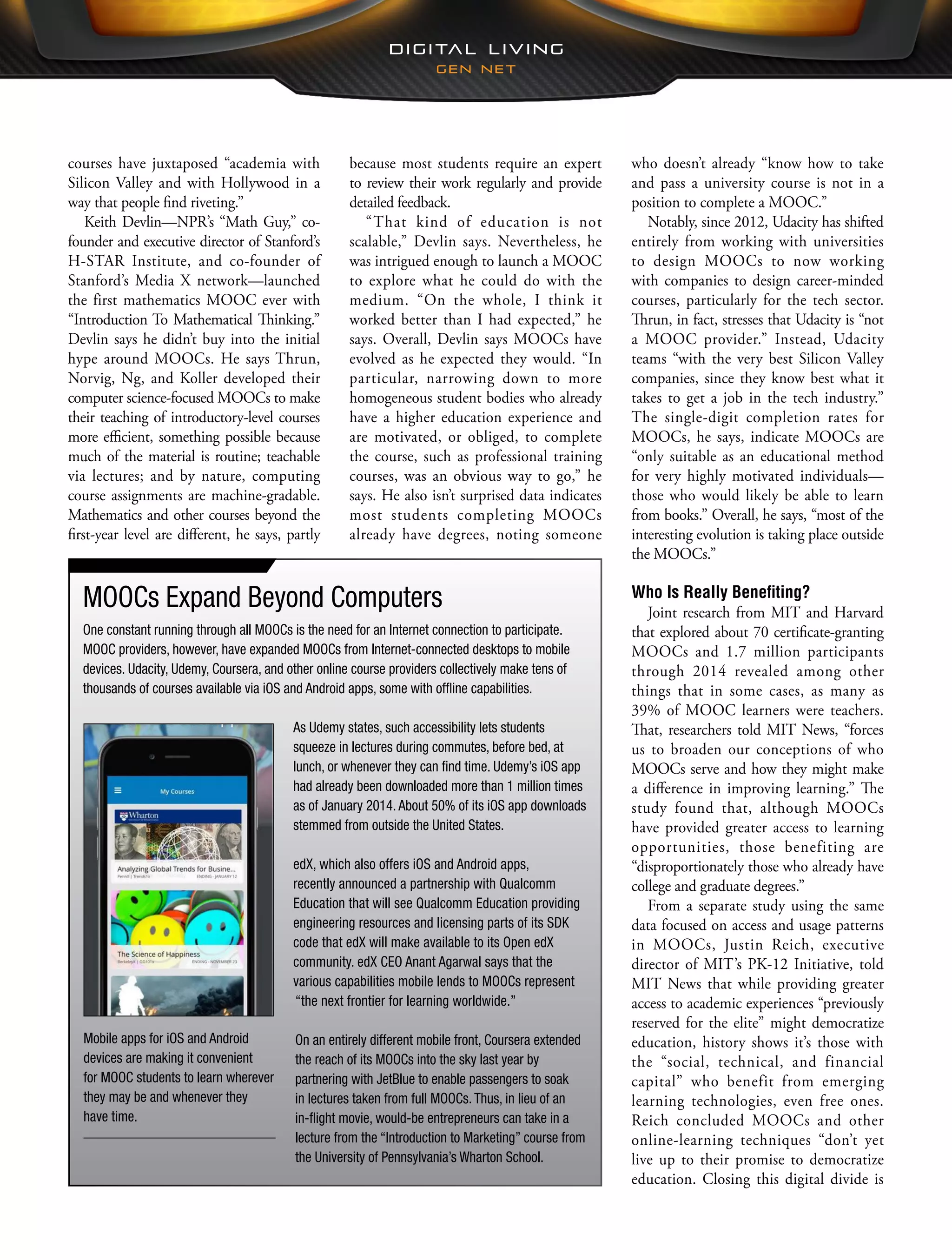
Mobile apps for iOS and Android
devices are making it convenient
for MOOC students to learn wherever
they may be and whenever they
have time.
Where low completion rates are
concerned, Cook says finishing a
MOOC can mean many things. Some
people can finish a MOOC on autopilot,
while others really jump into the
subject matter, he says. Often, he adds,
“expectations of what a student will get
out of a MOOC are slightly lower. That
said, they’re often free, and motivated
students can really learn a lot in MOOC
settings. There just isn’t quite as much
support as in traditional university
settings.” Frequently, people use MOOCs
(particularly on-demand ones) as quick
refresher courses or to get a quick glimpse
into a new skill set or discipline, he says.
Romero is one who believes
MOOCs have delivered on very few of
the early expectations that they could
alter traditional learning. “Very few
institutions of higher education have
adopted them because of the numerous
problems regarding completion rates,
assessment, etc.,” he says. “After the big
hype, many of the great prophesies that
were made haven’t come to fruition.”
What MOOCs have done is help show
distance education works only with a
small segment of people who tend to
be more mature, already educated, and
better off than those people MOOCs
were supposed to help, he says. Romero
increased access to
high-quality education
for learners globally.
Until recently, he says,
quality education, and
even higher education
at all, had been the
privilege of the few.
MOOCs, he says, can
provide opportunities
to everyone so that in
the near future, factors
such as economics,
social status, gender,
or geography won’t be
the primary issues that
determine whether
someone has access
to education or an
opportunity for success.
Devlin says that
MOOCs have definitely benefited some
groups, citing one example of highly
motivated individuals located where
there’s no viable higher-education
system. That said, he says universities
offer a small-group-based community
experience, some direct access to experts,
and a valuable credential but require a
significant degree of commitment.
“MOOCs offer none of those benefits
and require minimal commitment since
the cost of dropping out is low, if not
zero,” he says. “But they do offer a cheap,
maybe free, way for someone with college
experience to learn about something new.”
exactly the kind of grand challenge that
the world’s greatest universities should be
tackling head on.”
In an article titled “Who’s Benefiting
From MOOCs, and Why” penned
for the Harvard Business Review,
representatives from Coursera and two
MOOC-offering universities noted some
research has tempered initial expectations
for MOOCs. However, their own
data gathered from surveying 52,000
respondents who completed a Coursera
MOOC before Sept. 1, 2014, found 72%
of respondents reporting career benefits
and 61% educational benefits.
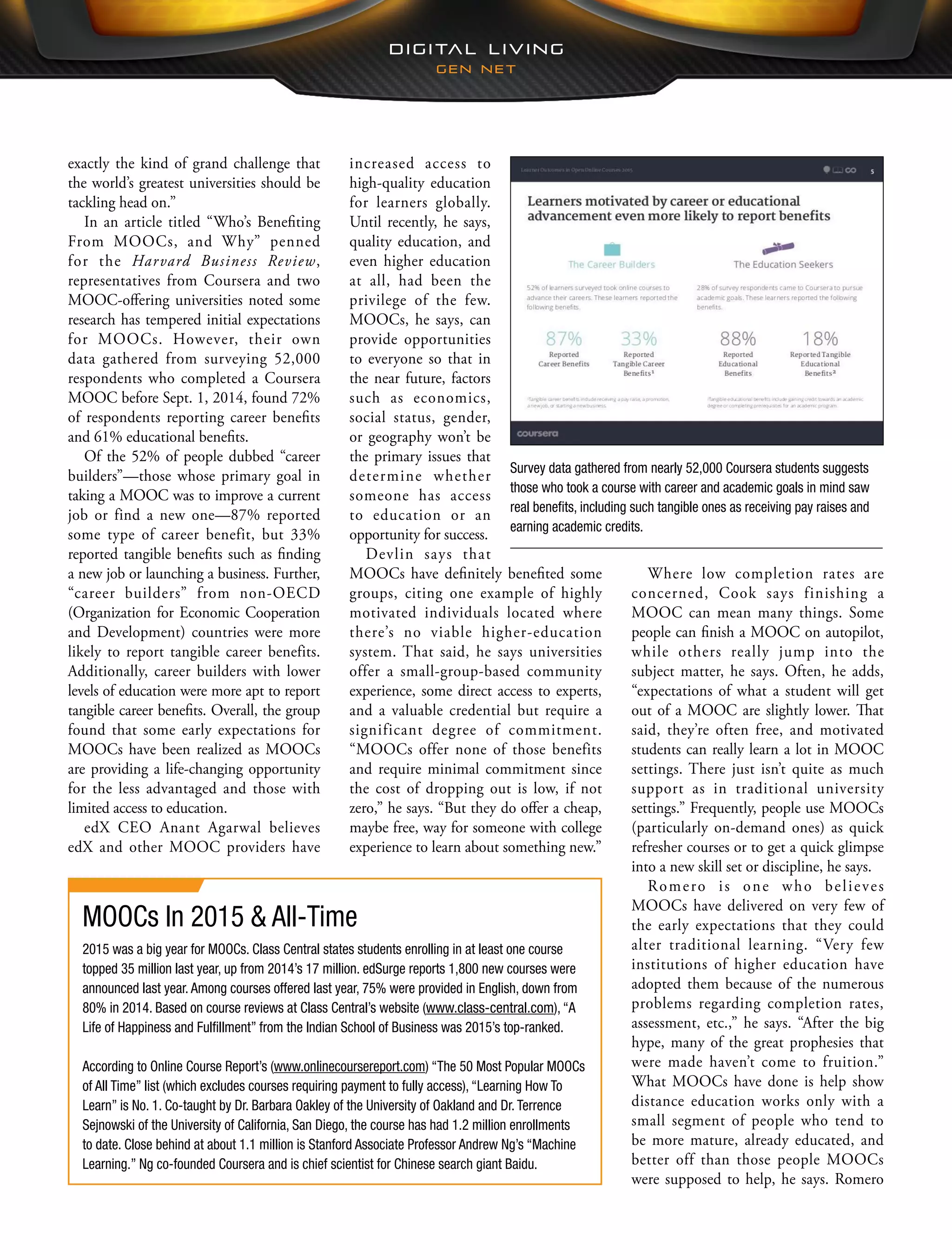
Of the 52% of people dubbed “career
builders”—those whose primary goal in
taking a MOOC was to improve a current
job or find a new one—87% reported
some type of career benefit, but 33%
reported tangible benefits such as finding
a new job or launching a business. Further,
“career builders” from non-OECD
(Organization for Economic Cooperation
and Development) countries were more
likely to report tangible career benefits.
Additionally, career builders with lower
levels of education were more apt to report
tangible career benefits. Overall, the group
found that some early expectations for
MOOCs have been realized as MOOCs
are providing a life-changing opportunity
for the less advantaged and those with
limited access to education.
edX CEO Anant Agarwal believes
edX and other MOOC providers have
Survey data gathered from nearly 52,000 Coursera students suggests
those who took a course with career and academic goals in mind saw
real benefits, including such tangible ones as receiving pay raises and
earning academic credits.
MOOCs In 2015 & All-Time
2015 was a big year for MOOCs. Class Central states students enrolling in at least one course
topped 35 million last year, up from 2014’s 17 million. edSurge reports 1,800 new courses were
announced last year. Among courses offered last year, 75% were provided in English, down from
80% in 2014. Based on course reviews at Class Central’s website (www.class-central.com), “A
Life of Happiness and Fulfillment” from the Indian School of Business was 2015’s top-ranked.
According to Online Course Report’s (www.onlinecoursereport.com) “The 50 Most Popular MOOCs
of All Time” list (which excludes courses requiring payment to fully access), “Learning How To
Learn” is No. 1. Co-taught by Dr. Barbara Oakley of the University of Oakland and Dr. Terrence
Sejnowski of the University of California, San Diego, the course has had 1.2 million enrollments
to date. Close behind at about 1.1 million is Stanford Associate Professor Andrew Ng’s “Machine
Learning.” Ng co-founded Coursera and is chief scientist for Chinese search giant Baidu.
says. “The MOOC industry should look
to learn from this motivated group.”
Oakley says she’s met students of her
course from Singapore, Johannesburg,
Jakarta, Hong Kong, Guatemala,
and elsewhere. “I’m in awe of these
extraordinary students—their desire
to learn, their commitment, and their
extraordinary dedication,” she says. “They
truly care about learning in the same way
as my very best on-campus students. The
motivations are very similar.”
Certificates & Credits
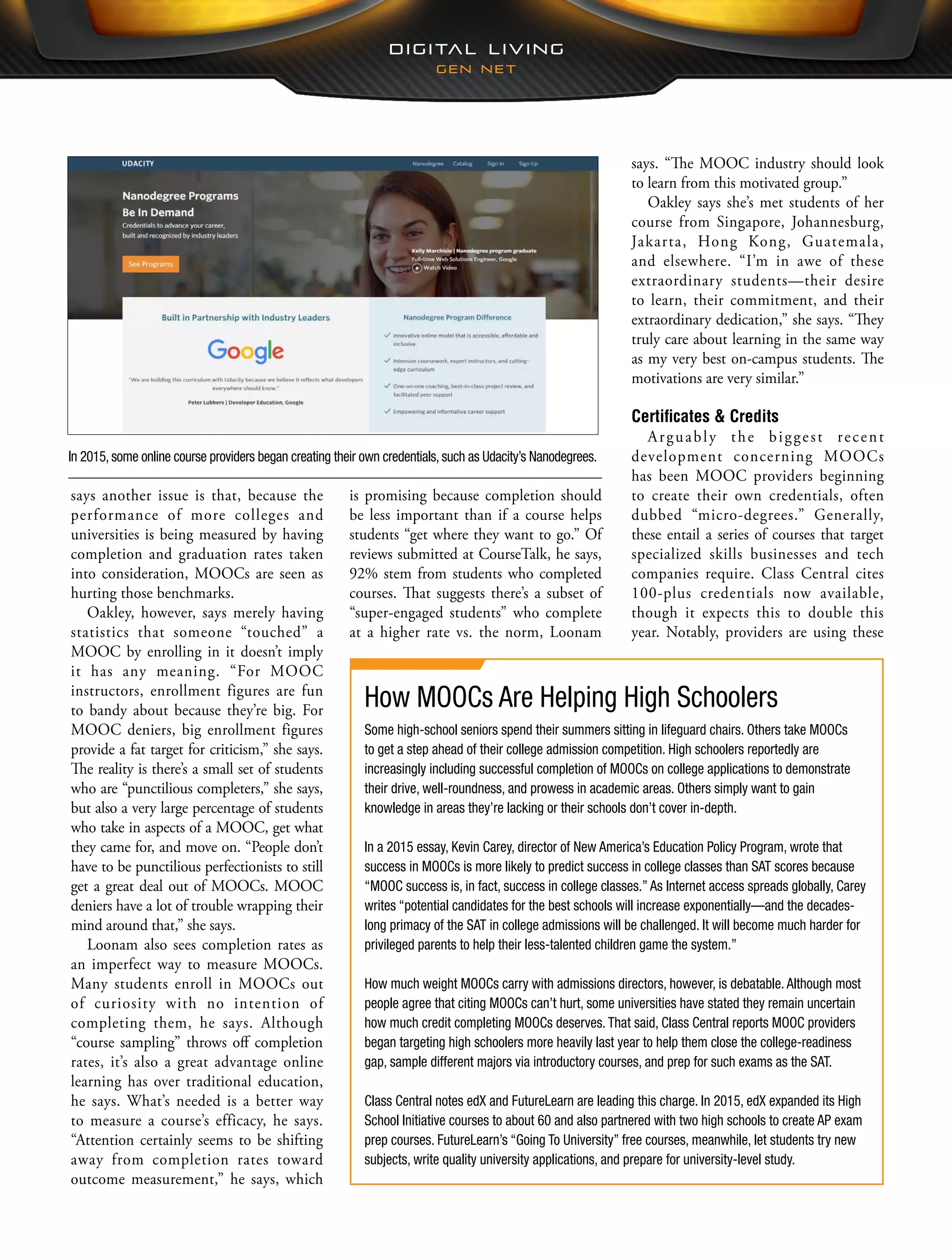
Arguably the biggest recent
development concerning MOOCs
has been MOOC providers beginning
to create their own credentials, often
dubbed “micro-degrees.” Generally,
these entail a series of courses that target
specialized skills businesses and tech
companies require. Class Central cites
100-plus credentials now available,
though it expects this to double this
year. Notably, providers are using these
is promising because completion should
be less important than if a course helps
students “get where they want to go.” Of
reviews submitted at CourseTalk, he says,
92% stem from students who completed
courses. That suggests there’s a subset of
“super-engaged students” who complete
at a higher rate vs. the norm, Loonam
says another issue is that, because the
performance of more colleges and
universities is being measured by having
completion and graduation rates taken
into consideration, MOOCs are seen as
hurting those benchmarks.
Oakley, however, says merely having
statistics that someone “touched” a
MOOC by enrolling in it doesn’t imply
it has any meaning. “For MOOC
instructors, enrollment figures are fun
to bandy about because they’re big. For
MOOC deniers, big enrollment figures
provide a fat target for criticism,” she says.
The reality is there’s a small set of students
who are “punctilious completers,” she says,
but also a very large percentage of students
who take in aspects of a MOOC, get what
they came for, and move on. “People don’t
have to be punctilious perfectionists to still
get a great deal out of MOOCs. MOOC
deniers have a lot of trouble wrapping their
mind around that,” she says.
Loonam also sees completion rates as
an imperfect way to measure MOOCs.
Many students enroll in MOOCs out
of curiosity with no intention of
completing them, he says. Although
“course sampling” throws off completion
rates, it’s also a great advantage online
learning has over traditional education,
he says. What’s needed is a better way
to measure a course’s efficacy, he says.
“Attention certainly seems to be shifting
away from completion rates toward
outcome measurement,” he says, which
How MOOCs Are Helping High Schoolers
Some high-school seniors spend their summers sitting in lifeguard chairs. Others take MOOCs
to get a step ahead of their college admission competition. High schoolers reportedly are
increasingly including successful completion of MOOCs on college applications to demonstrate
their drive, well-roundness, and prowess in academic areas. Others simply want to gain
knowledge in areas they’re lacking or their schools don’t cover in-depth.
In a 2015 essay, Kevin Carey, director of New America’s Education Policy Program, wrote that
success in MOOCs is more likely to predict success in college classes than SAT scores because
“MOOC success is, in fact, success in college classes.” As Internet access spreads globally, Carey
writes “potential candidates for the best schools will increase exponentially—and the decades-
long primacy of the SAT in college admissions will be challenged. It will become much harder for
privileged parents to help their less-talented children game the system.”
How much weight MOOCs carry with admissions directors, however, is debatable. Although most
people agree that citing MOOCs can’t hurt, some universities have stated they remain uncertain
how much credit completing MOOCs deserves. That said, Class Central reports MOOC providers
began targeting high schoolers more heavily last year to help them close the college-readiness
gap, sample different majors via introductory courses, and prep for such exams as the SAT.
Class Central notes edX and FutureLearn are leading this charge. In 2015, edX expanded its High
School Initiative courses to about 60 and also partnered with two high schools to create AP exam
prep courses. FutureLearn’s “Going To University” free courses, meanwhile, let students try new
subjects, write quality university applications, and prepare for university-level study.
In 2015, some online course providers began creating their own credentials, such as Udacity’s Nanodegrees.
for credit that’s much less expensive than
if on campus. edX is also collaborating
with Charter Oak State College on a
“pay-when-you-pass” program to earn
college credit. Udacity, meanwhile, has
partnered with Georgia Tech University
and AT&T on a master’s degree program
in computer science for $7,000.
Others disagree with awarding
university credits or degrees for
successfully completing some or any
MOOCs. Devlin says apart from special
subjects such as computer science in
which a case has and can be made, “the
difference in learning experience is so
great that it makes no sense to confer
degrees. It’s an error to view MOOCs
as cheap college courses. They are not.”
Rather, MOOCs are alternative learning
experiences that have sufficient merit
to continue in their own right, he says.
“Some students move on from MOOCs
to regular degree courses. For others, the
MOOC itself is sufficient,” he says.
Romero says in addition to few
institutions recognizing credits for
MOOCs, there’s been difficulty in
determining how to make a profit from
initiatives in this area. “It’s difficult to
imagine how you can sell a system that’s
supposed to be open (free) and make
money out of that,” he says. MOOCs, he
says, were heralded as democratizing higher
education by making it free. That promise
“falls off the cliff” once you start charging
for it, he says. Romero says cheating
also remains a big issue with MOOCs,
particularly at the international level.
Oakley says if MOOCs were provided
for college credit, on-campus MOOC
proctoring centers or using proctoring
services could minimize cheating. “It’s
not exactly a problem now, but I think
there’s immense potential in building
better quizzing and testing with mastery
learning,” she says. She says noted
Stanford philosopher Patrick Suppes’
“pioneering work on computer-aided
learning laid a great path forward for
many MOOC instructors.”
Loonam says the traditional university
degree is “being disrupted in front of
our eyes” as more people add MOOC
top 50 Android Nanodegree finishers to
its headquarters all expenses paid, while
AT&T has reserved up to 100 internships
for Nanodegree finishers. “This level of
recognition isn’t even given to some of
the top universities,” he says. Last year,
Coursera announced an effort in which
universities will help design courses for
given Specializations, and tech companies,
including Google, Instagram, and Shazam,
will create capstone projects to complete.
Agarwal says high-quality education
can come from many different sources.
Such organizations as Tenaris and
Microsoft and such foundations as the
Linux Foundation, he says, possess deep
knowledge and access to subject-matter
experts who can share their expertise
and skill sets to learners and help train
professionals for current and future jobs.
MOOCs have also made progress with
students earning university credits by
completing the courses. edX has launched
a Global Freshman Academy program
with Arizona State University, for
example, to offer a freshman year worth
of general-education courses via MOOCs
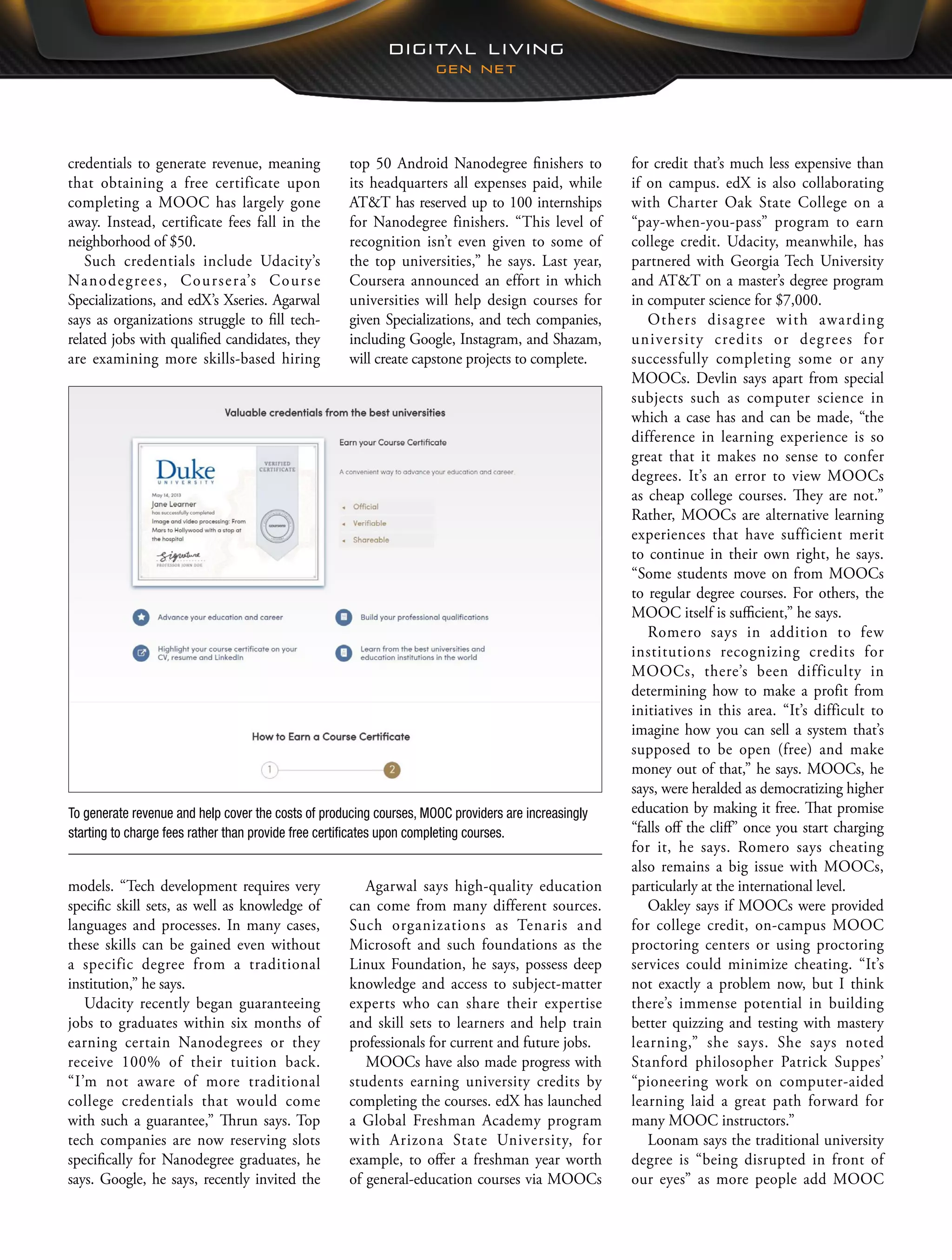
credentials to generate revenue, meaning
that obtaining a free certificate upon
completing a MOOC has largely gone
away. Instead, certificate fees fall in the
neighborhood of $50.
Such credentials include Udacity’s
Nanodegrees, Coursera’s Course
Specializations, and edX’s Xseries. Agarwal
says as organizations struggle to fill tech-
related jobs with qualified candidates, they
are examining more skills-based hiring
models. “Tech development requires very
specific skill sets, as well as knowledge of
languages and processes. In many cases,
these skills can be gained even without
a specific degree from a traditional
institution,” he says.
Udacity recently began guaranteeing
jobs to graduates within six months of
earning certain Nanodegrees or they
receive 100% of their tuition back.
“I’m not aware of more traditional
college credentials that would come
with such a guarantee,” Thrun says. Top
tech companies are now reserving slots
specifically for Nanodegree graduates, he
says. Google, he says, recently invited the
To generate revenue and help cover the costs of producing courses, MOOC providers are increasingly
starting to charge fees rather than provide free certificates upon completing courses.
is the No. 2 reason our users cite for
taking online classes (after personal
fulfillment),” he says. “Any effort to align
online learning with the realities of the
business world will be surely welcomed
by students.”
Moving Forward
Beyond a need for an accreditation
system that helps employers and
traditional educators understand what was
taught in a MOOC and how a student
performed, Loonam says there is also
a need to reach learners in more varied
demographic groups. Another issue is
addressing the limited start dates of many
courses, something providers are doing
via self-paced formats or by archiving
courses, he says. And with thousands of
MOOCs available at any time, he says,
online learners need a way to gauge a
course before enrolling. About 80% of
classes rated on CourseTalk have four- to
five-star ratings, he says. “It seems the
majority of options are meeting students’
needs, but we need to help students
avoid wasting their time on the lackluster
courses that also exist,” he says.
Though Cook sees MOOCs as being
increasingly used to bolster interest
and expertise in the core technologies
corporations need, MOOCs also have
areas less skill-centered and more geared
toward “lifelong learners.” Over time, he
foresees a large and well-curated base of
MOOCs forming on such “classic topics”
as philosophy, leadership, and art history.
Loonam aptly points out that online
learning is still young, thus continued
evolution is necessary to ensure the needs
of students, employers, and educators
are met. For example, while MOOCs
are most popular currently in developed
countries, providers are working to get
into emerging markets and capitalize on
the massive interest in MOOCs that exists
in areas such as China where discretionary
spending on education doubles that in the
United States and in India where 53% of
large employers attribute job vacancies to
a lack of a skilled workforce. “We’ve only
begun to see the appetite for MOOCs in
these markets,” he says. ■
because much of the excitement
surrounding MOOCs now concerns
their potential to fill skills gaps in the
workforce, he says. “Career advancement
certificates to resumes and LinkedIn
profiles to market their competencies.
It will be critical to have employers and
online educators continue to collaborate
The Ingredients Of A Quality MOOC
Not all MOOCs are created equal. Production quality, video features, instructor enthusiasm,
teaching techniques, and other facets can vary greatly. Along with Dr. Terrence Sejnowski, head
of the Computational Neurobiology Laboratory at the University of California, San Diego, Barbara
Oakley, Ph. D., Oakland University engineering professor, created “Learning How To Learn,” the
all-time most popular MOOC with more than 1.2 million enrollments to date. We asked Oakley
what goes into a quality MOOC.
“A well-designed MOOC is like a great cake—it has lots of ingredients,” Oakley says. “First, it
needs knowledgeable instructors who are enjoyable to watch. There are lots of ways to skin that
cat, of course.” Though some instructors are stiff and stolid, that’s not necessarily bad. “When
they crack unexpected jokes and display surprising wit, it feeds our little dopamine-fueled
pleasure centers,” she says. “There are actually many ways to be charismatic on-screen, as any
good actor could tell you.”
Oakley says smart MOOC producers use motion
and movement at every turn in their videos
because it helps keep attention riveted to the
screen.An instructor continually situated on one
side of the screen with bullet points on the other
side is less ideal.“Looming motion is particularly
riveting. It activates all sorts of components within
our attentional systems,” she says.“After all, on an
evolutionary basis, looming things were much more
likely to kill you.” Keeping hands in view is also key,
as gesticulation “appears to activate mirror neurons
in the students’ brains” that helps with better
understanding and retaining information.
Surprise, humor, and wit are also important.
Conventional classrooms box “students in
a cage,” she says.Thus, it doesn’t matter if
instructors make the material more palatable
and enjoyable.“Online learning doesn’t have the
luxury of caged students,” she says. Even a little
humor gives the brain’s “focused” centers a momentary rest as other neural areas are activated, she
says, leaving the brain better able to return to tackle more difficult material with a fresh perspective.
Increasingly, Oakley says it’s understood that keeping MOOC videos short falls in line with
people’s attention spans. Making a short video that’s riveting, however, is more difficult than
creating a full-length lecture, she says. “It’s as Pascal once said, ‘I would have written a shorter
letter, but I did not have the time,’” Oakley says. Exceptional MOOCs also feature carefully
constructed quizzes and tests and considerable refinement using student feedback. They also
provide quality mentors who help improve the learning experience by answering questions and
helping improve course content.
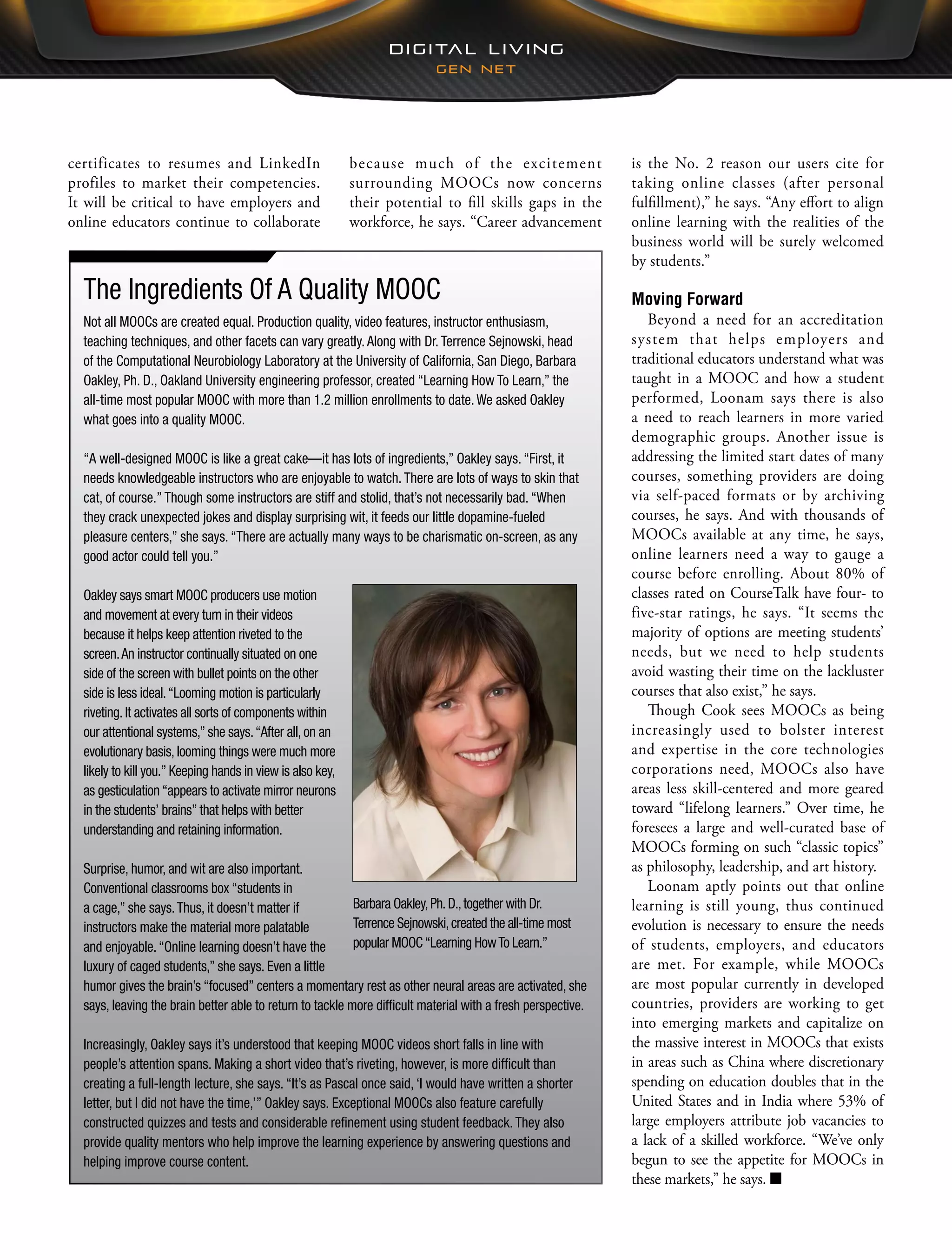
Barbara Oakley,Ph.D.,together with Dr.
Terrence Sejnowski,created the all-time most
popular MOOC“Learning HowTo Learn.”

doc.axd

  • 1.
    MOOCs Grow Up ButAre They Fulfilling Their Original Promise? technologies that corporations need talent in.” In fields where learning objectives are measurable, he says, “we might see some increase in recruiting directly from MOOC participants, as well.” The following looks at how MOOCs have developed since 2012 and where they may be headed in coming years. The Evolution Of MOOCs History tells us the term “MOOC” first emerged from a 2008 non- credit “Connectivism and Connective Knowledge” course the University of Manitoba offered on campus but that 2,200 online students also enrolled in for free. In 2011, Stanford professors Sebastian Thrun (also founder of Google MOOC supporters counter that although completion rates are low, they aren’t necessarily the best means for judging the worth of MOOCs. Advocates argue MOOCs are still young, and many students who have taken them have realized real career and educational benefits, especially students in developing countries with less education and a lower socioeconomic status. Something most people seemingly agree on is that MOOCs have great potential to help students learn the skills that companies are currently seeking. As Merrill Cook, founder of Online Course Report (www.onlinecoursereport.com), says, “MOOCs will be continually used to bolster interest and expertise in core In 2012, when Udacity, Coursera, and edX launched platforms for providing MOOCs (massive open online courses), there was talk MOOCs had the potential to radically disrupt the traditional higher learning university system. Providing anyone, no matter their location or socioeconomic status, with free access to the same course curriculum taught on campus at Harvard, MIT, Stanford, and other top universities was seen as a great educational equalizer. All students needed to enroll was the motivation and an Internet connection. Fast-forward to 2016, and MOOCs have made a significant impact on learning, and there’s even been progress in terms of students receiving university credits for completing MOOCs. Still, although enrollments have reached into the tens of millions, studies indicate only about 4 to 5% of those who enroll in MOOCs actually complete them. Further, rather than democratizing access to higher education, for the most part, the primary users of MOOCs have been affluent people who already hold degrees. Such developments have produced rifts within the education community. MOOC detractors suggest that in addition to cheap access to higher learning largely failing to serve the disadvantaged, low completion rates for MOOCs indicate students are less motivated when not on campus where instructor and peer support is more readily available. As Aldemaro Romero Jr., Ph. D, former dean of the College of Arts and Sciences at Southern Illinois University, Edwardsville, says, “There’s no real substitute for one-on-one teaching when done by good professors, especially when it comes to the traditional population age of college students, 18 to 24 years old.” Although Udacity and Coursera are both for-profit companies that Stanford professors separately launched in 2012, edX is a nonprofit platform that sprang from a partnership between Harvard University and MIT. Today, Udacity has shifted focus to expressly offer courses that teach skills, including tech-related ones, that companies are seeking in employees.
  • 2.
    educators becoming lessinterested in “massiveness” and more focused on engagement and outcomes, there’s been a huge increase in the number and variety of online learning options overall, “no matter what you call them.” CourseTalk catalogs 40,000-plus online classes from more than 65 providers. “To get a sense for the vast spectrum of topics covered, just look at our 10 highest-rated courses,” he says. “They range from programming to astronomy, accounting, and beyond.” Loonam also notes MOOCs have progressed from consisting of simple lectures posted online to fully interactive experiences with discussions, assessments, real-world assignments, and more. Interactivity is a common reason students rate courses highly at CourseTalk, he says. Oakley says although many MOOCs still use approaches that don’t fully utilize the power of MOOCs (talking heads with bullet points, for example), a few breakout annual growth rate of 46% from 2015 to 2019. Barbara Oakley, Ph. D., an Oakland University engineering professor and co- instructor of “Learning How To Learn,” which Online Course Report ranks the most popular MOOC of all time with 1.2 million-plus students enrolled, says one way MOOCs have evolved since 2012 is that there are now a lot of them (“some 4,200”) and enrollments are accelerating. Class Central states enrollments from 2014 to 2015 doubled to 35 million. That’s still a tiny percentage of potential “MOOCers,” Oakley says. Many people who could most enjoy and benefit from MOOCs “haven’t even heard of the term,” she says. Similarly, Don Loonam, CEO of CourseTalk (www.coursetalk.com), a review site for online learning providers, says while the term MOOC has lost some relevancy over the years due to online X) and Peter Norvig (now director of Google Research) created “The Introduction to AI” MOOC, which 160,000 students enrolled in. About the same time, fellow Stanford professor Andrew Ng created a “Machine Learning” MOOC, which about 1.1 million students have enrolled in to date. In 2012, Thrun founded Udacity, while Ng (now chief scientist of Baidu) and Stanford colleague Daphne Koller co-founded Coursera. Both for-profit companies went about working with universities to design MOOCs for their respective platforms. Later in 2012, Harvard University and MIT partnered to create edX, a nonprofit open platform for MOOCs. Today, Coursera is considered the leading MOOC provider, accounting for reportedly about half of all MOOC student enrollments. Overall, the entire MOOC market is thriving. Technovia, for example, recently projected a compound Superheroes Rise Up Within The MOOC Universe Curious as to why and how superheroes began to surface in 1938 and later experienced a Golden Age during WWII? Intrigued about when and how comic book artwork became an acceptable true American art form? Does obtaining first-hand insight from comic book pioneer Stan Lee get your superpowers revved up? If yes, head to the nearest phone booth, slip on your cape and mask, and get ready to learn. Through a partnership with the Smithsonian Institution, MOOC provider edX offers a MOOC called “The Rise of Superheroes and Their Impact On Pop Culture.” The course is free, but those who successfully complete it can optionally obtain a $49 verified certificate that includes digital artwork (created by a current comic book artist especially for the course) and also includes digital signatures from Lee and Michael Uslan, who lends his expertise. Beyond being a professor at Indiana University’s Media School, Uslan is an executive producer of “Batman v Superman: Dawn of Justice,” “The Lego Movie,” and the Dark Knight trilogy movies. “The Rise of Superheroes” course is one of three MOOCs edX announced in March 2015 with the Smithsonian Institution as developed by the National Museum of American History. edX states the course covers the history and origins of the first superheroes and comic books and how they’ve evolved since, and it also provides perspective of how American society has evolved since the Depression era as viewed through the comic book genre and how to apply historical examples to create present-day superheroes. Students also design their own superheroes, villains, and story scenes to create a personal comic book. Featuring insight from comic book pioneer Stan Lee, “The Rise of Superheroes and Their Impact On Pop Culture” explores the history of comic books and their rightful place as an American art form. edX and the Smithsonian Institution collaborated in creating the MOOC.
  • 3.
    who doesn’t already“know how to take and pass a university course is not in a position to complete a MOOC.” Notably, since 2012, Udacity has shifted entirely from working with universities to design MOOCs to now working with companies to design career-minded courses, particularly for the tech sector. Thrun, in fact, stresses that Udacity is “not a MOOC provider.” Instead, Udacity teams “with the very best Silicon Valley companies, since they know best what it takes to get a job in the tech industry.” The single-digit completion rates for MOOCs, he says, indicate MOOCs are “only suitable as an educational method for very highly motivated individuals— those who would likely be able to learn from books.” Overall, he says, “most of the interesting evolution is taking place outside the MOOCs.” Who Is Really Benefiting? Joint research from MIT and Harvard that explored about 70 certificate-granting MOOCs and 1.7 million participants through 2014 revealed among other things that in some cases, as many as 39% of MOOC learners were teachers. That, researchers told MIT News, “forces us to broaden our conceptions of who MOOCs serve and how they might make a difference in improving learning.” The study found that, although MOOCs have provided greater access to learning opportunities, those benefiting are “disproportionately those who already have college and graduate degrees.” From a separate study using the same data focused on access and usage patterns in MOOCs, Justin Reich, executive director of MIT’s PK-12 Initiative, told MIT News that while providing greater access to academic experiences “previously reserved for the elite” might democratize education, history shows it’s those with the “social, technical, and financial capital” who benefit from emerging learning technologies, even free ones. Reich concluded MOOCs and other online-learning techniques “don’t yet live up to their promise to democratize education. Closing this digital divide is because most students require an expert to review their work regularly and provide detailed feedback. “That kind of education is not scalable,” Devlin says. Nevertheless, he was intrigued enough to launch a MOOC to explore what he could do with the medium. “On the whole, I think it worked better than I had expected,” he says. Overall, Devlin says MOOCs have evolved as he expected they would. “In particular, narrowing down to more homogeneous student bodies who already have a higher education experience and are motivated, or obliged, to complete the course, such as professional training courses, was an obvious way to go,” he says. He also isn’t surprised data indicates most students completing MOOCs already have degrees, noting someone courses have juxtaposed “academia with Silicon Valley and with Hollywood in a way that people find riveting.” Keith Devlin—NPR’s “Math Guy,” co- founder and executive director of Stanford’s H-STAR Institute, and co-founder of Stanford’s Media X network—launched the first mathematics MOOC ever with “Introduction To Mathematical Thinking.” Devlin says he didn’t buy into the initial hype around MOOCs. He says Thrun, Norvig, Ng, and Koller developed their computer science-focused MOOCs to make their teaching of introductory-level courses more efficient, something possible because much of the material is routine; teachable via lectures; and by nature, computing course assignments are machine-gradable. Mathematics and other courses beyond the first-year level are different, he says, partly MOOCs Expand Beyond Computers One constant running through all MOOCs is the need for an Internet connection to participate. MOOC providers, however, have expanded MOOCs from Internet-connected desktops to mobile devices. Udacity, Udemy, Coursera, and other online course providers collectively make tens of thousands of courses available via iOS and Android apps, some with offline capabilities. As Udemy states, such accessibility lets students squeeze in lectures during commutes, before bed, at lunch, or whenever they can find time. Udemy’s iOS app had already been downloaded more than 1 million times as of January 2014. About 50% of its iOS app downloads stemmed from outside the United States. edX, which also offers iOS and Android apps, recently announced a partnership with Qualcomm Education that will see Qualcomm Education providing engineering resources and licensing parts of its SDK code that edX will make available to its Open edX community. edX CEO Anant Agarwal says that the various capabilities mobile lends to MOOCs represent “the next frontier for learning worldwide.” On an entirely different mobile front, Coursera extended the reach of its MOOCs into the sky last year by partnering with JetBlue to enable passengers to soak in lectures taken from full MOOCs. Thus, in lieu of an in-flight movie, would-be entrepreneurs can take in a lecture from the “Introduction to Marketing” course from the University of Pennsylvania’s Wharton School. Mobile apps for iOS and Android devices are making it convenient for MOOC students to learn wherever they may be and whenever they have time.
  • 4.
    Where low completionrates are concerned, Cook says finishing a MOOC can mean many things. Some people can finish a MOOC on autopilot, while others really jump into the subject matter, he says. Often, he adds, “expectations of what a student will get out of a MOOC are slightly lower. That said, they’re often free, and motivated students can really learn a lot in MOOC settings. There just isn’t quite as much support as in traditional university settings.” Frequently, people use MOOCs (particularly on-demand ones) as quick refresher courses or to get a quick glimpse into a new skill set or discipline, he says. Romero is one who believes MOOCs have delivered on very few of the early expectations that they could alter traditional learning. “Very few institutions of higher education have adopted them because of the numerous problems regarding completion rates, assessment, etc.,” he says. “After the big hype, many of the great prophesies that were made haven’t come to fruition.” What MOOCs have done is help show distance education works only with a small segment of people who tend to be more mature, already educated, and better off than those people MOOCs were supposed to help, he says. Romero increased access to high-quality education for learners globally. Until recently, he says, quality education, and even higher education at all, had been the privilege of the few. MOOCs, he says, can provide opportunities to everyone so that in the near future, factors such as economics, social status, gender, or geography won’t be the primary issues that determine whether someone has access to education or an opportunity for success. Devlin says that MOOCs have definitely benefited some groups, citing one example of highly motivated individuals located where there’s no viable higher-education system. That said, he says universities offer a small-group-based community experience, some direct access to experts, and a valuable credential but require a significant degree of commitment. “MOOCs offer none of those benefits and require minimal commitment since the cost of dropping out is low, if not zero,” he says. “But they do offer a cheap, maybe free, way for someone with college experience to learn about something new.” exactly the kind of grand challenge that the world’s greatest universities should be tackling head on.” In an article titled “Who’s Benefiting From MOOCs, and Why” penned for the Harvard Business Review, representatives from Coursera and two MOOC-offering universities noted some research has tempered initial expectations for MOOCs. However, their own data gathered from surveying 52,000 respondents who completed a Coursera MOOC before Sept. 1, 2014, found 72% of respondents reporting career benefits and 61% educational benefits. Of the 52% of people dubbed “career builders”—those whose primary goal in taking a MOOC was to improve a current job or find a new one—87% reported some type of career benefit, but 33% reported tangible benefits such as finding a new job or launching a business. Further, “career builders” from non-OECD (Organization for Economic Cooperation and Development) countries were more likely to report tangible career benefits. Additionally, career builders with lower levels of education were more apt to report tangible career benefits. Overall, the group found that some early expectations for MOOCs have been realized as MOOCs are providing a life-changing opportunity for the less advantaged and those with limited access to education. edX CEO Anant Agarwal believes edX and other MOOC providers have Survey data gathered from nearly 52,000 Coursera students suggests those who took a course with career and academic goals in mind saw real benefits, including such tangible ones as receiving pay raises and earning academic credits. MOOCs In 2015 & All-Time 2015 was a big year for MOOCs. Class Central states students enrolling in at least one course topped 35 million last year, up from 2014’s 17 million. edSurge reports 1,800 new courses were announced last year. Among courses offered last year, 75% were provided in English, down from 80% in 2014. Based on course reviews at Class Central’s website (www.class-central.com), “A Life of Happiness and Fulfillment” from the Indian School of Business was 2015’s top-ranked. According to Online Course Report’s (www.onlinecoursereport.com) “The 50 Most Popular MOOCs of All Time” list (which excludes courses requiring payment to fully access), “Learning How To Learn” is No. 1. Co-taught by Dr. Barbara Oakley of the University of Oakland and Dr. Terrence Sejnowski of the University of California, San Diego, the course has had 1.2 million enrollments to date. Close behind at about 1.1 million is Stanford Associate Professor Andrew Ng’s “Machine Learning.” Ng co-founded Coursera and is chief scientist for Chinese search giant Baidu.
  • 5.
    says. “The MOOCindustry should look to learn from this motivated group.” Oakley says she’s met students of her course from Singapore, Johannesburg, Jakarta, Hong Kong, Guatemala, and elsewhere. “I’m in awe of these extraordinary students—their desire to learn, their commitment, and their extraordinary dedication,” she says. “They truly care about learning in the same way as my very best on-campus students. The motivations are very similar.” Certificates & Credits Arguably the biggest recent development concerning MOOCs has been MOOC providers beginning to create their own credentials, often dubbed “micro-degrees.” Generally, these entail a series of courses that target specialized skills businesses and tech companies require. Class Central cites 100-plus credentials now available, though it expects this to double this year. Notably, providers are using these is promising because completion should be less important than if a course helps students “get where they want to go.” Of reviews submitted at CourseTalk, he says, 92% stem from students who completed courses. That suggests there’s a subset of “super-engaged students” who complete at a higher rate vs. the norm, Loonam says another issue is that, because the performance of more colleges and universities is being measured by having completion and graduation rates taken into consideration, MOOCs are seen as hurting those benchmarks. Oakley, however, says merely having statistics that someone “touched” a MOOC by enrolling in it doesn’t imply it has any meaning. “For MOOC instructors, enrollment figures are fun to bandy about because they’re big. For MOOC deniers, big enrollment figures provide a fat target for criticism,” she says. The reality is there’s a small set of students who are “punctilious completers,” she says, but also a very large percentage of students who take in aspects of a MOOC, get what they came for, and move on. “People don’t have to be punctilious perfectionists to still get a great deal out of MOOCs. MOOC deniers have a lot of trouble wrapping their mind around that,” she says. Loonam also sees completion rates as an imperfect way to measure MOOCs. Many students enroll in MOOCs out of curiosity with no intention of completing them, he says. Although “course sampling” throws off completion rates, it’s also a great advantage online learning has over traditional education, he says. What’s needed is a better way to measure a course’s efficacy, he says. “Attention certainly seems to be shifting away from completion rates toward outcome measurement,” he says, which How MOOCs Are Helping High Schoolers Some high-school seniors spend their summers sitting in lifeguard chairs. Others take MOOCs to get a step ahead of their college admission competition. High schoolers reportedly are increasingly including successful completion of MOOCs on college applications to demonstrate their drive, well-roundness, and prowess in academic areas. Others simply want to gain knowledge in areas they’re lacking or their schools don’t cover in-depth. In a 2015 essay, Kevin Carey, director of New America’s Education Policy Program, wrote that success in MOOCs is more likely to predict success in college classes than SAT scores because “MOOC success is, in fact, success in college classes.” As Internet access spreads globally, Carey writes “potential candidates for the best schools will increase exponentially—and the decades- long primacy of the SAT in college admissions will be challenged. It will become much harder for privileged parents to help their less-talented children game the system.” How much weight MOOCs carry with admissions directors, however, is debatable. Although most people agree that citing MOOCs can’t hurt, some universities have stated they remain uncertain how much credit completing MOOCs deserves. That said, Class Central reports MOOC providers began targeting high schoolers more heavily last year to help them close the college-readiness gap, sample different majors via introductory courses, and prep for such exams as the SAT. Class Central notes edX and FutureLearn are leading this charge. In 2015, edX expanded its High School Initiative courses to about 60 and also partnered with two high schools to create AP exam prep courses. FutureLearn’s “Going To University” free courses, meanwhile, let students try new subjects, write quality university applications, and prepare for university-level study. In 2015, some online course providers began creating their own credentials, such as Udacity’s Nanodegrees.
  • 6.
    for credit that’smuch less expensive than if on campus. edX is also collaborating with Charter Oak State College on a “pay-when-you-pass” program to earn college credit. Udacity, meanwhile, has partnered with Georgia Tech University and AT&T on a master’s degree program in computer science for $7,000. Others disagree with awarding university credits or degrees for successfully completing some or any MOOCs. Devlin says apart from special subjects such as computer science in which a case has and can be made, “the difference in learning experience is so great that it makes no sense to confer degrees. It’s an error to view MOOCs as cheap college courses. They are not.” Rather, MOOCs are alternative learning experiences that have sufficient merit to continue in their own right, he says. “Some students move on from MOOCs to regular degree courses. For others, the MOOC itself is sufficient,” he says. Romero says in addition to few institutions recognizing credits for MOOCs, there’s been difficulty in determining how to make a profit from initiatives in this area. “It’s difficult to imagine how you can sell a system that’s supposed to be open (free) and make money out of that,” he says. MOOCs, he says, were heralded as democratizing higher education by making it free. That promise “falls off the cliff” once you start charging for it, he says. Romero says cheating also remains a big issue with MOOCs, particularly at the international level. Oakley says if MOOCs were provided for college credit, on-campus MOOC proctoring centers or using proctoring services could minimize cheating. “It’s not exactly a problem now, but I think there’s immense potential in building better quizzing and testing with mastery learning,” she says. She says noted Stanford philosopher Patrick Suppes’ “pioneering work on computer-aided learning laid a great path forward for many MOOC instructors.” Loonam says the traditional university degree is “being disrupted in front of our eyes” as more people add MOOC top 50 Android Nanodegree finishers to its headquarters all expenses paid, while AT&T has reserved up to 100 internships for Nanodegree finishers. “This level of recognition isn’t even given to some of the top universities,” he says. Last year, Coursera announced an effort in which universities will help design courses for given Specializations, and tech companies, including Google, Instagram, and Shazam, will create capstone projects to complete. Agarwal says high-quality education can come from many different sources. Such organizations as Tenaris and Microsoft and such foundations as the Linux Foundation, he says, possess deep knowledge and access to subject-matter experts who can share their expertise and skill sets to learners and help train professionals for current and future jobs. MOOCs have also made progress with students earning university credits by completing the courses. edX has launched a Global Freshman Academy program with Arizona State University, for example, to offer a freshman year worth of general-education courses via MOOCs credentials to generate revenue, meaning that obtaining a free certificate upon completing a MOOC has largely gone away. Instead, certificate fees fall in the neighborhood of $50. Such credentials include Udacity’s Nanodegrees, Coursera’s Course Specializations, and edX’s Xseries. Agarwal says as organizations struggle to fill tech- related jobs with qualified candidates, they are examining more skills-based hiring models. “Tech development requires very specific skill sets, as well as knowledge of languages and processes. In many cases, these skills can be gained even without a specific degree from a traditional institution,” he says. Udacity recently began guaranteeing jobs to graduates within six months of earning certain Nanodegrees or they receive 100% of their tuition back. “I’m not aware of more traditional college credentials that would come with such a guarantee,” Thrun says. Top tech companies are now reserving slots specifically for Nanodegree graduates, he says. Google, he says, recently invited the To generate revenue and help cover the costs of producing courses, MOOC providers are increasingly starting to charge fees rather than provide free certificates upon completing courses.
  • 7.
    is the No.2 reason our users cite for taking online classes (after personal fulfillment),” he says. “Any effort to align online learning with the realities of the business world will be surely welcomed by students.” Moving Forward Beyond a need for an accreditation system that helps employers and traditional educators understand what was taught in a MOOC and how a student performed, Loonam says there is also a need to reach learners in more varied demographic groups. Another issue is addressing the limited start dates of many courses, something providers are doing via self-paced formats or by archiving courses, he says. And with thousands of MOOCs available at any time, he says, online learners need a way to gauge a course before enrolling. About 80% of classes rated on CourseTalk have four- to five-star ratings, he says. “It seems the majority of options are meeting students’ needs, but we need to help students avoid wasting their time on the lackluster courses that also exist,” he says. Though Cook sees MOOCs as being increasingly used to bolster interest and expertise in the core technologies corporations need, MOOCs also have areas less skill-centered and more geared toward “lifelong learners.” Over time, he foresees a large and well-curated base of MOOCs forming on such “classic topics” as philosophy, leadership, and art history. Loonam aptly points out that online learning is still young, thus continued evolution is necessary to ensure the needs of students, employers, and educators are met. For example, while MOOCs are most popular currently in developed countries, providers are working to get into emerging markets and capitalize on the massive interest in MOOCs that exists in areas such as China where discretionary spending on education doubles that in the United States and in India where 53% of large employers attribute job vacancies to a lack of a skilled workforce. “We’ve only begun to see the appetite for MOOCs in these markets,” he says. ■ because much of the excitement surrounding MOOCs now concerns their potential to fill skills gaps in the workforce, he says. “Career advancement certificates to resumes and LinkedIn profiles to market their competencies. It will be critical to have employers and online educators continue to collaborate The Ingredients Of A Quality MOOC Not all MOOCs are created equal. Production quality, video features, instructor enthusiasm, teaching techniques, and other facets can vary greatly. Along with Dr. Terrence Sejnowski, head of the Computational Neurobiology Laboratory at the University of California, San Diego, Barbara Oakley, Ph. D., Oakland University engineering professor, created “Learning How To Learn,” the all-time most popular MOOC with more than 1.2 million enrollments to date. We asked Oakley what goes into a quality MOOC. “A well-designed MOOC is like a great cake—it has lots of ingredients,” Oakley says. “First, it needs knowledgeable instructors who are enjoyable to watch. There are lots of ways to skin that cat, of course.” Though some instructors are stiff and stolid, that’s not necessarily bad. “When they crack unexpected jokes and display surprising wit, it feeds our little dopamine-fueled pleasure centers,” she says. “There are actually many ways to be charismatic on-screen, as any good actor could tell you.” Oakley says smart MOOC producers use motion and movement at every turn in their videos because it helps keep attention riveted to the screen.An instructor continually situated on one side of the screen with bullet points on the other side is less ideal.“Looming motion is particularly riveting. It activates all sorts of components within our attentional systems,” she says.“After all, on an evolutionary basis, looming things were much more likely to kill you.” Keeping hands in view is also key, as gesticulation “appears to activate mirror neurons in the students’ brains” that helps with better understanding and retaining information. Surprise, humor, and wit are also important. Conventional classrooms box “students in a cage,” she says.Thus, it doesn’t matter if instructors make the material more palatable and enjoyable.“Online learning doesn’t have the luxury of caged students,” she says. Even a little humor gives the brain’s “focused” centers a momentary rest as other neural areas are activated, she says, leaving the brain better able to return to tackle more difficult material with a fresh perspective. Increasingly, Oakley says it’s understood that keeping MOOC videos short falls in line with people’s attention spans. Making a short video that’s riveting, however, is more difficult than creating a full-length lecture, she says. “It’s as Pascal once said, ‘I would have written a shorter letter, but I did not have the time,’” Oakley says. Exceptional MOOCs also feature carefully constructed quizzes and tests and considerable refinement using student feedback. They also provide quality mentors who help improve the learning experience by answering questions and helping improve course content. Barbara Oakley,Ph.D.,together with Dr. Terrence Sejnowski,created the all-time most popular MOOC“Learning HowTo Learn.”