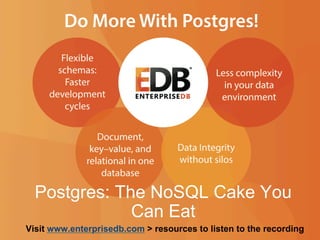
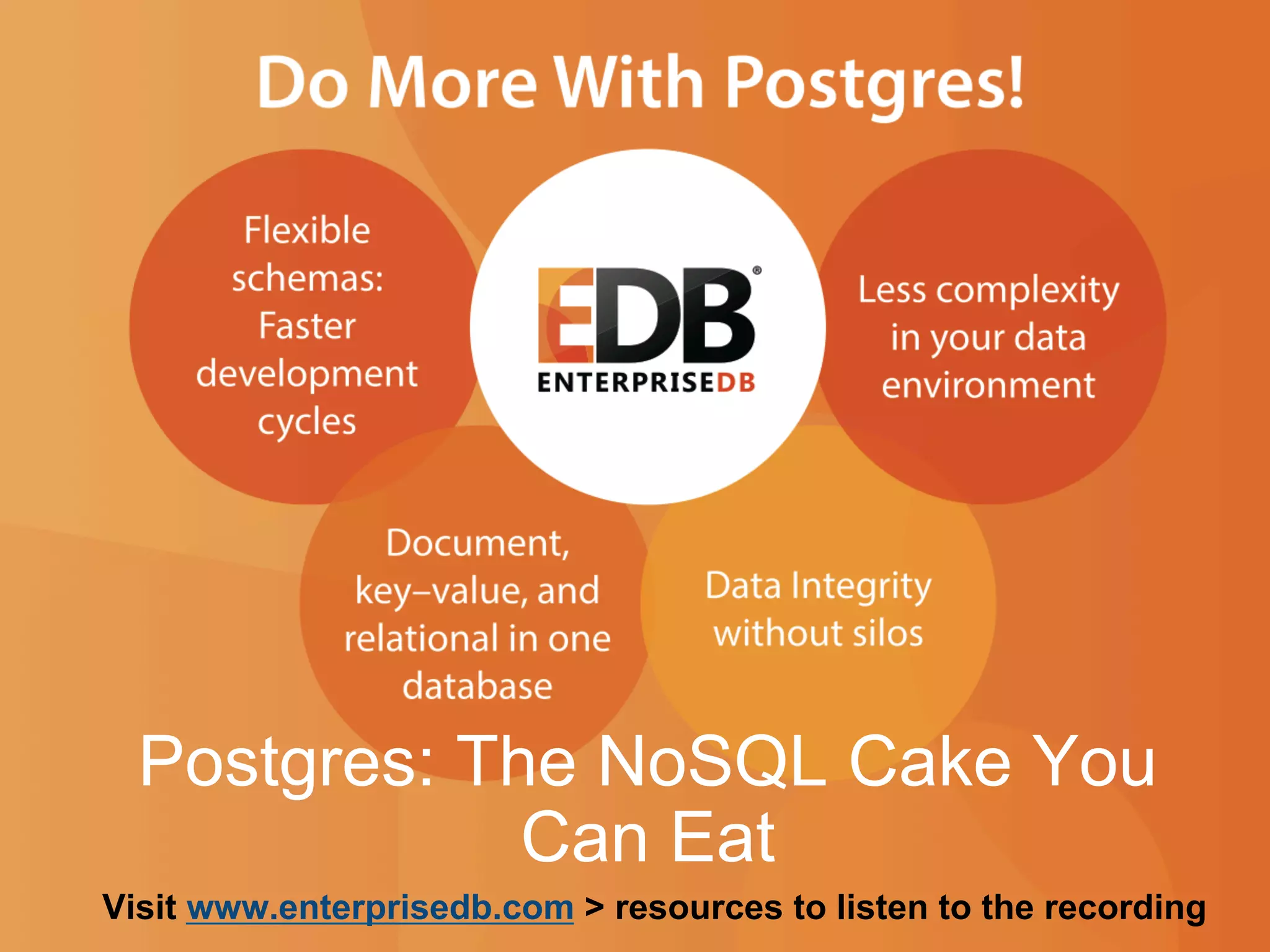
Postgres: The NoSQL Cake You 
Can Eat 
Visit www.enterprisedb.com > resources to listen to the recording 
© 2014 EnterpriseDB Corporation. All rights reserved. 1
Agenda 
• About EDB 
• Do more with Postgres 
• The NoSQL conundrum 
• Not only SQL – technology innovation on a 
robust platform 
• An example: 360° view of the 
customer 
• Not only SQL rules! 
© 2014 EnterpriseDB Corporation. All rights reserved. 2
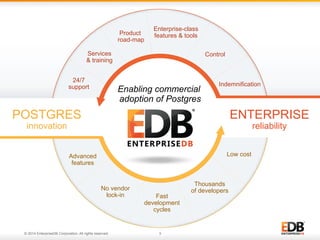
POSTGRES 
innovation 
Services 
& training 
© 2014 EnterpriseDB Corporation. All rights reserved. 3 
ENTERPRISE 
reliability 
24/7 
support 
Enterprise-class 
features & tools 
Indemnification 
Product 
road-map 
Control 
Thousands 
of developers 
Fast 
development 
cycles 
Low cost 
No vendor 
lock-in 
Advanced 
features 
Enabling commercial 
adoption of Postgres
EDB Customers 
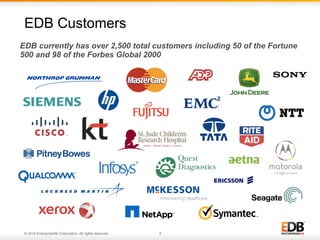
EDB currently has over 2,500 total customers including 50 of the Fortune 
500 and 98 of the Forbes Global 2000 
© 2014 EnterpriseDB Corporation. All rights reserved. 4
Postgres Plus 
Advanced Server Postgres Plus 
Management Performance 
© 2014 EnterpriseDB Corporation. All rights reserved. 5 
Cloud Database 
High Availability 
REMOTE 
DBA 24x7 
SUPPORT 
PROFESSIONAL 
SERVICES 
TRAINING 
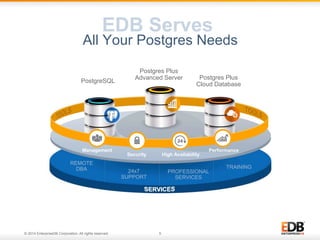
EDB Serves 
All Your Postgres Needs 
PostgreSQL 
Security
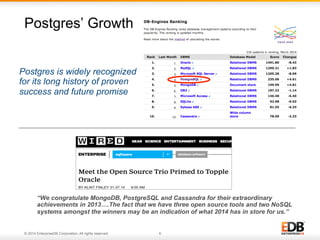
Postgres’ Growth 
Postgres is widely recognized 
for its long history of proven 
success and future promise 
“We congratulate MongoDB, PostgreSQL and Cassandra for their extraordinary 
achievements in 2013….The fact that we have three open source tools and two NoSQL 
systems amongst the winners may be an indication of what 2014 has in store for us.” 
© 2014 EnterpriseDB Corporation. All rights reserved. 6
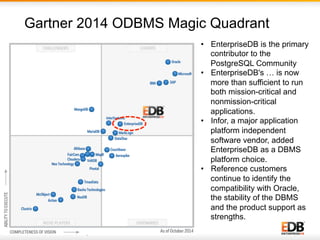
Gartner 2014 ODBMS Magic Quadrant 
© 2014 EnterpriseDB Corporation. All rights reserved. 7 
• EnterpriseDB is the primary 
contributor to the 
PostgreSQL Community 
• EnterpriseDB's … is now 
more than sufficient to run 
both mission-critical and 
nonmission-critical 
applications. 
• Infor, a major application 
platform independent 
software vendor, added 
EnterpriseDB as a DBMS 
platform choice. 
• Reference customers 
continue to identify the 
compatibility with Oracle, 
the stability of the DBMS 
and the product support as 
strengths.
Do more with Postgres 
© 2014 EnterpriseDB Corporation. All rights reserved. 8
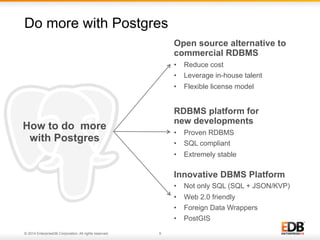
Do more with Postgres 
How to do more 
with Postgres 
© 2014 EnterpriseDB Corporation. All rights reserved. 9 
Open source alternative to 
commercial RDBMS 
• Reduce cost 
• Leverage in-house talent 
• Flexible license model 
RDBMS platform for 
new developments 
• Proven RDBMS 
• SQL compliant 
• Extremely stable 
Innovative DBMS Platform 
• Not only SQL (SQL + JSON/KVP) 
• Web 2.0 friendly 
• Foreign Data Wrappers 
• PostGIS
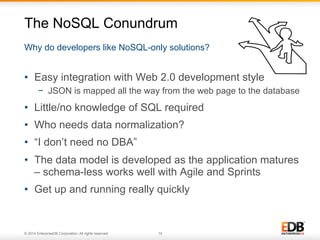
The NoSQL Conundrum 
Why do developers like NoSQL-only solutions? 
• Easy integration with Web 2.0 development style 
− JSON is mapped all the way from the web page to the database 
• Little/no knowledge of SQL required 
• Who needs data normalization? 
• “I don’t need no DBA” 
• The data model is developed as the application matures 
– schema-less works well with Agile and Sprints 
• Get up and running really quickly 
© 2014 EnterpriseDB Corporation. All rights reserved. 10
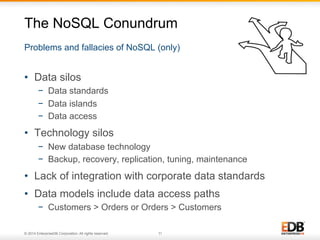
The NoSQL Conundrum 
Problems and fallacies of NoSQL (only) 
• Data silos 
− Data standards 
− Data islands 
− Data access 
• Technology silos 
− New database technology 
− Backup, recovery, replication, tuning, maintenance 
• Lack of integration with corporate data standards 
• Data models include data access paths 
− Customers > Orders or Orders > Customers 
© 2014 EnterpriseDB Corporation. All rights reserved. 11
The NoSQL Conundrum 
Data Standards 
• Structures and standards emerge! 
• Data has references (products link to catalogs; 
products have bills of material; components appear in 
multiple products; storage locations link to ISO country 
tables) 
• When the database has duplicate data entries, the 
application has to manage updates in multiple places – 
what happens when there is no ACID transactional 
model? 
© 2014 EnterpriseDB Corporation. All rights reserved. 12
The NoSQL Conundrum 
Data Islands 
• Solutions exist in context 
• Applications must be integrated 
− Orders flow to the warehouse 
− Invoices go to AP 
− Customer data must tie into the CRM 
• Data must be managed 
“By 2017, 50% of data stored in NoSQL DBMSs will be damaging 
to the business due to a lack of applied information governance 
policies and programs.” 
Dec. 3, 2013 Research Note “Does Your NoSQL DMBS Result in Information 
Governance Debt?” by Nick Heudecker and Ted Friedman. 
© 2014 EnterpriseDB Corporation. All rights reserved. 13
The NoSQL Conundrum 
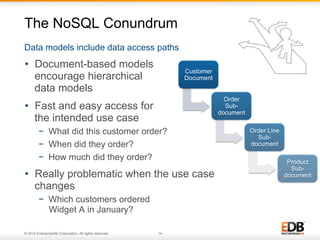
Data models include data access paths 
• Document-based models 
encourage hierarchical 
data models 
• Fast and easy access for 
the intended use case 
− What did this customer order? 
− When did they order? 
− How much did they order? 
• Really problematic when the use case 
changes 
− Which customers ordered 
Widget A in January? 
© 2014 EnterpriseDB Corporation. All rights reserved. 14 
Customer 
Document 
Order 
Sub-document 
Order Line 
Sub-document 
Product 
Sub-document
Not Only SQL - Technology 
Innovation on a Robust Platform 
© 2014 EnterpriseDB Corporation. All rights reserved. 15
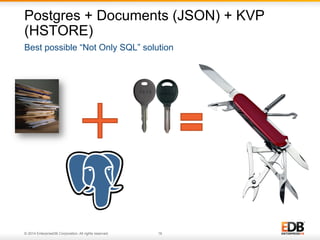
Postgres + Documents (JSON) + KVP 
(HSTORE) 
Best possible “Not Only SQL” solution 
© 2014 EnterpriseDB Corporation. All rights reserved. 16
Postgres’ NoSQL 
Capabilities 
• HSTORE 
− Key-value pair 
− Simple, fast and easy 
− Postgres v 8.2 – pre-dates many NoSQL-only solutions 
− Ideal for flat data structures that are sparsely populated 
• JSON 
− Hierarchical document model 
− Introduced in Postgres 9.2, perfected in 9.3 
• JSONB 
− Binary version of JSON 
− Faster, more operators and even more robust 
− Postgres 9.4 
© 2014 EnterpriseDB Corporation. All rights reserved. 17
Postgres: Document Store 
• JSON is the most popular 
data-interchange format on the web 
• Derived from the ECMAScript 
Programming Language Standard 
(European Computer Manufacturers 
Association). 
• Supported by virtually every 
programming language 
• New supporting technologies 
continue to expand JSON’s utility 
− PL/V8 JavaScript extension 
− Node.js 
• Postgres has a native JSON data type (v9.2) and a JSON parser and a 
variety of JSON functions (v9.3) 
• Postgres will have a JSONB data type with binary storage and indexing 
(coming – v9.4) 
© 2014 EnterpriseDB Corporation. All rights reserved. 18
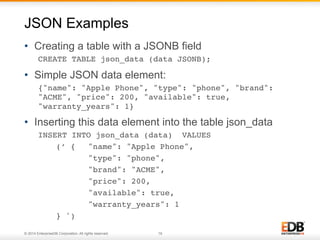
JSON Examples 
• Creating a table with a JSONB field 
CREATE TABLE json_data (data JSONB);! 
• Simple JSON data element: 
{"name": "Apple Phone", "type": "phone", "brand": 
"ACME", "price": 200, "available": true, 
"warranty_years": 1}! 
• Inserting this data element into the table json_data 
INSERT INTO json_data (data) VALUES ! 
!(’ { !"name": "Apple Phone", ! 
! !"type": "phone", ! 
! !"brand": "ACME", ! 
! !"price": 200, ! 
! !"available": true, ! 
! !"warranty_years": 1 ! !! 
!} ')! 
© 2014 EnterpriseDB Corporation. All rights reserved. 19
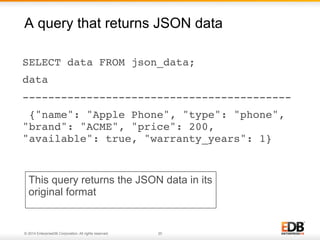
A query that returns JSON data 
SELECT data FROM json_data;! 
data ! 
------------------------------------------! 
{"name": "Apple Phone", "type": "phone", 
"brand": "ACME", "price": 200, 
"available": true, "warranty_years": 1}! 
This query returns the JSON data in its 
original format 
© 2014 EnterpriseDB Corporation. All rights reserved. 20
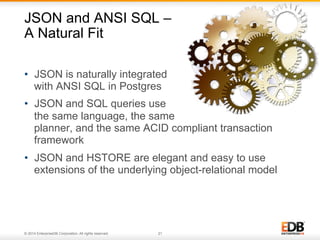
JSON and ANSI SQL – 
A Natural Fit 
• JSON is naturally integrated 
with ANSI SQL in Postgres 
• JSON and SQL queries use 
the same language, the same 
planner, and the same ACID compliant transaction 
framework 
• JSON and HSTORE are elegant and easy to use 
extensions of the underlying object-relational model 
© 2014 EnterpriseDB Corporation. All rights reserved. 21
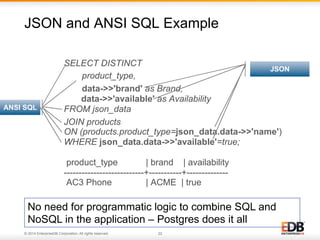
JSON and ANSI SQL Example 
SELECT DISTINCT 
product_type, 
data->>'brand' as Brand, 
data->>'available' as Availability 
FROM json_data 
JOIN products 
ON (products.product_type=json_data.data->>'name') 
WHERE json_data.data->>'available'=true; 
product_type | brand | availability 
---------------------------+-----------+-------------- 
AC3 Phone | ACME | true 
ANSI SQL 
© 2014 EnterpriseDB Corporation. All rights reserved. 22 
JSON 
No need for programmatic logic to combine SQL and 
NoSQL in the application – Postgres does it all
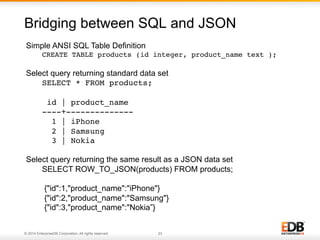
Bridging between SQL and JSON 
Simple ANSI SQL Table Definition 
CREATE TABLE products (id integer, product_name text );! 
Select query returning standard data set 
SELECT * FROM products; 
! 
id | product_name ! 
----+--------------! 
1 | iPhone! 
2 | Samsung! 
3 | Nokia! 
Select query returning the same result as a JSON data set 
SELECT ROW_TO_JSON(products) FROM products; 
{"id":1,"product_name":"iPhone"} 
{"id":2,"product_name":"Samsung"} 
{"id":3,"product_name":"Nokia”} 
© 2014 EnterpriseDB Corporation. All rights reserved. 23
JSON Data Types 
• 1. Number: 
− Signed decimal number that may contain a fractional part and may use exponential 
notation. 
− No distinction between integer and floating-point 
• 2. String 
− A sequence of zero or more Unicode characters. 
− Strings are delimited with double-quotation mark 
− Supports a backslash escaping syntax. 
• 3. Boolean 
− Either of the values true or false. 
• 4. Array 
− An ordered list of zero or more values, 
− Each values may be of any type. 
− Arrays use square bracket notation with elements being comma-separated. 
• 5. Object 
− An unordered associative array (name/value pairs). 
− Objects are delimited with curly brackets 
− Commas to separate each pair 
− Each pair the colon ':' character separates the key or name from its value. 
− All keys must be strings and should be distinct from each other within that object. 
• 6. null 
− An empty value, using the word null 
© 2014 EnterpriseDB Corporation. All rights reserved. 24 
JSON is defined per RFC – 7159 
For more detail please refer http://tools.ietf.org/ 
html/rfc7159
JSON Data Type Example 
{ 
"firstName": "John", -- String Type 
"lastName": "Smith", -- String Type 
"isAlive": true, -- Boolean Type 
"age": 25, -- Number Type 
"height_cm": 167.6, -- Number Type 
"address": { -- Object Type 
"streetAddress": "21 2nd Street”, 
"city": "New York”, 
"state": "NY”, 
"postalCode": "10021-3100” 
}, 
"phoneNumbers": [ // Object Array 
{ // Object 
"type": "home”, 
"number": "212 555-1234” 
}, 
{ 
"type": "office”, 
"number": "646 555-4567” 
} 
], 
"children": [], 
"spouse": null // Null 
} 
© 2014 EnterpriseDB Corporation. All rights reserved. 25
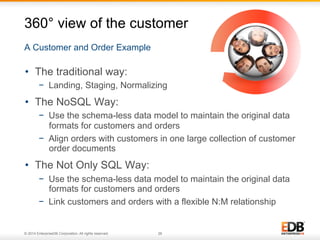
360° view of the customer 
A Customer and Order Example 
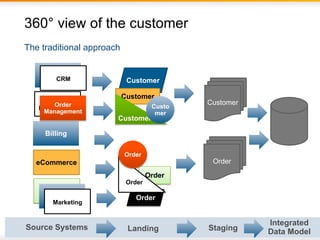
• The traditional way: 
− Landing, Staging, Normalizing 
• The NoSQL Way: 
− Use the schema-less data model to maintain the original data 
formats for customers and orders 
− Align orders with customers in one large collection of customer 
order documents 
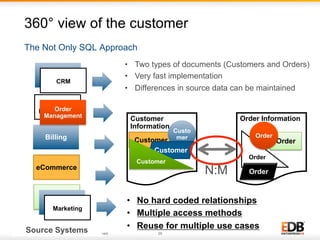
• The Not Only SQL Way: 
− Use the schema-less data model to maintain the original data 
formats for customers and orders 
− Link customers and orders with a flexible N:M relationship 
© 2014 EnterpriseDB Corporation. All rights reserved. 26
360° view of the customer 
The traditional approach 
CRM 
CRM 
Order 
Order 
Management 
Management 
Billing 
eCommerce 
Marketing 
Marketing 
Marketing 
Customer 
Customer 
Order 
Order 
Order 
Order 
© 2014 EnterpriseDB Corporation. All rights reserved. 27 
Customer 
Order 
Source Systems Landing Staging Integrated 
Data Model 
Customer 
Custo 
mer
360° view of the customer 
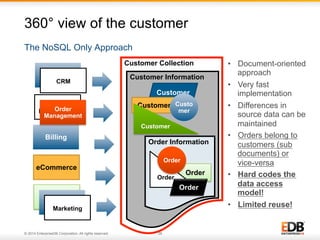
The NoSQL Only Approach 
Customer Collection • Document-oriented 
Customer Information 
CRM 
CRM 
Order 
Order 
Management 
Management 
Billing 
eCommerce 
Marketing 
Marketing 
Marketing 
Customer 
Customer 
Customer 
© 2014 EnterpriseDB Corporation. All rights reserved. 28 
Custo 
mer 
Order Information 
Order 
Order Order 
Order 
approach 
• Very fast 
implementation 
• Differences in 
source data can be 
maintained 
• Orders belong to 
customers (sub 
documents) or 
vice-versa 
• Hard codes the 
data access 
model! 
• Limited reuse!
360° view of the customer 
The Not Only SQL Approach 
CRM 
CRM 
Order 
Order 
Management 
Management 
Billing 
eCommerce 
Marketing 
Marketing 
Marketing 
Source Systems 
• Two types of documents (Customers and Orders) 
• Very fast implementation 
• Differences in source data can be maintained 
© 2014 EnterpriseDB Corporation. All rights reserved. 29 
Order Information 
Order 
Order 
Order 
Order 
Customer 
Custo 
mer 
Customer 
Information 
Customer 
Customer 
N:M 
• No hard coded relationships 
• Multiple access methods 
• Reuse for multiple use cases
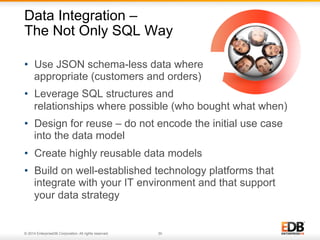
Data Integration – 
The Not Only SQL Way 
• Use JSON schema-less data where 
appropriate (customers and orders) 
• Leverage SQL structures and 
relationships where possible (who bought what when) 
• Design for reuse – do not encode the initial use case 
into the data model 
• Create highly reusable data models 
• Build on well-established technology platforms that 
integrate with your IT environment and that support 
your data strategy 
© 2014 EnterpriseDB Corporation. All rights reserved. 30
Not Only SQL Rules! 
• Use structures and relationships where appropriate, be flexible 
everywhere else 
− Use JSON for data with high degrees of variability 
− Use the flexibility of JSON to bridge multiple formats and data 
elements 
− Use SQL to make relationships explicit – don’t hard code them 
• Leverage a single tech platform to avoid tech silos, skills silos and 
data silos 
• Focus on creating value-add, not on setting up yet another 
infrastructure 
• Build on the most advanced open source DBMS’s Capabilities 
Do more with Postgres! 
© 2014 EnterpriseDB Corporation. All rights reserved. 31
© 2014 EnterpriseDB Corporation. All rights reserved. 32

Postgres: The NoSQL Cake You Can Eat

  • 1.
    Postgres: The NoSQLCake You Can Eat Visit www.enterprisedb.com > resources to listen to the recording © 2014 EnterpriseDB Corporation. All rights reserved. 1
  • 2.
    Agenda • AboutEDB • Do more with Postgres • The NoSQL conundrum • Not only SQL – technology innovation on a robust platform • An example: 360° view of the customer • Not only SQL rules! © 2014 EnterpriseDB Corporation. All rights reserved. 2
  • 3.
    POSTGRES innovation Services & training © 2014 EnterpriseDB Corporation. All rights reserved. 3 ENTERPRISE reliability 24/7 support Enterprise-class features & tools Indemnification Product road-map Control Thousands of developers Fast development cycles Low cost No vendor lock-in Advanced features Enabling commercial adoption of Postgres
  • 4.
    EDB Customers EDBcurrently has over 2,500 total customers including 50 of the Fortune 500 and 98 of the Forbes Global 2000 © 2014 EnterpriseDB Corporation. All rights reserved. 4
  • 5.
    Postgres Plus AdvancedServer Postgres Plus Management Performance © 2014 EnterpriseDB Corporation. All rights reserved. 5 Cloud Database High Availability REMOTE DBA 24x7 SUPPORT PROFESSIONAL SERVICES TRAINING EDB Serves All Your Postgres Needs PostgreSQL Security
  • 6.
    Postgres’ Growth Postgresis widely recognized for its long history of proven success and future promise “We congratulate MongoDB, PostgreSQL and Cassandra for their extraordinary achievements in 2013….The fact that we have three open source tools and two NoSQL systems amongst the winners may be an indication of what 2014 has in store for us.” © 2014 EnterpriseDB Corporation. All rights reserved. 6
  • 7.
    Gartner 2014 ODBMSMagic Quadrant © 2014 EnterpriseDB Corporation. All rights reserved. 7 • EnterpriseDB is the primary contributor to the PostgreSQL Community • EnterpriseDB's … is now more than sufficient to run both mission-critical and nonmission-critical applications. • Infor, a major application platform independent software vendor, added EnterpriseDB as a DBMS platform choice. • Reference customers continue to identify the compatibility with Oracle, the stability of the DBMS and the product support as strengths.
  • 8.
    Do more withPostgres © 2014 EnterpriseDB Corporation. All rights reserved. 8
  • 9.
    Do more withPostgres How to do more with Postgres © 2014 EnterpriseDB Corporation. All rights reserved. 9 Open source alternative to commercial RDBMS • Reduce cost • Leverage in-house talent • Flexible license model RDBMS platform for new developments • Proven RDBMS • SQL compliant • Extremely stable Innovative DBMS Platform • Not only SQL (SQL + JSON/KVP) • Web 2.0 friendly • Foreign Data Wrappers • PostGIS
  • 10.
    The NoSQL Conundrum Why do developers like NoSQL-only solutions? • Easy integration with Web 2.0 development style − JSON is mapped all the way from the web page to the database • Little/no knowledge of SQL required • Who needs data normalization? • “I don’t need no DBA” • The data model is developed as the application matures – schema-less works well with Agile and Sprints • Get up and running really quickly © 2014 EnterpriseDB Corporation. All rights reserved. 10
  • 11.
    The NoSQL Conundrum Problems and fallacies of NoSQL (only) • Data silos − Data standards − Data islands − Data access • Technology silos − New database technology − Backup, recovery, replication, tuning, maintenance • Lack of integration with corporate data standards • Data models include data access paths − Customers > Orders or Orders > Customers © 2014 EnterpriseDB Corporation. All rights reserved. 11
  • 12.
    The NoSQL Conundrum Data Standards • Structures and standards emerge! • Data has references (products link to catalogs; products have bills of material; components appear in multiple products; storage locations link to ISO country tables) • When the database has duplicate data entries, the application has to manage updates in multiple places – what happens when there is no ACID transactional model? © 2014 EnterpriseDB Corporation. All rights reserved. 12
  • 13.
    The NoSQL Conundrum Data Islands • Solutions exist in context • Applications must be integrated − Orders flow to the warehouse − Invoices go to AP − Customer data must tie into the CRM • Data must be managed “By 2017, 50% of data stored in NoSQL DBMSs will be damaging to the business due to a lack of applied information governance policies and programs.” Dec. 3, 2013 Research Note “Does Your NoSQL DMBS Result in Information Governance Debt?” by Nick Heudecker and Ted Friedman. © 2014 EnterpriseDB Corporation. All rights reserved. 13
  • 14.
    The NoSQL Conundrum Data models include data access paths • Document-based models encourage hierarchical data models • Fast and easy access for the intended use case − What did this customer order? − When did they order? − How much did they order? • Really problematic when the use case changes − Which customers ordered Widget A in January? © 2014 EnterpriseDB Corporation. All rights reserved. 14 Customer Document Order Sub-document Order Line Sub-document Product Sub-document
  • 15.
    Not Only SQL- Technology Innovation on a Robust Platform © 2014 EnterpriseDB Corporation. All rights reserved. 15
  • 16.
    Postgres + Documents(JSON) + KVP (HSTORE) Best possible “Not Only SQL” solution © 2014 EnterpriseDB Corporation. All rights reserved. 16
  • 17.
    Postgres’ NoSQL Capabilities • HSTORE − Key-value pair − Simple, fast and easy − Postgres v 8.2 – pre-dates many NoSQL-only solutions − Ideal for flat data structures that are sparsely populated • JSON − Hierarchical document model − Introduced in Postgres 9.2, perfected in 9.3 • JSONB − Binary version of JSON − Faster, more operators and even more robust − Postgres 9.4 © 2014 EnterpriseDB Corporation. All rights reserved. 17
  • 18.
    Postgres: Document Store • JSON is the most popular data-interchange format on the web • Derived from the ECMAScript Programming Language Standard (European Computer Manufacturers Association). • Supported by virtually every programming language • New supporting technologies continue to expand JSON’s utility − PL/V8 JavaScript extension − Node.js • Postgres has a native JSON data type (v9.2) and a JSON parser and a variety of JSON functions (v9.3) • Postgres will have a JSONB data type with binary storage and indexing (coming – v9.4) © 2014 EnterpriseDB Corporation. All rights reserved. 18
  • 19.
    JSON Examples •Creating a table with a JSONB field CREATE TABLE json_data (data JSONB);! • Simple JSON data element: {"name": "Apple Phone", "type": "phone", "brand": "ACME", "price": 200, "available": true, "warranty_years": 1}! • Inserting this data element into the table json_data INSERT INTO json_data (data) VALUES ! !(’ { !"name": "Apple Phone", ! ! !"type": "phone", ! ! !"brand": "ACME", ! ! !"price": 200, ! ! !"available": true, ! ! !"warranty_years": 1 ! !! !} ')! © 2014 EnterpriseDB Corporation. All rights reserved. 19
  • 20.
    A query thatreturns JSON data SELECT data FROM json_data;! data ! ------------------------------------------! {"name": "Apple Phone", "type": "phone", "brand": "ACME", "price": 200, "available": true, "warranty_years": 1}! This query returns the JSON data in its original format © 2014 EnterpriseDB Corporation. All rights reserved. 20
  • 21.
    JSON and ANSISQL – A Natural Fit • JSON is naturally integrated with ANSI SQL in Postgres • JSON and SQL queries use the same language, the same planner, and the same ACID compliant transaction framework • JSON and HSTORE are elegant and easy to use extensions of the underlying object-relational model © 2014 EnterpriseDB Corporation. All rights reserved. 21
  • 22.
    JSON and ANSISQL Example SELECT DISTINCT product_type, data->>'brand' as Brand, data->>'available' as Availability FROM json_data JOIN products ON (products.product_type=json_data.data->>'name') WHERE json_data.data->>'available'=true; product_type | brand | availability ---------------------------+-----------+-------------- AC3 Phone | ACME | true ANSI SQL © 2014 EnterpriseDB Corporation. All rights reserved. 22 JSON No need for programmatic logic to combine SQL and NoSQL in the application – Postgres does it all
  • 23.
    Bridging between SQLand JSON Simple ANSI SQL Table Definition CREATE TABLE products (id integer, product_name text );! Select query returning standard data set SELECT * FROM products; ! id | product_name ! ----+--------------! 1 | iPhone! 2 | Samsung! 3 | Nokia! Select query returning the same result as a JSON data set SELECT ROW_TO_JSON(products) FROM products; {"id":1,"product_name":"iPhone"} {"id":2,"product_name":"Samsung"} {"id":3,"product_name":"Nokia”} © 2014 EnterpriseDB Corporation. All rights reserved. 23
  • 24.
    JSON Data Types • 1. Number: − Signed decimal number that may contain a fractional part and may use exponential notation. − No distinction between integer and floating-point • 2. String − A sequence of zero or more Unicode characters. − Strings are delimited with double-quotation mark − Supports a backslash escaping syntax. • 3. Boolean − Either of the values true or false. • 4. Array − An ordered list of zero or more values, − Each values may be of any type. − Arrays use square bracket notation with elements being comma-separated. • 5. Object − An unordered associative array (name/value pairs). − Objects are delimited with curly brackets − Commas to separate each pair − Each pair the colon ':' character separates the key or name from its value. − All keys must be strings and should be distinct from each other within that object. • 6. null − An empty value, using the word null © 2014 EnterpriseDB Corporation. All rights reserved. 24 JSON is defined per RFC – 7159 For more detail please refer http://tools.ietf.org/ html/rfc7159
  • 25.
    JSON Data TypeExample { "firstName": "John", -- String Type "lastName": "Smith", -- String Type "isAlive": true, -- Boolean Type "age": 25, -- Number Type "height_cm": 167.6, -- Number Type "address": { -- Object Type "streetAddress": "21 2nd Street”, "city": "New York”, "state": "NY”, "postalCode": "10021-3100” }, "phoneNumbers": [ // Object Array { // Object "type": "home”, "number": "212 555-1234” }, { "type": "office”, "number": "646 555-4567” } ], "children": [], "spouse": null // Null } © 2014 EnterpriseDB Corporation. All rights reserved. 25
  • 26.
    360° view ofthe customer A Customer and Order Example • The traditional way: − Landing, Staging, Normalizing • The NoSQL Way: − Use the schema-less data model to maintain the original data formats for customers and orders − Align orders with customers in one large collection of customer order documents • The Not Only SQL Way: − Use the schema-less data model to maintain the original data formats for customers and orders − Link customers and orders with a flexible N:M relationship © 2014 EnterpriseDB Corporation. All rights reserved. 26
  • 27.
    360° view ofthe customer The traditional approach CRM CRM Order Order Management Management Billing eCommerce Marketing Marketing Marketing Customer Customer Order Order Order Order © 2014 EnterpriseDB Corporation. All rights reserved. 27 Customer Order Source Systems Landing Staging Integrated Data Model Customer Custo mer
  • 28.
    360° view ofthe customer The NoSQL Only Approach Customer Collection • Document-oriented Customer Information CRM CRM Order Order Management Management Billing eCommerce Marketing Marketing Marketing Customer Customer Customer © 2014 EnterpriseDB Corporation. All rights reserved. 28 Custo mer Order Information Order Order Order Order approach • Very fast implementation • Differences in source data can be maintained • Orders belong to customers (sub documents) or vice-versa • Hard codes the data access model! • Limited reuse!
  • 29.
    360° view ofthe customer The Not Only SQL Approach CRM CRM Order Order Management Management Billing eCommerce Marketing Marketing Marketing Source Systems • Two types of documents (Customers and Orders) • Very fast implementation • Differences in source data can be maintained © 2014 EnterpriseDB Corporation. All rights reserved. 29 Order Information Order Order Order Order Customer Custo mer Customer Information Customer Customer N:M • No hard coded relationships • Multiple access methods • Reuse for multiple use cases
  • 30.
    Data Integration – The Not Only SQL Way • Use JSON schema-less data where appropriate (customers and orders) • Leverage SQL structures and relationships where possible (who bought what when) • Design for reuse – do not encode the initial use case into the data model • Create highly reusable data models • Build on well-established technology platforms that integrate with your IT environment and that support your data strategy © 2014 EnterpriseDB Corporation. All rights reserved. 30
  • 31.
    Not Only SQLRules! • Use structures and relationships where appropriate, be flexible everywhere else − Use JSON for data with high degrees of variability − Use the flexibility of JSON to bridge multiple formats and data elements − Use SQL to make relationships explicit – don’t hard code them • Leverage a single tech platform to avoid tech silos, skills silos and data silos • Focus on creating value-add, not on setting up yet another infrastructure • Build on the most advanced open source DBMS’s Capabilities Do more with Postgres! © 2014 EnterpriseDB Corporation. All rights reserved. 31
  • 32.
    © 2014 EnterpriseDBCorporation. All rights reserved. 32