ASI THOMAS, M.Sc
(MEDICAL BIOCHEMISTRY),
LECTURER,
Ganga College of Nursing,
Coimbatore.
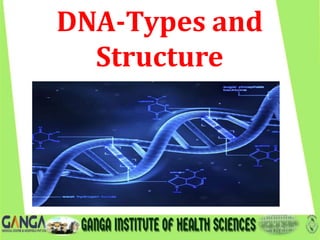
DNA-Types and
Structure
DNA or deoxyribonuclic acid is the
heriditary material in humans and almost
all organisms.
INTRODUCTION
NUCLEOTIDES:-
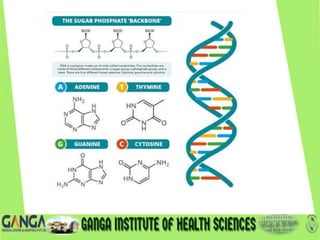
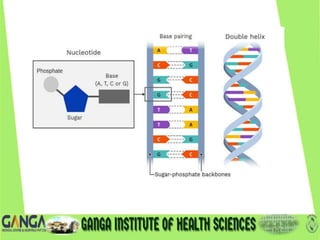
Nitogeneous base + Pentose sugar +
Phosphate
Nitrogeneous base + sugar
NUCLEOSIDE
PURINES & PYRIMIDINES
The nitrogeneous base found in
nucleotides
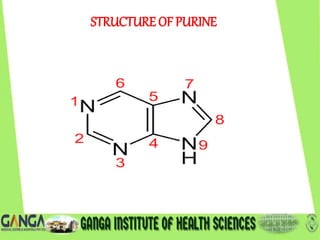
• Purine
•Adenosine and Guanine.
•Numbered in anticlockwise
direction
STRUCTURE OF PURINE
Pyrimidine
•Cytosine, Thyamine and Uracil.
•Numbered clockwise direction.
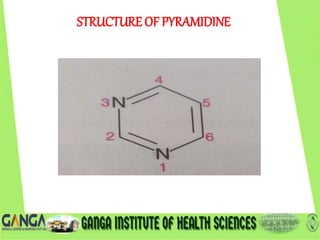
STRUCTURE OF PYRAMIDINE
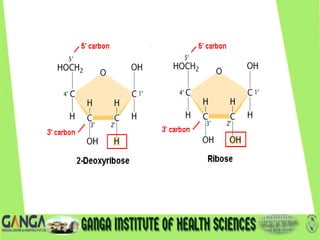
SUGARS OF NUCLIC ACID
• RNA - D-ribose sugar
• DNA- D- deoxyribose sugar
• These two differ at their structure at
C2 position.
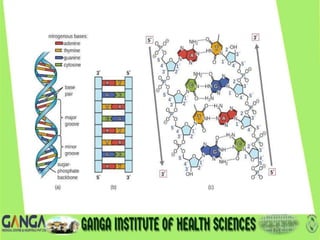
STRUCTURE OF DNA
• DNA is a polymer of
deoxyribonucleotides
• Composed of monomeric units of
–dGMP
–dAMP
–dCMP
–dTMP
Chargaff’s Rule
• DNA had equal number of adenine
and thymine (A=T)
• equal number of guanine and
cytosine (G≡C)
DNA- TYPES
• Proposed by James Watson and Francis
Crick.
• Different forms of DNA
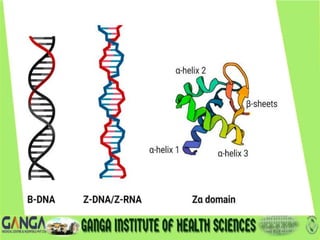
B-DNA
A-DNA
Z-DNA
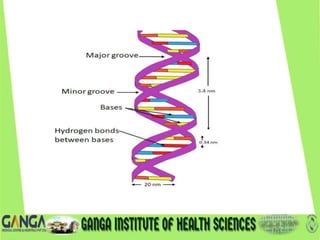
B-DNA
• Right handed helix
• Strands are antiparallel
• Strands interact by hydrogen bonding
• A=T
• G≡C
• Angle of interaction between base pairs
result in major groove and minor groove.
• Helix diameter is 20Ao
• Helix rise per base pair is 3.32Ao
• 10.4 basepair per helical turn
Z-DNA
• It is left handed in which helix winds
to the left in a zig zag pattern.
• Play a major role in regulation of
gene expression
• In humans Z-DNA was found to form
in actively transcribed regions of the
genome
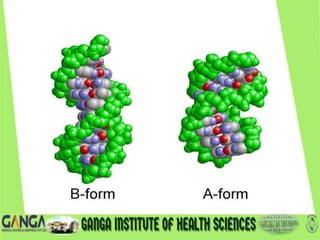
A-DNA
• Dehydration of DNA drives it into the A
form, which has been shown to protect
DNA under conditions such as the
extreme desiccation of bacteria
• It is right handed
• Base pair per turn is 11
• Vertical rise per turn is 2.56Ao
• Rotation per base pair is +33o
• Helical diameter is 19Ao
DNA.pptx
DNA.pptx
DNA.pptx

DNA.pptx