Submitted by: Payal ratdiya
M.Sc. Microbiology sem I
Submitted to:- Dr. Sonia kaura
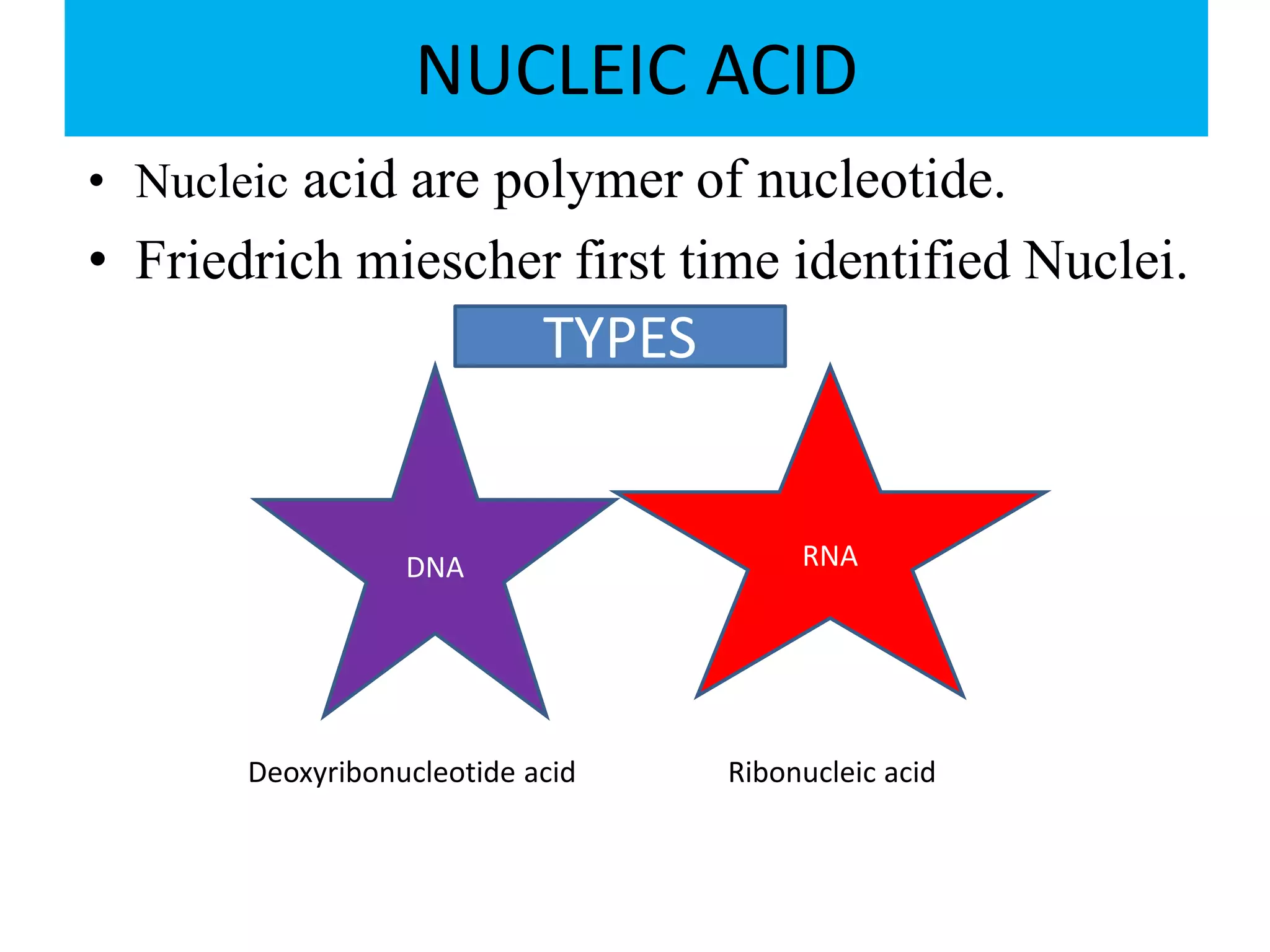
NUCLEIC ACID
• Nucleic acid are polymer of nucleotide.
• Friedrich miescher first time identified Nuclei.
TYPES
DNA RNA
Deoxyribonucleotide acid Ribonucleic acid
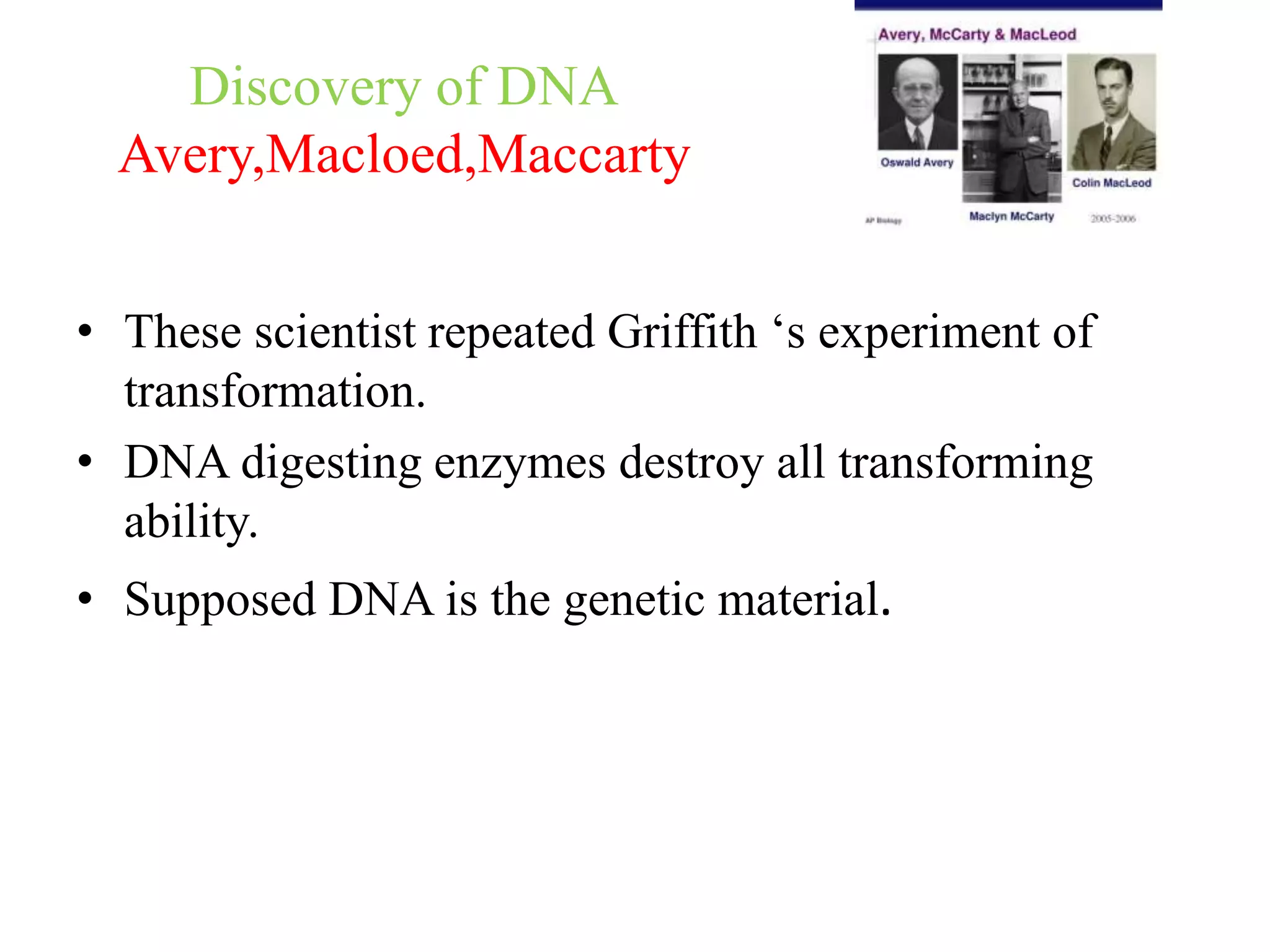
Discovery of DNA
Avery,Macloed,Maccarty
• These scientist repeated Griffith ‘s experiment of
transformation.
• DNA digesting enzymes destroy all transforming
ability.
• Supposed DNA is the genetic material.
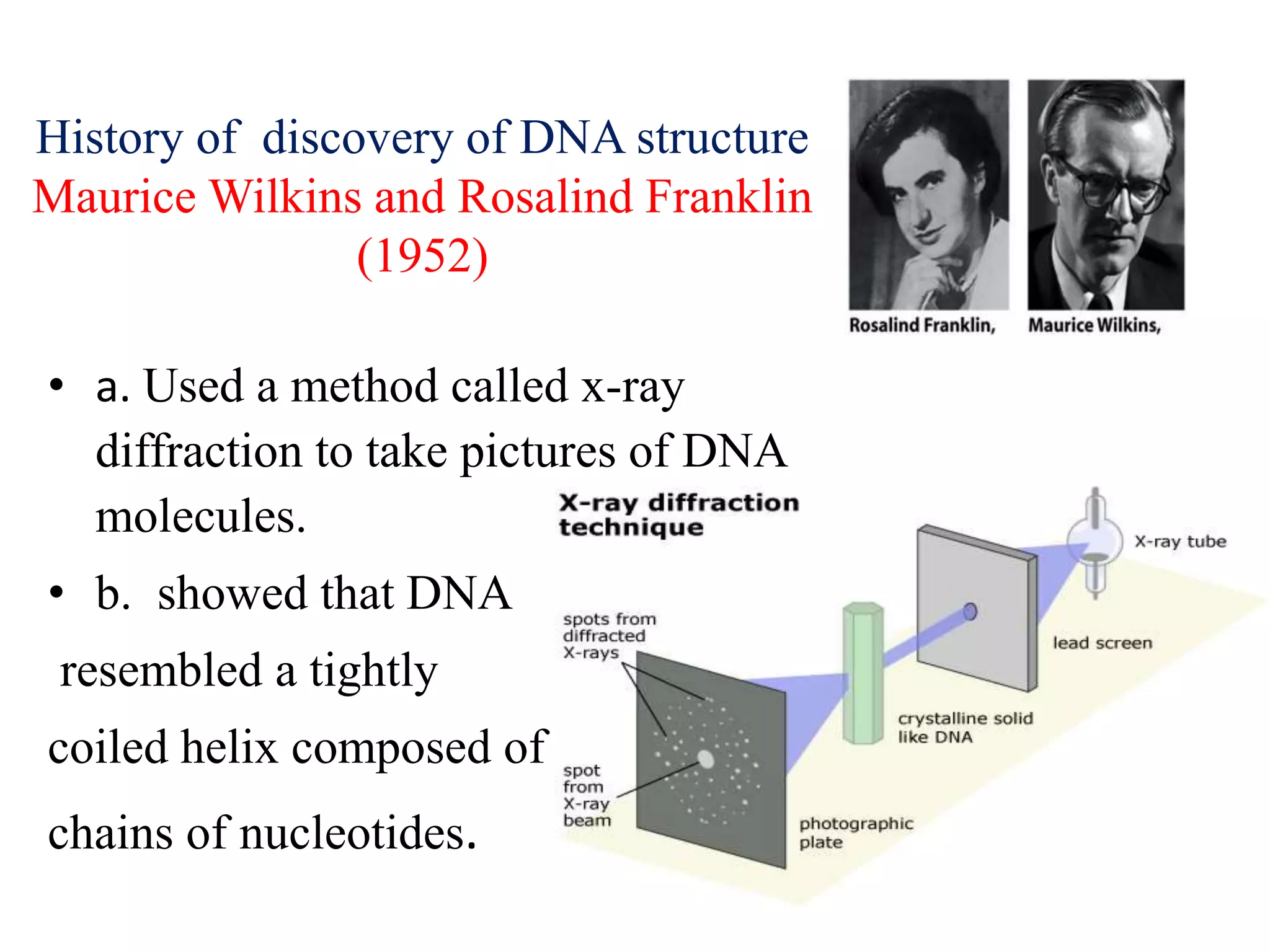
History of discovery of DNA structure
Maurice Wilkins and Rosalind Franklin
(1952)
• a. Used a method called x-ray
diffraction to take pictures of DNA
molecules.
• b. showed that DNA
resembled a tightly
coiled helix composed of
chains of nucleotides.
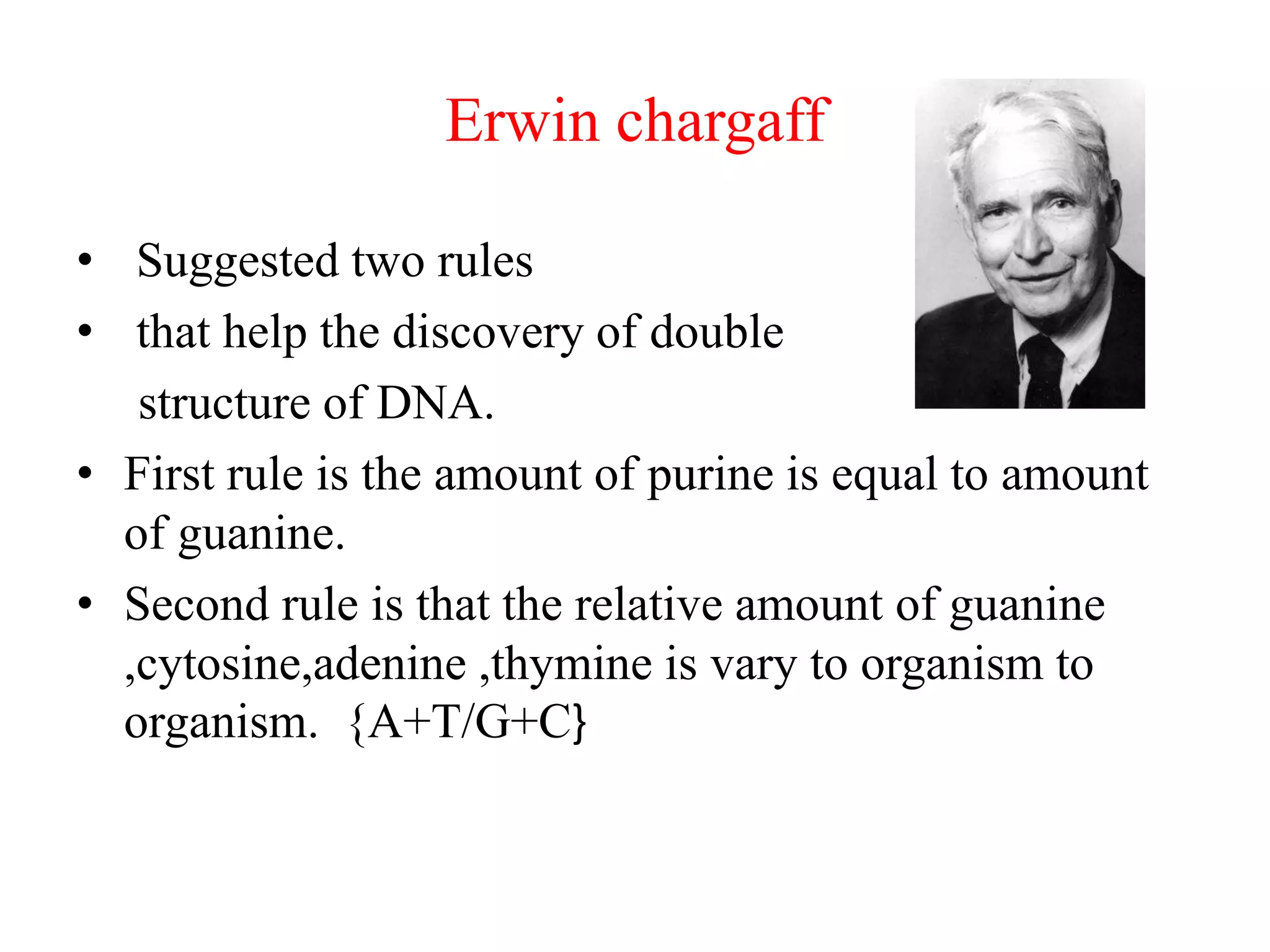
Erwin chargaff
• Suggested two rules
• that help the discovery of double
structure of DNA.
• First rule is the amount of purine is equal to amount
of guanine.
• Second rule is that the relative amount of guanine
,cytosine,adenine ,thymine is vary to organism to
organism. {A+T/G+C}
Watson and Crick(1953)
• a.Used Chargaff ,Wilkins,and Franklin observation
to develop their DNA model.
• b.They proposed that DNA is made to two chains
that wrap around each other in the shape of double
helix,proposed Bform of DNA
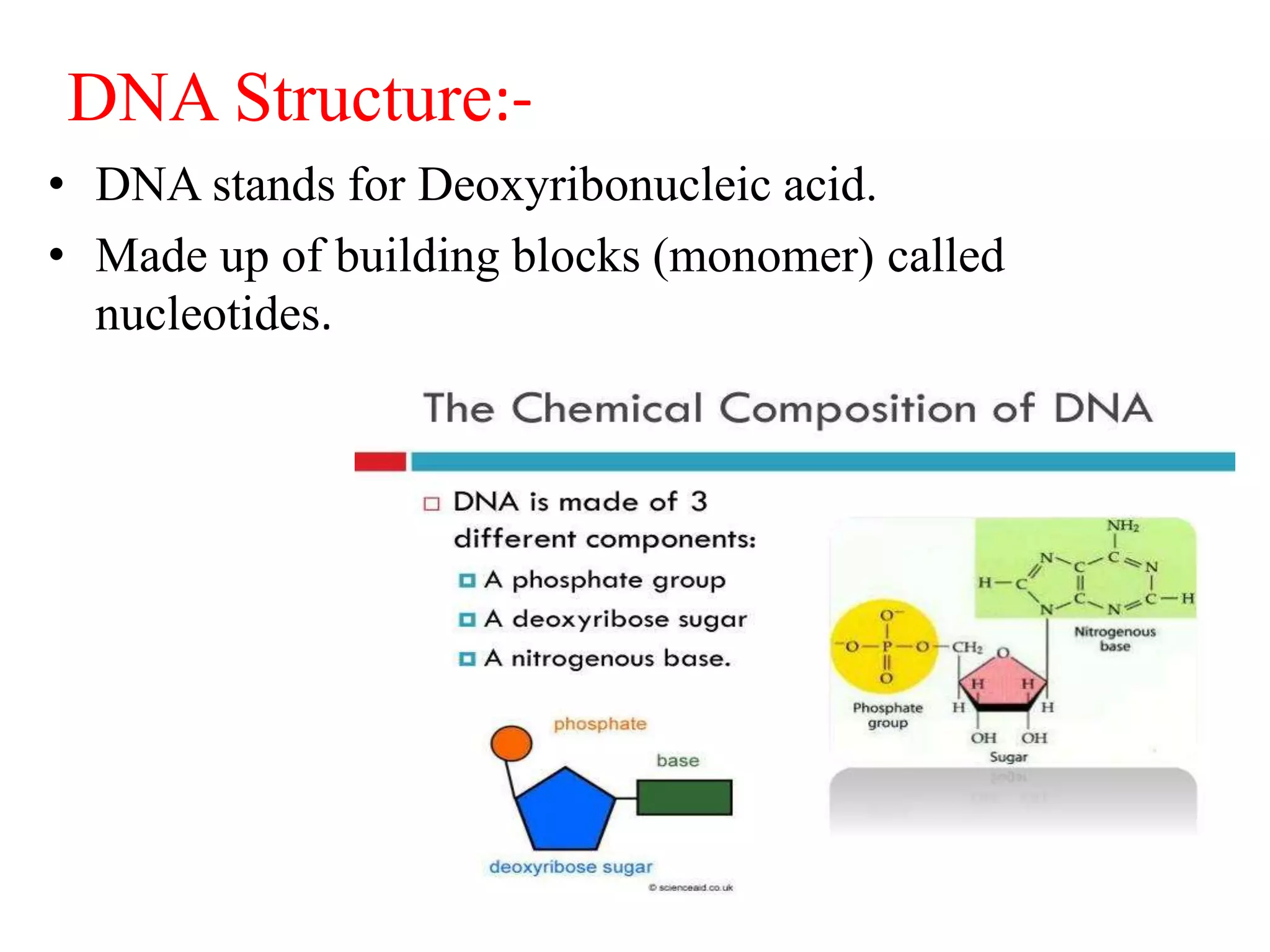
DNA Structure:-
• DNA stands for Deoxyribonucleic acid.
• Made up of building blocks (monomer) called
nucleotides.
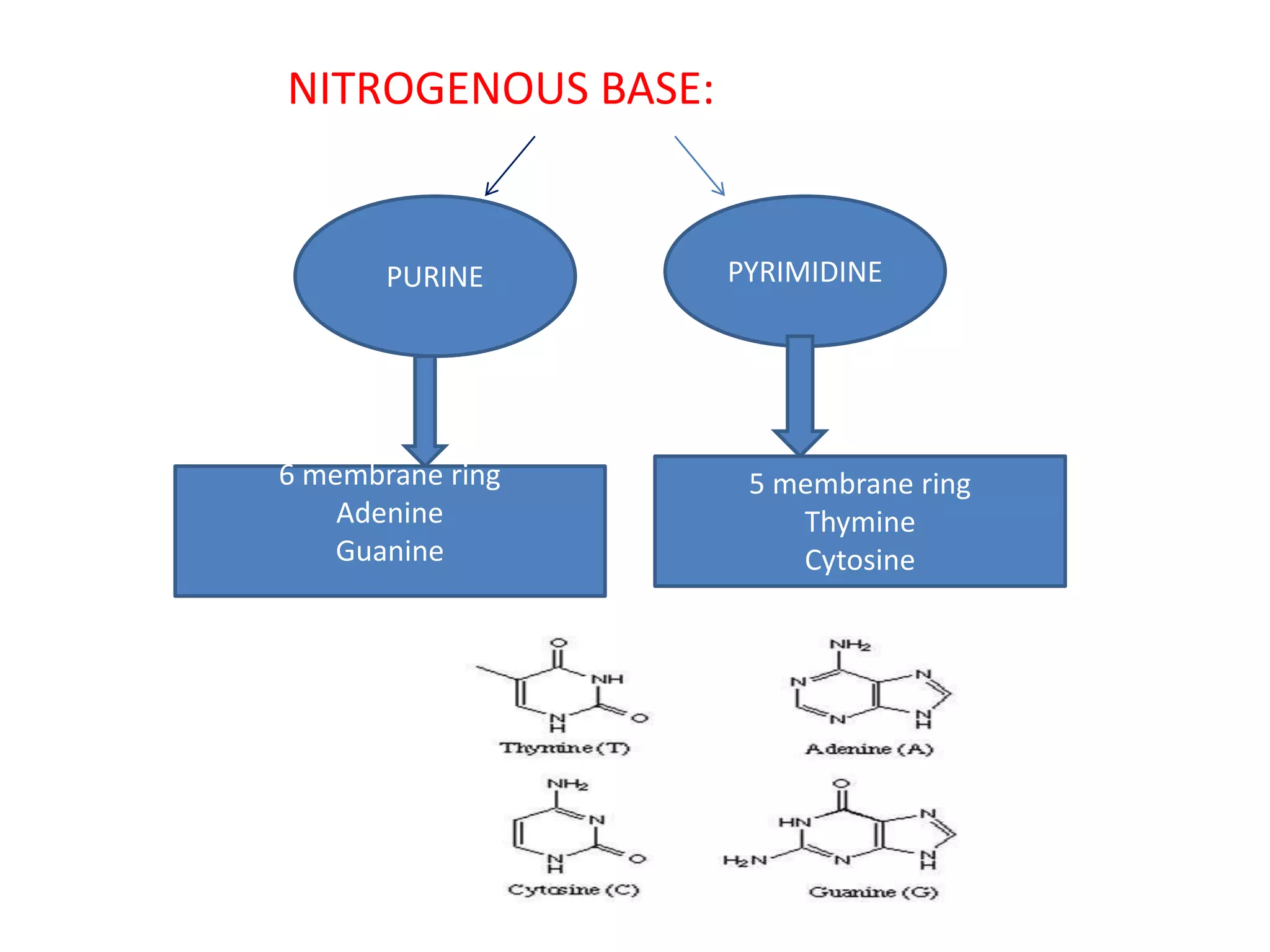
NITROGENOUS BASE:
PURINE PYRIMIDINE
6 membrane ring
Adenine
Guanine
5 membrane ring
Thymine
Cytosine
Sugars
• 2 types of pentose sugar: ribose and
deoxyribose
ribose nucleic acid
absence of OH group at 2 C
Ribose
Absence of 2’OH group at 2C
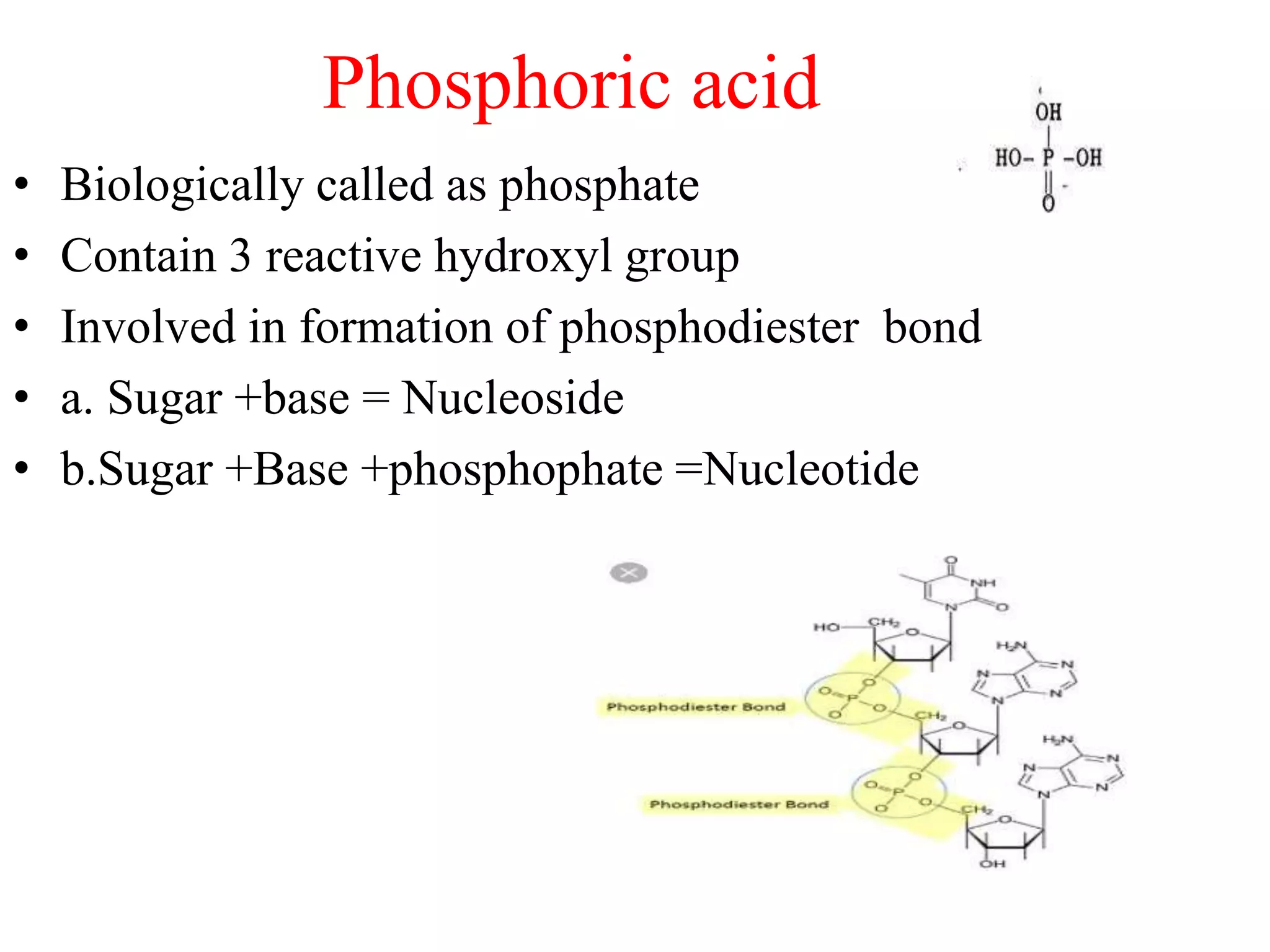
Phosphoric acid
• Biologically called as phosphate
• Contain 3 reactive hydroxyl group
• Involved in formation of phosphodiester bond
• a. Sugar +base = Nucleoside
• b.Sugar +Base +phosphophate =Nucleotide
DNA Structure
To form polynucleotide structure of DNA and
RNA nucleotides are linked together by
phosphodiester bonds which formes between the
phosphate group which is attached to 5C of sugar of
one nucleotide and 3C of another nucleotide.5’-3’
phosphodiester bond form.
Nitrogen bases are attached to the first carbon
of the pentose sugar by covalent bond.
Watson and Crick model
Used X ray diffraction technique to proposed model .DNA is a
double stranded molecule that is twisted into a helix
• Chains are antiparallel
Bases are joined by hydrogen bond Adenine= Thymine
• Guanine = Cytosine
Diameter of helix 20⁰A
• One strand oriented in 5’ to3’D and another
strand is oriented in 3’ to 5’D.
• 10 base pair present in per turn.
• The interaction between base and sugar form
grooves . Major groove [large angle between
base and sugar] and Minor groove [naarow
angle between base and sugar]
Different types of DNA
Parameter A-DNA B-DNA Z-DNA
Helix sense
right-
handed
right-
handed
left-
handed
Residues per turn 11 10.5 12
Helix pitch(°) 28 34 45
Base pair tilt(°) 20 6 7
Rotation per residue (°) 33 36 30
Diameter of helix [Å] 23 20 18
Glycosidic Bond configration
anti anti
syn
Dna structure

Dna structure

  • 1.
    Submitted by: Payalratdiya M.Sc. Microbiology sem I Submitted to:- Dr. Sonia kaura
  • 2.
    NUCLEIC ACID • Nucleicacid are polymer of nucleotide. • Friedrich miescher first time identified Nuclei. TYPES DNA RNA Deoxyribonucleotide acid Ribonucleic acid
  • 3.
    Discovery of DNA Avery,Macloed,Maccarty •These scientist repeated Griffith ‘s experiment of transformation. • DNA digesting enzymes destroy all transforming ability. • Supposed DNA is the genetic material.
  • 4.
    History of discoveryof DNA structure Maurice Wilkins and Rosalind Franklin (1952) • a. Used a method called x-ray diffraction to take pictures of DNA molecules. • b. showed that DNA resembled a tightly coiled helix composed of chains of nucleotides.
  • 5.
    Erwin chargaff • Suggestedtwo rules • that help the discovery of double structure of DNA. • First rule is the amount of purine is equal to amount of guanine. • Second rule is that the relative amount of guanine ,cytosine,adenine ,thymine is vary to organism to organism. {A+T/G+C}
  • 6.
    Watson and Crick(1953) •a.Used Chargaff ,Wilkins,and Franklin observation to develop their DNA model. • b.They proposed that DNA is made to two chains that wrap around each other in the shape of double helix,proposed Bform of DNA
  • 7.
    DNA Structure:- • DNAstands for Deoxyribonucleic acid. • Made up of building blocks (monomer) called nucleotides.
  • 8.
    NITROGENOUS BASE: PURINE PYRIMIDINE 6membrane ring Adenine Guanine 5 membrane ring Thymine Cytosine
  • 9.
    Sugars • 2 typesof pentose sugar: ribose and deoxyribose ribose nucleic acid absence of OH group at 2 C Ribose Absence of 2’OH group at 2C
  • 10.
    Phosphoric acid • Biologicallycalled as phosphate • Contain 3 reactive hydroxyl group • Involved in formation of phosphodiester bond • a. Sugar +base = Nucleoside • b.Sugar +Base +phosphophate =Nucleotide
  • 11.
    DNA Structure To formpolynucleotide structure of DNA and RNA nucleotides are linked together by phosphodiester bonds which formes between the phosphate group which is attached to 5C of sugar of one nucleotide and 3C of another nucleotide.5’-3’ phosphodiester bond form. Nitrogen bases are attached to the first carbon of the pentose sugar by covalent bond.
  • 12.
    Watson and Crickmodel Used X ray diffraction technique to proposed model .DNA is a double stranded molecule that is twisted into a helix • Chains are antiparallel Bases are joined by hydrogen bond Adenine= Thymine • Guanine = Cytosine
  • 13.
    Diameter of helix20⁰A • One strand oriented in 5’ to3’D and another strand is oriented in 3’ to 5’D. • 10 base pair present in per turn. • The interaction between base and sugar form grooves . Major groove [large angle between base and sugar] and Minor groove [naarow angle between base and sugar]
  • 14.
    Different types ofDNA Parameter A-DNA B-DNA Z-DNA Helix sense right- handed right- handed left- handed Residues per turn 11 10.5 12 Helix pitch(°) 28 34 45 Base pair tilt(°) 20 6 7 Rotation per residue (°) 33 36 30 Diameter of helix [Å] 23 20 18 Glycosidic Bond configration anti anti syn