DNA Measurement Using a
Smart Phone Fluorimeter
By: Carissa Henriksen
Arizona State University
Research Question

 How can we easily and quickly test for viruses in
  developing nations, without the use of expensive
  machines?
 Diseases such as Yellow Fever and Dengue Infection are
  devastating many countries in South America, Africa,
  and Asia.
    There are over 200,000 cases of yellow fever every year,
     with 30,000 deaths (Domingo)
    There are over 100 million cases of Dengue Infection
     (Khawsak)
 These diseases desperately need a fast, easy indicator to
  determine if a person has one of these diseases.
Collecting Data 1


 The use of helicase dependent amplification is important
  in this experiment, because it can be completed fairly
  quickly. It is also done in one temperature, unlike other
  amplification processes, where the reaction needs to be
  heated and cooled multiple times.
Collecting Data 2

 This was the basic template for the amplified mix used
  throughout the experiment
 Reaction Mix
    14 microliters of distilled water
    2.5 microliters of 10x Annealing Buffer
    2 microliters of Sodium Chloride
    1 microliter of Magnesium Sulfate
    2 microliters of dNTP
    1 microliter each of forward and reverse primer
    2 microliters of enzyme mix
    2.5 microliters of Template DNA
Collecting Data 3


 The Reaction mix was placed under lamps producing 60
  degrees Celsius for 30 minutes, then added to SYBR
  Green mixture
SYBR Green Mixture

Two different SYBR Green mixtures were
used to allow the DNA to fluoresce

 Mix 1                          Mix 2
    2.5 microliters 10,000x        5 microliters 10,000x
     SYBR Green 1                    SYBR Green 1
    10 milliliters of Trizma       10 milliliters of Trizma
     Hydrochloric Acid, 1M           Hydrochloric Acid, 1M
     pH 8                            pH 8
Analyzing the Data

 After calibrating, the 28 uL of the sample was added to a
  drop on a 30 well slide coated with teflon with 132 uL of
  SYBR Green
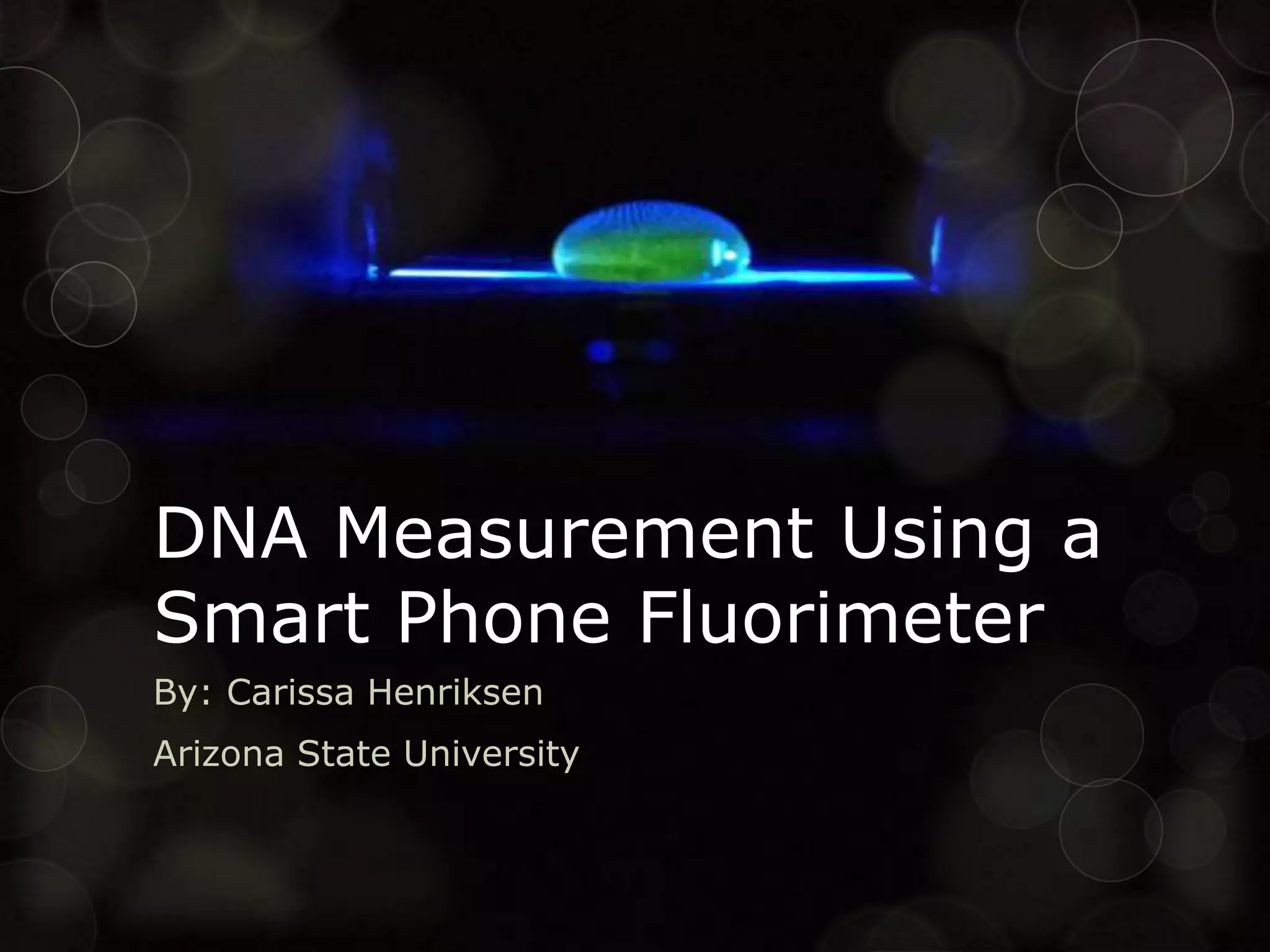
 A blue light is then shone through the middle of the drop
  to highlight flourescence
 A picture is then taken on a smart phone (could be done
  with any digital camera)
 The picture(s) are then uploaded to a computer to be
  analyzed on ImageJ, a free Java-based image processing
  program
    Note: It is not always necessary to analyze on ImageJ,
     most of the results can be seen with the naked eye
     qualitatively!
Drop to be analyzed
Setup
Comparison of Data

No DNA          Amplified DNA
Analyzing Data on Image J


 An elongated oval is traced on the bottom of the drop,
  and then the “measure” tool is used to measure area,
  integrated density, and mean gray value
 The integrated density is directly proportional to the
  amount of material in the system
     Product of area and Mean gray value
 The Mean Gray Value is the average gray value within
  the selection
Other Trials Done in Experiment


 These trials were done to verify that the DNA is actually
  amplifying
 Mix #9: Solution without DNA (2.5 Extra microliters of
  water)
 Mix #10: Solution without Primers (2 Extra microliters of
  water)
 Mix #11: Solution without Enzymes (2 extra microliters
  of water)
 Mix #12: Broken pipettor used
Data
Name                  Area          Integrated Density   MGV

Water Sample           43,120.00            1.78*105            4.14

80:80 Calibration      43,120.00            1.03*106           23.99

132:28 Calibration     43,120.00            1.06*106           24.52

Mixture 8 (normal)     43,120.00            1.72*106           39.89

Mix 9 (no DNA)         43,120.00            1.42*106           32.91

Mix 10 (no Primers)    43,120.00            9.31*105           21.58

Mix 11 (no Enzymes)    43,120.00            6.20*105           14.38
Mix 12 (broken pipette) 43,120.00           4.44*105           10.29
Mean Integrated Density

1.80E+06                    1.72E+06

1.60E+06                          1.42E+06
1.40E+06
1.20E+06              1.06E+06
                                        9.31E+05
1.00E+06        1.03E+06
8.00E+05                                      6.20E+05
6.00E+05                                            4.44E+05
4.00E+05
           1.78E+05
2.00E+05
0.00E+00
Mean Gray Value
                            39.89
40
                                    32.91
35
30
            23.99   24.52
25                                          21.58
20
                                                    14.38
15                                                          10.29
10
     4.14
5
0
Results
 Results were calculated by taking the percentage of the
  integrated density of each reaction divided by the
  integrated density of the 132:28 calibration.
 Mix 12 Results: 41.9%
 Mix 11 Results: 58.6%
 Mix 10 Results: 88.034%
 Mix 9 Results: 134.25%
 Mix 8 Results: 162.7%
Discussion of Results


 The DNA was definitely amplified in Mix 8. In mix 9, the
  results were so high because of possible contamination.
  Mix 10 did not have the primers, which is essential to
  actually amplify the DNA. Mix 11 did not have any
  enzyme, which would not allow the reaction to be
  completed in any reasonable time. Mix 12 just did not
  work, resulting from a broken pipette used in the
  measurements.
Conclusions
 In half an hour, the DNA was amplified.
 The system does not require any expensive machinery.
 Results are evident right away. No waiting!
 Another system is in the works to have multiple
  reactions occur at once!
References
 Domingo, Christina, et al. "Advanced Yellow Fever Virus
  Genome Detection in Point-of-Care Facilities and
  Reference Laboratories." Journal of
  Clinical Microbiology 50.12 (2012): 4054-60. PDF file.
 Khawsak, Phaisan, Sirichai Phantana, and Kosum
  Chansiri. "Determination of Dengue Virus Serotypes in
  Thailand Using PCR Based Method." Southeast Asian
   J Trop Med Public Health 34.4 (2003): 781-85. PDF file.


          Back to “Research Question” (slide 2)
Acknowledgements


 Dr. Antonio Garcia; Arizona State University- provided
  research opportunity and lab
 Dr. Karmella Haynes; Arizona State University- ran gel
  electrophoresis experiments and co-author
 Angle Lastra; co-author

Dna measurement using a smart phone fluorometer

  • 1.
    DNA Measurement Usinga Smart Phone Fluorimeter By: Carissa Henriksen Arizona State University
  • 2.
    Research Question  Howcan we easily and quickly test for viruses in developing nations, without the use of expensive machines?  Diseases such as Yellow Fever and Dengue Infection are devastating many countries in South America, Africa, and Asia.  There are over 200,000 cases of yellow fever every year, with 30,000 deaths (Domingo)  There are over 100 million cases of Dengue Infection (Khawsak)  These diseases desperately need a fast, easy indicator to determine if a person has one of these diseases.
  • 3.
    Collecting Data 1 The use of helicase dependent amplification is important in this experiment, because it can be completed fairly quickly. It is also done in one temperature, unlike other amplification processes, where the reaction needs to be heated and cooled multiple times.
  • 4.
    Collecting Data 2 This was the basic template for the amplified mix used throughout the experiment  Reaction Mix  14 microliters of distilled water  2.5 microliters of 10x Annealing Buffer  2 microliters of Sodium Chloride  1 microliter of Magnesium Sulfate  2 microliters of dNTP  1 microliter each of forward and reverse primer  2 microliters of enzyme mix  2.5 microliters of Template DNA
  • 5.
    Collecting Data 3 The Reaction mix was placed under lamps producing 60 degrees Celsius for 30 minutes, then added to SYBR Green mixture
  • 6.
    SYBR Green Mixture Twodifferent SYBR Green mixtures were used to allow the DNA to fluoresce  Mix 1  Mix 2  2.5 microliters 10,000x  5 microliters 10,000x SYBR Green 1 SYBR Green 1  10 milliliters of Trizma  10 milliliters of Trizma Hydrochloric Acid, 1M Hydrochloric Acid, 1M pH 8 pH 8
  • 7.
    Analyzing the Data After calibrating, the 28 uL of the sample was added to a drop on a 30 well slide coated with teflon with 132 uL of SYBR Green  A blue light is then shone through the middle of the drop to highlight flourescence  A picture is then taken on a smart phone (could be done with any digital camera)  The picture(s) are then uploaded to a computer to be analyzed on ImageJ, a free Java-based image processing program  Note: It is not always necessary to analyze on ImageJ, most of the results can be seen with the naked eye qualitatively!
  • 8.
    Drop to beanalyzed Setup
  • 9.
    Comparison of Data NoDNA Amplified DNA
  • 10.
    Analyzing Data onImage J  An elongated oval is traced on the bottom of the drop, and then the “measure” tool is used to measure area, integrated density, and mean gray value  The integrated density is directly proportional to the amount of material in the system  Product of area and Mean gray value  The Mean Gray Value is the average gray value within the selection
  • 11.
    Other Trials Donein Experiment  These trials were done to verify that the DNA is actually amplifying  Mix #9: Solution without DNA (2.5 Extra microliters of water)  Mix #10: Solution without Primers (2 Extra microliters of water)  Mix #11: Solution without Enzymes (2 extra microliters of water)  Mix #12: Broken pipettor used
  • 12.
    Data Name Area Integrated Density MGV Water Sample 43,120.00 1.78*105 4.14 80:80 Calibration 43,120.00 1.03*106 23.99 132:28 Calibration 43,120.00 1.06*106 24.52 Mixture 8 (normal) 43,120.00 1.72*106 39.89 Mix 9 (no DNA) 43,120.00 1.42*106 32.91 Mix 10 (no Primers) 43,120.00 9.31*105 21.58 Mix 11 (no Enzymes) 43,120.00 6.20*105 14.38 Mix 12 (broken pipette) 43,120.00 4.44*105 10.29
  • 13.
    Mean Integrated Density 1.80E+06 1.72E+06 1.60E+06 1.42E+06 1.40E+06 1.20E+06 1.06E+06 9.31E+05 1.00E+06 1.03E+06 8.00E+05 6.20E+05 6.00E+05 4.44E+05 4.00E+05 1.78E+05 2.00E+05 0.00E+00
  • 14.
    Mean Gray Value 39.89 40 32.91 35 30 23.99 24.52 25 21.58 20 14.38 15 10.29 10 4.14 5 0
  • 15.
    Results  Results werecalculated by taking the percentage of the integrated density of each reaction divided by the integrated density of the 132:28 calibration.  Mix 12 Results: 41.9%  Mix 11 Results: 58.6%  Mix 10 Results: 88.034%  Mix 9 Results: 134.25%  Mix 8 Results: 162.7%
  • 16.
    Discussion of Results The DNA was definitely amplified in Mix 8. In mix 9, the results were so high because of possible contamination. Mix 10 did not have the primers, which is essential to actually amplify the DNA. Mix 11 did not have any enzyme, which would not allow the reaction to be completed in any reasonable time. Mix 12 just did not work, resulting from a broken pipette used in the measurements.
  • 17.
    Conclusions  In halfan hour, the DNA was amplified.  The system does not require any expensive machinery.  Results are evident right away. No waiting!  Another system is in the works to have multiple reactions occur at once!
  • 18.
    References  Domingo, Christina,et al. "Advanced Yellow Fever Virus Genome Detection in Point-of-Care Facilities and Reference Laboratories." Journal of Clinical Microbiology 50.12 (2012): 4054-60. PDF file.  Khawsak, Phaisan, Sirichai Phantana, and Kosum Chansiri. "Determination of Dengue Virus Serotypes in Thailand Using PCR Based Method." Southeast Asian J Trop Med Public Health 34.4 (2003): 781-85. PDF file. Back to “Research Question” (slide 2)
  • 19.
    Acknowledgements  Dr. AntonioGarcia; Arizona State University- provided research opportunity and lab  Dr. Karmella Haynes; Arizona State University- ran gel electrophoresis experiments and co-author  Angle Lastra; co-author

Editor's Notes

  • #13 Yield of calf thymus DNA: about 2.542% (w/w) [percentage of weight over weight/number of grams of solute in 100 grams of solution]Get integrated density and take the ratio of final amount to initial amount