MAHARASHTRA STATE BOARD OF TECHNICAL EDUCATION
Diploma Programme in Computer Engineering
I – Scheme
Programme Structure
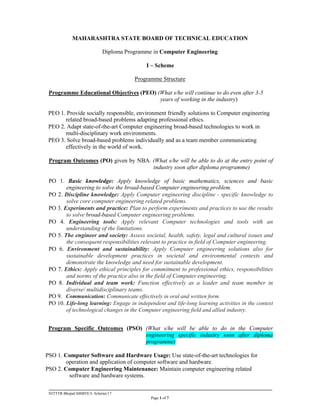
Programme Educational Objectives (PEO) (What s/he will continue to do even after 3-5
years of working in the industry)
PEO 1. Provide socially responsible, environment friendly solutions to Computer engineering
related broad-based problems adapting professional ethics.
PEO 2. Adapt state-of-the-art Computer engineering broad-based technologies to work in
multi-disciplinary work environments.
PEO 3. Solve broad-based problems individually and as a team member communicating
effectively in the world of work.
Program Outcomes (PO) given by NBA. (What s/he will be able to do at the entry point of
industry soon after diploma programme)
PO 1. Basic knowledge: Apply knowledge of basic mathematics, sciences and basic
engineering to solve the broad-based Computer engineering problem.
PO 2. Discipline knowledge: Apply Computer engineering discipline - specific knowledge to
solve core computer engineering related problems.
PO 3. Experiments and practice: Plan to perform experiments and practices to use the results
to solve broad-based Computer engineering problems.
PO 4. Engineering tools: Apply relevant Computer technologies and tools with an
understanding of the limitations.
PO 5. The engineer and society: Assess societal, health, safety, legal and cultural issues and
the consequent responsibilities relevant to practice in field of Computer engineering.
PO 6. Environment and sustainability: Apply Computer engineering solutions also for
sustainable development practices in societal and environmental contexts and
demonstrate the knowledge and need for sustainable development.
PO 7. Ethics: Apply ethical principles for commitment to professional ethics, responsibilities
and norms of the practice also in the field of Computer engineering.
PO 8. Individual and team work: Function effectively as a leader and team member in
diverse/ multidisciplinary teams.
PO 9. Communication: Communicate effectively in oral and written form.
PO 10. Life-long learning: Engage in independent and life-long learning activities in the context
of technological changes in the Computer engineering field and allied industry.
Program Specific Outcomes (PSO) (What s/he will be able to do in the Computer
engineering specific industry soon after diploma
programme)
PSO 1. Computer Software and Hardware Usage: Use state-of-the-art technologies for
operation and application of computer software and hardware.
PSO 2. Computer Engineering Maintenance: Maintain computer engineering related
software and hardware systems.
NITTTR Bhopal-MSBTE/I- Scheme/17
Page 1 of 7
Notes for All the Semesters
1. Every student has to separately pass in End-Semester-Examination (ESE) for both the-
ory and practical by securing minimum of 40% marks, (i.e. 30 out of 75, 28 out of 70, 20
out of 50, and 10 out of 25).
2. Progressive Assessment (PA) for Theory includes Written Exam/micro projects/ Assign-
ment/Quiz/Presentations/attendance according to the nature of the course. The scheme
and schedule for progressive assessment should be informed to the students and dis-
cussed with them at the start of the term. This scheme should also be informed in writing
to the principal of the institute.
3. Teachers need to give marks judiciously for PA of theory and practicals so that there is
always a reasonable correlation between the ESE marks obtained by the student and the
PA marks given by respective teachers for the same student. In case the PA marks in
some courses of some students seems to be relatively inflated in comparison to ESE
marks, then MSBTE may review the PA records of such students.
4. For developing self-directed learning skills, from each course about 15-20% of the top-
ics/sub-topics, which are relatively simpler or descriptive in nature are to be given to the
students for self-study and proper learning of these topics should be assured through
classroom presentations by students (see implementation guideline for details).
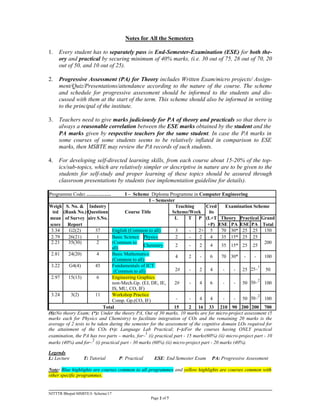
Programme Code: …………… I – Scheme Diploma Programme in Computer Engineering
I – Semester
Weigh S. No. & Industry Teaching Cred Examination Scheme
ted (Rank No.) Questionn Course Title Scheme/Week its
mean of Survey aire S.No. L T P (L+T Theory Practical Grand
score Report +P) ESE PA ESE PA Total
3.34 G2(2) 37 English (Common to all) 3 - 2+ 5 70 30* 25 25 150
2.79 26(21) 1 Basic Science Physics 2 - 2 4 35 15* 25 25
2.21 35(30) 2 (Common to 200
Chemistry 2 - 2 4 35 15* 25 25
all)
2.81 24(20) 4 Basic Mathematics
4 2 - 6 70 30* - - 100
(Common to all)
3.22 G4(4) 45 Fundamentals of ICT
2# - 2 4 - - 25 25~
1
50(Common to all)
2.97 15(13) 6 Engineering Graphics
2# - 4 6 - - 50 50~
2
100non-Mech.Gp. (EJ, DE, IE,
IS, MU, CO, IF)
3.24 3(2) 11 Workshop Practice
- - 4 4 - - 50 50~
2
100Comp. Gp.(CO, IF)
Total 15 2 16 33 210 90 200 200 700
(#):No theory Exam; (*): Under the theory PA, Out of 30 marks, 10 marks are for micro-project assessment (5
marks each for Physics and Chemistry) to facilitate integration of COs and the remaining 20 marks is the
average of 2 tests to be taken during the semester for the assessment of the cognitive domain LOs required for
the attainment of the COs (+): Language Lab Practical; (~):For the courses having ONLY practical
examination, the PA has two parts – marks, for~
1
(i) practical part - 15 marks(60%) (ii) micro-project part - 10
marks (40%) and for~
2
(i) practical part - 30 marks (60%) (ii) micro-project part - 20 marks (40%).
Legends
L: Lecture T: Tutorial P: Practical ESE: End Semester Exam PA: Progressive Assessment
Note: Blue highlights are courses common to all programmes and yellow highlights are courses common with
other specific programmes.
NITTTR Bhopal-MSBTE/I- Scheme/17
Page 2 of 7
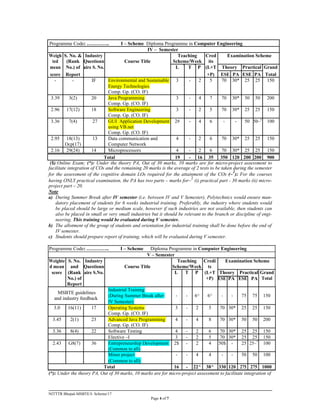
Programme Code: ………….. I – Scheme Diploma Programme in Computer Engineering
II – Semester
Weigh S. No. Industry Teaching Credi Examination Scheme
ted and Questionn Course Title Scheme/Week ts
mean (Rank aire S.No. L T P (L+T Theory Practical Grand
score No.) of +P) TotalESE PA ESE PA
Report
2.61 25(20)
2 Applied Mathematics 4 2 - 6 70 30* - - 100
Comp. Gp. (CO. IF)
2.39 26(21), 5,7 Basic Electronics 3 - 2 5 70 30* 25 25 150
2.25 27(22) Comp. Gp. (CO. IF)
Elements of Electrical 4 - 2 6 70 30* 25 25 150
2.39
26(21)
5 Engineering
Elx, Gp.(DE, EJ, IE, IS, CO, IF)
3.34 9(5) 4
Programming in 'C'
3 2 2 7 70 30* 25 25 150
Comp. Gp. (CO. IF)
Computer Peripheral and
50~
2
2.7 23(18) 12 Hardware Maintenance 2# - 2 4 - - 50@ 100
Comp. Gp. (CO. IF)
3.21 12(7) 8
Web Page Designing with
2# - 2 4 - - 50 50~
2
100HTML Comp. Gp. (CO, IF)
Business Communication Using
-
3.75 G 1(1) 33 Computers 2$ - - 2 35$ 15 - 50
(Common to all)
Total 20 4 10 34 315 135 175 175 800
(#):No theory Exam; (*): Under the theory PA, Out of 30 marks, 10 marks are for micro-project assessment to
facilitate integration of COs and the remaining 20 marks is the average of 2 tests to be taken during the semester
for the assessment of the cognitive domain LOs required for the attainment of the COs; (~
2
): For the courses
having ONLY practical examination, the PA has two parts – marks for~
2
(i) practical part - 30 marks (ii) micro-
project part – 20, @: with external examiner.
Programme Code: ………….. I – Scheme Diploma Programme in Computer Engineering
III – Semester
Weigh S. No. & Industry Teaching Credi Examination Scheme
ted (Rank Questionn Course Title Scheme/Week ts
mean No.) of aire S.No. L T P (L+T Theory Practical Grand
score Report +P) TotalESE PA ESE PA
3.39 4(2) 15 Object Oriented Programming 3 2 2 7 70 30* 25 25 150
using C++
Comp. Gp. (CO. IF)
3.39 5(2) 9 Data structure using ‘C ’ 3 - 2 5 70 30* 25 25 150
Comp. Gp. (CO. IF)
2.93 19(14) 16 Computer Graphics 4 - 2 6 70 30* 25 25 150
3.45 1(1) 10 Database Management System 4 2 2 8 70 30* 25 25 150
2.18 28(23) 31 Digital Techniques 4 - 2 6 70 30* 25 25 150
Elx. Gp. (DE, EJ, IE, IS, MU,
CO)
Total 18 4 10 32 350 150 125 125 750
(*): Under the theory PA, Out of 30 marks, 10 marks are for micro-project assessment to facilitate integration of
COs and the remaining 20 marks is the average of 2 tests to be taken during the semester for the assessment of
the cognitive domain LOs required for the attainment of the COs
NITTTR Bhopal-MSBTE/I- Scheme/17
Page 3 of 7
Programme Code: ………….. I – Scheme Diploma Programme in Computer Engineering
IV – Semester
Weigh S. No. & Industry Teaching Cred Examination Scheme
ted (Rank Questionn Course Title Scheme/Week its
mean No.) of aire S. No. L T P (L+T Theory Practical Grand
score Report +P) TotalESE PA ESE PA
- - IF Environmental and Sustainable 3 - 2 5 70 30* 25 25 150
Energy Technologies
Comp. Gp. (CO. IF)
3.39 3(2) 20 Java Programming 3 - 4 7 70 30* 50 50 200
Comp. Gp. (CO. IF)
2.96 17(12) 18 Software Engineering 3 - 2 5 70 30* 25 25 150
Comp. Gp. (CO. IF)
3.36 7(4) 27 GUI Application Development 2# - 4 6 - - 50 50~
2
100
using VB.net
Comp. Gp. (CO. IF)
2.95 18(13) 13 Data communication and 4 - 2 6 70 30* 25 25 150
Ocp(17) Computer Network
2.16 29(24) 14 Microprocessors 4 - 2 6 70 30* 25 25 150
Total 19 - 16 35 350 120 200 200 900
($):Online Exam; (*): Under the theory PA, Out of 30 marks, 10 marks are for micro-project assessment to
facilitate integration of COs and the remaining 20 marks is the average of 2 tests to be taken during the semester
for the assessment of the cognitive domain LOs required for the attainment of the COs (~
2
): For the courses
having ONLY practical examination, the PA has two parts – marks for~
2
(i) practical part - 30 marks (ii) micro-
project part – 20.
Note
a) During Summer Break after IV semester (i.e. between IV and V Semester), Polytechnics would ensure man-
datory placement of students for 6 weeks industrial training. Preferably, the industry where students would
be placed should be large or medium scale, however if such industries are not available, then students can
also be placed in small or very small industries but it should be relevant to the branch or discipline of engi-
neering. This training would be evaluated during V semester.
b) The allotment of the group of students and orientation for industrial training shall be done before the end of
IV semester.
c) Students should prepare report of training, which will be evaluated during V semester.
Programme Code: ………….. I – Scheme Diploma Programme in Computer Engineering
V – Semester
Weighte S. No. Industry Teaching Credi Examination Scheme
d mean and Questionn Course Title Scheme/Week ts
score (Rank aire S.No. L T P (L+T Theory Practical Grand
No.) of +P) TotalESE PA ESE PA
Report
MSBTE guidelines
Industrial Training
(During Summer Break after - - 6^ 6^ - - 75 75 150
and industry feedback
IV Semester)
3.0 16(11) 17 Operating Systems 3 - 2 5 70 30* 25 25 150
Comp. Gp. (CO. IF)
3.45 2(1) 23 Advanced Java Programming 4 - 4 8 70 30* 50 50 200
Comp. Gp. (CO. IF)
3.36 8(4) 22 Software Testing 4 - 2 6 70 30* 25 25 150
Elective –I 3 - 2 5 70 30* 25 25 150
2.43 G8(7) 36 Entrepreneurship Development 2$ - 2 4 50$ - 25 25~
1
100
(Common to all)
Minor project - - 4 4 - - 50 50 100
(Common to all)
Total 16 - 22^ 38^ 330 120 275 275 1000
(*): Under the theory PA, Out of 30 marks, 10 marks are for micro-project assessment to facilitate integration of
NITTTR Bhopal-MSBTE/I- Scheme/17
Page 4 of 7
COs and the remaining 20 marks is the average of 2 tests to be taken during the semester for the assessment of
the cognitive domain LOs required for the attainment of the COs; (~
1
): For the courses having ONLY practical
examination, the PA has two parts – marks, for~
1
(i) practical part - 15 marks (ii) micro-project part - 10 marks;
(^): Though 6 credits are allocated for Industrial Training it is only for awarding marks. As far as teaching
load/time table preparation is considered, each faculty would be assigned with one batch of students (equivalent
to practical batch size) for guiding the preparation of industrial training report and its evaluation. For this
purpose 1 hour (or two hours on working Saturdays) teaching load would be considered.
Note
a) Evaluation of industrial training and its reports is to be done during this semester. Credits of Industrial
Training will not affect the framing of the time table.
b) Students have to choose any one elective group in V semester as stream specific specialisation, and have to
take first course of that group as elective- I in V semester. They would be required to take another two cours-
es of the same group/stream in VI semester as elective - II and elective - III. Their major and minor projects
should also have emphasis preferably on the same stream of specialisation.
Weighted S. No. and Industry
mean (Rank Questionnair
Group Number and Name of Specialization
score No.) of e S. No.
Report
Group A – Web Development
3.38 6(3) 26 Elective I - Client side scripting using Java Script (CO. IF)
Group B – Network Security and Digital Forensic
2.95 18(13) 13 Elective I - Advanced Computer Network
Group C – Data Mining
3.45 1(1) 10 Elective I - Advanced Database Management systems
Programme Code: ………….. I – Scheme Diploma Programme in Computer Engineering
VI – Semester
Weighte S. No. & Industry Teaching Cred Examination Scheme
d mean (Rank Questionn Course Title Scheme/Week its
score No.) of aire S. No. L T P (L+T Theory Practical
Gran
d
Report +P) TotalESE PA ESE PA
3.16 14(9) 19 Programming With Python 3 - 2 5 70 30* 25 25 150
- IF(13) - Mobile Application 4 - 4 8 70 30* 50 50 200
Development
(CO. IF)
Elective-II 3 - 2 5 70 30* 25 25 150
Elective-III 3 - 2 5 70 30* 25 25 150
3.75 G 1(1) 33 Technical Writing
- - 2 2 - - 25 25 50
(Common to all)
Major Project - - 6 6 - - 75 75 150
(Common to all)
Total 13 - 18 31 280 120 225 225 850
(*): Under the theory PA, Out of 30 marks, 10 marks are for micro-project assessment to facilitate integration of
COs and the remaining 20 marks is the average of 2 tests to be taken during the semester for the assessment of
the cognitive domain LOs required for the attainment of the COs.
Note
a) The Technical Writing course is introduced as practical work, in which English faculty members would fa-
cilitate the framing of correct language for writing different chapters and presentation (i.e.PPT. and others)
of their project work from English point of view. Name of English teacher has to be included as a ‘Language
Editor’ in the project and this activity will be the part of practical shown against Technical Writing course at
VI semester. This work shall be carried out for each batch (size same as for practical).
b) Students who have chosen the stream specific specialisation in elective – I in V semester, should choose the
same stream/group courses in elective – II and elective – III in VI semester. Their major project should also
NITTTR Bhopal-MSBTE/I- Scheme/17
Page 5 of 7
have emphasis preferably on the same group/stream which could further sharpen their skills in that area.
Weighte S. No. & Industry
d mean Rank No.) Questionn Group Number and Name of Specialization
score of Report aire S. No.
Group A – Web Development
3.38 6(3). 26 Elective II - Server Side Scripting Using JSP (CO, IF)
IF(20)
3.32 10(6) 25 Elective III -(Choose any one)
1) Web based Application development with PHP (CO, IF)
2) Web based Application development with PERL. (CO, IF)
Group B – Network Security and Digital Forensic
3.16 14(9) 19 Elective II - Computer and Network Security (CO, IF)
IF IF IF Elective III - Digital Forensic and Hacking Techniques ( CO, IF)
Group C – Analytic and Data Mining Techniques
IF Elective III - Data Warehousing and Mining
IF Elective II - Business Intelligence
IF: Industrial Feedback; FF: Faculty Feedback
I – Scheme Summary of Teaching Scheme/Week, Credits and Examination Scheme
Computer Engineering
Semester Teaching Scheme/Week Credits Examination Scheme
(L+T+PL T P Theory Practical Grand Total
) ESE PA ESE PA
I 15 2 16 33 210 90 200 200 700
II 20 4 10 34 315 135 175 175 800
III 18 4 10 32 350 150 125 125 750
IV 19 - 16 35 350 120 200 200 900
V 16 - 22 38^ 330 120 275 275 1000
VI 13 - 18 31 280 120 225 225 850
Total 101 10 92 203^ 1835 735 1200 1200 5000
(^): This includes total 6 credits for Industrial Training conducted during Summer Break between IV and
V semester.
NITTTR Bhopal-MSBTE/I- Scheme/17
Page 7 of 7

Dms COURSE

  • 1.
    MAHARASHTRA STATE BOARDOF TECHNICAL EDUCATION Diploma Programme in Computer Engineering I – Scheme Programme Structure Programme Educational Objectives (PEO) (What s/he will continue to do even after 3-5 years of working in the industry) PEO 1. Provide socially responsible, environment friendly solutions to Computer engineering related broad-based problems adapting professional ethics. PEO 2. Adapt state-of-the-art Computer engineering broad-based technologies to work in multi-disciplinary work environments. PEO 3. Solve broad-based problems individually and as a team member communicating effectively in the world of work. Program Outcomes (PO) given by NBA. (What s/he will be able to do at the entry point of industry soon after diploma programme) PO 1. Basic knowledge: Apply knowledge of basic mathematics, sciences and basic engineering to solve the broad-based Computer engineering problem. PO 2. Discipline knowledge: Apply Computer engineering discipline - specific knowledge to solve core computer engineering related problems. PO 3. Experiments and practice: Plan to perform experiments and practices to use the results to solve broad-based Computer engineering problems. PO 4. Engineering tools: Apply relevant Computer technologies and tools with an understanding of the limitations. PO 5. The engineer and society: Assess societal, health, safety, legal and cultural issues and the consequent responsibilities relevant to practice in field of Computer engineering. PO 6. Environment and sustainability: Apply Computer engineering solutions also for sustainable development practices in societal and environmental contexts and demonstrate the knowledge and need for sustainable development. PO 7. Ethics: Apply ethical principles for commitment to professional ethics, responsibilities and norms of the practice also in the field of Computer engineering. PO 8. Individual and team work: Function effectively as a leader and team member in diverse/ multidisciplinary teams. PO 9. Communication: Communicate effectively in oral and written form. PO 10. Life-long learning: Engage in independent and life-long learning activities in the context of technological changes in the Computer engineering field and allied industry. Program Specific Outcomes (PSO) (What s/he will be able to do in the Computer engineering specific industry soon after diploma programme) PSO 1. Computer Software and Hardware Usage: Use state-of-the-art technologies for operation and application of computer software and hardware. PSO 2. Computer Engineering Maintenance: Maintain computer engineering related software and hardware systems. NITTTR Bhopal-MSBTE/I- Scheme/17 Page 1 of 7
  • 2.
    Notes for Allthe Semesters 1. Every student has to separately pass in End-Semester-Examination (ESE) for both the- ory and practical by securing minimum of 40% marks, (i.e. 30 out of 75, 28 out of 70, 20 out of 50, and 10 out of 25). 2. Progressive Assessment (PA) for Theory includes Written Exam/micro projects/ Assign- ment/Quiz/Presentations/attendance according to the nature of the course. The scheme and schedule for progressive assessment should be informed to the students and dis- cussed with them at the start of the term. This scheme should also be informed in writing to the principal of the institute. 3. Teachers need to give marks judiciously for PA of theory and practicals so that there is always a reasonable correlation between the ESE marks obtained by the student and the PA marks given by respective teachers for the same student. In case the PA marks in some courses of some students seems to be relatively inflated in comparison to ESE marks, then MSBTE may review the PA records of such students. 4. For developing self-directed learning skills, from each course about 15-20% of the top- ics/sub-topics, which are relatively simpler or descriptive in nature are to be given to the students for self-study and proper learning of these topics should be assured through classroom presentations by students (see implementation guideline for details). Programme Code: …………… I – Scheme Diploma Programme in Computer Engineering I – Semester Weigh S. No. & Industry Teaching Cred Examination Scheme ted (Rank No.) Questionn Course Title Scheme/Week its mean of Survey aire S.No. L T P (L+T Theory Practical Grand score Report +P) ESE PA ESE PA Total 3.34 G2(2) 37 English (Common to all) 3 - 2+ 5 70 30* 25 25 150 2.79 26(21) 1 Basic Science Physics 2 - 2 4 35 15* 25 25 2.21 35(30) 2 (Common to 200 Chemistry 2 - 2 4 35 15* 25 25 all) 2.81 24(20) 4 Basic Mathematics 4 2 - 6 70 30* - - 100 (Common to all) 3.22 G4(4) 45 Fundamentals of ICT 2# - 2 4 - - 25 25~ 1 50(Common to all) 2.97 15(13) 6 Engineering Graphics 2# - 4 6 - - 50 50~ 2 100non-Mech.Gp. (EJ, DE, IE, IS, MU, CO, IF) 3.24 3(2) 11 Workshop Practice - - 4 4 - - 50 50~ 2 100Comp. Gp.(CO, IF) Total 15 2 16 33 210 90 200 200 700 (#):No theory Exam; (*): Under the theory PA, Out of 30 marks, 10 marks are for micro-project assessment (5 marks each for Physics and Chemistry) to facilitate integration of COs and the remaining 20 marks is the average of 2 tests to be taken during the semester for the assessment of the cognitive domain LOs required for the attainment of the COs (+): Language Lab Practical; (~):For the courses having ONLY practical examination, the PA has two parts – marks, for~ 1 (i) practical part - 15 marks(60%) (ii) micro-project part - 10 marks (40%) and for~ 2 (i) practical part - 30 marks (60%) (ii) micro-project part - 20 marks (40%). Legends L: Lecture T: Tutorial P: Practical ESE: End Semester Exam PA: Progressive Assessment Note: Blue highlights are courses common to all programmes and yellow highlights are courses common with other specific programmes. NITTTR Bhopal-MSBTE/I- Scheme/17 Page 2 of 7
  • 3.
    Programme Code: …………..I – Scheme Diploma Programme in Computer Engineering II – Semester Weigh S. No. Industry Teaching Credi Examination Scheme ted and Questionn Course Title Scheme/Week ts mean (Rank aire S.No. L T P (L+T Theory Practical Grand score No.) of +P) TotalESE PA ESE PA Report 2.61 25(20) 2 Applied Mathematics 4 2 - 6 70 30* - - 100 Comp. Gp. (CO. IF) 2.39 26(21), 5,7 Basic Electronics 3 - 2 5 70 30* 25 25 150 2.25 27(22) Comp. Gp. (CO. IF) Elements of Electrical 4 - 2 6 70 30* 25 25 150 2.39 26(21) 5 Engineering Elx, Gp.(DE, EJ, IE, IS, CO, IF) 3.34 9(5) 4 Programming in 'C' 3 2 2 7 70 30* 25 25 150 Comp. Gp. (CO. IF) Computer Peripheral and 50~ 2 2.7 23(18) 12 Hardware Maintenance 2# - 2 4 - - 50@ 100 Comp. Gp. (CO. IF) 3.21 12(7) 8 Web Page Designing with 2# - 2 4 - - 50 50~ 2 100HTML Comp. Gp. (CO, IF) Business Communication Using - 3.75 G 1(1) 33 Computers 2$ - - 2 35$ 15 - 50 (Common to all) Total 20 4 10 34 315 135 175 175 800 (#):No theory Exam; (*): Under the theory PA, Out of 30 marks, 10 marks are for micro-project assessment to facilitate integration of COs and the remaining 20 marks is the average of 2 tests to be taken during the semester for the assessment of the cognitive domain LOs required for the attainment of the COs; (~ 2 ): For the courses having ONLY practical examination, the PA has two parts – marks for~ 2 (i) practical part - 30 marks (ii) micro- project part – 20, @: with external examiner. Programme Code: ………….. I – Scheme Diploma Programme in Computer Engineering III – Semester Weigh S. No. & Industry Teaching Credi Examination Scheme ted (Rank Questionn Course Title Scheme/Week ts mean No.) of aire S.No. L T P (L+T Theory Practical Grand score Report +P) TotalESE PA ESE PA 3.39 4(2) 15 Object Oriented Programming 3 2 2 7 70 30* 25 25 150 using C++ Comp. Gp. (CO. IF) 3.39 5(2) 9 Data structure using ‘C ’ 3 - 2 5 70 30* 25 25 150 Comp. Gp. (CO. IF) 2.93 19(14) 16 Computer Graphics 4 - 2 6 70 30* 25 25 150 3.45 1(1) 10 Database Management System 4 2 2 8 70 30* 25 25 150 2.18 28(23) 31 Digital Techniques 4 - 2 6 70 30* 25 25 150 Elx. Gp. (DE, EJ, IE, IS, MU, CO) Total 18 4 10 32 350 150 125 125 750 (*): Under the theory PA, Out of 30 marks, 10 marks are for micro-project assessment to facilitate integration of COs and the remaining 20 marks is the average of 2 tests to be taken during the semester for the assessment of the cognitive domain LOs required for the attainment of the COs NITTTR Bhopal-MSBTE/I- Scheme/17 Page 3 of 7
  • 4.
    Programme Code: …………..I – Scheme Diploma Programme in Computer Engineering IV – Semester Weigh S. No. & Industry Teaching Cred Examination Scheme ted (Rank Questionn Course Title Scheme/Week its mean No.) of aire S. No. L T P (L+T Theory Practical Grand score Report +P) TotalESE PA ESE PA - - IF Environmental and Sustainable 3 - 2 5 70 30* 25 25 150 Energy Technologies Comp. Gp. (CO. IF) 3.39 3(2) 20 Java Programming 3 - 4 7 70 30* 50 50 200 Comp. Gp. (CO. IF) 2.96 17(12) 18 Software Engineering 3 - 2 5 70 30* 25 25 150 Comp. Gp. (CO. IF) 3.36 7(4) 27 GUI Application Development 2# - 4 6 - - 50 50~ 2 100 using VB.net Comp. Gp. (CO. IF) 2.95 18(13) 13 Data communication and 4 - 2 6 70 30* 25 25 150 Ocp(17) Computer Network 2.16 29(24) 14 Microprocessors 4 - 2 6 70 30* 25 25 150 Total 19 - 16 35 350 120 200 200 900 ($):Online Exam; (*): Under the theory PA, Out of 30 marks, 10 marks are for micro-project assessment to facilitate integration of COs and the remaining 20 marks is the average of 2 tests to be taken during the semester for the assessment of the cognitive domain LOs required for the attainment of the COs (~ 2 ): For the courses having ONLY practical examination, the PA has two parts – marks for~ 2 (i) practical part - 30 marks (ii) micro- project part – 20. Note a) During Summer Break after IV semester (i.e. between IV and V Semester), Polytechnics would ensure man- datory placement of students for 6 weeks industrial training. Preferably, the industry where students would be placed should be large or medium scale, however if such industries are not available, then students can also be placed in small or very small industries but it should be relevant to the branch or discipline of engi- neering. This training would be evaluated during V semester. b) The allotment of the group of students and orientation for industrial training shall be done before the end of IV semester. c) Students should prepare report of training, which will be evaluated during V semester. Programme Code: ………….. I – Scheme Diploma Programme in Computer Engineering V – Semester Weighte S. No. Industry Teaching Credi Examination Scheme d mean and Questionn Course Title Scheme/Week ts score (Rank aire S.No. L T P (L+T Theory Practical Grand No.) of +P) TotalESE PA ESE PA Report MSBTE guidelines Industrial Training (During Summer Break after - - 6^ 6^ - - 75 75 150 and industry feedback IV Semester) 3.0 16(11) 17 Operating Systems 3 - 2 5 70 30* 25 25 150 Comp. Gp. (CO. IF) 3.45 2(1) 23 Advanced Java Programming 4 - 4 8 70 30* 50 50 200 Comp. Gp. (CO. IF) 3.36 8(4) 22 Software Testing 4 - 2 6 70 30* 25 25 150 Elective –I 3 - 2 5 70 30* 25 25 150 2.43 G8(7) 36 Entrepreneurship Development 2$ - 2 4 50$ - 25 25~ 1 100 (Common to all) Minor project - - 4 4 - - 50 50 100 (Common to all) Total 16 - 22^ 38^ 330 120 275 275 1000 (*): Under the theory PA, Out of 30 marks, 10 marks are for micro-project assessment to facilitate integration of NITTTR Bhopal-MSBTE/I- Scheme/17 Page 4 of 7
  • 5.
    COs and theremaining 20 marks is the average of 2 tests to be taken during the semester for the assessment of the cognitive domain LOs required for the attainment of the COs; (~ 1 ): For the courses having ONLY practical examination, the PA has two parts – marks, for~ 1 (i) practical part - 15 marks (ii) micro-project part - 10 marks; (^): Though 6 credits are allocated for Industrial Training it is only for awarding marks. As far as teaching load/time table preparation is considered, each faculty would be assigned with one batch of students (equivalent to practical batch size) for guiding the preparation of industrial training report and its evaluation. For this purpose 1 hour (or two hours on working Saturdays) teaching load would be considered. Note a) Evaluation of industrial training and its reports is to be done during this semester. Credits of Industrial Training will not affect the framing of the time table. b) Students have to choose any one elective group in V semester as stream specific specialisation, and have to take first course of that group as elective- I in V semester. They would be required to take another two cours- es of the same group/stream in VI semester as elective - II and elective - III. Their major and minor projects should also have emphasis preferably on the same stream of specialisation. Weighted S. No. and Industry mean (Rank Questionnair Group Number and Name of Specialization score No.) of e S. No. Report Group A – Web Development 3.38 6(3) 26 Elective I - Client side scripting using Java Script (CO. IF) Group B – Network Security and Digital Forensic 2.95 18(13) 13 Elective I - Advanced Computer Network Group C – Data Mining 3.45 1(1) 10 Elective I - Advanced Database Management systems Programme Code: ………….. I – Scheme Diploma Programme in Computer Engineering VI – Semester Weighte S. No. & Industry Teaching Cred Examination Scheme d mean (Rank Questionn Course Title Scheme/Week its score No.) of aire S. No. L T P (L+T Theory Practical Gran d Report +P) TotalESE PA ESE PA 3.16 14(9) 19 Programming With Python 3 - 2 5 70 30* 25 25 150 - IF(13) - Mobile Application 4 - 4 8 70 30* 50 50 200 Development (CO. IF) Elective-II 3 - 2 5 70 30* 25 25 150 Elective-III 3 - 2 5 70 30* 25 25 150 3.75 G 1(1) 33 Technical Writing - - 2 2 - - 25 25 50 (Common to all) Major Project - - 6 6 - - 75 75 150 (Common to all) Total 13 - 18 31 280 120 225 225 850 (*): Under the theory PA, Out of 30 marks, 10 marks are for micro-project assessment to facilitate integration of COs and the remaining 20 marks is the average of 2 tests to be taken during the semester for the assessment of the cognitive domain LOs required for the attainment of the COs. Note a) The Technical Writing course is introduced as practical work, in which English faculty members would fa- cilitate the framing of correct language for writing different chapters and presentation (i.e.PPT. and others) of their project work from English point of view. Name of English teacher has to be included as a ‘Language Editor’ in the project and this activity will be the part of practical shown against Technical Writing course at VI semester. This work shall be carried out for each batch (size same as for practical). b) Students who have chosen the stream specific specialisation in elective – I in V semester, should choose the same stream/group courses in elective – II and elective – III in VI semester. Their major project should also NITTTR Bhopal-MSBTE/I- Scheme/17 Page 5 of 7
  • 6.
    have emphasis preferablyon the same group/stream which could further sharpen their skills in that area. Weighte S. No. & Industry d mean Rank No.) Questionn Group Number and Name of Specialization score of Report aire S. No. Group A – Web Development 3.38 6(3). 26 Elective II - Server Side Scripting Using JSP (CO, IF) IF(20) 3.32 10(6) 25 Elective III -(Choose any one) 1) Web based Application development with PHP (CO, IF) 2) Web based Application development with PERL. (CO, IF) Group B – Network Security and Digital Forensic 3.16 14(9) 19 Elective II - Computer and Network Security (CO, IF) IF IF IF Elective III - Digital Forensic and Hacking Techniques ( CO, IF) Group C – Analytic and Data Mining Techniques IF Elective III - Data Warehousing and Mining IF Elective II - Business Intelligence IF: Industrial Feedback; FF: Faculty Feedback I – Scheme Summary of Teaching Scheme/Week, Credits and Examination Scheme Computer Engineering Semester Teaching Scheme/Week Credits Examination Scheme (L+T+PL T P Theory Practical Grand Total ) ESE PA ESE PA I 15 2 16 33 210 90 200 200 700 II 20 4 10 34 315 135 175 175 800 III 18 4 10 32 350 150 125 125 750 IV 19 - 16 35 350 120 200 200 900 V 16 - 22 38^ 330 120 275 275 1000 VI 13 - 18 31 280 120 225 225 850 Total 101 10 92 203^ 1835 735 1200 1200 5000 (^): This includes total 6 credits for Industrial Training conducted during Summer Break between IV and V semester.
  • 7.