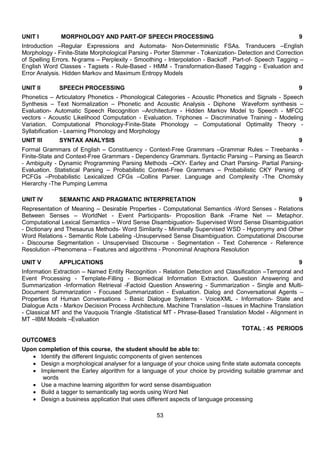
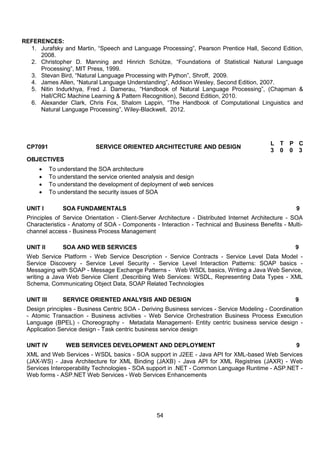
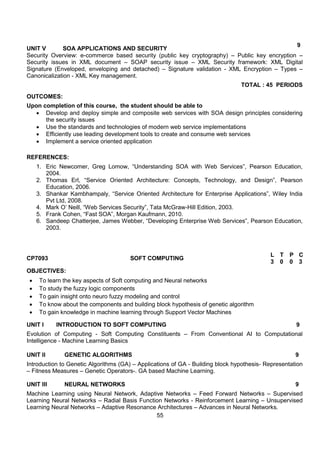
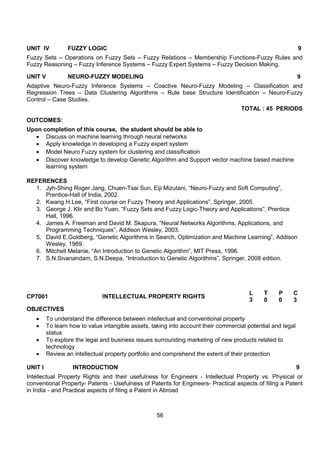
1
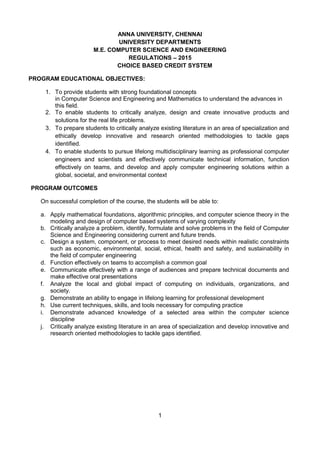
ANNA UNIVERSITY, CHENNAI
UNIVERSITY DEPARTMENTS
M.E. COMPUTER SCIENCE AND ENGINEERING
REGULATIONS – 2015
CHOICE BASED CREDIT SYSTEM
PROGRAM EDUCATIONAL OBJECTIVES:
1. To provide students with strong foundational concepts
in Computer Science and Engineering and Mathematics to understand the advances in
this field.
2. To enable students to critically analyze, design and create innovative products and
solutions for the real life problems.
3. To prepare students to critically analyze existing literature in an area of specialization and
ethically develop innovative and research oriented methodologies to tackle gaps
identified.
4. To enable students to pursue lifelong multidisciplinary learning as professional computer
engineers and scientists and effectively communicate technical information, function
effectively on teams, and develop and apply computer engineering solutions within a
global, societal, and environmental context
PROGRAM OUTCOMES
On successful completion of the course, the students will be able to:
a. Apply mathematical foundations, algorithmic principles, and computer science theory in the
modeling and design of computer based systems of varying complexity
b. Critically analyze a problem, identify, formulate and solve problems in the field of Computer
Science and Engineering considering current and future trends.
c. Design a system, component, or process to meet desired needs within realistic constraints
such as economic, environmental, social, ethical, health and safety, and sustainability in
the field of computer engineering
d. Function effectively on teams to accomplish a common goal
e. Communicate effectively with a range of audiences and prepare technical documents and
make effective oral presentations
f. Analyze the local and global impact of computing on individuals, organizations, and
society.
g. Demonstrate an ability to engage in lifelong learning for professional development
h. Use current techniques, skills, and tools necessary for computing practice
i. Demonstrate advanced knowledge of a selected area within the computer science
discipline
j. Critically analyze existing literature in an area of specialization and develop innovative and
research oriented methodologies to tackle gaps identified.
2
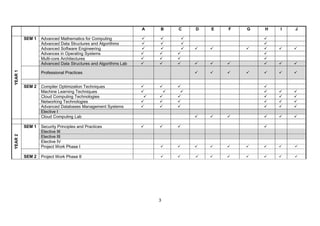
MAPPING OF PROGRAMME EDUCATIONAL OBJECTIVES WITH PROGRAMME OUTCOMES
A broad relation between the programme objective and the outcomes is given in the following table
Programme
Educational
Objectives
Programme Outcomes
A B C D E F G H I J
1 √ √ √ √
2 √ √ √ √ √ √
3 √ √ √ √ √ √
4 √ √ √ √ √ √ √ √
3
A B C D E F G H I J
YEAR1
SEM 1 Advanced Mathematics for Computing    
Advanced Data Structures and Algorithms    
Advanced Software Engineering         
Advances in Operating Systems    
Multi-core Architectures    
Advanced Data Structures and Algorithms Lab         
Professional Practices       
SEM 2 Compiler Optimization Techniques    
Machine Learning Techniques      
Cloud Computing Technologies      
Networking Technologies      
Advanced Databases Management Systems      
Elective I
Cloud Computing Lab      
YEAR2
SEM 1 Security Principles and Practices    
Elective III
Elective III
Elective IV
Project Work Phase I         
SEM 2 Project Work Phase II         
4
ANNA UNIVERSITY, CHENNAI
UNIVERSITY DEPARTMENTS
M.E. COMPUTER SCIENCE AND ENGINEERING
REGULATIONS – 2015
CHOICE BASED CREDIT SYSTEM
CURRICULA AND SYLLABI
SEMESTER - I
SL.
No
COURSE
CODE
COURSE TITLE CATEGORY
CONTACT
PERIODS
L T P C
THEORY
1.
MA7153
Advanced Mathematics
for Computing
FC 4 4 0 0 4
2.
CP7151
Advanced Data
Structures and
Algorithms
PC 3 3 0 0 3
3.
CP7152
Advanced Software
Engineering
PC 3 3 0 0 3
4.
CP7153
Advances in Operating
Systems
PC 3 3 0 0 3
5. CP7154 Multi Core Architectures PC 3 3 0 0 3
PRACTICALS
6. CP7161 Advanced Data
Structures and
Algorithms Lab
PC 4 0 0 4 2
7. CP7162 Professional Practices EEC 2 0 0 2 1
TOTAL 22
22
16
16
0 6 19
II SEMESTER
SL.
No
COURSE
CODE
COURSE TITLE CATEGORY
CONTACT
PERIODS
L T P C
THEORY
1.
CP7252
Compiler Optimization
Techniques
PC 3 3 0 0 3
2.
CP7253
Machine Learning
Techniques
PC 5 3 0 2 4
3.
CP7251
Cloud Computing
Technologies
PC 3 3 0 0 3
4.
CP7155
Networking
Technologies
PC 3 3 0 0 3
5.
SO7251
Advanced Databases
Management Systems
PC 5 3 0 2 4
6.
Elective I PE 3 3 0 0 3
PRACTICALS
7. CP 7211 Cloud Computing Lab PC 4 0 0 4 2
TOTAL 26 18 0 8 22
5
III SEMESTER
SL.
No
COURSE
CODE
COURSE TITLE CATEGORY
CONTACT
PERIODS
L T P C
THEORY
1. CP 7254 Security Principles and
Practices
PC 3 3 0 0 3
2.
Elective II PE 3 3 0 0 3
3.
Elective III PE 3 3 0 0 3
4.
Elective IV PE 3 3 0 0 3
PRACTICALS
5. CP7311 Project Work Phase I EEC 12 0 0 12 6
TOTAL 24 12 0 12 18
IV SEMESTER
SL.No
COURSE
CODE
COURSE TITLE CATEGORY
CONTACT
PERIODS
L T P C
PRACTICALS
1. CP7411 Project Work Phase II EEC 24 0 0 24 12
TOTAL 24 0 0 24 12
TOTAL NO. OF CREDITS:71
6
ANNA UNIVERSITY, CHENNAI
UNIVERSITY DEPARTMENTS
M.E. COMPUTER SCIENCE AND ENGINEERING (PART-TIME)
REGULATIONS – 2015
CHOICE BASED CREDIT SYSTEM
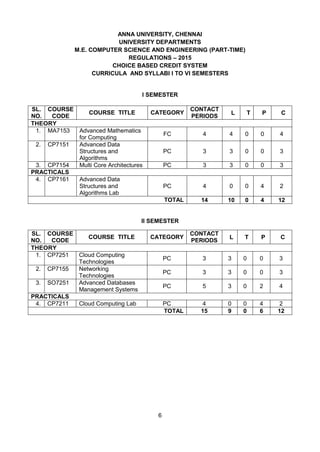
CURRICULA AND SYLLABI I TO VI SEMESTERS
I SEMESTER
SL.
NO.
COURSE
CODE
COURSE TITLE CATEGORY
CONTACT
PERIODS
L T P C
THEORY
1. MA7153 Advanced Mathematics
for Computing
FC 4 4 0 0 4
2. CP7151 Advanced Data
Structures and
Algorithms
PC 3 3 0 0 3
3. CP7154 Multi Core Architectures PC 3 3 0 0 3
PRACTICALS
4. CP7161 Advanced Data
Structures and
Algorithms Lab
PC 4 0 0 4 2
TOTAL 14 10 0 4 12
II SEMESTER
SL.
NO.
COURSE
CODE
COURSE TITLE CATEGORY
CONTACT
PERIODS
L T P C
THEORY
1. CP7251 Cloud Computing
Technologies
PC 3 3 0 0 3
2. CP7155 Networking
Technologies
PC 3 3 0 0 3
3. SO7251 Advanced Databases
Management Systems
PC 5 3 0 2 4
PRACTICALS
4. CP7211 Cloud Computing Lab PC 4 0 0 4 2
TOTAL 15 9 0 6 12
7
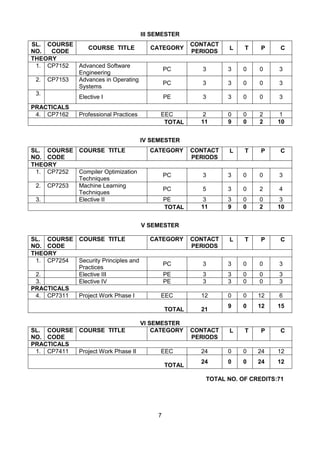
III SEMESTER
SL.
NO.
COURSE
CODE
COURSE TITLE CATEGORY
CONTACT
PERIODS
L T P C
THEORY
1. CP7152 Advanced Software
Engineering
PC 3 3 0 0 3
2. CP7153 Advances in Operating
Systems
PC 3 3 0 0 3
3.
Elective I PE 3 3 0 0 3
PRACTICALS
4. CP7162 Professional Practices EEC 2 0 0 2 1
TOTAL 11 9 0 2 10
IV SEMESTER
SL.
NO.
COURSE
CODE
COURSE TITLE CATEGORY CONTACT
PERIODS
L T P C
THEORY
1. CP7252 Compiler Optimization
Techniques
PC 3 3 0 0 3
2. CP7253 Machine Learning
Techniques
PC 5 3 0 2 4
3. Elective II PE 3 3 0 0 3
TOTAL 11 9 0 2 10
V SEMESTER
SL.
NO.
COURSE
CODE
COURSE TITLE CATEGORY CONTACT
PERIODS
L T P C
THEORY
1. CP7254 Security Principles and
Practices
PC 3 3 0 0 3
2. Elective III PE 3 3 0 0 3
3. Elective IV PE 3 3 0 0 3
PRACTICALS
4. CP7311 Project Work Phase I EEC 12 0 0 12 6
TOTAL 21
9 0 12 15
VI SEMESTER
SL.
NO.
COURSE
CODE
COURSE TITLE CATEGORY CONTACT
PERIODS
L T P C
PRACTICALS
1. CP7411 Project Work Phase II EEC 24 0 0 24 12
TOTAL
24 0 0 24 12
TOTAL NO. OF CREDITS:71
8
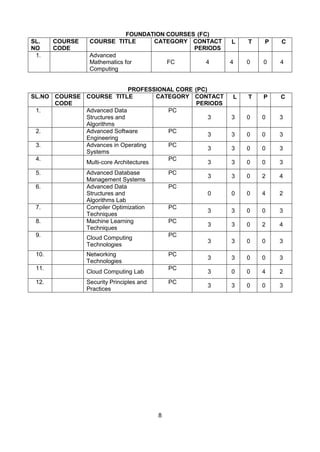
FOUNDATION COURSES (FC)
SL.
NO
COURSE
CODE
COURSE TITLE CATEGORY CONTACT
PERIODS
L T P C
1. Advanced
Mathematics for
Computing
FC 4 4 0 0 4
PROFESSIONAL CORE (PC)
SL.NO COURSE
CODE
COURSE TITLE CATEGORY CONTACT
PERIODS
L T P C
1. Advanced Data
Structures and
Algorithms
PC
3 3 0 0 3
2. Advanced Software
Engineering
PC
3 3 0 0 3
3. Advances in Operating
Systems
PC
3 3 0 0 3
4.
Multi-core Architectures
PC
3 3 0 0 3
5. Advanced Database
Management Systems
PC
3 3 0 2 4
6. Advanced Data
Structures and
Algorithms Lab
PC
0 0 0 4 2
7. Compiler Optimization
Techniques
PC
3 3 0 0 3
8. Machine Learning
Techniques
PC
3 3 0 2 4
9. Cloud Computing
Technologies
PC
3 3 0 0 3
10. Networking
Technologies
PC
3 3 0 0 3
11.
Cloud Computing Lab
PC
3 0 0 4 2
12. Security Principles and
Practices
PC
3 3 0 0 3
9
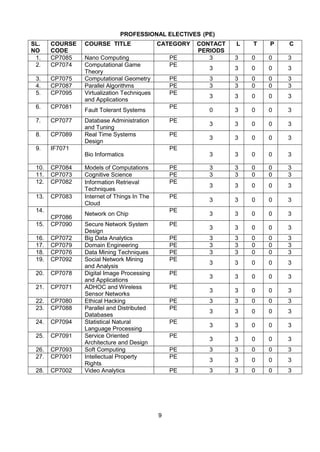
PROFESSIONAL ELECTIVES (PE)
SL.
NO
COURSE
CODE
COURSE TITLE CATEGORY CONTACT
PERIODS
L T P C
1. CP7085 Nano Computing PE 3 3 0 0 3
2. CP7074 Computational Game
Theory
PE
3 3 0 0 3
3. CP7075 Computational Geometry PE 3 3 0 0 3
4. CP7087 Parallel Algorithms PE 3 3 0 0 3
5. CP7095 Virtualization Techniques
and Applications
PE
3 3 0 0 3
6. CP7081
Fault Tolerant Systems
PE
0 3 0 0 3
7. CP7077 Database Administration
and Tuning
PE
3 3 0 0 3
8. CP7089 Real Time Systems
Design
PE
3 3 0 0 3
9. IF7071
Bio Informatics
PE
3 3 0 0 3
10. CP7084 Models of Computations PE 3 3 0 0 3
11. CP7073 Cognitive Science PE 3 3 0 0 3
12. CP7082 Information Retrieval
Techniques
PE
3 3 0 0 3
13. CP7083 Internet of Things In The
Cloud
PE
3 3 0 0 3
14.
CP7086
Network on Chip
PE
3 3 0 0 3
15. CP7090 Secure Network System
Design
PE
3 3 0 0 3
16. CP7072 Big Data Analytics PE 3 3 0 0 3
17. CP7079 Domain Engineering PE 3 3 0 0 3
18. CP7076 Data Mining Techniques PE 3 3 0 0 3
19. CP7092 Social Network Mining
and Analysis
PE
3 3 0 0 3
20. CP7078 Digital Image Processing
and Applications
PE
3 3 0 0 3
21. CP7071 ADHOC and Wireless
Sensor Networks
PE
3 3 0 0 3
22. CP7080 Ethical Hacking PE 3 3 0 0 3
23. CP7088 Parallel and Distributed
Databases
PE
3 3 0 0 3
24. CP7094 Statistical Natural
Language Processing
PE
3 3 0 0 3
25. CP7091 Service Oriented
Architecture and Design
PE
3 3 0 0 3
26. CP7093 Soft Computing PE 3 3 0 0 3
27. CP7001 Intellectual Property
Rights
PE
3 3 0 0 3
28. CP7002 Video Analytics PE 3 3 0 0 3
10
EMPLOYABILITY ENHANCEMENT COURSES (EEC)
Sl.
No
COURSE
CODE
COURSE TITLE CATEGORY CONTACT
PERIODS
L T P C
1.
Professional Practices EEC 2 0 0 2 1
2.
Project Work Phase I EEC 12 0 0 12 6
3.
Project Work Phase II EEC 24 0 0 24 12
11
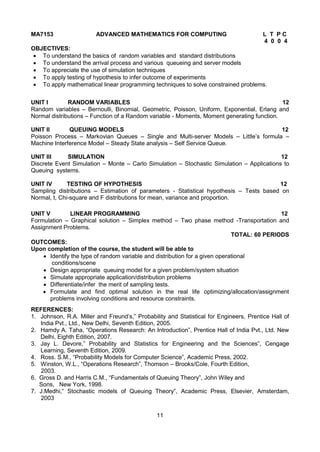
MA7153 ADVANCED MATHEMATICS FOR COMPUTING L T P C
4 0 0 4
OBJECTIVES:
 To understand the basics of random variables and standard distributions
 To understand the arrival process and various queueing and server models
 To appreciate the use of simulation techniques
 To apply testing of hypothesis to infer outcome of experiments
 To apply mathematical linear programming techniques to solve constrained problems.
UNIT I RANDOM VARIABLES 12
Random variables – Bernoulli, Binomial, Geometric, Poisson, Uniform, Exponential, Erlang and
Normal distributions – Function of a Random variable - Moments, Moment generating function.
UNIT II QUEUING MODELS 12
Poisson Process – Markovian Queues – Single and Multi-server Models – Little‟s formula –
Machine Interference Model – Steady State analysis – Self Service Queue.
UNIT III SIMULATION 12
Discrete Event Simulation – Monte – Carlo Simulation – Stochastic Simulation – Applications to
Queuing systems.
UNIT IV TESTING OF HYPOTHESIS 12
Sampling distributions – Estimation of parameters - Statistical hypothesis – Tests based on
Normal, t, Chi-square and F distributions for mean, variance and proportion.
UNIT V LINEAR PROGRAMMING 12
Formulation – Graphical solution – Simplex method – Two phase method -Transportation and
Assignment Problems.
TOTAL: 60 PERIODS
OUTCOMES:
Upon completion of the course, the student will be able to
 Identify the type of random variable and distribution for a given operational
conditions/scene
 Design appropriate queuing model for a given problem/system situation
 Simulate appropriate application/distribution problems
 Differentiate/infer the merit of sampling tests.
 Formulate and find optimal solution in the real life optimizing/allocation/assignment
problems involving conditions and resource constraints.
REFERENCES:
1. Johnson, R.A. Miller and Freund‟s,” Probability and Statistical for Engineers, Prentice Hall of
India Pvt., Ltd., New Delhi, Seventh Edition, 2005.
2. Hamdy A. Taha, “Operations Research: An Introduction”, Prentice Hall of India Pvt., Ltd. New
Delhi, Eighth Edition, 2007.
3. Jay L. Devore,” Probability and Statistics for Engineering and the Sciences”, Cengage
Learning, Seventh Edition, 2009.
4. Ross. S.M., “Probability Models for Computer Science”, Academic Press, 2002.
5. Winston, W.L., “Operations Research”, Thomson – Brooks/Cole, Fourth Edition,
2003.
6. Gross D. and Harris C.M., “Fundamentals of Queuing Theory”, John Wiley and
Sons, New York, 1998.
7. J.Medhi,” Stochastic models of Queuing Theory”, Academic Press, Elsevier, Amsterdam,
2003
12
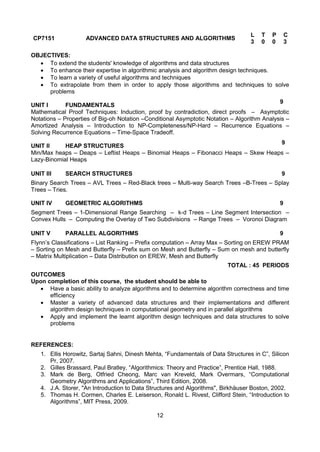
CP7151 ADVANCED DATA STRUCTURES AND ALGORITHMS
L T P C
3 0 0 3
OBJECTIVES:
 To extend the students' knowledge of algorithms and data structures
 To enhance their expertise in algorithmic analysis and algorithm design techniques.
 To learn a variety of useful algorithms and techniques
 To extrapolate from them in order to apply those algorithms and techniques to solve
problems
UNIT I FUNDAMENTALS
9
Mathematical Proof Techniques: Induction, proof by contradiction, direct proofs – Asymptotic
Notations – Properties of Big-oh Notation –Conditional Asymptotic Notation – Algorithm Analysis –
Amortized Analysis – Introduction to NP-Completeness/NP-Hard – Recurrence Equations –
Solving Recurrence Equations – Time-Space Tradeoff.
UNIT II HEAP STRUCTURES
9
Min/Max heaps – Deaps – Leftist Heaps – Binomial Heaps – Fibonacci Heaps – Skew Heaps –
Lazy-Binomial Heaps
UNIT III SEARCH STRUCTURES 9
Binary Search Trees – AVL Trees – Red-Black trees – Multi-way Search Trees –B-Trees – Splay
Trees – Tries.
UNIT IV GEOMETRIC ALGORITHMS 9
Segment Trees – 1-Dimensional Range Searching – k-d Trees – Line Segment Intersection –
Convex Hulls – Computing the Overlay of Two Subdivisions – Range Trees – Voronoi Diagram
UNIT V PARALLEL ALGORITHMS 9
Flynn‟s Classifications – List Ranking – Prefix computation – Array Max – Sorting on EREW PRAM
– Sorting on Mesh and Butterfly – Prefix sum on Mesh and Butterfly – Sum on mesh and butterfly
– Matrix Multiplication – Data Distribution on EREW, Mesh and Butterfly
TOTAL : 45 PERIODS
OUTCOMES
Upon completion of this course, the student should be able to
 Have a basic ability to analyze algorithms and to determine algorithm correctness and time
efficiency
 Master a variety of advanced data structures and their implementations and different
algorithm design techniques in computational geometry and in parallel algorithms
 Apply and implement the learnt algorithm design techniques and data structures to solve
problems
REFERENCES:
1. Ellis Horowitz, Sartaj Sahni, Dinesh Mehta, “Fundamentals of Data Structures in C”, Silicon
Pr, 2007.
2. Gilles Brassard, Paul Bratley, “Algorithmics: Theory and Practice”, Prentice Hall, 1988.
3. Mark de Berg, Otfried Cheong, Marc van Kreveld, Mark Overmars, “Computational
Geometry Algorithms and Applications”, Third Edition, 2008.
4. J.A. Storer, "An Introduction to Data Structures and Algorithms", Birkhäuser Boston, 2002.
5. Thomas H. Cormen, Charles E. Leiserson, Ronald L. Rivest, Clifford Stein, “Introduction to
Algorithms”, MIT Press, 2009.
13
CP7152 ADVANCED SOFTWARE ENGINEERING
L T P C
3 0 0 3
OBJECTIVES:
 To comprehend software development process and formal specifications
 To know advanced software development techniques and its application in real world context
 To understand how to manage complex projects
 To use advanced software testing techniques
 To understand process improvement and re engineering

UNIT I SOFTWARE ENGINEERING PROCESS AND FORMAL METHODS 9
Software Process models – Software Life Cycle – Development Activities – Managing Software
Development – Unified Modeling Language – Requirement elicitation and specification –
Understanding formal methods – motivation for formal methods – informal requirements to formal
specifications – validating formal specifications – Overview of Z specification
UNIT II AGILE AND ASPECT ORIENTED SOFTWARE ENGINEERING 9
Agile Development: Agility – agile principles- Extreme Programming -– Agile process models –
Agile modeling – Agile unified Process – tools set for agile process – Complex Projects: SCRUM
– basics, SCRUM Process, Development using SCRUM – Aspect Oriented Software
Development: Aspect-Orientation in the Software Lifecycle – Generic Aspect-Oriented Design
with UML – Modeling for Aspect-Oriented Software Development-Developing Secure Applications
Through Aspect-Oriented Programming.
UNIT III COMPONENT-BASED SOFTWARE ENGINEERING 9
Engineering of component-based systems, the CBSE process – Designing class based
components – component design for Web Apps – Component-based development – Component-
level design patterns – Classifying and retrieving components, and economics of CBSE.
UNIT IV ADVANCED SOFTWARE TESTING TECHNIQUES 9
Software Review – Testing Strategies - Testing Conventional Applications – Testing Object-
Oriented Applications – Testing Web Applications – Formal Modeling and verification – Metrics :
Product, process, project, testing and quality metrics – Software Test Automation
UNIT V SOFTWARE PROCESS IMPROVEMENT AND REENGINEERING 9
SPI process – CMMI – SPI frameworks – SPI Trends – Emerging trends ion Software Engineering
– identifying soft trends – Technology directions – Tool-related trends – Software Maintenance and
Reengineering: software reengineering, reverse reengineering, restructuring, forward
reengineering.
TOTAL : 45 PERIODS
OUTCOMES:
Upon completion of this course, the student should be able to
 Analytically apply general principles of software development in the development of
complex software and software- intensive systems
 Discuss methods and techniques for advanced software development and also to be able to
use these in various development situations
 Apply testing techniques for object oriented software and web-based systems
14
REFERENCES:
1. Roger S. Pressman, “Software Engineering – A Practioner‟s Approach”, MCGraw Hill, 7th
edition, 2009.
2. Ian Sommerville, “Software Engineering”, Addison-Wesley 9th
Edition, 2010
3. Bernd Bruegge, Allen H. Dutoit, "Object-Oriented Software Engineering", Prentice Hall, Third
Edition, 2009.
4. Robert E. Filman, Tzilla Elrad, Siobhán Clarke, Mehmet Aksit, “Aspect-Oriented Software
Development”, Addison-Wesley Professional, 2004.
5. Renu Rajni, Pradeep Oak, “Software Testing: Effective Methods, Tools and Techniques”, Tata
McGraw Hill, 2004.
6. Jonathan Bowen, "Formal Specification and Documentation using Z - A Case Study Approach",
Intl Thomson Computer Pr, 1996.
7. Antoni Diller, “Z: An Introduction to Formal Methods”, Wiley, 1994.
8. James Shore, Shane Warden “The Art of Agile Development - Pragmatic guide to agile
software development”, O'Reilly Media, October 2007.
9. Ken Schwaber, “Agile Project Management with SCRUM”, Microsoft Press, 2004.
CP7153 ADVANCES IN OPERATING SYSTEMS
L T P C
3 0 0 3
OBJECTIVES:
 To understand the concepts of distributed systems
 To get an insight into the various issues and solutions in distributed operating systems
 To learn about mobile and real-time operating systems
 To gain knowledge on the design concepts of mainframe operating systems
UNIT I BASICS OF OPERATING SYSTEMS 9
Overview – Synchronization Mechanisms – Processes and Threads – Process Deadlocks – Issues in
Distributed Operating Systems – Communication Primitives – Limitations of a Distributed System
UNIT II DISTRIBUTED OPERATING SYSTEMS 9
Lamport‟s Logical Clocks – Vector Clocks – Causal Ordering of Messages – Distributed Mutual Exclusion
Algorithms – Centralized, Distributed and Hierarchical Deadlock Detection Algorithms – Agreement
Protocols
UNIT III DISTRIBUTED RESOURCE MANAGEMENT 9
Distributed File Systems – Design Issues – Google File System – Hadoop Distributed File System –
Distributed Shared Memory – Algorithms for Implementing Distributed Shared Memory – Load Distributed
Algorithms – Issues in Task Migration – Synchronous and Asynchronous Check Pointing and Recovery –
Fault Tolerance – Two-Phase Commit Protocol – Nonblocking Commit Protocol
UNIT IV MOBILE AND REAL TIME OPERATING SYSTEMS 9
Basic Model of Real Time Systems – Characteristics – Applications of Real Time Systems – Real Time
Task Scheduling – Handling Resource Sharing. Mobile Operating Systems – Architecture – Layers –
Microkernel Design – Kernel Extensions – Processes and Threads – Memory Management – File system
– Android – iOS
15
UNIT V MAINFRAME AND LINUX OPERATING SYSTEMS 9
Mainframe – z/OS – Overview of z/OS Facilities – Virtual Storage and other Mainframe Concepts –
Workload Management – I/O and Data Management – Supervising the Execution of Work in the System –
Cross-memory Services – Characteristics of z/OS. Linux – Design Principles – Kernel Modules – Process
Management – Scheduling – Memory Management – I/O Management – File System – Interprocess
Communication
TOTAL : 45 PERIODS
OUTCOMES:
Upon completion of this course, the student should be able to
 Demonstrate the various protocols of distributed operating systems
 Identify the different features of mobile and real-time operating systems
 Discuss the various features of mainframe operating systems
REFERENCES
1. Mukesh Singhal, Niranjan Shivaratri, “Advanced Concepts in Operating Systems – Distributed,
Database and Multiprocessor Operating Systems”, Tata McGraw-Hill, 2001.
2. Rajib Mall, “Real-Time Systems: Theory and Practice”, Prentice Hall, 2006.
3. Neil Smyth, “iPhone iOS 4 Development Essentials – Xcode”, Payload Media, Fourth Edition,
2011.
4. Nikolay Elenkov, “Android Security Internals: An In-Depth Guide to Android‟s Security
Architecture”, No Starch Press, 2014.
5. Jonathan Levin, “Mac OS X and iOS Internals: To the Apple‟s Core”, John Wiley & Sons, 2012.
6. Andrew S. Tanenbaum and Herbert Bos, “Modern Operating Systems”, Fourth Edition, Prentice
Hall, 2014.
7. Mike Ebbers, John Kettner, Wayne O‟Brien, Bill Ogden, “Introduction to the New Mainframe: z/OS
Basics”, Third Edition, International Business Machines Corporation, 2011.
8. Abraham Silberschatz, Peter B. Galvin, Greg Gagne, "Operating System Concepts", Wiley, Eighth
edition, 2008.
CP7154 MULTI CORE ARCHITECTURES
L T P C
3 0 0 3
OBJECTIVES:
 To introduce the students to the recent trends in the field of Computer Architecture and identify
performance related parameters
 To understand the different multiprocessor issues
 To expose the different types of multicore architectures
 To understand the design of the memory hierarchy
UNIT I
FUNDAMENTALS OF COMPUTER DESIGN AND ILP 9
Fundamentals of Computer Design – Measuring and Reporting Performance – Instruction Level
Parallelism and its Exploitation – Concepts and Challenges – Limitations of ILP – Multithreading – SMT
and CMP Architectures – The Multicore era.
UNIT II MEMORY HIERARCHY DESIGN 9
Introduction – Optimizations of Cache Performance – Memory Technology and Optimizations – Protection:
Virtual Memory and Virtual Machines – Design of Memory Hierarchies – Case Studies.
16
UNIT III MULTIPROCESSOR ISSUES
9
Symmetric and Distributed Shared Memory Architectures – Cache Coherence Issues – Performance
Issues – Synchronization Issues – Models of Memory Consistency – Interconnection Networks – Buses,
Crossbar and Multi-stage Interconnection Networks.
UNIT IV MULTICORE ARCHITECTURES 9
Homogeneous and Heterogeneous Multi-core Architectures – Intel Multicore Architectures – SUN CMP
architecture – IBM Cell Architecture. Introduction to Warehouse-scale computers, Cloud Computing –
Architectures and Issues – Case Studies.
UNIT V VECTOR, SIMD AND GPU ARCHITECTURES 9
Vector Architecture – SIMD Extensions for Multimedia – Graphics Processing Units – Case Studies –
GPGPU Computing – Detecting and Enhancing Loop Level Parallelism.
TOTAL : 45 PERIODS
OUTCOMES:
Upon completion of this course, the student should be able to
 Identify the limitations of ILP and the need for multicore architectures
 Discuss the issues related to multiprocessing and suggest solutions
 Point out the salient features of different multicore architectures and how they exploit parallelism
 Critically analyze the different types of inter connection networks
 Design a memory hierarchy and optimize it
REFERENCES:
1. John L. Hennessey and David A. Patterson, “Computer Architecture – A Quantitative Approach”,
Morgan Kaufmann / Elsevier, 5th edition, 2012.
2. Darryl Gove, “Multicore Application Programming: For Windows, Linux, and Oracle Solaris”,
Pearson, 2011.
3. David B. Kirk, Wen-mei W. Hwu, “Programming Massively Parallel Processors”, Morgan
Kauffman, 2010.
4. Wen– mei W. Hwu, “GPU Computing Gems”, Morgan Kaufmann / Elsevier, 2011
CP7161 ADVANCED DATA STRUCTURES AND ALGORITHMS LAB L T P C
0 0 4 2
OBJECTIVES:
 To understand heap and various tree structures like AVL, Red-black, B and Segment trees
 To understand the problems such as line segment intersection, convex shell and Voronoi diagram
1. Min/Max Heap
2. Leftist Heap
3. AVL Trees
4. Red-Black Trees
5. B-Trees
17
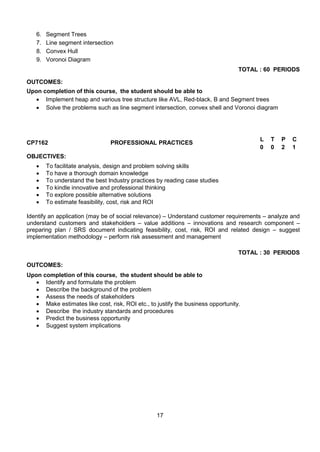
6. Segment Trees
7. Line segment intersection
8. Convex Hull
9. Voronoi Diagram
TOTAL : 60 PERIODS
OUTCOMES:
Upon completion of this course, the student should be able to
 Implement heap and various tree structure like AVL, Red-black, B and Segment trees
 Solve the problems such as line segment intersection, convex shell and Voronoi diagram
CP7162 PROFESSIONAL PRACTICES
L T P C
0 0 2 1
OBJECTIVES:
 To facilitate analysis, design and problem solving skills
 To have a thorough domain knowledge
 To understand the best Industry practices by reading case studies
 To kindle innovative and professional thinking
 To explore possible alternative solutions
 To estimate feasibility, cost, risk and ROI
Identify an application (may be of social relevance) – Understand customer requirements – analyze and
understand customers and stakeholders – value additions – innovations and research component –
preparing plan / SRS document indicating feasibility, cost, risk, ROI and related design – suggest
implementation methodology – perform risk assessment and management
TOTAL : 30 PERIODS
OUTCOMES:
Upon completion of this course, the student should be able to
 Identify and formulate the problem
 Describe the background of the problem
 Assess the needs of stakeholders
 Make estimates like cost, risk, ROI etc., to justify the business opportunity.
 Describe the industry standards and procedures
 Predict the business opportunity
 Suggest system implications
18
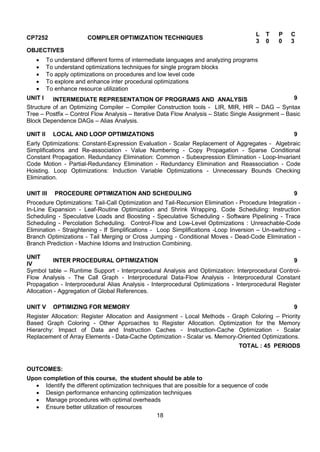
CP7252 COMPILER OPTIMIZATION TECHNIQUES
L T P C
3 0 0 3
OBJECTIVES
 To understand different forms of intermediate languages and analyzing programs
 To understand optimizations techniques for single program blocks
 To apply optimizations on procedures and low level code
 To explore and enhance inter procedural optimizations
 To enhance resource utilization
UNIT I INTERMEDIATE REPRESENTATION OF PROGRAMS AND ANALYSIS 9
Structure of an Optimizing Compiler – Compiler Construction tools - LIR, MIR, HIR – DAG – Syntax
Tree – Postfix – Control Flow Analysis – Iterative Data Flow Analysis – Static Single Assignment – Basic
Block Dependence DAGs – Alias Analysis.
UNIT II LOCAL AND LOOP OPTIMIZATIONS 9
Early Optimizations: Constant-Expression Evaluation - Scalar Replacement of Aggregates - Algebraic
Simplifications and Re-association - Value Numbering - Copy Propagation - Sparse Conditional
Constant Propagation. Redundancy Elimination: Common - Subexpression Elimination - Loop-Invariant
Code Motion - Partial-Redundancy Elimination - Redundancy Elimination and Reassociation - Code
Hoisting. Loop Optimizations: Induction Variable Optimizations - Unnecessary Bounds Checking
Elimination.
UNIT III PROCEDURE OPTIMIZATION AND SCHEDULING 9
Procedure Optimizations: Tail-Call Optimization and Tail-Recursion Elimination - Procedure Integration -
In-Line Expansion - Leaf-Routine Optimization and Shrink Wrapping. Code Scheduling: Instruction
Scheduling - Speculative Loads and Boosting - Speculative Scheduling - Software Pipelining - Trace
Scheduling - Percolation Scheduling. Control-Flow and Low-Level Optimizations : Unreachable-Code
Elimination - Straightening - If Simplifications - Loop Simplifications -Loop Inversion – Un-switching -
Branch Optimizations - Tail Merging or Cross Jumping - Conditional Moves - Dead-Code Elimination -
Branch Prediction - Machine Idioms and Instruction Combining.
UNIT
IV
INTER PROCEDURAL OPTIMIZATION 9
Symbol table – Runtime Support - Interprocedural Analysis and Optimization: Interprocedural Control-
Flow Analysis - The Call Graph - Interprocedural Data-Flow Analysis - Interprocedural Constant
Propagation - Interprocedural Alias Analysis - Interprocedural Optimizations - Interprocedural Register
Allocation - Aggregation of Global References.
UNIT V OPTIMIZING FOR MEMORY 9
Register Allocation: Register Allocation and Assignment - Local Methods - Graph Coloring – Priority
Based Graph Coloring - Other Approaches to Register Allocation. Optimization for the Memory
Hierarchy: Impact of Data and Instruction Caches - Instruction-Cache Optimization - Scalar
Replacement of Array Elements - Data-Cache Optimization - Scalar vs. Memory-Oriented Optimizations.
TOTAL : 45 PERIODS
OUTCOMES:
Upon completion of this course, the student should be able to
 Identify the different optimization techniques that are possible for a sequence of code
 Design performance enhancing optimization techniques
 Manage procedures with optimal overheads
 Ensure better utilization of resources
19
REFERENCES:
1. Steven Muchnick, “Advanced Compiler Design and Implementation”, Morgan Kaufman
Publishers, 1997.
2. Alfred V. Aho, Ravi Sethi, Jeffrey D. Ullman, "Compilers: Principles, Techniques, and Tools",
Addison Wesley, Second Edition, 2007.
3. Andrew W. Appel, Jens Palsberg, "Modern Compiler Implementation in Java", Cambridge
University Press, Second Edition, 2002.
4. Keith Cooper, Linda Torczon, "Engineering a Compiler", Morgan Kaufmann, Second Edition,
2011.
5. Randy Allen and Ken Kennedy, “Optimizing Compilers for Modern Architectures: A Dependence
based Approach”, Morgan Kaufman, 2001.
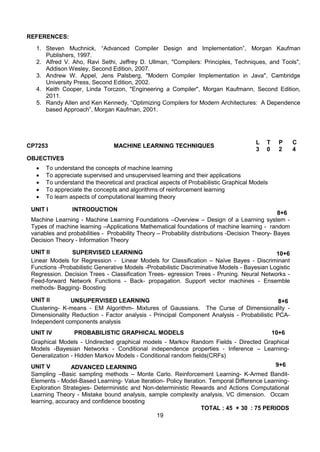
CP7253 MACHINE LEARNING TECHNIQUES
L T P C
3 0 2 4
OBJECTIVES
 To understand the concepts of machine learning
 To appreciate supervised and unsupervised learning and their applications
 To understand the theoretical and practical aspects of Probabilistic Graphical Models
 To appreciate the concepts and algorithms of reinforcement learning
 To learn aspects of computational learning theory
UNIT I INTRODUCTION
8+6
Machine Learning - Machine Learning Foundations –Overview – Design of a Learning system -
Types of machine learning –Applications Mathematical foundations of machine learning - random
variables and probabilities - Probability Theory – Probability distributions -Decision Theory- Bayes
Decision Theory - Information Theory
UNIT II SUPERVISED LEARNING 10+6
Linear Models for Regression - Linear Models for Classification – Naïve Bayes - Discriminant
Functions -Probabilistic Generative Models -Probabilistic Discriminative Models - Bayesian Logistic
Regression. Decision Trees - Classification Trees- egression Trees - Pruning. Neural Networks -
Feed-forward Network Functions - Back- propagation. Support vector machines - Ensemble
methods- Bagging- Boosting
UNIT III UNSUPERVISED LEARNING 8+6
Clustering- K-means - EM Algorithm- Mixtures of Gaussians. The Curse of Dimensionality -
Dimensionality Reduction - Factor analysis - Principal Component Analysis - Probabilistic PCA-
Independent components analysis
UNIT IV PROBABILISTIC GRAPHICAL MODELS 10+6
Graphical Models - Undirected graphical models - Markov Random Fields - Directed Graphical
Models -Bayesian Networks - Conditional independence properties - Inference – Learning-
Generalization - Hidden Markov Models - Conditional random fields(CRFs)
UNIT V ADVANCED LEARNING 9+6
Sampling –Basic sampling methods – Monte Carlo. Reinforcement Learning- K-Armed Bandit-
Elements - Model-Based Learning- Value Iteration- Policy Iteration. Temporal Difference Learning-
Exploration Strategies- Deterministic and Non-deterministic Rewards and Actions Computational
Learning Theory - Mistake bound analysis, sample complexity analysis, VC dimension. Occam
learning, accuracy and confidence boosting
TOTAL : 45 + 30 : 75 PERIODS
20
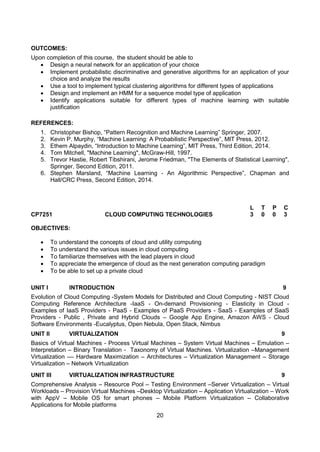
OUTCOMES:
Upon completion of this course, the student should be able to
 Design a neural network for an application of your choice
 Implement probabilistic discriminative and generative algorithms for an application of your
choice and analyze the results
 Use a tool to implement typical clustering algorithms for different types of applications
 Design and implement an HMM for a sequence model type of application
 Identify applications suitable for different types of machine learning with suitable
justification
REFERENCES:
1. Christopher Bishop, “Pattern Recognition and Machine Learning” Springer, 2007.
2. Kevin P. Murphy, “Machine Learning: A Probabilistic Perspective”, MIT Press, 2012.
3. Ethem Alpaydin, “Introduction to Machine Learning”, MIT Press, Third Edition, 2014.
4. Tom Mitchell, "Machine Learning", McGraw-Hill, 1997.
5. Trevor Hastie, Robert Tibshirani, Jerome Friedman, "The Elements of Statistical Learning",
Springer, Second Edition, 2011.
6. Stephen Marsland, “Machine Learning - An Algorithmic Perspective”, Chapman and
Hall/CRC Press, Second Edition, 2014.
CP7251 CLOUD COMPUTING TECHNOLOGIES
L T P C
3 0 0 3
OBJECTIVES:
 To understand the concepts of cloud and utility computing
 To understand the various issues in cloud computing
 To familiarize themselves with the lead players in cloud
 To appreciate the emergence of cloud as the next generation computing paradigm
 To be able to set up a private cloud
UNIT I INTRODUCTION 9
Evolution of Cloud Computing -System Models for Distributed and Cloud Computing - NIST Cloud
Computing Reference Architecture -IaaS - On-demand Provisioning - Elasticity in Cloud -
Examples of IaaS Providers - PaaS - Examples of PaaS Providers - SaaS - Examples of SaaS
Providers - Public , Private and Hybrid Clouds – Google App Engine, Amazon AWS - Cloud
Software Environments -Eucalyptus, Open Nebula, Open Stack, Nimbus
UNIT II VIRTUALIZATION 9
Basics of Virtual Machines - Process Virtual Machines – System Virtual Machines – Emulation –
Interpretation – Binary Translation - Taxonomy of Virtual Machines. Virtualization –Management
Virtualization –– Hardware Maximization – Architectures – Virtualization Management – Storage
Virtualization – Network Virtualization
UNIT III VIRTUALIZATION INFRASTRUCTURE 9
Comprehensive Analysis – Resource Pool – Testing Environment –Server Virtualization – Virtual
Workloads – Provision Virtual Machines –Desktop Virtualization – Application Virtualization – Work
with AppV – Mobile OS for smart phones – Mobile Platform Virtualization – Collaborative
Applications for Mobile platforms
21
UNIT IV PROGRAMMING MODEL 9
Map Reduce Hadoop Distributed File Systems – Hadoop I/O – Developing Map Reduce
Applications – Working of Map Reduce – Types and Formats – Setting up Hadoop Cluster
UNIT V CLOUD INFRASTRUCTURE AND SECURITY 9
Architectural Design of Compute and Storage Clouds - Inter Cloud Resource Management -
Resource Provisioning and Platform Deployment - Global Exchange of Cloud Resources -
Security Overview – Cloud Security Challenges – Software as a Service Security – Security
Governance – Risk Management – Security Monitoring – Security Architecture Design – Data
Security – Application Security – Virtual Machine Security.
TOTAL : 45 PERIODS
OUTCOMES:
Upon completion of this course, the student should be able to
 Articulate the main concepts, key technologies, strengths and limitations of cloud
computing
 Identify the architecture, infrastructure and delivery models of cloud computing
 Explain the core issues of cloud computing such as security, privacy and interoperability
 Choose the appropriate technologies, algorithms and approaches for the related issues
REFERENCES:
1. Kai Hwang, Geoffrey C Fox, Jack G Dongarra, "Distributed and Cloud Computing, From
Parallel Processing to the Internet of Things", Morgan Kaufmann Publishers, 2012.
2. John W.Rittinghouse and James F.Ransome, "Cloud Computing: Implementation,
Management, and Security", CRC Press, 2010.
3. Toby Velte, Anthony Velte, Robert Elsenpeter, "Cloud Computing, A Practical Approach",
McGraw-Hill Osborne Media, 2009.
4. Jim Smith, Ravi Nair, "Virtual Machines: Versatile Platforms for Systems and Processes",
Elsevier/Morgan Kaufmann, 2005.
5. Danielle Ruest, Nelson Ruest, “Virtualization: A Beginner‟s Guide”, McGraw-Hill Osborne
Media, 2009.
6. Tom White, "Hadoop: The Definitive Guide", Yahoo Press, 2012.
7. Rajkumar Buyya, Christian Vecchiola, and Thamarai Selvi, “Mastering Cloud Computing”,
Tata McGraw Hill, 2013.
CP7155 NETWORKING TECHNOLOGIES
L T P C
3 0 0 3
OBJECTIVES
 To learn about integrated and differentiated services architectures
 To understand the working of wireless network protocols
 To study the evolution made in cellular networks
 To get familiarized with next generation networks
UNIT I NETWORK ARCHITECTURE AND QoS 9
Overview of TCP/IP Network Architecture – Integrated Services Architecture – Approach –
Components – Services – Queuing Discipline – FQ – PS – BRFQ – GPS – WFQ – Random Early
Detection – Differentiated Services.
22
UNIT II WIRELESS NETWORKS 9
IEEE802.16 and WiMAX – Security – Advanced 802.16 Functionalities – Mobile WiMAX - 802.16e
– Network Infrastructure – WLAN – Configuration – Management Operation – Security – IEEE
802.11e and WMM – QoS – Comparison of WLAN and UMTS – Bluetooth – Protocol Stack –
Security – Profiles
UNIT III CELLULAR NETWORKS 9
GSM – Mobility Management and call control – GPRS – Network Elements – Radio Resource
Management – Mobility Management and Session Management – Small Screen Web Browsing
over GPRS and EDGE – MMS over GPRS – UMTS – Channel Structure on the Air Interface –
UTRAN –Core and Radio Network Mobility Management – UMTS Security
UNIT IV 4G NETWORKS 9
LTE – Network Architecture and Interfaces – FDD Air Interface and Radio Networks –Scheduling –
Mobility Management and Power Optimization – LTE Security Architecture – Interconnection with
UMTS and GSM – LTE Advanced (3GPPP Release 10) - 4G Networks and Composite Radio
Environment – Protocol Boosters – Hybrid 4G Wireless Networks Protocols – Green Wireless
Networks – Physical Layer and Multiple Access – Channel Modelling for 4G – Introduction to 5G
UNIT V SOFTWARE DEFINED NETWORKS 9
Introduction – Centralized and Distributed Control and Data Planes – Open Flow – SDN
Controllers – General Concepts – VLANs – NVGRE – Open Flow – Network Overlays – Types –
Virtualization – Data Plane – I/O – Design of SDN Framework
TOTAL : 45 PERIODS
OUTCOMES:
Upon completion of this course, the student should be able to
 Identify the different features of integrated and differentiated services
 Demonstrate various protocols of wireless and cellular networks
 Discuss the features of 4G and 5G networks
REFERENCES:
1. William Stallings, “High Speed Networks and Internets: Performance and Quality of
Service”, Prentice Hall, Second Edition, 2002.
2. Martin Sauter, "From GSM to LTE, An Introduction to Mobile Networks and Mobile
Broadband", Wiley, 2014.
3. Savo G Glisic, “Advanced Wireless Networks – 4G Technologies”, John Wiley & Sons,
2007.
4. Jonathan Rodriguez, “Fundamentals of 5G Mobile Networks”, Wiley, 2015.
5. Martin Sauter, “Beyond 3G - Bringing Networks, Terminals and the Web Together: LTE,
WiMAX, IMS, 4G Devices and the Mobile Web 2.0”, Wiley, 2009.
6. Naveen Chilamkurti, Sherali Zeadally, Hakima Chaouchi, “Next-Generation Wireless
Technologies”, Springer, 2013.
7. Erik Dahlman, Stefan Parkvall, Johan Skold, “4G: LTE/LTE-Advanced for Mobile
Broadband”, Academic Press, 2013.
8. Thomas D.Nadeau and Ken Gray, “SDN – Software Defined Networks”, O‟Reilly
Publishers, 2013.
23
SO7251 ADVANCED DATABASE MANAGEMENT SYSTEMS
L T P C
3 0 0 3
OBJECTIVES:
 To understand the underlying principles of Relational Database Management System.
 To understand and implement the advanced features of DBMS.
 To develop database models using distributed databases.
 To implement and maintain an efficient database system using emerging trends.
UNIT I RELATIONAL MODEL 9
Data Model – Types of Data Models: – Entity Relationship Model – Relational Data Model –
Mapping Entity Relationship Model to Relational Model – Structured Query Language – Database
Normalization – Transaction Management.
UNIT II PARALLEL AND DISTRIBUTED DATABASES 9
Centralized and Client-Server Architectures – Parallel Systems – Distributed Systems – Parallel
Databases – I/O Parallelism – Inter- and Intra-Query Parallelism – Inter- and Intra-operation
Parallelism – Distributed Database Concepts: – Distributed Data Storage – Distributed
Transactions – Commit Protocols – Concurrency Control – Distributed Query Processing.
UNIT III XML DATABASES 9
XML Databases: XML Data Model – DTD – XML Schema – XML Querying – Web Databases –
Open Database Connectivity.
UNIT IV MULTIMEDIA DATABASES 9
Multidimensional Data Structures – Image Databases – Text / Document Databases – Video
Databases – Audio Databases – Multimedia Database Design.
UNIT V CURRENT ISSUES 9
Active Databases – Deductive Databases – Data Warehousing – Data Mining – Database Tuning
– Database Security
TOTAL :45 PERIODS
OUTCOMES:
On successful completion of this course, the student will be able to:
 Design and implement relational databases, distributed databases, XML databases and
multimedia databases.
 Implement the concept of database connectivity with the applications.
REFERENCES
1. R. Elmasri, S.B. Navathe, “Fundamentals of Database Systems”, Addison-Wesley, 2011.
2. Thomas Cannolly and Carolyn Begg, “Database Systems, A Practical Approach to Design,
Implementation and Management”, Third Edition, Pearson Education, 2007.
3. Henry F Korth, Abraham Silberschatz, S. Sudharshan, “Database System Concepts”, Fifth
Edition, McGraw Hill, 2006.
4. C.J.Date, A.Kannan and S.Swamynathan,”An Introduction to Database Systems”, Eighth
Edition, Pearson Education, 2006.
5. V.S.Subramanian, “Principles of Multimedia Database Systems”, Harcourt India Pvt. Ltd.,
2001.
24
CP 7211 CLOUD COMPUTING LAB L T P C
0 0 4 2
OBJECTIVES
 To understand the installation of hypervisors
 To understand the installation of different cloud simulation tools and cloud setup tools
 To deploy cloud services
1. Installation of various hypervisors and instantiation of VMs with image file using open
source hypervisors such as Virtual Box, VMWare Player, Xen and KVM.
2. Client server communication between two virtual machine instances, execution of chat
application.
3. Creation of simple network topology using open source network virtualization tools (like
mininet and others).
4. Implementation of simple network protocols using open source network controllers (like
OpenDaylight).
5. Implementation of various scheduling mechanisms using open source cloud simulator.
6. Familiarization and usage of the following cloud services with open source cloud tools (like
Eucalyptus, Openstack, Open Nebula and others)
a) scheduling mechanisms
b) load balancing mechanisms
c) hashing and encryption mechanisms
7. Familiarization and usage of collaborative applications (SaaS).
8. Implementing applications using Google App Engine (PaaS).
9. Develop MapReduce application (example-URL Pattern count and others) using Hadoop
cluster set up (Single node and multi node).
TOTAL : 60 PERIODS
OUTCOMES:
Upon completion of this course, the student should be able to
 Run their application on the instantiated VMs over different hypervisors
 Simulate their sample proposed systems
 Setup a private cloud with open source cloud tools and deploy simple cloud services
 Develop MapReduce Application using Hadoop setup
CP 7254 SECURITY PRINCIPLES AND PRACTICES L T P C
3 0 0 3
OBJECTIVES
 To understand the mathematical foundations of security principles
 To appreciate the different aspects of encryption techniques
 To understand the role played by authentication in security
 To appreciate the current trends of security practices
25
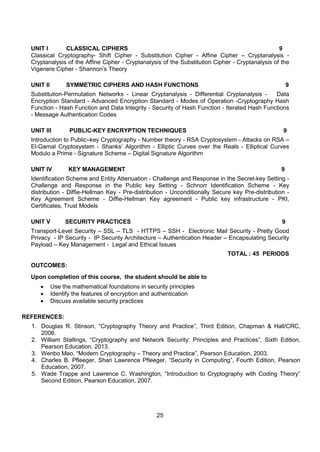
UNIT I CLASSICAL CIPHERS 9
Classical Cryptography- Shift Cipher - Substitution Cipher - Affine Cipher – Cryptanalysis -
Cryptanalysis of the Affine Cipher - Cryptanalysis of the Substitution Cipher - Cryptanalysis of the
Vigenere Cipher - Shannon‟s Theory
UNIT II SYMMETRIC CIPHERS AND HASH FUNCTIONS 9
Substitution-Permutation Networks - Linear Cryptanalysis - Differential Cryptanalysis - Data
Encryption Standard - Advanced Encryption Standard - Modes of Operation -Cryptography Hash
Function - Hash Function and Data Integrity - Security of Hash Function - Iterated Hash Functions
- Message Authentication Codes
UNIT III PUBLIC-KEY ENCRYPTION TECHNIQUES 9
Introduction to Public–key Cryptography - Number theory - RSA Cryptosystem - Attacks on RSA –
El-Gamal Cryptosystem - Shanks‟ Algorithm - Elliptic Curves over the Reals - Elliptical Curves
Modulo a Prime - Signature Scheme – Digital Signature Algorithm
UNIT IV KEY MANAGEMENT 9
Identification Scheme and Entity Attenuation - Challenge and Response in the Secret-key Setting -
Challenge and Response in the Public key Setting - Schnorr Identification Scheme - Key
distribution - Diffie-Hellman Key - Pre-distribution - Unconditionally Secure key Pre-distribution -
Key Agreement Scheme - Diffie-Hellman Key agreement - Public key infrastructure - PKI,
Certificates, Trust Models
UNIT V SECURITY PRACTICES 9
Transport-Level Security – SSL – TLS - HTTPS – SSH - Electronic Mail Security - Pretty Good
Privacy - IP Security - IP Security Architecture – Authentication Header – Encapsulating Security
Payload – Key Management - Legal and Ethical Issues
TOTAL : 45 PERIODS
OUTCOMES:
Upon completion of this course, the student should be able to
 Use the mathematical foundations in security principles
 Identify the features of encryption and authentication
 Discuss available security practices
REFERENCES:
1. Douglas R. Stinson, “Cryptography Theory and Practice”, Third Edition, Chapman & Hall/CRC,
2006.
2. William Stallings, “Cryptography and Network Security: Principles and Practices”, Sixth Edition,
Pearson Education, 2013.
3. Wenbo Mao, “Modern Cryptography – Theory and Practice”, Pearson Education, 2003.
4. Charles B. Pfleeger, Shari Lawrence Pfleeger, “Security in Computing”, Fourth Edition, Pearson
Education, 2007.
5. Wade Trappe and Lawrence C. Washington, “Introduction to Cryptography with Coding Theory”
Second Edition, Pearson Education, 2007.
26
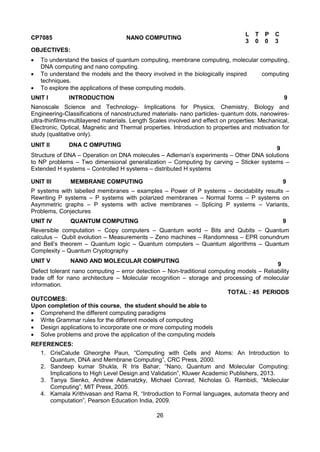
CP7085 NANO COMPUTING
L T P C
3 0 0 3
OBJECTIVES:
 To understand the basics of quantum computing, membrane computing, molecular computing,
DNA computing and nano computing.
 To understand the models and the theory involved in the biologically inspired computing
techniques.
 To explore the applications of these computing models.
UNIT I INTRODUCTION 9
Nanoscale Science and Technology- Implications for Physics, Chemistry, Biology and
Engineering-Classifications of nanostructured materials- nano particles- quantum dots, nanowires-
ultra-thinfilms-multilayered materials. Length Scales involved and effect on properties: Mechanical,
Electronic, Optical, Magnetic and Thermal properties. Introduction to properties and motivation for
study (qualitative only).
UNIT II DNA C OMPUTING
9
Structure of DNA – Operation on DNA molecules – Adleman‟s experiments – Other DNA solutions
to NP problems – Two dimensional generalization – Computing by carving – Sticker systems –
Extended H systems – Controlled H systems – distributed H systems
UNIT III MEMBRANE COMPUTING 9
P systems with labelled membranes – examples – Power of P systems – decidability results –
Rewriting P systems – P systems with polarized membranes – Normal forms – P systems on
Asymmetric graphs – P systems with active membranes – Splicing P systems – Variants,
Problems, Conjectures
UNIT IV QUANTUM COMPUTING 9
Reversible computation – Copy computers – Quantum world – Bits and Qubits – Quantum
calculus – Qubit evolution – Measurements – Zeno machines – Randomness – EPR conundrum
and Bell‟s theorem – Quantum logic – Quantum computers – Quantum algorithms – Quantum
Complexity – Quantum Cryptography
UNIT V NANO AND MOLECULAR COMPUTING
9
Defect tolerant nano computing – error detection – Non-traditional computing models – Reliability
trade off for nano architecture – Molecular recognition – storage and processing of molecular
information.
TOTAL : 45 PERIODS
OUTCOMES:
Upon completion of this course, the student should be able to
 Comprehend the different computing paradigms
 Write Grammar rules for the different models of computing
 Design applications to incorporate one or more computing models
 Solve problems and prove the application of the computing models
REFERENCES:
1. CrisCalude Gheorghe Paun, “Computing with Cells and Atoms: An Introduction to
Quantum, DNA and Membrane Computing”, CRC Press, 2000.
2. Sandeep kumar Shukla, R Iris Bahar, “Nano, Quantum and Molecular Computing:
Implications to High Level Design and Validation”, Kluwer Academic Publishers, 2013.
3. Tanya Sienko, Andrew Adamatzky, Michael Conrad, Nicholas G. Rambidi, “Molecular
Computing”, MIT Press, 2005.
4. Kamala Krithivasan and Rama R, “Introduction to Formal languages, automata theory and
computation”, Pearson Education India, 2009.
27
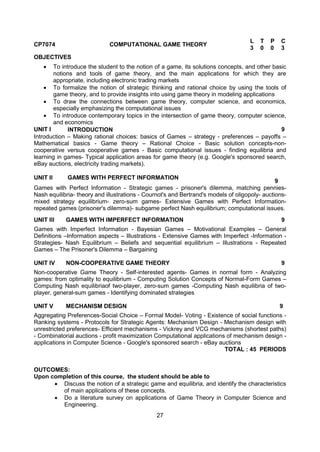
CP7074 COMPUTATIONAL GAME THEORY
L T P C
3 0 0 3
OBJECTIVES
 To introduce the student to the notion of a game, its solutions concepts, and other basic
notions and tools of game theory, and the main applications for which they are
appropriate, including electronic trading markets
 To formalize the notion of strategic thinking and rational choice by using the tools of
game theory, and to provide insights into using game theory in modeling applications
 To draw the connections between game theory, computer science, and economics,
especially emphasizing the computational issues
 To introduce contemporary topics in the intersection of game theory, computer science,
and economics
UNIT I INTRODUCTION 9
Introduction – Making rational choices: basics of Games – strategy - preferences – payoffs –
Mathematical basics - Game theory – Rational Choice - Basic solution concepts-non-
cooperative versus cooperative games - Basic computational issues - finding equilibria and
learning in games- Typical application areas for game theory (e.g. Google's sponsored search,
eBay auctions, electricity trading markets).
UNIT II GAMES WITH PERFECT INFORMATION
9
Games with Perfect Information - Strategic games - prisoner's dilemma, matching pennies-
Nash equilibria- theory and illustrations - Cournot's and Bertrand's models of oligopoly- auctions-
mixed strategy equilibrium- zero-sum games- Extensive Games with Perfect Information-
repeated games (prisoner's dilemma)- subgame perfect Nash equilibrium; computational issues.
UNIT III GAMES WITH IMPERFECT INFORMATION 9
Games with Imperfect Information - Bayesian Games – Motivational Examples – General
Definitions –Information aspects – Illustrations - Extensive Games with Imperfect -Information -
Strategies- Nash Equilibrium – Beliefs and sequential equilibrium – Illustrations - Repeated
Games – The Prisoner's Dilemma – Bargaining
UNIT IV NON-COOPERATIVE GAME THEORY 9
Non-cooperative Game Theory - Self-interested agents- Games in normal form - Analyzing
games: from optimality to equilibrium - Computing Solution Concepts of Normal-Form Games –
Computing Nash equilibriaof two-player, zero-sum games -Computing Nash equilibria of two-
player, general-sum games - Identifying dominated strategies
UNIT V MECHANISM DESIGN 9
Aggregating Preferences-Social Choice – Formal Model- Voting - Existence of social functions -
Ranking systems - Protocols for Strategic Agents: Mechanism Design - Mechanism design with
unrestricted preferences- Efficient mechanisms - Vickrey and VCG mechanisms (shortest paths)
- Combinatorial auctions - profit maximization Computational applications of mechanism design -
applications in Computer Science - Google's sponsored search - eBay auctions
TOTAL : 45 PERIODS
OUTCOMES:
Upon completion of this course, the student should be able to
 Discuss the notion of a strategic game and equilibria, and identify the characteristics
of main applications of these concepts.
 Do a literature survey on applications of Game Theory in Computer Science and
Engineering.
28
 Discuss the use of Nash Equilibrium for other problems.
 Identify key strategic aspects and based on these be able to connect them to
appropriate game theoretic concepts given a real world situation.
 Identify some applications that need aspects of Bayesian Games
 Implement a typical Virtual Business scenario using Game theory
REFERENCES:
1. M. J. Osborne, “An Introduction to Game Theory”, Oxford University Press, 2003.
2. N. Nisan, T. Roughgarden, E. Tardos, and V. V. Vazirani, “Algorithmic Game Theory”,
Cambridge University Press, 2007.
3. M. J. Osborne and A. Rubinstein, “A Course in Game Theory”, MIT Press, 1994.
4. A.Dixit and S. Skeath, “Games of Strategy”, W W Norton & Co Inc, 3rd Edition 2009.
5. YoavShoham, Kevin Leyton-Brown, “Multi agent Systems: Algorithmic, Game- Theoretic,
and Logical Foundations”, Cambridge University Press, 2008.
6. Zhu Han, Dusit Niyato, Walid Saad, Tamer Basar and Are Hjorungnes, “Game Theory in
Wireless and Communication Networks”, Cambridge University Press, 2012.
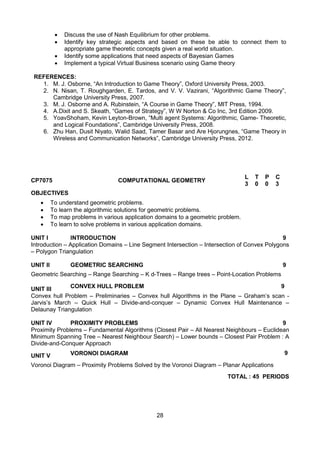
CP7075 COMPUTATIONAL GEOMETRY
L T P C
3 0 0 3
OBJECTIVES
 To understand geometric problems.
 To learn the algorithmic solutions for geometric problems.
 To map problems in various application domains to a geometric problem.
 To learn to solve problems in various application domains.
UNIT I INTRODUCTION 9
Introduction – Application Domains – Line Segment Intersection – Intersection of Convex Polygons
– Polygon Triangulation
UNIT II GEOMETRIC SEARCHING 9
Geometric Searching – Range Searching – K d-Trees – Range trees – Point-Location Problems
UNIT III CONVEX HULL PROBLEM 9
Convex hull Problem – Preliminaries – Convex hull Algorithms in the Plane – Graham‟s scan -
Jarvis‟s March – Quick Hull – Divide-and-conquer – Dynamic Convex Hull Maintenance –
Delaunay Triangulation
UNIT IV PROXIMITY PROBLEMS 9
Proximity Problems – Fundamental Algorithms (Closest Pair – All Nearest Neighbours – Euclidean
Minimum Spanning Tree – Nearest Neighbour Search) – Lower bounds – Closest Pair Problem : A
Divide-and-Conquer Approach
UNIT V VORONOI DIAGRAM 9
Voronoi Diagram – Proximity Problems Solved by the Voronoi Diagram – Planar Applications
TOTAL : 45 PERIODS
29
OUTCOMES:
Upon completion of this course, the student should be able to
 Identify problems that can be mapped to geometric problems
 Transform problems in different applications to geometric problems
 Use the algorithms learnt for solving the transformed problems
REFERENCES
1. Franco P. Preparata, Michael I. Shamos, “Computational Geometry: An Introduction”,
Springer, 1993.
2. Mark de Berg, Otfried Cheong, Marc van Kreveld, Mark Overmars, “Computational
Geometry : Algorithms and Applications”, Springer, 3rd Edition, 2008.
3. Satyan L. Devadoss and Joseph O'Rourke, “Discrete and Computational Geometry”,
Princeton University Press, 2011.
4. Herbert Edelsbrunner, “Algorithms in Combinatorial Geometry, EATCS Monographs in
Computer Science”, Springer Verlag, 2011.
CP7087 PARALLEL ALGORITHMS L T P C
3 0 0 3
OBJECTIVES:
 To learn parallel algorithms development techniques for shared memory and DCM models
 To study the main classes of fundamental parallel algorithms
 To study the complexity and correctness models for parallel algorithms.
UNIT I INTRODUCTION 9
Introduction to Parallel Algorithms – Models of computation – Selection – Mergin on EREW and CREW –
Median of two sorted sequence – Fast Merging on EREW – Analyzing Parallel Algorithms
UNIT II SORTING & SEARCHING
9
Sorting Networks – Sorting on a Linear Array – Sorting on CRCW, CREW, EREW – Searching a sorted
sequence – Searching a random sequence – Bitonic Sort
UNIT III ALGEBRAIC PROBLEMS
9
Permutations and Combinations – Matrix Transpositions – Matrix by Matrix multiplications – Matrix by
vector multiplication.
UNIT IV GRAPH & GEOMETRY 9
Connectivity Matrix – Connected Components – All Pair Shortest Paths – Minimum Spanning Trees –
Point Inclusion – Intersection, Proximity and Construction Problems
UNIT V OPTIMIZATION & BIT COMPUTATIONS 9
Prefix Sums – Job Sequencing – Knapsack - Adding two integers – Adding n integers – Multiplying two
integers – Selection.
TOTAL : 45 PERIODS
30
OUTCOMES:
Upon completion of this course, the student should be able to
 Familiarize with design of parallel algorithms in various models of parallel computation
 Familiarize with the efficient parallel algorithms related to many areas of computer science:
expression computation, sorting, graph-theoretic problems, computational geometry, etc
 Familiarize with the basic issues of implementing parallel algorithms
REFERENCES:
1. Selim G. Akl, “The Design and Analysis of Parallel Algorithms”, Prentice Hall, New Jercy, 1989.
2. Michael J. Quinn, “Parallel Computing: Theory & Practice”, Tata McGraw Hill Edition, 2003.
3. Joseph JaJa, “Introduction to Parallel Algorithms”, Addison-Wesley, 1992.
CP7095 VIRTUALIZATION TECHNIQUES AND APPLICATIONS
L T P C
3 0 0 3
OBJECTIVES
 To understand the concepts of virtualization and virtual machines
 To understand the implementation of process and system virtual machines
 To explore the aspects of high level language virtual machines
 To gain expertise in server, network and storage virtualization.
 To understand and deploy practical virtualization solutions and enterprise solutions
UNIT I OVERVIEW OF VIRTUALIZATION 9
System architectures - Virtual Machine basics - Process vs System Virtual Machines - Taxonomy.
Emulation: Basic Interpretation - Threaded Interpretation - Precoded and Direct Threaded Interpretation -
Binary Translation. System Virtual Machines - Key concepts - Resource utilization basics.
UNIT II PROCESS VIRTUAL MACHINES
9
Implementation – Compatibility – Levels – Framework – State Mapping – Register – Memory Address
Space – Memory Architecture Emulation – Memory Protection – Instruction Emulation – Performance
Tradeoff - Staged Emulation – Exception Emulation – Exception Detection – Interrupt Handling –
Operating Systems Emulation – Same OS Emulation – Different OS Emulation – System Environment.
UNIT III HIGH LEVEL LANGUAGE VIRTUAL MACHINES AND SERVER VIRTUALIZATION 9
HLL virtual machines: Pascal P-Code – Object Oriented HLLVMs - Java VM architecture - Java Native
Interface - Common Language Infrastructure. Server virtualization: Partitioning techniques - virtual
hardware - uses of virtual servers - server virtualization platforms
UNIT IV NETWORK AND STORAGE VIRTUALIZATION 9
Design of Scalable Enterprise Networks – Layer2 Virtualization – VLAN - VFI - Layer 3 Virtualization –
VRF - Virtual Firewall Contexts - Network Device Virtualization - Data- Path Virtualization - Routing
Protocols. Hardware Devices – SAN backup and recovery techniques – RAID – Classical Storage Model –
SNIA Shared Storage Model – Virtual Storage: File System Level and Block Level
31
UNIT V APPLYING VIRTUALIZATION 9
Practical Virtualization Solutions: Comparison of Virtualization Technologies: Guest OS/ Host OS –
Hypervisor – Emulation – Kernel Level – Shared Kernel, Enterprise Solutions: VMWare Server – VMWare
ESXi – Citrix Xen Server – Microsoft Virtual PC – Microsoft Hyper-V – Virtual Box, Server Virtualization:
Configuring Servers with Virtualization – Adjusting and Tuning Virtual servers – VM Backup – VM
Migration, Desktop Virtualization: Terminal services – Hosted Desktop – Web-based Solutions – Localized
Virtual Desktops, Network and Storage Virtualization: Virtual Private Networks – Virtual LAN – SAN and
VSAN – NAS
TOTAL : 45 PERIODS
OUTCOMES:
Upon completion of this course, the student should be able to
 Deploy legacy OS on virtual machines.
 Analyze the intricacies of server, storage and network virtualizations
 Design and develop applications on virtual machine platforms
REFERENCES:
1. James E. Smith, Ravi Nair, “Virtual Machines: Versatile Platforms for Systems and Processes”,
Elsevier/Morgan Kaufmann, 2005.
2. David Marshall, Wade A. Reynolds, “Advanced Server Virtualization: VMware and Microsoft
Platform in the Virtual Data Center”, Auerbach Publications, 2006.
3. Kumar Reddy, Victor Moreno, “Network virtualization”, Cisco Press, July, 2006.
4. Chris Wolf, Erick M. Halter, “Virtualization: From the Desktop to the Enterprise”, APress 2005.
5. Kenneth Hess , Amy Newman, “Practical Virtualization Solutions: Virtualization from the Trenches”,
Prentice Hall, 2010
CP7081 FAULT TOLERANT SYSTEMS
L T P C
3 0 0 3
OBJECTIVES
 To provide and appreciate a comprehensive view of fault tolerant systems
 To expose the students to the methods of hardware fault tolerance
 To understand the different ways of providing information redundancy and the ways of providing
software fault tolerance.
 To expose the students to concept of check pointing and their role in providing fault tolerance.
 To understand how to handle security attacks.
UNIT I INTRODUCTION 9
Fault Classification, Types of Redundancy, Basic Measures of Fault Tolerance, Hardware Fault Tolerance,
The Rate of Hardware Failures, Failure Rate, Reliability, and Mean Time to Failure, Canonical and
Resilient Structures, Other Reliability Evaluation Techniques, Processor level Techniques
UNIT II INFORMATION REDUNDANCY
9
Information Redundancy, Coding, Resilient Disk Systems, Data Replication, Voting: Hierarchical
Organization, Primary-Backup Approach, Algorithm-Based Fault Tolerance, Fault-Tolerant Networks:
Measures of Resilience, Common Network Topologies and Their Resilience, Fault- Tolerant Routing
32
UNIT III SOFTWARE FAULT TOLERANCE 9
Acceptance Tests, Single-Version Fault Tolerance, N-Version Programming, Recovery Block Approach,
Preconditions, Post conditions, and Assertions, Exception-Handling, Software Reliability Models, Fault-
Tolerant Remote Procedure Calls
UNIT IV CHECKPOINTING 9
Introduction, Checkpoint Level, Optimal Checkpointing - An Analytical Model, Cache-Aided Rollback Error
Recovery, Checkpointing in Distributed Systems, Checkpointing in Shared-Memory Systems,
Checkpointing in Real-Time Systems, Case Studies: NonStop Systems, Stratus Systems, Cassini
Command and Data Subsystem, IBM G5, IBM Sysplex, Itanium
UNIT V FAULT DETECTION IN CRYPTOGRAPHIC SYSTEMS 9
Security Attacks Through Fault Injection – Fault Attacks on Symmetric Key Ciphers – Fault Attacks on
Public (Asymmetric) Key Ciphers – Counter Measures – Spatial and Temporal Duplication – Error
Detecting Codes
TOTAL : 45 PERIODS
OUTCOMES:
Upon completion of this course, the student should be able to
 Define the traditional measures of fault tolerance
 Point out the processor level fault tolerance techniques
 Critically analyze the different types of RAID levels
 Discuss techniques like recovery blocks and N-version programming
 Identify techniques for check pointing in distributed and shared memory systems.
 Provide techniques to detect injected faults in ciphers.
REFERENCES:
1. Israel Koren, Mani Krishna, “Fault Tolerant Systems”, Morgan Kaufmann, 2010
2. Parag K. Lala “Fault Tolerant and Fault Testable Hardware Design”, Prentice-Hall International,
1984.
3. LL Pullam, “Software Fault Tolerance Techniques and Implementation”, Artech House Computer
Security Series, 2002.
4. Martin L Shooman, “Reliability of Computer Systems and Networks: Fault Tolerance, Analysis and
Design”, Willey, 2002.
CP7077 DATABASE ADMINISTRATION AND TUNING
L T P C
3 0 0 3
OBJECTIVES
 To design and implement relational database solutions for general applications
 To develop database scripts for data manipulation and database administration
 To understand and perform common database administration tasks such as database monitoring,
performance tuning, data transfer, and security
 To balance the different types of competing resources in the database environment so that the
most important applications have priority access to the resources
UNIT I INTRODUCTION TO DATABASE ADMINISTRATION 9
Database Administration - DBA Tasks - DBMS Release Migration - Types of DBAs - Creating the
Database Environment – Defining the organizations DBMS strategy - Installing the DBMS - Upgrading
DBMS Versions and Releases
33
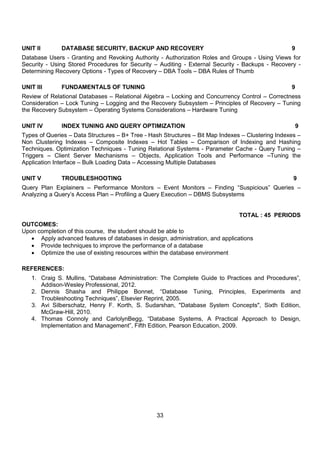
UNIT II DATABASE SECURITY, BACKUP AND RECOVERY 9
Database Users - Granting and Revoking Authority - Authorization Roles and Groups - Using Views for
Security - Using Stored Procedures for Security – Auditing - External Security - Backups - Recovery -
Determining Recovery Options - Types of Recovery – DBA Tools – DBA Rules of Thumb
UNIT III FUNDAMENTALS OF TUNING 9
Review of Relational Databases – Relational Algebra – Locking and Concurrency Control – Correctness
Consideration – Lock Tuning – Logging and the Recovery Subsystem – Principles of Recovery – Tuning
the Recovery Subsystem – Operating Systems Considerations – Hardware Tuning
UNIT IV INDEX TUNING AND QUERY OPTIMIZATION 9
Types of Queries – Data Structures – B+ Tree - Hash Structures – Bit Map Indexes – Clustering Indexes –
Non Clustering Indexes – Composite Indexes – Hot Tables – Comparison of Indexing and Hashing
Techniques. Optimization Techniques - Tuning Relational Systems - Parameter Cache - Query Tuning –
Triggers – Client Server Mechanisms – Objects, Application Tools and Performance –Tuning the
Application Interface – Bulk Loading Data – Accessing Multiple Databases
UNIT V TROUBLESHOOTING 9
Query Plan Explainers – Performance Monitors – Event Monitors – Finding “Suspicious” Queries –
Analyzing a Query‟s Access Plan – Profiling a Query Execution – DBMS Subsystems
TOTAL : 45 PERIODS
OUTCOMES:
Upon completion of this course, the student should be able to
 Apply advanced features of databases in design, administration, and applications
 Provide techniques to improve the performance of a database
 Optimize the use of existing resources within the database environment
REFERENCES:
1. Craig S. Mullins, “Database Administration: The Complete Guide to Practices and Procedures”,
Addison-Wesley Professional, 2012.
2. Dennis Shasha and Philippe Bonnet, “Database Tuning, Principles, Experiments and
Troubleshooting Techniques”, Elsevier Reprint, 2005.
3. Avi Silberschatz, Henry F. Korth, S. Sudarshan, "Database System Concepts", Sixth Edition,
McGraw-Hill, 2010.
4. Thomas Connoly and CarlolynBegg, “Database Systems, A Practical Approach to Design,
Implementation and Management”, Fifth Edition, Pearson Education, 2009.
34
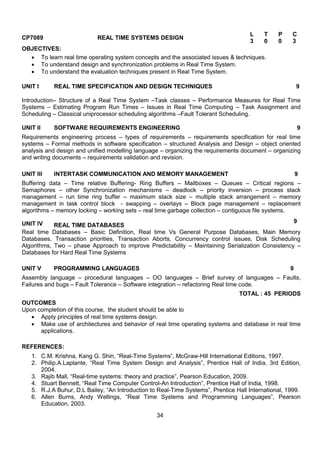
CP7089 REAL TIME SYSTEMS DESIGN
L T P C
3 0 0 3
OBJECTIVES:
 To learn real time operating system concepts and the associated issues & techniques.
 To understand design and synchronization problems in Real Time System.
 To understand the evaluation techniques present in Real Time System.
UNIT I REAL TIME SPECIFICATION AND DESIGN TECHNIQUES 9
Introduction– Structure of a Real Time System –Task classes – Performance Measures for Real Time
Systems – Estimating Program Run Times – Issues in Real Time Computing – Task Assignment and
Scheduling – Classical uniprocessor scheduling algorithms –Fault Tolerant Scheduling.
UNIT II SOFTWARE REQUIREMENTS ENGINEERING 9
Requirements engineering process – types of requirements – requirements specification for real time
systems – Formal methods in software specification – structured Analysis and Design – object oriented
analysis and design and unified modelling language – organizing the requirements document – organizing
and writing documents – requirements validation and revision.
UNIT III INTERTASK COMMUNICATION AND MEMORY MANAGEMENT 9
Buffering data – Time relative Buffering- Ring Buffers – Mailboxes – Queues – Critical regions –
Semaphores – other Synchronization mechanisms – deadlock – priority inversion – process stack
management – run time ring buffer – maximum stack size – multiple stack arrangement – memory
management in task control block - swapping – overlays – Block page management – replacement
algorithms – memory locking – working sets – real time garbage collection – contiguous file systems.
UNIT IV REAL TIME DATABASES
9
Real time Databases – Basic Definition, Real time Vs General Purpose Databases, Main Memory
Databases, Transaction priorities, Transaction Aborts, Concurrency control issues, Disk Scheduling
Algorithms, Two – phase Approach to improve Predictability – Maintaining Serialization Consistency –
Databases for Hard Real Time Systems
UNIT V PROGRAMMING LANGUAGES 9
Assembly language – procedural languages – OO languages – Brief survey of languages – Faults,
Failures and bugs – Fault Tolerance – Software integration – refactoring Real time code.
TOTAL : 45 PERIODS
OUTCOMES
Upon completion of this course, the student should be able to
 Apply principles of real time systems design.
 Make use of architectures and behavior of real time operating systems and database in real time
applications.
REFERENCES:
1. C.M. Krishna, Kang G. Shin, “Real-Time Systems”, McGraw-Hill International Editions, 1997.
2. Philip.A.Laplante, “Real Time System Design and Analysis”, Prentice Hall of India, 3rd Edition,
2004.
3. Rajib Mall, “Real-time systems: theory and practice”, Pearson Education, 2009.
4. Stuart Bennett, “Real Time Computer Control-An Introduction”, Prentice Hall of India, 1998.
5. R.J.A Buhur, D.L Bailey, “An Introduction to Real-Time Systems”, Prentice Hall International, 1999.
6. Allen Burns, Andy Wellings, “Real Time Systems and Programming Languages”, Pearson
Education, 2003.
35
IF 7071 BIOINFORMATICS L T P C
3 0 0 3
OBJECTIVES:
 To learn bio-informatics algorithms
UNIT I 9
What is Bio-Informatics – Overview- Major databases in Bio Informatics- Molecular biology –
Central DogmaData retrieval tools – gene structure - Prokaryotic and Eukaryotic Genomes –
Sequence Assembly – Gene mapping – Physical maps – cloning –– the genetic material ––
chemical bonds – molecular biology tools – genomic information content.
UNIT II 9
DNA: working with single DNA sequence : removing vector sequences- verifying restriction maps –
PCR design – GC content – counting words – internal repeats – protein coding regions – ORFing
– Genomescan Protein: predicting properties – primary structure analysis – transmembrane
segments – PROSITE patterns – interpreting scanprosite results- finding domains – CD server
results – pfscan results. – Alignment of Pair of Sequences
UNIT III 9
Phylogenetics – phylogenetic trees –Parsimony – ancestral sequences – strategies for faster
searches – consensus trees – tree confidence – comparison of phylogenetic methods – molecular
phylogenie. Dot matrix – using scoring matrices – PAM matrices – BLOSUM. - Working with
FASTA – Algorithm – output – E-values – Histogram. Working with BLAST – algorithm – output –
services – gapped BLAST- PSIBLAST – comparison of FASTA and BLAST. - Multiple sequence
alignment - Criteria for Multiple sequence alignment – applications – choosing the right sequences;
FASTA, ClustalW, TCoffee methods
UNIT IV 9
interpreting multiple sequence alignment – getting in right format – converting formats – using
Jalview – preparing for publication. - Protein Classification & Structure Prediction - Structure of
amino acids – primary structure – secondary structure – folds and motifs – alpha and beta helix –
structure based protein classification – protein structure Data bases – folding problem –
PROPSEARCH – primary structure analysis and prediction – secondary structure analysis and
prediction – motifs – profiles – patterns and fingerprints
UNIT V 9
Drug Discovery – components – process – Perspectives – Numeric considerations – Algorithms –
Hardware – Issues – Protein structure – AbInitio Methods – Heuristic methods – Systems Biology
– Tools – Collaboration and Communications – standards - Issues – Security – Intellectual
property
TOTAL:45 PERIODS
OUTCOMES:
Upon the completion of this course the student should be able
 To design and implement bio-informatics algorithms
REFERENCES
1. Arthur M. Lesk, “Introduction to Bioinformatics”, Second Edition, Oxford University Press, 2005.
2. T. K. Attwood, D. J. Parry-Smith, and S. Phukan, “Introduction to Bioinformatics”, Pearson
Education, 1999.
3. Vittal R. Srinivas, “Bioinformatics – A Modern Approach”, Prentice-Hall of India Pvt. Ltd., 2005
4. S.C Rostogi , Mendiratta, P.Rasogi, “ BioInformatics: methods and applications”,second
edition, PHI 2006.
5. Jean Mickel Clavere & Cadrienotredom “Bio Informatics– A beginners guide” Wiley
DreamTech, 2003.
6. T.K. Attwood and D.J Perry Smith, “ Introduction to Bio Informatics”, Pearson Education, 1st
Edition, 2001.
36
CP7084 MODELS OF COMPUTATIONS
L T P C
3 0 0 3
OBJECTIVES
 To understand computation and computability concepts.
 To study different approaches to facilitate computing
 To learn the abstractions of computation and their implementations
UNIT I TURING MACHINE MODEL 9
Turing Machine Logic, Proof, Computability
UNIT II QUANTUM COMPUTATION 9
Quantum Computing History, Postulates of Quantum Theory, Dirac Notation, the Quantum Circuit Model,
Simple Quantum Protocols: Teleportation, Superdense Coding, Foundation Algorithms
UNIT III NATURE INSPIRED COMPUTING 9
Nature-Inspired Computing Optimization and Decision Support Techniques, Evolutionary Algorithms,
Swarm Intelligence, Benchmarks and Testing
UNIT IV SOCIAL COMPUTING 9
Social Computing Online communities, Online discussions, Twitter, Social Networking Systems, Web 2.0,
social media, Crowdsourcing, Facebook, blogs, wikis, social recommendations, Collective intelligence
UNIT V EVOLUTIONARY COMPUTING 9
Evolutionary Computing Introduction to Genetic Algorithms, Genetic Operators and Parameters, Genetic
Algorithms in Problem Solving, Theoretical Foundations of Genetic Algorithms, Implementation Issues
TOTAL : 45 PERIODS
OUTCOMES:
Upon completion of this course, the student should be able to
 Identify the terminology of the theory of computing
 Predict the major results in computability and complexity theory.
 Prepare the major models of computations
REFERENCES
1. Danah Boyd, “It's Complicated: The Social Lives of Networked Teens”, Yale University Press, 2015
2. John E. Savage, “Models Of Computation - Exploring the Power of Computing”, Addison-Wesley,
2008
3. Margaret M. Fleck, “Building Blocks for Theoretical Computer Science”, University of Illinois,
Urbana-Champaign, 2013.
4. Michael A. Nielsen & Isaac L. Chuang, “Quantum Computation and Quantum Information”,
Cambridge University Press, 2010
5. M. Mitchell, “An Introduction to Genetic Algorithms”, Prentice-Hall, 1996.
6. G.Rozenberg, T.Back, J.Kok, Editors, “Handbook of Natural Computing”, Springer Verlag, 2012.
37
CP7073 COGNITIVE SCIENCE
L T P C
3 0 0 3
OBJECTIVES:
 To learn the basics of Cognitive Science with focus on acquisition, representation, and use of
knowledge by individual minds, brains, and machines
 To study the mind and intelligence, embracing psychology, artificial intelligence, neuroscience and
linguistics
 To understand the role of neuro science in the cognitive field
UNIT I INTRODUCTION TO COGNITIVE SCIENCE 9
The Cognitive view –Some Fundamental Concepts – Computers in Cognitive Science – Applied Cognitive
Science – The Interdisciplinary Nature of Cognitive Science – Artificial Intelligence: Knowledge
representation -The Nature of Artificial Intelligence - Knowledge Representation – Artificial Intelligence:
Search, Control, and Learning
UNIT II COGNITIVE PSYCHOLOGY 9
Cognitive Psychology – The Architecture of the Mind - The Nature of Cognitive Psychology- A Global View
of The Cognitive Architecture- Propositional Representation- Schematic Representation- Cognitive
Processes, Working Memory, and Attention- The Acquisition of Skill- The Connectionist Approach to
Cognitive Architecture
UNIT III COGNITIVE NEUROSCIENCE 9
Brain and Cognition Introduction to the Study of the Nervous System – Neural Representation –
Neuropsychology- Computational Neuroscience - The Organization of the mind - Organization of Cognitive
systems - Strategies for Brain mapping – A Case study: Exploring mindreading
UNIT IV LANGUAGE ACQUISITION, SEMANTICS AND PROCESSING MODELS 9
Milestones in Acquisition – Theoretical Perspectives- Semantics and Cognitive Science – Meaning and
Entailment – Reference – Sense – Cognitive and Computational Models of Semantic Processing –
Information Processing Models of the Mind- Physical symbol systems and language of thought- Applying
the Symbolic Paradigm- Neural networks and distributed information processing- Neural network models of
Cognitive Processes
UNIT V HIGHER-LEVEL COGNITION
9
Reasoning – Decision Making – Computer Science and AI: Foundations & Robotics – New Horizons -
Dynamical systems and situated cognition- Challenges – Emotions and Consciousness – Physical and
Social Environments – Applications
TOTAL : 45 PERIODS
OUTCOMES:
Upon completion of this course, the student should be able to
 Explain and analyze the major concepts, philosophical and theoretical perspectives, empirical findings,
and historical trends in cognitive science, related to cultural diversity and living in a global community.
 Use cognitive science knowledge base to create their own methods for answering novel questions of
either a theoretical or applied nature, and to critically evaluate the work of others in the same domain
 Be proficient with basic cognitive science research methods, including both theory-driven and applied
research design, data collection, data analysis, and data interpretation
38
REFERENCES:
1. Neil Stillings, Steven E. Weisler, Christopher H. Chase and Mark H. Feinstein, “Cognitive Science:
An Introduction”, Second Edition, MIT press ,1995
2. José Luis Bermúdez, “Cognitive Science: An Introduction to the Science of the Mind”, Cambridge
University Press, New York, 2014
3. Robert L. Solso, Otto H. MacLin and M. Kimberly MacLin, “Cognitive Psychology, Pearson
Education, 2007.
4. J. Friedenberg and G. Silverman, “Cognitive Science: An Introduction to the Study of Mind”, 2011
5. Steven Pinker, “How the mind works”, W. W. Norton & Company; Reissue edition, 2009
6. Carolyn Panzer Sobel and Paul Li, “Cognitive Science: An Interdisciplinary Approach”, 2013
7. Paul Thagard, “Mind: Introduction to Cognitive Science”, 2nd Edition, MIT Press, 2005
CP7082 INFORMATION RETRIEVAL TECHNIQUES
L T P C
3 0 0 3
OBJECTIVES:
 To understand the basics of information retrieval with pertinence to modeling, query operations and
indexing
 To get an understanding of machine learning techniques for text classification and clustering.
 To understand the various applications of information retrieval giving emphasis to multimedia IR,
web search
 To understand the concepts of digital libraries
UNIT I INTRODUCTION: MOTIVATION 9
Basic Concepts – Practical Issues - Retrieval Process – Architecture - Boolean Retrieval –Retrieval
Evaluation – Open Source IR Systems–History of Web Search – Web Characteristics–The impact of the
web on IR ––IR Versus Web Search–Components of a Search engine
UNIT II MODELING 9
Taxonomy and Characterization of IR Models – Boolean Model – Vector Model - Term Weighting – Scoring
and Ranking –Language Models – Set Theoretic Models - Probabilistic Models – Algebraic Models –
Structured Text Retrieval Models – Models for Browsing
UNIT III INDEXING 9
Static and Dynamic Inverted Indices – Index Construction and Index Compression. Searching - Sequential
Searching and Pattern Matching. Query Operations -Query Languages – Query Processing - Relevance
Feedback and Query Expansion - Automatic Local and Global Analysis – Measuring Effectiveness and
Efficiency
UNIT IV CLASSIFICATION AND CLUSTERING 9
Text Classification and Naïve Bayes – Vector Space Classification – Support vector machines and Machine
learning on documents. Flat Clustering – Hierarchical Clustering –Matrix decompositions and latent
semantic indexing – Fusion and Meta learning
UNIT V SEARCHING THE WEB 9
Searching the Web –Structure of the Web –IR and web search – Static and Dynamic Ranking – Web
Crawling and Indexing – Link Analysis - XML Retrieval Multimedia IR: Models and Languages – Indexing
and Searching Parallel and Distributed IR – Digital Libraries
TOTAL : 45 PERIODS
39
OUTCOMES:
Upon completion of this course, the student should be able to
 Build an Information Retrieval system using the available tools
 Identify and design the various components of an Information Retrieval system
 Apply machine learning techniques to text classification and clustering which is used for efficient
Information Retrieval
 Design an efficient search engine and analyze the Web content structure
REFERENCES:
1. Ricardo Baeza – Yates, Berthier Ribeiro – Neto, “Modern Information Retrieval: The concepts and
Technology behind Search” (ACM Press Books), Second Edition, 2011.
2. Christopher D. Manning, Prabhakar Raghavan, Hinrich Schutze, “Introduction to Information
Retrieval”, Cambridge University Press, First South Asian Edition, 2008.
3. Stefan Buttcher, Charles L. A. Clarke, Gordon V. Cormack, “Information Retrieval
Implementing and Evaluating Search Engines”, The MIT Press, Cambridge, Massachusetts London,
England, 2010.
CP7083 INTERNET OF THINGS IN THE CLOUD
L T P C
3 0 0 3
OBJECTIVES:
 To understand the basics of Internet of things and protocols
 To get an idea of some of the application areas where Internet of Things can be applied
 To understand the middleware for Internet of Things
 To understand the concepts of Web of Things
 To understand the concepts of Cloud of Things with emphasis on Mobile cloud computing

UNIT I INTRODUCTION 10
Definitions and Functional Requirements –Motivation – Architecture - Web 3.0 View of IoT– Ubiquitous IoT
Applications – Four Pillars of IoT – DNA of IoT - The Toolkit Approach for End-user Participation in the
Internet of Things. Middleware for IoT: Overview – Communication middleware for IoT –IoT Information
Security
UNIT II IOT PROTOCOLS 8
Protocol Standardization for IoT – Efforts – M2M and WSN Protocols – SCADA and RFID Protocols –
Issues with IoT Standardization – Unified Data Standards – Protocols – IEEE 802.15.4–BACNet Protocol–
Modbus – KNX – Zigbee– Network layer – APS layer – Security
UNIT III WEB OF THINGS 10
Web of Things versus Internet of Things – Two Pillars of the Web – Architecture Standardization for WoT–
Platform Middleware for WoT – Unified Multitier WoT Architecture – WoT Portals and Business Intelligence.
Cloud of Things: Grid/SOA and Cloud Computing – Cloud Middleware – Cloud Standards – Cloud Providers
and Systems – Mobile Cloud Computing – The Cloud of Things Architecture.
UNIT IV INTEGRATED 9
Integrated Billing Solutions in the Internet of Things Business Models for the Internet of Things - Network
Dynamics: Population Models – Information Cascades - Network Effects – Network Dynamics: Structural
Models - Cascading Behavior in Networks - The Small-World Phenomenon
40
UNIT V APPLICATIONS 8
The Role of the Internet of Things for Increased Autonomy and Agility in Collaborative Production
Environments - Resource Management in the Internet of Things: Clustering, Synchronisation and Software
Agents. Applications - Smart Grid – Electrical Vehicle Charging
TOTAL : 45 PERIODS
OUTCOMES:
Upon completion of this course, the student should be able to
 Identify and design the new models for market strategic interaction
 Design business intelligence and information security for WoB
 Analyze various protocols for IoT
 Design a middleware for IoT
 Analyze and design different models for network dynamics
REFERENCES
1. Honbo Zhou, “The Internet of Things in the Cloud: A Middleware Perspective”, CRC Press, 2012.
2. Dieter Uckelmann, Mark Harrison, Michahelles, Florian (Eds), “Architecting the Internet of Things”,
Springer, 2011.
3. David Easley and Jon Kleinberg, “Networks, Crowds, and Markets: Reasoning About a Highly
Connected World”, Cambridge University Press, 2010.
4. Olivier Hersent, Omar Elloumi and David Boswarthick, “The Internet of Things: Applications to the
Smart Grid and Building”, Wiley, 2012.
5. Olivier Hersent, David Boswarthick, Omar Elloumi , “The Internet of Things – Key applications and
Protocols”, Wiley, 2012.
CP7086 NETWORK ON CHIP
L T P C
3 0 0 3
OBJECTIVES
 To understand the various classes of Interconnection networks
 To learn about different routing techniques for on-chip network
 To know the importance of flow control in on-chip network.
 To learn the building blocks of routers
 To provide an overview of the current state-of-the-art research
UNIT I ICN ARCHITECTURES 9
Introduction - Classification of ICNs - Topologies - Direct networks - Indirect networks-Performance
analysis.
UNIT II SWITCHING TECHNIQUES 9
Basic switching techniques - Virtual channels - Hybrid switching techniques Optimizing switching
techniques - Comparison of switching techniques - Deadlock, livelock and Starvation
UNIT III ROUTING ALGORITHMS 9
Taxonomy of routing algorithms - Deterministic routing algorithms - Partially adaptive algorithms - Fully
adaptive algorithms - Routing in MINs - Routing in switch-based networks with irregular topologies -
Resource allocation policies- Flow control.
41
UNIT IV NETWORK-ON-CHIP 9
NoC Architectures - Router architecture - Area, energy and reliability constraints - NoC design lternatives -
Quality-of Service (QoS) issues in NoC architectures
UNIT V EMERGING TRENDS
9
Fault-tolerance issues - Emerging on-chip interconnection technologies- 3D NoC- Simulation
TOTAL : 45 PERIODS
OUTCOMES:
Upon completion of this course, the student should be able to
 Identify the major components required to design an on-chip network
 Compare different switching techniques
 Evaluate the performance and the cost of the given on-chip network
 Demonstrate deadlock-free and live lock free routing protocols
 Simulate and assess the performance of a given on-chip network
REFERENCES:
1. Jose Duato, Sudhakar Yalamanchili, Lionel Ni, "Interconnection Networks: An Engineering
Approach", Morgan Kaufmann, 2002.
2. William James Dally, Brian Towles, "Principles and Practices of Interconnection Networks", Morgan
Kaufmann, 2004.
3. Giovanni De Micheli, Luca Benini, "Networks on Chips: Technology and Tools", Morgan Kaufmann,
2006.
4. Natalie D. Enright Jerger, Li-Shiuan Peh, “On-Chip Networks (Synthesis Lectures on Computer
Architecture)”, Morgan and Claypool, 2008.
5. Fayez Gebali, Haytham Elmiligi, Mohamed Wathed El-Kharashi, “Networks-on-Chips: Theory and
Practice”, CRC Press, 2009.
CP7090 SECURE NETWORK SYSTEM DESIGN
L T P C
3 0 0 3
OBJECTIVES
 To understand best security practices and how to take advantage of the networking gear that is
already available
 To learn design considerations for device hardening, Layer 2 and Layer 3 security issues, denial of
service, IPSec VPNs, and network identity
 To understand security design considerations for common applications such as DNS, mail and web
 To identify the key security roles and placement issues for network security elements such as
firewalls, intrusion detection systems, VPN gateways, content filtering, as well as for traditional
network infrastructure devices such as routers and switches
 To understand the various testing and optimizations strategies to select the technologies and
devices for secure network design
42
UNIT I NETWORK SECURITY FOUNDATIONS 9
Secure network design through modeling and simulation, A fundamental framework for network security,
need for user level security on demand, Network Security Axioms, security policies and operations life
cycle, security networking threats, network security technologies, general and identity design
considerations, network security platform options and best deployment practices, secure network
management and network security management
UNIT II IDENTIFYING SYSTEM DESIGNER’S NEEDS AND GOALS
9
Evolution of network security and lessons learned from history, Analyzing top-down network design
methodologies, technical goals and tradeoffs – scalability, reliability, availability, Network performance,
security, Characterizing the existing internetwork, characterizing network traffic, developing network
security strategies
UNIT III PHYSICAL SECURITY ISSUES AND LAYER 2 SECURITY
9
Control physical access to facilities, Control physical access to data centers, Separate identity mechanisms
for insecure locations, Prevent password-recovery mechanisms in insecure locations, awareness about
cable plant issues, electromagnetic radiation and physical PC security threats, L2 control protocols, MAC
flooding considerations, attack mitigations, VLAN hopping attacks, ARP, DHCP, PVLAN security
considerations, L2 best practice policies
UNIT IV IP ADDRESSING AND ROUTING DESIGN CONSIDERATIONS 9
Route summarizations, ingress and egress filtering, Non routable networks, ICMP traffic management,
Routing protocol security, Routing protocol authentication, transport protocol management policies, Network
DoS/flooding attacks
UNIT V TESTING AND OPTIMIZING SYSTEM DESIGN 9
Selecting technologies and devices for network design, testing network design – using industry tests,
building a prototype network system, writing and implementing test plan, tools for testing, optimizing
network design – network performance to meet quality of service (QoS), Modeling, simulation and behavior
analysis of security attacks, future issues in information system security
TOTAL : 45 PERIODS
OUTCOMES:
Upon completion of this course, the student should be able to
 Follow the best practices to understand the basic needs to design secure network
 Satisfy the need for user and physical level security on demand for various types of network attacks
 Use best practice policies for different network layer protocols
 Apply the network analysis, simulation, testing and optimizing of security attacks to provide Quality
of Service
REFERENCES:
1. Sumit Ghosh, “Principles of Secure Network System Design”, Springer, 2012.
2. Sean Convery, “Network Security Architectures”, Pearson Education, 2011.
3. Priscilla Oppenheimer, “Top-Down network Design”, Cisco press, Third edition, 2012.
4. Larry L. Peterson, Bruce S. Davie, “Computer Networks: A Systems Approach”, Morgan Kauffmann
Publishers Inc., Fifth Revised Edition, 2011.
5. William Stallings, “Cryptography and Network Security Principles and Practices”, Pearson / PHI,
Fourth Edition, 2006.
6. Wade Trappe, Lawrence C Washington, “Introduction to Cryptography with Coding Theory”, Second
Edition, Pearson, 2007.
43
CP7072 BIG DATA ANALYTICS
L T P C
3 0 0 3
OBJECTIVES
 To understand big data analytics as the next wave for businesses looking for competitive advantage
 To understand the financial value of big data analytics and to explore tools and practices for working
with big data
 To understand how big data analytics can leverage into a key component
 To learn about stream computing
 To know about the research that requires the integration of large amounts of data
UNIT I INTRODUCTION TO BIG DATA 9
Analytics – Nuances of big data – Value – Issues – Case for Big data – Big data options Team challenge –
Big data sources – Acquisition – Nuts and Bolts of Big data. Features of Big Data - Security, Compliance,
auditing and protection - Evolution of Big data – Best Practices for Big data Analytics - Big data
characteristics - Volume, Veracity, Velocity, Variety – Data Appliance and Integration tools – Greenplum –
Informatica
UNIT II LAMBDA CALCULUS AND DATA ANALYSIS 9
Lambda notation for functions – syntax – curried functions – parametric polymorphism – lambda reduction –
alpha reduction – beta reduction – beta abstraction – extensionality theorem – delta reduction – reduction
strategies – normal forms – Church-Rosser Theorems – pure lambda calculus – constants – arithmetic –
Evolution of analytic scalability - Convergence – parallel processing systems –– map reduce – enterprise
analytic sand box – analytic data sets – Analytic methods - analytic tools – Cognos – Microstrategy -
Pentaho. Analysis approaches – Statistical significance – business approaches
UNIT III STREAM COMPUTING 9
Introduction to Streams Concepts – Stream data model and architecture - Stream Computing, Sampling
data in a stream – Filtering streams – Counting distinct elements in a stream – Estimating moments –
Counting oneness in a window – Decaying window – Real time Analytics Platform(RTAP) applications IBM
Infosphere – Big data at rest – Infosphere streams – Data stage – Statistical analysis – Intelligent scheduler
– Infosphere Streams
UNIT IV PREDICTIVE ANALYTICS AND VISUALIZATION
9
Predictive Analytics – Supervised – Unsupervised learning – Neural networks – Kohonen models – Normal
– Deviations from normal patterns – Normal behaviours – Expert options – Variable entry - Mining Frequent
itemsets - Market based model – Apriori Algorithm – Handling large data sets in Main memory – Limited
Pass algorithm – Counting frequent itemsets in a stream – Clustering Techniques – Hierarchical – K-
Means – Clustering high dimensional data Visualizations - Visual data analysis techniques, interaction
techniques; Systems and applications
UNIT V FRAMEWORKS AND APPLICATIONS 9
IBM for Big Data – Map Reduce Framework - Hadoop – Hive – Sharding – NoSQL Databases - S3 -
Hadoop Distributed file systems – Hbase – Impala – Analyzing big data with twitter – Big data for
Ecommerce – Big data for blogs.
TOTAL : 45 PERIODS
OUTCOMES:
Upon completion of this course, the student should be able to
 Use Hadoop, Map Reduce Framework
 Suggest areas to apply big data to increase business outcome
 Contextually integrate and correlate large amounts of information automatically to gain faster
insights
44
REFERENCES:
1. Frank J Ohlhorst, “Big Data Analytics: Turning Big Data into Big Money”, Wiley and SAS Business
Series, 2013.
2. Colleen Mccue, “Data Mining and Predictive Analysis: Intelligence Gathering and Crime Analysis”,
Elsevier, Second Edition, 2015.
3. Michael Berthold, David J. Hand, “Intelligent Data Analysis”, Springer, Second Edition, 2007.
4. Anand Rajaraman and Jeffrey David Ullman, “Mining of Massive Datasets”, Cambridge University
Press, 2014.
5. Bill Franks, “Taming the Big Data Tidal Wave: Finding Opportunities in Huge Data Streams with
Advanced Analytics”, Wiley and SAS Business Series, 2012.
6. Paul Zikopoulos, Chris Eaton, Paul Zikopoulos, “Understanding Big Data: Analytics for Enterprise
Class Hadoop and Streaming Data”, McGraw Hill, 2012.
7. Paul Zikopoulos, Dirk de Roos, Krishnan Parasuraman, Thomas Deutsch , James Giles, David
Corrigan, “Harness the Power of Big data - The big data platform”, McGraw Hill, McGraw-Hill
Osborne Media, 2012.
8. Glenn J. Myatt, “Making Sense of Data I: A Practical Guide to Exploratory Data Analysis and Data
Mining”, John Wiley & Sons, Second Edition, 2014.
9. Pete Warden, “Big Data Glossary”, O‟Reilly, 2011.
10. Jiawei Han, Micheline Kamber “Data Mining Concepts and Techniques”, Elsevier, Third Edition,
2011.
11. Greg Michaelson, “An introduction to functional programming through lambda calculus”, Dover
Publications, 2011.
CP7079 DOMAIN ENGINEERING
L T P C
3 0 0 3
OBJECTIVES
 To maximize the satisfaction of the requirements of its stakeholders
 To include the core set of concepts and terminology understood by practitioners in a given area
 To include the knowledge of how to build software systems (or parts of software systems) in a given
area
 To evolve consensus amongst the stakeholders
UNIT I DOMAIN ANALYSIS AND SCOPING 9
Domain Analysis. Domain Design and Domain Implementation. Application Engineering. Product-Line
Practices. Key Domain Engineering Concepts. Domain. Domain Scope and Scoping. Relationships
between Domains. Features and Feature Models. Method Tailoring and Specialization. Survey of Domain
Analysis and Domain Engineering Methods
UNIT II DOMAIN ENGINEERING METHODS 9
Feature-Oriented Domain Analysis (FODA). FODA Process. Organization Domain Modeling (ODM). The
ODM Process. Draco. Capture. Domain Analysis and Reuse Environment (DARE). Domain-Specific
Software Architecture (DSSA) Approach, Algebraic Approach. Other Approaches. Domain Engineering and
Related Approaches
45
UNIT III FEATURE MODELING 9
Feature Modeling. Feature Models. Feature Diagrams. Mandatory Features. Optional Features. Alternative
Features. Or-Features. Normalized Feature Diagrams. Expressing Commonality in Feature Diagrams.
Expressing Variability in Feature Diagrams. Other Infon-nation Associated with Feature Diagrams in a
Feature Model. Assigning Priorities to Variable Features. Availability Sites, Binding Sites, and Binding
Modes Sites. Relationship between Optimizations and Availability Sites, Binding Sites, and Binding Modes.
UNIT IV GENERATIVE PROGRAMMING 9
Generative Domain Models. Main Development Steps in Generative Programming.
Adapting Domain Engineering for Generative Programming. Domain-Specific Languages. DEMRAL:
Example of a Domain Engineering Method for Generative Programming. Outline of DEMRAL. Domain
Analysis. Domain Definition. Domain Modeling. Identification of Key Concepts. Feature Modeling. Feature
Starter Set for ADTs. Feature Starter Set for Algorithms. Domain Design. Scope Domain Model for
Implementation. Identify Packages
UNIT V LANGUAGES AND TOOLS 9
Hume, DSL Paradigm, Stratego/XT, Run-time Code Generation in C++
TOTAL : 45 PERIODS
OUTCOMES
Upon completion of this course, the student should be able to
 Collect, organize, and store past experience in building systems or parts of systems in a particular
domain in the form of reusable assets
 Reuse assets when building new systems
 Develop an architecture for family of systems in a domain and provide production plan
REFERENCES:
1. Krysztof Czarnecki, Ulrich Eisenecker, “Generative programming: Methods, Tools and Applications”,
Addition Wesley, 2000.
2. Christian Lengauer, Don Batory, Charles Consel, Martin Odersky, “Domain- Specific Program
Generation”, Springer, 2003.
CP7076 DATA MINING TECHNIQUES
L T P C
3 0 0 3
OBJECTIVES
 To understand data mining principles and techniques and Introduce DM as a cutting edge
business intelligence
 To expose the students to the concepts of data warehousing architecture and implementation
 To study the overview of developing areas – web mining, text mining and ethical aspects of data
mining
 To identify business applications and trends of data mining
UNIT I INTRODUCTION TO DATA WAREHOUSING 9
Evolution of Decision Support Systems- Data warehousing Components – Building a Data warehouse,
Data Warehouse and DBMS, Data marts, Metadata, Multidimensional data model, OLAP vs OLTP, OLAP
operations, Data cubes, Schemas for Multidimensional Database: Stars, Snowflakes and Fact
constellations
46
UNIT II DATA WAREHOUSE PROCESS AND ARCHITECTURE 9
Types of OLAP servers, 3–Tier data warehouse architecture, distributed and virtual data warehouses. Data
warehouse implementation, tuning and testing of data warehouse. Data Staging (ETL) Design and
Development, data warehouse visualization, Data Warehouse Deployment, Maintenance, Growth,
Business Intelligence Overview- Data Warehousing and Business Intelligence Trends - Business
Applications- tools-SAS
UNIT III INTRODUCTION TO DATA MINING 9
Data mining-KDD versus data mining, Stages of the Data Mining Process-task primitives, Data Mining
Techniques -Data mining knowledge representation – Data mining query languages, Integration of a Data
Mining System with a Data Warehouse – Issues, Data preprocessing – Data cleaning, Data transformation,
Feature selection, Dimensionality reduction, Discretization and generating concept hierarchies-Mining
frequent patterns- association-correlation
UNIT IV CLASSIFICATION AND CLUSTERING 9
Decision Tree Induction - Bayesian Classification – Rule Based Classification – Classification by Back
propagation – Support Vector Machines – Associative Classification – Lazy Learners – Other Classification
Methods – Clustering techniques – , Partitioning methods- k-means- Hierarchical Methods – distance
based agglomerative and divisible clustering, Density-Based Methods – expectation maximization -Grid
Based Methods – Model-Based Clustering Methods – Constraint – Based Cluster Analysis – Outlier
Analysis
UNIT V PREDICTIVE MODELING OF BIG DATA AND TRENDS IN DATAMINING 9
Statistics and Data Analysis – EDA – Small and Big Data –Logistic Regression Model - Ordinary
Regression Model-Mining complex data objects – Spatial databases – Temporal databases – Multimedia
databases – Time series and sequence data – Text mining – Web mining – Applications in Data mining
TOTAL : 45 PERIODS
OUTCOMES:
Upon completion of this course, the student should be able to
 Evolve multidimensional intelligent model from typical system
 Discover the knowledge imbibed in the high dimensional system
 Evaluate various mining techniques on complex data objects
REFERENCES
1. Jiawei Han, Micheline Kamber, “Data Mining: Concepts and Techniques”, Morgan Kaufmann, Third
edition, 2011.
2. Alex Berson, Stephen J. Smith, “Data Warehousing, Data Mining & OLAP”, Tata McGraw Hill, Tenth
Reprint, 2007.
3. G. K. Gupta, “Introduction to Data Min Data Mining with Case Studies”, Eastern Economy Edition,
Prentice Hall of India, Third Edition, 2014.
4. Ian.H.Witten, Eibe Frank and Mark.A.Hall, “Data Mining: Practical Machine Learning Tools and
Techniques”, Morgan Kaufmann, Third edition, 2011.
5. Bruce Ratner, “Statistical and Machine - Learning Data Mining: Techniques for Better Predictive
Modeling and Analysis of Big Data”, CRC Press, Second Edition, 2012.
6. Mehmed kantardzic, “Data mining: Concepts, Models, Methods, and Algorithms”, Wiley-Blackwell,
Second Edition, 2011.
7. Ian Witten, Eibe Frank, “Data Mining: Practical Machine Learning Tools and Techniques”, Third
Edition, Morgan Kaufmann, 2011.
8. George M Marakas, “Modern Data Warehousing, Mining and Visualization: Core Concepts”,
Prentice Hall, 2002.
47
CP7092 SOCIAL NETWORK MINING AND ANALYSIS
L T P C
3 0 0 3
OBJECTIVES
 To gain knowledge about the current web development and emergence of social web
 To study about the modeling, aggregating and knowledge representation of semantic web
 To appreciate the use of machine learning approaches for web content mining
 To learn about the extraction and mining tools for social networks
 To gain knowledge on web personalization and web visualization of social networks
UNIT I
INTRODUCTION TO SOCIAL NETWORK ANALYSIS AND KNOWLEDGE
REPRESENTATION
9
Introduction to Web - Limitations of current Web – Development of Semantic Web – Emergence of the
Social Web - Network analysis - Development of Social Network Analysis - Key concepts and measures in
network analysis- Knowledge Representation on the Semantic Web – Ontology languages for the Semantic
Web – RDF and OWL - Modeling and aggregating social network data.
UNIT II SOCIAL MEDIA MINING
9
Data Mining Essential –Data Mining Algorithm - Web Content Mining – Supervised Learning – Decision tree
- Naïve Bayesian Text Classification - Support Vector Machines - Ensemble of Classifiers. Unsupervised
Learning - K-means Clustering - Hierarchical Clustering –Partially Supervised Learning – Markov Models -
Probability-Based Clustering - Classification and Clustering – Vector Space Model – Latent semantic
Indexing – Automatic Topic Extraction - Opinion Mining and Sentiment Analysis – Document Sentiment
Classification
UNIT III EXTRACTION AND MINING COMMUNITITES IN WEB SOCIAL NETWROKS 9
Extracting evolution of Web Community from a Series of Web Archive - Detecting Communities in Social
Networks - Definition of Community - Evaluating Communities - Methods for Community Detection & Mining
- Applications of Community Mining Algorithms - Tools for Detecting Communities Social Network
Infrastructures and Communities - Decentralized Online Social Networks- Multi- Relational Characterization
of Dynamic Social Network Communities
UNIT IV HUMAN BEHAVIOR ANALYSIS AND PRIVACY ISSUES 9
Understanding and Predicting Human Behavior for Social Communities - User Data Management,
Inference and Distribution - Enabling New Human Experiences - Reality Mining - Context-Awareness -
Privacy in Online Social Networks - Trust in Online Environment - Trust Models Based on Subjective Logic -
Trust Network Analysis - Trust Transitivity Analysis - Combining Trust and Reputation – Trust Derivation
Based on Trust Comparisons - Attack Spectrum and Countermeasures
UNIT V VISUALIZATION AND APPLICATIONS OF SOCIAL NETWORKS 9
Graph Theory- Centrality- Clustering - Node-Edge Diagrams, Matrix representation, Visualizing Online
Social Networks, Visualizing Social Networks with Matrix-Based Representations- Matrix +Node-Link
Diagrams, Hybrid Representations - Applications - Covert Networks - Community Welfare -Collaboration
Networks - Co-Citation Networks- Recommendation in Social Media: Challenges-Classical
Recommendation Algorithms-Recommendation Using Social Context-Evaluating Recommendations.
TOTAL : 45 PERIODS
OUTCOMES:
Upon completion of this course, the student should be able to
 Apply knowledge for current Web development in the era of social Web
 Model, aggregate and represent knowledge for Semantic Web
 Use machine learning approaches for Web Content Mining
 Design extraction and mining tools for Social networks
 Develop personalized web sites and visualization for Social networks
48
REFERENCES:
1. Peter Mika, “Social networks and the Semantic Web”, Springer, 2007.
2. Borko Furht, “Handbook of Social Network Technologies and Applications”, Springer, 2010.
3. Bing Liu, “Web Data Mining: Exploring Hyperlinks, Contents, and Usage Data (Data- Centric
Systems and Applications)”, Springer; Second Edition, 2011.
4. Reza Zafarani, Mohammad Ali Abbasi, Huan Liu, ”Social Media Mining”, Cambridge University
Press, 2014.
5. Guandong Xu, Yanchun Zhang and Lin Li, “Web Mining and Social Networking Techniques and
applications”, Springer, 2011.
6. Dion Goh and Schubert Foo, “Social information retrieval systems: emerging technologies and
Applications for searching the Web effectively”, Idea Group, 2007.
7. Max Chevalier, Christine Julien and Chantal Soulé-Dupuy, “Collaborative and social Information
retrieval and access: Techniques for Improved User Modelling”, Information Science Reference,
2009.
8. John G. Breslin, Alexandre Passant and Stefan Decker, “The Social Semantic Web”, Springer,
2010.
CP7078 DIGITAL IMAGE PROCESSING AND APPLICATIONS
L T P C
3 0 0 3
OBJECTIVES
 To understand the basic concepts of digital image processing and various image transforms
 To familiarize the student with the image processing facilities in Matlab
 To expose the student to a broad range of image processing techniques and their applications, and
to provide the student with practical experience using them
 To appreciate the use of current technologies those are specific to image processing systems
 To expose the students to real-world applications of Image Processing
UNIT I FUNDAMENTALS OF IMAGE PROCESSING 9
Introduction – Steps in Digital Image Processing – Image sampling and Quantization – Basic relationships
between pixels – Color Fundamentals – File Formats – Image Transforms: DFT, DCT, Haar, SVD and KL-
Introduction to Matlab Toolbox
UNIT II IMAGE ENHANCEMENT AND RESTORATION 9
Image Enhancement in the Spatial Domain: Basic Gray Level Transformations, Histogram Processing,
Enhancement Using Arithmetic/Logic Operations, Spatial Filtering , Fuzzy sets for spatial filters – Image
Enhancement in the Frequency Domain: Frequency Domain Filters - Image Restoration: Model of Image
Degradation/Restoration Process, Noise Models, Linear and non linear image restoration techniques, Blind
Deconvolution
UNIT III MULTI RESOLUTION ANALYSIS AND IMAGE COMPRESSION 9
Multi Resolution Analysis: Image Pyramids – Multi resolution expansion – Fast Wavelet Transforms, Lifting
scheme. Image Compression: Fundamentals – Models – Elements of Information Theory – Error Free
Compression – Lossy Compression-wavelet based image compression techniques – Compression
standards-JPEG/MPEG, Video compression
UNIT IV IMAGE SEGMENTATION AND DESCRIPTION 9
Image Segmentation: Detection of Discontinuities, Edge Linking and Boundary Detection, Thresholding,
Region Based Segmentation, Basic Morphological Algorithms, Morphological Water Sheds - Description:
Boundary Descriptors, Regional Descriptors
49
UNIT V CURRENT TRENDS AND APPLICATIONS OF IMAGE PROCESSING 9
Applications: Image Classification, Object Recognition, Image Fusion, Steganography – Current Trends:
Color Image Processing, Wavelets in Image Processing
TOTAL : 45 PERIODS
OUTCOMES:
Upon completion of this course, the student should be able to
 Have a clear impression of the breadth and practical scope of digital image processing and have
arrived at a level of understanding that is the foundation for most of the work currently underway in
this field
 Implement basic image processing algorithms using MATLAB tools
 Explore advanced topics of Digital Image Processing, Ability to Apply and develop new techniques
in the areas of image enhancement-restoration segmentation-compression-wavelet processing and
image morphology
 Make a positive professional contribution in the field of Digital Image Processing
REFERENCES:
1. Rafael C.Gonzalez, Richard E.Woods, “Digital Image Processing”, Pearson Education, Third
Edition, 2013.
2. S. Sridhar, “Digital Image Processing”, Oxford University Press, 2011.
3. Milan Sonka, Vaclav Hlavac, Roger Boyle, “Image Processing, Analysis and Machine Vision”,
Brooks Cole, Third Edition, 2014.
4. Anil K.Jain, “Fundamentals of Digital Image Processing”, Prentice-Hall India, 1994.
5. Madhuri A. Joshi, „Digital Image Processing: An Algorithmic Approach”, Prentice-Hall India, 2006.
6. Rafael C.Gonzalez, Richard E.Woods, Steven L. Eddins, “Digital Image Processing Using
MATLAB”, McGraw Hill Education, Second Edition, 2010.
CP7071 ADHOC AND WIRELESS SENSOR NETWORKS
L T P C
3 0 0 3
OBJECTIVES:
 To learn about the issues in the design of wireless ad hoc networks
 To understand the working of protocols in different layers of mobile ad hoc and sensor networks
 To expose the students to different aspects in sensor networks
 To understand various security issues in ad hoc and sensor networks and solutions to the issues
UNIT I MAC & ROUTING IN AD HOC NETWORKS 9
Introduction – Issues and challenges in ad hoc networks – MAC Layer Protocols for wireless ad hoc
networks – Contention-Based MAC protocols – MAC Protocols Using Directional Antennas – Multiple-
Channel MAC Protocols – Power-Aware MAC Protocols – Routing in Ad hoc Networks – Design Issues –
Proactive, Reactive and Hybrid Routing Protocols
UNIT II TRANSPORT & QOS IN AD HOC NETWORKS 9
TCP‟s challenges and Design Issues in Ad Hoc Networks – Transport protocols for ad hoc networks –
Issues and Challenges in providing QoS – MAC Layer QoS solutions – Network Layer QoS solutions – QoS
Model
50
UNIT III MAC & ROUTING IN WIRELESS SENSOR NETWORKS 9
Introduction – Applications – Challenges – Sensor network architecture – MAC Protocols for wireless
sensor networks – Low duty cycle protocols and wakeup concepts – Contention-Based protocols –
Schedule-Based protocols –Zig bee – Topology Control – Routing Protocols
UNIT IV TRANSPORT & QOS IN WIRELESS SENSOR NETWORKS 9
Data-Centric and Contention-Based Networking – Transport Layer and QoS in Wireless Sensor Networks –
Congestion Control – In-network processing – Operating systems for wireless sensor networks – Examples.
UNIT V SECURITY IN AD HOC AND SENSOR NETWORKS 9
Security Attacks – Key Distribution and Management – Intrusion Detection – Software based Anti-tamper
techniques – Water marking techniques – Defense against routing attacks - Secure Ad hoc routing
protocols – Broadcast authentication WSN protocols – TESLA – Biba – Sensor Network Security Protocols
– SPINS
TOTAL : 45 PERIODS
OUTCOMES:
Upon completion of this course, the student should be able to
 Identify different issues in wireless ad hoc and sensor networks
 Analyze protocols developed for ad hoc and sensor networks
 Identify different issues in wireless ad hoc and sensor networks
 Identify and critique security issues in ad hoc and sensor networks
REFERENCES:
1. Subir Kumar Sarkar, T G Basavaraju, C Puttamadappa, “Ad-Hoc Mobile Wireless Networks”,
Auerbach Publications, 2007.
2. Holger Karl, Andreas Willig, “Protocols and Architectures for Wireless Sensor Networks”, Wiley India
Private Limited, 2011.
3. Erdal Çayirci ,Chunming Rong, “Security in Wireless Ad Hoc and Sensor Networks”, John Wiley and
Sons, 2009.
4. C. Siva Ram Murthy and B.S. Manoj, “Ad Hoc Wireless Networks – Architectures and Protocols”,
Pearson Education, 2004.
5. Carlos De Morais Cordeiro, Dharma Prakash Agrawal, “Ad Hoc and Sensor Networks: Theory and
Applications”, World Scientific Publishing, Second Edition, 2011.
6. Waltenegus Dargie, Christian Poellabauer, “Fundamentals of Wireless Sensor Networks Theory and
Practice”, Wiley India Private Limited, 2014.
7. Adrian Perrig, J.D. Tygar, “Secure Broadcast Communication: In Wired and Wireless Networks”,
Kluwer Academic Publishers, Springer, 2002.
CP7080 ETHICAL HACKING
L T P C
3 0 0 3
OBJECTIVES
 To learn about the importance of information security
 To learn different scanning and enumeration methodologies and tools
 To understand various hacking techniques and attacks
 To be exposed to programming languages for security professionals
 To get familiarized with the different phases in penetration testing
51
UNIT I INTRODUCTION TO HACKING 9
Introduction to Hacking – Importance of Security – Elements of Security – Phases of an Attack – Types of
Hacker Attacks – Hacktivism – Vulnerability Research – Introduction to Footprinting – Information
Gathering Methodology – Footprinting Tools – WHOIS Tools – DNS Information Tools – Locating the
Network Range – Meta Search Engines.
UNIT II SCANNING AND ENUMERATION 9
Introduction to Scanning – Objectives – Scanning Methodology – Tools – Introduction to Enumeration –
Enumeration Techniques – Enumeration Procedure – Tools.
UNIT III SYSTEM HACKING 9
Introduction – Cracking Passwords – Password Cracking Websites – Password Guessing – Password
Cracking Tools – Password Cracking Counter measures – Escalating Privileges –Executing Applications –
Keyloggers and Spyware.
UNIT IV PROGRAMMING FOR SECURITY PROFESSIONALS 9
Programming Fundamentals – C language – HTML – Perl – Windows OS Vulnerabilities – Tools for
Identifying Vulnerabilities – Countermeasures – Linux OS Vulnerabilities – Tools for Identifying
Vulnerabilities – Countermeasures.
UNIT V PENETRATION TESTING 9
Introduction – Security Assessments – Types of Penetration Testing- Phases of Penetration Testing –
Tools – Choosing Different Types of Pen-Test Tools – Penetration Testing Tools
TOTAL : 45 PERIODS
OUTCOMES
Upon completion of this course, the student should be able to
 Defend hacking attacks and protect data assets
 Defend a computer against a variety of security attacks using various tools
 Practice and use safe techniques on the World Wide Web
REFERENCES:
1. Ec-Council, “Ethical Hacking and Countermeasures: Attack Phases”, Delmar Cengage Learning,
2009.
2. Michael T. Simpson, Kent Backman, James E. Corley, “Hands-On Ethical Hacking and Network
Defense”, Cengage Learning, 2012.
3. Patrick Engebretson, “The Basics of Hacking and Penetration Testing – Ethical Hacking and
Penetration Testing Made Easy”, Syngress Media, Second Revised Edition, 2013.
4. Jon Erickson, “Hacking: The Art of Exploitation”, No Starch Press, Second Edition, 2008.
CP7088 PARALLEL AND DISTRIBUTED DATABASES
L T P C
3 0 0 3
OBJECTIVES
 To realize the need of parallel processing
 To cater to applications that require a system capable of sustaining trillions of operations per second
on very large data sets
 To understand the need of data integration over data centralization
52
UNIT I INTRODUCTION TO PARALLEL DATABASES 9
Need of Parallelism - Forms of parallelism – architecture – Analytical models. Basic Query Parallelism –
Parallel Search- Parallel sort and Group By- Parallel Join
UNIT II ADVANCED QUERY PROCESSING IN PARALLEL DATABASES 9
Parallel indexing. Parallel Universal Qualification – Collection Join Queries. Parallel Query Scheduling –
Optimization, Applications
UNIT III INTRODUCTION TO DISTRIBUTED DATABASES 9
Overview - Promises of DDB –Design Issues – DDB Design – DDB Integration – Data and Access Control
UNIT IV QUERY PROCESSING IN DISTRIBUTED DATABASES 9
Overview- of Query Processing – Query Decomposition and Data Localization – Optimization of Distributed
Queries, Multi-database Query Processing
UNIT V TRANSACTION MANAGEMENT AND OTHER ADVANCED SYSTEMS 9
Introduction – Concurrency Control - Distributed DBMS Reliability – Data Replication – DDB Applications,
Distributed Object Database Management – Peer -to-Peer Data Management – Web Data Management –
Streaming Data and Cloud Computing
TOTAL : 45 PERIODS
OUTCOMES:
Upon completion of this course, the student should be able to
 Get good knowledge on the need, issues, design and application of both parallel and distributed
databases
 Know how to write optimal queries to cater to applications that need these forms of databases
 Fragment, replicate and localize their data as well as their queries to get their work done faster
 Get idea on other similar trends of optimal data processing
REFERENCES:
1. David Taniar, Clement H.C.Leung, Wenny Rahayu, Sushant Goel , “High Performance Parallel
Database Processing and Grid Databases” (Wiley Series in Parallel and Distributed Computing),
Wiley-Blackwell, 2008.
2. M. Tamer Ozsu and Patrick Valduriez, “Principles of Distributed Database Systems”, Springer
Science + Business Media , Third Edition, 2011.
CP7094 STATISTICAL NATURAL LANGUAGE PROCESSING
L T P C
3 0 0 3
OBJECTIVES
 To understand the representation and processing of Morphology and Part-of Speech Taggers
 To appreciate various techniques used for speech synthesis and recognition
 To understand different aspects of natural language syntax and the various
methods used for processing syntax and disambiguating word senses
 To appreciate the various representations of semantics and discourse
 To know about various applications of natural language processing
53
UNIT I MORPHOLOGY AND PART-OF SPEECH PROCESSING 9
Introduction –Regular Expressions and Automata- Non-Deterministic FSAs. Tranducers –English
Morphology - Finite-State Morphological Parsing - Porter Stemmer - Tokenization- Detection and Correction
of Spelling Errors. N-grams – Perplexity - Smoothing - Interpolation - Backoff . Part-of- Speech Tagging –
English Word Classes - Tagsets - Rule-Based - HMM - Transformation-Based Tagging - Evaluation and
Error Analysis. Hidden Markov and Maximum Entropy Models
UNIT II SPEECH PROCESSING 9
Phonetics – Articulatory Phonetics - Phonological Categories - Acoustic Phonetics and Signals - Speech
Synthesis – Text Normalization – Phonetic and Acoustic Analysis - Diphone Waveform synthesis –
Evaluation- Automatic Speech Recognition –Architecture - Hidden Markov Model to Speech - MFCC
vectors - Acoustic Likelihood Computation - Evaluation. Triphones – Discriminative Training - Modeling
Variation. Computational Phonology-Finite-State Phonology – Computational Optimality Theory -
Syllabification - Learning Phonology and Morphology
UNIT III SYNTAX ANALYSIS 9
Formal Grammars of English – Constituency - Context-Free Grammars –Grammar Rules – Treebanks -
Finite-State and Context-Free Grammars - Dependency Grammars. Syntactic Parsing – Parsing as Search
- Ambiguity - Dynamic Programming Parsing Methods –CKY- Earley and Chart Parsing- Partial Parsing-
Evaluation. Statistical Parsing – Probabilistic Context-Free Grammars – Probabilistic CKY Parsing of
PCFGs –Probabilistic Lexicalized CFGs –Collins Parser. Language and Complexity -The Chomsky
Hierarchy -The Pumping Lemma
UNIT IV SEMANTIC AND PRAGMATIC INTERPRETATION 9
Representation of Meaning – Desirable Properties - Computational Semantics -Word Senses - Relations
Between Senses – WorldNet - Event Participants- Proposition Bank -Frame Net -– Metaphor.
Computational Lexical Semantics – Word Sense Disambiguation- Supervised Word Sense Disambiguation
- Dictionary and Thesaurus Methods- Word Similarity - Minimally Supervised WSD - Hyponymy and Other
Word Relations - Semantic Role Labeling -Unsupervised Sense Disambiguation. Computational Discourse
- Discourse Segmentation - Unsupervised Discourse - Segmentation - Text Coherence - Reference
Resolution –Phenomena – Features and algorithms - Pronominal Anaphora Resolution
UNIT V APPLICATIONS 9
Information Extraction – Named Entity Recognition - Relation Detection and Classification –Temporal and
Event Processing - Template-Filling - Biomedical Information Extraction. Question Answering and
Summarization -Information Retrieval -Factoid Question Answering - Summarization - Single and Multi-
Document Summarization - Focused Summarization - Evaluation. Dialog and Conversational Agents –
Properties of Human Conversations - Basic Dialogue Systems - VoiceXML - Information- State and
Dialogue Acts - Markov Decision Process Architecture. Machine Translation –Issues in Machine Translation
- Classical MT and the Vauquois Triangle -Statistical MT - Phrase-Based Translation Model - Alignment in
MT –IBM Models –Evaluation
TOTAL : 45 PERIODS
OUTCOMES
Upon completion of this course, the student should be able to:
 Identify the different linguistic components of given sentences
 Design a morphological analyser for a language of your choice using finite state automata concepts
 Implement the Earley algorithm for a language of your choice by providing suitable grammar and
words
 Use a machine learning algorithm for word sense disambiguation
 Build a tagger to semantically tag words using Word Net
 Design a business application that uses different aspects of language processing
54
REFERENCES:
1. Jurafsky and Martin, “Speech and Language Processing”, Pearson Prentice Hall, Second Edition,
2008.
2. Christopher D. Manning and Hinrich Schütze, “Foundations of Statistical Natural Language
Processing”, MIT Press, 1999.
3. Stevan Bird, “Natural Language Processing with Python”, Shroff, 2009.
4. James Allen, “Natural Language Understanding”, Addison Wesley, Second Edition, 2007.
5. Nitin Indurkhya, Fred J. Damerau, “Handbook of Natural Language Processing”, (Chapman &
Hall/CRC Machine Learning & Pattern Recognition), Second Edition, 2010.
6. Alexander Clark, Chris Fox, Shalom Lappin, “The Handbook of Computational Linguistics and
Natural Language Processing”, Wiley-Blackwell, 2012.
CP7091 SERVICE ORIENTED ARCHITECTURE AND DESIGN
L T P C
3 0 0 3
OBJECTIVES
 To understand the SOA architecture
 To understand the service oriented analysis and design
 To understand the development of deployment of web services
 To understand the security issues of SOA
UNIT I SOA FUNDAMENTALS 9
Principles of Service Orientation - Client-Server Architecture - Distributed Internet Architecture - SOA
Characteristics - Anatomy of SOA - Components - Interaction - Technical and Business Benefits - Multi-
channel access - Business Process Management
UNIT II SOA AND WEB SERVICES 9
Web Service Platform - Web Service Description - Service Contracts - Service Level Data Model -
Service Discovery - Service Level Security - Service Level Interaction Patterns: SOAP basics -
Messaging with SOAP - Message Exchange Patterns - Web WSDL basics, Writing a Java Web Service,
writing a Java Web Service Client ,Describing Web Services: WSDL, Representing Data Types - XML
Schema, Communicating Object Data, SOAP Related Technologies
UNIT III SERVICE ORIENTED ANALYSIS AND DESIGN 9
Design principles - Business Centric SOA - Deriving Business services - Service Modeling - Coordination
- Atomic Transaction - Business activities - Web Service Orchestration Business Process Execution
Language (BPEL) - Choreography - Metadata Management- Entity centric business service design -
Application Service design - Task centric business service design
UNIT IV WEB SERVICES DEVELOPMENT AND DEPLOYMENT 9
XML and Web Services - WSDL basics - SOA support in J2EE - Java API for XML-based Web Services
(JAX-WS) - Java Architecture for XML Binding (JAXB) - Java API for XML Registries (JAXR) - Web
Services Interoperability Technologies - SOA support in .NET - Common Language Runtime - ASP.NET -
Web forms - ASP.NET Web Services - Web Services Enhancements
55
UNIT V SOA APPLICATIONS AND SECURITY
9
Security Overview: e-commerce based security (public key cryptography) – Public key encryption –
Security issues in XML document – SOAP security issue – XML Security framework: XML Digital
Signature (Enveloped, enveloping and detached) – Signature validation - XML Encryption – Types –
Canonicalization - XML Key management.
TOTAL : 45 PERIODS
OUTCOMES:
Upon completion of this course, the student should be able to
 Develop and deploy simple and composite web services with SOA design principles considering
the security issues
 Use the standards and technologies of modern web service implementations
 Efficiently use leading development tools to create and consume web services
 Implement a service oriented application
REFERENCES:
1. Eric Newcomer, Greg Lomow, “Understanding SOA with Web Services”, Pearson Education,
2004.
2. Thomas Erl, “Service Oriented Architecture: Concepts, Technology, and Design”, Pearson
Education, 2006.
3. Shankar Kambhampaly, “Service Oriented Architecture for Enterprise Applications”, Wiley India
Pvt Ltd, 2008.
4. Mark O‟ Neill, “Web Services Security”, Tata McGraw-Hill Edition, 2003.
5. Frank Cohen, “Fast SOA”, Morgan Kaufmann, 2010.
6. Sandeep Chatterjee, James Webber, “Developing Enterprise Web Services”, Pearson Education,
2003.
CP7093 SOFT COMPUTING
L T P C
3 0 0 3
OBJECTIVES:
 To learn the key aspects of Soft computing and Neural networks
 To study the fuzzy logic components
 To gain insight onto neuro fuzzy modeling and control
 To know about the components and building block hypothesis of genetic algorithm
 To gain knowledge in machine learning through Support Vector Machines
UNIT I INTRODUCTION TO SOFT COMPUTING 9
Evolution of Computing - Soft Computing Constituents – From Conventional AI to Computational
Intelligence - Machine Learning Basics
UNIT II GENETIC ALGORITHMS 9
Introduction to Genetic Algorithms (GA) – Applications of GA - Building block hypothesis- Representation
– Fitness Measures – Genetic Operators-. GA based Machine Learning.
UNIT III NEURAL NETWORKS 9
Machine Learning using Neural Network, Adaptive Networks – Feed Forward Networks – Supervised
Learning Neural Networks – Radial Basis Function Networks - Reinforcement Learning – Unsupervised
Learning Neural Networks – Adaptive Resonance Architectures – Advances in Neural Networks.
56
UNIT IV FUZZY LOGIC 9
Fuzzy Sets – Operations on Fuzzy Sets – Fuzzy Relations – Membership Functions-Fuzzy Rules and
Fuzzy Reasoning – Fuzzy Inference Systems – Fuzzy Expert Systems – Fuzzy Decision Making.
UNIT V NEURO-FUZZY MODELING 9
Adaptive Neuro-Fuzzy Inference Systems – Coactive Neuro-Fuzzy Modeling – Classification and
Regression Trees – Data Clustering Algorithms – Rule base Structure Identification – Neuro-Fuzzy
Control – Case Studies.
TOTAL : 45 PERIODS
OUTCOMES:
Upon completion of this course, the student should be able to
 Discuss on machine learning through neural networks
 Apply knowledge in developing a Fuzzy expert system
 Model Neuro Fuzzy system for clustering and classification
 Discover knowledge to develop Genetic Algorithm and Support vector machine based machine
learning system
REFERENCES
1. Jyh-Shing Roger Jang, Chuen-Tsai Sun, Eiji Mizutani, “Neuro-Fuzzy and Soft Computing”,
Prentice-Hall of India, 2002.
2. Kwang H.Lee, “First course on Fuzzy Theory and Applications”, Springer, 2005.
3. George J. Klir and Bo Yuan, “Fuzzy Sets and Fuzzy Logic-Theory and Applications”, Prentice
Hall, 1996.
4. James A. Freeman and David M. Skapura, “Neural Networks Algorithms, Applications, and
Programming Techniques”, Addison Wesley, 2003.
5. David E.Goldberg, “Genetic Algorithms in Search, Optimization and Machine Learning”, Addison
Wesley, 1989.
6. Mitchell Melanie, “An Introduction to Genetic Algorithm”, MIT Press, 1996.
7. S.N.Sivanandam, S.N.Deepa, “Introduction to Genetic Algorithms”, Springer, 2008 edition.
CP7001 INTELLECTUAL PROPERTY RIGHTS
L T P C
3 0 0 3
OBJECTIVES
 To understand the difference between intellectual and conventional property
 To learn how to value intangible assets, taking into account their commercial potential and legal
status
 To explore the legal and business issues surrounding marketing of new products related to
technology
 Review an intellectual property portfolio and comprehend the extent of their protection
UNIT I INTRODUCTION 9
Intellectual Property Rights and their usefulness for Engineers - Intellectual Property vs. Physical or
conventional Property- Patents - Usefulness of Patents for Engineers- Practical aspects of filing a Patent
in India - and Practical aspects of filing a Patent in Abroad
57
UNIT II COPY RIGHTS 9
Copyright and its usefulness in Engineering -Practical aspects of Copyright Registration and Transfer -
Design registration - Industrial Design Registration and its usefulness in Engineering - Practical aspects
of Industrial Design Registration in India and Abroad
UNIT III TRADE SECRETS AND TRADEMARKS
9
Trade Secrets- Importance for Engineers – Trademarks- Importance in Engineering
UNIT IV AGREEMENTS AND LEGISLATION 9
International Agreements and Organizations related to Intellectual Property - Legislations and Policy
UNIT V DIGITAL PRODUCTS AND LAW 9
Digital Innovations and Developments as Knowledge Assets -IP Laws, Cyber laws and Digital Content
Protection - Case studies - Preparation of a prior art search map-Downloading and filing of granted
patents and published patent applications – Maintaining a patent file - Filing a copyright application for a
software - Filing an industrial design application for an innovative design of machine-Generating a „patent
infringement clearance report‟ for a client
TOTAL : 45 PERIODS
OUTCOMES
Upon completion of this course, the student should be able to
 Apply for patents in India and Abroad
 Develop a business plan that advances the value of their intellectual property portfolio
 Develop a strategy of marketing their intellectual property and understand some negotiation
basics
 Explain some of the limits of their intellectual property rights and comprehend some basic legal
pitfalls
REFERENCES
1. Kompal Bansal and Parikshit Bansal,” Fundamentals of Intellectual Property for Engineers”, BS
Publications/BSP Books, 2013,
2. Deborah E.Bouchoux, “Intellectual Property: The Law of Trademarks, Copyrights, Patents, and
Trade Secrets”, Cengage Learning, Third Edition, 2012,
3. Prabuddha Ganguli, “ Intellectual Property Rights : Unleashing the Knowledge Economy”,
McGraw Hill Education, 2008.
CP7002 VIDEO ANALYTICS
L T P C
3 0 0 3
OBJECTIVES:
 To know the fundamental concepts of big data and analytics
 To learn various techniques for mining data streams
 To acquire the knowledge of extracting information from surveillance videos
 To learn Event Modeling for different applications
 To understand the models used for recognition of objects in videos
58
UNIT I INTRODUCTION TO BIG DATA & DATA ANALYSIS 9
Introduction to Big Data Platform – Challenges of Conventional systems – Web data- Evolution of Analytic
scalability- analytic processes and tools- Analysis Vs Reporting- Modern data analytic tools- Data Analysis:
Regression Modeling- Bayesian Modeling- Rule induction
UNIT II MINING DATA STREAMS 9
Introduction to Stream concepts- Stream data model and architecture – Stream Computing- Sampling data
in a Stream- Filtering Streams- Counting distinct elements in a Stream- Estimating moments- Counting
oneness in a window- Decaying window- Real time Analytics platform(RTAP) applications- case studies
UNIT III VIDEO ANALYTICS 9
Introduction- Video Basics - Fundamentals for Video Surveillance- Scene Artifacts- Object Detection and
Tracking: Adaptive Background Modelling and Subtraction- Pedestrian Detection and Tracking-Vehicle
Detection and Tracking- Articulated Human Motion Tracking in Low-Dimensional Latent Spaces 57
UNIT IV BEHAVIOURAL ANALYSIS & ACTIVITY RECOGNITION 9
Event Modelling - Behavioural Analysis- Human Activity Recognition-Complex Activity Recognition- Activity
Modelling using 3D shape, Video summarization, shape based activity models- Suspicious Activity
Detection
UNIT V HUMAN FACE RECOGNITION & GAIT ANALYSIS 9
Introduction - Overview of Recognition algorithms – Human Recognition using Face - Face Recognition
from still images - Face Recognition from video - Evaluation of Face Recognition Technologies - Human
Recognition using gait - HMM Framework for Gait Recognition - View Invariant Gait Recognition - Role of
Shape and Dynamics in Gait Recognition
TOTAL : 45 PERIODS
OUTCOMES
Upon completion of this course, the student should be able to
 Work with big data platform and its analysis techniques
 Design efficient algorithms for mining the data from large volumes
 Work with surveillance videos for analytics
 Design of optimization algorithms for better analysis and recognition of objects in a scene
 Model a framework for Human Activity Recognition
REFERENCES
1. Michael Berthold, David J.Hand, “Intelligent Data Analysis”, Springer, 2007.
2. Anand Rajaraman and Jeffrey David Ullman, “Mining of Massive Datasets”, Cambridge University
Press, 2012.
3. Yunqian Ma, Gang Qian, “Intelligent Video Surveillance: Systems and Technology”, CRC Press
(Taylor and Francis Group), 2009.
4. Rama Chellappa, Amit K.Roy-Chowdhury, Kevin Zhou.S, “Recognition of Humans and their
Activities using Video”, Morgan & Claypool, 2005.

37.%20 m.e.%20cse%20

  • 1.
    1 ANNA UNIVERSITY, CHENNAI UNIVERSITYDEPARTMENTS M.E. COMPUTER SCIENCE AND ENGINEERING REGULATIONS – 2015 CHOICE BASED CREDIT SYSTEM PROGRAM EDUCATIONAL OBJECTIVES: 1. To provide students with strong foundational concepts in Computer Science and Engineering and Mathematics to understand the advances in this field. 2. To enable students to critically analyze, design and create innovative products and solutions for the real life problems. 3. To prepare students to critically analyze existing literature in an area of specialization and ethically develop innovative and research oriented methodologies to tackle gaps identified. 4. To enable students to pursue lifelong multidisciplinary learning as professional computer engineers and scientists and effectively communicate technical information, function effectively on teams, and develop and apply computer engineering solutions within a global, societal, and environmental context PROGRAM OUTCOMES On successful completion of the course, the students will be able to: a. Apply mathematical foundations, algorithmic principles, and computer science theory in the modeling and design of computer based systems of varying complexity b. Critically analyze a problem, identify, formulate and solve problems in the field of Computer Science and Engineering considering current and future trends. c. Design a system, component, or process to meet desired needs within realistic constraints such as economic, environmental, social, ethical, health and safety, and sustainability in the field of computer engineering d. Function effectively on teams to accomplish a common goal e. Communicate effectively with a range of audiences and prepare technical documents and make effective oral presentations f. Analyze the local and global impact of computing on individuals, organizations, and society. g. Demonstrate an ability to engage in lifelong learning for professional development h. Use current techniques, skills, and tools necessary for computing practice i. Demonstrate advanced knowledge of a selected area within the computer science discipline j. Critically analyze existing literature in an area of specialization and develop innovative and research oriented methodologies to tackle gaps identified.
  • 2.
    2 MAPPING OF PROGRAMMEEDUCATIONAL OBJECTIVES WITH PROGRAMME OUTCOMES A broad relation between the programme objective and the outcomes is given in the following table Programme Educational Objectives Programme Outcomes A B C D E F G H I J 1 √ √ √ √ 2 √ √ √ √ √ √ 3 √ √ √ √ √ √ 4 √ √ √ √ √ √ √ √
  • 3.
    3 A B CD E F G H I J YEAR1 SEM 1 Advanced Mathematics for Computing     Advanced Data Structures and Algorithms     Advanced Software Engineering          Advances in Operating Systems     Multi-core Architectures     Advanced Data Structures and Algorithms Lab          Professional Practices        SEM 2 Compiler Optimization Techniques     Machine Learning Techniques       Cloud Computing Technologies       Networking Technologies       Advanced Databases Management Systems       Elective I Cloud Computing Lab       YEAR2 SEM 1 Security Principles and Practices     Elective III Elective III Elective IV Project Work Phase I          SEM 2 Project Work Phase II         
  • 4.
    4 ANNA UNIVERSITY, CHENNAI UNIVERSITYDEPARTMENTS M.E. COMPUTER SCIENCE AND ENGINEERING REGULATIONS – 2015 CHOICE BASED CREDIT SYSTEM CURRICULA AND SYLLABI SEMESTER - I SL. No COURSE CODE COURSE TITLE CATEGORY CONTACT PERIODS L T P C THEORY 1. MA7153 Advanced Mathematics for Computing FC 4 4 0 0 4 2. CP7151 Advanced Data Structures and Algorithms PC 3 3 0 0 3 3. CP7152 Advanced Software Engineering PC 3 3 0 0 3 4. CP7153 Advances in Operating Systems PC 3 3 0 0 3 5. CP7154 Multi Core Architectures PC 3 3 0 0 3 PRACTICALS 6. CP7161 Advanced Data Structures and Algorithms Lab PC 4 0 0 4 2 7. CP7162 Professional Practices EEC 2 0 0 2 1 TOTAL 22 22 16 16 0 6 19 II SEMESTER SL. No COURSE CODE COURSE TITLE CATEGORY CONTACT PERIODS L T P C THEORY 1. CP7252 Compiler Optimization Techniques PC 3 3 0 0 3 2. CP7253 Machine Learning Techniques PC 5 3 0 2 4 3. CP7251 Cloud Computing Technologies PC 3 3 0 0 3 4. CP7155 Networking Technologies PC 3 3 0 0 3 5. SO7251 Advanced Databases Management Systems PC 5 3 0 2 4 6. Elective I PE 3 3 0 0 3 PRACTICALS 7. CP 7211 Cloud Computing Lab PC 4 0 0 4 2 TOTAL 26 18 0 8 22
  • 5.
    5 III SEMESTER SL. No COURSE CODE COURSE TITLECATEGORY CONTACT PERIODS L T P C THEORY 1. CP 7254 Security Principles and Practices PC 3 3 0 0 3 2. Elective II PE 3 3 0 0 3 3. Elective III PE 3 3 0 0 3 4. Elective IV PE 3 3 0 0 3 PRACTICALS 5. CP7311 Project Work Phase I EEC 12 0 0 12 6 TOTAL 24 12 0 12 18 IV SEMESTER SL.No COURSE CODE COURSE TITLE CATEGORY CONTACT PERIODS L T P C PRACTICALS 1. CP7411 Project Work Phase II EEC 24 0 0 24 12 TOTAL 24 0 0 24 12 TOTAL NO. OF CREDITS:71
  • 6.
    6 ANNA UNIVERSITY, CHENNAI UNIVERSITYDEPARTMENTS M.E. COMPUTER SCIENCE AND ENGINEERING (PART-TIME) REGULATIONS – 2015 CHOICE BASED CREDIT SYSTEM CURRICULA AND SYLLABI I TO VI SEMESTERS I SEMESTER SL. NO. COURSE CODE COURSE TITLE CATEGORY CONTACT PERIODS L T P C THEORY 1. MA7153 Advanced Mathematics for Computing FC 4 4 0 0 4 2. CP7151 Advanced Data Structures and Algorithms PC 3 3 0 0 3 3. CP7154 Multi Core Architectures PC 3 3 0 0 3 PRACTICALS 4. CP7161 Advanced Data Structures and Algorithms Lab PC 4 0 0 4 2 TOTAL 14 10 0 4 12 II SEMESTER SL. NO. COURSE CODE COURSE TITLE CATEGORY CONTACT PERIODS L T P C THEORY 1. CP7251 Cloud Computing Technologies PC 3 3 0 0 3 2. CP7155 Networking Technologies PC 3 3 0 0 3 3. SO7251 Advanced Databases Management Systems PC 5 3 0 2 4 PRACTICALS 4. CP7211 Cloud Computing Lab PC 4 0 0 4 2 TOTAL 15 9 0 6 12
  • 7.
    7 III SEMESTER SL. NO. COURSE CODE COURSE TITLECATEGORY CONTACT PERIODS L T P C THEORY 1. CP7152 Advanced Software Engineering PC 3 3 0 0 3 2. CP7153 Advances in Operating Systems PC 3 3 0 0 3 3. Elective I PE 3 3 0 0 3 PRACTICALS 4. CP7162 Professional Practices EEC 2 0 0 2 1 TOTAL 11 9 0 2 10 IV SEMESTER SL. NO. COURSE CODE COURSE TITLE CATEGORY CONTACT PERIODS L T P C THEORY 1. CP7252 Compiler Optimization Techniques PC 3 3 0 0 3 2. CP7253 Machine Learning Techniques PC 5 3 0 2 4 3. Elective II PE 3 3 0 0 3 TOTAL 11 9 0 2 10 V SEMESTER SL. NO. COURSE CODE COURSE TITLE CATEGORY CONTACT PERIODS L T P C THEORY 1. CP7254 Security Principles and Practices PC 3 3 0 0 3 2. Elective III PE 3 3 0 0 3 3. Elective IV PE 3 3 0 0 3 PRACTICALS 4. CP7311 Project Work Phase I EEC 12 0 0 12 6 TOTAL 21 9 0 12 15 VI SEMESTER SL. NO. COURSE CODE COURSE TITLE CATEGORY CONTACT PERIODS L T P C PRACTICALS 1. CP7411 Project Work Phase II EEC 24 0 0 24 12 TOTAL 24 0 0 24 12 TOTAL NO. OF CREDITS:71
  • 8.
    8 FOUNDATION COURSES (FC) SL. NO COURSE CODE COURSETITLE CATEGORY CONTACT PERIODS L T P C 1. Advanced Mathematics for Computing FC 4 4 0 0 4 PROFESSIONAL CORE (PC) SL.NO COURSE CODE COURSE TITLE CATEGORY CONTACT PERIODS L T P C 1. Advanced Data Structures and Algorithms PC 3 3 0 0 3 2. Advanced Software Engineering PC 3 3 0 0 3 3. Advances in Operating Systems PC 3 3 0 0 3 4. Multi-core Architectures PC 3 3 0 0 3 5. Advanced Database Management Systems PC 3 3 0 2 4 6. Advanced Data Structures and Algorithms Lab PC 0 0 0 4 2 7. Compiler Optimization Techniques PC 3 3 0 0 3 8. Machine Learning Techniques PC 3 3 0 2 4 9. Cloud Computing Technologies PC 3 3 0 0 3 10. Networking Technologies PC 3 3 0 0 3 11. Cloud Computing Lab PC 3 0 0 4 2 12. Security Principles and Practices PC 3 3 0 0 3
  • 9.
    9 PROFESSIONAL ELECTIVES (PE) SL. NO COURSE CODE COURSETITLE CATEGORY CONTACT PERIODS L T P C 1. CP7085 Nano Computing PE 3 3 0 0 3 2. CP7074 Computational Game Theory PE 3 3 0 0 3 3. CP7075 Computational Geometry PE 3 3 0 0 3 4. CP7087 Parallel Algorithms PE 3 3 0 0 3 5. CP7095 Virtualization Techniques and Applications PE 3 3 0 0 3 6. CP7081 Fault Tolerant Systems PE 0 3 0 0 3 7. CP7077 Database Administration and Tuning PE 3 3 0 0 3 8. CP7089 Real Time Systems Design PE 3 3 0 0 3 9. IF7071 Bio Informatics PE 3 3 0 0 3 10. CP7084 Models of Computations PE 3 3 0 0 3 11. CP7073 Cognitive Science PE 3 3 0 0 3 12. CP7082 Information Retrieval Techniques PE 3 3 0 0 3 13. CP7083 Internet of Things In The Cloud PE 3 3 0 0 3 14. CP7086 Network on Chip PE 3 3 0 0 3 15. CP7090 Secure Network System Design PE 3 3 0 0 3 16. CP7072 Big Data Analytics PE 3 3 0 0 3 17. CP7079 Domain Engineering PE 3 3 0 0 3 18. CP7076 Data Mining Techniques PE 3 3 0 0 3 19. CP7092 Social Network Mining and Analysis PE 3 3 0 0 3 20. CP7078 Digital Image Processing and Applications PE 3 3 0 0 3 21. CP7071 ADHOC and Wireless Sensor Networks PE 3 3 0 0 3 22. CP7080 Ethical Hacking PE 3 3 0 0 3 23. CP7088 Parallel and Distributed Databases PE 3 3 0 0 3 24. CP7094 Statistical Natural Language Processing PE 3 3 0 0 3 25. CP7091 Service Oriented Architecture and Design PE 3 3 0 0 3 26. CP7093 Soft Computing PE 3 3 0 0 3 27. CP7001 Intellectual Property Rights PE 3 3 0 0 3 28. CP7002 Video Analytics PE 3 3 0 0 3
  • 10.
    10 EMPLOYABILITY ENHANCEMENT COURSES(EEC) Sl. No COURSE CODE COURSE TITLE CATEGORY CONTACT PERIODS L T P C 1. Professional Practices EEC 2 0 0 2 1 2. Project Work Phase I EEC 12 0 0 12 6 3. Project Work Phase II EEC 24 0 0 24 12
  • 11.
    11 MA7153 ADVANCED MATHEMATICSFOR COMPUTING L T P C 4 0 0 4 OBJECTIVES:  To understand the basics of random variables and standard distributions  To understand the arrival process and various queueing and server models  To appreciate the use of simulation techniques  To apply testing of hypothesis to infer outcome of experiments  To apply mathematical linear programming techniques to solve constrained problems. UNIT I RANDOM VARIABLES 12 Random variables – Bernoulli, Binomial, Geometric, Poisson, Uniform, Exponential, Erlang and Normal distributions – Function of a Random variable - Moments, Moment generating function. UNIT II QUEUING MODELS 12 Poisson Process – Markovian Queues – Single and Multi-server Models – Little‟s formula – Machine Interference Model – Steady State analysis – Self Service Queue. UNIT III SIMULATION 12 Discrete Event Simulation – Monte – Carlo Simulation – Stochastic Simulation – Applications to Queuing systems. UNIT IV TESTING OF HYPOTHESIS 12 Sampling distributions – Estimation of parameters - Statistical hypothesis – Tests based on Normal, t, Chi-square and F distributions for mean, variance and proportion. UNIT V LINEAR PROGRAMMING 12 Formulation – Graphical solution – Simplex method – Two phase method -Transportation and Assignment Problems. TOTAL: 60 PERIODS OUTCOMES: Upon completion of the course, the student will be able to  Identify the type of random variable and distribution for a given operational conditions/scene  Design appropriate queuing model for a given problem/system situation  Simulate appropriate application/distribution problems  Differentiate/infer the merit of sampling tests.  Formulate and find optimal solution in the real life optimizing/allocation/assignment problems involving conditions and resource constraints. REFERENCES: 1. Johnson, R.A. Miller and Freund‟s,” Probability and Statistical for Engineers, Prentice Hall of India Pvt., Ltd., New Delhi, Seventh Edition, 2005. 2. Hamdy A. Taha, “Operations Research: An Introduction”, Prentice Hall of India Pvt., Ltd. New Delhi, Eighth Edition, 2007. 3. Jay L. Devore,” Probability and Statistics for Engineering and the Sciences”, Cengage Learning, Seventh Edition, 2009. 4. Ross. S.M., “Probability Models for Computer Science”, Academic Press, 2002. 5. Winston, W.L., “Operations Research”, Thomson – Brooks/Cole, Fourth Edition, 2003. 6. Gross D. and Harris C.M., “Fundamentals of Queuing Theory”, John Wiley and Sons, New York, 1998. 7. J.Medhi,” Stochastic models of Queuing Theory”, Academic Press, Elsevier, Amsterdam, 2003
  • 12.
    12 CP7151 ADVANCED DATASTRUCTURES AND ALGORITHMS L T P C 3 0 0 3 OBJECTIVES:  To extend the students' knowledge of algorithms and data structures  To enhance their expertise in algorithmic analysis and algorithm design techniques.  To learn a variety of useful algorithms and techniques  To extrapolate from them in order to apply those algorithms and techniques to solve problems UNIT I FUNDAMENTALS 9 Mathematical Proof Techniques: Induction, proof by contradiction, direct proofs – Asymptotic Notations – Properties of Big-oh Notation –Conditional Asymptotic Notation – Algorithm Analysis – Amortized Analysis – Introduction to NP-Completeness/NP-Hard – Recurrence Equations – Solving Recurrence Equations – Time-Space Tradeoff. UNIT II HEAP STRUCTURES 9 Min/Max heaps – Deaps – Leftist Heaps – Binomial Heaps – Fibonacci Heaps – Skew Heaps – Lazy-Binomial Heaps UNIT III SEARCH STRUCTURES 9 Binary Search Trees – AVL Trees – Red-Black trees – Multi-way Search Trees –B-Trees – Splay Trees – Tries. UNIT IV GEOMETRIC ALGORITHMS 9 Segment Trees – 1-Dimensional Range Searching – k-d Trees – Line Segment Intersection – Convex Hulls – Computing the Overlay of Two Subdivisions – Range Trees – Voronoi Diagram UNIT V PARALLEL ALGORITHMS 9 Flynn‟s Classifications – List Ranking – Prefix computation – Array Max – Sorting on EREW PRAM – Sorting on Mesh and Butterfly – Prefix sum on Mesh and Butterfly – Sum on mesh and butterfly – Matrix Multiplication – Data Distribution on EREW, Mesh and Butterfly TOTAL : 45 PERIODS OUTCOMES Upon completion of this course, the student should be able to  Have a basic ability to analyze algorithms and to determine algorithm correctness and time efficiency  Master a variety of advanced data structures and their implementations and different algorithm design techniques in computational geometry and in parallel algorithms  Apply and implement the learnt algorithm design techniques and data structures to solve problems REFERENCES: 1. Ellis Horowitz, Sartaj Sahni, Dinesh Mehta, “Fundamentals of Data Structures in C”, Silicon Pr, 2007. 2. Gilles Brassard, Paul Bratley, “Algorithmics: Theory and Practice”, Prentice Hall, 1988. 3. Mark de Berg, Otfried Cheong, Marc van Kreveld, Mark Overmars, “Computational Geometry Algorithms and Applications”, Third Edition, 2008. 4. J.A. Storer, "An Introduction to Data Structures and Algorithms", Birkhäuser Boston, 2002. 5. Thomas H. Cormen, Charles E. Leiserson, Ronald L. Rivest, Clifford Stein, “Introduction to Algorithms”, MIT Press, 2009.
  • 13.
    13 CP7152 ADVANCED SOFTWAREENGINEERING L T P C 3 0 0 3 OBJECTIVES:  To comprehend software development process and formal specifications  To know advanced software development techniques and its application in real world context  To understand how to manage complex projects  To use advanced software testing techniques  To understand process improvement and re engineering  UNIT I SOFTWARE ENGINEERING PROCESS AND FORMAL METHODS 9 Software Process models – Software Life Cycle – Development Activities – Managing Software Development – Unified Modeling Language – Requirement elicitation and specification – Understanding formal methods – motivation for formal methods – informal requirements to formal specifications – validating formal specifications – Overview of Z specification UNIT II AGILE AND ASPECT ORIENTED SOFTWARE ENGINEERING 9 Agile Development: Agility – agile principles- Extreme Programming -– Agile process models – Agile modeling – Agile unified Process – tools set for agile process – Complex Projects: SCRUM – basics, SCRUM Process, Development using SCRUM – Aspect Oriented Software Development: Aspect-Orientation in the Software Lifecycle – Generic Aspect-Oriented Design with UML – Modeling for Aspect-Oriented Software Development-Developing Secure Applications Through Aspect-Oriented Programming. UNIT III COMPONENT-BASED SOFTWARE ENGINEERING 9 Engineering of component-based systems, the CBSE process – Designing class based components – component design for Web Apps – Component-based development – Component- level design patterns – Classifying and retrieving components, and economics of CBSE. UNIT IV ADVANCED SOFTWARE TESTING TECHNIQUES 9 Software Review – Testing Strategies - Testing Conventional Applications – Testing Object- Oriented Applications – Testing Web Applications – Formal Modeling and verification – Metrics : Product, process, project, testing and quality metrics – Software Test Automation UNIT V SOFTWARE PROCESS IMPROVEMENT AND REENGINEERING 9 SPI process – CMMI – SPI frameworks – SPI Trends – Emerging trends ion Software Engineering – identifying soft trends – Technology directions – Tool-related trends – Software Maintenance and Reengineering: software reengineering, reverse reengineering, restructuring, forward reengineering. TOTAL : 45 PERIODS OUTCOMES: Upon completion of this course, the student should be able to  Analytically apply general principles of software development in the development of complex software and software- intensive systems  Discuss methods and techniques for advanced software development and also to be able to use these in various development situations  Apply testing techniques for object oriented software and web-based systems
  • 14.
    14 REFERENCES: 1. Roger S.Pressman, “Software Engineering – A Practioner‟s Approach”, MCGraw Hill, 7th edition, 2009. 2. Ian Sommerville, “Software Engineering”, Addison-Wesley 9th Edition, 2010 3. Bernd Bruegge, Allen H. Dutoit, "Object-Oriented Software Engineering", Prentice Hall, Third Edition, 2009. 4. Robert E. Filman, Tzilla Elrad, Siobhán Clarke, Mehmet Aksit, “Aspect-Oriented Software Development”, Addison-Wesley Professional, 2004. 5. Renu Rajni, Pradeep Oak, “Software Testing: Effective Methods, Tools and Techniques”, Tata McGraw Hill, 2004. 6. Jonathan Bowen, "Formal Specification and Documentation using Z - A Case Study Approach", Intl Thomson Computer Pr, 1996. 7. Antoni Diller, “Z: An Introduction to Formal Methods”, Wiley, 1994. 8. James Shore, Shane Warden “The Art of Agile Development - Pragmatic guide to agile software development”, O'Reilly Media, October 2007. 9. Ken Schwaber, “Agile Project Management with SCRUM”, Microsoft Press, 2004. CP7153 ADVANCES IN OPERATING SYSTEMS L T P C 3 0 0 3 OBJECTIVES:  To understand the concepts of distributed systems  To get an insight into the various issues and solutions in distributed operating systems  To learn about mobile and real-time operating systems  To gain knowledge on the design concepts of mainframe operating systems UNIT I BASICS OF OPERATING SYSTEMS 9 Overview – Synchronization Mechanisms – Processes and Threads – Process Deadlocks – Issues in Distributed Operating Systems – Communication Primitives – Limitations of a Distributed System UNIT II DISTRIBUTED OPERATING SYSTEMS 9 Lamport‟s Logical Clocks – Vector Clocks – Causal Ordering of Messages – Distributed Mutual Exclusion Algorithms – Centralized, Distributed and Hierarchical Deadlock Detection Algorithms – Agreement Protocols UNIT III DISTRIBUTED RESOURCE MANAGEMENT 9 Distributed File Systems – Design Issues – Google File System – Hadoop Distributed File System – Distributed Shared Memory – Algorithms for Implementing Distributed Shared Memory – Load Distributed Algorithms – Issues in Task Migration – Synchronous and Asynchronous Check Pointing and Recovery – Fault Tolerance – Two-Phase Commit Protocol – Nonblocking Commit Protocol UNIT IV MOBILE AND REAL TIME OPERATING SYSTEMS 9 Basic Model of Real Time Systems – Characteristics – Applications of Real Time Systems – Real Time Task Scheduling – Handling Resource Sharing. Mobile Operating Systems – Architecture – Layers – Microkernel Design – Kernel Extensions – Processes and Threads – Memory Management – File system – Android – iOS
  • 15.
    15 UNIT V MAINFRAMEAND LINUX OPERATING SYSTEMS 9 Mainframe – z/OS – Overview of z/OS Facilities – Virtual Storage and other Mainframe Concepts – Workload Management – I/O and Data Management – Supervising the Execution of Work in the System – Cross-memory Services – Characteristics of z/OS. Linux – Design Principles – Kernel Modules – Process Management – Scheduling – Memory Management – I/O Management – File System – Interprocess Communication TOTAL : 45 PERIODS OUTCOMES: Upon completion of this course, the student should be able to  Demonstrate the various protocols of distributed operating systems  Identify the different features of mobile and real-time operating systems  Discuss the various features of mainframe operating systems REFERENCES 1. Mukesh Singhal, Niranjan Shivaratri, “Advanced Concepts in Operating Systems – Distributed, Database and Multiprocessor Operating Systems”, Tata McGraw-Hill, 2001. 2. Rajib Mall, “Real-Time Systems: Theory and Practice”, Prentice Hall, 2006. 3. Neil Smyth, “iPhone iOS 4 Development Essentials – Xcode”, Payload Media, Fourth Edition, 2011. 4. Nikolay Elenkov, “Android Security Internals: An In-Depth Guide to Android‟s Security Architecture”, No Starch Press, 2014. 5. Jonathan Levin, “Mac OS X and iOS Internals: To the Apple‟s Core”, John Wiley & Sons, 2012. 6. Andrew S. Tanenbaum and Herbert Bos, “Modern Operating Systems”, Fourth Edition, Prentice Hall, 2014. 7. Mike Ebbers, John Kettner, Wayne O‟Brien, Bill Ogden, “Introduction to the New Mainframe: z/OS Basics”, Third Edition, International Business Machines Corporation, 2011. 8. Abraham Silberschatz, Peter B. Galvin, Greg Gagne, "Operating System Concepts", Wiley, Eighth edition, 2008. CP7154 MULTI CORE ARCHITECTURES L T P C 3 0 0 3 OBJECTIVES:  To introduce the students to the recent trends in the field of Computer Architecture and identify performance related parameters  To understand the different multiprocessor issues  To expose the different types of multicore architectures  To understand the design of the memory hierarchy UNIT I FUNDAMENTALS OF COMPUTER DESIGN AND ILP 9 Fundamentals of Computer Design – Measuring and Reporting Performance – Instruction Level Parallelism and its Exploitation – Concepts and Challenges – Limitations of ILP – Multithreading – SMT and CMP Architectures – The Multicore era. UNIT II MEMORY HIERARCHY DESIGN 9 Introduction – Optimizations of Cache Performance – Memory Technology and Optimizations – Protection: Virtual Memory and Virtual Machines – Design of Memory Hierarchies – Case Studies.
  • 16.
    16 UNIT III MULTIPROCESSORISSUES 9 Symmetric and Distributed Shared Memory Architectures – Cache Coherence Issues – Performance Issues – Synchronization Issues – Models of Memory Consistency – Interconnection Networks – Buses, Crossbar and Multi-stage Interconnection Networks. UNIT IV MULTICORE ARCHITECTURES 9 Homogeneous and Heterogeneous Multi-core Architectures – Intel Multicore Architectures – SUN CMP architecture – IBM Cell Architecture. Introduction to Warehouse-scale computers, Cloud Computing – Architectures and Issues – Case Studies. UNIT V VECTOR, SIMD AND GPU ARCHITECTURES 9 Vector Architecture – SIMD Extensions for Multimedia – Graphics Processing Units – Case Studies – GPGPU Computing – Detecting and Enhancing Loop Level Parallelism. TOTAL : 45 PERIODS OUTCOMES: Upon completion of this course, the student should be able to  Identify the limitations of ILP and the need for multicore architectures  Discuss the issues related to multiprocessing and suggest solutions  Point out the salient features of different multicore architectures and how they exploit parallelism  Critically analyze the different types of inter connection networks  Design a memory hierarchy and optimize it REFERENCES: 1. John L. Hennessey and David A. Patterson, “Computer Architecture – A Quantitative Approach”, Morgan Kaufmann / Elsevier, 5th edition, 2012. 2. Darryl Gove, “Multicore Application Programming: For Windows, Linux, and Oracle Solaris”, Pearson, 2011. 3. David B. Kirk, Wen-mei W. Hwu, “Programming Massively Parallel Processors”, Morgan Kauffman, 2010. 4. Wen– mei W. Hwu, “GPU Computing Gems”, Morgan Kaufmann / Elsevier, 2011 CP7161 ADVANCED DATA STRUCTURES AND ALGORITHMS LAB L T P C 0 0 4 2 OBJECTIVES:  To understand heap and various tree structures like AVL, Red-black, B and Segment trees  To understand the problems such as line segment intersection, convex shell and Voronoi diagram 1. Min/Max Heap 2. Leftist Heap 3. AVL Trees 4. Red-Black Trees 5. B-Trees
  • 17.
    17 6. Segment Trees 7.Line segment intersection 8. Convex Hull 9. Voronoi Diagram TOTAL : 60 PERIODS OUTCOMES: Upon completion of this course, the student should be able to  Implement heap and various tree structure like AVL, Red-black, B and Segment trees  Solve the problems such as line segment intersection, convex shell and Voronoi diagram CP7162 PROFESSIONAL PRACTICES L T P C 0 0 2 1 OBJECTIVES:  To facilitate analysis, design and problem solving skills  To have a thorough domain knowledge  To understand the best Industry practices by reading case studies  To kindle innovative and professional thinking  To explore possible alternative solutions  To estimate feasibility, cost, risk and ROI Identify an application (may be of social relevance) – Understand customer requirements – analyze and understand customers and stakeholders – value additions – innovations and research component – preparing plan / SRS document indicating feasibility, cost, risk, ROI and related design – suggest implementation methodology – perform risk assessment and management TOTAL : 30 PERIODS OUTCOMES: Upon completion of this course, the student should be able to  Identify and formulate the problem  Describe the background of the problem  Assess the needs of stakeholders  Make estimates like cost, risk, ROI etc., to justify the business opportunity.  Describe the industry standards and procedures  Predict the business opportunity  Suggest system implications
  • 18.
    18 CP7252 COMPILER OPTIMIZATIONTECHNIQUES L T P C 3 0 0 3 OBJECTIVES  To understand different forms of intermediate languages and analyzing programs  To understand optimizations techniques for single program blocks  To apply optimizations on procedures and low level code  To explore and enhance inter procedural optimizations  To enhance resource utilization UNIT I INTERMEDIATE REPRESENTATION OF PROGRAMS AND ANALYSIS 9 Structure of an Optimizing Compiler – Compiler Construction tools - LIR, MIR, HIR – DAG – Syntax Tree – Postfix – Control Flow Analysis – Iterative Data Flow Analysis – Static Single Assignment – Basic Block Dependence DAGs – Alias Analysis. UNIT II LOCAL AND LOOP OPTIMIZATIONS 9 Early Optimizations: Constant-Expression Evaluation - Scalar Replacement of Aggregates - Algebraic Simplifications and Re-association - Value Numbering - Copy Propagation - Sparse Conditional Constant Propagation. Redundancy Elimination: Common - Subexpression Elimination - Loop-Invariant Code Motion - Partial-Redundancy Elimination - Redundancy Elimination and Reassociation - Code Hoisting. Loop Optimizations: Induction Variable Optimizations - Unnecessary Bounds Checking Elimination. UNIT III PROCEDURE OPTIMIZATION AND SCHEDULING 9 Procedure Optimizations: Tail-Call Optimization and Tail-Recursion Elimination - Procedure Integration - In-Line Expansion - Leaf-Routine Optimization and Shrink Wrapping. Code Scheduling: Instruction Scheduling - Speculative Loads and Boosting - Speculative Scheduling - Software Pipelining - Trace Scheduling - Percolation Scheduling. Control-Flow and Low-Level Optimizations : Unreachable-Code Elimination - Straightening - If Simplifications - Loop Simplifications -Loop Inversion – Un-switching - Branch Optimizations - Tail Merging or Cross Jumping - Conditional Moves - Dead-Code Elimination - Branch Prediction - Machine Idioms and Instruction Combining. UNIT IV INTER PROCEDURAL OPTIMIZATION 9 Symbol table – Runtime Support - Interprocedural Analysis and Optimization: Interprocedural Control- Flow Analysis - The Call Graph - Interprocedural Data-Flow Analysis - Interprocedural Constant Propagation - Interprocedural Alias Analysis - Interprocedural Optimizations - Interprocedural Register Allocation - Aggregation of Global References. UNIT V OPTIMIZING FOR MEMORY 9 Register Allocation: Register Allocation and Assignment - Local Methods - Graph Coloring – Priority Based Graph Coloring - Other Approaches to Register Allocation. Optimization for the Memory Hierarchy: Impact of Data and Instruction Caches - Instruction-Cache Optimization - Scalar Replacement of Array Elements - Data-Cache Optimization - Scalar vs. Memory-Oriented Optimizations. TOTAL : 45 PERIODS OUTCOMES: Upon completion of this course, the student should be able to  Identify the different optimization techniques that are possible for a sequence of code  Design performance enhancing optimization techniques  Manage procedures with optimal overheads  Ensure better utilization of resources
  • 19.
    19 REFERENCES: 1. Steven Muchnick,“Advanced Compiler Design and Implementation”, Morgan Kaufman Publishers, 1997. 2. Alfred V. Aho, Ravi Sethi, Jeffrey D. Ullman, "Compilers: Principles, Techniques, and Tools", Addison Wesley, Second Edition, 2007. 3. Andrew W. Appel, Jens Palsberg, "Modern Compiler Implementation in Java", Cambridge University Press, Second Edition, 2002. 4. Keith Cooper, Linda Torczon, "Engineering a Compiler", Morgan Kaufmann, Second Edition, 2011. 5. Randy Allen and Ken Kennedy, “Optimizing Compilers for Modern Architectures: A Dependence based Approach”, Morgan Kaufman, 2001. CP7253 MACHINE LEARNING TECHNIQUES L T P C 3 0 2 4 OBJECTIVES  To understand the concepts of machine learning  To appreciate supervised and unsupervised learning and their applications  To understand the theoretical and practical aspects of Probabilistic Graphical Models  To appreciate the concepts and algorithms of reinforcement learning  To learn aspects of computational learning theory UNIT I INTRODUCTION 8+6 Machine Learning - Machine Learning Foundations –Overview – Design of a Learning system - Types of machine learning –Applications Mathematical foundations of machine learning - random variables and probabilities - Probability Theory – Probability distributions -Decision Theory- Bayes Decision Theory - Information Theory UNIT II SUPERVISED LEARNING 10+6 Linear Models for Regression - Linear Models for Classification – Naïve Bayes - Discriminant Functions -Probabilistic Generative Models -Probabilistic Discriminative Models - Bayesian Logistic Regression. Decision Trees - Classification Trees- egression Trees - Pruning. Neural Networks - Feed-forward Network Functions - Back- propagation. Support vector machines - Ensemble methods- Bagging- Boosting UNIT III UNSUPERVISED LEARNING 8+6 Clustering- K-means - EM Algorithm- Mixtures of Gaussians. The Curse of Dimensionality - Dimensionality Reduction - Factor analysis - Principal Component Analysis - Probabilistic PCA- Independent components analysis UNIT IV PROBABILISTIC GRAPHICAL MODELS 10+6 Graphical Models - Undirected graphical models - Markov Random Fields - Directed Graphical Models -Bayesian Networks - Conditional independence properties - Inference – Learning- Generalization - Hidden Markov Models - Conditional random fields(CRFs) UNIT V ADVANCED LEARNING 9+6 Sampling –Basic sampling methods – Monte Carlo. Reinforcement Learning- K-Armed Bandit- Elements - Model-Based Learning- Value Iteration- Policy Iteration. Temporal Difference Learning- Exploration Strategies- Deterministic and Non-deterministic Rewards and Actions Computational Learning Theory - Mistake bound analysis, sample complexity analysis, VC dimension. Occam learning, accuracy and confidence boosting TOTAL : 45 + 30 : 75 PERIODS
  • 20.
    20 OUTCOMES: Upon completion ofthis course, the student should be able to  Design a neural network for an application of your choice  Implement probabilistic discriminative and generative algorithms for an application of your choice and analyze the results  Use a tool to implement typical clustering algorithms for different types of applications  Design and implement an HMM for a sequence model type of application  Identify applications suitable for different types of machine learning with suitable justification REFERENCES: 1. Christopher Bishop, “Pattern Recognition and Machine Learning” Springer, 2007. 2. Kevin P. Murphy, “Machine Learning: A Probabilistic Perspective”, MIT Press, 2012. 3. Ethem Alpaydin, “Introduction to Machine Learning”, MIT Press, Third Edition, 2014. 4. Tom Mitchell, "Machine Learning", McGraw-Hill, 1997. 5. Trevor Hastie, Robert Tibshirani, Jerome Friedman, "The Elements of Statistical Learning", Springer, Second Edition, 2011. 6. Stephen Marsland, “Machine Learning - An Algorithmic Perspective”, Chapman and Hall/CRC Press, Second Edition, 2014. CP7251 CLOUD COMPUTING TECHNOLOGIES L T P C 3 0 0 3 OBJECTIVES:  To understand the concepts of cloud and utility computing  To understand the various issues in cloud computing  To familiarize themselves with the lead players in cloud  To appreciate the emergence of cloud as the next generation computing paradigm  To be able to set up a private cloud UNIT I INTRODUCTION 9 Evolution of Cloud Computing -System Models for Distributed and Cloud Computing - NIST Cloud Computing Reference Architecture -IaaS - On-demand Provisioning - Elasticity in Cloud - Examples of IaaS Providers - PaaS - Examples of PaaS Providers - SaaS - Examples of SaaS Providers - Public , Private and Hybrid Clouds – Google App Engine, Amazon AWS - Cloud Software Environments -Eucalyptus, Open Nebula, Open Stack, Nimbus UNIT II VIRTUALIZATION 9 Basics of Virtual Machines - Process Virtual Machines – System Virtual Machines – Emulation – Interpretation – Binary Translation - Taxonomy of Virtual Machines. Virtualization –Management Virtualization –– Hardware Maximization – Architectures – Virtualization Management – Storage Virtualization – Network Virtualization UNIT III VIRTUALIZATION INFRASTRUCTURE 9 Comprehensive Analysis – Resource Pool – Testing Environment –Server Virtualization – Virtual Workloads – Provision Virtual Machines –Desktop Virtualization – Application Virtualization – Work with AppV – Mobile OS for smart phones – Mobile Platform Virtualization – Collaborative Applications for Mobile platforms
  • 21.
    21 UNIT IV PROGRAMMINGMODEL 9 Map Reduce Hadoop Distributed File Systems – Hadoop I/O – Developing Map Reduce Applications – Working of Map Reduce – Types and Formats – Setting up Hadoop Cluster UNIT V CLOUD INFRASTRUCTURE AND SECURITY 9 Architectural Design of Compute and Storage Clouds - Inter Cloud Resource Management - Resource Provisioning and Platform Deployment - Global Exchange of Cloud Resources - Security Overview – Cloud Security Challenges – Software as a Service Security – Security Governance – Risk Management – Security Monitoring – Security Architecture Design – Data Security – Application Security – Virtual Machine Security. TOTAL : 45 PERIODS OUTCOMES: Upon completion of this course, the student should be able to  Articulate the main concepts, key technologies, strengths and limitations of cloud computing  Identify the architecture, infrastructure and delivery models of cloud computing  Explain the core issues of cloud computing such as security, privacy and interoperability  Choose the appropriate technologies, algorithms and approaches for the related issues REFERENCES: 1. Kai Hwang, Geoffrey C Fox, Jack G Dongarra, "Distributed and Cloud Computing, From Parallel Processing to the Internet of Things", Morgan Kaufmann Publishers, 2012. 2. John W.Rittinghouse and James F.Ransome, "Cloud Computing: Implementation, Management, and Security", CRC Press, 2010. 3. Toby Velte, Anthony Velte, Robert Elsenpeter, "Cloud Computing, A Practical Approach", McGraw-Hill Osborne Media, 2009. 4. Jim Smith, Ravi Nair, "Virtual Machines: Versatile Platforms for Systems and Processes", Elsevier/Morgan Kaufmann, 2005. 5. Danielle Ruest, Nelson Ruest, “Virtualization: A Beginner‟s Guide”, McGraw-Hill Osborne Media, 2009. 6. Tom White, "Hadoop: The Definitive Guide", Yahoo Press, 2012. 7. Rajkumar Buyya, Christian Vecchiola, and Thamarai Selvi, “Mastering Cloud Computing”, Tata McGraw Hill, 2013. CP7155 NETWORKING TECHNOLOGIES L T P C 3 0 0 3 OBJECTIVES  To learn about integrated and differentiated services architectures  To understand the working of wireless network protocols  To study the evolution made in cellular networks  To get familiarized with next generation networks UNIT I NETWORK ARCHITECTURE AND QoS 9 Overview of TCP/IP Network Architecture – Integrated Services Architecture – Approach – Components – Services – Queuing Discipline – FQ – PS – BRFQ – GPS – WFQ – Random Early Detection – Differentiated Services.
  • 22.
    22 UNIT II WIRELESSNETWORKS 9 IEEE802.16 and WiMAX – Security – Advanced 802.16 Functionalities – Mobile WiMAX - 802.16e – Network Infrastructure – WLAN – Configuration – Management Operation – Security – IEEE 802.11e and WMM – QoS – Comparison of WLAN and UMTS – Bluetooth – Protocol Stack – Security – Profiles UNIT III CELLULAR NETWORKS 9 GSM – Mobility Management and call control – GPRS – Network Elements – Radio Resource Management – Mobility Management and Session Management – Small Screen Web Browsing over GPRS and EDGE – MMS over GPRS – UMTS – Channel Structure on the Air Interface – UTRAN –Core and Radio Network Mobility Management – UMTS Security UNIT IV 4G NETWORKS 9 LTE – Network Architecture and Interfaces – FDD Air Interface and Radio Networks –Scheduling – Mobility Management and Power Optimization – LTE Security Architecture – Interconnection with UMTS and GSM – LTE Advanced (3GPPP Release 10) - 4G Networks and Composite Radio Environment – Protocol Boosters – Hybrid 4G Wireless Networks Protocols – Green Wireless Networks – Physical Layer and Multiple Access – Channel Modelling for 4G – Introduction to 5G UNIT V SOFTWARE DEFINED NETWORKS 9 Introduction – Centralized and Distributed Control and Data Planes – Open Flow – SDN Controllers – General Concepts – VLANs – NVGRE – Open Flow – Network Overlays – Types – Virtualization – Data Plane – I/O – Design of SDN Framework TOTAL : 45 PERIODS OUTCOMES: Upon completion of this course, the student should be able to  Identify the different features of integrated and differentiated services  Demonstrate various protocols of wireless and cellular networks  Discuss the features of 4G and 5G networks REFERENCES: 1. William Stallings, “High Speed Networks and Internets: Performance and Quality of Service”, Prentice Hall, Second Edition, 2002. 2. Martin Sauter, "From GSM to LTE, An Introduction to Mobile Networks and Mobile Broadband", Wiley, 2014. 3. Savo G Glisic, “Advanced Wireless Networks – 4G Technologies”, John Wiley & Sons, 2007. 4. Jonathan Rodriguez, “Fundamentals of 5G Mobile Networks”, Wiley, 2015. 5. Martin Sauter, “Beyond 3G - Bringing Networks, Terminals and the Web Together: LTE, WiMAX, IMS, 4G Devices and the Mobile Web 2.0”, Wiley, 2009. 6. Naveen Chilamkurti, Sherali Zeadally, Hakima Chaouchi, “Next-Generation Wireless Technologies”, Springer, 2013. 7. Erik Dahlman, Stefan Parkvall, Johan Skold, “4G: LTE/LTE-Advanced for Mobile Broadband”, Academic Press, 2013. 8. Thomas D.Nadeau and Ken Gray, “SDN – Software Defined Networks”, O‟Reilly Publishers, 2013.
  • 23.
    23 SO7251 ADVANCED DATABASEMANAGEMENT SYSTEMS L T P C 3 0 0 3 OBJECTIVES:  To understand the underlying principles of Relational Database Management System.  To understand and implement the advanced features of DBMS.  To develop database models using distributed databases.  To implement and maintain an efficient database system using emerging trends. UNIT I RELATIONAL MODEL 9 Data Model – Types of Data Models: – Entity Relationship Model – Relational Data Model – Mapping Entity Relationship Model to Relational Model – Structured Query Language – Database Normalization – Transaction Management. UNIT II PARALLEL AND DISTRIBUTED DATABASES 9 Centralized and Client-Server Architectures – Parallel Systems – Distributed Systems – Parallel Databases – I/O Parallelism – Inter- and Intra-Query Parallelism – Inter- and Intra-operation Parallelism – Distributed Database Concepts: – Distributed Data Storage – Distributed Transactions – Commit Protocols – Concurrency Control – Distributed Query Processing. UNIT III XML DATABASES 9 XML Databases: XML Data Model – DTD – XML Schema – XML Querying – Web Databases – Open Database Connectivity. UNIT IV MULTIMEDIA DATABASES 9 Multidimensional Data Structures – Image Databases – Text / Document Databases – Video Databases – Audio Databases – Multimedia Database Design. UNIT V CURRENT ISSUES 9 Active Databases – Deductive Databases – Data Warehousing – Data Mining – Database Tuning – Database Security TOTAL :45 PERIODS OUTCOMES: On successful completion of this course, the student will be able to:  Design and implement relational databases, distributed databases, XML databases and multimedia databases.  Implement the concept of database connectivity with the applications. REFERENCES 1. R. Elmasri, S.B. Navathe, “Fundamentals of Database Systems”, Addison-Wesley, 2011. 2. Thomas Cannolly and Carolyn Begg, “Database Systems, A Practical Approach to Design, Implementation and Management”, Third Edition, Pearson Education, 2007. 3. Henry F Korth, Abraham Silberschatz, S. Sudharshan, “Database System Concepts”, Fifth Edition, McGraw Hill, 2006. 4. C.J.Date, A.Kannan and S.Swamynathan,”An Introduction to Database Systems”, Eighth Edition, Pearson Education, 2006. 5. V.S.Subramanian, “Principles of Multimedia Database Systems”, Harcourt India Pvt. Ltd., 2001.
  • 24.
    24 CP 7211 CLOUDCOMPUTING LAB L T P C 0 0 4 2 OBJECTIVES  To understand the installation of hypervisors  To understand the installation of different cloud simulation tools and cloud setup tools  To deploy cloud services 1. Installation of various hypervisors and instantiation of VMs with image file using open source hypervisors such as Virtual Box, VMWare Player, Xen and KVM. 2. Client server communication between two virtual machine instances, execution of chat application. 3. Creation of simple network topology using open source network virtualization tools (like mininet and others). 4. Implementation of simple network protocols using open source network controllers (like OpenDaylight). 5. Implementation of various scheduling mechanisms using open source cloud simulator. 6. Familiarization and usage of the following cloud services with open source cloud tools (like Eucalyptus, Openstack, Open Nebula and others) a) scheduling mechanisms b) load balancing mechanisms c) hashing and encryption mechanisms 7. Familiarization and usage of collaborative applications (SaaS). 8. Implementing applications using Google App Engine (PaaS). 9. Develop MapReduce application (example-URL Pattern count and others) using Hadoop cluster set up (Single node and multi node). TOTAL : 60 PERIODS OUTCOMES: Upon completion of this course, the student should be able to  Run their application on the instantiated VMs over different hypervisors  Simulate their sample proposed systems  Setup a private cloud with open source cloud tools and deploy simple cloud services  Develop MapReduce Application using Hadoop setup CP 7254 SECURITY PRINCIPLES AND PRACTICES L T P C 3 0 0 3 OBJECTIVES  To understand the mathematical foundations of security principles  To appreciate the different aspects of encryption techniques  To understand the role played by authentication in security  To appreciate the current trends of security practices
  • 25.
    25 UNIT I CLASSICALCIPHERS 9 Classical Cryptography- Shift Cipher - Substitution Cipher - Affine Cipher – Cryptanalysis - Cryptanalysis of the Affine Cipher - Cryptanalysis of the Substitution Cipher - Cryptanalysis of the Vigenere Cipher - Shannon‟s Theory UNIT II SYMMETRIC CIPHERS AND HASH FUNCTIONS 9 Substitution-Permutation Networks - Linear Cryptanalysis - Differential Cryptanalysis - Data Encryption Standard - Advanced Encryption Standard - Modes of Operation -Cryptography Hash Function - Hash Function and Data Integrity - Security of Hash Function - Iterated Hash Functions - Message Authentication Codes UNIT III PUBLIC-KEY ENCRYPTION TECHNIQUES 9 Introduction to Public–key Cryptography - Number theory - RSA Cryptosystem - Attacks on RSA – El-Gamal Cryptosystem - Shanks‟ Algorithm - Elliptic Curves over the Reals - Elliptical Curves Modulo a Prime - Signature Scheme – Digital Signature Algorithm UNIT IV KEY MANAGEMENT 9 Identification Scheme and Entity Attenuation - Challenge and Response in the Secret-key Setting - Challenge and Response in the Public key Setting - Schnorr Identification Scheme - Key distribution - Diffie-Hellman Key - Pre-distribution - Unconditionally Secure key Pre-distribution - Key Agreement Scheme - Diffie-Hellman Key agreement - Public key infrastructure - PKI, Certificates, Trust Models UNIT V SECURITY PRACTICES 9 Transport-Level Security – SSL – TLS - HTTPS – SSH - Electronic Mail Security - Pretty Good Privacy - IP Security - IP Security Architecture – Authentication Header – Encapsulating Security Payload – Key Management - Legal and Ethical Issues TOTAL : 45 PERIODS OUTCOMES: Upon completion of this course, the student should be able to  Use the mathematical foundations in security principles  Identify the features of encryption and authentication  Discuss available security practices REFERENCES: 1. Douglas R. Stinson, “Cryptography Theory and Practice”, Third Edition, Chapman & Hall/CRC, 2006. 2. William Stallings, “Cryptography and Network Security: Principles and Practices”, Sixth Edition, Pearson Education, 2013. 3. Wenbo Mao, “Modern Cryptography – Theory and Practice”, Pearson Education, 2003. 4. Charles B. Pfleeger, Shari Lawrence Pfleeger, “Security in Computing”, Fourth Edition, Pearson Education, 2007. 5. Wade Trappe and Lawrence C. Washington, “Introduction to Cryptography with Coding Theory” Second Edition, Pearson Education, 2007.
  • 26.
    26 CP7085 NANO COMPUTING LT P C 3 0 0 3 OBJECTIVES:  To understand the basics of quantum computing, membrane computing, molecular computing, DNA computing and nano computing.  To understand the models and the theory involved in the biologically inspired computing techniques.  To explore the applications of these computing models. UNIT I INTRODUCTION 9 Nanoscale Science and Technology- Implications for Physics, Chemistry, Biology and Engineering-Classifications of nanostructured materials- nano particles- quantum dots, nanowires- ultra-thinfilms-multilayered materials. Length Scales involved and effect on properties: Mechanical, Electronic, Optical, Magnetic and Thermal properties. Introduction to properties and motivation for study (qualitative only). UNIT II DNA C OMPUTING 9 Structure of DNA – Operation on DNA molecules – Adleman‟s experiments – Other DNA solutions to NP problems – Two dimensional generalization – Computing by carving – Sticker systems – Extended H systems – Controlled H systems – distributed H systems UNIT III MEMBRANE COMPUTING 9 P systems with labelled membranes – examples – Power of P systems – decidability results – Rewriting P systems – P systems with polarized membranes – Normal forms – P systems on Asymmetric graphs – P systems with active membranes – Splicing P systems – Variants, Problems, Conjectures UNIT IV QUANTUM COMPUTING 9 Reversible computation – Copy computers – Quantum world – Bits and Qubits – Quantum calculus – Qubit evolution – Measurements – Zeno machines – Randomness – EPR conundrum and Bell‟s theorem – Quantum logic – Quantum computers – Quantum algorithms – Quantum Complexity – Quantum Cryptography UNIT V NANO AND MOLECULAR COMPUTING 9 Defect tolerant nano computing – error detection – Non-traditional computing models – Reliability trade off for nano architecture – Molecular recognition – storage and processing of molecular information. TOTAL : 45 PERIODS OUTCOMES: Upon completion of this course, the student should be able to  Comprehend the different computing paradigms  Write Grammar rules for the different models of computing  Design applications to incorporate one or more computing models  Solve problems and prove the application of the computing models REFERENCES: 1. CrisCalude Gheorghe Paun, “Computing with Cells and Atoms: An Introduction to Quantum, DNA and Membrane Computing”, CRC Press, 2000. 2. Sandeep kumar Shukla, R Iris Bahar, “Nano, Quantum and Molecular Computing: Implications to High Level Design and Validation”, Kluwer Academic Publishers, 2013. 3. Tanya Sienko, Andrew Adamatzky, Michael Conrad, Nicholas G. Rambidi, “Molecular Computing”, MIT Press, 2005. 4. Kamala Krithivasan and Rama R, “Introduction to Formal languages, automata theory and computation”, Pearson Education India, 2009.
  • 27.
    27 CP7074 COMPUTATIONAL GAMETHEORY L T P C 3 0 0 3 OBJECTIVES  To introduce the student to the notion of a game, its solutions concepts, and other basic notions and tools of game theory, and the main applications for which they are appropriate, including electronic trading markets  To formalize the notion of strategic thinking and rational choice by using the tools of game theory, and to provide insights into using game theory in modeling applications  To draw the connections between game theory, computer science, and economics, especially emphasizing the computational issues  To introduce contemporary topics in the intersection of game theory, computer science, and economics UNIT I INTRODUCTION 9 Introduction – Making rational choices: basics of Games – strategy - preferences – payoffs – Mathematical basics - Game theory – Rational Choice - Basic solution concepts-non- cooperative versus cooperative games - Basic computational issues - finding equilibria and learning in games- Typical application areas for game theory (e.g. Google's sponsored search, eBay auctions, electricity trading markets). UNIT II GAMES WITH PERFECT INFORMATION 9 Games with Perfect Information - Strategic games - prisoner's dilemma, matching pennies- Nash equilibria- theory and illustrations - Cournot's and Bertrand's models of oligopoly- auctions- mixed strategy equilibrium- zero-sum games- Extensive Games with Perfect Information- repeated games (prisoner's dilemma)- subgame perfect Nash equilibrium; computational issues. UNIT III GAMES WITH IMPERFECT INFORMATION 9 Games with Imperfect Information - Bayesian Games – Motivational Examples – General Definitions –Information aspects – Illustrations - Extensive Games with Imperfect -Information - Strategies- Nash Equilibrium – Beliefs and sequential equilibrium – Illustrations - Repeated Games – The Prisoner's Dilemma – Bargaining UNIT IV NON-COOPERATIVE GAME THEORY 9 Non-cooperative Game Theory - Self-interested agents- Games in normal form - Analyzing games: from optimality to equilibrium - Computing Solution Concepts of Normal-Form Games – Computing Nash equilibriaof two-player, zero-sum games -Computing Nash equilibria of two- player, general-sum games - Identifying dominated strategies UNIT V MECHANISM DESIGN 9 Aggregating Preferences-Social Choice – Formal Model- Voting - Existence of social functions - Ranking systems - Protocols for Strategic Agents: Mechanism Design - Mechanism design with unrestricted preferences- Efficient mechanisms - Vickrey and VCG mechanisms (shortest paths) - Combinatorial auctions - profit maximization Computational applications of mechanism design - applications in Computer Science - Google's sponsored search - eBay auctions TOTAL : 45 PERIODS OUTCOMES: Upon completion of this course, the student should be able to  Discuss the notion of a strategic game and equilibria, and identify the characteristics of main applications of these concepts.  Do a literature survey on applications of Game Theory in Computer Science and Engineering.
  • 28.
    28  Discuss theuse of Nash Equilibrium for other problems.  Identify key strategic aspects and based on these be able to connect them to appropriate game theoretic concepts given a real world situation.  Identify some applications that need aspects of Bayesian Games  Implement a typical Virtual Business scenario using Game theory REFERENCES: 1. M. J. Osborne, “An Introduction to Game Theory”, Oxford University Press, 2003. 2. N. Nisan, T. Roughgarden, E. Tardos, and V. V. Vazirani, “Algorithmic Game Theory”, Cambridge University Press, 2007. 3. M. J. Osborne and A. Rubinstein, “A Course in Game Theory”, MIT Press, 1994. 4. A.Dixit and S. Skeath, “Games of Strategy”, W W Norton & Co Inc, 3rd Edition 2009. 5. YoavShoham, Kevin Leyton-Brown, “Multi agent Systems: Algorithmic, Game- Theoretic, and Logical Foundations”, Cambridge University Press, 2008. 6. Zhu Han, Dusit Niyato, Walid Saad, Tamer Basar and Are Hjorungnes, “Game Theory in Wireless and Communication Networks”, Cambridge University Press, 2012. CP7075 COMPUTATIONAL GEOMETRY L T P C 3 0 0 3 OBJECTIVES  To understand geometric problems.  To learn the algorithmic solutions for geometric problems.  To map problems in various application domains to a geometric problem.  To learn to solve problems in various application domains. UNIT I INTRODUCTION 9 Introduction – Application Domains – Line Segment Intersection – Intersection of Convex Polygons – Polygon Triangulation UNIT II GEOMETRIC SEARCHING 9 Geometric Searching – Range Searching – K d-Trees – Range trees – Point-Location Problems UNIT III CONVEX HULL PROBLEM 9 Convex hull Problem – Preliminaries – Convex hull Algorithms in the Plane – Graham‟s scan - Jarvis‟s March – Quick Hull – Divide-and-conquer – Dynamic Convex Hull Maintenance – Delaunay Triangulation UNIT IV PROXIMITY PROBLEMS 9 Proximity Problems – Fundamental Algorithms (Closest Pair – All Nearest Neighbours – Euclidean Minimum Spanning Tree – Nearest Neighbour Search) – Lower bounds – Closest Pair Problem : A Divide-and-Conquer Approach UNIT V VORONOI DIAGRAM 9 Voronoi Diagram – Proximity Problems Solved by the Voronoi Diagram – Planar Applications TOTAL : 45 PERIODS
  • 29.
    29 OUTCOMES: Upon completion ofthis course, the student should be able to  Identify problems that can be mapped to geometric problems  Transform problems in different applications to geometric problems  Use the algorithms learnt for solving the transformed problems REFERENCES 1. Franco P. Preparata, Michael I. Shamos, “Computational Geometry: An Introduction”, Springer, 1993. 2. Mark de Berg, Otfried Cheong, Marc van Kreveld, Mark Overmars, “Computational Geometry : Algorithms and Applications”, Springer, 3rd Edition, 2008. 3. Satyan L. Devadoss and Joseph O'Rourke, “Discrete and Computational Geometry”, Princeton University Press, 2011. 4. Herbert Edelsbrunner, “Algorithms in Combinatorial Geometry, EATCS Monographs in Computer Science”, Springer Verlag, 2011. CP7087 PARALLEL ALGORITHMS L T P C 3 0 0 3 OBJECTIVES:  To learn parallel algorithms development techniques for shared memory and DCM models  To study the main classes of fundamental parallel algorithms  To study the complexity and correctness models for parallel algorithms. UNIT I INTRODUCTION 9 Introduction to Parallel Algorithms – Models of computation – Selection – Mergin on EREW and CREW – Median of two sorted sequence – Fast Merging on EREW – Analyzing Parallel Algorithms UNIT II SORTING & SEARCHING 9 Sorting Networks – Sorting on a Linear Array – Sorting on CRCW, CREW, EREW – Searching a sorted sequence – Searching a random sequence – Bitonic Sort UNIT III ALGEBRAIC PROBLEMS 9 Permutations and Combinations – Matrix Transpositions – Matrix by Matrix multiplications – Matrix by vector multiplication. UNIT IV GRAPH & GEOMETRY 9 Connectivity Matrix – Connected Components – All Pair Shortest Paths – Minimum Spanning Trees – Point Inclusion – Intersection, Proximity and Construction Problems UNIT V OPTIMIZATION & BIT COMPUTATIONS 9 Prefix Sums – Job Sequencing – Knapsack - Adding two integers – Adding n integers – Multiplying two integers – Selection. TOTAL : 45 PERIODS
  • 30.
    30 OUTCOMES: Upon completion ofthis course, the student should be able to  Familiarize with design of parallel algorithms in various models of parallel computation  Familiarize with the efficient parallel algorithms related to many areas of computer science: expression computation, sorting, graph-theoretic problems, computational geometry, etc  Familiarize with the basic issues of implementing parallel algorithms REFERENCES: 1. Selim G. Akl, “The Design and Analysis of Parallel Algorithms”, Prentice Hall, New Jercy, 1989. 2. Michael J. Quinn, “Parallel Computing: Theory & Practice”, Tata McGraw Hill Edition, 2003. 3. Joseph JaJa, “Introduction to Parallel Algorithms”, Addison-Wesley, 1992. CP7095 VIRTUALIZATION TECHNIQUES AND APPLICATIONS L T P C 3 0 0 3 OBJECTIVES  To understand the concepts of virtualization and virtual machines  To understand the implementation of process and system virtual machines  To explore the aspects of high level language virtual machines  To gain expertise in server, network and storage virtualization.  To understand and deploy practical virtualization solutions and enterprise solutions UNIT I OVERVIEW OF VIRTUALIZATION 9 System architectures - Virtual Machine basics - Process vs System Virtual Machines - Taxonomy. Emulation: Basic Interpretation - Threaded Interpretation - Precoded and Direct Threaded Interpretation - Binary Translation. System Virtual Machines - Key concepts - Resource utilization basics. UNIT II PROCESS VIRTUAL MACHINES 9 Implementation – Compatibility – Levels – Framework – State Mapping – Register – Memory Address Space – Memory Architecture Emulation – Memory Protection – Instruction Emulation – Performance Tradeoff - Staged Emulation – Exception Emulation – Exception Detection – Interrupt Handling – Operating Systems Emulation – Same OS Emulation – Different OS Emulation – System Environment. UNIT III HIGH LEVEL LANGUAGE VIRTUAL MACHINES AND SERVER VIRTUALIZATION 9 HLL virtual machines: Pascal P-Code – Object Oriented HLLVMs - Java VM architecture - Java Native Interface - Common Language Infrastructure. Server virtualization: Partitioning techniques - virtual hardware - uses of virtual servers - server virtualization platforms UNIT IV NETWORK AND STORAGE VIRTUALIZATION 9 Design of Scalable Enterprise Networks – Layer2 Virtualization – VLAN - VFI - Layer 3 Virtualization – VRF - Virtual Firewall Contexts - Network Device Virtualization - Data- Path Virtualization - Routing Protocols. Hardware Devices – SAN backup and recovery techniques – RAID – Classical Storage Model – SNIA Shared Storage Model – Virtual Storage: File System Level and Block Level
  • 31.
    31 UNIT V APPLYINGVIRTUALIZATION 9 Practical Virtualization Solutions: Comparison of Virtualization Technologies: Guest OS/ Host OS – Hypervisor – Emulation – Kernel Level – Shared Kernel, Enterprise Solutions: VMWare Server – VMWare ESXi – Citrix Xen Server – Microsoft Virtual PC – Microsoft Hyper-V – Virtual Box, Server Virtualization: Configuring Servers with Virtualization – Adjusting and Tuning Virtual servers – VM Backup – VM Migration, Desktop Virtualization: Terminal services – Hosted Desktop – Web-based Solutions – Localized Virtual Desktops, Network and Storage Virtualization: Virtual Private Networks – Virtual LAN – SAN and VSAN – NAS TOTAL : 45 PERIODS OUTCOMES: Upon completion of this course, the student should be able to  Deploy legacy OS on virtual machines.  Analyze the intricacies of server, storage and network virtualizations  Design and develop applications on virtual machine platforms REFERENCES: 1. James E. Smith, Ravi Nair, “Virtual Machines: Versatile Platforms for Systems and Processes”, Elsevier/Morgan Kaufmann, 2005. 2. David Marshall, Wade A. Reynolds, “Advanced Server Virtualization: VMware and Microsoft Platform in the Virtual Data Center”, Auerbach Publications, 2006. 3. Kumar Reddy, Victor Moreno, “Network virtualization”, Cisco Press, July, 2006. 4. Chris Wolf, Erick M. Halter, “Virtualization: From the Desktop to the Enterprise”, APress 2005. 5. Kenneth Hess , Amy Newman, “Practical Virtualization Solutions: Virtualization from the Trenches”, Prentice Hall, 2010 CP7081 FAULT TOLERANT SYSTEMS L T P C 3 0 0 3 OBJECTIVES  To provide and appreciate a comprehensive view of fault tolerant systems  To expose the students to the methods of hardware fault tolerance  To understand the different ways of providing information redundancy and the ways of providing software fault tolerance.  To expose the students to concept of check pointing and their role in providing fault tolerance.  To understand how to handle security attacks. UNIT I INTRODUCTION 9 Fault Classification, Types of Redundancy, Basic Measures of Fault Tolerance, Hardware Fault Tolerance, The Rate of Hardware Failures, Failure Rate, Reliability, and Mean Time to Failure, Canonical and Resilient Structures, Other Reliability Evaluation Techniques, Processor level Techniques UNIT II INFORMATION REDUNDANCY 9 Information Redundancy, Coding, Resilient Disk Systems, Data Replication, Voting: Hierarchical Organization, Primary-Backup Approach, Algorithm-Based Fault Tolerance, Fault-Tolerant Networks: Measures of Resilience, Common Network Topologies and Their Resilience, Fault- Tolerant Routing
  • 32.
    32 UNIT III SOFTWAREFAULT TOLERANCE 9 Acceptance Tests, Single-Version Fault Tolerance, N-Version Programming, Recovery Block Approach, Preconditions, Post conditions, and Assertions, Exception-Handling, Software Reliability Models, Fault- Tolerant Remote Procedure Calls UNIT IV CHECKPOINTING 9 Introduction, Checkpoint Level, Optimal Checkpointing - An Analytical Model, Cache-Aided Rollback Error Recovery, Checkpointing in Distributed Systems, Checkpointing in Shared-Memory Systems, Checkpointing in Real-Time Systems, Case Studies: NonStop Systems, Stratus Systems, Cassini Command and Data Subsystem, IBM G5, IBM Sysplex, Itanium UNIT V FAULT DETECTION IN CRYPTOGRAPHIC SYSTEMS 9 Security Attacks Through Fault Injection – Fault Attacks on Symmetric Key Ciphers – Fault Attacks on Public (Asymmetric) Key Ciphers – Counter Measures – Spatial and Temporal Duplication – Error Detecting Codes TOTAL : 45 PERIODS OUTCOMES: Upon completion of this course, the student should be able to  Define the traditional measures of fault tolerance  Point out the processor level fault tolerance techniques  Critically analyze the different types of RAID levels  Discuss techniques like recovery blocks and N-version programming  Identify techniques for check pointing in distributed and shared memory systems.  Provide techniques to detect injected faults in ciphers. REFERENCES: 1. Israel Koren, Mani Krishna, “Fault Tolerant Systems”, Morgan Kaufmann, 2010 2. Parag K. Lala “Fault Tolerant and Fault Testable Hardware Design”, Prentice-Hall International, 1984. 3. LL Pullam, “Software Fault Tolerance Techniques and Implementation”, Artech House Computer Security Series, 2002. 4. Martin L Shooman, “Reliability of Computer Systems and Networks: Fault Tolerance, Analysis and Design”, Willey, 2002. CP7077 DATABASE ADMINISTRATION AND TUNING L T P C 3 0 0 3 OBJECTIVES  To design and implement relational database solutions for general applications  To develop database scripts for data manipulation and database administration  To understand and perform common database administration tasks such as database monitoring, performance tuning, data transfer, and security  To balance the different types of competing resources in the database environment so that the most important applications have priority access to the resources UNIT I INTRODUCTION TO DATABASE ADMINISTRATION 9 Database Administration - DBA Tasks - DBMS Release Migration - Types of DBAs - Creating the Database Environment – Defining the organizations DBMS strategy - Installing the DBMS - Upgrading DBMS Versions and Releases
  • 33.
    33 UNIT II DATABASESECURITY, BACKUP AND RECOVERY 9 Database Users - Granting and Revoking Authority - Authorization Roles and Groups - Using Views for Security - Using Stored Procedures for Security – Auditing - External Security - Backups - Recovery - Determining Recovery Options - Types of Recovery – DBA Tools – DBA Rules of Thumb UNIT III FUNDAMENTALS OF TUNING 9 Review of Relational Databases – Relational Algebra – Locking and Concurrency Control – Correctness Consideration – Lock Tuning – Logging and the Recovery Subsystem – Principles of Recovery – Tuning the Recovery Subsystem – Operating Systems Considerations – Hardware Tuning UNIT IV INDEX TUNING AND QUERY OPTIMIZATION 9 Types of Queries – Data Structures – B+ Tree - Hash Structures – Bit Map Indexes – Clustering Indexes – Non Clustering Indexes – Composite Indexes – Hot Tables – Comparison of Indexing and Hashing Techniques. Optimization Techniques - Tuning Relational Systems - Parameter Cache - Query Tuning – Triggers – Client Server Mechanisms – Objects, Application Tools and Performance –Tuning the Application Interface – Bulk Loading Data – Accessing Multiple Databases UNIT V TROUBLESHOOTING 9 Query Plan Explainers – Performance Monitors – Event Monitors – Finding “Suspicious” Queries – Analyzing a Query‟s Access Plan – Profiling a Query Execution – DBMS Subsystems TOTAL : 45 PERIODS OUTCOMES: Upon completion of this course, the student should be able to  Apply advanced features of databases in design, administration, and applications  Provide techniques to improve the performance of a database  Optimize the use of existing resources within the database environment REFERENCES: 1. Craig S. Mullins, “Database Administration: The Complete Guide to Practices and Procedures”, Addison-Wesley Professional, 2012. 2. Dennis Shasha and Philippe Bonnet, “Database Tuning, Principles, Experiments and Troubleshooting Techniques”, Elsevier Reprint, 2005. 3. Avi Silberschatz, Henry F. Korth, S. Sudarshan, "Database System Concepts", Sixth Edition, McGraw-Hill, 2010. 4. Thomas Connoly and CarlolynBegg, “Database Systems, A Practical Approach to Design, Implementation and Management”, Fifth Edition, Pearson Education, 2009.
  • 34.
    34 CP7089 REAL TIMESYSTEMS DESIGN L T P C 3 0 0 3 OBJECTIVES:  To learn real time operating system concepts and the associated issues & techniques.  To understand design and synchronization problems in Real Time System.  To understand the evaluation techniques present in Real Time System. UNIT I REAL TIME SPECIFICATION AND DESIGN TECHNIQUES 9 Introduction– Structure of a Real Time System –Task classes – Performance Measures for Real Time Systems – Estimating Program Run Times – Issues in Real Time Computing – Task Assignment and Scheduling – Classical uniprocessor scheduling algorithms –Fault Tolerant Scheduling. UNIT II SOFTWARE REQUIREMENTS ENGINEERING 9 Requirements engineering process – types of requirements – requirements specification for real time systems – Formal methods in software specification – structured Analysis and Design – object oriented analysis and design and unified modelling language – organizing the requirements document – organizing and writing documents – requirements validation and revision. UNIT III INTERTASK COMMUNICATION AND MEMORY MANAGEMENT 9 Buffering data – Time relative Buffering- Ring Buffers – Mailboxes – Queues – Critical regions – Semaphores – other Synchronization mechanisms – deadlock – priority inversion – process stack management – run time ring buffer – maximum stack size – multiple stack arrangement – memory management in task control block - swapping – overlays – Block page management – replacement algorithms – memory locking – working sets – real time garbage collection – contiguous file systems. UNIT IV REAL TIME DATABASES 9 Real time Databases – Basic Definition, Real time Vs General Purpose Databases, Main Memory Databases, Transaction priorities, Transaction Aborts, Concurrency control issues, Disk Scheduling Algorithms, Two – phase Approach to improve Predictability – Maintaining Serialization Consistency – Databases for Hard Real Time Systems UNIT V PROGRAMMING LANGUAGES 9 Assembly language – procedural languages – OO languages – Brief survey of languages – Faults, Failures and bugs – Fault Tolerance – Software integration – refactoring Real time code. TOTAL : 45 PERIODS OUTCOMES Upon completion of this course, the student should be able to  Apply principles of real time systems design.  Make use of architectures and behavior of real time operating systems and database in real time applications. REFERENCES: 1. C.M. Krishna, Kang G. Shin, “Real-Time Systems”, McGraw-Hill International Editions, 1997. 2. Philip.A.Laplante, “Real Time System Design and Analysis”, Prentice Hall of India, 3rd Edition, 2004. 3. Rajib Mall, “Real-time systems: theory and practice”, Pearson Education, 2009. 4. Stuart Bennett, “Real Time Computer Control-An Introduction”, Prentice Hall of India, 1998. 5. R.J.A Buhur, D.L Bailey, “An Introduction to Real-Time Systems”, Prentice Hall International, 1999. 6. Allen Burns, Andy Wellings, “Real Time Systems and Programming Languages”, Pearson Education, 2003.
  • 35.
    35 IF 7071 BIOINFORMATICSL T P C 3 0 0 3 OBJECTIVES:  To learn bio-informatics algorithms UNIT I 9 What is Bio-Informatics – Overview- Major databases in Bio Informatics- Molecular biology – Central DogmaData retrieval tools – gene structure - Prokaryotic and Eukaryotic Genomes – Sequence Assembly – Gene mapping – Physical maps – cloning –– the genetic material –– chemical bonds – molecular biology tools – genomic information content. UNIT II 9 DNA: working with single DNA sequence : removing vector sequences- verifying restriction maps – PCR design – GC content – counting words – internal repeats – protein coding regions – ORFing – Genomescan Protein: predicting properties – primary structure analysis – transmembrane segments – PROSITE patterns – interpreting scanprosite results- finding domains – CD server results – pfscan results. – Alignment of Pair of Sequences UNIT III 9 Phylogenetics – phylogenetic trees –Parsimony – ancestral sequences – strategies for faster searches – consensus trees – tree confidence – comparison of phylogenetic methods – molecular phylogenie. Dot matrix – using scoring matrices – PAM matrices – BLOSUM. - Working with FASTA – Algorithm – output – E-values – Histogram. Working with BLAST – algorithm – output – services – gapped BLAST- PSIBLAST – comparison of FASTA and BLAST. - Multiple sequence alignment - Criteria for Multiple sequence alignment – applications – choosing the right sequences; FASTA, ClustalW, TCoffee methods UNIT IV 9 interpreting multiple sequence alignment – getting in right format – converting formats – using Jalview – preparing for publication. - Protein Classification & Structure Prediction - Structure of amino acids – primary structure – secondary structure – folds and motifs – alpha and beta helix – structure based protein classification – protein structure Data bases – folding problem – PROPSEARCH – primary structure analysis and prediction – secondary structure analysis and prediction – motifs – profiles – patterns and fingerprints UNIT V 9 Drug Discovery – components – process – Perspectives – Numeric considerations – Algorithms – Hardware – Issues – Protein structure – AbInitio Methods – Heuristic methods – Systems Biology – Tools – Collaboration and Communications – standards - Issues – Security – Intellectual property TOTAL:45 PERIODS OUTCOMES: Upon the completion of this course the student should be able  To design and implement bio-informatics algorithms REFERENCES 1. Arthur M. Lesk, “Introduction to Bioinformatics”, Second Edition, Oxford University Press, 2005. 2. T. K. Attwood, D. J. Parry-Smith, and S. Phukan, “Introduction to Bioinformatics”, Pearson Education, 1999. 3. Vittal R. Srinivas, “Bioinformatics – A Modern Approach”, Prentice-Hall of India Pvt. Ltd., 2005 4. S.C Rostogi , Mendiratta, P.Rasogi, “ BioInformatics: methods and applications”,second edition, PHI 2006. 5. Jean Mickel Clavere & Cadrienotredom “Bio Informatics– A beginners guide” Wiley DreamTech, 2003. 6. T.K. Attwood and D.J Perry Smith, “ Introduction to Bio Informatics”, Pearson Education, 1st Edition, 2001.
  • 36.
    36 CP7084 MODELS OFCOMPUTATIONS L T P C 3 0 0 3 OBJECTIVES  To understand computation and computability concepts.  To study different approaches to facilitate computing  To learn the abstractions of computation and their implementations UNIT I TURING MACHINE MODEL 9 Turing Machine Logic, Proof, Computability UNIT II QUANTUM COMPUTATION 9 Quantum Computing History, Postulates of Quantum Theory, Dirac Notation, the Quantum Circuit Model, Simple Quantum Protocols: Teleportation, Superdense Coding, Foundation Algorithms UNIT III NATURE INSPIRED COMPUTING 9 Nature-Inspired Computing Optimization and Decision Support Techniques, Evolutionary Algorithms, Swarm Intelligence, Benchmarks and Testing UNIT IV SOCIAL COMPUTING 9 Social Computing Online communities, Online discussions, Twitter, Social Networking Systems, Web 2.0, social media, Crowdsourcing, Facebook, blogs, wikis, social recommendations, Collective intelligence UNIT V EVOLUTIONARY COMPUTING 9 Evolutionary Computing Introduction to Genetic Algorithms, Genetic Operators and Parameters, Genetic Algorithms in Problem Solving, Theoretical Foundations of Genetic Algorithms, Implementation Issues TOTAL : 45 PERIODS OUTCOMES: Upon completion of this course, the student should be able to  Identify the terminology of the theory of computing  Predict the major results in computability and complexity theory.  Prepare the major models of computations REFERENCES 1. Danah Boyd, “It's Complicated: The Social Lives of Networked Teens”, Yale University Press, 2015 2. John E. Savage, “Models Of Computation - Exploring the Power of Computing”, Addison-Wesley, 2008 3. Margaret M. Fleck, “Building Blocks for Theoretical Computer Science”, University of Illinois, Urbana-Champaign, 2013. 4. Michael A. Nielsen & Isaac L. Chuang, “Quantum Computation and Quantum Information”, Cambridge University Press, 2010 5. M. Mitchell, “An Introduction to Genetic Algorithms”, Prentice-Hall, 1996. 6. G.Rozenberg, T.Back, J.Kok, Editors, “Handbook of Natural Computing”, Springer Verlag, 2012.
  • 37.
    37 CP7073 COGNITIVE SCIENCE LT P C 3 0 0 3 OBJECTIVES:  To learn the basics of Cognitive Science with focus on acquisition, representation, and use of knowledge by individual minds, brains, and machines  To study the mind and intelligence, embracing psychology, artificial intelligence, neuroscience and linguistics  To understand the role of neuro science in the cognitive field UNIT I INTRODUCTION TO COGNITIVE SCIENCE 9 The Cognitive view –Some Fundamental Concepts – Computers in Cognitive Science – Applied Cognitive Science – The Interdisciplinary Nature of Cognitive Science – Artificial Intelligence: Knowledge representation -The Nature of Artificial Intelligence - Knowledge Representation – Artificial Intelligence: Search, Control, and Learning UNIT II COGNITIVE PSYCHOLOGY 9 Cognitive Psychology – The Architecture of the Mind - The Nature of Cognitive Psychology- A Global View of The Cognitive Architecture- Propositional Representation- Schematic Representation- Cognitive Processes, Working Memory, and Attention- The Acquisition of Skill- The Connectionist Approach to Cognitive Architecture UNIT III COGNITIVE NEUROSCIENCE 9 Brain and Cognition Introduction to the Study of the Nervous System – Neural Representation – Neuropsychology- Computational Neuroscience - The Organization of the mind - Organization of Cognitive systems - Strategies for Brain mapping – A Case study: Exploring mindreading UNIT IV LANGUAGE ACQUISITION, SEMANTICS AND PROCESSING MODELS 9 Milestones in Acquisition – Theoretical Perspectives- Semantics and Cognitive Science – Meaning and Entailment – Reference – Sense – Cognitive and Computational Models of Semantic Processing – Information Processing Models of the Mind- Physical symbol systems and language of thought- Applying the Symbolic Paradigm- Neural networks and distributed information processing- Neural network models of Cognitive Processes UNIT V HIGHER-LEVEL COGNITION 9 Reasoning – Decision Making – Computer Science and AI: Foundations & Robotics – New Horizons - Dynamical systems and situated cognition- Challenges – Emotions and Consciousness – Physical and Social Environments – Applications TOTAL : 45 PERIODS OUTCOMES: Upon completion of this course, the student should be able to  Explain and analyze the major concepts, philosophical and theoretical perspectives, empirical findings, and historical trends in cognitive science, related to cultural diversity and living in a global community.  Use cognitive science knowledge base to create their own methods for answering novel questions of either a theoretical or applied nature, and to critically evaluate the work of others in the same domain  Be proficient with basic cognitive science research methods, including both theory-driven and applied research design, data collection, data analysis, and data interpretation
  • 38.
    38 REFERENCES: 1. Neil Stillings,Steven E. Weisler, Christopher H. Chase and Mark H. Feinstein, “Cognitive Science: An Introduction”, Second Edition, MIT press ,1995 2. José Luis Bermúdez, “Cognitive Science: An Introduction to the Science of the Mind”, Cambridge University Press, New York, 2014 3. Robert L. Solso, Otto H. MacLin and M. Kimberly MacLin, “Cognitive Psychology, Pearson Education, 2007. 4. J. Friedenberg and G. Silverman, “Cognitive Science: An Introduction to the Study of Mind”, 2011 5. Steven Pinker, “How the mind works”, W. W. Norton & Company; Reissue edition, 2009 6. Carolyn Panzer Sobel and Paul Li, “Cognitive Science: An Interdisciplinary Approach”, 2013 7. Paul Thagard, “Mind: Introduction to Cognitive Science”, 2nd Edition, MIT Press, 2005 CP7082 INFORMATION RETRIEVAL TECHNIQUES L T P C 3 0 0 3 OBJECTIVES:  To understand the basics of information retrieval with pertinence to modeling, query operations and indexing  To get an understanding of machine learning techniques for text classification and clustering.  To understand the various applications of information retrieval giving emphasis to multimedia IR, web search  To understand the concepts of digital libraries UNIT I INTRODUCTION: MOTIVATION 9 Basic Concepts – Practical Issues - Retrieval Process – Architecture - Boolean Retrieval –Retrieval Evaluation – Open Source IR Systems–History of Web Search – Web Characteristics–The impact of the web on IR ––IR Versus Web Search–Components of a Search engine UNIT II MODELING 9 Taxonomy and Characterization of IR Models – Boolean Model – Vector Model - Term Weighting – Scoring and Ranking –Language Models – Set Theoretic Models - Probabilistic Models – Algebraic Models – Structured Text Retrieval Models – Models for Browsing UNIT III INDEXING 9 Static and Dynamic Inverted Indices – Index Construction and Index Compression. Searching - Sequential Searching and Pattern Matching. Query Operations -Query Languages – Query Processing - Relevance Feedback and Query Expansion - Automatic Local and Global Analysis – Measuring Effectiveness and Efficiency UNIT IV CLASSIFICATION AND CLUSTERING 9 Text Classification and Naïve Bayes – Vector Space Classification – Support vector machines and Machine learning on documents. Flat Clustering – Hierarchical Clustering –Matrix decompositions and latent semantic indexing – Fusion and Meta learning UNIT V SEARCHING THE WEB 9 Searching the Web –Structure of the Web –IR and web search – Static and Dynamic Ranking – Web Crawling and Indexing – Link Analysis - XML Retrieval Multimedia IR: Models and Languages – Indexing and Searching Parallel and Distributed IR – Digital Libraries TOTAL : 45 PERIODS
  • 39.
    39 OUTCOMES: Upon completion ofthis course, the student should be able to  Build an Information Retrieval system using the available tools  Identify and design the various components of an Information Retrieval system  Apply machine learning techniques to text classification and clustering which is used for efficient Information Retrieval  Design an efficient search engine and analyze the Web content structure REFERENCES: 1. Ricardo Baeza – Yates, Berthier Ribeiro – Neto, “Modern Information Retrieval: The concepts and Technology behind Search” (ACM Press Books), Second Edition, 2011. 2. Christopher D. Manning, Prabhakar Raghavan, Hinrich Schutze, “Introduction to Information Retrieval”, Cambridge University Press, First South Asian Edition, 2008. 3. Stefan Buttcher, Charles L. A. Clarke, Gordon V. Cormack, “Information Retrieval Implementing and Evaluating Search Engines”, The MIT Press, Cambridge, Massachusetts London, England, 2010. CP7083 INTERNET OF THINGS IN THE CLOUD L T P C 3 0 0 3 OBJECTIVES:  To understand the basics of Internet of things and protocols  To get an idea of some of the application areas where Internet of Things can be applied  To understand the middleware for Internet of Things  To understand the concepts of Web of Things  To understand the concepts of Cloud of Things with emphasis on Mobile cloud computing  UNIT I INTRODUCTION 10 Definitions and Functional Requirements –Motivation – Architecture - Web 3.0 View of IoT– Ubiquitous IoT Applications – Four Pillars of IoT – DNA of IoT - The Toolkit Approach for End-user Participation in the Internet of Things. Middleware for IoT: Overview – Communication middleware for IoT –IoT Information Security UNIT II IOT PROTOCOLS 8 Protocol Standardization for IoT – Efforts – M2M and WSN Protocols – SCADA and RFID Protocols – Issues with IoT Standardization – Unified Data Standards – Protocols – IEEE 802.15.4–BACNet Protocol– Modbus – KNX – Zigbee– Network layer – APS layer – Security UNIT III WEB OF THINGS 10 Web of Things versus Internet of Things – Two Pillars of the Web – Architecture Standardization for WoT– Platform Middleware for WoT – Unified Multitier WoT Architecture – WoT Portals and Business Intelligence. Cloud of Things: Grid/SOA and Cloud Computing – Cloud Middleware – Cloud Standards – Cloud Providers and Systems – Mobile Cloud Computing – The Cloud of Things Architecture. UNIT IV INTEGRATED 9 Integrated Billing Solutions in the Internet of Things Business Models for the Internet of Things - Network Dynamics: Population Models – Information Cascades - Network Effects – Network Dynamics: Structural Models - Cascading Behavior in Networks - The Small-World Phenomenon
  • 40.
    40 UNIT V APPLICATIONS8 The Role of the Internet of Things for Increased Autonomy and Agility in Collaborative Production Environments - Resource Management in the Internet of Things: Clustering, Synchronisation and Software Agents. Applications - Smart Grid – Electrical Vehicle Charging TOTAL : 45 PERIODS OUTCOMES: Upon completion of this course, the student should be able to  Identify and design the new models for market strategic interaction  Design business intelligence and information security for WoB  Analyze various protocols for IoT  Design a middleware for IoT  Analyze and design different models for network dynamics REFERENCES 1. Honbo Zhou, “The Internet of Things in the Cloud: A Middleware Perspective”, CRC Press, 2012. 2. Dieter Uckelmann, Mark Harrison, Michahelles, Florian (Eds), “Architecting the Internet of Things”, Springer, 2011. 3. David Easley and Jon Kleinberg, “Networks, Crowds, and Markets: Reasoning About a Highly Connected World”, Cambridge University Press, 2010. 4. Olivier Hersent, Omar Elloumi and David Boswarthick, “The Internet of Things: Applications to the Smart Grid and Building”, Wiley, 2012. 5. Olivier Hersent, David Boswarthick, Omar Elloumi , “The Internet of Things – Key applications and Protocols”, Wiley, 2012. CP7086 NETWORK ON CHIP L T P C 3 0 0 3 OBJECTIVES  To understand the various classes of Interconnection networks  To learn about different routing techniques for on-chip network  To know the importance of flow control in on-chip network.  To learn the building blocks of routers  To provide an overview of the current state-of-the-art research UNIT I ICN ARCHITECTURES 9 Introduction - Classification of ICNs - Topologies - Direct networks - Indirect networks-Performance analysis. UNIT II SWITCHING TECHNIQUES 9 Basic switching techniques - Virtual channels - Hybrid switching techniques Optimizing switching techniques - Comparison of switching techniques - Deadlock, livelock and Starvation UNIT III ROUTING ALGORITHMS 9 Taxonomy of routing algorithms - Deterministic routing algorithms - Partially adaptive algorithms - Fully adaptive algorithms - Routing in MINs - Routing in switch-based networks with irregular topologies - Resource allocation policies- Flow control.
  • 41.
    41 UNIT IV NETWORK-ON-CHIP9 NoC Architectures - Router architecture - Area, energy and reliability constraints - NoC design lternatives - Quality-of Service (QoS) issues in NoC architectures UNIT V EMERGING TRENDS 9 Fault-tolerance issues - Emerging on-chip interconnection technologies- 3D NoC- Simulation TOTAL : 45 PERIODS OUTCOMES: Upon completion of this course, the student should be able to  Identify the major components required to design an on-chip network  Compare different switching techniques  Evaluate the performance and the cost of the given on-chip network  Demonstrate deadlock-free and live lock free routing protocols  Simulate and assess the performance of a given on-chip network REFERENCES: 1. Jose Duato, Sudhakar Yalamanchili, Lionel Ni, "Interconnection Networks: An Engineering Approach", Morgan Kaufmann, 2002. 2. William James Dally, Brian Towles, "Principles and Practices of Interconnection Networks", Morgan Kaufmann, 2004. 3. Giovanni De Micheli, Luca Benini, "Networks on Chips: Technology and Tools", Morgan Kaufmann, 2006. 4. Natalie D. Enright Jerger, Li-Shiuan Peh, “On-Chip Networks (Synthesis Lectures on Computer Architecture)”, Morgan and Claypool, 2008. 5. Fayez Gebali, Haytham Elmiligi, Mohamed Wathed El-Kharashi, “Networks-on-Chips: Theory and Practice”, CRC Press, 2009. CP7090 SECURE NETWORK SYSTEM DESIGN L T P C 3 0 0 3 OBJECTIVES  To understand best security practices and how to take advantage of the networking gear that is already available  To learn design considerations for device hardening, Layer 2 and Layer 3 security issues, denial of service, IPSec VPNs, and network identity  To understand security design considerations for common applications such as DNS, mail and web  To identify the key security roles and placement issues for network security elements such as firewalls, intrusion detection systems, VPN gateways, content filtering, as well as for traditional network infrastructure devices such as routers and switches  To understand the various testing and optimizations strategies to select the technologies and devices for secure network design
  • 42.
    42 UNIT I NETWORKSECURITY FOUNDATIONS 9 Secure network design through modeling and simulation, A fundamental framework for network security, need for user level security on demand, Network Security Axioms, security policies and operations life cycle, security networking threats, network security technologies, general and identity design considerations, network security platform options and best deployment practices, secure network management and network security management UNIT II IDENTIFYING SYSTEM DESIGNER’S NEEDS AND GOALS 9 Evolution of network security and lessons learned from history, Analyzing top-down network design methodologies, technical goals and tradeoffs – scalability, reliability, availability, Network performance, security, Characterizing the existing internetwork, characterizing network traffic, developing network security strategies UNIT III PHYSICAL SECURITY ISSUES AND LAYER 2 SECURITY 9 Control physical access to facilities, Control physical access to data centers, Separate identity mechanisms for insecure locations, Prevent password-recovery mechanisms in insecure locations, awareness about cable plant issues, electromagnetic radiation and physical PC security threats, L2 control protocols, MAC flooding considerations, attack mitigations, VLAN hopping attacks, ARP, DHCP, PVLAN security considerations, L2 best practice policies UNIT IV IP ADDRESSING AND ROUTING DESIGN CONSIDERATIONS 9 Route summarizations, ingress and egress filtering, Non routable networks, ICMP traffic management, Routing protocol security, Routing protocol authentication, transport protocol management policies, Network DoS/flooding attacks UNIT V TESTING AND OPTIMIZING SYSTEM DESIGN 9 Selecting technologies and devices for network design, testing network design – using industry tests, building a prototype network system, writing and implementing test plan, tools for testing, optimizing network design – network performance to meet quality of service (QoS), Modeling, simulation and behavior analysis of security attacks, future issues in information system security TOTAL : 45 PERIODS OUTCOMES: Upon completion of this course, the student should be able to  Follow the best practices to understand the basic needs to design secure network  Satisfy the need for user and physical level security on demand for various types of network attacks  Use best practice policies for different network layer protocols  Apply the network analysis, simulation, testing and optimizing of security attacks to provide Quality of Service REFERENCES: 1. Sumit Ghosh, “Principles of Secure Network System Design”, Springer, 2012. 2. Sean Convery, “Network Security Architectures”, Pearson Education, 2011. 3. Priscilla Oppenheimer, “Top-Down network Design”, Cisco press, Third edition, 2012. 4. Larry L. Peterson, Bruce S. Davie, “Computer Networks: A Systems Approach”, Morgan Kauffmann Publishers Inc., Fifth Revised Edition, 2011. 5. William Stallings, “Cryptography and Network Security Principles and Practices”, Pearson / PHI, Fourth Edition, 2006. 6. Wade Trappe, Lawrence C Washington, “Introduction to Cryptography with Coding Theory”, Second Edition, Pearson, 2007.
  • 43.
    43 CP7072 BIG DATAANALYTICS L T P C 3 0 0 3 OBJECTIVES  To understand big data analytics as the next wave for businesses looking for competitive advantage  To understand the financial value of big data analytics and to explore tools and practices for working with big data  To understand how big data analytics can leverage into a key component  To learn about stream computing  To know about the research that requires the integration of large amounts of data UNIT I INTRODUCTION TO BIG DATA 9 Analytics – Nuances of big data – Value – Issues – Case for Big data – Big data options Team challenge – Big data sources – Acquisition – Nuts and Bolts of Big data. Features of Big Data - Security, Compliance, auditing and protection - Evolution of Big data – Best Practices for Big data Analytics - Big data characteristics - Volume, Veracity, Velocity, Variety – Data Appliance and Integration tools – Greenplum – Informatica UNIT II LAMBDA CALCULUS AND DATA ANALYSIS 9 Lambda notation for functions – syntax – curried functions – parametric polymorphism – lambda reduction – alpha reduction – beta reduction – beta abstraction – extensionality theorem – delta reduction – reduction strategies – normal forms – Church-Rosser Theorems – pure lambda calculus – constants – arithmetic – Evolution of analytic scalability - Convergence – parallel processing systems –– map reduce – enterprise analytic sand box – analytic data sets – Analytic methods - analytic tools – Cognos – Microstrategy - Pentaho. Analysis approaches – Statistical significance – business approaches UNIT III STREAM COMPUTING 9 Introduction to Streams Concepts – Stream data model and architecture - Stream Computing, Sampling data in a stream – Filtering streams – Counting distinct elements in a stream – Estimating moments – Counting oneness in a window – Decaying window – Real time Analytics Platform(RTAP) applications IBM Infosphere – Big data at rest – Infosphere streams – Data stage – Statistical analysis – Intelligent scheduler – Infosphere Streams UNIT IV PREDICTIVE ANALYTICS AND VISUALIZATION 9 Predictive Analytics – Supervised – Unsupervised learning – Neural networks – Kohonen models – Normal – Deviations from normal patterns – Normal behaviours – Expert options – Variable entry - Mining Frequent itemsets - Market based model – Apriori Algorithm – Handling large data sets in Main memory – Limited Pass algorithm – Counting frequent itemsets in a stream – Clustering Techniques – Hierarchical – K- Means – Clustering high dimensional data Visualizations - Visual data analysis techniques, interaction techniques; Systems and applications UNIT V FRAMEWORKS AND APPLICATIONS 9 IBM for Big Data – Map Reduce Framework - Hadoop – Hive – Sharding – NoSQL Databases - S3 - Hadoop Distributed file systems – Hbase – Impala – Analyzing big data with twitter – Big data for Ecommerce – Big data for blogs. TOTAL : 45 PERIODS OUTCOMES: Upon completion of this course, the student should be able to  Use Hadoop, Map Reduce Framework  Suggest areas to apply big data to increase business outcome  Contextually integrate and correlate large amounts of information automatically to gain faster insights
  • 44.
    44 REFERENCES: 1. Frank JOhlhorst, “Big Data Analytics: Turning Big Data into Big Money”, Wiley and SAS Business Series, 2013. 2. Colleen Mccue, “Data Mining and Predictive Analysis: Intelligence Gathering and Crime Analysis”, Elsevier, Second Edition, 2015. 3. Michael Berthold, David J. Hand, “Intelligent Data Analysis”, Springer, Second Edition, 2007. 4. Anand Rajaraman and Jeffrey David Ullman, “Mining of Massive Datasets”, Cambridge University Press, 2014. 5. Bill Franks, “Taming the Big Data Tidal Wave: Finding Opportunities in Huge Data Streams with Advanced Analytics”, Wiley and SAS Business Series, 2012. 6. Paul Zikopoulos, Chris Eaton, Paul Zikopoulos, “Understanding Big Data: Analytics for Enterprise Class Hadoop and Streaming Data”, McGraw Hill, 2012. 7. Paul Zikopoulos, Dirk de Roos, Krishnan Parasuraman, Thomas Deutsch , James Giles, David Corrigan, “Harness the Power of Big data - The big data platform”, McGraw Hill, McGraw-Hill Osborne Media, 2012. 8. Glenn J. Myatt, “Making Sense of Data I: A Practical Guide to Exploratory Data Analysis and Data Mining”, John Wiley & Sons, Second Edition, 2014. 9. Pete Warden, “Big Data Glossary”, O‟Reilly, 2011. 10. Jiawei Han, Micheline Kamber “Data Mining Concepts and Techniques”, Elsevier, Third Edition, 2011. 11. Greg Michaelson, “An introduction to functional programming through lambda calculus”, Dover Publications, 2011. CP7079 DOMAIN ENGINEERING L T P C 3 0 0 3 OBJECTIVES  To maximize the satisfaction of the requirements of its stakeholders  To include the core set of concepts and terminology understood by practitioners in a given area  To include the knowledge of how to build software systems (or parts of software systems) in a given area  To evolve consensus amongst the stakeholders UNIT I DOMAIN ANALYSIS AND SCOPING 9 Domain Analysis. Domain Design and Domain Implementation. Application Engineering. Product-Line Practices. Key Domain Engineering Concepts. Domain. Domain Scope and Scoping. Relationships between Domains. Features and Feature Models. Method Tailoring and Specialization. Survey of Domain Analysis and Domain Engineering Methods UNIT II DOMAIN ENGINEERING METHODS 9 Feature-Oriented Domain Analysis (FODA). FODA Process. Organization Domain Modeling (ODM). The ODM Process. Draco. Capture. Domain Analysis and Reuse Environment (DARE). Domain-Specific Software Architecture (DSSA) Approach, Algebraic Approach. Other Approaches. Domain Engineering and Related Approaches
  • 45.
    45 UNIT III FEATUREMODELING 9 Feature Modeling. Feature Models. Feature Diagrams. Mandatory Features. Optional Features. Alternative Features. Or-Features. Normalized Feature Diagrams. Expressing Commonality in Feature Diagrams. Expressing Variability in Feature Diagrams. Other Infon-nation Associated with Feature Diagrams in a Feature Model. Assigning Priorities to Variable Features. Availability Sites, Binding Sites, and Binding Modes Sites. Relationship between Optimizations and Availability Sites, Binding Sites, and Binding Modes. UNIT IV GENERATIVE PROGRAMMING 9 Generative Domain Models. Main Development Steps in Generative Programming. Adapting Domain Engineering for Generative Programming. Domain-Specific Languages. DEMRAL: Example of a Domain Engineering Method for Generative Programming. Outline of DEMRAL. Domain Analysis. Domain Definition. Domain Modeling. Identification of Key Concepts. Feature Modeling. Feature Starter Set for ADTs. Feature Starter Set for Algorithms. Domain Design. Scope Domain Model for Implementation. Identify Packages UNIT V LANGUAGES AND TOOLS 9 Hume, DSL Paradigm, Stratego/XT, Run-time Code Generation in C++ TOTAL : 45 PERIODS OUTCOMES Upon completion of this course, the student should be able to  Collect, organize, and store past experience in building systems or parts of systems in a particular domain in the form of reusable assets  Reuse assets when building new systems  Develop an architecture for family of systems in a domain and provide production plan REFERENCES: 1. Krysztof Czarnecki, Ulrich Eisenecker, “Generative programming: Methods, Tools and Applications”, Addition Wesley, 2000. 2. Christian Lengauer, Don Batory, Charles Consel, Martin Odersky, “Domain- Specific Program Generation”, Springer, 2003. CP7076 DATA MINING TECHNIQUES L T P C 3 0 0 3 OBJECTIVES  To understand data mining principles and techniques and Introduce DM as a cutting edge business intelligence  To expose the students to the concepts of data warehousing architecture and implementation  To study the overview of developing areas – web mining, text mining and ethical aspects of data mining  To identify business applications and trends of data mining UNIT I INTRODUCTION TO DATA WAREHOUSING 9 Evolution of Decision Support Systems- Data warehousing Components – Building a Data warehouse, Data Warehouse and DBMS, Data marts, Metadata, Multidimensional data model, OLAP vs OLTP, OLAP operations, Data cubes, Schemas for Multidimensional Database: Stars, Snowflakes and Fact constellations
  • 46.
    46 UNIT II DATAWAREHOUSE PROCESS AND ARCHITECTURE 9 Types of OLAP servers, 3–Tier data warehouse architecture, distributed and virtual data warehouses. Data warehouse implementation, tuning and testing of data warehouse. Data Staging (ETL) Design and Development, data warehouse visualization, Data Warehouse Deployment, Maintenance, Growth, Business Intelligence Overview- Data Warehousing and Business Intelligence Trends - Business Applications- tools-SAS UNIT III INTRODUCTION TO DATA MINING 9 Data mining-KDD versus data mining, Stages of the Data Mining Process-task primitives, Data Mining Techniques -Data mining knowledge representation – Data mining query languages, Integration of a Data Mining System with a Data Warehouse – Issues, Data preprocessing – Data cleaning, Data transformation, Feature selection, Dimensionality reduction, Discretization and generating concept hierarchies-Mining frequent patterns- association-correlation UNIT IV CLASSIFICATION AND CLUSTERING 9 Decision Tree Induction - Bayesian Classification – Rule Based Classification – Classification by Back propagation – Support Vector Machines – Associative Classification – Lazy Learners – Other Classification Methods – Clustering techniques – , Partitioning methods- k-means- Hierarchical Methods – distance based agglomerative and divisible clustering, Density-Based Methods – expectation maximization -Grid Based Methods – Model-Based Clustering Methods – Constraint – Based Cluster Analysis – Outlier Analysis UNIT V PREDICTIVE MODELING OF BIG DATA AND TRENDS IN DATAMINING 9 Statistics and Data Analysis – EDA – Small and Big Data –Logistic Regression Model - Ordinary Regression Model-Mining complex data objects – Spatial databases – Temporal databases – Multimedia databases – Time series and sequence data – Text mining – Web mining – Applications in Data mining TOTAL : 45 PERIODS OUTCOMES: Upon completion of this course, the student should be able to  Evolve multidimensional intelligent model from typical system  Discover the knowledge imbibed in the high dimensional system  Evaluate various mining techniques on complex data objects REFERENCES 1. Jiawei Han, Micheline Kamber, “Data Mining: Concepts and Techniques”, Morgan Kaufmann, Third edition, 2011. 2. Alex Berson, Stephen J. Smith, “Data Warehousing, Data Mining & OLAP”, Tata McGraw Hill, Tenth Reprint, 2007. 3. G. K. Gupta, “Introduction to Data Min Data Mining with Case Studies”, Eastern Economy Edition, Prentice Hall of India, Third Edition, 2014. 4. Ian.H.Witten, Eibe Frank and Mark.A.Hall, “Data Mining: Practical Machine Learning Tools and Techniques”, Morgan Kaufmann, Third edition, 2011. 5. Bruce Ratner, “Statistical and Machine - Learning Data Mining: Techniques for Better Predictive Modeling and Analysis of Big Data”, CRC Press, Second Edition, 2012. 6. Mehmed kantardzic, “Data mining: Concepts, Models, Methods, and Algorithms”, Wiley-Blackwell, Second Edition, 2011. 7. Ian Witten, Eibe Frank, “Data Mining: Practical Machine Learning Tools and Techniques”, Third Edition, Morgan Kaufmann, 2011. 8. George M Marakas, “Modern Data Warehousing, Mining and Visualization: Core Concepts”, Prentice Hall, 2002.
  • 47.
    47 CP7092 SOCIAL NETWORKMINING AND ANALYSIS L T P C 3 0 0 3 OBJECTIVES  To gain knowledge about the current web development and emergence of social web  To study about the modeling, aggregating and knowledge representation of semantic web  To appreciate the use of machine learning approaches for web content mining  To learn about the extraction and mining tools for social networks  To gain knowledge on web personalization and web visualization of social networks UNIT I INTRODUCTION TO SOCIAL NETWORK ANALYSIS AND KNOWLEDGE REPRESENTATION 9 Introduction to Web - Limitations of current Web – Development of Semantic Web – Emergence of the Social Web - Network analysis - Development of Social Network Analysis - Key concepts and measures in network analysis- Knowledge Representation on the Semantic Web – Ontology languages for the Semantic Web – RDF and OWL - Modeling and aggregating social network data. UNIT II SOCIAL MEDIA MINING 9 Data Mining Essential –Data Mining Algorithm - Web Content Mining – Supervised Learning – Decision tree - Naïve Bayesian Text Classification - Support Vector Machines - Ensemble of Classifiers. Unsupervised Learning - K-means Clustering - Hierarchical Clustering –Partially Supervised Learning – Markov Models - Probability-Based Clustering - Classification and Clustering – Vector Space Model – Latent semantic Indexing – Automatic Topic Extraction - Opinion Mining and Sentiment Analysis – Document Sentiment Classification UNIT III EXTRACTION AND MINING COMMUNITITES IN WEB SOCIAL NETWROKS 9 Extracting evolution of Web Community from a Series of Web Archive - Detecting Communities in Social Networks - Definition of Community - Evaluating Communities - Methods for Community Detection & Mining - Applications of Community Mining Algorithms - Tools for Detecting Communities Social Network Infrastructures and Communities - Decentralized Online Social Networks- Multi- Relational Characterization of Dynamic Social Network Communities UNIT IV HUMAN BEHAVIOR ANALYSIS AND PRIVACY ISSUES 9 Understanding and Predicting Human Behavior for Social Communities - User Data Management, Inference and Distribution - Enabling New Human Experiences - Reality Mining - Context-Awareness - Privacy in Online Social Networks - Trust in Online Environment - Trust Models Based on Subjective Logic - Trust Network Analysis - Trust Transitivity Analysis - Combining Trust and Reputation – Trust Derivation Based on Trust Comparisons - Attack Spectrum and Countermeasures UNIT V VISUALIZATION AND APPLICATIONS OF SOCIAL NETWORKS 9 Graph Theory- Centrality- Clustering - Node-Edge Diagrams, Matrix representation, Visualizing Online Social Networks, Visualizing Social Networks with Matrix-Based Representations- Matrix +Node-Link Diagrams, Hybrid Representations - Applications - Covert Networks - Community Welfare -Collaboration Networks - Co-Citation Networks- Recommendation in Social Media: Challenges-Classical Recommendation Algorithms-Recommendation Using Social Context-Evaluating Recommendations. TOTAL : 45 PERIODS OUTCOMES: Upon completion of this course, the student should be able to  Apply knowledge for current Web development in the era of social Web  Model, aggregate and represent knowledge for Semantic Web  Use machine learning approaches for Web Content Mining  Design extraction and mining tools for Social networks  Develop personalized web sites and visualization for Social networks
  • 48.
    48 REFERENCES: 1. Peter Mika,“Social networks and the Semantic Web”, Springer, 2007. 2. Borko Furht, “Handbook of Social Network Technologies and Applications”, Springer, 2010. 3. Bing Liu, “Web Data Mining: Exploring Hyperlinks, Contents, and Usage Data (Data- Centric Systems and Applications)”, Springer; Second Edition, 2011. 4. Reza Zafarani, Mohammad Ali Abbasi, Huan Liu, ”Social Media Mining”, Cambridge University Press, 2014. 5. Guandong Xu, Yanchun Zhang and Lin Li, “Web Mining and Social Networking Techniques and applications”, Springer, 2011. 6. Dion Goh and Schubert Foo, “Social information retrieval systems: emerging technologies and Applications for searching the Web effectively”, Idea Group, 2007. 7. Max Chevalier, Christine Julien and Chantal Soulé-Dupuy, “Collaborative and social Information retrieval and access: Techniques for Improved User Modelling”, Information Science Reference, 2009. 8. John G. Breslin, Alexandre Passant and Stefan Decker, “The Social Semantic Web”, Springer, 2010. CP7078 DIGITAL IMAGE PROCESSING AND APPLICATIONS L T P C 3 0 0 3 OBJECTIVES  To understand the basic concepts of digital image processing and various image transforms  To familiarize the student with the image processing facilities in Matlab  To expose the student to a broad range of image processing techniques and their applications, and to provide the student with practical experience using them  To appreciate the use of current technologies those are specific to image processing systems  To expose the students to real-world applications of Image Processing UNIT I FUNDAMENTALS OF IMAGE PROCESSING 9 Introduction – Steps in Digital Image Processing – Image sampling and Quantization – Basic relationships between pixels – Color Fundamentals – File Formats – Image Transforms: DFT, DCT, Haar, SVD and KL- Introduction to Matlab Toolbox UNIT II IMAGE ENHANCEMENT AND RESTORATION 9 Image Enhancement in the Spatial Domain: Basic Gray Level Transformations, Histogram Processing, Enhancement Using Arithmetic/Logic Operations, Spatial Filtering , Fuzzy sets for spatial filters – Image Enhancement in the Frequency Domain: Frequency Domain Filters - Image Restoration: Model of Image Degradation/Restoration Process, Noise Models, Linear and non linear image restoration techniques, Blind Deconvolution UNIT III MULTI RESOLUTION ANALYSIS AND IMAGE COMPRESSION 9 Multi Resolution Analysis: Image Pyramids – Multi resolution expansion – Fast Wavelet Transforms, Lifting scheme. Image Compression: Fundamentals – Models – Elements of Information Theory – Error Free Compression – Lossy Compression-wavelet based image compression techniques – Compression standards-JPEG/MPEG, Video compression UNIT IV IMAGE SEGMENTATION AND DESCRIPTION 9 Image Segmentation: Detection of Discontinuities, Edge Linking and Boundary Detection, Thresholding, Region Based Segmentation, Basic Morphological Algorithms, Morphological Water Sheds - Description: Boundary Descriptors, Regional Descriptors
  • 49.
    49 UNIT V CURRENTTRENDS AND APPLICATIONS OF IMAGE PROCESSING 9 Applications: Image Classification, Object Recognition, Image Fusion, Steganography – Current Trends: Color Image Processing, Wavelets in Image Processing TOTAL : 45 PERIODS OUTCOMES: Upon completion of this course, the student should be able to  Have a clear impression of the breadth and practical scope of digital image processing and have arrived at a level of understanding that is the foundation for most of the work currently underway in this field  Implement basic image processing algorithms using MATLAB tools  Explore advanced topics of Digital Image Processing, Ability to Apply and develop new techniques in the areas of image enhancement-restoration segmentation-compression-wavelet processing and image morphology  Make a positive professional contribution in the field of Digital Image Processing REFERENCES: 1. Rafael C.Gonzalez, Richard E.Woods, “Digital Image Processing”, Pearson Education, Third Edition, 2013. 2. S. Sridhar, “Digital Image Processing”, Oxford University Press, 2011. 3. Milan Sonka, Vaclav Hlavac, Roger Boyle, “Image Processing, Analysis and Machine Vision”, Brooks Cole, Third Edition, 2014. 4. Anil K.Jain, “Fundamentals of Digital Image Processing”, Prentice-Hall India, 1994. 5. Madhuri A. Joshi, „Digital Image Processing: An Algorithmic Approach”, Prentice-Hall India, 2006. 6. Rafael C.Gonzalez, Richard E.Woods, Steven L. Eddins, “Digital Image Processing Using MATLAB”, McGraw Hill Education, Second Edition, 2010. CP7071 ADHOC AND WIRELESS SENSOR NETWORKS L T P C 3 0 0 3 OBJECTIVES:  To learn about the issues in the design of wireless ad hoc networks  To understand the working of protocols in different layers of mobile ad hoc and sensor networks  To expose the students to different aspects in sensor networks  To understand various security issues in ad hoc and sensor networks and solutions to the issues UNIT I MAC & ROUTING IN AD HOC NETWORKS 9 Introduction – Issues and challenges in ad hoc networks – MAC Layer Protocols for wireless ad hoc networks – Contention-Based MAC protocols – MAC Protocols Using Directional Antennas – Multiple- Channel MAC Protocols – Power-Aware MAC Protocols – Routing in Ad hoc Networks – Design Issues – Proactive, Reactive and Hybrid Routing Protocols UNIT II TRANSPORT & QOS IN AD HOC NETWORKS 9 TCP‟s challenges and Design Issues in Ad Hoc Networks – Transport protocols for ad hoc networks – Issues and Challenges in providing QoS – MAC Layer QoS solutions – Network Layer QoS solutions – QoS Model
  • 50.
    50 UNIT III MAC& ROUTING IN WIRELESS SENSOR NETWORKS 9 Introduction – Applications – Challenges – Sensor network architecture – MAC Protocols for wireless sensor networks – Low duty cycle protocols and wakeup concepts – Contention-Based protocols – Schedule-Based protocols –Zig bee – Topology Control – Routing Protocols UNIT IV TRANSPORT & QOS IN WIRELESS SENSOR NETWORKS 9 Data-Centric and Contention-Based Networking – Transport Layer and QoS in Wireless Sensor Networks – Congestion Control – In-network processing – Operating systems for wireless sensor networks – Examples. UNIT V SECURITY IN AD HOC AND SENSOR NETWORKS 9 Security Attacks – Key Distribution and Management – Intrusion Detection – Software based Anti-tamper techniques – Water marking techniques – Defense against routing attacks - Secure Ad hoc routing protocols – Broadcast authentication WSN protocols – TESLA – Biba – Sensor Network Security Protocols – SPINS TOTAL : 45 PERIODS OUTCOMES: Upon completion of this course, the student should be able to  Identify different issues in wireless ad hoc and sensor networks  Analyze protocols developed for ad hoc and sensor networks  Identify different issues in wireless ad hoc and sensor networks  Identify and critique security issues in ad hoc and sensor networks REFERENCES: 1. Subir Kumar Sarkar, T G Basavaraju, C Puttamadappa, “Ad-Hoc Mobile Wireless Networks”, Auerbach Publications, 2007. 2. Holger Karl, Andreas Willig, “Protocols and Architectures for Wireless Sensor Networks”, Wiley India Private Limited, 2011. 3. Erdal Çayirci ,Chunming Rong, “Security in Wireless Ad Hoc and Sensor Networks”, John Wiley and Sons, 2009. 4. C. Siva Ram Murthy and B.S. Manoj, “Ad Hoc Wireless Networks – Architectures and Protocols”, Pearson Education, 2004. 5. Carlos De Morais Cordeiro, Dharma Prakash Agrawal, “Ad Hoc and Sensor Networks: Theory and Applications”, World Scientific Publishing, Second Edition, 2011. 6. Waltenegus Dargie, Christian Poellabauer, “Fundamentals of Wireless Sensor Networks Theory and Practice”, Wiley India Private Limited, 2014. 7. Adrian Perrig, J.D. Tygar, “Secure Broadcast Communication: In Wired and Wireless Networks”, Kluwer Academic Publishers, Springer, 2002. CP7080 ETHICAL HACKING L T P C 3 0 0 3 OBJECTIVES  To learn about the importance of information security  To learn different scanning and enumeration methodologies and tools  To understand various hacking techniques and attacks  To be exposed to programming languages for security professionals  To get familiarized with the different phases in penetration testing
  • 51.
    51 UNIT I INTRODUCTIONTO HACKING 9 Introduction to Hacking – Importance of Security – Elements of Security – Phases of an Attack – Types of Hacker Attacks – Hacktivism – Vulnerability Research – Introduction to Footprinting – Information Gathering Methodology – Footprinting Tools – WHOIS Tools – DNS Information Tools – Locating the Network Range – Meta Search Engines. UNIT II SCANNING AND ENUMERATION 9 Introduction to Scanning – Objectives – Scanning Methodology – Tools – Introduction to Enumeration – Enumeration Techniques – Enumeration Procedure – Tools. UNIT III SYSTEM HACKING 9 Introduction – Cracking Passwords – Password Cracking Websites – Password Guessing – Password Cracking Tools – Password Cracking Counter measures – Escalating Privileges –Executing Applications – Keyloggers and Spyware. UNIT IV PROGRAMMING FOR SECURITY PROFESSIONALS 9 Programming Fundamentals – C language – HTML – Perl – Windows OS Vulnerabilities – Tools for Identifying Vulnerabilities – Countermeasures – Linux OS Vulnerabilities – Tools for Identifying Vulnerabilities – Countermeasures. UNIT V PENETRATION TESTING 9 Introduction – Security Assessments – Types of Penetration Testing- Phases of Penetration Testing – Tools – Choosing Different Types of Pen-Test Tools – Penetration Testing Tools TOTAL : 45 PERIODS OUTCOMES Upon completion of this course, the student should be able to  Defend hacking attacks and protect data assets  Defend a computer against a variety of security attacks using various tools  Practice and use safe techniques on the World Wide Web REFERENCES: 1. Ec-Council, “Ethical Hacking and Countermeasures: Attack Phases”, Delmar Cengage Learning, 2009. 2. Michael T. Simpson, Kent Backman, James E. Corley, “Hands-On Ethical Hacking and Network Defense”, Cengage Learning, 2012. 3. Patrick Engebretson, “The Basics of Hacking and Penetration Testing – Ethical Hacking and Penetration Testing Made Easy”, Syngress Media, Second Revised Edition, 2013. 4. Jon Erickson, “Hacking: The Art of Exploitation”, No Starch Press, Second Edition, 2008. CP7088 PARALLEL AND DISTRIBUTED DATABASES L T P C 3 0 0 3 OBJECTIVES  To realize the need of parallel processing  To cater to applications that require a system capable of sustaining trillions of operations per second on very large data sets  To understand the need of data integration over data centralization
  • 52.
    52 UNIT I INTRODUCTIONTO PARALLEL DATABASES 9 Need of Parallelism - Forms of parallelism – architecture – Analytical models. Basic Query Parallelism – Parallel Search- Parallel sort and Group By- Parallel Join UNIT II ADVANCED QUERY PROCESSING IN PARALLEL DATABASES 9 Parallel indexing. Parallel Universal Qualification – Collection Join Queries. Parallel Query Scheduling – Optimization, Applications UNIT III INTRODUCTION TO DISTRIBUTED DATABASES 9 Overview - Promises of DDB –Design Issues – DDB Design – DDB Integration – Data and Access Control UNIT IV QUERY PROCESSING IN DISTRIBUTED DATABASES 9 Overview- of Query Processing – Query Decomposition and Data Localization – Optimization of Distributed Queries, Multi-database Query Processing UNIT V TRANSACTION MANAGEMENT AND OTHER ADVANCED SYSTEMS 9 Introduction – Concurrency Control - Distributed DBMS Reliability – Data Replication – DDB Applications, Distributed Object Database Management – Peer -to-Peer Data Management – Web Data Management – Streaming Data and Cloud Computing TOTAL : 45 PERIODS OUTCOMES: Upon completion of this course, the student should be able to  Get good knowledge on the need, issues, design and application of both parallel and distributed databases  Know how to write optimal queries to cater to applications that need these forms of databases  Fragment, replicate and localize their data as well as their queries to get their work done faster  Get idea on other similar trends of optimal data processing REFERENCES: 1. David Taniar, Clement H.C.Leung, Wenny Rahayu, Sushant Goel , “High Performance Parallel Database Processing and Grid Databases” (Wiley Series in Parallel and Distributed Computing), Wiley-Blackwell, 2008. 2. M. Tamer Ozsu and Patrick Valduriez, “Principles of Distributed Database Systems”, Springer Science + Business Media , Third Edition, 2011. CP7094 STATISTICAL NATURAL LANGUAGE PROCESSING L T P C 3 0 0 3 OBJECTIVES  To understand the representation and processing of Morphology and Part-of Speech Taggers  To appreciate various techniques used for speech synthesis and recognition  To understand different aspects of natural language syntax and the various methods used for processing syntax and disambiguating word senses  To appreciate the various representations of semantics and discourse  To know about various applications of natural language processing
  • 53.
    53 UNIT I MORPHOLOGYAND PART-OF SPEECH PROCESSING 9 Introduction –Regular Expressions and Automata- Non-Deterministic FSAs. Tranducers –English Morphology - Finite-State Morphological Parsing - Porter Stemmer - Tokenization- Detection and Correction of Spelling Errors. N-grams – Perplexity - Smoothing - Interpolation - Backoff . Part-of- Speech Tagging – English Word Classes - Tagsets - Rule-Based - HMM - Transformation-Based Tagging - Evaluation and Error Analysis. Hidden Markov and Maximum Entropy Models UNIT II SPEECH PROCESSING 9 Phonetics – Articulatory Phonetics - Phonological Categories - Acoustic Phonetics and Signals - Speech Synthesis – Text Normalization – Phonetic and Acoustic Analysis - Diphone Waveform synthesis – Evaluation- Automatic Speech Recognition –Architecture - Hidden Markov Model to Speech - MFCC vectors - Acoustic Likelihood Computation - Evaluation. Triphones – Discriminative Training - Modeling Variation. Computational Phonology-Finite-State Phonology – Computational Optimality Theory - Syllabification - Learning Phonology and Morphology UNIT III SYNTAX ANALYSIS 9 Formal Grammars of English – Constituency - Context-Free Grammars –Grammar Rules – Treebanks - Finite-State and Context-Free Grammars - Dependency Grammars. Syntactic Parsing – Parsing as Search - Ambiguity - Dynamic Programming Parsing Methods –CKY- Earley and Chart Parsing- Partial Parsing- Evaluation. Statistical Parsing – Probabilistic Context-Free Grammars – Probabilistic CKY Parsing of PCFGs –Probabilistic Lexicalized CFGs –Collins Parser. Language and Complexity -The Chomsky Hierarchy -The Pumping Lemma UNIT IV SEMANTIC AND PRAGMATIC INTERPRETATION 9 Representation of Meaning – Desirable Properties - Computational Semantics -Word Senses - Relations Between Senses – WorldNet - Event Participants- Proposition Bank -Frame Net -– Metaphor. Computational Lexical Semantics – Word Sense Disambiguation- Supervised Word Sense Disambiguation - Dictionary and Thesaurus Methods- Word Similarity - Minimally Supervised WSD - Hyponymy and Other Word Relations - Semantic Role Labeling -Unsupervised Sense Disambiguation. Computational Discourse - Discourse Segmentation - Unsupervised Discourse - Segmentation - Text Coherence - Reference Resolution –Phenomena – Features and algorithms - Pronominal Anaphora Resolution UNIT V APPLICATIONS 9 Information Extraction – Named Entity Recognition - Relation Detection and Classification –Temporal and Event Processing - Template-Filling - Biomedical Information Extraction. Question Answering and Summarization -Information Retrieval -Factoid Question Answering - Summarization - Single and Multi- Document Summarization - Focused Summarization - Evaluation. Dialog and Conversational Agents – Properties of Human Conversations - Basic Dialogue Systems - VoiceXML - Information- State and Dialogue Acts - Markov Decision Process Architecture. Machine Translation –Issues in Machine Translation - Classical MT and the Vauquois Triangle -Statistical MT - Phrase-Based Translation Model - Alignment in MT –IBM Models –Evaluation TOTAL : 45 PERIODS OUTCOMES Upon completion of this course, the student should be able to:  Identify the different linguistic components of given sentences  Design a morphological analyser for a language of your choice using finite state automata concepts  Implement the Earley algorithm for a language of your choice by providing suitable grammar and words  Use a machine learning algorithm for word sense disambiguation  Build a tagger to semantically tag words using Word Net  Design a business application that uses different aspects of language processing
  • 54.
    54 REFERENCES: 1. Jurafsky andMartin, “Speech and Language Processing”, Pearson Prentice Hall, Second Edition, 2008. 2. Christopher D. Manning and Hinrich Schütze, “Foundations of Statistical Natural Language Processing”, MIT Press, 1999. 3. Stevan Bird, “Natural Language Processing with Python”, Shroff, 2009. 4. James Allen, “Natural Language Understanding”, Addison Wesley, Second Edition, 2007. 5. Nitin Indurkhya, Fred J. Damerau, “Handbook of Natural Language Processing”, (Chapman & Hall/CRC Machine Learning & Pattern Recognition), Second Edition, 2010. 6. Alexander Clark, Chris Fox, Shalom Lappin, “The Handbook of Computational Linguistics and Natural Language Processing”, Wiley-Blackwell, 2012. CP7091 SERVICE ORIENTED ARCHITECTURE AND DESIGN L T P C 3 0 0 3 OBJECTIVES  To understand the SOA architecture  To understand the service oriented analysis and design  To understand the development of deployment of web services  To understand the security issues of SOA UNIT I SOA FUNDAMENTALS 9 Principles of Service Orientation - Client-Server Architecture - Distributed Internet Architecture - SOA Characteristics - Anatomy of SOA - Components - Interaction - Technical and Business Benefits - Multi- channel access - Business Process Management UNIT II SOA AND WEB SERVICES 9 Web Service Platform - Web Service Description - Service Contracts - Service Level Data Model - Service Discovery - Service Level Security - Service Level Interaction Patterns: SOAP basics - Messaging with SOAP - Message Exchange Patterns - Web WSDL basics, Writing a Java Web Service, writing a Java Web Service Client ,Describing Web Services: WSDL, Representing Data Types - XML Schema, Communicating Object Data, SOAP Related Technologies UNIT III SERVICE ORIENTED ANALYSIS AND DESIGN 9 Design principles - Business Centric SOA - Deriving Business services - Service Modeling - Coordination - Atomic Transaction - Business activities - Web Service Orchestration Business Process Execution Language (BPEL) - Choreography - Metadata Management- Entity centric business service design - Application Service design - Task centric business service design UNIT IV WEB SERVICES DEVELOPMENT AND DEPLOYMENT 9 XML and Web Services - WSDL basics - SOA support in J2EE - Java API for XML-based Web Services (JAX-WS) - Java Architecture for XML Binding (JAXB) - Java API for XML Registries (JAXR) - Web Services Interoperability Technologies - SOA support in .NET - Common Language Runtime - ASP.NET - Web forms - ASP.NET Web Services - Web Services Enhancements
  • 55.
    55 UNIT V SOAAPPLICATIONS AND SECURITY 9 Security Overview: e-commerce based security (public key cryptography) – Public key encryption – Security issues in XML document – SOAP security issue – XML Security framework: XML Digital Signature (Enveloped, enveloping and detached) – Signature validation - XML Encryption – Types – Canonicalization - XML Key management. TOTAL : 45 PERIODS OUTCOMES: Upon completion of this course, the student should be able to  Develop and deploy simple and composite web services with SOA design principles considering the security issues  Use the standards and technologies of modern web service implementations  Efficiently use leading development tools to create and consume web services  Implement a service oriented application REFERENCES: 1. Eric Newcomer, Greg Lomow, “Understanding SOA with Web Services”, Pearson Education, 2004. 2. Thomas Erl, “Service Oriented Architecture: Concepts, Technology, and Design”, Pearson Education, 2006. 3. Shankar Kambhampaly, “Service Oriented Architecture for Enterprise Applications”, Wiley India Pvt Ltd, 2008. 4. Mark O‟ Neill, “Web Services Security”, Tata McGraw-Hill Edition, 2003. 5. Frank Cohen, “Fast SOA”, Morgan Kaufmann, 2010. 6. Sandeep Chatterjee, James Webber, “Developing Enterprise Web Services”, Pearson Education, 2003. CP7093 SOFT COMPUTING L T P C 3 0 0 3 OBJECTIVES:  To learn the key aspects of Soft computing and Neural networks  To study the fuzzy logic components  To gain insight onto neuro fuzzy modeling and control  To know about the components and building block hypothesis of genetic algorithm  To gain knowledge in machine learning through Support Vector Machines UNIT I INTRODUCTION TO SOFT COMPUTING 9 Evolution of Computing - Soft Computing Constituents – From Conventional AI to Computational Intelligence - Machine Learning Basics UNIT II GENETIC ALGORITHMS 9 Introduction to Genetic Algorithms (GA) – Applications of GA - Building block hypothesis- Representation – Fitness Measures – Genetic Operators-. GA based Machine Learning. UNIT III NEURAL NETWORKS 9 Machine Learning using Neural Network, Adaptive Networks – Feed Forward Networks – Supervised Learning Neural Networks – Radial Basis Function Networks - Reinforcement Learning – Unsupervised Learning Neural Networks – Adaptive Resonance Architectures – Advances in Neural Networks.
  • 56.
    56 UNIT IV FUZZYLOGIC 9 Fuzzy Sets – Operations on Fuzzy Sets – Fuzzy Relations – Membership Functions-Fuzzy Rules and Fuzzy Reasoning – Fuzzy Inference Systems – Fuzzy Expert Systems – Fuzzy Decision Making. UNIT V NEURO-FUZZY MODELING 9 Adaptive Neuro-Fuzzy Inference Systems – Coactive Neuro-Fuzzy Modeling – Classification and Regression Trees – Data Clustering Algorithms – Rule base Structure Identification – Neuro-Fuzzy Control – Case Studies. TOTAL : 45 PERIODS OUTCOMES: Upon completion of this course, the student should be able to  Discuss on machine learning through neural networks  Apply knowledge in developing a Fuzzy expert system  Model Neuro Fuzzy system for clustering and classification  Discover knowledge to develop Genetic Algorithm and Support vector machine based machine learning system REFERENCES 1. Jyh-Shing Roger Jang, Chuen-Tsai Sun, Eiji Mizutani, “Neuro-Fuzzy and Soft Computing”, Prentice-Hall of India, 2002. 2. Kwang H.Lee, “First course on Fuzzy Theory and Applications”, Springer, 2005. 3. George J. Klir and Bo Yuan, “Fuzzy Sets and Fuzzy Logic-Theory and Applications”, Prentice Hall, 1996. 4. James A. Freeman and David M. Skapura, “Neural Networks Algorithms, Applications, and Programming Techniques”, Addison Wesley, 2003. 5. David E.Goldberg, “Genetic Algorithms in Search, Optimization and Machine Learning”, Addison Wesley, 1989. 6. Mitchell Melanie, “An Introduction to Genetic Algorithm”, MIT Press, 1996. 7. S.N.Sivanandam, S.N.Deepa, “Introduction to Genetic Algorithms”, Springer, 2008 edition. CP7001 INTELLECTUAL PROPERTY RIGHTS L T P C 3 0 0 3 OBJECTIVES  To understand the difference between intellectual and conventional property  To learn how to value intangible assets, taking into account their commercial potential and legal status  To explore the legal and business issues surrounding marketing of new products related to technology  Review an intellectual property portfolio and comprehend the extent of their protection UNIT I INTRODUCTION 9 Intellectual Property Rights and their usefulness for Engineers - Intellectual Property vs. Physical or conventional Property- Patents - Usefulness of Patents for Engineers- Practical aspects of filing a Patent in India - and Practical aspects of filing a Patent in Abroad
  • 57.
    57 UNIT II COPYRIGHTS 9 Copyright and its usefulness in Engineering -Practical aspects of Copyright Registration and Transfer - Design registration - Industrial Design Registration and its usefulness in Engineering - Practical aspects of Industrial Design Registration in India and Abroad UNIT III TRADE SECRETS AND TRADEMARKS 9 Trade Secrets- Importance for Engineers – Trademarks- Importance in Engineering UNIT IV AGREEMENTS AND LEGISLATION 9 International Agreements and Organizations related to Intellectual Property - Legislations and Policy UNIT V DIGITAL PRODUCTS AND LAW 9 Digital Innovations and Developments as Knowledge Assets -IP Laws, Cyber laws and Digital Content Protection - Case studies - Preparation of a prior art search map-Downloading and filing of granted patents and published patent applications – Maintaining a patent file - Filing a copyright application for a software - Filing an industrial design application for an innovative design of machine-Generating a „patent infringement clearance report‟ for a client TOTAL : 45 PERIODS OUTCOMES Upon completion of this course, the student should be able to  Apply for patents in India and Abroad  Develop a business plan that advances the value of their intellectual property portfolio  Develop a strategy of marketing their intellectual property and understand some negotiation basics  Explain some of the limits of their intellectual property rights and comprehend some basic legal pitfalls REFERENCES 1. Kompal Bansal and Parikshit Bansal,” Fundamentals of Intellectual Property for Engineers”, BS Publications/BSP Books, 2013, 2. Deborah E.Bouchoux, “Intellectual Property: The Law of Trademarks, Copyrights, Patents, and Trade Secrets”, Cengage Learning, Third Edition, 2012, 3. Prabuddha Ganguli, “ Intellectual Property Rights : Unleashing the Knowledge Economy”, McGraw Hill Education, 2008. CP7002 VIDEO ANALYTICS L T P C 3 0 0 3 OBJECTIVES:  To know the fundamental concepts of big data and analytics  To learn various techniques for mining data streams  To acquire the knowledge of extracting information from surveillance videos  To learn Event Modeling for different applications  To understand the models used for recognition of objects in videos
  • 58.
    58 UNIT I INTRODUCTIONTO BIG DATA & DATA ANALYSIS 9 Introduction to Big Data Platform – Challenges of Conventional systems – Web data- Evolution of Analytic scalability- analytic processes and tools- Analysis Vs Reporting- Modern data analytic tools- Data Analysis: Regression Modeling- Bayesian Modeling- Rule induction UNIT II MINING DATA STREAMS 9 Introduction to Stream concepts- Stream data model and architecture – Stream Computing- Sampling data in a Stream- Filtering Streams- Counting distinct elements in a Stream- Estimating moments- Counting oneness in a window- Decaying window- Real time Analytics platform(RTAP) applications- case studies UNIT III VIDEO ANALYTICS 9 Introduction- Video Basics - Fundamentals for Video Surveillance- Scene Artifacts- Object Detection and Tracking: Adaptive Background Modelling and Subtraction- Pedestrian Detection and Tracking-Vehicle Detection and Tracking- Articulated Human Motion Tracking in Low-Dimensional Latent Spaces 57 UNIT IV BEHAVIOURAL ANALYSIS & ACTIVITY RECOGNITION 9 Event Modelling - Behavioural Analysis- Human Activity Recognition-Complex Activity Recognition- Activity Modelling using 3D shape, Video summarization, shape based activity models- Suspicious Activity Detection UNIT V HUMAN FACE RECOGNITION & GAIT ANALYSIS 9 Introduction - Overview of Recognition algorithms – Human Recognition using Face - Face Recognition from still images - Face Recognition from video - Evaluation of Face Recognition Technologies - Human Recognition using gait - HMM Framework for Gait Recognition - View Invariant Gait Recognition - Role of Shape and Dynamics in Gait Recognition TOTAL : 45 PERIODS OUTCOMES Upon completion of this course, the student should be able to  Work with big data platform and its analysis techniques  Design efficient algorithms for mining the data from large volumes  Work with surveillance videos for analytics  Design of optimization algorithms for better analysis and recognition of objects in a scene  Model a framework for Human Activity Recognition REFERENCES 1. Michael Berthold, David J.Hand, “Intelligent Data Analysis”, Springer, 2007. 2. Anand Rajaraman and Jeffrey David Ullman, “Mining of Massive Datasets”, Cambridge University Press, 2012. 3. Yunqian Ma, Gang Qian, “Intelligent Video Surveillance: Systems and Technology”, CRC Press (Taylor and Francis Group), 2009. 4. Rama Chellappa, Amit K.Roy-Chowdhury, Kevin Zhou.S, “Recognition of Humans and their Activities using Video”, Morgan & Claypool, 2005.