GRT INSTITUTE OF ENGINEERING AND TECHNOLOGY
DEPARTMENT OF MECHANICAL ENGINEERING
III YEAR - ODD SEMESTER 2020-2021
Design of Machine Elements Multiple choice questions
UNIT - I
1. The toughness of a material __________whenit is heated.
A. increases
B. decreases
C. does not change
2. Soderberg relation is basedon __________ ofthe material whereas all other
failure relationfor dynamic loading are basedon ultimate strength of the
material.
A. elastic strength
B. yield strength
C. shear strength
D. Ultimate Strength
3. The value of stress concentrationfactordepends upon
A. material of the part
B. geometry of the part
C. material and geometryof the part
D. none of these
4. Surface endurance limit of gearmaterial is dependent upon its
A. elastic strength
B. yield strength
C. brinell hardness number
D. toughness
5. Stress concentrationis causeddue to
A. variations in load acting on a member
B. variations in properties of materials in a member
C. abrupt change of cross-section
D. all of these
6. The maximum normal stress theory is used for
A. brittle materials
B. ductile materials
C. plastic materials
D. non-ferrous materials
7. The maximum shear stress theory is used for
A. brittle materials
B. ductile materials
C. plastic materials
D. non-ferrous materials
8. The ratio of the ultimate stress to the design stress is known as
A. elastic limit
B. strain
C. factor of safety
D. bulk modulus
9. Stress concentration factor is defined as the ratio of
A. maximum stress to the endurance limit
B. nominal stress to the enurance limit
C. maximum stress to the nominal stress
D. nominal stress to the maximum stress
10. Which of the following welded joint is designed for shear strength ?
A. Transverse fillet welded joint
B. Parallel fillet welded joint
C. Butt welded joint
D. all of these
11.Why is the maximum stress applied to any machine elementshould always be
less than its ultimate stress or criticalstress?
A. for safety against machine failure
B. to make complete use of mechanical properties of the machine element
C. both a and b
D. none of the above
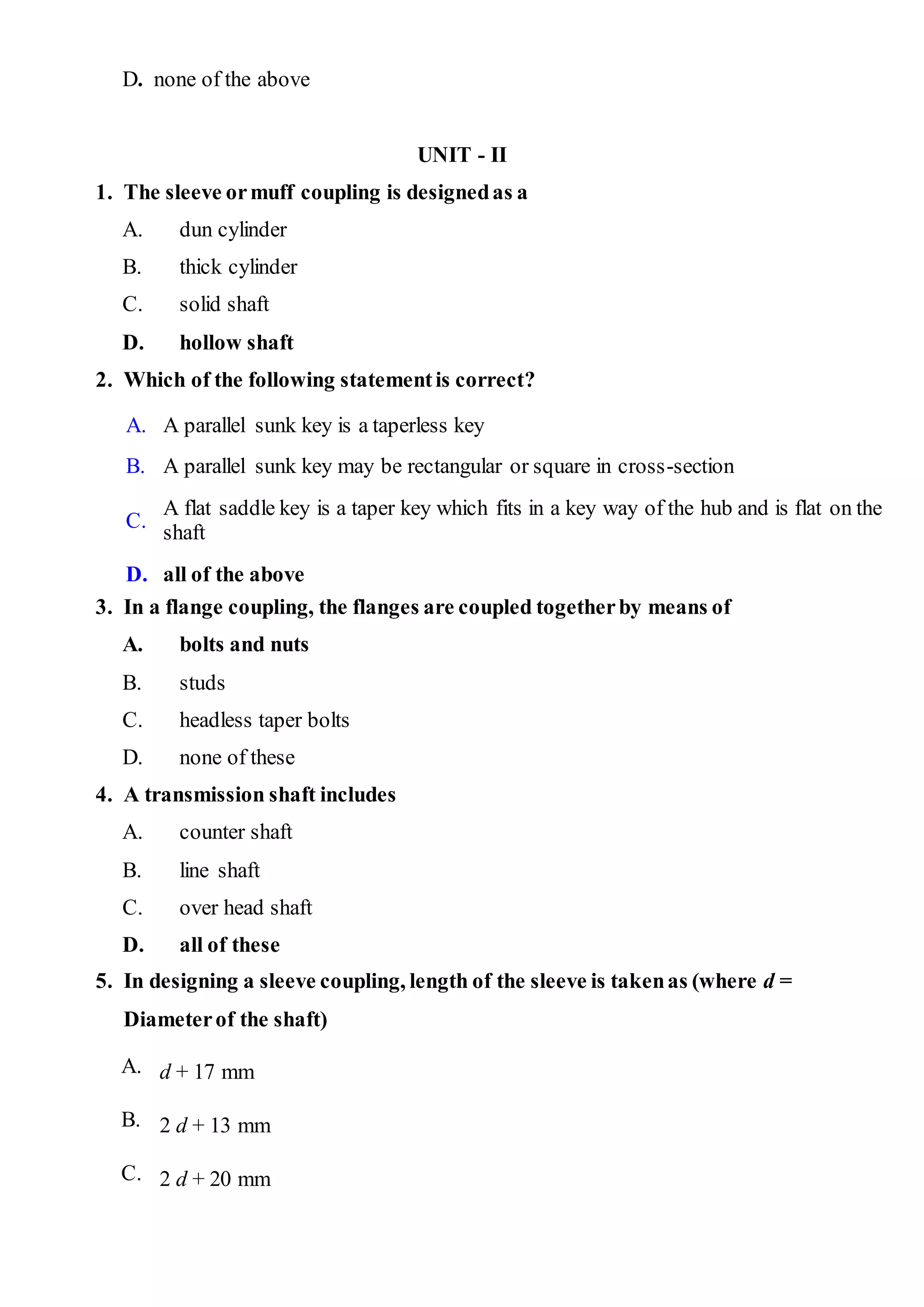
UNIT - II
1. The sleeve ormuff coupling is designedas a
A. dun cylinder
B. thick cylinder
C. solid shaft
D. hollow shaft
2. Which of the following statementis correct?
A. A parallel sunk key is a taperless key
B. A parallel sunk key may be rectangular or square in cross-section
C.
A flat saddle key is a taper key which fits in a key way of the hub and is flat on the
shaft
D. all of the above
3. In a flange coupling, the flanges are coupled togetherby means of
A. bolts and nuts
B. studs
C. headless taper bolts
D. none of these
4. A transmission shaft includes
A. counter shaft
B. line shaft
C. over head shaft
D. all of these
5. In designing a sleeve coupling, length of the sleeve is takenas (where d =
Diameterof the shaft)
A. d + 17 mm
B. 2 d + 13 mm
C. 2 d + 20 mm
D. 3.5 d
6. An universal coupling is used to connect two shafts
A. which are perfectly aligned
B. which are not in exact alignment
C. have lateral misalignment
D. whose axes intersect at a small angle
7. A taper key which fits half in the key way of the hub and half in the key way of shaft, is
known as
A. sunk key
B. flat saddle key
C. hollow saddle key
D. tangent key
8.
8. In a marine flange coupling, the thickness offlange is takenas
A. d/4
B. d/3
C. d/2
D. 3 d/4
9. A wood-ruff keyis
A. a tapered key with head at one end
B. fitted in pairs at right angles
C. capable of tilting in a recessmilled out in the shaft
D. all of the above
10. The bolts in a rigid flanged coupling connecting two shafts transmitting power
are subjectedto
A. Shear force and bending moment diagram
B. Axial force
C. Torsion
D. Torsion and bending moment
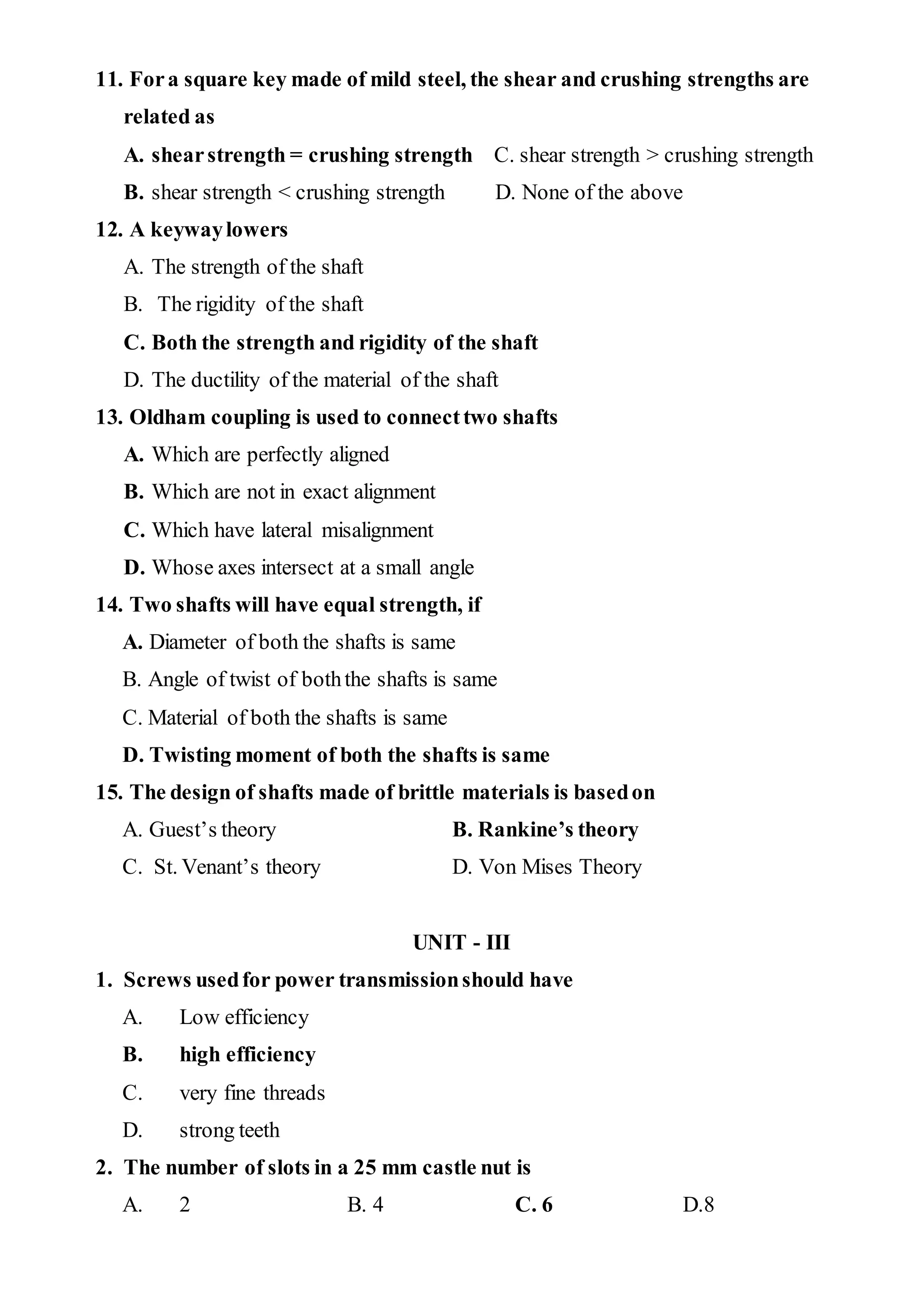
11. Fora square key made of mild steel, the shear and crushing strengths are
related as
A. shearstrength = crushing strength C. shear strength > crushing strength
B. shear strength < crushing strength D. None of the above
12. A keywaylowers
A. The strength of the shaft
B. The rigidity of the shaft
C. Both the strength and rigidity of the shaft
D. The ductility of the material of the shaft
13. Oldham coupling is used to connecttwo shafts
A. Which are perfectly aligned
B. Which are not in exact alignment
C. Which have lateral misalignment
D. Whose axes intersect at a small angle
14. Two shafts will have equal strength, if
A. Diameter of both the shafts is same
B. Angle of twist of boththe shafts is same
C. Material of both the shafts is same
D. Twisting moment of both the shafts is same
15. The design of shafts made of brittle materials is basedon
A. Guest’s theory B. Rankine’s theory
C. St. Venant’s theory D. Von Mises Theory
UNIT - III
1. Screws usedfor power transmissionshould have
A. Low efficiency
B. high efficiency
C. very fine threads
D. strong teeth
2. The number of slots in a 25 mm castle nut is
A. 2 B. 4 C. 6 D.8
3. A locking device in which the bottom cylindrical portion is recessedto receive
the tip of the locking setscrew, is called
A. castle nut
B. jam nut
C. ring nut
D. sawn nut
4. When screw threads are to be used in a situation where poweris being
transmitted in one direction only, then the screw threads suitable for this will be
A. square threads
B. acme threads
C. knuckle threads
D. buttress threads
5. When a bolt is subjected to shock loading, the resilience of the bolt should be
consideredin order to prevent breakage atthe
A. head B. Shank C. Thread D. Middle
7. A cotterjoint is used to transmit
A. axial tensile force only
B. axial tensile or compressive force
C. axial compressive force only
D. combined bending and torsional moment
8. A connecting rod is designedas a
A. long column
B. short column
C. strut
D. all of these
9. When a bolt and nut is made of mild steel, then the effective height of nut is
made equal to (where d = Nominal diameter of bolt)
A. 0.5 d C. d
B. 0.75 d D. 1.25 d
10. Weldments in fabricatedsteelbeams are designed for
A. Bending Stress at the flange
B. Shear stress at transverse plane
C. Combination of bending and shear
D. None of the above
11. In designing a sleeve and cotterjoint, the outside diameter of the sleeve is
takenas
A. 1.5 d B. 2.5 d C. 3d D. 4d
12. In a steam engine, the piston rod is usually connectedto the crossheadby
means of a
A. Knuckle joint B. Universal joint
C. Flange coupling D. Cotter joint
13. In a turn buckle, if one of the rods has left hand threads, then other rod will
A. Right hand threads B. Left hand threads
C. Pointed threads D. Multiple threads
14. When one gib is used in a gib and cotter joint, then width of gib should be
A. 0.45 B B. 0.55 B C. 0.65 B D. 0.75 B
15. Which of the following formula is used in designing a connecting rod ?
(a) Euler’s formula (b) Rankine’s formula
(c) Johnson’s straight line formula (d) Johnson’s parabolic formula
16.. A screw is said to be over hauling screw, if its efficiencyis
A.less than 50%
B.more than 50%
C.equal to 50%
D.none of these
UNIT – IV
1. A crankshaftis a __________shaft.
A. Transmission B. Machine
2. In leaf springs, the longestleafis known as
A. Lower leaf C. Upper leaf
B. Masterleaf D. None of these
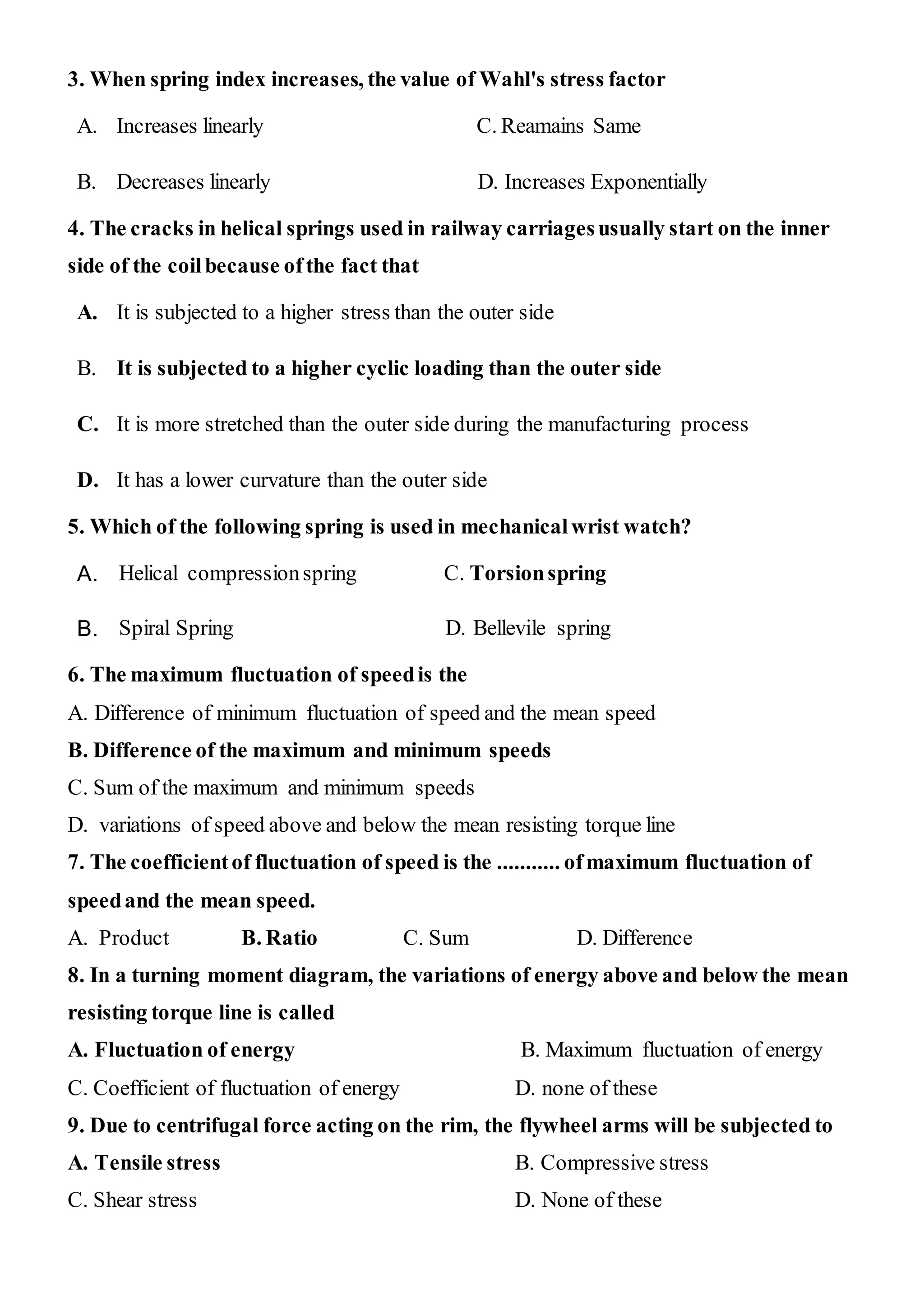
3. When spring index increases, the value of Wahl's stress factor
A. Increases linearly C. Reamains Same
B. Decreases linearly D. Increases Exponentially
4. The cracks in helical springs used in railway carriagesusually start on the inner
side of the coilbecause ofthe fact that
A. It is subjected to a higher stress than the outer side
B. It is subjected to a higher cyclic loading than the outer side
C. It is more stretched than the outer side during the manufacturing process
D. It has a lower curvature than the outer side
5. Which of the following spring is used in mechanicalwrist watch?
A. Helical compressionspring C. Torsionspring
B. Spiral Spring D. Bellevile spring
6. The maximum fluctuation of speedis the
A. Difference of minimum fluctuation of speed and the mean speed
B. Difference of the maximum and minimum speeds
C. Sum of the maximum and minimum speeds
D. variations of speed above and below the mean resisting torque line
7. The coefficientof fluctuation of speed is the ........... ofmaximum fluctuation of
speedand the mean speed.
A. Product B. Ratio C. Sum D. Difference
8. In a turning moment diagram, the variations of energy above and below the mean
resisting torque line is called
A. Fluctuation of energy B. Maximum fluctuation of energy
C. Coefficient of fluctuation of energy D. none of these
9. Due to centrifugal force acting on the rim, the flywheel arms will be subjected to
A. Tensile stress B. Compressive stress
C. Shear stress D. None of these
10. The spring mostly used in gramophones is
A. Helical spring B. Conical spring
C. Laminated spring D. Flatspiral spring
11. A leaf spring in automobiles is used
A. to apply forces B. to measure forces
C. to absorb shocks D. to store strain energy
12. When two concentric coilsprings made of the same material, having same length
and compressedequally by an axial load, the load sharedby the two springs will
be ............to the square of the diameters of the wires of the two springs.
A. directly proportional B. inversely proportional
C. Equal to D. None
13. Two close coiledhelicalsprings with stiffness k1 and k2 respectivelyare
connectedin series. The stiffness of an equivalent spring is given by
Ans: (a)
UNIT – V
1. The ball bearings are provided with a cage
A. to reduce friction
B. to facilitate slipping of balls
C. to prevent the lubricant from flowing out
D. to maintain the balls at a fixed distance apart
2. In a hydrodynamic lubricated bearing
A. there is a thick film of lubricant between the journal and the bearing
B. there is a thin film of lubricant between the journal and the bearing
C. there is no lubricant between the journal and the bearing
D. the lubricant is forced between the journal and the bearing, by external pressure
3. The rolling contactbearings are knownas
A. thick lubricated bearings
B. plastic bearings
C. thin lubricated bearings
D. antifriction bearings
4. The rolling contactbearings as compared to sliding contactbearings have
A. small overall dimensions
B. accuracy of shaft alignment
C. low starting and low running friction except at very high speeds
D. all of the above
5. The bearings of heavy series have capacity__________overthe medium series.
A. 10 to 20%
B. 20 to 30%
C. 30 to 40%
D. 40 to 50%
6. A sliding bearing which operates without any lubricant present, is called
A. zero film bearing
B. boundary lubricated bearing
C. hydrodynamic lubricated bearing
D. hydrostatic lubricated bearing
7. The metal suitable for bearings subjected to light loads is
A. silicon bronze
B. white metal
C. monel metal
D.
phosphor bronze
8. Which of the following is an antifriction bearing?
A. journal bearing
B. pedestal bearing
C. collar bearing
D. needle bearing
9. Tapered roller bearings can take
A. radial load only
B. axial load only
C. both radial and axial loads and the ratio of these being less than unity
D. both radial and axial loads and the ratio of these being greater than unity
10. When the length of the journal is equal to the diameter of the journal, then the
bearing is said to be a
A. short bearing
B. long bearing
C. medium bearing
D. square bearing
11. Antifriction bearings are
A. Thick lubricated bearings
B. Plastic bearings
C. Thin lubricated bearings
D. Ball and roller bearings
12. Which of the bearings given below SHOULD NOT be subjectedto a thrust load?
A. Deep groove ball bearing
B. Angular Contact bearing
C. Cylindrical roller bearing
D. Single row tapered roller bearing
13. Which one of the following is criterion in the design of hydrodynamic journal bearings?
A. Sommerfeld number
B. Rating Life
C. Specify Dynamic Capacity
D. Rotation Factor
14. To restore stable operating condition in a hydrodynamic journal bearing, when it
encounters higher magnitude loads.
A. Oil Viscosity is to be decreased
B. Oil Viscosityis to be increased
C. Oil Viscosity index is to be decreased
D. Oil Viscosity index is to be increased
15. In thick film hydrodynamic journal bearings, the coefficientof friction
A. Increased with increase in load
B. Is Independent of load
C. Decrease withincrease in load
D. May increase or decrease with increase in load
16. Spherical roller bearings are normally used
A. For Increase radial load
B. For increase thrust load
C. When there is less radial load
D. To compensate for angular Misalignment
17. If the load on a ball bearing is reduced to half, the life of the ball bearing will
A. Increase 8 times
B. Increase 4 times
C. Increase 2 times
D. No Change

Dme mcq

  • 1.
    GRT INSTITUTE OFENGINEERING AND TECHNOLOGY DEPARTMENT OF MECHANICAL ENGINEERING III YEAR - ODD SEMESTER 2020-2021 Design of Machine Elements Multiple choice questions UNIT - I 1. The toughness of a material __________whenit is heated. A. increases B. decreases C. does not change 2. Soderberg relation is basedon __________ ofthe material whereas all other failure relationfor dynamic loading are basedon ultimate strength of the material. A. elastic strength B. yield strength C. shear strength D. Ultimate Strength 3. The value of stress concentrationfactordepends upon A. material of the part B. geometry of the part C. material and geometryof the part D. none of these 4. Surface endurance limit of gearmaterial is dependent upon its A. elastic strength B. yield strength C. brinell hardness number D. toughness 5. Stress concentrationis causeddue to A. variations in load acting on a member B. variations in properties of materials in a member C. abrupt change of cross-section
  • 2.
    D. all ofthese 6. The maximum normal stress theory is used for A. brittle materials B. ductile materials C. plastic materials D. non-ferrous materials 7. The maximum shear stress theory is used for A. brittle materials B. ductile materials C. plastic materials D. non-ferrous materials 8. The ratio of the ultimate stress to the design stress is known as A. elastic limit B. strain C. factor of safety D. bulk modulus 9. Stress concentration factor is defined as the ratio of A. maximum stress to the endurance limit B. nominal stress to the enurance limit C. maximum stress to the nominal stress D. nominal stress to the maximum stress 10. Which of the following welded joint is designed for shear strength ? A. Transverse fillet welded joint B. Parallel fillet welded joint C. Butt welded joint D. all of these 11.Why is the maximum stress applied to any machine elementshould always be less than its ultimate stress or criticalstress? A. for safety against machine failure B. to make complete use of mechanical properties of the machine element C. both a and b
  • 3.
    D. none ofthe above UNIT - II 1. The sleeve ormuff coupling is designedas a A. dun cylinder B. thick cylinder C. solid shaft D. hollow shaft 2. Which of the following statementis correct? A. A parallel sunk key is a taperless key B. A parallel sunk key may be rectangular or square in cross-section C. A flat saddle key is a taper key which fits in a key way of the hub and is flat on the shaft D. all of the above 3. In a flange coupling, the flanges are coupled togetherby means of A. bolts and nuts B. studs C. headless taper bolts D. none of these 4. A transmission shaft includes A. counter shaft B. line shaft C. over head shaft D. all of these 5. In designing a sleeve coupling, length of the sleeve is takenas (where d = Diameterof the shaft) A. d + 17 mm B. 2 d + 13 mm C. 2 d + 20 mm
  • 4.
    D. 3.5 d 6.An universal coupling is used to connect two shafts A. which are perfectly aligned B. which are not in exact alignment C. have lateral misalignment D. whose axes intersect at a small angle 7. A taper key which fits half in the key way of the hub and half in the key way of shaft, is known as A. sunk key B. flat saddle key C. hollow saddle key D. tangent key 8. 8. In a marine flange coupling, the thickness offlange is takenas A. d/4 B. d/3 C. d/2 D. 3 d/4 9. A wood-ruff keyis A. a tapered key with head at one end B. fitted in pairs at right angles C. capable of tilting in a recessmilled out in the shaft D. all of the above 10. The bolts in a rigid flanged coupling connecting two shafts transmitting power are subjectedto A. Shear force and bending moment diagram B. Axial force C. Torsion D. Torsion and bending moment
  • 5.
    11. Fora squarekey made of mild steel, the shear and crushing strengths are related as A. shearstrength = crushing strength C. shear strength > crushing strength B. shear strength < crushing strength D. None of the above 12. A keywaylowers A. The strength of the shaft B. The rigidity of the shaft C. Both the strength and rigidity of the shaft D. The ductility of the material of the shaft 13. Oldham coupling is used to connecttwo shafts A. Which are perfectly aligned B. Which are not in exact alignment C. Which have lateral misalignment D. Whose axes intersect at a small angle 14. Two shafts will have equal strength, if A. Diameter of both the shafts is same B. Angle of twist of boththe shafts is same C. Material of both the shafts is same D. Twisting moment of both the shafts is same 15. The design of shafts made of brittle materials is basedon A. Guest’s theory B. Rankine’s theory C. St. Venant’s theory D. Von Mises Theory UNIT - III 1. Screws usedfor power transmissionshould have A. Low efficiency B. high efficiency C. very fine threads D. strong teeth 2. The number of slots in a 25 mm castle nut is A. 2 B. 4 C. 6 D.8
  • 6.
    3. A lockingdevice in which the bottom cylindrical portion is recessedto receive the tip of the locking setscrew, is called A. castle nut B. jam nut C. ring nut D. sawn nut 4. When screw threads are to be used in a situation where poweris being transmitted in one direction only, then the screw threads suitable for this will be A. square threads B. acme threads C. knuckle threads D. buttress threads 5. When a bolt is subjected to shock loading, the resilience of the bolt should be consideredin order to prevent breakage atthe A. head B. Shank C. Thread D. Middle 7. A cotterjoint is used to transmit A. axial tensile force only B. axial tensile or compressive force C. axial compressive force only D. combined bending and torsional moment 8. A connecting rod is designedas a A. long column B. short column C. strut D. all of these 9. When a bolt and nut is made of mild steel, then the effective height of nut is made equal to (where d = Nominal diameter of bolt) A. 0.5 d C. d B. 0.75 d D. 1.25 d 10. Weldments in fabricatedsteelbeams are designed for A. Bending Stress at the flange
  • 7.
    B. Shear stressat transverse plane C. Combination of bending and shear D. None of the above 11. In designing a sleeve and cotterjoint, the outside diameter of the sleeve is takenas A. 1.5 d B. 2.5 d C. 3d D. 4d 12. In a steam engine, the piston rod is usually connectedto the crossheadby means of a A. Knuckle joint B. Universal joint C. Flange coupling D. Cotter joint 13. In a turn buckle, if one of the rods has left hand threads, then other rod will A. Right hand threads B. Left hand threads C. Pointed threads D. Multiple threads 14. When one gib is used in a gib and cotter joint, then width of gib should be A. 0.45 B B. 0.55 B C. 0.65 B D. 0.75 B 15. Which of the following formula is used in designing a connecting rod ? (a) Euler’s formula (b) Rankine’s formula (c) Johnson’s straight line formula (d) Johnson’s parabolic formula 16.. A screw is said to be over hauling screw, if its efficiencyis A.less than 50% B.more than 50% C.equal to 50% D.none of these UNIT – IV 1. A crankshaftis a __________shaft. A. Transmission B. Machine 2. In leaf springs, the longestleafis known as A. Lower leaf C. Upper leaf B. Masterleaf D. None of these
  • 8.
    3. When springindex increases, the value of Wahl's stress factor A. Increases linearly C. Reamains Same B. Decreases linearly D. Increases Exponentially 4. The cracks in helical springs used in railway carriagesusually start on the inner side of the coilbecause ofthe fact that A. It is subjected to a higher stress than the outer side B. It is subjected to a higher cyclic loading than the outer side C. It is more stretched than the outer side during the manufacturing process D. It has a lower curvature than the outer side 5. Which of the following spring is used in mechanicalwrist watch? A. Helical compressionspring C. Torsionspring B. Spiral Spring D. Bellevile spring 6. The maximum fluctuation of speedis the A. Difference of minimum fluctuation of speed and the mean speed B. Difference of the maximum and minimum speeds C. Sum of the maximum and minimum speeds D. variations of speed above and below the mean resisting torque line 7. The coefficientof fluctuation of speed is the ........... ofmaximum fluctuation of speedand the mean speed. A. Product B. Ratio C. Sum D. Difference 8. In a turning moment diagram, the variations of energy above and below the mean resisting torque line is called A. Fluctuation of energy B. Maximum fluctuation of energy C. Coefficient of fluctuation of energy D. none of these 9. Due to centrifugal force acting on the rim, the flywheel arms will be subjected to A. Tensile stress B. Compressive stress C. Shear stress D. None of these
  • 9.
    10. The springmostly used in gramophones is A. Helical spring B. Conical spring C. Laminated spring D. Flatspiral spring 11. A leaf spring in automobiles is used A. to apply forces B. to measure forces C. to absorb shocks D. to store strain energy 12. When two concentric coilsprings made of the same material, having same length and compressedequally by an axial load, the load sharedby the two springs will be ............to the square of the diameters of the wires of the two springs. A. directly proportional B. inversely proportional C. Equal to D. None 13. Two close coiledhelicalsprings with stiffness k1 and k2 respectivelyare connectedin series. The stiffness of an equivalent spring is given by Ans: (a) UNIT – V 1. The ball bearings are provided with a cage A. to reduce friction B. to facilitate slipping of balls C. to prevent the lubricant from flowing out D. to maintain the balls at a fixed distance apart 2. In a hydrodynamic lubricated bearing A. there is a thick film of lubricant between the journal and the bearing B. there is a thin film of lubricant between the journal and the bearing C. there is no lubricant between the journal and the bearing D. the lubricant is forced between the journal and the bearing, by external pressure 3. The rolling contactbearings are knownas A. thick lubricated bearings B. plastic bearings
  • 10.
    C. thin lubricatedbearings D. antifriction bearings 4. The rolling contactbearings as compared to sliding contactbearings have A. small overall dimensions B. accuracy of shaft alignment C. low starting and low running friction except at very high speeds D. all of the above 5. The bearings of heavy series have capacity__________overthe medium series. A. 10 to 20% B. 20 to 30% C. 30 to 40% D. 40 to 50% 6. A sliding bearing which operates without any lubricant present, is called A. zero film bearing B. boundary lubricated bearing C. hydrodynamic lubricated bearing D. hydrostatic lubricated bearing 7. The metal suitable for bearings subjected to light loads is A. silicon bronze B. white metal C. monel metal D. phosphor bronze 8. Which of the following is an antifriction bearing? A. journal bearing B. pedestal bearing C. collar bearing D. needle bearing 9. Tapered roller bearings can take
  • 11.
    A. radial loadonly B. axial load only C. both radial and axial loads and the ratio of these being less than unity D. both radial and axial loads and the ratio of these being greater than unity 10. When the length of the journal is equal to the diameter of the journal, then the bearing is said to be a A. short bearing B. long bearing C. medium bearing D. square bearing 11. Antifriction bearings are A. Thick lubricated bearings B. Plastic bearings C. Thin lubricated bearings D. Ball and roller bearings 12. Which of the bearings given below SHOULD NOT be subjectedto a thrust load? A. Deep groove ball bearing B. Angular Contact bearing C. Cylindrical roller bearing D. Single row tapered roller bearing 13. Which one of the following is criterion in the design of hydrodynamic journal bearings? A. Sommerfeld number B. Rating Life C. Specify Dynamic Capacity D. Rotation Factor 14. To restore stable operating condition in a hydrodynamic journal bearing, when it encounters higher magnitude loads. A. Oil Viscosity is to be decreased B. Oil Viscosityis to be increased
  • 12.
    C. Oil Viscosityindex is to be decreased D. Oil Viscosity index is to be increased 15. In thick film hydrodynamic journal bearings, the coefficientof friction A. Increased with increase in load B. Is Independent of load C. Decrease withincrease in load D. May increase or decrease with increase in load 16. Spherical roller bearings are normally used A. For Increase radial load B. For increase thrust load C. When there is less radial load D. To compensate for angular Misalignment 17. If the load on a ball bearing is reduced to half, the life of the ball bearing will A. Increase 8 times B. Increase 4 times C. Increase 2 times D. No Change