3rdGrade Mathematics ● Unpacked Content
For the new Common Core State Standards that will be effective in all North Carolina schools in the 2012-13.
This document is designed to help North Carolina educators teach the Common Core (Standard Course of Study). NCDPI staff are continually
updating and improving these tools to better serve teachers.


  What is the purpose of this document?
  To increase student achievement by ensuring educators understand specifically what the new standards mean a student must know,
  understand and be able to do.

  What is in the document?
  Descriptions of what each standard means a student will know, understand and be able to do. The ―unpacking‖ of the standards done in this
  document is an effort to answer a simple question ―What does this standard mean that a student must know and be able to do?‖ and to
  ensure the description is helpful, specific and comprehensive for educators.

  How do I send Feedback?
  We intend the explanations and examples in this document to be helpful and specific. That said, we believe that as this document is used,
  teachers and educators will find ways in which the unpacking can be improved and made ever more useful. Please send feedback to us at
  feedback@dpi.state.nc.us and we will use your input to refine our unpacking of the standards. Thank You!

  Just want the standards alone?
  You can find the standards alone at http://corestandards.org/the-standards

  Mathematical Vocabulary is identified in bold print. These are words that students should know and be able to use in context.


       3rd Grade Mathematics ● Unpacked Content

   .
Operations and Algebraic Thinking                                                                                                                    3.0A
Common Core Cluster
Represent and solve problems involving multiplication and division.
Students develop an understanding of the meanings of multiplication and division of whole numbers through activities and problems involving equal-sized
groups, arrays, and area models; multiplication is finding an unknown product, and division is finding an unknown factor in these situations. For equal-sized
group situations, division can require finding the unknown number of groups or the unknown group size.
      Common Core Standard                    Unpacking
                                              What do these standards mean a child will know and be able to do?
3.OA.1 Interpret products of whole            3.OA.1 Interpret products of whole numbers.
numbers, e.g., interpret 5 × 7 as the total
number of objects in 5 groups of 7            Example:
objects each.                                 Jim purchased 5 packages of muffins. Each package contained 3 muffins. How many muffins did Jim purchase?
For example, describe a context in            5 groups of 3, 5 x 3 = 15. Describe another situation where there would be 5 groups of 3 or 5 x 3.
which a total number of objects can be
expressed as 5 × 7.
3.OA.2 Interpret whole-number                 3.OA.2 focuses on two distinct models of division: partition models and measurement (repeated subtraction)
quotients of whole numbers, e.g.,             models.
interpret 56 ÷ 8 as the number of
objects in each share when 56 objects
are partitioned equally into 8 shares,        Partition models focus on the question, ―How many in each group?‖ A context for partition models would be:
or as a number of shares when 56              There are 12 cookies on the counter. If you are sharing the cookies equally among three bags, how many cookies
objects are partitioned into equal shares     will go in each bag?
of 8 objects each.                                                                  OOOO             OOOO            OOOO
For example, describe a context in
which a number of shares or a number          Measurement (repeated subtraction) models focus on the question, ―How many groups can you make?‖ A context
of groups can be expressed as 56 ÷ 8.         for measurement models would be: There are 12 cookies on the counter. If you put 3 cookies in each bag, how
                                              many bags will you fill?
                                                                             OOO                OOO             OOO              OOO


3.OA.3 Use multiplication and                 3.OA.3 students should apply their skills to solve word problems. This could include one or two-step word
division within 100 to solve word             problems, such as:
problems in situations involving equal        If you divide 4 dozen brownies among 8 people, how many cookies does each person receive? (4x12 = 48, 48 ÷ 8
groups, arrays, and measurement               = 6).
quantities, e.g., by using drawings and       Glossary, Table 2 gives examples of a variety of problem solving contexts, in which students need to find the

      3rd Grade Mathematics ● Unpacked Content                                                                                                   Page 2
equations with a symbol for the          product, the group size, or the number of groups. Students should be given ample experiences to explore all of the
unknown number to represent the          different problem structures.
problem.1                                3.OA.3 references various strategies that can be used to solve word problems involving multiplication and
                                         division.
1
    See Glossary, Table 2.               Examples:
                                         There are 24 desks in the classroom. If the teacher puts 6 desks in each row, how many rows are there?
                                         This task can be solved by drawing an array by putting 6 desks in each row.


                                         This task can also be solved by drawing pictures.
                                         4 groups of 6 equals 24 objects


                                         A student could also reason through the problem mentally or verbally, ―I know 6 and 6 are 12. 12 and 12 are 24.
                                         Therefore, there are 4 groups of 6 giving a total of 24 desks in the classroom.‖

                                         3.OA.3 in third grade students should use a variety of pictures, such as stars, boxes, flowers to represent unknown
                                         numbers (variables).. Letters are also introduced to represent unknowns in third grade.
                                         Example:
                                         There are some students at recess. The teacher divides the class into 4 lines with 6 students in each line. Write a
                                         division equation for this story and determine how many students are in the class
                                         students in the class).
3.OA.4 Determine the unknown whole       3.OA.4 refers to Glossary, Table 2 and equations for the different types of multiplication and division problem
number in a multiplication or division   structures. The easiest problem structure includes Unknown Product (3 x ? = 18 or 18 ÷ 3 = 6). The more difficult
equation relating three whole numbers.   problem structures include Group Size Unknown (3 x ? = 18 or 18 ÷ 3 = 6) or Number of Groups Unknown (? x 6
For example, determine the unknown       = 18, 18 ÷ 6 = 3). The focus of 3.OA.4 goes beyond the traditional notion of fact families, by having students
number that makes the equation true in   explore the inverse relationship of multiplication and division.
each of the equations 8 × ? = 48,
5 = _ ÷ 3, 6 × 6 = ?


        3rd Grade Mathematics ● Unpacked Content                                                                                               Page 3
Common Core Cluster
Understand properties of multiplication and the relationship between multiplication and division.
Students use properties of operations to calculate products of whole numbers, using increasingly sophisticated strategies based on these properties to solve
multiplication and division problems involving single-digit factors. By comparing a variety of solution strategies, students learn the relationship between
multiplication and division.
     Common Core Standard                   Unpacking
                                            What do these standards mean a child will know and be able to do?
3.OA.5 Apply properties of operations       3.OA.5 references properties of multiplication. While students DO NOT need to not use the formal terms of these
as strategies to multiply and divide.2      properties, student should understand that properties are rules about how numbers work, they need to be flexibly
Examples: If 6 × 4 = 24 is known, then      and fluently applying each of them.
4 × 6 = 24 is also known.                   The associative property states that the sum or product stays the same when the grouping of addends or factors is
(Commutative property of                    changed. For example, when a student multiplies 7 x 5 x 2, a student could rearrange the numbers to first multiply
multiplication.) 3 × 5 × 2 can be found     5 x 2 = 10 and then multiply 10 x 7 = 70.
by 3 × 5 = 15, then 15 × 2 = 30, or by 5
                                            properties – rules about how numbers work
× 2 = 10, then 3 × 10 = 30.
(Associative property of multiplication.)
                                            The commutative property (order property) states that the order of numbers does not matter when you are adding
Knowing that 8 × 5 = 40 and 8 × 2 =         or multiplying numbers. For example, if a student knows that 5 x 4 = 20, then they also know that 4 x 5 = 20.
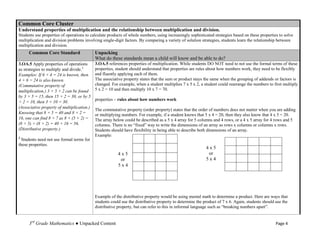
16, one can find 8 × 7 as 8 × (5 + 2) =     The array below could be described as a 5 x 4 array for 5 columns and 4 rows, or a 4 x 5 array for 4 rows and 5
(8 × 5) + (8 × 2) = 40 + 16 = 56.           columns. There is no ―fixed‖ way to write the dimensions of an array as rows x columns or columns x rows.
(Distributive property.)                    Students should have flexibility in being able to describe both dimensions of an array.
2
                                            Example:
  Students need not use formal terms for
these properties.
                                                                                                           4x5
                                                         4x5                                                or
                                                          or                                               5x4
                                                         5x4


                                            Example of the distributive property would be using mental math to determine a product. Here are ways that
                                            students could use the distributive property to determine the product of 7 x 6. Again, students should use the
                                            distributive property, but can refer to this in informal language such as ―breaking numbers apart‖.


     3rd Grade Mathematics ● Unpacked Content                                                                                                      Page 4
Student 1              Student 2            Student 3
                                                                     7x6                    7x6                  7x6
                                                                     7 x 5 = 35             7 x 3 = 21           5 x 6 = 30
                                                                     7x1=7                  7 x 3 = 21           2 x 6 = 12
                                                                     35 + 7 = 42            21 + 21 = 42         30 + 12 = 42

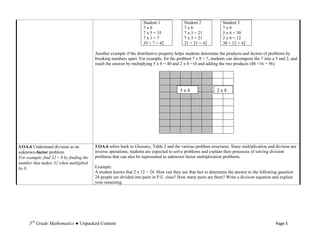
                                          Another example if the distributive property helps students determine the products and factors of problems by
                                          breaking numbers apart. For example, for the problem 7 x 8 = ?, students can decompose the 7 into a 5 and 2, and
                                          reach the answer by multiplying 5 x 8 = 40 and 2 x 8 =16 and adding the two products (40 +16 = 56).


                                                                                         5x8                  2x8


3.OA.6 Understand division as an          3.OA.6 refers back to Glossary, Table 2 and the various problem structures. Since multiplication and division are
unknown-factor problem.                   inverse operations, students are expected to solve problems and explain their processes of solving division
For example, find 32 ÷ 8 by finding the   problems that can also be represented as unknown factor multiplication problems.
number that makes 32 when multiplied
by 8.                                     Example:
                                          A student knows that 2 x 12 = 24. How can they use that fact to determine the answer to the following question:
                                          24 people are divided into pairs in P.E. class? How many pairs are there? Write a division equation and explain
                                          your reasoning.


     3rd Grade Mathematics ● Unpacked Content                                                                                                  Page 5
Common Core Cluster
Multiply and divide within 100.

     Common Core Standard                  Unpacking
                                           What do these standards mean a child will know and be able to do?
3.OA.7 Fluently multiply and divide        3.OA.7 uses the word fluently, which means accuracy (correct answer), efficiency (within 3-4 seconds), and
within 100, using strategies such as the   flexibility (using strategies such as the distributive property). ―Know from memory‖ should not focus only on
relationship between multiplication and    timed tests and repetitive practice, but ample experiences working with manipulatives, pictures, arrays, word
division (e.g., knowing that 8 × 5 = 40,   problems, and numbers to internalize the basic facts (up to 9 x 9).
one knows 40 ÷ 5 = 8) or properties of
operations. By the end of Grade 3,
know from memory all products of two
one-digit numbers.


Common Core Cluster
Solve problems involving the four operations, and identify and explain patterns in arithmetic.

     Common Core Standard                  Unpacking
                                           What do these standards mean a child will know and be able to do?
3.OA.8 Solve two-step word problems        3.OA.8 refers to two-step word problems using the four operations. The size of the numbers should be limited to
using the four operations. Represent       related 3rd grade standards (e.g., 3.OA.7 and 3.NBT.2). Adding and subtracting numbers should include numbers
these problems using equations with a      within 1,000, and multiplying and dividing numbers should include single-digit factors and products less than
letter standing for the unknown            100.
quantity. Assess the reasonableness of
                                           3.OA.8 calls for students to represent problems using equations with a letter to represent unknown quantities.
answers using mental computation and
                                           Example:
estimation strategies including
                                           Mike runs 2 miles a day. His goal is to run 25 miles. After 5 days, how many miles does Mike have left to run in
rounding.3                                 order to meet his goal? Write an equation and find the solution (2 x 5 + m = 25).
3
 This standard is limited to problems      3.OA.8 refers to estimation strategies, including using compatible numbers (numbers that sum to 10, 50, or 100)
posed with whole numbers and having        or rounding. The focus in this standard is to have students use and discuss various strategies. Students should
whole-number answers; students should      estimate during problem solving, and then revisit their estimate to check for reasonableness.
know how to perform operations in the
conventional order when there are no       Example:
parentheses to specify a particular        Here are some typical estimation strategies for the problem:

     3rd Grade Mathematics ● Unpacked Content                                                                                                   Page 6
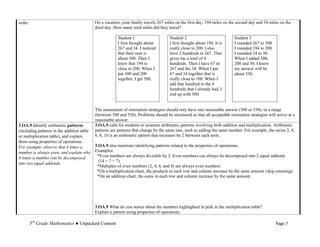
order.                                      On a vacation, your family travels 267 miles on the first day, 194 miles on the second day and 34 miles on the
                                            third day. How many total miles did they travel?

                                                         Student 1                    Student 2                            Student 3
                                                         I first thought about        I first thought about 194. It is     I rounded 267 to 300.
                                                         267 and 34. I noticed        really close to 200. I also          I rounded 194 to 200.
                                                         that their sum is            have 2 hundreds in 267. That         I rounded 34 to 30.
                                                         about 300. Then I            gives me a total of 4                When I added 300,
                                                         knew that 194 is             hundreds. Then I have 67 in          200 and 30, I know
                                                         close to 200. When I         267 and the 34. When I put           my answer will be
                                                         put 300 and 200              67 and 34 together that is           about 530.
                                                         together, I get 500.         really close to 100. When I
                                                                                      add that hundred to the 4
                                                                                      hundreds that I already had, I
                                                                                      end up with 500.


                                            The assessment of estimation strategies should only have one reasonable answer (500 or 530), or a range
                                            (between 500 and 550). Problems should be structured so that all acceptable estimation strategies will arrive at a
                                            reasonable answer.
3.OA.9 Identify arithmetic patterns         3.OA.9 calls for students to examine arithmetic patterns involving both addition and multiplication. Arithmetic
(including patterns in the addition table   patterns are patterns that change by the same rate, such as adding the same number. For example, the series 2, 4,
or multiplication table), and explain       6, 8, 10 is an arithmetic pattern that increases by 2 between each term.
them using properties of operations.
For example, observe that 4 times a         3.OA.9 also mentions identifying patterns related to the properties of operations.
number is always even, and explain why      Examples:
4 times a number can be decomposed           *Even numbers are always divisible by 2. Even numbers can always be decomposed into 2 equal addends
                                              (14 = 7 + 7).
into two equal addends.
                                             *Multiples of even numbers (2, 4, 6, and 8) are always even numbers.
                                             *On a multiplication chart, the products in each row and column increase by the same amount (skip counting).
                                             *On an addition chart, the sums in each row and column increase by the same amount.


                                            3.OA.9 What do you notice about the numbers highlighted in pink in the multiplication table?
                                            Explain a pattern using properties of operations.

         3rd Grade Mathematics ● Unpacked Content                                                                                                  Page 7
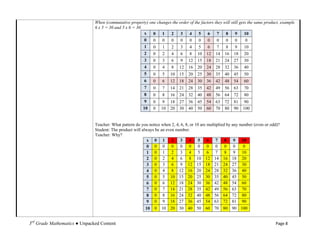
When (commutative property) one changes the order of the factors they will still gets the same product, example
                              6 x 5 = 30 and 5 x 6 = 30.
                                                         x  0    1   2     3   4     5     6    7    8      9     10
                                                         0  0    0   0     0   0     0     0    0    0      0      0
                                                         1  0    1   2     3   4     5     6    7    8      9     10
                                                         2     0   2    4    6    8    10   12   14   16   18   20
                                                         3     0   3    6    9    12   15   18   21   24   27   30
                                                         4     0   4    8    12   16   20   24   28   32   36   40
                                                         5     0   5    10   15   20   25   30   35   40   45   50
                                                         6     0   6    12   18   24   30   36   42   48   54   60
                                                         7     0   7    14   21   28   35   42   49   56   63   70
                                                         8     0   8    16   24   32   40   48   56   64   72   80
                                                         9     0    9   18   27   36   45   54   63   72   81    90
                                                        10     0   10   20   30   40   50   60   70   80   90   100


                              Teacher: What pattern do you notice when 2, 4, 6, 8, or 10 are multiplied by any number (even or odd)?
                              Student: The product will always be an even number.
                              Teacher: Why?
                                                           x 0 1 2 3 4 5 6 7 8 9 10
                                                           0 0 0 0 0 0 0 0 0 0 0                                 0
                                                           1 0 1 2 3 4 5 6 7 8 9 10
                                                           2 0 2 4 6 8 10 12 14 16 18 20
                                                           3 0 3 6 9 12 15 18 21 24 27 30
                                                           4 0 4 8 12 16 20 24 28 32 36 40
                                                           5 0 5 10 15 20 25 30 35 40 45 50
                                                           6 0 6 12 18 24 30 36 42 48 54 60
                                                           7 0 7 14 21 28 35 42 49 56 63 70
                                                           8 0 8 16 24 32 40 48 56 64 72 80
                                                           9 0 9 18 27 36 45 54 63 72 81 90
                                                          10   0   10 20 30 40 50 60 70 80 90 100


3rd Grade Mathematics ● Unpacked Content                                                                                          Page 8
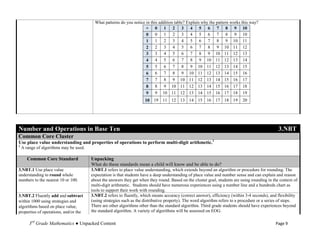
What patterns do you notice in this addition table? Explain why the pattern works this way?
                                                                       + 0 1 2 3 4 5 6 7 8 9 10
                                                                       0 0 1 2 3 4 5 6 7 8 9 10
                                                                       1 1 2 3 4 5 6 7 8 9 10 11
                                                                       2 2 3 4 5 6 7 8 9 10 11 12
                                                                       3 3 4 5 6 7 8 9 10 11 12 13
                                                                       4 4 5 6 7 8 9 10 11 12 13 14
                                                                       5 5 6 7 8 9 10 11 12 13 14 15
                                                                       6 6 7 8 9 10 11 12 13 14 15 16
                                                                       7 7 8 9 10 11 12 13 14 15 16 17
                                                                       8 8 9 10 11 12 13 14 15 16 17 18
                                                                       9 9 10 11 12 13 14 15 16 17 18 19
                                                                       10 19 11 12 13 14 15 16 17 18 19                       20


Number and Operations in Base Ten                                                                                                                 3.NBT
Common Core Cluster
Use place value understanding and properties of operations to perform multi-digit arithmetic.1
1
    A range of algorithms may be used.

       Common Core Standard              Unpacking
                                         What do these standards mean a child will know and be able to do?
3.NBT.1 Use place value                  3.NBT.1 refers to place value understanding, which extends beyond an algorithm or procedure for rounding. The
understanding to round whole             expectation is that students have a deep understanding of place value and number sense and can explain and reason
numbers to the nearest 10 or 100.        about the answers they get when they round. Based on the cluster goal, students are using rounding in the context of
                                         multi-digit arithmetic. Students should have numerous experiences using a number line and a hundreds chart as
                                         tools to support their work with rounding.
3.NBT.2 Fluently add and subtract        3.NBT.2 refers to fluently, which means accuracy (correct answer), efficiency (within 3-4 seconds), and flexibility
within 1000 using strategies and         (using strategies such as the distributive property). The word algorithm refers to a procedure or a series of steps.
algorithms based on place value,         There are other algorithms other than the standard algorithm. Third grade students should have experiences beyond
properties of operations, and/or the     the standard algorithm. A variety of algorithms will be assessed on EOG.

        3rd Grade Mathematics ● Unpacked Content                                                                                                Page 9
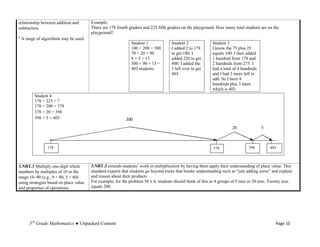
relationship between addition and        Example:
subtraction.                             There are 178 fourth graders and 225 fifth graders on the playground. How many total students are on the
                                         playground?
1
    A range of algorithms may be used.
                                                               Student 1              Student 2              Student 3
                                                               100 + 200 = 300        I added 2 to 178       I know the 75 plus 25
                                                               70 + 20 = 90           to get 180. I          equals 100. I then added
                                                               8 + 5 = 13             added 220 to get       1 hundred from 178 and
                                                               300 + 90 + 13 =        400. I added the       2 hundreds from 275. I
                                                               403 students           3 left over to get     had a total of 4 hundreds
                                                                                      403.                   and I had 3 more left to
                                                                                                             add. So I have 4
                                                                                                             hundreds plus 3 more
                                                                                                             which is 403.
           Student 4
           178 + 225 = ?
           178 + 200 = 378
           378 + 20 = 398
           398 + 5 = 403                                    200
                                                                                                                        20               5


                  178                                                                                        378                 398         403


3.NBT.3 Multiply one-digit whole         3.NBT.3 extends students’ work in multiplication by having them apply their understanding of place value. This
numbers by multiples of 10 in the        standard expects that students go beyond tricks that hinder understanding such as ―just adding zeros‖ and explain
range 10–90 (e.g., 9 × 80, 5 × 60)       and reason about their products.
using strategies based on place value    For example, for the problem 50 x 4, students should think of this as 4 groups of 5 tens or 20 tens. Twenty tens
and properties of operations.            equals 200.


        3rd Grade Mathematics ● Unpacked Content                                                                                                Page 10
Number and Operation – Fractions1                                                                                                                          3.NF
Common Core Cluster
Develop understanding of fractions as numbers.
1
  Grade 3 expectations in this domain are limited to fractions with denominators 2, 3, 4, 6, 8.
Students develop an understanding of fractions, beginning with unit fractions. Students view fractions in general as being built out of unit fractions, and they
use fractions along with visual fraction models to represent parts of a whole. Students understand that the size of a fractional part is relative to the size of the
whole. For example, ½ of the paint in a small bucket could be less paint than 1/3 of the paint in a larger bucket, but 1/3 of a ribbon is longer than 1/5 of the
same ribbon because when the ribbon is divided into 3 equal parts, the parts are longer than when the ribbon is divided into 5 equal parts. Students are able
to use fractions to represent numbers equal to, less than, and greater than one. They solve problems that involve comparing fractions by using visual fraction
models and strategies based on noticing equal numerators or denominators.
      Common Core Standard                  Unpacking
                                            What do these standards mean a child will know and be able to do?
3.NF.1 Understand a fraction 1/b as the     3.NF.1 refers to the sharing of a whole being partitioned or split. Fraction models in third grade include area
quantity formed by 1 part when a whole      (parts of a whole) models (circles, rectangles, squares) and number lines. Set models (parts of a group) are not
is partitioned into b equal parts;          introduced in Third Grade. In 3.NF.1 students should focus on the concept that a fraction is made up (composed)
understand a fraction a/b as the quantity   of many pieces of a unit fraction, which has a numerator of 1. For example, the fraction 3/5 is composed of 3
formed by a parts of size 1/b.              pieces that each has a size of 1/5.
3.NF.2 Understand a fraction as a
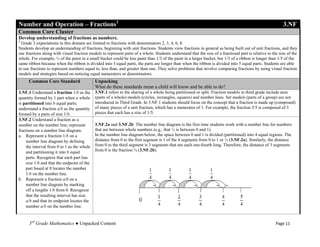
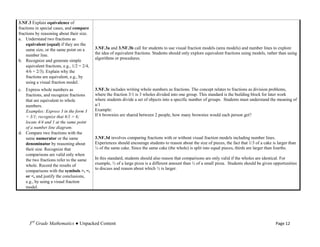
number on the number line; represent        3.NF.2a and 3.NF.2b The number line diagram is the first time students work with a number line for numbers
fractions on a number line diagram.         that are between whole numbers (e.g., that ½ is between 0 and 1).
a. Represent a fraction 1/b on a            In the number line diagram below, the space between 0 and 1 is divided (partitioned) into 4 equal regions. The
    number line diagram by defining         distance from 0 to the first segment is 1 of the 4 segments from 0 to 1 or ¼ (3.NF.2a). Similarly, the distance
    the interval from 0 to 1 as the whole   from 0 to the third segment is 3 segments that are each one-fourth long. Therefore, the distance of 3 segments
    and partitioning it into b equal        from 0 is the fraction ¾ (3.NF.2b).
    parts. Recognize that each part has
    size 1/b and that the endpoint of the
    part based at 0 locates the number
    1/b on the number line.
b. Represent a fraction a/b on a
    number line diagram by marking
    off a lengths 1/b from 0. Recognize
    that the resulting interval has size
    a/b and that its endpoint locates the
    number a/b on the number line.


      3rd Grade Mathematics ● Unpacked Content                                                                                                         Page 11
3.NF.3 Explain equivalence of
fractions in special cases, and compare
fractions by reasoning about their size.
a. Understand two fractions as
    equivalent (equal) if they are the
    same size, or the same point on a        3.NF.3a and 3.NF.3b call for students to use visual fraction models (area models) and number lines to explore
    number line.                             the idea of equivalent fractions. Students should only explore equivalent fractions using models, rather than using
                                             algorithms or procedures.
b. Recognize and generate simple
    equivalent fractions, e.g., 1/2 = 2/4,
    4/6 = 2/3). Explain why the
    fractions are equivalent, e.g., by
    using a visual fraction model.
c. Express whole numbers as                  3.NF.3c includes writing whole numbers as fractions. The concept relates to fractions as division problems,
   fractions, and recognize fractions        where the fraction 3/1 is 3 wholes divided into one group. This standard is the building block for later work
   that are equivalent to whole              where students divide a set of objects into a specific number of groups. Students must understand the meaning of
   numbers.                                  a/1
   Examples: Express 3 in the form 3         Example:
   = 3/1; recognize that 6/1 = 6;            If 6 brownies are shared between 2 people, how many brownies would each person get?
   locate 4/4 and 1 at the same point
   of a number line diagram.
d. Compare two fractions with the
   same numerator or the same                3.NF.3d involves comparing fractions with or without visual fraction models including number lines.
   denominator by reasoning about            Experiences should encourage students to reason about the size of pieces, the fact that 1/3 of a cake is larger than
   their size. Recognize that                ¼ of the same cake. Since the same cake (the whole) is split into equal pieces, thirds are larger than fourths.
   comparisons are valid only when
   the two fractions refer to the same       In this standard, students should also reason that comparisons are only valid if the wholes are identical. For
   whole. Record the results of              example, ½ of a large pizza is a different amount than ½ of a small pizza. Students should be given opportunities
                                             to discuss and reason about which ½ is larger.
   comparisons with the symbols >, =,
   or <, and justify the conclusions,
   e.g., by using a visual fraction
   model.


      3rd Grade Mathematics ● Unpacked Content                                                                                                       Page 12
Measurement and Data                                                                                                                                 3.MD
Common Core Cluster
Solve problems involving measurement and estimation of intervals of time, liquid volumes, and masses of objects.

      Unpacking Common Core               Unpacking
                                          What do these standards mean a child will know and be able to do?
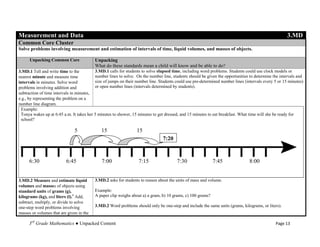
3.MD.1 Tell and write time to the         3.MD.1 calls for students to solve elapsed time, including word problems. Students could use clock models or
nearest minute and measure time           number lines to solve. On the number line, students should be given the opportunities to determine the intervals and
intervals in minutes. Solve word          size of jumps on their number line. Students could use pre-determined number lines (intervals every 5 or 15 minutes)
problems involving addition and           or open number lines (intervals determined by students).
subtraction of time intervals in minutes,
e.g., by representing the problem on a
number line diagram.
 Example:
 Tonya wakes up at 6:45 a.m. It takes her 5 minutes to shower, 15 minutes to get dressed, and 15 minutes to eat breakfast. What time will she be ready for
 school?

                               5             15                  15
                                                                              7:20
                                                                               7:20


     6:30                 6:45                7:00                7:15                 7:30                 7:45                8:00


3.MD.2 Measure and estimate liquid        3.MD.2 asks for students to reason about the units of mass and volume.
volumes and masses of objects using
standard units of grams (g),              Example:
kilograms (kg), and liters (l).1 Add,     A paper clip weighs about a) a gram, b) 10 grams, c) 100 grams?
subtract, multiply, or divide to solve
one-step word problems involving          3.MD.2 Word problems should only be one-step and include the same units (grams, kilograms, or liters).
masses or volumes that are given in the

     3rd Grade Mathematics ● Unpacked Content                                                                                                 Page 13
same units, e.g., by using drawings
(such as a beaker with a measurement
scale) to represent the problem.2
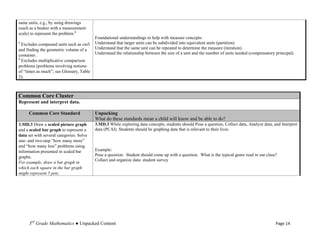
                                          Foundational understandings to help with measure concepts:
1
  Excludes compound units such as cm3     Understand that larger units can be subdivided into equivalent units (partition).
and finding the geometric volume of a     Understand that the same unit can be repeated to determine the measure (iteration).
container.                                Understand the relationship between the size of a unit and the number of units needed (compensatory principal).
2
  Excludes multiplicative comparison
problems (problems involving notions
of ―times as much‖; see Glossary, Table
2).


Common Core Cluster
Represent and interpret data.

     Common Core Standard                 Unpacking
                                          What do these standards mean a child will know and be able to do?
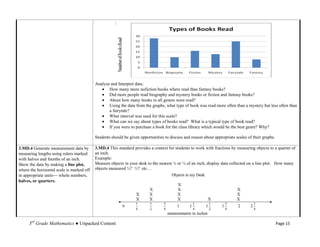
3.MD.3 Draw a scaled picture graph        3.MD.3 While exploring data concepts, students should Pose a question, Collect data, Analyze data, and Interpret
and a scaled bar graph to represent a     data (PCAI). Students should be graphing data that is relevant to their lives
data set with several categories. Solve
one- and two-step ―how many more‖
and ―how many less‖ problems using
information presented in scaled bar       Example:
graphs.                                   Pose a question: Student should come up with a question. What is the typical genre read in our class?
                                          Collect and organize data: student survey
For example, draw a bar graph in
which each square in the bar graph
might represent 5 pets.


     3rd Grade Mathematics ● Unpacked Content                                                                                                 Page 14
Analyze and Interpret data:
                                                  How many more nofiction books where read than fantasy books?
                                                  Did more people read biography and mystery books or fiction and fantasy books?
                                                  About how many books in all genres were read?
                                                  Using the data from the graphs, what type of book was read more often than a mystery but less often than
                                                  a fairytale?
                                                  What interval was used for this scale?
                                                  What can we say about types of books read? What is a typical type of book read?
                                                  If you were to purchase a book for the class library which would be the best genre? Why?

                                           Students should be given opportunities to discuss and reason about appropriate scales of their graphs.

3.MD.4 Generate measurement data by        3.MD.4 This standard provides a context for students to work with fractions by measuring objects to a quarter of
measuring lengths using rulers marked      an inch.
with halves and fourths of an inch.        Example:
Show the data by making a line plot,       Measure objects in your desk to the nearest ½ or ¼ of an inch, display data collected on a line plot. How many
where the horizontal scale is marked off   objects measured ¼? ½? etc…
in appropriate units— whole numbers,
halves, or quarters.


     3rd Grade Mathematics ● Unpacked Content                                                                                                       Page 15
Common Core Cluster
Geometric measurement: understand concepts of area and relate area to multiplication and to addition.
Students recognize area as an attribute of two-dimensional regions. They measure the area of a shape by finding the total number of same size units of area
required to cover the shape without gaps or overlaps, a square with sides of unit length being the standard unit for measuring area. Students understand that
rectangular arrays can be decomposed into identical rows or into identical columns. By decomposing rectangles into rectangular arrays of squares, students
connect area to multiplication, and justify using multiplication to determine the area of a rectangle.
     Common Core Standard                   Unpacking
                                            What do these standards mean a child will know and be able to do?
3.MD.5 Recognize area as an attribute
of plane figures and understand
concepts of area measurement.
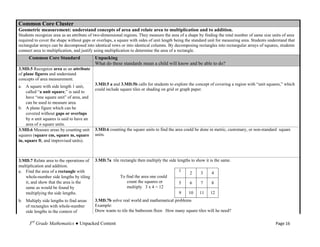
a. A square with side length 1 unit,        3.MD.5 a and 3.MD.5b calls for students to explore the concept of covering a region with ―unit squares,‖ which
                                            could include square tiles or shading on grid or graph paper.
     called ―a unit square,‖ is said to
     have ―one square unit‖ of area, and
     can be used to measure area.
b. A plane figure which can be
     covered without gaps or overlaps
     by n unit squares is said to have an
     area of n square units.
3.MD.6 Measure areas by counting unit       3.MD.6 counting the square units to find the area could be done in metric, customary, or non-standard square
squares (square cm, square m, square        units.
in, square ft, and improvised units).


3.MD.7 Relate area to the operations of     3.MD.7a tile rectangle then multiply the side lengths to show it is the same.
multiplication and addition.
a. Find the area of a rectangle with                                                       1
                                                                                                 2     3      4
   whole-number side lengths by tiling                    To find the area one could
   it, and show that the area is the                         count the squares or          5     6     7      8
   same as would be found by                                 multiply 3 x 4 = 12
   multiplying the side lengths.                                                           9     10    11    12
b. Multiply side lengths to find areas      3.MD.7b solve real world and mathematical problems
   of rectangles with whole-number          Example:
   side lengths in the context of           Drew wants to tile the bathroom floor. How many square tiles will he need?

      3rd Grade Mathematics ● Unpacked Content                                                                                                    Page 16
solving real world and
                                                              6 square feet
    mathematical problems, and
    represent whole-number products as
                                                                               8 square feet
    rectangular areas in mathematical
    reasoning.

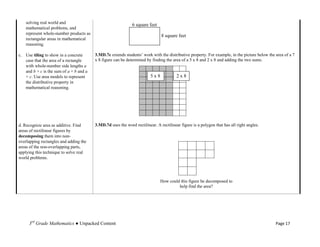
c. Use tiling to show in a concrete      3.MD.7c extends students’ work with the distributive property. For example, in the picture below the area of a 7
   case that the area of a rectangle     x 8 figure can be determined by finding the area of a 5 x 8 and 2 x 8 and adding the two sums.
   with whole-number side lengths a
   and b + c is the sum of a × b and a
   × c. Use area models to represent                                     5x8            2x8
   the distributive property in
   mathematical reasoning.


d. Recognize area as additive. Find      3.MD.7d uses the word rectilinear. A rectilinear figure is a polygon that has all right angles.
areas of rectilinear figures by
decomposing them into non-
overlapping rectangles and adding the
areas of the non-overlapping parts,
applying this technique to solve real
world problems.


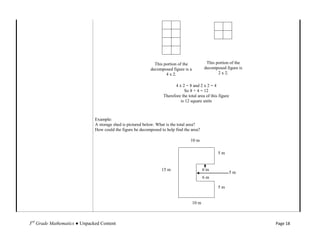
                                                                               How could this figure be decomposed to
                                                                                        help find the area?


     3rd Grade Mathematics ● Unpacked Content                                                                                                 Page 17
This portion of the            This portion of the
                                                            decomposed figure is a          decomposed figure is
                                                                    4 x 2.                         2 x 2.

                                                                         4 x 2 = 8 and 2 x 2 = 4
                                                                              So 8 + 4 = 12
                                                                   Therefore the total area of this figure
                                                                            is 12 square units


                              Example:
                              A storage shed is pictured below. What is the total area?
                              How could the figure be decomposed to help find the area?

                                                                                   10 m

                                                                                                   5m


                                                                  15 m                      6m
                                                                                                         5m
                                                                                            6m

                                                                                                   5m


                                                                                     10 m


3rd Grade Mathematics ● Unpacked Content                                                                           Page 18
Common Core Cluster
Geometric measurement: recognize perimeter as an attribute of plane figures and distinguish between linear and area measures.

     Common Core Standard                Unpacking
                                         What do these standards mean a child will know and be able to do?
3.MD.8 Solve real world and              3.MD.8 calls for students to solve problems about perimeter, or the distance around a shape. Students should
mathematical problems involving          have ample opportunities to measure and determine the perimeters of polygons.
perimeters of polygons, including        Example: What rectangles can be made with a perimeter of 12 units?
finding the perimeter given the side               Which rectangle gives you the greatest area? How do you know?
lengths, finding an unknown side
length, and exhibiting rectangles with
the same perimeter and different areas
or with the same area and different
perimeters.


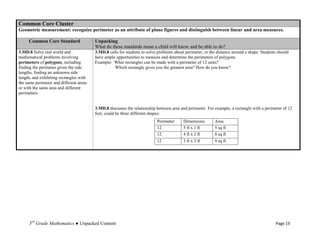
                                         3.MD.8 discusses the relationship between area and perimeter. For example, a rectangle with a perimeter of 12
                                         feet, could be three different shapes:
                                                                           Perimeter      Dimensions       Area
                                                                           12             5 ft x 1 ft      5 sq ft
                                                                           12             4 ft x 2 ft      8 sq ft
                                                                           12             3 ft x 3 ft      9 sq ft


     3rd Grade Mathematics ● Unpacked Content                                                                                                Page 19
Geometry                                                                                                                                                    3.G
Common Core Cluster
Reason with shapes and their attributes.
Students describe, analyze, and compare properties of two dimensional shapes. They compare and classify shapes by their sides and angles, and connect
these with definitions of shapes. Students also relate their fraction work to geometry by expressing the area of part of a shape as a unit fraction of the whole.
      Common Core Standard                  Unpacking
                                            What do these standards mean a child will know and be able to do?
3.G.1 Understand that shapes in             3.G.1 involves classifying shapes by attributes and drawing shapes that fit specific categories.
different categories (e.g., rhombuses,      For example, parallelograms include: squares, rectangles, rhombi, or other shapes that have two pairs of parallel
rectangles, and others) may share           sides. Also, the broad category quadrilaterals include all types of parallelograms, trapezoids and other four-sided
attributes (e.g., having four sides), and   figures.
that the shared attributes can define a
larger category (e.g., quadrilaterals).     Example:
Recognize rhombuses, rectangles, and        Draw a picture of a quadrilateral. Draw a picture of a rhombus.
                                            How are they alike? How are they different?
squares as examples of quadrilaterals,
                                            Is a quadrilateral a rhombus? Is a rhombus a quadrilateral? Justify your thinking.
and draw examples of quadrilaterals
that do not belong to any of these
subcategories.
3.G.2 Partition shapes into parts with      3.G.2 builds on students’ work with fractions and area. Students are responsible for partitioning shapes into
equal areas. Express the area of each       halves, thirds, fourths, sixths and eighths.
part as a unit fraction of the whole.
For example, partition a shape into 4
parts with equal area, and describe the     Example:
area of each part as 1/4 of the area of     This figure was partitioned/divided into four equal parts. Each part is ¼ of the total area of the figure.
the shape.

                                                                                    ¼
                                                                            ¼

                                                                            ¼      ¼


      3rd Grade Mathematics ● Unpacked Content                                                                                                       Page 20

Common Core Unpacked Grade 3

  • 1.
    3rdGrade Mathematics ●Unpacked Content For the new Common Core State Standards that will be effective in all North Carolina schools in the 2012-13. This document is designed to help North Carolina educators teach the Common Core (Standard Course of Study). NCDPI staff are continually updating and improving these tools to better serve teachers. What is the purpose of this document? To increase student achievement by ensuring educators understand specifically what the new standards mean a student must know, understand and be able to do. What is in the document? Descriptions of what each standard means a student will know, understand and be able to do. The ―unpacking‖ of the standards done in this document is an effort to answer a simple question ―What does this standard mean that a student must know and be able to do?‖ and to ensure the description is helpful, specific and comprehensive for educators. How do I send Feedback? We intend the explanations and examples in this document to be helpful and specific. That said, we believe that as this document is used, teachers and educators will find ways in which the unpacking can be improved and made ever more useful. Please send feedback to us at feedback@dpi.state.nc.us and we will use your input to refine our unpacking of the standards. Thank You! Just want the standards alone? You can find the standards alone at http://corestandards.org/the-standards Mathematical Vocabulary is identified in bold print. These are words that students should know and be able to use in context. 3rd Grade Mathematics ● Unpacked Content .
  • 2.
    Operations and AlgebraicThinking 3.0A Common Core Cluster Represent and solve problems involving multiplication and division. Students develop an understanding of the meanings of multiplication and division of whole numbers through activities and problems involving equal-sized groups, arrays, and area models; multiplication is finding an unknown product, and division is finding an unknown factor in these situations. For equal-sized group situations, division can require finding the unknown number of groups or the unknown group size. Common Core Standard Unpacking What do these standards mean a child will know and be able to do? 3.OA.1 Interpret products of whole 3.OA.1 Interpret products of whole numbers. numbers, e.g., interpret 5 × 7 as the total number of objects in 5 groups of 7 Example: objects each. Jim purchased 5 packages of muffins. Each package contained 3 muffins. How many muffins did Jim purchase? For example, describe a context in 5 groups of 3, 5 x 3 = 15. Describe another situation where there would be 5 groups of 3 or 5 x 3. which a total number of objects can be expressed as 5 × 7. 3.OA.2 Interpret whole-number 3.OA.2 focuses on two distinct models of division: partition models and measurement (repeated subtraction) quotients of whole numbers, e.g., models. interpret 56 ÷ 8 as the number of objects in each share when 56 objects are partitioned equally into 8 shares, Partition models focus on the question, ―How many in each group?‖ A context for partition models would be: or as a number of shares when 56 There are 12 cookies on the counter. If you are sharing the cookies equally among three bags, how many cookies objects are partitioned into equal shares will go in each bag? of 8 objects each. OOOO OOOO OOOO For example, describe a context in which a number of shares or a number Measurement (repeated subtraction) models focus on the question, ―How many groups can you make?‖ A context of groups can be expressed as 56 ÷ 8. for measurement models would be: There are 12 cookies on the counter. If you put 3 cookies in each bag, how many bags will you fill? OOO OOO OOO OOO 3.OA.3 Use multiplication and 3.OA.3 students should apply their skills to solve word problems. This could include one or two-step word division within 100 to solve word problems, such as: problems in situations involving equal If you divide 4 dozen brownies among 8 people, how many cookies does each person receive? (4x12 = 48, 48 ÷ 8 groups, arrays, and measurement = 6). quantities, e.g., by using drawings and Glossary, Table 2 gives examples of a variety of problem solving contexts, in which students need to find the 3rd Grade Mathematics ● Unpacked Content Page 2
  • 3.
    equations with asymbol for the product, the group size, or the number of groups. Students should be given ample experiences to explore all of the unknown number to represent the different problem structures. problem.1 3.OA.3 references various strategies that can be used to solve word problems involving multiplication and division. 1 See Glossary, Table 2. Examples: There are 24 desks in the classroom. If the teacher puts 6 desks in each row, how many rows are there? This task can be solved by drawing an array by putting 6 desks in each row. This task can also be solved by drawing pictures. 4 groups of 6 equals 24 objects A student could also reason through the problem mentally or verbally, ―I know 6 and 6 are 12. 12 and 12 are 24. Therefore, there are 4 groups of 6 giving a total of 24 desks in the classroom.‖ 3.OA.3 in third grade students should use a variety of pictures, such as stars, boxes, flowers to represent unknown numbers (variables).. Letters are also introduced to represent unknowns in third grade. Example: There are some students at recess. The teacher divides the class into 4 lines with 6 students in each line. Write a division equation for this story and determine how many students are in the class students in the class). 3.OA.4 Determine the unknown whole 3.OA.4 refers to Glossary, Table 2 and equations for the different types of multiplication and division problem number in a multiplication or division structures. The easiest problem structure includes Unknown Product (3 x ? = 18 or 18 ÷ 3 = 6). The more difficult equation relating three whole numbers. problem structures include Group Size Unknown (3 x ? = 18 or 18 ÷ 3 = 6) or Number of Groups Unknown (? x 6 For example, determine the unknown = 18, 18 ÷ 6 = 3). The focus of 3.OA.4 goes beyond the traditional notion of fact families, by having students number that makes the equation true in explore the inverse relationship of multiplication and division. each of the equations 8 × ? = 48, 5 = _ ÷ 3, 6 × 6 = ? 3rd Grade Mathematics ● Unpacked Content Page 3
  • 4.
    Common Core Cluster Understandproperties of multiplication and the relationship between multiplication and division. Students use properties of operations to calculate products of whole numbers, using increasingly sophisticated strategies based on these properties to solve multiplication and division problems involving single-digit factors. By comparing a variety of solution strategies, students learn the relationship between multiplication and division. Common Core Standard Unpacking What do these standards mean a child will know and be able to do? 3.OA.5 Apply properties of operations 3.OA.5 references properties of multiplication. While students DO NOT need to not use the formal terms of these as strategies to multiply and divide.2 properties, student should understand that properties are rules about how numbers work, they need to be flexibly Examples: If 6 × 4 = 24 is known, then and fluently applying each of them. 4 × 6 = 24 is also known. The associative property states that the sum or product stays the same when the grouping of addends or factors is (Commutative property of changed. For example, when a student multiplies 7 x 5 x 2, a student could rearrange the numbers to first multiply multiplication.) 3 × 5 × 2 can be found 5 x 2 = 10 and then multiply 10 x 7 = 70. by 3 × 5 = 15, then 15 × 2 = 30, or by 5 properties – rules about how numbers work × 2 = 10, then 3 × 10 = 30. (Associative property of multiplication.) The commutative property (order property) states that the order of numbers does not matter when you are adding Knowing that 8 × 5 = 40 and 8 × 2 = or multiplying numbers. For example, if a student knows that 5 x 4 = 20, then they also know that 4 x 5 = 20. 16, one can find 8 × 7 as 8 × (5 + 2) = The array below could be described as a 5 x 4 array for 5 columns and 4 rows, or a 4 x 5 array for 4 rows and 5 (8 × 5) + (8 × 2) = 40 + 16 = 56. columns. There is no ―fixed‖ way to write the dimensions of an array as rows x columns or columns x rows. (Distributive property.) Students should have flexibility in being able to describe both dimensions of an array. 2 Example: Students need not use formal terms for these properties. 4x5 4x5 or or 5x4 5x4 Example of the distributive property would be using mental math to determine a product. Here are ways that students could use the distributive property to determine the product of 7 x 6. Again, students should use the distributive property, but can refer to this in informal language such as ―breaking numbers apart‖. 3rd Grade Mathematics ● Unpacked Content Page 4
  • 5.
    Student 1 Student 2 Student 3 7x6 7x6 7x6 7 x 5 = 35 7 x 3 = 21 5 x 6 = 30 7x1=7 7 x 3 = 21 2 x 6 = 12 35 + 7 = 42 21 + 21 = 42 30 + 12 = 42 Another example if the distributive property helps students determine the products and factors of problems by breaking numbers apart. For example, for the problem 7 x 8 = ?, students can decompose the 7 into a 5 and 2, and reach the answer by multiplying 5 x 8 = 40 and 2 x 8 =16 and adding the two products (40 +16 = 56). 5x8 2x8 3.OA.6 Understand division as an 3.OA.6 refers back to Glossary, Table 2 and the various problem structures. Since multiplication and division are unknown-factor problem. inverse operations, students are expected to solve problems and explain their processes of solving division For example, find 32 ÷ 8 by finding the problems that can also be represented as unknown factor multiplication problems. number that makes 32 when multiplied by 8. Example: A student knows that 2 x 12 = 24. How can they use that fact to determine the answer to the following question: 24 people are divided into pairs in P.E. class? How many pairs are there? Write a division equation and explain your reasoning. 3rd Grade Mathematics ● Unpacked Content Page 5
  • 6.
    Common Core Cluster Multiplyand divide within 100. Common Core Standard Unpacking What do these standards mean a child will know and be able to do? 3.OA.7 Fluently multiply and divide 3.OA.7 uses the word fluently, which means accuracy (correct answer), efficiency (within 3-4 seconds), and within 100, using strategies such as the flexibility (using strategies such as the distributive property). ―Know from memory‖ should not focus only on relationship between multiplication and timed tests and repetitive practice, but ample experiences working with manipulatives, pictures, arrays, word division (e.g., knowing that 8 × 5 = 40, problems, and numbers to internalize the basic facts (up to 9 x 9). one knows 40 ÷ 5 = 8) or properties of operations. By the end of Grade 3, know from memory all products of two one-digit numbers. Common Core Cluster Solve problems involving the four operations, and identify and explain patterns in arithmetic. Common Core Standard Unpacking What do these standards mean a child will know and be able to do? 3.OA.8 Solve two-step word problems 3.OA.8 refers to two-step word problems using the four operations. The size of the numbers should be limited to using the four operations. Represent related 3rd grade standards (e.g., 3.OA.7 and 3.NBT.2). Adding and subtracting numbers should include numbers these problems using equations with a within 1,000, and multiplying and dividing numbers should include single-digit factors and products less than letter standing for the unknown 100. quantity. Assess the reasonableness of 3.OA.8 calls for students to represent problems using equations with a letter to represent unknown quantities. answers using mental computation and Example: estimation strategies including Mike runs 2 miles a day. His goal is to run 25 miles. After 5 days, how many miles does Mike have left to run in rounding.3 order to meet his goal? Write an equation and find the solution (2 x 5 + m = 25). 3 This standard is limited to problems 3.OA.8 refers to estimation strategies, including using compatible numbers (numbers that sum to 10, 50, or 100) posed with whole numbers and having or rounding. The focus in this standard is to have students use and discuss various strategies. Students should whole-number answers; students should estimate during problem solving, and then revisit their estimate to check for reasonableness. know how to perform operations in the conventional order when there are no Example: parentheses to specify a particular Here are some typical estimation strategies for the problem: 3rd Grade Mathematics ● Unpacked Content Page 6
  • 7.
    order. On a vacation, your family travels 267 miles on the first day, 194 miles on the second day and 34 miles on the third day. How many total miles did they travel? Student 1 Student 2 Student 3 I first thought about I first thought about 194. It is I rounded 267 to 300. 267 and 34. I noticed really close to 200. I also I rounded 194 to 200. that their sum is have 2 hundreds in 267. That I rounded 34 to 30. about 300. Then I gives me a total of 4 When I added 300, knew that 194 is hundreds. Then I have 67 in 200 and 30, I know close to 200. When I 267 and the 34. When I put my answer will be put 300 and 200 67 and 34 together that is about 530. together, I get 500. really close to 100. When I add that hundred to the 4 hundreds that I already had, I end up with 500. The assessment of estimation strategies should only have one reasonable answer (500 or 530), or a range (between 500 and 550). Problems should be structured so that all acceptable estimation strategies will arrive at a reasonable answer. 3.OA.9 Identify arithmetic patterns 3.OA.9 calls for students to examine arithmetic patterns involving both addition and multiplication. Arithmetic (including patterns in the addition table patterns are patterns that change by the same rate, such as adding the same number. For example, the series 2, 4, or multiplication table), and explain 6, 8, 10 is an arithmetic pattern that increases by 2 between each term. them using properties of operations. For example, observe that 4 times a 3.OA.9 also mentions identifying patterns related to the properties of operations. number is always even, and explain why Examples: 4 times a number can be decomposed *Even numbers are always divisible by 2. Even numbers can always be decomposed into 2 equal addends (14 = 7 + 7). into two equal addends. *Multiples of even numbers (2, 4, 6, and 8) are always even numbers. *On a multiplication chart, the products in each row and column increase by the same amount (skip counting). *On an addition chart, the sums in each row and column increase by the same amount. 3.OA.9 What do you notice about the numbers highlighted in pink in the multiplication table? Explain a pattern using properties of operations. 3rd Grade Mathematics ● Unpacked Content Page 7
  • 8.
    When (commutative property)one changes the order of the factors they will still gets the same product, example 6 x 5 = 30 and 5 x 6 = 30. x 0 1 2 3 4 5 6 7 8 9 10 0 0 0 0 0 0 0 0 0 0 0 0 1 0 1 2 3 4 5 6 7 8 9 10 2 0 2 4 6 8 10 12 14 16 18 20 3 0 3 6 9 12 15 18 21 24 27 30 4 0 4 8 12 16 20 24 28 32 36 40 5 0 5 10 15 20 25 30 35 40 45 50 6 0 6 12 18 24 30 36 42 48 54 60 7 0 7 14 21 28 35 42 49 56 63 70 8 0 8 16 24 32 40 48 56 64 72 80 9 0 9 18 27 36 45 54 63 72 81 90 10 0 10 20 30 40 50 60 70 80 90 100 Teacher: What pattern do you notice when 2, 4, 6, 8, or 10 are multiplied by any number (even or odd)? Student: The product will always be an even number. Teacher: Why? x 0 1 2 3 4 5 6 7 8 9 10 0 0 0 0 0 0 0 0 0 0 0 0 1 0 1 2 3 4 5 6 7 8 9 10 2 0 2 4 6 8 10 12 14 16 18 20 3 0 3 6 9 12 15 18 21 24 27 30 4 0 4 8 12 16 20 24 28 32 36 40 5 0 5 10 15 20 25 30 35 40 45 50 6 0 6 12 18 24 30 36 42 48 54 60 7 0 7 14 21 28 35 42 49 56 63 70 8 0 8 16 24 32 40 48 56 64 72 80 9 0 9 18 27 36 45 54 63 72 81 90 10 0 10 20 30 40 50 60 70 80 90 100 3rd Grade Mathematics ● Unpacked Content Page 8
  • 9.
    What patterns doyou notice in this addition table? Explain why the pattern works this way? + 0 1 2 3 4 5 6 7 8 9 10 0 0 1 2 3 4 5 6 7 8 9 10 1 1 2 3 4 5 6 7 8 9 10 11 2 2 3 4 5 6 7 8 9 10 11 12 3 3 4 5 6 7 8 9 10 11 12 13 4 4 5 6 7 8 9 10 11 12 13 14 5 5 6 7 8 9 10 11 12 13 14 15 6 6 7 8 9 10 11 12 13 14 15 16 7 7 8 9 10 11 12 13 14 15 16 17 8 8 9 10 11 12 13 14 15 16 17 18 9 9 10 11 12 13 14 15 16 17 18 19 10 19 11 12 13 14 15 16 17 18 19 20 Number and Operations in Base Ten 3.NBT Common Core Cluster Use place value understanding and properties of operations to perform multi-digit arithmetic.1 1 A range of algorithms may be used. Common Core Standard Unpacking What do these standards mean a child will know and be able to do? 3.NBT.1 Use place value 3.NBT.1 refers to place value understanding, which extends beyond an algorithm or procedure for rounding. The understanding to round whole expectation is that students have a deep understanding of place value and number sense and can explain and reason numbers to the nearest 10 or 100. about the answers they get when they round. Based on the cluster goal, students are using rounding in the context of multi-digit arithmetic. Students should have numerous experiences using a number line and a hundreds chart as tools to support their work with rounding. 3.NBT.2 Fluently add and subtract 3.NBT.2 refers to fluently, which means accuracy (correct answer), efficiency (within 3-4 seconds), and flexibility within 1000 using strategies and (using strategies such as the distributive property). The word algorithm refers to a procedure or a series of steps. algorithms based on place value, There are other algorithms other than the standard algorithm. Third grade students should have experiences beyond properties of operations, and/or the the standard algorithm. A variety of algorithms will be assessed on EOG. 3rd Grade Mathematics ● Unpacked Content Page 9
  • 10.
    relationship between additionand Example: subtraction. There are 178 fourth graders and 225 fifth graders on the playground. How many total students are on the playground? 1 A range of algorithms may be used. Student 1 Student 2 Student 3 100 + 200 = 300 I added 2 to 178 I know the 75 plus 25 70 + 20 = 90 to get 180. I equals 100. I then added 8 + 5 = 13 added 220 to get 1 hundred from 178 and 300 + 90 + 13 = 400. I added the 2 hundreds from 275. I 403 students 3 left over to get had a total of 4 hundreds 403. and I had 3 more left to add. So I have 4 hundreds plus 3 more which is 403. Student 4 178 + 225 = ? 178 + 200 = 378 378 + 20 = 398 398 + 5 = 403 200 20 5 178 378 398 403 3.NBT.3 Multiply one-digit whole 3.NBT.3 extends students’ work in multiplication by having them apply their understanding of place value. This numbers by multiples of 10 in the standard expects that students go beyond tricks that hinder understanding such as ―just adding zeros‖ and explain range 10–90 (e.g., 9 × 80, 5 × 60) and reason about their products. using strategies based on place value For example, for the problem 50 x 4, students should think of this as 4 groups of 5 tens or 20 tens. Twenty tens and properties of operations. equals 200. 3rd Grade Mathematics ● Unpacked Content Page 10
  • 11.
    Number and Operation– Fractions1 3.NF Common Core Cluster Develop understanding of fractions as numbers. 1 Grade 3 expectations in this domain are limited to fractions with denominators 2, 3, 4, 6, 8. Students develop an understanding of fractions, beginning with unit fractions. Students view fractions in general as being built out of unit fractions, and they use fractions along with visual fraction models to represent parts of a whole. Students understand that the size of a fractional part is relative to the size of the whole. For example, ½ of the paint in a small bucket could be less paint than 1/3 of the paint in a larger bucket, but 1/3 of a ribbon is longer than 1/5 of the same ribbon because when the ribbon is divided into 3 equal parts, the parts are longer than when the ribbon is divided into 5 equal parts. Students are able to use fractions to represent numbers equal to, less than, and greater than one. They solve problems that involve comparing fractions by using visual fraction models and strategies based on noticing equal numerators or denominators. Common Core Standard Unpacking What do these standards mean a child will know and be able to do? 3.NF.1 Understand a fraction 1/b as the 3.NF.1 refers to the sharing of a whole being partitioned or split. Fraction models in third grade include area quantity formed by 1 part when a whole (parts of a whole) models (circles, rectangles, squares) and number lines. Set models (parts of a group) are not is partitioned into b equal parts; introduced in Third Grade. In 3.NF.1 students should focus on the concept that a fraction is made up (composed) understand a fraction a/b as the quantity of many pieces of a unit fraction, which has a numerator of 1. For example, the fraction 3/5 is composed of 3 formed by a parts of size 1/b. pieces that each has a size of 1/5. 3.NF.2 Understand a fraction as a number on the number line; represent 3.NF.2a and 3.NF.2b The number line diagram is the first time students work with a number line for numbers fractions on a number line diagram. that are between whole numbers (e.g., that ½ is between 0 and 1). a. Represent a fraction 1/b on a In the number line diagram below, the space between 0 and 1 is divided (partitioned) into 4 equal regions. The number line diagram by defining distance from 0 to the first segment is 1 of the 4 segments from 0 to 1 or ¼ (3.NF.2a). Similarly, the distance the interval from 0 to 1 as the whole from 0 to the third segment is 3 segments that are each one-fourth long. Therefore, the distance of 3 segments and partitioning it into b equal from 0 is the fraction ¾ (3.NF.2b). parts. Recognize that each part has size 1/b and that the endpoint of the part based at 0 locates the number 1/b on the number line. b. Represent a fraction a/b on a number line diagram by marking off a lengths 1/b from 0. Recognize that the resulting interval has size a/b and that its endpoint locates the number a/b on the number line. 3rd Grade Mathematics ● Unpacked Content Page 11
  • 12.
    3.NF.3 Explain equivalenceof fractions in special cases, and compare fractions by reasoning about their size. a. Understand two fractions as equivalent (equal) if they are the same size, or the same point on a 3.NF.3a and 3.NF.3b call for students to use visual fraction models (area models) and number lines to explore number line. the idea of equivalent fractions. Students should only explore equivalent fractions using models, rather than using algorithms or procedures. b. Recognize and generate simple equivalent fractions, e.g., 1/2 = 2/4, 4/6 = 2/3). Explain why the fractions are equivalent, e.g., by using a visual fraction model. c. Express whole numbers as 3.NF.3c includes writing whole numbers as fractions. The concept relates to fractions as division problems, fractions, and recognize fractions where the fraction 3/1 is 3 wholes divided into one group. This standard is the building block for later work that are equivalent to whole where students divide a set of objects into a specific number of groups. Students must understand the meaning of numbers. a/1 Examples: Express 3 in the form 3 Example: = 3/1; recognize that 6/1 = 6; If 6 brownies are shared between 2 people, how many brownies would each person get? locate 4/4 and 1 at the same point of a number line diagram. d. Compare two fractions with the same numerator or the same 3.NF.3d involves comparing fractions with or without visual fraction models including number lines. denominator by reasoning about Experiences should encourage students to reason about the size of pieces, the fact that 1/3 of a cake is larger than their size. Recognize that ¼ of the same cake. Since the same cake (the whole) is split into equal pieces, thirds are larger than fourths. comparisons are valid only when the two fractions refer to the same In this standard, students should also reason that comparisons are only valid if the wholes are identical. For whole. Record the results of example, ½ of a large pizza is a different amount than ½ of a small pizza. Students should be given opportunities to discuss and reason about which ½ is larger. comparisons with the symbols >, =, or <, and justify the conclusions, e.g., by using a visual fraction model. 3rd Grade Mathematics ● Unpacked Content Page 12
  • 13.
    Measurement and Data 3.MD Common Core Cluster Solve problems involving measurement and estimation of intervals of time, liquid volumes, and masses of objects. Unpacking Common Core Unpacking What do these standards mean a child will know and be able to do? 3.MD.1 Tell and write time to the 3.MD.1 calls for students to solve elapsed time, including word problems. Students could use clock models or nearest minute and measure time number lines to solve. On the number line, students should be given the opportunities to determine the intervals and intervals in minutes. Solve word size of jumps on their number line. Students could use pre-determined number lines (intervals every 5 or 15 minutes) problems involving addition and or open number lines (intervals determined by students). subtraction of time intervals in minutes, e.g., by representing the problem on a number line diagram. Example: Tonya wakes up at 6:45 a.m. It takes her 5 minutes to shower, 15 minutes to get dressed, and 15 minutes to eat breakfast. What time will she be ready for school? 5 15 15 7:20 7:20 6:30 6:45 7:00 7:15 7:30 7:45 8:00 3.MD.2 Measure and estimate liquid 3.MD.2 asks for students to reason about the units of mass and volume. volumes and masses of objects using standard units of grams (g), Example: kilograms (kg), and liters (l).1 Add, A paper clip weighs about a) a gram, b) 10 grams, c) 100 grams? subtract, multiply, or divide to solve one-step word problems involving 3.MD.2 Word problems should only be one-step and include the same units (grams, kilograms, or liters). masses or volumes that are given in the 3rd Grade Mathematics ● Unpacked Content Page 13
  • 14.
    same units, e.g.,by using drawings (such as a beaker with a measurement scale) to represent the problem.2 Foundational understandings to help with measure concepts: 1 Excludes compound units such as cm3 Understand that larger units can be subdivided into equivalent units (partition). and finding the geometric volume of a Understand that the same unit can be repeated to determine the measure (iteration). container. Understand the relationship between the size of a unit and the number of units needed (compensatory principal). 2 Excludes multiplicative comparison problems (problems involving notions of ―times as much‖; see Glossary, Table 2). Common Core Cluster Represent and interpret data. Common Core Standard Unpacking What do these standards mean a child will know and be able to do? 3.MD.3 Draw a scaled picture graph 3.MD.3 While exploring data concepts, students should Pose a question, Collect data, Analyze data, and Interpret and a scaled bar graph to represent a data (PCAI). Students should be graphing data that is relevant to their lives data set with several categories. Solve one- and two-step ―how many more‖ and ―how many less‖ problems using information presented in scaled bar Example: graphs. Pose a question: Student should come up with a question. What is the typical genre read in our class? Collect and organize data: student survey For example, draw a bar graph in which each square in the bar graph might represent 5 pets. 3rd Grade Mathematics ● Unpacked Content Page 14
  • 15.
    Analyze and Interpretdata: How many more nofiction books where read than fantasy books? Did more people read biography and mystery books or fiction and fantasy books? About how many books in all genres were read? Using the data from the graphs, what type of book was read more often than a mystery but less often than a fairytale? What interval was used for this scale? What can we say about types of books read? What is a typical type of book read? If you were to purchase a book for the class library which would be the best genre? Why? Students should be given opportunities to discuss and reason about appropriate scales of their graphs. 3.MD.4 Generate measurement data by 3.MD.4 This standard provides a context for students to work with fractions by measuring objects to a quarter of measuring lengths using rulers marked an inch. with halves and fourths of an inch. Example: Show the data by making a line plot, Measure objects in your desk to the nearest ½ or ¼ of an inch, display data collected on a line plot. How many where the horizontal scale is marked off objects measured ¼? ½? etc… in appropriate units— whole numbers, halves, or quarters. 3rd Grade Mathematics ● Unpacked Content Page 15
  • 16.
    Common Core Cluster Geometricmeasurement: understand concepts of area and relate area to multiplication and to addition. Students recognize area as an attribute of two-dimensional regions. They measure the area of a shape by finding the total number of same size units of area required to cover the shape without gaps or overlaps, a square with sides of unit length being the standard unit for measuring area. Students understand that rectangular arrays can be decomposed into identical rows or into identical columns. By decomposing rectangles into rectangular arrays of squares, students connect area to multiplication, and justify using multiplication to determine the area of a rectangle. Common Core Standard Unpacking What do these standards mean a child will know and be able to do? 3.MD.5 Recognize area as an attribute of plane figures and understand concepts of area measurement. a. A square with side length 1 unit, 3.MD.5 a and 3.MD.5b calls for students to explore the concept of covering a region with ―unit squares,‖ which could include square tiles or shading on grid or graph paper. called ―a unit square,‖ is said to have ―one square unit‖ of area, and can be used to measure area. b. A plane figure which can be covered without gaps or overlaps by n unit squares is said to have an area of n square units. 3.MD.6 Measure areas by counting unit 3.MD.6 counting the square units to find the area could be done in metric, customary, or non-standard square squares (square cm, square m, square units. in, square ft, and improvised units). 3.MD.7 Relate area to the operations of 3.MD.7a tile rectangle then multiply the side lengths to show it is the same. multiplication and addition. a. Find the area of a rectangle with 1 2 3 4 whole-number side lengths by tiling To find the area one could it, and show that the area is the count the squares or 5 6 7 8 same as would be found by multiply 3 x 4 = 12 multiplying the side lengths. 9 10 11 12 b. Multiply side lengths to find areas 3.MD.7b solve real world and mathematical problems of rectangles with whole-number Example: side lengths in the context of Drew wants to tile the bathroom floor. How many square tiles will he need? 3rd Grade Mathematics ● Unpacked Content Page 16
  • 17.
    solving real worldand 6 square feet mathematical problems, and represent whole-number products as 8 square feet rectangular areas in mathematical reasoning. c. Use tiling to show in a concrete 3.MD.7c extends students’ work with the distributive property. For example, in the picture below the area of a 7 case that the area of a rectangle x 8 figure can be determined by finding the area of a 5 x 8 and 2 x 8 and adding the two sums. with whole-number side lengths a and b + c is the sum of a × b and a × c. Use area models to represent 5x8 2x8 the distributive property in mathematical reasoning. d. Recognize area as additive. Find 3.MD.7d uses the word rectilinear. A rectilinear figure is a polygon that has all right angles. areas of rectilinear figures by decomposing them into non- overlapping rectangles and adding the areas of the non-overlapping parts, applying this technique to solve real world problems. How could this figure be decomposed to help find the area? 3rd Grade Mathematics ● Unpacked Content Page 17
  • 18.
    This portion ofthe This portion of the decomposed figure is a decomposed figure is 4 x 2. 2 x 2. 4 x 2 = 8 and 2 x 2 = 4 So 8 + 4 = 12 Therefore the total area of this figure is 12 square units Example: A storage shed is pictured below. What is the total area? How could the figure be decomposed to help find the area? 10 m 5m 15 m 6m 5m 6m 5m 10 m 3rd Grade Mathematics ● Unpacked Content Page 18
  • 19.
    Common Core Cluster Geometricmeasurement: recognize perimeter as an attribute of plane figures and distinguish between linear and area measures. Common Core Standard Unpacking What do these standards mean a child will know and be able to do? 3.MD.8 Solve real world and 3.MD.8 calls for students to solve problems about perimeter, or the distance around a shape. Students should mathematical problems involving have ample opportunities to measure and determine the perimeters of polygons. perimeters of polygons, including Example: What rectangles can be made with a perimeter of 12 units? finding the perimeter given the side Which rectangle gives you the greatest area? How do you know? lengths, finding an unknown side length, and exhibiting rectangles with the same perimeter and different areas or with the same area and different perimeters. 3.MD.8 discusses the relationship between area and perimeter. For example, a rectangle with a perimeter of 12 feet, could be three different shapes: Perimeter Dimensions Area 12 5 ft x 1 ft 5 sq ft 12 4 ft x 2 ft 8 sq ft 12 3 ft x 3 ft 9 sq ft 3rd Grade Mathematics ● Unpacked Content Page 19
  • 20.
    Geometry 3.G Common Core Cluster Reason with shapes and their attributes. Students describe, analyze, and compare properties of two dimensional shapes. They compare and classify shapes by their sides and angles, and connect these with definitions of shapes. Students also relate their fraction work to geometry by expressing the area of part of a shape as a unit fraction of the whole. Common Core Standard Unpacking What do these standards mean a child will know and be able to do? 3.G.1 Understand that shapes in 3.G.1 involves classifying shapes by attributes and drawing shapes that fit specific categories. different categories (e.g., rhombuses, For example, parallelograms include: squares, rectangles, rhombi, or other shapes that have two pairs of parallel rectangles, and others) may share sides. Also, the broad category quadrilaterals include all types of parallelograms, trapezoids and other four-sided attributes (e.g., having four sides), and figures. that the shared attributes can define a larger category (e.g., quadrilaterals). Example: Recognize rhombuses, rectangles, and Draw a picture of a quadrilateral. Draw a picture of a rhombus. How are they alike? How are they different? squares as examples of quadrilaterals, Is a quadrilateral a rhombus? Is a rhombus a quadrilateral? Justify your thinking. and draw examples of quadrilaterals that do not belong to any of these subcategories. 3.G.2 Partition shapes into parts with 3.G.2 builds on students’ work with fractions and area. Students are responsible for partitioning shapes into equal areas. Express the area of each halves, thirds, fourths, sixths and eighths. part as a unit fraction of the whole. For example, partition a shape into 4 parts with equal area, and describe the Example: area of each part as 1/4 of the area of This figure was partitioned/divided into four equal parts. Each part is ¼ of the total area of the figure. the shape. ¼ ¼ ¼ ¼ 3rd Grade Mathematics ● Unpacked Content Page 20