I. OBJECTIVES
Monday Tuesday Wednesday Thursday Friday
Objectives must be met over the week and connected to the curriculum standards. To meet the objectives, necessary procedures must be followed and if needed, additional lessons, exercises and remedial activities may
be done for developing content knowledge and competencies. These are assessed using Formative Assessment strategies. Valuing objectives support the learning of content and competencies and enable children to
find significance and joy in learning the lessons. Weekly objectives shall be derived from the curriculum guides.
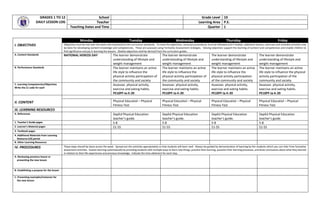
A. Content Standards NATIONAL HEREOS DAY The learner demonstrate
understanding of lifestyle and
weight management
The learner demonstrate
understanding of lifestyle and
weight management
The learner demonstrate
understanding of lifestyle and
weight management
The learner demonstrate
understanding of lifestyle and
weight management
B. Performance Standards The learner maintains an active
life style to influence the
physical activity participation of
the community and society
The learner maintains an active
life style to influence the
physical activity participation of
the community and society
The learner maintains an active
life style to influence the
physical activity participation
of the community and society
The learner maintains an active
life style to influence the physical
activity participation of the
community and society
C. Learning Competencies/Objectives
Write the LC code for each
Assesses physical activity,
exercise and eating habits.
PE10PF-Ia-h-39
Assesses physical activity,
exercise and eating habits.
PE10PF-Ia-h-39
Assesses physical activity,
exercise and eating habits.
PE10PF-Ia-h-39
Assesses physical activity,
exercise and eating habits.
PE10PF-Ia-h-39
II. CONTENT Physical Educatiol – Physical
Fitness Test
Physical Educatiol – Physical
Fitness Test
Physical Educatiol – Physical
Fitness Test
Physical Educatiol – Physical
Fitness Test
III. LEARNING RESOURCES
A. References DepEd Physical Education
teacher’s guide.
DepEd Physical Education
teacher’s guide.
DepEd Physical Education
teacher’s guide.
DepEd Physical Education
teacher’s guide.
1. Teacher’s Guide pages 5-8 5-8 5-8 5-8
2. Learner’s Material pages 51-55 51-55 51-55 51-55
3. Textbook pages
4. Additional Materials from Learning
Resource (LR) portal
B. Other Learning Resources
IV. PROCEDURES These steps should be done across the week. Spread out the activities appropriately so that students will learn well. Always be guided by demonstration of learning by the students which you can infer from formative
assessment activities. Sustain learning systematically by providing students with multiple ways to learn new things, practice their learning, question their learning processes, and draw conclusions about what they learned
in relation to their life experiences and previous knowledge. Indicate the time allotment for each step.
A. Reviewing previous lesson or
presenting the new lesson
B. Establishing a purpose for the lesson
C. Presenting examples/instances for
the new lesson
GRADES 1 TO 12
DAILY LESSON LOG
School Grade Level 10
Teacher Learning Area P.E.
Teaching Dates and Time Quarter 1
Monday Tuesday Wednesday Thursday Friday
D. Discussing new concepts and
practicing new skills #1
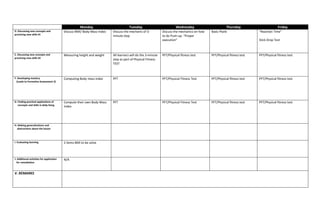
Discuss BMI/ Body Mass Index Discuss the mechanis of 3-
minute step
Discuss the mechanics on how
to do Push-up. “Proper
execution”
Basic Plank “Reaction Time”
Stick Drop Test
E. Discussing new concepts and
practicing new skills #2
Measuring height and weight All learners will do the 3-minute
step as part of Physical Fitness
TEST
PFT/Physical fitness test PFT/Physical fitness test PFT/Physical fitness test
F. Developing mastery
(Leads to Formative Assessment 3)
Computing Body mass index PFT PFT/Physical Fitness Test PFT/Physical fitness test PFT/Physical fitness test
G. Finding practical applications of
concepts and skills in daily living
Compute their own Body Mass
Index
PFT PFT/Physical Fitness Test PFT/Physical fitness test PFT/Physical fitness test
H. Making generalizations and
abstractions about the lesson
I. Evaluating learning 2 items BMI to be solve
J. Additional activities for application
for remediation
N/A
V. REMARKS
VI.REFLECTION Reflect on your teaching and assess yourself as a teacher. Think about your students’ progress this week. What works? What else needs to be done to help the students learn? Identify what help your instructional
supervisors can provide for you so when you meet them, you can ask them relevant questions.
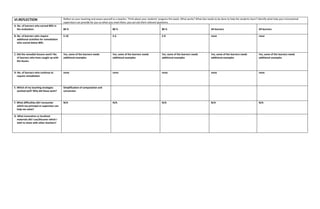
A. No. of learners who earned 80% in
the evaluation. 80 % 80 % 80 % All learners All learners
B. No. of learners who require
additional activities for remediation
who scored below 80%.
5-10 5-6 5-8 none none
C. Did the remedial lessons work? No.
of learners who have caught up with
the lesson.
Yes, some of the learners needs
additional examples
Yes, some of the learners needs
additional examples
Yes, some of the learners needs
additional examples
Yes, some of the learners needs
additional examples
Yes, some of the learners needs
additional examples
D. No. of learners who continue to
require remediation
none none none none none
E. Which of my teaching strategies
worked well? Why did these work?
Simplification of computation and
conversion
F. What difficulties did I encounter
which my principal or supervisor can
help me solve?
N/A N/A N/A N/A N/A
G. What innovation or localized
materials did I use/discover which I
wish to share with other teachers?

DLL 2nd week.docx

  • 1.
    I. OBJECTIVES Monday TuesdayWednesday Thursday Friday Objectives must be met over the week and connected to the curriculum standards. To meet the objectives, necessary procedures must be followed and if needed, additional lessons, exercises and remedial activities may be done for developing content knowledge and competencies. These are assessed using Formative Assessment strategies. Valuing objectives support the learning of content and competencies and enable children to find significance and joy in learning the lessons. Weekly objectives shall be derived from the curriculum guides. A. Content Standards NATIONAL HEREOS DAY The learner demonstrate understanding of lifestyle and weight management The learner demonstrate understanding of lifestyle and weight management The learner demonstrate understanding of lifestyle and weight management The learner demonstrate understanding of lifestyle and weight management B. Performance Standards The learner maintains an active life style to influence the physical activity participation of the community and society The learner maintains an active life style to influence the physical activity participation of the community and society The learner maintains an active life style to influence the physical activity participation of the community and society The learner maintains an active life style to influence the physical activity participation of the community and society C. Learning Competencies/Objectives Write the LC code for each Assesses physical activity, exercise and eating habits. PE10PF-Ia-h-39 Assesses physical activity, exercise and eating habits. PE10PF-Ia-h-39 Assesses physical activity, exercise and eating habits. PE10PF-Ia-h-39 Assesses physical activity, exercise and eating habits. PE10PF-Ia-h-39 II. CONTENT Physical Educatiol – Physical Fitness Test Physical Educatiol – Physical Fitness Test Physical Educatiol – Physical Fitness Test Physical Educatiol – Physical Fitness Test III. LEARNING RESOURCES A. References DepEd Physical Education teacher’s guide. DepEd Physical Education teacher’s guide. DepEd Physical Education teacher’s guide. DepEd Physical Education teacher’s guide. 1. Teacher’s Guide pages 5-8 5-8 5-8 5-8 2. Learner’s Material pages 51-55 51-55 51-55 51-55 3. Textbook pages 4. Additional Materials from Learning Resource (LR) portal B. Other Learning Resources IV. PROCEDURES These steps should be done across the week. Spread out the activities appropriately so that students will learn well. Always be guided by demonstration of learning by the students which you can infer from formative assessment activities. Sustain learning systematically by providing students with multiple ways to learn new things, practice their learning, question their learning processes, and draw conclusions about what they learned in relation to their life experiences and previous knowledge. Indicate the time allotment for each step. A. Reviewing previous lesson or presenting the new lesson B. Establishing a purpose for the lesson C. Presenting examples/instances for the new lesson GRADES 1 TO 12 DAILY LESSON LOG School Grade Level 10 Teacher Learning Area P.E. Teaching Dates and Time Quarter 1
  • 2.
    Monday Tuesday WednesdayThursday Friday D. Discussing new concepts and practicing new skills #1 Discuss BMI/ Body Mass Index Discuss the mechanis of 3- minute step Discuss the mechanics on how to do Push-up. “Proper execution” Basic Plank “Reaction Time” Stick Drop Test E. Discussing new concepts and practicing new skills #2 Measuring height and weight All learners will do the 3-minute step as part of Physical Fitness TEST PFT/Physical fitness test PFT/Physical fitness test PFT/Physical fitness test F. Developing mastery (Leads to Formative Assessment 3) Computing Body mass index PFT PFT/Physical Fitness Test PFT/Physical fitness test PFT/Physical fitness test G. Finding practical applications of concepts and skills in daily living Compute their own Body Mass Index PFT PFT/Physical Fitness Test PFT/Physical fitness test PFT/Physical fitness test H. Making generalizations and abstractions about the lesson I. Evaluating learning 2 items BMI to be solve J. Additional activities for application for remediation N/A V. REMARKS
  • 3.
    VI.REFLECTION Reflect onyour teaching and assess yourself as a teacher. Think about your students’ progress this week. What works? What else needs to be done to help the students learn? Identify what help your instructional supervisors can provide for you so when you meet them, you can ask them relevant questions. A. No. of learners who earned 80% in the evaluation. 80 % 80 % 80 % All learners All learners B. No. of learners who require additional activities for remediation who scored below 80%. 5-10 5-6 5-8 none none C. Did the remedial lessons work? No. of learners who have caught up with the lesson. Yes, some of the learners needs additional examples Yes, some of the learners needs additional examples Yes, some of the learners needs additional examples Yes, some of the learners needs additional examples Yes, some of the learners needs additional examples D. No. of learners who continue to require remediation none none none none none E. Which of my teaching strategies worked well? Why did these work? Simplification of computation and conversion F. What difficulties did I encounter which my principal or supervisor can help me solve? N/A N/A N/A N/A N/A G. What innovation or localized materials did I use/discover which I wish to share with other teachers?