What does “data publication” 
mean to researchers? 
John Kratz & Carly Strasser
“…it [is] clear that scientists 
in all fields endorse the 
principle of data sharing as a 
desirable norm of science.” 
–Ceci SJ, 1988, Scientists’ attitudes toward data sharing. 
Science, Technology, & Human Values 13: 45–52.
“…it is clear that something 
is amiss in the academy.” 
–Ceci SJ, 1988, Scientists’ attitudes toward data sharing. 
Science, Technology, & Human Values 13: 45–52.
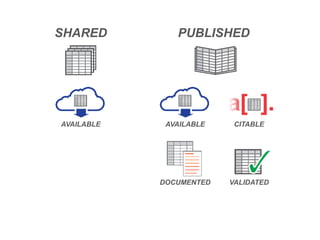
SHARED PUBLISHED 
AVAILABLE AVAILABLE 
CITABLE 
DOCUMENTED VALIDATED
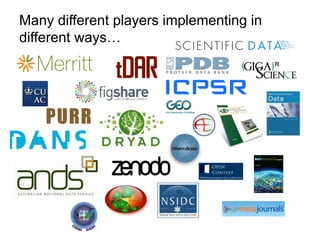
Many different players implementing in 
different ways… 
PURR
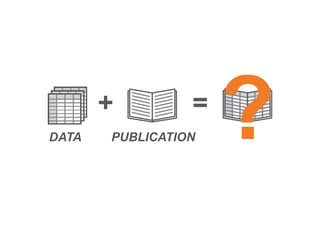
DATA 
PUBLICATION ? 
+ =
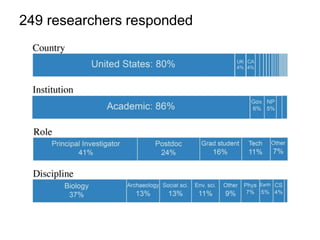
249 researchers responded
What does “data publication” 
mean to researchers?
How would you expect a published dataset to 
differ from a shared one?
How would you expect a published dataset to 
differ from a shared one? 
RESEARCH 
PAPER 
AVAILABLE 
DATA 
PAPER
How highly do researchers 
value data publications?
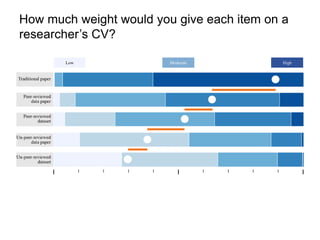
How much weight would you give each item on a 
researcher’s CV? 
Low Moderate High
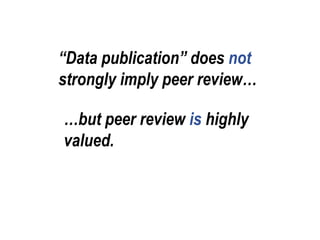
“Data publication” does not 
strongly imply peer review… 
…but peer review is highly 
valued.
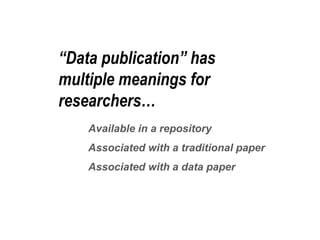
“Data publication” has 
multiple meanings for 
researchers… 
Available in a repository 
Associated with a traditional paper 
Associated with a data paper
Researchers do not 
immediately understand or 
value data publication.
What does data publication 
mean to researchers? 
John Kratz 
0000-0002-9610-5370 
John.Kratz@ucop.edu 
@john_kratz 
Carly Strasser 
000-0001-9592-2339 
Carly.Strasser@ucop.edu 
@carlystrasser

What does "data publication" mean to researchers?

  • 1.
    What does “datapublication” mean to researchers? John Kratz & Carly Strasser
  • 2.
    “…it [is] clearthat scientists in all fields endorse the principle of data sharing as a desirable norm of science.” –Ceci SJ, 1988, Scientists’ attitudes toward data sharing. Science, Technology, & Human Values 13: 45–52.
  • 3.
    “…it is clearthat something is amiss in the academy.” –Ceci SJ, 1988, Scientists’ attitudes toward data sharing. Science, Technology, & Human Values 13: 45–52.
  • 4.
    SHARED PUBLISHED AVAILABLEAVAILABLE CITABLE DOCUMENTED VALIDATED
  • 5.
    Many different playersimplementing in different ways… PURR
  • 6.
  • 8.
  • 9.
    What does “datapublication” mean to researchers?
  • 10.
    How would youexpect a published dataset to differ from a shared one?
  • 11.
    How would youexpect a published dataset to differ from a shared one? RESEARCH PAPER AVAILABLE DATA PAPER
  • 12.
    How highly doresearchers value data publications?
  • 13.
    How much weightwould you give each item on a researcher’s CV? Low Moderate High
  • 14.
    “Data publication” doesnot strongly imply peer review… …but peer review is highly valued.
  • 15.
    “Data publication” has multiple meanings for researchers… Available in a repository Associated with a traditional paper Associated with a data paper
  • 16.
    Researchers do not immediately understand or value data publication.
  • 17.
    What does datapublication mean to researchers? John Kratz 0000-0002-9610-5370 John.Kratz@ucop.edu @john_kratz Carly Strasser 000-0001-9592-2339 Carly.Strasser@ucop.edu @carlystrasser

Editor's Notes

  • #3 1988 paper by Stephen Ceci reflecting consensus in a survey done in 1985, almost 3 decades ago
  • #4  and yet "it is clear that something is amiss in the academy" which was that no one is actually doing it * 30 years later the situation has ceratinly improved, but really, the same thing is still amiss * There are a lot of ways to approach this problem, but
  • #5 One solution is to shift from talking about _sharing_ data by making it available, to _publishing_ it analogy to publication in the scholarly literature Cachet of publication rubs off on data
  • #6 This solution has gotten a lot of traction over the last 5 years– there are lots of initiatives, lots of different ideas about exactly how it should work, lots of players in this space– both new and established.
  • #7 Much of this is based on an untested assumption that because researchers understand "data", and "publication" , "data publication" will make sense– but is that true? If so, what kind of sense? How much of the cachet of publication do we really get?
  • #8 Carly Strasser and I put an online survey up last spring about data publication (as distinct from dissemination in general, which had been studied much more directed specifically at researchers in science and social science.
  • #9 We got not quite 250 responses American Academics research roles: PIs,postdocs, and grad students disciplines; Lots of biologists,others. skew towards people who care about this stuff.
  • #10 To answer “what does data pub mean?”…
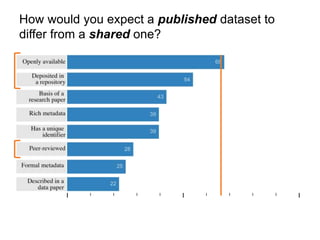
  • #11 * here's what they said: * * firstly, not an overwhelming majority on any item– nothing much higher than 2/3 * most popular is the not-**exclusively**-scholarly sense that it's just available * peer review, which is fundamental to some models of data publication and certainly to scholarly publication is expected by less than 1/3. * this is a jumble of parts; are respondents flailing around or are they assembling them together into coherent ideas or definitions of data publication?
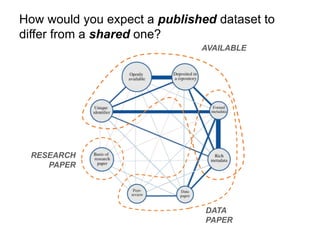
  • #12 same data here, again, are the parts- here's how they connect; thick edges connect parts that tend to be chosen together i'll pull out three definitions here Described in trad research I would divide the rest- with no real statistical support- into two partially overlapping overlapping definitions peer-reviewed data paper deposit in a public database or repository
  • #13 To an
  • #14 if you're looking a someone's CV, how much is each of these things worth? traditional papers as a baseline permutations of data publication scale of 1-5, darker is more valuable highest data pub is much less than a traditional paper, which is to be expected A data paper definitely adds weight But peer review is the bigger factor
  • #15 * even though peer review wasn't expected,, it was valued.
  • #16 * Data publication can mean any of a few different things- at least two- sometimes to the same researcher.
  • #17 * We shouldn't expect researchers to automatically understand or value data publications.