INSTITUTE OF AERONAUTICAL ENGINEERING
(Autonomous)
Dundigal, Hyderabad -500 043
COMMON FOR
COMPUTER SCIENCE ENGINEERING/
INFORMATION TECHNOLOGY
DIGITALLOGIC DESIGN PPT
(AEC020)
Course Coordinator
Mr. K.Ravi,Assistant Professor, ECE
Ms. G. Bhavana, Assistant Professor, ECE
Ms. L.Shruthi,Assistant Professor, ECE
Ms. V
.Bindusree,Assistant Professor, ECE
Ms. J.Swetha,Assistant Professor, ECE
Ms. Shreya verma, Assistant Professor, ECE
DIGITAL LOGIC DESIGN PPT
1
UNIT 1
INTRODUCTION TO DIGITAL
LOGIC DESIGN
2
INTRODUCTION TO DIGITAL LOGIC DESIGN
Digital logic design is a system in electrical
and computer engineering that uses simple
number values to produce input and output
operations.
3
INTRODUCTION TO DIGITAL LOGIC DESIGN
4
Advantages:
•A digital computer stores data in terms of digits
(numbers) and proceeds in discrete steps from one state
to the next.
•The states of a digital computer typically involve binary
digits which may take the form of the presence or
absence of magnetic markers in a storage medium , on-
off switches or relays. In digital computers, even letters,
words and whole texts are represented digitally.
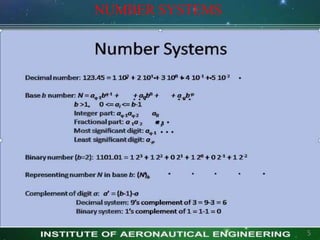
NUMBER SYSTEMS
5
NUMBER BASE CONVERSION
6
Binary to Decimal Conversion:
It is by the positional weights method . In this
method,each binary digit of the no. is multiplied by its position
weight . The product terms are added to obtain the decimal no.
NUMBER BASE CONVERSION
7
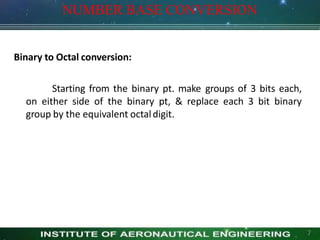
Binary to Octal conversion:
Starting from the binary pt. make groups of 3 bits each,
on either side of the binary pt, & replace each 3 bit binary
group by the equivalent octaldigit.
NUMBER BASE CONVERSION
8
Binary to Hexadecimal conversion:
For this make groups of 4 bits each , on either side of the
binary pt & replace each 4 bit group by the equivalent
hexadecimaldigit.
NUMBER BASE CONVERSION
9
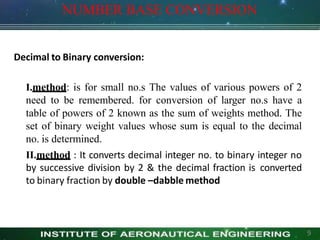
Decimal to Binary conversion:
I.method: is for small no.s The values of various powers of 2
need to be remembered. for conversion of larger no.s have a
table of powers of 2 known as the sum of weights method. The
set of binary weight values whose sum is equal to the decimal
no. is determined.
II.method : It converts decimal integer no. to binary integer no
by successive division by 2 & the decimal fraction is converted
to binary fraction by double –dabble method
NUMBER BASE CONVERSION
1
Octal to decimal Conversion:
Multiply each digit in the octal no by the weight of
its position&add all the product termsDecimal value of the octal
no.
NUMBER BASE CONVERSION
1
Decimal to Octal Conversion:
To convert a mixed decimal no. To a mixed octal no.
convert the integer and fraction parts separately. To convert
decimal integer no. to octal, successively divide the given no by
8 till the quotient is 0. The last remainder is the MSD .The
remainder read upwards give the equivalent octal integer no. T
o
convert the given decimal fraction to octal, successively
multiply the decimal fraction&the subsequent decimal fractions
by 8 till the product is 0 or till the required accuracy is the
MSD. The integers to the left of the octal pt read downwards
give the octal fraction.
NUMBER BASE CONVERSION
1
Decimal to Hexadecimal conversion:
It is successively divide the given decimal no. by 16
till the quotient is zero. The last remainder is the MSB. The
remainder read from bottom to top gives the equivalent
hexadecimal integer. To convert a decimal fraction to
hexadecimal successively multiply the given decimal fraction &
subsequent decimal fractions by 16, till the product is zero. Or
till the required accuracy is obtained,and collect all the integers
to the left of decimal pt. The first integer is MSB & the integer
read from top to bottom give the hexadecimal fraction known as
the hexadabble method.
NUMBER BASE CONVERSION
1
Octal to hexadecimal conversion:
The simplest way is to first convert the given octal no. to
binary & then the binary no. to hexadecimal.
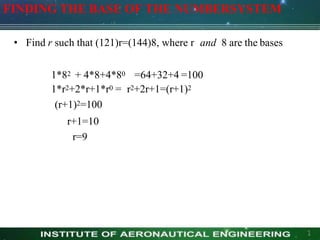
FINDING THE BASE OF THE NUMBERSYSTEM
1
• Find r such that (121)r=(144)8, where r and 8 are the bases
1*82 + 4*8+4*80 =64+32+4 =100
1*r2+2*r+1*r0 = r2+2r+1=(r+1)2
(r+1)2=100
r+1=10
r=9
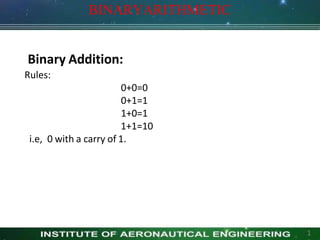
Binary Addition:
Rules:
0+0=0
0+1=1
1+0=1
1+1=10
i.e, 0 with a carry of 1.
1
BINARYARITHMETIC
BINARYARITHMETIC
1
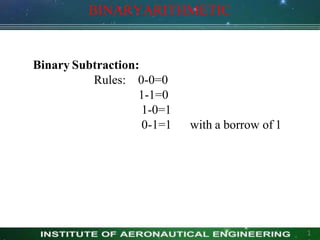
Binary Subtraction:
Rules: 0-0=0
1-1=0
1-0=1
0-1=1 with a borrow of 1
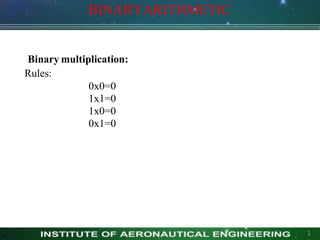
Binary multiplication:
Rules:
0x0=0
1x1=0
1x0=0
0x1=0
1
BINARYARITHMETIC
BINARYARITHMETIC
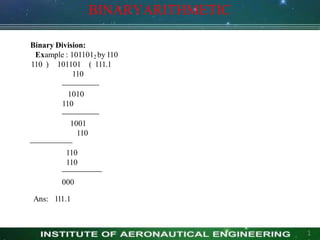
Binary Division:
Example : 1011012 by 110
110 ) 101101 ( 111.1
110
1010
110
1001
110
110
110
000
1
Ans: 111.1
BINARYARITHMETIC
1
9’s & 10’s Complements:
It is the Subtraction of decimal no.s can be accomplished by
the 9’s & 10’s compliment methods similar to the 1’s & 2’s
compliment methods of binary . the 9’s compliment of a
decimal no. is obtained by subtracting each digit of that
decimal no. from 9. The 10’s compliment of a decimal no is
obtained by adding a 1 to its 9’s compliment.
1’s compliment of n number:
It is obtained by simply complimenting each bit of the
no,.& also , 1’s comp of a no, is subtracting each bit of the
no. form 1.This complemented value rep the –ve of the
original no. One of the difficulties of using 1’s comp is its
rep o f zero.Both 00000000 & its 1’s comp 11111111 rep
zero.The 00000000 called +ve zero& 11111111called –ve
zero.
2
BINARYARITHMETIC
BINARYARITHMETIC
2
1’s compliment arithmetic:
In 1’s comp subtraction, add the 1’s comp of
the subtrahend to the minuend. If there is a carryout , bring
the carry around & add it to the LSB called the end around
carry. Look at the sign bit (MSB) . If this is a 0, the result
is +ve & is in true binary. If the MSB is a 1 ( carry or no
carry ), the result is –ve & is in its is comp form .Take its 1’s
comp to get the magnitude inn binary.
BINARYARITHMETIC
2
9’s & 10’s Complements:
It is the Subtraction of decimal no.s can be accomplished by
the 9’s & 10’s compliment methods similar to the 1’s & 2’s
compliment methods of binary . the 9’s compliment of a
decimal no. is obtained by subtracting each digit of that
decimal no. from 9. The 10’s compliment of a decimal no is
obtained by adding a 1 to its 9’s compliment.
Methods of obtaining 2’s comp of a no:
In 3 ways
By obtaining the 1’s comp of the given no. (by changing all 0’s to
1’s & 1’s to 0’s) & then adding 1.
By subtracting the given n bit no N from 2n
Starting at the LSB , copying down each bit upto & including the
first 1 bit encountered , and complimenting the remaining bits.
2
BINARYARITHMETIC
BINARYARITHMETIC
2
2’s compliment Arithmetic:
The 2’s comp system is used to rep –ve no.s using modulus
arithmetic . The word length of a computer is fixed. i.e, if a 4 bit no.
is added to another 4 bit no . the result will be only of 4 bits. Carry
if any , from the fourth bit will overflow called the Modulus
arithmetic.
Ex:1100+1111=1011
BINARYARITHMETIC
2
9’s & 10’s Complements:
.
It is the Subtraction of decimal no.s can be accomplished by
the 9’s & 10’s compliment methods similar to the 1’s & 2’s
compliment methods of binary . the 9’s compliment of a
decimal no. is obtained by subtracting each digit of that
decimal no. from 9. The 10’s compliment of a decimal no is
obtained by adding a 1 to its 9’s compliment
1’s compliment of n number:
It is obtained by simply complimenting each bit of the
no,.& also , 1’s comp of a no, is subtracting each bit of the
no. form 1.This complemented value rep the –ve of the
original no. One of the difficulties of using 1’s comp is its
rep o f zero.Both 00000000 & its 1’s comp 11111111 rep
zero.The 00000000 called +ve zero& 11111111called –ve
zero.
2
BINARYARITHMETIC
BINARYARITHMETIC
2
1’s compliment arithmetic:
In 1’s comp subtraction, add the 1’s comp of
the subtrahend to the minuend. If there is a carryout , bring
the carry around & add it to the LSB called the end around
carry. Look at the sign bit (MSB) . If this is a 0, the result
is +ve & is in true binary. If the MSB is a 1 ( carry or no
carry ), the result is –ve & is in its is comp form .Take its 1’s
comp to get the magnitude inn binary.
BINARYARITHMETIC
2
9’s & 10’s Complements:
It is the Subtraction of decimal no.s can be accomplished by
the 9’s & 10’s compliment methods similar to the 1’s & 2’s
compliment methods of binary . the 9’s compliment of a
decimal no. is obtained by subtracting each digit of that
decimal no. from 9. The 10’s compliment of a decimal no is
obtained by adding a 1 to its 9’s compliment.
Weighted Codes:-
The weighted codes are those that obey the position
weighting principle, which states that the position of each
number represent a specific weight. In these codes each
decimal digit is represented by a group of four bits.
In weighted codes, each digit is assigned a specific weight
according to its position. For example, in 8421/BCD code,
1001 the weights of 1, 1, 0, 1 (from left to right) are 8, 4, 2
and 1 respectively.
Examples:8421,2421 are all weighted codes.
2
BINARY WEIGHTED AND NON- WEIGHTED CODES
3
Non-weightedcodes:
The non-weighted codes are not positionally weighted . In other
words codes that are not assigned with any weight to each digit
position.
Examples:Excess-3(XS-3) and Gray Codes.
BCD Addition:
It is individually adding the corresponding digits of the
decimal no,s expressed in 4 bit binary groups starting from
the LSD . If there is no carry & the sum term is not an illegal
code , no correction is needed.If there is a carry out of one
group to the next group or if the sum term is an illegal code
then 610(0100) is added to the sum term of that group &the
resulting carry is added to the next group.
3
BINARY CODED DECIMAL
BCD Subtraction:
Performed by subtracting the digits of each 4 bit groupof
the subtrahend the digits from the corresponding 4- bit
group of the minuend in binary starting from the LSD . if
there is no borrow from the next group , then 610(0110)is
subtracted from the difference term of thisgroup.
3
BINARY CODED DECIMAL
Excess-3Addition:
Add the xs-3 no.s by adding the 4 bit groups in each column starting
from the LSD. If there is no carry starting from the addition of any of the 4-bit
groups , subtract 0011 from the sum term of those groups ( because when 2
decimal digits are added in xs-3 & there is no carry , result in xs-6). If there is a
carry out, add 0011 to the sum term of those groups( because when there is a
carry, the invalid states are skipped and the result is normal binary).
3
BINARY CODED DECIMAL
Excess -3 (XS-3) Subtraction:
Subtract the xs-3 no.s by subtracting each 4 bit group of the subtrahend from
the corresponding 4 bit group of the minuend starting form the LSD .if there is
no borrow from the next 4-bit group add 0011 to the difference term of such
groups (because when decimal digits are subtracted in xs-3 & there is no borrow
, result is normal binary). I f there is a borrow , subtract 0011 from the difference
term(b coz taking a borrow is equivalent to adding six invalid states , result is in
xs-6)
3
BINARY CODED DECIMAL
Representation of signed no.s binary
arithmetic in computers:
Two ways of rep signed no.s
Sign Magnitude form
Complemented form
Two complimented forms
1’s compliment form
2’s compliment form
3
SIGNED BINARY NUMBERS
3
Error – Detecting codes:When binary data is transmitted &
processed,it is susceptible to noise that can alter or distort its
contents. The 1’s may get changed to 0’s & 1’s .because digital
systems must be accurate to the digit, error can pose a problem.
Several schemes have been devised to detect the occurrence of a
single bit error in a binary word, so that whenever such an error
occurs the concerned binary word can be corrected &
retransmitted.
ERROR DETECTING AND CORRECTING CODES
3
• Introduction:
• When we talk about digital systems, be it a digital computer or a
digital communication set-up, the issue of error detection and
correction is of great practical significance.
• Errors creep into the bit stream owing to noise or other
impairments during the course of its transmission from the
transmitter to the receiver.
• While the addition of redundant bits helps in achieving the goal of
making transmission of information from one place to another
error free or reliable, it also makes it inefficient.
ERROR DETECTING AND CORRECTING CODES
3
• Some Common Error Detecting and CorrectingCodes
• Parity Code
• Repetition Code
• Cyclic Redundancy Check Code
• Hamming Code
ERROR DETECTING AND CORRECTING CODES
3
• Parity Code:
• A parity bit is an extra bit added to a string of data bits in order to detect
any error that might have crept into it while it was being stored or
processed and moved from one place to another in a digital system.
• This simple parity code suffers from two limitations. Firstly, it cannot
detect the error if the number of bits having undergone a change is even.
• Repetition Code:
• The repetition code makes use of repetitive transmission of each data bit
in the bit stream. In the case of threefold repetition, ‘1’ and ‘0’ would be
transmitted as ‘111’ and ‘000’ respectively.
• The repetition code is highly inefficient and the information throughput
drops rapidly as we increase the number of times each data bit needs to
be repeated to build error detection and correction capability.
ERROR DETECTING AND CORRECTING CODES
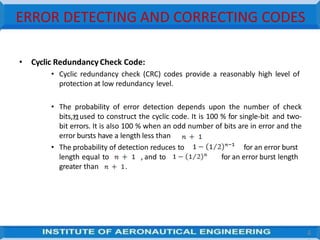
• Cyclic RedundancyCheck Code:
• Cyclic redundancy check (CRC) codes provide a reasonably high level of
protection at low redundancy level.
• The probability of error detection depends upon the number of check
bits, , used to construct the cyclic code. It is 100 % for single-bit and two-
bit errors. It is also 100 % when an odd number of bits are in error and the
error bursts have a length less than
• The probability of detection reduces to for an error burst
for an error burst length
length equal to , and to
greater than .
4
ERROR DETECTING AND CORRECTING CODES
4
• Hamming Code:
• An increase in the number of redundant bits added to message bits can
enhance the capability of the code to detect and correct errors.
• If sufficient number of redundant bits arranged such that different error
bits produce different error results, then it should be possible not only to
detect the error bit but also to identify its location.
• In fact, the addition of redundant bits alters the ‘distance’ code parameter,
which has come to be known as the Hamming distance.
• Hamming Distance:
• The Hamming distance is nothing but the number of bit disagreements
between two code words.
ERROR DETECTING AND CORRECTING CODES
4
• For example, the addition of single-bit parity results in a code with a
Hamming distance of at least 2.
• The smallest Hamming distance in the case of a threefold repetition code
would be 3.
• Hamming noticed that an increase in distance enhanced the code’s ability
to detect and correct errors.
• Hamming’s code was therefore an attempt at increasing the Hamming
distance and at the same time having as high an information throughput
rate as possible.
ERROR DETECTING AND CORRECTING CODES
4
• The algorithm for writing the generalized Hamming code is as follows:
1. The generalized form of code is P1P2D1P3D2D3D4P4D5D6D7D8D9D10D11P5.......,
where P and D respectively represent parity and data bits.
2. We can see from the generalized form of the code that all bit positions
that are powers of 2 (positions 1, 2, 4, 8, 16 ...) are used as parity bits.
3. All other bit positions (positions 3, 5, 6, 7, 9, 10, 11 ...) are used to encode
data.
4. Each parity bit is allotted a group of bits from the data bits in the code
word, and the value of the parity bit (0 or 1) is used to give it certain
parity.
ERROR DETECTING AND CORRECTING CODES
4
• Groups are formed by first checking bits and then alternately skipping and
checking bits following the parity bit. Here, is the position of the parity bit;
1 for P1, 2 for P2, 4 for P3, 8 for P4 and soon.
• For example, for the generalized form of code
given above, various groups of bits formed with different parity
bits would be P1D1D2D4D5....,
P2D1D3D4D6D7...., P3D2D3D4D8D9...., P4D5D6D7D8D9D10D11...., and so on. T
o
illustrate the formation of groups further, let us examine the group
corresponding to parity bit P3.
Now,the position of P3 is at number 4. In order to form the group, we check
the first three bits N-1=3 and then follow it up by alternately skipping and
checking four bits (N=4).
ERROR DETECTING AND CORRECTING CODES
• The Hamming code is capable of correcting single-bit errors on messages of
any length.
• Although the Hamming code can detect two-bit errors, it cannot give the error
locations.
• The number of parity bits required to be transmitted along with the message,
however,depends upon the message length.
• The number of parity bits n required to encode m message bits is the smallest
integer that satisfies the condition .
• The most commonly used Hamming code is the one that has a code word
length of seven bits with four message bits and three parity bits.
• It is also referred to as the Hamming (7, 4) code
4
ERROR DETECTING AND CORRECTING CODES
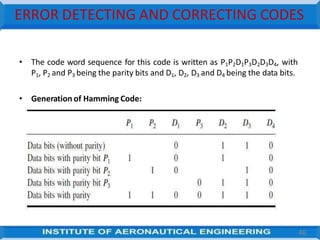
• The code word sequence for this code is written as P1P2D1P3D2D3D4, with
P1, P2 and P3 being the parity bits and D1, D2, D3 and D4 being the data bits.
• Generation of Hamming Code:
46
BOOLEAN ALGEBRA
47
UNIT 2
INTRODUCTION TO BOOLEAN
ALGEBRA
BOOLEAN ALGEBRA
48
• Also known as Switching Algebra
› Invented by mathematician George Boole in 1849
› Used by Claude Shannon at Bell Labs in 1938
• T
odescribe digital circuits built from relays
• Digital circuit design is based on
› Boolean Algebra
• Attributes
• Postulates
• Theorems
› These allow minimization and manipulation of logic gates for
optimizing digital circuits
BOOLEAN ALGEBRA ATTRIBUTES
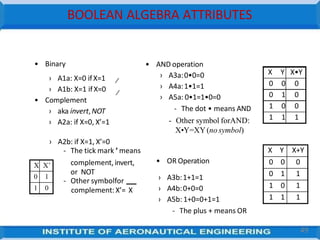
• Binary
› A1a: X=0 ifX=1
› A1b: X=1 ifX=0
• Complement
› aka invert,NOT
› A2a: if X=0, X’=1
X Y X•Y
0 0 0
0 1 0
1 0 0
1 1 1
• AND operation
› A3a:0•0=0
› A4a:1•1=1
› A5a: 0•1=1•0=0
- The dot • means AND
- Other symbol forAND:
X•Y=XY(no symbol)
› A2b: if X=1, X’=0
- The tick mark ’ means
complement,invert,
or NOT
- Other symbolfor
complement: X’= X
› A3b:1+1=1
› A4b:0+0=0
› A5b: 1+0=0+1=1
- The plus + means OR
X Y X+Y
0 0 0
0 1 1
1 0 1
1 1 1
X X’
0 1
1 0
• OR Operation
49
BOOLEAN ALGEBRA ATTRIBUTES
• Variable: Variables are the different symbols in a Boolean expression
• Literal: Each occurrence of a variable or its complement is called a literal
• Term:A term is the expression formed by literals and operations at one
level
– A, B, C are three variables
– Eight Literals
– Expression has five terms including four AND terms and the OR term
that combines the first-level AND terms.
50
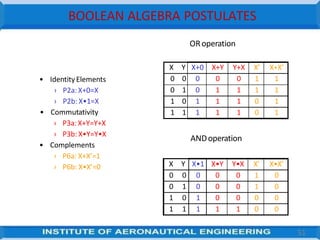
BOOLEAN ALGEBRA POSTULATES
51
• IdentityElements
› P2a:X+0=X
› P2b: X•1=X
• Commutativity
› P3a:X+Y=Y+X
› P3b: X•Y=Y•X
• Complements
› P6a: X+X’=1
› P6b: X•X’=0 X Y X•1 X•Y Y•X X’ X•X’
0 0 0 0 0 1 0
0 1 0 0 0 1 0
1 0 1 0 0 0 0
1 1 1 1 1 0 0
X Y X+0 X+Y Y+X X’ X+X’
0 0 0 0 0 1 1
0 1 0 1 1 1 1
1 0 1 1 1 0 1
1 1 1 1 1 0 1
ANDoperation
ORoperation
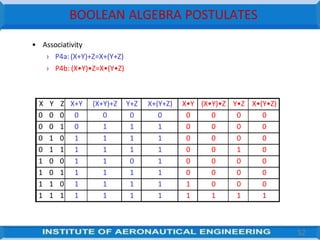
BOOLEAN ALGEBRA POSTULATES
52
• Associativity
› P4a:(X+Y)+Z=X+(Y+Z)
› P4b: (X•Y)•Z=X•(Y•Z)
X Y Z X+Y (X+Y)+Z Y+Z X+(Y+Z) X•Y (X•Y)•Z Y•Z X•(Y•Z)
0 0 0 0 0 0 0 0 0 0 0
0 0 1 0 1 1 1 0 0 0 0
0 1 0 1 1 1 1 0 0 0 0
0 1 1 1 1 1 1 0 0 1 0
1 0 0 1 1 0 1 0 0 0 0
1 0 1 1 1 1 1 0 0 0 0
1 1 0 1 1 1 1 1 0 0 0
1 1 1 1 1 1 1 1 1 1 1
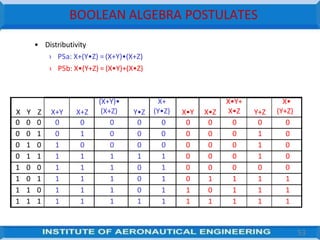
BOOLEAN ALGEBRA POSTULATES
53
• Distributivity
› P5a: X+(Y•Z) = (X+Y)•(X+Z)
› P5b: X•(Y+Z) = (X•Y)+(X•Z)
X Y Z X+Y X+Z
(X+Y)•
(X+Z) Y•Z
X+
(Y•Z) X•Y X•Z
X•Y+
X•Z Y+Z
X•
(Y+Z)
0 0 0 0 0 0 0 0 0 0 0 0 0
0 0 1 0 1 0 0 0 0 0 0 1 0
0 1 0 1 0 0 0 0 0 0 0 1 0
0 1 1 1 1 1 1 1 0 0 0 1 0
1 0 0 1 1 1 0 1 0 0 0 0 0
1 0 1 1 1 1 0 1 0 1 1 1 1
1 1 0 1 1 1 0 1 1 0 1 1 1
1 1 1 1 1 1 1 1 1 1 1 1 1
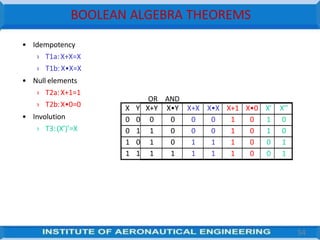
BOOLEAN ALGEBRA THEOREMS
54
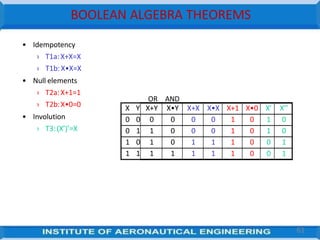
• Idempotency
› T1a:X+X=X
› T1b: X•X=X
• Null elements
› T2a:X+1=1
› T2b:X•0=0
• Involution
› T3:(X’)’=X
X Y X+Y X•Y X+X X•X X+1 X•0 X’ X’’
0 0 0 0 0 0 1 0 1 0
0 1 1 0 0 0 1 0 1 0
1 0 1 0 1 1 1 0 0 1
1 1 1 1 1 1 1 0 0 1
OR AND
BOOLEAN ALGEBRA THEOREMS
55
X Y X+Y X•Y
X+
(X•Y)
X•
(X+Y) X’ X’•Y
X+
(X’•Y) X’+Y
X•
(X’+Y)
0 0 0 0 0 0 1 0 0 1 0
0 1 1 0 0 0 1 1 1 1 0
1 0 1 0 1 1 0 0 1 0 0
1 1 1 1 1 1 0 0 1 1 1
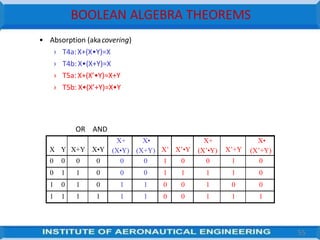
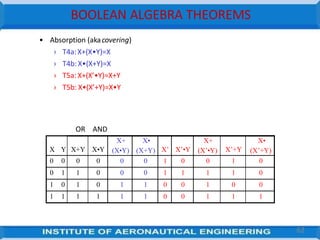
• Absorption (akacovering)
› T4a:X+(X•Y)=X
› T4b:X•(X+Y)=X
› T5a: X+(X’•Y)=X+Y
› T5b: X•(X’+Y)=X•Y
OR AND
BOOLEAN ALGEBRA THEOREMS
56
X Y X+Y X•Y Y’ X•Y’
(X•Y)+
(X•Y’) X+Y’
(X+Y)•
(X+Y’)
0 0 0 0 1 0 0 1 0
0 1 1 0 0 0 0 0 0
1 0 1 0 1 1 1 1 1
1 1 1 1 0 0 1 1 1
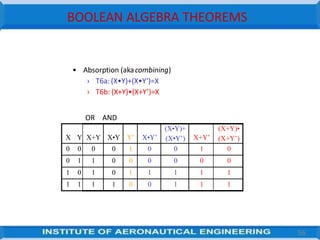
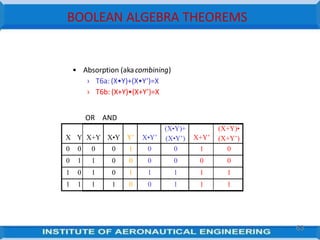
• Absorption (akacombining)
› T6a: (X•Y)+(X•Y’)=X
› T6b: (X+Y)•(X+Y’)=X
OR AND
BOOLEAN ALGEBRA THEOREMS
57
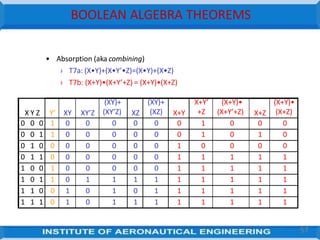
• Absorption (aka combining)
› T7a: (X•Y)+(X•Y’•Z)=(X•Y)+(X•Z)
› T7b: (X+Y)•(X+Y’+Z) = (X+Y)•(X+Z)
X Y Z Y’ XY XY’Z
(XY)+
(XY’Z) XZ
(XY)+
(XZ) X+Y
X+Y’
+Z
(X+Y)•
(X+Y’+Z) X+Z
(X+Y)•
(X+Z)
0 0 0 1 0 0 0 0 0 0 1 0 0 0
0 0 1 1 0 0 0 0 0 0 1 0 1 0
0 1 0 0 0 0 0 0 0 1 0 0 0 0
0 1 1 0 0 0 0 0 0 1 1 1 1 1
1 0 0 1 0 0 0 0 0 1 1 1 1 1
1 0 1 1 0 1 1 1 1 1 1 1 1 1
1 1 0 0 1 0 1 0 1 1 1 1 1 1
1 1 1 0 1 0 1 1 1 1 1 1 1 1
BOOLEAN ALGEBRA THEOREMS
X Y X+Y X•Y X’ Y’ (X+Y)’ X’•Y’ (X•Y)’ X’+Y’
0 0 0 0 1 1 1 1 1 1
0 1 1 0 1 0 0 0 1 1
1 0 1 0 0 1 0 0 1 1
1 1 1 1 0 0 0 0 0 0
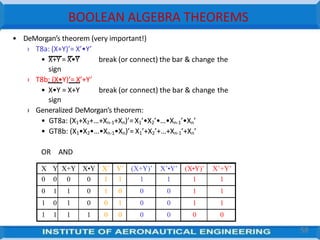
• DeMorgan’s theorem (very important!)
› T8a: (X+Y)’= X’•Y’
break (or connect) the bar & change the
• X+Y = X•Y
sign
› T8b: (X•Y)’= X’+Y’
• X•Y = X+Y
sign
› Generalized DeMorgan’s theorem:
• GT8a: (X1+X2+…+Xn-1+Xn)’=X1’•X2’•…•Xn-1’•Xn’
• GT8b: (X1•X2•…•Xn-1•Xn)’= X1’+X2’+…+Xn-1’+Xn’
OR AND
58
BOOLEAN ALGEBRA THEOREMS
59
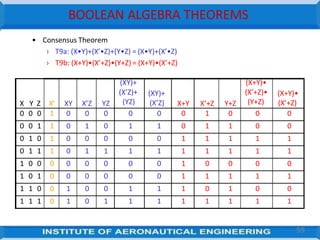
• Consensus Theorem
› T9a: (X•Y)+(X’•Z)+(Y•Z) = (X•Y)+(X’•Z)
› T9b: (X+Y)•(X’+Z)•(Y+Z) = (X+Y)•(X’+Z)
X Y Z X’ XY X’Z YZ
(XY)+
(X’Z)+
(YZ)
(XY)+
(X’Z) X+Y X’+Z Y+Z
(X+Y)•
(X’+Z)•
(Y+Z)
(X+Y)•
(X’+Z)
0 0 0 1 0 0 0 0 0 0 1 0 0 0
0 0 1 1 0 1 0 1 1 0 1 1 0 0
0 1 0 1 0 0 0 0 0 1 1 1 1 1
0 1 1 1 0 1 1 1 1 1 1 1 1 1
1 0 0 0 0 0 0 0 0 1 0 0 0 0
1 0 1 0 0 0 0 0 0 1 1 1 1 1
1 1 0 0 1 0 0 1 1 1 0 1 0 0
1 1 1 0 1 0 1 1 1 1 1 1 1 1
MORE THEOREMS?
60
• Shannon’s expansion theorem (also very important!)
• › T10a: f(X1,X2,…,Xn-1,Xn)=
• (X1’•f(0,X2,…,Xn-1,Xn))+(X1•f(1,X2,…,Xn-1,Xn))
• Can be taken further:
• - f(X1,X2,…,Xn-1,Xn)= (X1’•X2’•f(0,0,…,Xn-1,Xn))
• + (X1•X2’•f(1,0,…,Xn-1,Xn)) + (X1’•X2•f(0,1,…,Xn-1,Xn))
• +(X1•X2•f(1,1,…,Xn-1,Xn))
• Can be taken even further:
• - f(X1,X2,…,Xn-1,Xn)= (X1’•X2’•…•Xn-1’•Xn’•f(0,0,…,0,0))
• + (X1•X2’•…•Xn-1’•Xn’•f(1,0,…,0,0)) + …
• + (X1•X2•…•Xn-1•Xn•f(1,1,…,1,1))
• › T10b: f(X1,X2,…,Xn-1,Xn)=
• (X1+f(0,X2,…,Xn-1,Xn))•(X1’+f(1,X2,…,Xn-1,Xn))
• Can be taken further as in the case of T10a
• We’ll see significance of Shannon’s expansion theorem later
BOOLEAN ALGEBRA THEOREMS
61
• Idempotency
› T1a:X+X=X
› T1b: X•X=X
• Null elements
› T2a:X+1=1
› T2b:X•0=0
• Involution
› T3:(X’)’=X
X Y X+Y X•Y X+X X•X X+1 X•0 X’ X’’
0 0 0 0 0 0 1 0 1 0
0 1 1 0 0 0 1 0 1 0
1 0 1 0 1 1 1 0 0 1
1 1 1 1 1 1 1 0 0 1
OR AND
BOOLEAN ALGEBRA THEOREMS
62
X Y X+Y X•Y
X+
(X•Y)
X•
(X+Y) X’ X’•Y
X+
(X’•Y) X’+Y
X•
(X’+Y)
0 0 0 0 0 0 1 0 0 1 0
0 1 1 0 0 0 1 1 1 1 0
1 0 1 0 1 1 0 0 1 0 0
1 1 1 1 1 1 0 0 1 1 1
• Absorption (akacovering)
› T4a:X+(X•Y)=X
› T4b:X•(X+Y)=X
› T5a: X+(X’•Y)=X+Y
› T5b: X•(X’+Y)=X•Y
OR AND
BOOLEAN ALGEBRA THEOREMS
63
X Y X+Y X•Y Y’ X•Y’
(X•Y)+
(X•Y’) X+Y’
(X+Y)•
(X+Y’)
0 0 0 0 1 0 0 1 0
0 1 1 0 0 0 0 0 0
1 0 1 0 1 1 1 1 1
1 1 1 1 0 0 1 1 1
• Absorption (akacombining)
› T6a: (X•Y)+(X•Y’)=X
› T6b: (X+Y)•(X+Y’)=X
OR AND
BOOLEAN ALGEBRA THEOREMS
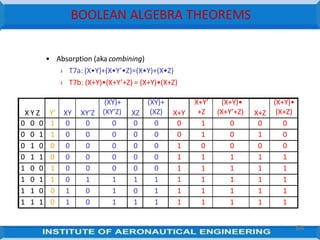
64
• Absorption (aka combining)
› T7a: (X•Y)+(X•Y’•Z)=(X•Y)+(X•Z)
› T7b: (X+Y)•(X+Y’+Z) = (X+Y)•(X+Z)
X Y Z Y’ XY XY’Z
(XY)+
(XY’Z) XZ
(XY)+
(XZ) X+Y
X+Y’
+Z
(X+Y)•
(X+Y’+Z) X+Z
(X+Y)•
(X+Z)
0 0 0 1 0 0 0 0 0 0 1 0 0 0
0 0 1 1 0 0 0 0 0 0 1 0 1 0
0 1 0 0 0 0 0 0 0 1 0 0 0 0
0 1 1 0 0 0 0 0 0 1 1 1 1 1
1 0 0 1 0 0 0 0 0 1 1 1 1 1
1 0 1 1 0 1 1 1 1 1 1 1 1 1
1 1 0 0 1 0 1 0 1 1 1 1 1 1
1 1 1 0 1 0 1 1 1 1 1 1 1 1
BOOLEAN ALGEBRA THEOREMS
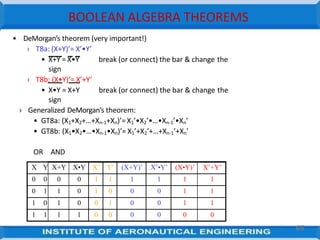
X Y X+Y X•Y X’ Y’ (X+Y)’ X’•Y’ (X•Y)’ X’+Y’
0 0 0 0 1 1 1 1 1 1
0 1 1 0 1 0 0 0 1 1
1 0 1 0 0 1 0 0 1 1
1 1 1 1 0 0 0 0 0 0
• DeMorgan’s theorem (very important!)
› T8a: (X+Y)’= X’•Y’
break (or connect) the bar & change the
• X+Y = X•Y
sign
› T8b: (X•Y)’= X’+Y’
• X•Y = X+Y
sign
› Generalized DeMorgan’s theorem:
• GT8a: (X1+X2+…+Xn-1+Xn)’=X1’•X2’•…•Xn-1’•Xn’
• GT8b: (X1•X2•…•Xn-1•Xn)’= X1’+X2’+…+Xn-1’+Xn’
OR AND
65
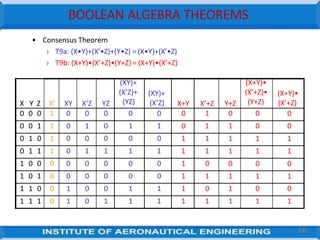
BOOLEAN ALGEBRA THEOREMS
66
• Consensus Theorem
› T9a: (X•Y)+(X’•Z)+(Y•Z) = (X•Y)+(X’•Z)
› T9b: (X+Y)•(X’+Z)•(Y+Z) = (X+Y)•(X’+Z)
X Y Z X’ XY X’Z YZ
(XY)+
(X’Z)+
(YZ)
(XY)+
(X’Z) X+Y X’+Z Y+Z
(X+Y)•
(X’+Z)•
(Y+Z)
(X+Y)•
(X’+Z)
0 0 0 1 0 0 0 0 0 0 1 0 0 0
0 0 1 1 0 1 0 1 1 0 1 1 0 0
0 1 0 1 0 0 0 0 0 1 1 1 1 1
0 1 1 1 0 1 1 1 1 1 1 1 1 1
1 0 0 0 0 0 0 0 0 1 0 0 0 0
1 0 1 0 0 0 0 0 0 1 1 1 1 1
1 1 0 0 1 0 0 1 1 1 0 1 0 0
1 1 1 0 1 0 1 1 1 1 1 1 1 1
MORE THEOREMS?
67
• Shannon’s expansion theorem (also very important!)
• › T10a: f(X1,X2,…,Xn-1,Xn)=
• (X1’•f(0,X2,…,Xn-1,Xn))+(X1•f(1,X2,…,Xn-1,Xn))
• Can be taken further:
• - f(X1,X2,…,Xn-1,Xn)= (X1’•X2’•f(0,0,…,Xn-1,Xn))
• + (X1•X2’•f(1,0,…,Xn-1,Xn)) + (X1’•X2•f(0,1,…,Xn-1,Xn))
• +(X1•X2•f(1,1,…,Xn-1,Xn))
• Can be taken even further:
• - f(X1,X2,…,Xn-1,Xn)= (X1’•X2’•…•Xn-1’•Xn’•f(0,0,…,0,0))
• + (X1•X2’•…•Xn-1’•Xn’•f(1,0,…,0,0)) + …
• + (X1•X2•…•Xn-1•Xn•f(1,1,…,1,1))
• › T10b: f(X1,X2,…,Xn-1,Xn)=
• (X1+f(0,X2,…,Xn-1,Xn))•(X1’+f(1,X2,…,Xn-1,Xn))
• Can be taken further as in the case of T10a
• We’ll see significance of Shannon’s expansion theorem later
SWITCHING FUNCTIONS
68
• Objective:
Understand the logic functions of the digitalcircuits
• Course Outcomes(CAEC020.05):
Describe minimization techniques and other optimization
techniques for Boolean formulas in general and digitalcircuits.
SWITCHING FUNCTIONs
69
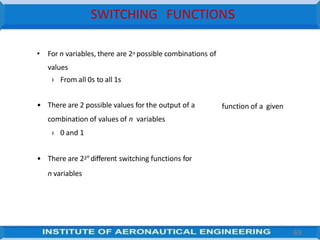
function of a given
• For n variables, there are 2n possible combinations of
values
› From all 0s to all 1s
• There are 2 possible values for the output of a
combination of values of n variables
› 0 and 1
• There are 22n
different switching functions for
n variables
SWITCHING FUNCTION EXAMPLES
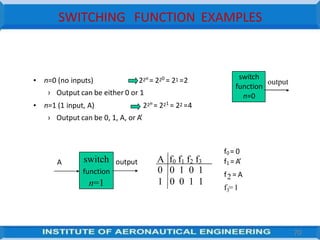
• n=0 (no inputs) 22n
= 220
= 21 =2
› Output can be either 0 or 1
• n=1 (1 input, A) 22n
= 221
= 22 =4
› Output can be 0, 1, A, or A’
switch
function
n=0
output
switch
function
n=1
output
A A f0 f1 f2 f3
0 0 1 0 1
1 0 0 1 1
f0 = 0
f1 = A’
f2 = A
3
f =1
70
SWITCHING FUNCTION EXAMPLES
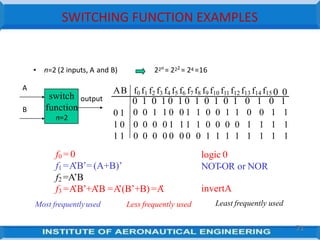
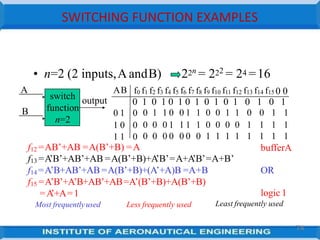
• n=2 (2 inputs, A and B) 22n
= 222
= 24 =16
AB f0 f1 f2 f3 f4 f5 f6 f7 f8 f9 f10 f11 f12 f13 f14 f15 0 0
0 1
0
0
1
0
0
1
1 0
1 0
1 0
0 1
1
1
0
0
1
0
0
1
1
1
0
0
1
0
0
1
1
1
1 0 0 0 0 0 1 1 1 1 0 0 0 0 1 1 1 1
1 1 0 0 0 0 0 0 0 0 1 1 1 1 1 1 1 1
logic 0
NOT-OR or NOR
switch
function
n=2
output
A
B
f0 = 0
f1 =A
’B’= (A+B)’
f2 =A’B
f3 =A
’B’+A
’B =A
’(B’+B) =A
’
Most frequentlyused Less frequently used
71
invertA
Least frequently used
SWITCHING FUNCTION EXAMPLES
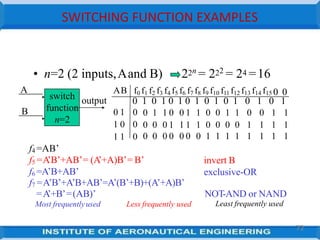
• n=2 (2 inputs,Aand B) 22n
= 222
= 24 =16
AB f0 f1 f2 f3 f4 f5 f6 f7 f8 f9 f10 f11 f12 f13 f14 f15 0 0
0 1 0 1 0 1 0 1 0 1 0 1 0 1 0 1
0 1 0
1 0 0
1 1 0
0 1 1 0 0 1 1 0 0 1 1 0 0 1 1
0 0 0 1 1 1 1 0 0 0 0 1 1 1 1
0 0 0 0 0 0 0 1 1 1 1 1 1 1 1
switch
function
n=2
output
A
B
invert B
exclusive-OR
f4 =AB’
f5 =A
’B’+AB’= (A
’+A)B’= B’
f6 =A’B+AB’
f7 =A’B’+A’B+AB’=A’(B’+B)+(A’+A)B’
=A
’+B’=(AB)’
Most frequently used Less frequently used
72
NOT-AND or NAND
Least frequently used
SWITCHING FUNCTION EXAMPLES
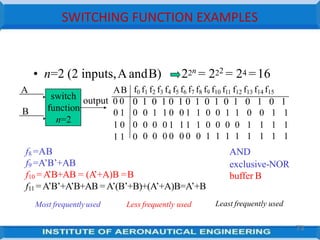
• n=2 (2 inputs,AandB) 22n
= 222
= 24 =16
1 1 0
0 1 1 0 0 1 1 0 0 1 1 0 0 1 1
0 0 0 1 1 1 1 0 0 0 0 1 1 1 1
0 0 0 0 0 0 0 1 1 1 1 1 1 1 1
switch
function
n=2
output
0 1 0
1 0 0
A AB
0 0
f0 f1 f2 f3 f4 f5 f6 f7 f8 f9 f10 f11 f12 f13 f14 f15
0 1 0 1 0 1 0 1 0 1 0 1 0 1 0 1
B
AND
exclusive-NOR
buffer B
f8 =AB
f9 =A’B’+AB
f10 =A
’B+AB = (A
’+A)B =B
f11 =A’B’+A’B+AB =A’(B’+B)+(A’+A)B=A’+B
Most frequentlyused Less frequently used
73
Least frequently used
SWITCHING FUNCTION EXAMPLES
• n=2 (2 inputs,AandB) 22n
= 222
= 24 =16
0 1 0
1 0 0
1 1 0
0 1 1 0 0 1 1 0 0 1 1 0 0 1 1
0 0 0 1 1 1 1 0 0 0 0 1 1 1 1
0 0 0 0 0 0 0 1 1 1 1 1 1 1 1
switch
function
n=2
output
A AB f0 f1 f2 f3 f4 f5 f6 f7 f8 f9 f10 f11 f12 f13 f14 f15 0 0
0 1 0 1 0 1 0 1 0 1 0 1 0 1 0 1
B
bufferA
OR
f12 =AB’+AB =A(B’+B) =A
f13 =A
’B’+AB’+AB =A(B’+B)+A
’B’=A+A
’B’=A+B’
f14 =A’B+AB’+AB =A(B’+B)+(A’+A)B =A+B
f15 =A’B’+A’B+AB’+AB=A’(B’+B)+A(B’+B)
=A
’+A=1 logic 1
Most frequentlyused Less frequently used
74
Least frequently used
CANONICAL AND STANDERED FORMS
75
• Logical functions are generally expressed in terms of different
combinations of logical variables with their true forms as well as the
complement forms. Binary logic values obtained by the logical functions
and logic variables are in binary form. An arbitrary logic function can be
expressed in the following forms.
• Sum of the Products (SOP)
• Product of the Sums (POS)
CANONICAL AND STANDERED FORMS
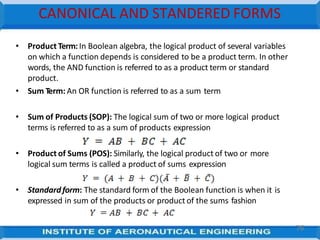
• Product Term:In Boolean algebra, the logical product of several variables
on which a function depends is considered to be a product term. In other
words, the AND function is referred to as a product term or standard
product.
• Sum Term: An OR function is referred to as a sum term
• Sum of Products (SOP): The logical sum of two or more logical product
terms is referred to as a sum of products expression
• Product of Sums (POS): Similarly, the logical product of two or more
logical sum terms is called a product of sums expression
• Standardform: The standard form of the Boolean function is when it is
expressed in sum of the products or product of the sums fashion
76
CANONICAL AND STANDERED FORMS
• Nonstandard Form: Boolean functions are also sometimes expressed in
nonstandard forms like , which is neither a sum of
products form nor a product of sums form.
• Minterm: A product term containing all n variables of the function in
either true or complemented form is called the minterm. Each minterm is
obtained by an AND operation of the variables in their true form or
complemented form.
• Maxterm: A sum term containing all n variables of the function in either
true or complemented form is called the Maxterm. Each Maxterm is
obtained by an OR operation of the variables in their true form or
complemented form.
77
CANONICAL SUM OF PRODUCTS
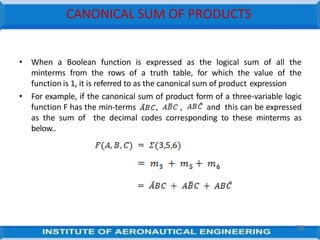
• When a Boolean function is expressed as the logical sum of all the
minterms from the rows of a truth table, for which the value of the
function is 1, it is referred to as the canonical sum of product expression
• For example, if the canonical sum of product form of a three-variable logic
function F has the min-terms , , and this can be expressed
as the sum of the decimal codes corresponding to these minterms as
below..
78
CANONICAL SUM OF PRODUCTS
79
• The canonical sum of products form of a logic function can be obtained by
using the following procedure:
• Check each term in the given logic function. Retain if it is a
minterm, continue to examine the next term in the same manner.
• Examine for the variables that are missing in each product which is
not a minterm. If the missing variable in the minterm is X, multiply
that minterm with (X+X’).
• Multiply all the products and discard the redundant terms.
CANONICAL SUM OF PRODUCTS
• Example: Obtain the canonical sum of product form of the following
function
• Solution:
• Hence the canonical sum of the product expression of the given function is
80
CANONICAL SUM OF PRODUCTS
81
The product of sums form is a method (or form) of simplifying the Boolean
expressions of logic gates. In this POS form, all the variables are ORed, i.e. written
as sums to form sum terms. All these sum terms are ANDed (multiplied) together to
get the product-of-sum form. This form is exactly opposite to the SOP form. So this
can also be said as ―
Dual of SOP form‖ .
(A+B) * (A + B + C) * (C +D)
(A+B) ̅ * (C + D + E ̅)
CANONICAL SUM OF PRODUCTS
82
POS form can be obtained by
• Writing an OR term for each input combination, which produces LOW
output.
• Writing the input variables if the value is 0, and write the complement of
the variable if its value isAND the OR terms to obtain the output function.
CANONICAL SUM OF PRODUCTS
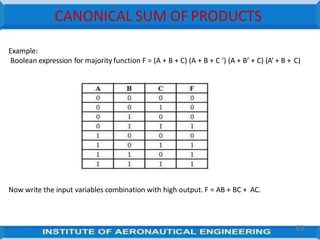
Example:
Boolean expression for majority function F = (A + B + C) (A + B + C ‘) (A + B’ + C) (A’ + B + C)
Now write the input variables combination with high output. F = AB + BC + AC.
83
KARANAUGH MAP
84
• Boolean algebra helps us simplify expressions andcircuits
• Karnaugh Map: A graphical technique for simplifying aBoolean
expression into either form:
– minimal sum of products(MSP)
– minimal product of sums(MPS)
• Goal of the simplification.
– There are a minimal number of product/sumterms
– Each term has a minimal number of literals
⚫A two-variable function has four possible minterms. We canre-
arrange
these minterms into a Karnaughmap
x y minterm
0 0 x’y’
0 1 x’y
1 0 xy’
1 1 xy
Y
0 1
X
0
1
x’y’ x’y
xy’ xy
⚫Now we can easily see which minterms contain commonliterals
◦ Minterms on the left and right sides contain y’ and y respectively
◦ Minterms in the top and bottom rows contain x’ and x respectively
Y
0 1
X
0
1
x’y’ x’y
xy’ xy
Y’ Y
X’ x’y’ x’y
X xy’ xy
8
55
KARANAUGH MAP
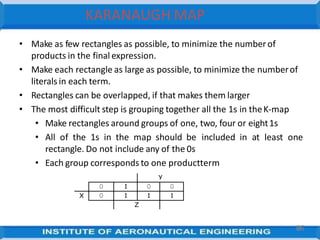
• Make as few rectangles as possible, to minimize the numberof
products in the final expression.
• Make each rectangle as large as possible, to minimize the numberof
literals in each term.
• Rectangles can be overlapped, if that makes them larger
• The most difficult step is grouping together all the 1s in theK-map
• Make rectangles around groups of one, two, four or eight1s
• All of the 1s in the map should be included in at least one
rectangle. Do not include any of the 0s
• Each group corresponds to one productterm
8
66
Y
0 1 0 0
X 0 1 1 1
Z
KARANAUGH MAP
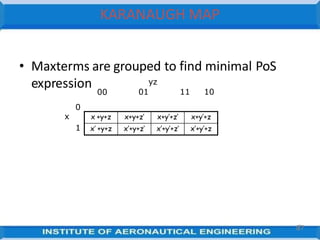
• Maxterms are grouped to find minimal PoS
8
77
expression
x +y+z x+y+z’ x+y’+z’ x+y’+z
x’ +y+z x’+y+z’ x’+y’+z’ x’+y’+z
00
0
x
1
yz
01 11 10
KARANAUGH MAP
x y z f(x,y,z)
0 0 0 0
0 0 1 1
0 1 0 0
0 1 1 0
1 0 0 0
1 0 1 1
1 1 0 1
1 1 1 1
8
38
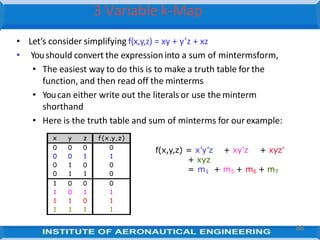
• Let’s consider simplifying f(x,y,z) = xy + y’z + xz
• Youshould convert the expression into a sum of mintermsform,
• The easiest way to do this is to make a truth table for the
function, and then read off the minterms
• Youcan either write out the literals or use the minterm
shorthand
• Here is the truth table and sum of minterms for our example:
f(x,y,z) = x’y’z + xy’z + xyz’
+ xyz
= m1 + m5 + m6 + m7
3 Variable k-Map
Y
x’y’z’ x’y’z x’yz x’yz’
X xy’z’ xy’z xyz xyz’
Z
8
49
Y
m0 m1 m3 m2
X m4 m5 m7 m6
Z
YZ
00 01 11 10
X
0
1
x’y’z’ x’y’z x’yz x’yz’
xy’z’ xy’z xyz xyz’
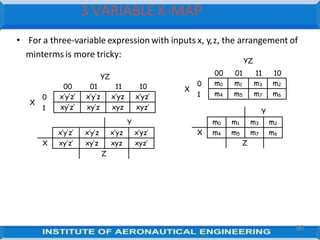
• For a three-variable expression with inputs x, y,z, the arrangement of
minterms is more tricky:
YZ
00 01 11 10
X
0
1
m0 m1 m3 m2
m4 m5 m7 m6
3 VARIABLE K-MAP
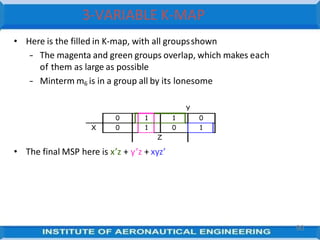
• Here is the filled in K-map, with all groupsshown
– The magenta and green groups overlap, which makes each
of them as large as possible
– Minterm m6 is in a group all by its lonesome
• The final MSP here is x’z + y’z + xyz’
Y
0 1 1 0
X 0 1 0 1
Z
3-VARIABLE K-MAP
90
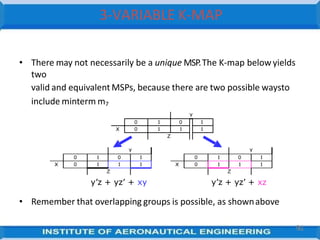
• There may not necessarily be a unique MSP.The K-map belowyields
two
valid and equivalent MSPs, because there are two possible waysto
include minterm m7
Y
0 1 0 1
X 0 1 1 1
Z
y’z + yz’ + xy y’z + yz’ + xz
• Remember that overlapping groups is possible, as shownabove
Y
0 1 0 1
X 0 1 1 1
Z
9
61
Y
0 1 0 1
X 0 1 1 1
Z
3-VARIABLE K-MAP
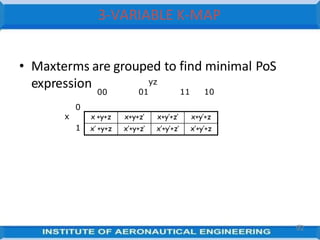
• Maxterms are grouped to find minimal PoS
9
72
expression
x +y+z x+y+z’ x+y’+z’ x+y’+z
x’ +y+z x’+y+z’ x’+y’+z’ x’+y’+z
00
0
x
1
yz
01 11 10
3-VARIABLE K-MAP
4-VARIABLE K-MAP
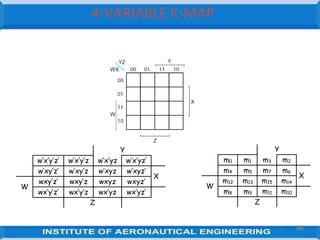
• We can do four-variable expressionstoo!
– The minterms in the third and fourth columns, and in thethird
and
fourth rows, are switchedaround.
– Again, this ensures that adjacent squares have common literals
• Grouping minterms is similar to the three-variable case, but:
– Youcan have rectangular groups of 1, 2, 4, 8 or 16 minterms
– Youcan wrap around all four sides
93
Y
m0 m1 m3 m2
m4 m5 m7 m6
X
W
m12 m13 m15 m14
m8 m9 m11 m10
Z
Y
w’x’y’z’ w’x’y’z w’x’yz w’x’yz’
w’xy’z’ w’xy’z w’xyz w’xyz’
X
W
wxy’z’ wxy’z wxyz wxyz’
wx’y’z’ wx’y’z wx’yz wx’yz’
Z
4-VARIABLE K-MAP
9
44
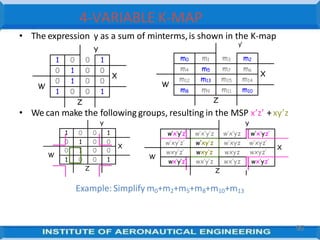
• The expression y as a sum of minterms,is shown in the K-map
• We can make the following groups, resulting in the MSP x’z’ +xy’z
Y
1 0 0 1
0 1 0 0
X
W
0 1 0 0
1 0 0 1
Z
y’
m0 m1 m3 m2
m4 m5 m7 m6
X
W
m12 m13 m15 m14
m8 m9 m11 m10
Z
Y
1 0 0 1
X
W
0 1 0 0
0 1 0 0
1 0 0 1
Z
Example: Simplify m0+m2+m5+m8+m10+m13
Y
w’x’y’z’ w’x’y’z w’x’yz w’x’yz’
w’xy’z’ w’xy’z w’xyz w’xyz’
X
W
wxy’z’ wxy’z wxyz wxyz’
wx’y’z’ wx’y’z wx’yz wx’yz’
Z
9
55
4-VARIABLE K-MAP
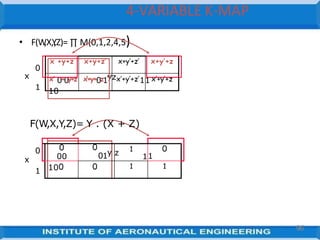
• F(W
,X,Y
,Z)= ∏ M(0,1,2,4,5)
x +y+z x+y+z’ x+y’+z’ x+y’+z
x’ 0+0y+z x’+y+0z1’ 1 x’+y’+z
10
0
1
x zx’+y’+z’1
y
0 0
00 01y z 1
1
0
1
100 0 1 1
F(W,X,Y,Z)= Y . (X + Z)
9
66
0
x
1
4-VARIABLE K-MAP
5-VARIABLE K-MAP
97
• Objective:
Understand the 5-Variable K-map
• Course Outcomes(CAEC020.06):
Evaluate the functions using various types of minimizing algorithms
like Karanaugh map method.
V= 0
9
38
Y
m0 m1 m3 m2
m4 m5 m7 m6
X
W
m12 m13 m15 m14
m8 m9 m11 m10
Z
V= 1Y
m16 m17 m19 m8
m20 m21 m23 m22
X
W
m28 m29 m31 m30
m24 m25 m27 m26
Z
5-variable K-map
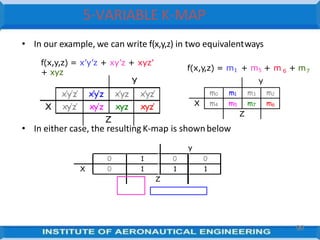
• In our example, we can write f(x,y,z) in two equivalentways
Y
x’y’z’ x’y’z x’yz x’yz’
X xy’z’ xy’z xyz xyz’
Z
f(x,y,z) = x’y’z + xy’z + xyz’
+ xyz
Y
m0 m1 m3 m2
X m4 m5 m7 m6
Z
6
f(x,y
,z) = m1 + m5 + m + m7
• In either case, the resulting K-map is shownbelow
Y
0 1 0 0
X 0 1 1 1
Z
5-VARIABLE K-MAP
9
49
V= 1
1
V= 0
1
1 1
1 1 1
1 1
1 1 1
1 1
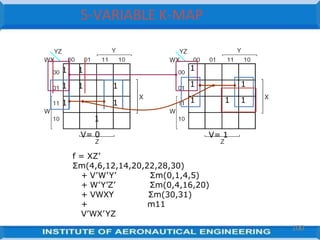
f = XZ’
Σm(4,6,12,14,20,22,28,30)
10
50
Σm(0,1,4,5)
Σm(0,4,16,20)
+ V’W’Y’
+ W’Y’Z’
+ VWXY
+
V’WX’YZ
Σm(30,31)
m11
5-VARIABLE K-MAP
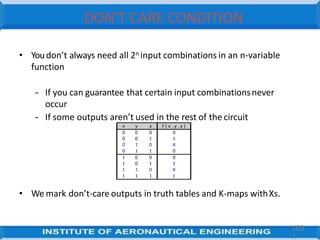
• Youdon’t always need all 2n input combinations in an n-variable
function
– If you can guarantee that certain input combinationsnever
occur
– If some outputs aren’t used in the rest of the circuit
103
1
• We mark don’t-care outputs in truth tables and K-maps withXs.
x y z f ( x , y , z )
0 0 0 0
0 0 1 1
0 1 0 X
0 1 1 0
1 0 0 0
1 0 1 1
1 1 0 X
1 1 1 1
DON’T CARE CONDITION
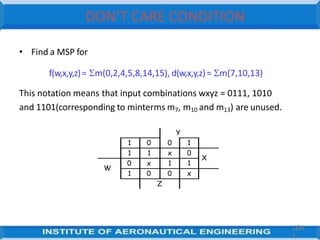
• Find a MSP for
f(w,x,y,z)= m(0,2,4,5,8,14,15), d(w,x,y,z)= m(7,10,13)
This notation means that input combinations wxyz = 0111, 1010
and 1101(corresponding to minterms m7, m10 and m13) are unused.
104
1
Y
1 0 0 1
1 1 x 0
X
W
0 x 1 1
1 0 0 x
Z
DON’T CARE CONDITION
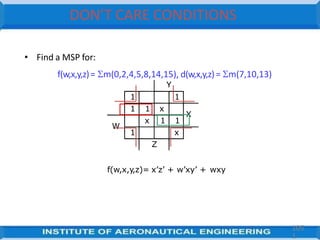
• Find a MSP for:
f(w,x,y,z)= m(0,2,4,5,8,14,15), d(w,x,y,z)= m(7,10,13)
Y
1 1
1 1 x
X
W
1
x 1 1
x
Z
f(w,x,y
,z)= x’z’ + w’xy’ + wxy
105
1
DON’T CARE CONDITIONS
• The objectives of this lesson are to learnabout:
1. Universal gates - NAND and NOR.
2. How to implement NOT,AND, and OR gate using NAND gates only.
3. How to implement NOT,AND, and OR gate using NOR gates only.
4. Equivalentgates.
104
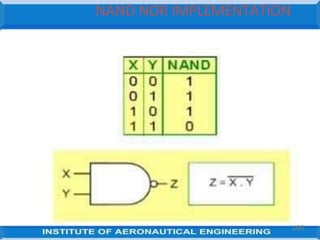
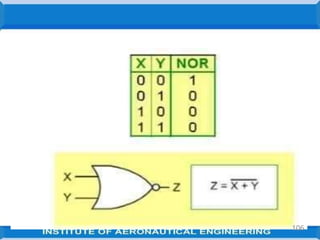
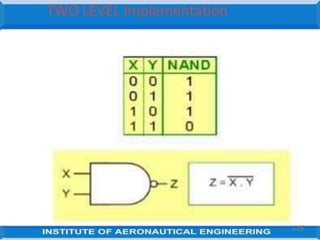
NAND NOR IMPLEMENTATION
105
106
NAND NOR IMPLEMENTATION
107
NAND NOR IMPLEMENTATION
108
TWO LEVEL Implementation
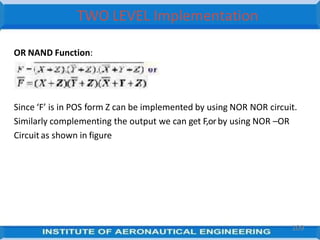
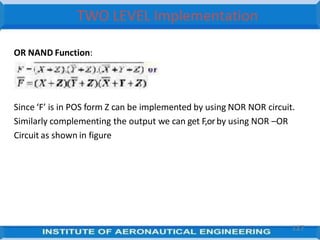
OR NAND Function:
Implement the followingfunction
Since ‘F’ is in POS form Z can be implemented by using NOR NOR circuit.
Similarly complementing the output we can get F,orby using NOR –OR
Circuit as shown in figure
109
TWO LEVEL Implementation
110
It can also be implemented using OR-NAND circuit as it is equivalent
to NOR-OR circuit
111
TWO LEVEL Implementation
Two Level Implementation
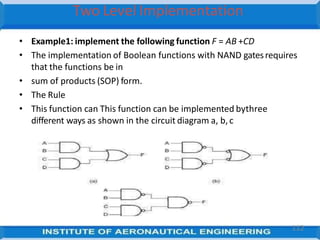
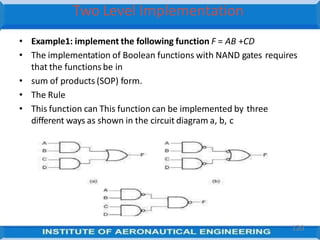
• Example1: implement the following function F = AB +CD
• The implementation of Boolean functions with NAND gatesrequires
that the functions be in
• sum of products (SOP) form.
• The Rule
• This function can This function can be implemented bythree
different ways as shown in the circuit diagram a, b, c
112
Two Level Implementation
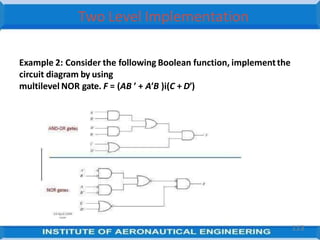
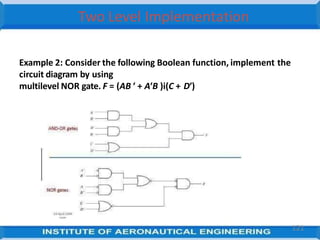
Example 2: Consider the following Boolean function, implementthe
circuit diagram by using
multilevel NOR gate. F = (AB ′ + A′B )i(C + D′)
113
Two Level Implementation
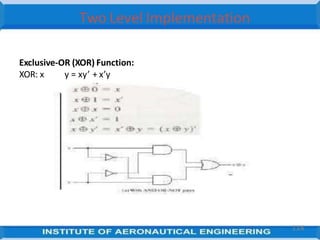
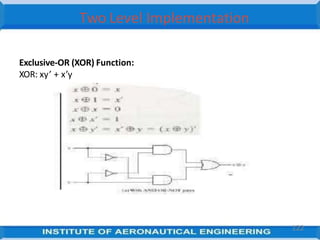
Exclusive‐OR (XOR) Function:
XOR: x y = xy’ + x’y
114
Two Level Implementation
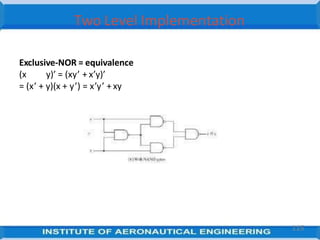
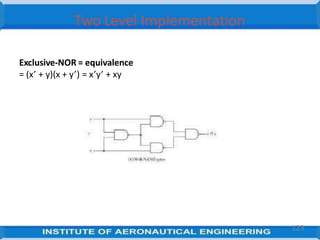
Exclusive‐NOR = equivalence
(x y)’ = (xy’ + x’y)’
= (x’ + y)(x + y’) = x’y’ + xy
115
TWO LEVEL Implementation
116
TWO LEVEL Implementation
OR NAND Function:
Implement the following function
Since ‘F’ is in POS form Z can be implemented by using NOR NOR circuit.
Similarly complementing the output we can get F,orby using NOR –OR
Circuit as shown in figure
117
TWO LEVEL Implementation
118
It can also be implemented using OR-NAND circuit as it is equivalent
to NOR-OR circuit
119
TWO LEVEL Implementation
Two Level Implementation
• Example1: implement the following function F = AB +CD
• The implementation of Boolean functions with NAND gates requires
that the functions be in
• sum of products (SOP) form.
• The Rule
• This function can This function can be implemented by three
different ways as shown in the circuit diagram a, b, c
120
Two Level Implementation
Example 2: Consider the following Boolean function, implement the
circuit diagram by using
multilevel NOR gate. F = (AB ′ + A′B )i(C + D′)
121
Two Level Implementation
Exclusive‐OR (XOR) Function:
XOR: xy’ + x’y
122
Two Level Implementation
Exclusive‐NOR = equivalence
= (x’ + y)(x + y’) = x’y’ + xy
123
COMBINATIONAL CIRCUITS
UNIT 3
COMBINATIONAL
CIRCUITS
124
Combinational Circuits
125
• Combinational circuit is a circuit in which we combine the different
gates in the circuit, for example encoder, decoder, multiplexer and
demultiplexer.
Some of the characteristics of combinational circuits are following:
• The output of combinational circuit at any instant of time,depends
only on the levels present at inputterminals.
• The combinational circuit do not use any memory. The previousstate
of input does not have any effect on the present state of the circuit.
• A combinational circuit can have an n number of inputs and mnumber
of outputs.
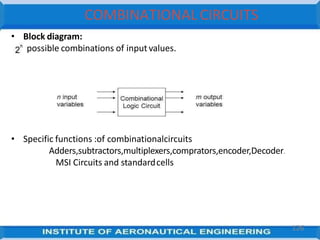
• Block diagram:
possible combinations of input values.
• Specific functions :of combinationalcircuits
Adders,subtractors,multiplexers,comprators,encoder,Decoder.
MSI Circuits and standardcells
COMBINATIONAL CIRCUITS
126
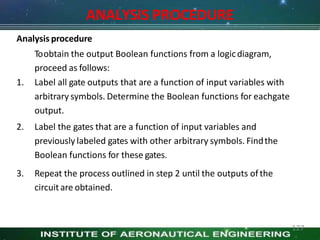
Analysis procedure
Toobtain the output Boolean functions from a logicdiagram,
proceed as follows:
1. Label all gate outputs that are a function of input variables with
arbitrary symbols. Determine the Boolean functions for eachgate
output.
2. Label the gates that are a function of input variables and
previously labeled gates with other arbitrary symbols. Findthe
Boolean functions for these gates.
3. Repeat the process outlined in step 2 until the outputs ofthe
circuit are obtained.
127
ANALYSIS PROCEDURE
DESIGN PROCEDURE
128
Design Procedure
1.The problem is stated
2.The number of available input variables and requiredoutput
variables is determined.
3.The input and output variables are assigned lettersymbols.
4.The truth table that defines the required relationship betweeninputs
and outputs is derived.
5.The simplified Boolean function for each output isobtained.
6.The logic diagram is drawn.
BINARY ADDERS
ADDERS
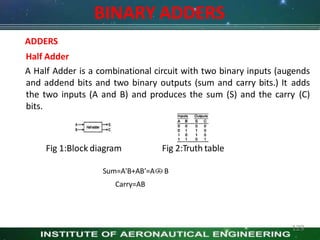
Half Adder
A Half Adder is a combinational circuit with two binary inputs (augends
and addend bits and two binary outputs (sum and carry bits.) It adds
the two inputs (A and B) and produces the sum (S) and the carry (C)
bits.
Fig 1:Block diagram Fig 2:Truth table
Sum=A′B+AB′=A B
Carry=AB
129
Full Adder
The full-adder adds the bits A and B and the carry from the previous
column called the carry-in Cin and outputs the sum bit S and the
carry bit called the carry-out Cout .
BINARY ADDERS
Fig 3: block diagram
130
Fig 4:Truth table
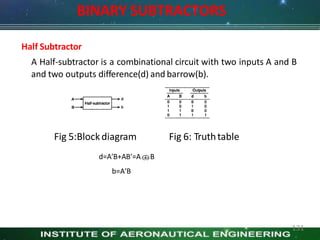
Half Subtractor
A Half-subtractor is a combinational circuit with two inputs A and B
and two outputs difference(d) and barrow(b).
Fig 5:Blockdiagram Fig 6: Truthtable
BINARY SUBTRACTORS
d=A′B+AB′=A B
b=A′B
131
BINARY SUBTRACTORS
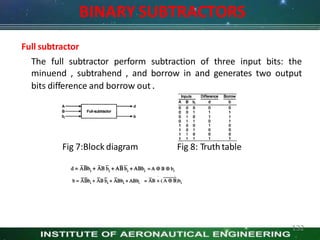
Full subtractor
The full subtractor perform subtraction of three input bits: the
minuend , subtrahend , and borrow in and generates two output
bits difference and borrow out .
Fig 7:Block diagram Fig 8: Truthtable
132
PARALLEL ADDER AND SUBTRACTOR
A binary parallel adder is a digital circuit that adds two binary
numbers in parallel form and produces the arithmetic sum ofthose
numbers in parallelform
Fig 9:parallel adder
133
Fig 10:parallel subtractor
CARRY LOOK-A- HEAD ADDER
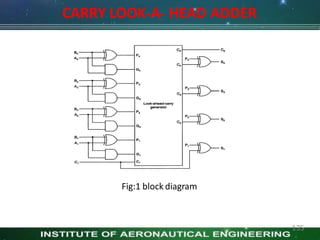
• In parallel-adder , the speed with which an addition can be
performed is governed by the time required for the carriesto
propagate or ripple through all of the stages of theadder.
• The look-ahead carry adder speeds up the process by eliminating
this ripple carry delay.
134
CARRY LOOK-A- HEAD ADDER
Fig:1 block diagram
135
BINARY MULTIPLIER
136
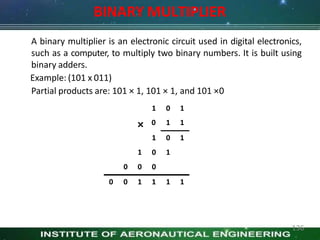
A binary multiplier is an electronic circuit used in digital electronics,
such as a computer, to multiply two binary numbers. It is built using
binary adders.
Example: (101 x 011)
Partial products are: 101 × 1, 101 × 1, and 101 ×0
1 0 1
× 0 1 1
1 0 1
1 0 1
0 0 0
0 0 1 1 1 1
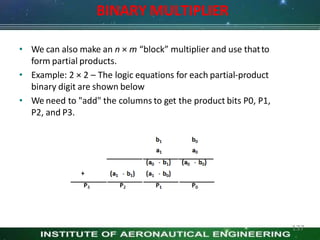
• We can also make an n × m “block” multiplier and use thatto
form partial products.
• Example: 2 × 2 – The logic equations for each partial-product
binary digit are shown below
• We need to "add" the columns to get the product bits P0, P1,
P2, and P3.
BINARY MULTIPLIER
137
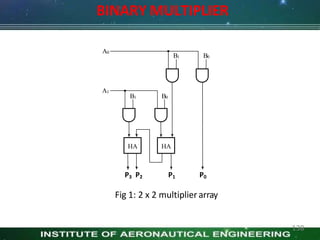
HA HA
A0
A1
B1 B0
B1 B0
BINARY MULTIPLIER
138
P3 P2 P1 P0
Fig 1: 2 x 2 multiplierarray
MAGNITUDE COMPARATOR
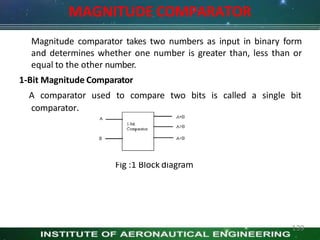
Magnitude comparator takes two numbers as input in binary form
and determines whether one number is greater than, less than or
equal to the other number.
1-Bit Magnitude Comparator
A comparator used to compare two bits is called a single bit
comparator.
Fig :1 Block diagram
139
MAGNITUDE COMPARATOR
Fig 2:Logic diagram of 1-bit comparator
140
MAGNITUDE COMPARATOR
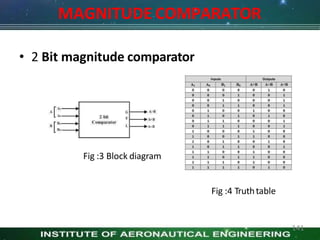
• 2 Bit magnitude comparator
Fig :3 Block diagram
Fig :4 Truthtable
141
MAGNITUDE COMPARATOR
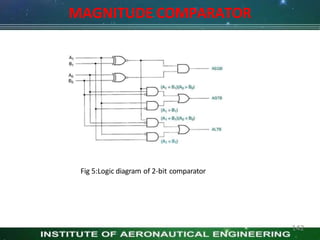
Fig 5:Logic diagram of 2-bit comparator
142
BCD ADDER
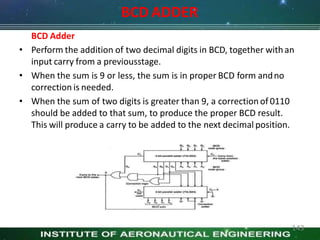
BCD Adder
• Perform the addition of two decimal digits in BCD, together withan
input carry from a previousstage.
• When the sum is 9 or less, the sum is in proper BCD form andno
correction is needed.
• When the sum of two digits is greater than 9, a correction of 0110
should be added to that sum, to produce the proper BCD result.
This will produce a carry to be added to the next decimal position.
143
DECODER
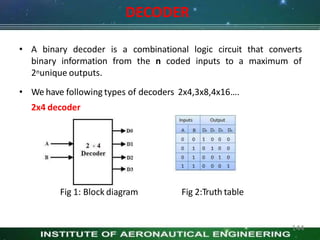
• A binary decoder is a combinational logic circuit that converts
binary information from the n coded inputs to a maximum of
2nunique outputs.
• We have following types of decoders 2x4,3x8,4x16….
2x4 decoder
Fig 1: Block diagram Fig 2:Truth table
144
DECODERS
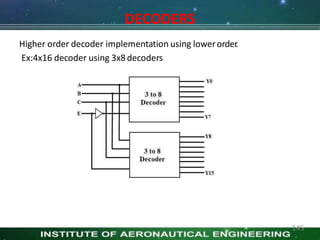
Higher order decoder implementation using lowerorder
.
Ex:4x16 decoder using 3x8decoders
145
ENCODERS
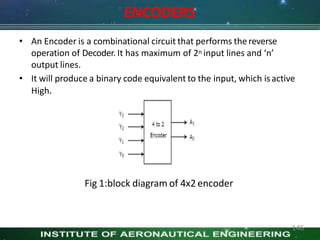
• An Encoder is a combinational circuit that performs thereverse
operation of Decoder. It has maximum of 2n input lines and ‘n’
output lines.
• It will produce a binary code equivalent to the input, which isactive
High.
Fig 1:block diagram of 4x2 encoder
146
ENCODERS
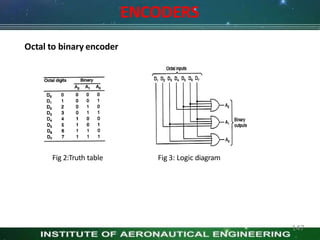
Octal to binary encoder
147
Fig 3: Logic diagram
Fig 2:Truth table
ENCODER
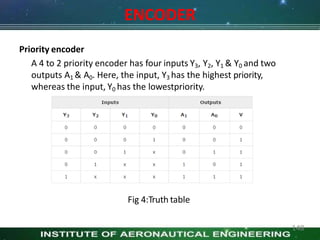
Priority encoder
A 4 to 2 priority encoder has four inputs Y3, Y2, Y1 & Y0 and two
outputs A1 & A0. Here, the input, Y3 has the highest priority,
whereas the input, Y0 has the lowestpriority.
Fig 4:Truth table
148
MULTIPLEXERS
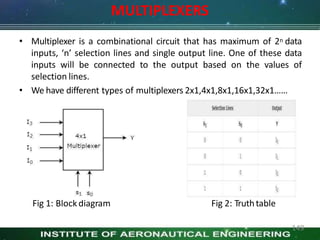
• Multiplexer is a combinational circuit that has maximum of 2n data
inputs, ‘n’ selection lines and single output line. One of these data
inputs will be connected to the output based on the values of
selection lines.
• We have different types of multiplexers 2x1,4x1,8x1,16x1,32x1……
Fig 1: Block diagram Fig 2: Truthtable
149
MULTIPLEXERS
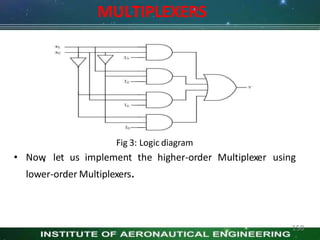
Fig 3: Logic diagram
• Now
, let us implement the higher-order Multiplexer using
lower-order Multiplexers.
150
MULTIPLEXERS
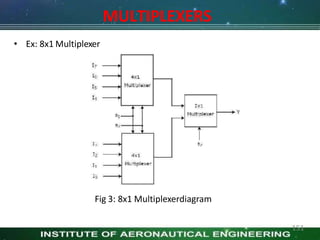
• Ex: 8x1 Multiplexer
Fig 3: 8x1 Multiplexerdiagram
151
MULTIPLEXERS
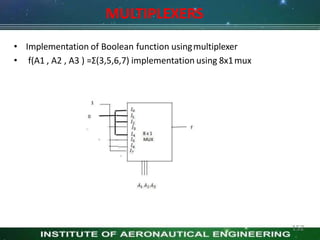
• Implementation of Boolean function usingmultiplexer
• f(A1 , A2 , A3 ) =Σ(3,5,6,7) implementation using 8x1mux
152
MULTIPLEXERS
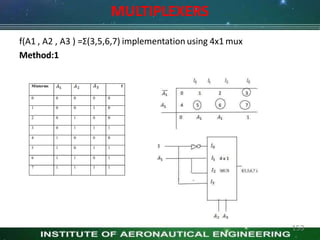
f(A1 , A2 , A3 ) =Σ(3,5,6,7) implementation using 4x1 mux
Method:1
Fig 1: Truthtable
153
MULTIPLEXERS
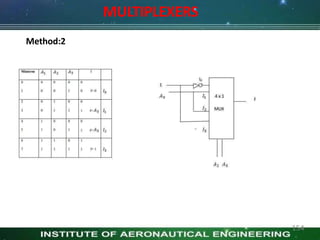
Method:2
Fig 1: Truthtable
154
DEMULTIPLEXER
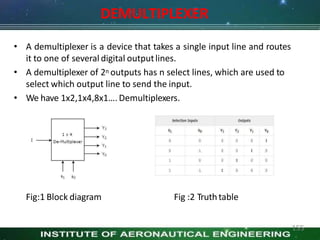
• A demultiplexer is a device that takes a single input line and routes
it to one of several digital outputlines.
• A demultiplexer of 2n outputs has n select lines, which are used to
select which output line to send the input.
• We have 1x2,1x4,8x1….Demultiplexers.
Fig:1 Block diagram Fig :2 Truthtable
155
DEMULTIPLEXER
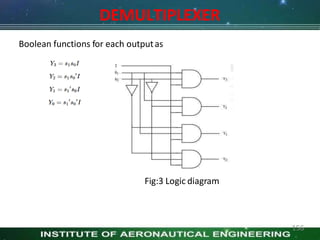
Boolean functions for each outputas
Fig:3 Logic diagram
156
CODE CONVERTERS
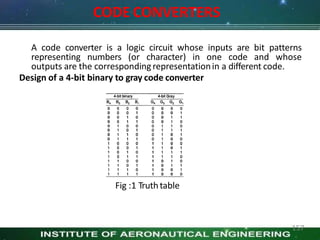
A code converter is a logic circuit whose inputs are bit patterns
representing numbers (or character) in one code and whose
outputs are the corresponding representationin a different code.
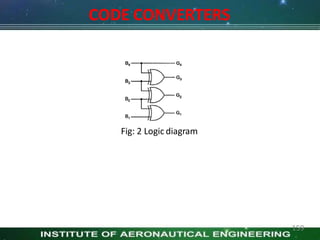
Design of a 4-bit binary to gray code converter
Fig :1 Truthtable
157
CODE CONVERTERS
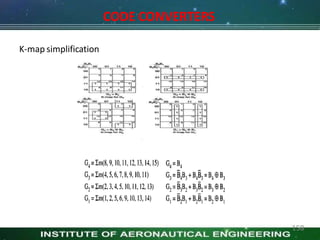
K-map simplification
158
CODE CONVERTERS
Fig: 2 Logic diagram
159
UNIT 4
INTRODUCTION TO
SEQUENTIALLOGIC CIRCUITS
160
SEQUENTIAL LOGIC CIRCUITS
SEQUENTIALLOGIC CIRCUITS
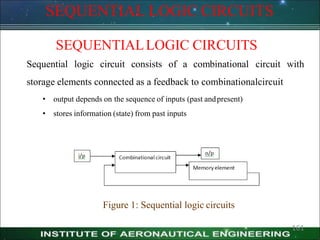
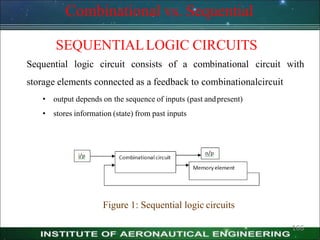
Sequential logic circuit consists of a combinational circuit with
storage elements connected as a feedback to combinationalcircuit
• output depends on the sequence of inputs (past andpresent)
• stores information (state) from past inputs
SEQUENTIAL LOGIC CIRCUITS
Figure 1: Sequential logic circuits
161
SEQUENTIAL LOGIC CIRCUITS
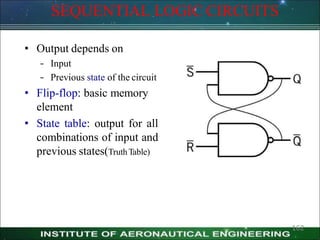
• Output depends on
– Input
– Previous state of the circuit
• Flip-flop: basic memory
element
• State table: output for all
combinations of input and
previous states(TruthTable)
162
SEQUENTIAL LOGIC CIRCUITS
163
1. Sequential circuit receives the binary informationfrom
external inputs and with the present state of the storage
elements together determine the binary value of the
outputs.
2. The output in a sequential circuit are a function of not
only the inputs, but also the present state of the storage
elements.
3. The next state of the storage elements is also afunction
of external inputs and the presentstate.
4. There are two main types of sequentialcircuits
1. synchronous sequential circuits
2. asynchronous sequential circuits
Synchronous sequential circuits
It is a system whose behaviour can be
defined from the knowledge of itssignals
at discrete instants of time
Asynchronous sequential circuits
It depends upon the input signals at any
instant of time and the order in which the
input changes
164
SEQUENTIAL LOGIC CIRCUITS
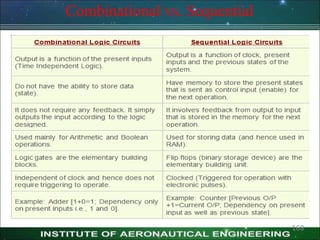
Combinational vs. Sequential
COMBINA
TIONAL LOGIC CIRCUIT
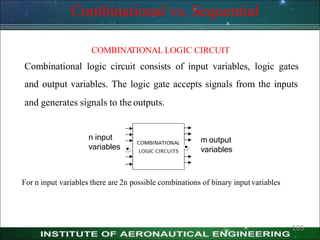
Combinational logic circuit consists of input variables, logic gates
and output variables. The logic gate accepts signals from the inputs
and generates signals to the outputs.
n input
variables
165
m output
variables
For n input variables there are 2n possible combinations of binary input variables
SEQUENTIALLOGIC CIRCUITS
Sequential logic circuit consists of a combinational circuit with
storage elements connected as a feedback to combinationalcircuit
• output depends on the sequence of inputs (past andpresent)
• stores information (state) from past inputs
Combinational vs. Sequential
Figure 1: Sequential logic circuits
166
Combinational vs. Sequential
167
Combinational Circuit
always gives the same output for a given set of inputs
ex: adder always generates sum and carry,
regardless of previous inputs
Sequential Circuit
stores information
output depends on stored information (state) plus input
so a given input might produce different outputs,
depending on the stored information
example: ticket counter
advances when you push the button
output depends on previous state
useful for building ―memory‖ elements and ―statemachines‖
Combinational vs. Sequential
168
LATCHES
169
STORAGE ELEMENTS
Storage elements in a digital circuit can maintain a binary state
indefinitely, until directed by an input signal to switch states. The
major difference among various storage elements are the number of
input they posses and the manner in which the inputs affect the
binary state.There are two types of storage elements
1. Latches
2. Flipflops
Storage elements that operate with signal level are referred aslatch
and those controlled by a clock transition are referred asflipflops.
LATCHES
170
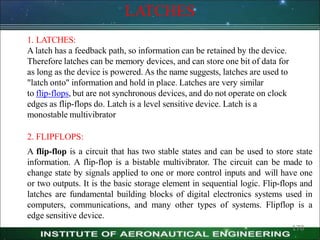
1. LATCHES:
A latch has a feedback path, so information can be retained by the device.
Therefore latches can be memory devices, and can store one bit of data for
as long as the device is powered. As the name suggests, latches are used to
"latch onto" information and hold in place. Latches are very similar
to flip-flops, but are not synchronous devices, and do not operate on clock
edges as flip-flops do. Latch is a level sensitive device. Latch is a
monostable multivibrator
2. FLIPFLOPS:
A flip-flop is a circuit that has two stable states and can be used to store state
information. A flip-flop is a bistable multivibrator. The circuit can be made to
change state by signals applied to one or more control inputs and will have one
or two outputs. It is the basic storage element in sequential logic. Flip-flops and
latches are fundamental building blocks of digital electronics systems used in
computers, communications, and many other types of systems. Flipflop is a
edge sensitive device.
LATCHES
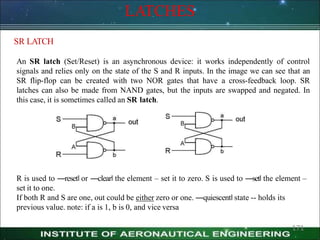
SR LATCH
An SR latch (Set/Reset) is an asynchronous device: it works independently of control
signals and relies only on the state of the S and R inputs. In the image we can see that an
SR flip-flop can be created with two NOR gates that have a cross-feedback loop. SR
latches can also be made from NAND gates, but the inputs are swapped and negated. In
this case, it is sometimes called an SR latch.
R is used to ―reset‖ or ―clear‖ the element – set it to zero. S is used to ―set‖ the element –
set it to one.
If both R and S are one, out could be either zero or one. ―quiescent‖ state -- holds its
previous value. note: if a is 1, b is 0, and vice versa
171
LATCHES
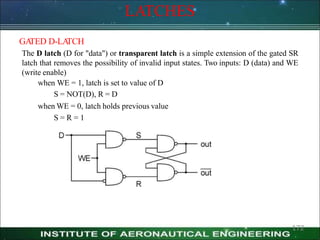
GA
TED D-LA
TCH
The D latch (D for "data") or transparent latch is a simple extension of the gated SR
latch that removes the possibility of invalid input states. Two inputs: D (data) and WE
(write enable)
when WE = 1, latch is set to value of D
S = NOT(D), R = D
when WE = 0, latch holds previous value
S = R = 1
172
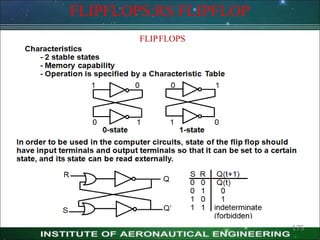
FLIPFLOPS:RS FLIPFLOP
173
Flip flops
A flip flop is an electronic circuit with two stable states that can be used to store
binary data. The stored data can be changed by applying varying inputs. Flip-flops
and latches are fundamental building blocks of digital electronics systems used in
computers, communications, and many other types of systems. Flip-flops and
latches are used as data storage elements. There are 4 types of flipflops
1. RS flip flop
2. Jk flip flop
3. D flip flop
4. T flip flop
Applications of Flip-Flops
These are the various types of flip-flops being used in digital electronic circuits and
the applications like Counters, Frequency Dividers, Shift Registers, Storage
Registers
FLIPFLOPS:RS FLIPFLOP
EDGE-TRIGGERED FLIP FLOPS
Characteristics
- State transition occurs at the rising edge or
falling edge of the clock pulse
Latches
respond to the input only during these periods
Edge-triggered Flip Flops (positive)
respond to the input only at this time
174
FLIPFLOPS:RS FLIPFLOP
FLIPFLOPS
175
FLIPFLOPS:RS FLIPFLOP
SR Flip-Flop
The SR flip-flop, also known as a SR Latch, can be considered as one of the most basic
sequential logic circuit possible. This simple flip-flop is basically a one-bit memory bistable
device that has two inputs, one which will ―SET‖ the device (meaning the output = ―1‖),
and is labelled S and one which will ―RESET‖the device (meaning the output = ―0‖),
labelled R.The reset input resets the flip-flop back to its original state with an output Q that
will be either at a logic level ―1‖or logic ―0‖depending upon this set/resetcondition.
Abasic NAND gate SR flip-flop circuit provides feedback from both of its outputs back to
its opposing inputs and is commonly used in memory circuits to store a single data bit.
Then the SR flip-flop actually has three inputs, Set, Reset and its current output Q relating
to it’s current state or history.
Truth Table for this Set-Reset Function
176
FLIPFLOPS:JK FLIPFLOP
177
JK Flip flop
The JK Flip-flop is similar to the SR Flip-flop but there is no change in state when
the J and K inputs are both LOW.The basic S-R NAND flip-flop circuit has many
advantages and uses in sequential logic circuits but it suffers from two basic
switching problems.
1. the Set = 0 and Reset = 0 condition (S = R = 0) must always be avoided
2.if Set or Reset change state while the enable (EN) input is high the correct
latching action may not occur
Then to overcome these two fundamental design problems with the SR flip-flop
design, the JK flip Flop was developed by the scientist name Jack Kirby.
The JK flip flop is basically a gated SR flip-flop with the addition of a clock input
circuitry that prevents the illegal or invalid output condition that can occur when
both inputs S and R are equal to logic level ―
1‖. Due to this additional clocked
input, a JK flip-flop has four possible input combinations, ―logic1‖, ―logic0‖, ―
n
o
change‖ and ―toggle‖.The symbol for a JK flip flop is similar to that of an SR
Bistable Latch as seen in the previous tutorial except for the addition of a clock
input.
FLIPFLOPS:JK FLIPFLOP
Both the S and the R inputs of the previous SR bistable have now been replaced by two inputs
called the J and K inputs, respectively after its inventorJack Kilby. Then thisequates
to: J = S and K = R.
The two 2-inputAND gates of the gated SR bistable have now been replaced by two 3-
input NAND gates with the third input of each gate connected to the outputs at Q and Q. This cross
coupling of the SR flip-flop allows the previously invalid condition of S = ―1‖and R = ―1‖state to be
used to produce a ―toggle action‖ as the two inputsare now interlocked.
If the circuit is now ―SET‖ the J input is inhibited by the ―0‖status of Q throughthe
lower NAND gate. If the circuit is ―RESET‖ the K input is inhibited by the ―0‖status of Q through
the upper NAND gate.As Q and Q are always different we can use them to control the input.When
both inputs J and K are equal to logic ―1‖,the JK flip flop toggles as shown in the following truth
table.
178
FLIPFLOPS:JK FLIPFLOP
The Truth T
able for the JK Function
Then the JK flip-flop is basically an SR flip flop
with feedback which enables only one of its two
input terminals, either SET or RESET to be
active at any one time thereby eliminating the
invalid condition seen previously in the SR flip
flop circuit. Also when both the J and
the K inputs are at logic level ―
1‖ at the same
time, and the clock input is pulsed ―HIGH‖,the
circuit will ―
toggle‖ from its SET state to a
RESET state, or visa-versa. This results in the JK
flip flop acting more like a T-type toggle flip-flop
when both terminals are―HIGH‖.
179
FLIPFLOPS:T FLIPFLOP
T FLIPFLOP
We can construct a T flip flop by any of the following methods. Connecting the output feedback
to the input, in SR flip flop. Connecting the XOR of T input and Q PREVIOUS output to the
Data input, in D flip flop. Hard – wiring the J and K inputs together and connecting it to T input,
in JK flip – flop.
180
FLIPFLOPS:T FLIPFLOP
Working
T flip – flop is an edge triggered device i.e. the low to high or high to low transitions
on a clock signal of narrow triggers that is provided as input will cause the change in
output state of flip – flop. T flip – flop is an edge triggered device.
Truth T
able of T flip – flop
181
FLIPFLOPS:T FLIPFLOP
182
If the output Q = 0, then the upper NAND is in enable state and lower NAND gate is in
disable condition. This allows the trigger to pass the S inputs to make the flip – flop in SET
state i.e. Q = 1.
If the output Q = 1, then the upper NAND is in disable state and lower NAND gate is in
enable condition. This allows the trigger to pass the R inputs to make the flip – flop in RESET
state i.e. Q =0.
In simple terms, the operation of the T flip – flop is
When the T input is low, then the next sate of the T flip flop is same as the present state.
T = 0 and present state = 0 then the next state = 0
T = 1 and present state = 1 then the next state = 1
When the T input is high and during the positive transition of the clock signal, the next stateof
the T flip – flop is the inverse of presentstate.
T = 1 and present state = 0 then the next state = 1
T = 1 and present state = 1 then the next state = 0
Applications
Frequency Division Circuits.
2 – Bit Parallel Load Registers.
FLIPFLOPS:D FLIPFLOP
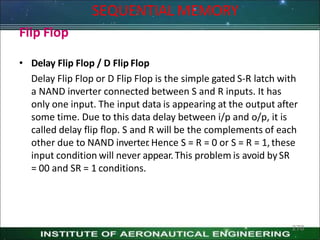
183
D FLIP FLOP
The D-type flip-flop is a modified Set-Reset flip-flop with the addition of an inverter to prevent
the S and R inputs from being at the same logic level
One of the main disadvantages of the basic SR NAND Gate Bistable circuit is that the
indeterminate input condition of SET = ―0‖and RESET = ―0‖isforbidden.
This state will force both outputs to be at logic ―1‖,over-riding the feedback latching action and
whichever input goes to logic level ―1‖first will lose control, while the other input still at logic
―
0‖ controls the resulting state of the latch.
But in order to prevent this from happening an inverter can be connected between the ―SET‖ and
the ―RESET‖inputs to produce another type of flip flop circuit known as a Data Latch, Delay
flip flop, D-type Bistable, D-type Flip Flop or just simply a D Flip Flop as it is more generally
called.
The D Flip Flop is by far the most important of the clocked flip-flops as it ensures that ensures
that inputs S and R are never equal to one at the same time. The D-type flip flop are constructed
from a gated SR flip-flop with an inverter added between the S and the R inputs to allow for a
single D (data) input.
Then this single data input, labelled ―D‖and is used in place of the ―Set‖ signal, and the inverter
is used to generate the complementary ―Reset‖input thereby making a level-sensitive D-type
flip-flop from a level-sensitive SR-latch as now S = D and R = not D as shown.
FLIPFLOPS:D FLIPFLOP
D-type Flip-Flop Circuit
184
Weremember that a simple SR flip-flop requires two inputs, one to ―SET‖ the output and one
to ―RESET‖ the output. By connecting an inverter (NOT gate) to the SR flip-flop we can
―SET‖and ―RESET‖the flip-flop using just one input as now the two input signals are
complements of each other. This complement avoids the ambiguity inherent in the SR latch
when both inputs are LOW, since that state is no longer possible. Thus this single input is
called the ―DA
T
A‖input. If this data input is held HIGH the flip flop would be ―SET‖and
when it is LOW the flip flop would change and become ―RESET‖. However, this would be
rather pointless since the output of the flip flop would always change on every pulse applied
to this data input.
FLIPFLOPS:D FLIPFLOP
To avoid this an additional input called the ―CLOCK‖ or ―ENABLE‖ input is used to isolate the
data input from the flip flop’s latching circuitry after the desired data has been stored. The effect
is that D input condition is only copied to the output Q when the clock input is active. This then
forms the basis of another sequential device called a D Flip Flop.
The ―
Dflip flop‖ will store and output whatever logic level is applied to its data terminal so long
as the clock input is HIGH. Once the clock input goes LOW the ―set‖and ―reset‖inputs of the
flip-flop are both held at logic level ―1‖so it will not change state and store whatever data was
present on its output before the clock transition occurred. In other words the output is ―latched‖at
either logic ―0‖or logic ―1‖.
Truth Table for the D-type Flip Flop
Note that: ↓ and ↑ indicates direction of
clock pulse as it is assumed D-type flip
flops are edge triggered
185
FLIPFLOPS:MASTER SLAVE FLIPFLOP
MASTER SLAVE FLIPFLOP
Master-slave flip flop is designed using two separate flip flops. Out of these, one acts as
the master and the other as a slave. The figure of a master-slave J-K flip flop is shown
below.
From the above figure you can see that both the J-K flip flops are presented in a
series connection. The output of the master J-K flip flop is fed to the input of the slave
J-K flip flop. The output of the slave J-K flip flop is given as a feedback to the input of
the master J-K flip flop. The clock pulse [Clk] is given to the master J-K flip flop and it
is sent through a NOT Gate and thus inverted before passing it to the slave J-K flip
flop.
186
FLIPFLOPS:MASTER SLAVE FLIPFLOP
187
FLIPFLOPS:MASTER SLAVE FLIPFLOP
The truth table corresponding to the working of the flip-flop shown in Figure is given by
Table I. Here it is seen that the outputs at the master-part of the flip-flop (data enclosed
in red boxes) appear during the positive-edge of the clock (red arrow). However at this
instant the slave-outputs remain latched or unchanged. The same data is transferred to
the output pins of the master-slave flip-flop (data enclosed in blue boxes) by the slave
during the negative edge of the clock pulse (blue arrow). The same principle is further
emphasized in the timing diagram of master-slave flip-flop shown by Figure 3. Here
the green arrows are used to indicate that the slave-output is nothing but the master-
output delayed by half-a-clock cycle. Moreover it is to be noted that the working of any
other type of master-slave flip-flop is analogous to that of the master slave JK flip-flop
explained here.
188
FLIPFLOPS:MASTER SLAVE FLIPFLOP
.
189
FLIPFLOPS:EXCITATION FUNCTIONS
190
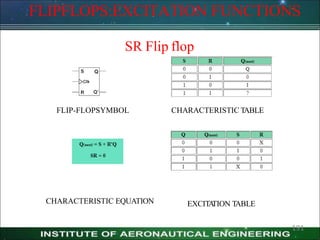
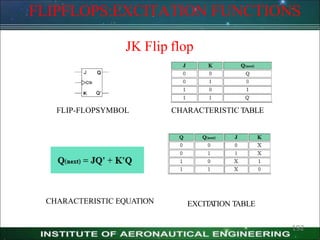
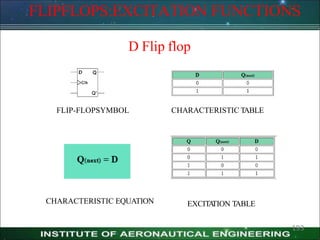
In electronics design, an excitation table shows the minimum inputs that are necessary to generate a
particular next state (in other words, to "excite" it to the next state) when the current state is known.
They are similar to truth tables and state tables, but rearrange the data so that the current state and next
state are next to each other on the left-hand side of the table, and the inputs needed to make that state
change happen.
All flip-flops can be divided into four basic types: SR, JK, D and T. They differ in the number of
inputs and in the response invoked by different value of inputsignals.
The characteristic table in the third column of Table 1 defines the state of each flip-flop as a function of
its inputs and previous state. Q refers to the present state and Q(next) refers to the next state after the
occurrence of the clock pulse. The characteristic table for the RS flip-flop shows that the next state is
equal to the present state when both inputs S and R are equal to 0. When R=1, the next clock pulse
clears the flip-flop. When S=1, the flip-flop output Q is set to 1. The equation mark (?) for the next state
when S and R are both equal to 1 designates an indeterminate nextstate.
The characteristic table for the JK flip-flop is the same as that of the RS when J and K are replaced by S
and R respectively, except for the indeterminate case. When both J and K are equal to 1, the next state is
equal to the complement of the present state, that is, Q(next) = Q'.
The next state of the D flip-flop is completely dependent on the input D and independent of the present
state.
The next state for the T flip-flop is the same as the present state Q if T=0 and complemented ifT=1.
SR Flip flop
FLIPFLOPS:EXCITATION FUNCTIONS
FLIP-FLOPSYMBOL CHARACTERISTIC TABLE
CHARACTERISTIC EQUATION EXCITA
TION TABLE
191
JK Flip flop
FLIPFLOPS:EXCITATION FUNCTIONS
FLIP-FLOPSYMBOL CHARACTERISTIC TABLE
CHARACTERISTIC EQUATION EXCITA
TION TABLE
192
D Flip flop
FLIPFLOPS:EXCITATION FUNCTIONS
FLIP-FLOPSYMBOL CHARACTERISTIC TABLE
CHARACTERISTIC EQUATION EXCITA
TION TABLE
193
T Flip flop
FLIPFLOPS:EXCITATION FUNCTIONS
FLIP-FLOPSYMBOL CHARACTERISTIC TABLE
CHARACTERISTIC EQUATION EXCITA
TION TABLE
194
CONVERTION OF ONE FLIP FLOP TO ANOTHER FLIP FLOP
195
CONVERTION OF SR FLIPFLOPTO JK FLIPFLOP
J and K will be given as external inputs to S and R. As shown in the logic diagram below, S
and R will be the outputs of the combinationalcircuit.
The truth tables for the flip flop conversion are given below. The present state is represented
by Qp and Qp+1 is the next state to be obtained when the J and K inputs are applied.
For two inputs J and K, there will be eight possible combinations. For each combination of
J, K and Qp, the corresponding Qp+1 states are found. Qp+1 simply suggests the future
values to be obtained by the JK flip flop after the value of Qp. The table is then completed
by writing the values of S and R required to get each Qp+1 from the corresponding Qp. That
is, the values of S and R that are required to change the state of the flip flop from Qp to
Qp+1 are written.
CONVERTION OF ONE FLIP FLOP TO ANOTHER FLIP FLOP
196
CONVERTION OF ONE FLIP FLOP TO ANOTHER FLIP FLOP
197
CONVERTION OF JK FLIPFLOPTO SR FLIPFLOP
This will be the reverse process of the above explained conversion. S and R will be the
external inputs to J and K. As shown in the logic diagram below, J and K will be the
outputs of the combinational circuit. Thus, the values of J and K have to be obtained in
terms of S, R and Qp. The logic diagram is shown below.
A conversion table is to be written using S, R, Qp, Qp+1, J and K. For two inputs, S and
R, eight combinations are made. For each combination, the corresponding Qp+1 outputs
are found ut. The outputs for the combinations of S=1 and R=1 are not permitted for an
SR flip flop. Thus the outputs are considered invalid and the J and K values are taken as
―
don’t cares‖.
CONVERTION OF ONE FLIP FLOP TO ANOTHER FLIP FLOP
198
CONVERTION OF ONE FLIP FLOP TO ANOTHER FLIP FLOP
CONVERTION OF SR FLIPFLOPTO D FLIPFLOP
As shown in the figure, S and R are the actual inputs of the flip flop and D is the external
input of the flip flop. The four combinations, the logic diagram, conversion table, and the
K-map for S and R in terms of D and Qp are shown below.
199
CONVERTION OF ONE FLIP FLOP TO ANOTHER FLIP FLOP
CONVERTION OF D FLIPFLOPTO SR FLIPFLOP
D is the actual input of the flip flop and S and R are the external inputs. Eight possible
combinations are achieved from the external inputs S, R and Qp. But, since the combination
of S=1 and R=1 are invalid, the values of Qp+1 and D are considered as ―don’tcares‖. The
logic diagram showing the conversion from D to SR, and the K-map for D in terms of S, R
and Qp are shown below.
200
CONVERTION OF ONE FLIP FLOP TO ANOTHER FLIP FLOP
CONVERTION OFJK FLIPFLOPTO T FLIPFLOP
J and K are the actual inputs of the flip flop and T is taken as the external input for
conversion. Four combinations are produced with T and Qp. J and K are expressed in terms
of T and Qp. The conversion table, K-maps, and the logic diagram are given below.
201
CONVERTION OF ONE FLIP FLOP TO ANOTHER FLIP FLOP
CONVERTION OF JK FLIPFLOPTO D FLIPFLOP
D is the external input and J and K are the actual inputs of the flip flop. D and Qp make
four combinations. J and K are expressed in terms of D and Qp. The four combination
conversion table, the K-maps for J and K in terms of D and Qp, and the logic diagram
showing the conversion from JK to D are given below.
202
CONVERTION OF ONE FLIP FLOP TO ANOTHER FLIP FLOP
CONVERTION OF D FLIPFLOPTO JK FLIPFLOP
In this conversion, D is the actual input to the flip flop and J and K are the external inputs.
J, K and Qp make eight possible combinations, as shown in the conversion table below. D
is expressed in terms of J, K and Qp.
The conversion table, the K-map for D in terms of J, K and Qp and the logic diagram
showing the conversion from D to JK are given in the figure below.
203
CONVERTION OF ONE FLIP FLOP TO ANOTHER FLIP FLOP
CONVERTION OFT FLIPFLOPTO JK FLIPFLOP
Webegin with the T-to-JK conversion table (see Figure 5), which combines the information
in the JK flip-flop's truth table and the T flip-flop's excitation table.
Next, we need to obtain the simplified Boolean expression for the T input in terms of J, K, and
Qn. The expression for the T input as JQ̅ n + KQn. This means that to convert the T flip-flop into
a JK flip-flop, the T input is driven by the output of a two-input OR gate which has as inputs
JANDed with the negation of the present-state Qn, i.e., Q̅n
KANDed with the present-state, Qn
204
STATE MACHINES
State Machine
Another type of sequential circuit
Combines combinational logic with storage
―Remembers‖ state, and changes output (and state) based on inputs and current state
State
The state of a system is a snapshot of all the relevant elements of the system at the moment the
snapshot is taken.
Examples:
The state of a basketball game can be represented by the scoreboard.
Number of points, time remaining, possession, etc.
The state of a tic-tac-toe game can be represented by the placement of X’s and O’s on the board.
205
STATE MACHINES
State Tables and State Diagrams
ST
A
TETABLESAND ST
A
TE DIAGRAMS
In this model the effect of all previous inputs on the outputs is represented by a state of the
circuit. Thus, the output of the circuit at any time depends upon its current state and the
input. These also determine the next state of the circuit. The relationship that exists among
the inputs, outputs, present states and next states can be specified by either the state table or
the state diagram.
State T
able
The state table representation of a sequential circuit consists of three sections labeled present
state, next state and output. The present state designates the state of flip-flops before the
occurrence of a clock pulse. The next state shows the states of flip-flops after the clock
pulse, and the output section lists the value of the output variables during the presentstate.
206
STATE MACHINES
State Diagram
In addition to graphical symbols, tables or equations, flip-flops can also be represented
graphically by a state diagram. In this diagram, a state is represented by a circle, and the
transition between states is indicated by directed lines (or arcs) connecting the circles.
The binary number inside each circle identifies the state the
circle represents. The directed lines are labelled with two binary
numbers separated by a slash (/). The input value that causes the
state transition is labelled first. The number after the slash
symbol / gives the value of the output. For example, the directed
line from state 00 to 01 is labelled 1/0, meaning that, if the
sequential circuit is in a present state and the input is 1, then the
next state is 01 and the output is 0. If it is in a present state 00
and the input is 0, it will remain in that state. A directed line
connecting a circle with itself indicates that no change of state
occurs. The state diagram provides exactly the same information
as the state table and is obtained directly from the state table.
State Diagram
207
Example:
Consider a sequential circuit
STATE MACHINES
The behavior of the circuit is determined by the
following Boolean expressions:
208
Z = x*Q1
D1 = x' + Q1
D2 = x*Q2' +x'*Q1'
These equations can be used to form the state table. Suppose the present state (i.e. Q1Q2) = 00
and input x = 0. Under these conditions, we get Z = 0, D1 = 1, and D2 = 1. Thus the next state
of the circuit D1D2 = 11, and this will be the present state after the clock pulse has been
applied. The output of the circuit corresponding to the present state Q1Q2 = 00 and x = 1 is Z=
0. This data is entered into the state table as shown in Table2.
State table for the sequential circuit
STATE MACHINES
The state diagram for the sequential circuit
209
state diagrams of the four types of flip-flops
STA
TE MACHINES
210
STATE REDUCTION
State Reduction
Any design process must consider the problem of minimising the cost of the final circuit. The
two most obvious cost reductions are reductions in the number of flip-flops and the number of
gates.
The number of states in a sequential circuit is closely related to the complexity of the resulting
circuit. It is therefore desirable to know when two or more states are equivalent in all aspects.
The process of eliminating the equivalent or redundant states from a state table/diagram is
known as state reduction.
Example: Let us consider the state table of a sequentialcircuit
State table
211
STATE REDUCTION
It can be seen from the table that the present state A and F both have the same next states, B
(when x=0) and C (when x=1). They also produce the same output 1 (when x=0) and 0 (when
x=1). Therefore states A and F are equivalent. Thus one of the states, A or F can be removed
from the state table. For example, if we remove row F from the table and replace all F's by
A's in the columns, the state table is modified
State F removed
It is apparent that states B and E are equivalent. Removing E and replacing E's by B's results
in the reduce table
212
STATE REDUCTION
Reduced state table
The removal of equivalent states has reduced the number of states in the circuit from six to
four. Two states are considered to be equivalent if and only if for every input sequence the
circuit produces the same output sequence irrespective of which one of the two states is the
starting state.
213
STATEASSIGNMENT
214
STATEASSIGNMENT
Each circuit state given in a state table has to be assigned a unique value, which represents
combinations of flip – flop output states.
Acircuit having 2 internal states requires one flip – flop in its implementation
Acircuit having 3 or 4 internal states requires two flip – flops in its implementation
Acircuit having 5→ 8 internal states requires three flip – flops in its implementation etc.
It should be noted that although assignments are arbitrary, one assignment might be more
economical than another.
Consider the state table shown below for a circuit having two input pulses x1, x2 and a level
output Z.
Since the circuit has four internal states then two flip-flops are required. Let the two flip-flop
outputs be represented by variables y1 and y2, which can have combinations of values y1y2 =
00, 01, 11, 10. The state table can then be translated into a state table with secondary
assignments as shown. Note that this is just one of many possible assignments (in fact there are
24)
STATEASSIGNMENT
Example of state assignment
With y1y2 =0 (i.e. in state 1), if x1 is applied then y1y2must change to 01 (i.e. state 2). That is,
the flip/flop generating y1 must not disturbed, but the y2generating flip-flop requires an input
such that the circuit settles in state 2, (for example a SET input if using SR flip-flops).
215
MEALY AND MOORE STATEMACHINES
Mealy state machine
In the theory of computation, a Mealy machine is a finite state transducer that generates an
output based on its current state and input. This means that the state diagram will include
both an input and output signal for each transition edge. In contrast, the output of a Moore
finite state machine depends only on the machine's current state; transitions are not directly
dependent upon input. The use of a Mealy FSM leads often to a reduction of the number of
states. However, for each Mealy machine there is an equivalent Moore machine.
216
MEALY AND MOORE STATEMACHINES
Moore state machine
In the theory of computation, a Moore machine is a finite state transducer where the outputs are
determined by the current state alone (and do not depend directly on the input). The state diagram
for a Moore machine will include an output signal for each state. Compare with a Mealy machine,
which maps transitions in the machine to outputs. The advantage of the Moore model is a
simplification of the behavior.
217
MEALY AND MOORE STATEMACHINES
Examples for Mealy and Moore machines
Derive a minimal state table for a single-input and single-output Moore-type FSM
that produces an output of 1 if in the input sequence it detects either 110 or 101
patterns. Overlapping sequences should be detected. (Show the detailed stepsof
your solution.)
218
MEAL
YAND MOORE STA
TEMACHINES
Sate Table (MooreFSM)
219
MEALY AND MOORE STATEMACHINES
StateAssignment (Mealy FSM):
stateA: Got no 1
state B: Got‖1‖
state C: Got‖11‖
state D: Got‖10”
Sate Table (Mealy FSM)
220
MEALY AND MOORE MACHINES
221
Sequential Logic Implementation
Models for representing sequential circuits
Abstraction of sequential elements
Finite state machines and their state diagrams
Inputs/outputs
Mealy, Moore, and synchronous Mealy machines
Finite state machine design procedure
V
erilog specification
Deriving state diagram
Deriving state transition table
Determining next state and output functions
Implementing combinational logic
MEALY AND MOORE MACHINES
Mealy vs. Moore Machines
Moore: outputs depend on current state only
Mealy: outputs depend on current state and inputs
Ant brain is a Moore Machine (Output does not react immediately to input change)
Wecould have specified a Mealy FSM (Outputs have immediate reaction to inputs .As
inputs change, so does next state, doesn’t commit until clocking event)
Specifying Outputs for a Moore Machine
Output is only function of state. Specify in state bubble in state diagram. Example:
sequence detector for 01 or 10
222
MEALY AND MOORE MACHINES
Specifying Outputs for a Mealy Machine
Output is function of state and inputs .Specify output on transition arc between states.
Example: sequence detector for 01 or 10
223
MEALY AND MOORE MACHINES
Comparison of Mealy and Moore Machines
Mealy Machines tend to have less states
Different outputs on arcs (n^2) rather than states (n)
Moore Machines are safer to use
Outputs change at clock edge (always one cycle later)
In Mealy machines, input change can cause output change as soon as logic is done – a big
problem when two machines are interconnected – asynchronous feedback
Mealy Machines react faster to inputs
React in same cycle – don't need to wait for clock
In Moore machines, more logic may be necessary to decode state into outputs – more gate
delays after
224
SYNCHRONOUSAND ASYNCHRONOUS SEQUENTIAL CIRCUITS
225
synchronous sequential circuits a clock signal consisting of pulses, controls the
state variables which are represented by flip-flops. they are said to operatein
pulse mode.
asynchronous circuits state changes are not triggered by clock pulses. they depend on
the values of the input and feedback variables.
two conditions for proper operation:
1.-inputs to the circuit must change one at a time and must remain constant until the
circuit reaches stable state.
2.-feedback variables should change also one at a time. when all internal signals stop
changing, then the circuit is said to have reached stable state when the inputs
satisfy condition 1 above, then the circuit is said to operate in fundamental mode.
Analysis of Clocked Sequential Circuits
The analysis of a sequential circuit consists of obtaining a table or a diagram for
the time sequence of inputs, outputs, and internal states. It is also possible to write
Boolean expressions that describe the behavior of the sequential circuit. These
expressions must include the necessary time sequence, either directly or
indirectly.
SYNCHRONOUS AND ASYNCHRONOUS SEQUENTIAL CIRCUITS
State Equations
The behavior of a clocked sequential circuit can be described algebraically by means of
state equations. A state equation specifies the next state as a function of the present state and
inputs. Consider the sequential circuit shown in Fig. 5-15. It consists of two D flip-flops A
and B, an input x and an output y.
State equation
A(t+1) =A(t) x(t) + B(t) x(t)
B(t+1) =A`(t) x(t)
226
A state equation is an algebraic expression that specifies the condition for a flip-flop state
transition. The left side of the equation with (t+1) denotes the next state of the flip-flop one
clock edge later. The right side of the equation is Boolean expression that specifies the
present state and input conditions that make the next state equal to 1.
Y(t) = (A(t) + B(t)) x(t)`
SYNCHRONOUS AND ASYNCHRONOUS SEQUENTIAL CIRCUITS
State Table
The time sequence of inputs, outputs, and flip-flop states can be enumerated in a state table
(sometimes called transition table). State Diagram
1/0 : means input=1
output=0
The information available in a state table can be represented graphically in the form of a state
diagram. In this type of diagram, a state is represented by a circle, and the transitions between
states are indicated by directed lines connecting the circles.
227
SYNCHRONOUS AND ASYNCHRONOUS SEQUENTIAL CIRCUITS
Flip-Flop Input Equations
The part of the combinational circuit that generates external outputs is descirbed
algebraically by a set of Boolean functions called output equations. The part of
the circuit that generates the inputs to flip-flops is described algebraically by a set
of Boolean functions called flip-flop input equations. The sequential circuit of
Fig. 5-15 consists of two D flip-flops A and B, an input x, and an output y. The
logic diagram of the circuit can be expressed algebraically with two flip-flop
input equations and an output equation:
DA=Ax + Bx,DB =A`x and y = (A+B)x`
Analysis with D Flip-Flop
The circuit we want to analyze is described by the input equation
The DA symbol implies a D flip-flop with output A. The x and y variables are the inputs to the
circuit. No output equations are given, so the output is implied to come from the output of the
flip-flop.
228
SYNCHRONOUS AND ASYNCHRONOUS SEQUENTIAL CIRCUITS
The binary numbers under A y are listed from 000 through 111 as shown in
Fig. 5-17(b). The next state values are obtained from the state equation
The state diagram consists of two circles-one for each state as shown in Fig.5-17(c)
229
SYNCHRONOUS AND ASYNCHRONOUS SEQUENTIAL CIRCUITS
230
ASYNCHRONOUS SEQUENTIAL CIRCUIT
Analysis of asynchronous circuits
Procedure:
– Cut all feedback paths and insert a delay element at each point where cut was made
– Input to the delay element is the next state variable yi while the output is the
present value yi .
– Derive the next-sate and output expressions from the circuit
– Derive the excitation table
– Derive the flow table
– Derive a state-diagram from the flow table
– Asynchronous circuits don’t use clock pulses
• State transitions by changes in inputs
– Storage Elements:
• Clock less storage elements or Delay elements
– In many cases, as combinational feedback
• Normally much harder to design
SYNCHRONOUS AND ASYNCHRONOUS SEQUENTIAL CIRCUITS
yi = Yi in steady state (but may be different during transition) Simultaneous change
in two (or more) inputs is prohibited. The time between two changes must beless
than the time of stability. Analysis
231
SYNCHRONOUS AND ASYNCHRONOUS SEQUENTIAL CIRCUITS
3.Draw a map by using rows: yi’s, columns: inputs, entries: Yi’s
4.To have a stable state, Y must be = y (circled)
(Transition Table) Y1 Y2
At y1y2x = 000, if x: 0  1
thenY1Y2: 00  01
then y1y2 = 01 (2nd row):stable
232
SYNCHRONOUS AND ASYNCHRONOUS SEQUENTIAL CIRCUITS
In general, if an input takes the circuit to an unstable state, yi’s change untila stable
State TableAs synchronous
state is found.
General state of circuit:
y1y2x:
There are 4 stable states:
000, 011, 110, 101
and 4 unstable states.
Flow Table
As Transition Table
(but with symbolic
states):
SYNTHESIS OFASYNCHROUNOUS CIRCUITS
This topic is not covered in this course. it belongs to a more advanced logic design course.This it
is very important in todays digital systems design because clocks are so fast that they present
propagation delays making subsystems to operate out of synchronization.
Techniques for synthesis of asynchronous circuits include
The hoffman or classic synthesis approach
Handshaking signaling for two subsystems to communicate asynchronously
233
SHIFT REGISTERS
234
Introduction :
Shift registers are a type of sequential logic circuit, mainly for storage of digital data. They are
a group of flip-flops connected in a chain so that the output from one flip-flop becomes the
input of the next flip-flop. Most of the registers possess no characteristic internal sequence of
states. All the flip-flops are driven by a common clock, and all are set or reset simultaneously.
Shift registers are divided into two types.
1. Uni directional shift registers
1.Serial in – serial out shift register
2.Serial in – parallel out shift register
3.Parallel in – serial out shift register
4. Parallel in – parallel out shift register
2. Bidirectional shift registers
1.Left shift register
2. Right shift register
SHIFT REGISTERS
1.Serial in – serial out shift register
A basic four-bit shift register can be constructed using four D flip-flops, as shown below. The
operation of the circuit is as follows. The register is first cleared, forcing all four outputs to
zero. The input data is then applied sequentially to the D input of the first flip-flop on the left
(FF0). During each clock pulse, one bit is transmitted from left to right. Assume a data word
to be 1001. The least significant bit of the data has to be shifted through the register from FF0
to FF3.
In order to get the data out of the register, they must be shifted out serially. This can be done
destructively or non-destructively. For destructive readout, the original data is lost and at the end
of the read cycle, all flip-flops are reset to zero.
235
SHIFT REGISTERS
Toavoid the loss of data, an arrangement for a non-destructive reading can be done by
adding twoAND gates, an OR gate and an inverter to the system. The construction of this
circuit is shown below
The data is loaded to the register when the control line is HIGH (ie WRITE). The data can be
shifted out of the register when the control line is LOW (ie READ). This is shown in the
animation below.
236
SHIFT REGISTERS
2.Serial in – parallel out shift register
The difference is the way in which the data bits are taken out of the register. Once the data
are stored, each bit appears on its respective output line, and all bits are available
simultaneously.
In the animation below, we can see how the four-bit binary number 1001 is shifted to the Q
outputs of the register.
237
SHIFT REGISTERS
3.Parallel in – serial out shift register
Afour-bit parallel in - serial out shift register is shown below. The circuit uses D flip-flops
and NAND gates for entering data (ie writing) to the register.
D0, D1, D2 and D3 are the parallel inputs, where D0 is the most significant bit and D3 is
the least significant bit. Towrite data in, the mode control line is taken to LOW and the
data is clocked in. The data can be shifted when the mode control line is HIGH as SHIFT
is active high. The register performs right shift operation on the application of a clock
pulse, as shown in the animation below.
238
SHIFT REGISTERS
4.Parallel in –parallel out shift register
For parallel in - parallel out shift registers, all data bits appear on the parallel outputs
immediately following the simultaneous entry of the data bits. The following circuit is a
four-bit parallel in - parallel out shift register constructed by D flip-flops.
The D's are the parallel inputs and the Q's are the parallel outputs. Once the registeris
clocked, all the data at the D inputs appear at the corresponding Q outputs simultaneously.
239
SHIFT REGISTERS AND COUNTERS
Bidirectional Shift Registers
The registers discussed so far involved only right shift operations. Each right shift operation has
the effect of successively dividing the binary number by two. If the operation is reversed (left
shift), this has the effect of multiplying the number by two. With suitable gating arrangement a
serial shift register can perform both operations. A bidirectional, or reversible, shift register is one
in which the data can be shift either left or right. A four-bit bidirectional shift register using D
flip-flops is shown below
Here a set of NAND gates are configured as OR gates to select data inputs from the right
or left adjacent bitable, as selected by the LEFT/RIGHT control line.
The animation below performs right shift four times, then left shift four times. Notice the
order of the four output bits are not the same as the order of the original four input bits.
240
SHIFT REGISTERS AND COUNTERS
COUNTERS
Two of the most common types of shift register counters are introduced here: the Ring counter
and the Johnson counter. They are basically shift registers with the serial outputs connected
back to the serial inputs in order to produce particular sequences. These registers are classified
as counters because they exhibit a specified sequence of states.
Ring Counters
A ring counter is basically a circulating shift register in which the output of the most significant
stage is fed back to the input of the least significant stage. The following is a 4-bit ring counter
constructed from D flip-flops. The output of each stage is shifted into the next stage on the
positive edge of a clock pulse. If the CLEAR signal is high, all the flip-flops except the first one
FF0 are reset to 0. FF0 is preset to 1 instead.
241
SHIFT REGISTERS AND COUNTERS
Since the count sequence has 4 distinct states, the counter can be considered as a mod-4
counter. Only 4 of the maximum 16 states are used, making ring counters very inefficient in
terms of state usage. But the major advantage of a ring counter over a binary counter is that it
is self-decoding. No extra decoding circuit is needed to determine what state the counter is in.
242
SHIFT REGISTERS AND COUNTERS
Johnson Counters
Johnson counters are a variation of standard ring counters, with the inverted output of the last
stage fed back to the input of the first stage. They are also known as twisted ring counters. An n-
stage Johnson counter yields a count sequence of length 2n, so it may be considered to be a mod-
2n counter. The circuit above shows a 4-bit Johnson counter. The state sequence for the counter
is given in the table as well as the animation on the left.
Again, the apparent disadvantage of this counter is that the maximum available states are not
fully utilized. Only eight of the sixteen states are being used.
Beware that for both the Ring and the Johnson counter must initially be forced into a valid
state in the count sequence because they operate on a subset of the available number of states.
Otherwise, the ideal sequence will not be followed.
243
UNIT 5
RANDOMACCESS
MEMORY
244
RANDOM ACCESS MEMORY
A memory unit is a collection of storage
cells together with associated circuits
needed to transfer information in and out
of the device.
Memory cells can be accessed for
information transfer to or from any desired
random location and hence the name
randomaccess memory, abbreviatedRAM.
A memory unit stores binary information
in groups of bits calledwords.
1 byte = 8 bits
1 word = 2 bytes.
The communication between a memory
and its environment is achieved
data input and output lines,
through
address
lines that
selection lines, and control
specify the direction of transfer.
Fig 1: Block diagram of memory unit
RANDOM ACCESS MEMORY
245
RANDOM ACCESS MEMORY
Content of amemory
 Each word in memory is
identification
an
called
assigned
number,
starting from 0
an address,
up to 2k-1,
where k is the number of
address lines.
 The number of words in a
memory with one of the
letters K=210, M=220, or G=230.
64K = 216 2M = 221
4G = 232 Fig 2: Content of a 1024 x 16 memory
246
RANDOM ACCESS MEMORY
247
Write and Readoperations

1.
Transferring a new word to be stored into memory:
Apply the binary address of the desired word to the
address lines.
2. memory tothe
Apply the data bits that must be stored in
data input lines.
3. Activate the writeinput.
Write and Read operations

1.
Transferring a stored word out of memory:
Apply the binary address of the desired word to the address lines.
2.

Activate the read input.
Commercial memory sometimes provide the two control inputs for reading and
writing in a somewhat different configuration in table 1.
Table 1
RANDOM ACCESS MEMORY
248
TYPES OF ROM
249
READ ONLY MEMORY (ROM)
• Computers almost always contain a small amount of read-only
memory that holds instructions for starting up the computer.Unlike
RAM, ROM cannot be written to.
• Because data stored in ROM cannot be modified (at least not very
quickly or easily), it is mainly used to distribute firmware (software
that is very closely tied to specific hardware, and unlikely to require
frequent updates).
• It is non-volatile which means once you turn off the computerthe
information is stillthere.
TYPES OF ROM
250
READ ONLY MEMORY (ROM)
• A type of memories that can only be read from anyselected
address in sequence.
• Stored data cannot be changed at all or cannot be changedwithout
specialized equipment.
• Writing a data is not permitted.
• Reading data from any address does not destruct the content of
read address.
• Usually to store data that is used repeatedly in system application.
TYPES OF ROM
251
Programmable ROM (PROM)
• Is a memory chip on which data can be written onlyonce.
• Once a program has been written onto a PROM, it remainsthere
forever.
• Nonvolatile memory - unlike RAM, PROM's retain their contents
when the computer is turned off.
• The difference between a PROM and a ROM (read-only memory) is
that a PROM is manufactured as blank memory, whereas a ROM is
programmed during the manufacturingprocess.
• To write data onto a PROM chip, you need a special device called a
PROM programmer or PROM burner
.
• PROM uses some type of fusing process to store bits. Fusible link is
programmed open or left intact to represent 0 or 1. The link cannot
be changed once it is programmed.
EPROM
• Once it is erased, it can be reprogrammed.
• Two basic types
• Ultraviolet (UV) EPROM
UV EPROM can be recognized by transparent quartz lid onthe
package.
Entire UV EPROM data can be erased by exposingthe
transparent quartz lid to the high intensity UVlight.
• Electrically EPROM (EEPROM)
Individual bytes in EEPROM can be erased and programmed
by electrical pulses (voltage).
252
TYPES OF ROM
Mask ROMs
• Usually referred to simply as ROM (the oldest type of solid state
ROM)
• The data are permanently stored in the memory during the
manufacturing process and it cannot be changed.
• Most IC ROMs utilize the presence or absence of a transistor
connection at a row/column junction to represent a 1 or0.
• Mask ROM and PROM can be of either MOS or bipolartechnology.
• Despite the simplicity of mask ROM, economies of scale and field-
programmability often make reprogrammable technologies more
flexible and inexpensive.
253
TYPES OF ROM
MEMORY DECODING
• Decoder
– select the memory word specified by the input address
• 2-dimensional coincident decoding is a more efficient
decoding scheme for large memories
254
MEMORY DECODING
MEMORY DECODING
Figure 1: Memory cell
logic of a binary cell that stores one bit of
 The equivalent
information is shown below.
Read/Write = 0, select = 1, input data to S-R latch
Read/Write = 1, select = 1, output data from S-R latch
255
MEMORY DECODING
MEMORY ARRAY
256
MEMORY DECODING
4 x 4 RAM
 There is a need for decoding circuits
to select the memory word specified
by the input address.
 During the read operation, the four
bits of the selected word go through
OR gates to the output terminals.
 During the write operation, the data
available in the input lines are
transferred into the four binary cells
of the selected word.
 A memory with 2k words of n bits per
word requires k address lines that go
into kx2k decoder.
Fig 2: Diagram of 4 x 4RAM
257
Coincident decoding
 A decoder with k inputs and
2k outputs requires 2k AND
gates with k inputs per gate.
 Two decoding in a two-
dimensional selection scheme
can reduce the number of
inputs per gate.
 1K-word memory
, instead of
using a single 10X1024
decoder
, we use two 5X32
decoders. Figure 1: Two-dimensionalDecoding
structure for a 1K word memory
MEMORY DECODING
258
MEMORY DECODING
259
Address multiplexing
 DRAMs typically have four times the density of SRAM.
 The cost per bit of DRAM storage is three to four times less
than SRAM. Another factor is lower powerrequirement.
MEMORY DECODING
260
Address multiplexing
 Address multiplexing will reduce the number of pins in the IC
package.
 In a two-dimensional array, the address is applied in two parts
at different times, with the row address first and the column
address second. Since the same set of pins is used for both
parts of the address, so can decrease the size of package
significantly.
Address Multiplexing of a 64K DRAM
settling time of the
After a time equivalent to the
row
selection, RAS goes back to the 1
level.
Registers are used to store the
addresses of the row and
column.
CAS must go back to the 1 level
before initialing another memory
operation.
Fig 2: Address Multiplexingfor a 64K DRAM
MEMORY DECODING
261
ADDRESS BUS AND DATABUS
Memory structures are crucial in digital design. – ROM, PROM, EPROM,
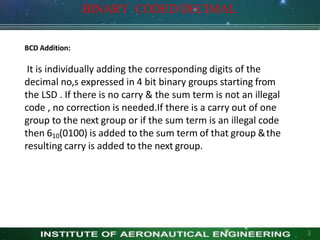
RAM, SRAM, (S)DRAM, RDRAM,..
All memory structures have an address bus and a data bus – Possibly
other control signals to control outputetc.
E.g. 4 Bit Address bus with 5 Bit DataBus
ADDRESS AND DATA BUS
262
ADDRESS BUS AND DATABUS
Internal organization
– ‘Lookup Table of values’
–For each address there is a
corresponding data output
ADDRESS AND DATA BUS
263
ADDRESS BUS
264
ADDRESS AND DATA BUS
•
•
•
•
Address signals are required to specify the location in the memory from
which information is accessed(read orwritten).
A set of parallel address lines known as the address bus carry the address
information.
• The number of bits (lines) comprising the address bus depends upon the
size of the memory.
For example, a memory having four locations to store data has four unique
(00, 01, 10, 11) specified by a 2-bit addressbus.
The size of the address bus depends upon the total addressable locations
specified by the formula 2^n, where n is the number of bits. Thus 2^4 = 16
(n=4) specifies 4 bits to uniquely identify 16 different locations.
ADDRESS AND DATA BUS
265
DATA BUS
• Data lines are required to retrieve the information from the memor
y array during a read operation and to provide the data that is to be
stored in the memory during a writeoperation.
• As
a
the memory
time therefore
reads
the
or writes one data unit at
data lines should be equal
•
to the number of data bits stored at each addressable location in th
e memory.
• A memory organized as a byte memory reads or writes byte data
values, therefore the number of data lines or the size of the data
bus should be 8-bits or 1 byte.
A memory organized to store nibble data values requires a 4-bit
wide data bus. Generally, the wider the data bus more data can be
accessed at each read or writeoperation
SEQUENTIAL MEMORY
• Output depends on stored information (current state) and maybe
on currentinputs
• Example:
• state = Score board of basket state = Score board of basketball
game (number of points time game (number of points, time
remaining, possession)
• input = which team scored the point
• output = point increase for the team that justscored.
• Sequential Circuits are built out of combinational logic and oneor
more memory/storage elements
• E.g. Registers, Memories, Counters, Control Unit .
266
SEQUENTIAL MEMORY
SEQUENTIAL MEMORY
267
1-Bit memory element Characteristics
• Need a unit that can
• Retain/Remember a single bit with possible values ( ) state i.e. 0or
1.
• This will allow us to read a previous value stored„
• Able to change the value (state). For a bit we can:
• Set the bit to 1
• Reset, or clear, the bit to 0
• Toremember/retain their state values, rely on concept of feedback
„
• Feedback digital circuits occurs when an output is looped backto
the input „
• A simple example of this concept is shownbelow
• If Q is 0 it will always be 0, if it is 1 it will always be 1
SEQUENTIAL MEMORY
268
Flip Flop
Flip flop is a sequential circuit which generally samples its
inputs and changes its outputs only at particular instants of
time and not continuously. Flip flop is said to be edge sensitive
or edge triggered rather than being level triggered like latches.
• S-R Flip Flop
It is basically S-R latch using NAND gates withan
additional enable input. It is also called as level triggeredSR-
FF.For this, circuit in output will take place if and only if the
enable input (E) is made active. In short this circuit will
operate as an S-R latch if E = 1 but there is no change in the
output if E = 0.
Flip Flop
• Master Slave JK Flip Flop
Master slave JK FF is a cascade of two S-R FF with feedback
from the output of second to input of first. Master is a
positive level triggered. But due to the presence of the
inverter in the clock line, the slave will respond to the
negative level. Hence when the clock = 1 (positive level) the
master is active and the slave is inactive. Whereas when clock
= 0 (low level) the slave is active and master is inactive.
269
SEQUENTIAL MEMORY
Flip Flop
• Delay Flip Flop / D Flip Flop
Delay Flip Flop or D Flip Flop is the simple gated S-R latch with
a NAND inverter connected between S and R inputs. It has
only one input. The input data is appearing at the output after
some time. Due to this data delay between i/p and o/p, it is
called delay flip flop. S and R will be the complements of each
other due to NAND inverter
.Hence S = R = 0 or S = R = 1,these
input condition will never appear.This problem is avoid bySR
= 00 and SR = 1 conditions.
270
SEQUENTIAL MEMORY
Flip Flop
• ToggleFlip Flop / T Flip Flop
Toggle flip flop is basically a JK flip flop with J and K terminals
permanently connected together
. It has only input denoted
by T .
271
SEQUENTIAL MEMORY
CACHE
• A small amount of fast memory that sits between normal main
memory and CPU
• May be located on CPU chip or module
• Intended to allow access speed approaching registerspeed
• When processor attempts to read a word from memory, cache is
checked first
272
CACHE MEMORY
CACHE MEMORY
273
Cache Memory Principles
• If data sought is not present in cache, a block of memory of
fixed size is read into the cache
• Locality of reference makes it likely that other words in the
same block will be accessed soon
CACHE MEMORY
274
CACHE VIEW OF MEMORY
• N address lines => 2n words of memory
• Cache stores fixed length blocks of K words
• Cache views memory as an array of M blocks where M = 2^n/K
• A block of memory in cache is referred to as a line. K is the linesize
• Cache size of C blocks where C < M (considerably)
• Each line includes a tag that identifies the block being stored
• Tagis usually upper portion of memory address
Cache operation – overview
• CPU requests contents of memory location
• Check cache for this data
• If present, get from cache (fast)
• If not present, read required block from main memoryto
cache
• Then deliver from cache to CPU
• Cache includes tags to identify which block of main memoryis
in each cache slot
275
CACHE MEMORY
Programmable Logic Array
• A programmable logic array (PLA) is a type of logic device that
can be programmed to implement various kinds of
combinational logic circuits.
• The device has a number of AND and OR gates which are
linked together to give output or further combined with more
gates or logic circuits.
276
PROGRAMMABLE LOGIC ARRAY
Programmable LogicArray
Fig 1: Block diagram of PLA
277
PLA
F1 =AB’+AC+A’BC’
F2 = (AC+BC)’
Fig 2: PLA with 3-inputs 4 product terms and 2
outputs
PROGRAMMABLE LOGIC ARRAY
278
PROGRAMMABLE LOGIC ARRAY
279
Programmable Logic Array
• Advantages
• PLA architecture is more efficient than aPROM.
• Disadvantage
• PLA architecture has two sets of programmable fuses due to
which PLA devices are difficult to manufacture, program and
test.
• Applications:
• PLA is used to provide control over datapath.
• PLA is used as a counter.
• PLA is used as decoders.
• PLA is used as a BUS interface in programmedI/O
Programming Table
280
1.
2. inputs and
First: lists the product termsnumerically
Second: specifies the required paths between
AND gates
3. Third: specifies the paths between the AND and OR gates
4. For each output variable, we may have a T(ture) or
C(complement) for programming the XOR gate
PROGRAMMABLE LOGIC ARRAY
Simplification ofPLA
 Careful investigation must be undertaken in order to reduce
the number of distinct product terms, PLA has a finite
number of AND gates.
 Both the true and complement of each function should be
simplified to see which one can be expressed with fewer
product terms and which one provides product terms that are
common to other functions.
281
PROGRAMMABLE LOGIC ARRAY
Example
Implement the following two Boolean functions with a PLA:
F1(A, B,C) = ? (0, 1, 2, 4)
F2(A, B, C) = ? (0, 5, 6, 7)
The two functions are simplified in the maps of given figure
282
PROGRAMMABLE LOGIC ARRAY
PLAtable by simplifying thefunction
 Both the true and
complement of the functions
are simplified in sum of
products.
 We can find the same terms
from the group terms of the
functions of F1, F1’,F2 and F2’
which will make the minimum
terms.
F1 = (AB +AC + BC)’
F2 = AB + AC + A’B’C’
Fig 1: Solution to example
283
PLAimplementation
PROGRAMMABLE LOGIC ARRAY
284
Memory Hierarchy
• For any memory:
— How fast?
— How much?
— How expensive?
• Fastermemory => greater cost per bit
• Greater capacity => smaller cost / bit
• Greater capacity => sloweraccess
• Going down the hierarchy:
— Decreasing cost / bit
— Increasing capacity
— Increasing access time
— Decreasing frequency of access by processor
285
MEMORY HIAERARCHY
Memory Hierarchy - Diagram
MEMORY HIAERARCHY
286
MEMORY HIAERARCHY
• Registers
— In CPU
• Internal or Main memory
— May include one or more levels of cache
— “RAM”
• External memory
— Backing store
287
MEMORY HIAERARCHY
HIAERARCHY LIST
• Registers
• L1 Cache
• L2 Cache
• Main memory
• Disk cache
• Magnetic Disk
• Optical
• Tape
288
MEMORY HIAERARCHY
Locality of Reference
• Two or more levels of memory can be used to produce average
access time approaching the highest level
• The reason that this works well is called ―localityof reference‖
• In practice memory references (both instructions and data) tend to
cluster
— Instructions: iterative loops and repetitive subroutine calls
— Data: tables, arrays, etc. Memory references cluster in short run
289
MEMORY HIAERARCHY
Characteristics of Memory Systems
MEMORY HIAERARCHY
290
Capacity
• Word size
—The natural unit of organisation
—Typically number of bits used to represent an integer in the
processor
• Number of words
—Most memory sizes are now expressed in bytes
—Most modern processors have byte-addressable memory
but some have word addressable memory
— Memory capacity for A address lines is 2A addressable
units
291
MEMORY HIAERARCHY
Access Methods
• Sequential
—Start at the beginning and read through in order
—Access time depends on location of data and previous
location
— e.g. tape
• Direct
— Individual blocks have unique address
— Access is by jumping to vicinity plus sequential search
— Access time depends on location and previouslocation
— e.g. disk
292
MEMORY HIAERARCHY
Access Methods
• Random
— Individual addresses identify locations exactly
— Access time is independent of location or previousaccess
— e.g. RAM
• Associative
—Data is located by a comparison with contents of a portion
of the store
— Access time is independent of location or previousaccess
293
simultaneously; access time is
— All memory is checked
constant
— e.g. cache
MEMORY HIAERARCHY
Performance
• Cycle Time
—Primarily applied to RAM; access time + additional time
before a second access can start
—Function of memory components and system bus, not the
processor
• TransferRate – the rate at which data can be transferred into
or out of a memory unit
— For RAM TR = 1 / (cycle time)
294
MEMORY HIAERARCHY

DLD_PPT_0.pptx

  • 1.
    INSTITUTE OF AERONAUTICALENGINEERING (Autonomous) Dundigal, Hyderabad -500 043 COMMON FOR COMPUTER SCIENCE ENGINEERING/ INFORMATION TECHNOLOGY DIGITALLOGIC DESIGN PPT (AEC020) Course Coordinator Mr. K.Ravi,Assistant Professor, ECE Ms. G. Bhavana, Assistant Professor, ECE Ms. L.Shruthi,Assistant Professor, ECE Ms. V .Bindusree,Assistant Professor, ECE Ms. J.Swetha,Assistant Professor, ECE Ms. Shreya verma, Assistant Professor, ECE DIGITAL LOGIC DESIGN PPT 1
  • 2.
    UNIT 1 INTRODUCTION TODIGITAL LOGIC DESIGN 2 INTRODUCTION TO DIGITAL LOGIC DESIGN
  • 3.
    Digital logic designis a system in electrical and computer engineering that uses simple number values to produce input and output operations. 3 INTRODUCTION TO DIGITAL LOGIC DESIGN
  • 4.
    INTRODUCTION TO DIGITALLOGIC DESIGN 4 Advantages: •A digital computer stores data in terms of digits (numbers) and proceeds in discrete steps from one state to the next. •The states of a digital computer typically involve binary digits which may take the form of the presence or absence of magnetic markers in a storage medium , on- off switches or relays. In digital computers, even letters, words and whole texts are represented digitally.
  • 5.
  • 6.
    NUMBER BASE CONVERSION 6 Binaryto Decimal Conversion: It is by the positional weights method . In this method,each binary digit of the no. is multiplied by its position weight . The product terms are added to obtain the decimal no.
  • 7.
    NUMBER BASE CONVERSION 7 Binaryto Octal conversion: Starting from the binary pt. make groups of 3 bits each, on either side of the binary pt, & replace each 3 bit binary group by the equivalent octaldigit.
  • 8.
    NUMBER BASE CONVERSION 8 Binaryto Hexadecimal conversion: For this make groups of 4 bits each , on either side of the binary pt & replace each 4 bit group by the equivalent hexadecimaldigit.
  • 9.
    NUMBER BASE CONVERSION 9 Decimalto Binary conversion: I.method: is for small no.s The values of various powers of 2 need to be remembered. for conversion of larger no.s have a table of powers of 2 known as the sum of weights method. The set of binary weight values whose sum is equal to the decimal no. is determined. II.method : It converts decimal integer no. to binary integer no by successive division by 2 & the decimal fraction is converted to binary fraction by double –dabble method
  • 10.
    NUMBER BASE CONVERSION 1 Octalto decimal Conversion: Multiply each digit in the octal no by the weight of its position&add all the product termsDecimal value of the octal no.
  • 11.
    NUMBER BASE CONVERSION 1 Decimalto Octal Conversion: To convert a mixed decimal no. To a mixed octal no. convert the integer and fraction parts separately. To convert decimal integer no. to octal, successively divide the given no by 8 till the quotient is 0. The last remainder is the MSD .The remainder read upwards give the equivalent octal integer no. T o convert the given decimal fraction to octal, successively multiply the decimal fraction&the subsequent decimal fractions by 8 till the product is 0 or till the required accuracy is the MSD. The integers to the left of the octal pt read downwards give the octal fraction.
  • 12.
    NUMBER BASE CONVERSION 1 Decimalto Hexadecimal conversion: It is successively divide the given decimal no. by 16 till the quotient is zero. The last remainder is the MSB. The remainder read from bottom to top gives the equivalent hexadecimal integer. To convert a decimal fraction to hexadecimal successively multiply the given decimal fraction & subsequent decimal fractions by 16, till the product is zero. Or till the required accuracy is obtained,and collect all the integers to the left of decimal pt. The first integer is MSB & the integer read from top to bottom give the hexadecimal fraction known as the hexadabble method.
  • 13.
    NUMBER BASE CONVERSION 1 Octalto hexadecimal conversion: The simplest way is to first convert the given octal no. to binary & then the binary no. to hexadecimal.
  • 14.
    FINDING THE BASEOF THE NUMBERSYSTEM 1 • Find r such that (121)r=(144)8, where r and 8 are the bases 1*82 + 4*8+4*80 =64+32+4 =100 1*r2+2*r+1*r0 = r2+2r+1=(r+1)2 (r+1)2=100 r+1=10 r=9
  • 15.
    Binary Addition: Rules: 0+0=0 0+1=1 1+0=1 1+1=10 i.e, 0with a carry of 1. 1 BINARYARITHMETIC
  • 16.
  • 17.
  • 18.
    BINARYARITHMETIC Binary Division: Example :1011012 by 110 110 ) 101101 ( 111.1 110 1010 110 1001 110 110 110 000 1 Ans: 111.1
  • 19.
    BINARYARITHMETIC 1 9’s & 10’sComplements: It is the Subtraction of decimal no.s can be accomplished by the 9’s & 10’s compliment methods similar to the 1’s & 2’s compliment methods of binary . the 9’s compliment of a decimal no. is obtained by subtracting each digit of that decimal no. from 9. The 10’s compliment of a decimal no is obtained by adding a 1 to its 9’s compliment.
  • 20.
    1’s compliment ofn number: It is obtained by simply complimenting each bit of the no,.& also , 1’s comp of a no, is subtracting each bit of the no. form 1.This complemented value rep the –ve of the original no. One of the difficulties of using 1’s comp is its rep o f zero.Both 00000000 & its 1’s comp 11111111 rep zero.The 00000000 called +ve zero& 11111111called –ve zero. 2 BINARYARITHMETIC
  • 21.
    BINARYARITHMETIC 2 1’s compliment arithmetic: In1’s comp subtraction, add the 1’s comp of the subtrahend to the minuend. If there is a carryout , bring the carry around & add it to the LSB called the end around carry. Look at the sign bit (MSB) . If this is a 0, the result is +ve & is in true binary. If the MSB is a 1 ( carry or no carry ), the result is –ve & is in its is comp form .Take its 1’s comp to get the magnitude inn binary.
  • 22.
    BINARYARITHMETIC 2 9’s & 10’sComplements: It is the Subtraction of decimal no.s can be accomplished by the 9’s & 10’s compliment methods similar to the 1’s & 2’s compliment methods of binary . the 9’s compliment of a decimal no. is obtained by subtracting each digit of that decimal no. from 9. The 10’s compliment of a decimal no is obtained by adding a 1 to its 9’s compliment.
  • 23.
    Methods of obtaining2’s comp of a no: In 3 ways By obtaining the 1’s comp of the given no. (by changing all 0’s to 1’s & 1’s to 0’s) & then adding 1. By subtracting the given n bit no N from 2n Starting at the LSB , copying down each bit upto & including the first 1 bit encountered , and complimenting the remaining bits. 2 BINARYARITHMETIC
  • 24.
    BINARYARITHMETIC 2 2’s compliment Arithmetic: The2’s comp system is used to rep –ve no.s using modulus arithmetic . The word length of a computer is fixed. i.e, if a 4 bit no. is added to another 4 bit no . the result will be only of 4 bits. Carry if any , from the fourth bit will overflow called the Modulus arithmetic. Ex:1100+1111=1011
  • 25.
    BINARYARITHMETIC 2 9’s & 10’sComplements: . It is the Subtraction of decimal no.s can be accomplished by the 9’s & 10’s compliment methods similar to the 1’s & 2’s compliment methods of binary . the 9’s compliment of a decimal no. is obtained by subtracting each digit of that decimal no. from 9. The 10’s compliment of a decimal no is obtained by adding a 1 to its 9’s compliment
  • 26.
    1’s compliment ofn number: It is obtained by simply complimenting each bit of the no,.& also , 1’s comp of a no, is subtracting each bit of the no. form 1.This complemented value rep the –ve of the original no. One of the difficulties of using 1’s comp is its rep o f zero.Both 00000000 & its 1’s comp 11111111 rep zero.The 00000000 called +ve zero& 11111111called –ve zero. 2 BINARYARITHMETIC
  • 27.
    BINARYARITHMETIC 2 1’s compliment arithmetic: In1’s comp subtraction, add the 1’s comp of the subtrahend to the minuend. If there is a carryout , bring the carry around & add it to the LSB called the end around carry. Look at the sign bit (MSB) . If this is a 0, the result is +ve & is in true binary. If the MSB is a 1 ( carry or no carry ), the result is –ve & is in its is comp form .Take its 1’s comp to get the magnitude inn binary.
  • 28.
    BINARYARITHMETIC 2 9’s & 10’sComplements: It is the Subtraction of decimal no.s can be accomplished by the 9’s & 10’s compliment methods similar to the 1’s & 2’s compliment methods of binary . the 9’s compliment of a decimal no. is obtained by subtracting each digit of that decimal no. from 9. The 10’s compliment of a decimal no is obtained by adding a 1 to its 9’s compliment.
  • 29.
    Weighted Codes:- The weightedcodes are those that obey the position weighting principle, which states that the position of each number represent a specific weight. In these codes each decimal digit is represented by a group of four bits. In weighted codes, each digit is assigned a specific weight according to its position. For example, in 8421/BCD code, 1001 the weights of 1, 1, 0, 1 (from left to right) are 8, 4, 2 and 1 respectively. Examples:8421,2421 are all weighted codes. 2 BINARY WEIGHTED AND NON- WEIGHTED CODES
  • 30.
    BINARY WEIGHTED ANDNON- WEIGHTED CODES 3 Non-weightedcodes: The non-weighted codes are not positionally weighted . In other words codes that are not assigned with any weight to each digit position. Examples:Excess-3(XS-3) and Gray Codes.
  • 31.
    BCD Addition: It isindividually adding the corresponding digits of the decimal no,s expressed in 4 bit binary groups starting from the LSD . If there is no carry & the sum term is not an illegal code , no correction is needed.If there is a carry out of one group to the next group or if the sum term is an illegal code then 610(0100) is added to the sum term of that group &the resulting carry is added to the next group. 3 BINARY CODED DECIMAL
  • 32.
    BCD Subtraction: Performed bysubtracting the digits of each 4 bit groupof the subtrahend the digits from the corresponding 4- bit group of the minuend in binary starting from the LSD . if there is no borrow from the next group , then 610(0110)is subtracted from the difference term of thisgroup. 3 BINARY CODED DECIMAL
  • 33.
    Excess-3Addition: Add the xs-3no.s by adding the 4 bit groups in each column starting from the LSD. If there is no carry starting from the addition of any of the 4-bit groups , subtract 0011 from the sum term of those groups ( because when 2 decimal digits are added in xs-3 & there is no carry , result in xs-6). If there is a carry out, add 0011 to the sum term of those groups( because when there is a carry, the invalid states are skipped and the result is normal binary). 3 BINARY CODED DECIMAL
  • 34.
    Excess -3 (XS-3)Subtraction: Subtract the xs-3 no.s by subtracting each 4 bit group of the subtrahend from the corresponding 4 bit group of the minuend starting form the LSD .if there is no borrow from the next 4-bit group add 0011 to the difference term of such groups (because when decimal digits are subtracted in xs-3 & there is no borrow , result is normal binary). I f there is a borrow , subtract 0011 from the difference term(b coz taking a borrow is equivalent to adding six invalid states , result is in xs-6) 3 BINARY CODED DECIMAL
  • 35.
    Representation of signedno.s binary arithmetic in computers: Two ways of rep signed no.s Sign Magnitude form Complemented form Two complimented forms 1’s compliment form 2’s compliment form 3 SIGNED BINARY NUMBERS
  • 36.
    SIGNED BINARY NUMBERS 3 Error– Detecting codes:When binary data is transmitted & processed,it is susceptible to noise that can alter or distort its contents. The 1’s may get changed to 0’s & 1’s .because digital systems must be accurate to the digit, error can pose a problem. Several schemes have been devised to detect the occurrence of a single bit error in a binary word, so that whenever such an error occurs the concerned binary word can be corrected & retransmitted.
  • 37.
    ERROR DETECTING ANDCORRECTING CODES 3 • Introduction: • When we talk about digital systems, be it a digital computer or a digital communication set-up, the issue of error detection and correction is of great practical significance. • Errors creep into the bit stream owing to noise or other impairments during the course of its transmission from the transmitter to the receiver. • While the addition of redundant bits helps in achieving the goal of making transmission of information from one place to another error free or reliable, it also makes it inefficient.
  • 38.
    ERROR DETECTING ANDCORRECTING CODES 3 • Some Common Error Detecting and CorrectingCodes • Parity Code • Repetition Code • Cyclic Redundancy Check Code • Hamming Code
  • 39.
    ERROR DETECTING ANDCORRECTING CODES 3 • Parity Code: • A parity bit is an extra bit added to a string of data bits in order to detect any error that might have crept into it while it was being stored or processed and moved from one place to another in a digital system. • This simple parity code suffers from two limitations. Firstly, it cannot detect the error if the number of bits having undergone a change is even. • Repetition Code: • The repetition code makes use of repetitive transmission of each data bit in the bit stream. In the case of threefold repetition, ‘1’ and ‘0’ would be transmitted as ‘111’ and ‘000’ respectively. • The repetition code is highly inefficient and the information throughput drops rapidly as we increase the number of times each data bit needs to be repeated to build error detection and correction capability.
  • 40.
    ERROR DETECTING ANDCORRECTING CODES • Cyclic RedundancyCheck Code: • Cyclic redundancy check (CRC) codes provide a reasonably high level of protection at low redundancy level. • The probability of error detection depends upon the number of check bits, , used to construct the cyclic code. It is 100 % for single-bit and two- bit errors. It is also 100 % when an odd number of bits are in error and the error bursts have a length less than • The probability of detection reduces to for an error burst for an error burst length length equal to , and to greater than . 4
  • 41.
    ERROR DETECTING ANDCORRECTING CODES 4 • Hamming Code: • An increase in the number of redundant bits added to message bits can enhance the capability of the code to detect and correct errors. • If sufficient number of redundant bits arranged such that different error bits produce different error results, then it should be possible not only to detect the error bit but also to identify its location. • In fact, the addition of redundant bits alters the ‘distance’ code parameter, which has come to be known as the Hamming distance. • Hamming Distance: • The Hamming distance is nothing but the number of bit disagreements between two code words.
  • 42.
    ERROR DETECTING ANDCORRECTING CODES 4 • For example, the addition of single-bit parity results in a code with a Hamming distance of at least 2. • The smallest Hamming distance in the case of a threefold repetition code would be 3. • Hamming noticed that an increase in distance enhanced the code’s ability to detect and correct errors. • Hamming’s code was therefore an attempt at increasing the Hamming distance and at the same time having as high an information throughput rate as possible.
  • 43.
    ERROR DETECTING ANDCORRECTING CODES 4 • The algorithm for writing the generalized Hamming code is as follows: 1. The generalized form of code is P1P2D1P3D2D3D4P4D5D6D7D8D9D10D11P5......., where P and D respectively represent parity and data bits. 2. We can see from the generalized form of the code that all bit positions that are powers of 2 (positions 1, 2, 4, 8, 16 ...) are used as parity bits. 3. All other bit positions (positions 3, 5, 6, 7, 9, 10, 11 ...) are used to encode data. 4. Each parity bit is allotted a group of bits from the data bits in the code word, and the value of the parity bit (0 or 1) is used to give it certain parity.
  • 44.
    ERROR DETECTING ANDCORRECTING CODES 4 • Groups are formed by first checking bits and then alternately skipping and checking bits following the parity bit. Here, is the position of the parity bit; 1 for P1, 2 for P2, 4 for P3, 8 for P4 and soon. • For example, for the generalized form of code given above, various groups of bits formed with different parity bits would be P1D1D2D4D5...., P2D1D3D4D6D7...., P3D2D3D4D8D9...., P4D5D6D7D8D9D10D11...., and so on. T o illustrate the formation of groups further, let us examine the group corresponding to parity bit P3. Now,the position of P3 is at number 4. In order to form the group, we check the first three bits N-1=3 and then follow it up by alternately skipping and checking four bits (N=4).
  • 45.
    ERROR DETECTING ANDCORRECTING CODES • The Hamming code is capable of correcting single-bit errors on messages of any length. • Although the Hamming code can detect two-bit errors, it cannot give the error locations. • The number of parity bits required to be transmitted along with the message, however,depends upon the message length. • The number of parity bits n required to encode m message bits is the smallest integer that satisfies the condition . • The most commonly used Hamming code is the one that has a code word length of seven bits with four message bits and three parity bits. • It is also referred to as the Hamming (7, 4) code 4
  • 46.
    ERROR DETECTING ANDCORRECTING CODES • The code word sequence for this code is written as P1P2D1P3D2D3D4, with P1, P2 and P3 being the parity bits and D1, D2, D3 and D4 being the data bits. • Generation of Hamming Code: 46
  • 47.
  • 48.
    BOOLEAN ALGEBRA 48 • Alsoknown as Switching Algebra › Invented by mathematician George Boole in 1849 › Used by Claude Shannon at Bell Labs in 1938 • T odescribe digital circuits built from relays • Digital circuit design is based on › Boolean Algebra • Attributes • Postulates • Theorems › These allow minimization and manipulation of logic gates for optimizing digital circuits
  • 49.
    BOOLEAN ALGEBRA ATTRIBUTES •Binary › A1a: X=0 ifX=1 › A1b: X=1 ifX=0 • Complement › aka invert,NOT › A2a: if X=0, X’=1 X Y X•Y 0 0 0 0 1 0 1 0 0 1 1 1 • AND operation › A3a:0•0=0 › A4a:1•1=1 › A5a: 0•1=1•0=0 - The dot • means AND - Other symbol forAND: X•Y=XY(no symbol) › A2b: if X=1, X’=0 - The tick mark ’ means complement,invert, or NOT - Other symbolfor complement: X’= X › A3b:1+1=1 › A4b:0+0=0 › A5b: 1+0=0+1=1 - The plus + means OR X Y X+Y 0 0 0 0 1 1 1 0 1 1 1 1 X X’ 0 1 1 0 • OR Operation 49
  • 50.
    BOOLEAN ALGEBRA ATTRIBUTES •Variable: Variables are the different symbols in a Boolean expression • Literal: Each occurrence of a variable or its complement is called a literal • Term:A term is the expression formed by literals and operations at one level – A, B, C are three variables – Eight Literals – Expression has five terms including four AND terms and the OR term that combines the first-level AND terms. 50
  • 51.
    BOOLEAN ALGEBRA POSTULATES 51 •IdentityElements › P2a:X+0=X › P2b: X•1=X • Commutativity › P3a:X+Y=Y+X › P3b: X•Y=Y•X • Complements › P6a: X+X’=1 › P6b: X•X’=0 X Y X•1 X•Y Y•X X’ X•X’ 0 0 0 0 0 1 0 0 1 0 0 0 1 0 1 0 1 0 0 0 0 1 1 1 1 1 0 0 X Y X+0 X+Y Y+X X’ X+X’ 0 0 0 0 0 1 1 0 1 0 1 1 1 1 1 0 1 1 1 0 1 1 1 1 1 1 0 1 ANDoperation ORoperation
  • 52.
    BOOLEAN ALGEBRA POSTULATES 52 •Associativity › P4a:(X+Y)+Z=X+(Y+Z) › P4b: (X•Y)•Z=X•(Y•Z) X Y Z X+Y (X+Y)+Z Y+Z X+(Y+Z) X•Y (X•Y)•Z Y•Z X•(Y•Z) 0 0 0 0 0 0 0 0 0 0 0 0 0 1 0 1 1 1 0 0 0 0 0 1 0 1 1 1 1 0 0 0 0 0 1 1 1 1 1 1 0 0 1 0 1 0 0 1 1 0 1 0 0 0 0 1 0 1 1 1 1 1 0 0 0 0 1 1 0 1 1 1 1 1 0 0 0 1 1 1 1 1 1 1 1 1 1 1
  • 53.
    BOOLEAN ALGEBRA POSTULATES 53 •Distributivity › P5a: X+(Y•Z) = (X+Y)•(X+Z) › P5b: X•(Y+Z) = (X•Y)+(X•Z) X Y Z X+Y X+Z (X+Y)• (X+Z) Y•Z X+ (Y•Z) X•Y X•Z X•Y+ X•Z Y+Z X• (Y+Z) 0 0 0 0 0 0 0 0 0 0 0 0 0 0 0 1 0 1 0 0 0 0 0 0 1 0 0 1 0 1 0 0 0 0 0 0 0 1 0 0 1 1 1 1 1 1 1 0 0 0 1 0 1 0 0 1 1 1 0 1 0 0 0 0 0 1 0 1 1 1 1 0 1 0 1 1 1 1 1 1 0 1 1 1 0 1 1 0 1 1 1 1 1 1 1 1 1 1 1 1 1 1 1 1
  • 54.
    BOOLEAN ALGEBRA THEOREMS 54 •Idempotency › T1a:X+X=X › T1b: X•X=X • Null elements › T2a:X+1=1 › T2b:X•0=0 • Involution › T3:(X’)’=X X Y X+Y X•Y X+X X•X X+1 X•0 X’ X’’ 0 0 0 0 0 0 1 0 1 0 0 1 1 0 0 0 1 0 1 0 1 0 1 0 1 1 1 0 0 1 1 1 1 1 1 1 1 0 0 1 OR AND
  • 55.
    BOOLEAN ALGEBRA THEOREMS 55 XY X+Y X•Y X+ (X•Y) X• (X+Y) X’ X’•Y X+ (X’•Y) X’+Y X• (X’+Y) 0 0 0 0 0 0 1 0 0 1 0 0 1 1 0 0 0 1 1 1 1 0 1 0 1 0 1 1 0 0 1 0 0 1 1 1 1 1 1 0 0 1 1 1 • Absorption (akacovering) › T4a:X+(X•Y)=X › T4b:X•(X+Y)=X › T5a: X+(X’•Y)=X+Y › T5b: X•(X’+Y)=X•Y OR AND
  • 56.
    BOOLEAN ALGEBRA THEOREMS 56 XY X+Y X•Y Y’ X•Y’ (X•Y)+ (X•Y’) X+Y’ (X+Y)• (X+Y’) 0 0 0 0 1 0 0 1 0 0 1 1 0 0 0 0 0 0 1 0 1 0 1 1 1 1 1 1 1 1 1 0 0 1 1 1 • Absorption (akacombining) › T6a: (X•Y)+(X•Y’)=X › T6b: (X+Y)•(X+Y’)=X OR AND
  • 57.
    BOOLEAN ALGEBRA THEOREMS 57 •Absorption (aka combining) › T7a: (X•Y)+(X•Y’•Z)=(X•Y)+(X•Z) › T7b: (X+Y)•(X+Y’+Z) = (X+Y)•(X+Z) X Y Z Y’ XY XY’Z (XY)+ (XY’Z) XZ (XY)+ (XZ) X+Y X+Y’ +Z (X+Y)• (X+Y’+Z) X+Z (X+Y)• (X+Z) 0 0 0 1 0 0 0 0 0 0 1 0 0 0 0 0 1 1 0 0 0 0 0 0 1 0 1 0 0 1 0 0 0 0 0 0 0 1 0 0 0 0 0 1 1 0 0 0 0 0 0 1 1 1 1 1 1 0 0 1 0 0 0 0 0 1 1 1 1 1 1 0 1 1 0 1 1 1 1 1 1 1 1 1 1 1 0 0 1 0 1 0 1 1 1 1 1 1 1 1 1 0 1 0 1 1 1 1 1 1 1 1
  • 58.
    BOOLEAN ALGEBRA THEOREMS XY X+Y X•Y X’ Y’ (X+Y)’ X’•Y’ (X•Y)’ X’+Y’ 0 0 0 0 1 1 1 1 1 1 0 1 1 0 1 0 0 0 1 1 1 0 1 0 0 1 0 0 1 1 1 1 1 1 0 0 0 0 0 0 • DeMorgan’s theorem (very important!) › T8a: (X+Y)’= X’•Y’ break (or connect) the bar & change the break (or connect) the bar & change the • X+Y = X•Y sign › T8b: (X•Y)’= X’+Y’ • X•Y = X+Y sign › Generalized DeMorgan’s theorem: • GT8a: (X1+X2+…+Xn-1+Xn)’=X1’•X2’•…•Xn-1’•Xn’ • GT8b: (X1•X2•…•Xn-1•Xn)’= X1’+X2’+…+Xn-1’+Xn’ OR AND 58
  • 59.
    BOOLEAN ALGEBRA THEOREMS 59 •Consensus Theorem › T9a: (X•Y)+(X’•Z)+(Y•Z) = (X•Y)+(X’•Z) › T9b: (X+Y)•(X’+Z)•(Y+Z) = (X+Y)•(X’+Z) X Y Z X’ XY X’Z YZ (XY)+ (X’Z)+ (YZ) (XY)+ (X’Z) X+Y X’+Z Y+Z (X+Y)• (X’+Z)• (Y+Z) (X+Y)• (X’+Z) 0 0 0 1 0 0 0 0 0 0 1 0 0 0 0 0 1 1 0 1 0 1 1 0 1 1 0 0 0 1 0 1 0 0 0 0 0 1 1 1 1 1 0 1 1 1 0 1 1 1 1 1 1 1 1 1 1 0 0 0 0 0 0 0 0 1 0 0 0 0 1 0 1 0 0 0 0 0 0 1 1 1 1 1 1 1 0 0 1 0 0 1 1 1 0 1 0 0 1 1 1 0 1 0 1 1 1 1 1 1 1 1
  • 60.
    MORE THEOREMS? 60 • Shannon’sexpansion theorem (also very important!) • › T10a: f(X1,X2,…,Xn-1,Xn)= • (X1’•f(0,X2,…,Xn-1,Xn))+(X1•f(1,X2,…,Xn-1,Xn)) • Can be taken further: • - f(X1,X2,…,Xn-1,Xn)= (X1’•X2’•f(0,0,…,Xn-1,Xn)) • + (X1•X2’•f(1,0,…,Xn-1,Xn)) + (X1’•X2•f(0,1,…,Xn-1,Xn)) • +(X1•X2•f(1,1,…,Xn-1,Xn)) • Can be taken even further: • - f(X1,X2,…,Xn-1,Xn)= (X1’•X2’•…•Xn-1’•Xn’•f(0,0,…,0,0)) • + (X1•X2’•…•Xn-1’•Xn’•f(1,0,…,0,0)) + … • + (X1•X2•…•Xn-1•Xn•f(1,1,…,1,1)) • › T10b: f(X1,X2,…,Xn-1,Xn)= • (X1+f(0,X2,…,Xn-1,Xn))•(X1’+f(1,X2,…,Xn-1,Xn)) • Can be taken further as in the case of T10a • We’ll see significance of Shannon’s expansion theorem later
  • 61.
    BOOLEAN ALGEBRA THEOREMS 61 •Idempotency › T1a:X+X=X › T1b: X•X=X • Null elements › T2a:X+1=1 › T2b:X•0=0 • Involution › T3:(X’)’=X X Y X+Y X•Y X+X X•X X+1 X•0 X’ X’’ 0 0 0 0 0 0 1 0 1 0 0 1 1 0 0 0 1 0 1 0 1 0 1 0 1 1 1 0 0 1 1 1 1 1 1 1 1 0 0 1 OR AND
  • 62.
    BOOLEAN ALGEBRA THEOREMS 62 XY X+Y X•Y X+ (X•Y) X• (X+Y) X’ X’•Y X+ (X’•Y) X’+Y X• (X’+Y) 0 0 0 0 0 0 1 0 0 1 0 0 1 1 0 0 0 1 1 1 1 0 1 0 1 0 1 1 0 0 1 0 0 1 1 1 1 1 1 0 0 1 1 1 • Absorption (akacovering) › T4a:X+(X•Y)=X › T4b:X•(X+Y)=X › T5a: X+(X’•Y)=X+Y › T5b: X•(X’+Y)=X•Y OR AND
  • 63.
    BOOLEAN ALGEBRA THEOREMS 63 XY X+Y X•Y Y’ X•Y’ (X•Y)+ (X•Y’) X+Y’ (X+Y)• (X+Y’) 0 0 0 0 1 0 0 1 0 0 1 1 0 0 0 0 0 0 1 0 1 0 1 1 1 1 1 1 1 1 1 0 0 1 1 1 • Absorption (akacombining) › T6a: (X•Y)+(X•Y’)=X › T6b: (X+Y)•(X+Y’)=X OR AND
  • 64.
    BOOLEAN ALGEBRA THEOREMS 64 •Absorption (aka combining) › T7a: (X•Y)+(X•Y’•Z)=(X•Y)+(X•Z) › T7b: (X+Y)•(X+Y’+Z) = (X+Y)•(X+Z) X Y Z Y’ XY XY’Z (XY)+ (XY’Z) XZ (XY)+ (XZ) X+Y X+Y’ +Z (X+Y)• (X+Y’+Z) X+Z (X+Y)• (X+Z) 0 0 0 1 0 0 0 0 0 0 1 0 0 0 0 0 1 1 0 0 0 0 0 0 1 0 1 0 0 1 0 0 0 0 0 0 0 1 0 0 0 0 0 1 1 0 0 0 0 0 0 1 1 1 1 1 1 0 0 1 0 0 0 0 0 1 1 1 1 1 1 0 1 1 0 1 1 1 1 1 1 1 1 1 1 1 0 0 1 0 1 0 1 1 1 1 1 1 1 1 1 0 1 0 1 1 1 1 1 1 1 1
  • 65.
    BOOLEAN ALGEBRA THEOREMS XY X+Y X•Y X’ Y’ (X+Y)’ X’•Y’ (X•Y)’ X’+Y’ 0 0 0 0 1 1 1 1 1 1 0 1 1 0 1 0 0 0 1 1 1 0 1 0 0 1 0 0 1 1 1 1 1 1 0 0 0 0 0 0 • DeMorgan’s theorem (very important!) › T8a: (X+Y)’= X’•Y’ break (or connect) the bar & change the break (or connect) the bar & change the • X+Y = X•Y sign › T8b: (X•Y)’= X’+Y’ • X•Y = X+Y sign › Generalized DeMorgan’s theorem: • GT8a: (X1+X2+…+Xn-1+Xn)’=X1’•X2’•…•Xn-1’•Xn’ • GT8b: (X1•X2•…•Xn-1•Xn)’= X1’+X2’+…+Xn-1’+Xn’ OR AND 65
  • 66.
    BOOLEAN ALGEBRA THEOREMS 66 •Consensus Theorem › T9a: (X•Y)+(X’•Z)+(Y•Z) = (X•Y)+(X’•Z) › T9b: (X+Y)•(X’+Z)•(Y+Z) = (X+Y)•(X’+Z) X Y Z X’ XY X’Z YZ (XY)+ (X’Z)+ (YZ) (XY)+ (X’Z) X+Y X’+Z Y+Z (X+Y)• (X’+Z)• (Y+Z) (X+Y)• (X’+Z) 0 0 0 1 0 0 0 0 0 0 1 0 0 0 0 0 1 1 0 1 0 1 1 0 1 1 0 0 0 1 0 1 0 0 0 0 0 1 1 1 1 1 0 1 1 1 0 1 1 1 1 1 1 1 1 1 1 0 0 0 0 0 0 0 0 1 0 0 0 0 1 0 1 0 0 0 0 0 0 1 1 1 1 1 1 1 0 0 1 0 0 1 1 1 0 1 0 0 1 1 1 0 1 0 1 1 1 1 1 1 1 1
  • 67.
    MORE THEOREMS? 67 • Shannon’sexpansion theorem (also very important!) • › T10a: f(X1,X2,…,Xn-1,Xn)= • (X1’•f(0,X2,…,Xn-1,Xn))+(X1•f(1,X2,…,Xn-1,Xn)) • Can be taken further: • - f(X1,X2,…,Xn-1,Xn)= (X1’•X2’•f(0,0,…,Xn-1,Xn)) • + (X1•X2’•f(1,0,…,Xn-1,Xn)) + (X1’•X2•f(0,1,…,Xn-1,Xn)) • +(X1•X2•f(1,1,…,Xn-1,Xn)) • Can be taken even further: • - f(X1,X2,…,Xn-1,Xn)= (X1’•X2’•…•Xn-1’•Xn’•f(0,0,…,0,0)) • + (X1•X2’•…•Xn-1’•Xn’•f(1,0,…,0,0)) + … • + (X1•X2•…•Xn-1•Xn•f(1,1,…,1,1)) • › T10b: f(X1,X2,…,Xn-1,Xn)= • (X1+f(0,X2,…,Xn-1,Xn))•(X1’+f(1,X2,…,Xn-1,Xn)) • Can be taken further as in the case of T10a • We’ll see significance of Shannon’s expansion theorem later
  • 68.
    SWITCHING FUNCTIONS 68 • Objective: Understandthe logic functions of the digitalcircuits • Course Outcomes(CAEC020.05): Describe minimization techniques and other optimization techniques for Boolean formulas in general and digitalcircuits.
  • 69.
    SWITCHING FUNCTIONs 69 function ofa given • For n variables, there are 2n possible combinations of values › From all 0s to all 1s • There are 2 possible values for the output of a combination of values of n variables › 0 and 1 • There are 22n different switching functions for n variables
  • 70.
    SWITCHING FUNCTION EXAMPLES •n=0 (no inputs) 22n = 220 = 21 =2 › Output can be either 0 or 1 • n=1 (1 input, A) 22n = 221 = 22 =4 › Output can be 0, 1, A, or A’ switch function n=0 output switch function n=1 output A A f0 f1 f2 f3 0 0 1 0 1 1 0 0 1 1 f0 = 0 f1 = A’ f2 = A 3 f =1 70
  • 71.
    SWITCHING FUNCTION EXAMPLES •n=2 (2 inputs, A and B) 22n = 222 = 24 =16 AB f0 f1 f2 f3 f4 f5 f6 f7 f8 f9 f10 f11 f12 f13 f14 f15 0 0 0 1 0 0 1 0 0 1 1 0 1 0 1 0 0 1 1 1 0 0 1 0 0 1 1 1 0 0 1 0 0 1 1 1 1 0 0 0 0 0 1 1 1 1 0 0 0 0 1 1 1 1 1 1 0 0 0 0 0 0 0 0 1 1 1 1 1 1 1 1 logic 0 NOT-OR or NOR switch function n=2 output A B f0 = 0 f1 =A ’B’= (A+B)’ f2 =A’B f3 =A ’B’+A ’B =A ’(B’+B) =A ’ Most frequentlyused Less frequently used 71 invertA Least frequently used
  • 72.
    SWITCHING FUNCTION EXAMPLES •n=2 (2 inputs,Aand B) 22n = 222 = 24 =16 AB f0 f1 f2 f3 f4 f5 f6 f7 f8 f9 f10 f11 f12 f13 f14 f15 0 0 0 1 0 1 0 1 0 1 0 1 0 1 0 1 0 1 0 1 0 1 0 0 1 1 0 0 1 1 0 0 1 1 0 0 1 1 0 0 1 1 0 0 0 1 1 1 1 0 0 0 0 1 1 1 1 0 0 0 0 0 0 0 1 1 1 1 1 1 1 1 switch function n=2 output A B invert B exclusive-OR f4 =AB’ f5 =A ’B’+AB’= (A ’+A)B’= B’ f6 =A’B+AB’ f7 =A’B’+A’B+AB’=A’(B’+B)+(A’+A)B’ =A ’+B’=(AB)’ Most frequently used Less frequently used 72 NOT-AND or NAND Least frequently used
  • 73.
    SWITCHING FUNCTION EXAMPLES •n=2 (2 inputs,AandB) 22n = 222 = 24 =16 1 1 0 0 1 1 0 0 1 1 0 0 1 1 0 0 1 1 0 0 0 1 1 1 1 0 0 0 0 1 1 1 1 0 0 0 0 0 0 0 1 1 1 1 1 1 1 1 switch function n=2 output 0 1 0 1 0 0 A AB 0 0 f0 f1 f2 f3 f4 f5 f6 f7 f8 f9 f10 f11 f12 f13 f14 f15 0 1 0 1 0 1 0 1 0 1 0 1 0 1 0 1 B AND exclusive-NOR buffer B f8 =AB f9 =A’B’+AB f10 =A ’B+AB = (A ’+A)B =B f11 =A’B’+A’B+AB =A’(B’+B)+(A’+A)B=A’+B Most frequentlyused Less frequently used 73 Least frequently used
  • 74.
    SWITCHING FUNCTION EXAMPLES •n=2 (2 inputs,AandB) 22n = 222 = 24 =16 0 1 0 1 0 0 1 1 0 0 1 1 0 0 1 1 0 0 1 1 0 0 1 1 0 0 0 1 1 1 1 0 0 0 0 1 1 1 1 0 0 0 0 0 0 0 1 1 1 1 1 1 1 1 switch function n=2 output A AB f0 f1 f2 f3 f4 f5 f6 f7 f8 f9 f10 f11 f12 f13 f14 f15 0 0 0 1 0 1 0 1 0 1 0 1 0 1 0 1 0 1 B bufferA OR f12 =AB’+AB =A(B’+B) =A f13 =A ’B’+AB’+AB =A(B’+B)+A ’B’=A+A ’B’=A+B’ f14 =A’B+AB’+AB =A(B’+B)+(A’+A)B =A+B f15 =A’B’+A’B+AB’+AB=A’(B’+B)+A(B’+B) =A ’+A=1 logic 1 Most frequentlyused Less frequently used 74 Least frequently used
  • 75.
    CANONICAL AND STANDEREDFORMS 75 • Logical functions are generally expressed in terms of different combinations of logical variables with their true forms as well as the complement forms. Binary logic values obtained by the logical functions and logic variables are in binary form. An arbitrary logic function can be expressed in the following forms. • Sum of the Products (SOP) • Product of the Sums (POS)
  • 76.
    CANONICAL AND STANDEREDFORMS • Product Term:In Boolean algebra, the logical product of several variables on which a function depends is considered to be a product term. In other words, the AND function is referred to as a product term or standard product. • Sum Term: An OR function is referred to as a sum term • Sum of Products (SOP): The logical sum of two or more logical product terms is referred to as a sum of products expression • Product of Sums (POS): Similarly, the logical product of two or more logical sum terms is called a product of sums expression • Standardform: The standard form of the Boolean function is when it is expressed in sum of the products or product of the sums fashion 76
  • 77.
    CANONICAL AND STANDEREDFORMS • Nonstandard Form: Boolean functions are also sometimes expressed in nonstandard forms like , which is neither a sum of products form nor a product of sums form. • Minterm: A product term containing all n variables of the function in either true or complemented form is called the minterm. Each minterm is obtained by an AND operation of the variables in their true form or complemented form. • Maxterm: A sum term containing all n variables of the function in either true or complemented form is called the Maxterm. Each Maxterm is obtained by an OR operation of the variables in their true form or complemented form. 77
  • 78.
    CANONICAL SUM OFPRODUCTS • When a Boolean function is expressed as the logical sum of all the minterms from the rows of a truth table, for which the value of the function is 1, it is referred to as the canonical sum of product expression • For example, if the canonical sum of product form of a three-variable logic function F has the min-terms , , and this can be expressed as the sum of the decimal codes corresponding to these minterms as below.. 78
  • 79.
    CANONICAL SUM OFPRODUCTS 79 • The canonical sum of products form of a logic function can be obtained by using the following procedure: • Check each term in the given logic function. Retain if it is a minterm, continue to examine the next term in the same manner. • Examine for the variables that are missing in each product which is not a minterm. If the missing variable in the minterm is X, multiply that minterm with (X+X’). • Multiply all the products and discard the redundant terms.
  • 80.
    CANONICAL SUM OFPRODUCTS • Example: Obtain the canonical sum of product form of the following function • Solution: • Hence the canonical sum of the product expression of the given function is 80
  • 81.
    CANONICAL SUM OFPRODUCTS 81 The product of sums form is a method (or form) of simplifying the Boolean expressions of logic gates. In this POS form, all the variables are ORed, i.e. written as sums to form sum terms. All these sum terms are ANDed (multiplied) together to get the product-of-sum form. This form is exactly opposite to the SOP form. So this can also be said as ― Dual of SOP form‖ . (A+B) * (A + B + C) * (C +D) (A+B) ̅ * (C + D + E ̅)
  • 82.
    CANONICAL SUM OFPRODUCTS 82 POS form can be obtained by • Writing an OR term for each input combination, which produces LOW output. • Writing the input variables if the value is 0, and write the complement of the variable if its value isAND the OR terms to obtain the output function.
  • 83.
    CANONICAL SUM OFPRODUCTS Example: Boolean expression for majority function F = (A + B + C) (A + B + C ‘) (A + B’ + C) (A’ + B + C) Now write the input variables combination with high output. F = AB + BC + AC. 83
  • 84.
    KARANAUGH MAP 84 • Booleanalgebra helps us simplify expressions andcircuits • Karnaugh Map: A graphical technique for simplifying aBoolean expression into either form: – minimal sum of products(MSP) – minimal product of sums(MPS) • Goal of the simplification. – There are a minimal number of product/sumterms – Each term has a minimal number of literals
  • 85.
    ⚫A two-variable functionhas four possible minterms. We canre- arrange these minterms into a Karnaughmap x y minterm 0 0 x’y’ 0 1 x’y 1 0 xy’ 1 1 xy Y 0 1 X 0 1 x’y’ x’y xy’ xy ⚫Now we can easily see which minterms contain commonliterals ◦ Minterms on the left and right sides contain y’ and y respectively ◦ Minterms in the top and bottom rows contain x’ and x respectively Y 0 1 X 0 1 x’y’ x’y xy’ xy Y’ Y X’ x’y’ x’y X xy’ xy 8 55 KARANAUGH MAP
  • 86.
    • Make asfew rectangles as possible, to minimize the numberof products in the final expression. • Make each rectangle as large as possible, to minimize the numberof literals in each term. • Rectangles can be overlapped, if that makes them larger • The most difficult step is grouping together all the 1s in theK-map • Make rectangles around groups of one, two, four or eight1s • All of the 1s in the map should be included in at least one rectangle. Do not include any of the 0s • Each group corresponds to one productterm 8 66 Y 0 1 0 0 X 0 1 1 1 Z KARANAUGH MAP
  • 87.
    • Maxterms aregrouped to find minimal PoS 8 77 expression x +y+z x+y+z’ x+y’+z’ x+y’+z x’ +y+z x’+y+z’ x’+y’+z’ x’+y’+z 00 0 x 1 yz 01 11 10 KARANAUGH MAP
  • 88.
    x y zf(x,y,z) 0 0 0 0 0 0 1 1 0 1 0 0 0 1 1 0 1 0 0 0 1 0 1 1 1 1 0 1 1 1 1 1 8 38 • Let’s consider simplifying f(x,y,z) = xy + y’z + xz • Youshould convert the expression into a sum of mintermsform, • The easiest way to do this is to make a truth table for the function, and then read off the minterms • Youcan either write out the literals or use the minterm shorthand • Here is the truth table and sum of minterms for our example: f(x,y,z) = x’y’z + xy’z + xyz’ + xyz = m1 + m5 + m6 + m7 3 Variable k-Map
  • 89.
    Y x’y’z’ x’y’z x’yzx’yz’ X xy’z’ xy’z xyz xyz’ Z 8 49 Y m0 m1 m3 m2 X m4 m5 m7 m6 Z YZ 00 01 11 10 X 0 1 x’y’z’ x’y’z x’yz x’yz’ xy’z’ xy’z xyz xyz’ • For a three-variable expression with inputs x, y,z, the arrangement of minterms is more tricky: YZ 00 01 11 10 X 0 1 m0 m1 m3 m2 m4 m5 m7 m6 3 VARIABLE K-MAP
  • 90.
    • Here isthe filled in K-map, with all groupsshown – The magenta and green groups overlap, which makes each of them as large as possible – Minterm m6 is in a group all by its lonesome • The final MSP here is x’z + y’z + xyz’ Y 0 1 1 0 X 0 1 0 1 Z 3-VARIABLE K-MAP 90
  • 91.
    • There maynot necessarily be a unique MSP.The K-map belowyields two valid and equivalent MSPs, because there are two possible waysto include minterm m7 Y 0 1 0 1 X 0 1 1 1 Z y’z + yz’ + xy y’z + yz’ + xz • Remember that overlapping groups is possible, as shownabove Y 0 1 0 1 X 0 1 1 1 Z 9 61 Y 0 1 0 1 X 0 1 1 1 Z 3-VARIABLE K-MAP
  • 92.
    • Maxterms aregrouped to find minimal PoS 9 72 expression x +y+z x+y+z’ x+y’+z’ x+y’+z x’ +y+z x’+y+z’ x’+y’+z’ x’+y’+z 00 0 x 1 yz 01 11 10 3-VARIABLE K-MAP
  • 93.
    4-VARIABLE K-MAP • Wecan do four-variable expressionstoo! – The minterms in the third and fourth columns, and in thethird and fourth rows, are switchedaround. – Again, this ensures that adjacent squares have common literals • Grouping minterms is similar to the three-variable case, but: – Youcan have rectangular groups of 1, 2, 4, 8 or 16 minterms – Youcan wrap around all four sides 93
  • 94.
    Y m0 m1 m3m2 m4 m5 m7 m6 X W m12 m13 m15 m14 m8 m9 m11 m10 Z Y w’x’y’z’ w’x’y’z w’x’yz w’x’yz’ w’xy’z’ w’xy’z w’xyz w’xyz’ X W wxy’z’ wxy’z wxyz wxyz’ wx’y’z’ wx’y’z wx’yz wx’yz’ Z 4-VARIABLE K-MAP 9 44
  • 95.
    • The expressiony as a sum of minterms,is shown in the K-map • We can make the following groups, resulting in the MSP x’z’ +xy’z Y 1 0 0 1 0 1 0 0 X W 0 1 0 0 1 0 0 1 Z y’ m0 m1 m3 m2 m4 m5 m7 m6 X W m12 m13 m15 m14 m8 m9 m11 m10 Z Y 1 0 0 1 X W 0 1 0 0 0 1 0 0 1 0 0 1 Z Example: Simplify m0+m2+m5+m8+m10+m13 Y w’x’y’z’ w’x’y’z w’x’yz w’x’yz’ w’xy’z’ w’xy’z w’xyz w’xyz’ X W wxy’z’ wxy’z wxyz wxyz’ wx’y’z’ wx’y’z wx’yz wx’yz’ Z 9 55 4-VARIABLE K-MAP
  • 96.
    • F(W ,X,Y ,Z)= ∏M(0,1,2,4,5) x +y+z x+y+z’ x+y’+z’ x+y’+z x’ 0+0y+z x’+y+0z1’ 1 x’+y’+z 10 0 1 x zx’+y’+z’1 y 0 0 00 01y z 1 1 0 1 100 0 1 1 F(W,X,Y,Z)= Y . (X + Z) 9 66 0 x 1 4-VARIABLE K-MAP
  • 97.
    5-VARIABLE K-MAP 97 • Objective: Understandthe 5-Variable K-map • Course Outcomes(CAEC020.06): Evaluate the functions using various types of minimizing algorithms like Karanaugh map method.
  • 98.
    V= 0 9 38 Y m0 m1m3 m2 m4 m5 m7 m6 X W m12 m13 m15 m14 m8 m9 m11 m10 Z V= 1Y m16 m17 m19 m8 m20 m21 m23 m22 X W m28 m29 m31 m30 m24 m25 m27 m26 Z 5-variable K-map
  • 99.
    • In ourexample, we can write f(x,y,z) in two equivalentways Y x’y’z’ x’y’z x’yz x’yz’ X xy’z’ xy’z xyz xyz’ Z f(x,y,z) = x’y’z + xy’z + xyz’ + xyz Y m0 m1 m3 m2 X m4 m5 m7 m6 Z 6 f(x,y ,z) = m1 + m5 + m + m7 • In either case, the resulting K-map is shownbelow Y 0 1 0 0 X 0 1 1 1 Z 5-VARIABLE K-MAP 9 49
  • 100.
    V= 1 1 V= 0 1 11 1 1 1 1 1 1 1 1 1 1 f = XZ’ Σm(4,6,12,14,20,22,28,30) 10 50 Σm(0,1,4,5) Σm(0,4,16,20) + V’W’Y’ + W’Y’Z’ + VWXY + V’WX’YZ Σm(30,31) m11 5-VARIABLE K-MAP
  • 101.
    • Youdon’t alwaysneed all 2n input combinations in an n-variable function – If you can guarantee that certain input combinationsnever occur – If some outputs aren’t used in the rest of the circuit 103 1 • We mark don’t-care outputs in truth tables and K-maps withXs. x y z f ( x , y , z ) 0 0 0 0 0 0 1 1 0 1 0 X 0 1 1 0 1 0 0 0 1 0 1 1 1 1 0 X 1 1 1 1 DON’T CARE CONDITION
  • 102.
    • Find aMSP for f(w,x,y,z)= m(0,2,4,5,8,14,15), d(w,x,y,z)= m(7,10,13) This notation means that input combinations wxyz = 0111, 1010 and 1101(corresponding to minterms m7, m10 and m13) are unused. 104 1 Y 1 0 0 1 1 1 x 0 X W 0 x 1 1 1 0 0 x Z DON’T CARE CONDITION
  • 103.
    • Find aMSP for: f(w,x,y,z)= m(0,2,4,5,8,14,15), d(w,x,y,z)= m(7,10,13) Y 1 1 1 1 x X W 1 x 1 1 x Z f(w,x,y ,z)= x’z’ + w’xy’ + wxy 105 1 DON’T CARE CONDITIONS
  • 104.
    • The objectivesof this lesson are to learnabout: 1. Universal gates - NAND and NOR. 2. How to implement NOT,AND, and OR gate using NAND gates only. 3. How to implement NOT,AND, and OR gate using NOR gates only. 4. Equivalentgates. 104 NAND NOR IMPLEMENTATION
  • 105.
  • 106.
  • 107.
  • 108.
  • 109.
    TWO LEVEL Implementation ORNAND Function: Implement the followingfunction Since ‘F’ is in POS form Z can be implemented by using NOR NOR circuit. Similarly complementing the output we can get F,orby using NOR –OR Circuit as shown in figure 109
  • 110.
  • 111.
    It can alsobe implemented using OR-NAND circuit as it is equivalent to NOR-OR circuit 111 TWO LEVEL Implementation
  • 112.
    Two Level Implementation •Example1: implement the following function F = AB +CD • The implementation of Boolean functions with NAND gatesrequires that the functions be in • sum of products (SOP) form. • The Rule • This function can This function can be implemented bythree different ways as shown in the circuit diagram a, b, c 112
  • 113.
    Two Level Implementation Example2: Consider the following Boolean function, implementthe circuit diagram by using multilevel NOR gate. F = (AB ′ + A′B )i(C + D′) 113
  • 114.
    Two Level Implementation Exclusive‐OR(XOR) Function: XOR: x y = xy’ + x’y 114
  • 115.
    Two Level Implementation Exclusive‐NOR= equivalence (x y)’ = (xy’ + x’y)’ = (x’ + y)(x + y’) = x’y’ + xy 115
  • 116.
  • 117.
    TWO LEVEL Implementation ORNAND Function: Implement the following function Since ‘F’ is in POS form Z can be implemented by using NOR NOR circuit. Similarly complementing the output we can get F,orby using NOR –OR Circuit as shown in figure 117
  • 118.
  • 119.
    It can alsobe implemented using OR-NAND circuit as it is equivalent to NOR-OR circuit 119 TWO LEVEL Implementation
  • 120.
    Two Level Implementation •Example1: implement the following function F = AB +CD • The implementation of Boolean functions with NAND gates requires that the functions be in • sum of products (SOP) form. • The Rule • This function can This function can be implemented by three different ways as shown in the circuit diagram a, b, c 120
  • 121.
    Two Level Implementation Example2: Consider the following Boolean function, implement the circuit diagram by using multilevel NOR gate. F = (AB ′ + A′B )i(C + D′) 121
  • 122.
    Two Level Implementation Exclusive‐OR(XOR) Function: XOR: xy’ + x’y 122
  • 123.
    Two Level Implementation Exclusive‐NOR= equivalence = (x’ + y)(x + y’) = x’y’ + xy 123
  • 124.
  • 125.
    Combinational Circuits 125 • Combinationalcircuit is a circuit in which we combine the different gates in the circuit, for example encoder, decoder, multiplexer and demultiplexer. Some of the characteristics of combinational circuits are following: • The output of combinational circuit at any instant of time,depends only on the levels present at inputterminals. • The combinational circuit do not use any memory. The previousstate of input does not have any effect on the present state of the circuit. • A combinational circuit can have an n number of inputs and mnumber of outputs.
  • 126.
    • Block diagram: possiblecombinations of input values. • Specific functions :of combinationalcircuits Adders,subtractors,multiplexers,comprators,encoder,Decoder. MSI Circuits and standardcells COMBINATIONAL CIRCUITS 126
  • 127.
    Analysis procedure Toobtain theoutput Boolean functions from a logicdiagram, proceed as follows: 1. Label all gate outputs that are a function of input variables with arbitrary symbols. Determine the Boolean functions for eachgate output. 2. Label the gates that are a function of input variables and previously labeled gates with other arbitrary symbols. Findthe Boolean functions for these gates. 3. Repeat the process outlined in step 2 until the outputs ofthe circuit are obtained. 127 ANALYSIS PROCEDURE
  • 128.
    DESIGN PROCEDURE 128 Design Procedure 1.Theproblem is stated 2.The number of available input variables and requiredoutput variables is determined. 3.The input and output variables are assigned lettersymbols. 4.The truth table that defines the required relationship betweeninputs and outputs is derived. 5.The simplified Boolean function for each output isobtained. 6.The logic diagram is drawn.
  • 129.
    BINARY ADDERS ADDERS Half Adder AHalf Adder is a combinational circuit with two binary inputs (augends and addend bits and two binary outputs (sum and carry bits.) It adds the two inputs (A and B) and produces the sum (S) and the carry (C) bits. Fig 1:Block diagram Fig 2:Truth table Sum=A′B+AB′=A B Carry=AB 129
  • 130.
    Full Adder The full-adderadds the bits A and B and the carry from the previous column called the carry-in Cin and outputs the sum bit S and the carry bit called the carry-out Cout . BINARY ADDERS Fig 3: block diagram 130 Fig 4:Truth table
  • 131.
    Half Subtractor A Half-subtractoris a combinational circuit with two inputs A and B and two outputs difference(d) and barrow(b). Fig 5:Blockdiagram Fig 6: Truthtable BINARY SUBTRACTORS d=A′B+AB′=A B b=A′B 131
  • 132.
    BINARY SUBTRACTORS Full subtractor Thefull subtractor perform subtraction of three input bits: the minuend , subtrahend , and borrow in and generates two output bits difference and borrow out . Fig 7:Block diagram Fig 8: Truthtable 132
  • 133.
    PARALLEL ADDER ANDSUBTRACTOR A binary parallel adder is a digital circuit that adds two binary numbers in parallel form and produces the arithmetic sum ofthose numbers in parallelform Fig 9:parallel adder 133 Fig 10:parallel subtractor
  • 134.
    CARRY LOOK-A- HEADADDER • In parallel-adder , the speed with which an addition can be performed is governed by the time required for the carriesto propagate or ripple through all of the stages of theadder. • The look-ahead carry adder speeds up the process by eliminating this ripple carry delay. 134
  • 135.
    CARRY LOOK-A- HEADADDER Fig:1 block diagram 135
  • 136.
    BINARY MULTIPLIER 136 A binarymultiplier is an electronic circuit used in digital electronics, such as a computer, to multiply two binary numbers. It is built using binary adders. Example: (101 x 011) Partial products are: 101 × 1, 101 × 1, and 101 ×0 1 0 1 × 0 1 1 1 0 1 1 0 1 0 0 0 0 0 1 1 1 1
  • 137.
    • We canalso make an n × m “block” multiplier and use thatto form partial products. • Example: 2 × 2 – The logic equations for each partial-product binary digit are shown below • We need to "add" the columns to get the product bits P0, P1, P2, and P3. BINARY MULTIPLIER 137
  • 138.
    HA HA A0 A1 B1 B0 B1B0 BINARY MULTIPLIER 138 P3 P2 P1 P0 Fig 1: 2 x 2 multiplierarray
  • 139.
    MAGNITUDE COMPARATOR Magnitude comparatortakes two numbers as input in binary form and determines whether one number is greater than, less than or equal to the other number. 1-Bit Magnitude Comparator A comparator used to compare two bits is called a single bit comparator. Fig :1 Block diagram 139
  • 140.
    MAGNITUDE COMPARATOR Fig 2:Logicdiagram of 1-bit comparator 140
  • 141.
    MAGNITUDE COMPARATOR • 2Bit magnitude comparator Fig :3 Block diagram Fig :4 Truthtable 141
  • 142.
    MAGNITUDE COMPARATOR Fig 5:Logicdiagram of 2-bit comparator 142
  • 143.
    BCD ADDER BCD Adder •Perform the addition of two decimal digits in BCD, together withan input carry from a previousstage. • When the sum is 9 or less, the sum is in proper BCD form andno correction is needed. • When the sum of two digits is greater than 9, a correction of 0110 should be added to that sum, to produce the proper BCD result. This will produce a carry to be added to the next decimal position. 143
  • 144.
    DECODER • A binarydecoder is a combinational logic circuit that converts binary information from the n coded inputs to a maximum of 2nunique outputs. • We have following types of decoders 2x4,3x8,4x16…. 2x4 decoder Fig 1: Block diagram Fig 2:Truth table 144
  • 145.
    DECODERS Higher order decoderimplementation using lowerorder . Ex:4x16 decoder using 3x8decoders 145
  • 146.
    ENCODERS • An Encoderis a combinational circuit that performs thereverse operation of Decoder. It has maximum of 2n input lines and ‘n’ output lines. • It will produce a binary code equivalent to the input, which isactive High. Fig 1:block diagram of 4x2 encoder 146
  • 147.
    ENCODERS Octal to binaryencoder 147 Fig 3: Logic diagram Fig 2:Truth table
  • 148.
    ENCODER Priority encoder A 4to 2 priority encoder has four inputs Y3, Y2, Y1 & Y0 and two outputs A1 & A0. Here, the input, Y3 has the highest priority, whereas the input, Y0 has the lowestpriority. Fig 4:Truth table 148
  • 149.
    MULTIPLEXERS • Multiplexer isa combinational circuit that has maximum of 2n data inputs, ‘n’ selection lines and single output line. One of these data inputs will be connected to the output based on the values of selection lines. • We have different types of multiplexers 2x1,4x1,8x1,16x1,32x1…… Fig 1: Block diagram Fig 2: Truthtable 149
  • 150.
    MULTIPLEXERS Fig 3: Logicdiagram • Now , let us implement the higher-order Multiplexer using lower-order Multiplexers. 150
  • 151.
    MULTIPLEXERS • Ex: 8x1Multiplexer Fig 3: 8x1 Multiplexerdiagram 151
  • 152.
    MULTIPLEXERS • Implementation ofBoolean function usingmultiplexer • f(A1 , A2 , A3 ) =Σ(3,5,6,7) implementation using 8x1mux 152
  • 153.
    MULTIPLEXERS f(A1 , A2, A3 ) =Σ(3,5,6,7) implementation using 4x1 mux Method:1 Fig 1: Truthtable 153
  • 154.
  • 155.
    DEMULTIPLEXER • A demultiplexeris a device that takes a single input line and routes it to one of several digital outputlines. • A demultiplexer of 2n outputs has n select lines, which are used to select which output line to send the input. • We have 1x2,1x4,8x1….Demultiplexers. Fig:1 Block diagram Fig :2 Truthtable 155
  • 156.
    DEMULTIPLEXER Boolean functions foreach outputas Fig:3 Logic diagram 156
  • 157.
    CODE CONVERTERS A codeconverter is a logic circuit whose inputs are bit patterns representing numbers (or character) in one code and whose outputs are the corresponding representationin a different code. Design of a 4-bit binary to gray code converter Fig :1 Truthtable 157
  • 158.
  • 159.
    CODE CONVERTERS Fig: 2Logic diagram 159
  • 160.
    UNIT 4 INTRODUCTION TO SEQUENTIALLOGICCIRCUITS 160 SEQUENTIAL LOGIC CIRCUITS
  • 161.
    SEQUENTIALLOGIC CIRCUITS Sequential logiccircuit consists of a combinational circuit with storage elements connected as a feedback to combinationalcircuit • output depends on the sequence of inputs (past andpresent) • stores information (state) from past inputs SEQUENTIAL LOGIC CIRCUITS Figure 1: Sequential logic circuits 161
  • 162.
    SEQUENTIAL LOGIC CIRCUITS •Output depends on – Input – Previous state of the circuit • Flip-flop: basic memory element • State table: output for all combinations of input and previous states(TruthTable) 162
  • 163.
    SEQUENTIAL LOGIC CIRCUITS 163 1.Sequential circuit receives the binary informationfrom external inputs and with the present state of the storage elements together determine the binary value of the outputs. 2. The output in a sequential circuit are a function of not only the inputs, but also the present state of the storage elements. 3. The next state of the storage elements is also afunction of external inputs and the presentstate. 4. There are two main types of sequentialcircuits 1. synchronous sequential circuits 2. asynchronous sequential circuits
  • 164.
    Synchronous sequential circuits Itis a system whose behaviour can be defined from the knowledge of itssignals at discrete instants of time Asynchronous sequential circuits It depends upon the input signals at any instant of time and the order in which the input changes 164 SEQUENTIAL LOGIC CIRCUITS
  • 165.
    Combinational vs. Sequential COMBINA TIONALLOGIC CIRCUIT Combinational logic circuit consists of input variables, logic gates and output variables. The logic gate accepts signals from the inputs and generates signals to the outputs. n input variables 165 m output variables For n input variables there are 2n possible combinations of binary input variables
  • 166.
    SEQUENTIALLOGIC CIRCUITS Sequential logiccircuit consists of a combinational circuit with storage elements connected as a feedback to combinationalcircuit • output depends on the sequence of inputs (past andpresent) • stores information (state) from past inputs Combinational vs. Sequential Figure 1: Sequential logic circuits 166
  • 167.
    Combinational vs. Sequential 167 CombinationalCircuit always gives the same output for a given set of inputs ex: adder always generates sum and carry, regardless of previous inputs Sequential Circuit stores information output depends on stored information (state) plus input so a given input might produce different outputs, depending on the stored information example: ticket counter advances when you push the button output depends on previous state useful for building ―memory‖ elements and ―statemachines‖
  • 168.
  • 169.
    LATCHES 169 STORAGE ELEMENTS Storage elementsin a digital circuit can maintain a binary state indefinitely, until directed by an input signal to switch states. The major difference among various storage elements are the number of input they posses and the manner in which the inputs affect the binary state.There are two types of storage elements 1. Latches 2. Flipflops Storage elements that operate with signal level are referred aslatch and those controlled by a clock transition are referred asflipflops.
  • 170.
    LATCHES 170 1. LATCHES: A latchhas a feedback path, so information can be retained by the device. Therefore latches can be memory devices, and can store one bit of data for as long as the device is powered. As the name suggests, latches are used to "latch onto" information and hold in place. Latches are very similar to flip-flops, but are not synchronous devices, and do not operate on clock edges as flip-flops do. Latch is a level sensitive device. Latch is a monostable multivibrator 2. FLIPFLOPS: A flip-flop is a circuit that has two stable states and can be used to store state information. A flip-flop is a bistable multivibrator. The circuit can be made to change state by signals applied to one or more control inputs and will have one or two outputs. It is the basic storage element in sequential logic. Flip-flops and latches are fundamental building blocks of digital electronics systems used in computers, communications, and many other types of systems. Flipflop is a edge sensitive device.
  • 171.
    LATCHES SR LATCH An SRlatch (Set/Reset) is an asynchronous device: it works independently of control signals and relies only on the state of the S and R inputs. In the image we can see that an SR flip-flop can be created with two NOR gates that have a cross-feedback loop. SR latches can also be made from NAND gates, but the inputs are swapped and negated. In this case, it is sometimes called an SR latch. R is used to ―reset‖ or ―clear‖ the element – set it to zero. S is used to ―set‖ the element – set it to one. If both R and S are one, out could be either zero or one. ―quiescent‖ state -- holds its previous value. note: if a is 1, b is 0, and vice versa 171
  • 172.
    LATCHES GA TED D-LA TCH The Dlatch (D for "data") or transparent latch is a simple extension of the gated SR latch that removes the possibility of invalid input states. Two inputs: D (data) and WE (write enable) when WE = 1, latch is set to value of D S = NOT(D), R = D when WE = 0, latch holds previous value S = R = 1 172
  • 173.
    FLIPFLOPS:RS FLIPFLOP 173 Flip flops Aflip flop is an electronic circuit with two stable states that can be used to store binary data. The stored data can be changed by applying varying inputs. Flip-flops and latches are fundamental building blocks of digital electronics systems used in computers, communications, and many other types of systems. Flip-flops and latches are used as data storage elements. There are 4 types of flipflops 1. RS flip flop 2. Jk flip flop 3. D flip flop 4. T flip flop Applications of Flip-Flops These are the various types of flip-flops being used in digital electronic circuits and the applications like Counters, Frequency Dividers, Shift Registers, Storage Registers
  • 174.
    FLIPFLOPS:RS FLIPFLOP EDGE-TRIGGERED FLIPFLOPS Characteristics - State transition occurs at the rising edge or falling edge of the clock pulse Latches respond to the input only during these periods Edge-triggered Flip Flops (positive) respond to the input only at this time 174
  • 175.
  • 176.
    FLIPFLOPS:RS FLIPFLOP SR Flip-Flop TheSR flip-flop, also known as a SR Latch, can be considered as one of the most basic sequential logic circuit possible. This simple flip-flop is basically a one-bit memory bistable device that has two inputs, one which will ―SET‖ the device (meaning the output = ―1‖), and is labelled S and one which will ―RESET‖the device (meaning the output = ―0‖), labelled R.The reset input resets the flip-flop back to its original state with an output Q that will be either at a logic level ―1‖or logic ―0‖depending upon this set/resetcondition. Abasic NAND gate SR flip-flop circuit provides feedback from both of its outputs back to its opposing inputs and is commonly used in memory circuits to store a single data bit. Then the SR flip-flop actually has three inputs, Set, Reset and its current output Q relating to it’s current state or history. Truth Table for this Set-Reset Function 176
  • 177.
    FLIPFLOPS:JK FLIPFLOP 177 JK Flipflop The JK Flip-flop is similar to the SR Flip-flop but there is no change in state when the J and K inputs are both LOW.The basic S-R NAND flip-flop circuit has many advantages and uses in sequential logic circuits but it suffers from two basic switching problems. 1. the Set = 0 and Reset = 0 condition (S = R = 0) must always be avoided 2.if Set or Reset change state while the enable (EN) input is high the correct latching action may not occur Then to overcome these two fundamental design problems with the SR flip-flop design, the JK flip Flop was developed by the scientist name Jack Kirby. The JK flip flop is basically a gated SR flip-flop with the addition of a clock input circuitry that prevents the illegal or invalid output condition that can occur when both inputs S and R are equal to logic level ― 1‖. Due to this additional clocked input, a JK flip-flop has four possible input combinations, ―logic1‖, ―logic0‖, ― n o change‖ and ―toggle‖.The symbol for a JK flip flop is similar to that of an SR Bistable Latch as seen in the previous tutorial except for the addition of a clock input.
  • 178.
    FLIPFLOPS:JK FLIPFLOP Both theS and the R inputs of the previous SR bistable have now been replaced by two inputs called the J and K inputs, respectively after its inventorJack Kilby. Then thisequates to: J = S and K = R. The two 2-inputAND gates of the gated SR bistable have now been replaced by two 3- input NAND gates with the third input of each gate connected to the outputs at Q and Q. This cross coupling of the SR flip-flop allows the previously invalid condition of S = ―1‖and R = ―1‖state to be used to produce a ―toggle action‖ as the two inputsare now interlocked. If the circuit is now ―SET‖ the J input is inhibited by the ―0‖status of Q throughthe lower NAND gate. If the circuit is ―RESET‖ the K input is inhibited by the ―0‖status of Q through the upper NAND gate.As Q and Q are always different we can use them to control the input.When both inputs J and K are equal to logic ―1‖,the JK flip flop toggles as shown in the following truth table. 178
  • 179.
    FLIPFLOPS:JK FLIPFLOP The TruthT able for the JK Function Then the JK flip-flop is basically an SR flip flop with feedback which enables only one of its two input terminals, either SET or RESET to be active at any one time thereby eliminating the invalid condition seen previously in the SR flip flop circuit. Also when both the J and the K inputs are at logic level ― 1‖ at the same time, and the clock input is pulsed ―HIGH‖,the circuit will ― toggle‖ from its SET state to a RESET state, or visa-versa. This results in the JK flip flop acting more like a T-type toggle flip-flop when both terminals are―HIGH‖. 179
  • 180.
    FLIPFLOPS:T FLIPFLOP T FLIPFLOP Wecan construct a T flip flop by any of the following methods. Connecting the output feedback to the input, in SR flip flop. Connecting the XOR of T input and Q PREVIOUS output to the Data input, in D flip flop. Hard – wiring the J and K inputs together and connecting it to T input, in JK flip – flop. 180
  • 181.
    FLIPFLOPS:T FLIPFLOP Working T flip– flop is an edge triggered device i.e. the low to high or high to low transitions on a clock signal of narrow triggers that is provided as input will cause the change in output state of flip – flop. T flip – flop is an edge triggered device. Truth T able of T flip – flop 181
  • 182.
    FLIPFLOPS:T FLIPFLOP 182 If theoutput Q = 0, then the upper NAND is in enable state and lower NAND gate is in disable condition. This allows the trigger to pass the S inputs to make the flip – flop in SET state i.e. Q = 1. If the output Q = 1, then the upper NAND is in disable state and lower NAND gate is in enable condition. This allows the trigger to pass the R inputs to make the flip – flop in RESET state i.e. Q =0. In simple terms, the operation of the T flip – flop is When the T input is low, then the next sate of the T flip flop is same as the present state. T = 0 and present state = 0 then the next state = 0 T = 1 and present state = 1 then the next state = 1 When the T input is high and during the positive transition of the clock signal, the next stateof the T flip – flop is the inverse of presentstate. T = 1 and present state = 0 then the next state = 1 T = 1 and present state = 1 then the next state = 0 Applications Frequency Division Circuits. 2 – Bit Parallel Load Registers.
  • 183.
    FLIPFLOPS:D FLIPFLOP 183 D FLIPFLOP The D-type flip-flop is a modified Set-Reset flip-flop with the addition of an inverter to prevent the S and R inputs from being at the same logic level One of the main disadvantages of the basic SR NAND Gate Bistable circuit is that the indeterminate input condition of SET = ―0‖and RESET = ―0‖isforbidden. This state will force both outputs to be at logic ―1‖,over-riding the feedback latching action and whichever input goes to logic level ―1‖first will lose control, while the other input still at logic ― 0‖ controls the resulting state of the latch. But in order to prevent this from happening an inverter can be connected between the ―SET‖ and the ―RESET‖inputs to produce another type of flip flop circuit known as a Data Latch, Delay flip flop, D-type Bistable, D-type Flip Flop or just simply a D Flip Flop as it is more generally called. The D Flip Flop is by far the most important of the clocked flip-flops as it ensures that ensures that inputs S and R are never equal to one at the same time. The D-type flip flop are constructed from a gated SR flip-flop with an inverter added between the S and the R inputs to allow for a single D (data) input. Then this single data input, labelled ―D‖and is used in place of the ―Set‖ signal, and the inverter is used to generate the complementary ―Reset‖input thereby making a level-sensitive D-type flip-flop from a level-sensitive SR-latch as now S = D and R = not D as shown.
  • 184.
    FLIPFLOPS:D FLIPFLOP D-type Flip-FlopCircuit 184 Weremember that a simple SR flip-flop requires two inputs, one to ―SET‖ the output and one to ―RESET‖ the output. By connecting an inverter (NOT gate) to the SR flip-flop we can ―SET‖and ―RESET‖the flip-flop using just one input as now the two input signals are complements of each other. This complement avoids the ambiguity inherent in the SR latch when both inputs are LOW, since that state is no longer possible. Thus this single input is called the ―DA T A‖input. If this data input is held HIGH the flip flop would be ―SET‖and when it is LOW the flip flop would change and become ―RESET‖. However, this would be rather pointless since the output of the flip flop would always change on every pulse applied to this data input.
  • 185.
    FLIPFLOPS:D FLIPFLOP To avoidthis an additional input called the ―CLOCK‖ or ―ENABLE‖ input is used to isolate the data input from the flip flop’s latching circuitry after the desired data has been stored. The effect is that D input condition is only copied to the output Q when the clock input is active. This then forms the basis of another sequential device called a D Flip Flop. The ― Dflip flop‖ will store and output whatever logic level is applied to its data terminal so long as the clock input is HIGH. Once the clock input goes LOW the ―set‖and ―reset‖inputs of the flip-flop are both held at logic level ―1‖so it will not change state and store whatever data was present on its output before the clock transition occurred. In other words the output is ―latched‖at either logic ―0‖or logic ―1‖. Truth Table for the D-type Flip Flop Note that: ↓ and ↑ indicates direction of clock pulse as it is assumed D-type flip flops are edge triggered 185
  • 186.
    FLIPFLOPS:MASTER SLAVE FLIPFLOP MASTERSLAVE FLIPFLOP Master-slave flip flop is designed using two separate flip flops. Out of these, one acts as the master and the other as a slave. The figure of a master-slave J-K flip flop is shown below. From the above figure you can see that both the J-K flip flops are presented in a series connection. The output of the master J-K flip flop is fed to the input of the slave J-K flip flop. The output of the slave J-K flip flop is given as a feedback to the input of the master J-K flip flop. The clock pulse [Clk] is given to the master J-K flip flop and it is sent through a NOT Gate and thus inverted before passing it to the slave J-K flip flop. 186
  • 187.
  • 188.
    FLIPFLOPS:MASTER SLAVE FLIPFLOP Thetruth table corresponding to the working of the flip-flop shown in Figure is given by Table I. Here it is seen that the outputs at the master-part of the flip-flop (data enclosed in red boxes) appear during the positive-edge of the clock (red arrow). However at this instant the slave-outputs remain latched or unchanged. The same data is transferred to the output pins of the master-slave flip-flop (data enclosed in blue boxes) by the slave during the negative edge of the clock pulse (blue arrow). The same principle is further emphasized in the timing diagram of master-slave flip-flop shown by Figure 3. Here the green arrows are used to indicate that the slave-output is nothing but the master- output delayed by half-a-clock cycle. Moreover it is to be noted that the working of any other type of master-slave flip-flop is analogous to that of the master slave JK flip-flop explained here. 188
  • 189.
  • 190.
    FLIPFLOPS:EXCITATION FUNCTIONS 190 In electronicsdesign, an excitation table shows the minimum inputs that are necessary to generate a particular next state (in other words, to "excite" it to the next state) when the current state is known. They are similar to truth tables and state tables, but rearrange the data so that the current state and next state are next to each other on the left-hand side of the table, and the inputs needed to make that state change happen. All flip-flops can be divided into four basic types: SR, JK, D and T. They differ in the number of inputs and in the response invoked by different value of inputsignals. The characteristic table in the third column of Table 1 defines the state of each flip-flop as a function of its inputs and previous state. Q refers to the present state and Q(next) refers to the next state after the occurrence of the clock pulse. The characteristic table for the RS flip-flop shows that the next state is equal to the present state when both inputs S and R are equal to 0. When R=1, the next clock pulse clears the flip-flop. When S=1, the flip-flop output Q is set to 1. The equation mark (?) for the next state when S and R are both equal to 1 designates an indeterminate nextstate. The characteristic table for the JK flip-flop is the same as that of the RS when J and K are replaced by S and R respectively, except for the indeterminate case. When both J and K are equal to 1, the next state is equal to the complement of the present state, that is, Q(next) = Q'. The next state of the D flip-flop is completely dependent on the input D and independent of the present state. The next state for the T flip-flop is the same as the present state Q if T=0 and complemented ifT=1.
  • 191.
    SR Flip flop FLIPFLOPS:EXCITATIONFUNCTIONS FLIP-FLOPSYMBOL CHARACTERISTIC TABLE CHARACTERISTIC EQUATION EXCITA TION TABLE 191
  • 192.
    JK Flip flop FLIPFLOPS:EXCITATIONFUNCTIONS FLIP-FLOPSYMBOL CHARACTERISTIC TABLE CHARACTERISTIC EQUATION EXCITA TION TABLE 192
  • 193.
    D Flip flop FLIPFLOPS:EXCITATIONFUNCTIONS FLIP-FLOPSYMBOL CHARACTERISTIC TABLE CHARACTERISTIC EQUATION EXCITA TION TABLE 193
  • 194.
    T Flip flop FLIPFLOPS:EXCITATIONFUNCTIONS FLIP-FLOPSYMBOL CHARACTERISTIC TABLE CHARACTERISTIC EQUATION EXCITA TION TABLE 194
  • 195.
    CONVERTION OF ONEFLIP FLOP TO ANOTHER FLIP FLOP 195 CONVERTION OF SR FLIPFLOPTO JK FLIPFLOP J and K will be given as external inputs to S and R. As shown in the logic diagram below, S and R will be the outputs of the combinationalcircuit. The truth tables for the flip flop conversion are given below. The present state is represented by Qp and Qp+1 is the next state to be obtained when the J and K inputs are applied. For two inputs J and K, there will be eight possible combinations. For each combination of J, K and Qp, the corresponding Qp+1 states are found. Qp+1 simply suggests the future values to be obtained by the JK flip flop after the value of Qp. The table is then completed by writing the values of S and R required to get each Qp+1 from the corresponding Qp. That is, the values of S and R that are required to change the state of the flip flop from Qp to Qp+1 are written.
  • 196.
    CONVERTION OF ONEFLIP FLOP TO ANOTHER FLIP FLOP 196
  • 197.
    CONVERTION OF ONEFLIP FLOP TO ANOTHER FLIP FLOP 197 CONVERTION OF JK FLIPFLOPTO SR FLIPFLOP This will be the reverse process of the above explained conversion. S and R will be the external inputs to J and K. As shown in the logic diagram below, J and K will be the outputs of the combinational circuit. Thus, the values of J and K have to be obtained in terms of S, R and Qp. The logic diagram is shown below. A conversion table is to be written using S, R, Qp, Qp+1, J and K. For two inputs, S and R, eight combinations are made. For each combination, the corresponding Qp+1 outputs are found ut. The outputs for the combinations of S=1 and R=1 are not permitted for an SR flip flop. Thus the outputs are considered invalid and the J and K values are taken as ― don’t cares‖.
  • 198.
    CONVERTION OF ONEFLIP FLOP TO ANOTHER FLIP FLOP 198
  • 199.
    CONVERTION OF ONEFLIP FLOP TO ANOTHER FLIP FLOP CONVERTION OF SR FLIPFLOPTO D FLIPFLOP As shown in the figure, S and R are the actual inputs of the flip flop and D is the external input of the flip flop. The four combinations, the logic diagram, conversion table, and the K-map for S and R in terms of D and Qp are shown below. 199
  • 200.
    CONVERTION OF ONEFLIP FLOP TO ANOTHER FLIP FLOP CONVERTION OF D FLIPFLOPTO SR FLIPFLOP D is the actual input of the flip flop and S and R are the external inputs. Eight possible combinations are achieved from the external inputs S, R and Qp. But, since the combination of S=1 and R=1 are invalid, the values of Qp+1 and D are considered as ―don’tcares‖. The logic diagram showing the conversion from D to SR, and the K-map for D in terms of S, R and Qp are shown below. 200
  • 201.
    CONVERTION OF ONEFLIP FLOP TO ANOTHER FLIP FLOP CONVERTION OFJK FLIPFLOPTO T FLIPFLOP J and K are the actual inputs of the flip flop and T is taken as the external input for conversion. Four combinations are produced with T and Qp. J and K are expressed in terms of T and Qp. The conversion table, K-maps, and the logic diagram are given below. 201
  • 202.
    CONVERTION OF ONEFLIP FLOP TO ANOTHER FLIP FLOP CONVERTION OF JK FLIPFLOPTO D FLIPFLOP D is the external input and J and K are the actual inputs of the flip flop. D and Qp make four combinations. J and K are expressed in terms of D and Qp. The four combination conversion table, the K-maps for J and K in terms of D and Qp, and the logic diagram showing the conversion from JK to D are given below. 202
  • 203.
    CONVERTION OF ONEFLIP FLOP TO ANOTHER FLIP FLOP CONVERTION OF D FLIPFLOPTO JK FLIPFLOP In this conversion, D is the actual input to the flip flop and J and K are the external inputs. J, K and Qp make eight possible combinations, as shown in the conversion table below. D is expressed in terms of J, K and Qp. The conversion table, the K-map for D in terms of J, K and Qp and the logic diagram showing the conversion from D to JK are given in the figure below. 203
  • 204.
    CONVERTION OF ONEFLIP FLOP TO ANOTHER FLIP FLOP CONVERTION OFT FLIPFLOPTO JK FLIPFLOP Webegin with the T-to-JK conversion table (see Figure 5), which combines the information in the JK flip-flop's truth table and the T flip-flop's excitation table. Next, we need to obtain the simplified Boolean expression for the T input in terms of J, K, and Qn. The expression for the T input as JQ̅ n + KQn. This means that to convert the T flip-flop into a JK flip-flop, the T input is driven by the output of a two-input OR gate which has as inputs JANDed with the negation of the present-state Qn, i.e., Q̅n KANDed with the present-state, Qn 204
  • 205.
    STATE MACHINES State Machine Anothertype of sequential circuit Combines combinational logic with storage ―Remembers‖ state, and changes output (and state) based on inputs and current state State The state of a system is a snapshot of all the relevant elements of the system at the moment the snapshot is taken. Examples: The state of a basketball game can be represented by the scoreboard. Number of points, time remaining, possession, etc. The state of a tic-tac-toe game can be represented by the placement of X’s and O’s on the board. 205
  • 206.
    STATE MACHINES State Tablesand State Diagrams ST A TETABLESAND ST A TE DIAGRAMS In this model the effect of all previous inputs on the outputs is represented by a state of the circuit. Thus, the output of the circuit at any time depends upon its current state and the input. These also determine the next state of the circuit. The relationship that exists among the inputs, outputs, present states and next states can be specified by either the state table or the state diagram. State T able The state table representation of a sequential circuit consists of three sections labeled present state, next state and output. The present state designates the state of flip-flops before the occurrence of a clock pulse. The next state shows the states of flip-flops after the clock pulse, and the output section lists the value of the output variables during the presentstate. 206
  • 207.
    STATE MACHINES State Diagram Inaddition to graphical symbols, tables or equations, flip-flops can also be represented graphically by a state diagram. In this diagram, a state is represented by a circle, and the transition between states is indicated by directed lines (or arcs) connecting the circles. The binary number inside each circle identifies the state the circle represents. The directed lines are labelled with two binary numbers separated by a slash (/). The input value that causes the state transition is labelled first. The number after the slash symbol / gives the value of the output. For example, the directed line from state 00 to 01 is labelled 1/0, meaning that, if the sequential circuit is in a present state and the input is 1, then the next state is 01 and the output is 0. If it is in a present state 00 and the input is 0, it will remain in that state. A directed line connecting a circle with itself indicates that no change of state occurs. The state diagram provides exactly the same information as the state table and is obtained directly from the state table. State Diagram 207
  • 208.
    Example: Consider a sequentialcircuit STATE MACHINES The behavior of the circuit is determined by the following Boolean expressions: 208 Z = x*Q1 D1 = x' + Q1 D2 = x*Q2' +x'*Q1' These equations can be used to form the state table. Suppose the present state (i.e. Q1Q2) = 00 and input x = 0. Under these conditions, we get Z = 0, D1 = 1, and D2 = 1. Thus the next state of the circuit D1D2 = 11, and this will be the present state after the clock pulse has been applied. The output of the circuit corresponding to the present state Q1Q2 = 00 and x = 1 is Z= 0. This data is entered into the state table as shown in Table2.
  • 209.
    State table forthe sequential circuit STATE MACHINES The state diagram for the sequential circuit 209
  • 210.
    state diagrams ofthe four types of flip-flops STA TE MACHINES 210
  • 211.
    STATE REDUCTION State Reduction Anydesign process must consider the problem of minimising the cost of the final circuit. The two most obvious cost reductions are reductions in the number of flip-flops and the number of gates. The number of states in a sequential circuit is closely related to the complexity of the resulting circuit. It is therefore desirable to know when two or more states are equivalent in all aspects. The process of eliminating the equivalent or redundant states from a state table/diagram is known as state reduction. Example: Let us consider the state table of a sequentialcircuit State table 211
  • 212.
    STATE REDUCTION It canbe seen from the table that the present state A and F both have the same next states, B (when x=0) and C (when x=1). They also produce the same output 1 (when x=0) and 0 (when x=1). Therefore states A and F are equivalent. Thus one of the states, A or F can be removed from the state table. For example, if we remove row F from the table and replace all F's by A's in the columns, the state table is modified State F removed It is apparent that states B and E are equivalent. Removing E and replacing E's by B's results in the reduce table 212
  • 213.
    STATE REDUCTION Reduced statetable The removal of equivalent states has reduced the number of states in the circuit from six to four. Two states are considered to be equivalent if and only if for every input sequence the circuit produces the same output sequence irrespective of which one of the two states is the starting state. 213
  • 214.
    STATEASSIGNMENT 214 STATEASSIGNMENT Each circuit stategiven in a state table has to be assigned a unique value, which represents combinations of flip – flop output states. Acircuit having 2 internal states requires one flip – flop in its implementation Acircuit having 3 or 4 internal states requires two flip – flops in its implementation Acircuit having 5→ 8 internal states requires three flip – flops in its implementation etc. It should be noted that although assignments are arbitrary, one assignment might be more economical than another. Consider the state table shown below for a circuit having two input pulses x1, x2 and a level output Z. Since the circuit has four internal states then two flip-flops are required. Let the two flip-flop outputs be represented by variables y1 and y2, which can have combinations of values y1y2 = 00, 01, 11, 10. The state table can then be translated into a state table with secondary assignments as shown. Note that this is just one of many possible assignments (in fact there are 24)
  • 215.
    STATEASSIGNMENT Example of stateassignment With y1y2 =0 (i.e. in state 1), if x1 is applied then y1y2must change to 01 (i.e. state 2). That is, the flip/flop generating y1 must not disturbed, but the y2generating flip-flop requires an input such that the circuit settles in state 2, (for example a SET input if using SR flip-flops). 215
  • 216.
    MEALY AND MOORESTATEMACHINES Mealy state machine In the theory of computation, a Mealy machine is a finite state transducer that generates an output based on its current state and input. This means that the state diagram will include both an input and output signal for each transition edge. In contrast, the output of a Moore finite state machine depends only on the machine's current state; transitions are not directly dependent upon input. The use of a Mealy FSM leads often to a reduction of the number of states. However, for each Mealy machine there is an equivalent Moore machine. 216
  • 217.
    MEALY AND MOORESTATEMACHINES Moore state machine In the theory of computation, a Moore machine is a finite state transducer where the outputs are determined by the current state alone (and do not depend directly on the input). The state diagram for a Moore machine will include an output signal for each state. Compare with a Mealy machine, which maps transitions in the machine to outputs. The advantage of the Moore model is a simplification of the behavior. 217
  • 218.
    MEALY AND MOORESTATEMACHINES Examples for Mealy and Moore machines Derive a minimal state table for a single-input and single-output Moore-type FSM that produces an output of 1 if in the input sequence it detects either 110 or 101 patterns. Overlapping sequences should be detected. (Show the detailed stepsof your solution.) 218
  • 219.
  • 220.
    MEALY AND MOORESTATEMACHINES StateAssignment (Mealy FSM): stateA: Got no 1 state B: Got‖1‖ state C: Got‖11‖ state D: Got‖10” Sate Table (Mealy FSM) 220
  • 221.
    MEALY AND MOOREMACHINES 221 Sequential Logic Implementation Models for representing sequential circuits Abstraction of sequential elements Finite state machines and their state diagrams Inputs/outputs Mealy, Moore, and synchronous Mealy machines Finite state machine design procedure V erilog specification Deriving state diagram Deriving state transition table Determining next state and output functions Implementing combinational logic
  • 222.
    MEALY AND MOOREMACHINES Mealy vs. Moore Machines Moore: outputs depend on current state only Mealy: outputs depend on current state and inputs Ant brain is a Moore Machine (Output does not react immediately to input change) Wecould have specified a Mealy FSM (Outputs have immediate reaction to inputs .As inputs change, so does next state, doesn’t commit until clocking event) Specifying Outputs for a Moore Machine Output is only function of state. Specify in state bubble in state diagram. Example: sequence detector for 01 or 10 222
  • 223.
    MEALY AND MOOREMACHINES Specifying Outputs for a Mealy Machine Output is function of state and inputs .Specify output on transition arc between states. Example: sequence detector for 01 or 10 223
  • 224.
    MEALY AND MOOREMACHINES Comparison of Mealy and Moore Machines Mealy Machines tend to have less states Different outputs on arcs (n^2) rather than states (n) Moore Machines are safer to use Outputs change at clock edge (always one cycle later) In Mealy machines, input change can cause output change as soon as logic is done – a big problem when two machines are interconnected – asynchronous feedback Mealy Machines react faster to inputs React in same cycle – don't need to wait for clock In Moore machines, more logic may be necessary to decode state into outputs – more gate delays after 224
  • 225.
    SYNCHRONOUSAND ASYNCHRONOUS SEQUENTIALCIRCUITS 225 synchronous sequential circuits a clock signal consisting of pulses, controls the state variables which are represented by flip-flops. they are said to operatein pulse mode. asynchronous circuits state changes are not triggered by clock pulses. they depend on the values of the input and feedback variables. two conditions for proper operation: 1.-inputs to the circuit must change one at a time and must remain constant until the circuit reaches stable state. 2.-feedback variables should change also one at a time. when all internal signals stop changing, then the circuit is said to have reached stable state when the inputs satisfy condition 1 above, then the circuit is said to operate in fundamental mode. Analysis of Clocked Sequential Circuits The analysis of a sequential circuit consists of obtaining a table or a diagram for the time sequence of inputs, outputs, and internal states. It is also possible to write Boolean expressions that describe the behavior of the sequential circuit. These expressions must include the necessary time sequence, either directly or indirectly.
  • 226.
    SYNCHRONOUS AND ASYNCHRONOUSSEQUENTIAL CIRCUITS State Equations The behavior of a clocked sequential circuit can be described algebraically by means of state equations. A state equation specifies the next state as a function of the present state and inputs. Consider the sequential circuit shown in Fig. 5-15. It consists of two D flip-flops A and B, an input x and an output y. State equation A(t+1) =A(t) x(t) + B(t) x(t) B(t+1) =A`(t) x(t) 226 A state equation is an algebraic expression that specifies the condition for a flip-flop state transition. The left side of the equation with (t+1) denotes the next state of the flip-flop one clock edge later. The right side of the equation is Boolean expression that specifies the present state and input conditions that make the next state equal to 1. Y(t) = (A(t) + B(t)) x(t)`
  • 227.
    SYNCHRONOUS AND ASYNCHRONOUSSEQUENTIAL CIRCUITS State Table The time sequence of inputs, outputs, and flip-flop states can be enumerated in a state table (sometimes called transition table). State Diagram 1/0 : means input=1 output=0 The information available in a state table can be represented graphically in the form of a state diagram. In this type of diagram, a state is represented by a circle, and the transitions between states are indicated by directed lines connecting the circles. 227
  • 228.
    SYNCHRONOUS AND ASYNCHRONOUSSEQUENTIAL CIRCUITS Flip-Flop Input Equations The part of the combinational circuit that generates external outputs is descirbed algebraically by a set of Boolean functions called output equations. The part of the circuit that generates the inputs to flip-flops is described algebraically by a set of Boolean functions called flip-flop input equations. The sequential circuit of Fig. 5-15 consists of two D flip-flops A and B, an input x, and an output y. The logic diagram of the circuit can be expressed algebraically with two flip-flop input equations and an output equation: DA=Ax + Bx,DB =A`x and y = (A+B)x` Analysis with D Flip-Flop The circuit we want to analyze is described by the input equation The DA symbol implies a D flip-flop with output A. The x and y variables are the inputs to the circuit. No output equations are given, so the output is implied to come from the output of the flip-flop. 228
  • 229.
    SYNCHRONOUS AND ASYNCHRONOUSSEQUENTIAL CIRCUITS The binary numbers under A y are listed from 000 through 111 as shown in Fig. 5-17(b). The next state values are obtained from the state equation The state diagram consists of two circles-one for each state as shown in Fig.5-17(c) 229
  • 230.
    SYNCHRONOUS AND ASYNCHRONOUSSEQUENTIAL CIRCUITS 230 ASYNCHRONOUS SEQUENTIAL CIRCUIT Analysis of asynchronous circuits Procedure: – Cut all feedback paths and insert a delay element at each point where cut was made – Input to the delay element is the next state variable yi while the output is the present value yi . – Derive the next-sate and output expressions from the circuit – Derive the excitation table – Derive the flow table – Derive a state-diagram from the flow table – Asynchronous circuits don’t use clock pulses • State transitions by changes in inputs – Storage Elements: • Clock less storage elements or Delay elements – In many cases, as combinational feedback • Normally much harder to design
  • 231.
    SYNCHRONOUS AND ASYNCHRONOUSSEQUENTIAL CIRCUITS yi = Yi in steady state (but may be different during transition) Simultaneous change in two (or more) inputs is prohibited. The time between two changes must beless than the time of stability. Analysis 231
  • 232.
    SYNCHRONOUS AND ASYNCHRONOUSSEQUENTIAL CIRCUITS 3.Draw a map by using rows: yi’s, columns: inputs, entries: Yi’s 4.To have a stable state, Y must be = y (circled) (Transition Table) Y1 Y2 At y1y2x = 000, if x: 0  1 thenY1Y2: 00  01 then y1y2 = 01 (2nd row):stable 232
  • 233.
    SYNCHRONOUS AND ASYNCHRONOUSSEQUENTIAL CIRCUITS In general, if an input takes the circuit to an unstable state, yi’s change untila stable State TableAs synchronous state is found. General state of circuit: y1y2x: There are 4 stable states: 000, 011, 110, 101 and 4 unstable states. Flow Table As Transition Table (but with symbolic states): SYNTHESIS OFASYNCHROUNOUS CIRCUITS This topic is not covered in this course. it belongs to a more advanced logic design course.This it is very important in todays digital systems design because clocks are so fast that they present propagation delays making subsystems to operate out of synchronization. Techniques for synthesis of asynchronous circuits include The hoffman or classic synthesis approach Handshaking signaling for two subsystems to communicate asynchronously 233
  • 234.
    SHIFT REGISTERS 234 Introduction : Shiftregisters are a type of sequential logic circuit, mainly for storage of digital data. They are a group of flip-flops connected in a chain so that the output from one flip-flop becomes the input of the next flip-flop. Most of the registers possess no characteristic internal sequence of states. All the flip-flops are driven by a common clock, and all are set or reset simultaneously. Shift registers are divided into two types. 1. Uni directional shift registers 1.Serial in – serial out shift register 2.Serial in – parallel out shift register 3.Parallel in – serial out shift register 4. Parallel in – parallel out shift register 2. Bidirectional shift registers 1.Left shift register 2. Right shift register
  • 235.
    SHIFT REGISTERS 1.Serial in– serial out shift register A basic four-bit shift register can be constructed using four D flip-flops, as shown below. The operation of the circuit is as follows. The register is first cleared, forcing all four outputs to zero. The input data is then applied sequentially to the D input of the first flip-flop on the left (FF0). During each clock pulse, one bit is transmitted from left to right. Assume a data word to be 1001. The least significant bit of the data has to be shifted through the register from FF0 to FF3. In order to get the data out of the register, they must be shifted out serially. This can be done destructively or non-destructively. For destructive readout, the original data is lost and at the end of the read cycle, all flip-flops are reset to zero. 235
  • 236.
    SHIFT REGISTERS Toavoid theloss of data, an arrangement for a non-destructive reading can be done by adding twoAND gates, an OR gate and an inverter to the system. The construction of this circuit is shown below The data is loaded to the register when the control line is HIGH (ie WRITE). The data can be shifted out of the register when the control line is LOW (ie READ). This is shown in the animation below. 236
  • 237.
    SHIFT REGISTERS 2.Serial in– parallel out shift register The difference is the way in which the data bits are taken out of the register. Once the data are stored, each bit appears on its respective output line, and all bits are available simultaneously. In the animation below, we can see how the four-bit binary number 1001 is shifted to the Q outputs of the register. 237
  • 238.
    SHIFT REGISTERS 3.Parallel in– serial out shift register Afour-bit parallel in - serial out shift register is shown below. The circuit uses D flip-flops and NAND gates for entering data (ie writing) to the register. D0, D1, D2 and D3 are the parallel inputs, where D0 is the most significant bit and D3 is the least significant bit. Towrite data in, the mode control line is taken to LOW and the data is clocked in. The data can be shifted when the mode control line is HIGH as SHIFT is active high. The register performs right shift operation on the application of a clock pulse, as shown in the animation below. 238
  • 239.
    SHIFT REGISTERS 4.Parallel in–parallel out shift register For parallel in - parallel out shift registers, all data bits appear on the parallel outputs immediately following the simultaneous entry of the data bits. The following circuit is a four-bit parallel in - parallel out shift register constructed by D flip-flops. The D's are the parallel inputs and the Q's are the parallel outputs. Once the registeris clocked, all the data at the D inputs appear at the corresponding Q outputs simultaneously. 239
  • 240.
    SHIFT REGISTERS ANDCOUNTERS Bidirectional Shift Registers The registers discussed so far involved only right shift operations. Each right shift operation has the effect of successively dividing the binary number by two. If the operation is reversed (left shift), this has the effect of multiplying the number by two. With suitable gating arrangement a serial shift register can perform both operations. A bidirectional, or reversible, shift register is one in which the data can be shift either left or right. A four-bit bidirectional shift register using D flip-flops is shown below Here a set of NAND gates are configured as OR gates to select data inputs from the right or left adjacent bitable, as selected by the LEFT/RIGHT control line. The animation below performs right shift four times, then left shift four times. Notice the order of the four output bits are not the same as the order of the original four input bits. 240
  • 241.
    SHIFT REGISTERS ANDCOUNTERS COUNTERS Two of the most common types of shift register counters are introduced here: the Ring counter and the Johnson counter. They are basically shift registers with the serial outputs connected back to the serial inputs in order to produce particular sequences. These registers are classified as counters because they exhibit a specified sequence of states. Ring Counters A ring counter is basically a circulating shift register in which the output of the most significant stage is fed back to the input of the least significant stage. The following is a 4-bit ring counter constructed from D flip-flops. The output of each stage is shifted into the next stage on the positive edge of a clock pulse. If the CLEAR signal is high, all the flip-flops except the first one FF0 are reset to 0. FF0 is preset to 1 instead. 241
  • 242.
    SHIFT REGISTERS ANDCOUNTERS Since the count sequence has 4 distinct states, the counter can be considered as a mod-4 counter. Only 4 of the maximum 16 states are used, making ring counters very inefficient in terms of state usage. But the major advantage of a ring counter over a binary counter is that it is self-decoding. No extra decoding circuit is needed to determine what state the counter is in. 242
  • 243.
    SHIFT REGISTERS ANDCOUNTERS Johnson Counters Johnson counters are a variation of standard ring counters, with the inverted output of the last stage fed back to the input of the first stage. They are also known as twisted ring counters. An n- stage Johnson counter yields a count sequence of length 2n, so it may be considered to be a mod- 2n counter. The circuit above shows a 4-bit Johnson counter. The state sequence for the counter is given in the table as well as the animation on the left. Again, the apparent disadvantage of this counter is that the maximum available states are not fully utilized. Only eight of the sixteen states are being used. Beware that for both the Ring and the Johnson counter must initially be forced into a valid state in the count sequence because they operate on a subset of the available number of states. Otherwise, the ideal sequence will not be followed. 243
  • 244.
  • 245.
    A memory unitis a collection of storage cells together with associated circuits needed to transfer information in and out of the device. Memory cells can be accessed for information transfer to or from any desired random location and hence the name randomaccess memory, abbreviatedRAM. A memory unit stores binary information in groups of bits calledwords. 1 byte = 8 bits 1 word = 2 bytes. The communication between a memory and its environment is achieved data input and output lines, through address lines that selection lines, and control specify the direction of transfer. Fig 1: Block diagram of memory unit RANDOM ACCESS MEMORY 245
  • 246.
    RANDOM ACCESS MEMORY Contentof amemory  Each word in memory is identification an called assigned number, starting from 0 an address, up to 2k-1, where k is the number of address lines.  The number of words in a memory with one of the letters K=210, M=220, or G=230. 64K = 216 2M = 221 4G = 232 Fig 2: Content of a 1024 x 16 memory 246
  • 247.
    RANDOM ACCESS MEMORY 247 Writeand Readoperations  1. Transferring a new word to be stored into memory: Apply the binary address of the desired word to the address lines. 2. memory tothe Apply the data bits that must be stored in data input lines. 3. Activate the writeinput.
  • 248.
    Write and Readoperations  1. Transferring a stored word out of memory: Apply the binary address of the desired word to the address lines. 2.  Activate the read input. Commercial memory sometimes provide the two control inputs for reading and writing in a somewhat different configuration in table 1. Table 1 RANDOM ACCESS MEMORY 248
  • 249.
    TYPES OF ROM 249 READONLY MEMORY (ROM) • Computers almost always contain a small amount of read-only memory that holds instructions for starting up the computer.Unlike RAM, ROM cannot be written to. • Because data stored in ROM cannot be modified (at least not very quickly or easily), it is mainly used to distribute firmware (software that is very closely tied to specific hardware, and unlikely to require frequent updates). • It is non-volatile which means once you turn off the computerthe information is stillthere.
  • 250.
    TYPES OF ROM 250 READONLY MEMORY (ROM) • A type of memories that can only be read from anyselected address in sequence. • Stored data cannot be changed at all or cannot be changedwithout specialized equipment. • Writing a data is not permitted. • Reading data from any address does not destruct the content of read address. • Usually to store data that is used repeatedly in system application.
  • 251.
    TYPES OF ROM 251 ProgrammableROM (PROM) • Is a memory chip on which data can be written onlyonce. • Once a program has been written onto a PROM, it remainsthere forever. • Nonvolatile memory - unlike RAM, PROM's retain their contents when the computer is turned off. • The difference between a PROM and a ROM (read-only memory) is that a PROM is manufactured as blank memory, whereas a ROM is programmed during the manufacturingprocess. • To write data onto a PROM chip, you need a special device called a PROM programmer or PROM burner . • PROM uses some type of fusing process to store bits. Fusible link is programmed open or left intact to represent 0 or 1. The link cannot be changed once it is programmed.
  • 252.
    EPROM • Once itis erased, it can be reprogrammed. • Two basic types • Ultraviolet (UV) EPROM UV EPROM can be recognized by transparent quartz lid onthe package. Entire UV EPROM data can be erased by exposingthe transparent quartz lid to the high intensity UVlight. • Electrically EPROM (EEPROM) Individual bytes in EEPROM can be erased and programmed by electrical pulses (voltage). 252 TYPES OF ROM
  • 253.
    Mask ROMs • Usuallyreferred to simply as ROM (the oldest type of solid state ROM) • The data are permanently stored in the memory during the manufacturing process and it cannot be changed. • Most IC ROMs utilize the presence or absence of a transistor connection at a row/column junction to represent a 1 or0. • Mask ROM and PROM can be of either MOS or bipolartechnology. • Despite the simplicity of mask ROM, economies of scale and field- programmability often make reprogrammable technologies more flexible and inexpensive. 253 TYPES OF ROM
  • 254.
    MEMORY DECODING • Decoder –select the memory word specified by the input address • 2-dimensional coincident decoding is a more efficient decoding scheme for large memories 254 MEMORY DECODING
  • 255.
    MEMORY DECODING Figure 1:Memory cell logic of a binary cell that stores one bit of  The equivalent information is shown below. Read/Write = 0, select = 1, input data to S-R latch Read/Write = 1, select = 1, output data from S-R latch 255
  • 256.
  • 257.
    MEMORY DECODING 4 x4 RAM  There is a need for decoding circuits to select the memory word specified by the input address.  During the read operation, the four bits of the selected word go through OR gates to the output terminals.  During the write operation, the data available in the input lines are transferred into the four binary cells of the selected word.  A memory with 2k words of n bits per word requires k address lines that go into kx2k decoder. Fig 2: Diagram of 4 x 4RAM 257
  • 258.
    Coincident decoding  Adecoder with k inputs and 2k outputs requires 2k AND gates with k inputs per gate.  Two decoding in a two- dimensional selection scheme can reduce the number of inputs per gate.  1K-word memory , instead of using a single 10X1024 decoder , we use two 5X32 decoders. Figure 1: Two-dimensionalDecoding structure for a 1K word memory MEMORY DECODING 258
  • 259.
    MEMORY DECODING 259 Address multiplexing DRAMs typically have four times the density of SRAM.  The cost per bit of DRAM storage is three to four times less than SRAM. Another factor is lower powerrequirement.
  • 260.
    MEMORY DECODING 260 Address multiplexing Address multiplexing will reduce the number of pins in the IC package.  In a two-dimensional array, the address is applied in two parts at different times, with the row address first and the column address second. Since the same set of pins is used for both parts of the address, so can decrease the size of package significantly.
  • 261.
    Address Multiplexing ofa 64K DRAM settling time of the After a time equivalent to the row selection, RAS goes back to the 1 level. Registers are used to store the addresses of the row and column. CAS must go back to the 1 level before initialing another memory operation. Fig 2: Address Multiplexingfor a 64K DRAM MEMORY DECODING 261
  • 262.
    ADDRESS BUS ANDDATABUS Memory structures are crucial in digital design. – ROM, PROM, EPROM, RAM, SRAM, (S)DRAM, RDRAM,.. All memory structures have an address bus and a data bus – Possibly other control signals to control outputetc. E.g. 4 Bit Address bus with 5 Bit DataBus ADDRESS AND DATA BUS 262
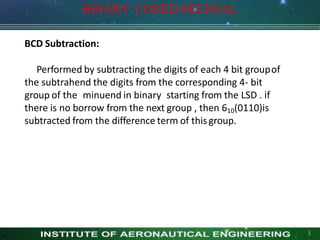
  • 263.
    ADDRESS BUS ANDDATABUS Internal organization – ‘Lookup Table of values’ –For each address there is a corresponding data output ADDRESS AND DATA BUS 263
  • 264.
    ADDRESS BUS 264 ADDRESS ANDDATA BUS • • • • Address signals are required to specify the location in the memory from which information is accessed(read orwritten). A set of parallel address lines known as the address bus carry the address information. • The number of bits (lines) comprising the address bus depends upon the size of the memory. For example, a memory having four locations to store data has four unique (00, 01, 10, 11) specified by a 2-bit addressbus. The size of the address bus depends upon the total addressable locations specified by the formula 2^n, where n is the number of bits. Thus 2^4 = 16 (n=4) specifies 4 bits to uniquely identify 16 different locations.

  • 265.
    ADDRESS AND DATABUS 265 DATA BUS • Data lines are required to retrieve the information from the memor y array during a read operation and to provide the data that is to be stored in the memory during a writeoperation. • As a the memory time therefore reads the or writes one data unit at data lines should be equal • to the number of data bits stored at each addressable location in th e memory. • A memory organized as a byte memory reads or writes byte data values, therefore the number of data lines or the size of the data bus should be 8-bits or 1 byte. A memory organized to store nibble data values requires a 4-bit wide data bus. Generally, the wider the data bus more data can be accessed at each read or writeoperation

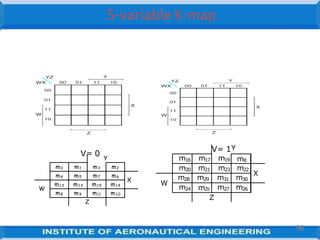
  • 266.
    SEQUENTIAL MEMORY • Outputdepends on stored information (current state) and maybe on currentinputs • Example: • state = Score board of basket state = Score board of basketball game (number of points time game (number of points, time remaining, possession) • input = which team scored the point • output = point increase for the team that justscored. • Sequential Circuits are built out of combinational logic and oneor more memory/storage elements • E.g. Registers, Memories, Counters, Control Unit . 266 SEQUENTIAL MEMORY

  • 267.
    SEQUENTIAL MEMORY 267 1-Bit memoryelement Characteristics • Need a unit that can • Retain/Remember a single bit with possible values ( ) state i.e. 0or 1. • This will allow us to read a previous value stored„ • Able to change the value (state). For a bit we can: • Set the bit to 1 • Reset, or clear, the bit to 0 • Toremember/retain their state values, rely on concept of feedback „ • Feedback digital circuits occurs when an output is looped backto the input „ • A simple example of this concept is shownbelow • If Q is 0 it will always be 0, if it is 1 it will always be 1
  • 268.
    SEQUENTIAL MEMORY 268 Flip Flop Flipflop is a sequential circuit which generally samples its inputs and changes its outputs only at particular instants of time and not continuously. Flip flop is said to be edge sensitive or edge triggered rather than being level triggered like latches. • S-R Flip Flop It is basically S-R latch using NAND gates withan additional enable input. It is also called as level triggeredSR- FF.For this, circuit in output will take place if and only if the enable input (E) is made active. In short this circuit will operate as an S-R latch if E = 1 but there is no change in the output if E = 0.
  • 269.
    Flip Flop • MasterSlave JK Flip Flop Master slave JK FF is a cascade of two S-R FF with feedback from the output of second to input of first. Master is a positive level triggered. But due to the presence of the inverter in the clock line, the slave will respond to the negative level. Hence when the clock = 1 (positive level) the master is active and the slave is inactive. Whereas when clock = 0 (low level) the slave is active and master is inactive. 269 SEQUENTIAL MEMORY
  • 270.
    Flip Flop • DelayFlip Flop / D Flip Flop Delay Flip Flop or D Flip Flop is the simple gated S-R latch with a NAND inverter connected between S and R inputs. It has only one input. The input data is appearing at the output after some time. Due to this data delay between i/p and o/p, it is called delay flip flop. S and R will be the complements of each other due to NAND inverter .Hence S = R = 0 or S = R = 1,these input condition will never appear.This problem is avoid bySR = 00 and SR = 1 conditions. 270 SEQUENTIAL MEMORY
  • 271.
    Flip Flop • ToggleFlipFlop / T Flip Flop Toggle flip flop is basically a JK flip flop with J and K terminals permanently connected together . It has only input denoted by T . 271 SEQUENTIAL MEMORY
  • 272.
    CACHE • A smallamount of fast memory that sits between normal main memory and CPU • May be located on CPU chip or module • Intended to allow access speed approaching registerspeed • When processor attempts to read a word from memory, cache is checked first 272 CACHE MEMORY
  • 273.
    CACHE MEMORY 273 Cache MemoryPrinciples • If data sought is not present in cache, a block of memory of fixed size is read into the cache • Locality of reference makes it likely that other words in the same block will be accessed soon
  • 274.
    CACHE MEMORY 274 CACHE VIEWOF MEMORY • N address lines => 2n words of memory • Cache stores fixed length blocks of K words • Cache views memory as an array of M blocks where M = 2^n/K • A block of memory in cache is referred to as a line. K is the linesize • Cache size of C blocks where C < M (considerably) • Each line includes a tag that identifies the block being stored • Tagis usually upper portion of memory address
  • 275.
    Cache operation –overview • CPU requests contents of memory location • Check cache for this data • If present, get from cache (fast) • If not present, read required block from main memoryto cache • Then deliver from cache to CPU • Cache includes tags to identify which block of main memoryis in each cache slot 275 CACHE MEMORY
  • 276.
    Programmable Logic Array •A programmable logic array (PLA) is a type of logic device that can be programmed to implement various kinds of combinational logic circuits. • The device has a number of AND and OR gates which are linked together to give output or further combined with more gates or logic circuits. 276 PROGRAMMABLE LOGIC ARRAY
  • 277.
    PROGRAMMABLE LOGIC ARRAY ProgrammableLogicArray Fig 1: Block diagram of PLA 277
  • 278.
    PLA F1 =AB’+AC+A’BC’ F2 =(AC+BC)’ Fig 2: PLA with 3-inputs 4 product terms and 2 outputs PROGRAMMABLE LOGIC ARRAY 278
  • 279.
    PROGRAMMABLE LOGIC ARRAY 279 ProgrammableLogic Array • Advantages • PLA architecture is more efficient than aPROM. • Disadvantage • PLA architecture has two sets of programmable fuses due to which PLA devices are difficult to manufacture, program and test. • Applications: • PLA is used to provide control over datapath. • PLA is used as a counter. • PLA is used as decoders. • PLA is used as a BUS interface in programmedI/O
  • 280.
    Programming Table 280 1. 2. inputsand First: lists the product termsnumerically Second: specifies the required paths between AND gates 3. Third: specifies the paths between the AND and OR gates 4. For each output variable, we may have a T(ture) or C(complement) for programming the XOR gate PROGRAMMABLE LOGIC ARRAY
  • 281.
    Simplification ofPLA  Carefulinvestigation must be undertaken in order to reduce the number of distinct product terms, PLA has a finite number of AND gates.  Both the true and complement of each function should be simplified to see which one can be expressed with fewer product terms and which one provides product terms that are common to other functions. 281 PROGRAMMABLE LOGIC ARRAY
  • 282.
    PROGRAMMABLE LOGIC ARRAY Example Implementthe following two Boolean functions with a PLA: F1(A, B,C) = ? (0, 1, 2, 4) F2(A, B, C) = ? (0, 5, 6, 7) The two functions are simplified in the maps of given figure 282
  • 283.
    PROGRAMMABLE LOGIC ARRAY PLAtableby simplifying thefunction  Both the true and complement of the functions are simplified in sum of products.  We can find the same terms from the group terms of the functions of F1, F1’,F2 and F2’ which will make the minimum terms. F1 = (AB +AC + BC)’ F2 = AB + AC + A’B’C’ Fig 1: Solution to example 283
  • 284.
  • 285.
    Memory Hierarchy • Forany memory: — How fast? — How much? — How expensive? • Fastermemory => greater cost per bit • Greater capacity => smaller cost / bit • Greater capacity => sloweraccess • Going down the hierarchy: — Decreasing cost / bit — Increasing capacity — Increasing access time — Decreasing frequency of access by processor 285 MEMORY HIAERARCHY
  • 286.
    Memory Hierarchy -Diagram MEMORY HIAERARCHY 286
  • 287.
    MEMORY HIAERARCHY • Registers —In CPU • Internal or Main memory — May include one or more levels of cache — “RAM” • External memory — Backing store 287 MEMORY HIAERARCHY
  • 288.
    HIAERARCHY LIST • Registers •L1 Cache • L2 Cache • Main memory • Disk cache • Magnetic Disk • Optical • Tape 288 MEMORY HIAERARCHY
  • 289.
    Locality of Reference •Two or more levels of memory can be used to produce average access time approaching the highest level • The reason that this works well is called ―localityof reference‖ • In practice memory references (both instructions and data) tend to cluster — Instructions: iterative loops and repetitive subroutine calls — Data: tables, arrays, etc. Memory references cluster in short run 289 MEMORY HIAERARCHY
  • 290.
    Characteristics of MemorySystems MEMORY HIAERARCHY 290
  • 291.
    Capacity • Word size —Thenatural unit of organisation —Typically number of bits used to represent an integer in the processor • Number of words —Most memory sizes are now expressed in bytes —Most modern processors have byte-addressable memory but some have word addressable memory — Memory capacity for A address lines is 2A addressable units 291 MEMORY HIAERARCHY
  • 292.
    Access Methods • Sequential —Startat the beginning and read through in order —Access time depends on location of data and previous location — e.g. tape • Direct — Individual blocks have unique address — Access is by jumping to vicinity plus sequential search — Access time depends on location and previouslocation — e.g. disk 292 MEMORY HIAERARCHY
  • 293.
    Access Methods • Random —Individual addresses identify locations exactly — Access time is independent of location or previousaccess — e.g. RAM • Associative —Data is located by a comparison with contents of a portion of the store — Access time is independent of location or previousaccess 293 simultaneously; access time is — All memory is checked constant — e.g. cache MEMORY HIAERARCHY
  • 294.
    Performance • Cycle Time —Primarilyapplied to RAM; access time + additional time before a second access can start —Function of memory components and system bus, not the processor • TransferRate – the rate at which data can be transferred into or out of a memory unit — For RAM TR = 1 / (cycle time) 294 MEMORY HIAERARCHY