Digital Logic Design (ES-215)
Number Systems
(CLO-1)
Lecture 3-4
3
Lecture Slides from Book Digital Fundamental by Floyd
References
4
 Decimal Numbers
 Binary Numbers
 Binary Conversions
 Binary addition and subtraction
 Hexadecimal Numbers
 Octal Numbers
 BCD Numbers
 Gray Code
 ASCII Code
 Excess-3 Code
Outline
5
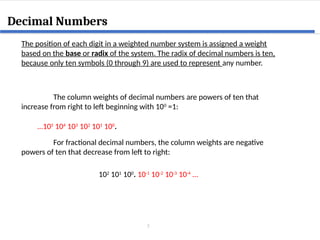
Decimal Numbers
The position of each digit in a weighted number system is assigned a weight
based on the base or radix of the system. The radix of decimal numbers is ten,
because only ten symbols (0 through 9) are used to represent any number.
The column weights of decimal numbers are powers of ten that
increase from right to left beginning with 100
=1:
…105
104
103
102
101
100
.
For fractional decimal numbers, the column weights are negative
powers of ten that decrease from left to right:
102
101
100
. 10-1
10-2
10-3
10-4
…
6
Decimal Numbers
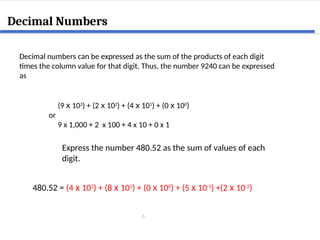
Express the number 480.52 as the sum of values of each
digit.
(9 x 10³
) + (2 x 10²
) + (4 x 101
) + (0 x 100
)
or
9 x 1,000 + 2 x 100 + 4 x 10 + 0 x 1
Decimal numbers can be expressed as the sum of the products of each digit
times the column value for that digit. Thus, the number 9240 can be expressed
as
480.52 = (4 x 10²
) + (8 x 101
) + (0 x 100
) + (5 x 10⁻¹
) +(2 x 10⁻²
)
7
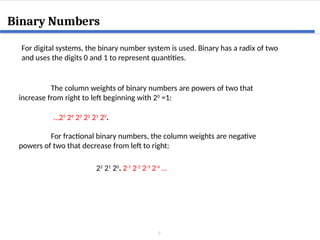
Binary Numbers
For digital systems, the binary number system is used. Binary has a radix of two
and uses the digits 0 and 1 to represent quantities.
The column weights of binary numbers are powers of two that
increase from right to left beginning with 20
=1:
…25
24
23
22
21
20
.
For fractional binary numbers, the column weights are negative
powers of two that decrease from left to right:
22
21
20
. 2-1
2-2
2-3
2-4
…
8
Binary Numbers
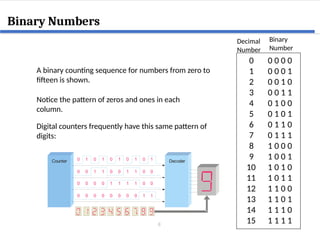
A binary counting sequence for numbers from zero to
fifteen is shown.
0 0 0 0 0
1 0 0 0 1
2 0 0 1 0
3 0 0 1 1
4 0 1 0 0
5 0 1 0 1
6 0 1 1 0
7 0 1 1 1
8 1 0 0 0
9 1 0 0 1
10 1 0 1 0
11 1 0 1 1
12 1 1 0 0
13 1 1 0 1
14 1 1 1 0
15 1 1 1 1
Decimal
Number
Binary
Number
Notice the pattern of zeros and ones in each
column.
Counter Decoder
1 0 1 0 1 0 1 0
0 1
0 1 1 0 0 1 1 0
0 0
0 0 0 1 1 1 1 0
0 0
0 0 0 0 0 0 0 1
0 1
Digital counters frequently have this same pattern of
digits:
9
Binary Conversions
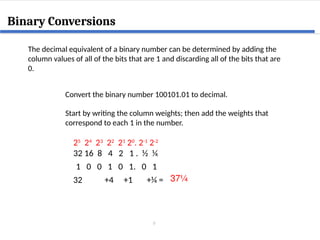
The decimal equivalent of a binary number can be determined by adding the
column values of all of the bits that are 1 and discarding all of the bits that are
0.
Convert the binary number 100101.01 to decimal.
Start by writing the column weights; then add the weights that
correspond to each 1 in the number.
25
24
23
22
21
20
. 2-1
2-2
32 16 8 4 2 1 . ½ ¼
1 0 0 1 0 1. 0 1
32 +4 +1 +¼ = 37¼
10
Binary Conversions
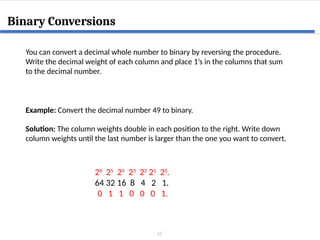
You can convert a decimal whole number to binary by reversing the procedure.
Write the decimal weight of each column and place 1’s in the columns that sum
to the decimal number.
Example: Convert the decimal number 49 to binary.
Solution: The column weights double in each position to the right. Write down
column weights until the last number is larger than the one you want to convert.
26
25
24
23
22
21
20
.
64 32 16 8 4 2 1.
0 1 1 0 0 0 1.
11
Binary Conversion
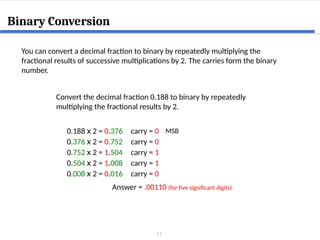
You can convert a decimal fraction to binary by repeatedly multiplying the
fractional results of successive multiplications by 2. The carries form the binary
number.
Convert the decimal fraction 0.188 to binary by repeatedly
multiplying the fractional results by 2.
0.188 x 2 = 0.376 carry = 0
0.376 x 2 = 0.752 carry = 0
0.752 x 2 = 1.504 carry = 1
0.504 x 2 = 1.008 carry = 1
0.008 x 2 = 0.016 carry = 0
Answer = .00110 (for five significant digits)
MSB
12
Binary Conversions
1
0
0
1
1 0
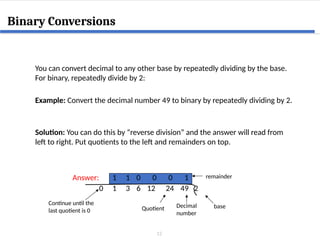
You can convert decimal to any other base by repeatedly dividing by the base.
For binary, repeatedly divide by 2:
Example: Convert the decimal number 49 to binary by repeatedly dividing by 2.
Solution: You can do this by “reverse division” and the answer will read from
left to right. Put quotients to the left and remainders on top.
49 2
Decimal
number
base
24
remainder
Quotient
12
6
3
1
0
Continue until the
last quotient is 0
Answer:
13
Binary Addition
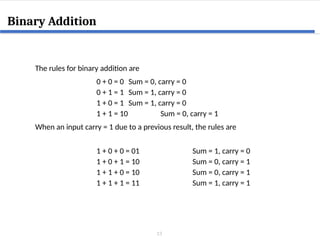
The rules for binary addition are
0 + 0 = 0 Sum = 0, carry = 0
0 + 1 = 1 Sum = 1, carry = 0
1 + 0 = 1 Sum = 1, carry = 0
1 + 1 = 10 Sum = 0, carry = 1
When an input carry = 1 due to a previous result, the rules are
1 + 0 + 0 = 01 Sum = 1, carry = 0
1 + 0 + 1 = 10 Sum = 0, carry = 1
1 + 1 + 0 = 10 Sum = 0, carry = 1
1 + 1 + 1 = 11 Sum = 1, carry = 1
14
Binary Addition
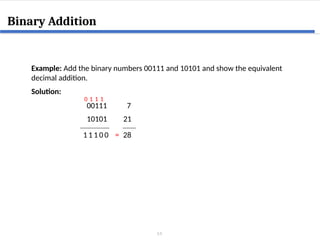
Example: Add the binary numbers 00111 and 10101 and show the equivalent
decimal addition.
Solution:
00111 7
10101 21
0
1
0
1
1
1
1
0
1 28
=
15
Binary Subtraction
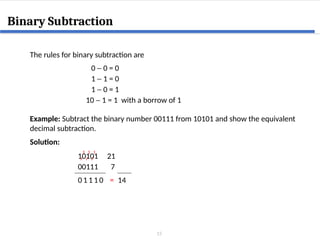
The rules for binary subtraction are
0 - 0 = 0
1 - 1 = 0
1 - 0 = 1
10 - 1 = 1 with a borrow of 1
Example: Subtract the binary number 00111 from 10101 and show the equivalent
decimal subtraction.
Solution:
00111 7
10101 21
0
/
1
1
1
1
0 14
/
1
/
1
=
16
Hexadecimal Numbers
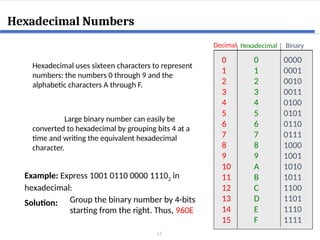
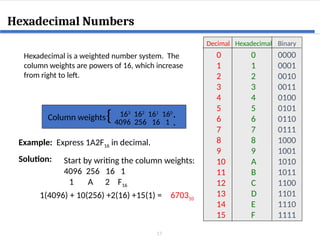
Hexadecimal uses sixteen characters to represent
numbers: the numbers 0 through 9 and the
alphabetic characters A through F.
0
1
2
3
4
5
6
7
8
9
10
11
12
13
14
15
0
1
2
3
4
5
6
7
8
9
A
B
C
D
E
F
0000
0001
0010
0011
0100
0101
0110
0111
1000
1001
1010
1011
1100
1101
1110
1111
Decimal Hexadecimal Binary
Large binary number can easily be
converted to hexadecimal by grouping bits 4 at a
time and writing the equivalent hexadecimal
character.
Example: Express 1001 0110 0000 11102 in
hexadecimal:
Solution: Group the binary number by 4-bits
starting from the right. Thus, 960E
17
Hexadecimal Numbers
17
Hexadecimal is a weighted number system. The
column weights are powers of 16, which increase
from right to left.
.
1 A 2 F16
670310
Column weights 163
162
161
160
4096 256 16 1 .
{
Example: Express 1A2F16 in decimal.
Solution: Start by writing the column weights:
4096 256 16 1
1(4096) + 10(256) +2(16) +15(1) =
0
1
2
3
4
5
6
7
8
9
10
11
12
13
14
15
0
1
2
3
4
5
6
7
8
9
A
B
C
D
E
F
0000
0001
0010
0011
0100
0101
0110
0111
1000
1001
1010
1011
1100
1101
1110
1111
Decimal Hexadecimal Binary
18
Octal Numbers
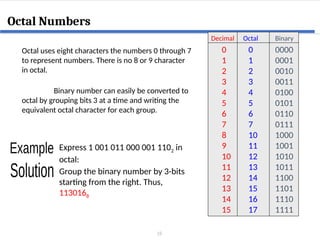
Octal uses eight characters the numbers 0 through 7
to represent numbers. There is no 8 or 9 character
in octal.
0
1
2
3
4
5
6
7
8
9
10
11
12
13
14
15
0
1
2
3
4
5
6
7
10
11
12
13
14
15
16
17
0000
0001
0010
0011
0100
0101
0110
0111
1000
1001
1010
1011
1100
1101
1110
1111
Decimal Octal Binary
Binary number can easily be converted to
octal by grouping bits 3 at a time and writing the
equivalent octal character for each group.
Express 1 001 011 000 001 1102 in
octal:
Group the binary number by 3-bits
starting from the right. Thus,
1130168
19
Octal Numbers
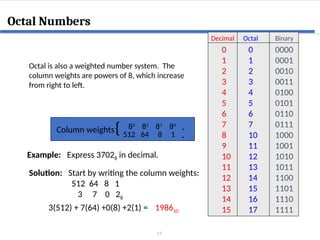
Octal is also a weighted number system. The
column weights are powers of 8, which increase
from right to left.
.
3 7 0 28
198610
Column weights 83
82
81
80
512 64 8 1 .
{
Example: Express 37028 in decimal.
Solution: Start by writing the column weights:
512 64 8 1
3(512) + 7(64) +0(8) +2(1) =
0
1
2
3
4
5
6
7
8
9
10
11
12
13
14
15
0
1
2
3
4
5
6
7
10
11
12
13
14
15
16
17
0000
0001
0010
0011
0100
0101
0110
0111
1000
1001
1010
1011
1100
1101
1110
1111
Decimal Octal Binary
20
BCD
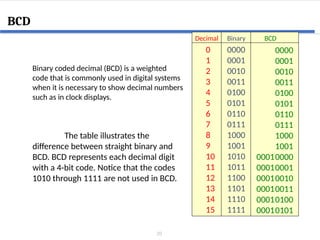
Binary coded decimal (BCD) is a weighted
code that is commonly used in digital systems
when it is necessary to show decimal numbers
such as in clock displays.
0
1
2
3
4
5
6
7
8
9
10
11
12
13
14
15
0000
0001
0010
0011
0100
0101
0110
0111
1000
1001
1010
1011
1100
1101
1110
1111
Decimal Binary BCD
0001
0001
0001
0001
0001
0001
0000
0001
0010
0011
0100
0101
0110
0111
1000
1001
0000
0001
0010
0011
0100
0101
The table illustrates the
difference between straight binary and
BCD. BCD represents each decimal digit
with a 4-bit code. Notice that the codes
1010 through 1111 are not used in BCD.
21
BCD
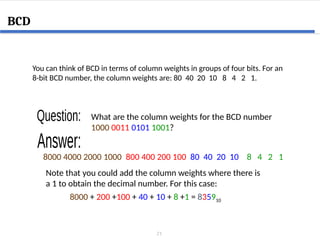
You can think of BCD in terms of column weights in groups of four bits. For an
8-bit BCD number, the column weights are: 80 40 20 10 8 4 2 1.
What are the column weights for the BCD number
1000 0011 0101 1001?
8000 4000 2000 1000 800 400 200 100 80 40 20 10 8 4 2 1
Note that you could add the column weights where there is
a 1 to obtain the decimal number. For this case:
8000 + 200 +100 + 40 + 10 + 8 +1 = 835910
22
Gray Code
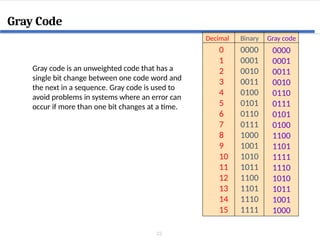
Gray code is an unweighted code that has a
single bit change between one code word and
the next in a sequence. Gray code is used to
avoid problems in systems where an error can
occur if more than one bit changes at a time.
0
1
2
3
4
5
6
7
8
9
10
11
12
13
14
15
0000
0001
0010
0011
0100
0101
0110
0111
1000
1001
1010
1011
1100
1101
1110
1111
Decimal Binary Gray code
0000
0001
0011
0010
0110
0111
0101
0100
1100
1101
1111
1110
1010
1011
1001
1000
23
Gray Code
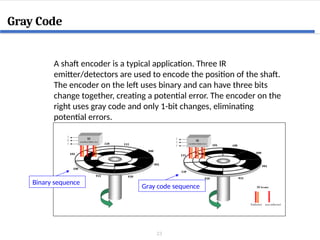
A shaft encoder is a typical application. Three IR
emitter/detectors are used to encode the position of the shaft.
The encoder on the left uses binary and can have three bits
change together, creating a potential error. The encoder on the
right uses gray code and only 1-bit changes, eliminating
potential errors.
Binary sequence
Gray code sequence
24
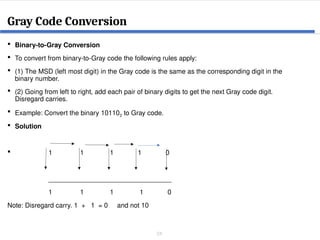
 Binary-to-Gray Conversion
 To convert from binary-to-Gray code the following rules apply:
 (1) The MSD (left most digit) in the Gray code is the same as the corresponding digit in the
binary number.
 (2) Going from left to right, add each pair of binary digits to get the next Gray code digit.
Disregard carries.
 Example: Convert the binary 101102 to Gray code.
 Solution
 1 1 1 1 0
_________________________________
1 1 1 1 0
Note: Disregard carry. 1 + 1 = 0 and not 10
Gray Code Conversion
25
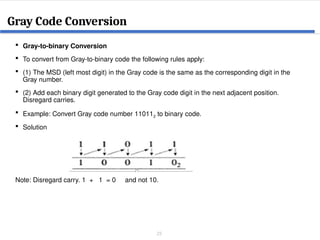
 Gray-to-binary Conversion
 To convert from Gray-to-binary code the following rules apply:
 (1) The MSD (left most digit) in the Gray code is the same as the corresponding digit in the
Gray number.
 (2) Add each binary digit generated to the Gray code digit in the next adjacent position.
Disregard carries.
 Example: Convert Gray code number 110112 to binary code.
 Solution
Note: Disregard carry. 1 + 1 = 0 and not 10.
Gray Code Conversion
26
• ASCII (American Standard code for information Interchange) is a code for alphanumeric
characters and control characters. In its original form, ASCII encoded 128 characters
and symbols using 7-bits. The first 32 characters are control characters, that are based
on obsolete teletype requirements, so these characters are generally assigned to other
functions in modern usage.
• In 1981, IBM introduced extended ASCII, which is an 8-bit code and increased the
character set to 256. Other extended sets (such as Unicode) have been introduced to
handle characters in languages other than English.
ASCII Code
27
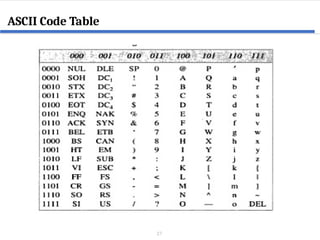
ASCII Code Table
28
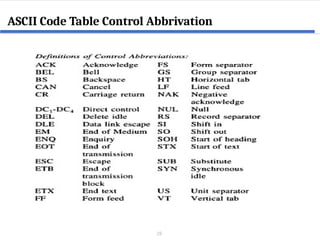
ASCII Code Table Control Abbrivation
29
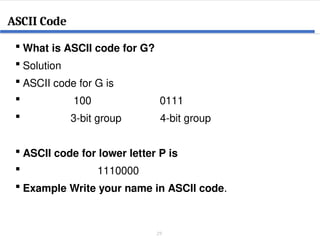
 What is ASCII code for G?
 Solution
 ASCII code for G is
 100 0111
 3-bit group 4-bit group
 ASCII code for lower letter P is
 1110000
 Example Write your name in ASCII code.
ASCII Code
30
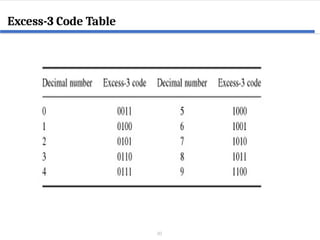
Excess-3 Code Table
31
END OF LECTURE # 3-4

Lecture # 3-4 Number Systems. DIGITALSS

  • 1.
  • 2.
  • 3.
    3 Lecture Slides fromBook Digital Fundamental by Floyd References
  • 4.
    4  Decimal Numbers Binary Numbers  Binary Conversions  Binary addition and subtraction  Hexadecimal Numbers  Octal Numbers  BCD Numbers  Gray Code  ASCII Code  Excess-3 Code Outline
  • 5.
    5 Decimal Numbers The positionof each digit in a weighted number system is assigned a weight based on the base or radix of the system. The radix of decimal numbers is ten, because only ten symbols (0 through 9) are used to represent any number. The column weights of decimal numbers are powers of ten that increase from right to left beginning with 100 =1: …105 104 103 102 101 100 . For fractional decimal numbers, the column weights are negative powers of ten that decrease from left to right: 102 101 100 . 10-1 10-2 10-3 10-4 …
  • 6.
    6 Decimal Numbers Express thenumber 480.52 as the sum of values of each digit. (9 x 10³ ) + (2 x 10² ) + (4 x 101 ) + (0 x 100 ) or 9 x 1,000 + 2 x 100 + 4 x 10 + 0 x 1 Decimal numbers can be expressed as the sum of the products of each digit times the column value for that digit. Thus, the number 9240 can be expressed as 480.52 = (4 x 10² ) + (8 x 101 ) + (0 x 100 ) + (5 x 10⁻¹ ) +(2 x 10⁻² )
  • 7.
    7 Binary Numbers For digitalsystems, the binary number system is used. Binary has a radix of two and uses the digits 0 and 1 to represent quantities. The column weights of binary numbers are powers of two that increase from right to left beginning with 20 =1: …25 24 23 22 21 20 . For fractional binary numbers, the column weights are negative powers of two that decrease from left to right: 22 21 20 . 2-1 2-2 2-3 2-4 …
  • 8.
    8 Binary Numbers A binarycounting sequence for numbers from zero to fifteen is shown. 0 0 0 0 0 1 0 0 0 1 2 0 0 1 0 3 0 0 1 1 4 0 1 0 0 5 0 1 0 1 6 0 1 1 0 7 0 1 1 1 8 1 0 0 0 9 1 0 0 1 10 1 0 1 0 11 1 0 1 1 12 1 1 0 0 13 1 1 0 1 14 1 1 1 0 15 1 1 1 1 Decimal Number Binary Number Notice the pattern of zeros and ones in each column. Counter Decoder 1 0 1 0 1 0 1 0 0 1 0 1 1 0 0 1 1 0 0 0 0 0 0 1 1 1 1 0 0 0 0 0 0 0 0 0 0 1 0 1 Digital counters frequently have this same pattern of digits:
  • 9.
    9 Binary Conversions The decimalequivalent of a binary number can be determined by adding the column values of all of the bits that are 1 and discarding all of the bits that are 0. Convert the binary number 100101.01 to decimal. Start by writing the column weights; then add the weights that correspond to each 1 in the number. 25 24 23 22 21 20 . 2-1 2-2 32 16 8 4 2 1 . ½ ¼ 1 0 0 1 0 1. 0 1 32 +4 +1 +¼ = 37¼
  • 10.
    10 Binary Conversions You canconvert a decimal whole number to binary by reversing the procedure. Write the decimal weight of each column and place 1’s in the columns that sum to the decimal number. Example: Convert the decimal number 49 to binary. Solution: The column weights double in each position to the right. Write down column weights until the last number is larger than the one you want to convert. 26 25 24 23 22 21 20 . 64 32 16 8 4 2 1. 0 1 1 0 0 0 1.
  • 11.
    11 Binary Conversion You canconvert a decimal fraction to binary by repeatedly multiplying the fractional results of successive multiplications by 2. The carries form the binary number. Convert the decimal fraction 0.188 to binary by repeatedly multiplying the fractional results by 2. 0.188 x 2 = 0.376 carry = 0 0.376 x 2 = 0.752 carry = 0 0.752 x 2 = 1.504 carry = 1 0.504 x 2 = 1.008 carry = 1 0.008 x 2 = 0.016 carry = 0 Answer = .00110 (for five significant digits) MSB
  • 12.
    12 Binary Conversions 1 0 0 1 1 0 Youcan convert decimal to any other base by repeatedly dividing by the base. For binary, repeatedly divide by 2: Example: Convert the decimal number 49 to binary by repeatedly dividing by 2. Solution: You can do this by “reverse division” and the answer will read from left to right. Put quotients to the left and remainders on top. 49 2 Decimal number base 24 remainder Quotient 12 6 3 1 0 Continue until the last quotient is 0 Answer:
  • 13.
    13 Binary Addition The rulesfor binary addition are 0 + 0 = 0 Sum = 0, carry = 0 0 + 1 = 1 Sum = 1, carry = 0 1 + 0 = 1 Sum = 1, carry = 0 1 + 1 = 10 Sum = 0, carry = 1 When an input carry = 1 due to a previous result, the rules are 1 + 0 + 0 = 01 Sum = 1, carry = 0 1 + 0 + 1 = 10 Sum = 0, carry = 1 1 + 1 + 0 = 10 Sum = 0, carry = 1 1 + 1 + 1 = 11 Sum = 1, carry = 1
  • 14.
    14 Binary Addition Example: Addthe binary numbers 00111 and 10101 and show the equivalent decimal addition. Solution: 00111 7 10101 21 0 1 0 1 1 1 1 0 1 28 =
  • 15.
    15 Binary Subtraction The rulesfor binary subtraction are 0 - 0 = 0 1 - 1 = 0 1 - 0 = 1 10 - 1 = 1 with a borrow of 1 Example: Subtract the binary number 00111 from 10101 and show the equivalent decimal subtraction. Solution: 00111 7 10101 21 0 / 1 1 1 1 0 14 / 1 / 1 =
  • 16.
    16 Hexadecimal Numbers Hexadecimal usessixteen characters to represent numbers: the numbers 0 through 9 and the alphabetic characters A through F. 0 1 2 3 4 5 6 7 8 9 10 11 12 13 14 15 0 1 2 3 4 5 6 7 8 9 A B C D E F 0000 0001 0010 0011 0100 0101 0110 0111 1000 1001 1010 1011 1100 1101 1110 1111 Decimal Hexadecimal Binary Large binary number can easily be converted to hexadecimal by grouping bits 4 at a time and writing the equivalent hexadecimal character. Example: Express 1001 0110 0000 11102 in hexadecimal: Solution: Group the binary number by 4-bits starting from the right. Thus, 960E
  • 17.
    17 Hexadecimal Numbers 17 Hexadecimal isa weighted number system. The column weights are powers of 16, which increase from right to left. . 1 A 2 F16 670310 Column weights 163 162 161 160 4096 256 16 1 . { Example: Express 1A2F16 in decimal. Solution: Start by writing the column weights: 4096 256 16 1 1(4096) + 10(256) +2(16) +15(1) = 0 1 2 3 4 5 6 7 8 9 10 11 12 13 14 15 0 1 2 3 4 5 6 7 8 9 A B C D E F 0000 0001 0010 0011 0100 0101 0110 0111 1000 1001 1010 1011 1100 1101 1110 1111 Decimal Hexadecimal Binary
  • 18.
    18 Octal Numbers Octal useseight characters the numbers 0 through 7 to represent numbers. There is no 8 or 9 character in octal. 0 1 2 3 4 5 6 7 8 9 10 11 12 13 14 15 0 1 2 3 4 5 6 7 10 11 12 13 14 15 16 17 0000 0001 0010 0011 0100 0101 0110 0111 1000 1001 1010 1011 1100 1101 1110 1111 Decimal Octal Binary Binary number can easily be converted to octal by grouping bits 3 at a time and writing the equivalent octal character for each group. Express 1 001 011 000 001 1102 in octal: Group the binary number by 3-bits starting from the right. Thus, 1130168
  • 19.
    19 Octal Numbers Octal isalso a weighted number system. The column weights are powers of 8, which increase from right to left. . 3 7 0 28 198610 Column weights 83 82 81 80 512 64 8 1 . { Example: Express 37028 in decimal. Solution: Start by writing the column weights: 512 64 8 1 3(512) + 7(64) +0(8) +2(1) = 0 1 2 3 4 5 6 7 8 9 10 11 12 13 14 15 0 1 2 3 4 5 6 7 10 11 12 13 14 15 16 17 0000 0001 0010 0011 0100 0101 0110 0111 1000 1001 1010 1011 1100 1101 1110 1111 Decimal Octal Binary
  • 20.
    20 BCD Binary coded decimal(BCD) is a weighted code that is commonly used in digital systems when it is necessary to show decimal numbers such as in clock displays. 0 1 2 3 4 5 6 7 8 9 10 11 12 13 14 15 0000 0001 0010 0011 0100 0101 0110 0111 1000 1001 1010 1011 1100 1101 1110 1111 Decimal Binary BCD 0001 0001 0001 0001 0001 0001 0000 0001 0010 0011 0100 0101 0110 0111 1000 1001 0000 0001 0010 0011 0100 0101 The table illustrates the difference between straight binary and BCD. BCD represents each decimal digit with a 4-bit code. Notice that the codes 1010 through 1111 are not used in BCD.
  • 21.
    21 BCD You can thinkof BCD in terms of column weights in groups of four bits. For an 8-bit BCD number, the column weights are: 80 40 20 10 8 4 2 1. What are the column weights for the BCD number 1000 0011 0101 1001? 8000 4000 2000 1000 800 400 200 100 80 40 20 10 8 4 2 1 Note that you could add the column weights where there is a 1 to obtain the decimal number. For this case: 8000 + 200 +100 + 40 + 10 + 8 +1 = 835910
  • 22.
    22 Gray Code Gray codeis an unweighted code that has a single bit change between one code word and the next in a sequence. Gray code is used to avoid problems in systems where an error can occur if more than one bit changes at a time. 0 1 2 3 4 5 6 7 8 9 10 11 12 13 14 15 0000 0001 0010 0011 0100 0101 0110 0111 1000 1001 1010 1011 1100 1101 1110 1111 Decimal Binary Gray code 0000 0001 0011 0010 0110 0111 0101 0100 1100 1101 1111 1110 1010 1011 1001 1000
  • 23.
    23 Gray Code A shaftencoder is a typical application. Three IR emitter/detectors are used to encode the position of the shaft. The encoder on the left uses binary and can have three bits change together, creating a potential error. The encoder on the right uses gray code and only 1-bit changes, eliminating potential errors. Binary sequence Gray code sequence
  • 24.
    24  Binary-to-Gray Conversion To convert from binary-to-Gray code the following rules apply:  (1) The MSD (left most digit) in the Gray code is the same as the corresponding digit in the binary number.  (2) Going from left to right, add each pair of binary digits to get the next Gray code digit. Disregard carries.  Example: Convert the binary 101102 to Gray code.  Solution  1 1 1 1 0 _________________________________ 1 1 1 1 0 Note: Disregard carry. 1 + 1 = 0 and not 10 Gray Code Conversion
  • 25.
    25  Gray-to-binary Conversion To convert from Gray-to-binary code the following rules apply:  (1) The MSD (left most digit) in the Gray code is the same as the corresponding digit in the Gray number.  (2) Add each binary digit generated to the Gray code digit in the next adjacent position. Disregard carries.  Example: Convert Gray code number 110112 to binary code.  Solution Note: Disregard carry. 1 + 1 = 0 and not 10. Gray Code Conversion
  • 26.
    26 • ASCII (AmericanStandard code for information Interchange) is a code for alphanumeric characters and control characters. In its original form, ASCII encoded 128 characters and symbols using 7-bits. The first 32 characters are control characters, that are based on obsolete teletype requirements, so these characters are generally assigned to other functions in modern usage. • In 1981, IBM introduced extended ASCII, which is an 8-bit code and increased the character set to 256. Other extended sets (such as Unicode) have been introduced to handle characters in languages other than English. ASCII Code
  • 27.
  • 28.
    28 ASCII Code TableControl Abbrivation
  • 29.
    29  What isASCII code for G?  Solution  ASCII code for G is  100 0111  3-bit group 4-bit group  ASCII code for lower letter P is  1110000  Example Write your name in ASCII code. ASCII Code
  • 30.
  • 31.