Prototyping an
electro-mechanical instrument
Hands-on session
CHM College - Internet of Things - Session 3
Compiled by - Deepak Malani (malani.deepak@gmail.com)
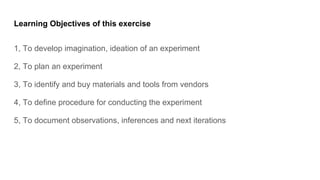
Learning Objectives of this exercise
1, To develop imagination, ideation of an experiment
2, To plan an experiment
3, To identify and buy materials and tools from vendors
4, To define procedure for conducting the experiment
5, To document observations, inferences and next iterations
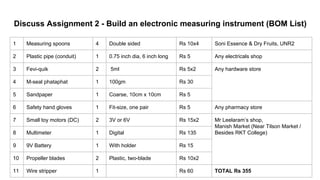
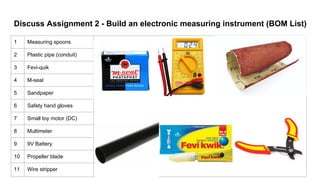
Discuss Assignment 2 - Build an electronic measuring instrument (BOM List)
1 Measuring spoons 4 Double sided Rs 10x4 Soni Essence & Dry Fruits, UNR2
2 Plastic pipe (conduit) 1 0.75 inch dia, 6 inch long Rs 5 Any electricals shop
3 Fevi-quik 2 5ml Rs 5x2 Any hardware store
4 M-seal phataphat 1 100gm Rs 30
5 Sandpaper 1 Coarse, 10cm x 10cm Rs 5
6 Safety hand gloves 1 Fit-size, one pair Rs 5 Any pharmacy store
7 Small toy motors (DC) 2 3V or 6V Rs 15x2 Mr Leelaram’s shop,
Manish Market (Near Tilson Market /
Besides RKT College)8 Multimeter 1 Digital Rs 135
9 9V Battery 1 With holder Rs 15
10 Propeller blades 2 Plastic, two-blade Rs 10x2
11 Wire stripper 1 Rs 60 TOTAL Rs 355
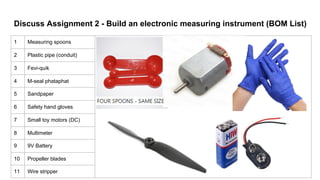
Discuss Assignment 2 - Build an electronic measuring instrument (BOM List)
1 Measuring spoons
2 Plastic pipe (conduit)
3 Fevi-quik
4 M-seal phataphat
5 Sandpaper
6 Safety hand gloves
7 Small toy motors (DC)
8 Multimeter
9 9V Battery
10 Propeller blades
11 Wire stripper
Discuss Assignment 2 - Build an electronic measuring instrument (BOM List)
1 Measuring spoons
2 Plastic pipe (conduit)
3 Fevi-quik
4 M-seal
5 Sandpaper
6 Safety hand gloves
7 Small toy motor (DC)
8 Multimeter
9 9V Battery
10 Propeller blade
11 Wire stripper
Questions (6Ws)
What?
Why?
How?
When?
Where?
By whom? For whom?
Questions (6Ws)
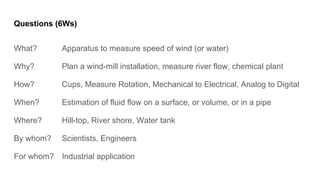
What? Apparatus to measure speed of wind (or water)
Why? Plan a wind-mill installation, measure river flow, chemical plant
How? Cups, Measure Rotation, Mechanical to Electrical, Analog to Digital
When? Estimation of fluid flow on a surface, or volume, or in a pipe
Where? Hill-top, River shore, Water tank
By whom? Scientists, Engineers
For whom? Industrial application
Precautions, Do’s and Dont’s
1, Wear safety gloves in your both hands
2, Create a clean table space / floor space for experiment
3, Put a newspaper in the experiment space
4, Use goggles for eye-safety
5, When using adhesives, do not touch chemical on your body, especially on eyes.
REPORT IF THIS HAPPENS.
6, Avoid wastage
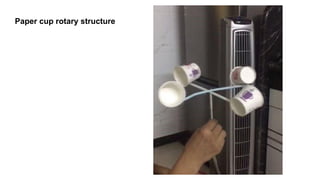
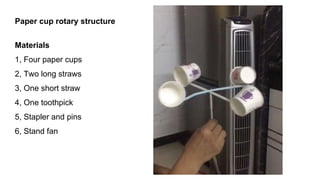
Paper cup rotary structure
Materials
1, Four paper cups
2, Two long straws
3, One short straw
4, One toothpick
5, Stapler and pins
6, Stand fan
Procedure to assemble cup rotary structure
1, Align the four paper cups, in a plane on the table, in back to back formation
2, Align two LARGE plastic straws perpendicular to each other touching the cups
3, Attach cups to the ends of large straws with pin-stapler
4, Insert sharp end of tooth-pick to bind two straws at their center
5, Insert the smooth end of tooth-pick in the small straw
6, Test the device for free rotation in front of vertical stand fan
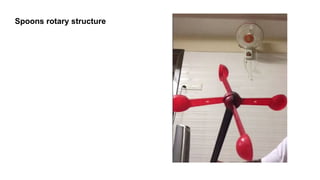
Spoons rotary structure
Procedure to assemble Spoons rotary structure
1, Align the four spoons, in a plane, in “ + ” formation
2, Roughen the spoons inside and outside completely with coarse sand-paper
3, Bond two spoons at right angle, using adhesive. Repeat with other two spoons
4, Bond above two pairs to form a + formation of four spoons
5, Bond one end of plastic conduit pipe with center of structure, using m-seal
6, Insert motor shaft in the hole of plastic propeller
Test this assembly for a couple of seconds with 9V battery (Do NOT run this
toy motor on 9V battery for long duration)
Procedure - Spoons rotary structure (continued)
7, Cut propeller blades (with wire-stripper) to fit with other end of pipe tightly
8, Test the rotation of apparatus by holding from the motor, to avoid wobbling
9, Test the apparatus in front of a stand fan
10, Connect two probes of multimeter to motor terminals
Multimeter should be in DC voltage setting, Knob at 200mV position
11, Test the apparatus in front of vertical stand fan
12, Record observations
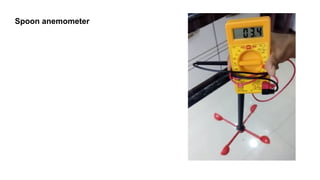
Spoon anemometer
Spoon anemometer
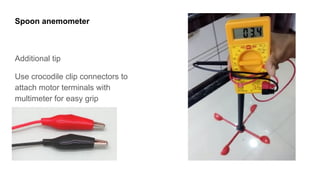
Additional tip
Use crocodile clip connectors to
attach motor terminals with
multimeter for easy grip
Discuss Observations
1 Range of voltage values on multimeter
2 Next iteration, what can be done differently? Additional Do’s and Dont’s
What next? Making an IoT Wind-Anemometer
1, Interface the motor* output with a smartphone to display values on screen (AUX
connector) - *Tach generator
2, Transmit data and display remotely
Assignment 4
Look around and think of a sensor assembly, that can be made using locally
available materials
Examples
1, To sense water level in a tank or a bucket (filled or half-full)
2, To sense a person entering or leaving a room
Discuss Assignment 3
Prepare a case study on ‘Evolution diagram/sketch of any utility product or
technology’
- Example: Telephony
- Examples: Automobiles, umbrella, sewing machine
Discuss Assignment 1
1 Observe around you the routine activities, tools, products, technologies,services;
and identify if they are optimum or have any difficulties in their utility
2 Repeat above with a neighbour
3 Repeat above with a shopkeeper / service provider (rickshaw driver / electric
pole repair / water supply piping)
*Recap - Umbrella design

DIY: Making a wind speed meter

  • 1.
    Prototyping an electro-mechanical instrument Hands-onsession CHM College - Internet of Things - Session 3 Compiled by - Deepak Malani (malani.deepak@gmail.com)
  • 2.
    Learning Objectives ofthis exercise 1, To develop imagination, ideation of an experiment 2, To plan an experiment 3, To identify and buy materials and tools from vendors 4, To define procedure for conducting the experiment 5, To document observations, inferences and next iterations
  • 3.
    Discuss Assignment 2- Build an electronic measuring instrument (BOM List) 1 Measuring spoons 4 Double sided Rs 10x4 Soni Essence & Dry Fruits, UNR2 2 Plastic pipe (conduit) 1 0.75 inch dia, 6 inch long Rs 5 Any electricals shop 3 Fevi-quik 2 5ml Rs 5x2 Any hardware store 4 M-seal phataphat 1 100gm Rs 30 5 Sandpaper 1 Coarse, 10cm x 10cm Rs 5 6 Safety hand gloves 1 Fit-size, one pair Rs 5 Any pharmacy store 7 Small toy motors (DC) 2 3V or 6V Rs 15x2 Mr Leelaram’s shop, Manish Market (Near Tilson Market / Besides RKT College)8 Multimeter 1 Digital Rs 135 9 9V Battery 1 With holder Rs 15 10 Propeller blades 2 Plastic, two-blade Rs 10x2 11 Wire stripper 1 Rs 60 TOTAL Rs 355
  • 4.
    Discuss Assignment 2- Build an electronic measuring instrument (BOM List) 1 Measuring spoons 2 Plastic pipe (conduit) 3 Fevi-quik 4 M-seal phataphat 5 Sandpaper 6 Safety hand gloves 7 Small toy motors (DC) 8 Multimeter 9 9V Battery 10 Propeller blades 11 Wire stripper
  • 5.
    Discuss Assignment 2- Build an electronic measuring instrument (BOM List) 1 Measuring spoons 2 Plastic pipe (conduit) 3 Fevi-quik 4 M-seal 5 Sandpaper 6 Safety hand gloves 7 Small toy motor (DC) 8 Multimeter 9 9V Battery 10 Propeller blade 11 Wire stripper
  • 6.
  • 7.
    Questions (6Ws) What? Apparatusto measure speed of wind (or water) Why? Plan a wind-mill installation, measure river flow, chemical plant How? Cups, Measure Rotation, Mechanical to Electrical, Analog to Digital When? Estimation of fluid flow on a surface, or volume, or in a pipe Where? Hill-top, River shore, Water tank By whom? Scientists, Engineers For whom? Industrial application
  • 8.
    Precautions, Do’s andDont’s 1, Wear safety gloves in your both hands 2, Create a clean table space / floor space for experiment 3, Put a newspaper in the experiment space 4, Use goggles for eye-safety 5, When using adhesives, do not touch chemical on your body, especially on eyes. REPORT IF THIS HAPPENS. 6, Avoid wastage
  • 9.
  • 10.
    Paper cup rotarystructure Materials 1, Four paper cups 2, Two long straws 3, One short straw 4, One toothpick 5, Stapler and pins 6, Stand fan
  • 11.
    Procedure to assemblecup rotary structure 1, Align the four paper cups, in a plane on the table, in back to back formation 2, Align two LARGE plastic straws perpendicular to each other touching the cups 3, Attach cups to the ends of large straws with pin-stapler 4, Insert sharp end of tooth-pick to bind two straws at their center 5, Insert the smooth end of tooth-pick in the small straw 6, Test the device for free rotation in front of vertical stand fan
  • 12.
  • 13.
    Procedure to assembleSpoons rotary structure 1, Align the four spoons, in a plane, in “ + ” formation 2, Roughen the spoons inside and outside completely with coarse sand-paper 3, Bond two spoons at right angle, using adhesive. Repeat with other two spoons 4, Bond above two pairs to form a + formation of four spoons 5, Bond one end of plastic conduit pipe with center of structure, using m-seal 6, Insert motor shaft in the hole of plastic propeller Test this assembly for a couple of seconds with 9V battery (Do NOT run this toy motor on 9V battery for long duration)
  • 14.
    Procedure - Spoonsrotary structure (continued) 7, Cut propeller blades (with wire-stripper) to fit with other end of pipe tightly 8, Test the rotation of apparatus by holding from the motor, to avoid wobbling 9, Test the apparatus in front of a stand fan 10, Connect two probes of multimeter to motor terminals Multimeter should be in DC voltage setting, Knob at 200mV position 11, Test the apparatus in front of vertical stand fan 12, Record observations
  • 15.
  • 16.
    Spoon anemometer Additional tip Usecrocodile clip connectors to attach motor terminals with multimeter for easy grip
  • 17.
    Discuss Observations 1 Rangeof voltage values on multimeter 2 Next iteration, what can be done differently? Additional Do’s and Dont’s What next? Making an IoT Wind-Anemometer 1, Interface the motor* output with a smartphone to display values on screen (AUX connector) - *Tach generator 2, Transmit data and display remotely
  • 18.
    Assignment 4 Look aroundand think of a sensor assembly, that can be made using locally available materials Examples 1, To sense water level in a tank or a bucket (filled or half-full) 2, To sense a person entering or leaving a room
  • 19.
    Discuss Assignment 3 Preparea case study on ‘Evolution diagram/sketch of any utility product or technology’ - Example: Telephony - Examples: Automobiles, umbrella, sewing machine
  • 20.
    Discuss Assignment 1 1Observe around you the routine activities, tools, products, technologies,services; and identify if they are optimum or have any difficulties in their utility 2 Repeat above with a neighbour 3 Repeat above with a shopkeeper / service provider (rickshaw driver / electric pole repair / water supply piping) *Recap - Umbrella design