The Author andHis
Time
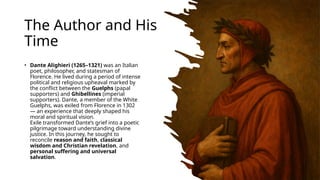
• Dante Alighieri (1265–1321) was an Italian
poet, philosopher, and statesman of
Florence. He lived during a period of intense
political and religious upheaval marked by
the conflict between the Guelphs (papal
supporters) and Ghibellines (imperial
supporters). Dante, a member of the White
Guelphs, was exiled from Florence in 1302
— an experience that deeply shaped his
moral and spiritual vision.
Exile transformed Dante’s grief into a poetic
pilgrimage toward understanding divine
justice. In this journey, he sought to
reconcile reason and faith, classical
wisdom and Christian revelation, and
personal suffering and universal
salvation.
3.
Overview
• The DivineComedy is Dante’s monumental
allegorical epic poem, written in terza rima
(three-line rhyming stanzas, aba bcb cdc…). It
consists of three parts—Inferno, Purgatorio,
and Paradiso—and follows the pilgrim Dante
as he journeys through the three realms of
the afterlife under divine guidance.
1. Inferno (Hell) – The descent through sin
and moral corruption.
2. Purgatorio (Purgatory) – The ascent
through repentance and purification.
3. Paradiso (Heaven) – The final union of the
soul with God.
• Though titled a “Comedy,” it ends joyfully in
divine light—thus contrasting with “tragedy,”
which ends in sorrow.
4.
• Inferno isthe first part of Dante’s Divine Comedy, composed around
1308–1314. It chronicles the poet’s journey through Hell, guided
by Virgil, representing human reason. The setting begins on Good
Friday of the year 1300, in a dark forest symbolizing the confusion
of sin.
The descent into Hell takes place over three days, aligning
symbolically with Christ’s death and resurrection. Dante’s journey
downward through the nine circles mirrors the soul’s descent into
sin and spiritual death.
• The poem is written as both a personal vision and a universal
allegory—Dante’s individual struggle with sin becomes humanity’s
struggle to return to God.
5.
Purpose
Dante wrote TheDivine Comedy for two intertwined purposes:
• Personal Redemption – to find meaning and spiritual direction amid despair
and exile. The poem represents Dante’s own moral pilgrimage from sin to
divine grace.
• Universal Instruction – to awaken readers to the reality of sin, the hope of
repentance, and the promise of salvation. In Dante’s words (from his Letter to
Can Grande della Scala), his goal was “to remove those living in this life from the
state of misery and lead them to the state of happiness.”
In essence, The Divine Comedy is both confession and catechism—a deeply
personal allegory intended for the moral and spiritual education of all
humanity.
6.
How was itwritten?
• Dante composed The Divine Comedy over approximately 15 years (c. 1308–1321),
during his exile in northern Italy.
• He wrote in the vernacular Italian, rather than Latin, to make profound truths
accessible to ordinary people. This decision helped shape Italian as a literary
language.
• The poem is written in terza rima (a chain rhyme of aba bcb cdc, etc.), a form Dante
invented to mirror the interconnection of human souls and divine order.
• The work’s architecture reflects medieval scholastic harmony—a structured
universe of reason and faith. The number three pervades everything (three realms,
three guides, three beasts, three-line stanzas), symbolizing the Holy Trinity.
• Each of the three parts (Inferno, Purgatorio, and Paradiso) contains 33 cantos, with
Inferno having one extra as a prologue, totaling 100 cantos, a number representing
perfection in medieval numerology.
7.
The Structure /Setting
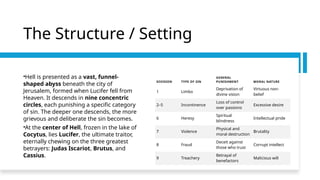
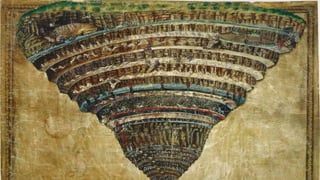
•Hell is presented as a vast, funnel-
shaped abyss beneath the city of
Jerusalem, formed when Lucifer fell from
Heaven. It descends in nine concentric
circles, each punishing a specific category
of sin. The deeper one descends, the more
grievous and deliberate the sin becomes.
•At the center of Hell, frozen in the lake of
Cocytus, lies Lucifer, the ultimate traitor,
eternally chewing on the three greatest
betrayers: Judas Iscariot, Brutus, and
Cassius.
DIVISION TYPE OF SIN
GENERAL
PUNISHMENT MORAL NATURE
1 Limbo
Deprivation of
divine vision
Virtuous non-
belief
2–5 Incontinence
Loss of control
over passions
Excessive desire
6 Heresy
Spiritual
blindness
Intellectual pride
7 Violence
Physical and
moral destruction
Brutality
8 Fraud
Deceit against
those who trust
Corrupt intellect
9 Treachery
Betrayal of
benefactors
Malicious will
9.
Motif
• A keymoral principle in Inferno is contrapasso (Italian for “counter-
suffering”) — the idea that each sinner’s punishment mirrors or contrasts
their sin in life.
For example:
• The lustful are blown about by eternal winds, symbolizing their lack of
self-control.
• The soothsayers walk with their heads twisted backward, for they tried
to see too far ahead.
• The hypocrites wear heavy leaden cloaks, shining on the outside but
weighing down their souls within.
• This poetic justice demonstrates divine order: every punishment reveals
the inner truth of the sin itself.
10.
Literary Symbolisms
• Infernois an unparalleled blend of classical and Christian imagery:
• From classical mythology, Dante borrows figures like Minos,
Charon, Cerberus, and the Furies, reimagining them within a
Christian cosmology.
• From Scripture, he draws moral authority, with divine justice
shaping the order of punishment.
• The political, personal, and theological worlds merge: Dante
populates Hell with real Florentines, corrupt popes, and mythic
sinners alike, making the poem both universal and contemporary.
• The Inferno’s tone is not of despair but of recognition—to confront
sin is to begin the journey to redemption.
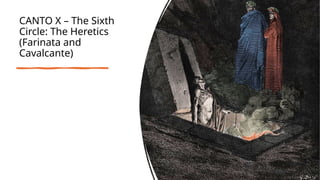
CANTO X –The Sixth
Circle: The Heretics
(Farinata and
Cavalcante)
Editor's Notes
#12 Summary of Events
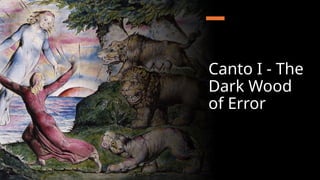
Dante, at the midpoint of his life (age 35), finds himself lost in a dark forest symbolizing spiritual confusion and sin. Trying to climb a hill bathed in sunlight (representing salvation), he is blocked by three beasts: a leopard (lust or fraud), a lion (pride or violence), and a she-wolf (avarice or incontinence). Overcome by fear and despair, Dante encounters the Roman poet Virgil, who offers to guide him through Hell and Purgatory so that he might reach Paradise, where another guide (Beatrice) awaits.
Characters
Dante Alighieri – The poet himself as protagonist, symbolizing humanity’s spiritual journey.
Virgil – The Roman poet, representing human reason and classical wisdom.
The Leopard – Allegory of fraud or lust.
The Lion – Allegory of pride or violence.
The She-Wolf – Allegory of greed or incontinence.
Beatrice (mentioned) – Dante’s ideal woman and symbol of divine love, who will later guide him in Paradise.
References or Origins of Alluded Characters
Virgil – Roman poet (70–19 BCE), author of The Aeneid. Dante venerates him as the greatest pagan poet and model of reason.
Beatrice Portinari – Real woman from Florence whom Dante loved spiritually; inspired La Vita Nuova and represents divine grace.
The Three Beasts – Possibly drawn from Jeremiah 5:6 (“a lion from the forest shall slay them, a wolf of the evenings shall spoil them, a leopard shall watch over their cities”), symbolizing three categories of sin.
The Dark Wood – A metaphor for the state of sin and moral confusion, echoing Psalm 23 (“the valley of the shadow of death”).
#13 Summary of Events
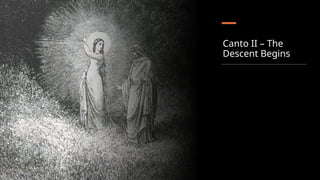
As evening falls on Good Friday, Dante hesitates before beginning his journey through the underworld. Doubt and fear overwhelm him—he feels unworthy to undertake such a divine mission, comparing himself to Aeneas and St. Paul, who both descended into the afterlife.
Virgil reassures Dante, explaining that Beatrice descended from Heaven to ask him to guide Dante. Beatrice was moved by the Virgin Mary, who sent St. Lucia, who in turn called Beatrice to act.
Encouraged by this act of divine mercy and inspired by love, Dante overcomes his fear and sets out with Virgil toward Hell’s gate.
Characters
Dante Alighieri – The pilgrim, still fearful and uncertain of his worthiness.
Virgil – His guide, representing reason, who reassures Dante with divine authority.
Beatrice – Appears indirectly through Virgil’s account; symbol of divine love and grace.
The Virgin Mary – The compassionate mother who initiates Dante’s rescue.
St. Lucia – Symbol of divine light and grace, acting as the intermediary between Mary and Beatrice.
Rachel (mentioned) – Represents the contemplative life; she dwells in Heaven beside Beatrice.
References or Origins of Alluded Characters
Aeneas – Trojan hero of Virgil’s Aeneid, who visited the Underworld to learn of Rome’s future. His descent is mirrored by Dante’s.
St. Paul – Apostle who, according to Christian tradition (2 Corinthians 12:2–4), was caught up to the “third heaven.”
The Virgin Mary – Mother of Christ; archetype of compassion and intercession.
St. Lucia (Saint Lucy) – Early Christian martyr from Syracuse; patron saint of sight, symbolizing illumination of the soul.
Rachel – Old Testament matriarch, symbolizing the contemplative life as contrasted with Martha’s active life (Luke 10:38–42).
Beatrice Portinari – Dante’s beloved, allegory of divine love and spiritual wisdom.
#14 Summary of Events
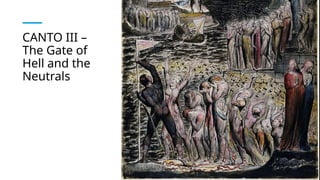
Dante and Virgil arrive before the Gate of Hell, bearing the ominous inscription that ends with “Abandon all hope, ye who enter here.” As they pass through, Dante hears the anguished cries of souls who lived without virtue or vice — the neutrals, those who took no side in life and served neither good nor evil. These souls are punished by being eternally stung by wasps and hornets while chasing a blank banner, symbolizing their indecisive lives.
Among them are the angels who did not side with God or Lucifer during the rebellion.
After this, Dante and Virgil reach the River Acheron, where the infernal ferryman Charon gathers souls to transport them across to Hell proper. Charon angrily refuses Dante because he is still living, but Virgil assures him that their journey is divinely willed. As Dante hears the thunder of despair, he faints at the sight.
Characters
Dante Alighieri – The living pilgrim, still fearful as he enters Hell’s threshold.
Virgil – His guide, who explains the meaning of divine justice.
Charon – The infernal ferryman who transports the dead across the River Acheron.
The Neutrals (Opportunists) – Souls who lived without moral conviction.
Unnamed Cowardly Pope or Celestine V (alluded) – Possibly the soul Dante hints at among the neutrals, who abdicated responsibility.
References or Origins of Alluded Characters
The Gate of Hell Inscription – Invented by Dante, symbolizing divine justice and the irrevocability of damnation; reflects the Aeneid’s “Abandon hope, all ye who enter.”
Acheron – In Greek mythology, one of the rivers of the underworld, often called the river of woe.
Charon – From Greek myth; the ferryman who carries souls across the river Styx (or Acheron) to Hades in exchange for an obol placed in the mouth of the dead.
The Neutrals – Concept derived from Christian theology and Virgil’s Aeneid (Book VI), where those “neither good nor bad” dwell outside true punishment.
Pope Celestine V (alluded) – Abdicated the papacy in 1294; Dante implies his cowardice “made the great refusal,” though he is unnamed in the text.
#15 Summary of Events
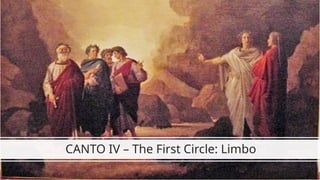
Dante awakens to the sound of thunder and finds himself on the brink of Hell proper — the First Circle, known as Limbo. Here dwell the souls of the unbaptized and the virtuous pagans — those who lived morally upright lives but were never touched by divine grace through baptism.
Virgil explains that he himself belongs here. Dante and Virgil enter a verdant meadow where they meet the great figures of antiquity — poets, philosophers, and heroes — who live without torment but without hope of seeing God. Among them are Homer, Horace, Ovid, and Lucan, who welcome Dante as one of their own.
They also see the towering figures of great thinkers and rulers who contributed to human knowledge, including Aristotle, Socrates, Plato, and Julius Caesar. Despite their dignity, all are condemned to eternal separation from God.
Characters
Dante Alighieri – The pilgrim, honored by the great poets of antiquity.
Virgil – Dante’s guide, one of the virtuous pagans in Limbo.
Homer, Horace, Ovid, Lucan – The “mighty shades,” representing the highest poetic tradition before Christianity.
Aristotle – Referred to as “the master of those who know,” symbolizing human reason.
Plato, Socrates, Cicero, Seneca, Euclid, Hippocrates, Galen, Avicenna, Averroës – Great philosophers, scientists, and scholars of the ancient and medieval world.
Hector, Aeneas, Caesar, Electra, Lavinia, Orpheus, and others – Heroes and figures from Greco-Roman myth and history.
References or Origins of Alluded Characters
Limbo – From the Latin limbus, meaning “border.” In Christian theology, Limbo is the edge of Hell where souls not guilty of sin but deprived of grace reside.
Homer (8th century BCE) – Greek epic poet, author of The Iliad and The Odyssey.
Horace (65–8 BCE) – Roman lyric poet known for his Odes and Epistles.
Ovid (43 BCE–17 CE) – Roman poet famous for Metamorphoses.
Lucan (39–65 CE) – Roman poet who wrote Pharsalia, an epic on civil war.
Aristotle (384–322 BCE) – Greek philosopher, student of Plato, teacher of Alexander the Great; central to scholastic philosophy.
Plato and Socrates – Founders of Western philosophy; their idealism contrasts with Christian revelation.
Avicenna (Ibn Sina, 980–1037) and Averroës (Ibn Rushd, 1126–1198) – Islamic philosophers who preserved and interpreted Aristotle’s works for the medieval world.
Caesar, Aeneas, Hector – Heroes of Roman and Trojan legend; symbolize human glory without divine salvation.
#16 Summary of Events
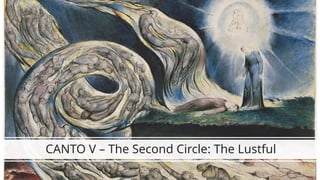
Descending from Limbo, Dante and Virgil enter the Second Circle of Hell, where the lustful are punished. Here begins the true torment of souls. At the gate stands Minos, the infernal judge, who wraps his tail around himself a number of times to indicate the circle to which each soul must descend.
Within this circle, a violent, endless storm of wind sweeps the souls about, symbolizing how they were driven by their passions in life. Dante sees many famous lovers: Semiramis, Dido, Cleopatra, Helen of Troy, Achilles, Paris, Tristan, and others.
He calls out to Francesca da Rimini and Paolo Malatesta, whose tragic love story moves him to tears. Francesca recounts how reading the tale of Lancelot and Guinevere led her and Paolo to their sinful kiss, for which they were both slain by Francesca’s husband, Paolo’s brother, Gianciotto. Overcome by pity, Dante faints once more.
Characters
Dante Alighieri – The pilgrim, overwhelmed by compassion for the damned.
Virgil – The guide, who instructs Dante on divine justice.
Minos – The infernal judge who assigns souls to their punishments.
Francesca da Rimini – A noblewoman from Ravenna, slain for adultery.
Paolo Malatesta – Francesca’s lover, also killed in the act of sin.
Semiramis – Legendary Assyrian queen, symbol of lust and excess.
Dido – Queen of Carthage, who killed herself for love of Aeneas.
Cleopatra – Queen of Egypt, who took her own life for love of Antony.
Helen of Troy – Whose beauty caused the Trojan War.
Achilles – Greek hero, slain after being ensnared by love.
Paris – Prince of Troy, lover of Helen.
Tristan – Knight of Arthurian legend, doomed for his love of Iseult.
References or Origins of Alluded Characters
Minos – In Greek mythology, king of Crete and judge of the dead in Hades; Dante adapts him as Hell’s demonic adjudicator.
Francesca da Rimini (1255–1285) – Historical figure; married to Gianciotto Malatesta but fell in love with his brother Paolo. Both were killed when discovered together.
Semiramis – Semi-mythical Babylonian queen; reputed for her sexual indulgence and despotic rule.
Dido – From Virgil’s Aeneid; abandoned by Aeneas, she took her own life, an act of passion over reason.
Cleopatra VII (69–30 BCE) – Egyptian queen; famed for her affairs with Julius Caesar and Mark Antony.
Helen of Troy – In Greek myth, her abduction by Paris sparked the Trojan War.
Achilles – Hero of the Iliad; slain by Paris, often depicted as undone by his love for Polyxena.
Paris – Prince of Troy, whose desire for Helen caused immense destruction.
Tristan (Tristram) – Medieval knight from Celtic legend; his adulterous love for Iseult led to tragedy.
Lancelot and Guinevere – Lovers from Arthurian romance; their tale serves as the “book and author” that led Francesca and Paolo to sin.
#17 Summary of Events
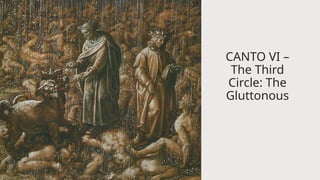
After fainting from pity for Francesca and Paolo, Dante awakens in the Third Circle of Hell, where the Gluttonous are punished. A cold, filthy rain falls eternally, mixed with sleet and hail, covering the souls who wallow in the mud like pigs. The monstrous Cerberus, a three-headed dog, guards them, ripping and tearing at the shades as they howl in misery.
Virgil throws handfuls of earth into Cerberus’s mouths to quiet him, allowing their passage. Among the damned, Dante meets Ciacco, a fellow Florentine known for his gluttony. Ciacco recognizes Dante and foretells the political strife in Florence, predicting the victory of the “Black Guelphs” over the “White Guelphs.” After his prophecy, Ciacco asks Dante to remember him when he returns to the world.
As they move on, Virgil explains that after Judgment Day, the torments of the damned will be even more severe, for both soul and body will then suffer together.
Characters
Dante Alighieri – The pilgrim, continuing his education on the nature of sin.
Virgil – The guide, who explains divine justice and prophecy.
Cerberus – The monstrous guardian of the Third Circle, representing uncontrolled appetite.
Ciacco (“The Hog”) – A Florentine citizen condemned for gluttony; offers political prophecy.
The Gluttonous Souls – Countless shades suffering under perpetual cold rain and filth.
References or Origins of Alluded Characters
Cerberus – From Greek mythology; the three-headed hound that guards the entrance to Hades. Dante adapts him as a symbol of insatiable hunger and excess.
Ciacco – A nickname meaning “hog.” Likely a historical Florentine known for indulgence; his prophecy reflects Dante’s exile-era politics.
The Black and White Guelphs – Rival political factions in Florence during Dante’s time. The White Guelphs, Dante’s party, opposed papal interference, while the Black Guelphs supported the Pope and eventually banished Dante.
Rain and Mire – The cold, stinking storm symbolizes the soul’s degradation through sensual indulgence — pleasure turned to filth.
Judgment Day – Reference to Christian eschatology; the resurrection of the flesh will make eternal punishment more complete.
#18 Summary of Events
At the entrance to the next circle, the Fourth Circle of Hell, Dante and Virgil are confronted by Plutus, the ancient god of wealth, now transformed into a monstrous, incoherent guardian who babbles, “Pape Satàn, pape Satàn aleppe!” Virgil silences him with words of divine authority, and the two pass safely.
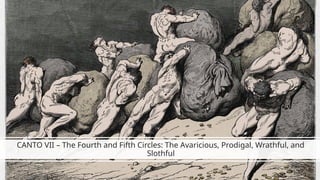
Here lie the souls of the Avaricious (the greedy) and the Prodigal (the wasteful). These shades roll enormous weights against each other in a perpetual circle, colliding and shouting accusations: “Why hoard?” and “Why waste?” Their punishment reflects the futility of material obsession—each extreme cancels the other out. Dante notes that even some clergymen and popes are among them, condemned for their greed.
Descending further, they reach the Fifth Circle, the swampy marsh of the River Styx, where the Wrathful and the Slothful (Sullen) are punished. The wrathful attack one another on the surface of the muddy waters, while the slothful lie gurgling beneath, forever trapped in silent rage. As they move along the Styx, Dante sees the lights of the infernal city of Dis, where the lower circles of Hell begin.
Characters
Dante Alighieri – The pilgrim, growing more aware of the moral balance of sin.
Virgil – The guide, symbolizing reason and moral order.
Plutus – Guardian of the Fourth Circle, representing the corruption caused by wealth.
The Avaricious – Those who hoarded earthly goods beyond measure.
The Prodigal – Those who squandered their possessions in wastefulness.
The Wrathful – Souls consumed by anger and aggression.
The Slothful (Sullen) – Souls who repressed their anger in life, now suffocating beneath the Styx.
References or Origins of Alluded Characters
Plutus – In Greek mythology, the god of wealth and abundance; in Dante’s vision, he becomes a demonic guardian representing the perversion of material desire.
River Styx – One of the mythological rivers of the underworld; oaths sworn upon it were sacred to the gods. Dante transforms it into a swamp symbolizing moral stagnation.
Avarice and Prodigality – Two extremes of misuse of material goods; a reflection of Aristotle’s Nicomachean Ethics, where virtue lies in moderation.
Popes and Clerics (unnamed) – Dante criticizes corruption in the Church, foreshadowing his later condemnation of specific popes in deeper circles.
City of Dis – Derived from Dis Pater, the Roman god of the underworld; in Dante’s Hell, it marks the entrance to the lower, more grievous sins (circles 6–9).
#19 Summary of Events
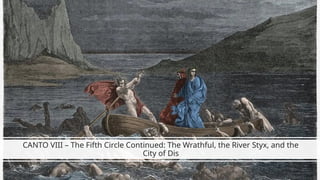
As Dante and Virgil journey across the Stygian Marsh, they are hailed by a boatman named Phlegyas, who ferries wrathful souls across the River Styx. Phlegyas, once the wrathful king of Boeotia, serves now as a symbol of uncontrollable rage.
While crossing, a muddy shade rises and confronts Dante — it is Filippo Argenti, a Florentine known for his arrogance and violence. Dante rebukes him harshly, and Virgil praises Dante’s righteous anger, contrasting it with sinful wrath. As they depart, the other wrathful souls tear Argenti apart in fury.
Soon, they approach the City of Dis, a walled fortress glowing red from the flames within. Thousands of fallen angels guard the gate and refuse them entry, slamming the doors shut in Virgil’s face. Virgil, momentarily shaken, assures Dante that a higher power will send divine aid. The canto closes with the two travelers stranded outside the gates of Hell’s lower regions, awaiting help from Heaven.
Characters
Dante Alighieri – The pilgrim, now developing moral discernment and courage in confronting sin.
Virgil – The guide, confident but momentarily thwarted by infernal resistance.
Phlegyas – The wrathful ferryman of the Styx, now a demonic servant of Hell.
Filippo Argenti – A Florentine noble, punished for wrath; he attacks Dante’s boat but is destroyed by his fellow damned.
Fallen Angels – Guardians of the City of Dis, representing rebellion against divine authority.
References or Origins of Alluded Characters
Phlegyas – In Greek mythology, king of the Lapiths who burned Apollo’s temple in rage after the god seduced his daughter; punished in Hades for his blasphemy.
Filippo Argenti – Historical Florentine from the Adimari family, enemies of Dante’s. Known for pride, violence, and arrogance. Dante’s joy at his torment reflects justified moral indignation rather than sinful wrath.
The River Styx – A major river in Greek myth encircling Hades; Dante uses it to punish wrath and sullenness.
City of Dis – Named after Dis Pater (“Father of Riches”), Roman god of the underworld. In Dante’s Hell, it marks the boundary between Upper Hell (sins of incontinence) and Lower Hell (sins of malice and violence).
Fallen Angels – Spirits who joined Lucifer in rebellion against God, representing hardened defiance of divine law.
#20 Summary of Events
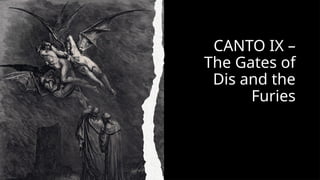
The canto opens with tension and uncertainty. Dante, frightened by the infernal rejection at the gates of Dis, questions whether Virgil can still protect him. Virgil reassures him but is visibly troubled. Suddenly, three terrifying female figures appear atop the tower — the Furies (Erinyes) — named Megaera, Alecto, and Tisiphone. They threaten to summon Medusa, whose gaze could turn Dante to stone. Virgil urgently covers Dante’s eyes to shield him from destruction.
At this moment, a heavenly messenger arrives — a divine envoy sent from Heaven. His presence causes the rebellious demons to scatter in fear. With effortless authority, the messenger opens the gates of Dis and reprimands the infernal hosts for resisting God’s will. Dante and Virgil then enter the city freely. Inside, they behold fields filled with open tombs, from which flames rise; within these fiery graves lie the Heretics, punished for denying the immortality of the soul. They prepare to explore this Sixth Circle in the next canto.
Characters
Dante Alighieri – The pilgrim, trembling before the powers of Hell but protected by divine grace.
Virgil – The guide, embodying reason that must yield to divine intervention when human wisdom fails.
The Furies (Megaera, Alecto, Tisiphone) – Avenging spirits who threaten Dante with Medusa’s gaze.
Medusa – Alluded to but unseen; her petrifying power symbolizes spiritual paralysis through despair.
The Heavenly Messenger – Angelic envoy from Heaven, representing divine authority over Hell.
The Fallen Angels – Guardians of Dis who refuse entry until subdued by the messenger.
References or Origins of Alluded Characters
Furies (Erinyes) – In Greek mythology, goddesses of vengeance who punish sinners; daughters of Earth and Darkness. Dante uses them to personify remorseless guilt and eternal punishment.
Medusa – One of the Gorgons, whose gaze turned mortals to stone. In Dante’s allegory, she represents the soul’s hardening in despair and sin.
The Heavenly Messenger – Possibly the archangel Michael or an unnamed celestial spirit symbolizing divine reason and grace surpassing human intellect.
Heretics – Those who denied the immortality of the soul or the existence of divine truth; their fiery tombs foreshadow the eternal death of the spirit.
City of Dis – The infernal metropolis encompassing the lower circles (6–9), reserved for sins of malice and intellectual rebellion.
#21 Summary of Events
Dante and Virgil enter the Sixth Circle of Hell, where the Heretics are punished. These souls lie in open fiery tombs, symbolizing their denial of the immortality of the soul and eternal life. The flames burn more fiercely around greater heretics.
As Dante walks among the sepulchers, a voice calls out—Farinata degli Uberti, a great Florentine military leader and nobleman, rises from his burning tomb to speak. Farinata, an Epicurean who denied life after death, displays proud defiance even in damnation.
Their dialogue turns to the politics of Florence, revealing Farinata’s enduring concern for his city and his family’s honor. During their talk, another figure rises—Cavalcante de’ Cavalcanti, father of Dante’s friend Guido Cavalcanti, who mistakes Dante’s phrasing to mean his son is dead and collapses in grief.
Farinata then explains that the damned can see future events but not the present, a tragic irony of their eternal punishment. As they depart, Dante reflects on the limits of human knowledge.
Characters
Dante Alighieri – The pilgrim, who converses compassionately yet firmly with the heretics.
Virgil – The guide, who provides context for the punishments.
Farinata degli Uberti – Florentine nobleman and military leader; punished for heresy and pride.
Cavalcante de’ Cavalcanti – Father of Guido Cavalcanti; punished for Epicurean disbelief.
Guido Cavalcanti (mentioned) – Dante’s poet friend; an important figure in the dolce stil novo movement.
Other Heretics (unnamed) – Souls who denied the immortality of the soul or divine truth.
References or Origins of Alluded Characters
Farinata degli Uberti (1212–1264) – Historical Florentine leader of the Ghibellines. He was accused of heresy for his Epicurean beliefs. In life, he defended Florence even against his own faction’s destruction plans, earning Dante’s respect despite ideological differences.
Cavalcante de’ Cavalcanti – A wealthy Florentine, father of Guido, also suspected of Epicureanism. His grief in the canto represents the agony of love and parental blindness.
Guido Cavalcanti (c. 1255–1300) – One of Florence’s most refined poets and Dante’s early mentor; known for his philosophical love poetry.
Epicurus (341–270 BCE) – Greek philosopher who taught that the soul dies with the body; his followers (Epicureans) are punished in the fiery tombs for denying immortality.
Fiery Tombs – Symbolize the spiritual death brought about by heresy and the burning intellect detached from divine truth.


![LIT 3 | Divine comedy [Updated]](https://cdn.slidesharecdn.com/ss_thumbnails/divinecomedyinfernopurgatoryparadise-160904231800-thumbnail.jpg?width=640&height=640&fit=bounds)


