DIVERSIFYING
AFRICAN TRADE
THE ROAD TO PROGRESS
Aubrey Hruby
R1-02/11/11
- -
-
-
-
-
-
--
OCP Déploiement identité novembre 2011
OCP FONDATION CMJN
C 100
M 0
J 100
N 30
C 100
M 0
J 100
N 20
C 30
M 0
J 100
N 0
C 65
M 0
J 100
N 10
DRAGON 100%
61645
This report is part of a partnership between the Atlantic Council’s Africa Center
and the OCP Policy Center and is made possible by generous support through the OCP Foundation.
ISBN: 978-1-61977-961-7
Cover photo credit: Make It Kenya Photo/Stuart Price. Overview of the port of Mombasa in Kenya.
This report is written and published in accordance with the Atlantic Council Policy on Intellectual Independence.
The author is solely responsible for its analysis and recommendations. The Atlantic Council and its donors do not
determine, nor do they necessarily endorse or advocate for, any of this report’s conclusions.
December 2015
DIVERSIFYING
AFRICAN TRADE
THE ROAD TO PROGRESS
Aubrey Hruby
TABLE OF CONTENTS
LIST OF ACRONYMS	 i
EXECUTIVE SUMMARY	 1
INTRODUCTION	 3
SNAPSHOT OF AFRICAN TRADE	 3
PARTNERSHIPS WITH EMERGING ECONOMIES	 7
THE SPECIAL CASE OF CHINA-AFRICA TRADE	 10
REGIONAL TRADE	 12
EXTERNAL TRADE POLICIES	 15
OBSTACLES TO DEEPENING TRADE 	 17
POLICY RECOMMENDATIONS 	 19
ABOUT THE AUTHOR	 23
i	 ATLANTIC COUNCIL
DIVERSIFYING AFRICAN TRADE: THE ROAD TO PROGRESS
LIST OF ACRONYMS
AfDB: African Development Bank
AGOA: African Growth and Opportunity Act
AMU: Arab Maghreb Union
AU: African Union
BRIC: Brazil, Russia, India, and China
COMESA: Common Market for Eastern and Southern Africa
DRC: Democratic Republic of the Congo
EAC: East African Community
EBA: Everything But Arms
ECOWAS: Economic Community of West African States
EPA: Economic Partnership Agreement
EPZ: Export Processing Zone
EU: European Union
Exim: Export-Import
FDI: Foreign Direct Investment
FTA: Free Trade Agreement
GDP: Gross Domestic Product
GSP: Generalized System of Preferences
IMF: International Monetary Fund
LDC: Least Developed Countries
NCIP: Northern Corridor Integration Projects
OECD: Organization for Economic Cooperation and Development
REC: Regional Economic Community
SADC: Southern African Development Community
TFA: Trade Facilitation Agreement
TFAF: Trade Facilitation Agreement Facility
TFTA: Tripartite Free Trade Agreement
TIFA: Trade and Investment Framework Agreements
UNCTAD: United Nations Conference on Trade and Development
USAID: United States Agency for International Development
USTR: United States Trade Representative
WTO: World Trade Organization
ATLANTIC COUNCIL	 1
DIVERSIFYING AFRICAN TRADE: THE ROAD TO PROGRESS
EXECUTIVE SUMMARY
Although African trade flows are accelerating at a healthy
rate, most African governments have struggled to diversify
their economies and to achieve inclusive, sustainable
growth. “As Africans, we should be proud of our recent
economic growth performance,” noted African Union (AU)
Commissioner for Trade and Industry Fatima Haram Acyl in
2014, “but there should be no room for complacency.”1
Increased trade could transform the African continent,
which is home to thirty-three of the world’s least developed
countries (LDCs) and accounted for only 3 percent of global
trade in 2014.2
African nations that have implemented
reforms supporting the free movement of goods, capital,
and people have reaped a substantial development dividend
and are ranked among the fastest growing economies in the
world.
This report examines the current state of trade in Africa,
identifies obstacles hindering economic diversification
and growth, and offers policy recommendations based on
these findings. It addresses the economic and geopolitical
implications of the global collapse of commodity demand
and China’s recent slowdown, as well as how regional
trade agreements and regional economic communities
(RECs) offer better opportunities for African economies to
unlock growth.
This study will focus on current bilateral trade policies,
including the United States’ recently renewed African Growth
andOpportunityAct(AGOA),aswellasmultilateralinitiatives
making their way through the World Trade Organization
(WTO). The WTO Trade Facilitation Agreement (TFA), which
seeks to expedite the movement of goods and better align
customs policies among its members, is expected to boost the
world economy by more than $1 trillion if fully ratified.3
This report identifies key recommendations for policymakers
in Africa and across the world:
•	 Speed up regional integration. Africa is home to
sixteen landlocked countries; high transport costs
1  African Union, press release, “African Union Ministers of Trade Consider
Global Trade and Investments Trends as the Continent Prepares to Launch
the Continental Free Trade Area (CFTA),” December 9, 2014, http://agen-
da2063.au.int/en/news/african-union-ministers-trade-consider-glob-
al-trade-and-investments-trends-continent-prepares-l.
2  United Nations Conference on Trade and Development, The Least Devel-
oped Countries Report 2014 (Geneva, Switzerland: UNCTD, 2014), http://
unctad.org/en/PublicationsLibrary/ldc2014_en.pdf; United Nations,
World Economic Situation and Prospects 2015 (New York: United Nations,
2015), http://www.un.org/en/development/desa/policy/wesp/wesp_ar-
chive/2015wesp-ch2-en.pdf.
3  Pascal Lamy, “A Trade Facilitation Deal Could Give a $1 Trillion Boost to
World Economy,” speech to the Chittagong Chamber of Commerce, February
1, 2013, https://www.wto.org/english/news_e/sppl_e/sppl265_e.htm.
and longer transit times will always disadvantage
these countries in the struggle to attract trade and
investment. Small or landlocked countries should look
to carve out nontraditional market niches that are less
dependent on large-scale exports, and should pressure
larger neighbors and donor nations to provide better
support for regional integration, including enhanced
financial and technical support of RECs.
•	 Maximize product diversity. Due to shared
topography and climate, many neighboring African
countries have similar export profiles. This makes
exporting between particular countries difficult, and
often results in national exports that directly compete
with those of neighbors. African countries should
improve the effectiveness of Export Processing Zones
(EPZs) to create competitive export-oriented clusters
and further diversify their export products, especially
in the manufacturing sector.
•	 Invest in infrastructure. Both landlocked and coastal
African countries lack adequate infrastructure to
minimize export transport costs and transit times.
African governments and international partners—
both public and private—should continue to invest in
African infrastructure, with a particular focus on the
power sector.
•	 Eliminate trade inefficiencies. Tariffs have steadily
decreased as regional integration has increased,
but nontariff barriers, such as transit fees, customs
inconsistencies,andpolicyrestrictions,remainsystemic
challenges to free trade, affecting transport times and
costs even in economically well-integrated regions.
Institutional partners should continue to support and
promote initiatives such as the Borderless Alliance,
a partnership that uses technology to target nontariff
barriers in West Africa. Additionally, African countries
AFRICAN NATIONS THAT
HAVE IMPLEMENTED
REFORMS SUPPORTING
THE FREE MOVEMENT
OF GOODS, CAPITAL,
AND PEOPLE HAVE
REAPED A SUBSTANTIAL
DEVELOPMENT DIVIDEND.
2	 ATLANTIC COUNCIL
DIVERSIFYING AFRICAN TRADE: THE ROAD TO PROGRESS
should streamline immigration policies and eliminate
onerous visa requirements for Africans traveling inside
the continent for business or tourism.
China’s economic slowdown has helped to precipitate a
global collapse in commodity demand. In 2015, Chinese
investment in and imports from Africa have fallen more than
40 percent year over year,4
and this, in combination with
falling commodity prices, will slow progress toward African
nations’ development milestones. Instead of shying away
4  “China’s investment in Africa down 40% on year,” Daily Moni-
tor, November 18, 2015, http://www.monitor.co.ug/News/World/
China-investment-Africa-year/-/688340/2960964/-/15j4k52z/-/
index.html?utm_source=November+19%2C+2015+EN&utm_cam-
paign=11%2F19%2F2015&utm_medium=email.
from these obstacles, African countries should view these
challenges as a chance to “drill down” and focus attention
on increasing trade diversification, eliminating economic
inefficiencies, and engaging both regional neighbors and
external partners in well-crafted and mutually beneficial
trade agreements. African countries and their international
partners should also recognize that the most innovative
progress tends to be made at the local, rather than national,
level. This report suggests that in parallel to broad trade
initiatives involving large groups of countries or the
entire continent, African governments and their partners
should focus attention and resources on smaller and more
manageable integration projects.
ATLANTIC COUNCIL	 3
DIVERSIFYING AFRICAN TRADE: THE ROAD TO PROGRESS
INTRODUCTION
The last fifteen years have seen attention turn toward efforts
to alleviate poverty in Africa through increased trade and
investment. The wisdom of this approach seems proven
by the surprising ability of even conflict-ridden nations in
Africa, including Nigeria and Democratic Republic of the
Congo (DRC), to join the ranks of the world’s fastest-growing
economies by promoting investment and trade.
Unfortunately, these success stories are incomplete and
not universal. Many African nations still struggle with
inefficient regulations, inadequate infrastructure, and other
severe impediments to trade. Africa appears to be sorting
itself into a collection of winners and losers, as nations that
practice reform surge ahead, while those that remain mired
in conflict, corruption, and bureaucratic inefficiency fall
ever further behind.
This study examines current trade and investment patterns
and offers recommendations based on the best practices of
Africa’s rising nations.5
SNAPSHOT OF AFRICAN
TRADE
Africa’s average gross domestic product (GDP) growth
increased from 3.5 percent in 2013 to 3.9 percent in 2014,
with a diversity of individual performance ranging from
negative growth rates in Equatorial Guinea, the Gambia, and
Libya to an impressive 10.3 percent GDP growth in Ethiopia.6
Despite significant progress in terms of diversification,
African trade remains highly dependent on commodities.
Minerals and ores make up more than two-thirds of Africa’s
total exports,7
and oil still represents up to 90 percent of
5  In this report, Africa refers to all fifty-four states in both sub-Saharan
Africa and North Africa.
6  African Economic Outlook, African Economic Outlook 2015: Regional
Development and Spatial Inclusion (Issy-les-Moulineaux, France: African
Economic Outlook, 2015), http://www.africaneconomicoutlook.org/
fileadmin/uploads/aeo/2015/PDF_Chapters/Overview_AEO2015_EN-
web.pdf; African Development Bank Group, African Union Commission,
and Economic Commission for Africa, African Statistical Yearbook, 2015, p.
90, http://www.afdb.org/fileadmin/uploads/afdb/Documents/Publica-
tions/African_Statistical_Yearbook_2015.pdf. Inside Africa, growth varied
regionally, with Central (5.6 percent), Eastern (7.1 percent), and Western
Africa (6 percent) vastly outperforming Northern (1.7 percent) and
Southern Africa (2.7 percent). In comparison to global regions, the BRICs
in 2014 experienced 6 percent GDP growth, while South Asia’s combined
GDP grew by 6.9 percent in the same year. Overall world GDP growth was
2.6 percent in 2014. GDP growth was measured by real GDP percentage,
or the output of goods and services produced by the region. For more, see
World Bank, Global Economic Prospects, http://www.worldbank.org/en/
publication/global-economic-prospects/data.
7  Ibid.
exports from Angola, Chad, and Equatorial Guinea.8
In 2014,
sub-Saharan Africa’s top exported products by dollar value
were crude oil, diamonds, gold, copper, and agricultural
products (most notably, specialty products like cocoa
beans; Africa produces nearly 70 percent of the global
cocoa supply9
). The region’s top imported products by value
were refined petroleum, pharmaceuticals, machinery, and
automotive products.10
According to the United Nations
Conference on Trade and Development (UNCTAD), only
fourteen of the fifty-four African countries had a trade
surplus in 2014, while forty had a trade deficit.11
This is
due mainly to the underdeveloped manufacturing base
across the region—African countries are not yet producing
significant volumes of the final products demanded in
external markets.
While the European Union (EU) and the United States
remain major partners in African trade, Chinese trade with
the continent has surged.12
Chinese trade with the region
increased by 83 percent from 2009 to 2011, hitting nearly
$200 billion in 2012.13
But other emerging economies,
8  World Bank, Africa’s Pulse, April 2015, http://www.worldbank.org/
content/dam/Worldbank/document/Africa/Report/Africas-Pulse-bro-
chure_Vol11.pdf.
9  World Cocoa Foundation, Cocoa Market Update, April 1, 2014, http://
worldcocoafoundation.org/wp-content/uploads/Cocoa-Market-Update-
as-of-4-1-2014.pdf.
10  World Bank, World Integrated Trade Solution Database, http://wits.
worldbank.org (author calculation).
11  United Nations Conference on Trade and Development, Country
Profiles, September 9, 2015, http://unctadstat.unctad.org/CountryPro-
file/024/en024GeneralProfile.html.
12  Christopher Alessi and Beina Xu, “China in Africa,” Council on Foreign
Relations, April 27, 2015, http://www.cfr.org/china/china-africa/
p9557. Although Chinese trade with the continent has increased, Chinese
foreign direct investment (FDI) remains low. Chinese levels of FDI on the
continent are lower than those of France, the United Kingdom, the United
States, and even South Africa. For more, see Wenjie Chen, David Dollar,
and Heiwei Tang, “China’s Direct Investment in Africa: Reality Versus
Myth,” Brookings, September 3, 2015, http://www.brookings.edu/blogs/
africa-in-focus/posts/2015/09/03-china-africa-investment-trade-myth-
chen-dollar-tang.
13  Yun Sun and Michael Rettig, “American and Chinese Trade with Africa:
Rhetoric vs. Reality,” Hill, August 5, 2014, http://thehill.com/blogs/
pundits-blog/international/214270-american-and-chinese-trade-with-af-
rica-rhetoric-vs-reality; Fred Dews, “8 Facts about China’s Investments
in Africa,” Brookings, May 20, 2014, http://www.brookings.edu/blogs/
brookings-now/posts/2014/05/8-facts-about-china-investment-in-africa.
AFRICA APPEARS TO BE
SORTING ITSELF INTO A
COLLECTION OF WINNERS
AND LOSERS, AS NATIONS
THAT PRACTICE REFORM
SURGE AHEAD.
4	 ATLANTIC COUNCIL
DIVERSIFYING AFRICAN TRADE: THE ROAD TO PROGRESS
including India14
and Turkey, are also increasing their
trade with Africa.15
India is expected to overtake China as
the world’s fastest-growing economy by 2017,16
and the
India-Africa Forum Summit in October 2015, the third of
its kind, centered on deepening trade and investment ties
in expectation of a Chinese economic slowdown. Trade
between Africa and Turkey increased tenfold between 2000
and 2014, to $23.4 billion.17
The emergence of robust new trading partnerships is a
step forward for Africa’s economies, as diversification helps
to protect national economies from fluctuations in global
markets and reduces dependency on traditional bilateral
trade initiatives.
Diversifying Exports and Trade Partners
In 2005, sub-Saharan Africa’s top five export partners were
the United Kingdom, the United States, Japan, China, and the
Netherlands, accounting for 40 percent of total exports. By
2014, China and Switzerland had overtaken the United States,
14  J. Peter Pham, “India’s New African Horizons: An American Perspec-
tive,” Africa Review vol. 5, no. 2, 2013, pp. 93-103.
15  World Bank, World Integrated Trade Solution Database, http://wits.
worldbank.org (author calculation).
16  Kathleen Caulderwood, “India Will Overtake China As World’s Fast-
est-Growing Major Economy By 2017, World Bank Says,” International
Business Times, January 14, 2015, http://www.ibtimes.com/india-will-
overtake-china-worlds-fastest-growing-major-economy-2017-world-
bank-says-1783446.
17  Republic of Turkey Ministry of Foreign Affairs, “Turkey-Africa Rela-
tions,” 2015, http://www.mfa.gov.tr/turkey-africa-relations.en.mfa.
followed by India and the Netherlands, and the top five export
partnerscollectivelyconsumedonly29percentoftotalexports.
Furthermore, no single export partner represented more than
10 percent of total exports, demonstrating the success of
African efforts to diversify export partners (see figure 1 for this
analysis across the continent).
Intra-African trade is also increasing rapidly. According
to the International Monetary Fund (IMF), intra-African
exports grew from $41 billion in 2010 to $61 billion in
2013.18
This growth is clearly visible on a national scale—
by 2014, three of Kenya’s top five export partners were
regional neighbors (Uganda, Tanzania, and Zambia).19
The increase in regional trade reflects the progress many
African countries have made in addressing logistical
inefficiencies and challenges. For example, East African
countries, through political cooperation and coordinated
elimination of border inefficiencies, were able to cut cargo
travel time from Mombasa, Kenya, to Kampala, Uganda,
from eighteen days to four days, and between Mombasa and
Kigali, Rwanda, from twenty-one days to only five days.20
18  African Economic Outlook 2015.
19  World Bank, World Integrated Trade Solution Database, http://wits.
worldbank.org (author calculation).
20  Aubrey Hruby, “China’s Slowdown: an Opportunity for Africa to
Address Longstanding Economic Inefficiencies,” Financial Times, October
26, 2015, http://blogs.ft.com/beyond-brics/2015/10/26/chinas-slow-
down-an-opportunity-for-africa-to-address-longstanding-economic-inef-
ficiencies/.
0
20
40
60
80
100
United States
France
Italy
United Kingdom
Spain
China
Intra-African
India
Rest
2005 2006 2007 2008 2009 2010 2011 2012 2013 2014
Source: World Bank, World Integrated Trade Solution Database, http://wits.worldbank.org. Author calculations.
Figure 1. Total Exports by Partner (all of Africa, in percentage)
ATLANTIC COUNCIL	 5
DIVERSIFYING AFRICAN TRADE: THE ROAD TO PROGRESS
Positive Balance of Trade
Negative Balance of Trade
South
Africa
Namibia
Madagascar
Réunion
Lesotho
Swaziland
Mauritius
Comoros
Cape
Verde
Egypt
Libya
Tunisia
Algeria
Morocco
SudanNigerMali
Mauritania
Chad
South
Sudan
Eritrea
Ethiopia
Somalia
Djibouti
Mozambique
Zimbabwe
Botswana
Zambia
Tanzania
Angola
Democratic
Republic
of the
Congo
KenyaUganda
Rwanda
Burundi
Congo
Central
African
Republic
Cameroon
Gabon
Equatorial Guinea
São Tomé
and Príncipe
Nigeria
Benin
Togo
Ghana
Senegal
The Gambia
Burkina Faso
Côte d’Ivoire
Liberia
Sierra
Leone
Guinea
Guinea-Bissau
Seychelles
Malawi
Source: United Nations, UNCTAD Data Center, http://unctadstat.unctad.org/EN/. Author calculations. Map Credit: Free Vector Maps.com.
Map 1. Balance of Trade
6	 ATLANTIC COUNCIL
DIVERSIFYING AFRICAN TRADE: THE ROAD TO PROGRESS
Case Study: Nigeria
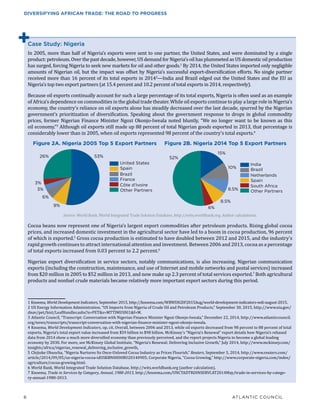
In 2005, more than half of Nigeria’s exports were sent to one partner, the United States, and were dominated by a single
product: petroleum. Over the past decade, however, US demand for Nigeria’s oil has plummeted as US domestic oil production
has surged, forcing Nigeria to seek new markets for oil and other goods.1
By 2014, the United States imported only negligible
amounts of Nigerian oil, but the impact was offset by Nigeria’s successful export-diversification efforts. No single partner
received more than 16 percent of its total exports in 20142
—India and Brazil edged out the United States and the EU as
Nigeria’s top two export partners (at 15.4 percent and 10.2 percent of total exports in 2014, respectively).
Because oil exports continually account for such a large percentage of its total exports, Nigeria is often used as an example
of Africa’s dependence on commodities in the global trade theater. While oil exports continue to play a large role in Nigeria’s
economy, the country’s reliance on oil exports alone has steadily decreased over the last decade, spurred by the Nigerian
government’s prioritization of diversification. Speaking about the government response to drops in global commodity
prices, former Nigerian Finance Minister Ngozi Okonjo-Iweala noted bluntly, “We no longer want to be known as this
oil economy.”3
Although oil exports still made up 88 percent of total Nigerian goods exported in 2013, that percentage is
considerably lower than in 2005, when oil exports represented 98 percent of the country’s total exports.4
Cocoa beans now represent one of Nigeria’s largest export commodities after petroleum products. Rising global cocoa
prices, and increased domestic investment in the agricultural sector have led to a boom in cocoa production, 96 percent
of which is exported.5
Gross cocoa production is estimated to have doubled between 2012 and 2015, and the industry’s
rapid growth continues to attract international attention and investment. Between 2006 and 2013, cocoa as a percentage
of total exports increased from 0.03 percent to 2.2 percent.6
Nigerian export diversification in service sectors, notably communications, is also increasing. Nigerian communication
exports (including the construction, maintenance, and use of Internet and mobile networks and postal services) increased
from $20 million in 2005 to $52 million in 2013, and now make up 2.3 percent of total services exported.7
Both agricultural
products and nonfuel crude materials became relatively more important export sectors during this period.
1  Knoema, World Development Indicators, September 2015, http://knoema.com/WBWDIGDF2015Aug/world-development-indicators-wdi-august-2015.
2  US Energy Information Administration, “US Imports from Nigeria of Crude Oil and Petroleum Products,” September 30, 2015, http://www.eia.gov/
dnav/pet/hist/LeafHandler.ashx?n=PET&s=MTTIMUSNI1&f=M.
3  Atlantic Council, “Transcript: Conversation with Nigerian Finance Minister Ngozi Okonjo-Iweala,” December 22, 2014, http://www.atlanticcouncil.
org/news/transcripts/transcript-conversation-with-nigerian-finance-minister-ngozi-okonjo-iweala.
4  Knoema, World Development Indicators, op. cit. Overall, between 2006 and 2013, while oil exports decreased from 98 percent to 88 percent of total
exports, Nigeria’s total export value increased from $59 billion to $98 billion. McKinsey’s “Nigeria’s Renewal” report details how Nigeria’s rebased
data from 2014 show a much more diversified economy than previously perceived, and the report projects Nigeria to become a global leading
economy by 2030. For more, see McKinsey Global Institute, “Nigeria’s Renewal: Delivering Inclusive Growth,” July 2014, http://www.mckinsey.com/
insights/africa/nigerias_renewal_delivering_inclusive_growth.
5  Chijioke Ohuocha, “Nigeria Nurtures Its Once-Unloved Cocoa Industry as Prices Flourish,” Reuters, September 5, 2014, http://www.reuters.com/
article/2014/09/05/us-nigeria-cocoa-idUSKBN0H00BU20140905; Corporate Nigeria, “Cocoa Growing,” http://www.corporate-nigeria.com/index/
agriculture/cocoa-growing.html.
6  World Bank, World Integrated Trade Solution Database, http://wits.worldbank.org (author calculation).
7  Knoema, Trade in Services by Category, Annual, 1980-2013, http://knoema.com/UNCTADTRDINSERVCAT2014May/trade-in-services-by-catego-
ry-annual-1980-2013.
United States
Spain
Brazil
France
Côte d’Ivoire
Other Partners
26% 53%
9%
6%
3%
3%
India
Brazil
Netherlands
Spain
South Africa
Other Partners
52%
15%
6%
8.5%
8.5%
10%
+
Figure 2A. Nigeria 2005 Top 5 Export Partners
Source: World Bank, World Integrated Trade Solution Database, http://wits.worldbank.org. Author calculations.
Figure 2B. Nigeria 2014 Top 5 Export Partners
ATLANTIC COUNCIL	 7
DIVERSIFYING AFRICAN TRADE: THE ROAD TO PROGRESS
Case Study: Morocco1
	
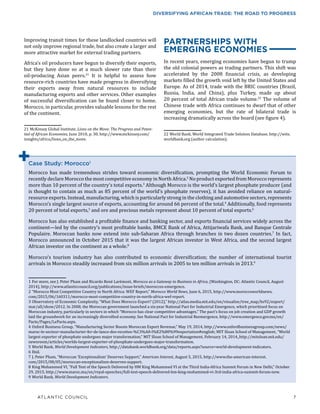
Morocco has made tremendous strides toward economic diversification, prompting the World Economic Forum to
recently declare Morocco the most competitive economy in North Africa.2
No product exported from Morocco represents
more than 10 percent of the country’s total exports.3
Although Morocco is the world’s largest phosphate producer (and
is thought to contain as much as 85 percent of the world’s phosphate reserves), it has avoided reliance on natural-
resource exports. Instead, manufacturing, which is particularly strong in the clothing and automotive sectors, represents
Morocco’s single largest source of exports, accounting for around 66 percent of the total.4
Additionally, food represents
20 percent of total exports,5
and ore and precious metals represent about 10 percent of total exports.6
Morocco has also established a profitable finance and banking sector, and exports financial services widely across the
continent—led by the country’s most profitable banks, BMCE Bank of Africa, Attijariwafa Bank, and Banque Centrale
Populaire. Moroccan banks now extend into sub-Saharan Africa through branches in two dozen countries.7
In fact,
Morocco announced in October 2015 that it was the largest African investor in West Africa, and the second largest
African investor on the continent as a whole.8
Morocco’s tourism industry has also contributed to economic diversification; the number of international tourist
arrivals in Morocco steadily increased from six million arrivals in 2005 to ten million arrivals in 2013.9
1  For more, see J. Peter Pham and Ricardo René Larémont, Morocco as a Gateway to Business in Africa, (Washington, DC: Atlantic Council, August
2014), http://www.atlanticcouncil.org/publications/issue-briefs/moroccos-emergence.
2  “Morocco Most Competitive Country in North Africa: WEF Report,” Morocco World News, June 6, 2015, http://www.moroccoworldnews.
com/2015/06/160311/morocco-most-competitive-country-in-north-africa-wef-report.
3  Observatory of Economic Complexity, “What Does Morocco Export? (2012),” http://atlas.media.mit.edu/en/visualize/tree_map/hs92/export/
mar/all/show/2012. In 2008, the Moroccan government launched a six-year National Pact for Industrial Emergence, which prioritized focus on
Moroccan industry, particularly in sectors in which “Morocco has clear competitive advantages.” The pact’s focus on job creation and GDP growth
laid the groundwork for an increasingly diversified economy. See National Pact for Industrial Reemergence, http://www.emergence.gov.ma/en/
Pacte/Pages/LePacte.aspx.
4  Oxford Business Group, “Manufacturing Sector Boosts Moroccan Export Revenue,” May 19, 2014, http://www.oxfordbusinessgroup.com/news/
maroc-le-secteur-manufacturier-fer-de-lance-des-recettes-%C3%A0-l%E2%80%99exportation#english; MIT Sloan School of Management, “World
largest exporter of phosphate undergoes major transformation,” MIT Sloan School of Management, February 14, 2014, http://mitsloan.mit.edu/
newsroom/articles/worlds-largest-exporter-of-phosphate-undergoes-major-transformation.
5  World Bank, World Development Indicators, http://databank.worldbank.org/data/reports.aspx?source=world-development-indicators.
6  Ibid.
7  J. Peter Pham, “Moroccan ‘Exceptionalism’ Deserves Support,” American Interest, August 5, 2015, http://www.the-american-interest.
com/2015/08/05/moroccan-exceptionalism-deserves-support.
8  King Mohammed VI, “Full Text of the Speech Delivered by HM King Mohammed VI at the Third India-Africa Summit Forum in New Delhi,” October
29, 2015, http://www.maroc.ma/en/royal-speeches/full-text-speech-delivered-hm-king-mohammed-vi-3rd-india-africa-summit-forum-new.
9  World Bank, World Development Indicators.
Improving transit times for these landlocked countries will
not only improve regional trade, but also create a larger and
more attractive market for external trading partners.
Africa’s oil producers have begun to diversify their exports,
but they have done so at a much slower rate than their
oil-producing Asian peers.21
It is helpful to assess how
resource-rich countries have made progress in diversifying
their exports away from natural resources to include
manufacturing exports and other services. Other examples
of successful diversification can be found closer to home.
Morocco, in particular, provides valuable lessons for the rest
of the continent.
21  McKinsey Global Institute, Lions on the Move: The Progress and Poten-
tial of African Economies, June 2010, p. 30, http://www.mckinsey.com/
insights/africa/lions_on_the_move.
PARTNERSHIPS WITH
EMERGING ECONOMIES
In recent years, emerging economies have begun to trump
the old colonial powers as trading partners. This shift was
accelerated by the 2008 financial crisis, as developing
markets filled the growth void left by the United States and
Europe. As of 2014, trade with the BRIC countries (Brazil,
Russia, India, and China), plus Turkey, made up about
20 percent of total African trade volume.22
The volume of
Chinese trade with Africa continues to dwarf that of other
emerging economies, but the rate of bilateral trade is
increasing dramatically across the board (see figure 4).
22  World Bank, World Integrated Trade Solution Database, http://wits.
worldbank.org (author calculation).
+
8	 ATLANTIC COUNCIL
DIVERSIFYING AFRICAN TRADE: THE ROAD TO PROGRESS
•	 Turkey hosted the inaugural Turkey-Africa Cooperation
Summit in Istanbul in 2008, prompting the African
Union (AU) to declare Turkey a strategic partner.23
A
second summit followed in 2014. Turkish investors
have been particularly attracted to Ethiopia’s low labor
costs and access to the port of Djibouti. Turkey has
targeted Ethiopia’s fast-growing and export-oriented
textile industry, which has been enhanced by Ethiopia’s
participation in several tariff preference programs.
Turkish textile giant Ayka Textile began production in
Ethiopia in 2010 with its Ayka Addis Group.24
•	 India has capitalized on its strong cultural ties and
geographic proximity to Eastern and Southern Africa
to become one of the continent’s largest trade partners,
with bilateral trade projected to reach $100 billion this
year.25
Large Indian diaspora communities and their
descendants live in Eastern and Southern Africa, and
many are involved in business. Two of East Africa’s
largest companies were founded by Africans of Indian
23  Alpaslan Özerdem, “How Turkey Is Emerging as a Key Development
Partner in Africa,” Guardian, April 10, 2013, http://www.theguardian.
com/global-development-professionals-network/2013/apr/10/tur-
key-development-partner-africa.
24  Ayka Textile, http://www.aykatextile.com/index.htm.
25  “One Among Many,” Economist, January 17, 2015, http://www.econ-
omist.com/news/middle-east-and-africa/21639554-china-has-become-
big-africa-now-backlash-one-among-many.
descent, including the Ugandan Madhvani Group,
which employs more than ten thousand people in its
manufacturing and industry operations in East Africa,
and Kenya’s Chandaria Group, which manufactures
nearly all of its tissue and hygiene products in country.26
India’s Tata Group, estimated to have a combined
market capitalization of more than $130 billion, first
expanded into Africa in 1994.27
As Tata Africa Managing
Director-designate Thamsanqa Mbele noted, “[Tata
International] has built itself a reputation as a credible
partner by its willingness to invest in building long-term
relationships.”28
The dividends received from doing
so are clear—Tata Africa now has a manufacturing
presence in twelve countries.29
•	 Brazil has historically traded with the Portuguese-
speaking African countries, but is branching out to
anglophone nations. Brazilian firm Odebrecht began
26  Kakira Sugar, “Madhvani Group,” http://www.kakirasugar.com/content/
madhvani-group; Chandaria Industries Limited, “Company Profile,” http://
www.chandaria.com/about-chandaria-industries/company-profile.
27  Tata, “Tata Group Profile,” http://www.tata.com/aboutus/sub_index/
Leadership-with-trust.
28  Tata, “African Safari,” July 2013, http://www.tataafrica.com/Mediar-
oom/articles_and_interview_african_safari.htm.
29  Tata, “Tata in Africa,” July 2013, http://www.tata.com/tataworldwide/
index/Tata-in-Africa.
0
100
200
300
400
500
Petroleum
Minerals/Precious Stones
Metals
Textiles
Chemicals
Transportation Equipment
Other
2005 2006 2007 2008 2009 2010 2011 2012 2013 2014
174
266
322
433
306
408
485
473
416
281
Figure 3. Export Product Diversity (all of Africa, in millions of US dollars)
Source: World Bank, World Integrated Trade Solution Database, http://wits.worldbank.org. Author calculations.
ATLANTIC COUNCIL	 9
DIVERSIFYING AFRICAN TRADE: THE ROAD TO PROGRESS
work in Angola in 1984. It has since expanded to Ghana
and Mozambique, primarily in infrastructure and
construction, and posted gross revenues of nearly $1.7
billionfromAfricanoperationsalonein2013.30
InAngola,
the firm is completing what will become Africa’s largest
hydroelectric facility.31
Former Brazilian President Luiz
Inácio Lula da Silva was instrumental in improving
Africa-Brazil trade during his tenure, and set the stage
for increased trade and investment between Brazil and
Portuguese-speaking Africa.
•	 Russia’s trade with Africa is relatively modest, but
nevertheless increased more than tenfold between
2000 and 2012.32
Rostec, a large, state-owned Russian
conglomerate, and one of the major contributors to
Russia and Africa’s total trade volume, recently began
to fund two massive projects on the continent—a
$4 billion oil refinery in Uganda, and a $3 billion
30  Odebrecht, “About the Group,” http://odebrecht.com/en/ode-
brecht-group/about-group; Odebrecht, “Odebrecht 2014,” http://ode-
brecht.com/relatorio2013/en/indicators/financial-indicators.
31  Odebrecht, “Global Presence,” http://odebrecht.com/en/ode-
brecht-group/odebrecht-world.
32  J. Peter Pham, “Russia’s Return to Africa,” AfricaSource (blog), Atlantic
Council, March 13, 2014, http://www.atlanticcouncil.org/publications/ar-
ticles/russia-s-return-to-africa; J. Peter Pham, “Russia’s Return to Africa: An
Update,” AfricaSource (blog), Atlantic Council, March 23, 2015, http://www.
atlanticcouncil.org/blogs/africasource/russia-s-return-to-africa-an-update.
platinum-mining project in Zimbabwe.33
Russian
energy company Gazprom has been particularly
active in North Africa, exemplified by its agreement to
supply Egypt with liquefied natural gas34
and its signed
memorandum of understanding with both Algerian
and Libyan state-owned energy companies, designed
to pave the way for further cooperation on geological
exploration, production, and distribution of natural gas
and petroleum products.35
Given the deepening trade relationship between African
nations and BRIC countries plus Turkey, it is not surprising
that business cycles are aligning between emerging
and frontier markets. After the 2008 financial crisis,
33  Kathleen Caulderwood, “Russian Industrial Giant Rostec Makes Forays
into Africa Amid Increasing US and European Sanctions,” International
Business Times, April 7, 2015, http://www.ibtimes.com/russian-industri-
al-giant-rostec-makes-forays-africa-amid-increasing-us-european-1872445.
34  The Africa Report, “Oil and Gas: Egypt and Russia to Finalize Gaz-
prom LNG Deal,” January 12, 2015, http://www.theafricareport.com/
North-Africa/oil-and-gas-egypt-and-russia-to-finalise-gazprom-lng-deal.
html; “Egypt Signs Gas Import Deal with Russia’s Gazprom - Petroleum
Ministry,” Aswat Masriya, March 17, 2015, http://allafrica.com/sto-
ries/201503171748.html.
35  African Development Bank, North Africa Quarterly Analytical, 2011,
http://www.afdb.org/fileadmin/uploads/afdb/Documents/Publications/
the%20BRICs%20in%20North%20Africa%20First%20annual%20ok_
Mise%20en%20page%201.pdf; Gazprom, “Libya,” http://www.gazprom.
com/about/production/projects/deposits/libya/.
0
20
40
60
80
100
Brazil
Russia
India
Turkey
China
2005 2006 2007 2008 2009 2010 2011 2012 2013 2014
Figure 4. BRIC plus Turkey Total Trade with Africa (in billions of US dollars)
Source: World Bank, World Integrated Trade Solution Database, http://wits.worldbank.org. Author calculations.
10	 ATLANTIC COUNCIL
DIVERSIFYING AFRICAN TRADE: THE ROAD TO PROGRESS
international capital flows into Africa increased, as
international investors took advantage of the region’s
relative isolation from global markets. Five years later,
South-South economic convergence has defined a new
reality. According to the IMF, the region’s new orientation
has closely tied Africa’s future growth and economic
diversification to the BRICs’ economic development and
shocks.36
African trade patterns now reflect a broader trend
that will see the region’s development trajectory impacted
by events in large emerging markets. The 2015 slowdown
in Chinese consumption, and the subsequent impact on
African economies, is a case in point.
THE SPECIAL CASE OF
CHINA-AFRICA TRADE
China’s involvement in trade on the African continent has
surgedinrecentyears,andthecountryisnowthecontinent’s
largest individual trading partner.37
China’s rapid economic
growth has fueled its appetite for natural resources, and
36  Oumar Diallo and Sampawende J.-A. Tapsoba, “Rising BRICs and
Changes in Sub-Saharan Africa’s Business Cycle Patterns,” International
Monetary Fund, February 2014, https://www.imf.org/external/pubs/ft/
wp/2014/wp1435.pdf.
37  “One Among Many,” Economist, op. cit.
it accounts for 11 percent of global demand for crude oil,
57 percent of the world’s copper demand, and more than
65 percent of the world demand for iron ore.38
Africa’s
extensive energy, mineral, and raw material reserves thus
make it a particularly attractive trading partner for China.
Sierra Leone, Mauritania, and Zambia are most dependent
on trade with China, with exports to the country accounting
for an average of 62 percent, 47 percent, and 46 percent of
total exports, respectively.39
The “Angola Model”
Since the introduction of China’s “Going Out” strategy—a
government-directed policy effort designed to encourage
Chinese investment abroad—in the mid-1990s, China has
strategically prioritized its economic relationship with
African nations, transforming a foundation of historical
political engagement into a significant two-way commercial
relationship. China values Africa’s emerging consumption
potential, particularly its growing demand for Chinese-
manufactured inexpensive goods.40
Africa’s important role
38  World Bank, Africa’s Pulse, October 2015.
39  Ibid.
40  Yun Sun, Africa in China’s Foreign Policy (Washington, DC: Brookings,
April 2014), http://www.brookings.edu/~/media/research/files/pa-
pers/2014/04/africa-china-policy-sun/africa-in-china-web_cmg7.pdf.
At the opening of the December 2015 Forum on China-Africa Cooperation, South African President Jacob Zuma stands with Chinese
President Xi Jinping and Zimbabwean President Robert Mugabe. Chinese involvement in Africa has surged in recent years, and, at the 2015
Forum, China pledged $60 billion in development funding to Africa over the next three years. Photo credit: Government Communication
and Information System, Republic of South Africa/Flickr.
ATLANTIC COUNCIL	 11
DIVERSIFYING AFRICAN TRADE: THE ROAD TO PROGRESS
in the broader Chinese international economic strategy
has resulted in the development of institutions aimed
at fostering the China-Africa relationship, including the
China-Africa Development Fund, the Forum on China-Africa
Cooperation, and the joint African Development Bank
(AfDB)-China Africa Growing Together Fund.
Chinese capital flows to Africa have increasingly been
earmarked for infrastructure that supports natural resource
extraction, and infrastructure-specific loan arrangements
haveincreaseddramaticallyfromabout$500millionin2001
to $14 billion in 2011.41
A common Chinese government
approach involves the Export-Import (Exim) Bank of China
providing an African partner government with a marginally
concessional line of credit, which is guaranteed with an
agreementonnationalcommodityrights.Chinesefirmsthen
compete to implement these projects, and are paid directly
by the Exim Bank or the African government. This approach
has become known as the “Angola Model.”42
Estimates
suggest that between 2003 and 2011, around 56 percent of
the $52.8 billion of Chinese loans in Africa were commodity-
backed.43
In addition to securing Chinese access to natural
commodities, Exim Bank-funded infrastructure projects
also often include country-of-origin procurement clauses,
which boost African imports of Chinese capital products.44
It should be noted, however, that this infrastructure is often
badly needed, and not many other countries are willing to
finance or build necessary African infrastructure, especially
when African countries have scarce foreign exchange to pay
international contractors.
As the model’s name suggests, commodity-backed Chinese
loans are most apparent in Angola, which has used its
oil reserves to back about $10 billion in loans and loan
commitments since 2004.45
While Chinese loans are
often guaranteed with oil, other commodities can also be
employed. For example, between 2008 and 2009, DRC
guaranteed and repaid about $5 billion of Chinese loans
with the profits from copper exports, and in 2007, Ghana
repaid a $200 million loan, which was used to construct the
Bui Dam, with the sale of cocoa.46
41  Larry Hanauer and Lyle J. Morris, Chinese Engagement in Africa (Santa
Monica, Calif: RAND Corporation, 2014), http://www.rand.org/content/
dam/rand/pubs/research_reports/RR500/RR521/RAND_RR521.pdf.
42  Miria Pigato and Wenxia Tang, “China and Africa: Expanding Economic
Ties in an Evolving Global Context,” World Bank, March 2015, http://
www.worldbank.org/content/dam/Worldbank/Event/Africa/Invest-
ing%20in%20Africa%20Forum/2015/investing-in-africa-forum-chi-
na-and-africa-expanding-economic-ties-in-an-evolving-global-context.pdf.
43  Deborah Brautigam and Kevin Gallagher, “Bartering Globalization:
China’s Commodity-backed Finance in Africa and Latin America,” Global
Policy vol. 5, no. 3, 2014.
44  Miria Pigato and Wenxia Tang, “China and Africa: Expanding Economic
Ties in an Evolving Global Context,” op. cit.
45  Deborah Brautigam and Kevin Gallagher, “Bartering Globalization:
China’s Commodity-backed Finance in Africa and Latin America,” op. cit.
46  Ibid.
The apparent deepening of Sino-African economic relations
has worried US and European governments and industries,
which are critical of China’s policy of noninterference in the
domestic political affairs of abusive or repressive regimes,
its disregard for social and environmental standards in
Chinese-funded projects in Africa, and seemingly unfair
Chinese government support for private industry in China.
Whiletheseareoftenwell-foundedconcerns,theyalsoreflect
a broader and more general Western unease with China’s
increasing importance on the international economic stage.
The Impact of China’s Slowdown on Africa
The robust economic growth that China enjoyed throughout
the first decade of the 2000s is slowing. Between 2012 and
2014, Chinese GDP growth dipped to around 7 percent,47
and the Organization for Economic Cooperation and
Development (OECD) forecasts that growth will continue
to fall to around 6.7 percent by 2016, largely as a result of
slowing investment in real estate and business.48
Concerns
about China’s economic prospects have been compounded
by the Chinese stock market’s recent plunge, and a surprise
announcement of further currency devaluation by the
Chinese government.
The slowdown in Chinese growth has been coupled with
a plunge in global oil and commodity prices. Falling
commodity prices have already led to substantial drops
in revenue for Africa’s major oil exporters, such as Nigeria
and Angola, as well as those dependent on exporting other
commodities, such as DRC and Mauritania.49
The impact of China’s slowdown on Africa has been
substantial. In the first half of 2015, Chinese investment in
and imports from Africa both fell by more than 40 percent
47  World Bank, “GDP growth (annual percentage),” World Development
Indicators, http://data.worldbank.org/indicator/NY.GDP.MKTP.KD.ZG.
48  Organization for Economic Cooperation and Development, “China-Eco-
nomic Forecast Summary,” November 2015, http://www.oecd.org/econo-
my/china-economic-forecast-summary.htm.
49  World Bank, Africa’s Pulse, April 2015; David Sheppard and Neil Hume,
“Commodity Prices Slide on China Weakness,” Financial Times, October 19,
2015, http://www.ft.com/intl/cms/s/0/c783877a-765a-11e5-933d-efcd-
c3c11c89.html#axzz3pyOxi300.
CHINESE CAPITAL
FLOWS TO AFRICA
HAVE INCREASINGLY
BEEN EARMARKED FOR
INFRASTRUCTURE THAT
SUPPORTS NATURAL
RESOURCE EXTRACTION.
12	 ATLANTIC COUNCIL
DIVERSIFYING AFRICAN TRADE: THE ROAD TO PROGRESS
year-on-year.50
More worryingly, slowed Chinese growth has
reduced infrastructural investment in Africa, as tightened
financial conditions in China have led to higher costs for
Chinese banks.51
The good news is that these negative
consequences are expected to be only temporary, and
economicprojectionspredictsub-SaharanAfricagrowthwill
dip only slightly before picking up again in 2016.52
Expected
increases in domestic demand will drive this rebound,
as will infrastructural investment in net oil-importer
economies, such as Kenya and Senegal, coupled with an
increase in demand from other regional and international
trading partners.53
Moreover, African governments can
take proactive steps to speed diversification and eliminate
economic efficiencies. (These steps will be outlined in detail
in the recommendations beginning on page 19.)
REGIONAL TRADE
The development trajectories of other regions of the world
have shown regional trade as critical to sustained economic
growth. However, despite recent progress, Africa continues to
lag behind the rest of the world in the amount of trade that
occurswithinthecontinent.From2002to2010,intraregional
trade in Africa fluctuated between 8 and 11 percent, staying
consistently low;54
by 2014, intraregional trade in Africa rose
to a mere 12 percent.55
For comparison, intraregional trade in
the developing economies of Asia was 17 percent as of 2012,56
and in Latin America, it has remained stagnant at around 20
percent for more than thirty years.57
The creation of regional economic communities (RECs) in
Africa has started—slowly—to boost trade through increased
50  Daily Monitor, “China’s investment in Africa down 40% on year.”
51  World Bank, Sub-Saharan Africa, June 2015, http://www.worldbank.
org/content/dam/Worldbank/GEP/GEP2015b/Global-Economic-Pros-
pects-June-2015-Sub-Saharan-Africa-analysis.pdf.
52  Ibid.
53  World Bank, Africa’s Pulse, April 2015.
54  Mwangi S. Kimenyi, Zenia A. Lewis, and Brandon Routman, Accel-
erating Growth through Improved Intra-African Trade (Washington,
DC: Brookings, January 2012), http://www.brookings.edu/~/media/
research/files/reports/2012/1/intra%20african%20trade/01_intra_afri-
can_trade_full_report.pdf.
55  Amadou Sy, “Four Instruments to Strengthen Financial Integration
in Sub-Saharan Africa,” FERDI, May 27, 2014, http://www.ferdi.fr/sites/
www.ferdi.fr/files/evenements/presentations/2014_05_27_confer-
ence_ferdi_banque_de_france_amadou_sy.pdf; Amadou Sy, “Hearing on
‘Will there be an African Economic Community?’” Brookings, January 9,
2014, http://www.brookings.edu/research/testimony/2014/01/09-af-
rican-economic-community-sy; Alex Manson, “How Africa Can Make the
Next Quantum Leap in Trade,” Standard Chartered Trade Flows, November
17, 2014, https://www.sc.com/BeyondBorders/africa-can-make-next-
quantum-leap-trade. Even reports written as recently as last year cite
figures for intraregional trade from 2012.
56  Mwangi S. Kimenyi, Zenia A. Lewis, and Brandon Routman, Accelerat-
ing Growth through Improved Intra-African Trade.
57  Augusto de la Torre, Daniel Lederman, and Samuel Pienknagura, “Do-
ing It Right,” International Monetary Fund, September 2015, http://www.
imf.org/external/pubs/ft/fandd/2015/09/delatorre.htm.
economic integration between neighboring states. Close
regional ties are especially important for the 30 percent of
Africans who live in landlocked countries or those with scarce
resources.58
Overthepastdecade,thecombinedregionaltrade
of three of Africa’s strongest RECs—East African Community
(EAC), Common Market for Eastern and Southern Africa
(COMESA), and Southern African Development Community
(SADC)—grew more than 300 percent, from $30 billion in
2004 to $102.6 billion in 2014.59
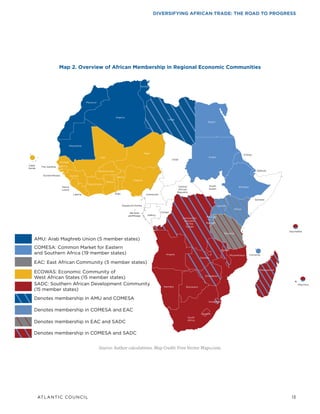
TheAfricancontinenthasfivemajoreconomiccommunities:
COMESA,SADC,EconomicCommunityofWestAfricanStates
(ECOWAS), EAC, and Arab Maghreb Union (AMU).60
Despite
the prevalence of African RECs, some have been more
successful than others in promoting economic integration
and growth.
•	 AMU has had little success in economic integration,
particularlyduetopoliticaldeadlockanddisagreements
over the union’s structure.61
•	 SADC has not yet established a customs union, which
would allow free trade among member countries and
a common external tariff for the rest of the world. Five
SADC countries are, however, part of the South African
Customs Union, which happens to be the oldest in the
world, and the South African rand is already the de facto
common currency in the region.62
•	 COMESA established a customs union in 2009, and
member states are slowly implementing the required
policy reforms. COMESA has focused on improving
free movement of people by eliminating cumbersome
visa requirements. In March 2015, Mauritius, Rwanda,
58  Paul Collier, The Bottom Billion (New York: Oxford University Press,
2007), p. 57, http://www.sfu.ca/content/sfu/dean-gradstudies/events/
dreamcolloquium/SpringColloquium/Readings/Readings/_jcr_content/
main_content/download_47/file.res/Paul%20Collier.
59  Dorothy Nakaweesi, “Africa Regional Trade Increases,” Daily Monitor,
March 5, 2015, http://www.monitor.co.ug/Business/Markets/Africa-re-
gional-trade-increases/-/688606/2642562/-/11emhkmz/-/index.htm.
60  COMESA includes the nineteen member states of Burundi, Comoros,
DRC, Djibouti, Egypt, Eritrea, Ethiopia, Kenya, Libya, Madagascar, Malawi,
Mauritius, Rwanda, Seychelles, Sudan, Swaziland, Uganda, Zambia, and
Zimbabwe; SADC members include Angola, Botswana, DRC, Lesotho,
Madagascar, Malawi, Mauritius, Mozambique, Namibia, Seychelles, South
Africa, Swaziland, Tanzania, Zambia, and Zimbabwe; ECOWAS members
include Benin, Burkina Faso, Cape Verde, Côte d’Ivoire, The Gambia,
Ghana, Guinea, Guinea Bissau, Liberia, Mali, Niger, Nigeria, Sierra Leone,
Senegal, and Togo; EAC includes Burundi, Kenya, Rwanda, Tanzania, and
Uganda; AMU includes Algeria, Libya, Mauritania, Morocco, and Tunisia.
Some states are members of more than one community.
61  Wafa Ben Hassine, “Arab Maghreb Union: Overcoming Competition in
Favor of Cooperation (Part I),” Jadaliyya, September 14, 2015, http://pro-
files.jadaliyya.com/pages/index/22640/arab-maghreb-union_overcom-
ing-competition-in-favor#_ftn6.
62  Lambertus van Zyl, “South Africa’s Experience of Regional Currency
Areas and the Use of Foreign Currencies,” BIS Papers, no. 17, 2003, pp.
134–39, http://www.bis.org/publ/bppdf/bispap17o.pdf. The rand is used
“extensively” in South Africa, Lesotho, Namibia, and Swaziland.
ATLANTIC COUNCIL	 13
DIVERSIFYING AFRICAN TRADE: THE ROAD TO PROGRESS
COMESA: Common Market for Eastern
and Southern Africa (19 member states)
EAC: East African Community (5 member states)
AMU: Arab Maghreb Union (5 member states)
ECOWAS: Economic Community of
West African States (15 member states)
SADC: Southern African Development Community
(15 member states)
Denotes membership in AMU and COMESA
Denotes membership in EAC and SADC
Denotes membership in COMESA and EAC
Denotes membership in COMESA and SADC
South
Africa
Namibia
Madagascar
Réunion
Lesotho
Swaziland
Mauritius
Comoros
Mayotte
Cape
Verde
Egypt
Libya
Tunisia
Algeria
Morocco
Sudan
Niger
Mali
Mauritania
Chad
South
Sudan
Eritrea
Ethiopia
Somalia
Djibouti
Mozambique
Zimbabwe
Botswana
Zambia
Tanzania
Angola
Democratic
Republic
of the
Congo
Kenya
Uganda
Rwanda
Burundi
Congo
Central
African
Republic
Cameroon
Gabon
Nigeria
Benin
Togo
Ghana
Senegal
The Gambia
Burkina Faso
Côte d’Ivoire
Liberia
Sierra
Leone
GuineaGuinea-Bissau
Seychelles
Malawi
Equatorial Guinea
Seychelles
São Tomé
and Príncipe
Map 2. Overview of African Membership in Regional Economic Communities
Source: Author calculations. Map Credit: Free Vector Maps.com.
14	 ATLANTIC COUNCIL
DIVERSIFYING AFRICAN TRADE: THE ROAD TO PROGRESS
and Seychelles removed visa restrictions for nationals
from COMESA member countries. Burundi, Kenya,
Rwanda, Zambia, and Zimbabwe are in various stages
doing the same.63
•	 ECOWAS, one of the few RECs that also has a strong
peace-and-security component through its peacekeeping
capabilities, implemented visa-free travel for members in
1980.64
In January 2015, ECOWAS introduced a Common
63  COMESA, “Brief on the COMESA Customs Union,” http://pro-
grammes.comesa.int/index.php?option=com_content&view=arti-
cle&id=90&Itemid=142; Allan Odhiambo, “More Comesa Members Scrap
Visa Requirement for Travelers,” Business Daily, March 3, 2015, http://
www.businessdailyafrica.com/More-Comesa-members-scrap-visa-re-
quirement-for-travellers/-/1248928/2641492/-/2vlnooz/-/index.html.
64  John Agyei and Ezekiel Clottey, Operationalizing ECOWAS Protocol on
Free Movement of People among the Member States: Issues of Convergence,
Divergence, and Prospects for Sub-Regional Integration, International
Migration Institute, http://www.imi.ox.ac.uk/events/ghana-african-mi-
grations-workshop/papers/clottey.pdf.
External Tariff that member states must implement.65
Some progress has been made toward establishing a
commoncurrency:ThefrancophonecountriesofECOWAS
use the Communauté Financière Africaine franc, which
is tied to the Central Bank of France, and leaders hope
to establish a common ECOWAS currency by 2020.66
But linguistic divisions between the anglophone and
francophone member countries continue to challenge
integration efforts, especially because anglophone Nigeria
is the dominant player in the ECOWAS community.
•	 Perhaps the most integrated of all African RECs is the EAC,
whichestablishedacustomsunionin2005and acommon
market (eliminating barriers to the free movement of
people and capital) in 2010. The EAC announced the
creation of East African passports in 1999 and East
African citizens and visitors no longer need a visa to travel
between other EAC countries. The EAC’s long-term goals
include establishing a common monetary union and,
ultimately, creating of a political federation.67
•	 The Tripartite Free Trade Area (TFTA) was officially
launched in June 2015 with the ambitious goal of joining
three of Africa’s major economic blocs—the EAC, SADC,
and COMESA—covering twenty-six countries with a
combined population of some 625 million people and
an overall GDP of more than $1 trillion. Egypt played a
key role in forging the TFTA, and the pact highlights that
country’s pivot back to Africa. By lowering custom duties
and nontariff barriers, the TFTA is projected to increase
intraregional trade by $8.5 billion once put into effect.
However, since each member’s national parliament must
first ratify the agreement over the next two years, the
TFTA may not come into effect until 2017 or even later.68
Economic integration in the RECs is often held back by the
difficulty of reconciling policies across countries and the
underresourced secretariats, though some tools exist from
external partners to support and speed integration. The
EU’s 10th European Development Fund includes support
for the economic integration of least developed countries
(LDCs) and REC leadership.69
65  ECOWAS Aid for Trade, ECOWAS Common External Tariff (CET), http://www.
aidfortrade.ecowas.int/programmes/ecowas-common-external-tariff-cet.
66  Gilles Dufrénot, “On the Way to a Single Currency for ECOWAS Coun-
tries?”, Revue Grain de Sel, July-September 2010, http://www.inter-re-
seaux.org/publications/revue-grain-de-sel/51-special-issue-nigeria/
article/on-the-way-to-a-single-currency?lang=fr.
67  JG Simoes and CA Hidalgo, The Economic Complexity Observatory: An Ana-
lytical Tool for Understanding the Dynamics of Economic Development, Work-
shops at the Twenty-Fifth AAAI Conference on Artificial Intelligence, 2011.
68  J. Peter Pham, “Free Trade Pact Highlights Egypt’s Pivot Back towards
Africa,” AfricaSource (blog), Atlantic Council, June 9, 2015, http://www.
atlanticcouncil.org/blogs/africasource/free-trade-pact-highlights-egypt-
s-pivot-back-towards-africa.
69  East African Community, “European Union–EAC Regional Cooperation,”
http://www.rmo.eac.int/index.php?option=com_content&view=arti-
cle&id=181&Itemid=242.
Case Study: The East African Community
Unlocks Trade Value by Eliminating
Inefficiencies 	
It does not always take an influx of funding or resources
tomakeanimpactontradeataregionallevel.Sometimes,
focused and sustained political will can have the same
effect. As a result of meetings of regional heads of state
through the Northern Corridor Integration Projects
(NCIP) every two months, for example, EAC members
have dramatically reduced the travel time of cargo trucks
from Mombasa, Kenya, to the region.
EAC members (Burundi, Kenya, Rwanda, Tanzania,
and Uganda) have also focused efforts on harmonizing
nontariff barriers to trade. By reducing burdensome
roaming fees, telecom traffic among EAC members has
exploded. Telecom traffic from Rwanda to Kenya, for
example, increased 951 percent in the months following
implementation of the “One Network Area,” while Kenya’s
outgoing calls to the region increased by 254 percent.1
Improving transit times and decreasing communication
costs for these countries will not only improve trade
inside the EAC region, but will also make the region more
attractive to external trading partners and investors. The
EAC’s ability to “unlock” trade value with few additional
resources in a matter of months is a valuable lesson for
other RECs with limited funding or technical capacity.
1  Lukas Musembi, “Regional Roaming within East Africa One-Net-
work-Area,” Communications Authority of Kenya, February 2015,
https://www.itu.int/en/ITU-D/Regulatory-Market/Documents/
Events/2015/Sao_Tome/Session5-1%20_Lukas%20regional%20
roaming.pdf.
+
ATLANTIC COUNCIL	 15
DIVERSIFYING AFRICAN TRADE: THE ROAD TO PROGRESS
EXTERNAL TRADE POLICIES
A number of external trade programs—initiated both by
the United States and the European Union—have been set
up over the past fifteen years to allow preferential trade
access to partner markets by African nations. These trade
programs aim to spur economic growth and, eventually,
to reduce the need for humanitarian and development aid
from the West.
Historically, there have been two types of bilateral trade
programs between African countries and either the
United States or the EU: “blanket” one-way programs
and reciprocal programs. On this spectrum of trading
agreements, the United States’ African Growth and
Opportunity Act (AGOA) and the EU’s “Everything But
Arms” (EBA) fall in the one-way section, offering a duty-
free, quota-free “gift” of market access to African countries
that meet certain standards. US Free Trade Agreements
(FTAs) and the EU’s Economic Partnership Agreements
(EPAs) offer reciprocal benefits to both the initiating party
and the African partner.
US Trade Programs
Passed in 2000 and renewed for the fifth time for 2015-2025,
AGOA is a preferential trade agreement that expands exports
fromandinvestmentinthirty-nineeligiblesub-SaharanAfrican
countries to the United States. African exports to the United
States—many of which enjoy duty-free and quota-free access
to the US market under AGOA—have more than quadrupled
since 2000.70
Despite its success, AGOA was never meant to be
a permanent trade-preference system. Instead, it was enacted
toallowAfricancountriestime-limitedaccesstotheUSmarket,
with the hope that they would eventually “graduate” from the
program and move on to more advanced trade agreements.
FTAs are the most comprehensive trade agreements that
the United States signs, offering reciprocal benefits to the
United States and another country (or bloc of countries)
for both imports and exports. The only US FTA in Africa
is an agreement with Morocco, which became effective
in 2006 and removes technical barriers to increased
US-Morocco trade. As a result, both US imports from and
exports to Morocco have increased. Successful FTAs are
the result of years of detailed and technical negotiation,
and often work best between economies with similar
development levels. While the Morocco agreement is
a step in the right direction, the failure of the US-SADC
FTA negotiations ten years ago shows that there is still
much ground to cover in adapting the US approach to
70  US Department of State, “African Growth and Opportunity Act (AGOA),”
http://www.state.gov/p/af/rt/agoa.
Trucks on the border of Kenya and Uganda. Heads of state from the East African Community—which includes Burundi, Kenya, Rwanda,
Tanzania, and Uganda—meet regularly to tackle trade inefficiencies in the region. One of their most successful efforts focused on decreas-
ing transport time and costs for goods transiting through the region to Kenya’s Mombasa port. Photo credit: Jeffrey Zabinski/Flickr.
16	 ATLANTIC COUNCIL
DIVERSIFYING AFRICAN TRADE: THE ROAD TO PROGRESS
FTA negotiations to developing-country realities that are
limited by institutional capacity, high levels of poverty, and
a narrow export base.71
Trade and Investment Framework Agreements (TIFAs) offer
a middle road between AGOA and FTA.72
These agreements
help structure negotiations between the United States and
its partners. Because of their ability to strengthen bilateral
trade ties with the United States (and, ostensibly, to work
through major obstacles that might hold up future, advanced
71  Office of the United States Trade Representative, “Morocco Free Trade
Agreement,” https://ustr.gov/trade-agreements/free-trade-agreements/
morocco-fta; Export.gov, “The US—Morocco Free Trade Agreement (FTA),”
http://export.gov/FTA/morocco/index.asp.
72  TIFAs set forth US principles on trade, affirming the importance of
foreign and domestic investment, intellectual-property protection, elim-
inating nontariff barriers, sustainable development and environmental
protection, and trade liberalization. The United States currently has TIFAs
with Angola, COMESA, EAC, ECOWAS, Ghana, Liberia, Mauritius, Mozam-
bique, Nigeria, Rwanda, South Africa, and the West African Economic and
Monetary Union (WAEMU).
trade negotiations), TIFAs are considered building blocks
for FTAs. The United States currently has more than a dozen
TIFAs with African countries and RECs.
European Trade Programs
TheEUcreatedEBAin2001togiveallLDCsduty-freeandquota-
freeaccesstotheEUfortheirexports.Therearecurrentlythirty-
four African beneficiaries of the agreement, which is designed
to encourage both domestic and international investment.73
Unfortunately, evidence thus far does not suggest that EBA
has had a significant impact on boosting either investment
in LDCs or LDC exports.74
Restrictive regulations on “rules of
origin” stipulating the percentage of a final product’s inputs
that can come from outside the beneficiary country remain
controversial.75
Annual EU restrictions on the amount of
certain products—including valuable African exports such as
bananas, sugar, and rice—that can enter the EU market before
taxation at an elevated rate are disincentives to investment in
such products.76
Europe has increasingly moved away from blanket “one-
way” development-oriented trade initiatives, and toward
reciprocal agreements such as EPAs. EPAs are crafted to
fit individual circumstances, have a broader scope than US
FTAs, and are focused mainly on regions of the world that
are already engaged in some degree of regional economic
integration (such as African, Caribbean, and Pacific
countries).77
Unlike many other bilateral trade agreements,
which are criticized for incentivizing African countries
to export raw materials rather than invest in industry or
the manufacturing sector, EPAs encourage developing
countries to export value-added processed products.78
But
EPA negotiations take time; the agreement with SADC, for
example, was completed in January 2014 after ten years
of negotiations.79
The agreements are also criticized for
disrupting regional integration efforts, as they change the
terms of trade for individual countries, without regard for
neighboring countries.80
73  European Commission, “Everything But Arms (EBA)–Who Benefits?”,
http://trade.ec.europa.eu/doclib/docs/2014/october/tradoc_152839.pdf.
74  Dekuwmini Mornah and George Akpandjar, “Preferential Trade Agree-
ments, Corruption and Foreign Direct Investment: The ‘Everything But Arms
(EBA) Initiative’,” International Journal of Economics & Social Science, vol. 5,
2015, pp. 82-95; O. Babarinde and G. Faber, “Exports by Least Developed
Countries in Sub-Saharan Africa,” EU Trade Politics and Developing Countries:
Everything But Arms Unravelled (London and New York: Routledge, 2007).
75  Dekuwmini Mornah and George Akpandjar, “Preferential Trade Agree-
ments, Corruption and Foreign Direct Investment: The ‘Everything But
Arms (EBA) Initiative’.”
76  Ibid.
77  European Commission, “Economic Partnerships,” http://ec.europa.eu/
trade/policy/countries-and-regions/development/economic-partnerships.
78  European Commission, Using Trade to Promote Development in Coun-
tries in Sub-Saharan Africa, the Caribbean & the Pacific, 2013, pp. 3-4.
79  European Commission, “Overview of EPA Negotiations,” September 2015,
http://trade.ec.europa.eu/doclib/docs/2009/september/tradoc_144912.pdf.
80  Stephen McDonald, Stephen Lande, and Dennis Matanda, Why Economic
Partnership Agreements Undermine Africa’s Regional Integration, April 2013,
https://www.wilsoncenter.org/sites/default/files/EPA%20Article.pdf.
Case Study: African Apparel Industry
under AGOA
AGOA has been especially impactful on Africa’s apparel
industry because of its generous rules of origin.1
Apparel
tariffsaretypicallyhigh,historicallyplacedunderquota,and
excludedfromduty-freetreatmentinGeneralizedSystemof
Preferences (GSP); consequently, AGOA countries enjoy a
competitiveadvantageoverotherapparelproducers.2
Inthe
fiveyearsfollowingAGOA’simplementation,Africanapparel
exports to the United States increased threefold.3
Ethiopia’s
apparel industry in particular has recently flourished under
AGOA, growing by 51 percent over the last six years, and
attracting large international apparel firms such as Phillips-
Van Heusen Corporation (owner of the Tommy Hilfiger and
Calvin Klein labels) to explore sourcing opportunities for
apparel in Ethiopia.4
1  Stephen Lande, Dennis Matanda, and Steve McDonald, “Going Be-
yond AGOA: Ideas for a Trans-Atlantic South Partnership with Africa,”
a Wilson Center Manchester Trade Paper, June 2013, https://www.
wilsoncenter.org/sites/default/files/Going%20Beyond%20AGOA.pdf.
2  Brock R. Williams, “African Growth and Opportunity Act (AGOA):
Background and Reauthorization,” Congressional Research Service,
April 22, 2015, https://www.fas.org/sgp/crs/row/R43173.pdf.
AGOA-eligible countries save 16 percent duty on cotton products
and 32 percent on poly-cotton products. (https://www.wewear.org/
assets/1/7/030912agoabizcommunityltr.pdf).
3  Amir Stepak and Marianna B.A. Ofos, “From Opportunity to
Growth: AGOA, Five Years Later,” pp. 5-8 in “The African Growth and
Opportunity Act: Lessons Learned, Challenges Ahead,” Woodrow
Wilson International Center for Scholars Africa Program, https://
www.wilsoncenter.org/sites/default/files/AGOA.pdf.
4  Ethiopian Investment Commission, “Textile and Garments,” http://
www.investethiopia.gov.et/investment-opportunities/strategic-sec-
tors/textiles-and-garments; Witney Schneidman, “Why AGOA Should
Be Extended for Fifteen Years: An Ethiopian Case Study,” Africa in Fo-
cus, March 19, 2015, http://www.brookings.edu/blogs/africa-in-fo-
cus/posts/2015/03/19-agoa-extension-ethiopia-schneidman.
+
ATLANTIC COUNCIL	 17
DIVERSIFYING AFRICAN TRADE: THE ROAD TO PROGRESS
Multilateral Trade Programs
In addition to US and EU trade agreements with African
countries, additional attempts by the international
community to further integrate Africa into the global
economy are ongoing, and experts have long argued that
African countries have the most to gain from restructuring
the international trading system. Moreover, African
countries make up the World Trade Organization (WTO)’s
largest regional bloc, including forty-three countries with
voting rights.81
The WTO’s Fourth Ministerial Conference began in Doha,
Qatar, in 2001—and was dubbed the “development round”
for its attempt to negotiate more favorable trade policies
for LDCs. But the Doha round failed to reach an agreement.
During the 2013 Bali round, WTO members finished
negotiating a trade facilitation agreement, which will
expedite the movement of goods and better align customs
policies. The landmark agreement—the first successfully
negotiated by the WTO—promises to cut trade costs and
increase profits, for LDCs and developed economies alike.
In order for a member to ratify the agreement, the country
must first comply with customs and trade-efficiency
requirements as spelled out in the Trade Facilitation
Agreement (TFA); the agreement enters into force after
two-thirds of the WTO’s 160 members ratify it.82
The TFA represents a watershed moment for the WTO.
Particularly after the failure of past WTO rounds to come to a
consensus on similar agreements, many global powers have
recently opted for “super” bilateral agreements, such as the
Transatlantic Trade and Investment Partnership and Trans-
Pacific Partnership, which exclude many developing countries
from the conversation on global trade, and may push WTO
efforts to the background of international trade policy.
By requiring each member to comply with efficiency
measures, the agreement—once it is fully ratified and
implemented—is projected to increase global trade by more
than $1 trillion, and reduce trade costs for lower-income
countries by 14 percent.83
While there is no set deadline, it
is widely hoped that this majority can be achieved in 2016.
The TFA is unique in that it allows individual countries the
81  World Trade Organization, “Groups in the Negotiations,” https://www.
wto.org/english/tratop_e/dda_e/negotiating_groups_e.htm#grp002.
Notably, the following African countries are not WTO members: Algeria,
Comoros, Equatorial Guinea, Eritrea, Ethiopia, Liberia, Libya, São Tomé
and Príncipe, Somalia, South Sudan, and Sudan.
82  World Trade Organization, “Encouraging Signs on Acceptance of WTO’s
Trade Facilitation Agreement,” March 24, 2015, https://www.wto.org/
english/news_e/news15_e/fac_24mar15_e.htm; World Trade Organiza-
tion, “Azevêdo Welcomes European Union Ratification of Trade Facilita-
tion Agreement,” October 5, 2015, https://www.wto.org/english/news_e/
news15_e/fac_05oct15_e.htm.
83  World Trade Organization, Trade Facilitation Agreement: Easing the
Flow of Goods across Borders, May 18, 2015, http://allafrica.com/view/
resource/main/main/id/00091886.html.
flexibility to identify which provisions they can implement
immediately, which they can enact in the near future without
assistance, and which require assistance from the WTO.
The challenge, however, is the complex political ratification
process at the national level. As WTO Director-General
Roberto Azevêdo explained, “[The WTO TFA] is global
trade’s equivalent of the shift from dial-up Internet access
to broadband—and it will have a similar impact.”84
Thus
far, fifty WTO members—including Botswana, Mauritius,
Niger, and Togo from the African bloc—have ratified the
agreement.85
OBSTACLES TO DEEPENING
TRADE
African countries face a range of challenges that impede
increased trade flows. These challenges include geographic,
structural, and infrastructure barriers, as well as trade
inefficiencies and a broader lack of institutional capacity.
•	 Geographic challenges. High transport costs and
longer wait times will always be a disadvantage for
Africa’s landlocked countries, as their goods face longer,
more expensive journeys to reach their destination
markets. For example, it costs more for a cargo truck
to move a container from Djibouti to Ethiopia than to
send the same cargo from China to Djibouti.86
Regional
economic-integration efforts aim to mitigate some of
these difficulties.
•	 Structural challenges. Many neighboring African
countries have similar export profiles—a feature of
similar topography and climate—which makes exporting
84  “WTO’s TFA Can Have Positive Impact on Developing Countries,” World
Grain, October 27, 2015, http://www.world-grain.com/articles/news_
home/World_Grain_News/2015/10/WTOs_TFA_can_have_positive_imp.
aspx?ID=%7BD6532813-A0B1-4945-A484-3DDFEEC2512C%7D&cck=1.
85  Mike Godfrey, “50 Nations Have Ratified WTO’s Trade Facilitation
Pact,” Tax News, October 20, 2015, http://www.tax-news.com/news/50_
Nations_Have_Ratified_WTOs_Trade_Facilitation_Pact____69454.html. The
United States and the EU have also ratified.
86  “Oceans Ahoy!”, Economist, April 21, 2012, http://www.economist.
com/node/21553050.
EXPERTS HAVE LONG
ARGUED THAT AFRICAN
COUNTRIES HAVE THE
MOST TO GAIN FROM
RESTRUCTURING THE
INTERNATIONAL TRADING
SYSTEM.
18	 ATLANTIC COUNCIL
DIVERSIFYING AFRICAN TRADE: THE ROAD TO PROGRESS
between countries difficult. Particularly as most African
countries lack industrial manufacturing or differentiated
trade in services, a limited number of products are often
competing with those of a country’s neighbors. For
example, it is unlikely that Uganda will sell tea to Kenya,
because Kenya is trying to export tea itself; Côte d’Ivoire
has no interest in Ghana’s cocoa, as it is also one of the
largest cocoa producers in the world.
•	 Infrastructure challenges. Even in African countries
with access to the sea, it is expensive to produce and
export goods. Generally speaking, African countries lack
the adequate infrastructure to maintain low export-
transport costs and transit times. According to the AfDB,
the broader infrastructure-investment gap in Africa
tops $50 billion annually in unmet needs—a gap that
particularly affects the transportation, communications,
and energy sectors.87
The average cost ($2,200.70)
to export a container from sub-Saharan Africa, for
example, is the highest of all regions surveyed in the
World Bank’s Doing Business indicators.88
The average
87  African Development Bank Group, “Infrastructure Finance,” http://
www.afdb.org/en/topics-and-sectors/sectors/private-sector/areas-of-fo-
cus/infrastructure-finance/; Aubrey Hruby and Dawda Jawara III, “Closing
the Infrastructure Investment Gap in Africa,” Financial Times, March 6,
2015, http://blogs.ft.com/beyond-brics/2015/03/06/guest-post-clos-
ing-the-infrastructure-investment-gap-in-africa/.
88  World Bank, “Trading Across Borders,” http://www.doingbusiness.
org/data/exploretopics/trading-across-borders.
number of days for exporting a container is the second-
slowest in the group, at 30.5 days.89
Comparatively,
the OECD high-income country group exports a
container for an average of $1,082.20 in 10.5 days.90
The high cost and unreliable nature of access to energy
also creates an obstacle to enhanced trade by making
manufacturing cost-prohibitive. Light manufacturing
has proven to be the gateway to exponential increases
in exports globally, as seen in the experiences of Taiwan,
South Korea, and China over the past five decades.
•	 Trade inefficiencies. While tariffs remain a barrier to
trade, the global fall in average tariff rates, combined
with deepening regional integration on the African
continent, is slowly eliminating this obstacle to
cross-border trade. But nontariff barriers—affecting
transport times and costs, as well as investor interest—
still remain formidable, systemic challenges to free
trade, even in economically integrated regions.
The requirement of visas for travel within Africa
is a significant nontariff trade barrier. Africa’s visa
restrictions are expensive and time consuming. As a
result,theydiscouragetrade,mobility,andtourism.Most
African countries require visitors from other African
countries (especially visitors coming from outside the
region) to apply for a visa; an African hoping to travel
around the continent will find that he or she needs to
apply for a visa in 60 percent of the countries.91
In its
recent report, the McKinsey Global Institute found that
stricter South African visa regulations were impacting
the number of visitors to the country.92
The country’s
visa rules also sparked a diplomatic incident with
Kenya, which claimed that South Africa’s expensive and
time-consuming visa process is impeding business.93
Even Africa’s richest man, Nigerian billionaire Aliko
Dangote, has trouble traveling across the continent:
“I need a visa in almost thirty-eight countries, which
means an American has more access into Africa
89  Ibid.
90  Ibid. The OECD’s “high income country group” includes Australia,
Austria, Belgium, Canada, Chile, the Czech Republic, Denmark, Estonia,
Finland, France, Germany, Greece, Hungary, Iceland, Ireland, Israel, Italy,
Japan, Republic of Korea, Luxembourg, the Netherlands, New Zealand,
Norway, Poland, Portugal, the Slovak Republic, Slovenia, Spain, Sweden,
Switzerland, the United Kingdom, and the United States.
91  African Development Bank Group, “Visa restrictions and economic
consequences in Africa,” June 10, 2013, http://www.afdb.org/en/blogs/
afdb-championing-inclusive-growth-across-africa/post/visa-restric-
tions-and-economic-consequences-in-africa-11987.
92  McKinsey Global Institute, South Africa’s Big Five: Bold Priorities for
Inclusive Growth, September 2015, p. 85.
93  Aggrey Mutambo, “Irregular Policies Hurting Kenya, South Afri-
ca Trade, Says CS,” Daily Nation, September 4, 2015, http://www.
nation.co.ke/business/Irregular-policies-hurting-Kenya-South-Afri-
ca-trade/-/996/2859000/-/d7h0kaz/-/index.html.
Case Study: The Borderless Alliance
The Borderless Alliance—a collaboration between the
US Agency for International Development (USAID) and
governmental organizations in Benin, Burkina Faso,
Ghana, Mali, Nigeria, Senegal, and Togo—is working
across West Africa to eliminate nontariff trade
barriers.1
In addition to identifying costly delays and
assessing transit time and procedures, the Alliance
monitors the number of checkpoints passed by a
truck transporting goods for export, the number of
bribes demanded, and time lost along the way. It also
publishes maps of “road governance.”
By identifying checkpoints—set up by police, customs
enforcement, gendarmes, immigration officials,
and others—as well as “naming and shaming”
underperformers and praising the high performance
of others, the initiative pushes relevant governments
to make cost-effective, trade-oriented reforms.
Similar progress is being made through a government
initiative in East Africa through the NCIP.
1  Borderless Alliance, “What is Borderless?”, http://www.borderless-
wa.com/what-borderless.
+
ATLANTIC COUNCIL	 19
DIVERSIFYING AFRICAN TRADE: THE ROAD TO PROGRESS
than myself.”94
Before the end of his tenure as AfDB
President, Donald Kaberuka launched the “Visa-Free
Travel in Africa” initiative—in concert with Rwandan
President Paul Kagame, Dangote, and Kenyan President
Uhuru Kenyatta—challenging leaders to ease visa
restrictions, thereby promoting trade and tourism.
“True integration,” Kaberuka noted, “will take place only
if people are able to move freely across the continent.”95
•	 Lack of institutional capacity for policy
implementation. Even with policy reforms around visa
issues and transport-corridor efficiency gains, eliminating
stubborn trade barriers requires institutional will and
strong capacity for coordination and implementation.
Effective economic integration initiatives require a
significant investment in people and processes. The
secretariats of the EAC, ECOWAS, COMESA, and others
are underresourced and understaffed for the magnitude
of their missions and mandates. The EAC budget for
94  Jaco Maritz, “What Africa’s Richest Man Aliko Dangote Told the World
Economic Forum in Davos,” How We Made It in Africa, January 22, 2014,
http://www.howwemadeitinafrica.com/what-africas-richest-man-aliko-
dangote-told-the-world-economic-forum-in-davos/34394/.
95  African Development Bank Group, “AfDB President Donald Kaberuka
Supports ‘Visa Free Travel in Africa’,” May 7, 2014, http://www.afdb.
org/en/news-and-events/article/afdb-president-donald-kaberuka-sup-
ports-visa-free-travel-in-africa-13043.
2015-2016, for example, is only $111 million,96
and is
tasked with integrating economies that have a combined
worth of more than $110 billion in GDP.97
POLICY RECOMMENDATIONS
To Address Geographic Challenges
•	 Small or landlocked countries should attempt to carve
out market niches that are less dependent on large-
scale exports. Rwanda, for example, has successfully
built a “luxury tourism” industry, in which visitors
spend thousands of dollars per person for a week of
gorilla trekking. These countries can also develop other
service exports (financial, educational, hospitality, etc.)
that they can market to larger neighbors.
•	 These traditionally disadvantaged nations should also
hone their diplomatic skills. The best hope for speeding
regional-integration efforts is to pressure larger, better-
resourced neighbors and donor nations to mobilize
96  Ernst & Young, “East African Community Presents 2015/16 Budget,”
June 4, 2015, http://www.ey.com/GL/en/Services/Tax/Internation-
al-Tax/Alert--East-African-Community-presents-2015-16-Budget.
97  East African Community, “Your Complete Guide to EAC Statistics,”
http://www.eac.int/statistics/.
A South African woman shows off her vegetables. Agriculture remains vital to African economies, despite the growing importance of
manufacturing. Large-scale commercial agriculture remains one of the biggest opportunities for African countries to diversify their product
offerings. Credit: Australian Department of Foreign Affairs and Trade/Flickr.
20	 ATLANTIC COUNCIL
DIVERSIFYING AFRICAN TRADE: THE ROAD TO PROGRESS
the political will and resources needed for integration,
including enhanced financial and technical support of
RECs.
To Address Structural Challenges
•	 Export Processing Zones (EPZs) are specialized
industrial zones that offer incentives, such as tax breaks,
to companies investing in manufacturing in the zone,
and are a potential avenue for creating competitive
export-oriented clusters. EPZs also offer a chance for
countries to strengthen their diversification efforts,
especially in the manufacturing sector. Particularly for
countries in which the economy has traditionally been
dependent on a small number of commodities, EPZs
offer incentives for investment in alternate industries.
In Asia, EPZs have been used extensively to attract
investment and build a robust export base. But despite
the creation of more than ninety African EPZs as of
2012,98
African EPZs have yet to deliver meaningful
development results. African governments should
critically assess the performance of EPZs to date, and
partner with and learn from Asian countries that have
successfully utilized EPZs to spur growth. Potential
partners might include the United Arab Emirates
and China, both of which have been global leaders in
creating profitable EPZs.
Policy predictability and regulatory certainty is a
particular challenge in most African countries. African
governments should ensure and maintain policy
consistency with partner companies on EPZs or
other bilateral trade deals. Foreign investors need to
have confidence, for example, that the terms of their
agreement with a host government (including, for
example, tax breaks or other financial incentives) will
be upheld in the coming years, or in the case of a change
of government. Moroccan success with specialized free
zones, particularly around Tangier, or Ethiopian success
with Chinese-built Special Economic Zones, may be
models to replicate.99
•	 African governments should ratify and implement
the WTO TFA, which will lower trade barriers for
developed and developing economies alike. But in
order to ratify the TFA, many African countries will
have to push the TFA requirements through their
legislative bodies, adding a layer of difficulty to the
already complex process. In 2014, the WTO announced
the formation of a TFA Facility (TFAF), designed to
98  African Center for Economic Transformation, “Africa’s Export Process-
ing Zones–It’s Time to Lift the Game,” August 17, 2012, http://acetforafri-
ca.org/whats-new/post/africas-export-processing-zones-its-time-to-lift-
the-game/.
99  Oxford Business Group, “Manufacturing Sector Boosts Moroccan
Export Revenue.”
provide trade facilitation-related assistance, capacity-
building, help finding sources of implementation
assistance, and “ensur[ance] that no WTO member
is left behind.”100
While the TFAF has just recently
become operational, African countries should seek its
support in preparation for implementation. The United
States and its European partners have also backed
international efforts to implement specific provisions of
the TFA: USAID and United States Trade Representative
(USTR)-led Global Alliance for Trade Facilitation, for
example, focuses on improving developing countries’
border management needed for TFA implementation.101
Within the WTO, African governments should also form
a working group on rules of origin in trade agreements
that seeks to capitalize on the success of trade programs
with liberal rules of origin (for example, AGOA’s success
in promoting garment manufacturing in Africa) and
harmonize the United States and EU programs for
African benefit.
To Address a Lack of Infrastructure
•	 African governments and international partners—
both public and private—should continue to invest in
African infrastructure, with a focus on the power sector.
According to a recent infrastructure report by the
Brookings Institution, external financing commitments
rose from $5 billion in 2003 to nearly $30 billion per
year in 2012102
—and this trend should continue.
Improved roads, bridges, ports, and communications
infrastructure will make African goods only more
competitive in the global market. Similarly, investment
in the power sector will make production and shipping
more reliable and cost-effective.
100  World Trade Organization, Trade Facilitation Agreement: Easing the
Flow of Goods across Borders.
101  Mission of the United States, Geneva, press release, “USAID An-
nounces Global Public-Private Trade Alliance,” July 1, 2015, https://
geneva.usmission.gov/2015/07/01/usaid-announces-global-public-pri-
vate-trade-alliance/.
102  Jeffrey Gutman, Amadou Sy, and Soumya Chattopadhyay, Financing
African Infrastructure: Can the World Deliver? (Washington, DC: Brookings,
March 2015), http://www.brookings.edu/~/media/Research/Files/
Reports/2015/03/financing-african-infrastructure-gutman-sy-chattopad-
hyay/AGIFinancingAfricanInfrastructure_FinalWebv2.pdf?la=en.
POLICY PREDICTABILITY
AND REGULATORY
CERTAINTY IS A
PARTICULAR CHALLENGE IN
MOST AFRICAN COUNTRIES.
ATLANTIC COUNCIL	 21
DIVERSIFYING AFRICAN TRADE: THE ROAD TO PROGRESS
To Address Other Trade Inefficiencies
•	 International partners should continue to support and
promote initiatives, such as the Borderless Alliance, that
offer countries the chance to participate in the process
of addressing inefficiencies negatively affecting African
trade. Because nations’ progress (or backsliding) is
catalogued in the project, these countries have an
incentive to make progress, and to do so quickly.
•	 The strides African governments have made to address
nontariff barriers should be replicated and deepened.
For example, the NCIP—an organization that includes
Kenya, Rwanda, Uganda, South Sudan, Burundi, and,
most recently, Ethiopia and DRC—aims to speed up
the shipment of goods from the Great Lakes to Kenya’s
Mombasa port, and vice versa. Beginning in 2013,
the member countries began integration into a Single
Customs Territory, which will streamline business
in the region.103
Unlike the Borderless Alliance, the
NCIP was conceived by the region’s governments,
looking to improve on the statistics found after a
2013 trial run of transport in the Northern Corridor,
in which the driver lost seventy-nine hours to waiting
at checkpoints, stops at roadblocks, or delays due to
poor road infrastructure—and paid more than $800 in
bribes to move a truck of tea from Kigali to Mombasa.104
Participating countries have also pledged to reduce
communications costs in the region, upgrade rail
infrastructure, and facilitate easier travel for regional
citizens.105
The political will shown by the Northern
Corridor countries to improve trade efficiency with
little to no extra external investment is proving to be
an inspiring example of African policy innovation and
implementation.
•	 While pursuing continent-wide integration efforts
that strengthen policy coordination in global fora,
African governments should also focus their resources
on smaller—but more able and willing—groups of
countries. Smaller, more integrated subregions are a
strong starting point for incentivizing other African
nations to improve their own integration efforts. The
experience of integration success at a more local level
is not only positive in itself, but will also make larger
initiatives less daunting. The improved transportation
efficiency achieved through the NCIP, for example,
began when Kenya, Uganda, and Rwanda started
103  Northern Corridor Integration Projects (NCIP), “Single Customs Terri-
tory,” http://www.nciprojects.org/project/single-customs-territory.
104  Susanna Pak, “Reducing Non-Tariff Barriers along East Africa’s
Northern Corridor,” International Trade Forum Magazine, December 1,
2013, http://www.tradeforum.org/article/Reducing-non-tariff-barri-
ers-along-East-Africas-Northern-Corridor/.
105  AllAfrica, “East Africa: Ninth Northern Corridor Integration Projects
Summit Joint Communiqué,” March 7, 2015, http://allafrica.com/sto-
ries/201503091536.html.
working together, allowing their neighbors to join at
their own pace.
•	 African political will should be mobilized to streamline
immigration policies and eliminate the onerous visa
requirements for Africans traveling inside the continent
on business. Countries may be able to channel efforts
into the AfDB’s “Visa-Free Travel in Africa” initiative to
pool resources and effort.
•	 To ensure accountability as African countries work
to cut these trade-related inefficiencies, the World
Bank should broaden its Doing Business “Trading
Across Borders” indicators to assess visa regulations,
the prevalence and cost of bribes, and other nontariff
barriers. Tech platforms, such as the Indian site “I Paid a
Bribe,” may be able to help catalogue and publicize data.
•	 Similarly, RECs should better track their trade data,
particularly focusing on the rate of intraregional trade.
While much of African trade, and especially regional
trade, remains informal, better data will help African
countries and their partners assess what is working,
and what is not.
•	 Regional communities have made progress lowering
nontariff barriers to trade and generating greater trade
efficiency. The largest economies, particularly Nigeria
and South Africa, should establish bilateral trade-and-
investment frameworks with each other to promote
growth across the continent. These agreements plant
seeds for increased cooperation over time. For example,
Kenya and Ethiopia’s Special Status Agreement, a
2012 bilateral agreement that seeks to improve ease
of trade and investment between the two countries,
has continued to develop, and is now allowing Kenyan
banks to open representative offices in Ethiopia.106
To Address the Institutional Policy
Implementation Capacity Gap
•	 Development partners should continue to provide RECs
with technical and financial support. While there has
been much interest in “hard” infrastructure (building
and maintaining roads, bridges, and ports, for example),
there has been less focus on “soft” infrastructure
(information and communications technology used in
customs and border enforcement, for example, and the
data collection and analysis needed to maintain efficient
operations). African countries will not be able to fulfill
their economic potential with hard infrastructure
106  Steve Mbogo, “Ethiopia Opens Doors to Trade with Kenya,” East
African, April 12, 2014, http://www.theeastafrican.co.ke/news/Ethio-
pia-opens-doors-to-trade-with-Kenya--/-/2558/2277314/-/rlr3enz/-/
index.html; Steve Mbogo, “Ethiopia Slowly Opens Up,” Financial Mail, April
23, 2014, http://www.financialmail.co.za/features/2014/04/23/ethio-
pia-slowly-opens-up.
22	 ATLANTIC COUNCIL
DIVERSIFYING AFRICAN TRADE: THE ROAD TO PROGRESS
alone; adequate attention to and investment in soft
infrastructure is also vital.
•	 Given the shifting global trade landscape toward
“super” bilateral agreements such as the Trans-Pacific
Partnership, the United States and the EU should grant
African governments observer status at major trade
negotiations involving other regions; likewise, African
governments should grant the United States and EU
observer status for continent-wide initiatives, such as
the TFTA, to promote mutual understanding of regional
priorities and policy harmonization over time.
The author is grateful to Atlantic Council Africa Center Deputy
Director Bronwyn Bruton, Assistant Director Kelsey Lilley, and
Research Assistant Patrick Rankowitz for their contributions
to this paper. The analysis also reflects comments from
participants in a roundtable discussion held at the Atlantic
Council on November 10, 2015. The author is thankful to all
participants for their valuable contributions to the report.
ATLANTIC COUNCIL	 23
DIVERSIFYING AFRICAN TRADE: THE ROAD TO PROGRESS
ABOUT THE AUTHOR
Aubrey Hruby is a Senior Fellow in
the Atlantic Council’s Africa Center.
She is also Co-Founder of the Africa
Expert Network (AXN), and an
adviser to investors and Fortune 500
companies doing business in Africa,
for whom she designs market entry
strategies, sources opportunities,
and facilitates transactions. Hruby
leads CEO-level delegations to
Africa and has worked in more
than twenty African markets. She
speaks regularly on African business issues. She has been
interviewed by Wall Street Journal, National Public Radio, Al
Jazeera, Bloomberg Radio, CCTV, Africa24, and VoiceAmerica
Business. Hruby is a term member of the Council on Foreign
Relations and the co-author of The Next Africa: An Emerging
Continent Becomes a Global Powerhouse (New York City:
Macmillan, July 2015). She earned an MBA from the Wharton
School at the University of Pennsylvania and an MA from
Georgetown University.
CHAIRMAN
*Jon M. Huntsman, Jr.
CHAIRMAN EMERITUS,
INTERNATIONAL
ADVISORY BOARD
Brent Scowcroft
PRESIDENT AND CEO
*Frederick Kempe
EXECUTIVE VICE
CHAIRS
*Adrienne Arsht
*Stephen J. Hadley
VICE CHAIRS
*Robert J. Abernethy
*Richard Edelman
*C. Boyden Gray
*George Lund
*Virginia A. Mulberger
*W. DeVier Pierson
*John Studzinski
TREASURER
*Brian C. McK. Henderson
SECRETARY
*Walter B. Slocombe
DIRECTORS
Stéphane Abrial
Odeh Aburdene
Peter Ackerman
Timothy D. Adams
John Allen
Michael Andersson
Michael Ansari
Richard L. Armitage
David D. Aufhauser
Elizabeth F. Bagley
Peter Bass
*Rafic Bizri
Dennis Blair
*Thomas L. Blair
Myron Brilliant
Esther Brimmer
*R. Nicholas Burns
William J. Burns
*Richard R. Burt
Michael Calvey
James E. Cartwright
John E. Chapoton
Ahmed Charai
Sandra Charles
Melanie Chen
George Chopivsky
Wesley K. Clark
David W. Craig
*Ralph D. Crosby, Jr.
Nelson Cunningham
Ivo H. Daalder
*Paula J. Dobriansky
Christopher J. Dodd
Conrado Dornier
Thomas J. Edelman
Thomas J. Egan, Jr.
*Stuart E. Eizenstat
Thomas R. Eldridge
Julie Finley
Lawrence P. Fisher, II
Alan H. Fleischmann
*Ronald M. Freeman
Laurie Fulton Courtney
Geduldig
*Robert S. Gelbard Thomas
Glocer
*Sherri W. Goodman
Mikael Hagström
Ian Hague
John D. Harris, II
Frank Haun
Amir Handjani
Michael V. Hayden
Annette Heuser
*Karl Hopkins
Robert Hormats
Miroslav Hornak
*Mary L. Howell
Wolfgang Ischinger
Reuben Jeffery, III
*James L. Jones, Jr.
George A. Joulwan
Lawrence S. Kanarek
Stephen R. Kappes
Maria Pica Karp
Sean Kevelighan
Zalmay M. Khalilzad
Robert M. Kimmitt
Henry A. Kissinger
Franklin D. Kramer
Philip Lader
*Richard L. Lawson
*Jan M. Lodal
Jane Holl Lute
William J. Lynn
Izzat Majeed
Wendy W. Makins
Mian M. Mansha
Gerardo Mato
William E. Mayer
Allan McArtor
Eric D.K. Melby
Franklin C. Miller
James N. Miller
*Judith A. Miller
*Alexander V. Mirtchev
Karl Moor
Michael Morell
Georgette Mosbacher
Steve C. Nicandros
Thomas R. Nides
Franco Nuschese
Joseph S. Nye
Sean O’Keefe
Hilda Ochoa-Brillembourg
Ahmet Oren
*Ana Palacio
Carlos Pascual
Thomas R. Pickering
Daniel B. Poneman
Daniel M. Price
Arnold L. Punaro
*Kirk A. Radke
Robert Rangel
Charles O. Rossotti
Stanley O. Roth
Robert Rowland
Harry Sachinis
John P. Schmitz
Brent Scowcroft
Rajiv Shah
Alan J. Spence
James Stavridis
Richard J.A. Steele
*Paula Stern
Robert J. Stevens
John S. Tanner
*Ellen O. Tauscher
Karen Tramontano
Clyde C. Tuggle
Paul Twomey
Melanne Verveer
Enzo Viscusi
Charles F. Wald
Jay Walker
Michael F. Walsh
Mark R. Warner
Maciej Witucki
Neal S. Wolin
Mary C. Yates
Dov S. Zakheim
HONORARY
DIRECTORS
David C. Acheson
Madeleine K. Albright
James A. Baker, III
Harold Brown
Frank C. Carlucci, III
Robert M. Gates
Michael G. Mullen
Leon E. Panetta
William J. Perry
Colin L. Powell
Condoleezza Rice
Edward L. Rowny
George P. Shultz
John W. Warner
William H. Webster
*ExecutiveCommittee
Members
List as of December 8, 2015
Atlantic Council Board of Directors
The Atlantic Council is a nonpartisan organization that ­promotes constructive US leadership and
engagement in ­international ­affairs based on the central role of the Atlantic community in ­meeting
today’s global ­challenges.
© 2015 The Atlantic Council of the United States. All rights reserved. No part of this publication may
be reproduced or transmitted in any form or by any means without permission in writing from the
Atlantic Council, except in the case of brief quotations in news articles, critical articles, or reviews.
Please contact us for more information.
1030 15th Street, NW,
12th Floor,
Washington, DC 20005
(202) 778-4952
AtlanticCouncil.org

Diversifying_African_Trade

  • 1.
    DIVERSIFYING AFRICAN TRADE THE ROADTO PROGRESS Aubrey Hruby
  • 2.
    R1-02/11/11 - - - - - - - -- OCP Déploiementidentité novembre 2011 OCP FONDATION CMJN C 100 M 0 J 100 N 30 C 100 M 0 J 100 N 20 C 30 M 0 J 100 N 0 C 65 M 0 J 100 N 10 DRAGON 100% 61645 This report is part of a partnership between the Atlantic Council’s Africa Center and the OCP Policy Center and is made possible by generous support through the OCP Foundation.
  • 3.
    ISBN: 978-1-61977-961-7 Cover photocredit: Make It Kenya Photo/Stuart Price. Overview of the port of Mombasa in Kenya. This report is written and published in accordance with the Atlantic Council Policy on Intellectual Independence. The author is solely responsible for its analysis and recommendations. The Atlantic Council and its donors do not determine, nor do they necessarily endorse or advocate for, any of this report’s conclusions. December 2015 DIVERSIFYING AFRICAN TRADE THE ROAD TO PROGRESS Aubrey Hruby
  • 4.
    TABLE OF CONTENTS LISTOF ACRONYMS i EXECUTIVE SUMMARY 1 INTRODUCTION 3 SNAPSHOT OF AFRICAN TRADE 3 PARTNERSHIPS WITH EMERGING ECONOMIES 7 THE SPECIAL CASE OF CHINA-AFRICA TRADE 10 REGIONAL TRADE 12 EXTERNAL TRADE POLICIES 15 OBSTACLES TO DEEPENING TRADE 17 POLICY RECOMMENDATIONS 19 ABOUT THE AUTHOR 23
  • 5.
    i ATLANTIC COUNCIL DIVERSIFYINGAFRICAN TRADE: THE ROAD TO PROGRESS LIST OF ACRONYMS AfDB: African Development Bank AGOA: African Growth and Opportunity Act AMU: Arab Maghreb Union AU: African Union BRIC: Brazil, Russia, India, and China COMESA: Common Market for Eastern and Southern Africa DRC: Democratic Republic of the Congo EAC: East African Community EBA: Everything But Arms ECOWAS: Economic Community of West African States EPA: Economic Partnership Agreement EPZ: Export Processing Zone EU: European Union Exim: Export-Import FDI: Foreign Direct Investment FTA: Free Trade Agreement GDP: Gross Domestic Product GSP: Generalized System of Preferences IMF: International Monetary Fund LDC: Least Developed Countries NCIP: Northern Corridor Integration Projects OECD: Organization for Economic Cooperation and Development REC: Regional Economic Community SADC: Southern African Development Community TFA: Trade Facilitation Agreement TFAF: Trade Facilitation Agreement Facility TFTA: Tripartite Free Trade Agreement TIFA: Trade and Investment Framework Agreements UNCTAD: United Nations Conference on Trade and Development USAID: United States Agency for International Development USTR: United States Trade Representative WTO: World Trade Organization
  • 6.
    ATLANTIC COUNCIL 1 DIVERSIFYINGAFRICAN TRADE: THE ROAD TO PROGRESS EXECUTIVE SUMMARY Although African trade flows are accelerating at a healthy rate, most African governments have struggled to diversify their economies and to achieve inclusive, sustainable growth. “As Africans, we should be proud of our recent economic growth performance,” noted African Union (AU) Commissioner for Trade and Industry Fatima Haram Acyl in 2014, “but there should be no room for complacency.”1 Increased trade could transform the African continent, which is home to thirty-three of the world’s least developed countries (LDCs) and accounted for only 3 percent of global trade in 2014.2 African nations that have implemented reforms supporting the free movement of goods, capital, and people have reaped a substantial development dividend and are ranked among the fastest growing economies in the world. This report examines the current state of trade in Africa, identifies obstacles hindering economic diversification and growth, and offers policy recommendations based on these findings. It addresses the economic and geopolitical implications of the global collapse of commodity demand and China’s recent slowdown, as well as how regional trade agreements and regional economic communities (RECs) offer better opportunities for African economies to unlock growth. This study will focus on current bilateral trade policies, including the United States’ recently renewed African Growth andOpportunityAct(AGOA),aswellasmultilateralinitiatives making their way through the World Trade Organization (WTO). The WTO Trade Facilitation Agreement (TFA), which seeks to expedite the movement of goods and better align customs policies among its members, is expected to boost the world economy by more than $1 trillion if fully ratified.3 This report identifies key recommendations for policymakers in Africa and across the world: • Speed up regional integration. Africa is home to sixteen landlocked countries; high transport costs 1  African Union, press release, “African Union Ministers of Trade Consider Global Trade and Investments Trends as the Continent Prepares to Launch the Continental Free Trade Area (CFTA),” December 9, 2014, http://agen- da2063.au.int/en/news/african-union-ministers-trade-consider-glob- al-trade-and-investments-trends-continent-prepares-l. 2  United Nations Conference on Trade and Development, The Least Devel- oped Countries Report 2014 (Geneva, Switzerland: UNCTD, 2014), http:// unctad.org/en/PublicationsLibrary/ldc2014_en.pdf; United Nations, World Economic Situation and Prospects 2015 (New York: United Nations, 2015), http://www.un.org/en/development/desa/policy/wesp/wesp_ar- chive/2015wesp-ch2-en.pdf. 3  Pascal Lamy, “A Trade Facilitation Deal Could Give a $1 Trillion Boost to World Economy,” speech to the Chittagong Chamber of Commerce, February 1, 2013, https://www.wto.org/english/news_e/sppl_e/sppl265_e.htm. and longer transit times will always disadvantage these countries in the struggle to attract trade and investment. Small or landlocked countries should look to carve out nontraditional market niches that are less dependent on large-scale exports, and should pressure larger neighbors and donor nations to provide better support for regional integration, including enhanced financial and technical support of RECs. • Maximize product diversity. Due to shared topography and climate, many neighboring African countries have similar export profiles. This makes exporting between particular countries difficult, and often results in national exports that directly compete with those of neighbors. African countries should improve the effectiveness of Export Processing Zones (EPZs) to create competitive export-oriented clusters and further diversify their export products, especially in the manufacturing sector. • Invest in infrastructure. Both landlocked and coastal African countries lack adequate infrastructure to minimize export transport costs and transit times. African governments and international partners— both public and private—should continue to invest in African infrastructure, with a particular focus on the power sector. • Eliminate trade inefficiencies. Tariffs have steadily decreased as regional integration has increased, but nontariff barriers, such as transit fees, customs inconsistencies,andpolicyrestrictions,remainsystemic challenges to free trade, affecting transport times and costs even in economically well-integrated regions. Institutional partners should continue to support and promote initiatives such as the Borderless Alliance, a partnership that uses technology to target nontariff barriers in West Africa. Additionally, African countries AFRICAN NATIONS THAT HAVE IMPLEMENTED REFORMS SUPPORTING THE FREE MOVEMENT OF GOODS, CAPITAL, AND PEOPLE HAVE REAPED A SUBSTANTIAL DEVELOPMENT DIVIDEND.
  • 7.
    2 ATLANTIC COUNCIL DIVERSIFYINGAFRICAN TRADE: THE ROAD TO PROGRESS should streamline immigration policies and eliminate onerous visa requirements for Africans traveling inside the continent for business or tourism. China’s economic slowdown has helped to precipitate a global collapse in commodity demand. In 2015, Chinese investment in and imports from Africa have fallen more than 40 percent year over year,4 and this, in combination with falling commodity prices, will slow progress toward African nations’ development milestones. Instead of shying away 4  “China’s investment in Africa down 40% on year,” Daily Moni- tor, November 18, 2015, http://www.monitor.co.ug/News/World/ China-investment-Africa-year/-/688340/2960964/-/15j4k52z/-/ index.html?utm_source=November+19%2C+2015+EN&utm_cam- paign=11%2F19%2F2015&utm_medium=email. from these obstacles, African countries should view these challenges as a chance to “drill down” and focus attention on increasing trade diversification, eliminating economic inefficiencies, and engaging both regional neighbors and external partners in well-crafted and mutually beneficial trade agreements. African countries and their international partners should also recognize that the most innovative progress tends to be made at the local, rather than national, level. This report suggests that in parallel to broad trade initiatives involving large groups of countries or the entire continent, African governments and their partners should focus attention and resources on smaller and more manageable integration projects.
  • 8.
    ATLANTIC COUNCIL 3 DIVERSIFYINGAFRICAN TRADE: THE ROAD TO PROGRESS INTRODUCTION The last fifteen years have seen attention turn toward efforts to alleviate poverty in Africa through increased trade and investment. The wisdom of this approach seems proven by the surprising ability of even conflict-ridden nations in Africa, including Nigeria and Democratic Republic of the Congo (DRC), to join the ranks of the world’s fastest-growing economies by promoting investment and trade. Unfortunately, these success stories are incomplete and not universal. Many African nations still struggle with inefficient regulations, inadequate infrastructure, and other severe impediments to trade. Africa appears to be sorting itself into a collection of winners and losers, as nations that practice reform surge ahead, while those that remain mired in conflict, corruption, and bureaucratic inefficiency fall ever further behind. This study examines current trade and investment patterns and offers recommendations based on the best practices of Africa’s rising nations.5 SNAPSHOT OF AFRICAN TRADE Africa’s average gross domestic product (GDP) growth increased from 3.5 percent in 2013 to 3.9 percent in 2014, with a diversity of individual performance ranging from negative growth rates in Equatorial Guinea, the Gambia, and Libya to an impressive 10.3 percent GDP growth in Ethiopia.6 Despite significant progress in terms of diversification, African trade remains highly dependent on commodities. Minerals and ores make up more than two-thirds of Africa’s total exports,7 and oil still represents up to 90 percent of 5  In this report, Africa refers to all fifty-four states in both sub-Saharan Africa and North Africa. 6  African Economic Outlook, African Economic Outlook 2015: Regional Development and Spatial Inclusion (Issy-les-Moulineaux, France: African Economic Outlook, 2015), http://www.africaneconomicoutlook.org/ fileadmin/uploads/aeo/2015/PDF_Chapters/Overview_AEO2015_EN- web.pdf; African Development Bank Group, African Union Commission, and Economic Commission for Africa, African Statistical Yearbook, 2015, p. 90, http://www.afdb.org/fileadmin/uploads/afdb/Documents/Publica- tions/African_Statistical_Yearbook_2015.pdf. Inside Africa, growth varied regionally, with Central (5.6 percent), Eastern (7.1 percent), and Western Africa (6 percent) vastly outperforming Northern (1.7 percent) and Southern Africa (2.7 percent). In comparison to global regions, the BRICs in 2014 experienced 6 percent GDP growth, while South Asia’s combined GDP grew by 6.9 percent in the same year. Overall world GDP growth was 2.6 percent in 2014. GDP growth was measured by real GDP percentage, or the output of goods and services produced by the region. For more, see World Bank, Global Economic Prospects, http://www.worldbank.org/en/ publication/global-economic-prospects/data. 7  Ibid. exports from Angola, Chad, and Equatorial Guinea.8 In 2014, sub-Saharan Africa’s top exported products by dollar value were crude oil, diamonds, gold, copper, and agricultural products (most notably, specialty products like cocoa beans; Africa produces nearly 70 percent of the global cocoa supply9 ). The region’s top imported products by value were refined petroleum, pharmaceuticals, machinery, and automotive products.10 According to the United Nations Conference on Trade and Development (UNCTAD), only fourteen of the fifty-four African countries had a trade surplus in 2014, while forty had a trade deficit.11 This is due mainly to the underdeveloped manufacturing base across the region—African countries are not yet producing significant volumes of the final products demanded in external markets. While the European Union (EU) and the United States remain major partners in African trade, Chinese trade with the continent has surged.12 Chinese trade with the region increased by 83 percent from 2009 to 2011, hitting nearly $200 billion in 2012.13 But other emerging economies, 8  World Bank, Africa’s Pulse, April 2015, http://www.worldbank.org/ content/dam/Worldbank/document/Africa/Report/Africas-Pulse-bro- chure_Vol11.pdf. 9  World Cocoa Foundation, Cocoa Market Update, April 1, 2014, http:// worldcocoafoundation.org/wp-content/uploads/Cocoa-Market-Update- as-of-4-1-2014.pdf. 10  World Bank, World Integrated Trade Solution Database, http://wits. worldbank.org (author calculation). 11  United Nations Conference on Trade and Development, Country Profiles, September 9, 2015, http://unctadstat.unctad.org/CountryPro- file/024/en024GeneralProfile.html. 12  Christopher Alessi and Beina Xu, “China in Africa,” Council on Foreign Relations, April 27, 2015, http://www.cfr.org/china/china-africa/ p9557. Although Chinese trade with the continent has increased, Chinese foreign direct investment (FDI) remains low. Chinese levels of FDI on the continent are lower than those of France, the United Kingdom, the United States, and even South Africa. For more, see Wenjie Chen, David Dollar, and Heiwei Tang, “China’s Direct Investment in Africa: Reality Versus Myth,” Brookings, September 3, 2015, http://www.brookings.edu/blogs/ africa-in-focus/posts/2015/09/03-china-africa-investment-trade-myth- chen-dollar-tang. 13  Yun Sun and Michael Rettig, “American and Chinese Trade with Africa: Rhetoric vs. Reality,” Hill, August 5, 2014, http://thehill.com/blogs/ pundits-blog/international/214270-american-and-chinese-trade-with-af- rica-rhetoric-vs-reality; Fred Dews, “8 Facts about China’s Investments in Africa,” Brookings, May 20, 2014, http://www.brookings.edu/blogs/ brookings-now/posts/2014/05/8-facts-about-china-investment-in-africa. AFRICA APPEARS TO BE SORTING ITSELF INTO A COLLECTION OF WINNERS AND LOSERS, AS NATIONS THAT PRACTICE REFORM SURGE AHEAD.
  • 9.
    4 ATLANTIC COUNCIL DIVERSIFYINGAFRICAN TRADE: THE ROAD TO PROGRESS including India14 and Turkey, are also increasing their trade with Africa.15 India is expected to overtake China as the world’s fastest-growing economy by 2017,16 and the India-Africa Forum Summit in October 2015, the third of its kind, centered on deepening trade and investment ties in expectation of a Chinese economic slowdown. Trade between Africa and Turkey increased tenfold between 2000 and 2014, to $23.4 billion.17 The emergence of robust new trading partnerships is a step forward for Africa’s economies, as diversification helps to protect national economies from fluctuations in global markets and reduces dependency on traditional bilateral trade initiatives. Diversifying Exports and Trade Partners In 2005, sub-Saharan Africa’s top five export partners were the United Kingdom, the United States, Japan, China, and the Netherlands, accounting for 40 percent of total exports. By 2014, China and Switzerland had overtaken the United States, 14  J. Peter Pham, “India’s New African Horizons: An American Perspec- tive,” Africa Review vol. 5, no. 2, 2013, pp. 93-103. 15  World Bank, World Integrated Trade Solution Database, http://wits. worldbank.org (author calculation). 16  Kathleen Caulderwood, “India Will Overtake China As World’s Fast- est-Growing Major Economy By 2017, World Bank Says,” International Business Times, January 14, 2015, http://www.ibtimes.com/india-will- overtake-china-worlds-fastest-growing-major-economy-2017-world- bank-says-1783446. 17  Republic of Turkey Ministry of Foreign Affairs, “Turkey-Africa Rela- tions,” 2015, http://www.mfa.gov.tr/turkey-africa-relations.en.mfa. followed by India and the Netherlands, and the top five export partnerscollectivelyconsumedonly29percentoftotalexports. Furthermore, no single export partner represented more than 10 percent of total exports, demonstrating the success of African efforts to diversify export partners (see figure 1 for this analysis across the continent). Intra-African trade is also increasing rapidly. According to the International Monetary Fund (IMF), intra-African exports grew from $41 billion in 2010 to $61 billion in 2013.18 This growth is clearly visible on a national scale— by 2014, three of Kenya’s top five export partners were regional neighbors (Uganda, Tanzania, and Zambia).19 The increase in regional trade reflects the progress many African countries have made in addressing logistical inefficiencies and challenges. For example, East African countries, through political cooperation and coordinated elimination of border inefficiencies, were able to cut cargo travel time from Mombasa, Kenya, to Kampala, Uganda, from eighteen days to four days, and between Mombasa and Kigali, Rwanda, from twenty-one days to only five days.20 18  African Economic Outlook 2015. 19  World Bank, World Integrated Trade Solution Database, http://wits. worldbank.org (author calculation). 20  Aubrey Hruby, “China’s Slowdown: an Opportunity for Africa to Address Longstanding Economic Inefficiencies,” Financial Times, October 26, 2015, http://blogs.ft.com/beyond-brics/2015/10/26/chinas-slow- down-an-opportunity-for-africa-to-address-longstanding-economic-inef- ficiencies/. 0 20 40 60 80 100 United States France Italy United Kingdom Spain China Intra-African India Rest 2005 2006 2007 2008 2009 2010 2011 2012 2013 2014 Source: World Bank, World Integrated Trade Solution Database, http://wits.worldbank.org. Author calculations. Figure 1. Total Exports by Partner (all of Africa, in percentage)
  • 10.
    ATLANTIC COUNCIL 5 DIVERSIFYINGAFRICAN TRADE: THE ROAD TO PROGRESS Positive Balance of Trade Negative Balance of Trade South Africa Namibia Madagascar Réunion Lesotho Swaziland Mauritius Comoros Cape Verde Egypt Libya Tunisia Algeria Morocco SudanNigerMali Mauritania Chad South Sudan Eritrea Ethiopia Somalia Djibouti Mozambique Zimbabwe Botswana Zambia Tanzania Angola Democratic Republic of the Congo KenyaUganda Rwanda Burundi Congo Central African Republic Cameroon Gabon Equatorial Guinea São Tomé and Príncipe Nigeria Benin Togo Ghana Senegal The Gambia Burkina Faso Côte d’Ivoire Liberia Sierra Leone Guinea Guinea-Bissau Seychelles Malawi Source: United Nations, UNCTAD Data Center, http://unctadstat.unctad.org/EN/. Author calculations. Map Credit: Free Vector Maps.com. Map 1. Balance of Trade
  • 11.
    6 ATLANTIC COUNCIL DIVERSIFYINGAFRICAN TRADE: THE ROAD TO PROGRESS Case Study: Nigeria In 2005, more than half of Nigeria’s exports were sent to one partner, the United States, and were dominated by a single product: petroleum. Over the past decade, however, US demand for Nigeria’s oil has plummeted as US domestic oil production has surged, forcing Nigeria to seek new markets for oil and other goods.1 By 2014, the United States imported only negligible amounts of Nigerian oil, but the impact was offset by Nigeria’s successful export-diversification efforts. No single partner received more than 16 percent of its total exports in 20142 —India and Brazil edged out the United States and the EU as Nigeria’s top two export partners (at 15.4 percent and 10.2 percent of total exports in 2014, respectively). Because oil exports continually account for such a large percentage of its total exports, Nigeria is often used as an example of Africa’s dependence on commodities in the global trade theater. While oil exports continue to play a large role in Nigeria’s economy, the country’s reliance on oil exports alone has steadily decreased over the last decade, spurred by the Nigerian government’s prioritization of diversification. Speaking about the government response to drops in global commodity prices, former Nigerian Finance Minister Ngozi Okonjo-Iweala noted bluntly, “We no longer want to be known as this oil economy.”3 Although oil exports still made up 88 percent of total Nigerian goods exported in 2013, that percentage is considerably lower than in 2005, when oil exports represented 98 percent of the country’s total exports.4 Cocoa beans now represent one of Nigeria’s largest export commodities after petroleum products. Rising global cocoa prices, and increased domestic investment in the agricultural sector have led to a boom in cocoa production, 96 percent of which is exported.5 Gross cocoa production is estimated to have doubled between 2012 and 2015, and the industry’s rapid growth continues to attract international attention and investment. Between 2006 and 2013, cocoa as a percentage of total exports increased from 0.03 percent to 2.2 percent.6 Nigerian export diversification in service sectors, notably communications, is also increasing. Nigerian communication exports (including the construction, maintenance, and use of Internet and mobile networks and postal services) increased from $20 million in 2005 to $52 million in 2013, and now make up 2.3 percent of total services exported.7 Both agricultural products and nonfuel crude materials became relatively more important export sectors during this period. 1  Knoema, World Development Indicators, September 2015, http://knoema.com/WBWDIGDF2015Aug/world-development-indicators-wdi-august-2015. 2  US Energy Information Administration, “US Imports from Nigeria of Crude Oil and Petroleum Products,” September 30, 2015, http://www.eia.gov/ dnav/pet/hist/LeafHandler.ashx?n=PET&s=MTTIMUSNI1&f=M. 3  Atlantic Council, “Transcript: Conversation with Nigerian Finance Minister Ngozi Okonjo-Iweala,” December 22, 2014, http://www.atlanticcouncil. org/news/transcripts/transcript-conversation-with-nigerian-finance-minister-ngozi-okonjo-iweala. 4  Knoema, World Development Indicators, op. cit. Overall, between 2006 and 2013, while oil exports decreased from 98 percent to 88 percent of total exports, Nigeria’s total export value increased from $59 billion to $98 billion. McKinsey’s “Nigeria’s Renewal” report details how Nigeria’s rebased data from 2014 show a much more diversified economy than previously perceived, and the report projects Nigeria to become a global leading economy by 2030. For more, see McKinsey Global Institute, “Nigeria’s Renewal: Delivering Inclusive Growth,” July 2014, http://www.mckinsey.com/ insights/africa/nigerias_renewal_delivering_inclusive_growth. 5  Chijioke Ohuocha, “Nigeria Nurtures Its Once-Unloved Cocoa Industry as Prices Flourish,” Reuters, September 5, 2014, http://www.reuters.com/ article/2014/09/05/us-nigeria-cocoa-idUSKBN0H00BU20140905; Corporate Nigeria, “Cocoa Growing,” http://www.corporate-nigeria.com/index/ agriculture/cocoa-growing.html. 6  World Bank, World Integrated Trade Solution Database, http://wits.worldbank.org (author calculation). 7  Knoema, Trade in Services by Category, Annual, 1980-2013, http://knoema.com/UNCTADTRDINSERVCAT2014May/trade-in-services-by-catego- ry-annual-1980-2013. United States Spain Brazil France Côte d’Ivoire Other Partners 26% 53% 9% 6% 3% 3% India Brazil Netherlands Spain South Africa Other Partners 52% 15% 6% 8.5% 8.5% 10% + Figure 2A. Nigeria 2005 Top 5 Export Partners Source: World Bank, World Integrated Trade Solution Database, http://wits.worldbank.org. Author calculations. Figure 2B. Nigeria 2014 Top 5 Export Partners
  • 12.
    ATLANTIC COUNCIL 7 DIVERSIFYINGAFRICAN TRADE: THE ROAD TO PROGRESS Case Study: Morocco1 Morocco has made tremendous strides toward economic diversification, prompting the World Economic Forum to recently declare Morocco the most competitive economy in North Africa.2 No product exported from Morocco represents more than 10 percent of the country’s total exports.3 Although Morocco is the world’s largest phosphate producer (and is thought to contain as much as 85 percent of the world’s phosphate reserves), it has avoided reliance on natural- resource exports. Instead, manufacturing, which is particularly strong in the clothing and automotive sectors, represents Morocco’s single largest source of exports, accounting for around 66 percent of the total.4 Additionally, food represents 20 percent of total exports,5 and ore and precious metals represent about 10 percent of total exports.6 Morocco has also established a profitable finance and banking sector, and exports financial services widely across the continent—led by the country’s most profitable banks, BMCE Bank of Africa, Attijariwafa Bank, and Banque Centrale Populaire. Moroccan banks now extend into sub-Saharan Africa through branches in two dozen countries.7 In fact, Morocco announced in October 2015 that it was the largest African investor in West Africa, and the second largest African investor on the continent as a whole.8 Morocco’s tourism industry has also contributed to economic diversification; the number of international tourist arrivals in Morocco steadily increased from six million arrivals in 2005 to ten million arrivals in 2013.9 1  For more, see J. Peter Pham and Ricardo René Larémont, Morocco as a Gateway to Business in Africa, (Washington, DC: Atlantic Council, August 2014), http://www.atlanticcouncil.org/publications/issue-briefs/moroccos-emergence. 2  “Morocco Most Competitive Country in North Africa: WEF Report,” Morocco World News, June 6, 2015, http://www.moroccoworldnews. com/2015/06/160311/morocco-most-competitive-country-in-north-africa-wef-report. 3  Observatory of Economic Complexity, “What Does Morocco Export? (2012),” http://atlas.media.mit.edu/en/visualize/tree_map/hs92/export/ mar/all/show/2012. In 2008, the Moroccan government launched a six-year National Pact for Industrial Emergence, which prioritized focus on Moroccan industry, particularly in sectors in which “Morocco has clear competitive advantages.” The pact’s focus on job creation and GDP growth laid the groundwork for an increasingly diversified economy. See National Pact for Industrial Reemergence, http://www.emergence.gov.ma/en/ Pacte/Pages/LePacte.aspx. 4  Oxford Business Group, “Manufacturing Sector Boosts Moroccan Export Revenue,” May 19, 2014, http://www.oxfordbusinessgroup.com/news/ maroc-le-secteur-manufacturier-fer-de-lance-des-recettes-%C3%A0-l%E2%80%99exportation#english; MIT Sloan School of Management, “World largest exporter of phosphate undergoes major transformation,” MIT Sloan School of Management, February 14, 2014, http://mitsloan.mit.edu/ newsroom/articles/worlds-largest-exporter-of-phosphate-undergoes-major-transformation. 5  World Bank, World Development Indicators, http://databank.worldbank.org/data/reports.aspx?source=world-development-indicators. 6  Ibid. 7  J. Peter Pham, “Moroccan ‘Exceptionalism’ Deserves Support,” American Interest, August 5, 2015, http://www.the-american-interest. com/2015/08/05/moroccan-exceptionalism-deserves-support. 8  King Mohammed VI, “Full Text of the Speech Delivered by HM King Mohammed VI at the Third India-Africa Summit Forum in New Delhi,” October 29, 2015, http://www.maroc.ma/en/royal-speeches/full-text-speech-delivered-hm-king-mohammed-vi-3rd-india-africa-summit-forum-new. 9  World Bank, World Development Indicators. Improving transit times for these landlocked countries will not only improve regional trade, but also create a larger and more attractive market for external trading partners. Africa’s oil producers have begun to diversify their exports, but they have done so at a much slower rate than their oil-producing Asian peers.21 It is helpful to assess how resource-rich countries have made progress in diversifying their exports away from natural resources to include manufacturing exports and other services. Other examples of successful diversification can be found closer to home. Morocco, in particular, provides valuable lessons for the rest of the continent. 21  McKinsey Global Institute, Lions on the Move: The Progress and Poten- tial of African Economies, June 2010, p. 30, http://www.mckinsey.com/ insights/africa/lions_on_the_move. PARTNERSHIPS WITH EMERGING ECONOMIES In recent years, emerging economies have begun to trump the old colonial powers as trading partners. This shift was accelerated by the 2008 financial crisis, as developing markets filled the growth void left by the United States and Europe. As of 2014, trade with the BRIC countries (Brazil, Russia, India, and China), plus Turkey, made up about 20 percent of total African trade volume.22 The volume of Chinese trade with Africa continues to dwarf that of other emerging economies, but the rate of bilateral trade is increasing dramatically across the board (see figure 4). 22  World Bank, World Integrated Trade Solution Database, http://wits. worldbank.org (author calculation). +
  • 13.
    8 ATLANTIC COUNCIL DIVERSIFYINGAFRICAN TRADE: THE ROAD TO PROGRESS • Turkey hosted the inaugural Turkey-Africa Cooperation Summit in Istanbul in 2008, prompting the African Union (AU) to declare Turkey a strategic partner.23 A second summit followed in 2014. Turkish investors have been particularly attracted to Ethiopia’s low labor costs and access to the port of Djibouti. Turkey has targeted Ethiopia’s fast-growing and export-oriented textile industry, which has been enhanced by Ethiopia’s participation in several tariff preference programs. Turkish textile giant Ayka Textile began production in Ethiopia in 2010 with its Ayka Addis Group.24 • India has capitalized on its strong cultural ties and geographic proximity to Eastern and Southern Africa to become one of the continent’s largest trade partners, with bilateral trade projected to reach $100 billion this year.25 Large Indian diaspora communities and their descendants live in Eastern and Southern Africa, and many are involved in business. Two of East Africa’s largest companies were founded by Africans of Indian 23  Alpaslan Özerdem, “How Turkey Is Emerging as a Key Development Partner in Africa,” Guardian, April 10, 2013, http://www.theguardian. com/global-development-professionals-network/2013/apr/10/tur- key-development-partner-africa. 24  Ayka Textile, http://www.aykatextile.com/index.htm. 25  “One Among Many,” Economist, January 17, 2015, http://www.econ- omist.com/news/middle-east-and-africa/21639554-china-has-become- big-africa-now-backlash-one-among-many. descent, including the Ugandan Madhvani Group, which employs more than ten thousand people in its manufacturing and industry operations in East Africa, and Kenya’s Chandaria Group, which manufactures nearly all of its tissue and hygiene products in country.26 India’s Tata Group, estimated to have a combined market capitalization of more than $130 billion, first expanded into Africa in 1994.27 As Tata Africa Managing Director-designate Thamsanqa Mbele noted, “[Tata International] has built itself a reputation as a credible partner by its willingness to invest in building long-term relationships.”28 The dividends received from doing so are clear—Tata Africa now has a manufacturing presence in twelve countries.29 • Brazil has historically traded with the Portuguese- speaking African countries, but is branching out to anglophone nations. Brazilian firm Odebrecht began 26  Kakira Sugar, “Madhvani Group,” http://www.kakirasugar.com/content/ madhvani-group; Chandaria Industries Limited, “Company Profile,” http:// www.chandaria.com/about-chandaria-industries/company-profile. 27  Tata, “Tata Group Profile,” http://www.tata.com/aboutus/sub_index/ Leadership-with-trust. 28  Tata, “African Safari,” July 2013, http://www.tataafrica.com/Mediar- oom/articles_and_interview_african_safari.htm. 29  Tata, “Tata in Africa,” July 2013, http://www.tata.com/tataworldwide/ index/Tata-in-Africa. 0 100 200 300 400 500 Petroleum Minerals/Precious Stones Metals Textiles Chemicals Transportation Equipment Other 2005 2006 2007 2008 2009 2010 2011 2012 2013 2014 174 266 322 433 306 408 485 473 416 281 Figure 3. Export Product Diversity (all of Africa, in millions of US dollars) Source: World Bank, World Integrated Trade Solution Database, http://wits.worldbank.org. Author calculations.
  • 14.
    ATLANTIC COUNCIL 9 DIVERSIFYINGAFRICAN TRADE: THE ROAD TO PROGRESS work in Angola in 1984. It has since expanded to Ghana and Mozambique, primarily in infrastructure and construction, and posted gross revenues of nearly $1.7 billionfromAfricanoperationsalonein2013.30 InAngola, the firm is completing what will become Africa’s largest hydroelectric facility.31 Former Brazilian President Luiz Inácio Lula da Silva was instrumental in improving Africa-Brazil trade during his tenure, and set the stage for increased trade and investment between Brazil and Portuguese-speaking Africa. • Russia’s trade with Africa is relatively modest, but nevertheless increased more than tenfold between 2000 and 2012.32 Rostec, a large, state-owned Russian conglomerate, and one of the major contributors to Russia and Africa’s total trade volume, recently began to fund two massive projects on the continent—a $4 billion oil refinery in Uganda, and a $3 billion 30  Odebrecht, “About the Group,” http://odebrecht.com/en/ode- brecht-group/about-group; Odebrecht, “Odebrecht 2014,” http://ode- brecht.com/relatorio2013/en/indicators/financial-indicators. 31  Odebrecht, “Global Presence,” http://odebrecht.com/en/ode- brecht-group/odebrecht-world. 32  J. Peter Pham, “Russia’s Return to Africa,” AfricaSource (blog), Atlantic Council, March 13, 2014, http://www.atlanticcouncil.org/publications/ar- ticles/russia-s-return-to-africa; J. Peter Pham, “Russia’s Return to Africa: An Update,” AfricaSource (blog), Atlantic Council, March 23, 2015, http://www. atlanticcouncil.org/blogs/africasource/russia-s-return-to-africa-an-update. platinum-mining project in Zimbabwe.33 Russian energy company Gazprom has been particularly active in North Africa, exemplified by its agreement to supply Egypt with liquefied natural gas34 and its signed memorandum of understanding with both Algerian and Libyan state-owned energy companies, designed to pave the way for further cooperation on geological exploration, production, and distribution of natural gas and petroleum products.35 Given the deepening trade relationship between African nations and BRIC countries plus Turkey, it is not surprising that business cycles are aligning between emerging and frontier markets. After the 2008 financial crisis, 33  Kathleen Caulderwood, “Russian Industrial Giant Rostec Makes Forays into Africa Amid Increasing US and European Sanctions,” International Business Times, April 7, 2015, http://www.ibtimes.com/russian-industri- al-giant-rostec-makes-forays-africa-amid-increasing-us-european-1872445. 34  The Africa Report, “Oil and Gas: Egypt and Russia to Finalize Gaz- prom LNG Deal,” January 12, 2015, http://www.theafricareport.com/ North-Africa/oil-and-gas-egypt-and-russia-to-finalise-gazprom-lng-deal. html; “Egypt Signs Gas Import Deal with Russia’s Gazprom - Petroleum Ministry,” Aswat Masriya, March 17, 2015, http://allafrica.com/sto- ries/201503171748.html. 35  African Development Bank, North Africa Quarterly Analytical, 2011, http://www.afdb.org/fileadmin/uploads/afdb/Documents/Publications/ the%20BRICs%20in%20North%20Africa%20First%20annual%20ok_ Mise%20en%20page%201.pdf; Gazprom, “Libya,” http://www.gazprom. com/about/production/projects/deposits/libya/. 0 20 40 60 80 100 Brazil Russia India Turkey China 2005 2006 2007 2008 2009 2010 2011 2012 2013 2014 Figure 4. BRIC plus Turkey Total Trade with Africa (in billions of US dollars) Source: World Bank, World Integrated Trade Solution Database, http://wits.worldbank.org. Author calculations.
  • 15.
    10 ATLANTIC COUNCIL DIVERSIFYINGAFRICAN TRADE: THE ROAD TO PROGRESS international capital flows into Africa increased, as international investors took advantage of the region’s relative isolation from global markets. Five years later, South-South economic convergence has defined a new reality. According to the IMF, the region’s new orientation has closely tied Africa’s future growth and economic diversification to the BRICs’ economic development and shocks.36 African trade patterns now reflect a broader trend that will see the region’s development trajectory impacted by events in large emerging markets. The 2015 slowdown in Chinese consumption, and the subsequent impact on African economies, is a case in point. THE SPECIAL CASE OF CHINA-AFRICA TRADE China’s involvement in trade on the African continent has surgedinrecentyears,andthecountryisnowthecontinent’s largest individual trading partner.37 China’s rapid economic growth has fueled its appetite for natural resources, and 36  Oumar Diallo and Sampawende J.-A. Tapsoba, “Rising BRICs and Changes in Sub-Saharan Africa’s Business Cycle Patterns,” International Monetary Fund, February 2014, https://www.imf.org/external/pubs/ft/ wp/2014/wp1435.pdf. 37  “One Among Many,” Economist, op. cit. it accounts for 11 percent of global demand for crude oil, 57 percent of the world’s copper demand, and more than 65 percent of the world demand for iron ore.38 Africa’s extensive energy, mineral, and raw material reserves thus make it a particularly attractive trading partner for China. Sierra Leone, Mauritania, and Zambia are most dependent on trade with China, with exports to the country accounting for an average of 62 percent, 47 percent, and 46 percent of total exports, respectively.39 The “Angola Model” Since the introduction of China’s “Going Out” strategy—a government-directed policy effort designed to encourage Chinese investment abroad—in the mid-1990s, China has strategically prioritized its economic relationship with African nations, transforming a foundation of historical political engagement into a significant two-way commercial relationship. China values Africa’s emerging consumption potential, particularly its growing demand for Chinese- manufactured inexpensive goods.40 Africa’s important role 38  World Bank, Africa’s Pulse, October 2015. 39  Ibid. 40  Yun Sun, Africa in China’s Foreign Policy (Washington, DC: Brookings, April 2014), http://www.brookings.edu/~/media/research/files/pa- pers/2014/04/africa-china-policy-sun/africa-in-china-web_cmg7.pdf. At the opening of the December 2015 Forum on China-Africa Cooperation, South African President Jacob Zuma stands with Chinese President Xi Jinping and Zimbabwean President Robert Mugabe. Chinese involvement in Africa has surged in recent years, and, at the 2015 Forum, China pledged $60 billion in development funding to Africa over the next three years. Photo credit: Government Communication and Information System, Republic of South Africa/Flickr.
  • 16.
    ATLANTIC COUNCIL 11 DIVERSIFYINGAFRICAN TRADE: THE ROAD TO PROGRESS in the broader Chinese international economic strategy has resulted in the development of institutions aimed at fostering the China-Africa relationship, including the China-Africa Development Fund, the Forum on China-Africa Cooperation, and the joint African Development Bank (AfDB)-China Africa Growing Together Fund. Chinese capital flows to Africa have increasingly been earmarked for infrastructure that supports natural resource extraction, and infrastructure-specific loan arrangements haveincreaseddramaticallyfromabout$500millionin2001 to $14 billion in 2011.41 A common Chinese government approach involves the Export-Import (Exim) Bank of China providing an African partner government with a marginally concessional line of credit, which is guaranteed with an agreementonnationalcommodityrights.Chinesefirmsthen compete to implement these projects, and are paid directly by the Exim Bank or the African government. This approach has become known as the “Angola Model.”42 Estimates suggest that between 2003 and 2011, around 56 percent of the $52.8 billion of Chinese loans in Africa were commodity- backed.43 In addition to securing Chinese access to natural commodities, Exim Bank-funded infrastructure projects also often include country-of-origin procurement clauses, which boost African imports of Chinese capital products.44 It should be noted, however, that this infrastructure is often badly needed, and not many other countries are willing to finance or build necessary African infrastructure, especially when African countries have scarce foreign exchange to pay international contractors. As the model’s name suggests, commodity-backed Chinese loans are most apparent in Angola, which has used its oil reserves to back about $10 billion in loans and loan commitments since 2004.45 While Chinese loans are often guaranteed with oil, other commodities can also be employed. For example, between 2008 and 2009, DRC guaranteed and repaid about $5 billion of Chinese loans with the profits from copper exports, and in 2007, Ghana repaid a $200 million loan, which was used to construct the Bui Dam, with the sale of cocoa.46 41  Larry Hanauer and Lyle J. Morris, Chinese Engagement in Africa (Santa Monica, Calif: RAND Corporation, 2014), http://www.rand.org/content/ dam/rand/pubs/research_reports/RR500/RR521/RAND_RR521.pdf. 42  Miria Pigato and Wenxia Tang, “China and Africa: Expanding Economic Ties in an Evolving Global Context,” World Bank, March 2015, http:// www.worldbank.org/content/dam/Worldbank/Event/Africa/Invest- ing%20in%20Africa%20Forum/2015/investing-in-africa-forum-chi- na-and-africa-expanding-economic-ties-in-an-evolving-global-context.pdf. 43  Deborah Brautigam and Kevin Gallagher, “Bartering Globalization: China’s Commodity-backed Finance in Africa and Latin America,” Global Policy vol. 5, no. 3, 2014. 44  Miria Pigato and Wenxia Tang, “China and Africa: Expanding Economic Ties in an Evolving Global Context,” op. cit. 45  Deborah Brautigam and Kevin Gallagher, “Bartering Globalization: China’s Commodity-backed Finance in Africa and Latin America,” op. cit. 46  Ibid. The apparent deepening of Sino-African economic relations has worried US and European governments and industries, which are critical of China’s policy of noninterference in the domestic political affairs of abusive or repressive regimes, its disregard for social and environmental standards in Chinese-funded projects in Africa, and seemingly unfair Chinese government support for private industry in China. Whiletheseareoftenwell-foundedconcerns,theyalsoreflect a broader and more general Western unease with China’s increasing importance on the international economic stage. The Impact of China’s Slowdown on Africa The robust economic growth that China enjoyed throughout the first decade of the 2000s is slowing. Between 2012 and 2014, Chinese GDP growth dipped to around 7 percent,47 and the Organization for Economic Cooperation and Development (OECD) forecasts that growth will continue to fall to around 6.7 percent by 2016, largely as a result of slowing investment in real estate and business.48 Concerns about China’s economic prospects have been compounded by the Chinese stock market’s recent plunge, and a surprise announcement of further currency devaluation by the Chinese government. The slowdown in Chinese growth has been coupled with a plunge in global oil and commodity prices. Falling commodity prices have already led to substantial drops in revenue for Africa’s major oil exporters, such as Nigeria and Angola, as well as those dependent on exporting other commodities, such as DRC and Mauritania.49 The impact of China’s slowdown on Africa has been substantial. In the first half of 2015, Chinese investment in and imports from Africa both fell by more than 40 percent 47  World Bank, “GDP growth (annual percentage),” World Development Indicators, http://data.worldbank.org/indicator/NY.GDP.MKTP.KD.ZG. 48  Organization for Economic Cooperation and Development, “China-Eco- nomic Forecast Summary,” November 2015, http://www.oecd.org/econo- my/china-economic-forecast-summary.htm. 49  World Bank, Africa’s Pulse, April 2015; David Sheppard and Neil Hume, “Commodity Prices Slide on China Weakness,” Financial Times, October 19, 2015, http://www.ft.com/intl/cms/s/0/c783877a-765a-11e5-933d-efcd- c3c11c89.html#axzz3pyOxi300. CHINESE CAPITAL FLOWS TO AFRICA HAVE INCREASINGLY BEEN EARMARKED FOR INFRASTRUCTURE THAT SUPPORTS NATURAL RESOURCE EXTRACTION.
  • 17.
    12 ATLANTIC COUNCIL DIVERSIFYINGAFRICAN TRADE: THE ROAD TO PROGRESS year-on-year.50 More worryingly, slowed Chinese growth has reduced infrastructural investment in Africa, as tightened financial conditions in China have led to higher costs for Chinese banks.51 The good news is that these negative consequences are expected to be only temporary, and economicprojectionspredictsub-SaharanAfricagrowthwill dip only slightly before picking up again in 2016.52 Expected increases in domestic demand will drive this rebound, as will infrastructural investment in net oil-importer economies, such as Kenya and Senegal, coupled with an increase in demand from other regional and international trading partners.53 Moreover, African governments can take proactive steps to speed diversification and eliminate economic efficiencies. (These steps will be outlined in detail in the recommendations beginning on page 19.) REGIONAL TRADE The development trajectories of other regions of the world have shown regional trade as critical to sustained economic growth. However, despite recent progress, Africa continues to lag behind the rest of the world in the amount of trade that occurswithinthecontinent.From2002to2010,intraregional trade in Africa fluctuated between 8 and 11 percent, staying consistently low;54 by 2014, intraregional trade in Africa rose to a mere 12 percent.55 For comparison, intraregional trade in the developing economies of Asia was 17 percent as of 2012,56 and in Latin America, it has remained stagnant at around 20 percent for more than thirty years.57 The creation of regional economic communities (RECs) in Africa has started—slowly—to boost trade through increased 50  Daily Monitor, “China’s investment in Africa down 40% on year.” 51  World Bank, Sub-Saharan Africa, June 2015, http://www.worldbank. org/content/dam/Worldbank/GEP/GEP2015b/Global-Economic-Pros- pects-June-2015-Sub-Saharan-Africa-analysis.pdf. 52  Ibid. 53  World Bank, Africa’s Pulse, April 2015. 54  Mwangi S. Kimenyi, Zenia A. Lewis, and Brandon Routman, Accel- erating Growth through Improved Intra-African Trade (Washington, DC: Brookings, January 2012), http://www.brookings.edu/~/media/ research/files/reports/2012/1/intra%20african%20trade/01_intra_afri- can_trade_full_report.pdf. 55  Amadou Sy, “Four Instruments to Strengthen Financial Integration in Sub-Saharan Africa,” FERDI, May 27, 2014, http://www.ferdi.fr/sites/ www.ferdi.fr/files/evenements/presentations/2014_05_27_confer- ence_ferdi_banque_de_france_amadou_sy.pdf; Amadou Sy, “Hearing on ‘Will there be an African Economic Community?’” Brookings, January 9, 2014, http://www.brookings.edu/research/testimony/2014/01/09-af- rican-economic-community-sy; Alex Manson, “How Africa Can Make the Next Quantum Leap in Trade,” Standard Chartered Trade Flows, November 17, 2014, https://www.sc.com/BeyondBorders/africa-can-make-next- quantum-leap-trade. Even reports written as recently as last year cite figures for intraregional trade from 2012. 56  Mwangi S. Kimenyi, Zenia A. Lewis, and Brandon Routman, Accelerat- ing Growth through Improved Intra-African Trade. 57  Augusto de la Torre, Daniel Lederman, and Samuel Pienknagura, “Do- ing It Right,” International Monetary Fund, September 2015, http://www. imf.org/external/pubs/ft/fandd/2015/09/delatorre.htm. economic integration between neighboring states. Close regional ties are especially important for the 30 percent of Africans who live in landlocked countries or those with scarce resources.58 Overthepastdecade,thecombinedregionaltrade of three of Africa’s strongest RECs—East African Community (EAC), Common Market for Eastern and Southern Africa (COMESA), and Southern African Development Community (SADC)—grew more than 300 percent, from $30 billion in 2004 to $102.6 billion in 2014.59 TheAfricancontinenthasfivemajoreconomiccommunities: COMESA,SADC,EconomicCommunityofWestAfricanStates (ECOWAS), EAC, and Arab Maghreb Union (AMU).60 Despite the prevalence of African RECs, some have been more successful than others in promoting economic integration and growth. • AMU has had little success in economic integration, particularlyduetopoliticaldeadlockanddisagreements over the union’s structure.61 • SADC has not yet established a customs union, which would allow free trade among member countries and a common external tariff for the rest of the world. Five SADC countries are, however, part of the South African Customs Union, which happens to be the oldest in the world, and the South African rand is already the de facto common currency in the region.62 • COMESA established a customs union in 2009, and member states are slowly implementing the required policy reforms. COMESA has focused on improving free movement of people by eliminating cumbersome visa requirements. In March 2015, Mauritius, Rwanda, 58  Paul Collier, The Bottom Billion (New York: Oxford University Press, 2007), p. 57, http://www.sfu.ca/content/sfu/dean-gradstudies/events/ dreamcolloquium/SpringColloquium/Readings/Readings/_jcr_content/ main_content/download_47/file.res/Paul%20Collier. 59  Dorothy Nakaweesi, “Africa Regional Trade Increases,” Daily Monitor, March 5, 2015, http://www.monitor.co.ug/Business/Markets/Africa-re- gional-trade-increases/-/688606/2642562/-/11emhkmz/-/index.htm. 60  COMESA includes the nineteen member states of Burundi, Comoros, DRC, Djibouti, Egypt, Eritrea, Ethiopia, Kenya, Libya, Madagascar, Malawi, Mauritius, Rwanda, Seychelles, Sudan, Swaziland, Uganda, Zambia, and Zimbabwe; SADC members include Angola, Botswana, DRC, Lesotho, Madagascar, Malawi, Mauritius, Mozambique, Namibia, Seychelles, South Africa, Swaziland, Tanzania, Zambia, and Zimbabwe; ECOWAS members include Benin, Burkina Faso, Cape Verde, Côte d’Ivoire, The Gambia, Ghana, Guinea, Guinea Bissau, Liberia, Mali, Niger, Nigeria, Sierra Leone, Senegal, and Togo; EAC includes Burundi, Kenya, Rwanda, Tanzania, and Uganda; AMU includes Algeria, Libya, Mauritania, Morocco, and Tunisia. Some states are members of more than one community. 61  Wafa Ben Hassine, “Arab Maghreb Union: Overcoming Competition in Favor of Cooperation (Part I),” Jadaliyya, September 14, 2015, http://pro- files.jadaliyya.com/pages/index/22640/arab-maghreb-union_overcom- ing-competition-in-favor#_ftn6. 62  Lambertus van Zyl, “South Africa’s Experience of Regional Currency Areas and the Use of Foreign Currencies,” BIS Papers, no. 17, 2003, pp. 134–39, http://www.bis.org/publ/bppdf/bispap17o.pdf. The rand is used “extensively” in South Africa, Lesotho, Namibia, and Swaziland.
  • 18.
    ATLANTIC COUNCIL 13 DIVERSIFYINGAFRICAN TRADE: THE ROAD TO PROGRESS COMESA: Common Market for Eastern and Southern Africa (19 member states) EAC: East African Community (5 member states) AMU: Arab Maghreb Union (5 member states) ECOWAS: Economic Community of West African States (15 member states) SADC: Southern African Development Community (15 member states) Denotes membership in AMU and COMESA Denotes membership in EAC and SADC Denotes membership in COMESA and EAC Denotes membership in COMESA and SADC South Africa Namibia Madagascar Réunion Lesotho Swaziland Mauritius Comoros Mayotte Cape Verde Egypt Libya Tunisia Algeria Morocco Sudan Niger Mali Mauritania Chad South Sudan Eritrea Ethiopia Somalia Djibouti Mozambique Zimbabwe Botswana Zambia Tanzania Angola Democratic Republic of the Congo Kenya Uganda Rwanda Burundi Congo Central African Republic Cameroon Gabon Nigeria Benin Togo Ghana Senegal The Gambia Burkina Faso Côte d’Ivoire Liberia Sierra Leone GuineaGuinea-Bissau Seychelles Malawi Equatorial Guinea Seychelles São Tomé and Príncipe Map 2. Overview of African Membership in Regional Economic Communities Source: Author calculations. Map Credit: Free Vector Maps.com.
  • 19.
    14 ATLANTIC COUNCIL DIVERSIFYINGAFRICAN TRADE: THE ROAD TO PROGRESS and Seychelles removed visa restrictions for nationals from COMESA member countries. Burundi, Kenya, Rwanda, Zambia, and Zimbabwe are in various stages doing the same.63 • ECOWAS, one of the few RECs that also has a strong peace-and-security component through its peacekeeping capabilities, implemented visa-free travel for members in 1980.64 In January 2015, ECOWAS introduced a Common 63  COMESA, “Brief on the COMESA Customs Union,” http://pro- grammes.comesa.int/index.php?option=com_content&view=arti- cle&id=90&Itemid=142; Allan Odhiambo, “More Comesa Members Scrap Visa Requirement for Travelers,” Business Daily, March 3, 2015, http:// www.businessdailyafrica.com/More-Comesa-members-scrap-visa-re- quirement-for-travellers/-/1248928/2641492/-/2vlnooz/-/index.html. 64  John Agyei and Ezekiel Clottey, Operationalizing ECOWAS Protocol on Free Movement of People among the Member States: Issues of Convergence, Divergence, and Prospects for Sub-Regional Integration, International Migration Institute, http://www.imi.ox.ac.uk/events/ghana-african-mi- grations-workshop/papers/clottey.pdf. External Tariff that member states must implement.65 Some progress has been made toward establishing a commoncurrency:ThefrancophonecountriesofECOWAS use the Communauté Financière Africaine franc, which is tied to the Central Bank of France, and leaders hope to establish a common ECOWAS currency by 2020.66 But linguistic divisions between the anglophone and francophone member countries continue to challenge integration efforts, especially because anglophone Nigeria is the dominant player in the ECOWAS community. • Perhaps the most integrated of all African RECs is the EAC, whichestablishedacustomsunionin2005and acommon market (eliminating barriers to the free movement of people and capital) in 2010. The EAC announced the creation of East African passports in 1999 and East African citizens and visitors no longer need a visa to travel between other EAC countries. The EAC’s long-term goals include establishing a common monetary union and, ultimately, creating of a political federation.67 • The Tripartite Free Trade Area (TFTA) was officially launched in June 2015 with the ambitious goal of joining three of Africa’s major economic blocs—the EAC, SADC, and COMESA—covering twenty-six countries with a combined population of some 625 million people and an overall GDP of more than $1 trillion. Egypt played a key role in forging the TFTA, and the pact highlights that country’s pivot back to Africa. By lowering custom duties and nontariff barriers, the TFTA is projected to increase intraregional trade by $8.5 billion once put into effect. However, since each member’s national parliament must first ratify the agreement over the next two years, the TFTA may not come into effect until 2017 or even later.68 Economic integration in the RECs is often held back by the difficulty of reconciling policies across countries and the underresourced secretariats, though some tools exist from external partners to support and speed integration. The EU’s 10th European Development Fund includes support for the economic integration of least developed countries (LDCs) and REC leadership.69 65  ECOWAS Aid for Trade, ECOWAS Common External Tariff (CET), http://www. aidfortrade.ecowas.int/programmes/ecowas-common-external-tariff-cet. 66  Gilles Dufrénot, “On the Way to a Single Currency for ECOWAS Coun- tries?”, Revue Grain de Sel, July-September 2010, http://www.inter-re- seaux.org/publications/revue-grain-de-sel/51-special-issue-nigeria/ article/on-the-way-to-a-single-currency?lang=fr. 67  JG Simoes and CA Hidalgo, The Economic Complexity Observatory: An Ana- lytical Tool for Understanding the Dynamics of Economic Development, Work- shops at the Twenty-Fifth AAAI Conference on Artificial Intelligence, 2011. 68  J. Peter Pham, “Free Trade Pact Highlights Egypt’s Pivot Back towards Africa,” AfricaSource (blog), Atlantic Council, June 9, 2015, http://www. atlanticcouncil.org/blogs/africasource/free-trade-pact-highlights-egypt- s-pivot-back-towards-africa. 69  East African Community, “European Union–EAC Regional Cooperation,” http://www.rmo.eac.int/index.php?option=com_content&view=arti- cle&id=181&Itemid=242. Case Study: The East African Community Unlocks Trade Value by Eliminating Inefficiencies It does not always take an influx of funding or resources tomakeanimpactontradeataregionallevel.Sometimes, focused and sustained political will can have the same effect. As a result of meetings of regional heads of state through the Northern Corridor Integration Projects (NCIP) every two months, for example, EAC members have dramatically reduced the travel time of cargo trucks from Mombasa, Kenya, to the region. EAC members (Burundi, Kenya, Rwanda, Tanzania, and Uganda) have also focused efforts on harmonizing nontariff barriers to trade. By reducing burdensome roaming fees, telecom traffic among EAC members has exploded. Telecom traffic from Rwanda to Kenya, for example, increased 951 percent in the months following implementation of the “One Network Area,” while Kenya’s outgoing calls to the region increased by 254 percent.1 Improving transit times and decreasing communication costs for these countries will not only improve trade inside the EAC region, but will also make the region more attractive to external trading partners and investors. The EAC’s ability to “unlock” trade value with few additional resources in a matter of months is a valuable lesson for other RECs with limited funding or technical capacity. 1  Lukas Musembi, “Regional Roaming within East Africa One-Net- work-Area,” Communications Authority of Kenya, February 2015, https://www.itu.int/en/ITU-D/Regulatory-Market/Documents/ Events/2015/Sao_Tome/Session5-1%20_Lukas%20regional%20 roaming.pdf. +
  • 20.
    ATLANTIC COUNCIL 15 DIVERSIFYINGAFRICAN TRADE: THE ROAD TO PROGRESS EXTERNAL TRADE POLICIES A number of external trade programs—initiated both by the United States and the European Union—have been set up over the past fifteen years to allow preferential trade access to partner markets by African nations. These trade programs aim to spur economic growth and, eventually, to reduce the need for humanitarian and development aid from the West. Historically, there have been two types of bilateral trade programs between African countries and either the United States or the EU: “blanket” one-way programs and reciprocal programs. On this spectrum of trading agreements, the United States’ African Growth and Opportunity Act (AGOA) and the EU’s “Everything But Arms” (EBA) fall in the one-way section, offering a duty- free, quota-free “gift” of market access to African countries that meet certain standards. US Free Trade Agreements (FTAs) and the EU’s Economic Partnership Agreements (EPAs) offer reciprocal benefits to both the initiating party and the African partner. US Trade Programs Passed in 2000 and renewed for the fifth time for 2015-2025, AGOA is a preferential trade agreement that expands exports fromandinvestmentinthirty-nineeligiblesub-SaharanAfrican countries to the United States. African exports to the United States—many of which enjoy duty-free and quota-free access to the US market under AGOA—have more than quadrupled since 2000.70 Despite its success, AGOA was never meant to be a permanent trade-preference system. Instead, it was enacted toallowAfricancountriestime-limitedaccesstotheUSmarket, with the hope that they would eventually “graduate” from the program and move on to more advanced trade agreements. FTAs are the most comprehensive trade agreements that the United States signs, offering reciprocal benefits to the United States and another country (or bloc of countries) for both imports and exports. The only US FTA in Africa is an agreement with Morocco, which became effective in 2006 and removes technical barriers to increased US-Morocco trade. As a result, both US imports from and exports to Morocco have increased. Successful FTAs are the result of years of detailed and technical negotiation, and often work best between economies with similar development levels. While the Morocco agreement is a step in the right direction, the failure of the US-SADC FTA negotiations ten years ago shows that there is still much ground to cover in adapting the US approach to 70  US Department of State, “African Growth and Opportunity Act (AGOA),” http://www.state.gov/p/af/rt/agoa. Trucks on the border of Kenya and Uganda. Heads of state from the East African Community—which includes Burundi, Kenya, Rwanda, Tanzania, and Uganda—meet regularly to tackle trade inefficiencies in the region. One of their most successful efforts focused on decreas- ing transport time and costs for goods transiting through the region to Kenya’s Mombasa port. Photo credit: Jeffrey Zabinski/Flickr.
  • 21.
    16 ATLANTIC COUNCIL DIVERSIFYINGAFRICAN TRADE: THE ROAD TO PROGRESS FTA negotiations to developing-country realities that are limited by institutional capacity, high levels of poverty, and a narrow export base.71 Trade and Investment Framework Agreements (TIFAs) offer a middle road between AGOA and FTA.72 These agreements help structure negotiations between the United States and its partners. Because of their ability to strengthen bilateral trade ties with the United States (and, ostensibly, to work through major obstacles that might hold up future, advanced 71  Office of the United States Trade Representative, “Morocco Free Trade Agreement,” https://ustr.gov/trade-agreements/free-trade-agreements/ morocco-fta; Export.gov, “The US—Morocco Free Trade Agreement (FTA),” http://export.gov/FTA/morocco/index.asp. 72  TIFAs set forth US principles on trade, affirming the importance of foreign and domestic investment, intellectual-property protection, elim- inating nontariff barriers, sustainable development and environmental protection, and trade liberalization. The United States currently has TIFAs with Angola, COMESA, EAC, ECOWAS, Ghana, Liberia, Mauritius, Mozam- bique, Nigeria, Rwanda, South Africa, and the West African Economic and Monetary Union (WAEMU). trade negotiations), TIFAs are considered building blocks for FTAs. The United States currently has more than a dozen TIFAs with African countries and RECs. European Trade Programs TheEUcreatedEBAin2001togiveallLDCsduty-freeandquota- freeaccesstotheEUfortheirexports.Therearecurrentlythirty- four African beneficiaries of the agreement, which is designed to encourage both domestic and international investment.73 Unfortunately, evidence thus far does not suggest that EBA has had a significant impact on boosting either investment in LDCs or LDC exports.74 Restrictive regulations on “rules of origin” stipulating the percentage of a final product’s inputs that can come from outside the beneficiary country remain controversial.75 Annual EU restrictions on the amount of certain products—including valuable African exports such as bananas, sugar, and rice—that can enter the EU market before taxation at an elevated rate are disincentives to investment in such products.76 Europe has increasingly moved away from blanket “one- way” development-oriented trade initiatives, and toward reciprocal agreements such as EPAs. EPAs are crafted to fit individual circumstances, have a broader scope than US FTAs, and are focused mainly on regions of the world that are already engaged in some degree of regional economic integration (such as African, Caribbean, and Pacific countries).77 Unlike many other bilateral trade agreements, which are criticized for incentivizing African countries to export raw materials rather than invest in industry or the manufacturing sector, EPAs encourage developing countries to export value-added processed products.78 But EPA negotiations take time; the agreement with SADC, for example, was completed in January 2014 after ten years of negotiations.79 The agreements are also criticized for disrupting regional integration efforts, as they change the terms of trade for individual countries, without regard for neighboring countries.80 73  European Commission, “Everything But Arms (EBA)–Who Benefits?”, http://trade.ec.europa.eu/doclib/docs/2014/october/tradoc_152839.pdf. 74  Dekuwmini Mornah and George Akpandjar, “Preferential Trade Agree- ments, Corruption and Foreign Direct Investment: The ‘Everything But Arms (EBA) Initiative’,” International Journal of Economics & Social Science, vol. 5, 2015, pp. 82-95; O. Babarinde and G. Faber, “Exports by Least Developed Countries in Sub-Saharan Africa,” EU Trade Politics and Developing Countries: Everything But Arms Unravelled (London and New York: Routledge, 2007). 75  Dekuwmini Mornah and George Akpandjar, “Preferential Trade Agree- ments, Corruption and Foreign Direct Investment: The ‘Everything But Arms (EBA) Initiative’.” 76  Ibid. 77  European Commission, “Economic Partnerships,” http://ec.europa.eu/ trade/policy/countries-and-regions/development/economic-partnerships. 78  European Commission, Using Trade to Promote Development in Coun- tries in Sub-Saharan Africa, the Caribbean & the Pacific, 2013, pp. 3-4. 79  European Commission, “Overview of EPA Negotiations,” September 2015, http://trade.ec.europa.eu/doclib/docs/2009/september/tradoc_144912.pdf. 80  Stephen McDonald, Stephen Lande, and Dennis Matanda, Why Economic Partnership Agreements Undermine Africa’s Regional Integration, April 2013, https://www.wilsoncenter.org/sites/default/files/EPA%20Article.pdf. Case Study: African Apparel Industry under AGOA AGOA has been especially impactful on Africa’s apparel industry because of its generous rules of origin.1 Apparel tariffsaretypicallyhigh,historicallyplacedunderquota,and excludedfromduty-freetreatmentinGeneralizedSystemof Preferences (GSP); consequently, AGOA countries enjoy a competitiveadvantageoverotherapparelproducers.2 Inthe fiveyearsfollowingAGOA’simplementation,Africanapparel exports to the United States increased threefold.3 Ethiopia’s apparel industry in particular has recently flourished under AGOA, growing by 51 percent over the last six years, and attracting large international apparel firms such as Phillips- Van Heusen Corporation (owner of the Tommy Hilfiger and Calvin Klein labels) to explore sourcing opportunities for apparel in Ethiopia.4 1  Stephen Lande, Dennis Matanda, and Steve McDonald, “Going Be- yond AGOA: Ideas for a Trans-Atlantic South Partnership with Africa,” a Wilson Center Manchester Trade Paper, June 2013, https://www. wilsoncenter.org/sites/default/files/Going%20Beyond%20AGOA.pdf. 2  Brock R. Williams, “African Growth and Opportunity Act (AGOA): Background and Reauthorization,” Congressional Research Service, April 22, 2015, https://www.fas.org/sgp/crs/row/R43173.pdf. AGOA-eligible countries save 16 percent duty on cotton products and 32 percent on poly-cotton products. (https://www.wewear.org/ assets/1/7/030912agoabizcommunityltr.pdf). 3  Amir Stepak and Marianna B.A. Ofos, “From Opportunity to Growth: AGOA, Five Years Later,” pp. 5-8 in “The African Growth and Opportunity Act: Lessons Learned, Challenges Ahead,” Woodrow Wilson International Center for Scholars Africa Program, https:// www.wilsoncenter.org/sites/default/files/AGOA.pdf. 4  Ethiopian Investment Commission, “Textile and Garments,” http:// www.investethiopia.gov.et/investment-opportunities/strategic-sec- tors/textiles-and-garments; Witney Schneidman, “Why AGOA Should Be Extended for Fifteen Years: An Ethiopian Case Study,” Africa in Fo- cus, March 19, 2015, http://www.brookings.edu/blogs/africa-in-fo- cus/posts/2015/03/19-agoa-extension-ethiopia-schneidman. +
  • 22.
    ATLANTIC COUNCIL 17 DIVERSIFYINGAFRICAN TRADE: THE ROAD TO PROGRESS Multilateral Trade Programs In addition to US and EU trade agreements with African countries, additional attempts by the international community to further integrate Africa into the global economy are ongoing, and experts have long argued that African countries have the most to gain from restructuring the international trading system. Moreover, African countries make up the World Trade Organization (WTO)’s largest regional bloc, including forty-three countries with voting rights.81 The WTO’s Fourth Ministerial Conference began in Doha, Qatar, in 2001—and was dubbed the “development round” for its attempt to negotiate more favorable trade policies for LDCs. But the Doha round failed to reach an agreement. During the 2013 Bali round, WTO members finished negotiating a trade facilitation agreement, which will expedite the movement of goods and better align customs policies. The landmark agreement—the first successfully negotiated by the WTO—promises to cut trade costs and increase profits, for LDCs and developed economies alike. In order for a member to ratify the agreement, the country must first comply with customs and trade-efficiency requirements as spelled out in the Trade Facilitation Agreement (TFA); the agreement enters into force after two-thirds of the WTO’s 160 members ratify it.82 The TFA represents a watershed moment for the WTO. Particularly after the failure of past WTO rounds to come to a consensus on similar agreements, many global powers have recently opted for “super” bilateral agreements, such as the Transatlantic Trade and Investment Partnership and Trans- Pacific Partnership, which exclude many developing countries from the conversation on global trade, and may push WTO efforts to the background of international trade policy. By requiring each member to comply with efficiency measures, the agreement—once it is fully ratified and implemented—is projected to increase global trade by more than $1 trillion, and reduce trade costs for lower-income countries by 14 percent.83 While there is no set deadline, it is widely hoped that this majority can be achieved in 2016. The TFA is unique in that it allows individual countries the 81  World Trade Organization, “Groups in the Negotiations,” https://www. wto.org/english/tratop_e/dda_e/negotiating_groups_e.htm#grp002. Notably, the following African countries are not WTO members: Algeria, Comoros, Equatorial Guinea, Eritrea, Ethiopia, Liberia, Libya, São Tomé and Príncipe, Somalia, South Sudan, and Sudan. 82  World Trade Organization, “Encouraging Signs on Acceptance of WTO’s Trade Facilitation Agreement,” March 24, 2015, https://www.wto.org/ english/news_e/news15_e/fac_24mar15_e.htm; World Trade Organiza- tion, “Azevêdo Welcomes European Union Ratification of Trade Facilita- tion Agreement,” October 5, 2015, https://www.wto.org/english/news_e/ news15_e/fac_05oct15_e.htm. 83  World Trade Organization, Trade Facilitation Agreement: Easing the Flow of Goods across Borders, May 18, 2015, http://allafrica.com/view/ resource/main/main/id/00091886.html. flexibility to identify which provisions they can implement immediately, which they can enact in the near future without assistance, and which require assistance from the WTO. The challenge, however, is the complex political ratification process at the national level. As WTO Director-General Roberto Azevêdo explained, “[The WTO TFA] is global trade’s equivalent of the shift from dial-up Internet access to broadband—and it will have a similar impact.”84 Thus far, fifty WTO members—including Botswana, Mauritius, Niger, and Togo from the African bloc—have ratified the agreement.85 OBSTACLES TO DEEPENING TRADE African countries face a range of challenges that impede increased trade flows. These challenges include geographic, structural, and infrastructure barriers, as well as trade inefficiencies and a broader lack of institutional capacity. • Geographic challenges. High transport costs and longer wait times will always be a disadvantage for Africa’s landlocked countries, as their goods face longer, more expensive journeys to reach their destination markets. For example, it costs more for a cargo truck to move a container from Djibouti to Ethiopia than to send the same cargo from China to Djibouti.86 Regional economic-integration efforts aim to mitigate some of these difficulties. • Structural challenges. Many neighboring African countries have similar export profiles—a feature of similar topography and climate—which makes exporting 84  “WTO’s TFA Can Have Positive Impact on Developing Countries,” World Grain, October 27, 2015, http://www.world-grain.com/articles/news_ home/World_Grain_News/2015/10/WTOs_TFA_can_have_positive_imp. aspx?ID=%7BD6532813-A0B1-4945-A484-3DDFEEC2512C%7D&cck=1. 85  Mike Godfrey, “50 Nations Have Ratified WTO’s Trade Facilitation Pact,” Tax News, October 20, 2015, http://www.tax-news.com/news/50_ Nations_Have_Ratified_WTOs_Trade_Facilitation_Pact____69454.html. The United States and the EU have also ratified. 86  “Oceans Ahoy!”, Economist, April 21, 2012, http://www.economist. com/node/21553050. EXPERTS HAVE LONG ARGUED THAT AFRICAN COUNTRIES HAVE THE MOST TO GAIN FROM RESTRUCTURING THE INTERNATIONAL TRADING SYSTEM.
  • 23.
    18 ATLANTIC COUNCIL DIVERSIFYINGAFRICAN TRADE: THE ROAD TO PROGRESS between countries difficult. Particularly as most African countries lack industrial manufacturing or differentiated trade in services, a limited number of products are often competing with those of a country’s neighbors. For example, it is unlikely that Uganda will sell tea to Kenya, because Kenya is trying to export tea itself; Côte d’Ivoire has no interest in Ghana’s cocoa, as it is also one of the largest cocoa producers in the world. • Infrastructure challenges. Even in African countries with access to the sea, it is expensive to produce and export goods. Generally speaking, African countries lack the adequate infrastructure to maintain low export- transport costs and transit times. According to the AfDB, the broader infrastructure-investment gap in Africa tops $50 billion annually in unmet needs—a gap that particularly affects the transportation, communications, and energy sectors.87 The average cost ($2,200.70) to export a container from sub-Saharan Africa, for example, is the highest of all regions surveyed in the World Bank’s Doing Business indicators.88 The average 87  African Development Bank Group, “Infrastructure Finance,” http:// www.afdb.org/en/topics-and-sectors/sectors/private-sector/areas-of-fo- cus/infrastructure-finance/; Aubrey Hruby and Dawda Jawara III, “Closing the Infrastructure Investment Gap in Africa,” Financial Times, March 6, 2015, http://blogs.ft.com/beyond-brics/2015/03/06/guest-post-clos- ing-the-infrastructure-investment-gap-in-africa/. 88  World Bank, “Trading Across Borders,” http://www.doingbusiness. org/data/exploretopics/trading-across-borders. number of days for exporting a container is the second- slowest in the group, at 30.5 days.89 Comparatively, the OECD high-income country group exports a container for an average of $1,082.20 in 10.5 days.90 The high cost and unreliable nature of access to energy also creates an obstacle to enhanced trade by making manufacturing cost-prohibitive. Light manufacturing has proven to be the gateway to exponential increases in exports globally, as seen in the experiences of Taiwan, South Korea, and China over the past five decades. • Trade inefficiencies. While tariffs remain a barrier to trade, the global fall in average tariff rates, combined with deepening regional integration on the African continent, is slowly eliminating this obstacle to cross-border trade. But nontariff barriers—affecting transport times and costs, as well as investor interest— still remain formidable, systemic challenges to free trade, even in economically integrated regions. The requirement of visas for travel within Africa is a significant nontariff trade barrier. Africa’s visa restrictions are expensive and time consuming. As a result,theydiscouragetrade,mobility,andtourism.Most African countries require visitors from other African countries (especially visitors coming from outside the region) to apply for a visa; an African hoping to travel around the continent will find that he or she needs to apply for a visa in 60 percent of the countries.91 In its recent report, the McKinsey Global Institute found that stricter South African visa regulations were impacting the number of visitors to the country.92 The country’s visa rules also sparked a diplomatic incident with Kenya, which claimed that South Africa’s expensive and time-consuming visa process is impeding business.93 Even Africa’s richest man, Nigerian billionaire Aliko Dangote, has trouble traveling across the continent: “I need a visa in almost thirty-eight countries, which means an American has more access into Africa 89  Ibid. 90  Ibid. The OECD’s “high income country group” includes Australia, Austria, Belgium, Canada, Chile, the Czech Republic, Denmark, Estonia, Finland, France, Germany, Greece, Hungary, Iceland, Ireland, Israel, Italy, Japan, Republic of Korea, Luxembourg, the Netherlands, New Zealand, Norway, Poland, Portugal, the Slovak Republic, Slovenia, Spain, Sweden, Switzerland, the United Kingdom, and the United States. 91  African Development Bank Group, “Visa restrictions and economic consequences in Africa,” June 10, 2013, http://www.afdb.org/en/blogs/ afdb-championing-inclusive-growth-across-africa/post/visa-restric- tions-and-economic-consequences-in-africa-11987. 92  McKinsey Global Institute, South Africa’s Big Five: Bold Priorities for Inclusive Growth, September 2015, p. 85. 93  Aggrey Mutambo, “Irregular Policies Hurting Kenya, South Afri- ca Trade, Says CS,” Daily Nation, September 4, 2015, http://www. nation.co.ke/business/Irregular-policies-hurting-Kenya-South-Afri- ca-trade/-/996/2859000/-/d7h0kaz/-/index.html. Case Study: The Borderless Alliance The Borderless Alliance—a collaboration between the US Agency for International Development (USAID) and governmental organizations in Benin, Burkina Faso, Ghana, Mali, Nigeria, Senegal, and Togo—is working across West Africa to eliminate nontariff trade barriers.1 In addition to identifying costly delays and assessing transit time and procedures, the Alliance monitors the number of checkpoints passed by a truck transporting goods for export, the number of bribes demanded, and time lost along the way. It also publishes maps of “road governance.” By identifying checkpoints—set up by police, customs enforcement, gendarmes, immigration officials, and others—as well as “naming and shaming” underperformers and praising the high performance of others, the initiative pushes relevant governments to make cost-effective, trade-oriented reforms. Similar progress is being made through a government initiative in East Africa through the NCIP. 1  Borderless Alliance, “What is Borderless?”, http://www.borderless- wa.com/what-borderless. +
  • 24.
    ATLANTIC COUNCIL 19 DIVERSIFYINGAFRICAN TRADE: THE ROAD TO PROGRESS than myself.”94 Before the end of his tenure as AfDB President, Donald Kaberuka launched the “Visa-Free Travel in Africa” initiative—in concert with Rwandan President Paul Kagame, Dangote, and Kenyan President Uhuru Kenyatta—challenging leaders to ease visa restrictions, thereby promoting trade and tourism. “True integration,” Kaberuka noted, “will take place only if people are able to move freely across the continent.”95 • Lack of institutional capacity for policy implementation. Even with policy reforms around visa issues and transport-corridor efficiency gains, eliminating stubborn trade barriers requires institutional will and strong capacity for coordination and implementation. Effective economic integration initiatives require a significant investment in people and processes. The secretariats of the EAC, ECOWAS, COMESA, and others are underresourced and understaffed for the magnitude of their missions and mandates. The EAC budget for 94  Jaco Maritz, “What Africa’s Richest Man Aliko Dangote Told the World Economic Forum in Davos,” How We Made It in Africa, January 22, 2014, http://www.howwemadeitinafrica.com/what-africas-richest-man-aliko- dangote-told-the-world-economic-forum-in-davos/34394/. 95  African Development Bank Group, “AfDB President Donald Kaberuka Supports ‘Visa Free Travel in Africa’,” May 7, 2014, http://www.afdb. org/en/news-and-events/article/afdb-president-donald-kaberuka-sup- ports-visa-free-travel-in-africa-13043. 2015-2016, for example, is only $111 million,96 and is tasked with integrating economies that have a combined worth of more than $110 billion in GDP.97 POLICY RECOMMENDATIONS To Address Geographic Challenges • Small or landlocked countries should attempt to carve out market niches that are less dependent on large- scale exports. Rwanda, for example, has successfully built a “luxury tourism” industry, in which visitors spend thousands of dollars per person for a week of gorilla trekking. These countries can also develop other service exports (financial, educational, hospitality, etc.) that they can market to larger neighbors. • These traditionally disadvantaged nations should also hone their diplomatic skills. The best hope for speeding regional-integration efforts is to pressure larger, better- resourced neighbors and donor nations to mobilize 96  Ernst & Young, “East African Community Presents 2015/16 Budget,” June 4, 2015, http://www.ey.com/GL/en/Services/Tax/Internation- al-Tax/Alert--East-African-Community-presents-2015-16-Budget. 97  East African Community, “Your Complete Guide to EAC Statistics,” http://www.eac.int/statistics/. A South African woman shows off her vegetables. Agriculture remains vital to African economies, despite the growing importance of manufacturing. Large-scale commercial agriculture remains one of the biggest opportunities for African countries to diversify their product offerings. Credit: Australian Department of Foreign Affairs and Trade/Flickr.
  • 25.
    20 ATLANTIC COUNCIL DIVERSIFYINGAFRICAN TRADE: THE ROAD TO PROGRESS the political will and resources needed for integration, including enhanced financial and technical support of RECs. To Address Structural Challenges • Export Processing Zones (EPZs) are specialized industrial zones that offer incentives, such as tax breaks, to companies investing in manufacturing in the zone, and are a potential avenue for creating competitive export-oriented clusters. EPZs also offer a chance for countries to strengthen their diversification efforts, especially in the manufacturing sector. Particularly for countries in which the economy has traditionally been dependent on a small number of commodities, EPZs offer incentives for investment in alternate industries. In Asia, EPZs have been used extensively to attract investment and build a robust export base. But despite the creation of more than ninety African EPZs as of 2012,98 African EPZs have yet to deliver meaningful development results. African governments should critically assess the performance of EPZs to date, and partner with and learn from Asian countries that have successfully utilized EPZs to spur growth. Potential partners might include the United Arab Emirates and China, both of which have been global leaders in creating profitable EPZs. Policy predictability and regulatory certainty is a particular challenge in most African countries. African governments should ensure and maintain policy consistency with partner companies on EPZs or other bilateral trade deals. Foreign investors need to have confidence, for example, that the terms of their agreement with a host government (including, for example, tax breaks or other financial incentives) will be upheld in the coming years, or in the case of a change of government. Moroccan success with specialized free zones, particularly around Tangier, or Ethiopian success with Chinese-built Special Economic Zones, may be models to replicate.99 • African governments should ratify and implement the WTO TFA, which will lower trade barriers for developed and developing economies alike. But in order to ratify the TFA, many African countries will have to push the TFA requirements through their legislative bodies, adding a layer of difficulty to the already complex process. In 2014, the WTO announced the formation of a TFA Facility (TFAF), designed to 98  African Center for Economic Transformation, “Africa’s Export Process- ing Zones–It’s Time to Lift the Game,” August 17, 2012, http://acetforafri- ca.org/whats-new/post/africas-export-processing-zones-its-time-to-lift- the-game/. 99  Oxford Business Group, “Manufacturing Sector Boosts Moroccan Export Revenue.” provide trade facilitation-related assistance, capacity- building, help finding sources of implementation assistance, and “ensur[ance] that no WTO member is left behind.”100 While the TFAF has just recently become operational, African countries should seek its support in preparation for implementation. The United States and its European partners have also backed international efforts to implement specific provisions of the TFA: USAID and United States Trade Representative (USTR)-led Global Alliance for Trade Facilitation, for example, focuses on improving developing countries’ border management needed for TFA implementation.101 Within the WTO, African governments should also form a working group on rules of origin in trade agreements that seeks to capitalize on the success of trade programs with liberal rules of origin (for example, AGOA’s success in promoting garment manufacturing in Africa) and harmonize the United States and EU programs for African benefit. To Address a Lack of Infrastructure • African governments and international partners— both public and private—should continue to invest in African infrastructure, with a focus on the power sector. According to a recent infrastructure report by the Brookings Institution, external financing commitments rose from $5 billion in 2003 to nearly $30 billion per year in 2012102 —and this trend should continue. Improved roads, bridges, ports, and communications infrastructure will make African goods only more competitive in the global market. Similarly, investment in the power sector will make production and shipping more reliable and cost-effective. 100  World Trade Organization, Trade Facilitation Agreement: Easing the Flow of Goods across Borders. 101  Mission of the United States, Geneva, press release, “USAID An- nounces Global Public-Private Trade Alliance,” July 1, 2015, https:// geneva.usmission.gov/2015/07/01/usaid-announces-global-public-pri- vate-trade-alliance/. 102  Jeffrey Gutman, Amadou Sy, and Soumya Chattopadhyay, Financing African Infrastructure: Can the World Deliver? (Washington, DC: Brookings, March 2015), http://www.brookings.edu/~/media/Research/Files/ Reports/2015/03/financing-african-infrastructure-gutman-sy-chattopad- hyay/AGIFinancingAfricanInfrastructure_FinalWebv2.pdf?la=en. POLICY PREDICTABILITY AND REGULATORY CERTAINTY IS A PARTICULAR CHALLENGE IN MOST AFRICAN COUNTRIES.
  • 26.
    ATLANTIC COUNCIL 21 DIVERSIFYINGAFRICAN TRADE: THE ROAD TO PROGRESS To Address Other Trade Inefficiencies • International partners should continue to support and promote initiatives, such as the Borderless Alliance, that offer countries the chance to participate in the process of addressing inefficiencies negatively affecting African trade. Because nations’ progress (or backsliding) is catalogued in the project, these countries have an incentive to make progress, and to do so quickly. • The strides African governments have made to address nontariff barriers should be replicated and deepened. For example, the NCIP—an organization that includes Kenya, Rwanda, Uganda, South Sudan, Burundi, and, most recently, Ethiopia and DRC—aims to speed up the shipment of goods from the Great Lakes to Kenya’s Mombasa port, and vice versa. Beginning in 2013, the member countries began integration into a Single Customs Territory, which will streamline business in the region.103 Unlike the Borderless Alliance, the NCIP was conceived by the region’s governments, looking to improve on the statistics found after a 2013 trial run of transport in the Northern Corridor, in which the driver lost seventy-nine hours to waiting at checkpoints, stops at roadblocks, or delays due to poor road infrastructure—and paid more than $800 in bribes to move a truck of tea from Kigali to Mombasa.104 Participating countries have also pledged to reduce communications costs in the region, upgrade rail infrastructure, and facilitate easier travel for regional citizens.105 The political will shown by the Northern Corridor countries to improve trade efficiency with little to no extra external investment is proving to be an inspiring example of African policy innovation and implementation. • While pursuing continent-wide integration efforts that strengthen policy coordination in global fora, African governments should also focus their resources on smaller—but more able and willing—groups of countries. Smaller, more integrated subregions are a strong starting point for incentivizing other African nations to improve their own integration efforts. The experience of integration success at a more local level is not only positive in itself, but will also make larger initiatives less daunting. The improved transportation efficiency achieved through the NCIP, for example, began when Kenya, Uganda, and Rwanda started 103  Northern Corridor Integration Projects (NCIP), “Single Customs Terri- tory,” http://www.nciprojects.org/project/single-customs-territory. 104  Susanna Pak, “Reducing Non-Tariff Barriers along East Africa’s Northern Corridor,” International Trade Forum Magazine, December 1, 2013, http://www.tradeforum.org/article/Reducing-non-tariff-barri- ers-along-East-Africas-Northern-Corridor/. 105  AllAfrica, “East Africa: Ninth Northern Corridor Integration Projects Summit Joint Communiqué,” March 7, 2015, http://allafrica.com/sto- ries/201503091536.html. working together, allowing their neighbors to join at their own pace. • African political will should be mobilized to streamline immigration policies and eliminate the onerous visa requirements for Africans traveling inside the continent on business. Countries may be able to channel efforts into the AfDB’s “Visa-Free Travel in Africa” initiative to pool resources and effort. • To ensure accountability as African countries work to cut these trade-related inefficiencies, the World Bank should broaden its Doing Business “Trading Across Borders” indicators to assess visa regulations, the prevalence and cost of bribes, and other nontariff barriers. Tech platforms, such as the Indian site “I Paid a Bribe,” may be able to help catalogue and publicize data. • Similarly, RECs should better track their trade data, particularly focusing on the rate of intraregional trade. While much of African trade, and especially regional trade, remains informal, better data will help African countries and their partners assess what is working, and what is not. • Regional communities have made progress lowering nontariff barriers to trade and generating greater trade efficiency. The largest economies, particularly Nigeria and South Africa, should establish bilateral trade-and- investment frameworks with each other to promote growth across the continent. These agreements plant seeds for increased cooperation over time. For example, Kenya and Ethiopia’s Special Status Agreement, a 2012 bilateral agreement that seeks to improve ease of trade and investment between the two countries, has continued to develop, and is now allowing Kenyan banks to open representative offices in Ethiopia.106 To Address the Institutional Policy Implementation Capacity Gap • Development partners should continue to provide RECs with technical and financial support. While there has been much interest in “hard” infrastructure (building and maintaining roads, bridges, and ports, for example), there has been less focus on “soft” infrastructure (information and communications technology used in customs and border enforcement, for example, and the data collection and analysis needed to maintain efficient operations). African countries will not be able to fulfill their economic potential with hard infrastructure 106  Steve Mbogo, “Ethiopia Opens Doors to Trade with Kenya,” East African, April 12, 2014, http://www.theeastafrican.co.ke/news/Ethio- pia-opens-doors-to-trade-with-Kenya--/-/2558/2277314/-/rlr3enz/-/ index.html; Steve Mbogo, “Ethiopia Slowly Opens Up,” Financial Mail, April 23, 2014, http://www.financialmail.co.za/features/2014/04/23/ethio- pia-slowly-opens-up.
  • 27.
    22 ATLANTIC COUNCIL DIVERSIFYINGAFRICAN TRADE: THE ROAD TO PROGRESS alone; adequate attention to and investment in soft infrastructure is also vital. • Given the shifting global trade landscape toward “super” bilateral agreements such as the Trans-Pacific Partnership, the United States and the EU should grant African governments observer status at major trade negotiations involving other regions; likewise, African governments should grant the United States and EU observer status for continent-wide initiatives, such as the TFTA, to promote mutual understanding of regional priorities and policy harmonization over time. The author is grateful to Atlantic Council Africa Center Deputy Director Bronwyn Bruton, Assistant Director Kelsey Lilley, and Research Assistant Patrick Rankowitz for their contributions to this paper. The analysis also reflects comments from participants in a roundtable discussion held at the Atlantic Council on November 10, 2015. The author is thankful to all participants for their valuable contributions to the report.
  • 28.
    ATLANTIC COUNCIL 23 DIVERSIFYINGAFRICAN TRADE: THE ROAD TO PROGRESS ABOUT THE AUTHOR Aubrey Hruby is a Senior Fellow in the Atlantic Council’s Africa Center. She is also Co-Founder of the Africa Expert Network (AXN), and an adviser to investors and Fortune 500 companies doing business in Africa, for whom she designs market entry strategies, sources opportunities, and facilitates transactions. Hruby leads CEO-level delegations to Africa and has worked in more than twenty African markets. She speaks regularly on African business issues. She has been interviewed by Wall Street Journal, National Public Radio, Al Jazeera, Bloomberg Radio, CCTV, Africa24, and VoiceAmerica Business. Hruby is a term member of the Council on Foreign Relations and the co-author of The Next Africa: An Emerging Continent Becomes a Global Powerhouse (New York City: Macmillan, July 2015). She earned an MBA from the Wharton School at the University of Pennsylvania and an MA from Georgetown University.
  • 29.
    CHAIRMAN *Jon M. Huntsman,Jr. CHAIRMAN EMERITUS, INTERNATIONAL ADVISORY BOARD Brent Scowcroft PRESIDENT AND CEO *Frederick Kempe EXECUTIVE VICE CHAIRS *Adrienne Arsht *Stephen J. Hadley VICE CHAIRS *Robert J. Abernethy *Richard Edelman *C. Boyden Gray *George Lund *Virginia A. Mulberger *W. DeVier Pierson *John Studzinski TREASURER *Brian C. McK. Henderson SECRETARY *Walter B. Slocombe DIRECTORS Stéphane Abrial Odeh Aburdene Peter Ackerman Timothy D. Adams John Allen Michael Andersson Michael Ansari Richard L. Armitage David D. Aufhauser Elizabeth F. Bagley Peter Bass *Rafic Bizri Dennis Blair *Thomas L. Blair Myron Brilliant Esther Brimmer *R. Nicholas Burns William J. Burns *Richard R. Burt Michael Calvey James E. Cartwright John E. Chapoton Ahmed Charai Sandra Charles Melanie Chen George Chopivsky Wesley K. Clark David W. Craig *Ralph D. Crosby, Jr. Nelson Cunningham Ivo H. Daalder *Paula J. Dobriansky Christopher J. Dodd Conrado Dornier Thomas J. Edelman Thomas J. Egan, Jr. *Stuart E. Eizenstat Thomas R. Eldridge Julie Finley Lawrence P. Fisher, II Alan H. Fleischmann *Ronald M. Freeman Laurie Fulton Courtney Geduldig *Robert S. Gelbard Thomas Glocer *Sherri W. Goodman Mikael Hagström Ian Hague John D. Harris, II Frank Haun Amir Handjani Michael V. Hayden Annette Heuser *Karl Hopkins Robert Hormats Miroslav Hornak *Mary L. Howell Wolfgang Ischinger Reuben Jeffery, III *James L. Jones, Jr. George A. Joulwan Lawrence S. Kanarek Stephen R. Kappes Maria Pica Karp Sean Kevelighan Zalmay M. Khalilzad Robert M. Kimmitt Henry A. Kissinger Franklin D. Kramer Philip Lader *Richard L. Lawson *Jan M. Lodal Jane Holl Lute William J. Lynn Izzat Majeed Wendy W. Makins Mian M. Mansha Gerardo Mato William E. Mayer Allan McArtor Eric D.K. Melby Franklin C. Miller James N. Miller *Judith A. Miller *Alexander V. Mirtchev Karl Moor Michael Morell Georgette Mosbacher Steve C. Nicandros Thomas R. Nides Franco Nuschese Joseph S. Nye Sean O’Keefe Hilda Ochoa-Brillembourg Ahmet Oren *Ana Palacio Carlos Pascual Thomas R. Pickering Daniel B. Poneman Daniel M. Price Arnold L. Punaro *Kirk A. Radke Robert Rangel Charles O. Rossotti Stanley O. Roth Robert Rowland Harry Sachinis John P. Schmitz Brent Scowcroft Rajiv Shah Alan J. Spence James Stavridis Richard J.A. Steele *Paula Stern Robert J. Stevens John S. Tanner *Ellen O. Tauscher Karen Tramontano Clyde C. Tuggle Paul Twomey Melanne Verveer Enzo Viscusi Charles F. Wald Jay Walker Michael F. Walsh Mark R. Warner Maciej Witucki Neal S. Wolin Mary C. Yates Dov S. Zakheim HONORARY DIRECTORS David C. Acheson Madeleine K. Albright James A. Baker, III Harold Brown Frank C. Carlucci, III Robert M. Gates Michael G. Mullen Leon E. Panetta William J. Perry Colin L. Powell Condoleezza Rice Edward L. Rowny George P. Shultz John W. Warner William H. Webster *ExecutiveCommittee Members List as of December 8, 2015 Atlantic Council Board of Directors
  • 30.
    The Atlantic Councilis a nonpartisan organization that ­promotes constructive US leadership and engagement in ­international ­affairs based on the central role of the Atlantic community in ­meeting today’s global ­challenges. © 2015 The Atlantic Council of the United States. All rights reserved. No part of this publication may be reproduced or transmitted in any form or by any means without permission in writing from the Atlantic Council, except in the case of brief quotations in news articles, critical articles, or reviews. Please contact us for more information. 1030 15th Street, NW, 12th Floor, Washington, DC 20005 (202) 778-4952 AtlanticCouncil.org