AfCFTA
Thriving in a
New Africa
www.pwc.com/ng
This article is the second part of a three-part series. In the
first part, we discussed the current state of intra-African
trade, the AfCFTA and its importance, and highlighted
businesses that have successfully leveraged regional
integration in ASEAN.
Since the publication of the first part of this article, Nigeria
has joined the CFTA. With Nigeria in the CFTA, Nigerian
businesses have direct access to a market of over one
billion people. Therefore, they must prepare to take
advantage of the new markets that the AfCFTA grants
access to. However, the Nigerian market is now directly
open to intra-African competition from businesses in
countries with comparative advantage.
In this part, we discuss the current state of trade in Nigeria,
and highlight African countries with businesses with the
capacity to compete with Nigerian businesses in the
Processed Agriculture, Retail and Trade, and FMCG
sectors.
Introduction
About PwC
At PwC, our purpose is to build trust in society and solve important problems. We’re a network of firms in 158 countries with more than 250,000
people who are committed to delivering quality in assurance, advisory and tax services. Find out more by visiting us at www.pwc.com/ng
1,2,3. ITC
4. International Trade Centre (ITC), National
Bureau of Statistics (NBS)
Part 2
The State of Trade in Nigeria
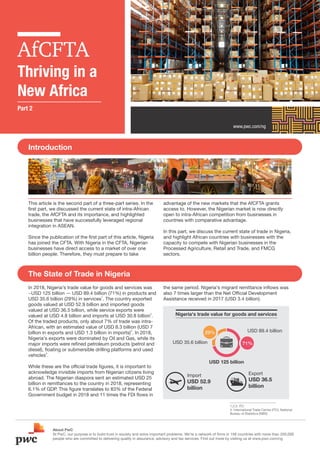
In 2018, Nigeria's trade value for goods and services was
~USD 125 billion — USD 89.4 billion (71%) in products and
1
USD 35.6 billion (29%) in services . The country exported
goods valued at USD 52.9 billion and imported goods
valued at USD 36.5 billion, while service exports were
2
valued at USD 4.8 billion and imports at USD 30.8 billion .
Of the traded products, only about 7% of trade was intra-
African, with an estimated value of USD 8.3 billion (USD 7
3
billion in exports and USD 1.3 billion in imports) . In 2018,
Nigeria's exports were dominated by Oil and Gas, while its
major imports were refined petroleum products (petrol and
diesel), floating or submersible drilling platforms and used
4
vehicles .
While these are the official trade figures, it is important to
acknowledge invisible imports from Nigerian citizens living
abroad. The Nigerian diaspora sent an estimated USD 25
billion in remittances to the country in 2018, representing
6.1% of GDP. This figure translates to 83% of the Federal
Government budget in 2018 and 11 times the FDI flows in
the same period. Nigeria's migrant remittance inflows was
also 7 times larger than the Net Official Development
Assistance received in 2017 (USD 3.4 billion).
Nigeria's trade value for goods and services
USD 125 billion
USD 89.4 billion
USD 35.6 billion 71%
29%
Import
USD 52.9
billion
Export
USD 36.5
billion
Nigeria's Top Exports and Imports (2018)
AfCFTA - Thriving in a New Africa (Part 2) 2
82.3%
9.9%
1.9%
0.7%
0.5%
4.8%
Crude Oil
Natural Gas
Tugs and Pusher Craft
Other Petroleum
Gases
Sesame Seeds
Others
Petrol
Diesel
Used Vehicles
Durum Wheat
Imported Motorcycles
Others
Floating or submersible
drilling platforms
22.4%
8.9%
4.6%
1.9%
1.8%
1.6%
58.8%
Exports Imports
Globally, Nigeria trades more frequently with European
countries. Its top export partners include India,
Netherlands, Spain, France and South Africa. In 2018,
Nigeria's top intra-African exports went to South Africa,
Côte d'Ivoire, Togo, Senegal and Cameroon.
On the import side, Nigeria's leading partners are China,
Netherlands, Republic of Korea, Belgium and USA. In
2018, Nigeria's top intra-African imports came from South
Africa, Morocco, Egypt, Eswatini and Tunisia.
Nigeria's Top Trade Partners
Europe Asia North America Latin America Africa Oceania
Others, 0.6
Cameroon, 0.3
Senegal, 0.6
Togo, 0.9
Côte d'Ivoire, 1.1
South Africa, 3.4
Europe Asia North America Latin America Africa Oceania
Tunisia, 0.1
Eswatini, 0.1
Egypt, 0.1
Morocco, 0.1
South Africa, 0.4
Source: International Trade Centre (ITC) - 2018
23.2
14.7
4.8
2.8
(Africa)7.0
0.2
Others, 0.4
14.9
0.9
1.3
0.3
Nigeria Import Partners (USD Billion) 2018
16.0
3.1
(Africa)
Nigeria Export Partners (USD Billion) 2018
In this section, we assess Nigeria's positioning compared
to other African countries, focusing primarily on three (3)
sectors – Processed Agriculture, Retail and Trade, and
FMCGs. In the next part of the series, we profile potential
leading competitor businesses from selected countries.
Nigeria's Positioning
3
STEP
1 Identify top 10 African economies
STEP
2
STEP
3
STEP
4
Select countries with agriculture
contributing more than 10% to total GDP
Select countries with agriculture
exports valued at more than USD 3bn
Select countries with agriculture exports
contributing more than 3% to GDP
This assessment identified Ghana, Kenya and
Morocco as the large economies with the comparative
advantage to compete with Nigerian agribusinesses in
the CFTA.
Total GDP (2017)
(>USD 50 bn)
Agriculture GDP as
% of total GDP (2017)
(>10%)
Agriculture exports
(value, USD) (2017)
(> USD 3bn)
Agriculture export(s)
as % of GDP
(>4%)
Nigeria
USD 460.5bn
South Africa
USD 326.8bn
Egypt
USD 271.7bn
Algeria
USD 199.2bn
Morocco
USD 119.3bn
Angola
USD 101.7bn
Sudan
USD 79.4bn
Kenya
USD 58.1bn
Ethiopia
USD 57.7bn
Ghana
USD 50.6bn
Kenya
34.6%
Ethiopia
34%
Sudan
30.5%
Nigeria
20.8%
Ghana
19.7%
Morocco
12.4%
Algeria
12.3%
Egypt
11.5%
Morocco
USD 5.5bn
Egypt
USD 5.1bn
Ghana
USD 3.5bn
Kenya
USD 3.5bn
Ghana
7.3%
Kenya
6%
Morocco
4.6%
Source: World Bank, WTO, PwC analysis
AfCFTA - Thriving in a New Africa (Part 2)
Processed Agriculture
The Agriculture sector is the largest contributor to Nigeria's
GDP, contributing about 21% to the total GDP in 2018 (PwC
estimates). Consequently, it is important to identify
competing African countries in the Agriculture sector.
The methodology used to shortlist key competing African
countries is summarised below:
As the fifth largest economy in Africa, Morocco has several
agribusinesses with the capacity to adequately compete
with Nigerian businesses. Rich in produce such as
oranges, tomatoes, potatoes, olives and olive oil,
agricultural commodities often get exported to Europe, as
Morocco has favourably exploited its closeness to the
continent. Morocco's long-term strategy is to forge strong
intra-trade partnerships across Africa, to explore
opportunities for exports, investments and services. To
implement this strategy, the country rejoined the African
Union in 2017, 33 years after its initial exit. Prior to the
AfCFTA agreement, the country sought to join ECOWAS in
a bid to enter into alliances and form partnerships within
the West African region. Morocco's overarching agenda is
to position itself as an indispensable country for European
exporters, importers and dealers in Africa.
While this article focuses primarily on Morocco, it is
important to note other smaller economies with
businesses that pose a threat to Nigeria's agribusiness
players, in terms of agricultural output and productivity.
For example, Côte d'Ivoire has a large agriculture
potential, as 75% of the national territory constitutes
arable agricultural land. Agriculture accounts for 19.8% its
GDP and over 60% of export receipts, and the sector
employs two-thirds of the population. Côte d'Ivoire is a net
food exporter of major cash crops grown by small farmers
including: cocoa, coffee, rubber, cotton, palm oil, cashew
nuts and bananas.
Selected Country: Morocco
4
Total GDP (2017)
(>USD 50 bn)
5
Total retail sales (2017)
(>USD 20bn)
Retail sales as a %
of GDP (>20%)
Nigeria
USD 460.5bn
South Africa
USD 326.8bn
Egypt
USD 271.7bn
Algeria
USD 199.2bn
Morocco
USD 119.3bn
Angola
USD 101.7bn
Sudan
USD 79.4bn
Kenya
USD 58.1bn
Ethiopia
USD 57.7bn
Ghana
USD 50.6bn
Nigeria
USD 109.0bn
South Africa
USD 94.0bn
Algeria
USD 42.0bn
Morocco
USD 40.0bn
Kenya
USD 28.0bn
Source: A.T Kearney, PwC analysis
Nigeria
23.7%
South Africa
28.8%
Morocco
33.5%
Kenya
48.2%
AfCFTA - Thriving in a New Africa (Part 2)
5. Total retail sales measure the purchases of durable and non-durable goods over a
certain period. This figure monitors and tracks consumer spending habits and the
demand for finished goods. These sales are reported by all food service and retail stores.
Retail and Trade
At 16%, the Retail and Trade sector was the second
largest contributor to GDP. In Nigeria, this sector is
mainly dominated by informal activities, which
account for over 90% of total retail trade in the
country. This assessment focuses primarily on the
formal retail sector, as the aim is to assess organised
retail businesses that can compete with Nigerian
businesses.
The methodology used to shortlist key competing
African countries is summarised:
STEP
1 Identify top 10 African economies
STEP
2
STEP
3
Select countries with retail
sales above USD 20bn
Select countries with retail
contributing more than 20% to GDP
This assessment identified Kenya, Morocco and South
Africa as the large economies with the comparative
advantage to compete with Nigerian retail businesses
in the CFTA.
The retail sector in Kenya is the second-largest in Africa
after South Africa, which already has significant presence
in Nigeria with supermarket brands such as Shoprite and
Game. Indigenous retail stores in Kenya have developed
strong competitive advantage, including the availability of
e-commerce channels, adherence to global standards and
experience with regional expansion. Additionally, the
Kenyan retail sector, which is dominated by local home-
grown players, continues to diversify with the entry of new
players and international brands, and the country is
considered to be the business/investment centre in the
East African region with retail services. Therefore, the
Kenyan retail sector holds potential insights for Nigerian
businesses around regional and national expansion.
5
Total GDP (2017)
(>USD 50 bn)
Level of
industrialisation
(>250)
Consumer goods
exports
(>USD 3bn)
Consumer
goods exports
as a % of GDP
(>4%)
Nigeria
USD 460.5bn
South Africa
USD 326.8bn
Egypt
USD 271.7bn
Algeria
USD 199.2bn
Morocco
USD 119.3bn
Angola
USD 101.7bn
Sudan
USD 79.4bn
Ethiopia
USD 57.7bn
Ghana
USD 50.6bn
Kenya
USD 58.1bn
Nigeria
254.4
South Africa
952.0
Egypt
436.6
Algeria
264.0
Source: World Bank, UNIDO, UNCTAD, WTO, PwC analysis
Morocco
474.0
South Africa
USD 18.6bn
Egypt
USD 11.1 bn
Nigeria
USD 6.6 bn
Kenya
USD 3.9 bn
South Africa
5.6%
Egypt
4.1%
AfCFTA - Thriving in a New Africa (Part 2)
6. manufacturing value added per capita
Selected Country: Kenya
FMCG analysis
In 2018, FMCGs, including food, beverage, tobacco and
textile, apparel and footwear segments, contributed 9%
to Nigeria's GDP.
The methodology used to shortlist key competing African
countries is summarised:
This assessment identified South Africa and Egypt as the
large economies with the comparative advantage to
compete with Nigerian FMCG businesses in the CFTA.
STEP
1 Identify top 10 African economies
STEP
2
STEP
3
Select industrialized countries, defined by
manufacturing value added per capita
Select countries with consumer goods
exports valued at more than USD 3bn
STEP
4 Select countries with consumer goods
exports contributing more than 4% to GDP
In the FMCG sector, South Africa is considered the
“gateway” to Africa with its well-developed manufacturing
sector, and the country being the main driver for raw
material intra-African trade. The FMCG sector is highly
industrialized, with the manufacturing sector absorbing
resources from other African countries and converting to
finished goods.
Egypt, the third largest economy in Africa, is also the third
biggest exporter in terms of intra-Africa trade. The FMCG
sector contributed 15.7% to Egypt's GDP with an
estimated market value of US$29.2 billion in 2016, and
continues to grow year-on-year, due to increased
manufacturing capacity, high levels of industrialisation and
production scale.
6
© 2019 PricewaterhouseCoopers Limited. All rights reserved. In this document, PwC refers to PricewaterhouseCoopers Limited (a Nigerian limited liability
company), which is a member firm of PricewaterhouseCoopers International Limited, each member firm of which is a separate legal entity.
Contacts
Andrew S. Nevin, Ph.D.
Partner & Chief Economist
andrew.x.nevin@pwc.com
Cyril Azobu
Partner & Advisory Leader
cyril.azobu@pwc.com
Mary Iwelumo
Partner & Government/
Public Services Leader
mary.iwelumo@pwc.com
Oyindamola Oladosu, Ph.D.
Manager, Advisory
oyindamola.oladosu@pwc.com
Omomia Omosomi
Manager
omomia.omosomi@pwc.com
Ajituewun Ashama
Senior Associate
ajituewun.ashama@pwc.com
Acknowledgement
We would like to thank Yemi Akoyi, Mustapha Suberu, Oyinkansola Ilupeju, Afomachukwu Ukah, Oladimeji Ladipo, Ufuoma Ofhide, and Echezonachukwu
Uduji for their contributions to the development of this report.
AfCFTA - Thriving in a New Africa (Part 2)
Selected Country: South Africa
In this part of the series, we discussed Nigeria's current
trading patterns, and presented an overview of countries
with businesses that serve as threat to Nigerian
businesses. In the next part, we profile potential leading
competitors from the selected countries, and
recommendations for success to Nigerian businesses in
these sectors.

Afcfta 2019-prt2

  • 1.
    AfCFTA Thriving in a NewAfrica www.pwc.com/ng This article is the second part of a three-part series. In the first part, we discussed the current state of intra-African trade, the AfCFTA and its importance, and highlighted businesses that have successfully leveraged regional integration in ASEAN. Since the publication of the first part of this article, Nigeria has joined the CFTA. With Nigeria in the CFTA, Nigerian businesses have direct access to a market of over one billion people. Therefore, they must prepare to take advantage of the new markets that the AfCFTA grants access to. However, the Nigerian market is now directly open to intra-African competition from businesses in countries with comparative advantage. In this part, we discuss the current state of trade in Nigeria, and highlight African countries with businesses with the capacity to compete with Nigerian businesses in the Processed Agriculture, Retail and Trade, and FMCG sectors. Introduction About PwC At PwC, our purpose is to build trust in society and solve important problems. We’re a network of firms in 158 countries with more than 250,000 people who are committed to delivering quality in assurance, advisory and tax services. Find out more by visiting us at www.pwc.com/ng 1,2,3. ITC 4. International Trade Centre (ITC), National Bureau of Statistics (NBS) Part 2 The State of Trade in Nigeria In 2018, Nigeria's trade value for goods and services was ~USD 125 billion — USD 89.4 billion (71%) in products and 1 USD 35.6 billion (29%) in services . The country exported goods valued at USD 52.9 billion and imported goods valued at USD 36.5 billion, while service exports were 2 valued at USD 4.8 billion and imports at USD 30.8 billion . Of the traded products, only about 7% of trade was intra- African, with an estimated value of USD 8.3 billion (USD 7 3 billion in exports and USD 1.3 billion in imports) . In 2018, Nigeria's exports were dominated by Oil and Gas, while its major imports were refined petroleum products (petrol and diesel), floating or submersible drilling platforms and used 4 vehicles . While these are the official trade figures, it is important to acknowledge invisible imports from Nigerian citizens living abroad. The Nigerian diaspora sent an estimated USD 25 billion in remittances to the country in 2018, representing 6.1% of GDP. This figure translates to 83% of the Federal Government budget in 2018 and 11 times the FDI flows in the same period. Nigeria's migrant remittance inflows was also 7 times larger than the Net Official Development Assistance received in 2017 (USD 3.4 billion). Nigeria's trade value for goods and services USD 125 billion USD 89.4 billion USD 35.6 billion 71% 29% Import USD 52.9 billion Export USD 36.5 billion
  • 2.
    Nigeria's Top Exportsand Imports (2018) AfCFTA - Thriving in a New Africa (Part 2) 2 82.3% 9.9% 1.9% 0.7% 0.5% 4.8% Crude Oil Natural Gas Tugs and Pusher Craft Other Petroleum Gases Sesame Seeds Others Petrol Diesel Used Vehicles Durum Wheat Imported Motorcycles Others Floating or submersible drilling platforms 22.4% 8.9% 4.6% 1.9% 1.8% 1.6% 58.8% Exports Imports Globally, Nigeria trades more frequently with European countries. Its top export partners include India, Netherlands, Spain, France and South Africa. In 2018, Nigeria's top intra-African exports went to South Africa, Côte d'Ivoire, Togo, Senegal and Cameroon. On the import side, Nigeria's leading partners are China, Netherlands, Republic of Korea, Belgium and USA. In 2018, Nigeria's top intra-African imports came from South Africa, Morocco, Egypt, Eswatini and Tunisia. Nigeria's Top Trade Partners Europe Asia North America Latin America Africa Oceania Others, 0.6 Cameroon, 0.3 Senegal, 0.6 Togo, 0.9 Côte d'Ivoire, 1.1 South Africa, 3.4 Europe Asia North America Latin America Africa Oceania Tunisia, 0.1 Eswatini, 0.1 Egypt, 0.1 Morocco, 0.1 South Africa, 0.4 Source: International Trade Centre (ITC) - 2018 Source: International Trade Centre (ITC) - 2018 Source: International Trade Centre (ITC) - 2018 23.2 14.7 4.8 2.8 (Africa)7.0 0.2 Others, 0.4 14.9 0.9 1.3 0.3 Nigeria Import Partners (USD Billion) 2018 16.0 3.1 (Africa) Nigeria Export Partners (USD Billion) 2018
  • 3.
    In this section,we assess Nigeria's positioning compared to other African countries, focusing primarily on three (3) sectors – Processed Agriculture, Retail and Trade, and FMCGs. In the next part of the series, we profile potential leading competitor businesses from selected countries. Nigeria's Positioning 3 STEP 1 Identify top 10 African economies STEP 2 STEP 3 STEP 4 Select countries with agriculture contributing more than 10% to total GDP Select countries with agriculture exports valued at more than USD 3bn Select countries with agriculture exports contributing more than 3% to GDP This assessment identified Ghana, Kenya and Morocco as the large economies with the comparative advantage to compete with Nigerian agribusinesses in the CFTA. Total GDP (2017) (>USD 50 bn) Agriculture GDP as % of total GDP (2017) (>10%) Agriculture exports (value, USD) (2017) (> USD 3bn) Agriculture export(s) as % of GDP (>4%) Nigeria USD 460.5bn South Africa USD 326.8bn Egypt USD 271.7bn Algeria USD 199.2bn Morocco USD 119.3bn Angola USD 101.7bn Sudan USD 79.4bn Kenya USD 58.1bn Ethiopia USD 57.7bn Ghana USD 50.6bn Kenya 34.6% Ethiopia 34% Sudan 30.5% Nigeria 20.8% Ghana 19.7% Morocco 12.4% Algeria 12.3% Egypt 11.5% Morocco USD 5.5bn Egypt USD 5.1bn Ghana USD 3.5bn Kenya USD 3.5bn Ghana 7.3% Kenya 6% Morocco 4.6% Source: World Bank, WTO, PwC analysis AfCFTA - Thriving in a New Africa (Part 2) Processed Agriculture The Agriculture sector is the largest contributor to Nigeria's GDP, contributing about 21% to the total GDP in 2018 (PwC estimates). Consequently, it is important to identify competing African countries in the Agriculture sector. The methodology used to shortlist key competing African countries is summarised below:
  • 4.
    As the fifthlargest economy in Africa, Morocco has several agribusinesses with the capacity to adequately compete with Nigerian businesses. Rich in produce such as oranges, tomatoes, potatoes, olives and olive oil, agricultural commodities often get exported to Europe, as Morocco has favourably exploited its closeness to the continent. Morocco's long-term strategy is to forge strong intra-trade partnerships across Africa, to explore opportunities for exports, investments and services. To implement this strategy, the country rejoined the African Union in 2017, 33 years after its initial exit. Prior to the AfCFTA agreement, the country sought to join ECOWAS in a bid to enter into alliances and form partnerships within the West African region. Morocco's overarching agenda is to position itself as an indispensable country for European exporters, importers and dealers in Africa. While this article focuses primarily on Morocco, it is important to note other smaller economies with businesses that pose a threat to Nigeria's agribusiness players, in terms of agricultural output and productivity. For example, Côte d'Ivoire has a large agriculture potential, as 75% of the national territory constitutes arable agricultural land. Agriculture accounts for 19.8% its GDP and over 60% of export receipts, and the sector employs two-thirds of the population. Côte d'Ivoire is a net food exporter of major cash crops grown by small farmers including: cocoa, coffee, rubber, cotton, palm oil, cashew nuts and bananas. Selected Country: Morocco 4 Total GDP (2017) (>USD 50 bn) 5 Total retail sales (2017) (>USD 20bn) Retail sales as a % of GDP (>20%) Nigeria USD 460.5bn South Africa USD 326.8bn Egypt USD 271.7bn Algeria USD 199.2bn Morocco USD 119.3bn Angola USD 101.7bn Sudan USD 79.4bn Kenya USD 58.1bn Ethiopia USD 57.7bn Ghana USD 50.6bn Nigeria USD 109.0bn South Africa USD 94.0bn Algeria USD 42.0bn Morocco USD 40.0bn Kenya USD 28.0bn Source: A.T Kearney, PwC analysis Nigeria 23.7% South Africa 28.8% Morocco 33.5% Kenya 48.2% AfCFTA - Thriving in a New Africa (Part 2) 5. Total retail sales measure the purchases of durable and non-durable goods over a certain period. This figure monitors and tracks consumer spending habits and the demand for finished goods. These sales are reported by all food service and retail stores. Retail and Trade At 16%, the Retail and Trade sector was the second largest contributor to GDP. In Nigeria, this sector is mainly dominated by informal activities, which account for over 90% of total retail trade in the country. This assessment focuses primarily on the formal retail sector, as the aim is to assess organised retail businesses that can compete with Nigerian businesses. The methodology used to shortlist key competing African countries is summarised: STEP 1 Identify top 10 African economies STEP 2 STEP 3 Select countries with retail sales above USD 20bn Select countries with retail contributing more than 20% to GDP This assessment identified Kenya, Morocco and South Africa as the large economies with the comparative advantage to compete with Nigerian retail businesses in the CFTA.
  • 5.
    The retail sectorin Kenya is the second-largest in Africa after South Africa, which already has significant presence in Nigeria with supermarket brands such as Shoprite and Game. Indigenous retail stores in Kenya have developed strong competitive advantage, including the availability of e-commerce channels, adherence to global standards and experience with regional expansion. Additionally, the Kenyan retail sector, which is dominated by local home- grown players, continues to diversify with the entry of new players and international brands, and the country is considered to be the business/investment centre in the East African region with retail services. Therefore, the Kenyan retail sector holds potential insights for Nigerian businesses around regional and national expansion. 5 Total GDP (2017) (>USD 50 bn) Level of industrialisation (>250) Consumer goods exports (>USD 3bn) Consumer goods exports as a % of GDP (>4%) Nigeria USD 460.5bn South Africa USD 326.8bn Egypt USD 271.7bn Algeria USD 199.2bn Morocco USD 119.3bn Angola USD 101.7bn Sudan USD 79.4bn Ethiopia USD 57.7bn Ghana USD 50.6bn Kenya USD 58.1bn Nigeria 254.4 South Africa 952.0 Egypt 436.6 Algeria 264.0 Source: World Bank, UNIDO, UNCTAD, WTO, PwC analysis Morocco 474.0 South Africa USD 18.6bn Egypt USD 11.1 bn Nigeria USD 6.6 bn Kenya USD 3.9 bn South Africa 5.6% Egypt 4.1% AfCFTA - Thriving in a New Africa (Part 2) 6. manufacturing value added per capita Selected Country: Kenya FMCG analysis In 2018, FMCGs, including food, beverage, tobacco and textile, apparel and footwear segments, contributed 9% to Nigeria's GDP. The methodology used to shortlist key competing African countries is summarised: This assessment identified South Africa and Egypt as the large economies with the comparative advantage to compete with Nigerian FMCG businesses in the CFTA. STEP 1 Identify top 10 African economies STEP 2 STEP 3 Select industrialized countries, defined by manufacturing value added per capita Select countries with consumer goods exports valued at more than USD 3bn STEP 4 Select countries with consumer goods exports contributing more than 4% to GDP
  • 6.
    In the FMCGsector, South Africa is considered the “gateway” to Africa with its well-developed manufacturing sector, and the country being the main driver for raw material intra-African trade. The FMCG sector is highly industrialized, with the manufacturing sector absorbing resources from other African countries and converting to finished goods. Egypt, the third largest economy in Africa, is also the third biggest exporter in terms of intra-Africa trade. The FMCG sector contributed 15.7% to Egypt's GDP with an estimated market value of US$29.2 billion in 2016, and continues to grow year-on-year, due to increased manufacturing capacity, high levels of industrialisation and production scale. 6 © 2019 PricewaterhouseCoopers Limited. All rights reserved. In this document, PwC refers to PricewaterhouseCoopers Limited (a Nigerian limited liability company), which is a member firm of PricewaterhouseCoopers International Limited, each member firm of which is a separate legal entity. Contacts Andrew S. Nevin, Ph.D. Partner & Chief Economist andrew.x.nevin@pwc.com Cyril Azobu Partner & Advisory Leader cyril.azobu@pwc.com Mary Iwelumo Partner & Government/ Public Services Leader mary.iwelumo@pwc.com Oyindamola Oladosu, Ph.D. Manager, Advisory oyindamola.oladosu@pwc.com Omomia Omosomi Manager omomia.omosomi@pwc.com Ajituewun Ashama Senior Associate ajituewun.ashama@pwc.com Acknowledgement We would like to thank Yemi Akoyi, Mustapha Suberu, Oyinkansola Ilupeju, Afomachukwu Ukah, Oladimeji Ladipo, Ufuoma Ofhide, and Echezonachukwu Uduji for their contributions to the development of this report. AfCFTA - Thriving in a New Africa (Part 2) Selected Country: South Africa In this part of the series, we discussed Nigeria's current trading patterns, and presented an overview of countries with businesses that serve as threat to Nigerian businesses. In the next part, we profile potential leading competitors from the selected countries, and recommendations for success to Nigerian businesses in these sectors.