Keynote at the 2nd GTAC Public Economics Winter School
University of Pretoria, South Africa, 3 July 2017
Finn Tarp
African Development
in Perspective
Introduction
Context
• The Economist (11 May 2000): Hopeless Africa
• The Independent (15 July 2009): Africa – the lost continent
• The Economist (3 December 2011): The hopeful continent
– Africa rising
• A recent Afrobarometer survey suggests: ‘despite high
reported growth rates, lived poverty at the grassroots
remains little changed’ (Dulani et al. 2013)
– Others even question the growth revival referring to poor data
Questions
• What is really happening?
• What is going on at country level?
• Can one make sense of it all?
• Which are the policy implications?
Macro-economic Background
Four key characteristics
• A growth turn-around, but still poor
• Variability
• New vulnerabilities
• Public sector dependence on foreign
inflows and indirect taxes
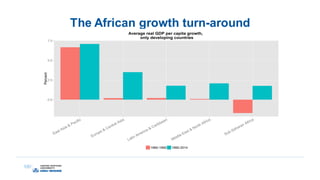
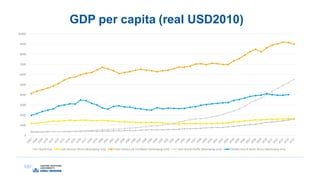
The African growth turn-around
GDP per capita (real USD2010)
0
1000
2000
3000
4000
5000
6000
7000
8000
9000
10000
South Asia Sub-Saharan Africa (developing only) Latin America& Caribbean (developing only) East Asia & Pacific (developing only) Middle East & North Africa (developing only)
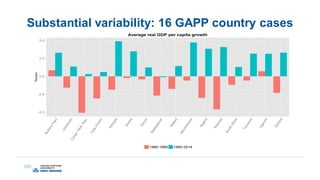
Substantial variability: 16 GAPP country cases
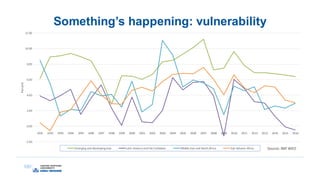
Something’s happening: vulnerability
-2.00
0.00
2.00
4.00
6.00
8.00
10.00
12.00
1991 1992 1993 1994 1995 1996 1997 1998 1999 2000 2001 2002 2003 2004 2005 2006 2007 2008 2009 2010 2011 2012 2013 2014 2015 2016
Percent
Emerging and developingAsia Latin Americaand the Caribbean Middle East and North Africa Sub-Saharan Africa Source: IMF WEO
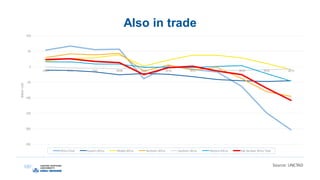
Also in trade
Source: UNCTAD
-250
-200
-150
-100
-50
0
50
100
2005 2006 2007 2008 2009 2010 2011 2012 2013 2014 2015
BillionUSD
AfricaTotal Eastern Africa Middle Africa Northern Africa Southern Africa Western Africa Sub-Sarahan Africa Total
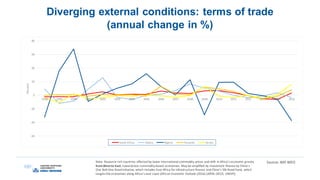
Diverging external conditions: terms of trade
(annual change in %)
-60
-40
-20
0
20
40
60
80
1998 1999 2000 2001 2002 2003 2004 2005 2006 2007 2008 2009 2010 2011 2012 2013 2014 2015
Percent
South Africa Ghana Nigeria Tanzania Kenya
Source: IMF WEONote: Resource rich countries affected by lower international commodity prices and shift in Africa’s economic gravity
from West to East, towardsless commodity-based economies. May be amplified by investment finance by China’s
One Belt One RoadInitiative, which includes East Africa for infrastructure finance and China’s Silk Road Fund, which
targetsthe economies along Africa’s east coast (African Economic Outlook (2016) (AfDB, OECD, UNDP))
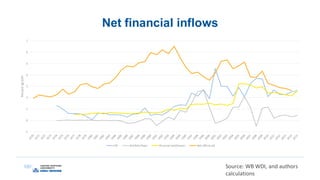
Net financial inflows
-1
0
1
2
3
4
5
6
7
PercentogGDP
FDI Portfolio flows Personal remittances Net official aid
Source: WB WDI, and authors
calculations
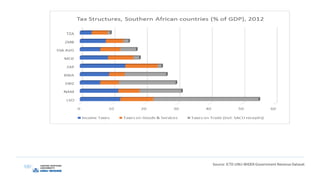
Source: ICTD UNU-WIDER Government RevenueDataset
Structural Dimensions
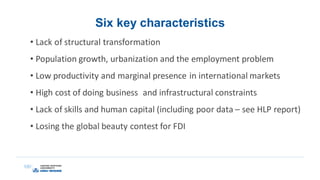
Six key characteristics
• Lack of structural transformation
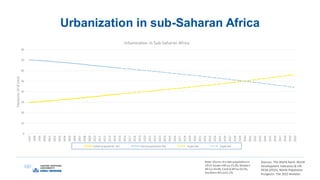
• Population growth, urbanization and the employment problem
• Low productivity and marginal presence in international markets
• High cost of doing business and infrastructural constraints
• Lack of skills and human capital (including poor data – see HLP report)
• Losing the global beauty contest for FDI
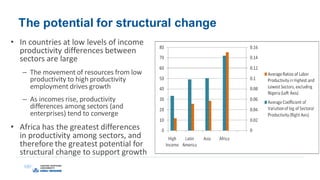
The potential for structural change
• In countries at low levels of income
productivity differences between
sectors are large
– The movement of resources from low
productivity to high productivity
employment drives growth
– As incomes rise, productivity
differences among sectors (and
enterprises) tend to converge
• Africa has the greatest differences
in productivity among sectors, and
therefore the greatest potential for
structural change to support growth
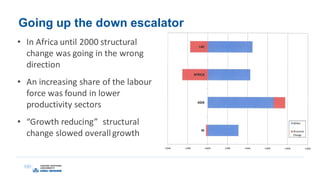
Going up the down escalator
• In Africa until 2000 structural
change was going in the wrong
direction
• An increasing share of the labour
force was found in lower
productivity sectors
• “Growth reducing” structural
change slowed overall growth
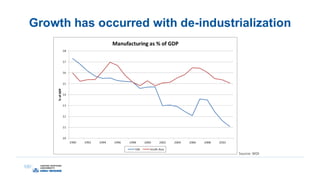
Growth has occurred with de-industrialization
Source: WDI
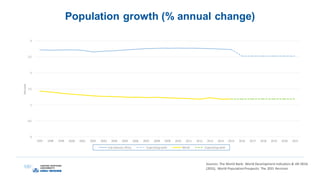
Population growth (% annual change)
0
0.5
1
1.5
2
2.5
3
1997 1998 1999 2000 2001 2002 2003 2004 2005 2006 2007 2008 2009 2010 2011 2012 2013 2014 2015 2016 2017 2018 2019 2020 2021
Percent
Sub-Saharan Africa Expected growth World Expected growth
Sources: The World Bank: World Development Indicators & UN DESA
(2015), World PopulationProspects: The 2015 Revision
Urbanization in sub-Saharan Africa
0
10
20
30
40
50
60
70
80
1997
1998
1999
2000
2001
2002
2003
2004
2005
2006
2007
2008
2009
2010
2011
2012
2013
2014
2015
2016
2017
2018
2019
2020
2021
2022
2023
2024
2025
2026
2027
2028
2029
2030
2031
2032
2033
2034
2035
2036
2037
2038
2039
2040
2041
2042
2043
2044
2045
2046
2047
2048
2049
2050
Population(%oftotal)
Urbanization in Sub-Saharan Africa
Urban population (%) Rural population (%) Expected Expected
Sources: The World Bank: World
Development Indicators & UN
DESA (2015), World Population
Prospects: The 2015 Revision
Note: Shares of urban populationin
2014:EasternAfrica25.2%,Western
Africa 44.4%,Central Africa43.5%,
Southern Africa61.2%
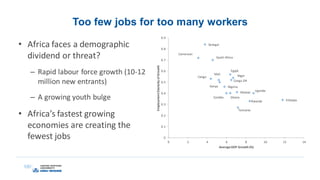
Too few jobs for too many workers
• Africa faces a demographic
dividend or threat?
– Rapid labour force growth (10-12
million new entrants)
– A growing youth bulge
• Africa’s fastest growing
economies are creating the
fewest jobs
Ethiopia
Uganda
Rwanda
Tanzania
Malawi
Niger
Congo DR
Ghana
Egypt
Zambia
NigeriaKenya
Mali
South Africa
Congo
Senegal
Cameroun
0
0.1
0.2
0.3
0.4
0.5
0.6
0.7
0.8
0.9
0 2 4 6 8 10 12 14
EmploymentElasticityofGrowth
AverageGDP Growth (%)
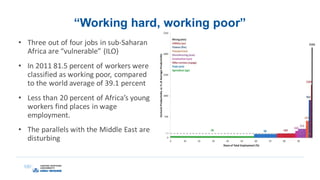
“Working hard, working poor”
• Three out of four jobs in sub-Saharan
Africa are “vulnerable” (ILO)
• In 2011 81.5 percent of workers were
classified as working poor, compared
to the world average of 39.1 percent
• Less than 20 percent of Africa’s young
workers find places in wage
employment.
• The parallels with the Middle East are
disturbing
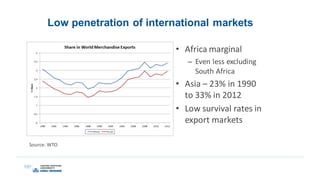
Low penetration of international markets
• Africa marginal
– Even less excluding
South Africa
• Asia – 23% in 1990
to 33% in 2012
• Low survival rates in
export markets
Source: WTO
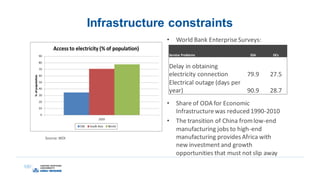
Infrastructure constraints
• World Bank EnterpriseSurveys:
• Share of ODA for Economic
Infrastructurewas reduced 1990-2010
• The transition of China fromlow-end
manufacturing jobs to high-end
manufacturing providesAfrica with
new investment and growth
opportunities that must not slip away
Service Problems SSA DCs
Delay in obtaining
electricity connection 79.9 27.5
Electrical outage (days per
year) 90.9 28.7
Source: WDI
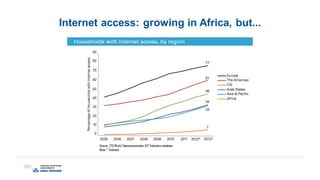
Internet access: growing in Africa, but...
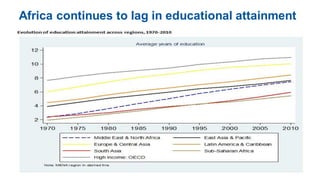
Africa continues to lag in educational attainment
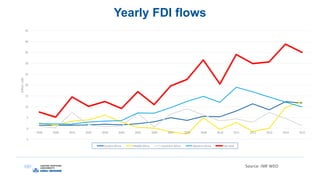
Yearly FDI flows
Source: IMF WEO
-5
0
5
10
15
20
25
30
35
40
45
1999 2000 2001 2002 2003 2004 2005 2006 2007 2008 2009 2010 2011 2012 2013 2014 2015
BillionUSD
Eastern Africa Middle Africa Southern Africa Western Africa SSA total
UNU-WIDER
engagement in Africa
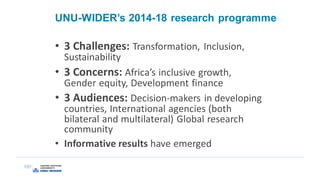
UNU-WIDER’s 2014-18 research programme
• 3 Challenges: Transformation, Inclusion,
Sustainability
• 3 Concerns: Africa’s inclusive growth,
Gender equity, Development finance
• 3 Audiences: Decision-makers in developing
countries, International agencies (both
bilateral and multilateral) Global research
community
• Informative results have emerged
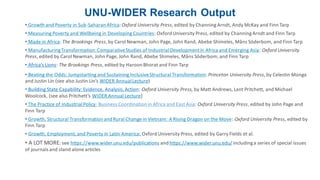
UNU-WIDER Research Output
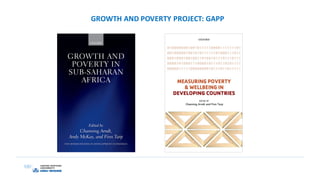
• Growth and Poverty in Sub-Saharan Africa:Oxford University Press, edited by Channing Arndt, Andy McKay and Finn Tarp
• Measuring Poverty and Wellbeing in Developing Countries: Oxford University Press, edited by ChanningArndt and Finn Tarp
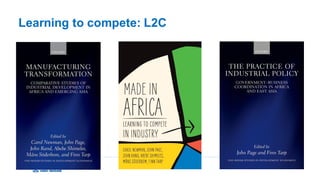
• Made in Africa: The Brookings Press, by CarolNewman, John Page, John Rand, Abebe Shimeles, Måns Söderbom, and Finn Tarp
• ManufacturingTransformation:ComparativeStudies of IndustrialDevelopmentin Africa and Emerging Asia: Oxford University
Press, edited by Carol Newman, John Page, John Rand, Abebe Shimeles, Måns Söderbom, and Finn Tarp
• Africa’s Lions: The Brookings Press, edited by Haroon Bhorat and Finn Tarp
• Beating the Odds:Jumpstarting and Sustaining InclusiveStructural Transformation:Princeton University Press, by Celestin Monga
and Justin Lin (see also Justin Lin’s WIDER AnnualLecture)
• Building State Capability: Evidence, Analysis, Action: Oxford University Press, by Matt Andrews, Lant Pritchett, and Michael
Woolcock, (see also Pritchett’s WIDER Annual Lecture)
• The Practice of IndustrialPolicy: Business Coordination in Africa and East Asia: Oxford University Press, edited by John Page and
Finn Tarp
• Growth, Structural Transformation and Rural Change in Vietnam: A Rising Dragon on the Move: Oxford University Press, edited by
Finn Tarp
• Growth, Employment, and Poverty in Latin America: Oxford University Press, edited by Garry Fields et al.
• A LOT MORE: see https://www.wider.unu.edu/publications and https://www.wider.unu.edu/ includinga series of special issues
of journals and stand alone articles
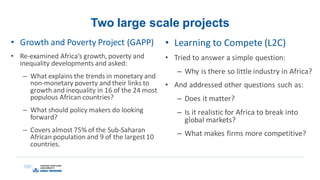
Two large scale projects
• Growth and Poverty Project (GAPP)
• Re-examined Africa’s growth, poverty and
inequality developments and asked:
– What explains the trends in monetary and
non-monetary poverty and their links to
growth and inequality in 16 of the 24 most
populous African countries?
– What should policy makers do looking
forward?
– Covers almost 75% of the Sub-Saharan
African population and 9 of the largest10
countries.
• Learning to Compete (L2C)
• Tried to answer a simple question:
– Why is there so little industry in Africa?
• And addressed other questions such as:
– Does it matter?
– Is it realistic for Africa to break into
global markets?
– What makes firms more competitive?
GAPP Approach and Country
Categorisation
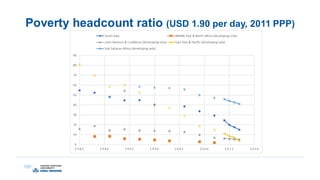
Poverty headcount ratio (USD 1.90 per day, 2011 PPP)
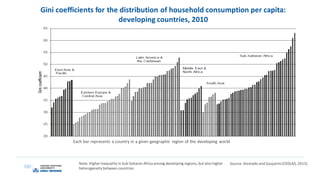
Gini coefficients for the distribution of household consumption per capita:
developing countries, 2010
Each bar represents a country in a given geographic region of the developing world
Source: Alvaredo and Gasparini(CEDLAS, 2013)Note: Higher inequality in Sub-Saharan Africa among developing regions, but also higher
heterogeneity between countries.
The GAPP approach
• Poverty, growth and inequality tend to be related
• Simple cross-country extrapolations from WDI data will not reveal underlying
dynamics or lack hereof in specific country contexts
• So we brought together:
– Available macroeconomic data
– Comparable household budget surveys
– Demographic and Health Survey data
– A host of other information (prices)
• To critically examine validity and consistency of existing data
• And develop coherent country case stories
GAPP
• Carried out 16 carefully designed country case studies from the 24 most populous
countries in sub-Saharan Africa:
– Ethiopia, Ghana, Malawi, Rwanda, Uganda, Burkina Faso, Mozambique,Nigeria, Tanzania, Zambia,
Cameroon,Côte d’Ivoire,Kenya, Madagascar, South Africa and the DRC
– Representalmost 75% of the African population and 9 of the largest 10 countries
– Exact time period varies: generally the last two decades
– 16 high quality teams consisting of leading local and international experts, focused on identifying
and explaining trends in monetary and non-monetary poverty and their links to growth and
inequality
– Synthesis and interpretation by the editors
• Key result: there is a lot to celebrate in African development (two cheers)
– But not every where, and major challenges remain (not three cheers)
Country level results
• Relatively rapid economic growth and corresponding poverty reduction:
Ethiopia, Ghana, Malawi, Rwanda, and Uganda
• Relatively rapid economic growth but limited poverty reduction: Burkina
Faso, Mozambique, Nigeria, Tanzania, and Zambia
• Uninspiring or negative economic growth with corresponding stagnation
or increasing poverty: Cameroon, Côte d’Ivoire, Kenya, Madagascar, and
South Africa
• Low-information countries: DRC
Three findings
• Socio-economic progress in Sub-Saharan Africa has been markedly
better than almost anyone expected 25 years ago
• But progress has not been even, the development process has without
exception been highly non-linear, and the fragility of gains evident
• The regional powerhouses of Kenya, Nigeria, and South Africa not
among the better performers in terms of growth or poverty reduction
Three lessons
• Volatility of monetary poverty measures: extreme care in
analysis and interpretation warranted
• Importance of multi-dimensional assessments: speaking to
non-money metrics of development
• The role of agriculture remains critical
GROWTH AND POVERTY PROJECT: GAPP
Learning to Compete (L2C)
Understanding why there is so little industry in
Africa
Ending up where it started
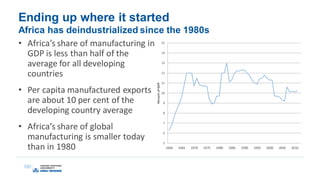
Africa has deindustrialized since the 1980s
• Africa’s share of manufacturing in
GDP is less than half of the
average for all developing
countries
• Per capita manufactured exports
are about 10 per cent of the
developing country average
• Africa’s share of global
manufacturing is smaller today
than in 1980
5
6
7
8
9
10
11
12
13
14
15
1960 1965 1970 1975 1980 1985 1990 1995 2000 2005 2010
PercentofGDP
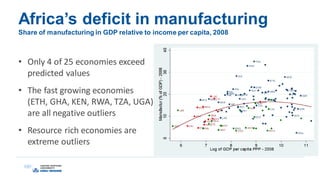
Africa’s deficit in manufacturing
Share of manufacturing in GDP relative to income per capita, 2008
• Only 4 of 25 economies exceed
predicted values
• The fast growing economies
(ETH, GHA, KEN, RWA, TZA, UGA)
are all negative outliers
• Resource rich economies are
extreme outliers
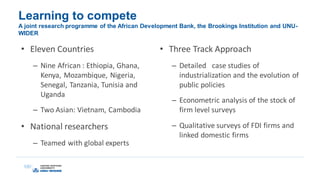
Learning to compete
A joint research programme of the African Development Bank, the Brookings Institution and UNU-
WIDER
• Eleven Countries
– Nine African : Ethiopia, Ghana,
Kenya, Mozambique, Nigeria,
Senegal, Tanzania, Tunisia and
Uganda
– Two Asian: Vietnam, Cambodia
• National researchers
– Teamed with global experts
• Three Track Approach
– Detailed case studies of
industrialization and the evolution of
public policies
– Econometric analysis of the stock of
firm level surveys
– Qualitative surveys of FDI firms and
linked domestic firms
Learning to compete: L2C
Four drivers of productivity and location
• The “basics” (“Investment Climate”)
– Infrastructureand skills
– Institutions and regulation
• Exports and competition
– Firms in low income countries increase their productivity by exporting
– Competition increases productivity through entry and exit
• Firm capabilities
– The tacit knowledge and working practices that affect both productivity and quality
– Capabilities can spill over to other firms through supply chain links
• Agglomerations
– Industrial clusters confer significant productivity gains
– Virtually everything we know about agglomeration economies comes from middle and
high income countries
Lacking the “basics”
• Country case studies highlight large gaps in infrastructure:
– Power is the biggest constraint
– Transport and logistics come a close second
• Skills related to production and management are lacking in
many countries
– Deficiencies in post-primary education
– Poorly performing vocational and technical education
Exports and productivity
• Confirming expectations
– More productive firms select into
exporting
– Large (and foreign) firms are more
likely to export
– Exporting further raises
productivity
– Learning effects are stronger in
• Domestically owned firms
• More sophisticated products
• Higher income (or more distant)
markets
• The initial yearsof exporting
• Some surprises
– Many African exporters are “born
global” (both FDI and local)
– Few firms “learn to export” (few
partial exporters and fewer
switchers)
– Export activity is highly persistent
– The productivity premium tends to
increase with low national (or
sectoral) export participation rates
Firm capabilities
• Africa lacks capable mid sized firms (50-70 workers)
– Management of a growing labour force is a major constraint
• Firms learn capabilities from exporting
– The positive relationship between exporting and productivity is mainly due
to process and quality innovations undertaken by firms
• Firm to firm knowledge transfers are an important source of
capabilities
– FDI is a major source of higher capabilities
– Vertical linkages along supply chains are much more dense in Asia
than in Africa
Agglomeration effects
• Broad evidence of productivity gains
– Large (formal) firms appear to benefit more than small (informal)
firms
• Localization (“cluster”) effects are strongest in lower
income countries
• Where markets are poorly integrated competition
offsets productivity gains
– Prices tend to fall, reducing incentives to cluster
A window of opportunity?
• Africa has a chance to break into the global market for
industrial goods
– Changes in Asia
– Trade in tasks
– Industries without smokestacks
• But Africa must attract more industrial firms
– Developing policies to attract global firms
• And while some firms in some countries are competitive many others
are not
– Developing policies to raise firm-level productivity
A new strategy for industrial development
• Reforming the Investment Climate
Agenda
• Mounting an “Export Push”
• Building Firm Capabilities
• Creating Clusters
Conclusion
Key messages
• There is a lot to celebrate in African development (two cheers)
– But not every where, and major challenges remain (not three cheers)
• Country context and understanding critical
• Growth matters for poverty reduction
– But not equally everywhere
– Will South Africa (and others) start pulling its weight for African growth?
• Africa has a chance to break into the global market for industrial goods
– But business as usual will not deliver desired for results
– Can South Africa promote constructive engagament?

African development-in-perspective

  • 1.
    Keynote at the2nd GTAC Public Economics Winter School University of Pretoria, South Africa, 3 July 2017 Finn Tarp African Development in Perspective
  • 2.
  • 3.
    Context • The Economist(11 May 2000): Hopeless Africa • The Independent (15 July 2009): Africa – the lost continent • The Economist (3 December 2011): The hopeful continent – Africa rising • A recent Afrobarometer survey suggests: ‘despite high reported growth rates, lived poverty at the grassroots remains little changed’ (Dulani et al. 2013) – Others even question the growth revival referring to poor data
  • 4.
    Questions • What isreally happening? • What is going on at country level? • Can one make sense of it all? • Which are the policy implications?
  • 5.
  • 6.
    Four key characteristics •A growth turn-around, but still poor • Variability • New vulnerabilities • Public sector dependence on foreign inflows and indirect taxes
  • 7.
    The African growthturn-around
  • 8.
    GDP per capita(real USD2010) 0 1000 2000 3000 4000 5000 6000 7000 8000 9000 10000 South Asia Sub-Saharan Africa (developing only) Latin America& Caribbean (developing only) East Asia & Pacific (developing only) Middle East & North Africa (developing only)
  • 9.
    Substantial variability: 16GAPP country cases
  • 10.
    Something’s happening: vulnerability -2.00 0.00 2.00 4.00 6.00 8.00 10.00 12.00 19911992 1993 1994 1995 1996 1997 1998 1999 2000 2001 2002 2003 2004 2005 2006 2007 2008 2009 2010 2011 2012 2013 2014 2015 2016 Percent Emerging and developingAsia Latin Americaand the Caribbean Middle East and North Africa Sub-Saharan Africa Source: IMF WEO
  • 11.
    Also in trade Source:UNCTAD -250 -200 -150 -100 -50 0 50 100 2005 2006 2007 2008 2009 2010 2011 2012 2013 2014 2015 BillionUSD AfricaTotal Eastern Africa Middle Africa Northern Africa Southern Africa Western Africa Sub-Sarahan Africa Total
  • 12.
    Diverging external conditions:terms of trade (annual change in %) -60 -40 -20 0 20 40 60 80 1998 1999 2000 2001 2002 2003 2004 2005 2006 2007 2008 2009 2010 2011 2012 2013 2014 2015 Percent South Africa Ghana Nigeria Tanzania Kenya Source: IMF WEONote: Resource rich countries affected by lower international commodity prices and shift in Africa’s economic gravity from West to East, towardsless commodity-based economies. May be amplified by investment finance by China’s One Belt One RoadInitiative, which includes East Africa for infrastructure finance and China’s Silk Road Fund, which targetsthe economies along Africa’s east coast (African Economic Outlook (2016) (AfDB, OECD, UNDP))
  • 13.
    Net financial inflows -1 0 1 2 3 4 5 6 7 PercentogGDP FDIPortfolio flows Personal remittances Net official aid Source: WB WDI, and authors calculations
  • 14.
    Source: ICTD UNU-WIDERGovernment RevenueDataset
  • 15.
  • 16.
    Six key characteristics •Lack of structural transformation • Population growth, urbanization and the employment problem • Low productivity and marginal presence in international markets • High cost of doing business and infrastructural constraints • Lack of skills and human capital (including poor data – see HLP report) • Losing the global beauty contest for FDI
  • 17.
    The potential forstructural change • In countries at low levels of income productivity differences between sectors are large – The movement of resources from low productivity to high productivity employment drives growth – As incomes rise, productivity differences among sectors (and enterprises) tend to converge • Africa has the greatest differences in productivity among sectors, and therefore the greatest potential for structural change to support growth
  • 18.
    Going up thedown escalator • In Africa until 2000 structural change was going in the wrong direction • An increasing share of the labour force was found in lower productivity sectors • “Growth reducing” structural change slowed overall growth
  • 19.
    Growth has occurredwith de-industrialization Source: WDI
  • 20.
    Population growth (%annual change) 0 0.5 1 1.5 2 2.5 3 1997 1998 1999 2000 2001 2002 2003 2004 2005 2006 2007 2008 2009 2010 2011 2012 2013 2014 2015 2016 2017 2018 2019 2020 2021 Percent Sub-Saharan Africa Expected growth World Expected growth Sources: The World Bank: World Development Indicators & UN DESA (2015), World PopulationProspects: The 2015 Revision
  • 21.
    Urbanization in sub-SaharanAfrica 0 10 20 30 40 50 60 70 80 1997 1998 1999 2000 2001 2002 2003 2004 2005 2006 2007 2008 2009 2010 2011 2012 2013 2014 2015 2016 2017 2018 2019 2020 2021 2022 2023 2024 2025 2026 2027 2028 2029 2030 2031 2032 2033 2034 2035 2036 2037 2038 2039 2040 2041 2042 2043 2044 2045 2046 2047 2048 2049 2050 Population(%oftotal) Urbanization in Sub-Saharan Africa Urban population (%) Rural population (%) Expected Expected Sources: The World Bank: World Development Indicators & UN DESA (2015), World Population Prospects: The 2015 Revision Note: Shares of urban populationin 2014:EasternAfrica25.2%,Western Africa 44.4%,Central Africa43.5%, Southern Africa61.2%
  • 22.
    Too few jobsfor too many workers • Africa faces a demographic dividend or threat? – Rapid labour force growth (10-12 million new entrants) – A growing youth bulge • Africa’s fastest growing economies are creating the fewest jobs Ethiopia Uganda Rwanda Tanzania Malawi Niger Congo DR Ghana Egypt Zambia NigeriaKenya Mali South Africa Congo Senegal Cameroun 0 0.1 0.2 0.3 0.4 0.5 0.6 0.7 0.8 0.9 0 2 4 6 8 10 12 14 EmploymentElasticityofGrowth AverageGDP Growth (%)
  • 23.
    “Working hard, workingpoor” • Three out of four jobs in sub-Saharan Africa are “vulnerable” (ILO) • In 2011 81.5 percent of workers were classified as working poor, compared to the world average of 39.1 percent • Less than 20 percent of Africa’s young workers find places in wage employment. • The parallels with the Middle East are disturbing
  • 24.
    Low penetration ofinternational markets • Africa marginal – Even less excluding South Africa • Asia – 23% in 1990 to 33% in 2012 • Low survival rates in export markets Source: WTO
  • 25.
    Infrastructure constraints • WorldBank EnterpriseSurveys: • Share of ODA for Economic Infrastructurewas reduced 1990-2010 • The transition of China fromlow-end manufacturing jobs to high-end manufacturing providesAfrica with new investment and growth opportunities that must not slip away Service Problems SSA DCs Delay in obtaining electricity connection 79.9 27.5 Electrical outage (days per year) 90.9 28.7 Source: WDI
  • 26.
    Internet access: growingin Africa, but...
  • 27.
    Africa continues tolag in educational attainment
  • 28.
    Yearly FDI flows Source:IMF WEO -5 0 5 10 15 20 25 30 35 40 45 1999 2000 2001 2002 2003 2004 2005 2006 2007 2008 2009 2010 2011 2012 2013 2014 2015 BillionUSD Eastern Africa Middle Africa Southern Africa Western Africa SSA total
  • 29.
  • 30.
    UNU-WIDER’s 2014-18 researchprogramme • 3 Challenges: Transformation, Inclusion, Sustainability • 3 Concerns: Africa’s inclusive growth, Gender equity, Development finance • 3 Audiences: Decision-makers in developing countries, International agencies (both bilateral and multilateral) Global research community • Informative results have emerged
  • 31.
    UNU-WIDER Research Output •Growth and Poverty in Sub-Saharan Africa:Oxford University Press, edited by Channing Arndt, Andy McKay and Finn Tarp • Measuring Poverty and Wellbeing in Developing Countries: Oxford University Press, edited by ChanningArndt and Finn Tarp • Made in Africa: The Brookings Press, by CarolNewman, John Page, John Rand, Abebe Shimeles, Måns Söderbom, and Finn Tarp • ManufacturingTransformation:ComparativeStudies of IndustrialDevelopmentin Africa and Emerging Asia: Oxford University Press, edited by Carol Newman, John Page, John Rand, Abebe Shimeles, Måns Söderbom, and Finn Tarp • Africa’s Lions: The Brookings Press, edited by Haroon Bhorat and Finn Tarp • Beating the Odds:Jumpstarting and Sustaining InclusiveStructural Transformation:Princeton University Press, by Celestin Monga and Justin Lin (see also Justin Lin’s WIDER AnnualLecture) • Building State Capability: Evidence, Analysis, Action: Oxford University Press, by Matt Andrews, Lant Pritchett, and Michael Woolcock, (see also Pritchett’s WIDER Annual Lecture) • The Practice of IndustrialPolicy: Business Coordination in Africa and East Asia: Oxford University Press, edited by John Page and Finn Tarp • Growth, Structural Transformation and Rural Change in Vietnam: A Rising Dragon on the Move: Oxford University Press, edited by Finn Tarp • Growth, Employment, and Poverty in Latin America: Oxford University Press, edited by Garry Fields et al. • A LOT MORE: see https://www.wider.unu.edu/publications and https://www.wider.unu.edu/ includinga series of special issues of journals and stand alone articles
  • 32.
    Two large scaleprojects • Growth and Poverty Project (GAPP) • Re-examined Africa’s growth, poverty and inequality developments and asked: – What explains the trends in monetary and non-monetary poverty and their links to growth and inequality in 16 of the 24 most populous African countries? – What should policy makers do looking forward? – Covers almost 75% of the Sub-Saharan African population and 9 of the largest10 countries. • Learning to Compete (L2C) • Tried to answer a simple question: – Why is there so little industry in Africa? • And addressed other questions such as: – Does it matter? – Is it realistic for Africa to break into global markets? – What makes firms more competitive?
  • 33.
    GAPP Approach andCountry Categorisation
  • 34.
    Poverty headcount ratio(USD 1.90 per day, 2011 PPP)
  • 35.
    Gini coefficients forthe distribution of household consumption per capita: developing countries, 2010 Each bar represents a country in a given geographic region of the developing world Source: Alvaredo and Gasparini(CEDLAS, 2013)Note: Higher inequality in Sub-Saharan Africa among developing regions, but also higher heterogeneity between countries.
  • 36.
    The GAPP approach •Poverty, growth and inequality tend to be related • Simple cross-country extrapolations from WDI data will not reveal underlying dynamics or lack hereof in specific country contexts • So we brought together: – Available macroeconomic data – Comparable household budget surveys – Demographic and Health Survey data – A host of other information (prices) • To critically examine validity and consistency of existing data • And develop coherent country case stories
  • 37.
    GAPP • Carried out16 carefully designed country case studies from the 24 most populous countries in sub-Saharan Africa: – Ethiopia, Ghana, Malawi, Rwanda, Uganda, Burkina Faso, Mozambique,Nigeria, Tanzania, Zambia, Cameroon,Côte d’Ivoire,Kenya, Madagascar, South Africa and the DRC – Representalmost 75% of the African population and 9 of the largest 10 countries – Exact time period varies: generally the last two decades – 16 high quality teams consisting of leading local and international experts, focused on identifying and explaining trends in monetary and non-monetary poverty and their links to growth and inequality – Synthesis and interpretation by the editors • Key result: there is a lot to celebrate in African development (two cheers) – But not every where, and major challenges remain (not three cheers)
  • 38.
    Country level results •Relatively rapid economic growth and corresponding poverty reduction: Ethiopia, Ghana, Malawi, Rwanda, and Uganda • Relatively rapid economic growth but limited poverty reduction: Burkina Faso, Mozambique, Nigeria, Tanzania, and Zambia • Uninspiring or negative economic growth with corresponding stagnation or increasing poverty: Cameroon, Côte d’Ivoire, Kenya, Madagascar, and South Africa • Low-information countries: DRC
  • 39.
    Three findings • Socio-economicprogress in Sub-Saharan Africa has been markedly better than almost anyone expected 25 years ago • But progress has not been even, the development process has without exception been highly non-linear, and the fragility of gains evident • The regional powerhouses of Kenya, Nigeria, and South Africa not among the better performers in terms of growth or poverty reduction
  • 40.
    Three lessons • Volatilityof monetary poverty measures: extreme care in analysis and interpretation warranted • Importance of multi-dimensional assessments: speaking to non-money metrics of development • The role of agriculture remains critical
  • 41.
    GROWTH AND POVERTYPROJECT: GAPP
  • 42.
    Learning to Compete(L2C) Understanding why there is so little industry in Africa
  • 43.
    Ending up whereit started Africa has deindustrialized since the 1980s • Africa’s share of manufacturing in GDP is less than half of the average for all developing countries • Per capita manufactured exports are about 10 per cent of the developing country average • Africa’s share of global manufacturing is smaller today than in 1980 5 6 7 8 9 10 11 12 13 14 15 1960 1965 1970 1975 1980 1985 1990 1995 2000 2005 2010 PercentofGDP
  • 44.
    Africa’s deficit inmanufacturing Share of manufacturing in GDP relative to income per capita, 2008 • Only 4 of 25 economies exceed predicted values • The fast growing economies (ETH, GHA, KEN, RWA, TZA, UGA) are all negative outliers • Resource rich economies are extreme outliers
  • 45.
    Learning to compete Ajoint research programme of the African Development Bank, the Brookings Institution and UNU- WIDER • Eleven Countries – Nine African : Ethiopia, Ghana, Kenya, Mozambique, Nigeria, Senegal, Tanzania, Tunisia and Uganda – Two Asian: Vietnam, Cambodia • National researchers – Teamed with global experts • Three Track Approach – Detailed case studies of industrialization and the evolution of public policies – Econometric analysis of the stock of firm level surveys – Qualitative surveys of FDI firms and linked domestic firms
  • 46.
  • 47.
    Four drivers ofproductivity and location • The “basics” (“Investment Climate”) – Infrastructureand skills – Institutions and regulation • Exports and competition – Firms in low income countries increase their productivity by exporting – Competition increases productivity through entry and exit • Firm capabilities – The tacit knowledge and working practices that affect both productivity and quality – Capabilities can spill over to other firms through supply chain links • Agglomerations – Industrial clusters confer significant productivity gains – Virtually everything we know about agglomeration economies comes from middle and high income countries
  • 48.
    Lacking the “basics” •Country case studies highlight large gaps in infrastructure: – Power is the biggest constraint – Transport and logistics come a close second • Skills related to production and management are lacking in many countries – Deficiencies in post-primary education – Poorly performing vocational and technical education
  • 49.
    Exports and productivity •Confirming expectations – More productive firms select into exporting – Large (and foreign) firms are more likely to export – Exporting further raises productivity – Learning effects are stronger in • Domestically owned firms • More sophisticated products • Higher income (or more distant) markets • The initial yearsof exporting • Some surprises – Many African exporters are “born global” (both FDI and local) – Few firms “learn to export” (few partial exporters and fewer switchers) – Export activity is highly persistent – The productivity premium tends to increase with low national (or sectoral) export participation rates
  • 50.
    Firm capabilities • Africalacks capable mid sized firms (50-70 workers) – Management of a growing labour force is a major constraint • Firms learn capabilities from exporting – The positive relationship between exporting and productivity is mainly due to process and quality innovations undertaken by firms • Firm to firm knowledge transfers are an important source of capabilities – FDI is a major source of higher capabilities – Vertical linkages along supply chains are much more dense in Asia than in Africa
  • 51.
    Agglomeration effects • Broadevidence of productivity gains – Large (formal) firms appear to benefit more than small (informal) firms • Localization (“cluster”) effects are strongest in lower income countries • Where markets are poorly integrated competition offsets productivity gains – Prices tend to fall, reducing incentives to cluster
  • 52.
    A window ofopportunity? • Africa has a chance to break into the global market for industrial goods – Changes in Asia – Trade in tasks – Industries without smokestacks • But Africa must attract more industrial firms – Developing policies to attract global firms • And while some firms in some countries are competitive many others are not – Developing policies to raise firm-level productivity
  • 53.
    A new strategyfor industrial development • Reforming the Investment Climate Agenda • Mounting an “Export Push” • Building Firm Capabilities • Creating Clusters
  • 54.
  • 55.
    Key messages • Thereis a lot to celebrate in African development (two cheers) – But not every where, and major challenges remain (not three cheers) • Country context and understanding critical • Growth matters for poverty reduction – But not equally everywhere – Will South Africa (and others) start pulling its weight for African growth? • Africa has a chance to break into the global market for industrial goods – But business as usual will not deliver desired for results – Can South Africa promote constructive engagament?