Sponsored by
Beyond commodities
Gulf investors and the new Africa
A report by The Economist Intelligence Unit
1 © The Economist Intelligence Unit Limited 2015
Beyond commodities: Gulf investors and the new Africa
Contents
About this research 2
Executive Summary 3
Chapter 1: Resilient Africa 5
Chapter 2: Africa and the Gulf 8
Conclusion21
2 © The Economist Intelligence Unit Limited 2015
Beyond commodities: Gulf investors and the new Africa
About this
research
Beyond commodities: Gulf investors and the new Africa is a
report by The Economist Intelligence Unit examining Sub-
Saharan Africa’s growth trends outside of the natural resource
and commodities sectors, and maps the existing and potential
role of Gulf-based investors. The findings are based on desk
research and interviews with experts, conducted by The
Economist Intelligence Unit. This research was commissioned
by Dubai Chamber.
The Economist Intelligence Unit would like to thank
the following experts who participated in the interview
programme:
l Sven Beckmann, general manager for South and Sub-
Saharan Africa, Intel (Johannesburg)
l Angus Downie, head of economic research, Ecobank
Transnational (London)
l Pablo Fetter, board member, GEMS Africa (Dubai)
l Hassan Jibreel, senior director of corporate development,
Julphar (Ras al Khaimah)
l Dorothy Kelso, head of strategy and research, African
Private Equity  Venture Capital Association (London)
l Jacob Kholi, chief investment officer for Sub-Saharan Africa,
Abraaj (Accra/Dubai)
l Roze Philips, managing director of products, Accenture
South Africa (Johannesburg)
l Ross McLean, president, Dow Sub-Saharan Africa
(Johannesburg)
l Joannes Mongardini, deputy director of research
department, IMF (Washington)
l Charles Robertson, chief economist, Renaissance Capital
(London)
l Geoffrey White, CEO, Agility Africa (Dubai/Kuwait)
The Economist Intelligence Unit bears sole responsibility for
the content of this report. The findings and views expressed in
the report do not necessarily reflect the views of the sponsor.
Iain Douglas authored the report and Adam Green was the
editor.
3 © The Economist Intelligence Unit Limited 2015
Beyond commodities: Gulf investors and the new Africa
Executive
summary
For over a century, the largest investments in
Africa were in natural resources and mammoth
infrastructure projects. Today, in a continent with
a young and growing population and increased
spending power, businesses are looking further
afield. From manufacturing to tourism, these
new sectors both reflect Africa’s growth and
contribute to it.
This report tracks Sub-Saharan African growth
in the non-commodities sectors, and explores
the role that Gulf-based investors are playing,
or could play, in the future. It focuses on all
materially significant non-commodity areas
excluding infrastructure, which was the subject
of an Economist Intelligence Unit report last
year.
Key findings
l Africa is resilient, able to withstand global
recession and the current commodity price
slump. The continent’s solid growth rates provide
further evidence of economic dynamism outside
the traditional mainstays of natural resources.
Demographic trends, growing consumer markets,
economic stability and an improving business
environment have all helped. While the continent
has been affected by negative global headwinds,
compared with previous periods, it is proving
resilient.
l East Africa is the most appealing region
for non-commodity investment from the
Gulf. South Africa notwithstanding, the East
Africa region is proving the main draw for Gulf
investors, with manufacturing in Ethiopia,
leisure, retail and tourism in Mozambique
and Kenya, and education in Uganda being of
particular interest. Retail and hypermarkets,
automotives, commercial banking and tourism
are key sectors. Investment from the Gulf region
is predominantly in areas in which companies
have experience and comparative advantages.
l Gulf investors have multiple potential
modes of FDI entry: co-investment with
private equity funds, purchase of private
equity businesses, and direct buyouts or
minority share acquisition. Co-investment with
private equity funds is particularly interesting
as foreign companies can use the experience
of private equity players to gain exposure to
African markets. With the exception of South
Africa, stocks and shares remain of limited
interest to Gulf investors. In some sectors
market entry needs to be through greenfield
projects because of a lack of existing companies
of sufficient scale or operating to international
standards, at least outside of South Africa.
l Shopping centres and hypermarkets are
emerging in a handful of countries. Gulf firms
are well-positioned to play a part, but progress
4 © The Economist Intelligence Unit Limited 2015
Beyond commodities: Gulf investors and the new Africa
is slow. While consumer spending is increasing,
large-scale retail centres are lagging, partly
because of the difficulties of developing
commercial real estate in crowded capital
cities. East African markets are more accessible,
especially Kenya. Gulf companies have a
comparative advantage thanks to a track record
in franchising and adapting brands to local
tastes and cultures. These firms are also skilled
at managing the logistics of multi-country
distribution.
l Travel and tourism have enjoyed high
growth and Gulf brands are among the front-
runners in newer markets like Mozambique.
Africa remains one of the world’s most exciting
tourism frontiers, with sites of natural beauty
and increasing infrastructure to support leisure
tourism. Gulf airlines have played a role in
opening Africa to international tourists, and
now direct tourism investments are evident.
Gulf investors own around 20 hotels and resorts
on the Sub-Saharan African continent. However,
the tourism sector does face challenges in some
security hotspots.
l Africa needs improved logistics in fast-
moving consumer goods. This sector is growing
rapidly in many of Africa’s lower-middle to
middle income countries, but logistics and
distribution remain challenging because of weak
infrastructure. Gulf firms have experience to
share in this field, but only a few are exploring
investment in Africa.
5 © The Economist Intelligence Unit Limited 2015
Beyond commodities: Gulf investors and the new Africa
Resilient Africa1
Over the last 15 years, perspectives on Africa
oscillated between two extremes: from a
continent beset by poverty and conflict in the
1990s, to a rising economic miracle by 2010.1
Today, a more balanced perspective is emerging.
The continent has a heterogeneous growth
pattern, from rapidly advancing economies to
stagnant ones, from regions that are increasingly
integrated to more isolated geographies. Africa
needs to be seen on a country-by-country level,
or even city-by-city.
The most significant common variable
influencing Africa’s past economic performance
was the commodity cycle. The collapse of
commodity prices in the late 1970s and early
1980s was largely responsible for the economic
hardships that Africa suffered in the ensuing
decades.
This time, as the commodity super-cycle is,
arguably, coming to an end and key prices fall,
the continent has been more resilient. Joannes
Mongardini, deputy director of research at the
IMF, explains: “A lot of people expected this
growth cycle [in Africa] to come to an end with
the decline in commodity prices. However,
it is clear that growth is more resilient than
expected and non-oil exporters are faring just
as well as previously, whether due to private-
sector demand or public-sector infrastructure
investment.”
Data from the African Development Bank
show that average real GDP growth across the
continent was 6.1% in 2010-14, and income per
head rose by nearly 60% to US$1,788 according
to Economist Intelligence Unit estimates. We
forecast a deceleration to 4.1% in 2015, mainly
due to the commodity price shock, before a pick
up to 5.1% in 2016.2
The IMF forecasts average
growth of 5.3% in 2017-20.3
Factors protecting Africa from the worst of
the commodity price fall include positive
demographic trends, improved economic policy,
relatively low debt, business environment
reforms, and improving infrastructure. Regional
integration is also getting better, which is
important in a continent with so many small and
landlocked countries. The most notable recent
development here is the planned Tripartite Free
Trade Area, an agreement signed in Cairo in June
2015 by three existing trade blocs (the Common
Market for Eastern and Southern Africa, the
Southern African Development Community and
the East African Community) that span 23 Sub-
Saharan countries as well as three North African
countries (Sudan, Egypt and Libya).
The agreement is pending ratification, but if
successful would boost inter-regional trade—
which remains low by international standards—
and facilitate the emergence of regional
companies. It could also connect to the regional
trade blocs in West and Central Africa to create
a broader continent-wide free-trade zone, as
envisaged in the African Union’s long-term
dream. However, there have been past attempts
at trade and economic integration that have not
come to fruition.
A second source of Africa’s resilience is
demography, thanks to growth in the working-
age population together with medium rates of
1
http://www.mckinsey.
com/insights/africa/lions_
on_the_move
2
The Economist Intelligence
Unit (June 2015), Middle
East and Africa Regional
Overview
3
IMF (April 2015), World
Economic Outlook
6 © The Economist Intelligence Unit Limited 2015
Beyond commodities: Gulf investors and the new Africa
urbanisation. The average rate of population
growth across Africa is 2.7%, compared with
a global average of 1.1% (and 0.5% in China).
The mid-case in the latest UN population
forecasts4
sees Sub-Saharan Africa’s population
ballooning from 962m in 2015 to 1.4bn in
2030 and eventually to 3.9bn at the end of the
century, when it will host one-third of the global
population.
Charles Robertson, chief economist at
Renaissance Capital, says that demographics
will support Africa through the downturn in
commodity prices: “The human capital story
implies that we will still be talking about 4-5%
growth over the next five years. Our base case for
any emerging market is that it grows by about
3%, plus or minus the growth rate in the working-
age population. Russia’s population is falling by
1% a year, while Nigeria’s is growing by 3%.”
Urbanisation is also critical to the demographic
story. Sub-Saharan Africa is currently the least
urbanised region in the world, with only about
4
UN Population Division
(2015), World Population
Prospects
5
UN Population Division
(2014), World Urbanisation
Prospects
6
African Development
Bank (2011), Middle of the
Pyramid: Dynamics of the
Middle Class in Africa
7
Financial Times (16 June
2015), “Nestlé cuts Africa
workforce as middle-class
growth disappoints”
37% of the population being urban (ranging from
25% in East Africa to 61% in Southern Africa).
The UN estimates5
that Africa’s urban population
will more than triple by 2050 to 1.1bn.
Experts interviewed in this report stressed the
importance of Africa’s major cities for investors.
Jacob Kholi, chief investment officer for Sub-
Saharan Africa at private equity group Abraaj,
explained that “cities are often growing at rates
that are twice the national average.” Roze Philips,
managing director of products at Accenture, says
this is of key concern to investors: “we advise our
clients to look equally at urban and rural areas
in South Africa, but in the rest of the continent
we advise them to take a city-centric strategy,
generally the capitals and a few other key urban
centres.” Many of Africa’s major cities are also
situated near the coast, which makes them more
accessible to global distribution networks.
These demographic trends are creating a
reasonably sized urban middle class with
discretionary spending power. Joannes
Mongardini says this is “manifesting itself in
demand for consumption goods, housing and
various types of services. The middle class is
sustaining growth through domestic demand and
investment.”
However, there has been confusion about how
to define this middle class. Angus Downie,
head of economic research at Ecobank, notes:
“Membership of the middle class is a somewhat
nebulous concept that needs to be carefully
quantified” to focus on those who have
discretionary consumption and savings. The
African Development Bank defined it as including
anyone earning from US$4-$20 a day6
.
However, that categorisation includes many
people without real discretionary spending
power. Companies need to be careful in their
market sizing assessment. In June 2015 Nestle,
the world’s biggest food and drinks firm, cut its
workforce in parts of Africa after overestimating
the size and growth of the middle class.7
Population growth until 2030
(bn)
Figure 1
2015 2030
East Africa
Source: UN Population Division.
0.1
0.2
0.4
0.4
0.6
0.5
0.2
0.1
West Africa
Middle Africa Southern Africa
2.5%2.5%
7 © The Economist Intelligence Unit Limited 2015
Beyond commodities: Gulf investors and the new Africa
More detailed income stratification is needed.
Accenture has a useful model that identifies
five groups: Basic Survivors (less than US$100/
month), Working Families (up to US$250/
month), then two groups who form the middle
class—Rising Strivers (up to US$750/month) and
Cosmopolitan Professionals (up to US$1,000/
month)—with the Affluent above them.
According to Accenture forecasts, the wealthiest
three groups should increase to 22% of the
population in 2015, from 13% in 2000, while the
share of the population who are Basic Survivors
will have fallen to 45%, from 66%.8
Stable ground
Beyond demographics, there are political
and economic management factors that
are supporting the continent’s resilience.
Africa suffered a long history of economic
mismanagement that contributed to decades of
underperformance. This is changing. Notable
examples are peaceful handovers of power,
despite domestic tensions, in Kenya in 2013 and
in Nigeria in 2015. Regional mediation is playing
a more effective role, including in negotiating
the end of a military coup in Burkina Faso in
September 2015.
The story is mixed of course, and there has been a
stagnation of democratisation or even a reversal
in some countries: the civil war in South Sudan,
and the growth of jihadist groups in a band of
instability running from al-Qaeda in the Islamic
Maghreb in the Sahel (notably in Mali), Boko
Haram in north-eastern Nigeria (and across the
borders into Chad, Cameroon and Niger) and al-
Shabab in Somalia and Kenya.
Nonetheless, Geoffrey White, the CEO of Agility
Africa, which operates across the continent,
says: “People are still reticent about the political
risk, but once you are engaged on the ground the
reality for political risk is significantly less than
the perception.”
Economic management
One widespread economic stabilisation trend in
Sub-Saharan Africa is reduced debt, thanks to a
string of bilateral and multilateral initiatives that
cancelled a large part of the external debts of 30
countries, bringing government debt down to
30% of GDP in 2014, from 67% in 2000, according
to IMF data.
Monetary policy has improved, bringing inflation
down to 6% in 2014—close to a historical low
for the region—compared with an average of
30% in the 1990s. In addition, many countries
have replaced heavily managed exchange-rate
systems either with pegs or with moves “towards
free floating exchange-rate regimes, which
have acted as shock absorbers for changes in
commodity prices” in countries such as Kenya
and Ghana, according to Angus Downie.
Greater political and economic stability has
led to a renewed focus on technical reforms
such as improving the business environment.
Some countries have reduced bureaucracy and
facilitated pro-business legislation. However,
much remains to be done, as the majority of
African countries still rank in the bottom quartile
of countries overall in the World Bank’s Doing
Business index, and only seven are in the top
half. Most laggards, such as Eritrea (189th) and
Central African Republic (187th), are not major
economies or viable investment destinations, but
the parlous state of the business environment
in Angola (181st) and Nigeria (170th) is more
concerning.
8
Accenture (2011), The
Dynamic African Consumer
Market
8 © The Economist Intelligence Unit Limited 2015
Beyond commodities: Gulf investors and the new Africa
Africa and the Gulf2
The Gulf and Africa have strong geographic and
cultural connections. The two regions have been
linked since early humans first migrated out of
Africa, crossing the Red Sea into the Arabian
Peninsula about 70 millennia ago.
Trading routes existed in ancient times and
connections deepened with the rise of Islam.
Although the Arab caliphates did not penetrate
south of the Sahara, Islam spread further,
notably to Somalia and West Africa.
The interconnectedness of the Islamic world
in the medieval period strengthened cultural
exchanges, as demonstrated by the pilgrimage
to Mecca of Mali’s king, Mansa Musa, in 1324.
Omani traders later carried Islam down the
East African coast and established a trading
empire centred on Zanzibar. These trade routes
stimulated migration flows and many Gulf
nationals have African ancestors and some East
Africans have not only Arab blood but also speak
an Arabic-derived language, Swahili.
After a period of decline in the 19th century,
the Gulf-Africa link strengthened once more in
the modern era, through institutions such as
the Organisation of Islamic Co operation (OIC)
and bilateral and multilateral development
initiatives.
Political ties are deepening. African heads of
state and ministers are increasingly frequent
visitors to the Gulf for conferences and bilateral
meetings, such as the delegation to Qatar in
2014 led by Kenyan president, Uhuru Kenyatta,
seeking investment in infrastructure projects.
Delegations have also travelled in the other
direction, including a visit by the United Arab
Emirates’ (UAE) Minister of Economy, Sultan bin
Said al-Mansouri, to South Africa in June 2015.
Permanent diplomatic links are increasing, with
Ethiopia opening an embassy in the UAE in 2014
and Ghana opening one in Qatar in 2015.
Yet trade between the Gulf Co-operation Council
(GCC) and Africa is modest. In 2014 GCC exports
to Sub-Saharan Africa totalled US$19.7bn,
according to IMF data. This was just 2% of the
GCC’s total exports, although it was significant
for some recipient countries—notably South
Africa,which imports half of its oil from Saudi
Arabia. Meanwhile, the GCC only received
US$5.5bn of imports from Africa, most of which
were destined for the UAE, partly for re-export.
Direct investment flows, on the other hand, are
growing. A number of pan-African companies
have relocated their headquarters to Dubai,
boosting links between the Gulf and Africa.
These include Stallion Group, the second largest
conglomerate in Nigeria and active across West
Africa, Atlantic Holdings of Ghana and Mara
Group of Kenya.
In the other direction, Gulf firms provided at
least US$9.3bn in foreign direct investment into
Sub-Saharan Africa in 2005-14, plus a further
US$2.7bn in the first half of 2015, more than
in any previous full year, according to data
from FDi Markets9
. These figures are likely to
be underestimates, because data on the size
of investments is not available for all projects.
However, Gulf countries invested nearly ten9
FDi Markets (2015), Trends
report (custom query)
9 © The Economist Intelligence Unit Limited 2015
Beyond commodities: Gulf investors and the new Africa
times as much in North Africa over the same
period, demonstrating closer links with fellow
Arab countries. The SSA countries that have
attracted the largest number of Gulf investors—
between ten and 25 firms each—are Nigeria,
South Africa, Kenya and Uganda.
Investment protection
There has been progress towards developing
formal treaties to protect bilateral investment.
The UN Conference on Trade and Development10
records 17 bilateral investment treaties between
Gulf and Sub-Saharan countries, with nearly
one-third signed in 2013—although only one
(Kuwait-Ethiopia) appears to be in force,
compared with 16 treaties in force with North
African states.
However, investors are already protected in
parts of the continent through multilateral
investment treaties - Mauritania, Somalia,
Djibouti and Comoros are all covered by the Arab
League’s investment treaty—while 21 countries,
from Senegal to Mozambique, are members of
the OIC, which has its own internal investment
treaty.
Nonetheless, an expansion in treaties would
boost interest amongst investors because of the
political stability brought about by the political
commitments of investor and host governments.
Hassan Jibreel, senior director of corporate
development for logistics company Julphar,
explained that the UAE embassy and the
Ethiopian government provided considerable
support when the company became the first
Emirati firm to invest in the country in 2011.
However, he said that: “If there was an
investment agreement between Ethiopia
and the UAE, then that would relieve a lot of
investors” and he advocated a treaty with the
GCC as a bloc. A high priority for such a treaty
would be guarantees on profit repatriation, as
access to foreign currency is one of the main
operational obstacles in Ethiopia.
Investment entry models
The most conventional route for GCC capital
into Africa would be through listed stocks and
bonds, including locally domiciled funds such
as Invest AD’s Emerging Africa Fund in the UAE
(jointly managed with Morocco’s Attijariwafa
Bank).
There is no data available on the scale of Gulf
portfolio investment in Africa, but investments
by sovereign wealth funds are likely to focus
on the largest and most liquid markets, which
have good standards of disclosure and investor
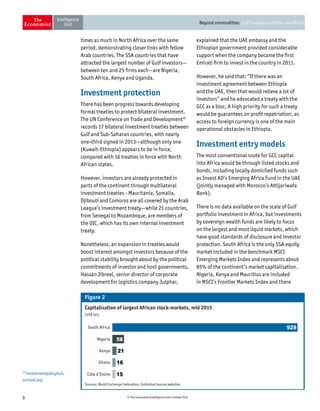
protection. South Africa is the only SSA equity
market included in the benchmark MSCI
Emerging Markets Index and represents about
85% of the continent’s market capitalisation.
Nigeria, Kenya and Mauritius are included
in MSCI’s Frontier Markets Index and there
Capitalisation of largest African stock-markets, mid 2015
(US$ bn)
Figure 2
Côte d’Ivoire
Sources: World Exchange Federation; Individual bourse websites.
Ghana
Kenya
Nigeria
South Africa 929
58
21
16
15
10
investmentpolicyhub.
unctad.org
10 © The Economist Intelligence Unit Limited 2015
Beyond commodities: Gulf investors and the new Africa
are another 19 African markets not currently
included, suggesting limited equities activity.
Given the paucity of suitable listed equities in
many African countries, where businesses are
often family-owned enterprises (a familiar
structure in the Gulf), private equity is an
important investment route. Abraaj is one of the
largest private equity investors in Africa and in
April 2015 closed its third Africa-focused fund
with US$1bn in subscribed capital (although
only a minority of these funds originated in
the Gulf). Other Gulf private equity firms active
in Africa include Swicorp of Saudi Arabia and
Kappafrik Group in Dubai.
Gulf companies can also make direct
investments, either for minority or controlling
stakes, in private African companies. The
most prominent Gulf investments into listed
African companies so far, both in 2014, have
been Qatar National Bank’s purchase of a 23%
stake in Ecobank of Togo, and the Investment
Corporation of Dubai’s US$300m investment
into Dangote Cement of Nigeria.
Another option is targeting companies already
backed by private equity firms and professional
management and reporting systems. Jacob
Kholi explained that “a number of private equity
funds on the continent are coming to the end
of their fund lives and are looking for exits, so
it is important to knock on their doors because
if they have done a good job then their investee
companies could provide a good entry point.”
Jacob Kholi explained that firms like Abraaj are
open to inviting suitable firms to co-invest so as
to scale up a promising company, which could
be an attractive option for Gulf firms that have
limited experience in Africa to safely develop
exposure alongside a more experienced player.
Foreign firms gaining such exposure through
private equity co-investment include Danone
of France alongside Abraaj in Fanmilk in Ghana,
and National Bank of Canada alongside Amethis
Finance in NSIA, a bank in Côte d’Ivoire.
Meanwhile, both Swiss Re and Prudential gained
a foothold in financial services by buying out
a private equity firm, Leapfrog, when it exited
investments in Apollo Investments of Ghana and
ExpressLife of Ghana, respectively.
A number of private equity funds that launched
in 2007-08, with around US$1.5bn in initial
capital invested in Sub-Saharan Africa, are
nearing or completing the end of their fund
lifecycles, and could offer opportunities for
Gulf investors across countries and sectors as
they negotiate exits. The largest of these are
the Lereko Metier Capital Growth Fund, the
Emerging Capital Partners Africa Fund II and
Helios Investors LP.11
Private equity markets are benefiting from
growing regional integration, which creates
opportunities to build strong cross-border
champions. Dorothy Kelso, the head of strategy
and research at the African Private Equity and
Venture Capital Association (AVCA), explains
that “increasing harmonisation, notably in East
Africa, is enabling private equity firms to scale
up local companies to regional or pan-African
players.”
This is crucial because “there are relatively
few large companies… [and so] investors
need to develop the platforms themselves” by
capitalising on the “huge opportunities in the
mid-to-lower sized deals, where demand for
capital outstrips supply.” She encourages Gulf
investors to consider co-investment alongside
private equity firms, or takeovers when PE firms
exit.
Another entry method is acquiring a
company with regional coverage located in
an advantageous country with a pro-business
environment. An example is Etisalat’s 2014
purchase of a majority stake in Maroc Telecom,
which has a network of subsidiaries across West
Africa. Etisalat subsequently folded its pre-
existing holdings in six West African countries
into the Maroc Telecom Group, which is better
placed given its regional expertise, language
11
Thanks to Dorothy
Kelso of African Private
Equity  Venture Capital
Association for data on
these funds. Details of the
various fund portfolios,
which may provide an
indication of potential
exit opportunities, can be
found at ecpinvestments.
com, lereko.co.za and
heliosinvestment.com
11 © The Economist Intelligence Unit Limited 2015
Beyond commodities: Gulf investors and the new Africa
skills and experience managing a low-income
customer base.
However, GCC firms interviewed in this report
said that they were unable to find suitable
acquisition targets. In the education sector,
Pablo Fetter, a board member of GEMS Africa,
based in Dubai, said: “South Africa is the
only country that has an established private
education system with a couple of large scale
players”, where an acquisition strategy might
make sense. However, “in the rest of the
continent it would be hard to find acquisition
targets that fulfil our expectations about
educational standards…and so we decided on a
greenfield expansion strategy.”
The story is similar in the logistics sector
“Other than in South Africa, international
standard logistics is a new concept, and so
there are relatively few companies that we
would be interested in acquiring, so we are
taking greenfield distribution sites to build
the infrastructure to our specifications,” said
Geoffrey White of Agility.
An effective greenfield strategy requires
considerable market research. Pablo Fetter
recalls that GEMS drew up a list of a dozen
countries, narrowed down to six through desk-
based analysis of demographic and income data,
followed by a comprehensive study, visiting
almost all the private schools in the main cities
of these countries - focusing on those with fees
of over US$1,000/year - to pinpoint supply-and-
demand gaps and assess operational conditions.
This led them to focus first on Nairobi and
Kampala, with plans to enter Lagos next.
Some of the risks and challenges associated
with greenfield investment can be mitigated
by having a local joint-venture partner, and
this was the route chosen by Julphar. Hassan
Jibreel explained that they developed their
first manufacturing facility in Africa, near the
Ethiopian capital of Addis Ababa, together with
MedTech, which had been their distributor in the
country since 2003.
“As we did not have any experience in Africa,
and none of our staff had been regularly
visiting…there were some concerns from the
management about whether the investment
would succeed or fail, which is why we went with
a partner who gave us good support during the
construction process.” However, having gained
valuable lessons through this joint venture, he
said Julphar would feel more confident to make
future investments in Ethiopia on its own.
Another joint-investment route, often favoured
by Gulf sovereign wealth funds, is to go into
partnership with the government of the
recipient country. An example of this is Saudi
Arabian South Africa Holding, established
by the two countries in 2012 to identify co-
investment opportunities. This model does
not appear to have been utilised elsewhere in
Sub-Saharan Africa, but is a familiar feature
of Gulf sovereign wealth fund investment in
other countries, where the involvement of the
recipient country provides both intelligence
on suitable opportunities and a method for
monitoring and protecting the investment.
Financial services
Inadequate access to financial services,
including banking and insurance, has long
been a barrier to development in Africa.
Individuals restricted to a cash-based economy
faced greater costs and risks, and companies
struggled to secure financing.
Fortunately the financial infrastructure has
improved, rapidly in places, as a result of an
expansion of financial services firms from South
Africa and beyond, as well as the development
of indigenous tools suited to the local context,
such as mobile banking. That said, Ross
Mclean, the President of Dow Africa, notes that
entrepreneurs still struggle to access financing,
partly because in many countries people are
not able to utilise property ownership as a form
of security to raise finance because in many
countries people are not able to utilise property
as collateral.
12 © The Economist Intelligence Unit Limited 2015
Beyond commodities: Gulf investors and the new Africa
A second bottleneck is regional integration.
Angus Downie of Ecobank explains that the
mobile banking revolution “has not yet taken
off so much in West Africa, largely because of
regulators’ concerns about how to manage
mobile banking in an already quite diversified
and competitive landscape.”
Joannes Mongardini of the IMF sees potential
in the conventional banking sector, because
it “is not well developed and competition is
not very strong, which allows relatively high
profit margins...the profit opportunities are
in trade financing and in financing for major
infrastructure projects,” rather than in retail
banking, which is more competitive.
Gulf banks find their feet
Two major GCC banks have put Africa at the
heart of their expansion plans. Qatar National
Bank (QNB), the GCC’s largest and most widely
spread bank, defines its near-term goal as
becoming the leading bank in the Middle East
and Africa, listing companies such as Standard
Bank of South Africa among its peers. As well as
acquiring banks in Egypt, Libya and Tunisia, QNB
set up branches in Mauritania, Sudan and South
Sudan in 2011, where it was the first foreign
entrant from outside East Africa. It has provided
substantial loans to finance the government
through periods of disrupted oil exports and
conflict. In 2014 it acquired a 23% stake (the
most that was permitted without initiating a
formal takeover bid) in Togo’s Ecobank, one of
the largest pan-African financial institutions.
Since 2013 National Bank of Abu Dhabi has
positioned itself as a central location on a
global “West-East Corridor” of rapidly growing
economies. It aims to open hub branches
along this corridor, including in Nigeria, on its
western edge. Other GCC banks, such as Union
National Bank and Abu Dhabi Islamic Bank, are
currently only active in North Africa.
Even banks that see Africa as a more peripheral
element of their strategy are identifying specific
opportunities. Doha Bank opened an office in
South Africa in June 2015 and Mashreqbank
of the UAE is considering offices in Kenya and
Nigeria. However, a physical presence is not a
necessary requirement for involvement in major
deals. An Emirates NBD-led consortium of GCC
banks is providing syndicated loans of US$85m
for Stanbic Bank of Uganda and US$125m for
FirstRand in South Africa.
Islamic finance is perhaps where the Gulf’s
involvement is most pronounced. Kuwait
Finance House arranged South Africa’s first
sovereign sukuk (a bond offering that complies
with Islamic law) , an oversubscribed US$500m
issue in 2014. It was only the second time a
non-Muslim country had drawn on Islamic
financing. It followed Sub-Saharan Africa’s
debut sukuk in Senegal, earlier in the year, and
Nigeria and Kenya are considering issuances.
The primary motivation for African countries to
issue sukuks is to access the financing available
from the Gulf’s Islamic banks. These banks are
also active in commercial deals, such as Ibdar
Bank of Bahrain’s sharia-compliant purchase
and lease-backs of planes for Ethiopian Airlines
and RwandAir.
There is also likely to be a growing demand for
Islamic finance, given that about 30% of the
Sub-Saharan population are Muslims, have
the region’s highest birth rates and form a
sizeable portion of the population in key growth
countries such as Nigeria and Ethiopia.12
Al Baraka Bank of Bahrain was an early pioneer,
establishing South Africa’s first Islamic bank in
1989. Dubai Islamic Bank has recently received,
in principal, approval from regulators in Kenya
to establish a branch, expected to open by the
end of 2015.
Gulf investors previously contributed to the
establishment of one of Kenya’s first Islamic
banks, Gulf African Bank, in 2007. As more
countries roll out legislation to support Islamic
banking, there will be further opportunities for
entrants.
12
Pew Research Centre
(2015), The Future of World
Religions: Population Growth
Projections, 2010-2015
13 © The Economist Intelligence Unit Limited 2015
Beyond commodities: Gulf investors and the new Africa
The GCC firm with the largest footprint in African
financial services is not a bank, but a remittance
company. UAE Exchange now operates in around
a dozen African countries, having expanded into
Nigeria, Ghana and South Africa in late 2014.
Kuwait’s Zain, the largest mobile operator
in Sudan, has teamed up with the Bank of
Khartoum to introduce mobile banking.
Other Gulf telecommunications companies in
Africa, such as Etisalat, might consider similar
opportunities. The money transfer sector faces a
challenge in managing concerns from regulators
that networks could be used for criminal
financing. Kenya suspended the operations
of 13 firms in April-June 2015 over concerns
about funds potentially flowing to al-Shabab
militants. GCC remittance firms have experience
managing such concerns in the Middle East,
and will benefit from the growing numbers of
Africans working in the GCC and using their
networks to send money home.
Insurance is another area of opportunity; it is
even less developed than banking. Abraaj took a
19% stake in Morocco’s Saham Finances, to help
fund expansion in the West African insurance
sector. International General Insurance
Holdings of the UAE has also looked to Morocco
as a gateway into West Africa, opening a sales
office there in early 2015. However, so far none
of the Gulf’s major insurance firms has looked
into expansion opportunities in Africa.
Retail: tapping into Africa’s
consumer class
African retail presents a huge opportunity, as
the continent’s population grows and becomes
increasingly urban. Although the majority of
Muslim population
(m)
Source: Pew Research Centre.
Figure 3
Gambia
Eritrea
Malawi
Benin
Mauritania
Cameroon
Uganda
Ghana
Kenya
Mozambique
Sierra Leone
Chad
Côte d'Ivoire
Guinea
Somalia
Burkina Faso
Senegal
Mali
Niger
Tanzania
Ethiopia
Nigeria
National
share
49%
35%
35%
98%
94%
96%
100%
84%
37%
55%
78%
18%
10%
16%
11%
18%
99%
24%
13%
37%
95%
62%
77
29
16
15
15
12
9
8
7
6
5
4
4
4
4
4
3
2
2
2
2
10
14 © The Economist Intelligence Unit Limited 2015
Beyond commodities: Gulf investors and the new Africa
the population still shops at open-air markets
or small local stores, this is changing in many
cities as disposable income levels increase,
transport options improve and the appetite
for international brands grows. A culture of
consumerism is also being created through the
spread of the Internet, according to Ross Mclean
of Dow: “We see access to information opening
up the [consumer] appetite.”
Historically, a lack of suitable retail space has
been a major barrier. Before 2014 there were
roughly a dozen shopping centres north of
South Africa that were larger than 20,000 sq
metres, and their combined retail area was
smaller than Dubai Mall, the largest shopping
mall in the UAE.
However, another dozen opened in 2014-
15 and a similar number are expected in
2016-17 (see Table 1). The wave of shopping
centre construction is being made possible by
improving infrastructure, particularly electricity
supply, and also availability of financing, as
African malls typically cost in the order of
US$100m to construct.
Major South African supermarket chains,
previously deterred by a lack of suitable
locations, are signing up as anchor stores in
many new developments.
Shoprite is expanding aggressively in Nigeria,
but while this is potentially the biggest single
market, it is a difficult operating environment
with a high cost of doing business and a strong
culture of informal markets. “It will probably be
like this for the next decade,” says Accenture’s
Roze Philips, who suggests that other countries
such as Ghana and the East African states are
more conducive to retail development.
A number of major retail companies have
emerged in the Gulf and are familiar with cross-
border expansion, having spread through the
GCC and Middle East and North Africa (MENA)
region. Some are engaging in Africa, while
others have the expertise and capital to do so.
They have relevant experience of retail in fast-
growing cities with stratified income groups.
Three sectors are well-developed in the Gulf
and could provide a platform for expansion into
Africa: automotive sales, hypermarkets and
franchise stores.
The most significant automotive development
was the US$86m purchase by Majid Al Futtaim
(MAF) Group of the UAE in 2014 of Kenya’s
CMC, which has dealership rights for brands
including Ford, Volkswagen and Suzuki in
Kenya. The branch of the family business owned
by Abdullah Al Futtaim was already operating
Honda and Toyota dealerships in Egypt. The firm
wants to expand across East Africa. Al Ghandi
Auto (UAE), one of the world’s largest General
Motors dealerships, opened an office in Ethiopia
in 2014, with a view to exploring opportunities
in the East African market.
Table 1: Major existing and planned shopping centres (selected)
Mall Country City ‘000 sq m Open
The Palms Nigeria Lagos 40 2005
Westgate Kenya Nairobi 33 2007
West Hills Ghana Accra 27 2014
Grove Mall Namibia Windhoek 55 2014
Mall of Kenya Kenya Nairobi 62 2015
Jabi Lake Mall Nigeria Abuja 27 2015
Mall of Mozambique Mozambique Maputo 67 2016
Lekki Mall Nigeria Lagos 22 2016
Mundial Shopping Angola Luanda 56 2017
Mall of Zimbabwe Zimbabwe Harare 41 unclear
15 © The Economist Intelligence Unit Limited 2015
Beyond commodities: Gulf investors and the new Africa
MAF has also taken the first step into
hypermarkets, leasing one-sixth of the new Mall
of Kenya, which will be the biggest shopping
centre in “Middle Africa” (the central part of
the continent, excluding South Africa and
north Africa), to open a Carrefour anchor store.
This follows a 2013 extension of its franchise
agreement with the French hypermarket chain,
which it represents in the Gulf, giving rights
to develop stores in East Africa (Carrefour is
expanding directly in francophone West Africa).
This is a bold strategy, given that Kenya’s
own supermarket chains are among the
most developed on the continent, and have
a presence in other East African countries.
Acquiring a Kenyan firm is a possible route for
Gulf investors, although only one (Uchumi)
is publically listed and past attempts to
acquire others have failed, notably a 2014
bid by Massmart of South Africa (a subsidiary
of Walmart) to buy the family-owned Naivas
Supermarkets. Roze Phillips of Accenture
advises Gulf firms ‘that are considering’ making
an acquisition in the retail sector “not to overly
brand it, as local products are the ones that sell
best.”
GCC retailers have become experts at
franchising across a range of stores, from
fashion to restaurants. The requirement for
majority local ownership of businesses in most
of the Gulf has discouraged direct expansion by
leading Western and Asian retail brands, which
instead franchised in the region. International
brands comprise the majority of retail sales in
the GCC, and the wider MENA franchise economy
is estimated to be worth about US$30bn and to
be growing by 27% a year13
.
While there are many GCC family conglomerates
that hold brand franchises in their home
countries, a small group of companies manage
dozens of franchises across multiple countries.
These include Alshaya in Kuwait, Jawad Business
Group in Bahrain, Al Tayer and BinHendi in the
UAE. They have a track record in maintaining
quality, meeting expansion targets and
adapting brand concepts to local tastes and
cultures (particularly Muslim preferences),
which has encouraged brands to grant them
regional licences. These firms are also skilled
at managing the logistics of multi-country
distribution, making them well prepared to
enter the African market.
Some companies are already established
in North Africa—Alshaya, for example,
has hundreds of stores across 20 brands in
Egypt—but only tentative steps have been
made south of the Sahara. One of the most
developed is Landmark Group (UAE), which
already has 13 stores, for brands such as Max
(affordable clothing) and Babyshop, across
Nigeria, Tanzania, Kenya and Zambia. BinHendi
has expressed interest in opening some of its
clothing franchise outlets in Kenya.14
Meanwhile, Caramel Group of the UAE chose
Nairobi as the location for its first foreign
Caramel Restaurant  Lounge. There are plans
for a home-grown GCC restaurant brand, The
Noodle House, owned by Jumeriah Restaurants,
to open in seven locations in Kenya. Other GCC
retail brands that could find a niche include
luxury goods, such as the jewellers Damas
and Joyalukkas, where there may be sufficient
demand from the affluent elite in cities such as
Lagos and Luanda.
Travel and tourism
The World Travel and Tourism Council estimates
that the travel and tourism sector directly
comprises about 3.5% of African GDP, with
a total contribution, including indirect and
induced expenditure, of 8.4%, which is below
the global average for the sector.15
Travel, both for business and leisure, is
increasing as connectivity improves. Rising
incomes and changing expectations are also
stimulating internal demand, with domestic
tourism on the rise. As well as bringing
international tourists to attractions such as
13
MENA Franchise
Association, website
14
The National (2015),
“Dubai luxury retailer
BinHendi to embark on
international expansion
drive”
15
World Travel and Tourism
Council (2015), Economic
Impact 2014: Africa
16 © The Economist Intelligence Unit Limited 2015
Beyond commodities: Gulf investors and the new Africa
safaris and beaches, African countries are also
seeing their diaspora return for more frequent
visits.
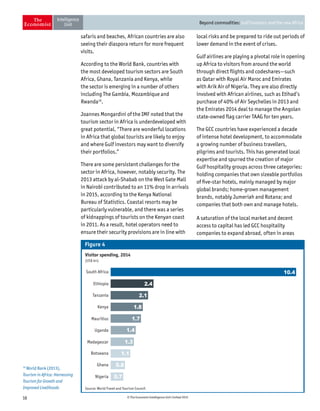
According to the World Bank, countries with
the most developed tourism sectors are South
Africa, Ghana, Tanzania and Kenya, while
the sector is emerging in a number of others
including The Gambia, Mozambique and
Rwanda16
.
Joannes Mongardini of the IMF noted that the
tourism sector in Africa is underdeveloped with
great potential. “There are wonderful locations
in Africa that global tourists are likely to enjoy
and where Gulf investors may want to diversify
their portfolios.”
There are some persistent challenges for the
sector in Africa, however, notably security. The
2013 attack by al-Shabab on the West Gate Mall
in Nairobi contributed to an 11% drop in arrivals
in 2015, according to the Kenya National
Bureau of Statistics. Coastal resorts may be
particularly vulnerable, and there was a series
of kidnappings of tourists on the Kenyan coast
in 2011. As a result, hotel operators need to
ensure their security provisions are in line with
local risks and be prepared to ride out periods of
lower demand in the event of crises.
Gulf airlines are playing a pivotal role in opening
up Africa to visitors from around the world
through direct flights and codeshares—such
as Qatar with Royal Air Maroc and Emirates
with Arik Air of Nigeria. They are also directly
involved with African airlines, such as Etihad’s
purchase of 40% of Air Seychelles in 2013 and
the Emirates 2014 deal to manage the Angolan
state-owned flag carrier TAAG for ten years.
The GCC countries have experienced a decade
of intense hotel development, to accommodate
a growing number of business travellers,
pilgrims and tourists. This has generated local
expertise and spurred the creation of major
Gulf hospitality groups across three categories:
holding companies that own sizeable portfolios
of five-star hotels, mainly managed by major
global brands; home-grown management
brands, notably Jumeriah and Rotana; and
companies that both own and manage hotels.
A saturation of the local market and decent
access to capital has led GCC hospitality
companies to expand abroad, often in areas
Visitor spending, 2014
(US$ bn)
Mauritius
Source: World Travel and Tourism Council
Uganda
Madagascar
Botswana
Ghana
Nigeria
Kenya
Tanzania
Ethiopia
South Africa
Figure 4
10.4
2.4
2.1
1.8
1.7
1.4
1.3
1.1
0.8
0.7
16
World Bank (2013),
Tourism in Africa: Harnessing
Tourism for Growth and
Improved Livelihoods
17 © The Economist Intelligence Unit Limited 2015
Beyond commodities: Gulf investors and the new Africa
popular with GCC tourists. Morocco and Egypt
have been favoured locations. However, a
number have already opened hotels in Sub-
Saharan Africa, and others have plans to expand
on the continent.
One early mover was Bahrain’s Gulf Hotels
Group, which opened the Ocean Paradise Resort
in Zanzibar in 2004.
Another was Saudi businessman Adel Aujan,
who opened a safari lodge near the Victoria Falls
in Zimbabwe as early as 1999 and subsequently
expanded his Rani Resorts into neighbouring
Mozambique. Rani Investment is now the largest
investor in Mozambique’s tourism industry with
four luxury hotels in Maputo, Pemba, Bazaruto
Island and Medjumbe private island. As part of a
US$206m joint-venture with a hotel group, Rani
Investment, also constructed a Raddison Blu
hotel in Maputo.
The Mozambican market appears a particularly
fast-developing tourism hotspot for other
investors too, suggesting that Gulf investors
are not alone in identifying its potential.
Belgium-based Aylos plans to build a raft
of shopping centres. South Africa-based
Atterbury Property Development has plans for
mixed-use development in Pemba, Beira and
Nacala. Terrace Africa, of South Africa, plans
to complete two retail parks in the northern
province of Tete, while South African retailers
such as Shoprite, OK Furniture and Pep plan to
open further stores, especially in previously
under-served areas.
Other East African countries are also drawing
in Gulf tourism and leisure investment. The
UAE’s Global Hotel Management opened a
Ramada-branded hotel in Nairobi and has plans
for a hotel in South Sudan. The most extensive
portfolio in Africa falls under Saudi Arabia’s
Kingdom Holdings. Seven of the 17 hotels that
it currently operates, under four global brands,
are in Africa (Kenya, Ghana, Zambia, Seychelles
and Mauritius) plus three more in North Africa.
Meanwhile five of the nine full-scale hotels
outside of the GCC managed by IFA Resorts
 Hotels of Kuwait are in South Africa and
Zanzibar. There are also GCC conglomerates with
an interest in single hotels, such as the Essque
resort in Zanzibar, opened in 2010 by Zabeel
Investments of the UAE.
The Gulf’s two largest hotel chains are making
plans to enter East Africa. Rotana, which is
present in Egypt and Sudan, is opening a hotel
in Tanzania in 2020, while Jumeriah Group
is opening a hotel in Mauritius in 2018 and
examining opportunities in Nigeria, Angola,
Kenya and South Africa.
Manufacturing lags, in part
because of power shortages
A stark feature of the Sub-Saharan African
economy is the limited contribution of
manufacturing to GDP. Across the region,
manufacturing only comprised 11% of GDP in
2013, compared with a global average of 16%
and 29% in “Developing Asia”.17
Manufacturing’s share of African economies has
been reducing over time, down from 18% back in
1975, as services and commodities take a larger
share. Although a few countries—such as South
Africa, Senegal, Kenya and Côte d’Ivoire—have
more prominent manufacturing sectors, they
are still smaller than the global average.
Ross Mclean of Dow, which has manufacturing
facilities in South Africa and the GCC, believes
that the sector is important for the next
stage of Africa’s development. “It is a key
enabler for moving to middle income status,
as the multiplier effect means one job in
manufacturing can produce between eight and
ten jobs down the line.” However, he identifies
significant barriers, including the need for
reliable energy supply, transport infrastructure,
skills, finance, and market access.
Charles Robertson of Renaissance Capital
explains: “You should expect to see the
beginnings of industrialisation now, but the
17
World Bank, World
Development Indicators
18 © The Economist Intelligence Unit Limited 2015
Beyond commodities: Gulf investors and the new Africa
prerequisite is electricity. If you want to run
a textiles factory in Nigeria today you have to
use diesel, which is far more expensive than
electricity so you cannot make competitively
priced t-shirts.”
Charles Robertson notes that in Kenya the
government’s commitment to doubling or
trebling electricity production within the
current parliamentary term could be a game-
changer. “There are already some small
industries, such as motorcycle production,
textiles and agricultural processing, but if the
electricity targets are achieved then you will see
manufacturing become more mainstream. In 10-
15 years I would expect to see a steel industry
and in 20 years a car industry.”
However, Angus Downie of Ecobank warns that
“there probably is not going to be an exact
replication in Africa in 10-15 years’ time of how
the manufacturing sector developed in Asia.”
Some of the lessons from Asia apply, but there
are different challenges that investors face
in Africa and, although the cost of labour is
competitive, it is only one of the inputs. “As
automation improves and quality requirements
increase, the advantage of Africa’s low labour
costs is likely to dissipate. Africa can also have
an uncompetitive capital cost compared with
other low-cost destinations.”
Despite the challenges, some countries are
notching higher manufacturing growth than
others: Ethiopia stands out as one example.
There has been considerable Gulf investment in
manufacturing, mostly by MIDROC, owned by
Mohammed Al-Amoudi, an Ethiopian-born Saudi
national whose holdings in Ethiopia include
cement, steel and tyre factories. A number
of Emirati companies are active in Ethiopia,
operating in joint ventures with local partners.
Maaza International is partnering with a
beverages firm, Petram, to open a bottling plant
with a capacity of 3.5m cases a year. Another
new investor is the Al Ghurair Group, which is
investing US$50m in an aluminium plant, also
with a local partner, Tracon Trading.
Julphar entered Ethiopia in 2013, investing
US$10m in a joint venture with MedTech, and is
now investing a further US$50m to expand the
factory to manufacture injectable medicines
such as insulin. It chose Ethiopia because this
was already its largest market. Ethiopia is also
a hub to reach neighbouring countries and
benefits from stability, a good calibre of staff
and relatively low operating costs, according
to Hassan Jibreel. However, Julphar has
experienced challenges including “difficulties
with supplies of materials in the construction
phase and occasional power and water supply
interruptions, especially in the winter, although
we manage this through standby generators.”
Elsewhere on the continent, Abraaj has stakes
in manufacturing companies ranging from
food processing in South Africa to furniture
manufacturing in Nigeria. Al-Bader Group of
Kuwait, which had a dhow fleet trading with
East Africa as far back as the 19th century,
announced plans in May 2015 to invest
US$1.5bn in manufacturing ethanol from
sugarcane in southern Mozambique; it is also
considering investing in a coal-to-fuel facility
there, a technology currently only utilised in
South Africa.
Logistics
Poor infrastructure and complicated multi-
country bureaucracy (particularly for trade
with land-locked countries) has made logistics
expensive for companies in every sector. The
dominant Gulf entrant into the market is the
UAE’s DP World, managing ports in Senegal,
Mozambique, Algeria and Egypt. Another
regional champion, Agility of Kuwait, is active in
11 African countries and in late 2014 announced
plans to develop five warehouse distribution
parks, the first of which is under construction in
Ghana’s Tema Port Free Trade Zone.
19 © The Economist Intelligence Unit Limited 2015
Beyond commodities: Gulf investors and the new Africa
Geoffrey White explained that they had been
operating in Africa for decades in a reactive
fashion, but at the end of 2014 “signed off on
a specific Africa strategy, which was demand
driven as we do global distribution for fast-
moving consumer goods customers, and have
seen growing interest from them in Africa,
which they now see as an essential market.”
Whereas the South African logistics market is
already quite saturated, Geoffrey White sees
opportunities along the east coast, notably in
Mozambique and Tanzania as they develop their
hydrocarbons sectors, as well as in Angola,
Nigeria and Ghana.
Although Agility is building international-
standard distribution parks, “around these
enclaves you still have questions about the
efficiency of ports, rail, the road system and
trucking availability … although we’re seeing
some progress on transport megaprojects
and lots of little steps elsewhere.” Another
Gulf logistics company expanding in Africa
is Aramex, through the acquisition of South
African firm Berco Express in 2011 and by
franchising the brand of PostNet, a local courier
firm, in 2014.
One logistics sub-sector of interest for Gulf
firms is aviation services, such as refuelling,
ground handling and permitting. The rapid
development of aviation in the Gulf has
spurred the development of this sector, and at
least three dedicated firms from the UAE are
engaging in Africa (in addition to Agility). Hadid
International Services opened its first office
in Senegal many years ago, recognising the
difficulties faced by business aviation in Africa,
and has been expanding recently, including
adding new operations in Ethiopia, South Africa
and Niger in 2014, with a plan to cover the
whole continent.
A rival, United Aviation Services, opened offices
in South Africa, Nigeria and Kenya in 2014 and
offers ground support in six other countries.
Meanwhile, a private jet operator, Empire
Aviation Group, is considering opening a base in
Nigeria, which is the continent’s largest market
for private jets, ahead of South Africa and
Angola.
Social sectors
The growth of the middle class in Africa is
stimulating demand for private healthcare and
education, as the public offerings are generally
inadequate. Sven Beckmann of Intel, which is
involved in initiatives to boost skills, laments
the shortfall: “If you look at outcomes of the
Millennium Development Goals, we are still
behind on education.”
These are two sectors that Abraaj is focused
on. “In North Africa we put together a platform
of hospitals and diagnostic centres, and we
are looking to do the same in the rest of the
continent and have a strong health pipeline in
Nigeria, Ghana and some of the francophone
countries,” says Jacob Kholi.
There may be opportunities in Sub-Saharan
Africa for dedicated healthcare companies in the
GCC, which have built networks across the Gulf
in response to rapid population growth and later
expanded further afield. One example is Dubai’s
Aster DM Healthcare, also active in India and the
Philippines.
For similar reasons, the GCC has also developed
networks of private school providers, some
of which are looking to invest in Africa. GEMS
Education, the world’s largest private schools
company, already operates schools in Kenya and
Uganda and has ambitious expansion plans.
Pablo Fetter says it aims to open 35 schools in
the next seven years, of varying costs ranging
from US$1,000/year to up to around $20,000/
year, to become the largest schools network on
the continent.
The company sees significant opportunity in
Africa across a wide range of school types and
cost models, and there is less competition
than in other markers. “Elsewhere in the world
20 © The Economist Intelligence Unit Limited 2015
Beyond commodities: Gulf investors and the new Africa
private education competes with the state,
which typically has a good average level, but
in Africa the majority of the state provision is
poor,” says Pablo Fetter.
The share of private education has increased
sharply as almost “anyone who can afford to
pay anything for their kids will chose private
education.” This means there is considerable
opportunity for ultra-low cost schools (under
$500/year), a model that has been successful in
India and that GEMS is investigating for Africa.
Food, water and…data
Much of Africa still lags behind in terms of
the coverage and speed of broadband access,
the key enabler for e-commerce. “As I travel
around Africa, people mention the essentials
as being food, water and data. Data costs still
need to come down so people can have a richer
experience,” says Sven Beckmann at Intel.
Despite the limitations, there has been
innovation in developing solutions to suit
local contexts. As smartphones become more
ubiquitous, and data services improve, there
will be opportunities to transform and disrupt
sectors. “The digital landscape is still quite open
and there are not enough consumer goods or
retail companies taking the digital opportunity
forward,” says Roze Philips of Accenture.
Gulf investors could provide seed capital to
African start-ups, perhaps those emerging
around incubators such as iHub in Nairobi,
which Sven Beckmann describes as a particularly
vibrant community of innovators. There are
also potentially opportunities to invest in more
established companies involved in building
the infrastructure of the Internet across
Africa, which need capital to scale up rapidly in
response to growing demand for data.
21 © The Economist Intelligence Unit Limited 2015
Beyond commodities: Gulf investors and the new Africa
Conclusions
Africa’s growth has been dented by the fall in
commodity prices, but at nothing like the rate of
previous eras. It provides further proof that the
continent is on a more secure economic footing
than ever before, with economic dynamism
beyond the old mainstay of natural resources.
The neighbouring Gulf region is no stranger
to the continent. Our report last year explored
wide-ranging infrastructure across the
continent. North Africa has a long history of
drawing Gulf investment. South of the Sahara,
Gulf exposure to non-commodity sectors is
building, but only in selected countries and
markets.
Retail stands out as a highly relevant
opportunity, but the African market is markedly
different to the Gulf. Formal retail malls and
hypermarkets do exist but commercial real
estate development moves faster in some
countries than others, and there are cultural
variations in terms of people’s preference for
open-air markets. East Africa currently appears
easier to enter than Nigeria, for instance, while
Ghana stands out as one investment hotspot for
commercial real estate development.
While public equities markets in countries other
than South Africa are of limited interest, direct
investments are evident through co-investment
with private equity funds and direct buyouts.
In the financial services sector, mobile money
is not an area where Gulf companies have
much comparative advantage, but commercial
banking (especially trade and project financing)
and international money transfers are both
areas of activity.
Africa is enjoying an upswing in tourism flows,
although this has been dented by political
instability in some key regions like Kenya.
Gulf airlines are already part of this sector due
to their coverage of the continent, and Gulf
investors own around 20 hotels and resorts,
from Ghana to Mozambique. The sector’s future
will depend largely on security issues. Finally,
a growing middle class in many of the more
successful African economies is leading to a
rising desire for private schooling, which some
Gulf firms have experience of in their home
markets. Capitalising on each of the above
growth sectors could provide Gulf companies
with new geographical markets and product
ranges, provided they can look to Africa in a
nuanced and selective manner, shortlisting the
attractive markets and sectors, and learning the
lessons of their peers so far.
While every effort has been taken to verify the accuracy
of this information, The Economist Intelligence Unit
Ltd. cannot accept any responsibility or liability
for reliance by any person on this report or any of
the information, opinions or conclusions set out
in this report.
Cover image - Cienpies Design/Shutterstock
LONDON
20 Cabot Square
London
E14 4QW
United Kingdom
Tel: (44.20) 7576 8000
Fax: (44.20) 7576 8500
E-mail: london@eiu.com
NEW YORK
750 Third Avenue
5th Floor
New York, NY 10017, US
Tel: (1.212) 554 0600
Fax: (1.212) 586 0248
E-mail: newyork@eiu.com
HONG KONG
1301 Cityplaza Four
12 Taikoo Wan Road
Taikoo Shing
Hong Kong
Tel: (852) 2585 3888
Fax: (852) 2802 7638
E-mail: hongkong@eiu.com
GENEVA
Rue de l’Athénée 32
1206 Geneva
Switzerland
Tel: (41) 22 566 2470
Fax: (41) 22 346 9347
E-mail: geneva@eiu.com
DUBAI
Office 1301a
Aurora Tower
PO Box 450056
Dubai Media City
Dubai
United Arab Emirates
Tel: (971) 4 433 4208
Fax: (971) 4 438 0224
E-mail: kaywestmoreland@economist.com

Beyond commodities

  • 1.
    Sponsored by Beyond commodities Gulfinvestors and the new Africa A report by The Economist Intelligence Unit
  • 2.
    1 © TheEconomist Intelligence Unit Limited 2015 Beyond commodities: Gulf investors and the new Africa Contents About this research 2 Executive Summary 3 Chapter 1: Resilient Africa 5 Chapter 2: Africa and the Gulf 8 Conclusion21
  • 3.
    2 © TheEconomist Intelligence Unit Limited 2015 Beyond commodities: Gulf investors and the new Africa About this research Beyond commodities: Gulf investors and the new Africa is a report by The Economist Intelligence Unit examining Sub- Saharan Africa’s growth trends outside of the natural resource and commodities sectors, and maps the existing and potential role of Gulf-based investors. The findings are based on desk research and interviews with experts, conducted by The Economist Intelligence Unit. This research was commissioned by Dubai Chamber. The Economist Intelligence Unit would like to thank the following experts who participated in the interview programme: l Sven Beckmann, general manager for South and Sub- Saharan Africa, Intel (Johannesburg) l Angus Downie, head of economic research, Ecobank Transnational (London) l Pablo Fetter, board member, GEMS Africa (Dubai) l Hassan Jibreel, senior director of corporate development, Julphar (Ras al Khaimah) l Dorothy Kelso, head of strategy and research, African Private Equity Venture Capital Association (London) l Jacob Kholi, chief investment officer for Sub-Saharan Africa, Abraaj (Accra/Dubai) l Roze Philips, managing director of products, Accenture South Africa (Johannesburg) l Ross McLean, president, Dow Sub-Saharan Africa (Johannesburg) l Joannes Mongardini, deputy director of research department, IMF (Washington) l Charles Robertson, chief economist, Renaissance Capital (London) l Geoffrey White, CEO, Agility Africa (Dubai/Kuwait) The Economist Intelligence Unit bears sole responsibility for the content of this report. The findings and views expressed in the report do not necessarily reflect the views of the sponsor. Iain Douglas authored the report and Adam Green was the editor.
  • 4.
    3 © TheEconomist Intelligence Unit Limited 2015 Beyond commodities: Gulf investors and the new Africa Executive summary For over a century, the largest investments in Africa were in natural resources and mammoth infrastructure projects. Today, in a continent with a young and growing population and increased spending power, businesses are looking further afield. From manufacturing to tourism, these new sectors both reflect Africa’s growth and contribute to it. This report tracks Sub-Saharan African growth in the non-commodities sectors, and explores the role that Gulf-based investors are playing, or could play, in the future. It focuses on all materially significant non-commodity areas excluding infrastructure, which was the subject of an Economist Intelligence Unit report last year. Key findings l Africa is resilient, able to withstand global recession and the current commodity price slump. The continent’s solid growth rates provide further evidence of economic dynamism outside the traditional mainstays of natural resources. Demographic trends, growing consumer markets, economic stability and an improving business environment have all helped. While the continent has been affected by negative global headwinds, compared with previous periods, it is proving resilient. l East Africa is the most appealing region for non-commodity investment from the Gulf. South Africa notwithstanding, the East Africa region is proving the main draw for Gulf investors, with manufacturing in Ethiopia, leisure, retail and tourism in Mozambique and Kenya, and education in Uganda being of particular interest. Retail and hypermarkets, automotives, commercial banking and tourism are key sectors. Investment from the Gulf region is predominantly in areas in which companies have experience and comparative advantages. l Gulf investors have multiple potential modes of FDI entry: co-investment with private equity funds, purchase of private equity businesses, and direct buyouts or minority share acquisition. Co-investment with private equity funds is particularly interesting as foreign companies can use the experience of private equity players to gain exposure to African markets. With the exception of South Africa, stocks and shares remain of limited interest to Gulf investors. In some sectors market entry needs to be through greenfield projects because of a lack of existing companies of sufficient scale or operating to international standards, at least outside of South Africa. l Shopping centres and hypermarkets are emerging in a handful of countries. Gulf firms are well-positioned to play a part, but progress
  • 5.
    4 © TheEconomist Intelligence Unit Limited 2015 Beyond commodities: Gulf investors and the new Africa is slow. While consumer spending is increasing, large-scale retail centres are lagging, partly because of the difficulties of developing commercial real estate in crowded capital cities. East African markets are more accessible, especially Kenya. Gulf companies have a comparative advantage thanks to a track record in franchising and adapting brands to local tastes and cultures. These firms are also skilled at managing the logistics of multi-country distribution. l Travel and tourism have enjoyed high growth and Gulf brands are among the front- runners in newer markets like Mozambique. Africa remains one of the world’s most exciting tourism frontiers, with sites of natural beauty and increasing infrastructure to support leisure tourism. Gulf airlines have played a role in opening Africa to international tourists, and now direct tourism investments are evident. Gulf investors own around 20 hotels and resorts on the Sub-Saharan African continent. However, the tourism sector does face challenges in some security hotspots. l Africa needs improved logistics in fast- moving consumer goods. This sector is growing rapidly in many of Africa’s lower-middle to middle income countries, but logistics and distribution remain challenging because of weak infrastructure. Gulf firms have experience to share in this field, but only a few are exploring investment in Africa.
  • 6.
    5 © TheEconomist Intelligence Unit Limited 2015 Beyond commodities: Gulf investors and the new Africa Resilient Africa1 Over the last 15 years, perspectives on Africa oscillated between two extremes: from a continent beset by poverty and conflict in the 1990s, to a rising economic miracle by 2010.1 Today, a more balanced perspective is emerging. The continent has a heterogeneous growth pattern, from rapidly advancing economies to stagnant ones, from regions that are increasingly integrated to more isolated geographies. Africa needs to be seen on a country-by-country level, or even city-by-city. The most significant common variable influencing Africa’s past economic performance was the commodity cycle. The collapse of commodity prices in the late 1970s and early 1980s was largely responsible for the economic hardships that Africa suffered in the ensuing decades. This time, as the commodity super-cycle is, arguably, coming to an end and key prices fall, the continent has been more resilient. Joannes Mongardini, deputy director of research at the IMF, explains: “A lot of people expected this growth cycle [in Africa] to come to an end with the decline in commodity prices. However, it is clear that growth is more resilient than expected and non-oil exporters are faring just as well as previously, whether due to private- sector demand or public-sector infrastructure investment.” Data from the African Development Bank show that average real GDP growth across the continent was 6.1% in 2010-14, and income per head rose by nearly 60% to US$1,788 according to Economist Intelligence Unit estimates. We forecast a deceleration to 4.1% in 2015, mainly due to the commodity price shock, before a pick up to 5.1% in 2016.2 The IMF forecasts average growth of 5.3% in 2017-20.3 Factors protecting Africa from the worst of the commodity price fall include positive demographic trends, improved economic policy, relatively low debt, business environment reforms, and improving infrastructure. Regional integration is also getting better, which is important in a continent with so many small and landlocked countries. The most notable recent development here is the planned Tripartite Free Trade Area, an agreement signed in Cairo in June 2015 by three existing trade blocs (the Common Market for Eastern and Southern Africa, the Southern African Development Community and the East African Community) that span 23 Sub- Saharan countries as well as three North African countries (Sudan, Egypt and Libya). The agreement is pending ratification, but if successful would boost inter-regional trade— which remains low by international standards— and facilitate the emergence of regional companies. It could also connect to the regional trade blocs in West and Central Africa to create a broader continent-wide free-trade zone, as envisaged in the African Union’s long-term dream. However, there have been past attempts at trade and economic integration that have not come to fruition. A second source of Africa’s resilience is demography, thanks to growth in the working- age population together with medium rates of 1 http://www.mckinsey. com/insights/africa/lions_ on_the_move 2 The Economist Intelligence Unit (June 2015), Middle East and Africa Regional Overview 3 IMF (April 2015), World Economic Outlook
  • 7.
    6 © TheEconomist Intelligence Unit Limited 2015 Beyond commodities: Gulf investors and the new Africa urbanisation. The average rate of population growth across Africa is 2.7%, compared with a global average of 1.1% (and 0.5% in China). The mid-case in the latest UN population forecasts4 sees Sub-Saharan Africa’s population ballooning from 962m in 2015 to 1.4bn in 2030 and eventually to 3.9bn at the end of the century, when it will host one-third of the global population. Charles Robertson, chief economist at Renaissance Capital, says that demographics will support Africa through the downturn in commodity prices: “The human capital story implies that we will still be talking about 4-5% growth over the next five years. Our base case for any emerging market is that it grows by about 3%, plus or minus the growth rate in the working- age population. Russia’s population is falling by 1% a year, while Nigeria’s is growing by 3%.” Urbanisation is also critical to the demographic story. Sub-Saharan Africa is currently the least urbanised region in the world, with only about 4 UN Population Division (2015), World Population Prospects 5 UN Population Division (2014), World Urbanisation Prospects 6 African Development Bank (2011), Middle of the Pyramid: Dynamics of the Middle Class in Africa 7 Financial Times (16 June 2015), “Nestlé cuts Africa workforce as middle-class growth disappoints” 37% of the population being urban (ranging from 25% in East Africa to 61% in Southern Africa). The UN estimates5 that Africa’s urban population will more than triple by 2050 to 1.1bn. Experts interviewed in this report stressed the importance of Africa’s major cities for investors. Jacob Kholi, chief investment officer for Sub- Saharan Africa at private equity group Abraaj, explained that “cities are often growing at rates that are twice the national average.” Roze Philips, managing director of products at Accenture, says this is of key concern to investors: “we advise our clients to look equally at urban and rural areas in South Africa, but in the rest of the continent we advise them to take a city-centric strategy, generally the capitals and a few other key urban centres.” Many of Africa’s major cities are also situated near the coast, which makes them more accessible to global distribution networks. These demographic trends are creating a reasonably sized urban middle class with discretionary spending power. Joannes Mongardini says this is “manifesting itself in demand for consumption goods, housing and various types of services. The middle class is sustaining growth through domestic demand and investment.” However, there has been confusion about how to define this middle class. Angus Downie, head of economic research at Ecobank, notes: “Membership of the middle class is a somewhat nebulous concept that needs to be carefully quantified” to focus on those who have discretionary consumption and savings. The African Development Bank defined it as including anyone earning from US$4-$20 a day6 . However, that categorisation includes many people without real discretionary spending power. Companies need to be careful in their market sizing assessment. In June 2015 Nestle, the world’s biggest food and drinks firm, cut its workforce in parts of Africa after overestimating the size and growth of the middle class.7 Population growth until 2030 (bn) Figure 1 2015 2030 East Africa Source: UN Population Division. 0.1 0.2 0.4 0.4 0.6 0.5 0.2 0.1 West Africa Middle Africa Southern Africa 2.5%2.5%
  • 8.
    7 © TheEconomist Intelligence Unit Limited 2015 Beyond commodities: Gulf investors and the new Africa More detailed income stratification is needed. Accenture has a useful model that identifies five groups: Basic Survivors (less than US$100/ month), Working Families (up to US$250/ month), then two groups who form the middle class—Rising Strivers (up to US$750/month) and Cosmopolitan Professionals (up to US$1,000/ month)—with the Affluent above them. According to Accenture forecasts, the wealthiest three groups should increase to 22% of the population in 2015, from 13% in 2000, while the share of the population who are Basic Survivors will have fallen to 45%, from 66%.8 Stable ground Beyond demographics, there are political and economic management factors that are supporting the continent’s resilience. Africa suffered a long history of economic mismanagement that contributed to decades of underperformance. This is changing. Notable examples are peaceful handovers of power, despite domestic tensions, in Kenya in 2013 and in Nigeria in 2015. Regional mediation is playing a more effective role, including in negotiating the end of a military coup in Burkina Faso in September 2015. The story is mixed of course, and there has been a stagnation of democratisation or even a reversal in some countries: the civil war in South Sudan, and the growth of jihadist groups in a band of instability running from al-Qaeda in the Islamic Maghreb in the Sahel (notably in Mali), Boko Haram in north-eastern Nigeria (and across the borders into Chad, Cameroon and Niger) and al- Shabab in Somalia and Kenya. Nonetheless, Geoffrey White, the CEO of Agility Africa, which operates across the continent, says: “People are still reticent about the political risk, but once you are engaged on the ground the reality for political risk is significantly less than the perception.” Economic management One widespread economic stabilisation trend in Sub-Saharan Africa is reduced debt, thanks to a string of bilateral and multilateral initiatives that cancelled a large part of the external debts of 30 countries, bringing government debt down to 30% of GDP in 2014, from 67% in 2000, according to IMF data. Monetary policy has improved, bringing inflation down to 6% in 2014—close to a historical low for the region—compared with an average of 30% in the 1990s. In addition, many countries have replaced heavily managed exchange-rate systems either with pegs or with moves “towards free floating exchange-rate regimes, which have acted as shock absorbers for changes in commodity prices” in countries such as Kenya and Ghana, according to Angus Downie. Greater political and economic stability has led to a renewed focus on technical reforms such as improving the business environment. Some countries have reduced bureaucracy and facilitated pro-business legislation. However, much remains to be done, as the majority of African countries still rank in the bottom quartile of countries overall in the World Bank’s Doing Business index, and only seven are in the top half. Most laggards, such as Eritrea (189th) and Central African Republic (187th), are not major economies or viable investment destinations, but the parlous state of the business environment in Angola (181st) and Nigeria (170th) is more concerning. 8 Accenture (2011), The Dynamic African Consumer Market
  • 9.
    8 © TheEconomist Intelligence Unit Limited 2015 Beyond commodities: Gulf investors and the new Africa Africa and the Gulf2 The Gulf and Africa have strong geographic and cultural connections. The two regions have been linked since early humans first migrated out of Africa, crossing the Red Sea into the Arabian Peninsula about 70 millennia ago. Trading routes existed in ancient times and connections deepened with the rise of Islam. Although the Arab caliphates did not penetrate south of the Sahara, Islam spread further, notably to Somalia and West Africa. The interconnectedness of the Islamic world in the medieval period strengthened cultural exchanges, as demonstrated by the pilgrimage to Mecca of Mali’s king, Mansa Musa, in 1324. Omani traders later carried Islam down the East African coast and established a trading empire centred on Zanzibar. These trade routes stimulated migration flows and many Gulf nationals have African ancestors and some East Africans have not only Arab blood but also speak an Arabic-derived language, Swahili. After a period of decline in the 19th century, the Gulf-Africa link strengthened once more in the modern era, through institutions such as the Organisation of Islamic Co operation (OIC) and bilateral and multilateral development initiatives. Political ties are deepening. African heads of state and ministers are increasingly frequent visitors to the Gulf for conferences and bilateral meetings, such as the delegation to Qatar in 2014 led by Kenyan president, Uhuru Kenyatta, seeking investment in infrastructure projects. Delegations have also travelled in the other direction, including a visit by the United Arab Emirates’ (UAE) Minister of Economy, Sultan bin Said al-Mansouri, to South Africa in June 2015. Permanent diplomatic links are increasing, with Ethiopia opening an embassy in the UAE in 2014 and Ghana opening one in Qatar in 2015. Yet trade between the Gulf Co-operation Council (GCC) and Africa is modest. In 2014 GCC exports to Sub-Saharan Africa totalled US$19.7bn, according to IMF data. This was just 2% of the GCC’s total exports, although it was significant for some recipient countries—notably South Africa,which imports half of its oil from Saudi Arabia. Meanwhile, the GCC only received US$5.5bn of imports from Africa, most of which were destined for the UAE, partly for re-export. Direct investment flows, on the other hand, are growing. A number of pan-African companies have relocated their headquarters to Dubai, boosting links between the Gulf and Africa. These include Stallion Group, the second largest conglomerate in Nigeria and active across West Africa, Atlantic Holdings of Ghana and Mara Group of Kenya. In the other direction, Gulf firms provided at least US$9.3bn in foreign direct investment into Sub-Saharan Africa in 2005-14, plus a further US$2.7bn in the first half of 2015, more than in any previous full year, according to data from FDi Markets9 . These figures are likely to be underestimates, because data on the size of investments is not available for all projects. However, Gulf countries invested nearly ten9 FDi Markets (2015), Trends report (custom query)
  • 10.
    9 © TheEconomist Intelligence Unit Limited 2015 Beyond commodities: Gulf investors and the new Africa times as much in North Africa over the same period, demonstrating closer links with fellow Arab countries. The SSA countries that have attracted the largest number of Gulf investors— between ten and 25 firms each—are Nigeria, South Africa, Kenya and Uganda. Investment protection There has been progress towards developing formal treaties to protect bilateral investment. The UN Conference on Trade and Development10 records 17 bilateral investment treaties between Gulf and Sub-Saharan countries, with nearly one-third signed in 2013—although only one (Kuwait-Ethiopia) appears to be in force, compared with 16 treaties in force with North African states. However, investors are already protected in parts of the continent through multilateral investment treaties - Mauritania, Somalia, Djibouti and Comoros are all covered by the Arab League’s investment treaty—while 21 countries, from Senegal to Mozambique, are members of the OIC, which has its own internal investment treaty. Nonetheless, an expansion in treaties would boost interest amongst investors because of the political stability brought about by the political commitments of investor and host governments. Hassan Jibreel, senior director of corporate development for logistics company Julphar, explained that the UAE embassy and the Ethiopian government provided considerable support when the company became the first Emirati firm to invest in the country in 2011. However, he said that: “If there was an investment agreement between Ethiopia and the UAE, then that would relieve a lot of investors” and he advocated a treaty with the GCC as a bloc. A high priority for such a treaty would be guarantees on profit repatriation, as access to foreign currency is one of the main operational obstacles in Ethiopia. Investment entry models The most conventional route for GCC capital into Africa would be through listed stocks and bonds, including locally domiciled funds such as Invest AD’s Emerging Africa Fund in the UAE (jointly managed with Morocco’s Attijariwafa Bank). There is no data available on the scale of Gulf portfolio investment in Africa, but investments by sovereign wealth funds are likely to focus on the largest and most liquid markets, which have good standards of disclosure and investor protection. South Africa is the only SSA equity market included in the benchmark MSCI Emerging Markets Index and represents about 85% of the continent’s market capitalisation. Nigeria, Kenya and Mauritius are included in MSCI’s Frontier Markets Index and there Capitalisation of largest African stock-markets, mid 2015 (US$ bn) Figure 2 Côte d’Ivoire Sources: World Exchange Federation; Individual bourse websites. Ghana Kenya Nigeria South Africa 929 58 21 16 15 10 investmentpolicyhub. unctad.org
  • 11.
    10 © TheEconomist Intelligence Unit Limited 2015 Beyond commodities: Gulf investors and the new Africa are another 19 African markets not currently included, suggesting limited equities activity. Given the paucity of suitable listed equities in many African countries, where businesses are often family-owned enterprises (a familiar structure in the Gulf), private equity is an important investment route. Abraaj is one of the largest private equity investors in Africa and in April 2015 closed its third Africa-focused fund with US$1bn in subscribed capital (although only a minority of these funds originated in the Gulf). Other Gulf private equity firms active in Africa include Swicorp of Saudi Arabia and Kappafrik Group in Dubai. Gulf companies can also make direct investments, either for minority or controlling stakes, in private African companies. The most prominent Gulf investments into listed African companies so far, both in 2014, have been Qatar National Bank’s purchase of a 23% stake in Ecobank of Togo, and the Investment Corporation of Dubai’s US$300m investment into Dangote Cement of Nigeria. Another option is targeting companies already backed by private equity firms and professional management and reporting systems. Jacob Kholi explained that “a number of private equity funds on the continent are coming to the end of their fund lives and are looking for exits, so it is important to knock on their doors because if they have done a good job then their investee companies could provide a good entry point.” Jacob Kholi explained that firms like Abraaj are open to inviting suitable firms to co-invest so as to scale up a promising company, which could be an attractive option for Gulf firms that have limited experience in Africa to safely develop exposure alongside a more experienced player. Foreign firms gaining such exposure through private equity co-investment include Danone of France alongside Abraaj in Fanmilk in Ghana, and National Bank of Canada alongside Amethis Finance in NSIA, a bank in Côte d’Ivoire. Meanwhile, both Swiss Re and Prudential gained a foothold in financial services by buying out a private equity firm, Leapfrog, when it exited investments in Apollo Investments of Ghana and ExpressLife of Ghana, respectively. A number of private equity funds that launched in 2007-08, with around US$1.5bn in initial capital invested in Sub-Saharan Africa, are nearing or completing the end of their fund lifecycles, and could offer opportunities for Gulf investors across countries and sectors as they negotiate exits. The largest of these are the Lereko Metier Capital Growth Fund, the Emerging Capital Partners Africa Fund II and Helios Investors LP.11 Private equity markets are benefiting from growing regional integration, which creates opportunities to build strong cross-border champions. Dorothy Kelso, the head of strategy and research at the African Private Equity and Venture Capital Association (AVCA), explains that “increasing harmonisation, notably in East Africa, is enabling private equity firms to scale up local companies to regional or pan-African players.” This is crucial because “there are relatively few large companies… [and so] investors need to develop the platforms themselves” by capitalising on the “huge opportunities in the mid-to-lower sized deals, where demand for capital outstrips supply.” She encourages Gulf investors to consider co-investment alongside private equity firms, or takeovers when PE firms exit. Another entry method is acquiring a company with regional coverage located in an advantageous country with a pro-business environment. An example is Etisalat’s 2014 purchase of a majority stake in Maroc Telecom, which has a network of subsidiaries across West Africa. Etisalat subsequently folded its pre- existing holdings in six West African countries into the Maroc Telecom Group, which is better placed given its regional expertise, language 11 Thanks to Dorothy Kelso of African Private Equity Venture Capital Association for data on these funds. Details of the various fund portfolios, which may provide an indication of potential exit opportunities, can be found at ecpinvestments. com, lereko.co.za and heliosinvestment.com
  • 12.
    11 © TheEconomist Intelligence Unit Limited 2015 Beyond commodities: Gulf investors and the new Africa skills and experience managing a low-income customer base. However, GCC firms interviewed in this report said that they were unable to find suitable acquisition targets. In the education sector, Pablo Fetter, a board member of GEMS Africa, based in Dubai, said: “South Africa is the only country that has an established private education system with a couple of large scale players”, where an acquisition strategy might make sense. However, “in the rest of the continent it would be hard to find acquisition targets that fulfil our expectations about educational standards…and so we decided on a greenfield expansion strategy.” The story is similar in the logistics sector “Other than in South Africa, international standard logistics is a new concept, and so there are relatively few companies that we would be interested in acquiring, so we are taking greenfield distribution sites to build the infrastructure to our specifications,” said Geoffrey White of Agility. An effective greenfield strategy requires considerable market research. Pablo Fetter recalls that GEMS drew up a list of a dozen countries, narrowed down to six through desk- based analysis of demographic and income data, followed by a comprehensive study, visiting almost all the private schools in the main cities of these countries - focusing on those with fees of over US$1,000/year - to pinpoint supply-and- demand gaps and assess operational conditions. This led them to focus first on Nairobi and Kampala, with plans to enter Lagos next. Some of the risks and challenges associated with greenfield investment can be mitigated by having a local joint-venture partner, and this was the route chosen by Julphar. Hassan Jibreel explained that they developed their first manufacturing facility in Africa, near the Ethiopian capital of Addis Ababa, together with MedTech, which had been their distributor in the country since 2003. “As we did not have any experience in Africa, and none of our staff had been regularly visiting…there were some concerns from the management about whether the investment would succeed or fail, which is why we went with a partner who gave us good support during the construction process.” However, having gained valuable lessons through this joint venture, he said Julphar would feel more confident to make future investments in Ethiopia on its own. Another joint-investment route, often favoured by Gulf sovereign wealth funds, is to go into partnership with the government of the recipient country. An example of this is Saudi Arabian South Africa Holding, established by the two countries in 2012 to identify co- investment opportunities. This model does not appear to have been utilised elsewhere in Sub-Saharan Africa, but is a familiar feature of Gulf sovereign wealth fund investment in other countries, where the involvement of the recipient country provides both intelligence on suitable opportunities and a method for monitoring and protecting the investment. Financial services Inadequate access to financial services, including banking and insurance, has long been a barrier to development in Africa. Individuals restricted to a cash-based economy faced greater costs and risks, and companies struggled to secure financing. Fortunately the financial infrastructure has improved, rapidly in places, as a result of an expansion of financial services firms from South Africa and beyond, as well as the development of indigenous tools suited to the local context, such as mobile banking. That said, Ross Mclean, the President of Dow Africa, notes that entrepreneurs still struggle to access financing, partly because in many countries people are not able to utilise property ownership as a form of security to raise finance because in many countries people are not able to utilise property as collateral.
  • 13.
    12 © TheEconomist Intelligence Unit Limited 2015 Beyond commodities: Gulf investors and the new Africa A second bottleneck is regional integration. Angus Downie of Ecobank explains that the mobile banking revolution “has not yet taken off so much in West Africa, largely because of regulators’ concerns about how to manage mobile banking in an already quite diversified and competitive landscape.” Joannes Mongardini of the IMF sees potential in the conventional banking sector, because it “is not well developed and competition is not very strong, which allows relatively high profit margins...the profit opportunities are in trade financing and in financing for major infrastructure projects,” rather than in retail banking, which is more competitive. Gulf banks find their feet Two major GCC banks have put Africa at the heart of their expansion plans. Qatar National Bank (QNB), the GCC’s largest and most widely spread bank, defines its near-term goal as becoming the leading bank in the Middle East and Africa, listing companies such as Standard Bank of South Africa among its peers. As well as acquiring banks in Egypt, Libya and Tunisia, QNB set up branches in Mauritania, Sudan and South Sudan in 2011, where it was the first foreign entrant from outside East Africa. It has provided substantial loans to finance the government through periods of disrupted oil exports and conflict. In 2014 it acquired a 23% stake (the most that was permitted without initiating a formal takeover bid) in Togo’s Ecobank, one of the largest pan-African financial institutions. Since 2013 National Bank of Abu Dhabi has positioned itself as a central location on a global “West-East Corridor” of rapidly growing economies. It aims to open hub branches along this corridor, including in Nigeria, on its western edge. Other GCC banks, such as Union National Bank and Abu Dhabi Islamic Bank, are currently only active in North Africa. Even banks that see Africa as a more peripheral element of their strategy are identifying specific opportunities. Doha Bank opened an office in South Africa in June 2015 and Mashreqbank of the UAE is considering offices in Kenya and Nigeria. However, a physical presence is not a necessary requirement for involvement in major deals. An Emirates NBD-led consortium of GCC banks is providing syndicated loans of US$85m for Stanbic Bank of Uganda and US$125m for FirstRand in South Africa. Islamic finance is perhaps where the Gulf’s involvement is most pronounced. Kuwait Finance House arranged South Africa’s first sovereign sukuk (a bond offering that complies with Islamic law) , an oversubscribed US$500m issue in 2014. It was only the second time a non-Muslim country had drawn on Islamic financing. It followed Sub-Saharan Africa’s debut sukuk in Senegal, earlier in the year, and Nigeria and Kenya are considering issuances. The primary motivation for African countries to issue sukuks is to access the financing available from the Gulf’s Islamic banks. These banks are also active in commercial deals, such as Ibdar Bank of Bahrain’s sharia-compliant purchase and lease-backs of planes for Ethiopian Airlines and RwandAir. There is also likely to be a growing demand for Islamic finance, given that about 30% of the Sub-Saharan population are Muslims, have the region’s highest birth rates and form a sizeable portion of the population in key growth countries such as Nigeria and Ethiopia.12 Al Baraka Bank of Bahrain was an early pioneer, establishing South Africa’s first Islamic bank in 1989. Dubai Islamic Bank has recently received, in principal, approval from regulators in Kenya to establish a branch, expected to open by the end of 2015. Gulf investors previously contributed to the establishment of one of Kenya’s first Islamic banks, Gulf African Bank, in 2007. As more countries roll out legislation to support Islamic banking, there will be further opportunities for entrants. 12 Pew Research Centre (2015), The Future of World Religions: Population Growth Projections, 2010-2015
  • 14.
    13 © TheEconomist Intelligence Unit Limited 2015 Beyond commodities: Gulf investors and the new Africa The GCC firm with the largest footprint in African financial services is not a bank, but a remittance company. UAE Exchange now operates in around a dozen African countries, having expanded into Nigeria, Ghana and South Africa in late 2014. Kuwait’s Zain, the largest mobile operator in Sudan, has teamed up with the Bank of Khartoum to introduce mobile banking. Other Gulf telecommunications companies in Africa, such as Etisalat, might consider similar opportunities. The money transfer sector faces a challenge in managing concerns from regulators that networks could be used for criminal financing. Kenya suspended the operations of 13 firms in April-June 2015 over concerns about funds potentially flowing to al-Shabab militants. GCC remittance firms have experience managing such concerns in the Middle East, and will benefit from the growing numbers of Africans working in the GCC and using their networks to send money home. Insurance is another area of opportunity; it is even less developed than banking. Abraaj took a 19% stake in Morocco’s Saham Finances, to help fund expansion in the West African insurance sector. International General Insurance Holdings of the UAE has also looked to Morocco as a gateway into West Africa, opening a sales office there in early 2015. However, so far none of the Gulf’s major insurance firms has looked into expansion opportunities in Africa. Retail: tapping into Africa’s consumer class African retail presents a huge opportunity, as the continent’s population grows and becomes increasingly urban. Although the majority of Muslim population (m) Source: Pew Research Centre. Figure 3 Gambia Eritrea Malawi Benin Mauritania Cameroon Uganda Ghana Kenya Mozambique Sierra Leone Chad Côte d'Ivoire Guinea Somalia Burkina Faso Senegal Mali Niger Tanzania Ethiopia Nigeria National share 49% 35% 35% 98% 94% 96% 100% 84% 37% 55% 78% 18% 10% 16% 11% 18% 99% 24% 13% 37% 95% 62% 77 29 16 15 15 12 9 8 7 6 5 4 4 4 4 4 3 2 2 2 2 10
  • 15.
    14 © TheEconomist Intelligence Unit Limited 2015 Beyond commodities: Gulf investors and the new Africa the population still shops at open-air markets or small local stores, this is changing in many cities as disposable income levels increase, transport options improve and the appetite for international brands grows. A culture of consumerism is also being created through the spread of the Internet, according to Ross Mclean of Dow: “We see access to information opening up the [consumer] appetite.” Historically, a lack of suitable retail space has been a major barrier. Before 2014 there were roughly a dozen shopping centres north of South Africa that were larger than 20,000 sq metres, and their combined retail area was smaller than Dubai Mall, the largest shopping mall in the UAE. However, another dozen opened in 2014- 15 and a similar number are expected in 2016-17 (see Table 1). The wave of shopping centre construction is being made possible by improving infrastructure, particularly electricity supply, and also availability of financing, as African malls typically cost in the order of US$100m to construct. Major South African supermarket chains, previously deterred by a lack of suitable locations, are signing up as anchor stores in many new developments. Shoprite is expanding aggressively in Nigeria, but while this is potentially the biggest single market, it is a difficult operating environment with a high cost of doing business and a strong culture of informal markets. “It will probably be like this for the next decade,” says Accenture’s Roze Philips, who suggests that other countries such as Ghana and the East African states are more conducive to retail development. A number of major retail companies have emerged in the Gulf and are familiar with cross- border expansion, having spread through the GCC and Middle East and North Africa (MENA) region. Some are engaging in Africa, while others have the expertise and capital to do so. They have relevant experience of retail in fast- growing cities with stratified income groups. Three sectors are well-developed in the Gulf and could provide a platform for expansion into Africa: automotive sales, hypermarkets and franchise stores. The most significant automotive development was the US$86m purchase by Majid Al Futtaim (MAF) Group of the UAE in 2014 of Kenya’s CMC, which has dealership rights for brands including Ford, Volkswagen and Suzuki in Kenya. The branch of the family business owned by Abdullah Al Futtaim was already operating Honda and Toyota dealerships in Egypt. The firm wants to expand across East Africa. Al Ghandi Auto (UAE), one of the world’s largest General Motors dealerships, opened an office in Ethiopia in 2014, with a view to exploring opportunities in the East African market. Table 1: Major existing and planned shopping centres (selected) Mall Country City ‘000 sq m Open The Palms Nigeria Lagos 40 2005 Westgate Kenya Nairobi 33 2007 West Hills Ghana Accra 27 2014 Grove Mall Namibia Windhoek 55 2014 Mall of Kenya Kenya Nairobi 62 2015 Jabi Lake Mall Nigeria Abuja 27 2015 Mall of Mozambique Mozambique Maputo 67 2016 Lekki Mall Nigeria Lagos 22 2016 Mundial Shopping Angola Luanda 56 2017 Mall of Zimbabwe Zimbabwe Harare 41 unclear
  • 16.
    15 © TheEconomist Intelligence Unit Limited 2015 Beyond commodities: Gulf investors and the new Africa MAF has also taken the first step into hypermarkets, leasing one-sixth of the new Mall of Kenya, which will be the biggest shopping centre in “Middle Africa” (the central part of the continent, excluding South Africa and north Africa), to open a Carrefour anchor store. This follows a 2013 extension of its franchise agreement with the French hypermarket chain, which it represents in the Gulf, giving rights to develop stores in East Africa (Carrefour is expanding directly in francophone West Africa). This is a bold strategy, given that Kenya’s own supermarket chains are among the most developed on the continent, and have a presence in other East African countries. Acquiring a Kenyan firm is a possible route for Gulf investors, although only one (Uchumi) is publically listed and past attempts to acquire others have failed, notably a 2014 bid by Massmart of South Africa (a subsidiary of Walmart) to buy the family-owned Naivas Supermarkets. Roze Phillips of Accenture advises Gulf firms ‘that are considering’ making an acquisition in the retail sector “not to overly brand it, as local products are the ones that sell best.” GCC retailers have become experts at franchising across a range of stores, from fashion to restaurants. The requirement for majority local ownership of businesses in most of the Gulf has discouraged direct expansion by leading Western and Asian retail brands, which instead franchised in the region. International brands comprise the majority of retail sales in the GCC, and the wider MENA franchise economy is estimated to be worth about US$30bn and to be growing by 27% a year13 . While there are many GCC family conglomerates that hold brand franchises in their home countries, a small group of companies manage dozens of franchises across multiple countries. These include Alshaya in Kuwait, Jawad Business Group in Bahrain, Al Tayer and BinHendi in the UAE. They have a track record in maintaining quality, meeting expansion targets and adapting brand concepts to local tastes and cultures (particularly Muslim preferences), which has encouraged brands to grant them regional licences. These firms are also skilled at managing the logistics of multi-country distribution, making them well prepared to enter the African market. Some companies are already established in North Africa—Alshaya, for example, has hundreds of stores across 20 brands in Egypt—but only tentative steps have been made south of the Sahara. One of the most developed is Landmark Group (UAE), which already has 13 stores, for brands such as Max (affordable clothing) and Babyshop, across Nigeria, Tanzania, Kenya and Zambia. BinHendi has expressed interest in opening some of its clothing franchise outlets in Kenya.14 Meanwhile, Caramel Group of the UAE chose Nairobi as the location for its first foreign Caramel Restaurant Lounge. There are plans for a home-grown GCC restaurant brand, The Noodle House, owned by Jumeriah Restaurants, to open in seven locations in Kenya. Other GCC retail brands that could find a niche include luxury goods, such as the jewellers Damas and Joyalukkas, where there may be sufficient demand from the affluent elite in cities such as Lagos and Luanda. Travel and tourism The World Travel and Tourism Council estimates that the travel and tourism sector directly comprises about 3.5% of African GDP, with a total contribution, including indirect and induced expenditure, of 8.4%, which is below the global average for the sector.15 Travel, both for business and leisure, is increasing as connectivity improves. Rising incomes and changing expectations are also stimulating internal demand, with domestic tourism on the rise. As well as bringing international tourists to attractions such as 13 MENA Franchise Association, website 14 The National (2015), “Dubai luxury retailer BinHendi to embark on international expansion drive” 15 World Travel and Tourism Council (2015), Economic Impact 2014: Africa
  • 17.
    16 © TheEconomist Intelligence Unit Limited 2015 Beyond commodities: Gulf investors and the new Africa safaris and beaches, African countries are also seeing their diaspora return for more frequent visits. According to the World Bank, countries with the most developed tourism sectors are South Africa, Ghana, Tanzania and Kenya, while the sector is emerging in a number of others including The Gambia, Mozambique and Rwanda16 . Joannes Mongardini of the IMF noted that the tourism sector in Africa is underdeveloped with great potential. “There are wonderful locations in Africa that global tourists are likely to enjoy and where Gulf investors may want to diversify their portfolios.” There are some persistent challenges for the sector in Africa, however, notably security. The 2013 attack by al-Shabab on the West Gate Mall in Nairobi contributed to an 11% drop in arrivals in 2015, according to the Kenya National Bureau of Statistics. Coastal resorts may be particularly vulnerable, and there was a series of kidnappings of tourists on the Kenyan coast in 2011. As a result, hotel operators need to ensure their security provisions are in line with local risks and be prepared to ride out periods of lower demand in the event of crises. Gulf airlines are playing a pivotal role in opening up Africa to visitors from around the world through direct flights and codeshares—such as Qatar with Royal Air Maroc and Emirates with Arik Air of Nigeria. They are also directly involved with African airlines, such as Etihad’s purchase of 40% of Air Seychelles in 2013 and the Emirates 2014 deal to manage the Angolan state-owned flag carrier TAAG for ten years. The GCC countries have experienced a decade of intense hotel development, to accommodate a growing number of business travellers, pilgrims and tourists. This has generated local expertise and spurred the creation of major Gulf hospitality groups across three categories: holding companies that own sizeable portfolios of five-star hotels, mainly managed by major global brands; home-grown management brands, notably Jumeriah and Rotana; and companies that both own and manage hotels. A saturation of the local market and decent access to capital has led GCC hospitality companies to expand abroad, often in areas Visitor spending, 2014 (US$ bn) Mauritius Source: World Travel and Tourism Council Uganda Madagascar Botswana Ghana Nigeria Kenya Tanzania Ethiopia South Africa Figure 4 10.4 2.4 2.1 1.8 1.7 1.4 1.3 1.1 0.8 0.7 16 World Bank (2013), Tourism in Africa: Harnessing Tourism for Growth and Improved Livelihoods
  • 18.
    17 © TheEconomist Intelligence Unit Limited 2015 Beyond commodities: Gulf investors and the new Africa popular with GCC tourists. Morocco and Egypt have been favoured locations. However, a number have already opened hotels in Sub- Saharan Africa, and others have plans to expand on the continent. One early mover was Bahrain’s Gulf Hotels Group, which opened the Ocean Paradise Resort in Zanzibar in 2004. Another was Saudi businessman Adel Aujan, who opened a safari lodge near the Victoria Falls in Zimbabwe as early as 1999 and subsequently expanded his Rani Resorts into neighbouring Mozambique. Rani Investment is now the largest investor in Mozambique’s tourism industry with four luxury hotels in Maputo, Pemba, Bazaruto Island and Medjumbe private island. As part of a US$206m joint-venture with a hotel group, Rani Investment, also constructed a Raddison Blu hotel in Maputo. The Mozambican market appears a particularly fast-developing tourism hotspot for other investors too, suggesting that Gulf investors are not alone in identifying its potential. Belgium-based Aylos plans to build a raft of shopping centres. South Africa-based Atterbury Property Development has plans for mixed-use development in Pemba, Beira and Nacala. Terrace Africa, of South Africa, plans to complete two retail parks in the northern province of Tete, while South African retailers such as Shoprite, OK Furniture and Pep plan to open further stores, especially in previously under-served areas. Other East African countries are also drawing in Gulf tourism and leisure investment. The UAE’s Global Hotel Management opened a Ramada-branded hotel in Nairobi and has plans for a hotel in South Sudan. The most extensive portfolio in Africa falls under Saudi Arabia’s Kingdom Holdings. Seven of the 17 hotels that it currently operates, under four global brands, are in Africa (Kenya, Ghana, Zambia, Seychelles and Mauritius) plus three more in North Africa. Meanwhile five of the nine full-scale hotels outside of the GCC managed by IFA Resorts Hotels of Kuwait are in South Africa and Zanzibar. There are also GCC conglomerates with an interest in single hotels, such as the Essque resort in Zanzibar, opened in 2010 by Zabeel Investments of the UAE. The Gulf’s two largest hotel chains are making plans to enter East Africa. Rotana, which is present in Egypt and Sudan, is opening a hotel in Tanzania in 2020, while Jumeriah Group is opening a hotel in Mauritius in 2018 and examining opportunities in Nigeria, Angola, Kenya and South Africa. Manufacturing lags, in part because of power shortages A stark feature of the Sub-Saharan African economy is the limited contribution of manufacturing to GDP. Across the region, manufacturing only comprised 11% of GDP in 2013, compared with a global average of 16% and 29% in “Developing Asia”.17 Manufacturing’s share of African economies has been reducing over time, down from 18% back in 1975, as services and commodities take a larger share. Although a few countries—such as South Africa, Senegal, Kenya and Côte d’Ivoire—have more prominent manufacturing sectors, they are still smaller than the global average. Ross Mclean of Dow, which has manufacturing facilities in South Africa and the GCC, believes that the sector is important for the next stage of Africa’s development. “It is a key enabler for moving to middle income status, as the multiplier effect means one job in manufacturing can produce between eight and ten jobs down the line.” However, he identifies significant barriers, including the need for reliable energy supply, transport infrastructure, skills, finance, and market access. Charles Robertson of Renaissance Capital explains: “You should expect to see the beginnings of industrialisation now, but the 17 World Bank, World Development Indicators
  • 19.
    18 © TheEconomist Intelligence Unit Limited 2015 Beyond commodities: Gulf investors and the new Africa prerequisite is electricity. If you want to run a textiles factory in Nigeria today you have to use diesel, which is far more expensive than electricity so you cannot make competitively priced t-shirts.” Charles Robertson notes that in Kenya the government’s commitment to doubling or trebling electricity production within the current parliamentary term could be a game- changer. “There are already some small industries, such as motorcycle production, textiles and agricultural processing, but if the electricity targets are achieved then you will see manufacturing become more mainstream. In 10- 15 years I would expect to see a steel industry and in 20 years a car industry.” However, Angus Downie of Ecobank warns that “there probably is not going to be an exact replication in Africa in 10-15 years’ time of how the manufacturing sector developed in Asia.” Some of the lessons from Asia apply, but there are different challenges that investors face in Africa and, although the cost of labour is competitive, it is only one of the inputs. “As automation improves and quality requirements increase, the advantage of Africa’s low labour costs is likely to dissipate. Africa can also have an uncompetitive capital cost compared with other low-cost destinations.” Despite the challenges, some countries are notching higher manufacturing growth than others: Ethiopia stands out as one example. There has been considerable Gulf investment in manufacturing, mostly by MIDROC, owned by Mohammed Al-Amoudi, an Ethiopian-born Saudi national whose holdings in Ethiopia include cement, steel and tyre factories. A number of Emirati companies are active in Ethiopia, operating in joint ventures with local partners. Maaza International is partnering with a beverages firm, Petram, to open a bottling plant with a capacity of 3.5m cases a year. Another new investor is the Al Ghurair Group, which is investing US$50m in an aluminium plant, also with a local partner, Tracon Trading. Julphar entered Ethiopia in 2013, investing US$10m in a joint venture with MedTech, and is now investing a further US$50m to expand the factory to manufacture injectable medicines such as insulin. It chose Ethiopia because this was already its largest market. Ethiopia is also a hub to reach neighbouring countries and benefits from stability, a good calibre of staff and relatively low operating costs, according to Hassan Jibreel. However, Julphar has experienced challenges including “difficulties with supplies of materials in the construction phase and occasional power and water supply interruptions, especially in the winter, although we manage this through standby generators.” Elsewhere on the continent, Abraaj has stakes in manufacturing companies ranging from food processing in South Africa to furniture manufacturing in Nigeria. Al-Bader Group of Kuwait, which had a dhow fleet trading with East Africa as far back as the 19th century, announced plans in May 2015 to invest US$1.5bn in manufacturing ethanol from sugarcane in southern Mozambique; it is also considering investing in a coal-to-fuel facility there, a technology currently only utilised in South Africa. Logistics Poor infrastructure and complicated multi- country bureaucracy (particularly for trade with land-locked countries) has made logistics expensive for companies in every sector. The dominant Gulf entrant into the market is the UAE’s DP World, managing ports in Senegal, Mozambique, Algeria and Egypt. Another regional champion, Agility of Kuwait, is active in 11 African countries and in late 2014 announced plans to develop five warehouse distribution parks, the first of which is under construction in Ghana’s Tema Port Free Trade Zone.
  • 20.
    19 © TheEconomist Intelligence Unit Limited 2015 Beyond commodities: Gulf investors and the new Africa Geoffrey White explained that they had been operating in Africa for decades in a reactive fashion, but at the end of 2014 “signed off on a specific Africa strategy, which was demand driven as we do global distribution for fast- moving consumer goods customers, and have seen growing interest from them in Africa, which they now see as an essential market.” Whereas the South African logistics market is already quite saturated, Geoffrey White sees opportunities along the east coast, notably in Mozambique and Tanzania as they develop their hydrocarbons sectors, as well as in Angola, Nigeria and Ghana. Although Agility is building international- standard distribution parks, “around these enclaves you still have questions about the efficiency of ports, rail, the road system and trucking availability … although we’re seeing some progress on transport megaprojects and lots of little steps elsewhere.” Another Gulf logistics company expanding in Africa is Aramex, through the acquisition of South African firm Berco Express in 2011 and by franchising the brand of PostNet, a local courier firm, in 2014. One logistics sub-sector of interest for Gulf firms is aviation services, such as refuelling, ground handling and permitting. The rapid development of aviation in the Gulf has spurred the development of this sector, and at least three dedicated firms from the UAE are engaging in Africa (in addition to Agility). Hadid International Services opened its first office in Senegal many years ago, recognising the difficulties faced by business aviation in Africa, and has been expanding recently, including adding new operations in Ethiopia, South Africa and Niger in 2014, with a plan to cover the whole continent. A rival, United Aviation Services, opened offices in South Africa, Nigeria and Kenya in 2014 and offers ground support in six other countries. Meanwhile, a private jet operator, Empire Aviation Group, is considering opening a base in Nigeria, which is the continent’s largest market for private jets, ahead of South Africa and Angola. Social sectors The growth of the middle class in Africa is stimulating demand for private healthcare and education, as the public offerings are generally inadequate. Sven Beckmann of Intel, which is involved in initiatives to boost skills, laments the shortfall: “If you look at outcomes of the Millennium Development Goals, we are still behind on education.” These are two sectors that Abraaj is focused on. “In North Africa we put together a platform of hospitals and diagnostic centres, and we are looking to do the same in the rest of the continent and have a strong health pipeline in Nigeria, Ghana and some of the francophone countries,” says Jacob Kholi. There may be opportunities in Sub-Saharan Africa for dedicated healthcare companies in the GCC, which have built networks across the Gulf in response to rapid population growth and later expanded further afield. One example is Dubai’s Aster DM Healthcare, also active in India and the Philippines. For similar reasons, the GCC has also developed networks of private school providers, some of which are looking to invest in Africa. GEMS Education, the world’s largest private schools company, already operates schools in Kenya and Uganda and has ambitious expansion plans. Pablo Fetter says it aims to open 35 schools in the next seven years, of varying costs ranging from US$1,000/year to up to around $20,000/ year, to become the largest schools network on the continent. The company sees significant opportunity in Africa across a wide range of school types and cost models, and there is less competition than in other markers. “Elsewhere in the world
  • 21.
    20 © TheEconomist Intelligence Unit Limited 2015 Beyond commodities: Gulf investors and the new Africa private education competes with the state, which typically has a good average level, but in Africa the majority of the state provision is poor,” says Pablo Fetter. The share of private education has increased sharply as almost “anyone who can afford to pay anything for their kids will chose private education.” This means there is considerable opportunity for ultra-low cost schools (under $500/year), a model that has been successful in India and that GEMS is investigating for Africa. Food, water and…data Much of Africa still lags behind in terms of the coverage and speed of broadband access, the key enabler for e-commerce. “As I travel around Africa, people mention the essentials as being food, water and data. Data costs still need to come down so people can have a richer experience,” says Sven Beckmann at Intel. Despite the limitations, there has been innovation in developing solutions to suit local contexts. As smartphones become more ubiquitous, and data services improve, there will be opportunities to transform and disrupt sectors. “The digital landscape is still quite open and there are not enough consumer goods or retail companies taking the digital opportunity forward,” says Roze Philips of Accenture. Gulf investors could provide seed capital to African start-ups, perhaps those emerging around incubators such as iHub in Nairobi, which Sven Beckmann describes as a particularly vibrant community of innovators. There are also potentially opportunities to invest in more established companies involved in building the infrastructure of the Internet across Africa, which need capital to scale up rapidly in response to growing demand for data.
  • 22.
    21 © TheEconomist Intelligence Unit Limited 2015 Beyond commodities: Gulf investors and the new Africa Conclusions Africa’s growth has been dented by the fall in commodity prices, but at nothing like the rate of previous eras. It provides further proof that the continent is on a more secure economic footing than ever before, with economic dynamism beyond the old mainstay of natural resources. The neighbouring Gulf region is no stranger to the continent. Our report last year explored wide-ranging infrastructure across the continent. North Africa has a long history of drawing Gulf investment. South of the Sahara, Gulf exposure to non-commodity sectors is building, but only in selected countries and markets. Retail stands out as a highly relevant opportunity, but the African market is markedly different to the Gulf. Formal retail malls and hypermarkets do exist but commercial real estate development moves faster in some countries than others, and there are cultural variations in terms of people’s preference for open-air markets. East Africa currently appears easier to enter than Nigeria, for instance, while Ghana stands out as one investment hotspot for commercial real estate development. While public equities markets in countries other than South Africa are of limited interest, direct investments are evident through co-investment with private equity funds and direct buyouts. In the financial services sector, mobile money is not an area where Gulf companies have much comparative advantage, but commercial banking (especially trade and project financing) and international money transfers are both areas of activity. Africa is enjoying an upswing in tourism flows, although this has been dented by political instability in some key regions like Kenya. Gulf airlines are already part of this sector due to their coverage of the continent, and Gulf investors own around 20 hotels and resorts, from Ghana to Mozambique. The sector’s future will depend largely on security issues. Finally, a growing middle class in many of the more successful African economies is leading to a rising desire for private schooling, which some Gulf firms have experience of in their home markets. Capitalising on each of the above growth sectors could provide Gulf companies with new geographical markets and product ranges, provided they can look to Africa in a nuanced and selective manner, shortlisting the attractive markets and sectors, and learning the lessons of their peers so far.
  • 23.
    While every efforthas been taken to verify the accuracy of this information, The Economist Intelligence Unit Ltd. cannot accept any responsibility or liability for reliance by any person on this report or any of the information, opinions or conclusions set out in this report. Cover image - Cienpies Design/Shutterstock
  • 24.
    LONDON 20 Cabot Square London E144QW United Kingdom Tel: (44.20) 7576 8000 Fax: (44.20) 7576 8500 E-mail: london@eiu.com NEW YORK 750 Third Avenue 5th Floor New York, NY 10017, US Tel: (1.212) 554 0600 Fax: (1.212) 586 0248 E-mail: newyork@eiu.com HONG KONG 1301 Cityplaza Four 12 Taikoo Wan Road Taikoo Shing Hong Kong Tel: (852) 2585 3888 Fax: (852) 2802 7638 E-mail: hongkong@eiu.com GENEVA Rue de l’Athénée 32 1206 Geneva Switzerland Tel: (41) 22 566 2470 Fax: (41) 22 346 9347 E-mail: geneva@eiu.com DUBAI Office 1301a Aurora Tower PO Box 450056 Dubai Media City Dubai United Arab Emirates Tel: (971) 4 433 4208 Fax: (971) 4 438 0224 E-mail: kaywestmoreland@economist.com