Promotion Decision
Meaning of Promotion
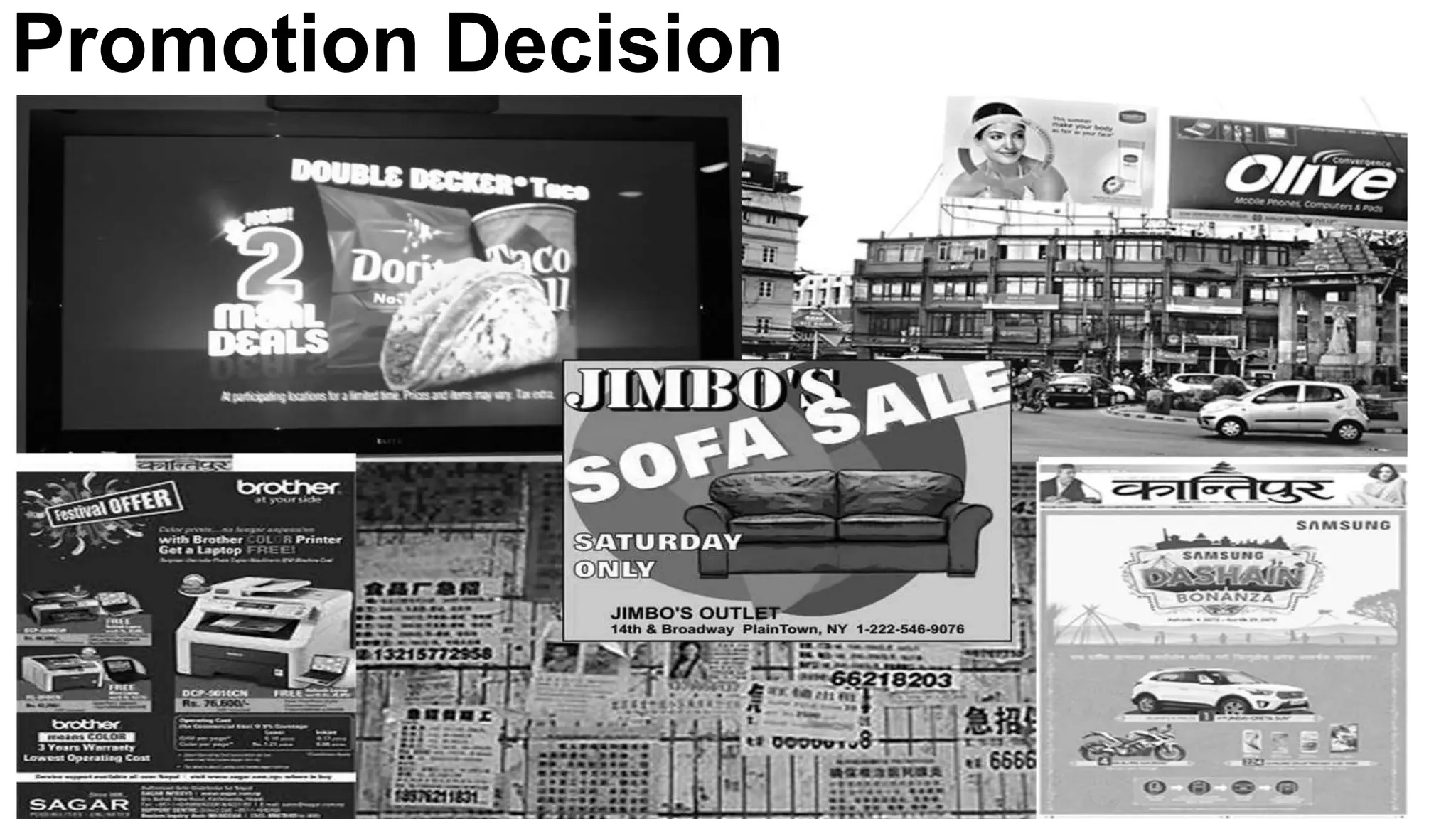
Promotion is any form of communication used to inform,
persuade, influence, and remind people about an organization’s
or individual’s goods, services, image, ideas, community
involvement, impact on society etc.
Objectives of Promotion
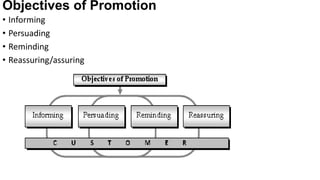
• Informing
• Persuading
• Reminding
• Reassuring/assuring
Marketing Communication
• Communication is the transfer of meaning from one person to another and is
reflected in attention, understanding, acceptance and results or response.
Process of Marketing Communication
1. Sender: Sender is the person who sends the message to another person.
2. Encoding: Encoding is the process of putting thoughts and ideas of the message
into symbolic form.
3. Message: Message is the set of symbols that the sender transmits to the
receiver. The best messages consist of words and other symbols that are familiar to
the receiver.
4. Media: Media are the communication channels through which the message
moves from the sender to the receiver. The sender must send the messages
through such media that reach target audience or receivers.
Cont’ed
5. Decoding: Decoding is the process by which the receiver assigns meaning to the
symbols encoded by the sender. It helps the receiver to interpret the messages sent by
the sender. Decoding depends to a large extent on the perception of the receiver, past
experience with the similar communication, personal desires etc.
6. Receiver: Receiver is the person receiving the message sent by somebody. Receiver
receives the message through some channels of communication and understands the
message by decoding it.
7. Response: Response indicates the reactions of the receiver after being exposed to the
message. Response depends, to a large extent, on the perception of the message,
interpretation of body language, personal desires of the receiver and the reaction to the
message.
8. Feedback: Feedback is the part of the receiver’s response communicated back to the
sender. Through feedback channels, the sender can assess the audience’s response.
Feedback can be written, spoken, signaled or given through other means. It follows the
same step-by-step process, as the initial sender followed the sequence.
9. Noise: Noise is the unplanned state or distortion of the communication process which
results in the receiver’s getting a different message than the one the sender sent.
Generally, environmental noise is an element or activity that disturbs, confuses or makes
the communication process more difficult.
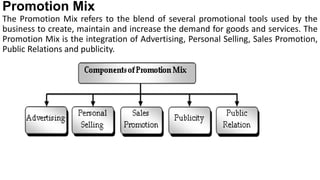
Promotion Mix
The Promotion Mix refers to the blend of several promotional tools used by the
business to create, maintain and increase the demand for goods and services. The
Promotion Mix is the integration of Advertising, Personal Selling, Sales Promotion,
Public Relations and publicity.
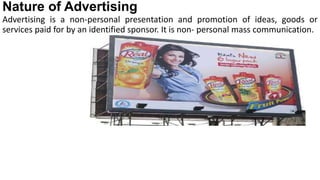
Nature of Advertising
Advertising is a non-personal presentation and promotion of ideas, goods or
services paid for by an identified sponsor. It is non- personal mass communication.
Features of Advertising
• Non-personal
• Mass Communication
• Sponsored
• Paid Form
• Inform and Persuade
• Speedy Communication
Objectives of Advertising
• To increase demand
• To build brand preference
• To build goodwill
• To support salesman
• To remind
• To inform about changes in marketing mix
• To face competition
• To information about a product
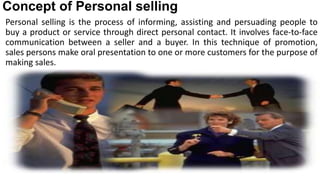
Concept of Personal selling
Personal selling is the process of informing, assisting and persuading people to
buy a product or service through direct personal contact. It involves face-to-face
communication between a seller and a buyer. In this technique of promotion,
sales persons make oral presentation to one or more customers for the purpose of
making sales.
Features of Personal Selling
•Personal Form
•Development of Relationship
•Oral Conversation
•Quick Solution of Queries
•Slow Speed of Sales
•Receipt of Additional Information
•Two-way Communication
Objectives of Personal selling
•Creating need awareness
•Identifying potential buyer
•Solution to the problem
•Convincing prospects to buy
•Persuade the customer
•Relationship building
•Satisfy customers
•Profit oriented objectives
Relevance of Personal Selling
•Flexible message
•Minimum wastage
•Effective sales
•Immediate feedback
•Complements to advertising
•Educates customers
•Employment opportunity
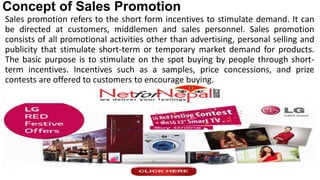
Concept of Sales Promotion
Sales promotion refers to the short form incentives to stimulate demand. It can
be directed at customers, middlemen and sales personnel. Sales promotion
consists of all promotional activities other than advertising, personal selling and
publicity that stimulate short-term or temporary market demand for products.
The basic purpose is to stimulate on the spot buying by people through short-
term incentives. Incentives such as a samples, price concessions, and prize
contests are offered to customers to encourage buying.
Objectives of Sales Promotion
•To introduce new product
•To attract new customers
•To reduce effect of seasonal decline
•To induce middlemen to purchase more
•To bridge the gap between advertising and personal selling
•Aid to middlemen
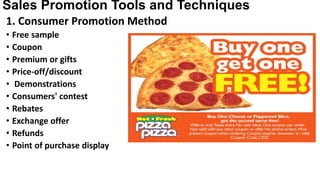
Sales Promotion Tools and Techniques
1. Consumer Promotion Method
• Free sample
• Coupon
• Premium or gifts
• Price-off/discount
• Demonstrations
• Consumers' contest
• Rebates
• Exchange offer
• Refunds
• Point of purchase display
Cont’ed
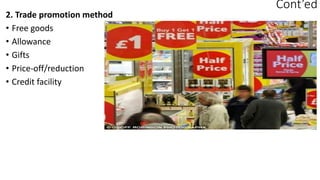
2. Trade promotion method
• Free goods
• Allowance
• Gifts
• Price-off/reduction
• Credit facility
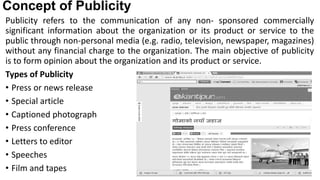
Concept of Publicity
Publicity refers to the communication of any non- sponsored commercially
significant information about the organization or its product or service to the
public through non-personal media (e.g. radio, television, newspaper, magazines)
without any financial charge to the organization. The main objective of publicity
is to form opinion about the organization and its product or service.
Types of Publicity
• Press or news release
• Special article
• Captioned photograph
• Press conference
• Letters to editor
• Speeches
• Film and tapes
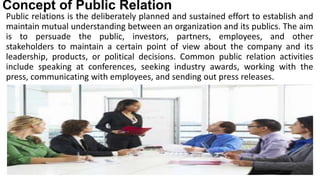
Concept of Public Relation
Public relations is the deliberately planned and sustained effort to establish and
maintain mutual understanding between an organization and its publics. The aim
is to persuade the public, investors, partners, employees, and other
stakeholders to maintain a certain point of view about the company and its
leadership, products, or political decisions. Common public relation activities
include speaking at conferences, seeking industry awards, working with the
press, communicating with employees, and sending out press releases.
Objectives of Public Relation
•Awareness
•Established credibility
•Creation of favorable/positive image
•Reduction of promotion cost
Tools of Public Relation
•Attendance at public events
•Press releases
•Newsletters
•Blogging
•Social media marketing
Concept of Direct Marketing
The marketing without intermediaries is called direct marketing. Direct marketers
communicate directly with customers, often on a one-to-one, interactive basis.
Direct mail, catalogue, telephone, television and internet etc. are widely used in
direct marketing.
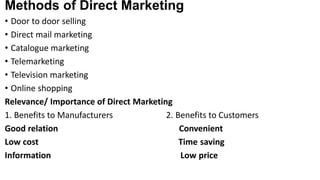
Methods of Direct Marketing
• Door to door selling
• Direct mail marketing
• Catalogue marketing
• Telemarketing
• Television marketing
• Online shopping
Relevance/ Importance of Direct Marketing
1. Benefits to Manufacturers 2. Benefits to Customers
Good relation Convenient
Low cost Time saving
Information Low price
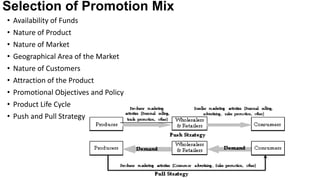
Selection of Promotion Mix
• Availability of Funds
• Nature of Product
• Nature of Market
• Geographical Area of the Market
• Nature of Customers
• Attraction of the Product
• Promotional Objectives and Policy
• Product Life Cycle
• Push and Pull Strategy

Promotion Decision by sandesh Acharya.pptx

  • 1.
  • 2.
    Meaning of Promotion Promotionis any form of communication used to inform, persuade, influence, and remind people about an organization’s or individual’s goods, services, image, ideas, community involvement, impact on society etc.
  • 3.
    Objectives of Promotion •Informing • Persuading • Reminding • Reassuring/assuring
  • 4.
    Marketing Communication • Communicationis the transfer of meaning from one person to another and is reflected in attention, understanding, acceptance and results or response. Process of Marketing Communication 1. Sender: Sender is the person who sends the message to another person. 2. Encoding: Encoding is the process of putting thoughts and ideas of the message into symbolic form. 3. Message: Message is the set of symbols that the sender transmits to the receiver. The best messages consist of words and other symbols that are familiar to the receiver. 4. Media: Media are the communication channels through which the message moves from the sender to the receiver. The sender must send the messages through such media that reach target audience or receivers.
  • 5.
    Cont’ed 5. Decoding: Decodingis the process by which the receiver assigns meaning to the symbols encoded by the sender. It helps the receiver to interpret the messages sent by the sender. Decoding depends to a large extent on the perception of the receiver, past experience with the similar communication, personal desires etc. 6. Receiver: Receiver is the person receiving the message sent by somebody. Receiver receives the message through some channels of communication and understands the message by decoding it. 7. Response: Response indicates the reactions of the receiver after being exposed to the message. Response depends, to a large extent, on the perception of the message, interpretation of body language, personal desires of the receiver and the reaction to the message. 8. Feedback: Feedback is the part of the receiver’s response communicated back to the sender. Through feedback channels, the sender can assess the audience’s response. Feedback can be written, spoken, signaled or given through other means. It follows the same step-by-step process, as the initial sender followed the sequence. 9. Noise: Noise is the unplanned state or distortion of the communication process which results in the receiver’s getting a different message than the one the sender sent. Generally, environmental noise is an element or activity that disturbs, confuses or makes the communication process more difficult.
  • 6.
    Promotion Mix The PromotionMix refers to the blend of several promotional tools used by the business to create, maintain and increase the demand for goods and services. The Promotion Mix is the integration of Advertising, Personal Selling, Sales Promotion, Public Relations and publicity.
  • 7.
    Nature of Advertising Advertisingis a non-personal presentation and promotion of ideas, goods or services paid for by an identified sponsor. It is non- personal mass communication.
  • 8.
    Features of Advertising •Non-personal • Mass Communication • Sponsored • Paid Form • Inform and Persuade • Speedy Communication
  • 9.
    Objectives of Advertising •To increase demand • To build brand preference • To build goodwill • To support salesman • To remind • To inform about changes in marketing mix • To face competition • To information about a product
  • 10.
    Concept of Personalselling Personal selling is the process of informing, assisting and persuading people to buy a product or service through direct personal contact. It involves face-to-face communication between a seller and a buyer. In this technique of promotion, sales persons make oral presentation to one or more customers for the purpose of making sales.
  • 11.
    Features of PersonalSelling •Personal Form •Development of Relationship •Oral Conversation •Quick Solution of Queries •Slow Speed of Sales •Receipt of Additional Information •Two-way Communication
  • 12.
    Objectives of Personalselling •Creating need awareness •Identifying potential buyer •Solution to the problem •Convincing prospects to buy •Persuade the customer •Relationship building •Satisfy customers •Profit oriented objectives
  • 13.
    Relevance of PersonalSelling •Flexible message •Minimum wastage •Effective sales •Immediate feedback •Complements to advertising •Educates customers •Employment opportunity
  • 14.
    Concept of SalesPromotion Sales promotion refers to the short form incentives to stimulate demand. It can be directed at customers, middlemen and sales personnel. Sales promotion consists of all promotional activities other than advertising, personal selling and publicity that stimulate short-term or temporary market demand for products. The basic purpose is to stimulate on the spot buying by people through short- term incentives. Incentives such as a samples, price concessions, and prize contests are offered to customers to encourage buying.
  • 15.
    Objectives of SalesPromotion •To introduce new product •To attract new customers •To reduce effect of seasonal decline •To induce middlemen to purchase more •To bridge the gap between advertising and personal selling •Aid to middlemen
  • 16.
    Sales Promotion Toolsand Techniques 1. Consumer Promotion Method • Free sample • Coupon • Premium or gifts • Price-off/discount • Demonstrations • Consumers' contest • Rebates • Exchange offer • Refunds • Point of purchase display
  • 17.
    Cont’ed 2. Trade promotionmethod • Free goods • Allowance • Gifts • Price-off/reduction • Credit facility
  • 18.
    Concept of Publicity Publicityrefers to the communication of any non- sponsored commercially significant information about the organization or its product or service to the public through non-personal media (e.g. radio, television, newspaper, magazines) without any financial charge to the organization. The main objective of publicity is to form opinion about the organization and its product or service. Types of Publicity • Press or news release • Special article • Captioned photograph • Press conference • Letters to editor • Speeches • Film and tapes
  • 19.
    Concept of PublicRelation Public relations is the deliberately planned and sustained effort to establish and maintain mutual understanding between an organization and its publics. The aim is to persuade the public, investors, partners, employees, and other stakeholders to maintain a certain point of view about the company and its leadership, products, or political decisions. Common public relation activities include speaking at conferences, seeking industry awards, working with the press, communicating with employees, and sending out press releases.
  • 20.
    Objectives of PublicRelation •Awareness •Established credibility •Creation of favorable/positive image •Reduction of promotion cost
  • 21.
    Tools of PublicRelation •Attendance at public events •Press releases •Newsletters •Blogging •Social media marketing
  • 22.
    Concept of DirectMarketing The marketing without intermediaries is called direct marketing. Direct marketers communicate directly with customers, often on a one-to-one, interactive basis. Direct mail, catalogue, telephone, television and internet etc. are widely used in direct marketing.
  • 23.
    Methods of DirectMarketing • Door to door selling • Direct mail marketing • Catalogue marketing • Telemarketing • Television marketing • Online shopping Relevance/ Importance of Direct Marketing 1. Benefits to Manufacturers 2. Benefits to Customers Good relation Convenient Low cost Time saving Information Low price
  • 24.
    Selection of PromotionMix • Availability of Funds • Nature of Product • Nature of Market • Geographical Area of the Market • Nature of Customers • Attraction of the Product • Promotional Objectives and Policy • Product Life Cycle • Push and Pull Strategy