Download as PDF, PPTX

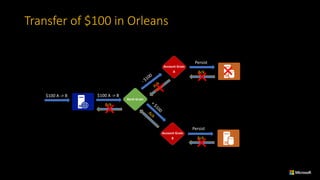
![Account Grain
B
What We Want for Transfer Operation
$100 A -> B
Bank Grain
Ack
[Tx(RequiresNew)]
$100 A -> B
Account Grain
A
Persist
Persist
Ack
Ack](https://image.slidesharecdn.com/sergeybykov-distributedtransactionsaredeadlonglivedistributedtransactions-180530145614/85/Distributed-Transactions-are-dead-long-live-distributed-transaction-23-320.jpg)
![Account Grain
B
We Want ACID Guarantees
$100 A -> B
Bank Grain
Ack
[Tx(RequiresNew)]
$100 A -> B
Account Grain
A
Persist
Persist
Ack
Ack
$500
$500
$400
$600](https://image.slidesharecdn.com/sergeybykov-distributedtransactionsaredeadlonglivedistributedtransactions-180530145614/85/Distributed-Transactions-are-dead-long-live-distributed-transaction-24-320.jpg)
![Bank Grain Interface
public interface IBankGrain : IGrainWithIntegerKey
{
[Transaction(TransactionOption.RequiresNew)]
Task Transfer(Guid fromAccount, Guid toAccount, uint amount);
}](https://image.slidesharecdn.com/sergeybykov-distributedtransactionsaredeadlonglivedistributedtransactions-180530145614/85/Distributed-Transactions-are-dead-long-live-distributed-transaction-26-320.jpg)
![Account Grain Interface
public interface IAccountGrain : IGrainWithGuidKey
{
[Transaction(TransactionOption.Required)]
Task Withdraw(uint amount);
[Transaction(TransactionOption.Required)]
Task Deposit(uint amount);
[Transaction(TransactionOption.Required)]
Task<uint> GetBalance();
}](https://image.slidesharecdn.com/sergeybykov-distributedtransactionsaredeadlonglivedistributedtransactions-180530145614/85/Distributed-Transactions-are-dead-long-live-distributed-transaction-27-320.jpg)
![Account Grain: Balance State Facet
public class Balance
{
public uint Value { get; set; } = 1000;
}
public class AccountGrain : Grain, IAccountGrain
{
private readonly ITransactionalState<Balance> balance;
public AccountGrain(
[TransactionalState("balance")]
ITransactionalState<Balance> balance)
{
this.balance = balance;
}
}](https://image.slidesharecdn.com/sergeybykov-distributedtransactionsaredeadlonglivedistributedtransactions-180530145614/85/Distributed-Transactions-are-dead-long-live-distributed-transaction-29-320.jpg)
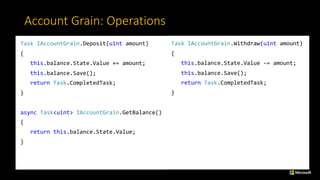
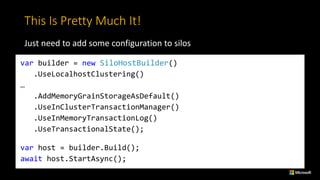
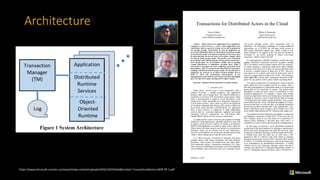
![Account Grain
B
Bank Grain[Tx(RequiresNew)]
$100 A -> B
Account Grain
A
TC
Transaction log
TM
Tx N:
A(N-5)
B(N-2)
Validate(N, {A, B}, {N-5, N-2})
Committed
Wait for
N-5 and N-2
N depends on
Success
2-Phase Commit](https://image.slidesharecdn.com/sergeybykov-distributedtransactionsaredeadlonglivedistributedtransactions-180530145614/85/Distributed-Transactions-are-dead-long-live-distributed-transaction-35-320.jpg)
![Account Grain
B
Bank Grain[Tx(RequiresNew)]
$100 A -> B
Account Grain
A
TC
Transaction log
TM
Tx N:
A(N-5)
B(N-2)
Validate(N, {A, B}, {N-5, N-2})
Abort
Wait for
N-5 and N-2
N depends on
Error
2PC Abort](https://image.slidesharecdn.com/sergeybykov-distributedtransactionsaredeadlonglivedistributedtransactions-180530145614/85/Distributed-Transactions-are-dead-long-live-distributed-transaction-37-320.jpg)
![Account Grain
B
Bank Grain[Tx(RequiresNew)]
$100 A -> B
Account Grain
A
TC
Transaction log
TM
Tx N:
A(N-5)
B(N-2)
Validate({N, O, P, Q, X, Y, Z})
Committed ({N,O,P,Q,X}) Aborted({Y,Z})
Success
Batching](https://image.slidesharecdn.com/sergeybykov-distributedtransactionsaredeadlonglivedistributedtransactions-180530145614/85/Distributed-Transactions-are-dead-long-live-distributed-transaction-39-320.jpg)
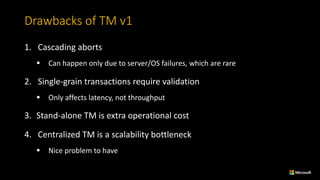
![TM v2
Account Grain
B
Bank Grain[Tx(RequiresNew)]
$100 A -> B
Account Grain
A
TC
Transaction log
TM
Tx N:
A(N-5)
B(N-2)
Validate(N, {A, B}, {N-5, N-2})
Committed
Success
TM](https://image.slidesharecdn.com/sergeybykov-distributedtransactionsaredeadlonglivedistributedtransactions-180530145614/85/Distributed-Transactions-are-dead-long-live-distributed-transaction-43-320.jpg)

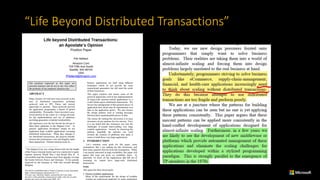
The document discusses the evolution and challenges of distributed transactions, particularly in the context of Orleans 2.0, a framework for building cloud applications. It contrasts traditional distributed transaction approaches with newer models like event sourcing and outlines Orleans' transaction management features, including support for strong consistency and scalability. The conclusion highlights the ongoing need for innovation in managing distributed transactions, inviting collaboration in the open-source community.


