EMOTIONAL INTELLIGENCE: A QUALITATIVE
STUDY OF THE DEVELOPMENT OF
EMOTIONAL INTELLIGENCE OF
COMMUNITY COLLEGE STUDENTS
ENROLLED IN A LEADERSHIP
DEVELOPMENT PROGRAM
DISSERTATION DEFENSE
STEVIE BLAKELY
COLORADO STATE UNIVERSITY
WEDNESDAY, JUNE 3RD 2015
RESEARCH QUESTIONS
Determine the impact of formal leadership
training on the emotional intelligence
development of community college students.
Purpose of the Study
1. How do community college students’ experiences in a formal
leadership training program impact their development of emotional
intelligence?
2. How do students demonstrating the greatest gains on the ESAP-A/B
perceive that their participation in a leadership training program
impacted their growth of emotional intelligence?
3. What curriculum/design components of a leadership training
program do participants perceive as having the greatest impact on
their personal development?
LITERATURE REVIEW
• Research regarding Student Development Theory
• We know they develop through in-classroom and out-of-classroom
experiences, but how do they develop through leadership training
specifically?
• Research regarding Emotional Intelligence
• As higher education, specifically community colleges, focus on
workforce development, it is important to research the experiences
which develop EI in students.
• Research regarding EI and Higher Education
• Strong research base discussing the connections between EI and
academic achievement, but not EI and student development.
This study fills the gap in the research, exploring how
leadership training can impact student EI development.
THEORETICAL FRAMEWORK
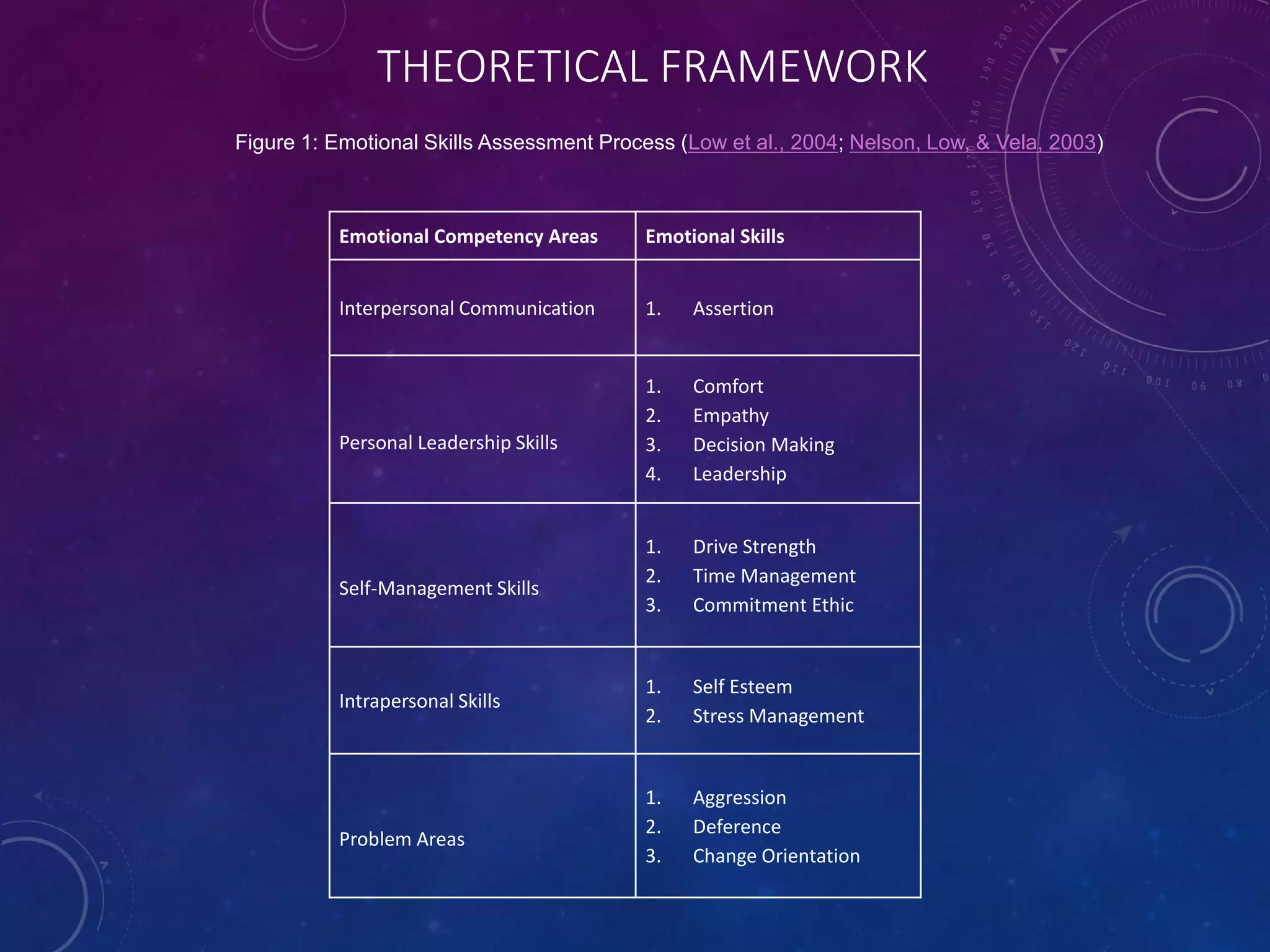
Emotional Competency Areas Emotional Skills
Interpersonal Communication 1. Assertion
Personal Leadership Skills
1. Comfort
2. Empathy
3. Decision Making
4. Leadership
Self-Management Skills
1. Drive Strength
2. Time Management
3. Commitment Ethic
Intrapersonal Skills
1. Self Esteem
2. Stress Management
Problem Areas
1. Aggression
2. Deference
3. Change Orientation
Figure 1: Emotional Skills Assessment Process (Low et al., 2004; Nelson, Low, & Vela, 2003)
METHODOLOGY
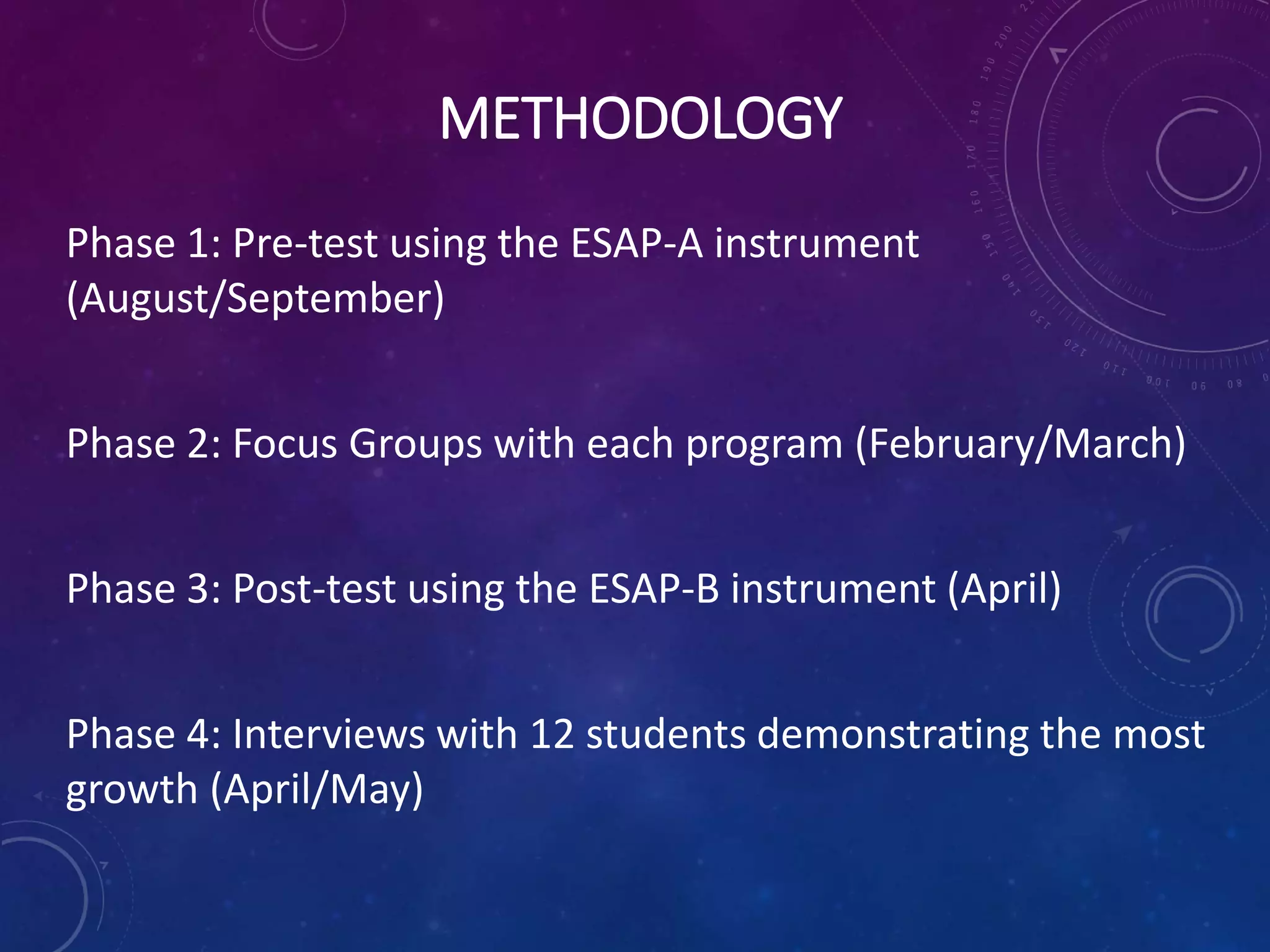
Phase 1: Pre-test using the ESAP-A instrument
(August/September)
Phase 2: Focus Groups with each program (February/March)
Phase 3: Post-test using the ESAP-B instrument (April)
Phase 4: Interviews with 12 students demonstrating the most
growth (April/May)
DATA RELIABILITY & TRUSTWORTHINESS
RESEARCHER BIAS
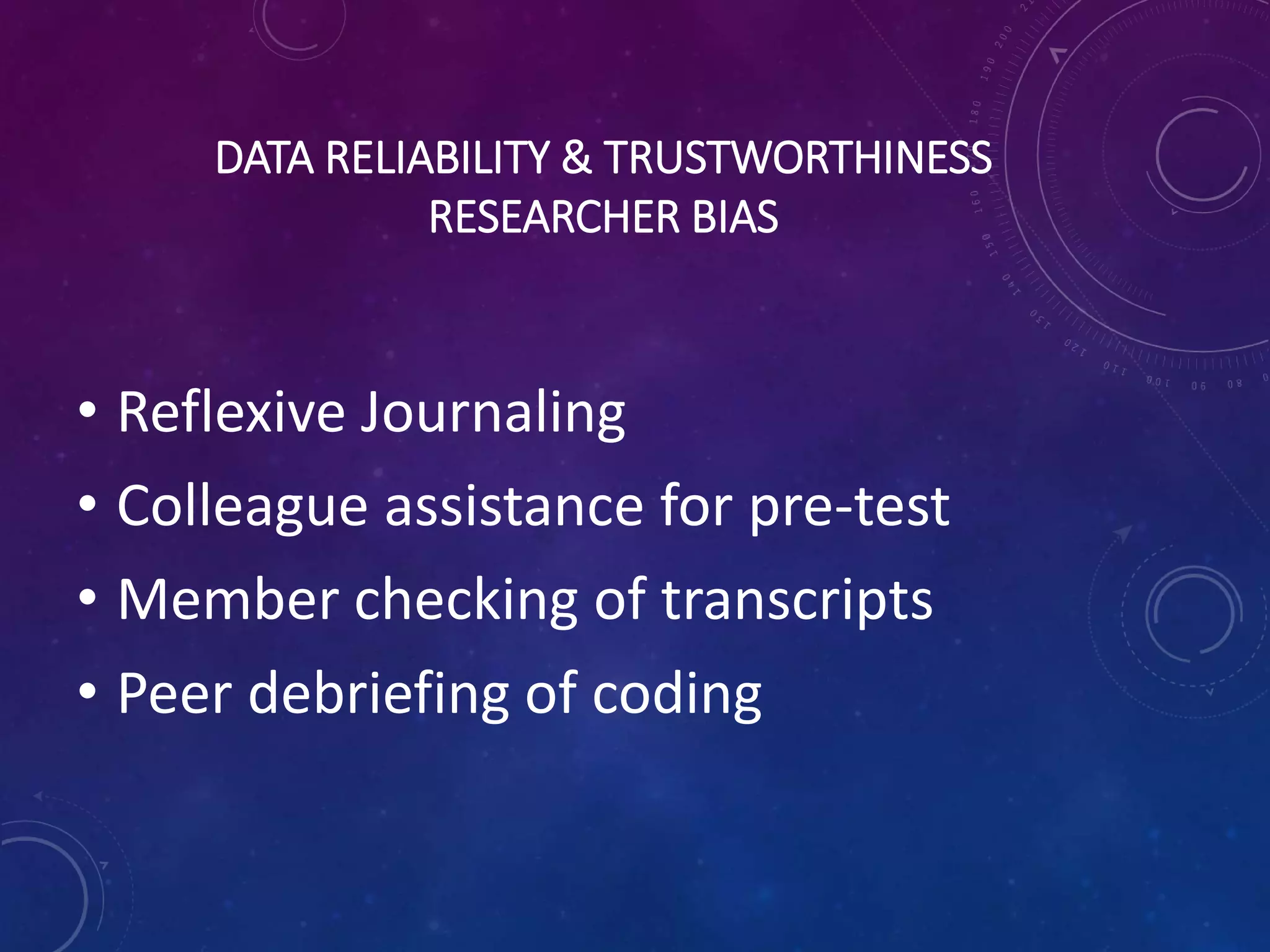
• Reflexive Journaling
• Colleague assistance for pre-test
• Member checking of transcripts
• Peer debriefing of coding
DEMOGRAPHICS
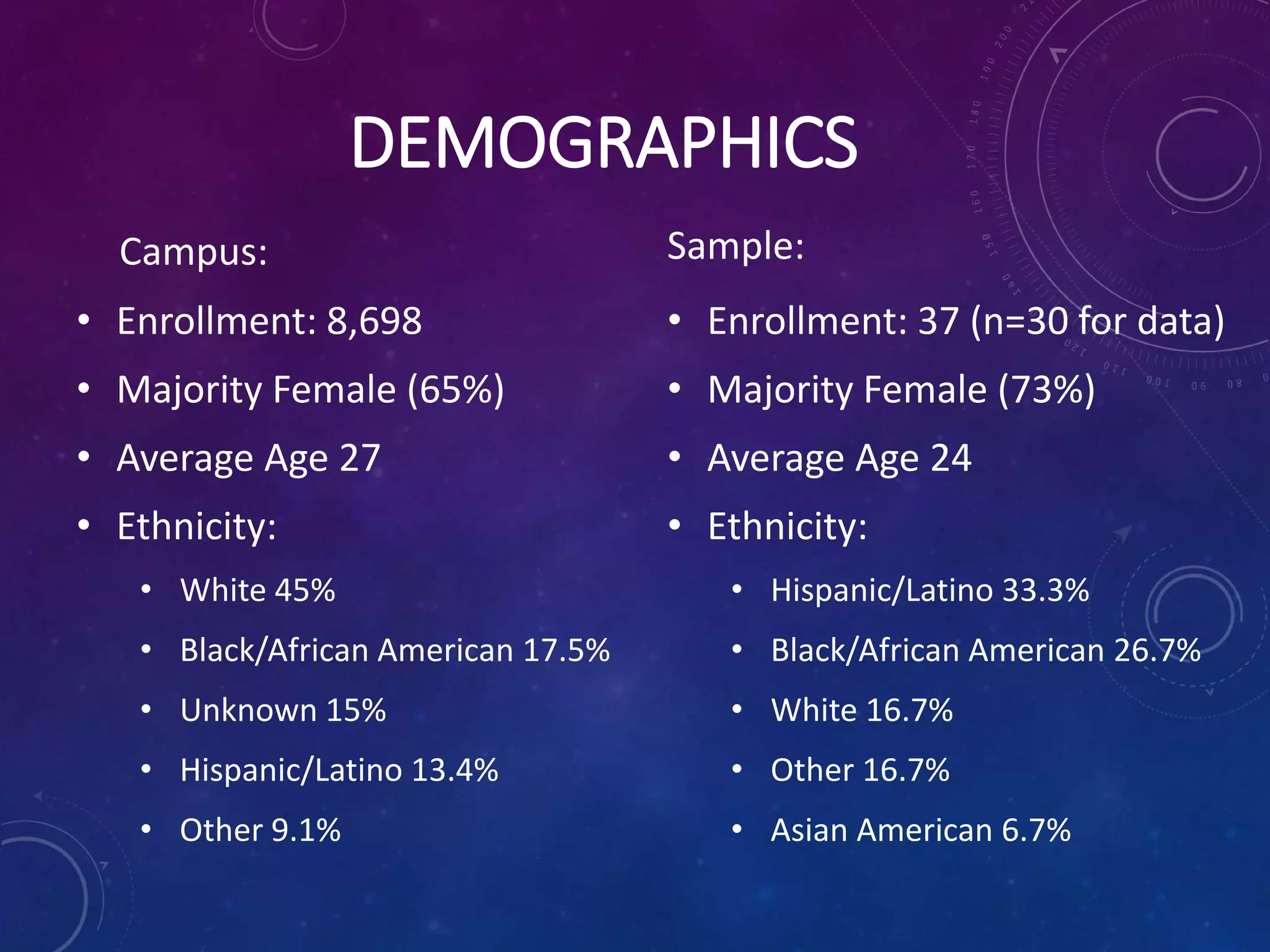
Campus:
• Enrollment: 8,698
• Majority Female (65%)
• Average Age 27
• Ethnicity:
• White 45%
• Black/African American 17.5%
• Unknown 15%
• Hispanic/Latino 13.4%
• Other 9.1%
Sample:
• Enrollment: 37 (n=30 for data)
• Majority Female (73%)
• Average Age 24
• Ethnicity:
• Hispanic/Latino 33.3%
• Black/African American 26.7%
• White 16.7%
• Other 16.7%
• Asian American 6.7%
FINDINGS- RESEARCH QUESTION 1
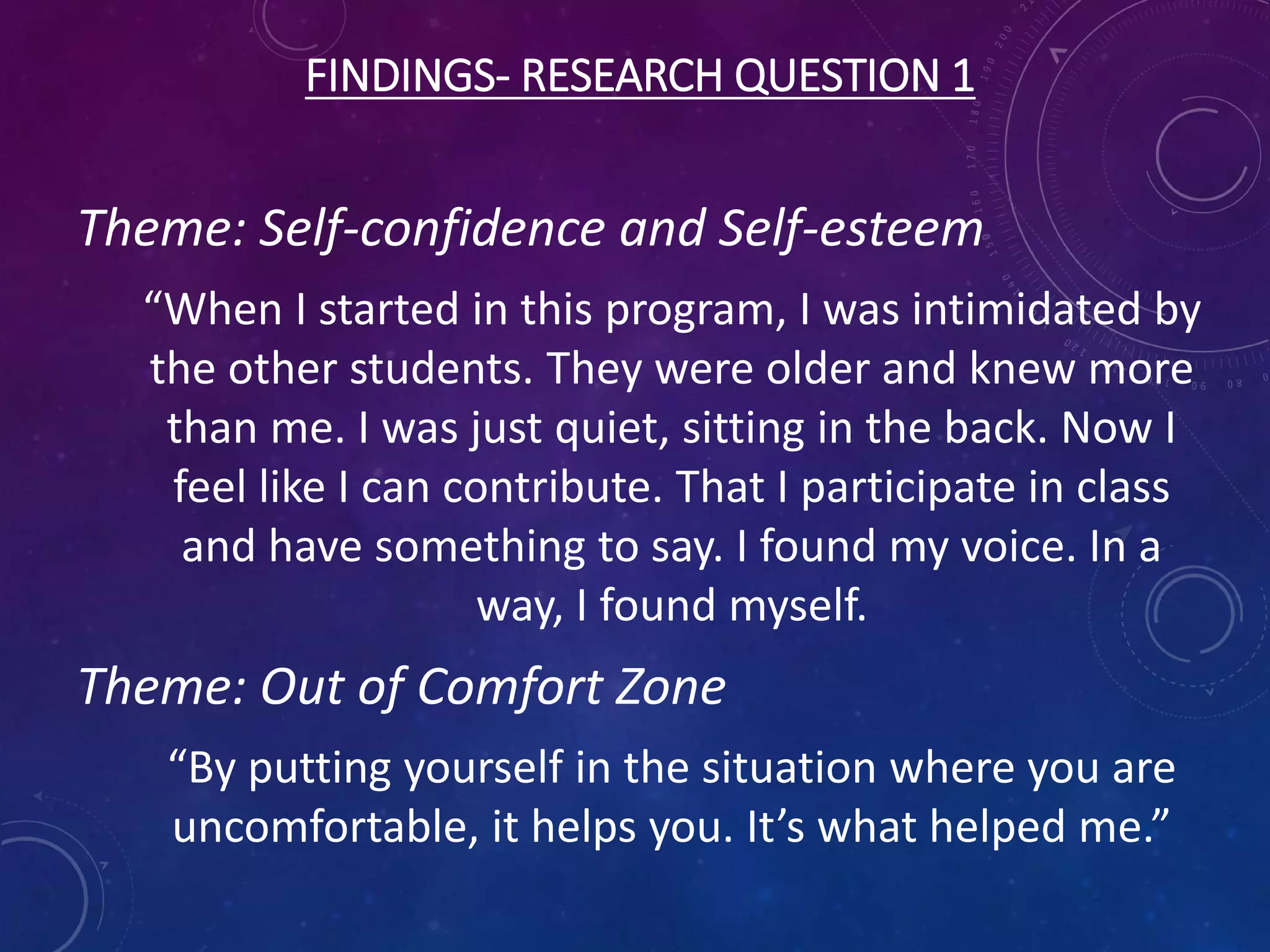
Theme: Self-confidence and Self-esteem
“When I started in this program, I was intimidated by
the other students. They were older and knew more
than me. I was just quiet, sitting in the back. Now I
feel like I can contribute. That I participate in class
and have something to say. I found my voice. In a
way, I found myself.
Theme: Out of Comfort Zone
“By putting yourself in the situation where you are
uncomfortable, it helps you. It’s what helped me.”
FINDINGS- RESEARCH QUESTION 2
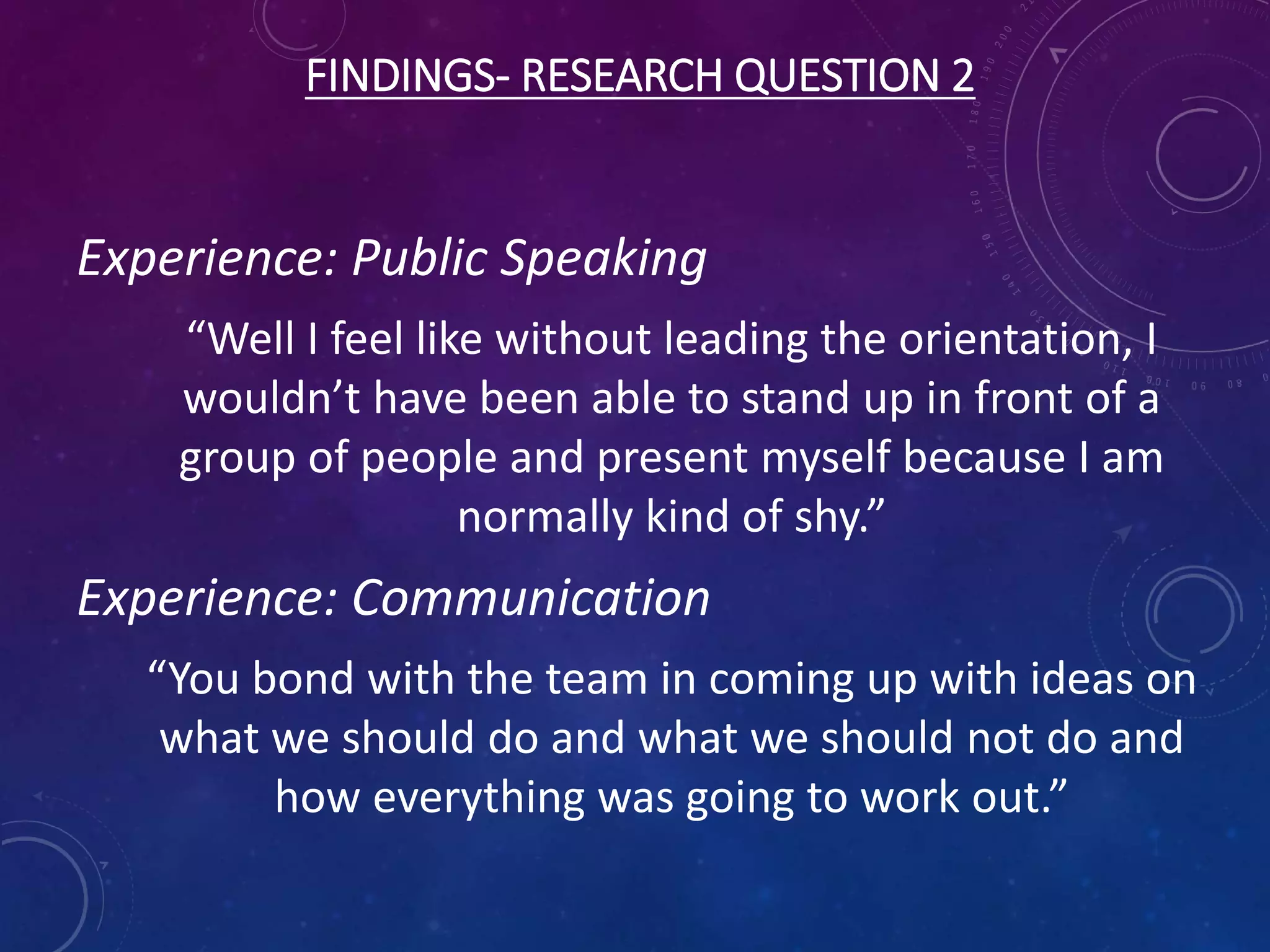
Experience: Public Speaking
“Well I feel like without leading the orientation, I
wouldn’t have been able to stand up in front of a
group of people and present myself because I am
normally kind of shy.”
Experience: Communication
“You bond with the team in coming up with ideas on
what we should do and what we should not do and
how everything was going to work out.”
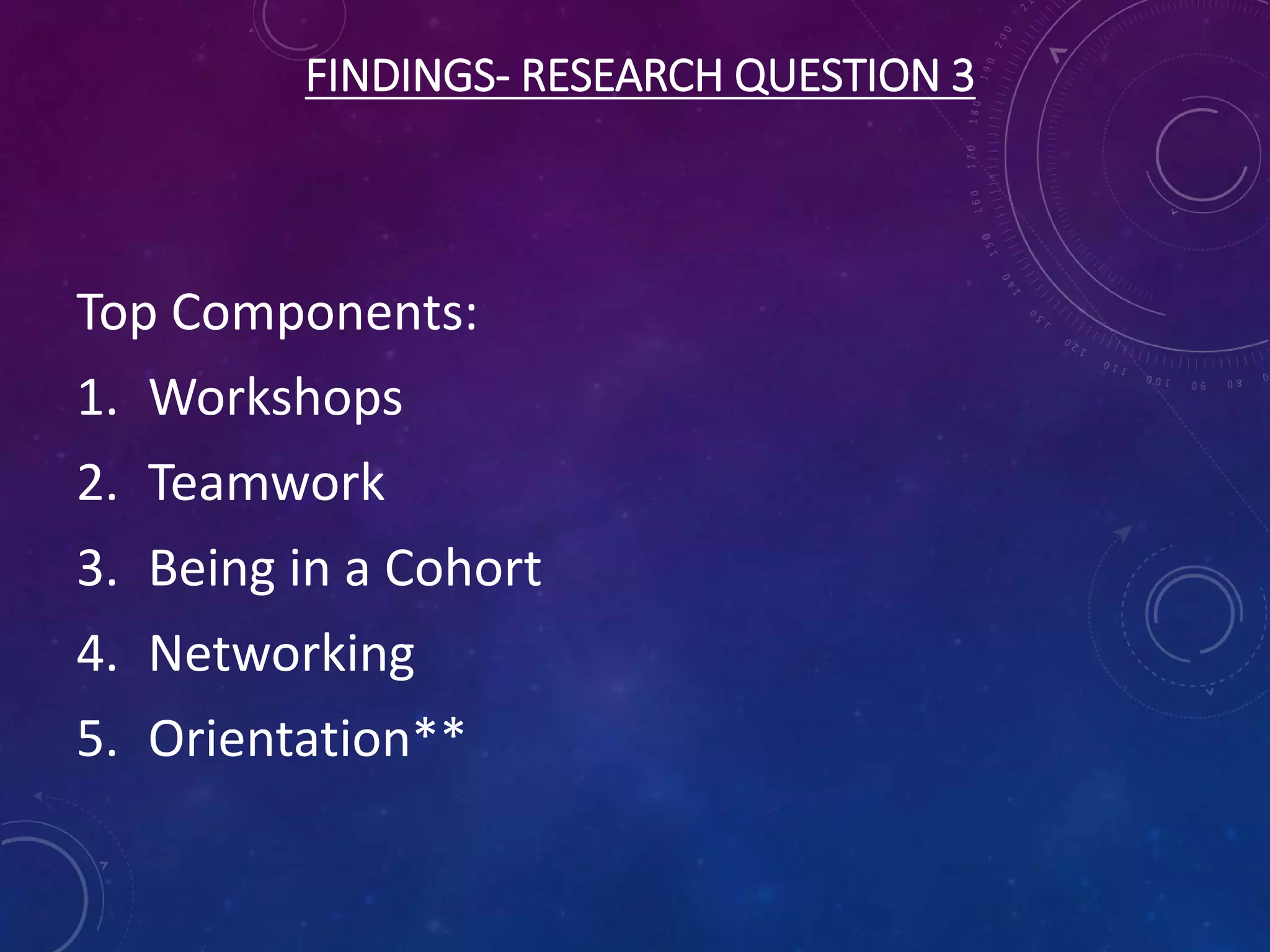
FINDINGS- RESEARCH QUESTION 3
Top Components:
1. Workshops
2. Teamwork
3. Being in a Cohort
4. Networking
5. Orientation**
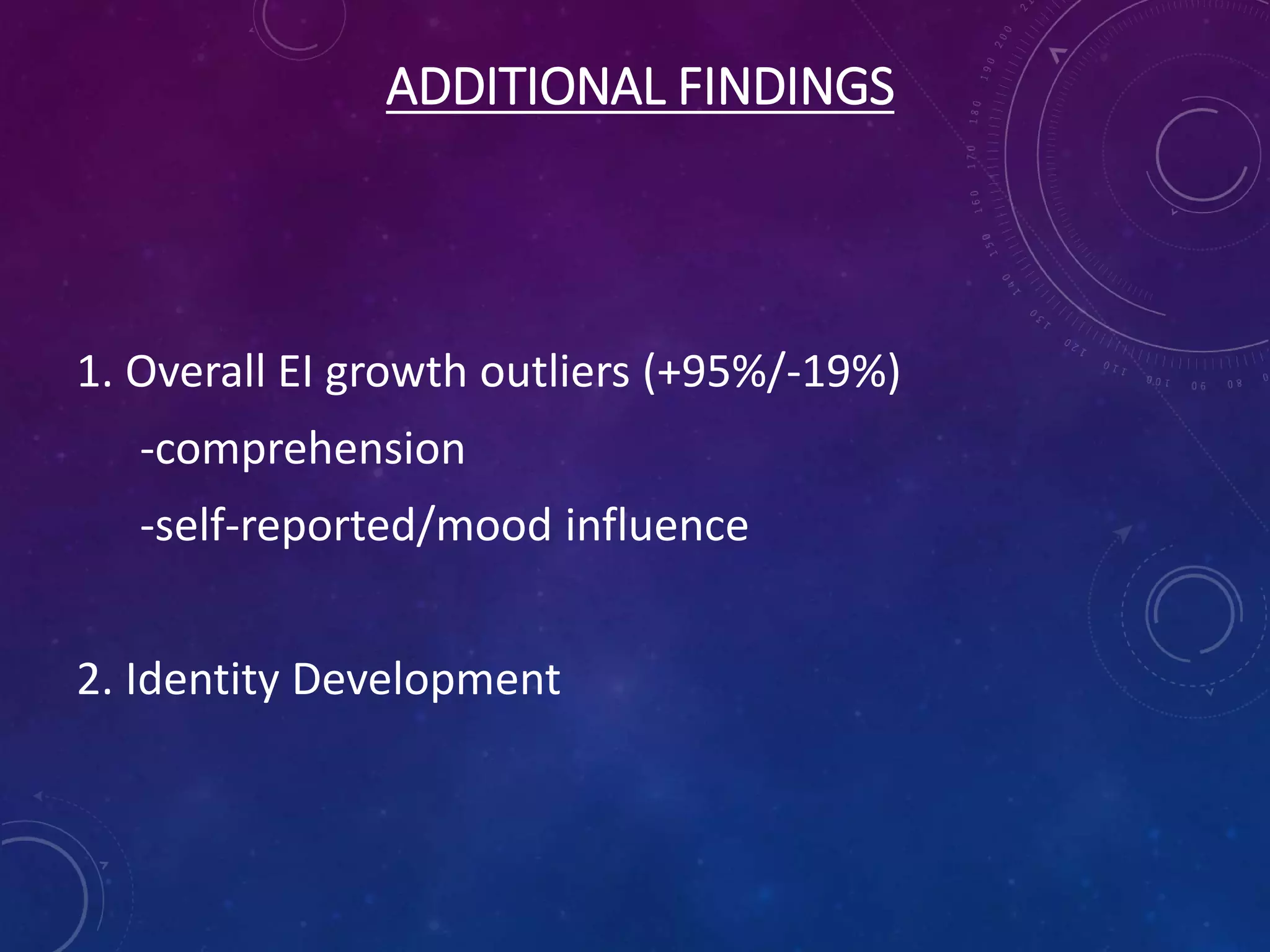
ADDITIONAL FINDINGS
1. Overall EI growth outliers (+95%/-19%)
-comprehension
-self-reported/mood influence
2. Identity Development
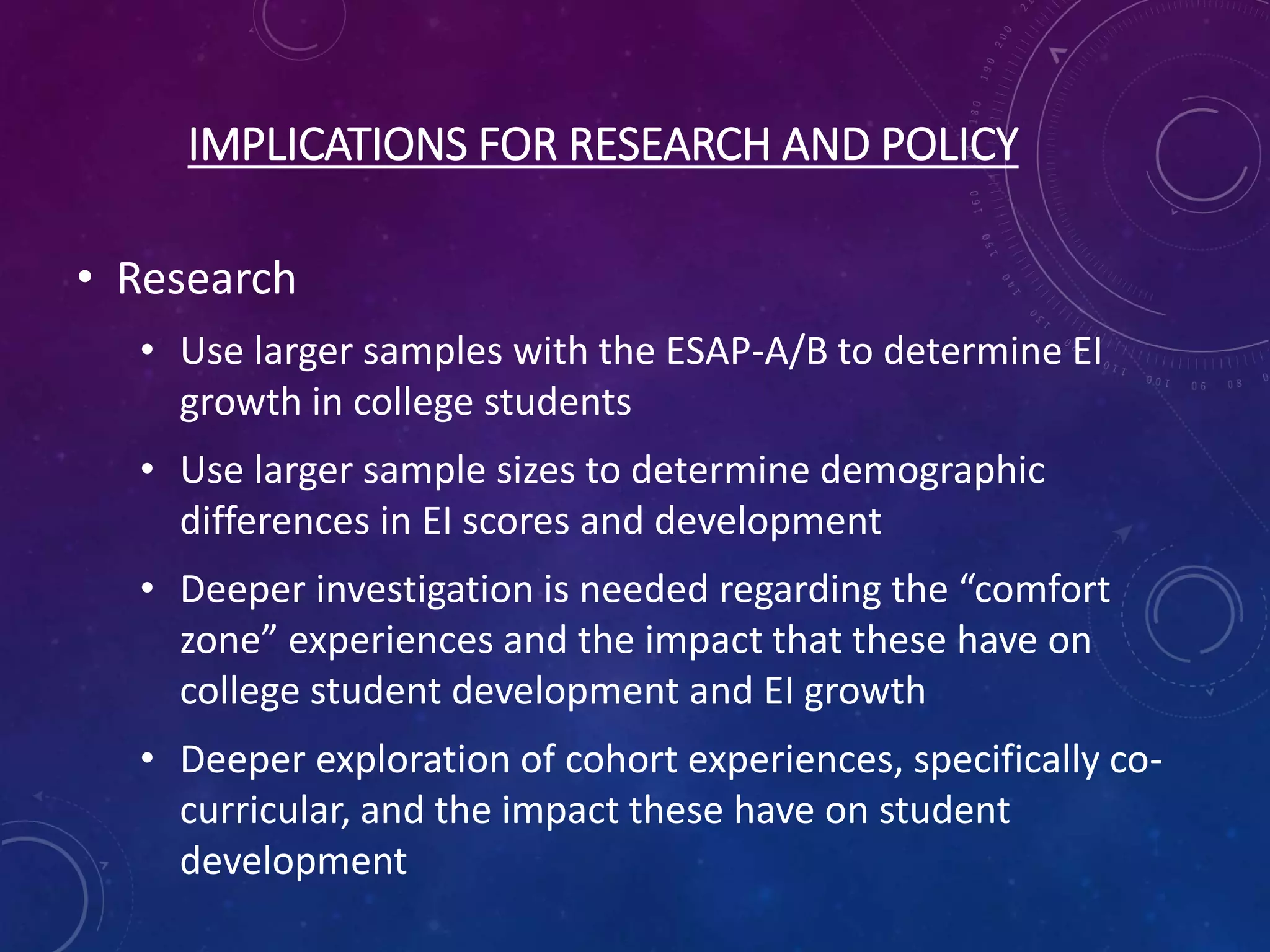
IMPLICATIONS FOR RESEARCH AND POLICY
• Research
• Use larger samples with the ESAP-A/B to determine EI
growth in college students
• Use larger sample sizes to determine demographic
differences in EI scores and development
• Deeper investigation is needed regarding the “comfort
zone” experiences and the impact that these have on
college student development and EI growth
• Deeper exploration of cohort experiences, specifically co-
curricular, and the impact these have on student
development
THANK YOU!

Dissertation Defense2

  • 1.
    EMOTIONAL INTELLIGENCE: AQUALITATIVE STUDY OF THE DEVELOPMENT OF EMOTIONAL INTELLIGENCE OF COMMUNITY COLLEGE STUDENTS ENROLLED IN A LEADERSHIP DEVELOPMENT PROGRAM DISSERTATION DEFENSE STEVIE BLAKELY COLORADO STATE UNIVERSITY WEDNESDAY, JUNE 3RD 2015
  • 2.
    RESEARCH QUESTIONS Determine theimpact of formal leadership training on the emotional intelligence development of community college students. Purpose of the Study 1. How do community college students’ experiences in a formal leadership training program impact their development of emotional intelligence? 2. How do students demonstrating the greatest gains on the ESAP-A/B perceive that their participation in a leadership training program impacted their growth of emotional intelligence? 3. What curriculum/design components of a leadership training program do participants perceive as having the greatest impact on their personal development?
  • 3.
    LITERATURE REVIEW • Researchregarding Student Development Theory • We know they develop through in-classroom and out-of-classroom experiences, but how do they develop through leadership training specifically? • Research regarding Emotional Intelligence • As higher education, specifically community colleges, focus on workforce development, it is important to research the experiences which develop EI in students. • Research regarding EI and Higher Education • Strong research base discussing the connections between EI and academic achievement, but not EI and student development. This study fills the gap in the research, exploring how leadership training can impact student EI development.
  • 4.
    THEORETICAL FRAMEWORK Emotional CompetencyAreas Emotional Skills Interpersonal Communication 1. Assertion Personal Leadership Skills 1. Comfort 2. Empathy 3. Decision Making 4. Leadership Self-Management Skills 1. Drive Strength 2. Time Management 3. Commitment Ethic Intrapersonal Skills 1. Self Esteem 2. Stress Management Problem Areas 1. Aggression 2. Deference 3. Change Orientation Figure 1: Emotional Skills Assessment Process (Low et al., 2004; Nelson, Low, & Vela, 2003)
  • 5.
    METHODOLOGY Phase 1: Pre-testusing the ESAP-A instrument (August/September) Phase 2: Focus Groups with each program (February/March) Phase 3: Post-test using the ESAP-B instrument (April) Phase 4: Interviews with 12 students demonstrating the most growth (April/May)
  • 6.
    DATA RELIABILITY &TRUSTWORTHINESS RESEARCHER BIAS • Reflexive Journaling • Colleague assistance for pre-test • Member checking of transcripts • Peer debriefing of coding
  • 7.
    DEMOGRAPHICS Campus: • Enrollment: 8,698 •Majority Female (65%) • Average Age 27 • Ethnicity: • White 45% • Black/African American 17.5% • Unknown 15% • Hispanic/Latino 13.4% • Other 9.1% Sample: • Enrollment: 37 (n=30 for data) • Majority Female (73%) • Average Age 24 • Ethnicity: • Hispanic/Latino 33.3% • Black/African American 26.7% • White 16.7% • Other 16.7% • Asian American 6.7%
  • 8.
    FINDINGS- RESEARCH QUESTION1 Theme: Self-confidence and Self-esteem “When I started in this program, I was intimidated by the other students. They were older and knew more than me. I was just quiet, sitting in the back. Now I feel like I can contribute. That I participate in class and have something to say. I found my voice. In a way, I found myself. Theme: Out of Comfort Zone “By putting yourself in the situation where you are uncomfortable, it helps you. It’s what helped me.”
  • 9.
    FINDINGS- RESEARCH QUESTION2 Experience: Public Speaking “Well I feel like without leading the orientation, I wouldn’t have been able to stand up in front of a group of people and present myself because I am normally kind of shy.” Experience: Communication “You bond with the team in coming up with ideas on what we should do and what we should not do and how everything was going to work out.”
  • 10.
    FINDINGS- RESEARCH QUESTION3 Top Components: 1. Workshops 2. Teamwork 3. Being in a Cohort 4. Networking 5. Orientation**
  • 11.
    ADDITIONAL FINDINGS 1. OverallEI growth outliers (+95%/-19%) -comprehension -self-reported/mood influence 2. Identity Development
  • 12.
    IMPLICATIONS FOR RESEARCHAND POLICY • Research • Use larger samples with the ESAP-A/B to determine EI growth in college students • Use larger sample sizes to determine demographic differences in EI scores and development • Deeper investigation is needed regarding the “comfort zone” experiences and the impact that these have on college student development and EI growth • Deeper exploration of cohort experiences, specifically co- curricular, and the impact these have on student development
  • 13.

Editor's Notes

  • #2 First, I want to thank all of you for your support and guidance through this process. Thank you for serving on this committee and exploring this topic with me. This study was enjoyable and directly related to my job. The impact of these results not only will serve as best practices for other leadership faculty, but have also served to improve the programs I oversee for next year.
  • #3 The purpose of this study was to determine the impact of formal leadership training on the emotional intelligence development of community college students. The impact would be determined using three broad research questions…
  • #4 Since we discussed the literature in more depth during my proposal, I wanted to include a brief recap here. There is a depth of knowledge regarding student development theory including models based on cognitive development, identity development, psychosocial development, and so on. There is very little research regarding the specific impact of leadership training on student development. Emotional intelligence was first popularized for the business world in 1996 by Daniel Goleman. Since that time it has gained some footing in the educational field, but research is still lacking. The current environment of community colleges specifically focus on workforce development. Therefore, if EI is important to the business world, it should also be important to higher education. Finally, the intersection of higher education and EI development has been based mostly around academic achievement. There is a gap in the research regarding how EI development assists students in outside of the classroom experiences. This study fills some gaps in the research, specifically exploring how leadership training can impact student EI development.
  • #5 The theoretical framework used in this study was the Emotional Skills Assessment Process. This model was developed by Nelson and Low and is the only student development model that directly connects student development theory to EI development, which is why it was chosen for this study. The model is broken into 4 competency areas and one potential problem area. The four competency areas, cover 10 EI skills that Nelson and Low feel can be taught and experienced. In fact the definition for Emotional Intelligence is the learned ability to identify, understand, experience, and express human emotions in healthy and productive ways. The potential problem area contains three skills that students need to handle well in order to be considered emotionally intelligent. For example, a student need to be able to identify and express aggression in a healthy way in or to be emotionally intelligent, some might even say in order to be successful. Students also need to be to adapt and handle change, as flexibility is an important workforce skill.
  • #6 There were four phases of data collection in this study. Phase one consisted of all students taking a pre-test. This pre-test was conducted by a colleague in a computer lab. Students were able to print their scores immediately and the colleague was able to discuss them with each student. After all students had completed the pre-test, this colleague used aliases such as Student 1, Student 2 etc. This way the researcher was not impacted by the scores during the year. In fact, the researcher did not even look at the scores until the post-test was completed. Focus groups were conducted within each program for phase two of data collection. These focus groups were transcribed allowing for the researcher to be able to identify each speaker. These focus groups lasted approximately one hour and enlightened the researcher into the components which students found to be the most memorable and most impactful during the leadership program. These focus group transcripts were coded to determine the five most frequently discussed components. These five components were then used as the basis for the interview questions in phase four. Phase three was the post-test. This was again given in a computer lab during a workshop or professional development session in April. While all students were asked to complete the survey, there were some students who were absent on this day and did not end up completing the post-test. Only students who completed both the pre-test and the post-test were able to be scored in regarding to growth, which meant that the data is skewed in this area. The post-test scores were partnered with the pre-test scores and the anonymity lifted. This allowed the researcher to view the scores for each student and write down thoughts and feelings in a reflexive journal. The 12 students who demonstrated the most growth were asked to participate in in-depth interviews. These interviews centered around the five components that emerged in the focus group data as the most impactful. These students were asked if there were other experiences that stood out to them regarding impact.
  • #7 It is important to discuss the reliability of the data due to the fact that the researcher was the main data collection instrument and also directly involved with these participants. As the facilitator for all three programs, the researcher had knowledge of individual students and ideas on their growth and development. The focus on the student voice, helped to bracket this bias from the data analysis. There were four specific elements used to establish trustworthiness, reliability, credibility, and confirmability. The use of reflexive journaling was important because it allowed the researcher to record thoughts and ideas throughout the process. Ideas such as the growth that was observed, methodological changes that might have been better, and the nonverbal communication that occurred during focus groups and interviews. By writing this information down separate from the data analysis, the researcher was left to focus on the student voice. The use of a colleague in handling the pre-test and being able to make the score anonymous was helpful to not sway the researcher in a certain direction. If the pre-test scores had been seen bias and judgement could have emerged between the researcher and specific participants or curriculum changes could have been made to improve certain skills. This would have skewed the data in favor of EI development, without being a true study. This would have taken an intervention approach which was outside the scope of this research. After coding had been completed the transcripts were sent to members for them to check for errors. Some grammatical or word choice errors were found and changes made. Transcripts, codes and a code book with definitions was given to a peer debriefer to check for code drift and researcher bias. Issues were discussed, clarified, and data analysis redone when needed.
  • #8 While no statistical significance in terms of demographics could be calculated, it is important to view the differences between the purposive sample and the campus community. It is interesting to note that the leadership programs attract more female applicants and, therefore, female participants than male students. While it is a female majority campus, the percentage of females in the leadership programs I even higher. The average age of leadership participants is lower. This could be due to the commuter campus/part-time student lifestyle, which may make participation in these leadership training co-curricular programs more difficult for these students, since all these programs are offered during daytime working hours. Finally, it is very interesting to see the large difference in ethnic diversity between the purposive sample and the campus community. The leadership programs train more Hispanics and African Americans than white students. Due to these large differences in demographic make-up coupled with the small sample size, this research is not generalizable to the campus community.
  • #9 When addressing the question of how leadership training impacts EI development, the data revealed two major themes. The first is that students felt the largest impact that leadership training had on their development was related to the EI skill of self-esteem. The students spoke of self-esteem in every data collection phase and demonstrated growth on the post-test an average of 19%. One of the student comments that best illustrates this idea is… The second theme the students discussed was how the leadership training forced them to expand their horizon, to go outside of their comfort zone to achieve goals and complete tasks. This pushing outside of the comfort zone is a way that students felt the leadership training programs had the biggest impact on their growth. This was apparent specifically when talking about their self-esteem. One quote that illustrates this theme is… Overall, it can be stated that students felt that leadership programs did impact their EI growth and development. While the vocalization of which skills and areas may not have been as clear, this serves as a solid foundation and adds to the current research.
  • #10 In regards to the question regarding the 12 students with the most growth and their perceived experiences of growth…the experiences of public speaking and team or group communication were discussed more frequently than any other experience. When students were asked the biggest impact, these were the two things that rose to the top. The students in these leadership programs are expected and required to perform multiple public speaking assignments and to work together as a team. Due to the cohort nature of the three programs, when students are placed on a team, they are not allowed to switch. This allows students to learn elements of conflict resolution and group dynamics, as some of them are with these same teams for the entire academic year. Here are two quotes from students that illustrate these experiences… The students all agreed that it was the requirements of the program that forced them to grow. While each student may have seen their own growth differently, they all agreed that program design elements were a strong factor. Interesting to note was that most of the students were surprised by their scores, not because they didn’t see growth, but they were unsure of the specific areas of growth. They felt the growth was overall and in totality.
  • #11 The final research question, regarding specific leadership training components, is where we discover foundations for best practices in leadership training. While there is research regarding pedagogical approaches to leadership training, this study suggests that these specific components will allow faculty to design more impactful programs. These components are all mandatory and intentional in their design. Students felt that the required workshops were the most impactful. This was evidenced when students discussed specific workshops and how they impacted their growth. The two workshops most discussed were Suicide Prevention Training and Body Language. The teamwork component and the experience of being in a cohort were interesting to discover. While these are elements that research suggests are important, it was enlightening to hear the students perceptions. One quote that illustrates this idea is “So the cohort I believe is super important. Because without it, there is no one to hold you accountable or to help critique you throughout the experience. Then you gain these friendships for a lifetime.” While these were the five most frequently discussed elements, it was enlightening to note that the students could not always easily identify the elements. They can identify that they grew, because of these programs, but not always in the specific skills or specific components. I believe by asking the 12 students with the most growth these specific component questions, the data was able to become more solid and stronger. I believe that this piece serves as a start of a best practices research for leadership training programs in reference to EI development.
  • #12 There were two additional curious findings that emerged from the data. The first was the fact that the overall EI growth within these 30 students recorded such a wide range. While one student demonstrated a 95% growth, there were five students who demonstrated negative growth. This is curious, because all of the students during the focus groups talked about the impact that the leadership training programs had on them. Perhaps the impact was not EI development? Perhaps reading comprehension was an issue? Also, due to the self-reported nature of the results, it is possible that students were in a different mood or different life circumstances in spring than they were in fall. For example, we had one student become homeless during the year and another become pregnant. Both of these life issues would impact mood and perception of self. On that note, the pregnant student showed negative growth and the homeless student was in the top 12. Another interesting finding was that of the theme of identity development. While it was not mentioned directly in every focus group or interview, many of the student’s comments could be interpreted as being related to identity development. One student actually said thank you for helping her find herself. This illustrates that identity development may be an area in need of further research in regards to leadership training impact.
  • #13 This study serves as a solid foundation for other researchers to build upon. Some of the ideas for future research are… Overall, I truly enjoyed this research and feel that I have gained tremendous knowledge from it. My only regret is that this study has ended, because there is so much more that I would like to know. I am anxious to continue research in this area in the future.
  • #14 In conclusion, this study adds to current research in the field by exploring specific components of leadership training that impact EI development; by correlating EI development to leadership training specifically through the student voice. As higher education continues to evolve and focus on preparing global citizens with solid relationship skills, this element of EI will become ever more important. As the world needs more leaders, it is imperative that research be conducted in the area of leadership training in higher education.