UNDERSTANDING BARRIERS
TO HEALTH CARE
Jeoffry B. Gordon, MD, MPH
paradocs2@hotmail.com
University of San Diego
November, 2016
U.S. Health Care System Is Not Adequately Serving Those with Greatest Needs
AMERICAN VALUES
Part 1: HEALTH DISPARITIES
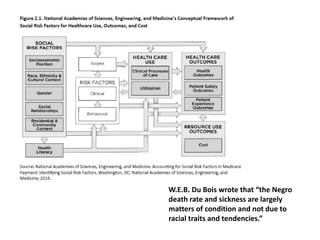
W.E.B. Du Bois wrote that “the Negro
death rate and sickness are largely
matters of condition and not due to
racial traits and tendencies.”
USA
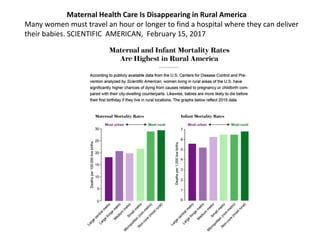
Maternal Health Care Is Disappearing in Rural America
Many women must travel an hour or longer to find a hospital where they can deliver
their babies. SCIENTIFIC AMERICAN, February 15, 2017
Maternal Mortality Rate in U.S. Rises, Defying Global Trend, Study Finds
By SABRINA TAVERNISE, NEW YORK TIMES, SEPT. 21, 2016
WASHINGTON — One of the biggest worldwide public health triumphs in
recent years has been maternal mortality. Global death rates fell by more
than a third from 2000 to 2015.
The United States has become an outlier among rich nations in maternal
deaths, according to data released Wednesday by the Institute of Health
Metrics and Evaluation, a research group funded by the Gates Foundation and
based at the University of Washington.
In 2005 there were 28 maternal deaths — defined as deaths due to
complications from pregnancy or childbirth — per 100,000 births in the
United States in 2013, up from 23, more than triple Canada’s. In all, the
American rate was up by more than half since 1990, according to the
institute, which uses many data sources, including countries’ vital records
systems.
The findings are part of a gathering body of evidence on the dismal numbers
for maternal mortality among American women and how they keep getting
worse.
An analysis looked at increases by state and found particularly high rates in
the District of Columbia, New Jersey, Georgia, Texas and Arkansas, especially
among black women.
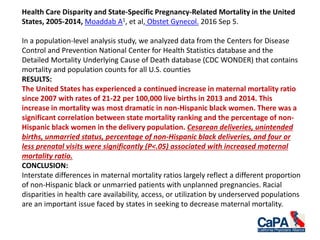
Health Care Disparity and State-Specific Pregnancy-Related Mortality in the United
States, 2005-2014, Moaddab A1, et al, Obstet Gynecol. 2016 Sep 5.
In a population-level analysis study, we analyzed data from the Centers for Disease
Control and Prevention National Center for Health Statistics database and the
Detailed Mortality Underlying Cause of Death database (CDC WONDER) that contains
mortality and population counts for all U.S. counties
RESULTS:
The United States has experienced a continued increase in maternal mortality ratio
since 2007 with rates of 21-22 per 100,000 live births in 2013 and 2014. This
increase in mortality was most dramatic in non-Hispanic black women. There was a
significant correlation between state mortality ranking and the percentage of non-
Hispanic black women in the delivery population. Cesarean deliveries, unintended
births, unmarried status, percentage of non-Hispanic black deliveries, and four or
less prenatal visits were significantly (P<.05) associated with increased maternal
mortality ratio.
CONCLUSION:
Interstate differences in maternal mortality ratios largely reflect a different proportion
of non-Hispanic black or unmarried patients with unplanned pregnancies. Racial
disparities in health care availability, access, or utilization by underserved populations
are an important issue faced by states in seeking to decrease maternal mortality.
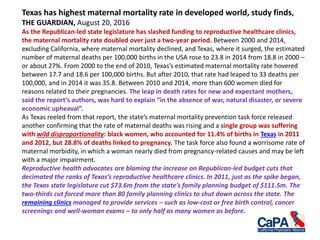
Texas has highest maternal mortality rate in developed world, study finds,
THE GUARDIAN, August 20, 2016
As the Republican-led state legislature has slashed funding to reproductive healthcare clinics,
the maternal mortality rate doubled over just a two-year period. Between 2000 and 2014,
excluding California, where maternal mortality declined, and Texas, where it surged, the estimated
number of maternal deaths per 100,000 births in the USA rose to 23.8 in 2014 from 18.8 in 2000 –
or about 27%. From 2000 to the end of 2010, Texas’s estimated maternal mortality rate hovered
between 17.7 and 18.6 per 100,000 births. But after 2010, that rate had leaped to 33 deaths per
100,000, and in 2014 it was 35.8. Between 2010 and 2014, more than 600 women died for
reasons related to their pregnancies. The leap in death rates for new and expectant mothers,
said the report’s authors, was hard to explain “in the absence of war, natural disaster, or severe
economic upheaval”.
As Texas reeled from that report, the state’s maternal mortality prevention task force released
another confirming that the rate of maternal deaths was rising and a single group was suffering
with wild disproportionality: black women, who accounted for 11.4% of births in Texas in 2011
and 2012, but 28.8% of deaths linked to pregnancy. The task force also found a worrisome rate of
maternal morbidity, in which a woman nearly died from pregnancy-related causes and may be left
with a major impairment.
Reproductive health advocates are blaming the increase on Republican-led budget cuts that
decimated the ranks of Texas’s reproductive healthcare clinics. In 2011, just as the spike began,
the Texas state legislature cut $73.6m from the state’s family planning budget of $111.5m. The
two-thirds cut forced more than 80 family planning clinics to shut down across the state. The
remaining clinics managed to provide services – such as low-cost or free birth control, cancer
screenings and well-woman exams – to only half as many women as before.
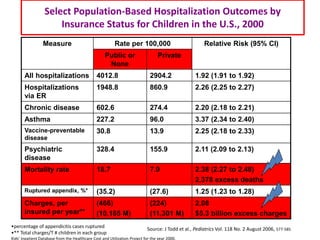
Select Population-Based Hospitalization Outcomes by
Insurance Status for Children in the U.S., 2000
Measure Rate per 100,000 Relative Risk (95% CI)
Public or
None
Private
All hospitalizations 4012.8 2904.2 1.92 (1.91 to 1.92)
Hospitalizations
via ER
1948.8 860.9 2.26 (2.25 to 2.27)
Chronic disease 602.6 274.4 2.20 (2.18 to 2.21)
Asthma 227.2 96.0 3.37 (2.34 to 2.40)
Vaccine-preventable
disease
30.8 13.9 2.25 (2.18 to 2.33)
Psychiatric
disease
328.4 155.9 2.11 (2.09 to 2.13)
Mortality rate 18.7 7.9 2.38 (2.27 to 2.48)
2,378 excess deaths
Ruptured appendix, %* (35.2) (27.6) 1.25 (1.23 to 1.28)
Charges, per
insured per year**
(466)
(10,165 M)
(224)
(11,301 M)
2.08
$5.3 billion excess charges
Source: J Todd et al., Pediatrics Vol. 118 No. 2 August 2006, 577-585
•percentage of appendicitis cases ruptured
•** Total charges/T # children in each group
Kids’ Inpatient Database from the Healthcare Cost and Utilization Project for the year 2000.
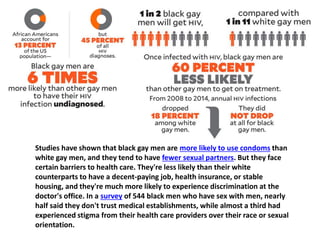
Studies have shown that black gay men are more likely to use condoms than
white gay men, and they tend to have fewer sexual partners. But they face
certain barriers to health care. They're less likely than their white
counterparts to have a decent-paying job, health insurance, or stable
housing, and they're much more likely to experience discrimination at the
doctor's office. In a survey of 544 black men who have sex with men, nearly
half said they don't trust medical establishments, while almost a third had
experienced stigma from their health care providers over their race or sexual
orientation.
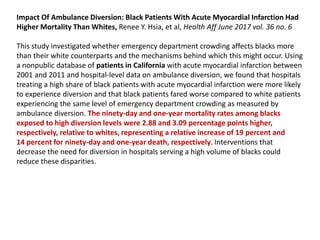
Impact Of Ambulance Diversion: Black Patients With Acute Myocardial Infarction Had
Higher Mortality Than Whites, Renee Y. Hsia, et al, Health Aff June 2017 vol. 36 no. 6
This study investigated whether emergency department crowding affects blacks more
than their white counterparts and the mechanisms behind which this might occur. Using
a nonpublic database of patients in California with acute myocardial infarction between
2001 and 2011 and hospital-level data on ambulance diversion, we found that hospitals
treating a high share of black patients with acute myocardial infarction were more likely
to experience diversion and that black patients fared worse compared to white patients
experiencing the same level of emergency department crowding as measured by
ambulance diversion. The ninety-day and one-year mortality rates among blacks
exposed to high diversion levels were 2.88 and 3.09 percentage points higher,
respectively, relative to whites, representing a relative increase of 19 percent and
14 percent for ninety-day and one-year death, respectively. Interventions that
decrease the need for diversion in hospitals serving a high volume of blacks could
reduce these disparities.
Racial/Ethnic Disparities in Fatal Unintentional Drowning Among Persons
Aged ≤29 Years — United States, 1999–2010, MMR Weekly, May 16, 2014 /
63(19);421-426
In 1962 African-American residents of Jackson, Miss., went to court to challenge
the racial segregation of the city’s five municipal swimming pools, four of which
were set aside for whites and one for blacks. When the plaintiffs won, the Jackson
City Council responded by closing all the pools. No pools, evidently, were preferable
to integrated pools. The black residents renewed their lawsuit, eventually reaching
the Supreme Court and they lost.
In the United States, almost 4,000 persons die from drowning each year. Drowning
is responsible for more deaths among children aged 1–4 years than any other cause
except congenital anomalies. The CDC analyzed combined mortality data from
1999–2010 for those aged ≤29 years. Among non-Hispanics, the overall drowning
rate for American Indians/Alaska Natives (AI/AN) was twice the rate for whites,
and the rate for blacks was 1.4 times the rate for whites. Swimming pool drowning
rates among blacks aged 5–19 years were 5.5 times higher than those among whites
in the same age group. This disparity was greatest at ages 11–12 years; at these
ages, blacks drown in swimming pools at 10 times the rate of whites.
This year, 20-year-old Simone Manuel became the first African-American female to
win an Olympic gold medal in an individual swimming event. When it was time for
Manuel's medal ceremony shortly after, NBC decided to air seven-hour-old footage
of Russian gymnasts instead.
Racial and Ethnic Disparities in Mental Health Care for Children and
Young Adults: A National Study
Psychiatric and behavior problems are common among children and
young adults, and many go without care or only receive treatment in
carceral settings. We examined racial and ethnic disparities in children’s
and young adults’ receipt of mental health and substance abuse care
using nationally representative data from the 2006–2012 Medical
Expenditure Panel Surveys. Blacks’ and Hispanics’ visit rates (and per
capita expenditures) were about half those of non-Hispanic whites for
all types and definitions of outpatient mental health services.
Disparities were generally larger for young adults than for children.
Black and white children had similar psychiatric inpatient and
emergency department utilization rates, while Hispanic children had
lower hospitalization rates. Multivariate control for mental health
impairment, demographics, and insurance status did not attenuate
racial/ethnic disparities in outpatient care. We conclude that
psychiatric and behavioral problems among minority youth often
result in school punishment or incarceration, but rarely mental health
care.
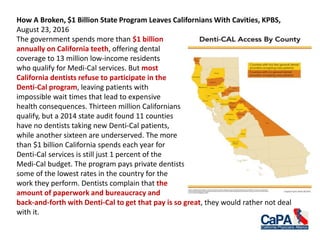
How A Broken, $1 Billion State Program Leaves Californians With Cavities, KPBS,
August 23, 2016
The government spends more than $1 billion
annually on California teeth, offering dental
coverage to 13 million low-income residents
who qualify for Medi-Cal services. But most
California dentists refuse to participate in the
Denti-Cal program, leaving patients with
impossible wait times that lead to expensive
health consequences. Thirteen million Californians
qualify, but a 2014 state audit found 11 counties
have no dentists taking new Denti-Cal patients,
while another sixteen are underserved. The more
than $1 billion California spends each year for
Denti-Cal services is still just 1 percent of the
Medi-Cal budget. The program pays private dentists
some of the lowest rates in the country for the
work they perform. Dentists complain that the
amount of paperwork and bureaucracy and
back-and-forth with Denti-Cal to get that pay is so great, they would rather not deal
with it.
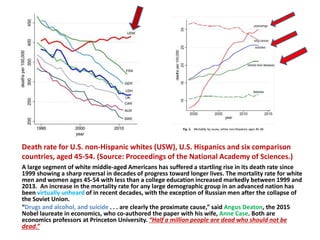
Death rate for U.S. non-Hispanic whites (USW), U.S. Hispanics and six comparison
countries, aged 45-54. (Source: Proceedings of the National Academy of Sciences.)
A large segment of white middle-aged Americans has suffered a startling rise in its death rate since
1999 showing a sharp reversal in decades of progress toward longer lives. The mortality rate for white
men and women ages 45-54 with less than a college education increased markedly between 1999 and
2013. An increase in the mortality rate for any large demographic group in an advanced nation has
been virtually unheard of in recent decades, with the exception of Russian men after the collapse of
the Soviet Union.
“Drugs and alcohol, and suicide . . . are clearly the proximate cause,” said Angus Deaton, the 2015
Nobel laureate in economics, who co-authored the paper with his wife, Anne Case. Both are
economics professors at Princeton University. “Half a million people are dead who should not be
dead.”
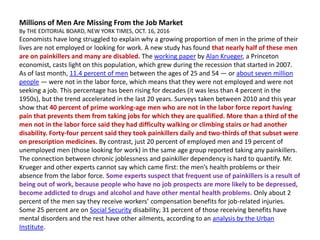
Millions of Men Are Missing From the Job Market
By THE EDITORIAL BOARD, NEW YORK TIMES, OCT. 16, 2016
Economists have long struggled to explain why a growing proportion of men in the prime of their
lives are not employed or looking for work. A new study has found that nearly half of these men
are on painkillers and many are disabled. The working paper by Alan Krueger, a Princeton
economist, casts light on this population, which grew during the recession that started in 2007.
As of last month, 11.4 percent of men between the ages of 25 and 54 — or about seven million
people — were not in the labor force, which means that they were not employed and were not
seeking a job. This percentage has been rising for decades (it was less than 4 percent in the
1950s), but the trend accelerated in the last 20 years. Surveys taken between 2010 and this year
show that 40 percent of prime working-age men who are not in the labor force report having
pain that prevents them from taking jobs for which they are qualified. More than a third of the
men not in the labor force said they had difficulty walking or climbing stairs or had another
disability. Forty-four percent said they took painkillers daily and two-thirds of that subset were
on prescription medicines. By contrast, just 20 percent of employed men and 19 percent of
unemployed men (those looking for work) in the same age group reported taking any painkillers.
The connection between chronic joblessness and painkiller dependency is hard to quantify. Mr.
Krueger and other experts cannot say which came first: the men’s health problems or their
absence from the labor force. Some experts suspect that frequent use of painkillers is a result of
being out of work, because people who have no job prospects are more likely to be depressed,
become addicted to drugs and alcohol and have other mental health problems. Only about 2
percent of the men say they receive workers’ compensation benefits for job-related injuries.
Some 25 percent are on Social Security disability; 31 percent of those receiving benefits have
mental disorders and the rest have other ailments, according to an analysis by the Urban
Institute.
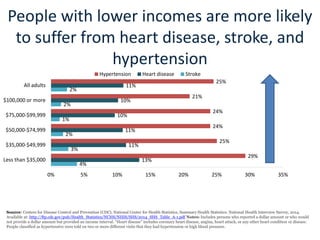
4%
3%
2%
1%
2%
2%
13%
11%
11%
10%
10%
11%
29%
25%
24%
24%
21%
25%
0% 5% 10% 15% 20% 25% 30% 35%
Less than $35,000
$35,000-$49,999
$50,000-$74,999
$75,000-$99,999
$100,000 or more
All adults
Hypertension Heart disease Stroke
Source: Centers for Disease Control and Prevention (CDC), National Center for Health Statistics, Summary Health Statistics: National Health Interview Survey, 2014.
Available at: http://ftp.cdc.gov/pub/Health_Statistics/NCHS/NHIS/SHS/2014_SHS_Table_A-1.pdf Notes: Includes persons who reported a dollar amount or who would
not provide a dollar amount but provided an income interval. “Heart disease” includes coronary heart disease, angina, heart attack, or any other heart condition or disease.
People classified as hypertensive were told on two or more different visits that they had hypertension or high blood pressure.
People with lower incomes are more likely
to suffer from heart disease, stroke, and
hypertension
Comparisons of disparities and risks of HIV infection in black and other men who have
sex with men in Canada, UK, and USA: a meta-analysis
Gregorio A Millett, LANCET, 380, No. 9839, p341–348, 28 July 2012
We analysed 7 studies from Canada, 13 from the UK, and 174 from the USA. In every
country, black MSM were as likely to engage similarly in serodiscordant unprotected sex
as other MSM. Black MSM in Canada and the USA were less likely than other MSM to
have a history of substance use (odds ratio, OR, 0·53, 95% CI 0·38–0·75, for Canada and
0·67, 0·50–0·92, for the USA). Black MSM in the UK (1·86, 1·58–2·18) and the USA (3·00,
2·06–4·40) were more likely to be HIV positive than were other MSM, but HIV-positive
black MSM in each country were less likely (22% in the UK and 60% in the USA) to
initiate combination antiretroviral therapy (cART) than other HIV-positive MSM. US
HIV-positive black MSM were also less likely to have health insurance, have a high CD4
count, adhere to cART, or be virally suppressed than were other US HIV-positive MSM.
Notably, despite a two-fold greater odds of having any structural barrier that increases
HIV risk (eg, unemployment, low income, previous incarceration, or less education)
compared with other US MSM, US black MSM were more likely to report any preventive
behaviour against HIV infection (1·39, 1·23–1·57). For outcomes associated with HIV
infection, disparities were greatest for US black MSM versus other MSM for structural
barriers, sex partner demographics (eg, age, race), and HIV care outcomes, whereas
disparities were least for sexual risk outcomes.
FIGURE 10 Cancer Survival by
Insurance Status*
Primary Care Providers Ordered Fewer Preventive Services For Women With
Medicaid Than For Women With Private Coverage
Stacey McMorrow, Sharon K. Long, Ariel Fogel, Health Aff June 2015
We examined the provision of recommended preventive services to women with Medicaid and those with
private insurance at visits to primary care providers in private office-based practices. The study looked at
12,444 visits to primary care practitioners by privately insured women and 1,519 visits by women who were
covered by Medicaid between 2006 and 2010. We found that after patient and provider characteristics were
controlled for, Medicaid-insured visits were less likely than privately insured visits to include several
preventive services, including clinical breast exams and Pap tests. The differences in provision of services by
payer were generally driven by the differences in care at visits classified as preventive and at visits to
obstetrician-gynecologists.
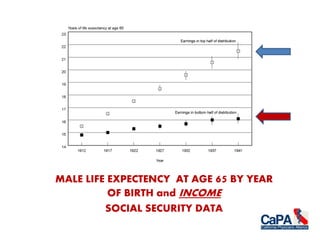
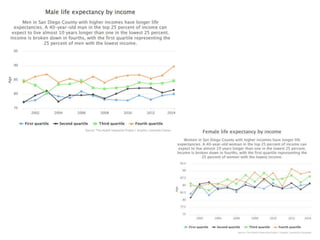
MALE LIFE EXPECTENCY AT AGE 65 BY YEAR
OF BIRTH and INCOME
SOCIAL SECURITY DATA
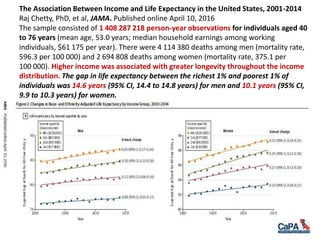
The Association Between Income and Life Expectancy in the United States, 2001-2014
Raj Chetty, PhD, et al, JAMA. Published online April 10, 2016
The sample consisted of 1 408 287 218 person-year observations for individuals aged 40
to 76 years (mean age, 53.0 years; median household earnings among working
individuals, $61 175 per year). There were 4 114 380 deaths among men (mortality rate,
596.3 per 100 000) and 2 694 808 deaths among women (mortality rate, 375.1 per
100 000). Higher income was associated with greater longevity throughout the income
distribution. The gap in life expectancy between the richest 1% and poorest 1% of
individuals was 14.6 years (95% CI, 14.4 to 14.8 years) for men and 10.1 years (95% CI,
9.9 to 10.3 years) for women.
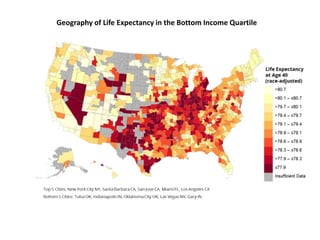
Geography of Life Expectancy in the Bottom Income Quartile
Active Life Expectancy In The Older US Population, 1982–2011: Differences Between
Blacks And Whites Persisted
By Vicki A. Freedman and Brenda C. Spillman, Health Affairs, August 2016
Understanding long-range trends in longevity and disability is useful for projecting the
likely impact of the baby-boom generation on long-term care utilization and spending.
We examine changes in active life expectancy in the United States from 1982 to 2011
for white and black adults ages sixty-five and older. For whites, longevity increased,
disability was postponed to older ages, the locus of care shifted from nursing facilities
to community settings, and the proportion of life at older ages spent without
disability increased. In contrast, for blacks, longevity increases were accompanied by
smaller postponements in disability, and the percentage of remaining life spent
active remained stable and well below that of whites. Older black women were
especially disadvantaged in 2011 in terms of the proportion of years expected to be
lived without disability. Public health measures directed at older black adults —
particularly women — are needed to offset impending pressures on the long-term care
delivery system as the result of population aging
PART 2: VALUES IN HEALTH CARE:
THE MORAL AND ETHICAL IMPERATIVE
The Values of a Healthy Society
“Health Care is a Human Right”
(1) MAXIMIZE HEALTHY STATES (provide good,
quality medical care)
(2) COMPASSION and CARING (relieve individual
pain, suffering and anxiety)
(3) SOCIAL and ECONOMIC JUSTICE (provide for the
vulnerable )
(4) CIVIC RESPONSIBILITY (society as a
commonwealth)
It was Ronald Reagan who
said “freedom is always just
one generation away from
extinction. We don’t pass it
to our children in the
bloodstream; we have to
fight for it and protect it, and
then hand it to them so that
they shall do the same, or
we’re going to find ourselves
spending our sunset years
telling our children and our
children’s children about a
time in America, back in the
day, when men and women
were free.”
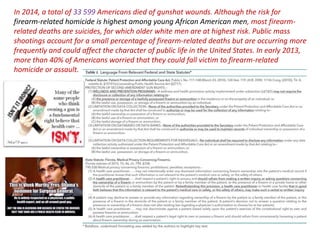
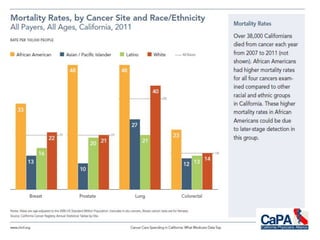
In 2014, a total of 33 599 Americans died of gunshot wounds. Although the risk for
firearm-related homicide is highest among young African American men, most firearm-
related deaths are suicides, for which older white men are at highest risk. Public mass
shootings account for a small percentage of firearm-related deaths but are occurring more
frequently and could affect the character of public life in the United States. In early 2013,
more than 40% of Americans worried that they could fall victim to firearm-related
homicide or assault.
HEALTH REFORM:
THE GOOD, THE BAD, and the UGLY
JEOFFRY B. GORDON, MD, MPH
paradocs2@hotmail.com
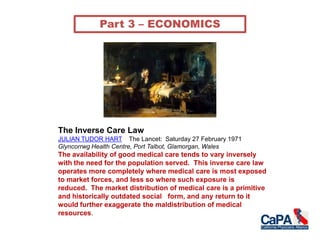
The Inverse Care Law
JULIAN TUDOR HART The Lancet: Saturday 27 February 1971
Glyncorrwg Health Centre, Port Talbot, Glamorgan, Wales
The availability of good medical care tends to vary inversely
with the need for the population served. This inverse care law
operates more completely where medical care is most exposed
to market forces, and less so where such exposure is
reduced. The market distribution of medical care is a primitive
and historically outdated social form, and any return to it
would further exaggerate the maldistribution of medical
resources.
Part 3 – ECONOMICS
PATIENTS ARE NOT GOOD CONSUMERS
• Producing, purchasing and using medical care is profoundly
different from manufacturing, selling, purchasing and using a car, a
blouse, a refrigerator, a haircut, a college class, or an accountant.
• (1) Even among the well educated there is a tremendous asymmetry
between the doctor and the patient in the esoteric technical
knowledge and judgment needed for the application of competent
and effective medical care.
• (2) A person who has an accident or an illness has very little
opportunity or capacity to shop around and compare either price or
quality. Usually the sicker and more acutely ill the patient, the less
this capacity will be.
• (3) During any illness it may be impossible or even catastrophically
dangerous for a patient to try out (consume) one set of treatments
and then choose to switch to another.
Arrow, Kenneth J. Uncertainty and the welfare economics of medical
care. The American Economic Review 1963;53:941-73.
PATIENTS ARE NOT GOOD CONSUMERS
• (4) Enduring and managing an illness or an accident inherently involves a
huge number of emotional factors, thus impairing “rational” consumer
choice.
• (5) Under the necessary insurance system the consumer/patient is mostly
insulated from the anticipated or actual purchase prices and costs
anticipated or actually incurred.
• (6) It is not unusual for a bout of illness to require the sudden purchase of
medical care which will be literally catastrophically expensive, yet to
forego it is to invite personal tragedy and face ongoing pain, disability or
even death.
• (7) The purchaser of most medical services and supplies and thus the
generator of most medical spending is the doctor, not the patient. (Yet
most doctors are, in fact, usually ignorant of the costs or the charges for
most of what they order.)
• (8) Under our current system many Americans do not have health
insurance and are overwhelmingly without personal resources. Thus they
are unable to buy into the market.
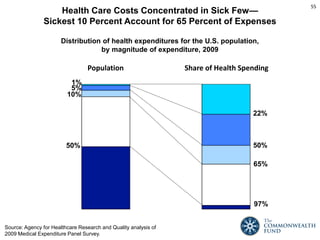
Health Care Costs Concentrated in Sick Few—
Sickest 10 Percent Account for 65 Percent of Expenses
Source: Agency for Healthcare Research and Quality analysis of
2009 Medical Expenditure Panel Survey.
Distribution of health expenditures for the U.S. population,
by magnitude of expenditure, 2009
1%
5%
10%
50%
65%
22%
50%
97%
Population Share of Health Spending
55
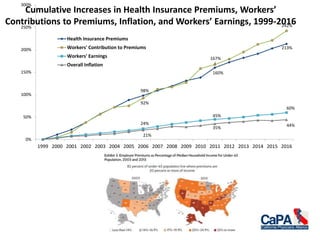
Cumulative Increases in Health Insurance Premiums, Workers’
Contributions to Premiums, Inflation, and Workers’ Earnings, 1999-2016
98%
160%
213%
92%
167%
242%
24%
45%
60%
21%
35%
44%
0%
50%
100%
150%
200%
250%
300%
1999 2000 2001 2002 2003 2004 2005 2006 2007 2008 2009 2010 2011 2012 2013 2014 2015 2016
Health Insurance Premiums
Workers' Contribution to Premiums
Workers' Earnings
Overall Inflation
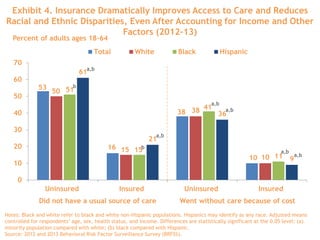
Exhibit 4. Insurance Dramatically Improves Access to Care and Reduces
Racial and Ethnic Disparities, Even After Accounting for Income and Other
Factors (2012–13)
Notes: Black and white refer to black and white non-Hispanic populations. Hispanics may identify as any race. Adjusted means
controlled for respondents’ age, sex, health status, and income. Differences are statistically significant at the 0.05 level: (a)
minority population compared with white; (b) black compared with Hispanic.
Source: 2012 and 2013 Behavioral Risk Factor Surveillance Survey (BRFSS).
53
16
38
10
50
15
38
10
51
15
41
11
61
21
36
9
0
10
20
30
40
50
60
70
Uninsured Insured Uninsured Insured
Total White Black Hispanic
Went without care because of costDid not have a usual source of care
Percent of adults ages 18–64
a,b
a,b
a,b
a,b
a,b
a,b
b
b
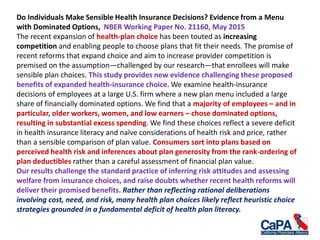
Do Individuals Make Sensible Health Insurance Decisions? Evidence from a Menu
with Dominated Options, NBER Working Paper No. 21160, May 2015
The recent expansion of health-plan choice has been touted as increasing
competition and enabling people to choose plans that fit their needs. The promise of
recent reforms that expand choice and aim to increase provider competition is
premised on the assumption—challenged by our research—that enrollees will make
sensible plan choices. This study provides new evidence challenging these proposed
benefits of expanded health-insurance choice. We examine health-insurance
decisions of employees at a large U.S. firm where a new plan menu included a large
share of financially dominated options. We find that a majority of employees – and in
particular, older workers, women, and low earners – chose dominated options,
resulting in substantial excess spending. We find these choices reflect a severe deficit
in health insurance literacy and naïve considerations of health risk and price, rather
than a sensible comparison of plan value. Consumers sort into plans based on
perceived health risk and inferences about plan generosity from the rank-ordering of
plan deductibles rather than a careful assessment of financial plan value.
Our results challenge the standard practice of inferring risk attitudes and assessing
welfare from insurance choices, and raise doubts whether recent health reforms will
deliver their promised benefits. Rather than reflecting rational deliberations
involving cost, need, and risk, many health plan choices likely reflect heuristic choice
strategies grounded in a fundamental deficit of health plan literacy.
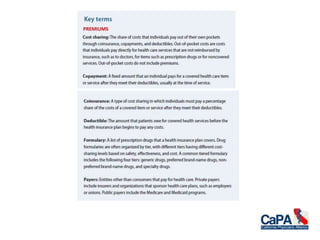
PREMIUMS
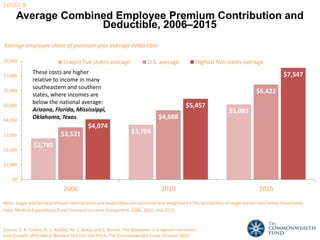
Source: S. R. Collins, D. C. Radley, M. Z. Gunja and S. Beutel, The Slowdown in Employer Insurance
Cost Growth: Why Many Workers Still Feel the Pinch, The Commonwealth Fund, October 2016.
$2,785
$3,704
$5,083
$3,531
$4,688
$6,422
$4,074
$5,457
$7,547
$0
$1,000
$2,000
$3,000
$4,000
$5,000
$6,000
$7,000
$8,000
2006 2010 2015
Lowest five states average U.S. average Highest five states average
Exhibit 8
Average Combined Employee Premium Contribution and
Deductible, 2006–2015
Note: Single and family premium contributions and deductibles are combined and weighted for the distribution of single-person and family households.
Data: Medical Expenditure Panel Survey–Insurance Component, 2006, 2010, and 2015.
Average employee share of premium plus average deductible
These costs are higher
relative to income in many
southeastern and southern
states, where incomes are
below the national average:
Arizona, Florida, Mississippi,
Oklahoma, Texas.
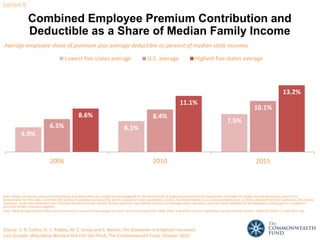
Source: S. R. Collins, D. C. Radley, M. Z. Gunja and S. Beutel, The Slowdown in Employer Insurance
Cost Growth: Why Many Workers Still Feel the Pinch, The Commonwealth Fund, October 2016.
4.9%
6.1%
7.5%
6.5%
8.4%
10.1%
8.6%
11.1%
13.2%
2006 2010 2015
Lowest five states average U.S. average Highest five states average
Exhibit 9
Combined Employee Premium Contribution and
Deductible as a Share of Median Family Income
Note: Single and family premium contributions and deductibles are combined and weighted for the distribution of single-person and family households. Estimates of median household income used in the
denominator for this ratio come from the Current Population Survey (CPS), which revised its income questions in 2013. The denominator in our ratio estimates prior to 2014 is derived from the traditional CPS income
questions, while ratio estimates from 2014 are derived from the revised income questions. Household incomes are averaged over two years, and have been adjusted for the likelihood that people in a residence
purchase health insurance together.
Data: Medical Expenditure Panel Survey–Insurance Component (employee premium share and deductible, 2006, 2010, and 2015); Current Population Survey (median income, 2006–07, 2010–11, and 2015–16).
Average employee share of premium plus average deductible as percent of median state incomes
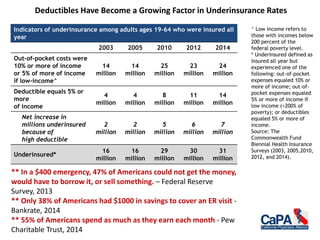
Deductibles Have Become a Growing Factor in Underinsurance Rates
Indicators of underinsurance among adults ages 19–64 who were insured all
year
2003 2005 2010 2012 2014
Out-of-pocket costs were
10% or more of income
or 5% of more of income
if low-income^
14
million
14
million
25
million
23
million
24
million
Deductible equals 5% or
more
of income
4
million
4
million
8
million
11
million
14
million
Net increase in
millions underinsured
because of
high deductible
2
million
2
million
5
million
6
million
7
million
Underinsured*
16
million
16
million
29
million
30
million
31
million
^ Low income refers to
those with incomes below
200 percent of the
federal poverty level.
* Underinsured defined as
insured all year but
experienced one of the
following: out-of-pocket
expenses equaled 10% or
more of income; out-of-
pocket expenses equaled
5% or more of income if
low income (<200% of
poverty); or deductibles
equaled 5% or more of
income.
Source: The
Commonwealth Fund
Biennial Health Insurance
Surveys (2003, 2005,2010,
2012, and 2014).
** In a $400 emergency, 47% of Americans could not get the money,
would have to borrow it, or sell something. – Federal Reserve
Survey, 2013
** Only 38% of Americans had $1000 in savings to cover an ER visit -
Bankrate, 2014
** 55% of Americans spend as much as they earn each month - Pew
Charitable Trust, 2014
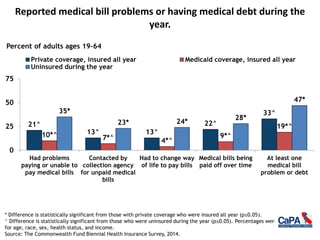
Reported medical bill problems or having medical debt during the
year.
* Difference is statistically significant from those with private coverage who were insured all year (p≤0.05).
^ Difference is statistically significant from those who were uninsured during the year (p≤0.05). Percentages were adjusted
for age, race, sex, health status, and income.
Source: The Commonwealth Fund Biennial Health Insurance Survey, 2014.
21^
13^ 13^
22^
33^
10*^ 7*^ 4*^
9*^
19*^
35*
23* 24*
28*
47*
0
25
50
75
Had problems
paying or unable to
pay medical bills
Contacted by
collection agency
for unpaid medical
bills
Had to change way
of life to pay bills
Medical bills being
paid off over time
At least one
medical bill
problem or debt
Private coverage, insured all year Medicaid coverage, insured all year
Uninsured during the year
Percent of adults ages 19–64
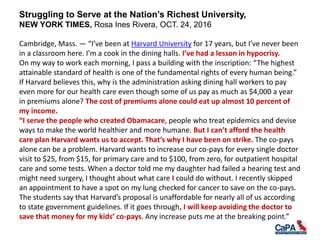
Struggling to Serve at the Nation’s Richest University,
NEW YORK TIMES, Rosa Ines Rivera, OCT. 24, 2016
Cambridge, Mass. — “I’ve been at Harvard University for 17 years, but I’ve never been
in a classroom here. I’m a cook in the dining halls. I’ve had a lesson in hypocrisy.
On my way to work each morning, I pass a building with the inscription: “The highest
attainable standard of health is one of the fundamental rights of every human being.”
If Harvard believes this, why is the administration asking dining hall workers to pay
even more for our health care even though some of us pay as much as $4,000 a year
in premiums alone? The cost of premiums alone could eat up almost 10 percent of
my income.
“I serve the people who created Obamacare, people who treat epidemics and devise
ways to make the world healthier and more humane. But I can’t afford the health
care plan Harvard wants us to accept. That’s why I have been on strike. The co-pays
alone can be a problem. Harvard wants to increase our co-pays for every single doctor
visit to $25, from $15, for primary care and to $100, from zero, for outpatient hospital
care and some tests. When a doctor told me my daughter had failed a hearing test and
might need surgery, I thought about what care I could do without. I recently skipped
an appointment to have a spot on my lung checked for cancer to save on the co-pays.
The students say that Harvard’s proposal is unaffordable for nearly all of us according
to state government guidelines. If it goes through, I will keep avoiding the doctor to
save that money for my kids’ co-pays. Any increase puts me at the breaking point.”
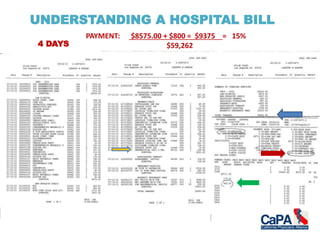
UNDERSTANDING A HOSPITAL BILL
4 DAYS
PAYMENT: $8575.00 + $800 = $9375 = 15%
$59,262
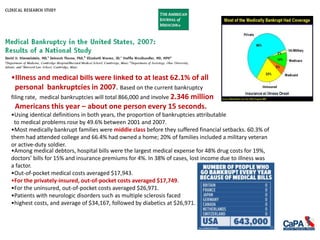
•Among medical debtors, hospital bills were the largest medical expense for 48% drug costs for 19%,
doctors’ bills for 15% and insurance premiums for 4%. In 38% of cases, lost income due to illness was
a factor.
•Out-of-pocket medical costs averaged $17,943.
•For the privately-insured, out-of-pocket costs averaged $17,749.
•For the uninsured, out-of-pocket costs averaged $26,971.
•Patients with neurologic disorders such as multiple sclerosis faced
•highest costs, and average of $34,167, followed by diabetics at $26,971.
•Illness and medical bills were linked to at least 62.1% of all
personal bankruptcies in 2007. Based on the current bankruptcy
filing rate, medical bankruptcies will total 866,000 and involve 2.346 million
Americans this year – about one person every 15 seconds.
•Using identical definitions in both years, the proportion of bankruptcies attributable
to medical problems rose by 49.6% between 2001 and 2007.
•Most medically bankrupt families were middle class before they suffered financial setbacks. 60.3% of
them had attended college and 66.4% had owned a home; 20% of families included a military veteran
or active-duty soldier.
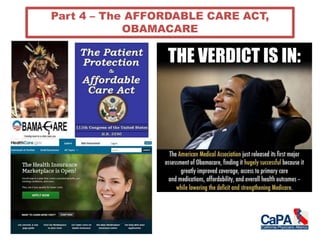
Part 4 – The AFFORDABLE CARE ACT,
OBAMACARE
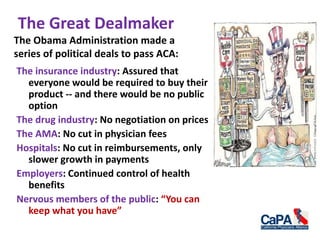
The Great Dealmaker
The Obama Administration made a
series of political deals to pass ACA:
The insurance industry: Assured that
everyone would be required to buy their
product -- and there would be no public
option
The drug industry: No negotiation on prices
The AMA: No cut in physician fees
Hospitals: No cut in reimbursements, only
slower growth in payments
Employers: Continued control of health
benefits
Nervous members of the public: “You can
keep what you have”
The ACA mandated
(1) An “essential health benefits” package, more
extensive than what most individuals and small
businesses already purchase.
(2) An age band so that the amount an older
individual pays will be no more than three times
what a younger individual pays.
(3) Same rates for men and women.
(4) No cost preventive services.
(5) Eliminated insurance companies’ rejection of
applicants or charging premiums due to pre-
existing medical conditions.
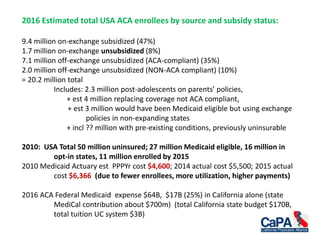
2016 Estimated total USA ACA enrollees by source and subsidy status:
9.4 million on-exchange subsidized (47%)
1.7 million on-exchange unsubsidized (8%)
7.1 million off-exchange unsubsidized (ACA-compliant) (35%)
2.0 million off-exchange unsubsidized (NON-ACA compliant) (10%)
= 20.2 million total
Includes: 2.3 million post-adolescents on parents’ policies,
+ est 4 million replacing coverage not ACA compliant,
+ est 3 million would have been Medicaid eligible but using exchange
policies in non-expanding states
+ incl ?? million with pre-existing conditions, previously uninsurable
2010: USA Total 50 million uninsured; 27 million Medicaid eligible, 16 million in
opt-in states, 11 million enrolled by 2015
2010 Medicaid Actuary est PPPYr cost $4,600; 2014 actual cost $5,500; 2015 actual
cost $6,366 (due to fewer enrollees, more utilization, higher payments)
2016 ACA Federal Medicaid expense $64B, $17B (25%) in California alone (state
MediCal contribution about $700m) (total California state budget $170B,
total tuition UC system $3B)
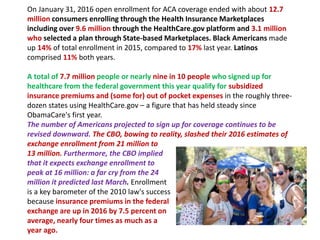
On January 31, 2016 open enrollment for ACA coverage ended with about 12.7
million consumers enrolling through the Health Insurance Marketplaces
including over 9.6 million through the HealthCare.gov platform and 3.1 million
who selected a plan through State-based Marketplaces. Black Americans made
up 14% of total enrollment in 2015, compared to 17% last year. Latinos
comprised 11% both years.
A total of 7.7 million people or nearly nine in 10 people who signed up for
healthcare from the federal government this year qualify for subsidized
insurance premiums and (some for) out of pocket expenses in the roughly three-
dozen states using HealthCare.gov – a figure that has held steady since
ObamaCare's first year.
The number of Americans projected to sign up for coverage continues to be
revised downward. The CBO, bowing to reality, slashed their 2016 estimates of
exchange enrollment from 21 million to
13 million. Furthermore, the CBO implied
that it expects exchange enrollment to
peak at 16 million: a far cry from the 24
million it predicted last March. Enrollment
is a key barometer of the 2010 law's success
because insurance premiums in the federal
exchange are up in 2016 by 7.5 percent on
average, nearly four times as much as a
year ago.
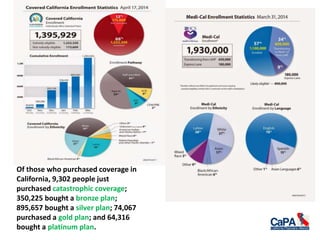
Of those who purchased coverage in
California, 9,302 people just
purchased catastrophic coverage;
350,225 bought a bronze plan;
895,657 bought a silver plan; 74,067
purchased a gold plan; and 64,316
bought a platinum plan.
Insurance Expansion Improved Care for Colorectal Cancer, October 04, 2016
Past research had shown that patients without health insurance typically presented with more
advanced colorectal cancer disease and had lower survival rates compared with patients with
private insurance. The expansion of healthcare in Massachusetts in 2006 was associated with
increased rates of resection, and a decreased likelihood of emergent resection, for patients with
colorectal cancer, according to the results of a study published in the Journal of Clinical Oncology. The
study identified 17,499 patients with government-subsidized, self-pay, or private insurance
admitted to the hospital between 2001 and 2011 in Massachusetts and compared them with
144,253 control patients from three states.
The 2006 Massachusetts health insurance expansion provided Medicaid coverage for people living
below 150% of the federal poverty limit, created a state-subsidized insurance program for people with
income less than 300% of the federal poverty limit but who remained ineligible for Medicaid, and
established an individual mandate requiring all residents to have health insurance.
The comparison showed that prior to the 2006 health insurance reform, those patients with
government-subsidized or self-pay insurance had significantly lower rates of resection for colorectal
cancer compared with patients with private insurance.
The health insurance reform was independently associated with a 44% increased rate of resection
for government-subsidized or self-pay patients (incident rate ratio [IRR], 1.44 [95% CI, 1.23–1.68]; P <
.001). More specifically, the reform was associated with a 49% increased rate of resection for colon
cancer and a 34% increase in resection for rectal cancer. The Massachusetts insurance expansion
was also associated with a 6.21 percentage point decreased probability of emergent admission (95%
CI, −11.88 to −0.54; P = .032) and an 8.13 percentage point increased probability of an elective
admission (95% CI, 1.34–14.91; P = .019) compared with the control states.
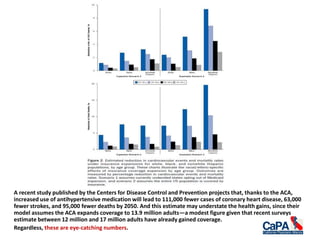
A recent study published by the Centers for Disease Control and Prevention projects that, thanks to the ACA,
increased use of antihypertensive medication will lead to 111,000 fewer cases of coronary heart disease, 63,000
fewer strokes, and 95,000 fewer deaths by 2050. And this estimate may understate the health gains, since their
model assumes the ACA expands coverage to 13.9 million adults—a modest figure given that recent surveys
estimate between 12 million and 17 million adults have already gained coverage.
Regardless, these are eye-catching numbers.
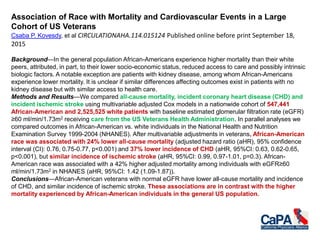
Association of Race with Mortality and Cardiovascular Events in a Large
Cohort of US Veterans
Csaba P. Kovesdy, et al CIRCULATIONAHA.114.015124 Published online before print September 18,
2015
Background—In the general population African-Americans experience higher mortality than their white
peers, attributed, in part, to their lower socio-economic status, reduced access to care and possibly intrinsic
biologic factors. A notable exception are patients with kidney disease, among whom African-Americans
experience lower mortality. It is unclear if similar differences affecting outcomes exist in patients with no
kidney disease but with similar access to health care.
Methods and Results—We compared all-cause mortality, incident coronary heart disease (CHD) and
incident ischemic stroke using multivariable adjusted Cox models in a nationwide cohort of 547,441
African-American and 2,525,525 white patients with baseline estimated glomerular filtration rate (eGFR)
≥60 ml/min/1.73m2 receiving care from the US Veterans Health Administration. In parallel analyses we
compared outcomes in African-American vs. white individuals in the National Health and Nutrition
Examination Survey 1999-2004 (NHANES). After multivariable adjustments in veterans, African-American
race was associated with 24% lower all-cause mortality (adjusted hazard ratio (aHR), 95% confidence
interval (CI): 0.76, 0.75-0.77, p<0.001) and 37% lower incidence of CHD (aHR, 95%CI: 0.63, 0.62-0.65,
p<0.001), but similar incidence of ischemic stroke (aHR, 95%CI: 0.99, 0.97-1.01, p=0.3). African-
American race was associated with a 42% higher adjusted mortality among individuals with eGFR≥60
ml/min/1.73m2 in NHANES (aHR, 95%CI: 1.42 (1.09-1.87)).
Conclusions—African-American veterans with normal eGFR have lower all-cause mortality and incidence
of CHD, and similar incidence of ischemic stroke. These associations are in contrast with the higher
mortality experienced by African-American individuals in the general US population.
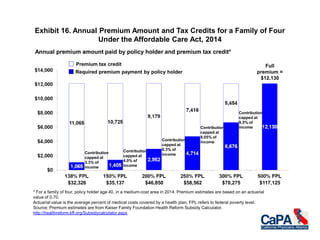
Annual premium amount paid by policy holder and premium tax credit*
Exhibit 16. Annual Premium Amount and Tax Credits for a Family of Four
Under the Affordable Care Act, 2014
* For a family of four, policy holder age 40, in a medium-cost area in 2014. Premium estimates are based on an actuarial
value of 0.70.
Actuarial value is the average percent of medical costs covered by a health plan. FPL refers to federal poverty level.
Source: Premium estimates are from Kaiser Family Foundation Health Reform Subsidy Calculator,
http://healthreform.kff.org/Subsidycalculator.aspx.
Full
premium =
$12,130
Required premium payment by policy holder
Premium tax credit
Contribution
capped at
3.3% of
income
Contribution
capped at
4.0% of
income
Contribution
capped at
6.3% of
income
Contribution
capped at
8.05% of
income
Contribution
capped at
9.5% of
income
$32,326 $35,137 $46,850 $58,562 $70,275 $117,125
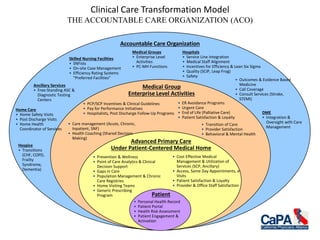
Clinical Care Transformation Model
THE ACCOUNTABLE CARE ORGANIZATION (ACO)
Patient
Advanced Primary Care
Under Patient-Centered Medical Home
Medical Group
Enterprise Level Activities
Accountable Care Organization
Hospitals
• Service Line Integration
• Medical Staff Alignment
• Incentives for Efficiency & Lean Six Sigma
• Quality (SCIP, Leap Frog)

• Safety
Medical Groups
• Enterprise Level
Activities
• PC-MH Functions
Skilled Nursing Facilities
• SNFists
• On-site Case Management
• Efficiency Rating Systems
“Preferred Facilities”
Ancillary Services
• Free-Standing ASC &
Diagnostic Testing
Centers
Home Care
• Home Safety Visits
• Post Discharge Visits
• Home Health
Coordinator of Services
Hospice
• Transitions
(CHF, COPD,
Frailty
Syndrome,
Dementia)
• PCP/SCP Incentives & Clinical Guidelines
• Pay for Performance Initiatives
• Hospitalists, Post Discharge Follow-Up Programs DME
• Integration &
Oversight with Care
Management
• Outcomes & Evidence Based
Medicine
• Call Coverage
• Consult Services (Stroke,
STEMI)
• ER Avoidance Programs
• Urgent Care
• End of Life (Palliative Care)
• Patient Satisfaction & Loyalty
• Personal Health Record
• Patient Portal
• Health Risk Assessment
• Patient Engagement &
Activation
• Prevention & Wellness
• Point of Care Analytics & Clinical
Decision Support
• Gaps in Care
• Population Management & Chronic
Care Registries
• Home Visiting Teams
• Generic Prescribing
Program
• Cost Effective Medical
Management & Utilization of
Services (SCP, Ancillary)
• Access, Same Day Appointments, e-
Visits
• Patient Satisfaction & Loyalty
• Provider & Office Staff Satisfaction
• Care management (Acute, Chronic,
Inpatient, SNF)
• Health Coaching (Shared Decision
Making)
• Transition of Care
• Provider Satisfaction
• Behavioral & Mental Health
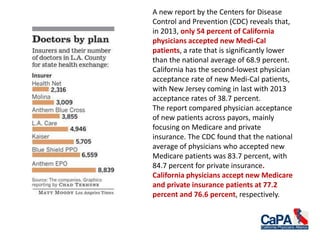
A new report by the Centers for Disease
Control and Prevention (CDC) reveals that,
in 2013, only 54 percent of California
physicians accepted new Medi-Cal
patients, a rate that is significantly lower
than the national average of 68.9 percent.
California has the second-lowest physician
acceptance rate of new Medi-Cal patients,
with New Jersey coming in last with 2013
acceptance rates of 38.7 percent.
The report compared physician acceptance
of new patients across payors, mainly
focusing on Medicare and private
insurance. The CDC found that the national
average of physicians who accepted new
Medicare patients was 83.7 percent, with
84.7 percent for private insurance.
California physicians accept new Medicare
and private insurance patients at 77.2
percent and 76.6 percent, respectively.
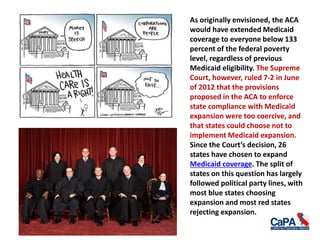
As originally envisioned, the ACA
would have extended Medicaid
coverage to everyone below 133
percent of the federal poverty
level, regardless of previous
Medicaid eligibility. The Supreme
Court, however, ruled 7-2 in June
of 2012 that the provisions
proposed in the ACA to enforce
state compliance with Medicaid
expansion were too coercive, and
that states could choose not to
implement Medicaid expansion.
Since the Court’s decision, 26
states have chosen to expand
Medicaid coverage. The split of
states on this question has largely
followed political party lines, with
most blue states choosing
expansion and most red states
rejecting expansion.
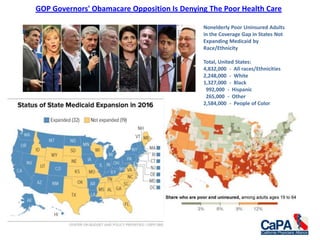
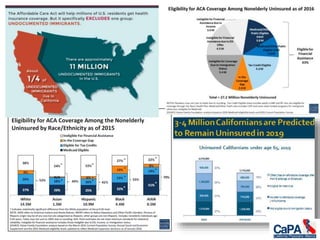
GOP Governors' Obamacare Opposition Is Denying The Poor Health Care
Millions of Poor Are Left Uncovered by Health Law
Nonelderly Poor Uninsured Adults
in the Coverage Gap in States Not
Expanding Medicaid by
Race/Ethnicity
Total, United States:
4,832,000 - All races/Ethnicities
2,248,000 - White
1,327,000 - Black
992,000 - Hispanic
265,000 - Other
2,584,000 - People of Color
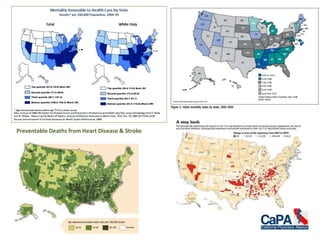
Preventable Deaths from Heart Disease & Stroke
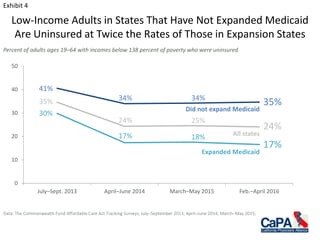
Low-Income Adults in States That Have Not Expanded Medicaid
Are Uninsured at Twice the Rates of Those in Expansion States
Exhibit 4
0
10
20
30
40
50
July–Sept. 2013 April–June 2014 March–May 2015 Feb.–April 2016
Data: The Commonwealth Fund Affordable Care Act Tracking Surveys, July–September 2013, April–June 2014, March–May 2015, and February–April 2016.
Percent of adults ages 19–64 with incomes below 138 percent of poverty who were uninsured
All states
Expanded Medicaid
Did not expand Medicaid
35%
17%
24%
41%
30%
35% 34%
17%
24%
34%
18%
25%
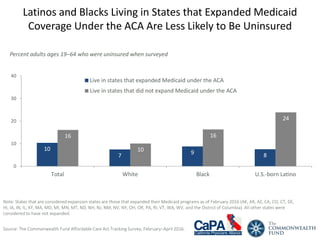
10
7 9 8
16
10
16
24
0
10
20
30
40
Total White Black U.S.-born Latino
Live in states that expanded Medicaid under the ACA
Live in states that did not expand Medicaid under the ACA
Latinos and Blacks Living in States that Expanded Medicaid
Coverage Under the ACA Are Less Likely to Be Uninsured
Note: States that are considered expansion states are those that expanded their Medicaid programs as of February 2016 (AK, AR, AZ, CA, CO, CT, DE,
HI, IA, IN, IL, KY, MA, MD, MI, MN, MT, ND, NH, NJ, NM, NV, NY, OH, OR, PA, RI, VT, WA, WV, and the District of Columbia). All other states were
considered to have not expanded.
Percent adults ages 19–64 who were uninsured when surveyed
Source: The Commonwealth Fund Affordable Care Act Tracking Survey, February–April 2016.
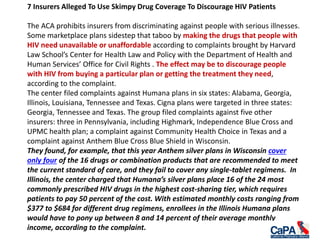
7 Insurers Alleged To Use Skimpy Drug Coverage To Discourage HIV Patients
The ACA prohibits insurers from discriminating against people with serious illnesses.
Some marketplace plans sidestep that taboo by making the drugs that people with
HIV need unavailable or unaffordable according to complaints brought by Harvard
Law School’s Center for Health Law and Policy with the Department of Health and
Human Services’ Office for Civil Rights . The effect may be to discourage people
with HIV from buying a particular plan or getting the treatment they need,
according to the complaint.
The center filed complaints against Humana plans in six states: Alabama, Georgia,
Illinois, Louisiana, Tennessee and Texas. Cigna plans were targeted in three states:
Georgia, Tennessee and Texas. The group filed complaints against five other
insurers: three in Pennsylvania, including Highmark, Independence Blue Cross and
UPMC health plan; a complaint against Community Health Choice in Texas and a
complaint against Anthem Blue Cross Blue Shield in Wisconsin.
They found, for example, that this year Anthem silver plans in Wisconsin cover
only four of the 16 drugs or combination products that are recommended to meet
the current standard of care, and they fail to cover any single-tablet regimens. In
Illinois, the center charged that Humana’s silver plans place 16 of the 24 most
commonly prescribed HIV drugs in the highest cost-sharing tier, which requires
patients to pay 50 percent of the cost. With estimated monthly costs ranging from
$377 to $684 for different drug regimens, enrollees in the Illinois Humana plans
would have to pony up between 8 and 14 percent of their average monthly
income, according to the complaint.
Affordable Care Act: imploding and beyond repair
By John Geyman, MD, THE HILL, October 21, 2016
Despite the ACA’s goals of containing costs and making health care affordable, in the first six and a half years it’s
proven to be too expensive to be sustainable, overly complex and bureaucratic, and a gift to the private health
insurance industry and other corporate stakeholders in the medical-industrial complex.
To be fair, the ACA has brought some kind of coverage to about 20 million Americans, in good part through the
expansion of Medicaid in 32 states (including D.C.) and the subsidized exchanges. But its negative results far
outweigh its gains, as shown by these data points:
• We still have 29 million uninsured Americans (compared to 48 million at the start), plus tens of millions
underinsured.
• Sign-ups for ACA coverage on the exchanges have fallen far short of expectations – just 11 million this year
compared to 24 million forecasted, with many people unable to afford even subsidized coverage.
• The costs of insurance and health care now exceed $25,000 for a family of four covered by an average employer-
sponsored PPO plan.
• Insurance plan deductibles and co-pays have sharply increased, deterring people from necessary care.
• Narrowed networks under the ACA have forced many millions of patients to change their desired physicians and
hospitals.
• The ACA has accelerated a national trend of corporate consolidation of insurers and hospitals, with growing
market and political power. Expanding hospital systems, facing less competition, are free to charge much higher
prices, by up 40 percent to 50 percent.
• The ACA’s regulation of health insurers has been lax, leaving insurers many ways to game the system (e.g. by
overstating the health risks of their enrollees) in their self-interest.
• Pharmaceutical drug prices have been sharply increasing, often shockingly so. A one-year course of cancer drugs
often exceeds $200,000, forcing many patients to choose between bankruptcy and treatment.
• The ACA’s accountable care organizations have failed to contain costs and improve quality of care.
• Most of the nonprofit co-ops established under the ACA have failed.
• Premium increases averaging 25 percent for 2017 are being reported in a number of states while many insurers
are exiting their markets.
The Affordable Care Act is having problems. But Republicans who say those problems are caused by “big
government” have it exactly backward. Obamacare’s current difficulties are grounded in its reliance on
“market forces.” In all likelihood, the private sector will never be able to provide universal, affordable health
coverage. Government isn’t the problem here. It’s the solution.
The flaws are real. One person in five on the exchanges will have no choice of insurers next year. Premiums
for “mid range” plans – which offer fairly paltry coverage – will increase by an average of 25 percent,
according to the Administration. States like Arizona are faring even worse, with an average projected increase
of 116 percent. Many people have found insurance on the exchanges to be unaffordable and are taking a tax
penalty instead. And while lower-income people will see their premium costs offset by subsidies, those
subsidies represent a shifting of wealth from the general public to for-profit insurance corporations.
The policy heart of the ACA is the individual mandate to purchase health insurance, which was crafted at a
right-wing think tank. A number of its other key provisions had GOP roots too, including the “marketplaces.”
The ACA’s deepest problems stem from assumptions built into its design – assumptions that its backers
described at the time as “technical” and “wonkish,” but which were in fact deeply ideological at their core.
These assumptions were rooted in a misplaced faith in private-sector market forces.
How did market myths distort the ACA? First, market forces can’t function without competition. And yet in
2009, before the Affordable Care Act was signed into law, several studies found that 94 percent of all health
insurance markets in the United States were “highly concentrated.” Second, the ACA also relied on free-
market ideology to “bend the cost curve,” assuming that insurers would compete to cut costs in order to gain
market share. But health insurers have relied on less productive tactics like mergers and market dominance
to boost their profits instead. Third the ACA used ideologically biased theory to justify penalizing “generous”
health plans with extra taxes if their coverage became too costly. Fourth the ACA also suffered from the
ideologically-driven notion that people who fail to purchase private-sector insurance coverage are guilty of
a moral lapse.
-------Richard Eskow,October 31, 2016
FHCSD MAKES A DIFFERENCE
FHC has 55 locations, 36 service sites, including 19 primary care clinics (most
offering integrated mental health services), 6 dental clinics and 4 behavioral
health facilities. Annually, Family Health Centers of San Diego provides care to
more than 180,000 patients through more than 677,000 encounters. Together we
spend over $160 million a year. We have about 1500 employees, including 120
FTE primary care medical practitioners, including pediatricians and obstetricians
and 6 FTE dentists. Our patients give us a 93% positive satisfaction rating. We are
training 12 doctors in their family medicine residency. We coordinate services
with all local hospitals. We are an accredited federally qualified health center
and a primary care medical home.
We do not accept that being poor, mentally or physically disabled, or a having a
minority background in America means going without quality health care and
respect.
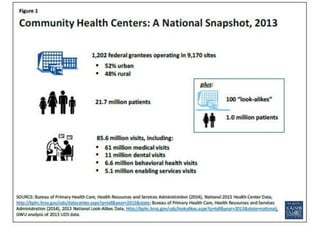
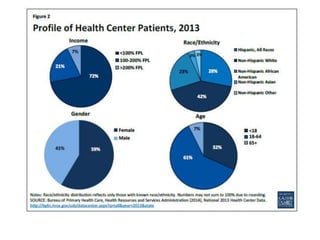
ACA’s Medicaid payment reform’s success depends on the active participation of these health
centers. In 2015 half of the nation’s 24.3 million community health center patients were enrolled
in Medicaid, making health centers a source of primary care for about one of five Medicaid
beneficiaries that year.1 And just as health centers play an outsize role in Medicaid, Medicaid plays
a major role in supporting health centers, representing 44 percent of all health center revenues in
2015.
In 2015, 25 percent of health center patients were uninsured, a rate nearly three times the
national average uninsured rate among the general population. Patient out-of-pocket payments, a
significant part of private health care practice, are a negligible revenue source for health centers
because their patients are so poor. Instead, health centers’ operating federal grants must cover
uninsured populations and uninsured services like dental care as well as costs associated with cost-
sharing responsibilities that their insured patients cannot afford.
Congress’s federally qualified health center (FQHC) payment rules, enacted in 1990, peg Medicaid
revenues to the cost of covered care and services furnished to Medicaid beneficiaries, thereby
ensuring that grant funding would be dedicated to costs associated with uninsured populations and
services. Under these rules, payment is tied to clinical encounters, meaning that like other fee-for-
service systems, payment is driven by the volume of medical encounters involving medical
professionals authorized to bill for care—physicians, dentists, and certain allied health professionals
such as nurse practitioners and physician assistants, depending on state law. However, costs
associated with care team members such as nutritionists, health educators, preventive health
counselors, outreach workers, and case managers often are recognized only indirectly as part of
overhead costs. Furthermore, much of the care for patients living with serious health conditions,
such as social services, is not billable. As a result, health centers and Medicaid agencies are
effectively locked into paying for care based primarily on physician encounters.
Part 5
A WORLD WIDE PERSPECTIVE
on DISEASE and MORBIDITY
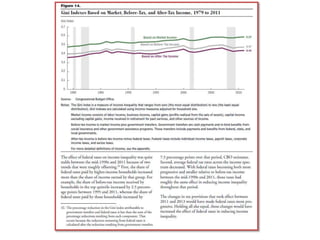
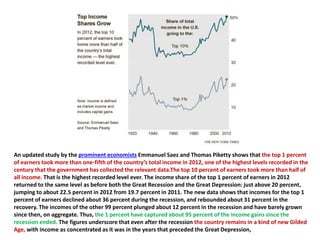
An updated study by the prominent economists Emmanuel Saez and Thomas Piketty shows that the top 1 percent
of earners took more than one-fifth of the country’s total income in 2012, one of the highest levels recorded in the
century that the government has collected the relevant data.The top 10 percent of earners took more than half of
all income. That is the highest recorded level ever. The income share of the top 1 percent of earners in 2012
returned to the same level as before both the Great Recession and the Great Depression: just above 20 percent,
jumping to about 22.5 percent in 2012 from 19.7 percent in 2011. The new data shows that incomes for the top 1
percent of earners declined about 36 percent during the recession, and rebounded about 31 percent in the
recovery. The incomes of the other 99 percent plunged about 12 percent in the recession and have barely grown
since then, on aggregate. Thus, the 1 percent have captured about 95 percent of the income gains since the
recession ended. The figures underscore that even after the recession the country remains in a kind of new Gilded
Age, with income as concentrated as it was in the years that preceded the Great Depression,
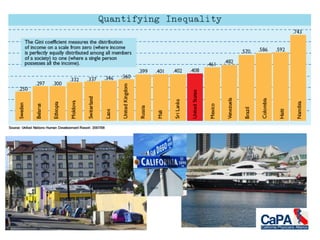
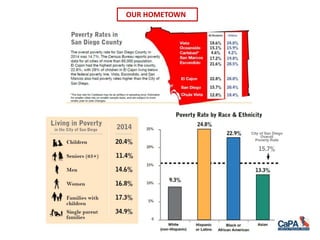
OUR HOMETOWN
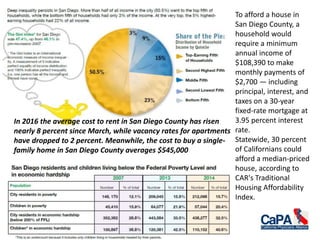
To afford a house in
San Diego County, a
household would
require a minimum
annual income of
$108,390 to make
monthly payments of
$2,700 — including
principal, interest, and
taxes on a 30-year
fixed-rate mortgage at
3.95 percent interest
rate.
Statewide, 30 percent
of Californians could
afford a median-priced
house, according to
CAR's Traditional
Housing Affordability
Index.
In 2016 the average cost to rent in San Diego County has risen
nearly 8 percent since March, while vacancy rates for apartments
have dropped to 2 percent. Meanwhile, the cost to buy a single-
family home in San Diego County averages $545,000
2013 USA
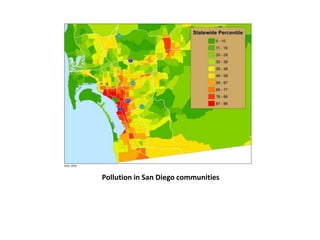
Pollution in San Diego communities
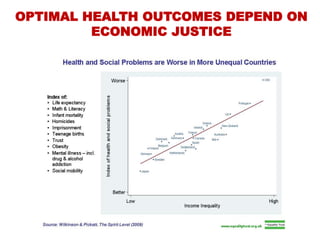
OPTIMAL HEALTH OUTCOMES DEPEND ON
ECONOMIC JUSTICE
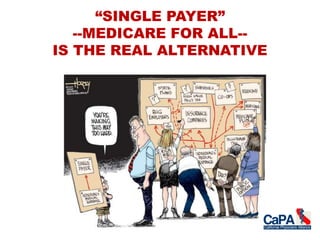
Part 6: LET’S TALK SOLUTIONS
INSURANCE COMPANIES MUST GO
“SINGLE PAYER”
--MEDICARE FOR ALL--
IS THE REAL ALTERNATIVE
Commentary: Single-payer essential to controlling health-care costs
By David Woods, MD The Philadelphia Inquirer, May 16, 2016
I emigrated from Britain to Canada, where I became the editor in chief of the Canadian Medical Association Journal, I
opted to come to the United States in 1988 for personal reasons. But I was also taken with American rugged
individualism and a health-care system focused on market forces and competition. Gradually, though, I too began to
have doubts about market-driven health care. Over the 25 years that I've lived on the U.S. side of the border, I've come
to the view that the American health-care system - which still leaves 11 percent of the population uninsured, despite
the Affordable Care Act - is inferior to the health systems in Canada and the United Kingdom. The reform didn't address
the fundamental problem in U.S. health care: It's more about profit than patients.
Controlling health-care costs is essential to the long-term financial health of the United States. A single-payer system
would make truly universal coverage affordable, costing no more than we already spend on health care. Of the $3.1
trillion the United States will spend on health care this year, 63 percent is taxpayer-financed, funding Medicare,
Medicaid, and Veterans Affairs, along with private coverage for government employees and tax subsidies for
employers. Because of its fragmented, profit-driven system, the United States spends 18.1 percent of gross domestic
product on health care, compared with about 8 percent in Britain and 11 percent in Canada. Much of U.S. health
spending is simply wasted. For example, 25.3 percent of hospital expenditures go to administrative costs, compared
with 12.4 percent in Canada, where there is a single payer in each province and hospitals are mainly funded on a global
or lump-sum basis. Canadians also save money by training a higher percentage of primary-care doctors relative to
specialists, negotiating drug prices with pharmaceutical companies, and prohibiting drug companies from advertising
directly to consumers. These measures would save Americans billions annually. Americans spend $1,010 per capita on
pharmaceuticals; Swedes spend less than half that, according to the Organization for Economic Cooperation and
Development. The reason? Sweden doesn't pay the list price.
Lobbying and influence-peddling by the pharmaceutical and insurance industries keeps the United States from
adopting a single-payer health system. Several presidential candidates this season seemed completely under their
hypnotic sway. The private insurance industry brazenly tells me, now a U.S. voter, which doctors I can see, charges me
astronomical premiums, not to mention co-pays and deductibles, and then wants me to believe that having publicly
funded health care that would allow me to go to any doctor in the United States without a $5,000 deductible would
be "socialism." And don't believe the widely held U.S. notion that Canadians suffer long waits for care. That's a canard..
With our much higher level of spending, waits would not be an issue, even with the population aging
Conyers HR 676
Expanded and Improved Medicare
for All “single payer national
health insurance”
• Automatic enrollment - everyone receives a
card assuring payment for all needed care
• Free choice of doctor and hospital
• Doctors and hospitals remain independent,
negotiate fees and budgets with public agency
• Public agency processes and pays bills
• Financed through progressive taxes
Pope Francis called for renewal of the Roman Catholic Church and attacked unfettered
capitalism as "a new tyranny", urging global leaders to fight poverty and growing
inequality in the first major work he has authored alone as pontiff. The 84-page
document, 'Evangelii Gaudium' known as an apostolic exhortation, amounted to an
official platform for his papacy. In it, Francis went further than previous comments
criticizing the global economic system, attacking the "idolatry of money" and
beseeching politicians to guarantee all citizens "dignified work, education and
healthcare".
He also called on rich people to share their wealth. "Just as the commandment 'Thou
shalt not kill' sets a clear limit in order to safeguard the value of human life, today we
also have to say 'thou shalt not' to an economy of exclusion and inequality. Such an
economy kills," Francis wrote in the document issued on Tuesday( Nov 26, 2013) "How
can it be that it is not a news item when an elderly homeless person dies of exposure,
but it is news when the stock market loses 2 points?"

Disparities

  • 1.
    UNDERSTANDING BARRIERS TO HEALTHCARE Jeoffry B. Gordon, MD, MPH paradocs2@hotmail.com University of San Diego November, 2016 U.S. Health Care System Is Not Adequately Serving Those with Greatest Needs
  • 2.
  • 3.
    Part 1: HEALTHDISPARITIES
  • 4.
    W.E.B. Du Boiswrote that “the Negro death rate and sickness are largely matters of condition and not due to racial traits and tendencies.”
  • 5.
  • 8.
    Maternal Health CareIs Disappearing in Rural America Many women must travel an hour or longer to find a hospital where they can deliver their babies. SCIENTIFIC AMERICAN, February 15, 2017
  • 9.
    Maternal Mortality Ratein U.S. Rises, Defying Global Trend, Study Finds By SABRINA TAVERNISE, NEW YORK TIMES, SEPT. 21, 2016 WASHINGTON — One of the biggest worldwide public health triumphs in recent years has been maternal mortality. Global death rates fell by more than a third from 2000 to 2015. The United States has become an outlier among rich nations in maternal deaths, according to data released Wednesday by the Institute of Health Metrics and Evaluation, a research group funded by the Gates Foundation and based at the University of Washington. In 2005 there were 28 maternal deaths — defined as deaths due to complications from pregnancy or childbirth — per 100,000 births in the United States in 2013, up from 23, more than triple Canada’s. In all, the American rate was up by more than half since 1990, according to the institute, which uses many data sources, including countries’ vital records systems. The findings are part of a gathering body of evidence on the dismal numbers for maternal mortality among American women and how they keep getting worse. An analysis looked at increases by state and found particularly high rates in the District of Columbia, New Jersey, Georgia, Texas and Arkansas, especially among black women.
  • 10.
    Health Care Disparityand State-Specific Pregnancy-Related Mortality in the United States, 2005-2014, Moaddab A1, et al, Obstet Gynecol. 2016 Sep 5. In a population-level analysis study, we analyzed data from the Centers for Disease Control and Prevention National Center for Health Statistics database and the Detailed Mortality Underlying Cause of Death database (CDC WONDER) that contains mortality and population counts for all U.S. counties RESULTS: The United States has experienced a continued increase in maternal mortality ratio since 2007 with rates of 21-22 per 100,000 live births in 2013 and 2014. This increase in mortality was most dramatic in non-Hispanic black women. There was a significant correlation between state mortality ranking and the percentage of non- Hispanic black women in the delivery population. Cesarean deliveries, unintended births, unmarried status, percentage of non-Hispanic black deliveries, and four or less prenatal visits were significantly (P<.05) associated with increased maternal mortality ratio. CONCLUSION: Interstate differences in maternal mortality ratios largely reflect a different proportion of non-Hispanic black or unmarried patients with unplanned pregnancies. Racial disparities in health care availability, access, or utilization by underserved populations are an important issue faced by states in seeking to decrease maternal mortality.
  • 11.
    Texas has highestmaternal mortality rate in developed world, study finds, THE GUARDIAN, August 20, 2016 As the Republican-led state legislature has slashed funding to reproductive healthcare clinics, the maternal mortality rate doubled over just a two-year period. Between 2000 and 2014, excluding California, where maternal mortality declined, and Texas, where it surged, the estimated number of maternal deaths per 100,000 births in the USA rose to 23.8 in 2014 from 18.8 in 2000 – or about 27%. From 2000 to the end of 2010, Texas’s estimated maternal mortality rate hovered between 17.7 and 18.6 per 100,000 births. But after 2010, that rate had leaped to 33 deaths per 100,000, and in 2014 it was 35.8. Between 2010 and 2014, more than 600 women died for reasons related to their pregnancies. The leap in death rates for new and expectant mothers, said the report’s authors, was hard to explain “in the absence of war, natural disaster, or severe economic upheaval”. As Texas reeled from that report, the state’s maternal mortality prevention task force released another confirming that the rate of maternal deaths was rising and a single group was suffering with wild disproportionality: black women, who accounted for 11.4% of births in Texas in 2011 and 2012, but 28.8% of deaths linked to pregnancy. The task force also found a worrisome rate of maternal morbidity, in which a woman nearly died from pregnancy-related causes and may be left with a major impairment. Reproductive health advocates are blaming the increase on Republican-led budget cuts that decimated the ranks of Texas’s reproductive healthcare clinics. In 2011, just as the spike began, the Texas state legislature cut $73.6m from the state’s family planning budget of $111.5m. The two-thirds cut forced more than 80 family planning clinics to shut down across the state. The remaining clinics managed to provide services – such as low-cost or free birth control, cancer screenings and well-woman exams – to only half as many women as before.
  • 13.
    Select Population-Based HospitalizationOutcomes by Insurance Status for Children in the U.S., 2000 Measure Rate per 100,000 Relative Risk (95% CI) Public or None Private All hospitalizations 4012.8 2904.2 1.92 (1.91 to 1.92) Hospitalizations via ER 1948.8 860.9 2.26 (2.25 to 2.27) Chronic disease 602.6 274.4 2.20 (2.18 to 2.21) Asthma 227.2 96.0 3.37 (2.34 to 2.40) Vaccine-preventable disease 30.8 13.9 2.25 (2.18 to 2.33) Psychiatric disease 328.4 155.9 2.11 (2.09 to 2.13) Mortality rate 18.7 7.9 2.38 (2.27 to 2.48) 2,378 excess deaths Ruptured appendix, %* (35.2) (27.6) 1.25 (1.23 to 1.28) Charges, per insured per year** (466) (10,165 M) (224) (11,301 M) 2.08 $5.3 billion excess charges Source: J Todd et al., Pediatrics Vol. 118 No. 2 August 2006, 577-585 •percentage of appendicitis cases ruptured •** Total charges/T # children in each group Kids’ Inpatient Database from the Healthcare Cost and Utilization Project for the year 2000.
  • 16.
    Studies have shownthat black gay men are more likely to use condoms than white gay men, and they tend to have fewer sexual partners. But they face certain barriers to health care. They're less likely than their white counterparts to have a decent-paying job, health insurance, or stable housing, and they're much more likely to experience discrimination at the doctor's office. In a survey of 544 black men who have sex with men, nearly half said they don't trust medical establishments, while almost a third had experienced stigma from their health care providers over their race or sexual orientation.
  • 17.
    Impact Of AmbulanceDiversion: Black Patients With Acute Myocardial Infarction Had Higher Mortality Than Whites, Renee Y. Hsia, et al, Health Aff June 2017 vol. 36 no. 6 This study investigated whether emergency department crowding affects blacks more than their white counterparts and the mechanisms behind which this might occur. Using a nonpublic database of patients in California with acute myocardial infarction between 2001 and 2011 and hospital-level data on ambulance diversion, we found that hospitals treating a high share of black patients with acute myocardial infarction were more likely to experience diversion and that black patients fared worse compared to white patients experiencing the same level of emergency department crowding as measured by ambulance diversion. The ninety-day and one-year mortality rates among blacks exposed to high diversion levels were 2.88 and 3.09 percentage points higher, respectively, relative to whites, representing a relative increase of 19 percent and 14 percent for ninety-day and one-year death, respectively. Interventions that decrease the need for diversion in hospitals serving a high volume of blacks could reduce these disparities.
  • 18.
    Racial/Ethnic Disparities inFatal Unintentional Drowning Among Persons Aged ≤29 Years — United States, 1999–2010, MMR Weekly, May 16, 2014 / 63(19);421-426 In 1962 African-American residents of Jackson, Miss., went to court to challenge the racial segregation of the city’s five municipal swimming pools, four of which were set aside for whites and one for blacks. When the plaintiffs won, the Jackson City Council responded by closing all the pools. No pools, evidently, were preferable to integrated pools. The black residents renewed their lawsuit, eventually reaching the Supreme Court and they lost. In the United States, almost 4,000 persons die from drowning each year. Drowning is responsible for more deaths among children aged 1–4 years than any other cause except congenital anomalies. The CDC analyzed combined mortality data from 1999–2010 for those aged ≤29 years. Among non-Hispanics, the overall drowning rate for American Indians/Alaska Natives (AI/AN) was twice the rate for whites, and the rate for blacks was 1.4 times the rate for whites. Swimming pool drowning rates among blacks aged 5–19 years were 5.5 times higher than those among whites in the same age group. This disparity was greatest at ages 11–12 years; at these ages, blacks drown in swimming pools at 10 times the rate of whites. This year, 20-year-old Simone Manuel became the first African-American female to win an Olympic gold medal in an individual swimming event. When it was time for Manuel's medal ceremony shortly after, NBC decided to air seven-hour-old footage of Russian gymnasts instead.
  • 19.
    Racial and EthnicDisparities in Mental Health Care for Children and Young Adults: A National Study Psychiatric and behavior problems are common among children and young adults, and many go without care or only receive treatment in carceral settings. We examined racial and ethnic disparities in children’s and young adults’ receipt of mental health and substance abuse care using nationally representative data from the 2006–2012 Medical Expenditure Panel Surveys. Blacks’ and Hispanics’ visit rates (and per capita expenditures) were about half those of non-Hispanic whites for all types and definitions of outpatient mental health services. Disparities were generally larger for young adults than for children. Black and white children had similar psychiatric inpatient and emergency department utilization rates, while Hispanic children had lower hospitalization rates. Multivariate control for mental health impairment, demographics, and insurance status did not attenuate racial/ethnic disparities in outpatient care. We conclude that psychiatric and behavioral problems among minority youth often result in school punishment or incarceration, but rarely mental health care.
  • 20.
    How A Broken,$1 Billion State Program Leaves Californians With Cavities, KPBS, August 23, 2016 The government spends more than $1 billion annually on California teeth, offering dental coverage to 13 million low-income residents who qualify for Medi-Cal services. But most California dentists refuse to participate in the Denti-Cal program, leaving patients with impossible wait times that lead to expensive health consequences. Thirteen million Californians qualify, but a 2014 state audit found 11 counties have no dentists taking new Denti-Cal patients, while another sixteen are underserved. The more than $1 billion California spends each year for Denti-Cal services is still just 1 percent of the Medi-Cal budget. The program pays private dentists some of the lowest rates in the country for the work they perform. Dentists complain that the amount of paperwork and bureaucracy and back-and-forth with Denti-Cal to get that pay is so great, they would rather not deal with it.
  • 29.
    Death rate forU.S. non-Hispanic whites (USW), U.S. Hispanics and six comparison countries, aged 45-54. (Source: Proceedings of the National Academy of Sciences.) A large segment of white middle-aged Americans has suffered a startling rise in its death rate since 1999 showing a sharp reversal in decades of progress toward longer lives. The mortality rate for white men and women ages 45-54 with less than a college education increased markedly between 1999 and 2013. An increase in the mortality rate for any large demographic group in an advanced nation has been virtually unheard of in recent decades, with the exception of Russian men after the collapse of the Soviet Union. “Drugs and alcohol, and suicide . . . are clearly the proximate cause,” said Angus Deaton, the 2015 Nobel laureate in economics, who co-authored the paper with his wife, Anne Case. Both are economics professors at Princeton University. “Half a million people are dead who should not be dead.”
  • 30.
    Millions of MenAre Missing From the Job Market By THE EDITORIAL BOARD, NEW YORK TIMES, OCT. 16, 2016 Economists have long struggled to explain why a growing proportion of men in the prime of their lives are not employed or looking for work. A new study has found that nearly half of these men are on painkillers and many are disabled. The working paper by Alan Krueger, a Princeton economist, casts light on this population, which grew during the recession that started in 2007. As of last month, 11.4 percent of men between the ages of 25 and 54 — or about seven million people — were not in the labor force, which means that they were not employed and were not seeking a job. This percentage has been rising for decades (it was less than 4 percent in the 1950s), but the trend accelerated in the last 20 years. Surveys taken between 2010 and this year show that 40 percent of prime working-age men who are not in the labor force report having pain that prevents them from taking jobs for which they are qualified. More than a third of the men not in the labor force said they had difficulty walking or climbing stairs or had another disability. Forty-four percent said they took painkillers daily and two-thirds of that subset were on prescription medicines. By contrast, just 20 percent of employed men and 19 percent of unemployed men (those looking for work) in the same age group reported taking any painkillers. The connection between chronic joblessness and painkiller dependency is hard to quantify. Mr. Krueger and other experts cannot say which came first: the men’s health problems or their absence from the labor force. Some experts suspect that frequent use of painkillers is a result of being out of work, because people who have no job prospects are more likely to be depressed, become addicted to drugs and alcohol and have other mental health problems. Only about 2 percent of the men say they receive workers’ compensation benefits for job-related injuries. Some 25 percent are on Social Security disability; 31 percent of those receiving benefits have mental disorders and the rest have other ailments, according to an analysis by the Urban Institute.
  • 31.
    4% 3% 2% 1% 2% 2% 13% 11% 11% 10% 10% 11% 29% 25% 24% 24% 21% 25% 0% 5% 10%15% 20% 25% 30% 35% Less than $35,000 $35,000-$49,999 $50,000-$74,999 $75,000-$99,999 $100,000 or more All adults Hypertension Heart disease Stroke Source: Centers for Disease Control and Prevention (CDC), National Center for Health Statistics, Summary Health Statistics: National Health Interview Survey, 2014. Available at: http://ftp.cdc.gov/pub/Health_Statistics/NCHS/NHIS/SHS/2014_SHS_Table_A-1.pdf Notes: Includes persons who reported a dollar amount or who would not provide a dollar amount but provided an income interval. “Heart disease” includes coronary heart disease, angina, heart attack, or any other heart condition or disease. People classified as hypertensive were told on two or more different visits that they had hypertension or high blood pressure. People with lower incomes are more likely to suffer from heart disease, stroke, and hypertension
  • 36.
    Comparisons of disparitiesand risks of HIV infection in black and other men who have sex with men in Canada, UK, and USA: a meta-analysis Gregorio A Millett, LANCET, 380, No. 9839, p341–348, 28 July 2012 We analysed 7 studies from Canada, 13 from the UK, and 174 from the USA. In every country, black MSM were as likely to engage similarly in serodiscordant unprotected sex as other MSM. Black MSM in Canada and the USA were less likely than other MSM to have a history of substance use (odds ratio, OR, 0·53, 95% CI 0·38–0·75, for Canada and 0·67, 0·50–0·92, for the USA). Black MSM in the UK (1·86, 1·58–2·18) and the USA (3·00, 2·06–4·40) were more likely to be HIV positive than were other MSM, but HIV-positive black MSM in each country were less likely (22% in the UK and 60% in the USA) to initiate combination antiretroviral therapy (cART) than other HIV-positive MSM. US HIV-positive black MSM were also less likely to have health insurance, have a high CD4 count, adhere to cART, or be virally suppressed than were other US HIV-positive MSM. Notably, despite a two-fold greater odds of having any structural barrier that increases HIV risk (eg, unemployment, low income, previous incarceration, or less education) compared with other US MSM, US black MSM were more likely to report any preventive behaviour against HIV infection (1·39, 1·23–1·57). For outcomes associated with HIV infection, disparities were greatest for US black MSM versus other MSM for structural barriers, sex partner demographics (eg, age, race), and HIV care outcomes, whereas disparities were least for sexual risk outcomes.
  • 37.
    FIGURE 10 CancerSurvival by Insurance Status*
  • 39.
    Primary Care ProvidersOrdered Fewer Preventive Services For Women With Medicaid Than For Women With Private Coverage Stacey McMorrow, Sharon K. Long, Ariel Fogel, Health Aff June 2015 We examined the provision of recommended preventive services to women with Medicaid and those with private insurance at visits to primary care providers in private office-based practices. The study looked at 12,444 visits to primary care practitioners by privately insured women and 1,519 visits by women who were covered by Medicaid between 2006 and 2010. We found that after patient and provider characteristics were controlled for, Medicaid-insured visits were less likely than privately insured visits to include several preventive services, including clinical breast exams and Pap tests. The differences in provision of services by payer were generally driven by the differences in care at visits classified as preventive and at visits to obstetrician-gynecologists.
  • 42.
    MALE LIFE EXPECTENCYAT AGE 65 BY YEAR OF BIRTH and INCOME SOCIAL SECURITY DATA
  • 43.
    The Association BetweenIncome and Life Expectancy in the United States, 2001-2014 Raj Chetty, PhD, et al, JAMA. Published online April 10, 2016 The sample consisted of 1 408 287 218 person-year observations for individuals aged 40 to 76 years (mean age, 53.0 years; median household earnings among working individuals, $61 175 per year). There were 4 114 380 deaths among men (mortality rate, 596.3 per 100 000) and 2 694 808 deaths among women (mortality rate, 375.1 per 100 000). Higher income was associated with greater longevity throughout the income distribution. The gap in life expectancy between the richest 1% and poorest 1% of individuals was 14.6 years (95% CI, 14.4 to 14.8 years) for men and 10.1 years (95% CI, 9.9 to 10.3 years) for women.
  • 44.
    Geography of LifeExpectancy in the Bottom Income Quartile
  • 47.
    Active Life ExpectancyIn The Older US Population, 1982–2011: Differences Between Blacks And Whites Persisted By Vicki A. Freedman and Brenda C. Spillman, Health Affairs, August 2016 Understanding long-range trends in longevity and disability is useful for projecting the likely impact of the baby-boom generation on long-term care utilization and spending. We examine changes in active life expectancy in the United States from 1982 to 2011 for white and black adults ages sixty-five and older. For whites, longevity increased, disability was postponed to older ages, the locus of care shifted from nursing facilities to community settings, and the proportion of life at older ages spent without disability increased. In contrast, for blacks, longevity increases were accompanied by smaller postponements in disability, and the percentage of remaining life spent active remained stable and well below that of whites. Older black women were especially disadvantaged in 2011 in terms of the proportion of years expected to be lived without disability. Public health measures directed at older black adults — particularly women — are needed to offset impending pressures on the long-term care delivery system as the result of population aging
  • 48.
    PART 2: VALUESIN HEALTH CARE: THE MORAL AND ETHICAL IMPERATIVE The Values of a Healthy Society “Health Care is a Human Right” (1) MAXIMIZE HEALTHY STATES (provide good, quality medical care) (2) COMPASSION and CARING (relieve individual pain, suffering and anxiety) (3) SOCIAL and ECONOMIC JUSTICE (provide for the vulnerable ) (4) CIVIC RESPONSIBILITY (society as a commonwealth)
  • 49.
    It was RonaldReagan who said “freedom is always just one generation away from extinction. We don’t pass it to our children in the bloodstream; we have to fight for it and protect it, and then hand it to them so that they shall do the same, or we’re going to find ourselves spending our sunset years telling our children and our children’s children about a time in America, back in the day, when men and women were free.”
  • 50.
    In 2014, atotal of 33 599 Americans died of gunshot wounds. Although the risk for firearm-related homicide is highest among young African American men, most firearm- related deaths are suicides, for which older white men are at highest risk. Public mass shootings account for a small percentage of firearm-related deaths but are occurring more frequently and could affect the character of public life in the United States. In early 2013, more than 40% of Americans worried that they could fall victim to firearm-related homicide or assault.
  • 51.
    HEALTH REFORM: THE GOOD,THE BAD, and the UGLY JEOFFRY B. GORDON, MD, MPH paradocs2@hotmail.com
  • 52.
    The Inverse CareLaw JULIAN TUDOR HART The Lancet: Saturday 27 February 1971 Glyncorrwg Health Centre, Port Talbot, Glamorgan, Wales The availability of good medical care tends to vary inversely with the need for the population served. This inverse care law operates more completely where medical care is most exposed to market forces, and less so where such exposure is reduced. The market distribution of medical care is a primitive and historically outdated social form, and any return to it would further exaggerate the maldistribution of medical resources. Part 3 – ECONOMICS
  • 53.
    PATIENTS ARE NOTGOOD CONSUMERS • Producing, purchasing and using medical care is profoundly different from manufacturing, selling, purchasing and using a car, a blouse, a refrigerator, a haircut, a college class, or an accountant. • (1) Even among the well educated there is a tremendous asymmetry between the doctor and the patient in the esoteric technical knowledge and judgment needed for the application of competent and effective medical care. • (2) A person who has an accident or an illness has very little opportunity or capacity to shop around and compare either price or quality. Usually the sicker and more acutely ill the patient, the less this capacity will be. • (3) During any illness it may be impossible or even catastrophically dangerous for a patient to try out (consume) one set of treatments and then choose to switch to another. Arrow, Kenneth J. Uncertainty and the welfare economics of medical care. The American Economic Review 1963;53:941-73.
  • 54.
    PATIENTS ARE NOTGOOD CONSUMERS • (4) Enduring and managing an illness or an accident inherently involves a huge number of emotional factors, thus impairing “rational” consumer choice. • (5) Under the necessary insurance system the consumer/patient is mostly insulated from the anticipated or actual purchase prices and costs anticipated or actually incurred. • (6) It is not unusual for a bout of illness to require the sudden purchase of medical care which will be literally catastrophically expensive, yet to forego it is to invite personal tragedy and face ongoing pain, disability or even death. • (7) The purchaser of most medical services and supplies and thus the generator of most medical spending is the doctor, not the patient. (Yet most doctors are, in fact, usually ignorant of the costs or the charges for most of what they order.) • (8) Under our current system many Americans do not have health insurance and are overwhelmingly without personal resources. Thus they are unable to buy into the market.
  • 55.
    Health Care CostsConcentrated in Sick Few— Sickest 10 Percent Account for 65 Percent of Expenses Source: Agency for Healthcare Research and Quality analysis of 2009 Medical Expenditure Panel Survey. Distribution of health expenditures for the U.S. population, by magnitude of expenditure, 2009 1% 5% 10% 50% 65% 22% 50% 97% Population Share of Health Spending 55
  • 59.
    Cumulative Increases inHealth Insurance Premiums, Workers’ Contributions to Premiums, Inflation, and Workers’ Earnings, 1999-2016 98% 160% 213% 92% 167% 242% 24% 45% 60% 21% 35% 44% 0% 50% 100% 150% 200% 250% 300% 1999 2000 2001 2002 2003 2004 2005 2006 2007 2008 2009 2010 2011 2012 2013 2014 2015 2016 Health Insurance Premiums Workers' Contribution to Premiums Workers' Earnings Overall Inflation
  • 64.
    Exhibit 4. InsuranceDramatically Improves Access to Care and Reduces Racial and Ethnic Disparities, Even After Accounting for Income and Other Factors (2012–13) Notes: Black and white refer to black and white non-Hispanic populations. Hispanics may identify as any race. Adjusted means controlled for respondents’ age, sex, health status, and income. Differences are statistically significant at the 0.05 level: (a) minority population compared with white; (b) black compared with Hispanic. Source: 2012 and 2013 Behavioral Risk Factor Surveillance Survey (BRFSS). 53 16 38 10 50 15 38 10 51 15 41 11 61 21 36 9 0 10 20 30 40 50 60 70 Uninsured Insured Uninsured Insured Total White Black Hispanic Went without care because of costDid not have a usual source of care Percent of adults ages 18–64 a,b a,b a,b a,b a,b a,b b b
  • 65.
    Do Individuals MakeSensible Health Insurance Decisions? Evidence from a Menu with Dominated Options, NBER Working Paper No. 21160, May 2015 The recent expansion of health-plan choice has been touted as increasing competition and enabling people to choose plans that fit their needs. The promise of recent reforms that expand choice and aim to increase provider competition is premised on the assumption—challenged by our research—that enrollees will make sensible plan choices. This study provides new evidence challenging these proposed benefits of expanded health-insurance choice. We examine health-insurance decisions of employees at a large U.S. firm where a new plan menu included a large share of financially dominated options. We find that a majority of employees – and in particular, older workers, women, and low earners – chose dominated options, resulting in substantial excess spending. We find these choices reflect a severe deficit in health insurance literacy and naïve considerations of health risk and price, rather than a sensible comparison of plan value. Consumers sort into plans based on perceived health risk and inferences about plan generosity from the rank-ordering of plan deductibles rather than a careful assessment of financial plan value. Our results challenge the standard practice of inferring risk attitudes and assessing welfare from insurance choices, and raise doubts whether recent health reforms will deliver their promised benefits. Rather than reflecting rational deliberations involving cost, need, and risk, many health plan choices likely reflect heuristic choice strategies grounded in a fundamental deficit of health plan literacy.
  • 66.
  • 68.
    Source: S. R.Collins, D. C. Radley, M. Z. Gunja and S. Beutel, The Slowdown in Employer Insurance Cost Growth: Why Many Workers Still Feel the Pinch, The Commonwealth Fund, October 2016. $2,785 $3,704 $5,083 $3,531 $4,688 $6,422 $4,074 $5,457 $7,547 $0 $1,000 $2,000 $3,000 $4,000 $5,000 $6,000 $7,000 $8,000 2006 2010 2015 Lowest five states average U.S. average Highest five states average Exhibit 8 Average Combined Employee Premium Contribution and Deductible, 2006–2015 Note: Single and family premium contributions and deductibles are combined and weighted for the distribution of single-person and family households. Data: Medical Expenditure Panel Survey–Insurance Component, 2006, 2010, and 2015. Average employee share of premium plus average deductible These costs are higher relative to income in many southeastern and southern states, where incomes are below the national average: Arizona, Florida, Mississippi, Oklahoma, Texas.
  • 69.
    Source: S. R.Collins, D. C. Radley, M. Z. Gunja and S. Beutel, The Slowdown in Employer Insurance Cost Growth: Why Many Workers Still Feel the Pinch, The Commonwealth Fund, October 2016. 4.9% 6.1% 7.5% 6.5% 8.4% 10.1% 8.6% 11.1% 13.2% 2006 2010 2015 Lowest five states average U.S. average Highest five states average Exhibit 9 Combined Employee Premium Contribution and Deductible as a Share of Median Family Income Note: Single and family premium contributions and deductibles are combined and weighted for the distribution of single-person and family households. Estimates of median household income used in the denominator for this ratio come from the Current Population Survey (CPS), which revised its income questions in 2013. The denominator in our ratio estimates prior to 2014 is derived from the traditional CPS income questions, while ratio estimates from 2014 are derived from the revised income questions. Household incomes are averaged over two years, and have been adjusted for the likelihood that people in a residence purchase health insurance together. Data: Medical Expenditure Panel Survey–Insurance Component (employee premium share and deductible, 2006, 2010, and 2015); Current Population Survey (median income, 2006–07, 2010–11, and 2015–16). Average employee share of premium plus average deductible as percent of median state incomes
  • 70.
    Deductibles Have Becomea Growing Factor in Underinsurance Rates Indicators of underinsurance among adults ages 19–64 who were insured all year 2003 2005 2010 2012 2014 Out-of-pocket costs were 10% or more of income or 5% of more of income if low-income^ 14 million 14 million 25 million 23 million 24 million Deductible equals 5% or more of income 4 million 4 million 8 million 11 million 14 million Net increase in millions underinsured because of high deductible 2 million 2 million 5 million 6 million 7 million Underinsured* 16 million 16 million 29 million 30 million 31 million ^ Low income refers to those with incomes below 200 percent of the federal poverty level. * Underinsured defined as insured all year but experienced one of the following: out-of-pocket expenses equaled 10% or more of income; out-of- pocket expenses equaled 5% or more of income if low income (<200% of poverty); or deductibles equaled 5% or more of income. Source: The Commonwealth Fund Biennial Health Insurance Surveys (2003, 2005,2010, 2012, and 2014). ** In a $400 emergency, 47% of Americans could not get the money, would have to borrow it, or sell something. – Federal Reserve Survey, 2013 ** Only 38% of Americans had $1000 in savings to cover an ER visit - Bankrate, 2014 ** 55% of Americans spend as much as they earn each month - Pew Charitable Trust, 2014
  • 71.
    Reported medical billproblems or having medical debt during the year. * Difference is statistically significant from those with private coverage who were insured all year (p≤0.05). ^ Difference is statistically significant from those who were uninsured during the year (p≤0.05). Percentages were adjusted for age, race, sex, health status, and income. Source: The Commonwealth Fund Biennial Health Insurance Survey, 2014. 21^ 13^ 13^ 22^ 33^ 10*^ 7*^ 4*^ 9*^ 19*^ 35* 23* 24* 28* 47* 0 25 50 75 Had problems paying or unable to pay medical bills Contacted by collection agency for unpaid medical bills Had to change way of life to pay bills Medical bills being paid off over time At least one medical bill problem or debt Private coverage, insured all year Medicaid coverage, insured all year Uninsured during the year Percent of adults ages 19–64
  • 73.
    Struggling to Serveat the Nation’s Richest University, NEW YORK TIMES, Rosa Ines Rivera, OCT. 24, 2016 Cambridge, Mass. — “I’ve been at Harvard University for 17 years, but I’ve never been in a classroom here. I’m a cook in the dining halls. I’ve had a lesson in hypocrisy. On my way to work each morning, I pass a building with the inscription: “The highest attainable standard of health is one of the fundamental rights of every human being.” If Harvard believes this, why is the administration asking dining hall workers to pay even more for our health care even though some of us pay as much as $4,000 a year in premiums alone? The cost of premiums alone could eat up almost 10 percent of my income. “I serve the people who created Obamacare, people who treat epidemics and devise ways to make the world healthier and more humane. But I can’t afford the health care plan Harvard wants us to accept. That’s why I have been on strike. The co-pays alone can be a problem. Harvard wants to increase our co-pays for every single doctor visit to $25, from $15, for primary care and to $100, from zero, for outpatient hospital care and some tests. When a doctor told me my daughter had failed a hearing test and might need surgery, I thought about what care I could do without. I recently skipped an appointment to have a spot on my lung checked for cancer to save on the co-pays. The students say that Harvard’s proposal is unaffordable for nearly all of us according to state government guidelines. If it goes through, I will keep avoiding the doctor to save that money for my kids’ co-pays. Any increase puts me at the breaking point.”
  • 74.
    UNDERSTANDING A HOSPITALBILL 4 DAYS PAYMENT: $8575.00 + $800 = $9375 = 15% $59,262
  • 76.
    •Among medical debtors,hospital bills were the largest medical expense for 48% drug costs for 19%, doctors’ bills for 15% and insurance premiums for 4%. In 38% of cases, lost income due to illness was a factor. •Out-of-pocket medical costs averaged $17,943. •For the privately-insured, out-of-pocket costs averaged $17,749. •For the uninsured, out-of-pocket costs averaged $26,971. •Patients with neurologic disorders such as multiple sclerosis faced •highest costs, and average of $34,167, followed by diabetics at $26,971. •Illness and medical bills were linked to at least 62.1% of all personal bankruptcies in 2007. Based on the current bankruptcy filing rate, medical bankruptcies will total 866,000 and involve 2.346 million Americans this year – about one person every 15 seconds. •Using identical definitions in both years, the proportion of bankruptcies attributable to medical problems rose by 49.6% between 2001 and 2007. •Most medically bankrupt families were middle class before they suffered financial setbacks. 60.3% of them had attended college and 66.4% had owned a home; 20% of families included a military veteran or active-duty soldier.
  • 77.
    Part 4 –The AFFORDABLE CARE ACT, OBAMACARE
  • 78.
    The Great Dealmaker TheObama Administration made a series of political deals to pass ACA: The insurance industry: Assured that everyone would be required to buy their product -- and there would be no public option The drug industry: No negotiation on prices The AMA: No cut in physician fees Hospitals: No cut in reimbursements, only slower growth in payments Employers: Continued control of health benefits Nervous members of the public: “You can keep what you have”
  • 79.
    The ACA mandated (1)An “essential health benefits” package, more extensive than what most individuals and small businesses already purchase. (2) An age band so that the amount an older individual pays will be no more than three times what a younger individual pays. (3) Same rates for men and women. (4) No cost preventive services. (5) Eliminated insurance companies’ rejection of applicants or charging premiums due to pre- existing medical conditions.
  • 82.
    2016 Estimated totalUSA ACA enrollees by source and subsidy status: 9.4 million on-exchange subsidized (47%) 1.7 million on-exchange unsubsidized (8%) 7.1 million off-exchange unsubsidized (ACA-compliant) (35%) 2.0 million off-exchange unsubsidized (NON-ACA compliant) (10%) = 20.2 million total Includes: 2.3 million post-adolescents on parents’ policies, + est 4 million replacing coverage not ACA compliant, + est 3 million would have been Medicaid eligible but using exchange policies in non-expanding states + incl ?? million with pre-existing conditions, previously uninsurable 2010: USA Total 50 million uninsured; 27 million Medicaid eligible, 16 million in opt-in states, 11 million enrolled by 2015 2010 Medicaid Actuary est PPPYr cost $4,600; 2014 actual cost $5,500; 2015 actual cost $6,366 (due to fewer enrollees, more utilization, higher payments) 2016 ACA Federal Medicaid expense $64B, $17B (25%) in California alone (state MediCal contribution about $700m) (total California state budget $170B, total tuition UC system $3B)
  • 83.
    On January 31,2016 open enrollment for ACA coverage ended with about 12.7 million consumers enrolling through the Health Insurance Marketplaces including over 9.6 million through the HealthCare.gov platform and 3.1 million who selected a plan through State-based Marketplaces. Black Americans made up 14% of total enrollment in 2015, compared to 17% last year. Latinos comprised 11% both years. A total of 7.7 million people or nearly nine in 10 people who signed up for healthcare from the federal government this year qualify for subsidized insurance premiums and (some for) out of pocket expenses in the roughly three- dozen states using HealthCare.gov – a figure that has held steady since ObamaCare's first year. The number of Americans projected to sign up for coverage continues to be revised downward. The CBO, bowing to reality, slashed their 2016 estimates of exchange enrollment from 21 million to 13 million. Furthermore, the CBO implied that it expects exchange enrollment to peak at 16 million: a far cry from the 24 million it predicted last March. Enrollment is a key barometer of the 2010 law's success because insurance premiums in the federal exchange are up in 2016 by 7.5 percent on average, nearly four times as much as a year ago.
  • 86.
    Of those whopurchased coverage in California, 9,302 people just purchased catastrophic coverage; 350,225 bought a bronze plan; 895,657 bought a silver plan; 74,067 purchased a gold plan; and 64,316 bought a platinum plan.
  • 88.
    Insurance Expansion ImprovedCare for Colorectal Cancer, October 04, 2016 Past research had shown that patients without health insurance typically presented with more advanced colorectal cancer disease and had lower survival rates compared with patients with private insurance. The expansion of healthcare in Massachusetts in 2006 was associated with increased rates of resection, and a decreased likelihood of emergent resection, for patients with colorectal cancer, according to the results of a study published in the Journal of Clinical Oncology. The study identified 17,499 patients with government-subsidized, self-pay, or private insurance admitted to the hospital between 2001 and 2011 in Massachusetts and compared them with 144,253 control patients from three states. The 2006 Massachusetts health insurance expansion provided Medicaid coverage for people living below 150% of the federal poverty limit, created a state-subsidized insurance program for people with income less than 300% of the federal poverty limit but who remained ineligible for Medicaid, and established an individual mandate requiring all residents to have health insurance. The comparison showed that prior to the 2006 health insurance reform, those patients with government-subsidized or self-pay insurance had significantly lower rates of resection for colorectal cancer compared with patients with private insurance. The health insurance reform was independently associated with a 44% increased rate of resection for government-subsidized or self-pay patients (incident rate ratio [IRR], 1.44 [95% CI, 1.23–1.68]; P < .001). More specifically, the reform was associated with a 49% increased rate of resection for colon cancer and a 34% increase in resection for rectal cancer. The Massachusetts insurance expansion was also associated with a 6.21 percentage point decreased probability of emergent admission (95% CI, −11.88 to −0.54; P = .032) and an 8.13 percentage point increased probability of an elective admission (95% CI, 1.34–14.91; P = .019) compared with the control states.
  • 89.
    A recent studypublished by the Centers for Disease Control and Prevention projects that, thanks to the ACA, increased use of antihypertensive medication will lead to 111,000 fewer cases of coronary heart disease, 63,000 fewer strokes, and 95,000 fewer deaths by 2050. And this estimate may understate the health gains, since their model assumes the ACA expands coverage to 13.9 million adults—a modest figure given that recent surveys estimate between 12 million and 17 million adults have already gained coverage. Regardless, these are eye-catching numbers.
  • 90.
    Association of Racewith Mortality and Cardiovascular Events in a Large Cohort of US Veterans Csaba P. Kovesdy, et al CIRCULATIONAHA.114.015124 Published online before print September 18, 2015 Background—In the general population African-Americans experience higher mortality than their white peers, attributed, in part, to their lower socio-economic status, reduced access to care and possibly intrinsic biologic factors. A notable exception are patients with kidney disease, among whom African-Americans experience lower mortality. It is unclear if similar differences affecting outcomes exist in patients with no kidney disease but with similar access to health care. Methods and Results—We compared all-cause mortality, incident coronary heart disease (CHD) and incident ischemic stroke using multivariable adjusted Cox models in a nationwide cohort of 547,441 African-American and 2,525,525 white patients with baseline estimated glomerular filtration rate (eGFR) ≥60 ml/min/1.73m2 receiving care from the US Veterans Health Administration. In parallel analyses we compared outcomes in African-American vs. white individuals in the National Health and Nutrition Examination Survey 1999-2004 (NHANES). After multivariable adjustments in veterans, African-American race was associated with 24% lower all-cause mortality (adjusted hazard ratio (aHR), 95% confidence interval (CI): 0.76, 0.75-0.77, p<0.001) and 37% lower incidence of CHD (aHR, 95%CI: 0.63, 0.62-0.65, p<0.001), but similar incidence of ischemic stroke (aHR, 95%CI: 0.99, 0.97-1.01, p=0.3). African- American race was associated with a 42% higher adjusted mortality among individuals with eGFR≥60 ml/min/1.73m2 in NHANES (aHR, 95%CI: 1.42 (1.09-1.87)). Conclusions—African-American veterans with normal eGFR have lower all-cause mortality and incidence of CHD, and similar incidence of ischemic stroke. These associations are in contrast with the higher mortality experienced by African-American individuals in the general US population.
  • 92.
    Annual premium amountpaid by policy holder and premium tax credit* Exhibit 16. Annual Premium Amount and Tax Credits for a Family of Four Under the Affordable Care Act, 2014 * For a family of four, policy holder age 40, in a medium-cost area in 2014. Premium estimates are based on an actuarial value of 0.70. Actuarial value is the average percent of medical costs covered by a health plan. FPL refers to federal poverty level. Source: Premium estimates are from Kaiser Family Foundation Health Reform Subsidy Calculator, http://healthreform.kff.org/Subsidycalculator.aspx. Full premium = $12,130 Required premium payment by policy holder Premium tax credit Contribution capped at 3.3% of income Contribution capped at 4.0% of income Contribution capped at 6.3% of income Contribution capped at 8.05% of income Contribution capped at 9.5% of income $32,326 $35,137 $46,850 $58,562 $70,275 $117,125
  • 93.
    Clinical Care TransformationModel THE ACCOUNTABLE CARE ORGANIZATION (ACO) Patient Advanced Primary Care Under Patient-Centered Medical Home Medical Group Enterprise Level Activities Accountable Care Organization Hospitals • Service Line Integration • Medical Staff Alignment • Incentives for Efficiency & Lean Six Sigma • Quality (SCIP, Leap Frog) • Safety Medical Groups • Enterprise Level Activities • PC-MH Functions Skilled Nursing Facilities • SNFists • On-site Case Management • Efficiency Rating Systems “Preferred Facilities” Ancillary Services • Free-Standing ASC & Diagnostic Testing Centers Home Care • Home Safety Visits • Post Discharge Visits • Home Health Coordinator of Services Hospice • Transitions (CHF, COPD, Frailty Syndrome, Dementia) • PCP/SCP Incentives & Clinical Guidelines • Pay for Performance Initiatives • Hospitalists, Post Discharge Follow-Up Programs DME • Integration & Oversight with Care Management • Outcomes & Evidence Based Medicine • Call Coverage • Consult Services (Stroke, STEMI) • ER Avoidance Programs • Urgent Care • End of Life (Palliative Care) • Patient Satisfaction & Loyalty • Personal Health Record • Patient Portal • Health Risk Assessment • Patient Engagement & Activation • Prevention & Wellness • Point of Care Analytics & Clinical Decision Support • Gaps in Care • Population Management & Chronic Care Registries • Home Visiting Teams • Generic Prescribing Program • Cost Effective Medical Management & Utilization of Services (SCP, Ancillary) • Access, Same Day Appointments, e- Visits • Patient Satisfaction & Loyalty • Provider & Office Staff Satisfaction • Care management (Acute, Chronic, Inpatient, SNF) • Health Coaching (Shared Decision Making) • Transition of Care • Provider Satisfaction • Behavioral & Mental Health
  • 94.
    A new reportby the Centers for Disease Control and Prevention (CDC) reveals that, in 2013, only 54 percent of California physicians accepted new Medi-Cal patients, a rate that is significantly lower than the national average of 68.9 percent. California has the second-lowest physician acceptance rate of new Medi-Cal patients, with New Jersey coming in last with 2013 acceptance rates of 38.7 percent. The report compared physician acceptance of new patients across payors, mainly focusing on Medicare and private insurance. The CDC found that the national average of physicians who accepted new Medicare patients was 83.7 percent, with 84.7 percent for private insurance. California physicians accept new Medicare and private insurance patients at 77.2 percent and 76.6 percent, respectively.
  • 95.
    As originally envisioned,the ACA would have extended Medicaid coverage to everyone below 133 percent of the federal poverty level, regardless of previous Medicaid eligibility. The Supreme Court, however, ruled 7-2 in June of 2012 that the provisions proposed in the ACA to enforce state compliance with Medicaid expansion were too coercive, and that states could choose not to implement Medicaid expansion. Since the Court’s decision, 26 states have chosen to expand Medicaid coverage. The split of states on this question has largely followed political party lines, with most blue states choosing expansion and most red states rejecting expansion.
  • 96.
    GOP Governors' ObamacareOpposition Is Denying The Poor Health Care Millions of Poor Are Left Uncovered by Health Law Nonelderly Poor Uninsured Adults in the Coverage Gap in States Not Expanding Medicaid by Race/Ethnicity Total, United States: 4,832,000 - All races/Ethnicities 2,248,000 - White 1,327,000 - Black 992,000 - Hispanic 265,000 - Other 2,584,000 - People of Color
  • 97.
    Preventable Deaths fromHeart Disease & Stroke
  • 98.
    Low-Income Adults inStates That Have Not Expanded Medicaid Are Uninsured at Twice the Rates of Those in Expansion States Exhibit 4 0 10 20 30 40 50 July–Sept. 2013 April–June 2014 March–May 2015 Feb.–April 2016 Data: The Commonwealth Fund Affordable Care Act Tracking Surveys, July–September 2013, April–June 2014, March–May 2015, and February–April 2016. Percent of adults ages 19–64 with incomes below 138 percent of poverty who were uninsured All states Expanded Medicaid Did not expand Medicaid 35% 17% 24% 41% 30% 35% 34% 17% 24% 34% 18% 25%
  • 99.
    10 7 9 8 16 10 16 24 0 10 20 30 40 TotalWhite Black U.S.-born Latino Live in states that expanded Medicaid under the ACA Live in states that did not expand Medicaid under the ACA Latinos and Blacks Living in States that Expanded Medicaid Coverage Under the ACA Are Less Likely to Be Uninsured Note: States that are considered expansion states are those that expanded their Medicaid programs as of February 2016 (AK, AR, AZ, CA, CO, CT, DE, HI, IA, IN, IL, KY, MA, MD, MI, MN, MT, ND, NH, NJ, NM, NV, NY, OH, OR, PA, RI, VT, WA, WV, and the District of Columbia). All other states were considered to have not expanded. Percent adults ages 19–64 who were uninsured when surveyed Source: The Commonwealth Fund Affordable Care Act Tracking Survey, February–April 2016.
  • 100.
    7 Insurers AllegedTo Use Skimpy Drug Coverage To Discourage HIV Patients The ACA prohibits insurers from discriminating against people with serious illnesses. Some marketplace plans sidestep that taboo by making the drugs that people with HIV need unavailable or unaffordable according to complaints brought by Harvard Law School’s Center for Health Law and Policy with the Department of Health and Human Services’ Office for Civil Rights . The effect may be to discourage people with HIV from buying a particular plan or getting the treatment they need, according to the complaint. The center filed complaints against Humana plans in six states: Alabama, Georgia, Illinois, Louisiana, Tennessee and Texas. Cigna plans were targeted in three states: Georgia, Tennessee and Texas. The group filed complaints against five other insurers: three in Pennsylvania, including Highmark, Independence Blue Cross and UPMC health plan; a complaint against Community Health Choice in Texas and a complaint against Anthem Blue Cross Blue Shield in Wisconsin. They found, for example, that this year Anthem silver plans in Wisconsin cover only four of the 16 drugs or combination products that are recommended to meet the current standard of care, and they fail to cover any single-tablet regimens. In Illinois, the center charged that Humana’s silver plans place 16 of the 24 most commonly prescribed HIV drugs in the highest cost-sharing tier, which requires patients to pay 50 percent of the cost. With estimated monthly costs ranging from $377 to $684 for different drug regimens, enrollees in the Illinois Humana plans would have to pony up between 8 and 14 percent of their average monthly income, according to the complaint.
  • 103.
    Affordable Care Act:imploding and beyond repair By John Geyman, MD, THE HILL, October 21, 2016 Despite the ACA’s goals of containing costs and making health care affordable, in the first six and a half years it’s proven to be too expensive to be sustainable, overly complex and bureaucratic, and a gift to the private health insurance industry and other corporate stakeholders in the medical-industrial complex. To be fair, the ACA has brought some kind of coverage to about 20 million Americans, in good part through the expansion of Medicaid in 32 states (including D.C.) and the subsidized exchanges. But its negative results far outweigh its gains, as shown by these data points: • We still have 29 million uninsured Americans (compared to 48 million at the start), plus tens of millions underinsured. • Sign-ups for ACA coverage on the exchanges have fallen far short of expectations – just 11 million this year compared to 24 million forecasted, with many people unable to afford even subsidized coverage. • The costs of insurance and health care now exceed $25,000 for a family of four covered by an average employer- sponsored PPO plan. • Insurance plan deductibles and co-pays have sharply increased, deterring people from necessary care. • Narrowed networks under the ACA have forced many millions of patients to change their desired physicians and hospitals. • The ACA has accelerated a national trend of corporate consolidation of insurers and hospitals, with growing market and political power. Expanding hospital systems, facing less competition, are free to charge much higher prices, by up 40 percent to 50 percent. • The ACA’s regulation of health insurers has been lax, leaving insurers many ways to game the system (e.g. by overstating the health risks of their enrollees) in their self-interest. • Pharmaceutical drug prices have been sharply increasing, often shockingly so. A one-year course of cancer drugs often exceeds $200,000, forcing many patients to choose between bankruptcy and treatment. • The ACA’s accountable care organizations have failed to contain costs and improve quality of care. • Most of the nonprofit co-ops established under the ACA have failed. • Premium increases averaging 25 percent for 2017 are being reported in a number of states while many insurers are exiting their markets.
  • 104.
    The Affordable CareAct is having problems. But Republicans who say those problems are caused by “big government” have it exactly backward. Obamacare’s current difficulties are grounded in its reliance on “market forces.” In all likelihood, the private sector will never be able to provide universal, affordable health coverage. Government isn’t the problem here. It’s the solution. The flaws are real. One person in five on the exchanges will have no choice of insurers next year. Premiums for “mid range” plans – which offer fairly paltry coverage – will increase by an average of 25 percent, according to the Administration. States like Arizona are faring even worse, with an average projected increase of 116 percent. Many people have found insurance on the exchanges to be unaffordable and are taking a tax penalty instead. And while lower-income people will see their premium costs offset by subsidies, those subsidies represent a shifting of wealth from the general public to for-profit insurance corporations. The policy heart of the ACA is the individual mandate to purchase health insurance, which was crafted at a right-wing think tank. A number of its other key provisions had GOP roots too, including the “marketplaces.” The ACA’s deepest problems stem from assumptions built into its design – assumptions that its backers described at the time as “technical” and “wonkish,” but which were in fact deeply ideological at their core. These assumptions were rooted in a misplaced faith in private-sector market forces. How did market myths distort the ACA? First, market forces can’t function without competition. And yet in 2009, before the Affordable Care Act was signed into law, several studies found that 94 percent of all health insurance markets in the United States were “highly concentrated.” Second, the ACA also relied on free- market ideology to “bend the cost curve,” assuming that insurers would compete to cut costs in order to gain market share. But health insurers have relied on less productive tactics like mergers and market dominance to boost their profits instead. Third the ACA used ideologically biased theory to justify penalizing “generous” health plans with extra taxes if their coverage became too costly. Fourth the ACA also suffered from the ideologically-driven notion that people who fail to purchase private-sector insurance coverage are guilty of a moral lapse. -------Richard Eskow,October 31, 2016
  • 107.
    FHCSD MAKES ADIFFERENCE FHC has 55 locations, 36 service sites, including 19 primary care clinics (most offering integrated mental health services), 6 dental clinics and 4 behavioral health facilities. Annually, Family Health Centers of San Diego provides care to more than 180,000 patients through more than 677,000 encounters. Together we spend over $160 million a year. We have about 1500 employees, including 120 FTE primary care medical practitioners, including pediatricians and obstetricians and 6 FTE dentists. Our patients give us a 93% positive satisfaction rating. We are training 12 doctors in their family medicine residency. We coordinate services with all local hospitals. We are an accredited federally qualified health center and a primary care medical home. We do not accept that being poor, mentally or physically disabled, or a having a minority background in America means going without quality health care and respect.
  • 110.
    ACA’s Medicaid paymentreform’s success depends on the active participation of these health centers. In 2015 half of the nation’s 24.3 million community health center patients were enrolled in Medicaid, making health centers a source of primary care for about one of five Medicaid beneficiaries that year.1 And just as health centers play an outsize role in Medicaid, Medicaid plays a major role in supporting health centers, representing 44 percent of all health center revenues in 2015. In 2015, 25 percent of health center patients were uninsured, a rate nearly three times the national average uninsured rate among the general population. Patient out-of-pocket payments, a significant part of private health care practice, are a negligible revenue source for health centers because their patients are so poor. Instead, health centers’ operating federal grants must cover uninsured populations and uninsured services like dental care as well as costs associated with cost- sharing responsibilities that their insured patients cannot afford. Congress’s federally qualified health center (FQHC) payment rules, enacted in 1990, peg Medicaid revenues to the cost of covered care and services furnished to Medicaid beneficiaries, thereby ensuring that grant funding would be dedicated to costs associated with uninsured populations and services. Under these rules, payment is tied to clinical encounters, meaning that like other fee-for- service systems, payment is driven by the volume of medical encounters involving medical professionals authorized to bill for care—physicians, dentists, and certain allied health professionals such as nurse practitioners and physician assistants, depending on state law. However, costs associated with care team members such as nutritionists, health educators, preventive health counselors, outreach workers, and case managers often are recognized only indirectly as part of overhead costs. Furthermore, much of the care for patients living with serious health conditions, such as social services, is not billable. As a result, health centers and Medicaid agencies are effectively locked into paying for care based primarily on physician encounters.
  • 111.
    Part 5 A WORLDWIDE PERSPECTIVE on DISEASE and MORBIDITY
  • 114.
    An updated studyby the prominent economists Emmanuel Saez and Thomas Piketty shows that the top 1 percent of earners took more than one-fifth of the country’s total income in 2012, one of the highest levels recorded in the century that the government has collected the relevant data.The top 10 percent of earners took more than half of all income. That is the highest recorded level ever. The income share of the top 1 percent of earners in 2012 returned to the same level as before both the Great Recession and the Great Depression: just above 20 percent, jumping to about 22.5 percent in 2012 from 19.7 percent in 2011. The new data shows that incomes for the top 1 percent of earners declined about 36 percent during the recession, and rebounded about 31 percent in the recovery. The incomes of the other 99 percent plunged about 12 percent in the recession and have barely grown since then, on aggregate. Thus, the 1 percent have captured about 95 percent of the income gains since the recession ended. The figures underscore that even after the recession the country remains in a kind of new Gilded Age, with income as concentrated as it was in the years that preceded the Great Depression,
  • 115.
  • 116.
    To afford ahouse in San Diego County, a household would require a minimum annual income of $108,390 to make monthly payments of $2,700 — including principal, interest, and taxes on a 30-year fixed-rate mortgage at 3.95 percent interest rate. Statewide, 30 percent of Californians could afford a median-priced house, according to CAR's Traditional Housing Affordability Index. In 2016 the average cost to rent in San Diego County has risen nearly 8 percent since March, while vacancy rates for apartments have dropped to 2 percent. Meanwhile, the cost to buy a single- family home in San Diego County averages $545,000
  • 119.
  • 121.
    Pollution in SanDiego communities
  • 123.
    OPTIMAL HEALTH OUTCOMESDEPEND ON ECONOMIC JUSTICE
  • 126.
    Part 6: LET’STALK SOLUTIONS INSURANCE COMPANIES MUST GO
  • 127.
    “SINGLE PAYER” --MEDICARE FORALL-- IS THE REAL ALTERNATIVE
  • 128.
    Commentary: Single-payer essentialto controlling health-care costs By David Woods, MD The Philadelphia Inquirer, May 16, 2016 I emigrated from Britain to Canada, where I became the editor in chief of the Canadian Medical Association Journal, I opted to come to the United States in 1988 for personal reasons. But I was also taken with American rugged individualism and a health-care system focused on market forces and competition. Gradually, though, I too began to have doubts about market-driven health care. Over the 25 years that I've lived on the U.S. side of the border, I've come to the view that the American health-care system - which still leaves 11 percent of the population uninsured, despite the Affordable Care Act - is inferior to the health systems in Canada and the United Kingdom. The reform didn't address the fundamental problem in U.S. health care: It's more about profit than patients. Controlling health-care costs is essential to the long-term financial health of the United States. A single-payer system would make truly universal coverage affordable, costing no more than we already spend on health care. Of the $3.1 trillion the United States will spend on health care this year, 63 percent is taxpayer-financed, funding Medicare, Medicaid, and Veterans Affairs, along with private coverage for government employees and tax subsidies for employers. Because of its fragmented, profit-driven system, the United States spends 18.1 percent of gross domestic product on health care, compared with about 8 percent in Britain and 11 percent in Canada. Much of U.S. health spending is simply wasted. For example, 25.3 percent of hospital expenditures go to administrative costs, compared with 12.4 percent in Canada, where there is a single payer in each province and hospitals are mainly funded on a global or lump-sum basis. Canadians also save money by training a higher percentage of primary-care doctors relative to specialists, negotiating drug prices with pharmaceutical companies, and prohibiting drug companies from advertising directly to consumers. These measures would save Americans billions annually. Americans spend $1,010 per capita on pharmaceuticals; Swedes spend less than half that, according to the Organization for Economic Cooperation and Development. The reason? Sweden doesn't pay the list price. Lobbying and influence-peddling by the pharmaceutical and insurance industries keeps the United States from adopting a single-payer health system. Several presidential candidates this season seemed completely under their hypnotic sway. The private insurance industry brazenly tells me, now a U.S. voter, which doctors I can see, charges me astronomical premiums, not to mention co-pays and deductibles, and then wants me to believe that having publicly funded health care that would allow me to go to any doctor in the United States without a $5,000 deductible would be "socialism." And don't believe the widely held U.S. notion that Canadians suffer long waits for care. That's a canard.. With our much higher level of spending, waits would not be an issue, even with the population aging
  • 129.
    Conyers HR 676 Expandedand Improved Medicare for All “single payer national health insurance” • Automatic enrollment - everyone receives a card assuring payment for all needed care • Free choice of doctor and hospital • Doctors and hospitals remain independent, negotiate fees and budgets with public agency • Public agency processes and pays bills • Financed through progressive taxes
  • 130.
    Pope Francis calledfor renewal of the Roman Catholic Church and attacked unfettered capitalism as "a new tyranny", urging global leaders to fight poverty and growing inequality in the first major work he has authored alone as pontiff. The 84-page document, 'Evangelii Gaudium' known as an apostolic exhortation, amounted to an official platform for his papacy. In it, Francis went further than previous comments criticizing the global economic system, attacking the "idolatry of money" and beseeching politicians to guarantee all citizens "dignified work, education and healthcare". He also called on rich people to share their wealth. "Just as the commandment 'Thou shalt not kill' sets a clear limit in order to safeguard the value of human life, today we also have to say 'thou shalt not' to an economy of exclusion and inequality. Such an economy kills," Francis wrote in the document issued on Tuesday( Nov 26, 2013) "How can it be that it is not a news item when an elderly homeless person dies of exposure, but it is news when the stock market loses 2 points?"