Disney Animation Techniques 
1937 – 1959 
By Des Murphy
Snow White and the Seven 
Dwarfs -1937 
 The first full-length animated feature film. 
 The first produced in full Technicolor. 
 The film became the most successful motion picture of 
1938 and earned over $8 million on its initial release, 
the equivalent of $122,487,945 in 2010.
Snow White and the Seven 
Dwarfs -1937 
 Technicolor - A three-color method that 
included all colours of the rainbow. 
aaaaaaaaaaaaaaaa
Snow White and the Seven 
Dwarfs - 1937 
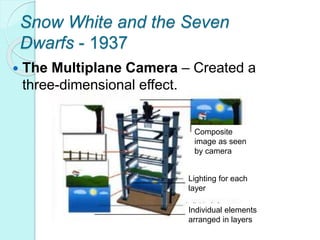
 The Multiplane Camera – Created a 
three-dimensional effect. 
Composite 
image as seen 
by camera 
Lighting for each 
layer 
Individual elements 
arranged in layers
Pinocchio -1940 
 Rotoscoping – An animation 
technique in which animators 
trace over live-action film 
movement, frame by frame.
Pinocchio -1940 
 Pinocchio was a ground 
breaking achievement in 
highly realistic effect 
animation. 
 Used Live Action Reference.
Sleeping Beauty - 1959 
 First animated feature to be 
photographed in the Technirama 
widescreen process.
Sleeping Beauty - 1959 
 The last Disney feature to 
use hand-inked cels in the 
animation. 
 Every shot in the film was 
done from a live-action 
reference version.
Disney Animation from 101 
Dalmatians (1961) to Beauty 
and the Beast (1991)
Xerography 
• “101 Dalmatians” (1961) the first movie to use this method. 
• Also first animated Disney movie to not use the technique of 
rotoscoped. 
• Disney animation team had a limited budget so had to come up with 
a way to make a box office hit at a reduced cost. 
• Ub Iwerks, having experimented with Xerography, suggested using 
this program which side-tracked the hand inking process, this 
involved placing the cels over the drawings and inkers copying the 
outlines with different coloured inks. This process only leaves the 
colour to be inked on. 
• One problem of this system is the original sketch type of drawing 
was kept in the final movie. 
• Problem was improved in the 1977 movie “The Rescuers” by re-drawing 
the original sketches into a cleaner finished product.
Recycled Animation 
• Over the next few years, the action of using templates already used 
in previous animations became quite common. The ability to reuse 
these templates reduced cost which was important in the times of 
Disney's limited budgets. 
• In “The Sword and the Stone” (1963) some templates were taken 
from “Bambi” (1942) , and “101 Dalmatians”. Some of the templates 
from this movie were also carried through to the next feature “The 
Jungle Book” (1967).
Revolutionary Animation 
Techniques 
• Animation in “The Rescuers” (1977) used in the opening 
credits marked the first time camera movements were used 
over still photographs. 
• New Xerography program used in this film re-created the 
softer outline that was not previously available with this 
system. Previously could only use black outlines, now use 
medium grey tones and more.
ATP Process 
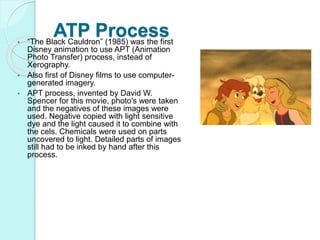
• “The Black Cauldron” (1985) was the first 
Disney animation to use APT (Animation 
Photo Transfer) process, instead of 
Xerography. 
• Also first of Disney films to use computer-generated 
imagery. 
• APT process, invented by David W. 
Spencer for this movie, photo's were taken 
and the negatives of these images were 
used. Negative copied with light sensitive 
dye and the light caused it to combine with 
the cels. Chemicals were used on parts 
uncovered to light. Detailed parts of images 
still had to be inked by hand after this 
process.
CGI 
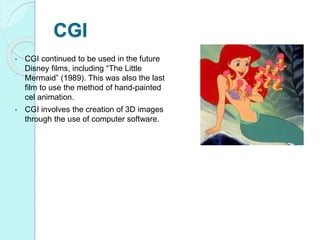
• CGI continued to be used in the future 
Disney films, including “The Little 
Mermaid” (1989). This was also the last 
film to use the method of hand-painted 
cel animation. 
• CGI involves the creation of 3D images 
through the use of computer software.
CAPS 
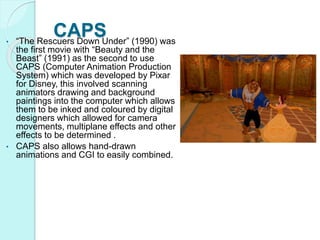
• “The Rescuers Down Under” (1990) was 
the first movie with “Beauty and the 
Beast” (1991) as the second to use 
CAPS (Computer Animation Production 
System) which was developed by Pixar 
for Disney, this involved scanning 
animators drawing and background 
paintings into the computer which allows 
them to be inked and coloured by digital 
designers which allowed for camera 
movements, multiplane effects and other 
effects to be determined . 
• CAPS also allows hand-drawn 
animations and CGI to easily combined.
Disney Renaissance? 
1989 – Present
The Woman’s role in later Disney 
 De Rozario – 1994 
“Princesses in later Disney perform an 
opposite social journey to Walt’s 
traditional princess” 
Role of Woman changing with 
society. 
 The Little Mermaid, Pocahontas, Mulan. 
 Jasmine in Aladdin; Jafar’s slave when 
he gets access to the genie, helps 
Aladdin by seducing Jafar. 
 Tarzan; Jane requires saving
Return to classic Disney 
Musicals 
 The Little Mermaid; Return to the 
musical Disney. 
 This proved successful as there are 6 
Disney Renaissance animated films in 
the top 50 highest grossing animated 
movies 
 The Lion King is second only to be 
topped by Toy Story 3.
Multicultural Phase 
 Aladdin – Good vs Evil. 
◦ Aladdin and Jamsine have thick American 
accents 
◦ Sultan – British “jolly” accent 
◦ Jafar – Arabic accent. 
 Hunchback of Notre Dame – racist 
oppression of Quasimodo and the 
gypsies in Paris.
Realism 
 Hercules, Mulan, Pocahontas, 
Hunchback of Notre Dame and the 
Little Mermaid are based on stories 
and historical figures. 
 Victor Hugo’s Hunchback Notre 
Dame; Everyone is killed, Quasimodo 
commits suicide by starving himself. 
 Brother’s Grimm Little Mermaid; Also 
dies, and her sisters lose their hair.
Following the Disney 
Renaissance 
 Following the Disney Renaissance there was 
a lull for Disney. 
 Animation; The animation level here is out 
standing, with exceptional facial expressions 
◦ The ending scene of Atlantis was described as 
the most difficult scene in the history of Disney 
Animation 
 Neglected movies. 
◦ FANTASIA 2000 
The Emperor’s New Groove. 
Atlantis: The Lost Empire – 350 Animators, based on comic book style – 
Mike Mignola. 
Lilo & Stitch 
Treasure Planet 
Brother Bear 
Home on the Range
But it didn’t work… 
 Following these unsuccessful movies, 
Disney returned the traditional hand drawn 
movies; 
◦ The Princess and the Frog. (2009) 
(First hand drawn feature for over 5 years) 
 Tangled – Computer Graphics 
◦ Why did this work when the CG films of the 
2000s didn’t?
References

Disney Animation

  • 1.
    Disney Animation Techniques 1937 – 1959 By Des Murphy
  • 2.
    Snow White andthe Seven Dwarfs -1937  The first full-length animated feature film.  The first produced in full Technicolor.  The film became the most successful motion picture of 1938 and earned over $8 million on its initial release, the equivalent of $122,487,945 in 2010.
  • 3.
    Snow White andthe Seven Dwarfs -1937  Technicolor - A three-color method that included all colours of the rainbow. aaaaaaaaaaaaaaaa
  • 4.
    Snow White andthe Seven Dwarfs - 1937  The Multiplane Camera – Created a three-dimensional effect. Composite image as seen by camera Lighting for each layer Individual elements arranged in layers
  • 5.
    Pinocchio -1940 Rotoscoping – An animation technique in which animators trace over live-action film movement, frame by frame.
  • 6.
    Pinocchio -1940 Pinocchio was a ground breaking achievement in highly realistic effect animation.  Used Live Action Reference.
  • 7.
    Sleeping Beauty -1959  First animated feature to be photographed in the Technirama widescreen process.
  • 8.
    Sleeping Beauty -1959  The last Disney feature to use hand-inked cels in the animation.  Every shot in the film was done from a live-action reference version.
  • 9.
    Disney Animation from101 Dalmatians (1961) to Beauty and the Beast (1991)
  • 10.
    Xerography • “101Dalmatians” (1961) the first movie to use this method. • Also first animated Disney movie to not use the technique of rotoscoped. • Disney animation team had a limited budget so had to come up with a way to make a box office hit at a reduced cost. • Ub Iwerks, having experimented with Xerography, suggested using this program which side-tracked the hand inking process, this involved placing the cels over the drawings and inkers copying the outlines with different coloured inks. This process only leaves the colour to be inked on. • One problem of this system is the original sketch type of drawing was kept in the final movie. • Problem was improved in the 1977 movie “The Rescuers” by re-drawing the original sketches into a cleaner finished product.
  • 12.
    Recycled Animation •Over the next few years, the action of using templates already used in previous animations became quite common. The ability to reuse these templates reduced cost which was important in the times of Disney's limited budgets. • In “The Sword and the Stone” (1963) some templates were taken from “Bambi” (1942) , and “101 Dalmatians”. Some of the templates from this movie were also carried through to the next feature “The Jungle Book” (1967).
  • 14.
    Revolutionary Animation Techniques • Animation in “The Rescuers” (1977) used in the opening credits marked the first time camera movements were used over still photographs. • New Xerography program used in this film re-created the softer outline that was not previously available with this system. Previously could only use black outlines, now use medium grey tones and more.
  • 15.
    ATP Process •“The Black Cauldron” (1985) was the first Disney animation to use APT (Animation Photo Transfer) process, instead of Xerography. • Also first of Disney films to use computer-generated imagery. • APT process, invented by David W. Spencer for this movie, photo's were taken and the negatives of these images were used. Negative copied with light sensitive dye and the light caused it to combine with the cels. Chemicals were used on parts uncovered to light. Detailed parts of images still had to be inked by hand after this process.
  • 16.
    CGI • CGIcontinued to be used in the future Disney films, including “The Little Mermaid” (1989). This was also the last film to use the method of hand-painted cel animation. • CGI involves the creation of 3D images through the use of computer software.
  • 17.
    CAPS • “TheRescuers Down Under” (1990) was the first movie with “Beauty and the Beast” (1991) as the second to use CAPS (Computer Animation Production System) which was developed by Pixar for Disney, this involved scanning animators drawing and background paintings into the computer which allows them to be inked and coloured by digital designers which allowed for camera movements, multiplane effects and other effects to be determined . • CAPS also allows hand-drawn animations and CGI to easily combined.
  • 18.
  • 19.
    The Woman’s rolein later Disney  De Rozario – 1994 “Princesses in later Disney perform an opposite social journey to Walt’s traditional princess” Role of Woman changing with society.  The Little Mermaid, Pocahontas, Mulan.  Jasmine in Aladdin; Jafar’s slave when he gets access to the genie, helps Aladdin by seducing Jafar.  Tarzan; Jane requires saving
  • 20.
    Return to classicDisney Musicals  The Little Mermaid; Return to the musical Disney.  This proved successful as there are 6 Disney Renaissance animated films in the top 50 highest grossing animated movies  The Lion King is second only to be topped by Toy Story 3.
  • 21.
    Multicultural Phase Aladdin – Good vs Evil. ◦ Aladdin and Jamsine have thick American accents ◦ Sultan – British “jolly” accent ◦ Jafar – Arabic accent.  Hunchback of Notre Dame – racist oppression of Quasimodo and the gypsies in Paris.
  • 22.
    Realism  Hercules,Mulan, Pocahontas, Hunchback of Notre Dame and the Little Mermaid are based on stories and historical figures.  Victor Hugo’s Hunchback Notre Dame; Everyone is killed, Quasimodo commits suicide by starving himself.  Brother’s Grimm Little Mermaid; Also dies, and her sisters lose their hair.
  • 23.
    Following the Disney Renaissance  Following the Disney Renaissance there was a lull for Disney.  Animation; The animation level here is out standing, with exceptional facial expressions ◦ The ending scene of Atlantis was described as the most difficult scene in the history of Disney Animation  Neglected movies. ◦ FANTASIA 2000 The Emperor’s New Groove. Atlantis: The Lost Empire – 350 Animators, based on comic book style – Mike Mignola. Lilo & Stitch Treasure Planet Brother Bear Home on the Range
  • 24.
    But it didn’twork…  Following these unsuccessful movies, Disney returned the traditional hand drawn movies; ◦ The Princess and the Frog. (2009) (First hand drawn feature for over 5 years)  Tangled – Computer Graphics ◦ Why did this work when the CG films of the 2000s didn’t?
  • 25.