DISEASE PREVENTION
STRATEGIES: PRIMARY
Health Sciences Module
BPH- 2nd year
Dr Tanveer Rehman
20-04-2021 1
Introduction
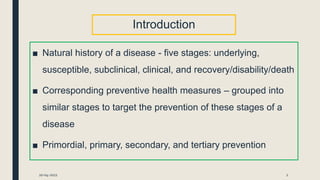
■ Natural history of a disease - five stages: underlying,
susceptible, subclinical, clinical, and recovery/disability/death
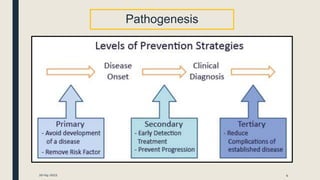
■ Corresponding preventive health measures – grouped into
similar stages to target the prevention of these stages of a
disease
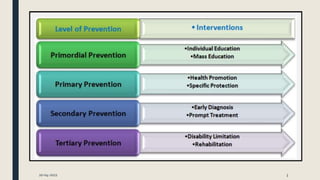
■ Primordial, primary, secondary, and tertiary prevention
20-04-2021 2
20-04-2021 3
20-04-2021 4
Pathogenesis
Primary prevention
■ Aims to prevent disease or injury before it ever occurs
■ Target population: Healthy individuals
■ Done by preventing exposures to hazards that cause
disease or injury, altering unhealthy or unsafe behaviours
that can lead to disease or injury, and increasing resistance
to disease or injury should exposure occur
20-04-2021 5
Significance
■ Action taken before the onset of disease
■ Intervention in the pre- pathogenesis phase of a disease or
health problem
■ Preventive services are proven to be an essential aspect of
healthcare – however, they appear consistently underutilized
in our country
20-04-2021 6
Significance…
■ With cost, time, and resource constraints on physicians,
many preventive services get overlooked for patients
■ Physicians need to remain up to date on the prevention
guidelines and ensure all are offered appropriate services
■ Includes concept of “positive health” – achievement &
maintenance of acceptable level of health
20-04-2021 7
Examples
■ Legislation and enforcement to ban or control the use of
hazardous products (e.g. asbestos) or to mandate safe and
healthy practices (e.g. use of seatbelts and bike helmets)
■ Education about healthy and safe habits (e.g. eating well
(supplementation), exercising regularly, not smoking)
■ Immunization against infectious diseases
20-04-2021 8
Modes of intervention
Two ways to achieve it
1. Health promotion
2. Specific protection
20-04-2021 9
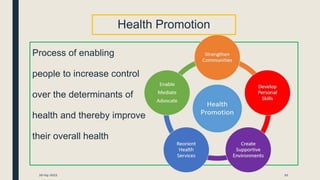
Health Promotion
Process of enabling
people to increase control
over the determinants of
health and thereby improve
their overall health
20-04-2021 10
Health Promotion
Can be achieved by following interventions
■ Health education
■ Environmental modification
■ Behavioural changes
■ Lifestyle changes
■ Nutritional intervention
20-04-2021 11
Specific protection
■ Efforts directed toward protection against specific diseases
■ Immunization
■ Use of specific nutrients
■ Chemoprophylaxis (e.g. Rifampicin for leprosy)
■ Protection against accidents / occupational hazards
20-04-2021 12
Approaches
WHO has recommended the following approaches for primary
prevention of chronic diseases where the risk factors are
established:
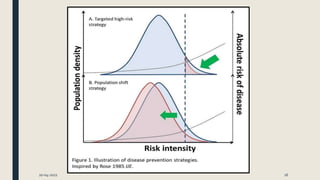
■ Population (mass) strategy
■ High-risk strategy
20-04-2021 13
Population (mass) strategy
■ Directed at the whole population (masses) irrespective of
individual risk levels – sick individuals & sick population
(Rose hypothesis)
■ Directed towards socio-economic, and lifestyle changes
■ Example: even a small reduction in the average blood
pressure/ serum cholesterol of a population would produce a
large reduction in incidence of cardiovascular diseases
20-04-2021 14
High-risk strategy
■ Aims to bring preventive care to individuals at special risk
■ Requires detection of individuals at high risk by the optimum
use of clinical methods
■ Primary prevention is a “Holistic” approach which relies on
the measures taken to promote health
20-04-2021 15
20-04-2021 16
THANK YOU
20-04-2021 17

Disease prevention strategies: Primary

  • 1.
    DISEASE PREVENTION STRATEGIES: PRIMARY HealthSciences Module BPH- 2nd year Dr Tanveer Rehman 20-04-2021 1
  • 2.
    Introduction ■ Natural historyof a disease - five stages: underlying, susceptible, subclinical, clinical, and recovery/disability/death ■ Corresponding preventive health measures – grouped into similar stages to target the prevention of these stages of a disease ■ Primordial, primary, secondary, and tertiary prevention 20-04-2021 2
  • 3.
  • 4.
  • 5.
    Primary prevention ■ Aimsto prevent disease or injury before it ever occurs ■ Target population: Healthy individuals ■ Done by preventing exposures to hazards that cause disease or injury, altering unhealthy or unsafe behaviours that can lead to disease or injury, and increasing resistance to disease or injury should exposure occur 20-04-2021 5
  • 6.
    Significance ■ Action takenbefore the onset of disease ■ Intervention in the pre- pathogenesis phase of a disease or health problem ■ Preventive services are proven to be an essential aspect of healthcare – however, they appear consistently underutilized in our country 20-04-2021 6
  • 7.
    Significance… ■ With cost,time, and resource constraints on physicians, many preventive services get overlooked for patients ■ Physicians need to remain up to date on the prevention guidelines and ensure all are offered appropriate services ■ Includes concept of “positive health” – achievement & maintenance of acceptable level of health 20-04-2021 7
  • 8.
    Examples ■ Legislation andenforcement to ban or control the use of hazardous products (e.g. asbestos) or to mandate safe and healthy practices (e.g. use of seatbelts and bike helmets) ■ Education about healthy and safe habits (e.g. eating well (supplementation), exercising regularly, not smoking) ■ Immunization against infectious diseases 20-04-2021 8
  • 9.
    Modes of intervention Twoways to achieve it 1. Health promotion 2. Specific protection 20-04-2021 9
  • 10.
    Health Promotion Process ofenabling people to increase control over the determinants of health and thereby improve their overall health 20-04-2021 10
  • 11.
    Health Promotion Can beachieved by following interventions ■ Health education ■ Environmental modification ■ Behavioural changes ■ Lifestyle changes ■ Nutritional intervention 20-04-2021 11
  • 12.
    Specific protection ■ Effortsdirected toward protection against specific diseases ■ Immunization ■ Use of specific nutrients ■ Chemoprophylaxis (e.g. Rifampicin for leprosy) ■ Protection against accidents / occupational hazards 20-04-2021 12
  • 13.
    Approaches WHO has recommendedthe following approaches for primary prevention of chronic diseases where the risk factors are established: ■ Population (mass) strategy ■ High-risk strategy 20-04-2021 13
  • 14.
    Population (mass) strategy ■Directed at the whole population (masses) irrespective of individual risk levels – sick individuals & sick population (Rose hypothesis) ■ Directed towards socio-economic, and lifestyle changes ■ Example: even a small reduction in the average blood pressure/ serum cholesterol of a population would produce a large reduction in incidence of cardiovascular diseases 20-04-2021 14
  • 15.
    High-risk strategy ■ Aimsto bring preventive care to individuals at special risk ■ Requires detection of individuals at high risk by the optimum use of clinical methods ■ Primary prevention is a “Holistic” approach which relies on the measures taken to promote health 20-04-2021 15
  • 16.
  • 17.