Trade Union Act 1926 
Misconduct and disciplinary Procedure
Labor Law 
Labor Laws can be classified into the following eight 
categories: 
 Laws related to Industrial Relations 
 Laws related to Wages 
 Laws related to Specific Industries 
 Laws related to Equality and Empowerment of Women 
 Laws related to Deprived and Disadvantaged Sections of 
the Society 
 Laws related to Social Security 
 Laws related to Employment & Training 
 Others
Laws Related to IR 
 The Trade Unions Act, 1926 
 The Industrial Employment Act (Standing Order), 
1946 
 The Industrial Disputes Act, 1947
Problems faced by Trade Unions 
 Lack of balanced growth 
 Low Membership 
 Poor Financial Position 
 Political Control 
 Multiplicity of Unions 
 Inter Union Rivalry 
 Lack of able leader 
 Lack of Recognition
Labour Problem- Misconduct and 
Disciplinary 
 Labor behavior on the duty 
 Mentioned in the item no. 9 & 14 of schedule -1 in 
industrial Employment 
 Misconducts are acts or conduct of employees 
prohibited under the employee disciplinary rules. A 
misconduct can lead to disciplinary action taken 
against the employee at fault
 Code of discipline defines terms and condition which 
is accepted by employer and workers. 
 A code of discipline drafted by the sub committee 
was duly rectified by the central organizations of 
workers and employers at the 16th session of the 
Indias Labour conference in March 1958 and 
operated from June 1958 
Code of discipline
 Without proper notice, strike is not permitted 
 No damage should be caused in plant or property 
 Violence, coercion should not be resorted 
 Willful damage to or loss of employer’s goods or 
property 
 Taking and giving bribes for any illegal gratification 
Principals of code of conduct
 Habitual absence without leave or absence without 
leave for more than 10 days. 
 Habitual late attendance 
 Habitual breach of any law applicable to the 
establishment 
 Habitual negligence or neglect of work 
 Frequent repetition of any act 
Principals of code of conduct….
Principals of code of conduct…. 
 Striking work or inciting others to strike work in 
contravention (with conflict) 
 Sexual harassment which includes such unwelcome 
sexually determined behavior (weather directly or by 
implication) 
1. Physical Contact 
2. A demand or request for sexual favors 
3. Sexually –colored remarks 
4. Showing pornography 
5. Verbal and nonverbal signs
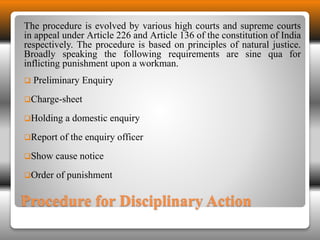
The procedure is evolved by various high courts and supreme courts 
in appeal under Article 226 and Article 136 of the constitution of India 
respectively. The procedure is based on principles of natural justice. 
Broadly speaking the following requirements are sine qua for 
inflicting punishment upon a workman. 
 Preliminary Enquiry 
Charge-sheet 
Holding a domestic enquiry 
Report of the enquiry officer 
Show cause notice 
Order of punishment 
Procedure for Disciplinary Action
 A preliminary enquiry is the first phase to collect 
proper and accurate information against a particular 
worker who has done any misconduct in the course 
of his employment. 
 Examine the material and to see whether a prima 
facie case exist calling for detailed inquiry. 
Preliminary Enquiry
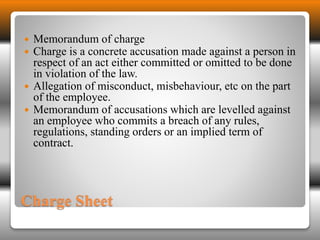
 Memorandum of charge 
 Charge is a concrete accusation made against a person in 
respect of an act either committed or omitted to be done 
in violation of the law. 
 Allegation of misconduct, misbehaviour, etc on the part 
of the employee. 
 Memorandum of accusations which are levelled against 
an employee who commits a breach of any rules, 
regulations, standing orders or an implied term of 
contract. 
Charge Sheet
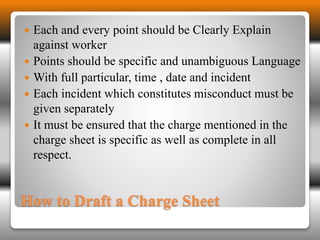
 Each and every point should be Clearly Explain 
against worker 
 Points should be specific and unambiguous Language 
 With full particular, time , date and incident 
 Each incident which constitutes misconduct must be 
given separately 
 It must be ensured that the charge mentioned in the 
charge sheet is specific as well as complete in all 
respect. 
How to Draft a Charge Sheet
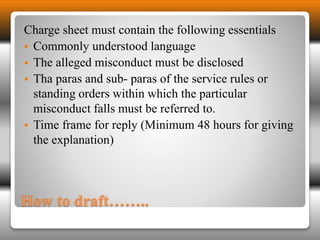
Charge sheet must contain the following essentials 
 Commonly understood language 
 The alleged misconduct must be disclosed 
 Tha paras and sub- paras of the service rules or 
standing orders within which the particular 
misconduct falls must be referred to. 
 Time frame for reply (Minimum 48 hours for giving 
the explanation) 
How to draft……..
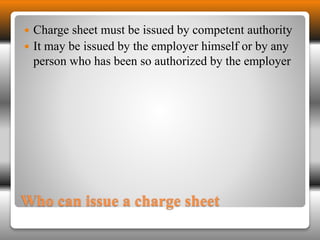
 Charge sheet must be issued by competent authority 
 It may be issued by the employer himself or by any 
person who has been so authorized by the employer 
Who can issue a charge sheet
 A charge sheet should be served on the workmen 
personally 
 Workmen signature or thumb impression is required 
for the charge sheet whether he accepted his charge 
sheet or not. 
 If the employee refuses the charge sheet , an 
endorsement to that effect be made on it in the 
presence of at least two witnesses so that proof of the 
same is available for evidence 
Service of Charge sheet
 In same condition if employee refuses to accept 
charge sheet , then it may be sent by registered A.D. 
post 
 Then the employer should get it published in some 
regional language daily news paper. 
Service of charge sheet…….
 Employee will be submit his explanation in respect 
of the charges leveled against him. 
 48 to 72 hours from the date of receipt of the charge 
sheet . 
 The purpose of calling for an explanation to the 
charge sheet is that if the employee admits the 
charge, there will be no need for any further enquiry 
Explanation of charge sheet
The principle of natural justice are crystallized into 
four principles of justice – 
a)Opportunity to both the contesting parties to be heard 
b)Hearing before an impartial enquiry officer so that no 
man can be judge of his own cause 
c)Decision made in good faith 
d) An orderly course of procedure 
Domestic Inquiry
 The stage of submitting the report 
 Report and findings should only be based on 
evidence 
 Type of punishment is to be given is entirely within 
management‘s discretion 
REPORT OF THE ENQUIRY OFFICER
SHOW CAUSE LETTER 
 Giving the employee the opportunity to defend 
himself or herself is an application of the "Law of 
Natural Justice". 
 It is advisable to always remember this at all times.
PUNISHMENT 
 For every misconduct punishment is a must. 
 Under the common law, punishment to be awarded 
was suppose to be entirely within discretion of 
management.
POINTS TO REMEMBER WHILE 
PROCEEDING DISCIPLINARY ACTIONS 
 A workman who is placed under suspension : shall, 
during the period of such suspension, be paid a 
subsistence allowance. 
 Previous punishment record.

Trade union Act 1926

  • 1.
    Trade Union Act1926 Misconduct and disciplinary Procedure
  • 2.
    Labor Law LaborLaws can be classified into the following eight categories:  Laws related to Industrial Relations  Laws related to Wages  Laws related to Specific Industries  Laws related to Equality and Empowerment of Women  Laws related to Deprived and Disadvantaged Sections of the Society  Laws related to Social Security  Laws related to Employment & Training  Others
  • 3.
    Laws Related toIR  The Trade Unions Act, 1926  The Industrial Employment Act (Standing Order), 1946  The Industrial Disputes Act, 1947
  • 4.
    Problems faced byTrade Unions  Lack of balanced growth  Low Membership  Poor Financial Position  Political Control  Multiplicity of Unions  Inter Union Rivalry  Lack of able leader  Lack of Recognition
  • 5.
    Labour Problem- Misconductand Disciplinary  Labor behavior on the duty  Mentioned in the item no. 9 & 14 of schedule -1 in industrial Employment  Misconducts are acts or conduct of employees prohibited under the employee disciplinary rules. A misconduct can lead to disciplinary action taken against the employee at fault
  • 6.
     Code ofdiscipline defines terms and condition which is accepted by employer and workers.  A code of discipline drafted by the sub committee was duly rectified by the central organizations of workers and employers at the 16th session of the Indias Labour conference in March 1958 and operated from June 1958 Code of discipline
  • 7.
     Without propernotice, strike is not permitted  No damage should be caused in plant or property  Violence, coercion should not be resorted  Willful damage to or loss of employer’s goods or property  Taking and giving bribes for any illegal gratification Principals of code of conduct
  • 8.
     Habitual absencewithout leave or absence without leave for more than 10 days.  Habitual late attendance  Habitual breach of any law applicable to the establishment  Habitual negligence or neglect of work  Frequent repetition of any act Principals of code of conduct….
  • 9.
    Principals of codeof conduct….  Striking work or inciting others to strike work in contravention (with conflict)  Sexual harassment which includes such unwelcome sexually determined behavior (weather directly or by implication) 1. Physical Contact 2. A demand or request for sexual favors 3. Sexually –colored remarks 4. Showing pornography 5. Verbal and nonverbal signs
  • 10.
    The procedure isevolved by various high courts and supreme courts in appeal under Article 226 and Article 136 of the constitution of India respectively. The procedure is based on principles of natural justice. Broadly speaking the following requirements are sine qua for inflicting punishment upon a workman.  Preliminary Enquiry Charge-sheet Holding a domestic enquiry Report of the enquiry officer Show cause notice Order of punishment Procedure for Disciplinary Action
  • 11.
     A preliminaryenquiry is the first phase to collect proper and accurate information against a particular worker who has done any misconduct in the course of his employment.  Examine the material and to see whether a prima facie case exist calling for detailed inquiry. Preliminary Enquiry
  • 12.
     Memorandum ofcharge  Charge is a concrete accusation made against a person in respect of an act either committed or omitted to be done in violation of the law.  Allegation of misconduct, misbehaviour, etc on the part of the employee.  Memorandum of accusations which are levelled against an employee who commits a breach of any rules, regulations, standing orders or an implied term of contract. Charge Sheet
  • 13.
     Each andevery point should be Clearly Explain against worker  Points should be specific and unambiguous Language  With full particular, time , date and incident  Each incident which constitutes misconduct must be given separately  It must be ensured that the charge mentioned in the charge sheet is specific as well as complete in all respect. How to Draft a Charge Sheet
  • 14.
    Charge sheet mustcontain the following essentials  Commonly understood language  The alleged misconduct must be disclosed  Tha paras and sub- paras of the service rules or standing orders within which the particular misconduct falls must be referred to.  Time frame for reply (Minimum 48 hours for giving the explanation) How to draft……..
  • 15.
     Charge sheetmust be issued by competent authority  It may be issued by the employer himself or by any person who has been so authorized by the employer Who can issue a charge sheet
  • 16.
     A chargesheet should be served on the workmen personally  Workmen signature or thumb impression is required for the charge sheet whether he accepted his charge sheet or not.  If the employee refuses the charge sheet , an endorsement to that effect be made on it in the presence of at least two witnesses so that proof of the same is available for evidence Service of Charge sheet
  • 17.
     In samecondition if employee refuses to accept charge sheet , then it may be sent by registered A.D. post  Then the employer should get it published in some regional language daily news paper. Service of charge sheet…….
  • 18.
     Employee willbe submit his explanation in respect of the charges leveled against him.  48 to 72 hours from the date of receipt of the charge sheet .  The purpose of calling for an explanation to the charge sheet is that if the employee admits the charge, there will be no need for any further enquiry Explanation of charge sheet
  • 19.
    The principle ofnatural justice are crystallized into four principles of justice – a)Opportunity to both the contesting parties to be heard b)Hearing before an impartial enquiry officer so that no man can be judge of his own cause c)Decision made in good faith d) An orderly course of procedure Domestic Inquiry
  • 20.
     The stageof submitting the report  Report and findings should only be based on evidence  Type of punishment is to be given is entirely within management‘s discretion REPORT OF THE ENQUIRY OFFICER
  • 21.
    SHOW CAUSE LETTER  Giving the employee the opportunity to defend himself or herself is an application of the "Law of Natural Justice".  It is advisable to always remember this at all times.
  • 22.
    PUNISHMENT  Forevery misconduct punishment is a must.  Under the common law, punishment to be awarded was suppose to be entirely within discretion of management.
  • 23.
    POINTS TO REMEMBERWHILE PROCEEDING DISCIPLINARY ACTIONS  A workman who is placed under suspension : shall, during the period of such suspension, be paid a subsistence allowance.  Previous punishment record.

Editor's Notes

  • #2 In industrial Relation we know about the labour Laws but before knowing these term of Misconduct and disciplinary … we will have to understand much more about the labour laws .
  • #3 Basically following laws which come under the labour laws . We can divide labour laws in eight categories.
  • #4 And IR can be classified in to three categories. You should know that what are standing orders- Standing order means rules of conduct for workmen employed in industrial estableshment. Standing Orders means rules relating to matters set out in the schdule to the act. (section 2(g))The schdule to the act requires that following should be specified in standing orders-(a) classification of workmen i.e. temporary, badli, casual, permanent,skilled etc. B: Manner of intimating to workmen working hours, shift working transfer etc. (c) holidays (d) attendance and late coming rules (e) leave rules (f) Leave eligibility and Leave condition (g) Closing and reopening of sections of industrial establishment (h) termination of employment, suspension, dismissal etc. for misconduct of act or omission which constitute misconduct (I) Retirement Age (J) Means of redressed of workmen against unfair treatment Or wrongful exaction b employer (K) Any other matter that may be prescribed The most important use of standing order in case of disciplinary action. A workmen can be punished only if the act committed by him is a misconduct as defined under the Standing Orders. The model standing orders contain such acts like insubordination, disobedience, fraud, dishonesty etc…..
  • #5 1.The main problem which is having serious concern for the trade union, The reason is unorganized agricultural sector. The agricultural workers work in different types of companies in India . 2. Low Membership- There is a set procedure to take membership but most of the employee hesitate to take membership because they have fear to cut salary and other benefits 3. Poor Financial Position-One of the main problem to take membership is poor financial position 4. Political Control – Trade union is affiliated with central political parties and they take interest in labour problems for gaining public attention and for gaining publicity. 5. There are more then one union within the same industry and each one backed by political party. They have inter conflict within one industry suppose that one trade union have a issue then other one may work against it. As a result no one have a better position to solve the labour issues. 6. Inter Union Rivalry- Everyone think about that they are in the power because they have political support. They do not want to work together because of their profits. Each Union may adopt a different approach to the problem. 7. Lack of Recognition-. Because more then one union, Inter Union Rivalry , different attitudes towards trade union
  • #6 1.“Mis” means bad and conduct means behaviour and we called misconduct as a group word. Disciplinary is the comman word which is used by all the colleges, companies and other industries. 2. As per the indian labour market the set rules of disciplinary is manadory for the economic growth of the country as well as company . 3. The set rules and condition which is formed by the company and government defined as a force for work properly . 4. Discipline inindustry may be described as willing cooperation and observance of the rules and regulations of the organisation by the management.
  • #7 Following principle will define that how code of conduct work in any organisation for the smooth running and better functioning in the organiation.
  • #8 Following principle explain the way of deciding misconduct in the organisation. Proper notice must be delivered before the strike otherwise strike comes under the violence.
  • #11 Following procedure will follow in the time of disciplinary action. Suppose that any employee engaged in any activity which come under the misconduct then Organization follow the same rules which is mentioned in law.
  • #12 Suppose we collect the information that indicate to workmen misconduct then disciplinary action will be proceed . What is prima facie case –A case in which the evidence presented is sufficient for a judgment to be made
  • #13 Memorandum means a written proposal and reminder
  • #14 Following information will describe that how to draft charge sheet in a effective manner and no chances of rezection