DISCIPLINARY ACTION
MADAN
Why indiscipline?
 Ignorance of rules
 Physical/ mental incapability
 Absence of proper training
 Discontented workmen
 Misguidance by Trade Union leaders
 Absence of standard policies of handling
discipline
 Uncongenial working conditions
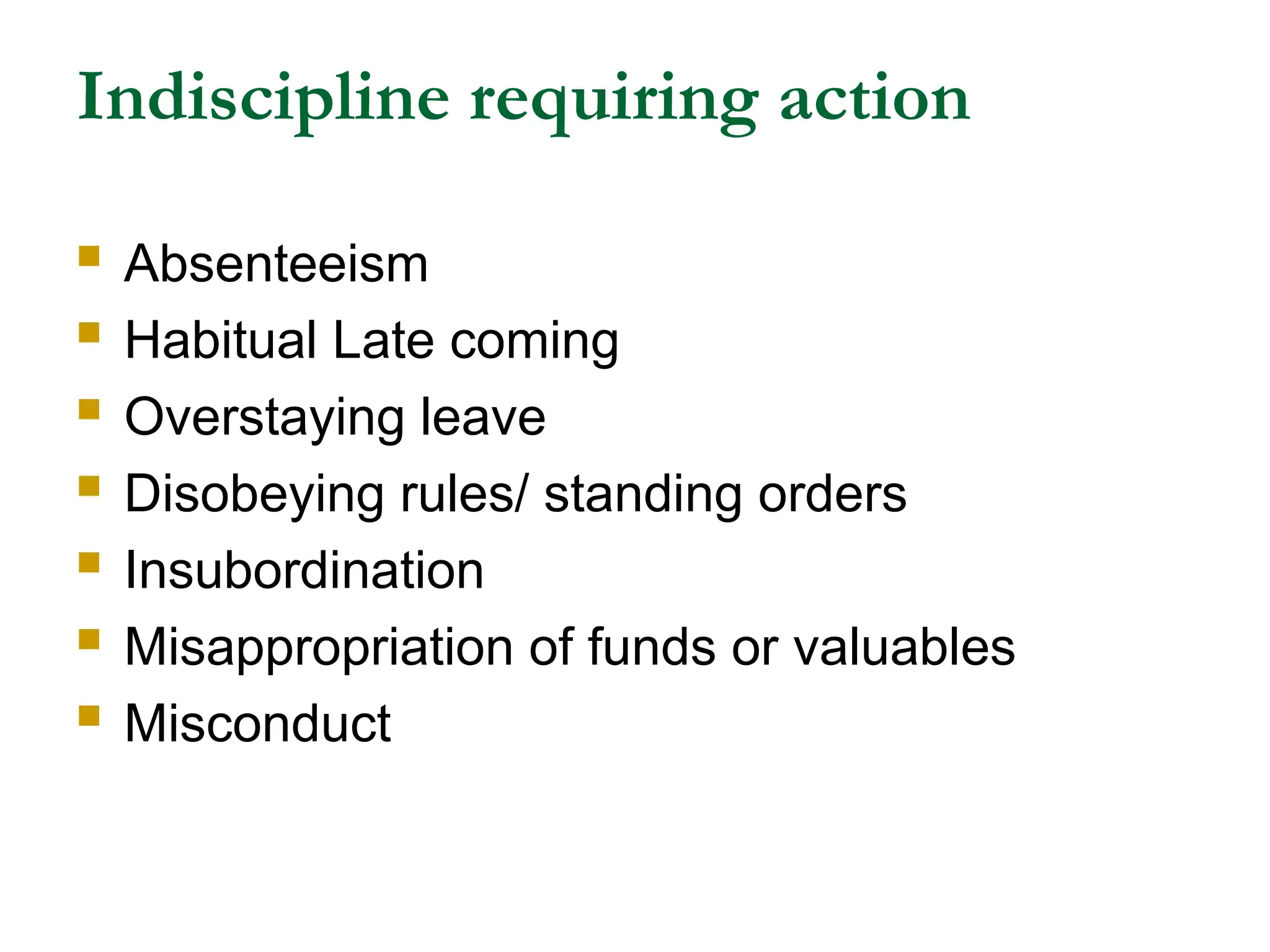
Indiscipline requiring action
 Absenteeism
 Habitual Late coming
 Overstaying leave
 Disobeying rules/ standing orders
 Insubordination
 Misappropriation of funds or valuables
 Misconduct
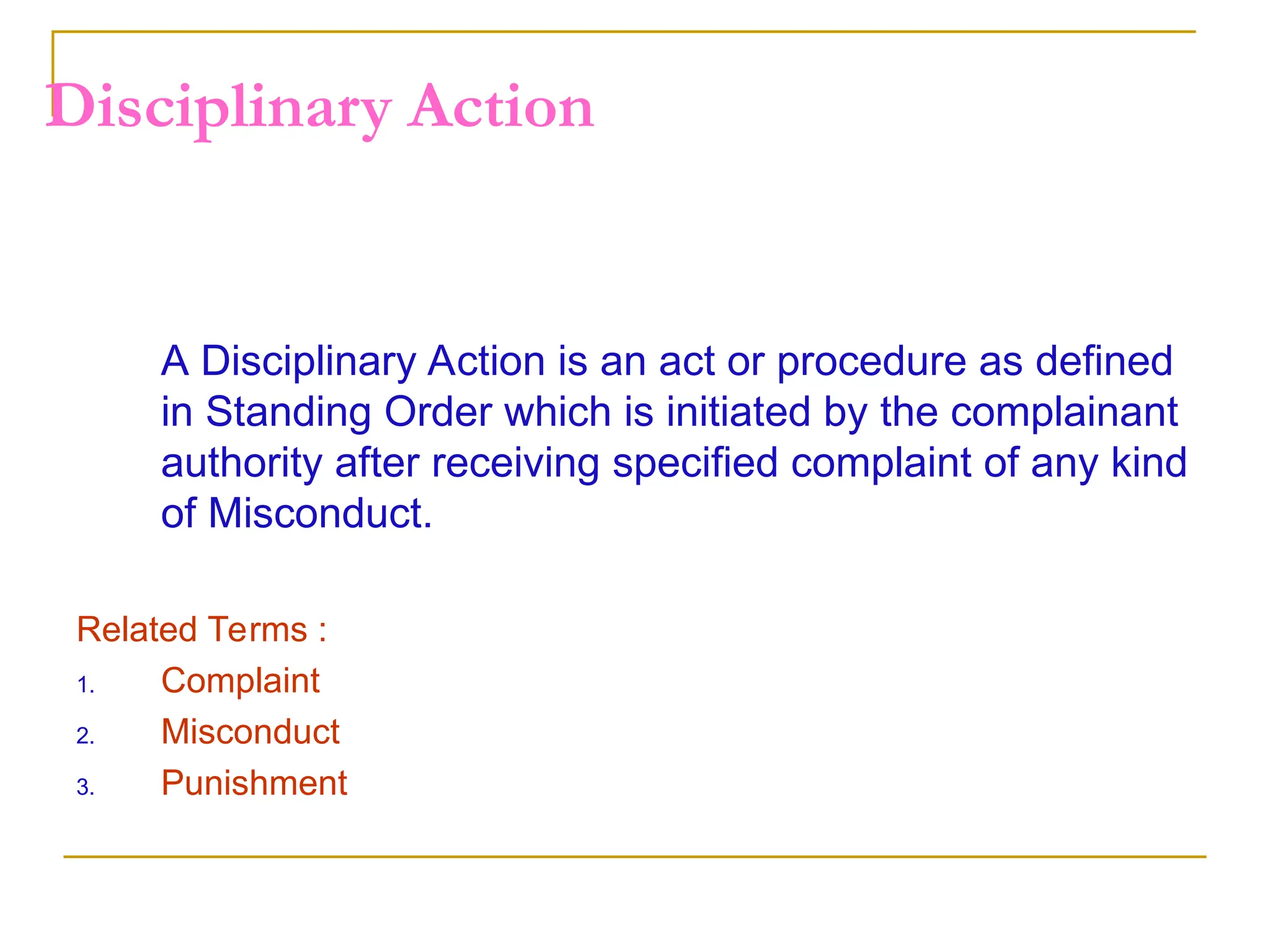
Disciplinary Action
A Disciplinary Action is an act or procedure as defined
in Standing Order which is initiated by the complainant
authority after receiving specified complaint of any kind
of Misconduct.
Related Terms :
1. Complaint
2. Misconduct
3. Punishment
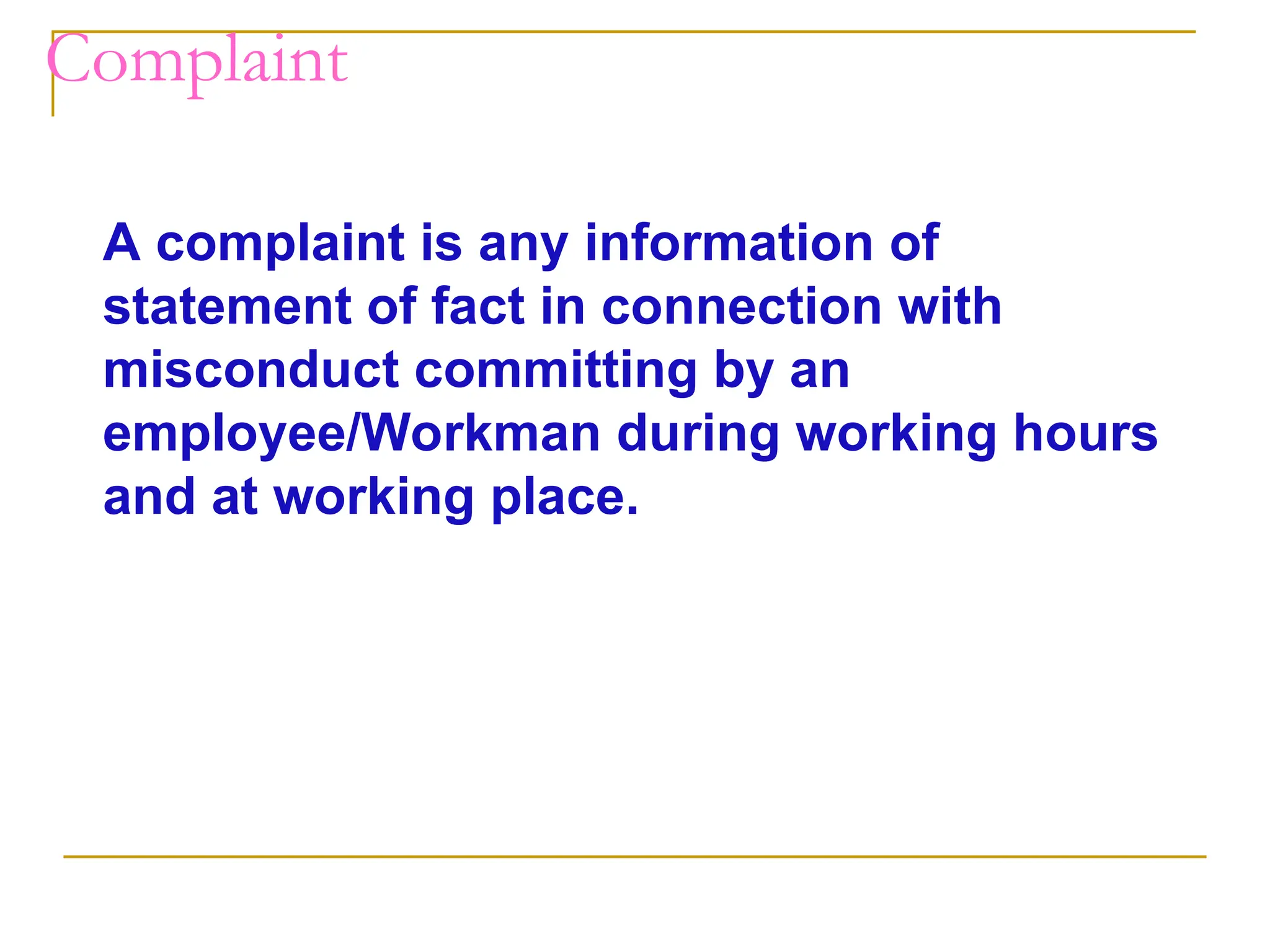
Complaint
A complaint is any information of
statement of fact in connection with
misconduct committing by an
employee/Workman during working hours
and at working place.
Main ingredients of the complaint:
1. Presence of employee on the date when a misconduct
said to be done.
2. Details of allotment of job by the immediate
supervisor or HOD, who so ever may be.
3. Narration of misconduct.
4. Any sort of disturbance in the process of
production/Output.
5. Any sort of damage or loss after committing the
misconduct by the employee.
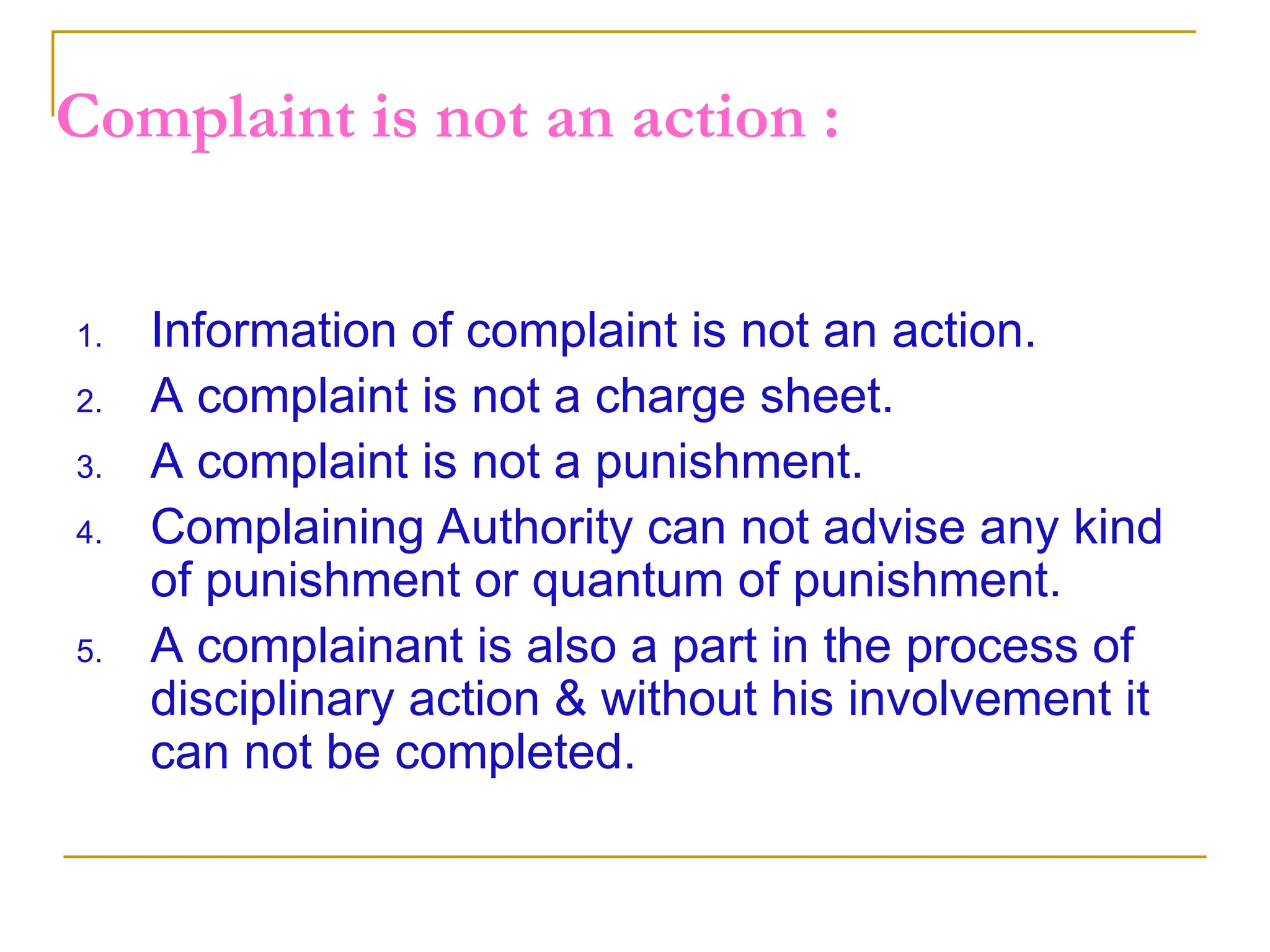
Complaint is not an action :
1. Information of complaint is not an action.
2. A complaint is not a charge sheet.
3. A complaint is not a punishment.
4. Complaining Authority can not advise any kind
of punishment or quantum of punishment.
5. A complainant is also a part in the process of
disciplinary action & without his involvement it
can not be completed.
Misconduct
An act which is not desirable by the employee
during working hours & working place.
Misconduct is the doing of something or the omitting to do
something which is wrong to do or omit. Whether the person is guilty
of the act or omission knows that the act which he is doing or that
which he is omitting to do so, is wrong thing to do or omit.
An employee is appointment & paid essentially for performance of
certain set of duties. Non observance of the duties, interested to
him is therefore ,the first & foremost misconduct on the part of
employee. even if the employee fails to perform a single duty, out of
the number of duties, that will be misconduct.
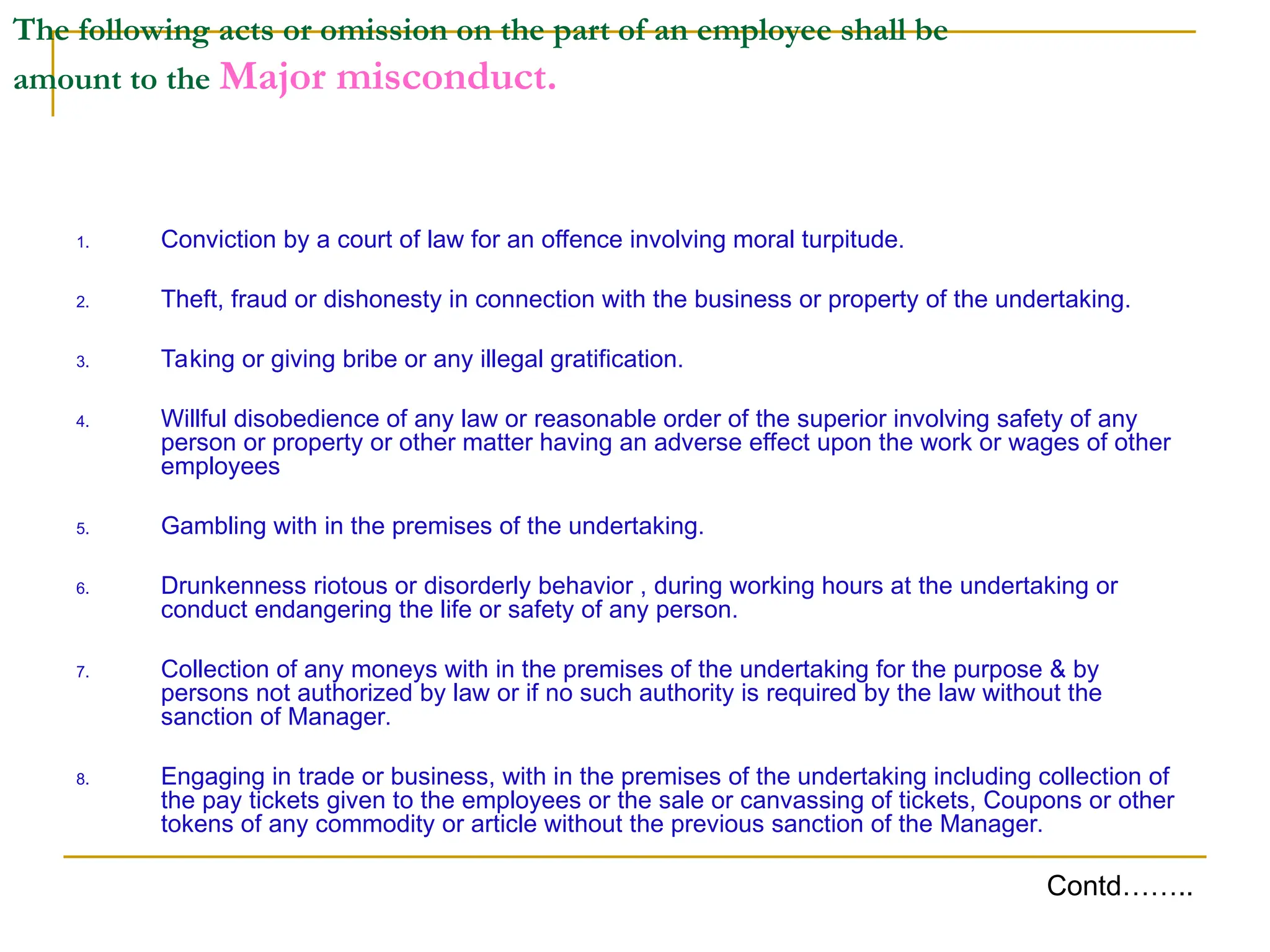
The following acts or omission on the part of an employee shall be
amount to the Major misconduct.
1. Conviction by a court of law for an offence involving moral turpitude.
2. Theft, fraud or dishonesty in connection with the business or property of the undertaking.
3. Taking or giving bribe or any illegal gratification.
4. Willful disobedience of any law or reasonable order of the superior involving safety of any
person or property or other matter having an adverse effect upon the work or wages of other
employees
5. Gambling with in the premises of the undertaking.
6. Drunkenness riotous or disorderly behavior , during working hours at the undertaking or
conduct endangering the life or safety of any person.
7. Collection of any moneys with in the premises of the undertaking for the purpose & by
persons not authorized by law or if no such authority is required by the law without the
sanction of Manager.
8. Engaging in trade or business, with in the premises of the undertaking including collection of
the pay tickets given to the employees or the sale or canvassing of tickets, Coupons or other
tokens of any commodity or article without the previous sanction of the Manager.
Contd……..
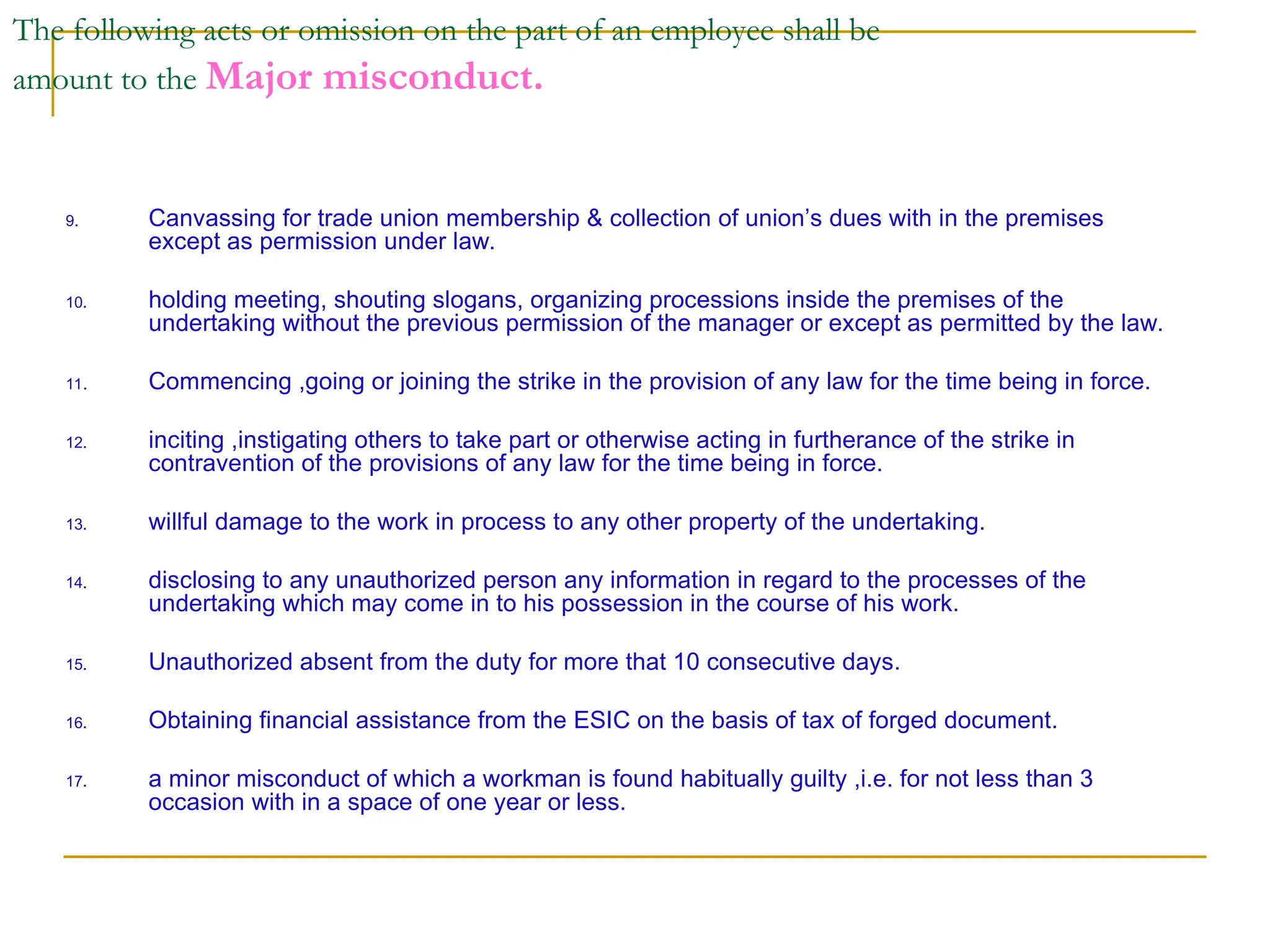
The following acts or omission on the part of an employee shall be
amount to the Major misconduct.
9. Canvassing for trade union membership & collection of union’s dues with in the premises
except as permission under law.
10. holding meeting, shouting slogans, organizing processions inside the premises of the
undertaking without the previous permission of the manager or except as permitted by the law.
11. Commencing ,going or joining the strike in the provision of any law for the time being in force.
12. inciting ,instigating others to take part or otherwise acting in furtherance of the strike in
contravention of the provisions of any law for the time being in force.
13. willful damage to the work in process to any other property of the undertaking.
14. disclosing to any unauthorized person any information in regard to the processes of the
undertaking which may come in to his possession in the course of his work.
15. Unauthorized absent from the duty for more that 10 consecutive days.
16. Obtaining financial assistance from the ESIC on the basis of tax of forged document.
17. a minor misconduct of which a workman is found habitually guilty ,i.e. for not less than 3
occasion with in a space of one year or less.
Any of the following acts or omission shall
amount to a minor misconduct
1. late attendance;
2. absence from duty without leave or without sufficient cause, which is not a major misconduct;
3. refusal to work on a job of a similar nature without giving adequate reasons for the same;
4. sleeping during working hours;
5. failure to observe safety instructions, or unauthorized removal in reference to machinery,
guard, fencing or other safety device installed in the premises of the establishment.
6. Any act or omission for which deductions from the wages of an employed person are
authorized by or under the payment of wages Act;
7. Entering or leaving the premises of the undertaking except by the gate or gates appointed for
the purpose.
8. Committing a nuisance in the premises of the undertaking, indiscipline, breach of any
standing order or instructions for the maintenance and running of any department and
maintaining its cleanliness.
PUNISHMENT
(a) The punishment for minor misconduct may be :
1. censure or
2. fine, or
(b) The punishment for a major misconduct may be
1. censure or
2. fine, or
3. suspension for a period not exceeding four days on any one occasion or
4. withholding or increment for a period of one year or
5. demotion or
6. dismissal,
(c) In awarding the punishment the manager shall take into account the
gravity of the misconduct, the previous record of the employee, if
any, and any other extenuating or aggravating circumstance.
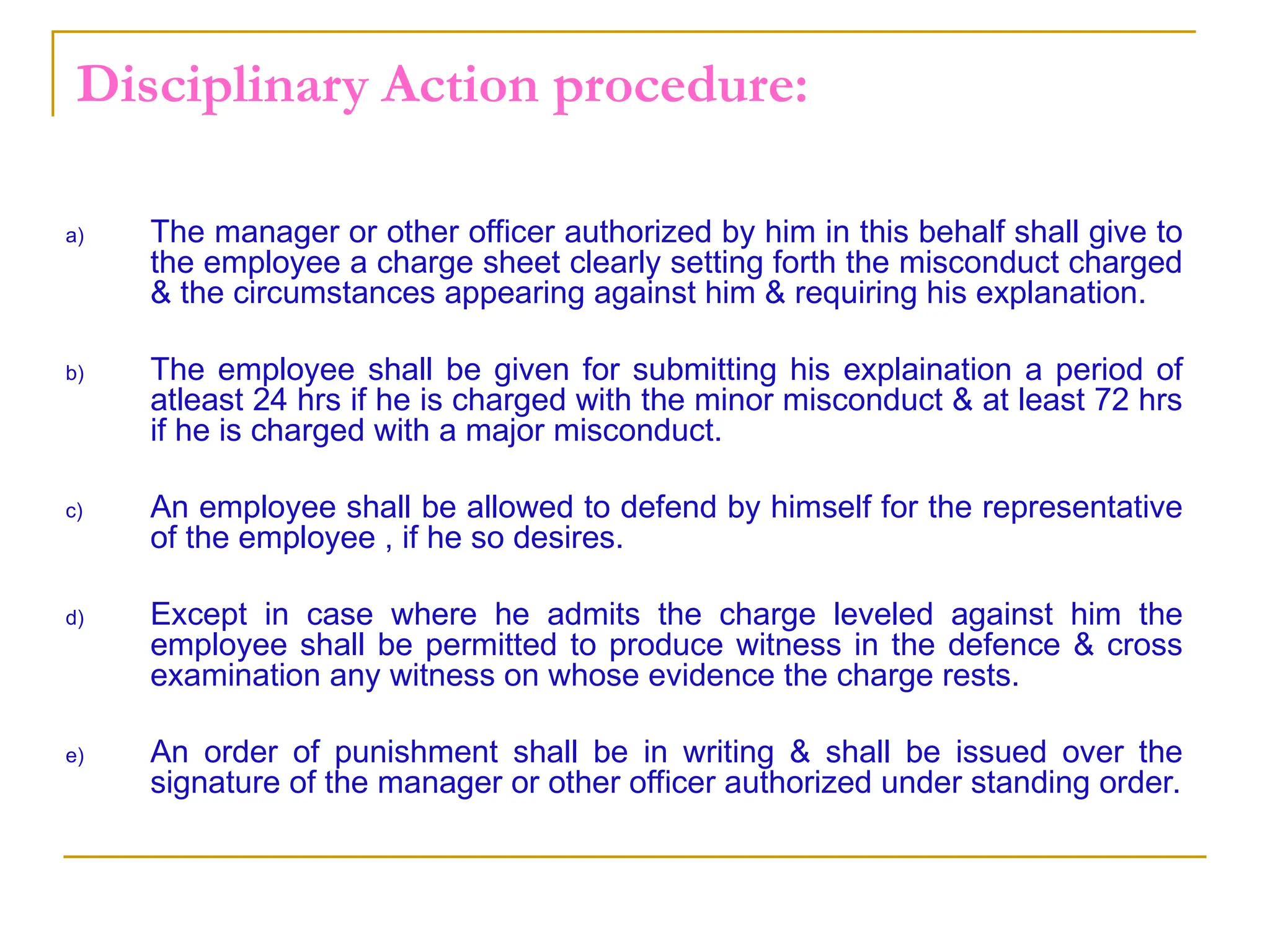
Disciplinary Action procedure:
a) The manager or other officer authorized by him in this behalf shall give to
the employee a charge sheet clearly setting forth the misconduct charged
& the circumstances appearing against him & requiring his explanation.
b) The employee shall be given for submitting his explaination a period of
atleast 24 hrs if he is charged with the minor misconduct & at least 72 hrs
if he is charged with a major misconduct.
c) An employee shall be allowed to defend by himself for the representative
of the employee , if he so desires.
d) Except in case where he admits the charge leveled against him the
employee shall be permitted to produce witness in the defence & cross
examination any witness on whose evidence the charge rests.
e) An order of punishment shall be in writing & shall be issued over the
signature of the manager or other officer authorized under standing order.
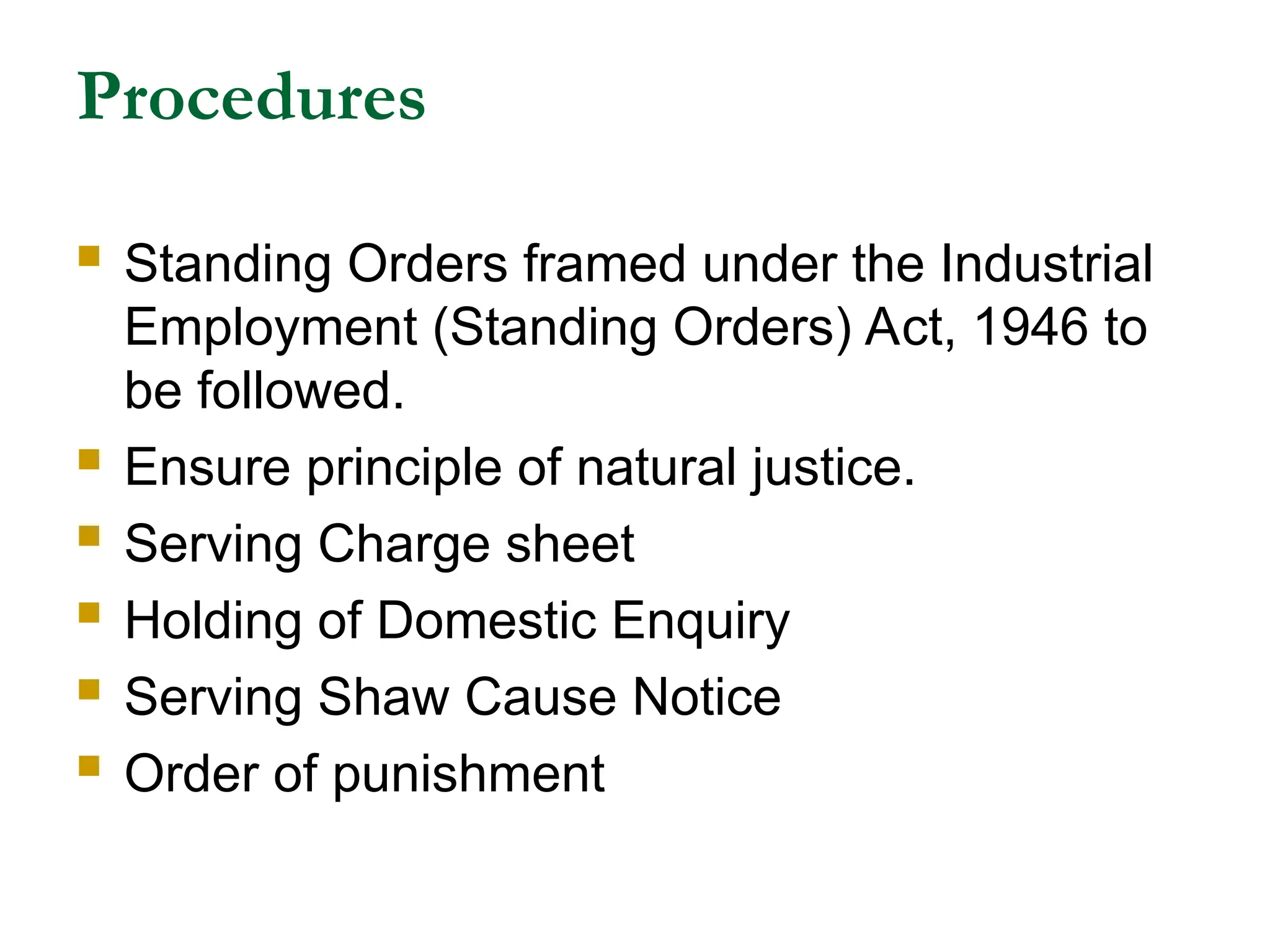
Procedures
 Standing Orders framed under the Industrial
Employment (Standing Orders) Act, 1946 to
be followed.
 Ensure principle of natural justice.
 Serving Charge sheet
 Holding of Domestic Enquiry
 Serving Shaw Cause Notice
 Order of punishment
Charge Sheet
 Memorandum of charges
 Statement of allegations of misconduct/
omission/ negligence
 No particular format prescribed for charge
sheet in any Labour enactment
 The object is to give the employee exact idea
of the misconduct committed by him so that
he may get reasonable opportunity to defend.
Requisites of Charge sheet
 It should contain complete picture of
misconduct
 It should state that the act of commission or
omission resulting in misconduct is violation
of a particular clause of standing order
 Language to be as per Standing Orders or as
required by the delinquent
 Enclose a list of witnesses in support of
charges
Be specific
 Charges leveled should be specifically
stated- avoid ‘ etc..etc’/ ‘ other’/ ‘any’/ ‘ some
people’ like expressions.
 The amount misappropriated should be
specific sum and not ‘ around’
 Person manhandled should be Mr./Ms. X and
not ‘ some one’
 Time of misconduct should be exact- avoid
‘around’ time.
 Charge sheet for using offending language
should contain the exact word used.
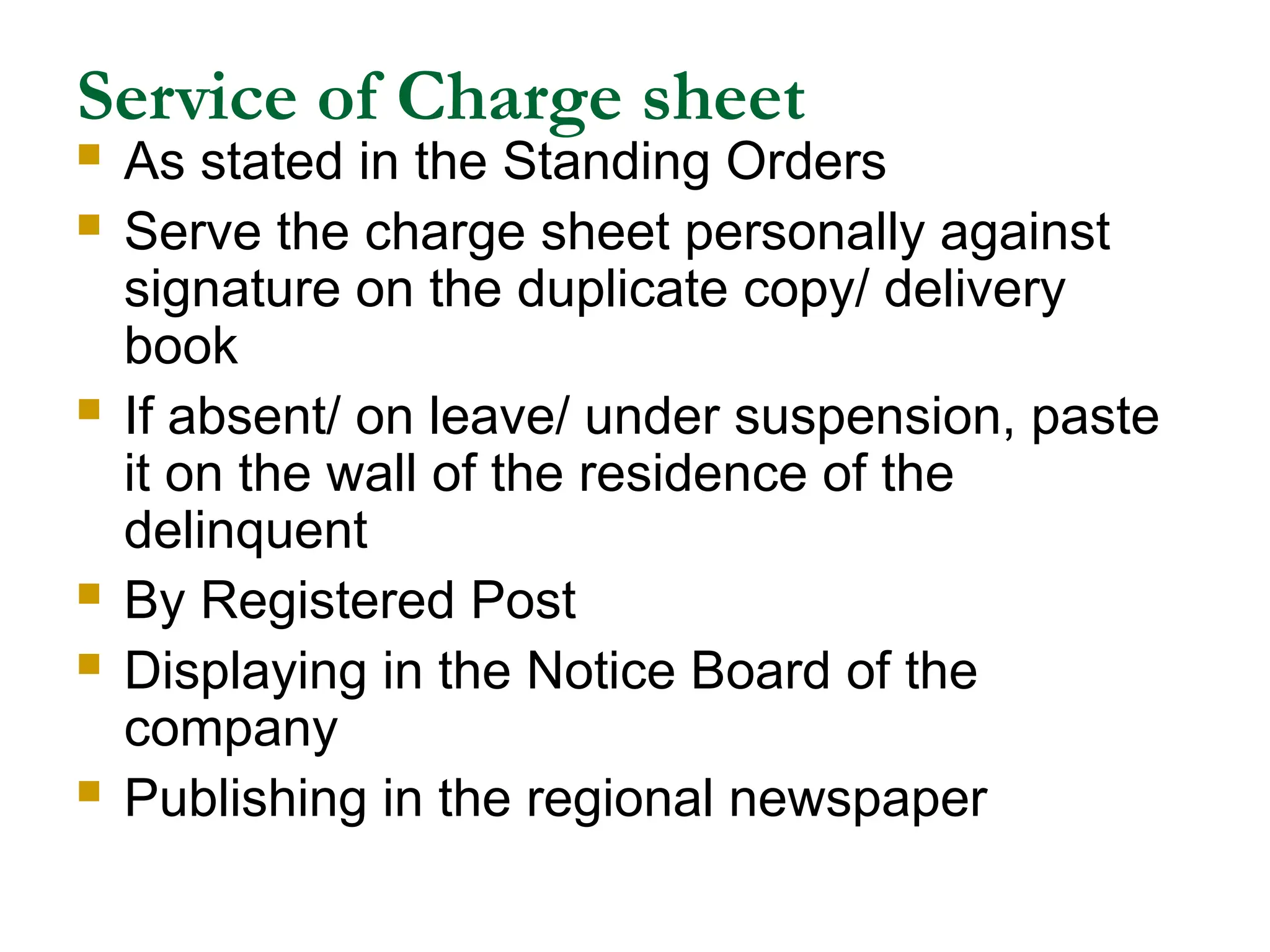
Service of Charge sheet
 As stated in the Standing Orders
 Serve the charge sheet personally against
signature on the duplicate copy/ delivery
book
 If absent/ on leave/ under suspension, paste
it on the wall of the residence of the
delinquent
 By Registered Post
 Displaying in the Notice Board of the
company
 Publishing in the regional newspaper
Domestic Enquiry
 Follow rules laid down in Standing Orders
 Purpose of domestic enquiry -
Provide delinquent an opportunity to
defend the charges
Provide employer an opportunity to
evaluate the situation and decide the
penalty to be imposed
Notice of Enquiry to be served
 Notice to show the Date and Time of enquiry
 Venue of holding enquiry
 Name of the Enquiry Officer
 Notice to be served in the same manner as followed
to serve charge sheet
 Workman shall have right to appoint a Defense
Helper
 When legally trained person represents
management in enquiry, workman shall also be
allowed to be represented by lawyer (Hindustan
Teleprinters Ltd Vs Mr. Rajan Isaac.)
Recording the Evidences
 Not mandatory that procedure laid down in the Code
of Criminal Procedure, 1973 or the Evidence Act,
1872 to be followed. (Mahindra and Mahindra Ltd. Vs Sunil
Yeshwant Pandit and another )
 Question- Answer pattern may be followed
 Statement of Management to be taken first
 Cross examination by employee/ helper
 Take signature of the concerned on record
 Examine and cross examine witnesses
 Object/ Disallow irrelevant questions
Show Cause Notice
 Before punishment is initiated a Show Cause Notice
highlighting the charges, findings of the enquiry and
possible penalty imposed on the delinquent shall
also be served calling on him to show cause ‘why
action including discharge or (even dismissal) shall
not be taken against’ the delinquent.
 Though serving of such notice will not make the
process of enquiry invalid (as decided in S. Shenbagaraj
Vs Additional Commissioner of Industries and Commerce,
Chepauk and others.), it is advisable to give the
employee a final opportunity before punishment is
inflicted.
 Enquiry report to be furnished to the employee
Order of Punishment
 Principles of natural justice to be followed
 Punishment should not violate section 73 of the
ESI Act - notice of dismissal or discharge given
to an employee during the period the employee
is in receipt of sickness, maternity or other
benefit shall be invalid.
 Order issued without holding a domestic
enquiry or after holding a defective enquiry will
not stand since Labour Court/ Tribunal can
interfere with such order as provided u/s 11A of
the Industrial Disputes Act, 1947
Charge sheet- absenting without intimation
 To Date:
-------------
Sub: Absenting without intimation-
You have been absent since_____ (date)/ overstaying leave
granted since_____ (date)
Absenting without leave/ overstaying of leave is an offence
as per rule ___ of our Standing Orders and as such your
act of absenting without intimation is a misconduct which
attracts such punishment including termination of service.
Accordingly you are hereby called upon to explain in writing
within 48 hours as to why appropriate action should not be
taken against you.
Sd/-
Appropriate Authority/ Authorised Signatory
Charge sheet- misbehavior
 To
-------
It is reported that on ____(date) at _____(time) you misbehaved
with Mr./Ms._____ (name), ____ (designation) in the
presence of ______ (as witnesses)
Disobeying orders and misbehaving are serious misconduct as
per rule____ of our Standing Orders which attract
punishment including dismissal from service.
Accordingly you are hereby called upon to explain in writing
within 48 hours as to why appropriate action should not be
taken against you.
Sd/-
Appropriate Authority/ Authorised Signatory
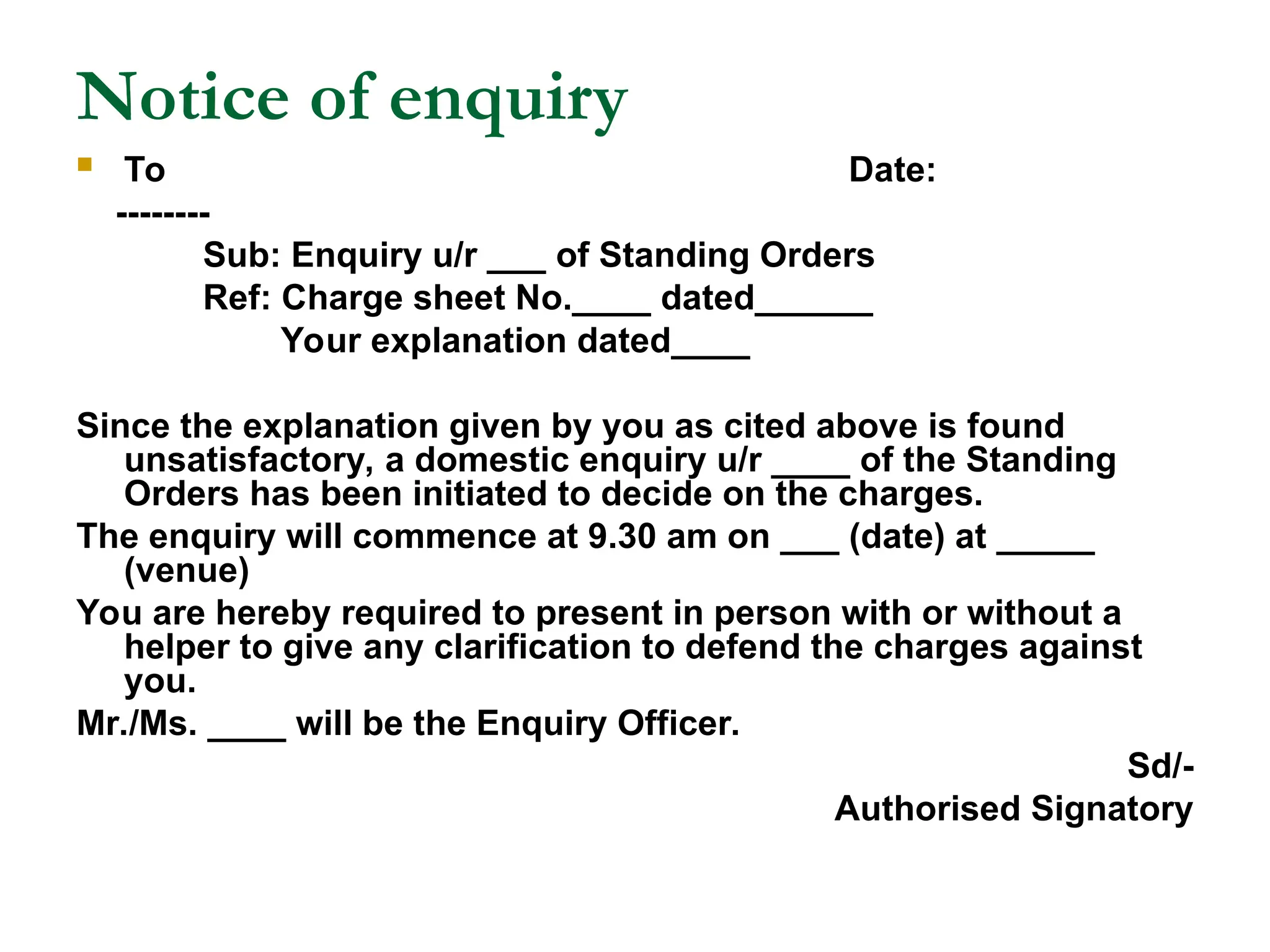
Notice of enquiry
 To Date:
--------
Sub: Enquiry u/r ___ of Standing Orders
Ref: Charge sheet No.____ dated______
Your explanation dated____
Since the explanation given by you as cited above is found
unsatisfactory, a domestic enquiry u/r ____ of the Standing
Orders has been initiated to decide on the charges.
The enquiry will commence at 9.30 am on ___ (date) at _____
(venue)
You are hereby required to present in person with or without a
helper to give any clarification to defend the charges against
you.
Mr./Ms. ____ will be the Enquiry Officer.
Sd/-
Authorised Signatory
Enquiry Proceedings
 Enquiry proceedings in to the charge sheet No____ dated ___ issued to Mr.___
(Time, date and place of enquiry)
Present
1. Charge sheeted employee
2. Defense helper
3. Management representative
The charges leveled against the employee were read over and explained to the
employee.
(Examination of management witness- statement in support of charges)
Name and details of witness
Statement/ questions and answers
Signature of witness
Signature of charge sheeted employee with a declaration that the statement has been
recorded in his presence
Signature of Enquiry Officer
(Cross Examination by Employee/ defense helper)
-Same process as above-
(Examination of witness against charges)
-Same process as above-
(Cross Examination by management representative)
-Same process as above-
* If any one does not want to cross examine, the same may be recorded as “
opportunity given for cross examination but declined to cross examine” with
signatures
Show Cause Notice
 To Date
---------
Sub: Show Cause Notice
WHEREAS you were charge sheeted for an offence as stated.
AND WHEREAS you were granted an opportunity to defend the charges by
way of Domestic enquiry which commenced on ____ and ended on ___
(dates)
AND WHEREAS you have failed to prove your innocence before the Enquiry
Officer.
NOW THEREFORE, the management is constrained to take disciplinary
action against you.
Without prejudice and following the Enquiry Officer’s report your act of
omission/ commission has been proved to be a serious misconduct
which attracts punishment which may extend to dismissal from service.
THEREFORE, you are hereby called upon to show cause why disciplinary
action including dismissal should not be taken against you/ why you
should not be removed from service. A copy of the findings of the
Enquiry Officer is enclosed herewith for your perusal.
Your written reply should reach the undersigned within____ days.
Sd/-
Authorised Signatory
Termination Order
 To Date
--------
Sub: Order of Termination of Service
Ref: Charge sheet No____ dated____
Pursuant to the charge sheet above referred and findings of enquiry
report dated____, the management has come to the conclusion that
the charges leveled against you have been proved categorically.
As you have been found guilty of serious misconduct, the
management has decided to dismiss you from service. However, on
compassionate grounds, we have decided to take a lenient step by
imposing a lesser punishment by discharging you from service
with effect from/ with immediate effect.
You are, therefore, directed to settle your dues including salary dues
and handover the charges to Mr________ during office hours
on_________
Sd/-
Authorised Signatory
Thank You
MADAN
Courtesy to Mr. H L Kumar’s Practical Guide to Labour Management

disciplinary action.pptppplplllllllllllll

  • 1.
  • 2.
    Why indiscipline?  Ignoranceof rules  Physical/ mental incapability  Absence of proper training  Discontented workmen  Misguidance by Trade Union leaders  Absence of standard policies of handling discipline  Uncongenial working conditions
  • 3.
    Indiscipline requiring action Absenteeism  Habitual Late coming  Overstaying leave  Disobeying rules/ standing orders  Insubordination  Misappropriation of funds or valuables  Misconduct
  • 4.
    Disciplinary Action A DisciplinaryAction is an act or procedure as defined in Standing Order which is initiated by the complainant authority after receiving specified complaint of any kind of Misconduct. Related Terms : 1. Complaint 2. Misconduct 3. Punishment
  • 5.
    Complaint A complaint isany information of statement of fact in connection with misconduct committing by an employee/Workman during working hours and at working place.
  • 6.
    Main ingredients ofthe complaint: 1. Presence of employee on the date when a misconduct said to be done. 2. Details of allotment of job by the immediate supervisor or HOD, who so ever may be. 3. Narration of misconduct. 4. Any sort of disturbance in the process of production/Output. 5. Any sort of damage or loss after committing the misconduct by the employee.
  • 7.
    Complaint is notan action : 1. Information of complaint is not an action. 2. A complaint is not a charge sheet. 3. A complaint is not a punishment. 4. Complaining Authority can not advise any kind of punishment or quantum of punishment. 5. A complainant is also a part in the process of disciplinary action & without his involvement it can not be completed.
  • 8.
    Misconduct An act whichis not desirable by the employee during working hours & working place. Misconduct is the doing of something or the omitting to do something which is wrong to do or omit. Whether the person is guilty of the act or omission knows that the act which he is doing or that which he is omitting to do so, is wrong thing to do or omit. An employee is appointment & paid essentially for performance of certain set of duties. Non observance of the duties, interested to him is therefore ,the first & foremost misconduct on the part of employee. even if the employee fails to perform a single duty, out of the number of duties, that will be misconduct.
  • 9.
    The following actsor omission on the part of an employee shall be amount to the Major misconduct. 1. Conviction by a court of law for an offence involving moral turpitude. 2. Theft, fraud or dishonesty in connection with the business or property of the undertaking. 3. Taking or giving bribe or any illegal gratification. 4. Willful disobedience of any law or reasonable order of the superior involving safety of any person or property or other matter having an adverse effect upon the work or wages of other employees 5. Gambling with in the premises of the undertaking. 6. Drunkenness riotous or disorderly behavior , during working hours at the undertaking or conduct endangering the life or safety of any person. 7. Collection of any moneys with in the premises of the undertaking for the purpose & by persons not authorized by law or if no such authority is required by the law without the sanction of Manager. 8. Engaging in trade or business, with in the premises of the undertaking including collection of the pay tickets given to the employees or the sale or canvassing of tickets, Coupons or other tokens of any commodity or article without the previous sanction of the Manager. Contd……..
  • 10.
    The following actsor omission on the part of an employee shall be amount to the Major misconduct. 9. Canvassing for trade union membership & collection of union’s dues with in the premises except as permission under law. 10. holding meeting, shouting slogans, organizing processions inside the premises of the undertaking without the previous permission of the manager or except as permitted by the law. 11. Commencing ,going or joining the strike in the provision of any law for the time being in force. 12. inciting ,instigating others to take part or otherwise acting in furtherance of the strike in contravention of the provisions of any law for the time being in force. 13. willful damage to the work in process to any other property of the undertaking. 14. disclosing to any unauthorized person any information in regard to the processes of the undertaking which may come in to his possession in the course of his work. 15. Unauthorized absent from the duty for more that 10 consecutive days. 16. Obtaining financial assistance from the ESIC on the basis of tax of forged document. 17. a minor misconduct of which a workman is found habitually guilty ,i.e. for not less than 3 occasion with in a space of one year or less.
  • 11.
    Any of thefollowing acts or omission shall amount to a minor misconduct 1. late attendance; 2. absence from duty without leave or without sufficient cause, which is not a major misconduct; 3. refusal to work on a job of a similar nature without giving adequate reasons for the same; 4. sleeping during working hours; 5. failure to observe safety instructions, or unauthorized removal in reference to machinery, guard, fencing or other safety device installed in the premises of the establishment. 6. Any act or omission for which deductions from the wages of an employed person are authorized by or under the payment of wages Act; 7. Entering or leaving the premises of the undertaking except by the gate or gates appointed for the purpose. 8. Committing a nuisance in the premises of the undertaking, indiscipline, breach of any standing order or instructions for the maintenance and running of any department and maintaining its cleanliness.
  • 12.
    PUNISHMENT (a) The punishmentfor minor misconduct may be : 1. censure or 2. fine, or (b) The punishment for a major misconduct may be 1. censure or 2. fine, or 3. suspension for a period not exceeding four days on any one occasion or 4. withholding or increment for a period of one year or 5. demotion or 6. dismissal, (c) In awarding the punishment the manager shall take into account the gravity of the misconduct, the previous record of the employee, if any, and any other extenuating or aggravating circumstance.
  • 13.
    Disciplinary Action procedure: a)The manager or other officer authorized by him in this behalf shall give to the employee a charge sheet clearly setting forth the misconduct charged & the circumstances appearing against him & requiring his explanation. b) The employee shall be given for submitting his explaination a period of atleast 24 hrs if he is charged with the minor misconduct & at least 72 hrs if he is charged with a major misconduct. c) An employee shall be allowed to defend by himself for the representative of the employee , if he so desires. d) Except in case where he admits the charge leveled against him the employee shall be permitted to produce witness in the defence & cross examination any witness on whose evidence the charge rests. e) An order of punishment shall be in writing & shall be issued over the signature of the manager or other officer authorized under standing order.
  • 14.
    Procedures  Standing Ordersframed under the Industrial Employment (Standing Orders) Act, 1946 to be followed.  Ensure principle of natural justice.  Serving Charge sheet  Holding of Domestic Enquiry  Serving Shaw Cause Notice  Order of punishment
  • 15.
    Charge Sheet  Memorandumof charges  Statement of allegations of misconduct/ omission/ negligence  No particular format prescribed for charge sheet in any Labour enactment  The object is to give the employee exact idea of the misconduct committed by him so that he may get reasonable opportunity to defend.
  • 16.
    Requisites of Chargesheet  It should contain complete picture of misconduct  It should state that the act of commission or omission resulting in misconduct is violation of a particular clause of standing order  Language to be as per Standing Orders or as required by the delinquent  Enclose a list of witnesses in support of charges
  • 17.
    Be specific  Chargesleveled should be specifically stated- avoid ‘ etc..etc’/ ‘ other’/ ‘any’/ ‘ some people’ like expressions.  The amount misappropriated should be specific sum and not ‘ around’  Person manhandled should be Mr./Ms. X and not ‘ some one’  Time of misconduct should be exact- avoid ‘around’ time.  Charge sheet for using offending language should contain the exact word used.
  • 18.
    Service of Chargesheet  As stated in the Standing Orders  Serve the charge sheet personally against signature on the duplicate copy/ delivery book  If absent/ on leave/ under suspension, paste it on the wall of the residence of the delinquent  By Registered Post  Displaying in the Notice Board of the company  Publishing in the regional newspaper
  • 19.
    Domestic Enquiry  Followrules laid down in Standing Orders  Purpose of domestic enquiry - Provide delinquent an opportunity to defend the charges Provide employer an opportunity to evaluate the situation and decide the penalty to be imposed
  • 20.
    Notice of Enquiryto be served  Notice to show the Date and Time of enquiry  Venue of holding enquiry  Name of the Enquiry Officer  Notice to be served in the same manner as followed to serve charge sheet  Workman shall have right to appoint a Defense Helper  When legally trained person represents management in enquiry, workman shall also be allowed to be represented by lawyer (Hindustan Teleprinters Ltd Vs Mr. Rajan Isaac.)
  • 21.
    Recording the Evidences Not mandatory that procedure laid down in the Code of Criminal Procedure, 1973 or the Evidence Act, 1872 to be followed. (Mahindra and Mahindra Ltd. Vs Sunil Yeshwant Pandit and another )  Question- Answer pattern may be followed  Statement of Management to be taken first  Cross examination by employee/ helper  Take signature of the concerned on record  Examine and cross examine witnesses  Object/ Disallow irrelevant questions
  • 22.
    Show Cause Notice Before punishment is initiated a Show Cause Notice highlighting the charges, findings of the enquiry and possible penalty imposed on the delinquent shall also be served calling on him to show cause ‘why action including discharge or (even dismissal) shall not be taken against’ the delinquent.  Though serving of such notice will not make the process of enquiry invalid (as decided in S. Shenbagaraj Vs Additional Commissioner of Industries and Commerce, Chepauk and others.), it is advisable to give the employee a final opportunity before punishment is inflicted.  Enquiry report to be furnished to the employee
  • 23.
    Order of Punishment Principles of natural justice to be followed  Punishment should not violate section 73 of the ESI Act - notice of dismissal or discharge given to an employee during the period the employee is in receipt of sickness, maternity or other benefit shall be invalid.  Order issued without holding a domestic enquiry or after holding a defective enquiry will not stand since Labour Court/ Tribunal can interfere with such order as provided u/s 11A of the Industrial Disputes Act, 1947
  • 24.
    Charge sheet- absentingwithout intimation  To Date: ------------- Sub: Absenting without intimation- You have been absent since_____ (date)/ overstaying leave granted since_____ (date) Absenting without leave/ overstaying of leave is an offence as per rule ___ of our Standing Orders and as such your act of absenting without intimation is a misconduct which attracts such punishment including termination of service. Accordingly you are hereby called upon to explain in writing within 48 hours as to why appropriate action should not be taken against you. Sd/- Appropriate Authority/ Authorised Signatory
  • 25.
    Charge sheet- misbehavior To ------- It is reported that on ____(date) at _____(time) you misbehaved with Mr./Ms._____ (name), ____ (designation) in the presence of ______ (as witnesses) Disobeying orders and misbehaving are serious misconduct as per rule____ of our Standing Orders which attract punishment including dismissal from service. Accordingly you are hereby called upon to explain in writing within 48 hours as to why appropriate action should not be taken against you. Sd/- Appropriate Authority/ Authorised Signatory
  • 26.
    Notice of enquiry To Date: -------- Sub: Enquiry u/r ___ of Standing Orders Ref: Charge sheet No.____ dated______ Your explanation dated____ Since the explanation given by you as cited above is found unsatisfactory, a domestic enquiry u/r ____ of the Standing Orders has been initiated to decide on the charges. The enquiry will commence at 9.30 am on ___ (date) at _____ (venue) You are hereby required to present in person with or without a helper to give any clarification to defend the charges against you. Mr./Ms. ____ will be the Enquiry Officer. Sd/- Authorised Signatory
  • 27.
    Enquiry Proceedings  Enquiryproceedings in to the charge sheet No____ dated ___ issued to Mr.___ (Time, date and place of enquiry) Present 1. Charge sheeted employee 2. Defense helper 3. Management representative The charges leveled against the employee were read over and explained to the employee. (Examination of management witness- statement in support of charges) Name and details of witness Statement/ questions and answers Signature of witness Signature of charge sheeted employee with a declaration that the statement has been recorded in his presence Signature of Enquiry Officer (Cross Examination by Employee/ defense helper) -Same process as above- (Examination of witness against charges) -Same process as above- (Cross Examination by management representative) -Same process as above- * If any one does not want to cross examine, the same may be recorded as “ opportunity given for cross examination but declined to cross examine” with signatures
  • 28.
    Show Cause Notice To Date --------- Sub: Show Cause Notice WHEREAS you were charge sheeted for an offence as stated. AND WHEREAS you were granted an opportunity to defend the charges by way of Domestic enquiry which commenced on ____ and ended on ___ (dates) AND WHEREAS you have failed to prove your innocence before the Enquiry Officer. NOW THEREFORE, the management is constrained to take disciplinary action against you. Without prejudice and following the Enquiry Officer’s report your act of omission/ commission has been proved to be a serious misconduct which attracts punishment which may extend to dismissal from service. THEREFORE, you are hereby called upon to show cause why disciplinary action including dismissal should not be taken against you/ why you should not be removed from service. A copy of the findings of the Enquiry Officer is enclosed herewith for your perusal. Your written reply should reach the undersigned within____ days. Sd/- Authorised Signatory
  • 29.
    Termination Order  ToDate -------- Sub: Order of Termination of Service Ref: Charge sheet No____ dated____ Pursuant to the charge sheet above referred and findings of enquiry report dated____, the management has come to the conclusion that the charges leveled against you have been proved categorically. As you have been found guilty of serious misconduct, the management has decided to dismiss you from service. However, on compassionate grounds, we have decided to take a lenient step by imposing a lesser punishment by discharging you from service with effect from/ with immediate effect. You are, therefore, directed to settle your dues including salary dues and handover the charges to Mr________ during office hours on_________ Sd/- Authorised Signatory
  • 30.
    Thank You MADAN Courtesy toMr. H L Kumar’s Practical Guide to Labour Management