The Business of Disaster RecoveryTrent Richardson
TodayDisaster recovery will no longer be needed after the end of 2011© 2010 All rights reserved
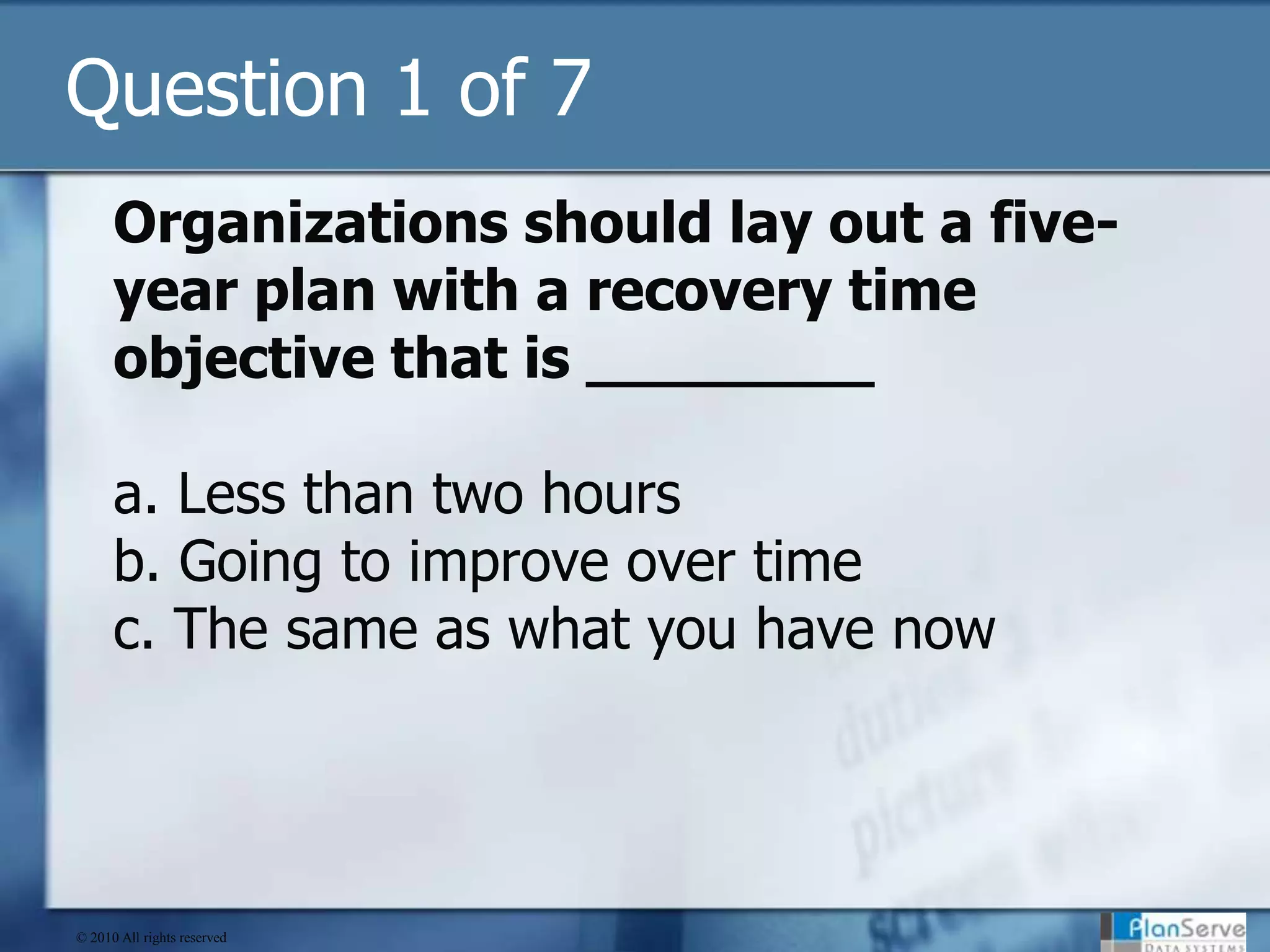
Question 1 of 7Organizations should lay out a five-year plan with a recovery time objective that is ________a. Less than two hoursb. Going to improve over timec. The same as what you have now© 2010 All rights reserved
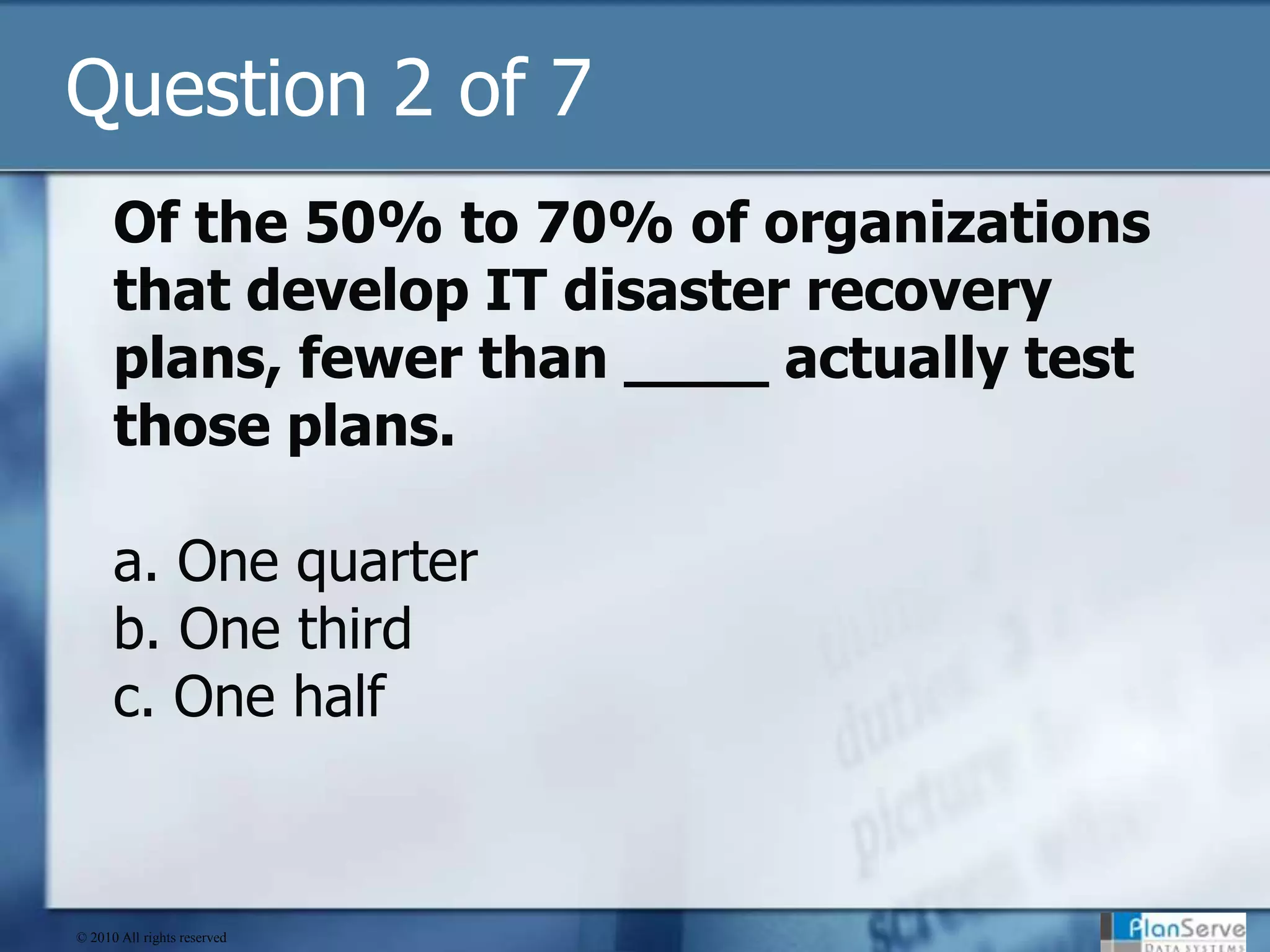
Question 2 of 7Of the 50% to 70% of organizations that develop IT disaster recovery plans, fewer than ____ actually test those plans.a. One quarterb. One thirdc. One half© 2010 All rights reserved
Question 3 of 744% of disaster recovery planners polled haven't told anybody that a DR plan exists in their organization.TrueFalse© 2010 All rights reserved
Question 4 of 7How do current budget constraints change IT disaster recovery discussions with other parts of the business?a. They don’t -- IT should proceed as it has before.b. It makes it more important to involve other business departments.c. It makes it less important to involve other business departments.© 2010 All rights reserved
Question 5 of 7The test of an IT disaster recovery plan came fast and furiously last year a gas and electric company, when flood waters swept over its Cedar Rapids, Iowa, territory. What technology, not touted as a big piece of the IT disaster recovery plan, came to the rescue?a. Voice over Internet Protocolb. Desktop virtualizationc. Duplication services© 2010 All rights reserved
Question 6 of 7The recession is putting a squeeze on budgets for outsourcing disaster recovery services. As such, CIOs are turning to _________ to reduce floor space at their leased recovery sites, according to providers of IT disaster recovery services.a. Server virtualizationb. Cloud computingc. Contract renegotiation© 2010 All rights reserved
Question 7 of 7 – Done!How are companies using cloud computing for IT disaster recovery outsourcing? a. They’re increasing the number of licensees with access to DR applications.b. They’re moving mission-critical applications to a cloud environment.c. They’re creating carbon copies of applications.© 2010 All rights reserved
Disaster Recovery:  what have we learned?Budget-minded small to midsized businesses (SMBs) once viewed business continuity (BC) planning as an expensive luxury. Not anymore. Upgrading disaster recovery (DR) capabilities is a major priority for 56% of IT decision makers in the U.S. and Europe, according to Forrester Research Inc.‘s.While companies think they’re immune to any long-term outage, more that one-fourth of companies have experienced a disruption in the last 5 years, averaging eight hours, or one business day. Source: Comdisco Vulnerability indexThe U.S. Department of Homeland Security says one in four businesses won't reopen following a disaster.© 2010 All rights reserved
The Plan:  What is a DR Plan?Backup TapesDocumentSoftwareContractsRecovery siteServer VirtualizationNone of the above…an ounce of prevention is worth a terabyte of cure© 2010 All rights reserved
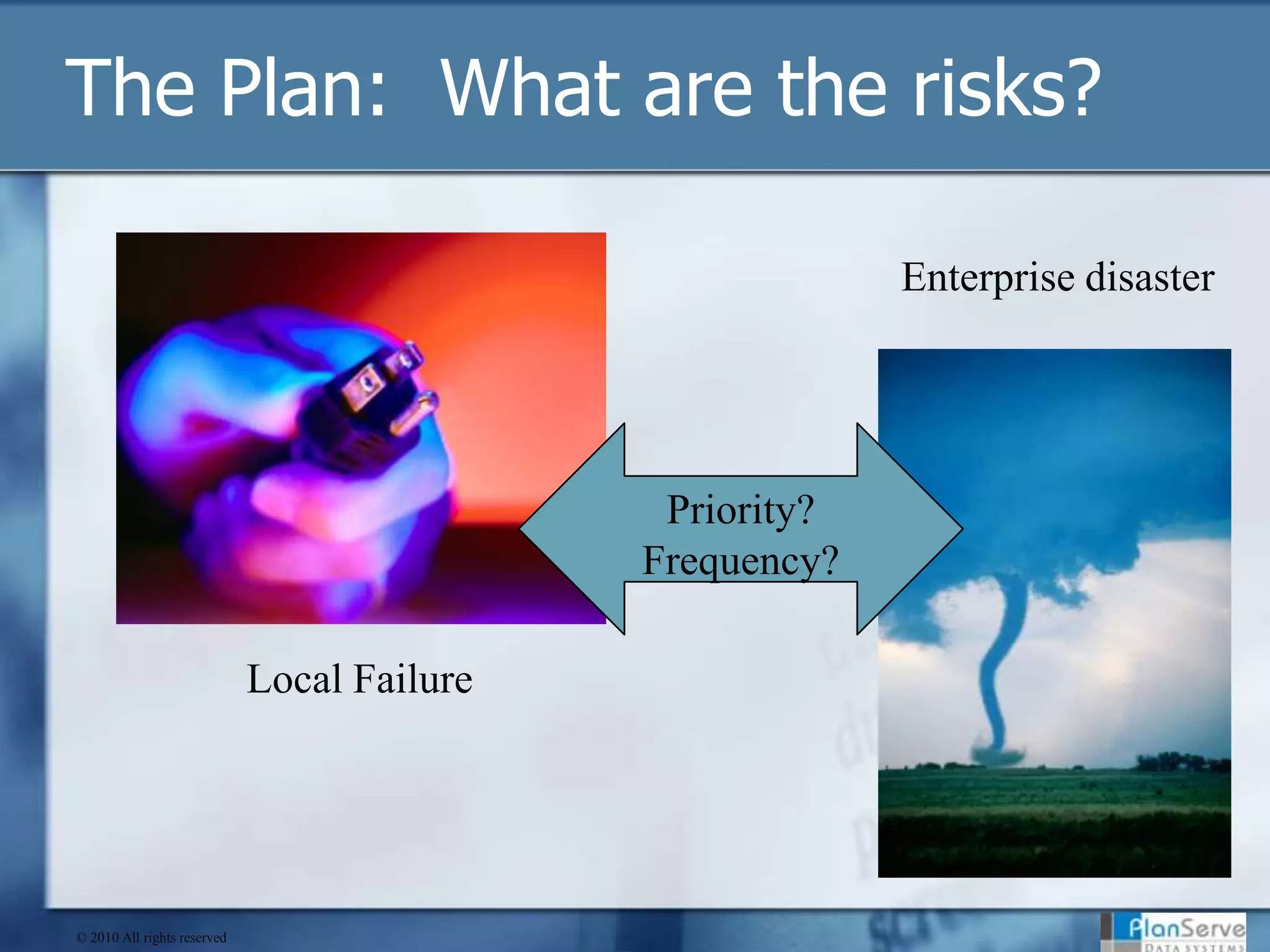
The Plan:  What are the risks?Enterprise disasterPriority?Frequency?Local Failure© 2010 All rights reserved
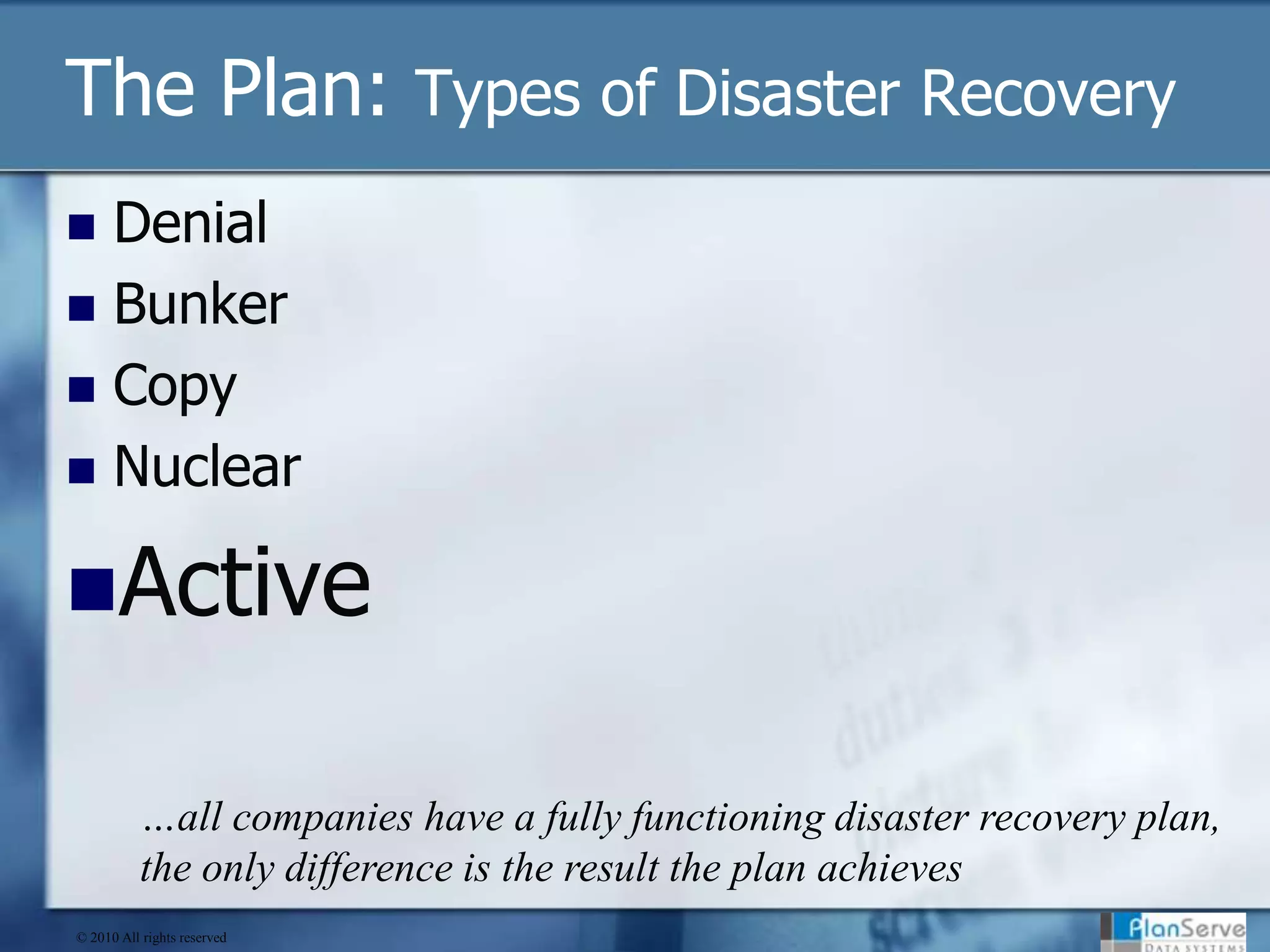
The Plan: Types of Disaster RecoveryDenialBunkerCopyNuclearActive…all companies have a fully functioning disaster recovery plan, the only difference is the result the plan achieves© 2010 All rights reserved
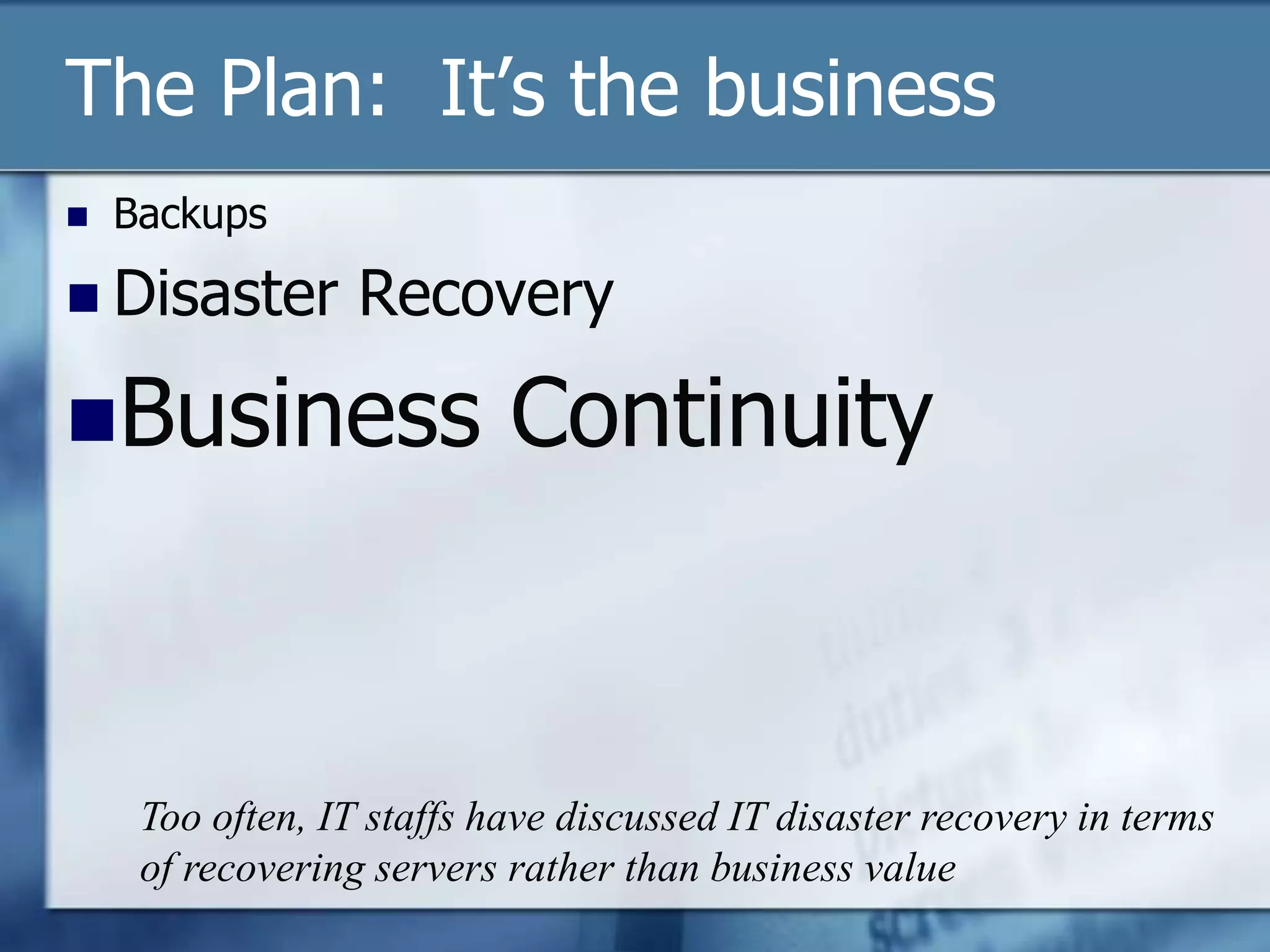
The Plan:  It’s the businessBackupsDisaster RecoveryBusiness ContinuityToo often, IT staffs have discussed IT disaster recovery in terms of recovering servers rather than business value
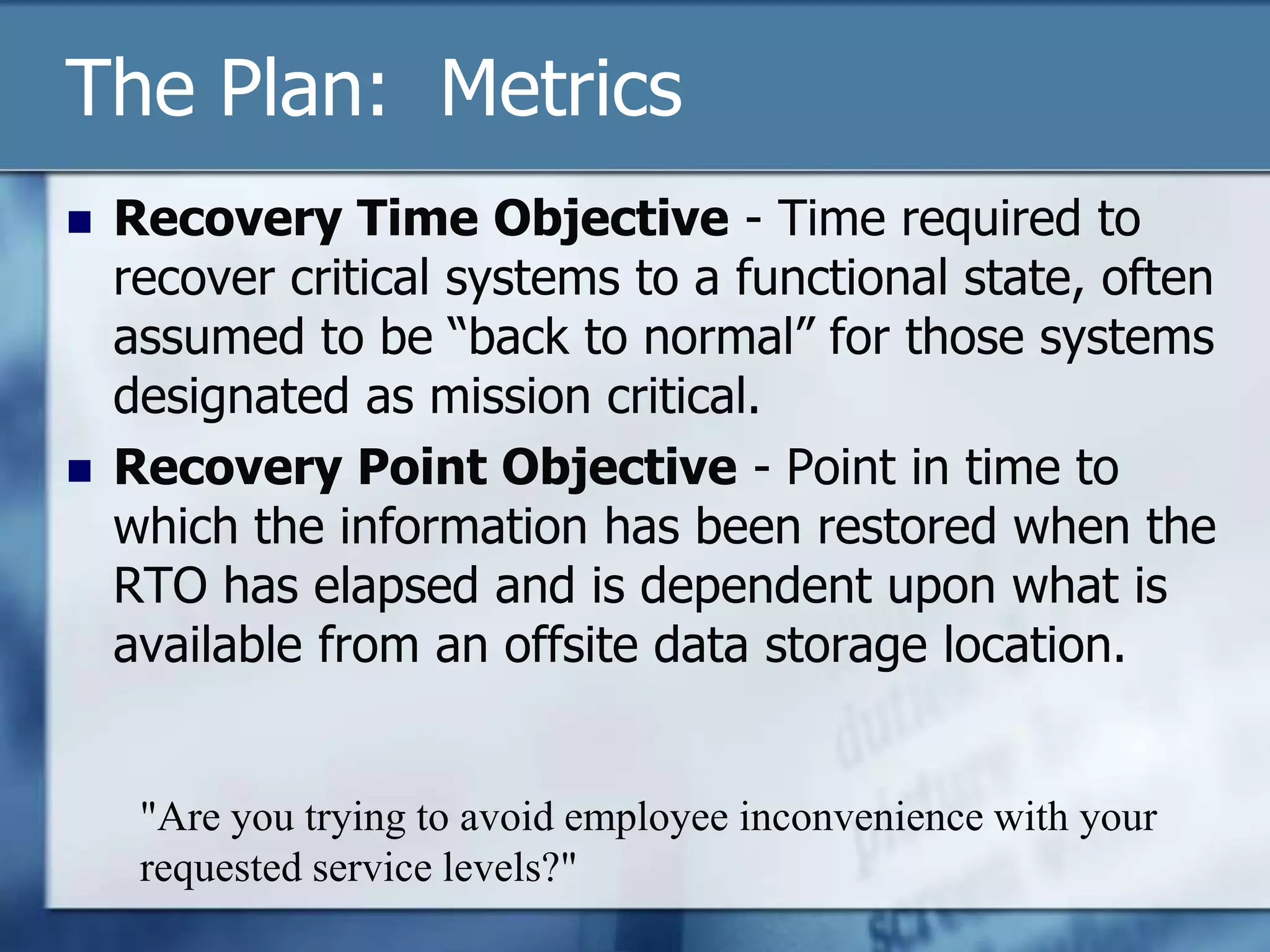
The Plan:  MetricsRecovery Time Objective - Time required to recover critical systems to a functional state, often assumed to be “back to normal” for those systems designated as mission critical.Recovery Point Objective - Point in time to which the information has been restored when the RTO has elapsed and is dependent upon what is available from an offsite data storage location."Are you trying to avoid employee inconvenience with your requested service levels?"
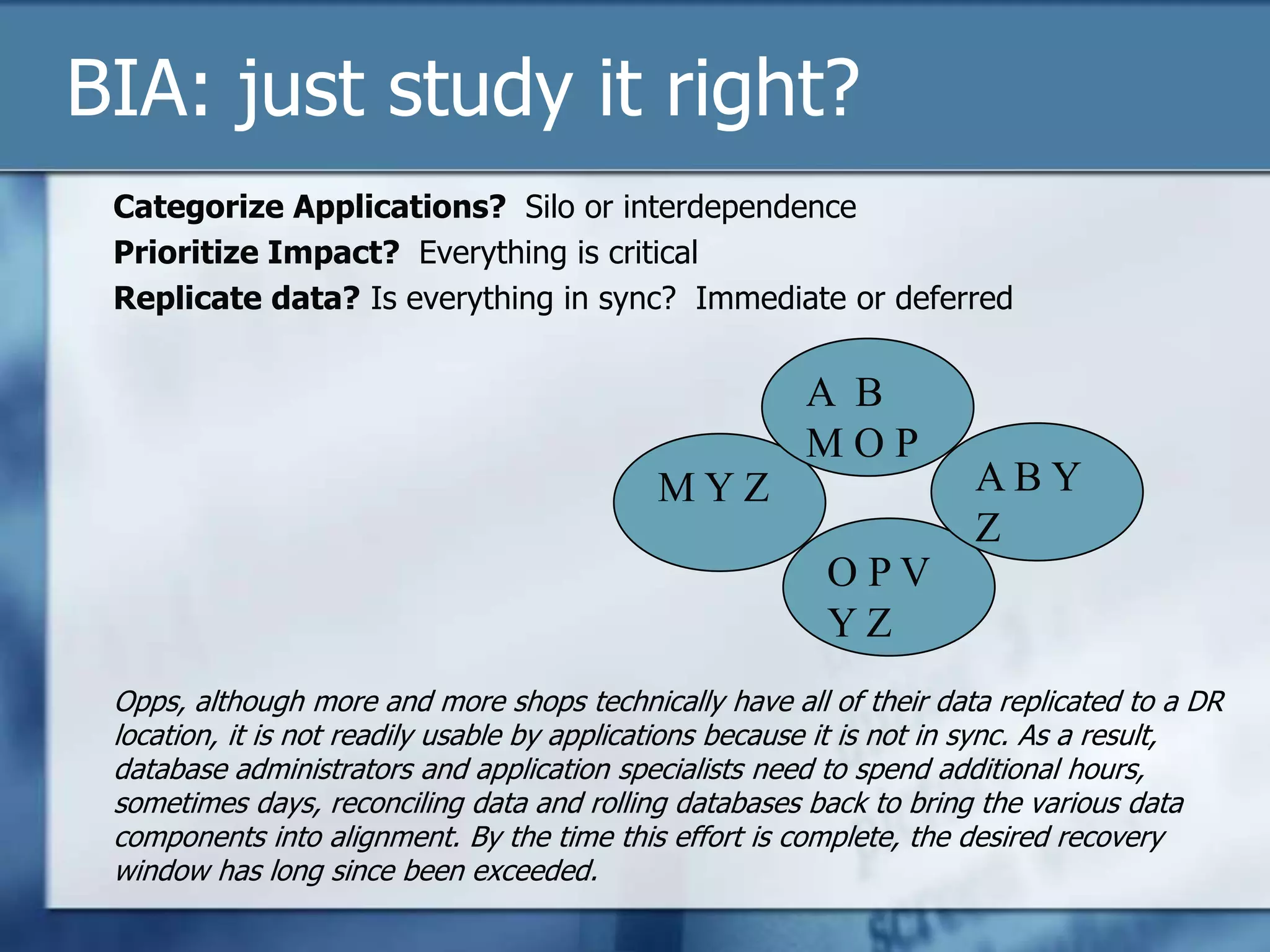
BIA: just study it right? Categorize Applications?  Silo or interdependencePrioritize Impact?  Everything is criticalReplicate data? Is everything in sync?  Immediate or deferredOpps, although more and more shops technically have all of their data replicated to a DR location, it is not readily usable by applications because it is not in sync. As a result, database administrators and application specialists need to spend additional hours, sometimes days, reconciling data and rolling databases back to bring the various data components into alignment. By the time this effort is complete, the desired recovery window has long since been exceeded.A  B  M O PA B Y ZM Y ZO P V Y Z
The Plan:  the hard part is not the boxThe most common mistake businesses make when determining service-level requirements is trying to keep the business running as if nothing happened.
Secrets to SuccessBuild resiliency into the design - Keep the architecture simple.Build before planningReverse the offsite co-location so that the primary location is remote and the recovery is local.Include key vendors in the plan so that they can provide assistance.Use offshore resources to daily validate and bring current secondary sites on a daily basis – routine failovers.Make high availability the responsibility of everyone – business and IT.© 2010 All rights reserved
Secrets to Success:  The keyYou have to make sure your disaster recovery plan will work with or without the internal key people who developed it. If the director in charge of financial ERP applications wrote the plan, for example, ask the business intelligence manager to test the recovery.© 2010 All rights reserved
Secrets to FailuresDepend upon familiar local resourcesPlan before buildingUse complex technology that inserts more moving parts into the daily operationsPrepare thick complex manuals.Designate a special recovery teamView the recovery in terms of hardwareTest the process annually over a 1-2 day period. Forget unique needs of legacy applications.Assume each application is an independent silo© 2010 All rights reserved
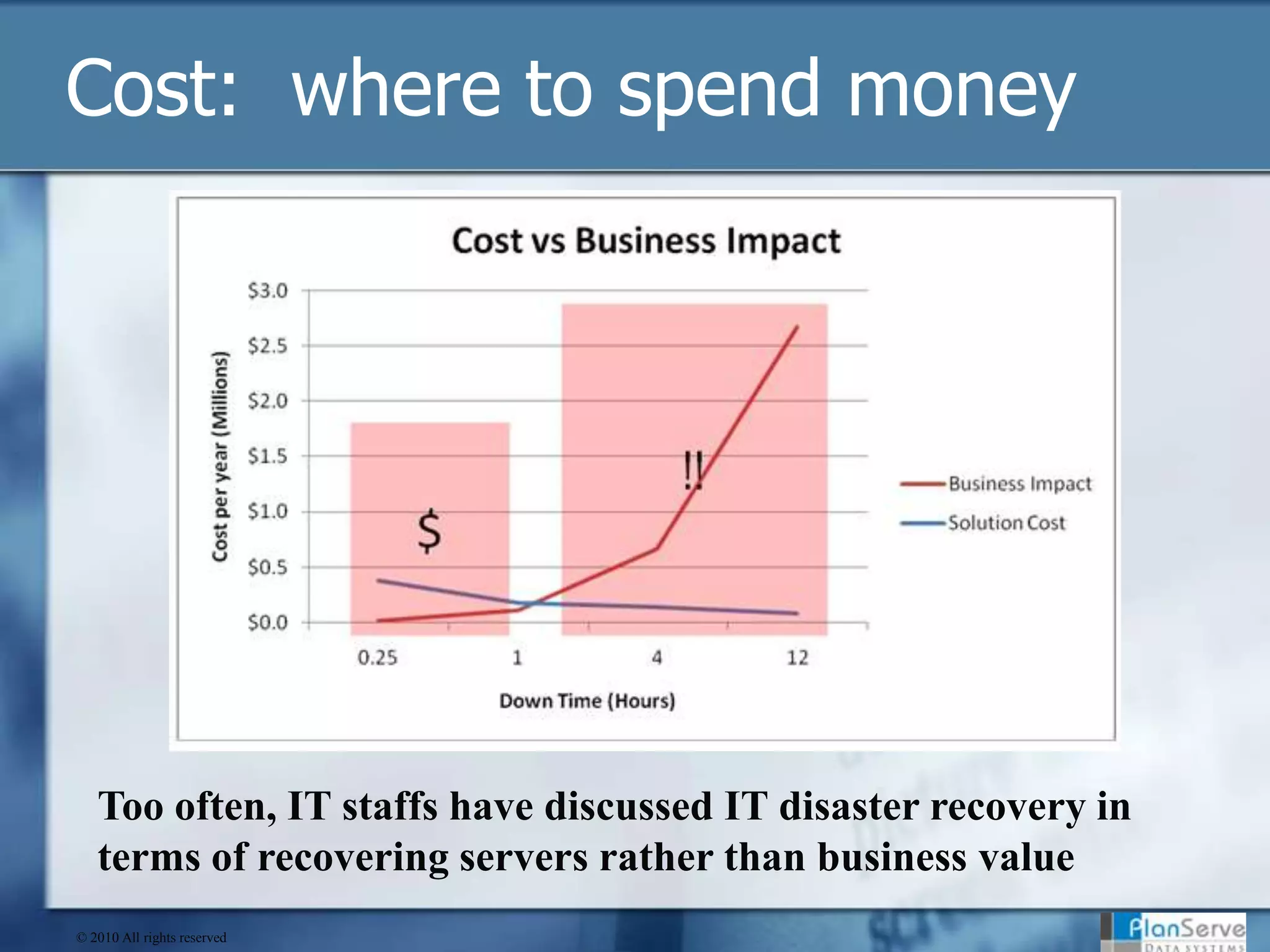
Cost:  where to spend moneyToo often, IT staffs have discussed IT disaster recovery in terms of recovering servers rather than business value© 2010 All rights reserved
Cost:  How to spend too muchOverprotect dataFail to maintain disaster recovery plans Test disaster recovery plans too oftenOverlook the benefits of server virtualizationReluctance to renegotiate with disaster recovery service providersRely on technology as a silver bulletEngage a consultancy to do a detailed plan© 2010 All rights reserved
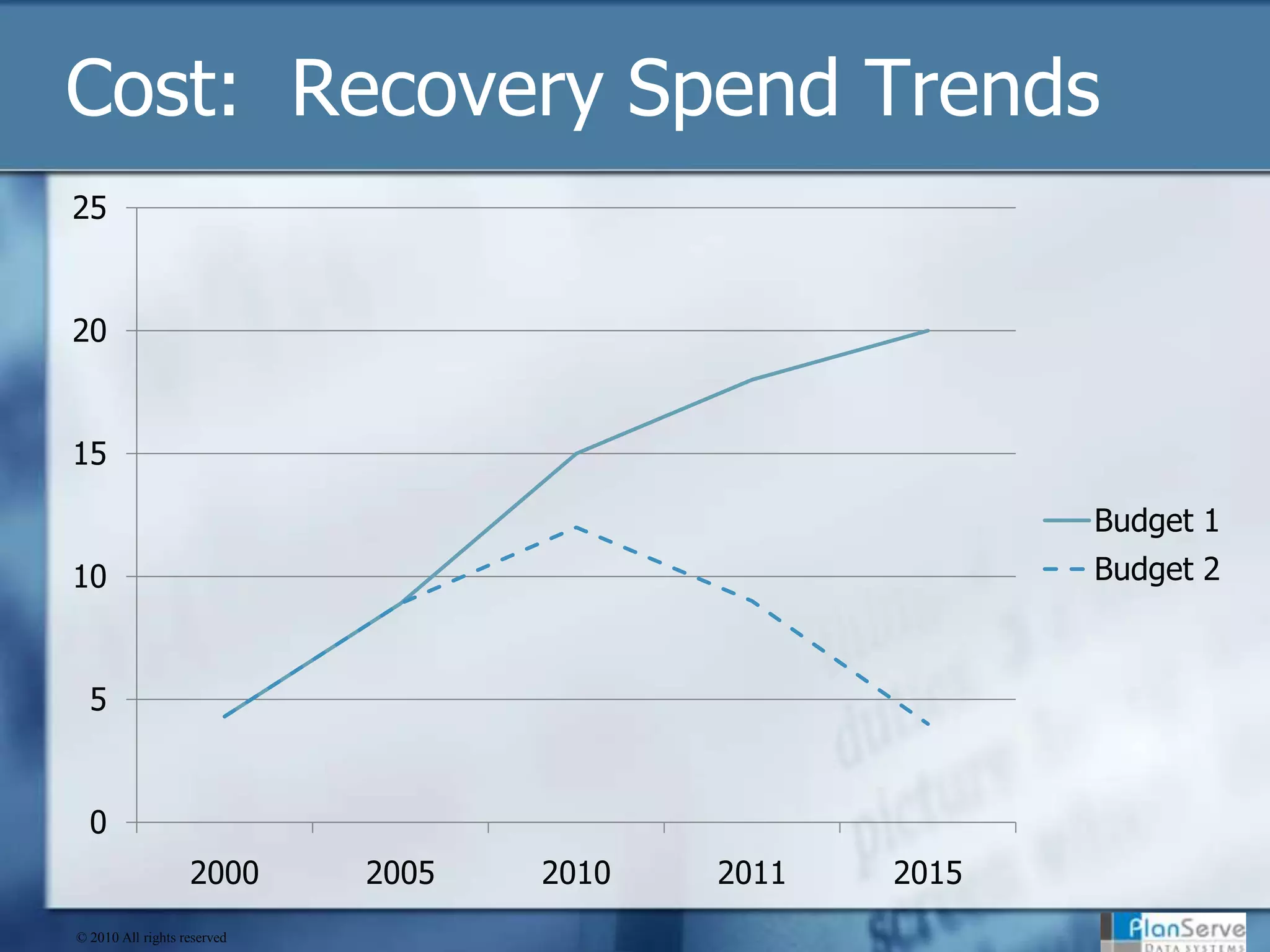
Cost:  Recovery Spend Trends© 2010 All rights reserved
Cost:  How to Save MoneyIdentify all of the costsDetermine the assumptionsReview the cost allocationBuild the recovery cost into the implementation© 2010 All rights reserved
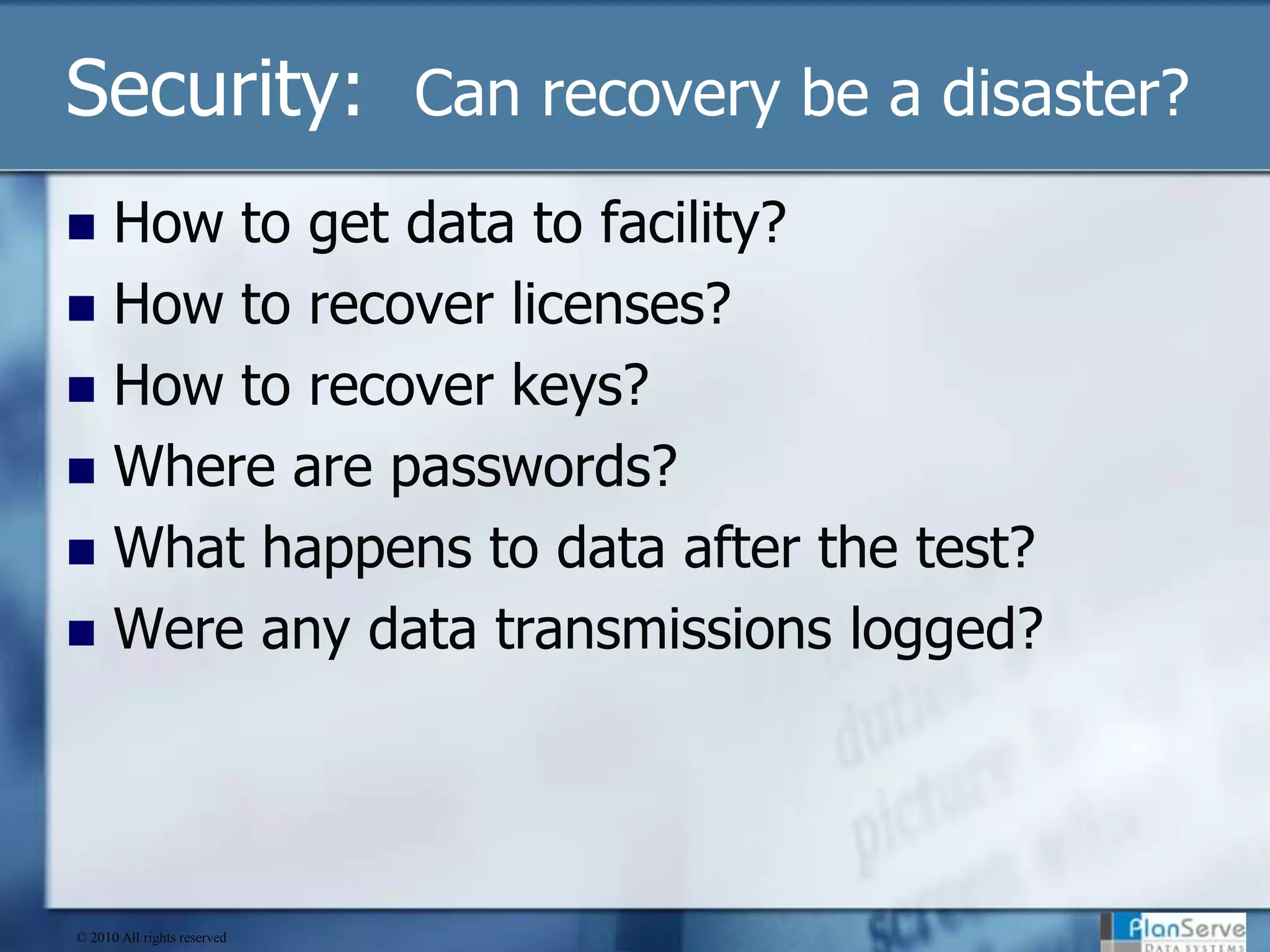
Security:  Can recovery be a disaster?How to get data to facility?How to recover licenses?How to recover keys?Where are passwords?What happens to data after the test?Were any data transmissions logged?© 2010 All rights reserved
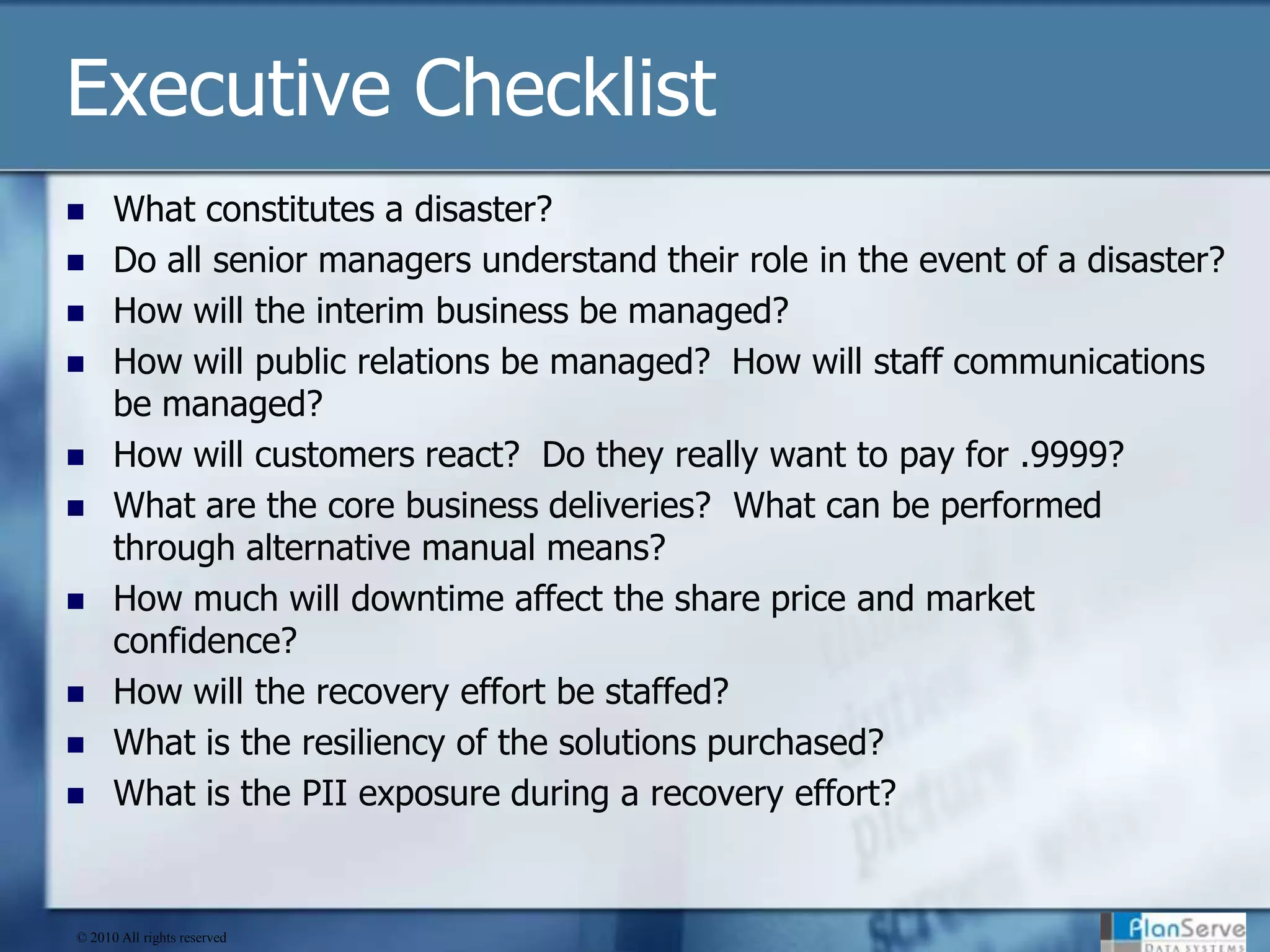
Executive ChecklistWhat constitutes a disaster?Do all senior managers understand their role in the event of a disaster?How will the interim business be managed? How will public relations be managed?  How will staff communications be managed?How will customers react?  Do they really want to pay for .9999? What are the core business deliveries?  What can be performed through alternative manual means?How much will downtime affect the share price and market confidence?How will the recovery effort be staffed?What is the resiliency of the solutions purchased?What is the PII exposure during a recovery effort?© 2010 All rights reserved
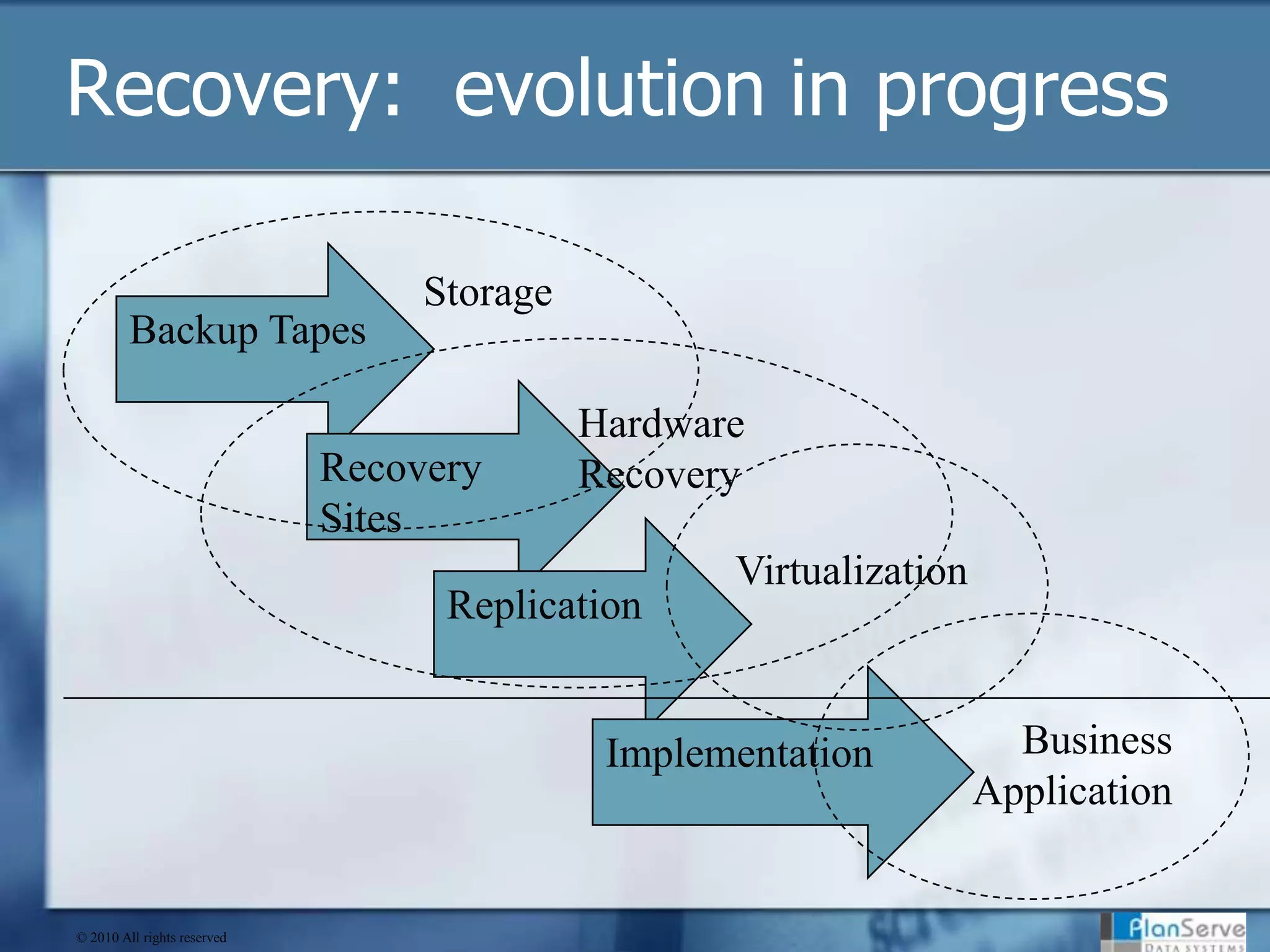
Recovery:  evolution in progress		StorageBackup TapesHardware 		RecoveryRecovery SitesVirtualizationReplicationBusiness ApplicationImplementation© 2010 All rights reserved
TomorrowAppropriate resilience will be a part of all successful implementationsin the next year or so© 2010 All rights reserved
ReferencesWeb Siteshttp://www.baselinemag.comhttp://www.computerworld.comhttp://mcpmag.comhttp://www.cisco.comhttp://searchdisasterrecovery.techtarget.comhttp://www.answers.com/topic/disaster-recoveryhttp://searchdatacenter.techtarget.comhttp://www.disaster-recovery-planning.comhttp://pcworld.about.comwww.globalcontinuity.comwww.drj.comwww.comdisco.comwww.survive.comwww.gartnergroup.comwww.rothstein.comBooksWindows NT Backup & Recovery by John McMains
Disaster Recovery Planning for Networks, Telecommunications and Data Communications by Regis J. Bates

Disaster Recovery is Dead

  • 1.
    The Business ofDisaster RecoveryTrent Richardson
  • 2.
    TodayDisaster recovery willno longer be needed after the end of 2011© 2010 All rights reserved
  • 3.
    Question 1 of7Organizations should lay out a five-year plan with a recovery time objective that is ________a. Less than two hoursb. Going to improve over timec. The same as what you have now© 2010 All rights reserved
  • 4.
    Question 2 of7Of the 50% to 70% of organizations that develop IT disaster recovery plans, fewer than ____ actually test those plans.a. One quarterb. One thirdc. One half© 2010 All rights reserved
  • 5.
    Question 3 of744% of disaster recovery planners polled haven't told anybody that a DR plan exists in their organization.TrueFalse© 2010 All rights reserved
  • 6.
    Question 4 of7How do current budget constraints change IT disaster recovery discussions with other parts of the business?a. They don’t -- IT should proceed as it has before.b. It makes it more important to involve other business departments.c. It makes it less important to involve other business departments.© 2010 All rights reserved
  • 7.
    Question 5 of7The test of an IT disaster recovery plan came fast and furiously last year a gas and electric company, when flood waters swept over its Cedar Rapids, Iowa, territory. What technology, not touted as a big piece of the IT disaster recovery plan, came to the rescue?a. Voice over Internet Protocolb. Desktop virtualizationc. Duplication services© 2010 All rights reserved
  • 8.
    Question 6 of7The recession is putting a squeeze on budgets for outsourcing disaster recovery services. As such, CIOs are turning to _________ to reduce floor space at their leased recovery sites, according to providers of IT disaster recovery services.a. Server virtualizationb. Cloud computingc. Contract renegotiation© 2010 All rights reserved
  • 9.
    Question 7 of7 – Done!How are companies using cloud computing for IT disaster recovery outsourcing? a. They’re increasing the number of licensees with access to DR applications.b. They’re moving mission-critical applications to a cloud environment.c. They’re creating carbon copies of applications.© 2010 All rights reserved
  • 10.
    Disaster Recovery: what have we learned?Budget-minded small to midsized businesses (SMBs) once viewed business continuity (BC) planning as an expensive luxury. Not anymore. Upgrading disaster recovery (DR) capabilities is a major priority for 56% of IT decision makers in the U.S. and Europe, according to Forrester Research Inc.‘s.While companies think they’re immune to any long-term outage, more that one-fourth of companies have experienced a disruption in the last 5 years, averaging eight hours, or one business day. Source: Comdisco Vulnerability indexThe U.S. Department of Homeland Security says one in four businesses won't reopen following a disaster.© 2010 All rights reserved
  • 11.
    The Plan: What is a DR Plan?Backup TapesDocumentSoftwareContractsRecovery siteServer VirtualizationNone of the above…an ounce of prevention is worth a terabyte of cure© 2010 All rights reserved
  • 12.
    The Plan: What are the risks?Enterprise disasterPriority?Frequency?Local Failure© 2010 All rights reserved
  • 13.
    The Plan: Typesof Disaster RecoveryDenialBunkerCopyNuclearActive…all companies have a fully functioning disaster recovery plan, the only difference is the result the plan achieves© 2010 All rights reserved
  • 14.
    The Plan: It’s the businessBackupsDisaster RecoveryBusiness ContinuityToo often, IT staffs have discussed IT disaster recovery in terms of recovering servers rather than business value
  • 15.
    The Plan: MetricsRecovery Time Objective - Time required to recover critical systems to a functional state, often assumed to be “back to normal” for those systems designated as mission critical.Recovery Point Objective - Point in time to which the information has been restored when the RTO has elapsed and is dependent upon what is available from an offsite data storage location."Are you trying to avoid employee inconvenience with your requested service levels?"
  • 16.
    BIA: just studyit right? Categorize Applications? Silo or interdependencePrioritize Impact? Everything is criticalReplicate data? Is everything in sync? Immediate or deferredOpps, although more and more shops technically have all of their data replicated to a DR location, it is not readily usable by applications because it is not in sync. As a result, database administrators and application specialists need to spend additional hours, sometimes days, reconciling data and rolling databases back to bring the various data components into alignment. By the time this effort is complete, the desired recovery window has long since been exceeded.A B M O PA B Y ZM Y ZO P V Y Z
  • 17.
    The Plan: the hard part is not the boxThe most common mistake businesses make when determining service-level requirements is trying to keep the business running as if nothing happened.
  • 18.
    Secrets to SuccessBuildresiliency into the design - Keep the architecture simple.Build before planningReverse the offsite co-location so that the primary location is remote and the recovery is local.Include key vendors in the plan so that they can provide assistance.Use offshore resources to daily validate and bring current secondary sites on a daily basis – routine failovers.Make high availability the responsibility of everyone – business and IT.© 2010 All rights reserved
  • 19.
    Secrets to Success: The keyYou have to make sure your disaster recovery plan will work with or without the internal key people who developed it. If the director in charge of financial ERP applications wrote the plan, for example, ask the business intelligence manager to test the recovery.© 2010 All rights reserved
  • 20.
    Secrets to FailuresDependupon familiar local resourcesPlan before buildingUse complex technology that inserts more moving parts into the daily operationsPrepare thick complex manuals.Designate a special recovery teamView the recovery in terms of hardwareTest the process annually over a 1-2 day period. Forget unique needs of legacy applications.Assume each application is an independent silo© 2010 All rights reserved
  • 21.
    Cost: whereto spend moneyToo often, IT staffs have discussed IT disaster recovery in terms of recovering servers rather than business value© 2010 All rights reserved
  • 22.
    Cost: Howto spend too muchOverprotect dataFail to maintain disaster recovery plans Test disaster recovery plans too oftenOverlook the benefits of server virtualizationReluctance to renegotiate with disaster recovery service providersRely on technology as a silver bulletEngage a consultancy to do a detailed plan© 2010 All rights reserved
  • 23.
    Cost: RecoverySpend Trends© 2010 All rights reserved
  • 24.
    Cost: Howto Save MoneyIdentify all of the costsDetermine the assumptionsReview the cost allocationBuild the recovery cost into the implementation© 2010 All rights reserved
  • 25.
    Security: Canrecovery be a disaster?How to get data to facility?How to recover licenses?How to recover keys?Where are passwords?What happens to data after the test?Were any data transmissions logged?© 2010 All rights reserved
  • 26.
    Executive ChecklistWhat constitutesa disaster?Do all senior managers understand their role in the event of a disaster?How will the interim business be managed? How will public relations be managed? How will staff communications be managed?How will customers react? Do they really want to pay for .9999? What are the core business deliveries? What can be performed through alternative manual means?How much will downtime affect the share price and market confidence?How will the recovery effort be staffed?What is the resiliency of the solutions purchased?What is the PII exposure during a recovery effort?© 2010 All rights reserved
  • 27.
    Recovery: evolutionin progress StorageBackup TapesHardware RecoveryRecovery SitesVirtualizationReplicationBusiness ApplicationImplementation© 2010 All rights reserved
  • 28.
    TomorrowAppropriate resilience willbe a part of all successful implementationsin the next year or so© 2010 All rights reserved
  • 29.
  • 30.
    Disaster Recovery Planningfor Networks, Telecommunications and Data Communications by Regis J. Bates
  • 31.
    Oracle8i Backup &Recoveryby Rama Velpuri
  • 32.
    Disaster Recovery Planningand Resources for Records Managers and Librariansby Jacqueline Virando
  • 33.
    Blueprints for HighAvailability: Designing Resilient Distributed Systems by Evan Marcus© 2010 All rights reserved
  • 34.