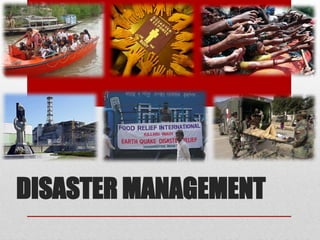
DISASTER MANAGEMENT
Topics :
1– Mitigation, Disaster
Preparedness, Policies
2 – Personal protection in
different types of Emergency
3 – Manmade Disasters,
Disasters in India,
Organizations.
Types of Disasters :
Natural
Disasters
Earthquake
Floods
Cyclones
Tsunami
Landslide
and
Avalanches
Manmade
Disasters
Chemical
Disaster
Nuclear
Disaster
Biological
Disaster
Examples
• Natural disasters : Earthquakes,
landslides, volcanic eruptions,
floods and cyclones
• Man-made disasters :
Stampedes, fires, transport
accidents, industrial accidents, oil
spills and nuclear
explosions/radiation. War and
deliberate attacks may also be put
in this category.
Disaster mitigation
Emergency Preparedness
and Policies
Disaster mitigation
Disaster mitigation
 Mitigation is a key to national preparedness.
 This includes an assessment of possible risks to
personal/family health and to personal property.
 For instance, in a flood plain, home owners
might not be aware of a property being exposed
to a hazard until trouble strikes. Specialists can
be hired to conduct risk identification and
assessment surveys.
Contd…
• Mitigation involves Structural and Non-structural
measures taken to limit the impact of disasters.
• Structural mitigation are actions that change the
characteristics of a building or its surrounding, examples
include shelters, window shutters, clearing forest around
the house.
• Non-structural mitigation on personal level mainly takes
the form of insurance or simply moving house to a safer
area.
DEFINITION
Disaster preparedness is “a programme of long term
development activities whose goals are to strengthen the overall
capacity and capability of a country to manage efficiently all
types of emergency it should bring about an orderly transition
from through recovery, and back to sustained development “
OBJECTIVE
To ensure that appropriate systems, procedures and resources
are in place to provide prompt effective assistance to disaster
victims ,thus facilitating relief measures and rehabilitation of
services .
Tasks to be followed in emergency
preparedness
1)Evaluate the risk of the country or
particular region to disaster.
India is vulnerable, in varying degrees, to a large
number of natural as well as man-made disasters. 58.6
per cent of the landmass is prone to earthquakes of
moderate to very high intensity; over 40 million
hectares (12 per cent of land) is prone to floods and
river erosion.
2) Adopt standards and regulation
Following according to NDMA guidelines
Of the 7,516 km long coastline, close to 5,700 km is prone
to cyclones and tsunamis; 68 per cent of the cultivable area
is vulnerable to drought and hilly areas are at risk from
landslides and avalanches. Vulnerability to disasters/
emergencies of Chemical, Biological, Radiological and
Nuclear (CBRN) origin also exists
contd…
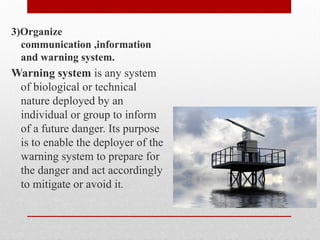
3)Organize
communication ,information
and warning system.
Warning system is any system
of biological or technical
nature deployed by an
individual or group to inform
of a future danger. Its purpose
is to enable the deployer of the
warning system to prepare for
the danger and act accordingly
to mitigate or avoid it.
4)Ensure coordination end response
mechanism.
These mechanisms include the "cluster approach", which
groups agencies with a shared operational interest, e.g.
health, water and sanitation. This approach helps to avoid
gaps and duplications. It also helps to ensure there is a
clear lead organization in each sector
5)Resource availability.
Ensuring that resource mobilization and financing are
handled in a common way, such as through a Flash
Appeal or the Central Emergency Response Fund.
6)Develop public education
programmes
If the public is to respond quickly and effectively to an
emergency involving toxic chemical agents, people must be made
aware of the risk from chemical agents and the necessary
protective actions well before an emergency occurs. A carefully
planned public education program is needed to provide people
potentially at risk with the knowledge required to take life-saving
actions.
7)Coordinate information with news
media.
The media is an undeniable important player in the
disaster management matrix especially in the area of
risk reduction advocacy, disaster mitigation
preparedness and response.
A disaster drill is an exercise in which people
simulate the circumstances of a disaster so that
they have an opportunity to practice their
responses.
8) DISASTER DRILL
• Efficacy of plans and Standard Operating Procedures
(SOPs) can be tested through mock drills
Contd . . .
Exercises have 3 main purposes:
• to validate plans (validation)
• to develop staff competencies and give them practice in carrying out their roles in the
plans (training)
• to test well-established procedures (testing)
There are 3 main types of exercise:
• Discussion-based
• Table top
• Live
COMMUNITY
PREPAREDNESS
• Community members resources organizations, and and
administration should be the cornerstone of an emergency
programme
REASONS FOR COMMUNITY
PREPAREDNESS
• Members of the community are the most to to lose
from being vulnerable to disasters and the most to gain
to gain from effective and appropriate emergency
preparedness programme.
• Those who respond first to an emergency come from
within the community .When transport and
communication are disrupted ,an external emergency
may not arrive for days.
• Resources are most easily pooled at community level
and every community posses capabilities .Failure to
explore these capabilities is poor resource
management .
• Sustained development is best achieved by allowing
emergency affected communities to design ,manage
and implement internal and external assistance
programme.
cont…
An example of reduced damage due to
preparedness
• On 12 November, 1970 a major cyclone hit the coastal belt of Bangladesh at 223 km/hr.
with a storm surge of six to nine meters height, killing an estimated 500,000 people.
• Due to the Cyclone Preparedness Program, the April 1991 cyclone with wind speed of
225 km/hr. killed only 138,000 people even though the coastal population had doubled
by that time.
• In May 1994, in a similar cyclone with a wind speed of 250 km/hr. only 127 people lost
their lives.
• In May 1997, in a cyclone with wind speed of 200 km/hr. only 111 people lost their
lives.
POLICY DEVELOPMENT
POLICY DEVELOPMENT
It is “the formal statement of a course of
action”.
Policy is strategic in nature and
performs the
following functions
Establish long term goals .
Assign responsibilities for achieving goals.
Establish recommended work practice.
Determine criteria for decision making.
• The form of emergency preparedness policies varies from
place to place . Six sectors are required for response and
recovery strategies .
• They are
Communication Police and security
Health Search and rescue
Social welfare Transport
National Policy on Disaster
Management(NPDM)
On 23 December, 2005, the Government of India took
a defining step by enacting the Disaster Management
Act, 2005which envisaged the creation of the National
Disaster Management Authority (NDMA), headed by
the Prime Minister, State Disaster Management
Authorities (SDMAs) headed by the Chief Ministers,
and District Disaster Management Authorities
(DDMAs) headed by the Collector or District
Magistrate or Deputy Commissioner.
INSTITUTIONAL AND LEGAL
ARRANGEMENTS
• Disaster Management Act, 2005
The Act lays down institutional, legal, financial and coordination
mechanisms at the national, state, district and local levels. These
institutions are not parallel structures and will work in close harmony.
• National Disaster Management Authority (NDMA)
• State Disaster Management Authority (SDMA)
National Disaster Management
Authority of India :
• It is a govt. Agency – under Ministry of Home Affairs.
• A group representing a public/private has recently been formed by
the Government of India.
• Some of the groups' early efforts involve the provision of
emergency management training for first responders (a first in
India), the creation of a single emergency telephone number, and the
establishment of standards for EMS staff, equipment, and training.
• Efforts are being made in making this a nation-wide effective group.
• It is funded primarily by a large India-based computer company and
aimed at improving the general response of communities to
emergencies.
cont……
• District Disaster Management Authority (DDMA).
• Local Authorities .
Local authorities would include Panchayati Raj Institutions (PRI),
Municipalities, District and Cantonment Boards and Town Planning
Authorities.
• National Institute of Disaster Management (NIDM) .
• National Disaster Response Force (NDRF).
cont……
• Armed Forces
• Central Para Military Forces
• Civil Defence and Home Guards
• State Police Forces and Fire Services
• State Disaster Response Force (SDRF)
FINANCIAL ARRANGEMENTS
• The National Disaster Response and Mitigation Fund
• The National Calamity Contingency Fund (NCCF)
General measures during
emergency
• Do not use telephone except call for help,so as to leave
telephone lines free for the organization to respond.
• Listen to the messages broadcast by radio and various media so
as to be informed of development.
• Carry out the official instructions given over the radio or by
loudspeaker.
• Keep a family emergency kit ready.
HOME EMERGENCY KIT
Battery-operated radios,
batteries
Alternate heat sources
Extra warm clothing and
blankets
Cash
First aid kit
Ready-to-eat and high-
energy foods for 3 days
Bottled water
Extra prescription
medications
Baby supplies
Special needs items
Lanterns, flashlights,
lightsticks
EMERGENCY KITS
38
• Flashlight
• Flares or reflective
triangle
• First aid kit
• Basic tools including a
shovel
• Extra clothing including
hats and gloves
• Booster cables
• Sand or kitty litter
• Ice scraper and brush
• Blanket
 Ice scraper and brush
 Blanket
 Non-perishable high energy
food
TRAVEL EMERGENCY KIT
PERSONAL PROTECTION IN
DIFFERENT TYPES OF
EMERGENCIES
FLOODS
Land Slide Volcanic Eruption
Cyclone Earthquake
Before a Flood
To prepare for a flood, you should:
 Avoid building in a flood prone area
unless you elevate and reinforce your home.
 Elevate the furnace, water heater, and electric
panel if susceptible to flooding.
 Install "check valves" in sewer traps to prevent floodwater from
backing up into the drains of your home.
 Contact community officials to find out if they are planning to
construct barriers (levees, beams, floodwalls) to stop floodwater from
entering the homes in your area.
 Seal the walls in your basement with waterproofing compounds to
avoid seepage
During a Flood
 If a flood is likely in your area, you should:
 Listen to the radio or television for information.
 Be aware that flash flooding can occur. If there is any possibility of
a flash flood, move immediately to higher ground. Do not wait for
instructions to move.
 Be aware of streams, drainage channels, canyons, and other areas
known to flood suddenly. Flash floods can occur in these areas with
or without such typical warnings as rain clouds or heavy rain.
cont…
If you must prepare to evacuate, you should do the following:
 Secure your home. If you have time, bring in outdoor furniture. Move essential
items to an upper floor.
 Turn off utilities at the main switches or valves if instructed to do so.
Disconnect electrical appliances. Do not touch electrical equipment if you are
wet or standing in water.
If you have to leave your home, remember these evacuation tips:
 Do not walk through moving water.. If you have to walk in water, walk
where the water is not moving. Use a stick to check the firmness of the ground
in front of you.
 Do not drive into flooded areas.
After a Flood
The following are guidelines for the period following a flood:
 Listen for news reports to learn whether the community’s water
supply is safe to drink.
 Avoid floodwaters; water may be contaminated by oil, gasoline,
or raw sewage. Water may also be electrically charged from
underground or downed power lines.
 Avoid moving water.
 Be aware of areas where floodwaters have receded. Roads may
have weakened and could collapse under the weight of a vehicle.
 Stay away from downed power lines, and report them to the
power company.
 Return home only when authorities indicate it is safe.
 Stay out of any building if it is surrounded by floodwaters.
 Use extreme caution when entering buildings; there may
be hidden damage, particularly in foundations.
 Service damaged septic tanks, cesspools, pits, and leaching
systems as soon as possible. Damaged sewage systems are
serious health hazards.
 Clean and disinfect everything that got wet. Mud left from
floodwater can contain sewage and chemicals
cont…
STORMS,HURRICANES,TORNADOES
What to do before hand?
 choose a shelter in advance
 minimise the effect of
storms
 take measures against
flooding
 prepare a family
emergency kit
1. During an emergency:
• Listen to the information and advice provided by the authorities.
• Do not go out in car or boat once the storm has been announced.
• Evacuate houses if requested
• Tie down any object liable to be blown away by wind
• If caught outside in a storm,take refuge as quickly as possible in
a shelter
• In a thunderstorm keep away from doors,windows,and electrical
conductors,unplug electrical appliances etc
• Donot use any electrical appliances or the telephone
During an emergency (Contd. . )
Anyone who is outside should:
Look for shelter in a building
never take shelter under a tree
if in a boat,get back to the shore
keep away from fences and electric
cables
kneel down rather than standing
After the emergency:
After the storm has subsided:
Follow the instructions given by the authorities
Stay indoors
Give alert as quickly as possible
Give first aid to the injured
Make sure the water is safe to drink
Check the exterior of dwellings and call for assistance if there
is a risk of falling objects[tiles,guttering...]
Earthquake
EARTHQUAKES
What to do before hand :
Repair deep plaster cracks in ceilings and foundations. Get expert
advice if there are signs of structural defects.
Hang heavy items such as pictures and Brace overhead light and
fan fixtures.
Repair defective electrical wiring and leaky gas connections.
These are potential fire risks.
Secure a water heater, LPG cylinder etc., by strapping it to the
wall studs and bolting it to the floor.
Store weed killers, pesticides, and flammable products securely in
closed cabinets with latches and on bottom shelves
Identify safe places indoors and outdoors.
1 Under strong dining table, bed
2.Against an inside wall
3.Away from where glass could shatter around windows, mirrors,
pictures, or where heavy bookcases or other heavy furniture could fall
over
4.In the open, away from buildings, trees, telephone and electrical lines,
flyovers, bridges
5.Have a disaster emergency kit ready
If indoors:
 DROP to the ground; take COVER by getting under a sturdy table or other piece of
furniture; and HOLD ON until the shaking stops. If there isn’t a table or desk near you,
cover your face and head with your arms and crouch in an inside corner of the building.
 Protect yourself by staying under the lintel of an inner door, in the corner of a room,
under a table or even under a bed.
 Stay away from glass, windows, outside doors and walls, and anything that could fall,
such as lighting fixtures or furniture.
 Stay in bed if you are there when the earthquake strikes. Hold on and protect your head
with a pillow, unless you are under a heavy light fixture that could fall.
 Stay inside until the shaking stops and it is safe to go outside. Research has shown that
most injuries occur when people inside buildings attempt to move to a different location
inside the building or try to leave.
DO NOT use the elevators.
 If you know that people have been buried, tell the rescue teams.
Do not rush and do not worsen the situation of injured persons or
your own situation.
 Avoid places where there are loose electric wires and do not touch
any metal object in contact with them.
 Do not drink water from open containers without having examined
it and filtered it through a sieve, a filter or an ordinary clean cloth.
 If your home is badly damaged, you will have to leave it. Collect
water containers, food, and ordinary and special medicines (for
persons with heart complaints, diabetes, etc.)
 Do not re-enter badly damaged buildings and do not go near
damaged structures.
If outdoors
• Stay there.
• Move away from buildings, trees, streetlights, and utility
wires.
• Once in the open, stay there until the shaking stops. The
greatest danger exists directly outside buildings, at exits,
and alongside exterior walls. Most earthquake-related
casualties result from collapsing walls, flying glass.
If in a moving vehicle
• Stop as quickly as safety permits and stay in the vehicle.
Avoid stopping near or under buildings, trees, overpasses,
and utility wires.
• Proceed cautiously once the earthquake has stopped.
Avoid roads, bridges, or ramps that might have been
damaged by the earthquake.
If trapped under debris
• Do not move about or kick up dust.
• Cover your mouth with a handkerchief or clothing.
• Tap on a pipe or wall so rescuers can locate you. Use a
whistle if one is available. Shout only as a last resort.
After an earthquake
 Keep calm, switch on the radio/TV and obey any instructions
you hear on it.
 Keep away from beaches and low banks of rivers. Huge waves
may sweep in.
 Expect aftershocks. Be prepared.
 Turn off the water, gas and electricity.
 Do not smoke and do not light matches or use a cigarette lighter.
Do not turn on switches. There may be gas leaks or short-circuits.
 Make sure that the water is safe to drink and food stored at home
is fit to eat.
During an emergency
• Do not use the telephone;leave lines free for rescue
services
• Listen to messages given by radio and other media
• Carry out the instructions given through media
• Close doors and windows
• Seal any cracks or gaps around windows and doors with
adhesive tapes
• Organise a reserve of water
• Turn off ventilators and air conditioners
After Emergency :
Follow the authorities instructions and do
not go out until there is no longer any risk
Carry out necessary decontamination
measures
Man-made Disasters
“Humans are good at creating
disasters, and throughout history
we’ve rarely been afraid to prove it”.
Definition :
• Man-made disasters are the threats
having an element of human intent,
negligence, or error ; or involving a
failure of a human-made system.
• Human causation may be accidental
or intentional
Types of man made
disasters
• Sudden disasters : such as Chernobyl disaster and
Bhopal gas tragedy,
• Insidious disasters : Chemical and radiation
exposure, global warming
Classification :
Sociological disasters
Terrorism
War and civil conflicts
Technological disasters
Industrial disasters
Structural collapse
and fire
CBRN disaster
Transportation
disasters
Sociological hazards
• Terrorism : The primary objective of a terrorism is
to create widespread fear.
• E.g. : On 11 September 2001 the World Trade
Centre in New York City was destroyed by crashing
American airlines and killed 2,752.
War :
 It is a conflict between relatively large groups of
people, which involves physical force by the use of
weapons .
 Warfare has destroyed entire cultures, countries,
economies and inflicted great suffering on humanity.
 E.g. : World war I and II. Since world war II there
have been about 127 wars and
22 million war related deaths
have occurred
Civil conflicts (riots):
Any incident that disrupts a community,
where intervention is required to maintain
public safety.
• eg: 1984 Sikh massacre, a riot against the
Sikhs in response to assassination of Indira
Gandhi by her Sikh bodyguards
• More than 11,000 people were killed
Technological hazards
• Industrial disasters :
 E.g.-The Nuclear Power Plant
Explosion in Chernobyl, Russia :
On April 26th 1986, which resulted
in the atmospheric release of
radioactive material four hundred
times more radioactive than
Hiroshima.
 Structural collapse :often caused
by engineering failures E.g.:
recently building collapse in
Bangladesh ,Kolkata and thane
:
• Fire : mainly forest fire , mine
fire.
• E.g. : In 2003, fire at Iraqi
sulphur plant releasing Sulphur
dioxide which killed people by
causing respiratory problems and
also creates acid rain which
destroys crops.
• Transportation disaster: air, Rail,
and Space disasters and traffic
collisions
• E.g.: Mangalore air crash on
22 May 2010. Only eight
passengers survived in 160.
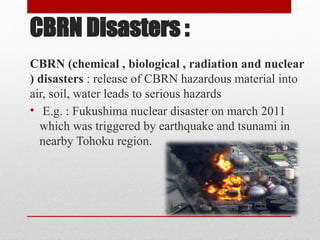
CBRN Disasters :
CBRN (chemical , biological , radiation and nuclear
) disasters : release of CBRN hazardous material into
air, soil, water leads to serious hazards
• E.g. : Fukushima nuclear disaster on march 2011
which was triggered by earthquake and tsunami in
nearby Tohoku region.
Worst disasters in India
Bhopal Gas Tragedy :1984
• Worlds worst man made disaster in which methyl isocyanate
gas was leaked at Union Carbide Pesticide Plant
• More than 20,000 people have been killed till date
• Today, in Bhopal 1,20,000 people are suffering from chronic
diseases like Emphysema, Cancer etc.
Worst disasters in
India(cont…)
• In 1999, Orissa had super cyclone ,in which thousands
lost their lives
• In 2001, Gujarat had a severe earthquake in which 16500
people died and lakhs became homeless
• In 2004, Indian ocean earthquake and Tsunami killed
more than 200,000 people in December 2004
• In 2008 ,terror attack in Mumbai
Prevention of man made
disaster
• Tighter regulation of chemical plants and other
hazardous facilities
• Chemical plants be built away from the dense
populous areas
• Appropriate engineering and technological
measures
• Early warnings and protection against human
errors
Organizations concerned
with disaster management
 NATIONAL
 INTERNATIONAL
 NGOs
International Organisations :
OCHA : United Nations Office for the
Coordination of Humanitarian Affairs
• It was designed to strengthen the UN's response to
complex emergencies and natural disasters by creating
the Department of Humanitarian Affairs (DHA)
International
Organisations (contd..) :
WHO : World Health Organization
• The role is to reduce avoidable loss of life
and the burden of disease and disability.
FAO :The Food and Agriculture Organisation of
the UN provides early warning
of impending food crises, and
assesses global food supply problems.
International
Organisations (contd..) :
IOM : The International Organisation for
Migration is an intergovernmental agency which
helps transfer refugees.
IRP : The International Recovery Platform serve
as a catalyst for the development of tools,
resources, and capacity for disaster recovery
WFP : The World Food Programme is the
principle supplier of relief food aid.
UNDP : The United Nations
Development Programme
UNICEF : The United Nations
Children’s Emergency Fund
NGOs
IFRC : International Federation of Red Cross and Red
Crescent Societies
• Pivotal roles in responding to emergencies . Field
Assessment and Coordination Team – (FACT) to the
affected country if requested by the national Red Cross or
Red Crescent Society.
CARE : The Cooperative for Assistance and Relief
Everywhere is a humanitarian organisation fighting global
poverty .
It also delivers emergency aid to survivors of war and
natural disasters, and helps people rebuild their lives.
NetHope :
Founded in 2001, is international NGOs that specializes in
improving IT connectivity among humanitarian
organizations in developing countries and areas affected by
disaster.
• Organization has partnerships with Microsoft, Cisco
Systems, Intel, and Accenture.
• HVO :Health Volunteers Overseas is a network of
health care professionals, organisations, corporations
and donors united in a common commitment to
improving global health through education
• IRC :International Rescue Committee offers
lifesaving care and life-changing assistance to
refugees forced to flee from war or disaster
• HI: Handicap International works in
partnership with local organisations
and government institutions. .
• MSF: Médecins Sans Frontières
provides medical services in
emergency situations.
• RI: Rehabilitation International is a
global network of expert
professionals
INDIAN NGO’s :
Aniruddha’s Academy of Disaster
Management(AADM) :
• Non-Profit Organization in Mumbai, India with
'Disaster Management' as its principal objective.
• Basic aim of AADM is to save life and property in the
event of a disaster, be it natural or manmade.
• Successfully trained 60,000 citizens, the Disaster
Management Volunteers (DMVs) to handle various
disasters and disaster situations effectively.
• AADM has build up a volunteer base, that assists the
Government authorities during the disaster relief and
rehabilitation work.
References :
• K Park – Text book of community medicine
• www.ndmindia.nic.in
• WIKIPEDIA
• Other information from various
websites with help of google

DISASTER management introduction- mitigation

  • 1.
  • 2.
    Topics : 1– Mitigation,Disaster Preparedness, Policies 2 – Personal protection in different types of Emergency 3 – Manmade Disasters, Disasters in India, Organizations.
  • 3.
    Types of Disasters: Natural Disasters Earthquake Floods Cyclones Tsunami Landslide and Avalanches Manmade Disasters Chemical Disaster Nuclear Disaster Biological Disaster Examples • Natural disasters : Earthquakes, landslides, volcanic eruptions, floods and cyclones • Man-made disasters : Stampedes, fires, transport accidents, industrial accidents, oil spills and nuclear explosions/radiation. War and deliberate attacks may also be put in this category.
  • 4.
  • 5.
  • 6.
    Disaster mitigation  Mitigationis a key to national preparedness.  This includes an assessment of possible risks to personal/family health and to personal property.  For instance, in a flood plain, home owners might not be aware of a property being exposed to a hazard until trouble strikes. Specialists can be hired to conduct risk identification and assessment surveys.
  • 7.
    Contd… • Mitigation involvesStructural and Non-structural measures taken to limit the impact of disasters. • Structural mitigation are actions that change the characteristics of a building or its surrounding, examples include shelters, window shutters, clearing forest around the house. • Non-structural mitigation on personal level mainly takes the form of insurance or simply moving house to a safer area.
  • 9.
    DEFINITION Disaster preparedness is“a programme of long term development activities whose goals are to strengthen the overall capacity and capability of a country to manage efficiently all types of emergency it should bring about an orderly transition from through recovery, and back to sustained development “
  • 10.
    OBJECTIVE To ensure thatappropriate systems, procedures and resources are in place to provide prompt effective assistance to disaster victims ,thus facilitating relief measures and rehabilitation of services .
  • 11.
    Tasks to befollowed in emergency preparedness 1)Evaluate the risk of the country or particular region to disaster. India is vulnerable, in varying degrees, to a large number of natural as well as man-made disasters. 58.6 per cent of the landmass is prone to earthquakes of moderate to very high intensity; over 40 million hectares (12 per cent of land) is prone to floods and river erosion.
  • 12.
    2) Adopt standardsand regulation Following according to NDMA guidelines Of the 7,516 km long coastline, close to 5,700 km is prone to cyclones and tsunamis; 68 per cent of the cultivable area is vulnerable to drought and hilly areas are at risk from landslides and avalanches. Vulnerability to disasters/ emergencies of Chemical, Biological, Radiological and Nuclear (CBRN) origin also exists contd…
  • 13.
    3)Organize communication ,information and warningsystem. Warning system is any system of biological or technical nature deployed by an individual or group to inform of a future danger. Its purpose is to enable the deployer of the warning system to prepare for the danger and act accordingly to mitigate or avoid it.
  • 14.
    4)Ensure coordination endresponse mechanism. These mechanisms include the "cluster approach", which groups agencies with a shared operational interest, e.g. health, water and sanitation. This approach helps to avoid gaps and duplications. It also helps to ensure there is a clear lead organization in each sector
  • 15.
    5)Resource availability. Ensuring thatresource mobilization and financing are handled in a common way, such as through a Flash Appeal or the Central Emergency Response Fund.
  • 16.
    6)Develop public education programmes Ifthe public is to respond quickly and effectively to an emergency involving toxic chemical agents, people must be made aware of the risk from chemical agents and the necessary protective actions well before an emergency occurs. A carefully planned public education program is needed to provide people potentially at risk with the knowledge required to take life-saving actions.
  • 17.
    7)Coordinate information withnews media. The media is an undeniable important player in the disaster management matrix especially in the area of risk reduction advocacy, disaster mitigation preparedness and response.
  • 18.
    A disaster drillis an exercise in which people simulate the circumstances of a disaster so that they have an opportunity to practice their responses. 8) DISASTER DRILL
  • 19.
    • Efficacy ofplans and Standard Operating Procedures (SOPs) can be tested through mock drills Contd . . .
  • 20.
    Exercises have 3main purposes: • to validate plans (validation) • to develop staff competencies and give them practice in carrying out their roles in the plans (training) • to test well-established procedures (testing)
  • 21.
    There are 3main types of exercise: • Discussion-based • Table top • Live
  • 22.
    COMMUNITY PREPAREDNESS • Community membersresources organizations, and and administration should be the cornerstone of an emergency programme
  • 23.
    REASONS FOR COMMUNITY PREPAREDNESS •Members of the community are the most to to lose from being vulnerable to disasters and the most to gain to gain from effective and appropriate emergency preparedness programme. • Those who respond first to an emergency come from within the community .When transport and communication are disrupted ,an external emergency may not arrive for days.
  • 24.
    • Resources aremost easily pooled at community level and every community posses capabilities .Failure to explore these capabilities is poor resource management . • Sustained development is best achieved by allowing emergency affected communities to design ,manage and implement internal and external assistance programme. cont…
  • 25.
    An example ofreduced damage due to preparedness • On 12 November, 1970 a major cyclone hit the coastal belt of Bangladesh at 223 km/hr. with a storm surge of six to nine meters height, killing an estimated 500,000 people. • Due to the Cyclone Preparedness Program, the April 1991 cyclone with wind speed of 225 km/hr. killed only 138,000 people even though the coastal population had doubled by that time. • In May 1994, in a similar cyclone with a wind speed of 250 km/hr. only 127 people lost their lives. • In May 1997, in a cyclone with wind speed of 200 km/hr. only 111 people lost their lives.
  • 26.
  • 27.
    POLICY DEVELOPMENT It is“the formal statement of a course of action”. Policy is strategic in nature and performs the following functions Establish long term goals . Assign responsibilities for achieving goals. Establish recommended work practice. Determine criteria for decision making.
  • 28.
    • The formof emergency preparedness policies varies from place to place . Six sectors are required for response and recovery strategies . • They are Communication Police and security Health Search and rescue Social welfare Transport
  • 29.
    National Policy onDisaster Management(NPDM) On 23 December, 2005, the Government of India took a defining step by enacting the Disaster Management Act, 2005which envisaged the creation of the National Disaster Management Authority (NDMA), headed by the Prime Minister, State Disaster Management Authorities (SDMAs) headed by the Chief Ministers, and District Disaster Management Authorities (DDMAs) headed by the Collector or District Magistrate or Deputy Commissioner.
  • 30.
    INSTITUTIONAL AND LEGAL ARRANGEMENTS •Disaster Management Act, 2005 The Act lays down institutional, legal, financial and coordination mechanisms at the national, state, district and local levels. These institutions are not parallel structures and will work in close harmony. • National Disaster Management Authority (NDMA) • State Disaster Management Authority (SDMA)
  • 31.
    National Disaster Management Authorityof India : • It is a govt. Agency – under Ministry of Home Affairs. • A group representing a public/private has recently been formed by the Government of India. • Some of the groups' early efforts involve the provision of emergency management training for first responders (a first in India), the creation of a single emergency telephone number, and the establishment of standards for EMS staff, equipment, and training. • Efforts are being made in making this a nation-wide effective group. • It is funded primarily by a large India-based computer company and aimed at improving the general response of communities to emergencies.
  • 32.
    cont…… • District DisasterManagement Authority (DDMA). • Local Authorities . Local authorities would include Panchayati Raj Institutions (PRI), Municipalities, District and Cantonment Boards and Town Planning Authorities. • National Institute of Disaster Management (NIDM) . • National Disaster Response Force (NDRF).
  • 34.
    cont…… • Armed Forces •Central Para Military Forces • Civil Defence and Home Guards • State Police Forces and Fire Services • State Disaster Response Force (SDRF)
  • 35.
    FINANCIAL ARRANGEMENTS • TheNational Disaster Response and Mitigation Fund • The National Calamity Contingency Fund (NCCF)
  • 36.
    General measures during emergency •Do not use telephone except call for help,so as to leave telephone lines free for the organization to respond. • Listen to the messages broadcast by radio and various media so as to be informed of development. • Carry out the official instructions given over the radio or by loudspeaker. • Keep a family emergency kit ready.
  • 37.
    HOME EMERGENCY KIT Battery-operatedradios, batteries Alternate heat sources Extra warm clothing and blankets Cash First aid kit Ready-to-eat and high- energy foods for 3 days Bottled water Extra prescription medications Baby supplies Special needs items Lanterns, flashlights, lightsticks
  • 38.
  • 39.
    • Flashlight • Flaresor reflective triangle • First aid kit • Basic tools including a shovel • Extra clothing including hats and gloves • Booster cables • Sand or kitty litter • Ice scraper and brush • Blanket  Ice scraper and brush  Blanket  Non-perishable high energy food TRAVEL EMERGENCY KIT
  • 40.
  • 41.
  • 42.
    Land Slide VolcanicEruption Cyclone Earthquake
  • 43.
    Before a Flood Toprepare for a flood, you should:  Avoid building in a flood prone area unless you elevate and reinforce your home.  Elevate the furnace, water heater, and electric panel if susceptible to flooding.  Install "check valves" in sewer traps to prevent floodwater from backing up into the drains of your home.  Contact community officials to find out if they are planning to construct barriers (levees, beams, floodwalls) to stop floodwater from entering the homes in your area.  Seal the walls in your basement with waterproofing compounds to avoid seepage
  • 44.
    During a Flood If a flood is likely in your area, you should:  Listen to the radio or television for information.  Be aware that flash flooding can occur. If there is any possibility of a flash flood, move immediately to higher ground. Do not wait for instructions to move.  Be aware of streams, drainage channels, canyons, and other areas known to flood suddenly. Flash floods can occur in these areas with or without such typical warnings as rain clouds or heavy rain.
  • 45.
    cont… If you mustprepare to evacuate, you should do the following:  Secure your home. If you have time, bring in outdoor furniture. Move essential items to an upper floor.  Turn off utilities at the main switches or valves if instructed to do so. Disconnect electrical appliances. Do not touch electrical equipment if you are wet or standing in water. If you have to leave your home, remember these evacuation tips:  Do not walk through moving water.. If you have to walk in water, walk where the water is not moving. Use a stick to check the firmness of the ground in front of you.  Do not drive into flooded areas.
  • 46.
    After a Flood Thefollowing are guidelines for the period following a flood:  Listen for news reports to learn whether the community’s water supply is safe to drink.  Avoid floodwaters; water may be contaminated by oil, gasoline, or raw sewage. Water may also be electrically charged from underground or downed power lines.  Avoid moving water.  Be aware of areas where floodwaters have receded. Roads may have weakened and could collapse under the weight of a vehicle.  Stay away from downed power lines, and report them to the power company.
  • 47.
     Return homeonly when authorities indicate it is safe.  Stay out of any building if it is surrounded by floodwaters.  Use extreme caution when entering buildings; there may be hidden damage, particularly in foundations.  Service damaged septic tanks, cesspools, pits, and leaching systems as soon as possible. Damaged sewage systems are serious health hazards.  Clean and disinfect everything that got wet. Mud left from floodwater can contain sewage and chemicals cont…
  • 49.
    STORMS,HURRICANES,TORNADOES What to dobefore hand?  choose a shelter in advance  minimise the effect of storms  take measures against flooding  prepare a family emergency kit
  • 50.
    1. During anemergency: • Listen to the information and advice provided by the authorities. • Do not go out in car or boat once the storm has been announced. • Evacuate houses if requested • Tie down any object liable to be blown away by wind • If caught outside in a storm,take refuge as quickly as possible in a shelter • In a thunderstorm keep away from doors,windows,and electrical conductors,unplug electrical appliances etc • Donot use any electrical appliances or the telephone
  • 51.
    During an emergency(Contd. . ) Anyone who is outside should: Look for shelter in a building never take shelter under a tree if in a boat,get back to the shore keep away from fences and electric cables kneel down rather than standing
  • 52.
    After the emergency: Afterthe storm has subsided: Follow the instructions given by the authorities Stay indoors Give alert as quickly as possible Give first aid to the injured Make sure the water is safe to drink Check the exterior of dwellings and call for assistance if there is a risk of falling objects[tiles,guttering...]
  • 54.
  • 55.
    EARTHQUAKES What to dobefore hand : Repair deep plaster cracks in ceilings and foundations. Get expert advice if there are signs of structural defects. Hang heavy items such as pictures and Brace overhead light and fan fixtures. Repair defective electrical wiring and leaky gas connections. These are potential fire risks. Secure a water heater, LPG cylinder etc., by strapping it to the wall studs and bolting it to the floor. Store weed killers, pesticides, and flammable products securely in closed cabinets with latches and on bottom shelves
  • 56.
    Identify safe placesindoors and outdoors. 1 Under strong dining table, bed 2.Against an inside wall 3.Away from where glass could shatter around windows, mirrors, pictures, or where heavy bookcases or other heavy furniture could fall over 4.In the open, away from buildings, trees, telephone and electrical lines, flyovers, bridges 5.Have a disaster emergency kit ready
  • 57.
    If indoors:  DROPto the ground; take COVER by getting under a sturdy table or other piece of furniture; and HOLD ON until the shaking stops. If there isn’t a table or desk near you, cover your face and head with your arms and crouch in an inside corner of the building.  Protect yourself by staying under the lintel of an inner door, in the corner of a room, under a table or even under a bed.  Stay away from glass, windows, outside doors and walls, and anything that could fall, such as lighting fixtures or furniture.  Stay in bed if you are there when the earthquake strikes. Hold on and protect your head with a pillow, unless you are under a heavy light fixture that could fall.  Stay inside until the shaking stops and it is safe to go outside. Research has shown that most injuries occur when people inside buildings attempt to move to a different location inside the building or try to leave. DO NOT use the elevators.
  • 58.
     If youknow that people have been buried, tell the rescue teams. Do not rush and do not worsen the situation of injured persons or your own situation.  Avoid places where there are loose electric wires and do not touch any metal object in contact with them.  Do not drink water from open containers without having examined it and filtered it through a sieve, a filter or an ordinary clean cloth.  If your home is badly damaged, you will have to leave it. Collect water containers, food, and ordinary and special medicines (for persons with heart complaints, diabetes, etc.)  Do not re-enter badly damaged buildings and do not go near damaged structures.
  • 59.
    If outdoors • Staythere. • Move away from buildings, trees, streetlights, and utility wires. • Once in the open, stay there until the shaking stops. The greatest danger exists directly outside buildings, at exits, and alongside exterior walls. Most earthquake-related casualties result from collapsing walls, flying glass.
  • 60.
    If in amoving vehicle • Stop as quickly as safety permits and stay in the vehicle. Avoid stopping near or under buildings, trees, overpasses, and utility wires. • Proceed cautiously once the earthquake has stopped. Avoid roads, bridges, or ramps that might have been damaged by the earthquake. If trapped under debris • Do not move about or kick up dust. • Cover your mouth with a handkerchief or clothing. • Tap on a pipe or wall so rescuers can locate you. Use a whistle if one is available. Shout only as a last resort.
  • 61.
    After an earthquake Keep calm, switch on the radio/TV and obey any instructions you hear on it.  Keep away from beaches and low banks of rivers. Huge waves may sweep in.  Expect aftershocks. Be prepared.  Turn off the water, gas and electricity.  Do not smoke and do not light matches or use a cigarette lighter. Do not turn on switches. There may be gas leaks or short-circuits.  Make sure that the water is safe to drink and food stored at home is fit to eat.
  • 62.
    During an emergency •Do not use the telephone;leave lines free for rescue services • Listen to messages given by radio and other media • Carry out the instructions given through media • Close doors and windows • Seal any cracks or gaps around windows and doors with adhesive tapes • Organise a reserve of water • Turn off ventilators and air conditioners
  • 63.
    After Emergency : Followthe authorities instructions and do not go out until there is no longer any risk Carry out necessary decontamination measures
  • 64.
  • 65.
    “Humans are goodat creating disasters, and throughout history we’ve rarely been afraid to prove it”.
  • 66.
    Definition : • Man-madedisasters are the threats having an element of human intent, negligence, or error ; or involving a failure of a human-made system. • Human causation may be accidental or intentional
  • 67.
    Types of manmade disasters • Sudden disasters : such as Chernobyl disaster and Bhopal gas tragedy, • Insidious disasters : Chemical and radiation exposure, global warming
  • 68.
    Classification : Sociological disasters Terrorism Warand civil conflicts Technological disasters Industrial disasters Structural collapse and fire CBRN disaster Transportation disasters
  • 69.
    Sociological hazards • Terrorism: The primary objective of a terrorism is to create widespread fear. • E.g. : On 11 September 2001 the World Trade Centre in New York City was destroyed by crashing American airlines and killed 2,752.
  • 70.
    War :  Itis a conflict between relatively large groups of people, which involves physical force by the use of weapons .  Warfare has destroyed entire cultures, countries, economies and inflicted great suffering on humanity.  E.g. : World war I and II. Since world war II there have been about 127 wars and 22 million war related deaths have occurred
  • 71.
    Civil conflicts (riots): Anyincident that disrupts a community, where intervention is required to maintain public safety. • eg: 1984 Sikh massacre, a riot against the Sikhs in response to assassination of Indira Gandhi by her Sikh bodyguards • More than 11,000 people were killed
  • 72.
    Technological hazards • Industrialdisasters :  E.g.-The Nuclear Power Plant Explosion in Chernobyl, Russia : On April 26th 1986, which resulted in the atmospheric release of radioactive material four hundred times more radioactive than Hiroshima.  Structural collapse :often caused by engineering failures E.g.: recently building collapse in Bangladesh ,Kolkata and thane :
  • 73.
    • Fire :mainly forest fire , mine fire. • E.g. : In 2003, fire at Iraqi sulphur plant releasing Sulphur dioxide which killed people by causing respiratory problems and also creates acid rain which destroys crops. • Transportation disaster: air, Rail, and Space disasters and traffic collisions • E.g.: Mangalore air crash on 22 May 2010. Only eight passengers survived in 160.
  • 74.
    CBRN Disasters : CBRN(chemical , biological , radiation and nuclear ) disasters : release of CBRN hazardous material into air, soil, water leads to serious hazards • E.g. : Fukushima nuclear disaster on march 2011 which was triggered by earthquake and tsunami in nearby Tohoku region.
  • 75.
    Worst disasters inIndia Bhopal Gas Tragedy :1984 • Worlds worst man made disaster in which methyl isocyanate gas was leaked at Union Carbide Pesticide Plant • More than 20,000 people have been killed till date • Today, in Bhopal 1,20,000 people are suffering from chronic diseases like Emphysema, Cancer etc.
  • 76.
    Worst disasters in India(cont…) •In 1999, Orissa had super cyclone ,in which thousands lost their lives • In 2001, Gujarat had a severe earthquake in which 16500 people died and lakhs became homeless • In 2004, Indian ocean earthquake and Tsunami killed more than 200,000 people in December 2004 • In 2008 ,terror attack in Mumbai
  • 78.
    Prevention of manmade disaster • Tighter regulation of chemical plants and other hazardous facilities • Chemical plants be built away from the dense populous areas • Appropriate engineering and technological measures • Early warnings and protection against human errors
  • 79.
    Organizations concerned with disastermanagement  NATIONAL  INTERNATIONAL  NGOs
  • 80.
    International Organisations : OCHA: United Nations Office for the Coordination of Humanitarian Affairs • It was designed to strengthen the UN's response to complex emergencies and natural disasters by creating the Department of Humanitarian Affairs (DHA)
  • 81.
    International Organisations (contd..) : WHO: World Health Organization • The role is to reduce avoidable loss of life and the burden of disease and disability. FAO :The Food and Agriculture Organisation of the UN provides early warning of impending food crises, and assesses global food supply problems.
  • 82.
    International Organisations (contd..) : IOM: The International Organisation for Migration is an intergovernmental agency which helps transfer refugees. IRP : The International Recovery Platform serve as a catalyst for the development of tools, resources, and capacity for disaster recovery
  • 83.
    WFP : TheWorld Food Programme is the principle supplier of relief food aid. UNDP : The United Nations Development Programme UNICEF : The United Nations Children’s Emergency Fund
  • 84.
    NGOs IFRC : InternationalFederation of Red Cross and Red Crescent Societies • Pivotal roles in responding to emergencies . Field Assessment and Coordination Team – (FACT) to the affected country if requested by the national Red Cross or Red Crescent Society.
  • 85.
    CARE : TheCooperative for Assistance and Relief Everywhere is a humanitarian organisation fighting global poverty . It also delivers emergency aid to survivors of war and natural disasters, and helps people rebuild their lives.
  • 86.
    NetHope : Founded in2001, is international NGOs that specializes in improving IT connectivity among humanitarian organizations in developing countries and areas affected by disaster. • Organization has partnerships with Microsoft, Cisco Systems, Intel, and Accenture.
  • 87.
    • HVO :HealthVolunteers Overseas is a network of health care professionals, organisations, corporations and donors united in a common commitment to improving global health through education • IRC :International Rescue Committee offers lifesaving care and life-changing assistance to refugees forced to flee from war or disaster
  • 88.
    • HI: HandicapInternational works in partnership with local organisations and government institutions. . • MSF: Médecins Sans Frontières provides medical services in emergency situations. • RI: Rehabilitation International is a global network of expert professionals
  • 89.
    INDIAN NGO’s : Aniruddha’sAcademy of Disaster Management(AADM) : • Non-Profit Organization in Mumbai, India with 'Disaster Management' as its principal objective. • Basic aim of AADM is to save life and property in the event of a disaster, be it natural or manmade. • Successfully trained 60,000 citizens, the Disaster Management Volunteers (DMVs) to handle various disasters and disaster situations effectively. • AADM has build up a volunteer base, that assists the Government authorities during the disaster relief and rehabilitation work.
  • 90.
    References : • KPark – Text book of community medicine • www.ndmindia.nic.in • WIKIPEDIA • Other information from various websites with help of google

Editor's Notes

  • #8 Welcome to this presentation on Community/ Personal Preparedness. Self introduction/ background.
  • #51 a