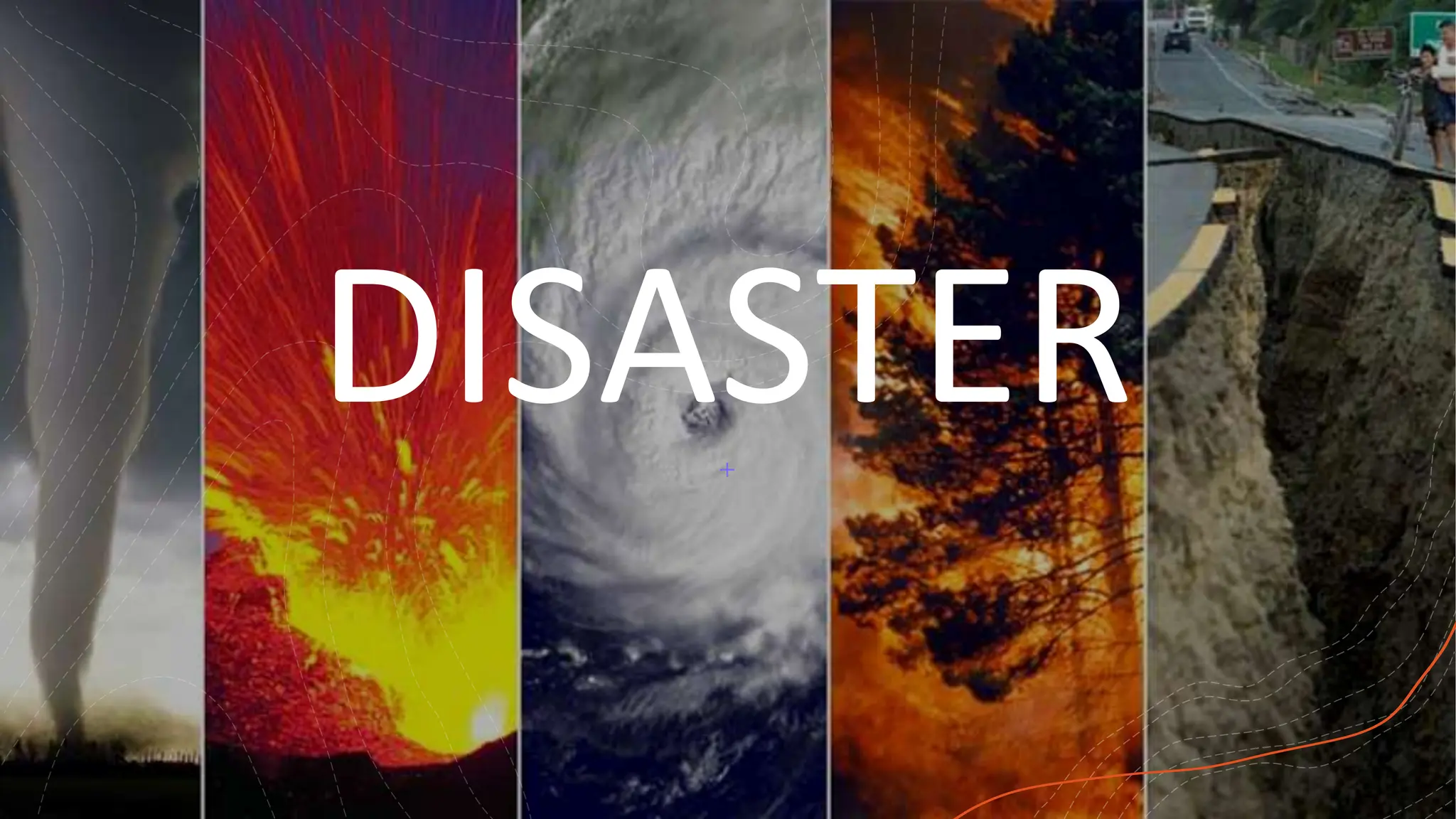
DISASTER
What is a Disaster?
Disaster is defined as a “sudden, calamitous
event, bringing great damage, loss, destruction
and devastation to life and property” (Asian
Disaster Preparedness Center – ADPC, 2012) It
is can be natural, such as earthquakes, floods,
and hurricanes, or of human origin, such as
explosions, nuclear accidents and terrorist acts.
How and When an Event Becomes a
Disaster
An event, either human-made or natural, becomes a disaster
when it is sudden or progressive, causing widespread human,
material or environmental losses. A typhoon like Yolanda is a
natural phenomenon. It became a disaster due to several
factors: its strength (290 km/hr); the storm surge it brought
which was sudden and unexpected; and its devastating effect
to human, material, and environment. More than 7,000 people
perished. The entire City of Tacloban was literally flattened to
the ground.
What are the Different Types of
Disasters?
Natural Disasters
These originate from the
different “forces” of nature
(geological, meteorological,
hydrometeorological and
biological). Natural disasters
such as earthquakes, volcanic
eruptions, typhoons, and
cyclones affect many countries in
Asia particularly the Philippines.
Human-Induced Disasters
These disasters occur due to
people’s actions against human,
material and environment. These
include transport and industrial
accidents, such as, air and train
crasher, chemical spills, and
building collapses. Terrorism is
also categorized as human-
induced disaster.
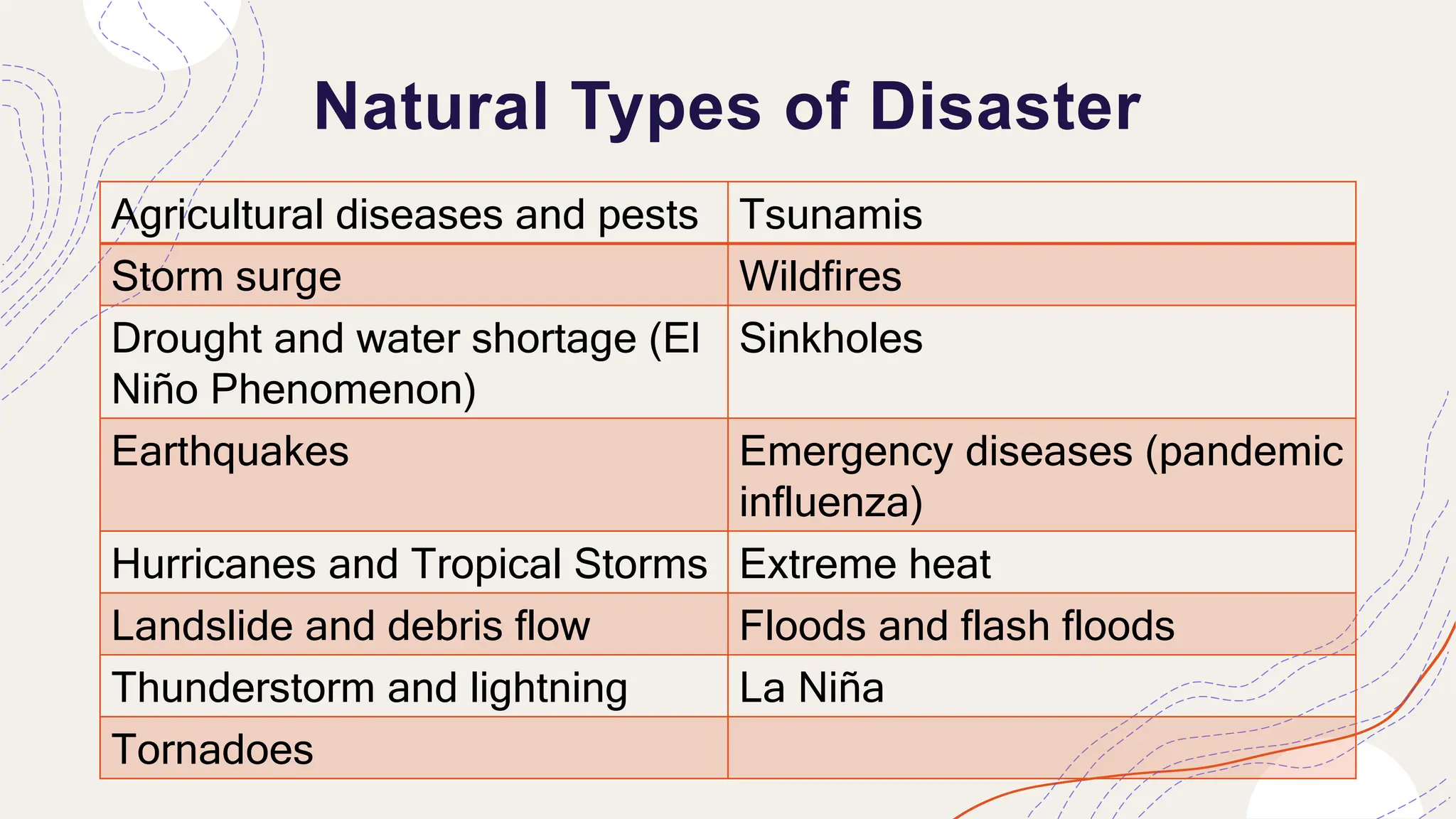
Natural Types of Disaster
Agricultural diseases and pests Tsunamis
Storm surge Wildfires
Drought and water shortage (El
Niño Phenomenon)
Sinkholes
Earthquakes Emergency diseases (pandemic
influenza)
Hurricanes and Tropical Storms Extreme heat
Landslide and debris flow Floods and flash floods
Thunderstorm and lightning La Niña
Tornadoes
Human-Induced and Teachnological
Types of Disasters
Spread of Hazardous materials Chemical threat and biological
weapons
Power service disruption and
blackout
Cyber attacks
Nuclear power plant and
nuclear blast
Bombings and terrorist attacks
Radiological emergencies Civil unrest
Effects of Natural Disasters on
Human Life
Displaced Populations Health Risks
Effects of Natural Disasters on
Human Life
Food Scarcity Emotional Aftershocks
What is Hazard?
Hazards are “those elements
of the physical environment,
harmful to man and caused by
forces extraneous to him.”
(Burton et al 1978)
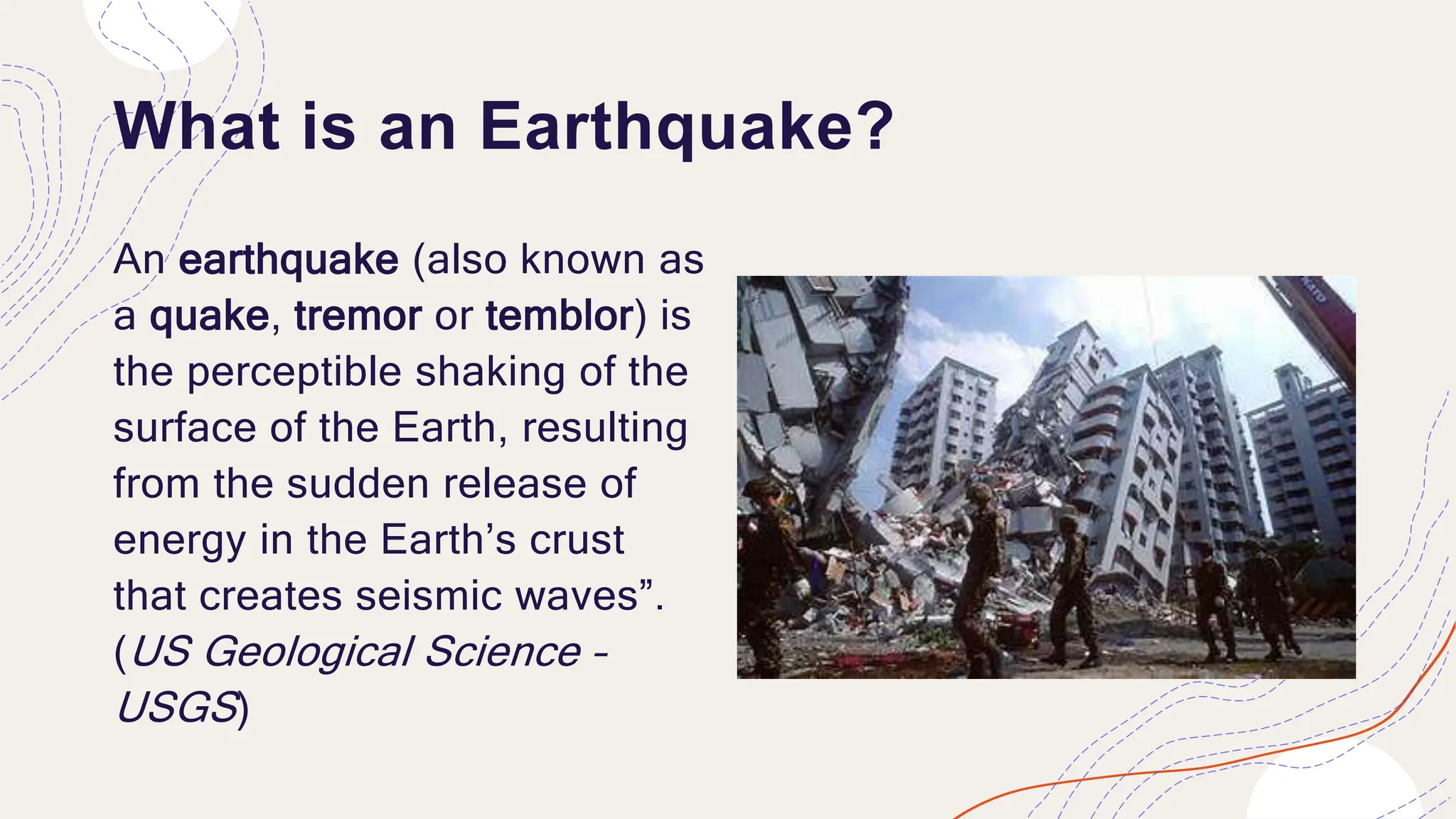
What is an Earthquake?
An earthquake (also known as
a quake, tremor or temblor) is
the perceptible shaking of the
surface of the Earth, resulting
from the sudden release of
energy in the Earth’s crust
that creates seismic waves”.
(US Geological Science –
USGS)
The Big One
The Big One refers to the
magnitude 7.2 earthquake that
could hit Metro Manila if the West
Valley Fault moves.
The West Valley Fault moves
roughly every 400 years, the last
happened in 1658, or 359 years
ago. According to the MMDA,
should the magnitude 7.2
earthquake hit Metro Manila, it
could cause 34,000 deaths and
114,000 injuries due to collapsed
buildings.
Tsunami A tsunami, also known as a
seismic sea wave, is a series
of waves in a water body
caused by the displacement
of a large volume of water,
generally in an ocean or large
lake. Earthquakes, volcanic
eruptions and other
underwater explosions
(including detonations of
underwater nuclear devices),
Tsunami
landslides, glacier cavings,
meteorite impacts and other
disturbances above or below
water all have the potential to
generate a tsunami. Unlike
normal ocean waves which
are generated by wind or
tides which are generated by
the gravitational pull of the
Moon and the Sun, a tsunami
is generated by the
displacement of water.

DISASTER (EARTHQUAKE, FIRE AND THE BIG ONE)

  • 1.
  • 2.
    What is aDisaster? Disaster is defined as a “sudden, calamitous event, bringing great damage, loss, destruction and devastation to life and property” (Asian Disaster Preparedness Center – ADPC, 2012) It is can be natural, such as earthquakes, floods, and hurricanes, or of human origin, such as explosions, nuclear accidents and terrorist acts.
  • 3.
    How and Whenan Event Becomes a Disaster An event, either human-made or natural, becomes a disaster when it is sudden or progressive, causing widespread human, material or environmental losses. A typhoon like Yolanda is a natural phenomenon. It became a disaster due to several factors: its strength (290 km/hr); the storm surge it brought which was sudden and unexpected; and its devastating effect to human, material, and environment. More than 7,000 people perished. The entire City of Tacloban was literally flattened to the ground.
  • 4.
    What are theDifferent Types of Disasters? Natural Disasters These originate from the different “forces” of nature (geological, meteorological, hydrometeorological and biological). Natural disasters such as earthquakes, volcanic eruptions, typhoons, and cyclones affect many countries in Asia particularly the Philippines. Human-Induced Disasters These disasters occur due to people’s actions against human, material and environment. These include transport and industrial accidents, such as, air and train crasher, chemical spills, and building collapses. Terrorism is also categorized as human- induced disaster.
  • 5.
    Natural Types ofDisaster Agricultural diseases and pests Tsunamis Storm surge Wildfires Drought and water shortage (El Niño Phenomenon) Sinkholes Earthquakes Emergency diseases (pandemic influenza) Hurricanes and Tropical Storms Extreme heat Landslide and debris flow Floods and flash floods Thunderstorm and lightning La Niña Tornadoes
  • 6.
    Human-Induced and Teachnological Typesof Disasters Spread of Hazardous materials Chemical threat and biological weapons Power service disruption and blackout Cyber attacks Nuclear power plant and nuclear blast Bombings and terrorist attacks Radiological emergencies Civil unrest
  • 7.
    Effects of NaturalDisasters on Human Life Displaced Populations Health Risks
  • 8.
    Effects of NaturalDisasters on Human Life Food Scarcity Emotional Aftershocks
  • 9.
    What is Hazard? Hazardsare “those elements of the physical environment, harmful to man and caused by forces extraneous to him.” (Burton et al 1978)
  • 10.
    What is anEarthquake? An earthquake (also known as a quake, tremor or temblor) is the perceptible shaking of the surface of the Earth, resulting from the sudden release of energy in the Earth’s crust that creates seismic waves”. (US Geological Science – USGS)
  • 14.
    The Big One TheBig One refers to the magnitude 7.2 earthquake that could hit Metro Manila if the West Valley Fault moves. The West Valley Fault moves roughly every 400 years, the last happened in 1658, or 359 years ago. According to the MMDA, should the magnitude 7.2 earthquake hit Metro Manila, it could cause 34,000 deaths and 114,000 injuries due to collapsed buildings.
  • 15.
    Tsunami A tsunami,also known as a seismic sea wave, is a series of waves in a water body caused by the displacement of a large volume of water, generally in an ocean or large lake. Earthquakes, volcanic eruptions and other underwater explosions (including detonations of underwater nuclear devices),
  • 16.
    Tsunami landslides, glacier cavings, meteoriteimpacts and other disturbances above or below water all have the potential to generate a tsunami. Unlike normal ocean waves which are generated by wind or tides which are generated by the gravitational pull of the Moon and the Sun, a tsunami is generated by the displacement of water.