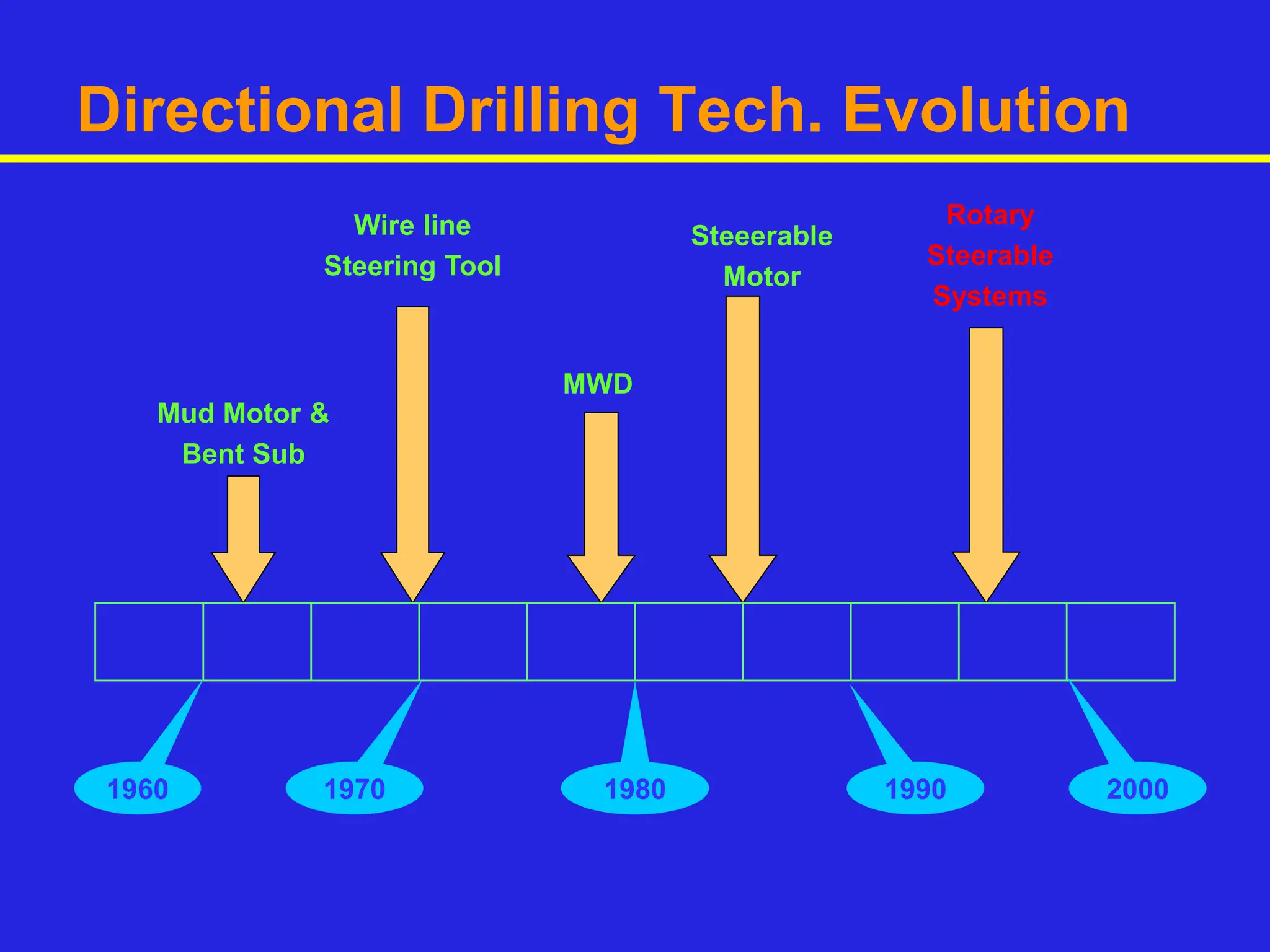
Directional Drilling Tech. Evolution
1960 1970 1980 1990 2000
Mud Motor &
Bent Sub
Wire line
Steering Tool
MWD
Steeerable
Motor
Rotary
Steerable
Systems
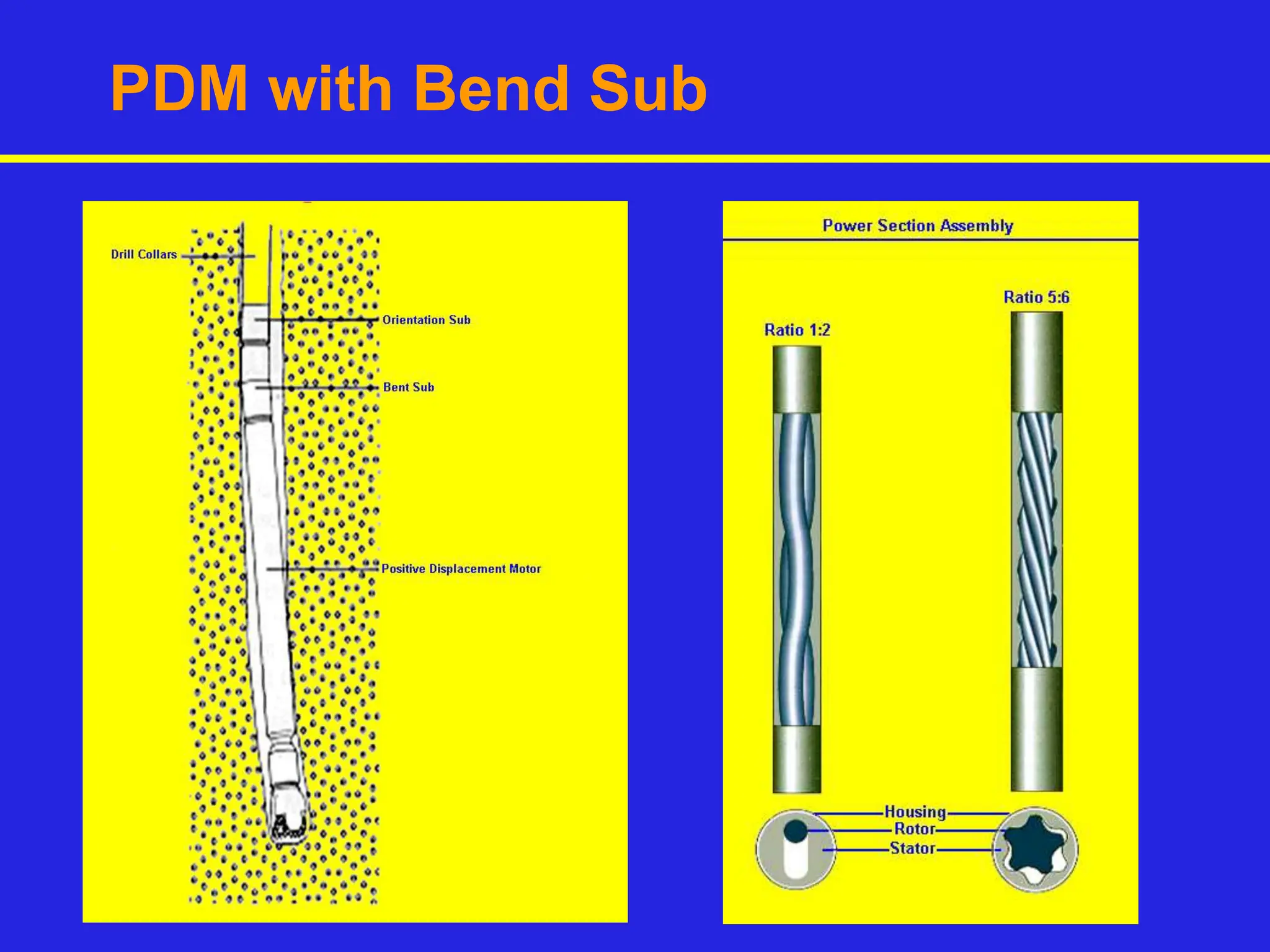
PDM with Bend Sub
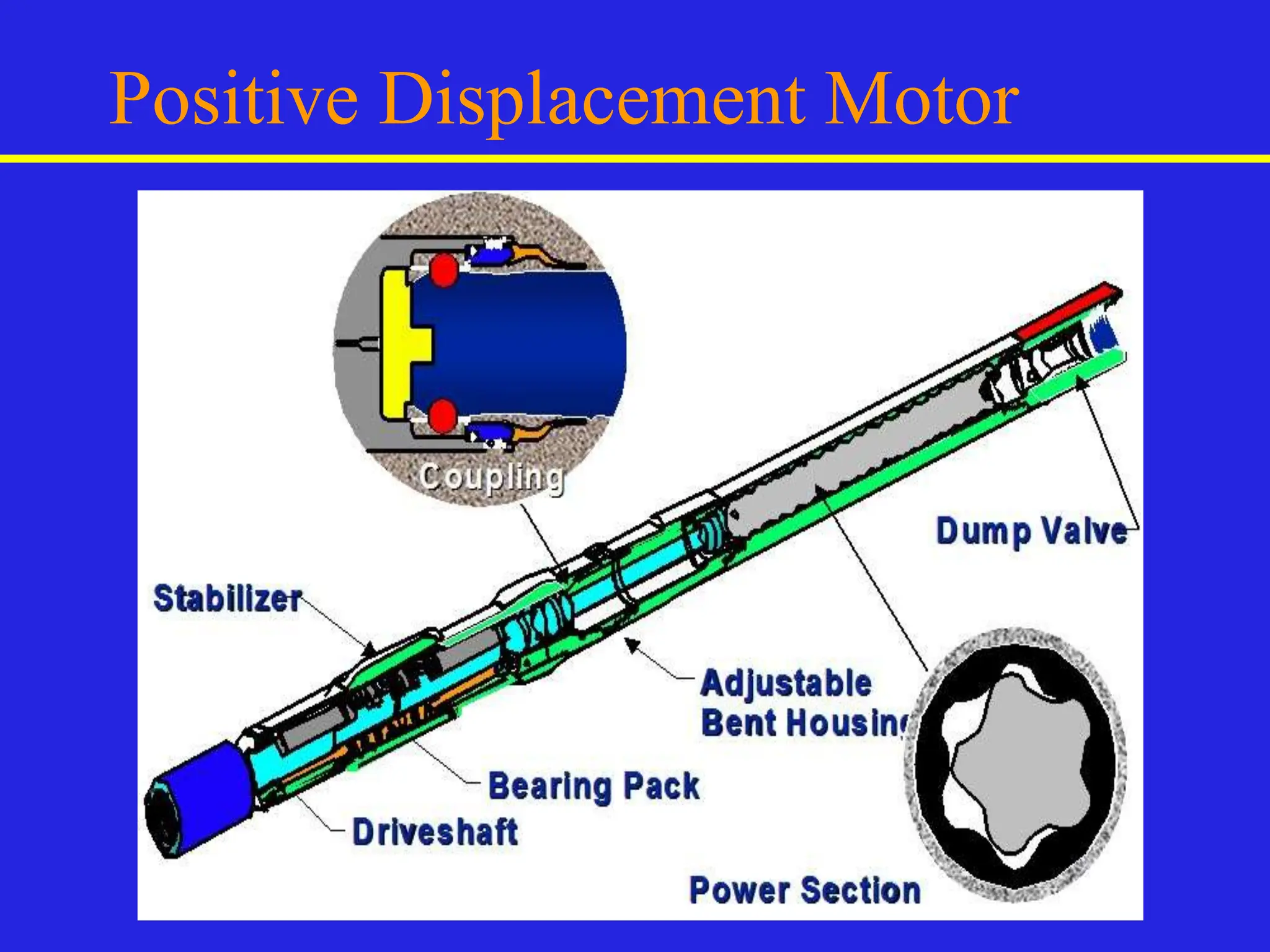
Positive Displacement Motor
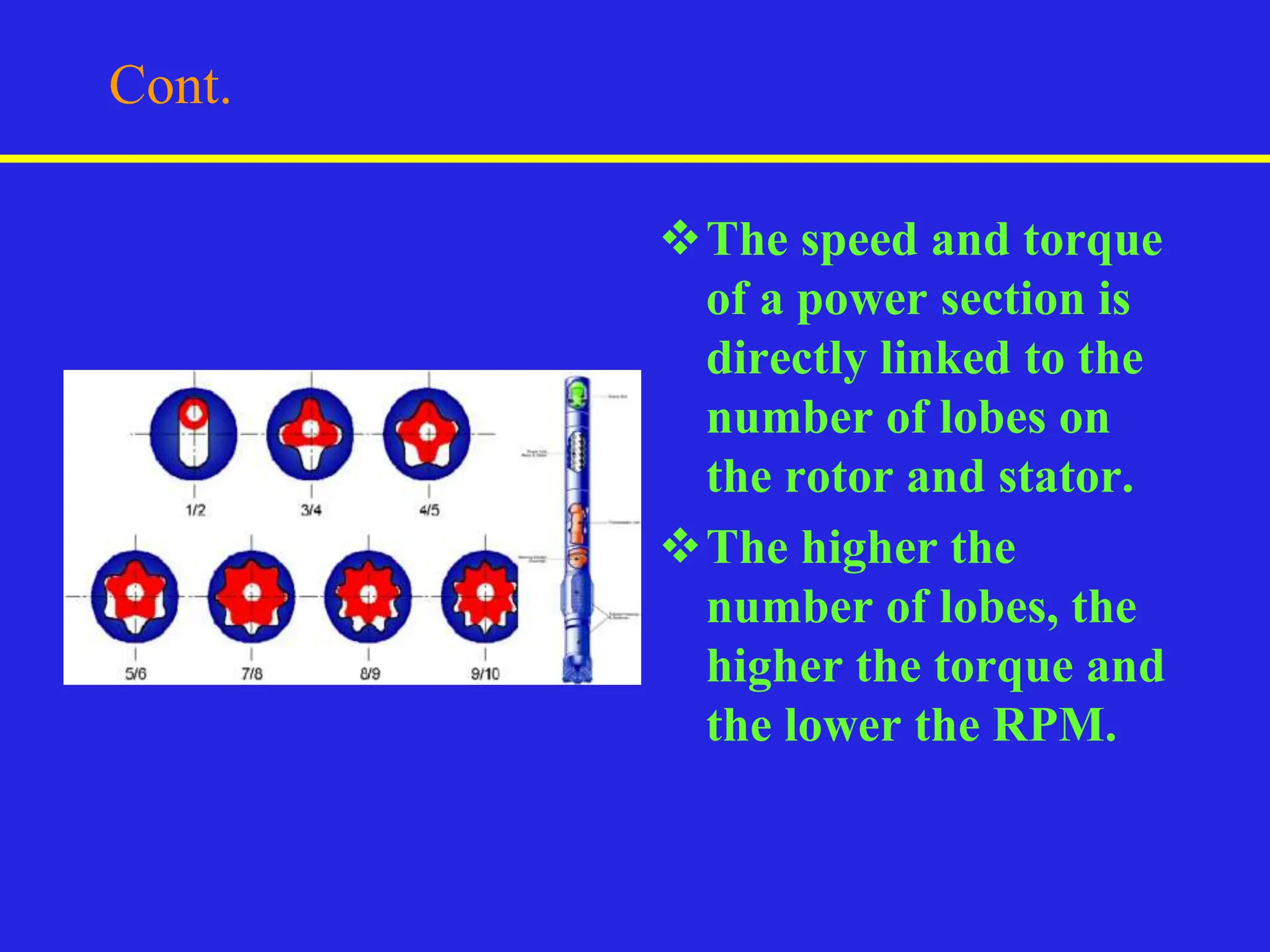
Cont.
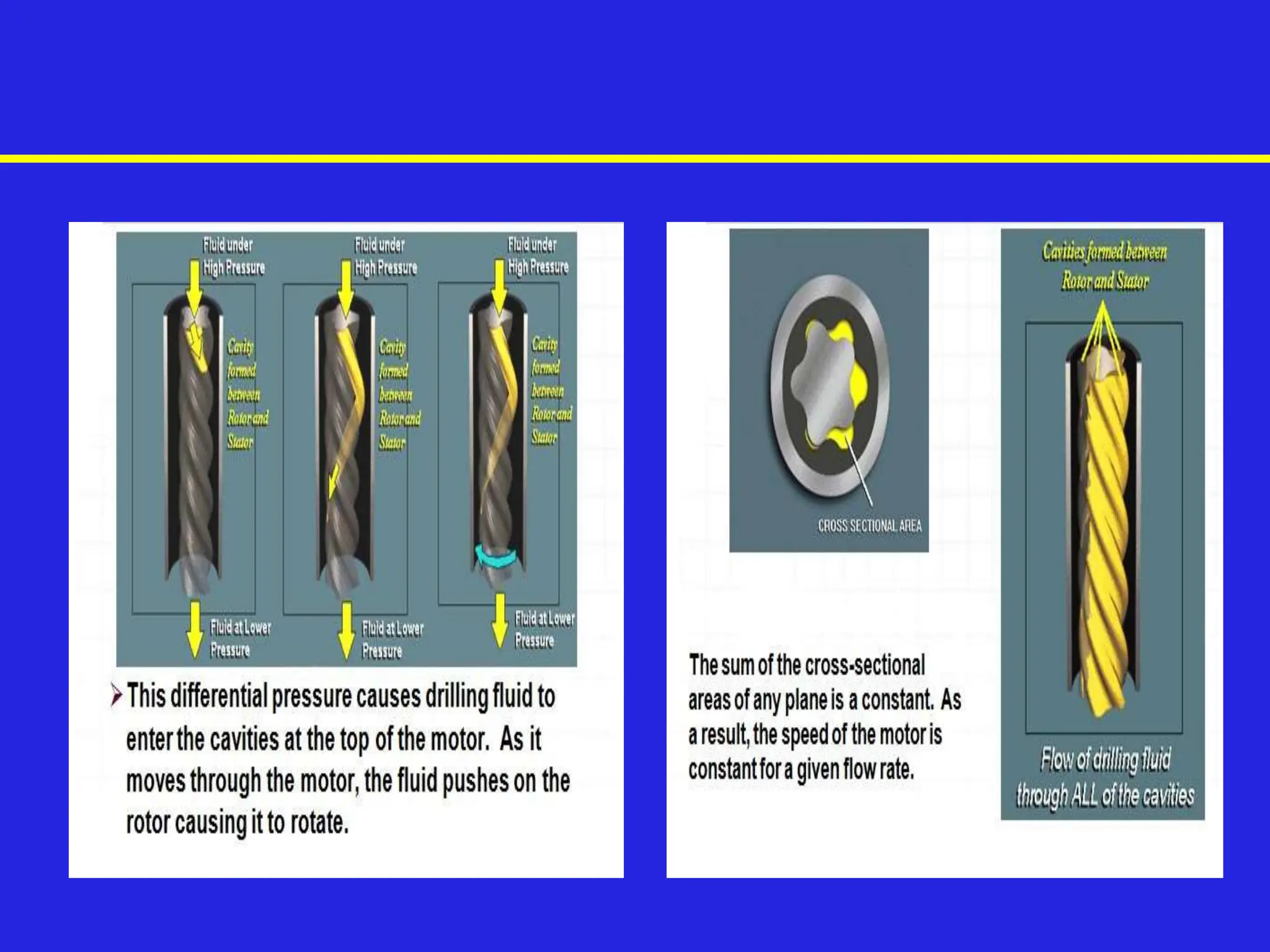
The speed and torque
of a power section is
directly linked to the
number of lobes on
the rotor and stator.
The higher the
number of lobes, the
higher the torque and
the lower the RPM.
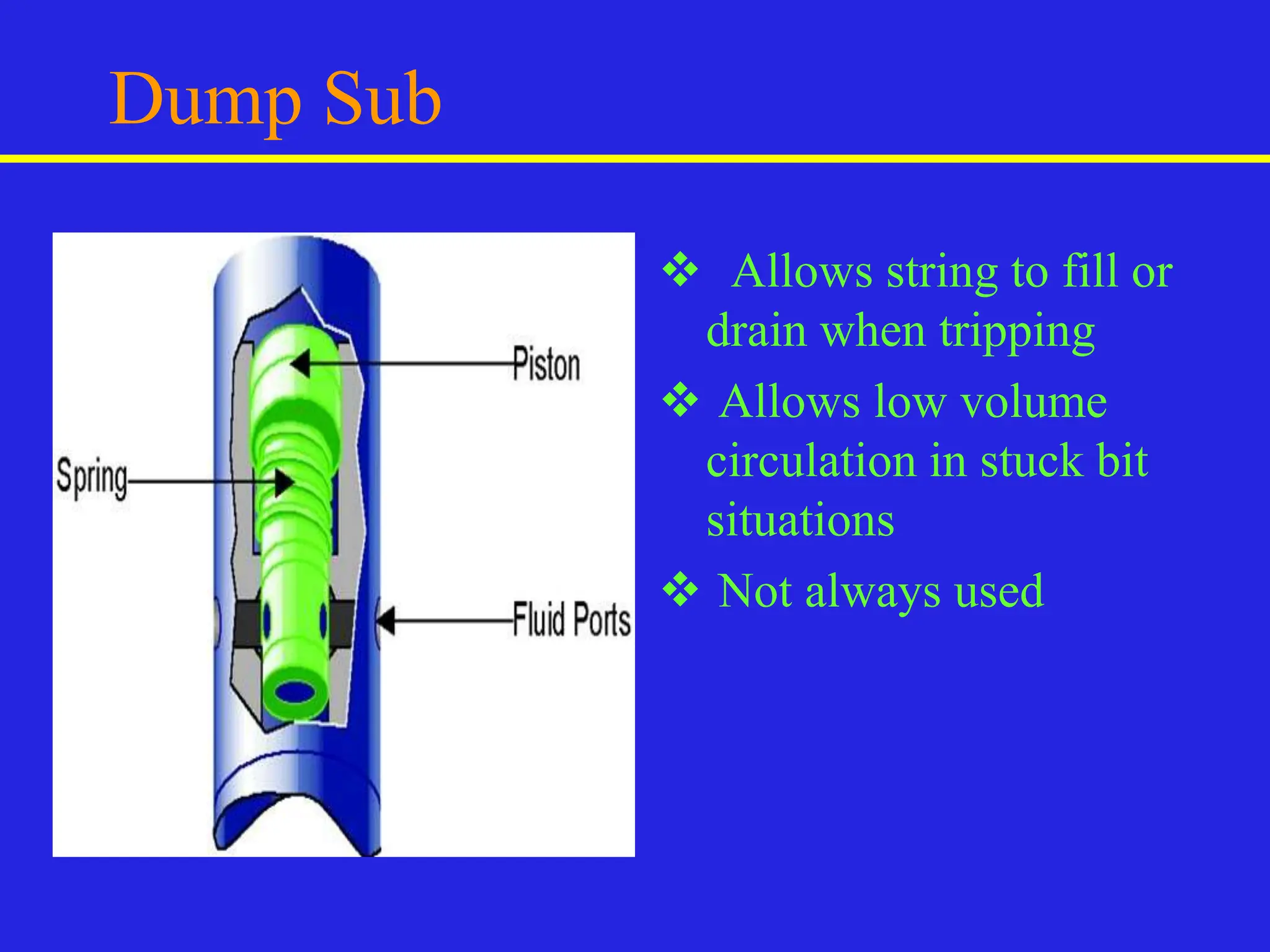
Dump Sub
 Allows string to fill or
drain when tripping
 Allows low volume
circulation in stuck bit
situations
 Not always used
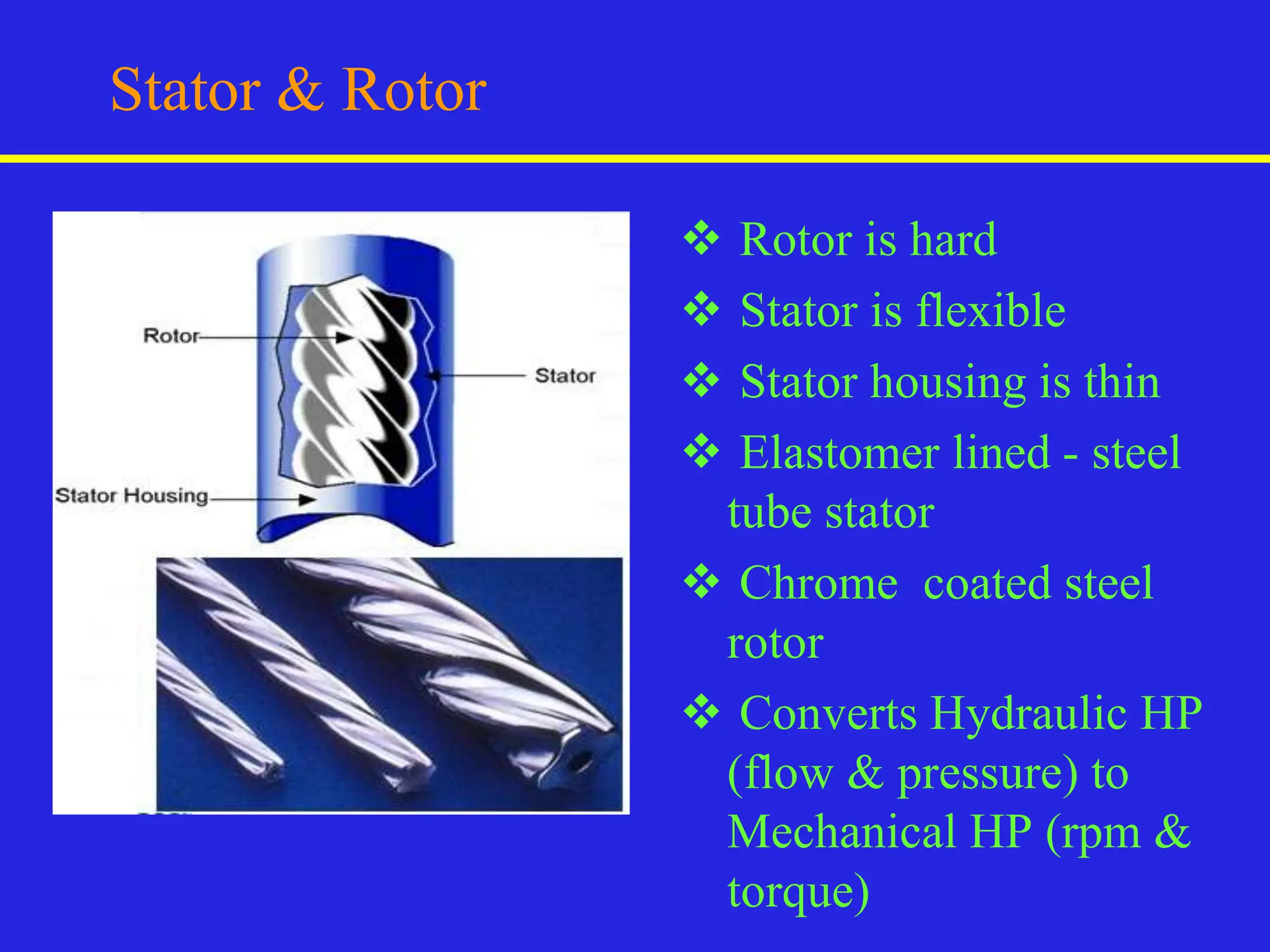
Stator & Rotor
 Rotor is hard
 Stator is flexible
 Stator housing is thin
 Elastomer lined - steel
tube stator
 Chrome coated steel
rotor
 Converts Hydraulic HP
(flow & pressure) to
Mechanical HP (rpm &
torque)
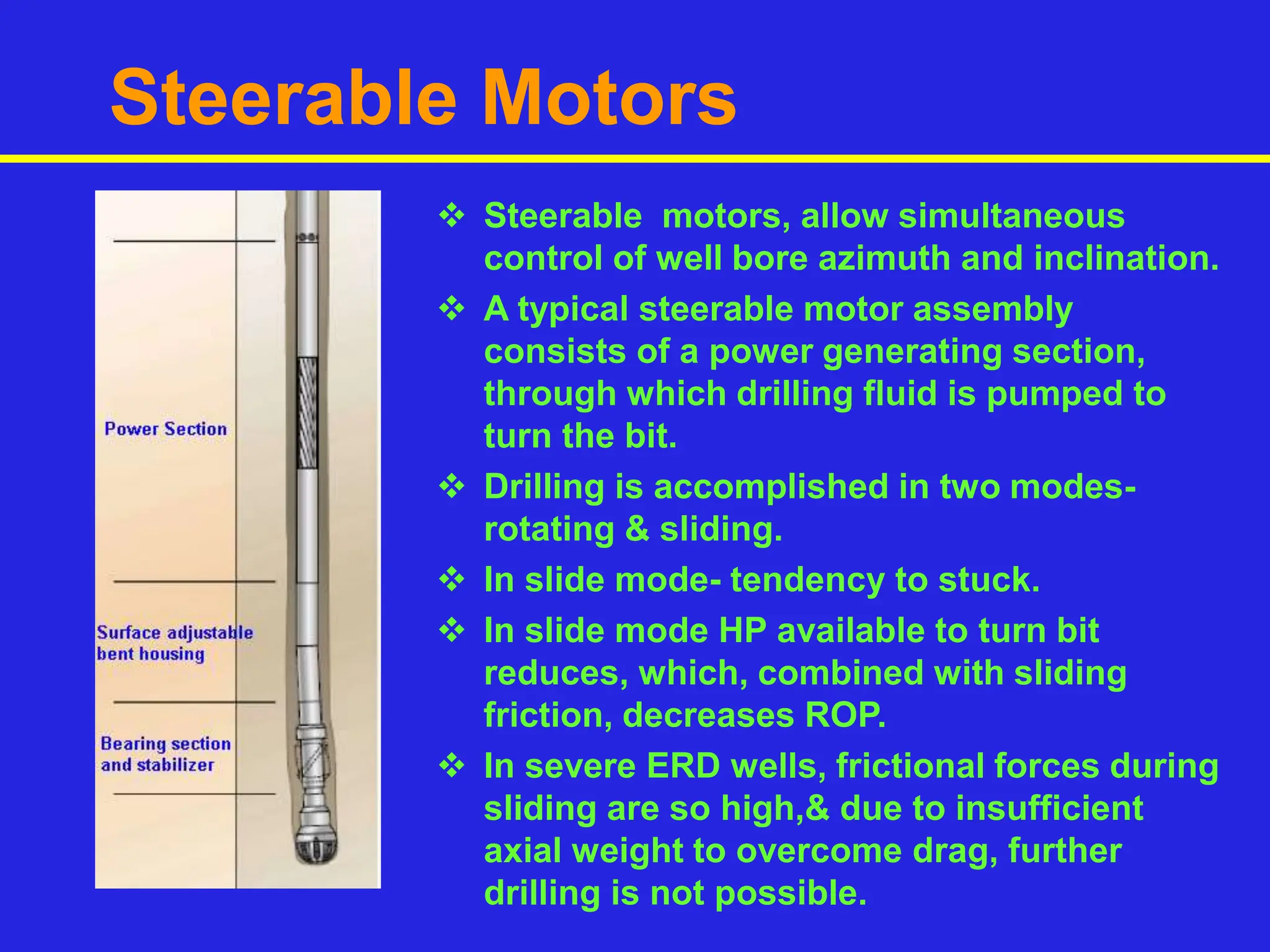
Steerable Motors
 Steerable motors, allow simultaneous
control of well bore azimuth and inclination.
 A typical steerable motor assembly
consists of a power generating section,
through which drilling fluid is pumped to
turn the bit.
 Drilling is accomplished in two modes-
rotating & sliding.
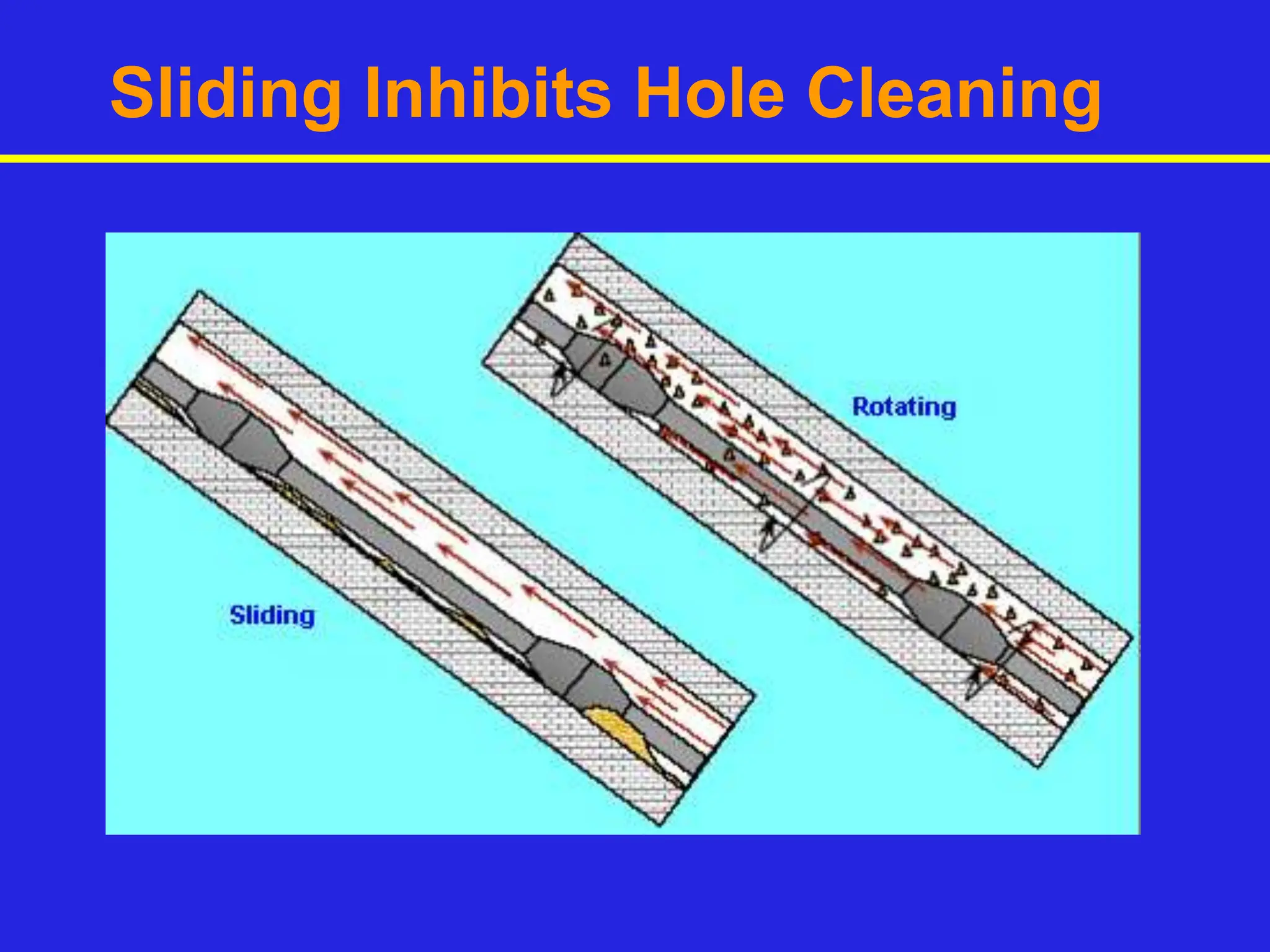
 In slide mode- tendency to stuck.
 In slide mode HP available to turn bit
reduces, which, combined with sliding
friction, decreases ROP.
 In severe ERD wells, frictional forces during
sliding are so high,& due to insufficient
axial weight to overcome drag, further
drilling is not possible.
Steerable Motors
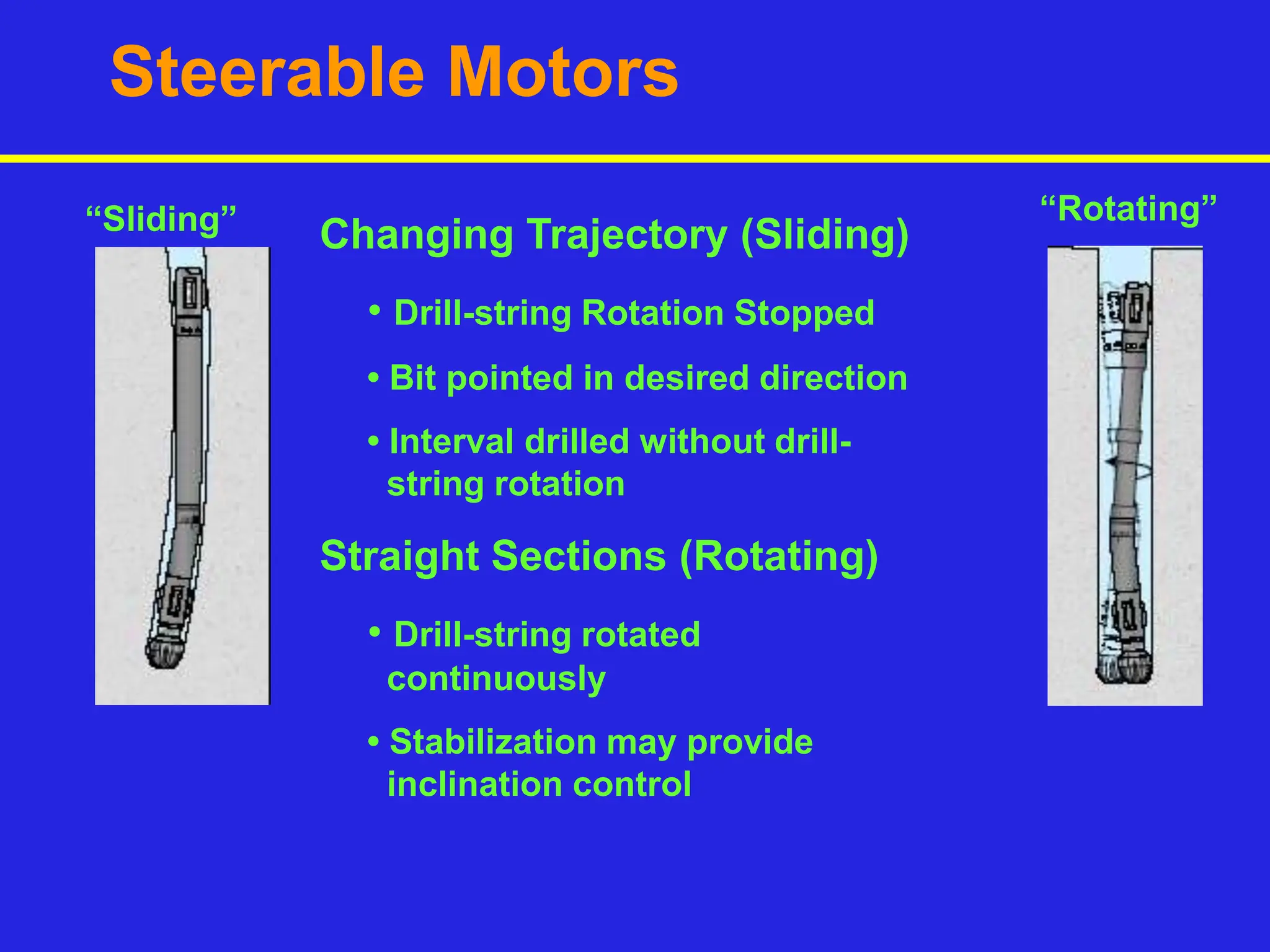
Changing Trajectory (Sliding)
• Drill-string Rotation Stopped
• Bit pointed in desired direction
• Interval drilled without drill-
string rotation
Straight Sections (Rotating)
• Drill-string rotated
continuously
• Stabilization may provide
inclination control
“Sliding” “Rotating”
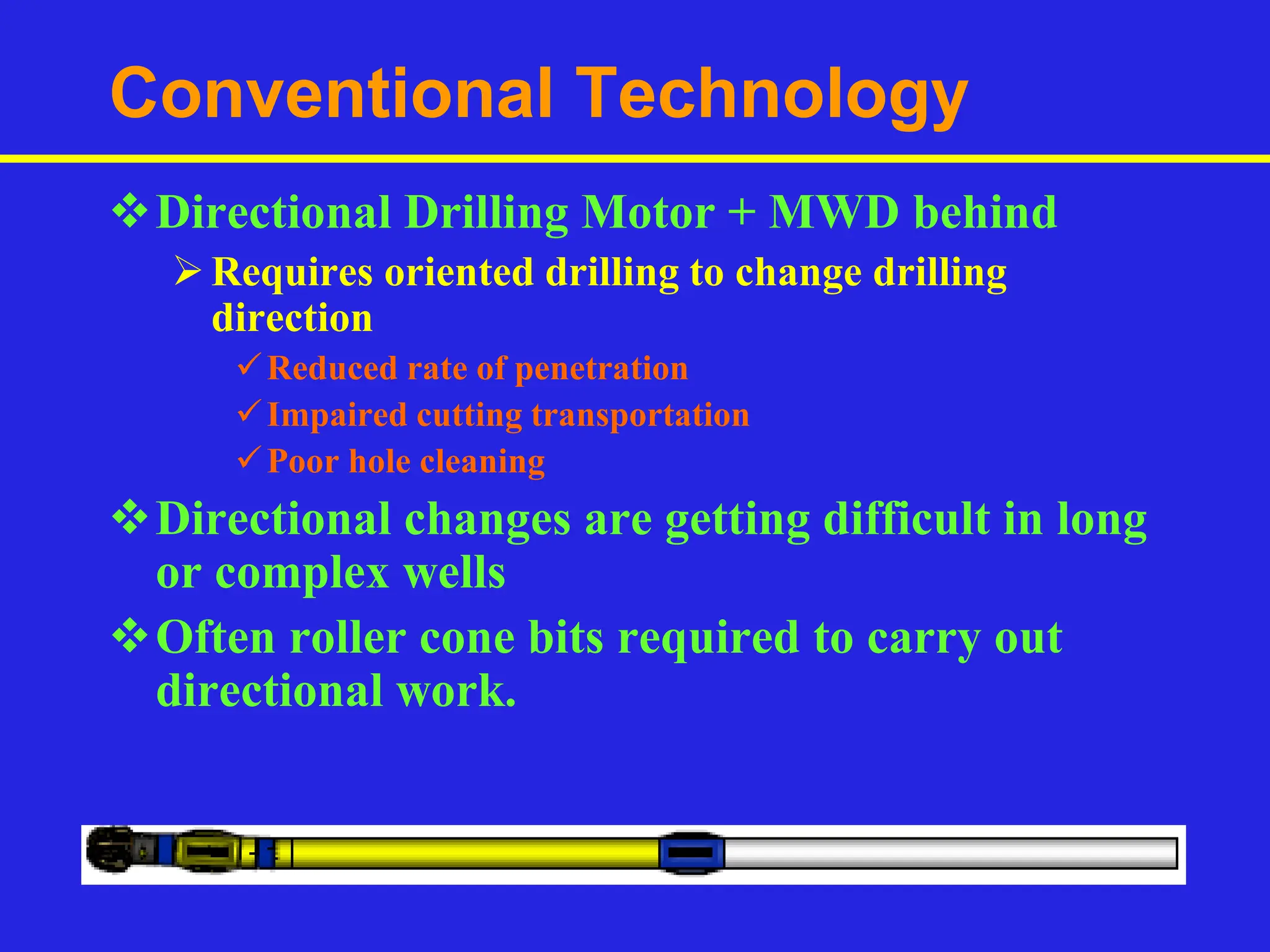
Conventional Technology
Directional Drilling Motor + MWD behind
Requires oriented drilling to change drilling
direction
Reduced rate of penetration
Impaired cutting transportation
Poor hole cleaning
Directional changes are getting difficult in long
or complex wells
Often roller cone bits required to carry out
directional work.
Steerable Motor vs. RSS
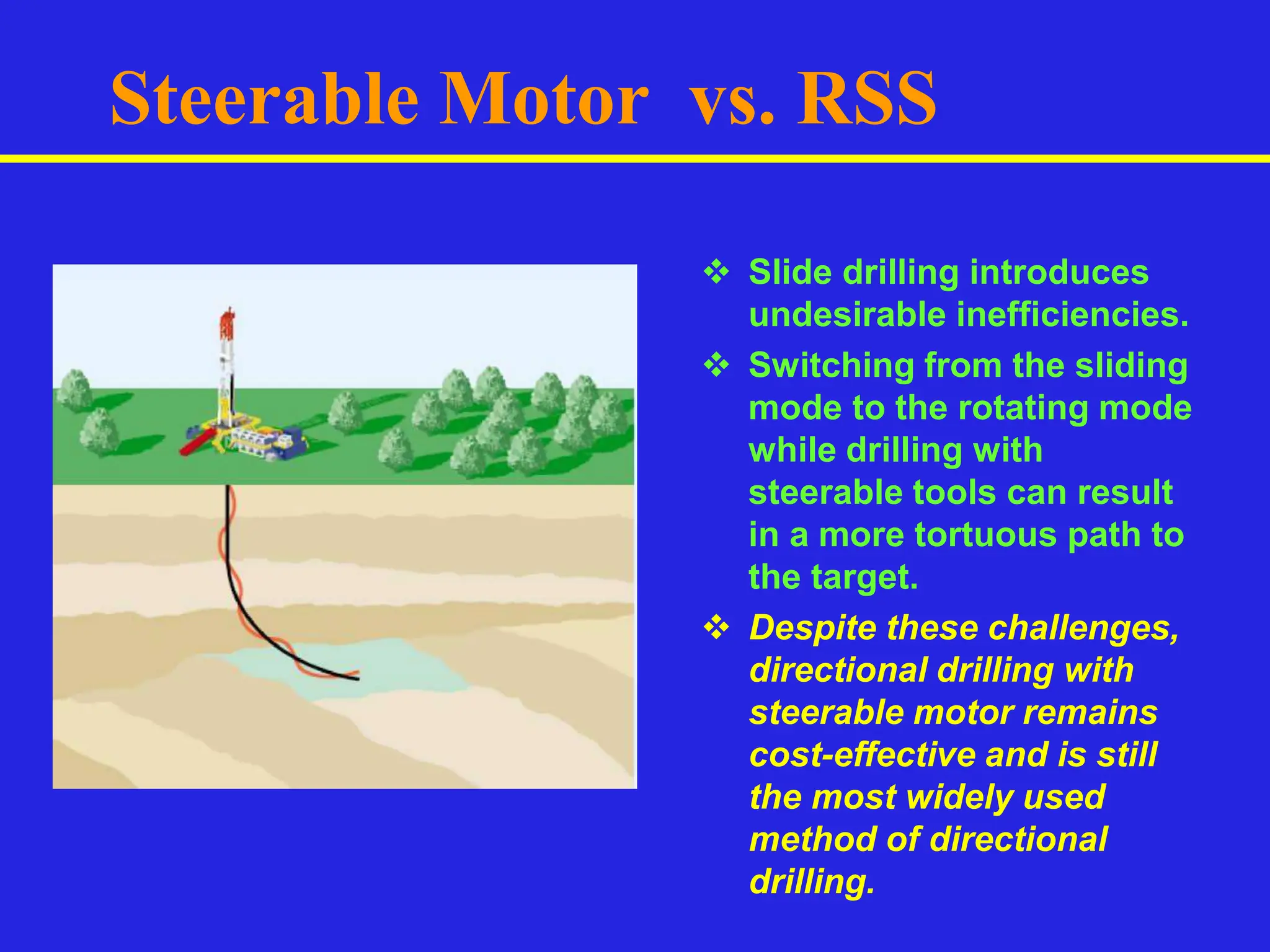
 Slide drilling introduces
undesirable inefficiencies.
 Switching from the sliding
mode to the rotating mode
while drilling with
steerable tools can result
in a more tortuous path to
the target.
 Despite these challenges,
directional drilling with
steerable motor remains
cost-effective and is still
the most widely used
method of directional
drilling.
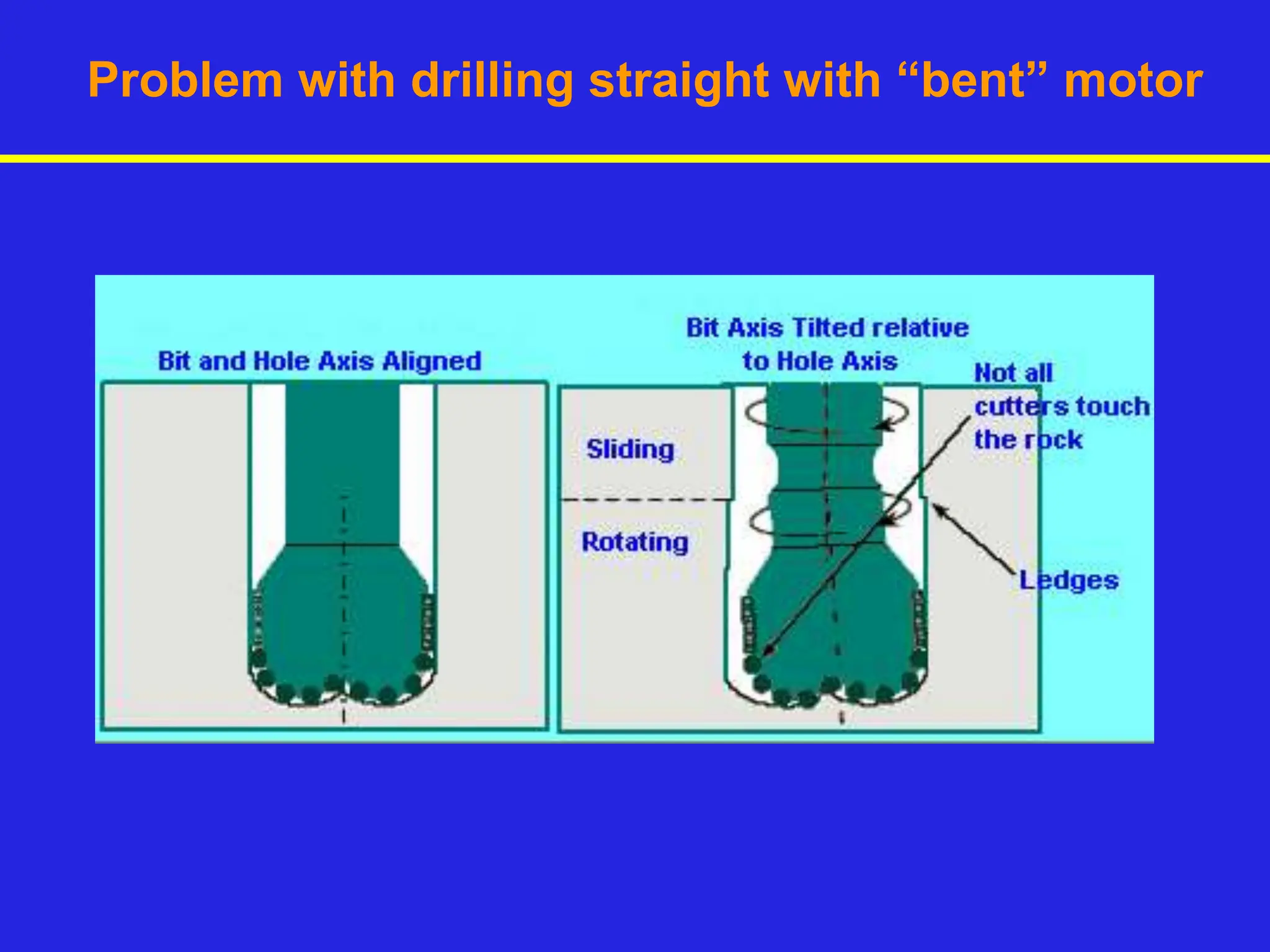
Problem with drilling straight with “bent” motor
Rotary Steerable Systems
Drivers for RSS Development
Elimination of Bent Tools
Borehole quality with possible string rotation
Automated down hole control over well path
With the invention of RSS directional drilling
efficiency further improved over steerable
systems.
Also improvement in placement accuracy
enabled to go for severe ERD & complex 3D
well profiles.
RSS probably most important technology to
drilling since Top drive.
Components
RSS includes
Steering Unit Few feet from bit
MWD Sensors
Down linking device to drilling assembly to
change course.
Advance system incorporates
Formation evaluation sensors
Drilling dynamics & Pressure sensor
Operating Principles
Two principles to steer the well
path
Push-the-bit
Point-the-bit
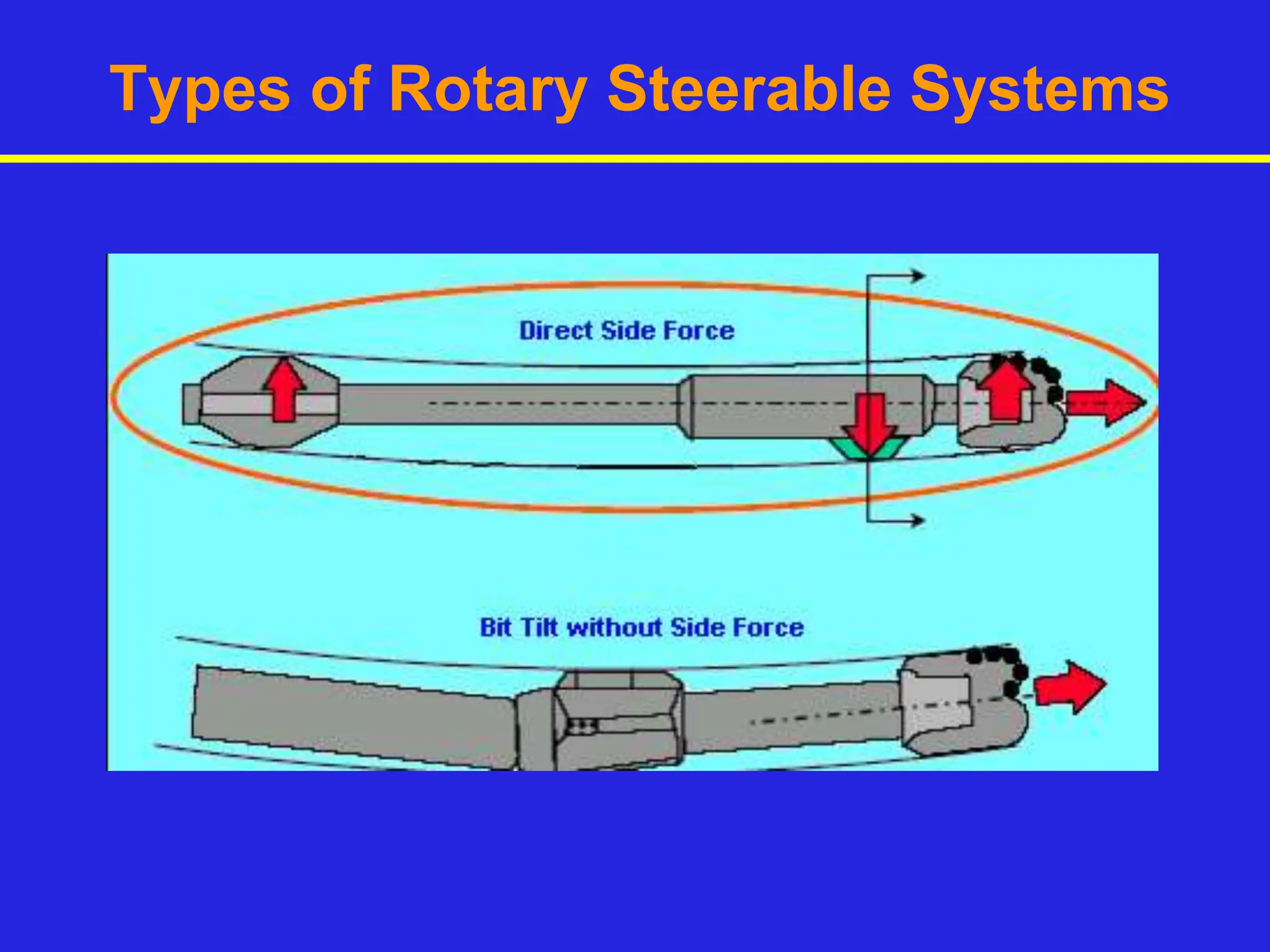
Types of Rotary Steerable Systems
Operating Principles
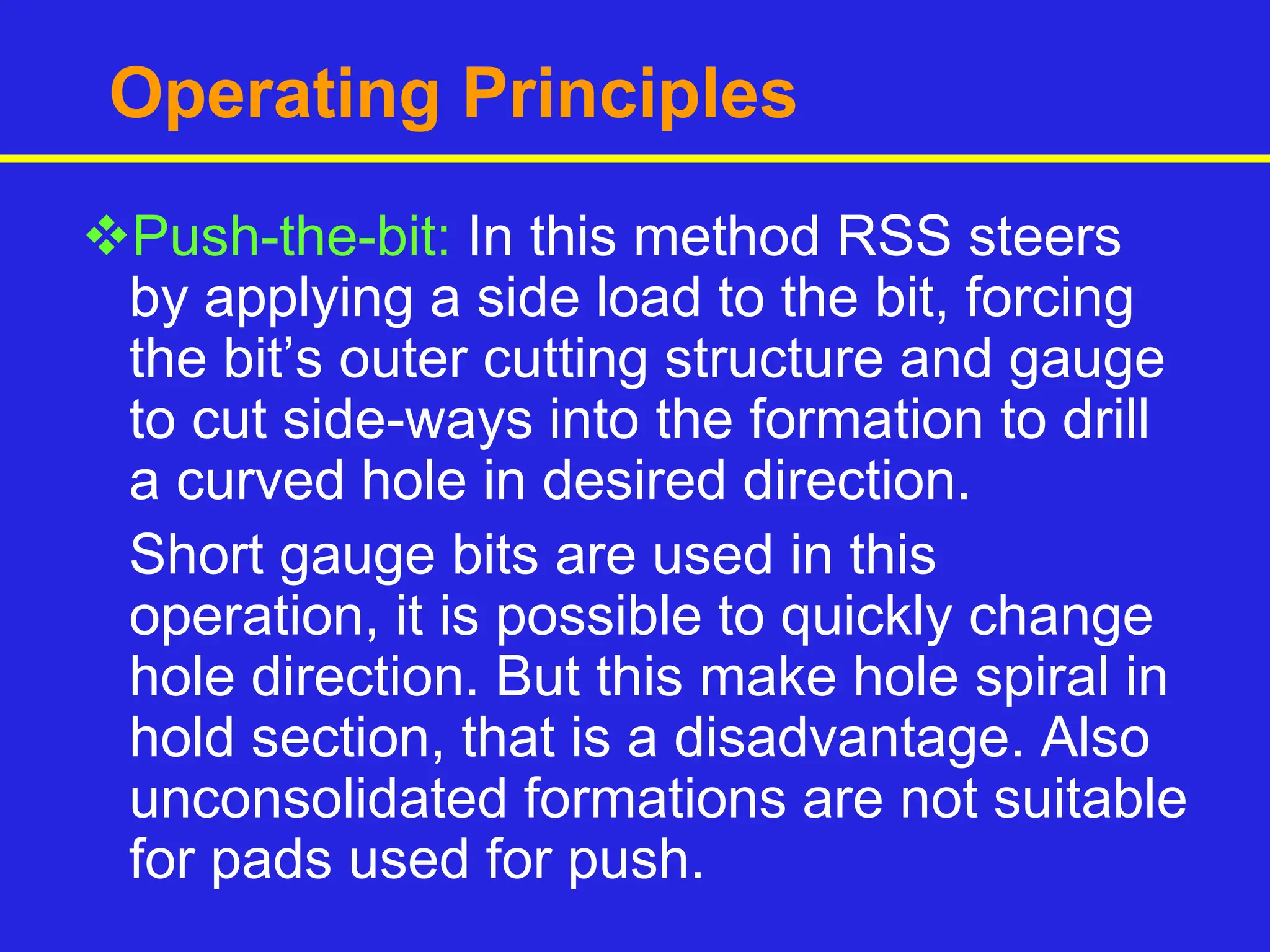
Push-the-bit: In this method RSS steers
by applying a side load to the bit, forcing
the bit’s outer cutting structure and gauge
to cut side-ways into the formation to drill
a curved hole in desired direction.
Short gauge bits are used in this
operation, it is possible to quickly change
hole direction. But this make hole spiral in
hold section, that is a disadvantage. Also
unconsolidated formations are not suitable
for pads used for push.
Operating Principles
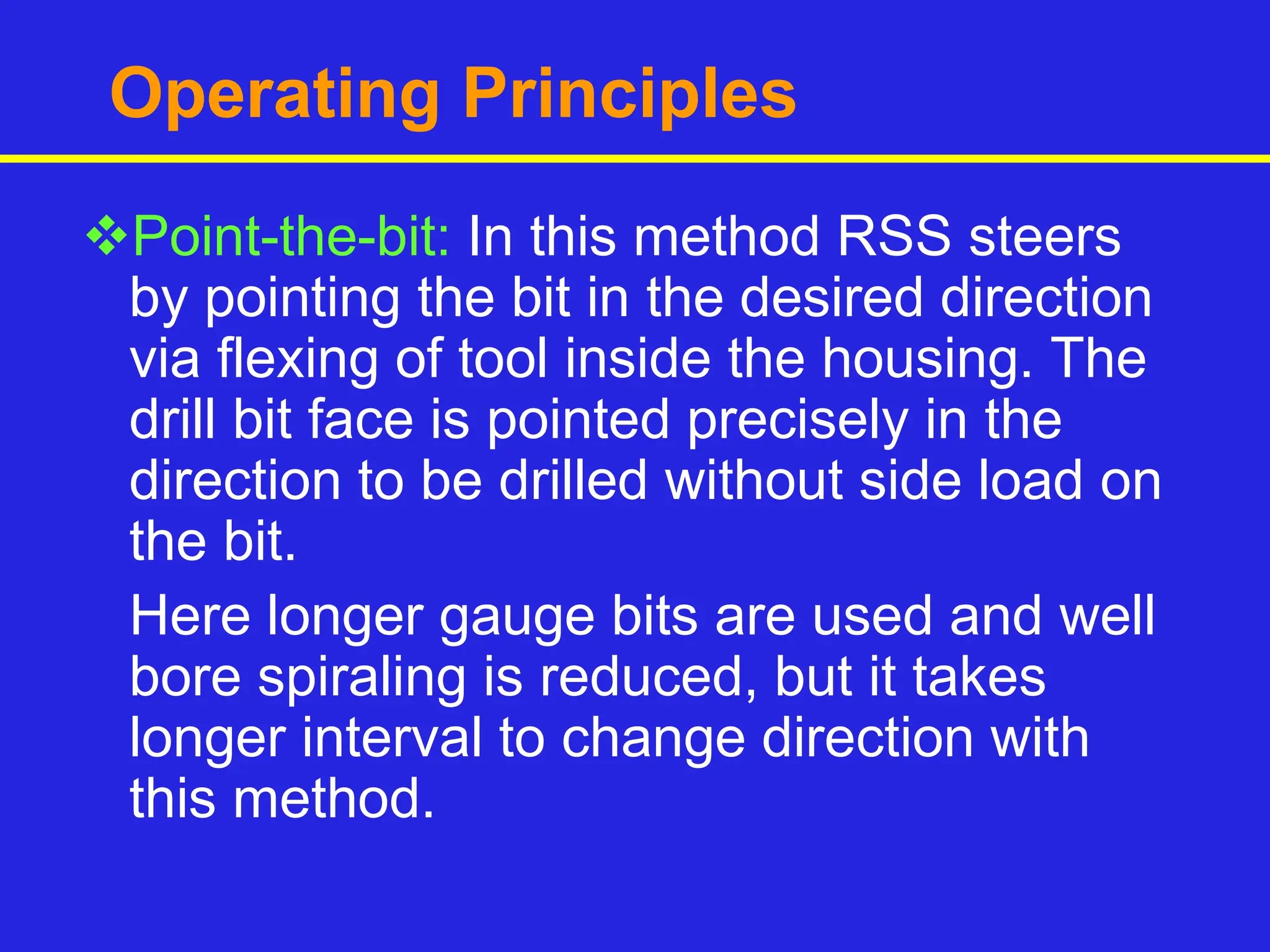
Point-the-bit: In this method RSS steers
by pointing the bit in the desired direction
via flexing of tool inside the housing. The
drill bit face is pointed precisely in the
direction to be drilled without side load on
the bit.
Here longer gauge bits are used and well
bore spiraling is reduced, but it takes
longer interval to change direction with
this method.
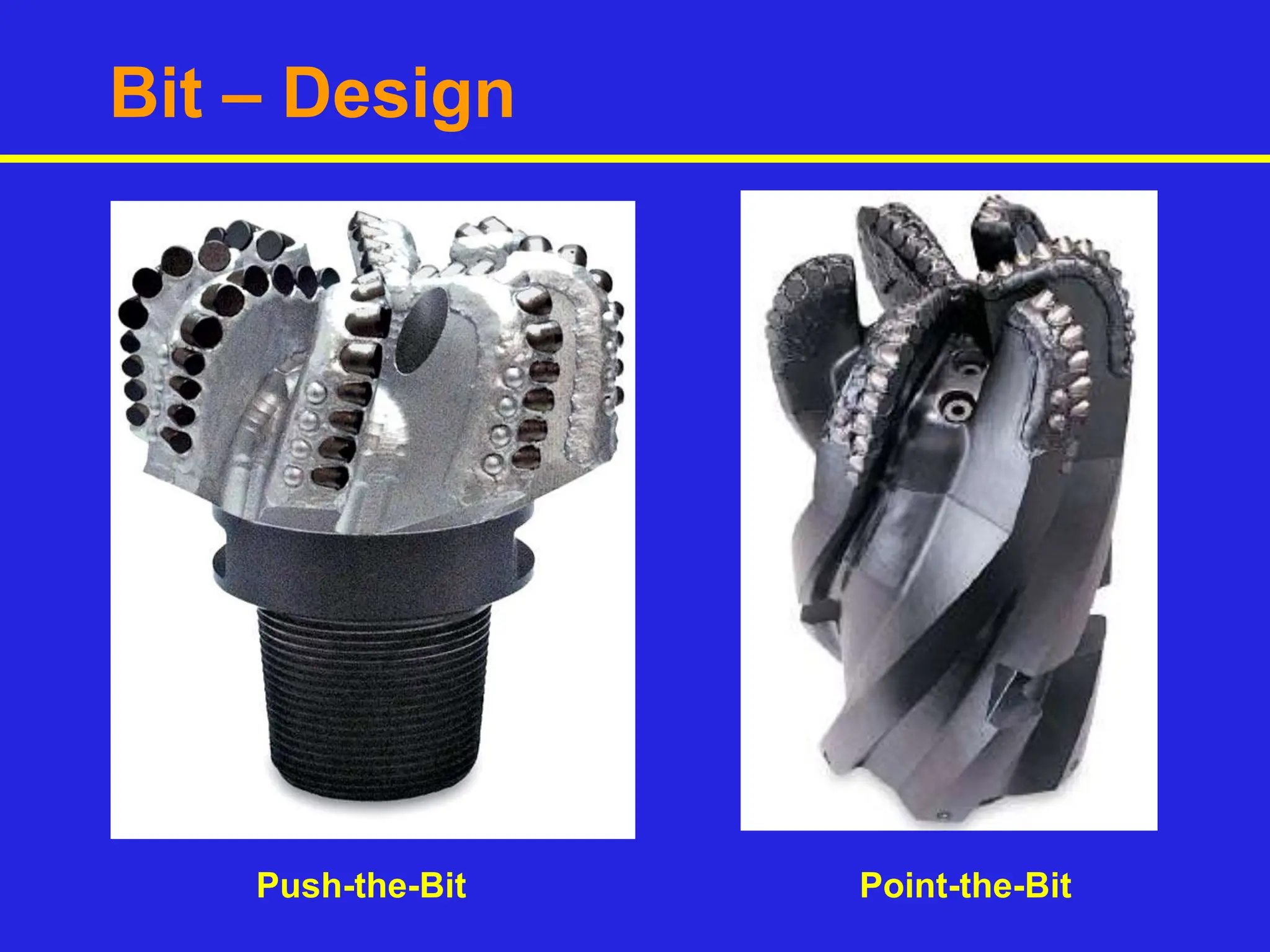
Bit – Design
Push-the-Bit Point-the-Bit
How does RSS Work [Point the bit]
 In this system bit direction is controlled by deflection of
the bit drive shaft rather than relying on bit side forces
to steer the well while rotating the drill string.
 In a compact bais unit- a pair of eccentric rings, one
nested inside the other, deviate a drive shaft mounted
on bearings at each end and enclosed in a non-rotating
outer sleeve.
 Control system is self correcting guidance system,
uses near bit inclination signals and accordingly self
correcting electronics automatically maintain
directional tool face and inclination.
 An anti-rotation device prevents slippage of the outer
housing while the tool is in the deflected, steering
mode, allowing for a stable tool face orientation.
How does RSS Work [Point the bit]
 Shaft deflection is achieved by a pair of eccentric
rings that can be rotated to any desired tool face
setting and varying degree of offset from the center.
 For maximum operating life and reliability, the
system's bearings, seals, and other internal moving
components are all immersed in lubricating oil. And,
because the tool operates independently of well
bore fluids, there are virtually no mud compatibility
problems.
 A pressure compensator maintains a slight positive
internal pressure across rotary seals.
Example: Geo-Pilot ® Rotary Steerable system
How does RSS Work [Point the bit]
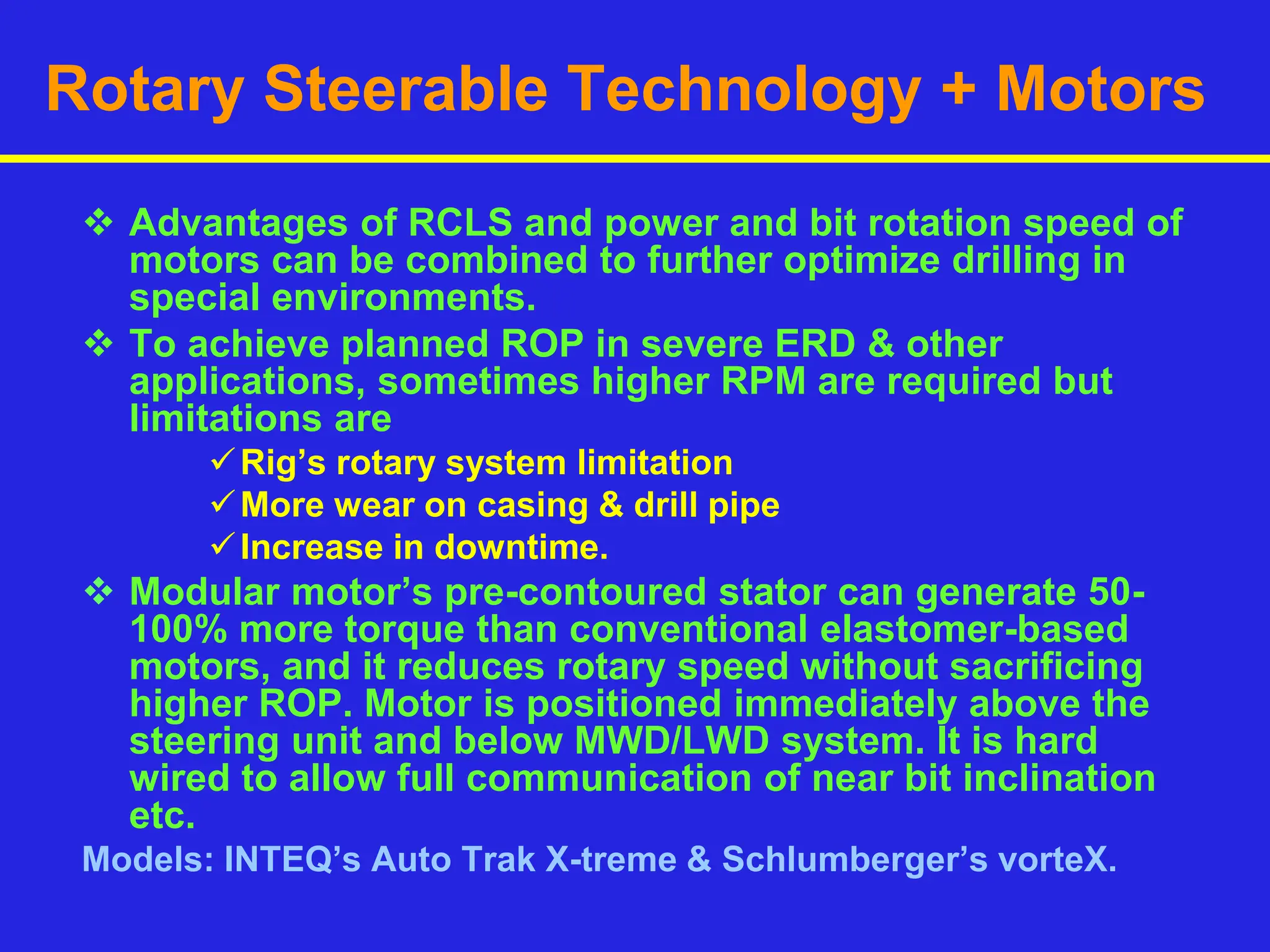
Rotary Steerable Technology + Motors
 Advantages of RCLS and power and bit rotation speed of
motors can be combined to further optimize drilling in
special environments.
 To achieve planned ROP in severe ERD & other
applications, sometimes higher RPM are required but
limitations are
Rig’s rotary system limitation
More wear on casing & drill pipe
Increase in downtime.
 Modular motor’s pre-contoured stator can generate 50-
100% more torque than conventional elastomer-based
motors, and it reduces rotary speed without sacrificing
higher ROP. Motor is positioned immediately above the
steering unit and below MWD/LWD system. It is hard
wired to allow full communication of near bit inclination
etc.
Models: INTEQ’s Auto Trak X-treme & Schlumberger’s vorteX.
Sliding Inhibits Hole Cleaning
How does RSS Work [Push the bit]
Pad Retracted Pad Extended
THANK YOU

Directional drilling_Rotary steering system.ppt

  • 2.
    Directional Drilling Tech.Evolution 1960 1970 1980 1990 2000 Mud Motor & Bent Sub Wire line Steering Tool MWD Steeerable Motor Rotary Steerable Systems
  • 3.
  • 4.
  • 5.
    Cont. The speed andtorque of a power section is directly linked to the number of lobes on the rotor and stator. The higher the number of lobes, the higher the torque and the lower the RPM.
  • 6.
    Dump Sub  Allowsstring to fill or drain when tripping  Allows low volume circulation in stuck bit situations  Not always used
  • 7.
    Stator & Rotor Rotor is hard  Stator is flexible  Stator housing is thin  Elastomer lined - steel tube stator  Chrome coated steel rotor  Converts Hydraulic HP (flow & pressure) to Mechanical HP (rpm & torque)
  • 9.
    Steerable Motors  Steerablemotors, allow simultaneous control of well bore azimuth and inclination.  A typical steerable motor assembly consists of a power generating section, through which drilling fluid is pumped to turn the bit.  Drilling is accomplished in two modes- rotating & sliding.  In slide mode- tendency to stuck.  In slide mode HP available to turn bit reduces, which, combined with sliding friction, decreases ROP.  In severe ERD wells, frictional forces during sliding are so high,& due to insufficient axial weight to overcome drag, further drilling is not possible.
  • 10.
    Steerable Motors Changing Trajectory(Sliding) • Drill-string Rotation Stopped • Bit pointed in desired direction • Interval drilled without drill- string rotation Straight Sections (Rotating) • Drill-string rotated continuously • Stabilization may provide inclination control “Sliding” “Rotating”
  • 11.
    Conventional Technology Directional DrillingMotor + MWD behind Requires oriented drilling to change drilling direction Reduced rate of penetration Impaired cutting transportation Poor hole cleaning Directional changes are getting difficult in long or complex wells Often roller cone bits required to carry out directional work.
  • 12.
    Steerable Motor vs.RSS  Slide drilling introduces undesirable inefficiencies.  Switching from the sliding mode to the rotating mode while drilling with steerable tools can result in a more tortuous path to the target.  Despite these challenges, directional drilling with steerable motor remains cost-effective and is still the most widely used method of directional drilling.
  • 13.
    Problem with drillingstraight with “bent” motor
  • 14.
    Rotary Steerable Systems Driversfor RSS Development Elimination of Bent Tools Borehole quality with possible string rotation Automated down hole control over well path With the invention of RSS directional drilling efficiency further improved over steerable systems. Also improvement in placement accuracy enabled to go for severe ERD & complex 3D well profiles. RSS probably most important technology to drilling since Top drive.
  • 15.
    Components RSS includes Steering UnitFew feet from bit MWD Sensors Down linking device to drilling assembly to change course. Advance system incorporates Formation evaluation sensors Drilling dynamics & Pressure sensor
  • 16.
    Operating Principles Two principlesto steer the well path Push-the-bit Point-the-bit
  • 17.
    Types of RotarySteerable Systems
  • 18.
    Operating Principles Push-the-bit: Inthis method RSS steers by applying a side load to the bit, forcing the bit’s outer cutting structure and gauge to cut side-ways into the formation to drill a curved hole in desired direction. Short gauge bits are used in this operation, it is possible to quickly change hole direction. But this make hole spiral in hold section, that is a disadvantage. Also unconsolidated formations are not suitable for pads used for push.
  • 19.
    Operating Principles Point-the-bit: Inthis method RSS steers by pointing the bit in the desired direction via flexing of tool inside the housing. The drill bit face is pointed precisely in the direction to be drilled without side load on the bit. Here longer gauge bits are used and well bore spiraling is reduced, but it takes longer interval to change direction with this method.
  • 20.
  • 21.
    How does RSSWork [Point the bit]  In this system bit direction is controlled by deflection of the bit drive shaft rather than relying on bit side forces to steer the well while rotating the drill string.  In a compact bais unit- a pair of eccentric rings, one nested inside the other, deviate a drive shaft mounted on bearings at each end and enclosed in a non-rotating outer sleeve.  Control system is self correcting guidance system, uses near bit inclination signals and accordingly self correcting electronics automatically maintain directional tool face and inclination.  An anti-rotation device prevents slippage of the outer housing while the tool is in the deflected, steering mode, allowing for a stable tool face orientation.
  • 22.
    How does RSSWork [Point the bit]  Shaft deflection is achieved by a pair of eccentric rings that can be rotated to any desired tool face setting and varying degree of offset from the center.  For maximum operating life and reliability, the system's bearings, seals, and other internal moving components are all immersed in lubricating oil. And, because the tool operates independently of well bore fluids, there are virtually no mud compatibility problems.  A pressure compensator maintains a slight positive internal pressure across rotary seals. Example: Geo-Pilot ® Rotary Steerable system
  • 23.
    How does RSSWork [Point the bit]
  • 24.
    Rotary Steerable Technology+ Motors  Advantages of RCLS and power and bit rotation speed of motors can be combined to further optimize drilling in special environments.  To achieve planned ROP in severe ERD & other applications, sometimes higher RPM are required but limitations are Rig’s rotary system limitation More wear on casing & drill pipe Increase in downtime.  Modular motor’s pre-contoured stator can generate 50- 100% more torque than conventional elastomer-based motors, and it reduces rotary speed without sacrificing higher ROP. Motor is positioned immediately above the steering unit and below MWD/LWD system. It is hard wired to allow full communication of near bit inclination etc. Models: INTEQ’s Auto Trak X-treme & Schlumberger’s vorteX.
  • 25.
  • 26.
    How does RSSWork [Push the bit] Pad Retracted Pad Extended
  • 27.