TEACHING
STRATEGIES FOR
ALL LEVELS
Beginners
GRAMMAR
 Instructions should be very
simple for this level.
Rote method is necessary.
Speech pace should be slower
than the normal pace.
GRAMMAR
Establishing rapport is very essential
at this level.
For both Lower and Upper Beginner,
expressions in L1 (first language) are
necessary for their better
understanding of the lessons and
instructions.
GRAMMAR
For juniors and adults, they are
taught of very simple expressions and
words. The eight parts of speech are
gradually introduced. The teacher
should teach them of the form or
sentence patterns. Rules along with
their explanations are not necessary at
this stage.
GRAMMAR
 Do not ask juniors and adults to
make their own sentences at this stage.
Instead, teach them how to respond to
questions properly.
GRAMMAR
For children at Lower Beginner level,
structures are not yet introduced. They
learn through rote method and recognize
words accompanied by pictures. They
start with the Alphabet, shapes, colors,
and simple expressions.
For children at Upper Beginner level,
more basic words and expressions are
introduced.
DIALOGUES (Situational
English)
For children at this level, proper
enunciation of words & intonation
should be taught.
For Juniors and Adults,
pronunciation, intonation, and stress
should be properly executed.
Q & As are not necessary.
VOCABULARY
The teacher should teach students the proper
enunciation of new words and expressions.
For children, they learn words and expressions
through pictures. Very simple extension questions
(usually close-ended questions) can be used by
associating them with what they like.
Example:
Lesson: Colors
**Extension question: “Do you like red/blue? “
VOCABULARY
Expressions and instructions in L1 can be
used for children at this level.
For Juniors and Adults, they also
recognize and remember words and
expressions through pictures at times. The
rote method (repetition and memorization)
is also effective for this level. The teacher
can introduce other simple expressions or
words besides those given in the book (for
Upper Beginner).
READING
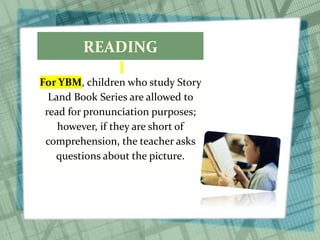
For YBM, children who study Story
Land Book Series are allowed to
read for pronunciation purposes;
however, if they are short of
comprehension, the teacher asks
questions about the picture.
READING
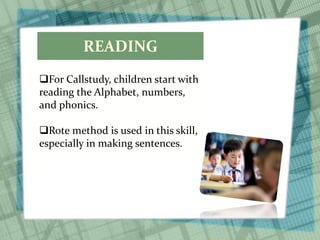
For Callstudy, children start with
reading the Alphabet, numbers,
and phonics.
Rote method is used in this skill,
especially in making sentences.
• Topical English and Picture
Description are not taught at
this level since they require
knowledge of vocabulary,
grammar, and cohesion.
Intermediate
GRAMMAR
In most children’s books, verbs, nouns,
modifiers, and commonly-used prepositions are
gradually introduced. The teacher should ask
the student to focus on the forms and structures
of these parts of speech before doing the pattern
drills. Then, the teacher can ask the student to
improvise his own sentence using the same
patterns.
GRAMMAR
In most books (for Juniors and Adults),
tenses, nouns, pronouns, modifiers, and
prepositions are introduced. In teaching these
parts of speech, the teacher should focus more
on the structures (form) and uses rather than
their meanings. Rules along with their
explanations are not necessary. Sentence
improvisation based on the lessons should be
encouraged.
GRAMMAR
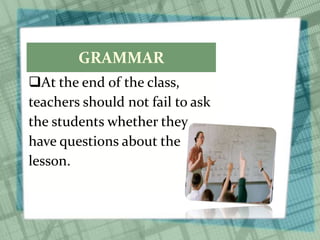
At the end of the class,
teachers should not fail to ask
the students whether they
have questions about the
lesson.
DIALOGUES (Situational
English)
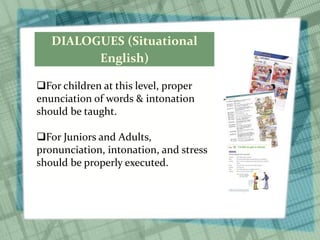
For children at this level, proper
enunciation of words & intonation
should be taught.
For Juniors and Adults,
pronunciation, intonation, and stress
should be properly executed.
DIALOGUES (Situational
English)
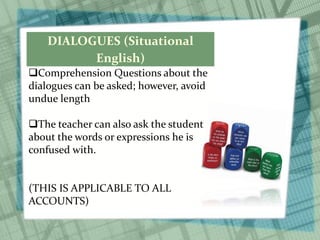
Comprehension Questions about the
dialogues can be asked; however, avoid
undue length
The teacher can also ask the student
about the words or expressions he is
confused with.
(THIS IS APPLICABLE TO ALL
ACCOUNTS)
VOCABULARY
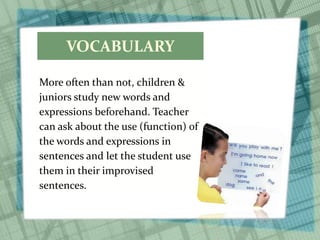
More often than not, children &
juniors study new words and
expressions beforehand. Teacher
can ask about the use (function) of
the words and expressions in
sentences and let the student use
them in their improvised
sentences.
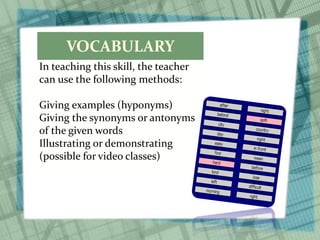
VOCABULARY
In teaching this skill, the teacher
can use the following methods:
Giving examples (hyponyms)
Giving the synonyms or antonyms
of the given words
Illustrating or demonstrating
(possible for video classes)
READING
For Callstudy account, teachers
ask their students to read the
passages beforehand and
summarize them the following
meeting.
The teacher should ask the
student about words or expressions
he cannot figure out (for
clarification).
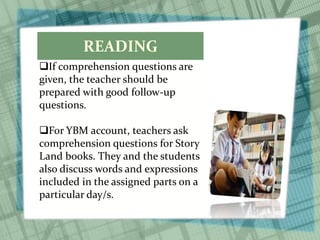
READING
If comprehension questions are
given, the teacher should be
prepared with good follow-up
questions.
For YBM account, teachers ask
comprehension questions for Story
Land books. They and the students
also discuss words and expressions
included in the assigned parts on a
particular day/s.
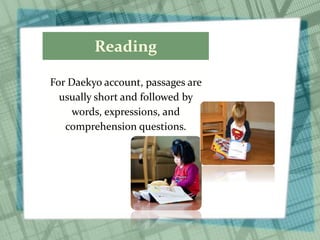
Reading
For Daekyo account, passages are
usually short and followed by
words, expressions, and
comprehension questions.
Free Conversation/Free Talking
(Topical English)
In conducting free talking (free
conversation) classes, instructors
should:
1.Use Socratic method in asking
questions (HOTS)
2.Promote critical thinking skills
3.Know the kinds of
questions/Proper Way of Asking
Questions
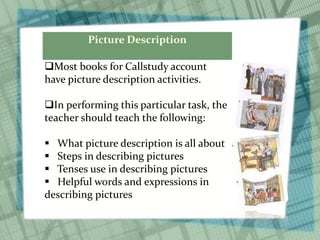
Picture Description
Most books for Callstudy account
have picture description activities.
In performing this particular task, the
teacher should teach the following:
 What picture description is all about
 Steps in describing pictures
 Tenses use in describing pictures
 Helpful words and expressions in
describing pictures
Advanced
Grammar
For all categories at this level, teachers
should focus more on fluency rather
than error correction in grammar. This
means teachers should pay more
attention to the content of their
communication rather than the
grammatical form. Instead, use error
correction to guide them.
GRAMMAR
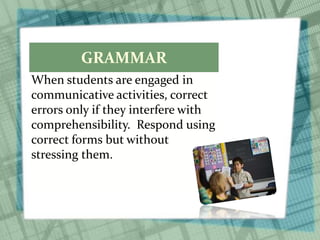
When students are engaged in
communicative activities, correct
errors only if they interfere with
comprehensibility. Respond using
correct forms but without
stressing them.
GRAMMAR
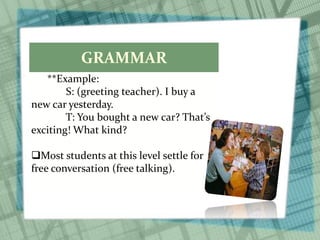
**Example:
S: (greeting teacher). I buy a
new car yesterday.
T: You bought a new car? That’s
exciting! What kind?
Most students at this level settle for
free conversation (free talking).
Dialogues (Situational English)
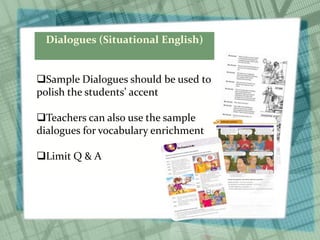
Sample Dialogues should be used to
polish the students’ accent
Teachers can also use the sample
dialogues for vocabulary enrichment
Limit Q & A
VOCABULARY
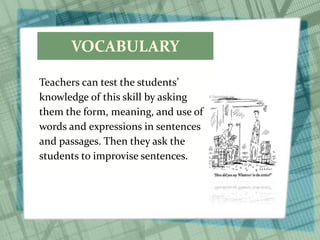
Teachers can test the students’
knowledge of this skill by asking
them the form, meaning, and use of
words and expressions in sentences
and passages. Then they ask the
students to improvise sentences.
READING
Teachers can ask the students to
summarize passages or if the latter have
not been able to go over the said
passages, teachers should summarize
the passages themselves.
Avoid reading during phone sessions
since it will be a waste of time unless
students request for it. This will also
depend on the length of the passage.
READING
Teachers should not only rely on the
given comprehension questions in books,
but they can also ask good follow-up
questions that will encourage or promote
critical thinking or HIGHER ORDER
THINKING SKILLS.
At the end of the discussion, teachers
should not fail to ask students about
words or expressions they find hard to
understand.
FREE CONVERSATION/FREE
TALKING (Topical English)
In conducting free talking (free
conversation) classes, instructors should:
1.Use Socratic method in asking
questions (HOTS)
2.Promote critical thinking skills
3.Know the kinds of questions/Proper
Way of Asking Questions
PICTURE DESCRIPTION
In performing this particular task, the
teacher should teach the following:
1.What picture description is all about
2.Steps in describing pictures
3.Tenses use in describing pictures
4.Helpful words and expressions in
describing pictures
Teaching strategies for all levels011209

Teaching strategies for all levels011209

  • 1.
  • 2.
  • 3.
    GRAMMAR  Instructions shouldbe very simple for this level. Rote method is necessary. Speech pace should be slower than the normal pace.
  • 4.
    GRAMMAR Establishing rapport isvery essential at this level. For both Lower and Upper Beginner, expressions in L1 (first language) are necessary for their better understanding of the lessons and instructions.
  • 5.
    GRAMMAR For juniors andadults, they are taught of very simple expressions and words. The eight parts of speech are gradually introduced. The teacher should teach them of the form or sentence patterns. Rules along with their explanations are not necessary at this stage.
  • 6.
    GRAMMAR  Do notask juniors and adults to make their own sentences at this stage. Instead, teach them how to respond to questions properly.
  • 7.
    GRAMMAR For children atLower Beginner level, structures are not yet introduced. They learn through rote method and recognize words accompanied by pictures. They start with the Alphabet, shapes, colors, and simple expressions. For children at Upper Beginner level, more basic words and expressions are introduced.
  • 8.
    DIALOGUES (Situational English) For childrenat this level, proper enunciation of words & intonation should be taught. For Juniors and Adults, pronunciation, intonation, and stress should be properly executed. Q & As are not necessary.
  • 9.
    VOCABULARY The teacher shouldteach students the proper enunciation of new words and expressions. For children, they learn words and expressions through pictures. Very simple extension questions (usually close-ended questions) can be used by associating them with what they like. Example: Lesson: Colors **Extension question: “Do you like red/blue? “
  • 10.
    VOCABULARY Expressions and instructionsin L1 can be used for children at this level. For Juniors and Adults, they also recognize and remember words and expressions through pictures at times. The rote method (repetition and memorization) is also effective for this level. The teacher can introduce other simple expressions or words besides those given in the book (for Upper Beginner).
  • 11.
    READING For YBM, childrenwho study Story Land Book Series are allowed to read for pronunciation purposes; however, if they are short of comprehension, the teacher asks questions about the picture.
  • 12.
    READING For Callstudy, childrenstart with reading the Alphabet, numbers, and phonics. Rote method is used in this skill, especially in making sentences.
  • 13.
    • Topical Englishand Picture Description are not taught at this level since they require knowledge of vocabulary, grammar, and cohesion.

  • 14.
  • 15.
    GRAMMAR In most children’sbooks, verbs, nouns, modifiers, and commonly-used prepositions are gradually introduced. The teacher should ask the student to focus on the forms and structures of these parts of speech before doing the pattern drills. Then, the teacher can ask the student to improvise his own sentence using the same patterns.
  • 16.
    GRAMMAR In most books(for Juniors and Adults), tenses, nouns, pronouns, modifiers, and prepositions are introduced. In teaching these parts of speech, the teacher should focus more on the structures (form) and uses rather than their meanings. Rules along with their explanations are not necessary. Sentence improvisation based on the lessons should be encouraged.
  • 17.
    GRAMMAR At the endof the class, teachers should not fail to ask the students whether they have questions about the lesson.
  • 18.
    DIALOGUES (Situational English) For childrenat this level, proper enunciation of words & intonation should be taught. For Juniors and Adults, pronunciation, intonation, and stress should be properly executed.
  • 19.
    DIALOGUES (Situational English) Comprehension Questionsabout the dialogues can be asked; however, avoid undue length The teacher can also ask the student about the words or expressions he is confused with. (THIS IS APPLICABLE TO ALL ACCOUNTS)
  • 20.
    VOCABULARY More often thannot, children & juniors study new words and expressions beforehand. Teacher can ask about the use (function) of the words and expressions in sentences and let the student use them in their improvised sentences.
  • 21.
    VOCABULARY In teaching thisskill, the teacher can use the following methods: Giving examples (hyponyms) Giving the synonyms or antonyms of the given words Illustrating or demonstrating (possible for video classes)
  • 22.
    READING For Callstudy account,teachers ask their students to read the passages beforehand and summarize them the following meeting. The teacher should ask the student about words or expressions he cannot figure out (for clarification).
  • 23.
    READING If comprehension questionsare given, the teacher should be prepared with good follow-up questions. For YBM account, teachers ask comprehension questions for Story Land books. They and the students also discuss words and expressions included in the assigned parts on a particular day/s.
  • 24.
    Reading For Daekyo account,passages are usually short and followed by words, expressions, and comprehension questions.
  • 25.
    Free Conversation/Free Talking (TopicalEnglish) In conducting free talking (free conversation) classes, instructors should: 1.Use Socratic method in asking questions (HOTS) 2.Promote critical thinking skills 3.Know the kinds of questions/Proper Way of Asking Questions
  • 26.
    Picture Description Most booksfor Callstudy account have picture description activities. In performing this particular task, the teacher should teach the following:  What picture description is all about  Steps in describing pictures  Tenses use in describing pictures  Helpful words and expressions in describing pictures
  • 27.
  • 28.
    Grammar For all categoriesat this level, teachers should focus more on fluency rather than error correction in grammar. This means teachers should pay more attention to the content of their communication rather than the grammatical form. Instead, use error correction to guide them.
  • 29.
    GRAMMAR When students areengaged in communicative activities, correct errors only if they interfere with comprehensibility. Respond using correct forms but without stressing them.
  • 30.
    GRAMMAR **Example: S: (greeting teacher).I buy a new car yesterday. T: You bought a new car? That’s exciting! What kind? Most students at this level settle for free conversation (free talking).
  • 31.
    Dialogues (Situational English) SampleDialogues should be used to polish the students’ accent Teachers can also use the sample dialogues for vocabulary enrichment Limit Q & A
  • 32.
    VOCABULARY Teachers can testthe students’ knowledge of this skill by asking them the form, meaning, and use of words and expressions in sentences and passages. Then they ask the students to improvise sentences.
  • 33.
    READING Teachers can askthe students to summarize passages or if the latter have not been able to go over the said passages, teachers should summarize the passages themselves. Avoid reading during phone sessions since it will be a waste of time unless students request for it. This will also depend on the length of the passage.
  • 34.
    READING Teachers should notonly rely on the given comprehension questions in books, but they can also ask good follow-up questions that will encourage or promote critical thinking or HIGHER ORDER THINKING SKILLS. At the end of the discussion, teachers should not fail to ask students about words or expressions they find hard to understand.
  • 35.
    FREE CONVERSATION/FREE TALKING (TopicalEnglish) In conducting free talking (free conversation) classes, instructors should: 1.Use Socratic method in asking questions (HOTS) 2.Promote critical thinking skills 3.Know the kinds of questions/Proper Way of Asking Questions
  • 36.
    PICTURE DESCRIPTION In performingthis particular task, the teacher should teach the following: 1.What picture description is all about 2.Steps in describing pictures 3.Tenses use in describing pictures 4.Helpful words and expressions in describing pictures