DIRECT MARKETING
                                                                                          BUSINESS MANAGEMENT SERIES


    Appropriate Technology Transfer for Rural Areas
       www.attra.ncat.org
    ATTRA is the national sustainable agriculture information center funded by the USDA’s Rural Business -- Cooperative Service.


  Abstract: This publication on direct marketing alternatives—with emphasis on niche, specialty and value-added
  crops—features many farm case studies, as well as information on enterprise budgets and promotion/publicity. A
  new section discusses implications of Internet marketing and e-commerce for agriculture.


                                                                CONTENTS:
Introduction............................................................. 2   Value-added marketing .............................................. 11
   Alternative marketing ......................................... 2          Pricing and profitability ............................................... 13
   Present system................................................... 2        Direct marketing alternatives ...................................... 15
   Exploring alternatives ......................................... 2         Marketing on the Internet ........................................... 18
   Why direct marketing? ....................................... 3            Promotion and publicity .............................................. 19
   Importance of marketing .................................... 3             Conclusion ................................................................... 23
   Niche marketing ................................................. 7        References .................................................................. 23
   Specialty crops and diversification ..................... 9                Resource list ................................................................ 25

                                    IS A PROJECT OF THE NATIONAL CENTER FOR APPROPRIATE TECHNOLOGY
By Katherine Adam, Radhika                                      develop and use innovative marketing methods
Balasubrahmanyam, and Holly Born                                (1). The assumption that farmers must either “get
NCAT Agriculture Specialists                                    big or get out” is being challenged, however, by
November 1999                                                   the emergence of alternatives. It is possible for
                                                                innovative farmers to stay small or medium-sized
Introduction
                                                                and make a comfortable and successful living
Many growers, especially new ones, are inclined to              from agriculture (2).
start production without giving a second thought
to the business of marketing. Good marketing is                                   Present system
an absolute must for a successful agricultural
                                                                Less than 2% of the U.S. population farms, a
enterprise. Some would even argue that it ranks                 fact often cited as proof of the extraordinary
higher in importance than production itself                    efficiency of U.S. agriculture. Technical strides
especially for farmers planning to diversify. After             in production and processing have made more
all, what good is a product if one cannot sell it               food available to more people around the year.
consistently for a profit?                                      For better or for worse, farmers are constrained
                                                                by a highly specialized system characterized by
Diversification out of commodity crops may                      a few large farmers and processors, and a
                                                                production and distribution system
mean becoming familiar with, or even creating,
                                                                increasingly integrated at all levels for the sake
new marketing systems. Existing marketing                       of efficiency and economies of scale.
channels very often do not accommodate the new
producer well especially the small producer.                   Vertical integration of markets and
                                                                consolidation of processing are especially
This publication describes direct marketing of                  pronounced in the livestock industry, where a
produce (and to a lesser extent livestock) and lists            handful of firms control broiler production, as
additional resources for those who are interested.              well as hog and cattle slaughter. By 1996,
                                                                almost 100% of broiler production was by
                                                                contract (3). Since 1996 hogs sold to packers
ATTRA has more information on marketing
                                                                by “pre-arranged agreements” (contracts) have
animal products. Some farmers may use direct                    increased from 17% to over 60%, according to a
marketing for particular products while                         study by agricultural economist Glenn Grimes
simultaneously participating in traditional                     of the University of Missouri (4). In many
markets. No two growers are the same, and the                   cases, the products are specified in such great
reader will have to determine through trial and                 detail in the contract that the farmer is not
error what works best.                                          selling an agricultural product, but is selling
                                                                his labor (5).
              Alternative marketing
                                                                               Exploring alternatives
Formal research on alternative marketing
mechanisms has been scattered and hard to                       Sustainable farming, which received a boost
access by producers. It is mostly experiential and              following the farm crisis of the 1980s, has given
unrecognized by the agricultural establishment                  impetus to diversified, decentralized systems in
and official information channels. Small farmers                which farmers take greater control of marketing
and grassroots farm groups are the most likely to               by bypassing traditional channels and marketing


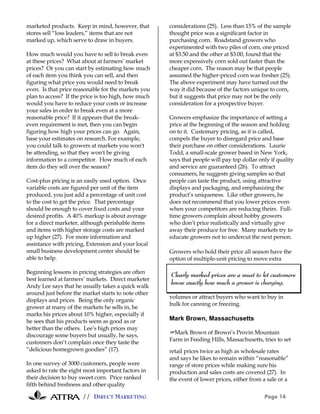
  When Mike and Jennifer Rupprecht sell beef direct to consumers, they make approximately $200 more per animal
  than if they had sold it to a large packing plant. Their consumers save at least $250 over what it would cost them to
  buy the equivalent amount in steak, roasts and hamburger in the store...
  ...The Minnesota Department of Agriculture estimates that in 1994, more than $31 million were generated through
  the state’s 354 custom meat plants in sales and processing fees, from directly marketed meat. Of this, farmers
  received an estimated $22.1 million.
                                          From The Land Stewardship Letter, November-December 1995.


                         // DIRECT MARKETING                                                               Page 2
directly to consumers at the local and regional               business. However, finding the right niche and
level. Foods that do not require much processing              marketing directly to the public is a hard and
before consumptionlike fruits, vegetables and                labor-intensive job requiring time and effort,
                                                              creativity, ingenuity, sales expertise, and the
meatare ideal for one-on-one marketing. Direct
                                                              ability to deal with people in a pleasant and
marketing is often quite unorthodox and may                   positive manner. Agricultural producers must be
take the form of roadside stands, pick-your-own               absolutely sure they are ready for the job.
operations, farmers’ markets, and sales to
restaurants, upscale retail or specialty                                  Importance of marketing
storeseven supermarkets and institutional food
service. Prospects for direct farmer-consumer                 For too long, farmers have thought of marketing
interaction are particularly promising at the                 as simply how to dispose of their products.
rural-urban fringe, where producers can take                  Locked into producing a very small number of
advantage of specialty market niches and the                  major crops and insulated from the market, they
demand for local and ethnic food and non-                     have not been required to have a clear under-
traditional products, while promoting                         standing of ever-changing consumer wants and
                                                              needs. Producers have traditionally taken
agricultural tourism and education.                           whatever price they could get while wholesale
                                                              and retail distribution networks undertook the
             Why direct marketing?                            business of marketing.
It is the excesses of the conventional marketing              Marketing does not begin after production, but
system that have forced the return of direct                  well before the first seed is planted. For farmers
marketing. Consumers tired of tasteless                       working outside the conventional system, the
supermarket produce and factory-raised meat                   importance of marketing cannot be over-
(and with increasing concerns about food safety               emphasized. Consumer-focused marketing is the
issues) want fresh food with flavor, as well as               single most important factor that determines the
more control over their food supply, and are                  success of an enterprise. Marketing is not just
                                                              about selling. It requires a clear and astute
willing to pay a premium price for it.
                                                              understanding of what consumers want and the
                                                              ability to deliver it to them through the most
Direct marketing, also called “shopping with a                appropriate channels for a profit. It includes the
human face,” promises “vine-ripened tomatoes                  planning, pricing, promotion and distribution of
that won’t bounce if dropped and are full of the              products and services for consumers, both
flavor you remember (6).”                                     present and potential. According to specialty
                                                              vegetable grower Don Anderson: “Knowing
Direct marketing can give the farmer a larger                 what’s happening in the marketplace is the
share of the food dollar and possibly a higher                difference between the farmer who makes it and
return on each unit sold, offset to some extent by            the farmer who doesn’t make it” (7).
loss of economies of scale. For some farmers,
                                                                             Enterprise evaluation
adding value or marketing some minimally
processed farm products directly to the consumer
                                                              A good marketing strategy begins with making
is a way of enhancing financial viability. Farmers            sure the enterprise is right for you and is feasible.
who are unable to compete in, or are locked out               This will require a review and evaluation of your
of, distant markets can build a thriving local                present situation, goals, possible enterprises,


  What are the qualities of a successful marketer?                 Not afraid to take risks
  Takes pride in the product and is not shy about saying so        Willing to plan, research and experiment
  Flexible                                                         Independent
  Creative                                                         Thrifty

                                   From Market What You Grow by Ralph J. Hills, Jr.


                        // DIRECT MARKETING                                                            Page 3
cooking could spin off into an additional on-farm
              Market development                     enterprise.
There are four basic ways to create a market (8):    !Do you have access to financial resources in the
✔market penetration, where the producer uses         form of savings, credit or investment by family or
more of his current product mix to meet the          friends?
needs of the market. This could mean boosting
sales by improving linkages between the buyer        !What are some of the crops that will grow well
and seller and serving more customers in the         in your area and will fetch the price you need?
existing market or by increasing consumption
per customer.                                        !What are the marketing resources in your
✔market development, where the producer looks        region? Check out the farmers’ markets and
for new uses or new markets for the product.         the retail stores. Is a roadside stand feasible?
✔product development, where a new product is         Talk to others who have one. Are there
produced for the existing market. This could be      restaurants, grocery stores and supermarkets
something that is less expensive to produce, or      willing to buy locally raised produce or meat?
value added to the original product or crop so
that it meets the customer’s needs better.           !Who are your potential customers? Would they
✔diversification, where the grower raises new        like to buy direct-marketed products or do they
products for completely new markets.                 prefer buying at mass retail outlets where price is
                                                     the main consideration? Is there scope in your
                                                     business plan for consumer education? Have you
physical, financial and marketing resources, and     considered the potential for entertainment
market potential. The evaluation should help         farming and tourism?
you answer some key questions, chiefly: Is this
really what you want to do? Is there a market for    !What information and resources do you need to
the product? Do you have the necessary skills to     help you along the way? How can you best
do it? Are you going to develop the market? Or       access such resources?
will you raise a crop for which there is a pre-
existing market? Will it be profitable? Can you                       Market research
expand in the foreseeable future? A sample
feasibility study for an agricultural enterprise     Following this preliminary survey, begin to identify
may be found on the University of Georgia            and define your product. Get all the information
Extension website at:                                you can about sources, marketing, production,
http://www.ces.uga.edu/pubed/b1066-w.html (9).       processing, packaging and sales. This will require a
                                                     good bit of systematic research. Check the libraries
!Start by listing your business and personal         in your area. Read all the USDA and Extension
goals. Prioritize them.                              publications you can lay your hands on as well as
                                                     trade journals and periodicals, books on market
!Is this going to be a full-time enterprise?         gardening and seed catalogs.

!Is your family involved and supportive?             Talk to your Extension agent, visit the local stores
                                                     (gourmet and otherwise) and supermarkets to see
!Inventory physical resources like land, soil,       what is selling, and why one product appears
machinery, water, buildings, livestock etc. Define   more appealing than another. Talk to customers,
constraints.                                         local stores, food clubs, specialty distributors,
                                                     ethnic stores, restaurants and other prospective
!Is family and/or off-farm labor available?          outlets in your region. What do they want? Is
                                                     there an unfilled niche? With your production,
!Is your spouse involved in the planning? A          labor and marketing resources, will you be able
spouse’s knowledge of medicinal herbs or             to fill this niche?


                       // DIRECT MARKETING                                                  Page 4
Why market research?

    Information from market research helps to formulate a market strategy and project profitability.
    Two levels of information may be obtained:
    General:
    Food shopping habits;
    What are some trends in lifestyles? convenience? Emphasis on family time and homecooked
    meals?
    What is the ethnic and racial make-up of population, what are its food preferences?
    What are the trends in food safety, health and nutrition?
    What are the marketing trends? Growth in organics? An emphasis on freshness?
    Specific:
    Who are the buyers? What are their ages, incomes and lifestyles?
    What are their wants?
    Size of the market, number of buyers;
    Number of competitors; are they successful? What are their weaknesses?
    What price can you expect?
    How much of the market can you expect to hold?
    What are packaging and labeling requirements?
    What are the barriers to market penetration for the products you have in mind?


Find out what your prospective competitors are            reduce business risk by providing credible
doing. Look for ways to improve upon what                 information, it can help identify problems in the
they are offering. Useful exercises for defining          market as well as little-known opportunities for
the competition and customer base can be found            profit. By knowing the size and makeup of your
in Geraldine Larkin’s book 12 Simple Steps to a           market, its geographic location, demographic and
Winning Market Plan (see Resources). For use in           behavioral characteristics, it will be easier to
researching the market for new farm-based                 create the appropriate marketing strategy and
enterprises, Judy Green of Cornell University has         you will avoid wasting time and money
compiled a list of agricultural alternatives. (For a      marketing to the wrong people.
copy of this list, request the ATTRA information
on evaluating a rural enterprise.) Information on                           Marketing plan
doing your own market research is also available
from ATTRA.                                               Marketing is an essential element of a small
                                                          agricultural enterprise. The marketing
You can either start small and grow bit by bit, or        environment will ultimately exert a strong
you can start in a big way from the very                  influence on the nature of the business. The crop
beginning. Either way, you must be prepared to            grown will be determined less by the farmer’s
do your homework and get to know your                     personal tastes than by what the market will
markets to be successful. One way to identify             absorb at a price the farmer is willing to take. A
potential markets that exist in your area is by           good market plan broadly aims to define the
using the “30-mile market technique” (12). Most           consumer, the products or services they want,
customers of direct marketers are believed to live        and the most effective promotion and advertising
within 30 miles of the point of sale. Market              strategies for reaching those consumers (13). It
research within this radius will unearth useful           clarifies objectives, appropriate actions, projected
information about production possibilities and            income, pricing structures, costs and potential
the presence of competitors. Detailed market              profitability. A step-by-step business planning
analysis and research is imperative before you            tutorial for a direct marketing enterprise is
promote and sell your product. Not only does it           available at http://fbimnet.ca/bc/.


                       // DIRECT MARKETING                                                        Page 5
A market plan alone does not guarantee success,                ✔Marketing objectivesa summary of your short
but it does indicate that many of the factors that             and long term goals, product diversification,
affect the profitability and continued survival of             additional market segments (alternative outlets)
the operation have been given consideration. A                 to tap. Objectives should be realistic and
market plan is usually part of a larger business               measurable—e.g., you would like to increase
plan that includes production, financial, staffing             sales by 10% within the next year.
and management plans. The process of writing a
business plan is not within the scope of this paper            ✔Marketing strategiesways to achieve your goals,
but listed at the end of this section are resources            what you will produce, how you will promote and
to help you find more information on the subject.              advertise the new product, the channels of sale,
                                                               how you plan to beat your competition.
A good place to start is the Small Business
                                                               ✔Budgetsinclude estimated costs and return
Administration, a federal agency that operates                 based on sales, and strategies for monitoring and
small business institutes and development                      curtailing costs.
centers, SCORE (Service Corps of Retired
Executives) and publishes business publications.               ✔Action planimmediate steps (e.g., look in the
Each state has an SBA office that may be                       yellow pages for graphic artists to design logo,
approached for help with developing a                          shortlist names of newspapers for a press release,
marketing or business plan.                                    assign person to deliver products to market, etc.)
Elements of a marketing plan are (14):
                                                               ✔Evaluationa summary of progress on
                                                               marketing objectives. The frequency of
✔Marketing situationa summary of your
                                                               evaluation depends on the plan and could be
present situation, what you are currently selling
                                                               each month, every six months or annually.
and how, who your customers are, what their
needs are, your competition, your own strengths
and weaknesses, how you are promoting your                     Objectives and strategies are a dynamic part of
product, what the current food and marketing                   the planning process and change depending on
trends are, etc.                                               the market situation and competition.


                         Domestic food demand - some trends to keep an eye on:

    Demography: There will be fewer new U.S. households formed through the year 2010. There will be a
    greater proportion of single-person households as well as families without children. Households with two
    adults and one child will fall from 25% of the total to 20% over the next 15 years. The Packer’s annual Fresh
    Trends survey found that one-person households already account for 25% of buyers. This information implies
    larger demand for single-serve products and produce, and higher per capita food spending in one and two-
    person households.
    Health and nutrition (10):
    #1) Products perceived to be fresh will have the strongest competitive advantage. According to a survey
    reported in The Packer’s 1997 supplement “Fresh Trends,” 17% of the respondents had purchased one or
    more new fresh vegetables every year.
    #2) Shoppers are looking for taste and may be less willing to compromise this for health. So, if a product is
    both healthy and tasty, it is guaranteed to be a winner.
    #3) Since 1990, the claims “natural” and “grown without pesticides” are the only two labels that have grown in
    importance relative to others.
    #4) Aging baby boomers will push new product positionings and define the market for health foods.
    #5) More and more consumers will recognize the connection between nutrition and health.
    Safety (11):
    The buzzword in 1999 is “local.” “Country of Origin” labelling was overwhelmingly (85%) favored by produce
    consumers participating in the Packer Survey. In fact, 63% favored mandatory labelling. This can only work
    to the advantage of local producers.


                        // DIRECT MARKETING                                                               Page 6
Niche marketing                                                Product differentiation

Anyone can pick a bunch of vegetables or fruits,                   A very elementary way of differentiating one’s
set up a stand at the local farmer’s market et voila!              product is to take it directly to the consumer. It is
a direct marketer is born. However, what is it                     relatively easy for a direct marketer to promote a
that differentiates a successful marketer from the                 product as farm-fresh and different from the one
rest of the pack? James McConnon, Business and                     sold at the mass retail store. Other ways to
Economics                                                                                             differentiate your
Specialist at the                   Blemishes Only Skin Deep, says Orchardist                         product are by
University of                                                                                         producing it
Maine Coop             ATTRA specialist Guy Ames of Ames Orchard and Nursery markets                  earlier in the
Extension says         his low-spray apples as ecologically raised. Ames, committed to                season, marketing
that in order to       growing healthy food for the community, is forced to spray for the plum        it as low-spray
                       curculio, an insect he is unable to control entirely through organic
survive in a           means. He uses Imidan once or twice during the season (unlike
                                                                                                      (see box) or
world of mass          conventional growers who rely heavily on more persistent pesticides,           organic or
retailers, it is       spraying up to 12-14 times in the season for a cosmetically perfect            naturally-raised,
absolutely             product). Part of Ames’ marketing strategy is to educate consumers to          and by adding
imperative to          disregard minor blemishes on fruit and instead appreciate its freshness        value to it in some
                       and wholesome flavor. Buyers can get a taste of the produce at the             other way. Cut
find and fill a
                       Fayetteville, AR, farmers’ market three times a week in season.
niche that is not                          (see Resources for publications on eco-labeling.)          flowers arranged
filled by the                                                                                         into bouquets,
mass retailer                                                                                         garlic turned into
(Wal-Mart, Safeway) (15). In addition, he lists                    decorative braids or wreaths, prewashed and
three other survival strategies: good promotion,                   bagged vegetables, bunched fresh herbsthese
good service, and good customer relations.                         are a few simple ways to add value to products.

The following section focuses on creative                       Consumer concerns with pesticides in food,
marketing tips, including specialty and value-                  freshness, nutrition, and flavor have turned the
added marketing, using examples of farmers who                  organic food movement into a multi-million
have built a successful direct marketing business.              dollar industry. The changing racial and ethnic
                                                                mix of the population signals an increase in the
              What is a niche market?                           demand for exotic and unusual vegetables and
                                                                meats. Not least exciting of all is that people are
✔A target group whose market responses are                      rediscovering the pleasure of fresh ingredients
 similar to each other, but different from other                from local farmsa more meaningful connection
 groups.                                                        to the land (16).

What makes a niche market worthwhile for the farmer?            The one advantage that direct marketers have
                                                                over retailers is the ability to build their
✔There must be accessible information about the                 relationships with customers over time. Indeed,
  group.                                                        good marketing is about building trust and
✔The group must be reachable through clearly                    personal loyalty in the relationship. Good sellers
  identified information channels.                              know and use the customer’s name. Consumers
✔The group must be big enough and sufficiently                  who feel an emotional bond to the grower are
  profitable to make it worth targeting.                        likely to remain loyal, even though the product is
✔The nature of a niche market is that it tends to               available at the grocery store at a cheaper price.
  disappear after awhile. Frieda Caplan, whose
  company introduced the kiwi to America,                       Marketing gimmicks will not hold customers
  stopped selling kiwis in 1990 because over-                   unless accompanied by an excellent product and
  supply and falling prices had eliminated                      superior service. Conventional marketing
  the niche.                                                    wisdom has it that 80% of sales come from 20% of


                         // DIRECT MARKETING                                                               Page 7
customer base. The grower must build a core             employees. Let them know why you are in
customer base and let them know how important           business and the direction you’d like to go. A
they are. Word-of-mouth advertising is the most         simple mission statement may read like this:
effective and inexpensive way to attract new            “Helping people stay healthy with fresh, locally
customers (17). Stay on top of consumer trends.         grown food!”
The best-made product in the world will not sell
if it isn’t something people want.                      Keep up with trends. Flexibility allows you to
                                                        adapt your product mix to market fashion and
Education of the consumer plays a big part in           trend. Remember, by the time you read that
salesmanship. Most people, for instance, are            “crop X” is THE hot thing this year, it’s probably
oblivious to the environmental and health               already too late to cash in on it. You have to be
benefits of livestock raised on forage.                 the first to capture, or better yet, create the next
                                                        hot thing. Visit specialty stores and restaurants—
Conveying information about the farm, how the           even if you aren’t interested in selling to them—
product is raised and why it is raised the way it is,   to find out what food items professionals see as
the effect of recent weather on the crops, and other    the trends to watch. Food fashions get started by
farm-centered conversation is important. Not only       upscale restaurants and trickle down to the
is this good for business, it also is a small step      consumer gradually. Read what your target
toward the development of consumer awareness            customers are reading.
of the farm and of social and health issues. Once
customers know that you are providing healthy           Food and food trade magazines and women’s
food, they gladly take on the responsibility to         magazines, in particular, offer great information.
support local farmers. Help them help you run           Another source is medical research on the health
your business successfully and profitably.              benefits of various foods, as reported in the
                                                        popular press (also an excellent source of
Write up your farm or company’s mission                 promotional information in today’s health-
statement and display it to your customers and          conscious society).


   Some resources you can use to educate the consumer about the benefits of fresh fruits, vegetables,
   and meat are:
                 !Nutrition Action Health Letter
                 Center For Science in the Public Interest
                 Suite 300, 1875 Connecticut Avenue NW, Washington DC 20009-5728
                 202-332-9110; e-mail cspi@cspinet.org, http://www.cspinet.org
                 !Produce For Better Health Foundation
                 1500 Casho Mill Road
                 Newark, DE 19711
                 302-738-7100
                 http://www.dole5aday.com
                 PBHF has been licensed by the National Cancer Institute to promote the 5-a-day
                 Program developed by NCI. PBHF is sponsored by the produce industry.
                  !Mothers and others
                 40 West 20 Street
                 New York, NY 10011-4211
                 e-mail: Mothers @mothers.org, http://www.mothers.org
                 West Coast Office: e-mail: WestCoast@mothers.org
                  (Publishes The Green Guide. Its primary project aim is to build demand for a better
                  quality food system, to open the marketplace to make it more responsive to
                  consumer needs, and to create market opportunities for regional, sustainably
                  produced food.)


                       // DIRECT MARKETING                                                     Page 8
An eggsample of creative marketing

     According to Jeff Ishee, a farmer with many years of marketing experience under his belt, if only
     people knew how commercial layers are managed, they would be flocking to the local market to
     buy free-range or humanely produced eggs. Laid by hens that are allowed to roam free and have
     access to fresh air and a rich and varied diet, these eggs have a rich yellow yolk compared to the
     pale watery insides of factory-produced eggs, and a freshness and good taste that only old-timers
     recall from their childhood.

     To take advantage of the market potential for farm-fresh eggs, talk to buyers about the differences
     between eggs raised naturally and those sold at the store. Explain why your product is
     nutritionally superior (a little research helpssee box above), present your point of view
     pictorially, display photographs of your hens and let the consumers connect. The education helps
     not just to aid in consumer awareness, but is also a great sales booster. People who feel
     responsible for their health and recognize instinctively the value of your product will be back for
     more. And they won’t mind paying more for your eggs!


      Specialty crops and diversification                  The Reeves maintain that conventional
                                                           wisdom does not apply in the marketing of
Because an enterprise has a better probability of          grass-fed beef. Beef raised entirely on grass
survival if it has a range of products to sell,            has the leanness of wild game and the flavor
diversification (especially into a mix of specialty        of sweet beef. It is not heavily marbled as is
or high-value crops) will benefit many                     grain-fed beef. The cattle are butchered
producers. Specialty crops are generally not               between the ages of 18-20 monthsthe
produced and sold in mass quantities. They                 younger the steer, the more delicate and
have a high cash value per acre, grossing                  tender the meat. Not much fat needs to be
between $4000−$20,000 per acre. They are not               trimmed off the carcass and the beef is sold
necessarily exotic and include crops that need a           with cooking instructions and recipes.
lot of care to raise (and are therefore outside the
traditional wholesale loop). They may be crops             It took some time and some “crushingly
with special attributes like vine-ripened                  expensive mistakes” for the Reeves to learn
tomatoes or lean meat, or those raised                     how to tap into their niche market. Glossy
especially for ethnic markets (7).                         advertising in the local tourist guides (Bon
                                                           Appetit, Eureka Springs Dining Guide, Guide to
David and Lisa Reeves                                      Local Businesses), press releases and bulk
Waterfall Hollow Farm, AR                                  mailings brought few or no sales. The poor
                                                           response convinced them that they were
  Niche marketing with grass-fed beef (18)                 better off addressing themselves exclusively
                                                           to the small percentage of meat-eaters who
#The two defining characteristics that
                                                           frequent health food stores or similar
differentiate the Reeves from other beef cattle
                                                           establishments and who would buy organic
farmers are their product and market. When they
                                                           meat. On the down side, of course, was the
first set out to direct market, they were
                                                           fact that many health food stores themselves
determined to give the public an opportunity to
                                                           steer clear of red meat because of perceived
eat the kind of beef they grew for themselves.
                                                           health risks. Their mission is now to:
Convinced that there was a niche market for
clean, range-grown beef, they proceeded to sell a                 convince them that there are people out
product that was free of unwanted chemicals,                      there who will joyfully eat clean, “range”-
growth hormones, and antibiotics.                                 grown beef, precisely because of the
                                                                  health benefits. We show them photos,

                        // DIRECT MARKETING                                                         Page 9
and describe the ranch and the lives of        Joan and Richard Wrench, Helena, MT
       our cattle. We point out the obvious that
       beef is a very high-quality, nutrient-dense    Montana-based growers Joan and Richard
       source of protein and obscure nutrients
                                                      Wrench have been raising garlic as a specialty
       like B12, folic acid and zinc, that it is
                                                      crop since 1971. They currently give about 8
       utterly delicious and deeply satisfying.
                                                      seminars a year at universities and through
Today, their main wholesale outlet is the Ozark       USDA, available at reasonable cost, to teach other
Cooperative Warehouse in Fayetteville,                farmers how to create a plan for farm
Arkansas. The warehouse itself markets only           independence through raising specialty crops.
their ground beef but trucks orders to buying         They are willing to help individual growers or
clubsgroups of private individuals in 11             groups wanting to establish a specialty crop
statesand allows the Reeves to ship on their         enterprise with developing a market and
truck. This is an enormous bit of luck because it     business plan. They may be reached at 406-752-
allows them to ship their product out of state for    3127 between 8-9:30 am MST.
very little expense. The other, and more costly
alternative, would be to use delivery services like   James and Alma Weaver, Kutztown, PA
UPS and Federal Express, which do not have
freezer trucks and require insulated packaging.       The Weavers grew tobacco and cattle on their 80-
                                                      acre farm for several years before making the
Lisa notes that they really ought to invest more      switch to specialty farming. The change has
time and effort into in-store presentations and       permitted them to survive in agriculture when
demonstrations. They’ve refrained from this           other less flexible operators have been forced to
partly because they do not wish to offend             bail out. The Weavers raise approximately 100
vegetarians present in the store and partly           different kinds of herbs, a range of flowers,
because they are still uncomfortable playing the      several varieties of ornamental colored corn,
role of salespeople.                                  more than 100 varieties of peppers, 54 varieties of
                                                      heirloom tomatoes, 30 different vegetables
Yet, store managers have found their obvious          including some odd-sounding heirloom varieties
naiveté and lack of sophistication refreshing,        like Cherokee Trail of Tears beans, Speckled
their “hemming and hawing and just talking            Mennonite lettuce, and Amish Moon and Stars
about their product” different from the spiel of      watermelons (19).
professional sales people. The couple do not
make “cold” calls but prefer to write a letter of     Steve Salt, Kirksville, MO
introduction in advance before paying a visit to
the store.                                            #Steve Salt (20), a Missouri-based farmer who
                                                      raises 600 kinds of vegetables, fruits, and herbs
Their ideal marketing strategy would entail           for sale at farmer’s markets, restaurants, and via
getting to know all the mainstream grocery stores
                                                      household subscriptions, has a book coming out
with alternative clientele, and health food stores    in November 1999 on specialty ethnic produce.
within a three-hour driving radius, contact them      Salt says that Asians, Middle-Easterners,
on a regular basisperhaps weekly, bi-weekly or       Mediterranean Europeans, and Latin Americans,
monthlyand keep the stores regularly stocked         all of whom have a higher per capita
with their product. So far, they have been able to    consumption of fresh fruit and vegetables than
sell everything they produce without actively         Americans of northwest European heritage, also
marketing. Recently, they have been in contact        have a strong tradition of buying their produce
with ranchers in Missouri and Arkansas who            unpackaged, at open air markets where they can
share their philosophy. The Reeves hope to buy        examine or taste it before purchase. Supermarkets
some of their cattle or contract with them to grow    have been unable to cater to the needs of these
beef animals, and expand the marketing end of         people, and Salt writes that raising produce for
their business soon.                                  ethnic markets offers a promising specialty niche

                        // DIRECT MARKETING                                                  Page 10
where the small grower can compete profitably         garlic, for example. Sold in bulk it brings $4/lb.
with the big growers. In addition to direct retail    When braided, it may bring up to $7/lb as a
sales, he recommends small-scale (wholesale)          decorative item. Adding value holds the promise
marketing to ethnic restaurants and grocery           of additional income especially in the off season,
stores (21).                                          but it is certainly more labor-intensive and requires
                                                      more management, more investment in equipment,
A wide variety of Asian vegetables, once a            and an awareness of legal and regulatory issues
stronghold of the ethnic market, more and more        pertaining to on-farm processing. Value-added
cross over into the mainstream produce section.       products do not have the same economies of scale
Primary markets are ethnic stores, grocery store      as mass-produced goods, and their success hinges
chains and restaurants. Market data is hard to        heavily on the producer’s retail strategy, especially
obtain partly because the truck farmers who raise     advertising and promotion.
crops for ethnic markets have generally operated
outside conventional channels. Some                   An alternative agricultural specialty currently
information on prices and availability may be         attracting a great deal of attention is agritourism.
obtained from The Packer and Produce Business         Although not every family is willing or able to
(see Resources).                                      entertain the public, for those who enjoy meeting
                                                      new people or hosting groups, a farm
Frieda Caplan, an authority on specialty produce      entertainment enterprise is a good opportunity
(see her home page at                                 for selling on-farm processed items.
http://friedas.com/about.cfm) says that
consumer education is extremely important when        On-farm processors must be aware of regulations
marketing specialties to the general public. This     governing their enterprise. If a food product is
is no less true of Asian vegetables, the popularity   being produced, usually a commercial kitchen is
of which has been fueled by ethnic restaurants        required. Specific regulations vary by state. A
and educational campaigns by retailers to             good overview may be found in a recent book by
demystify the preparation of Asian foods              Neil Hamilton (see Resources section). Many
through user-friendly packaging and recipes. For      farmers find it easier to lease space in an
a brief summary on market potential, refer to the     approved food processing facility, rather than
publication The U.S. Market For Miscellaneous         spend the $100,000 or more required to build and
Oriental Vegetables by Mihir Desai (listed in the     maintain a commercial kitchen on-farm. You
Resources section).                                   should be aware that most states prohibit small
                                                      children from entering a commercial kitchen, or
             Value-added marketing                    anyone who is ill, or domestic meal preparation
                                                      taking place there. A separate packaging facility
Value-added is a relatively new term in direct        may be needed. There are specific labeling
marketing jargon. Simply put, it means                requirements to be met, and additional
processing or modifying the product through           regulations may apply in the case of interstate
                                                      sales. Your state agriculture department and
“cooking, combining, churning, culturing,             county health department are good places to start
grinding, hulling, extracting, drying, smoking,       gathering information.
handcrafting, spinning, weaving, labeling, and
packaging” (22). Other ways to add value to an
agricultural product include:
        ♣growing something in a way that is
        acknowledged as safer, or
        ♣adding a component of information,
        education or entertainment

The customer is spared the additional work and the
producer charges extra for adding value. Take


                       // DIRECT MARKETING                                                    Page 11
An organization that can provide information        Little is known yet about the economic impact of
on developing food products is the Institute of     FPIs, as they are a relatively new concept.Duncan
Food Technologists (see Resources). In some         Hilchey at Cornell’s Farming Alternatives
places, governments, university centers or          Program (see list of organizations under
non-profit organizations (examples that come        Resources) has conducted case studies of four
to mind are Minnesota’s Agricultural                incubators to get a better understanding of their
Utilization Research Institute, the University of   working and impact. His findings are due to be
Nebraska’s Food Processing Center, Iowa’s           published early in 2000. Advance copies may be
Wallace Technology Transfer Foundation)             requested. Meanwhile, those interested in
assist rural micro-enterprise or other home-        exploring this subject further should get a copy of
based food processing businesses in getting         the publication called Establishing a Share-Use
started. University food technology                 Commercial Kitchen from:
departments may be able to provide
                                                       Bob Horn
handbooks and guides for value-added food              Next Level Training Network
processing, technical assistance, and funding          University of Colorado at Denver
opportunities, as well as information on rules,        Campus Box 128, PO Box 173364
responsibilities and marketing options.                Denver, CO 80217-3364
                                                       800-873-9378 (cost is $58 plus $4 s&h)
Food processing incubators (FPI) have been a           (303) 556-6651 FAX
popular rural development strategy. FPIs, for a
fee, provide commercial kitchen space and           Elizabeth Ryan, who sells a wide variety of value-
processing equipment, as well as technical          added products—such as cider, fruit sauces, chutneys
assistance with product formulation and             and salsa—at farmer’s markets in and around New
packaging. Some include peer group                  York City says that one way to make on-farm
counseling to talk over manufacturing or            processed goods more profitable is to give farmers
marketing issues.                                   access to a commercial processing plant on a time-
                                                    share basis. This kind of support has traditionally
                                                    been unavailable to value-added enterprises.
Arcata Economic Development
Corporation                                         Small farmers with specialty meat products have
                                                    had particular difficulty finding and gaining
#In Humboldt County, California, the Arcata         access to USDA-certified processing plants.
Economic Development Corporation (AEDC)             Arkansas-based graziers Lisa and David Reeves
constructed the Foodworks Culinary Center to        searched for three years to locate a good USDA-
help develop micro industry in the region (23).     inspected facility to process their direct-marketed
The Center served as an incubator for 12 local      beef. Large processors, although certified by the
gourmet and specialty food companies and            USDA, will not differentiate between the small
includes 1000 sq. feet of shared commercial         farmer’s product and the large volume of meat
kitchen space in addition to each company’s         they process and so are not a real option. (In
personal kitchen, 4000 sq. feet of warehouse        other words, the farmer cannot retain ownership
space, and central office services.                 of the product.) USDA certification is mandatory
                                                    for interstate sales and in states that lack an
Products being made by the companies include
baklava, pastas, Finnish coffee bread, smoked
salmon and garlic cream cheese spread, tofu            ATTRA’s Value-added and Processing
products, ice-cream and toppings, jams, flavored                      Series
honey and chocolate confections. Tenants have          Overview: Adding Value to Farm Products
formed a marketing cooperative and a mail order        Small-Scale Food Dehydration
catalog featuring the products was made                Grain Processing
available to promote them all across the country.      Small-Scale Oilseed Processing
For more information, call (707) 822-4616.             Soyfoods


                       // DIRECT MARKETING                                                 Page 12
inspection program (24).                               acreage or total production that each item accounts
                                                       for. So if 10% of your land were in corn, then 10%
             Pricing and profitability                 of your total overhead would be included in the
                                                       costs to produce that corn, for example.
If you don’t have a percentage of people walking
away from you at market, you’re selling too                        Break-even analysis
cheap, says Tim Kornder, a farmer from Belle
Plaine, Minnesota. Setting a price is one of the       The break-even point refers to the price and
more challenging tasks faced by the direct             quantity sold that will just cover all costs, leaving
                                                       zero profit. At this price and sales level, while no
marketer. How does one know how much a                 profits are made, you won’t be losing money.
pound of tomatoes or a head of lettuce is              The break-even point is calculated as follows:
worth? On what information are these pricing
decisions based?                                             Sales Price x Quantity Sold
                                                             = Revenues
In general, prices are set by production and                 — Variable Costs per unit x Quantity Sold
marketing costs at the lower end, while the upper            = Contribution Margin (“contribution
limit is set by what your customers are willing to                that the item makes to covering
pay, how much competition you have, and your                      fixed costs. This concept is useful
own desired profits. It pays to figure your costs                 because it is often very difficult to
and set your prices accordingly, rather than just                 decide what part of fixed costs can be
going by what others are charging; steady,                        assigned to a particular item. Rather
consistent prices encourage steady, consistent                    than trying to figure out that your
customers.                                                        rutabaga crop accounts for 5% of the
                                                                  cost of your tractor, you can figure
Knowing your costs of production, both fixed                      out which items contribute the most
and variable, is the first step in pricing strategy.              and plan your product mix accordingly).
Keeping good records for each item that you                    — Fixed Costs
produce allows you to assess the profitability of              = Zero, or you can substitute a desired
each item in your product mix. Variable costs                    profit margin, such as 5% of sales.
refer to costs directly associated with that item.     Understanding this concept allows you to
These include costs such as field preparation and      experiment with different combinations of prices
seed that will be there, even if nothing is            and quantities, as well as different levels of
harvested, as well as expenses directly related to     variable and fixed costs, to assess potential
yield such as harvest and packaging costs.             profitability of various items. If you can’t sell a
                                                       product for more than cost, you had better not
Fixed costs, or overhead, include costs such as loan   grow it in the first place. The new grower can
repayments, property taxes, insurance, and             start the educational process by studying
depreciation and maintenance on buildings and          wholesale prices and comparing those with retail
equipment, which will be there even if nothing is      rates at the store.
grown. In addition, it is important to include
some kind of wage or salary for yourself in your       USDA’s Agricultural Marketing Service
fixed costs. Don’t forget marketing costs. It’s        publishes daily wholesale prices for produce,
usually easiest to include these in overhead. For      which may be accessed at http://www.ams.
the small producer, the biggest marketing cost is      gov/marketnews.htm. Some growers call
probably his or her time spent in finding and          wholesalers for current prices; others check in
serving customers, doing promotions, making            with local chefs and local retail stores, especially
deliveries, and so on. Other costs could include       on comparable specialty items. Wholesalers
advertising, free samples, and fuel and vehicle        usually market up by 50%, while retailers mark

upkeep. These fixed costs are allocated to each        up by as much as 100%. This kind of information
item you produce, perhaps by the precent of total      is useful in setting a realistic price for direct-

                        // DIRECT MARKETING                                                     Page 13
marketed products. Keep in mind, however, that       considerations (25). Less than 15% of the sample
stores sell “loss leaders,” items that are not       thought price was a significant factor in
marked up, which serve to draw in buyers.            purchasing corn. Roadstand growers who
                                                     experimented with two piles of corn, one priced
How much would you have to sell to break even        at $3.50 and the other at $3.00, found that the
at these prices? What about at farmers’ market       more expensively corn sold out faster than the
prices? Or you can start by estimating how much      cheaper corn. The reason may be that people
of each item you think you can sell, and then        assumed the higher-priced corn was fresher (25).
figuring what price you would need to break          The above experiment may have turned out the
even. Is that price reasonable for the markets you   way it did because of the factors unique to corn,
plan to access? If the price is too high, how much   but it suggests that price may not be the only
would you have to reduce your costs or increase      consideration for a prospective buyer.
your sales in order to break even at a more
reasonable price? If it appears that the break-      Growers emphasize the importance of setting a
even requirement is met, then you can begin          price at the beginning of the season and holding
figuring how high your prices can go. Again,         on to it. Customary pricing, as it is called,
base your estimates on research. For example,        compels the buyer to disregard price and base
you could talk to growers at markets you won't       their purchase on other considerations. Laurie
be attending, so that they won't be giving           Todd, a small-scale grower based in New York,
information to a competitor. How much of each        says that people will pay top dollar only if quality
item do they sell over the season?                   and service are guaranteed (26). To attract
                                                     consumers, he suggests giving samples so that
Cost-plus pricing is an easily used option. Once     people can taste the product, using attractive
variable costs are figured per unit of the item      displays and packaging, and emphasizing the
produced, you just add a percentage of unit cost     product’s uniqueness. Like other growers, he
to the cost to get the price. That percentage        does not recommend that you lower prices even
should be enough to cover fixed costs and your       when your competitors are reducing theirs. Full-
desired profits. A 40% markup is about average       time growers complain about hobby growers
for a direct marketer, although perishable items     who don’t price realistically and virtually give
and items with higher storage costs are marked       away their produce for free. Many markets try to
up higher (27). For more information and             educate growers not to undercut the next person.
assistance with pricing, Extension and your local
small business development center should be          Growers who hold their price all season have the
able to help.                                        option of multiple-unit pricing to move extra

Beginning lessons in pricing strategies are often
                                                     Clearly marked prices are a must to let customers
best learned at farmers’ markets. Direct marketer
                                                     know exactly how much a grower is charging.
Andy Lee says that he usually takes a quick walk
around just before the market starts to note other
                                                     volumes or attract buyers who want to buy in
displays and prices. Being the only organic
                                                     bulk for canning or freezing.
grower at many of the markets he sells in, he
marks his prices about 10% higher, especially if
he sees that his products seem as good as or         Mark Brown, Massachusetts
better than the others. Lee’s high prices may
discourage some buyers but usually, he says,
                                                     #Mark Brown of Brown’s Provin Mountain
                                                     Farm in Feeding Hills, Massachusetts, tries to set
customers don’t complain once they taste the
“delicious homegrown goodies” (17).                  retail prices twice as high as wholesale rates
                                                     and says he likes to remain within “reasonable”
In one survey of 3000 customers, people were         range of store prices while making sure his
asked to rate the eight most important factors in    production and sales costs are covered (27). In
their decision to buy sweet corn. Price ranked       the event of lower prices, either from a sale or a
fifth behind freshness and other quality

                       // DIRECT MARKETING                                                  Page 14
market glut, Brown prefers to retain his base        there are more than 2,400 farmers’ markets, with
price and add extra value to his product instead     approximately 1 million people visiting them
of reducing his price. So, when the competition      each week. The Madison, WI, farmers’ market is
is selling corn for $2.75/dozen (0.23 cents an       first in the nation to have a website advertising
ear), Brown maintains his base price of 35 cents     the market. See
an ear and sells 6 ears for $2 with a seventh        http://www. madisonfarmersmarket.com/.
tossed in for free, or $3.75/dozen with two ears
free. Brown finds that more people buy 14 ears       Several states have centralized information on
for $3.75, and he still makes 4 cents/ear more       farmers’ markets, and a number of state-wide
than his competitors.                                farmers’ market associations have been formed.
                                                     A comprehensive address list of farmers’
Finally, this advice from growers:                   markets is available on the Internet at
                                                     http://www.hort.purdue.edu/newcrop/Farm
•   Don’t sell your goods for a lower rate at the
                                                       MARKET/FMIndex.html. Guides for
    end of the day;
                                                     organizing and selling at farmers’ markets are
•   Compete fairly on quality and service, never
                                                     published by the Cooperative Extension Service
    undercut;
                                                     in some states.
•   Don’t badmouth other growers;
•   Raise a good product and ask for a good          A publications list including direct marketing
    price.                                           and other information published by the Hartford
                                                     Food System may be requested (see Resources).
          Direct marketing alternatives              A new publication offers guidance on selling
                                                     local produce to school systems. Florida A&M
Ordinarily, retail markets command the highest       University has initiated the “School Lunch
price per pound of product, while wholesale          Project” to assist small farmers in marketing to
markets move more of the product than retail         institutional food programs. A network of small
markets but at lower prices. Farm sales and          farmers cooperatively produces and markets
farmers’ markets, You-Pick, mail-order are           selected produce items to institutional buyers.
typically low-volume markets. Restaurants,
retail stores, cafeterias, health food stores, and   Many states offer help in promoting locally grown
caterers constitute mid-volume markets, where        fruits and vegetables, sometimes with a special
prices are better than wholesale but on the          logo. City government, tourist departments and
lower end of retail. Smaller farmers may find        chambers of commerce can often be enlisted to
that selling to low- and mid-volume markets          help promote farmers’ markets.
works best for them. Mid-volume markets,
especially, offer the advantage of small to          Farmers’ markets seem to work best for growers
medium crop production as well as medium to          who offer a wide variety of produce of the type
better prices (28).                                  desired by customers. Consumers want markets
                                                     to be easily accessible with good parking
Some direct marketing options are outlined here.     facilities. A little related entertainment never
State departments of agriculture or Cooperative
                                                     seems to hurtseasonal festivals, street
Extension may have published guidebooks
                                                     musicians, tastings, demonstrations, etc. Sales
outlining the laws and regulations for direct
                                                     help must be pleasant and courteous, willing to
marketing in the state. Check with local
                                                     answer questions. Farmers interested in this
authorities before starting.
                                                     marketing method can find opportunities for
                                                     creative selling and fresh ideas through
    Organizing and selling at farmers' markets
                                                     participating in the local farmers’ market
                                                     association and direct marketing meetings.
There has been an explosive growth in the
number of farmers’ markets around the country.       Additional information on farmers’ markets is
In the mid-seventies, there were fewer than 300      available from ATTRA.
markets in the United States. Two decades later,

                       // DIRECT MARKETING                                                 Page 15
The Rombach Farm, Chesterfield, MO
   Community Supported Agriculture (CSA)
                                                      Beginning each July, the Rombach Farm becomes
Community Supported Agriculture (CSA) plans           a pumpkin wonderland. From late September
operate in several different ways. One involves       on, partner Steve Rombach works 7 days a week.
a single farmer selling "subscriptions" or "shares"   Besides pumpkins, apples, and squash, the farm
at the beginning of the season and then               market sells sweet corn (in season) and other
                                                      vegetables, handcrafted yard furniture, and yard
delivering, on a regular schedule, baskets of         ornaments. Most of the family’s remaining 700
whatever is produced. Another method                  acres (100 acres have been lost to development)
involves consumers who band together to rent          remain in soybeans and wheat. The biggest
land and hire a farmer to raise food for them. A      profit, however, is from farm stand sales.
new book, Sharing the Harvest, provides case
histories, models, and strategies for starting a      Many of the pumpkins are raised on the farm,
CSA (see Resources). The CSA of North                 rotated with wheat. Rombach is thinking of strip
America (see list of Associations) can provide        cropping pumpkins with wheat, however
more information on how CSAs work, including          (because the wheat is not ready when pumpkins
a video, It's Not Just About Vegetables, and          must be planted). He uses one field near the
accompanying handbook.                                house as a display area after the wheat is
                                                      harvested. The mid-size 20-lb. pumpkin is his
An e-mail networking list on CSA was started in       best seller, but bigger ones are popular. Few are
February 1996 and subscription is free. To            bought for pie-making. Those left unsold after
subscribe, send a message to:                         Thanksgiving are composted in the woods,
       listproc@prairienet.org.                       where wildlife enjoy them. The bulk market for
                                                      canning does not exist here.
In the body of the message, type subscribe csa-l
followed by your first name and your last name.       Besides family labor, Rombach hires a lot of part-
                                                      time help and depends on good friends to
For an overview of Community Supported Agri-          volunteer in creating seasonal displays. These
culture, ask for ATTRA’s publication on CSAs.         elaborate displays are extremely creative and
                                                      colorful—employing small buildings, 10-ft. high
        On-farm sales and agri-tourism                mounds of pumpkins, and Halloween figures.
                                                      They attract up to 1000 cars a day at the peak of
On-farm sales include pick-your-own (P-Y-O)           the season. They are not dismantled until the
and roadside stands or farm markets. Pick-            final two weeks “because so many schools
your-own began in response to the 1974 energy         come.” Backdrops are corn shocks or castor bean
crisis, appealing to customers (mainly families)      plants. Rombach is now looking into offering
who had the time and the necessary expertise          hayrides.
to process their own foods in quantity. More
recently, PYO enterprises have been integrated        Insurance is high. The farm carries 5-6 policies,
into the growing “farm entertainment” sector.         including an umbrella liability policy. Many
                                                      repairs, seed orders, fertilizer, etc. are undertaken
Marketing strategies may include educational          in the off season.
tours, an on-farm market with opportunities to
buy fresh produce or value-added products,            The Rombach farm has been totally rebuilt since
ready-to-eat food, festivals, classes, seasonal       1993, when Missouri River flooding put it under
events such as a personalized pumpkin patch,          seven feet of water. Initially, the farm enterprises
or agricultural mazes. A buffalo ranch, besides       included Christmas tree sales, and acres of U-pik
selling hides and meat, charges admission to          strawberries. But Rombach says they lost money
view the animals.                                     on the trees and PYO customers “trampled too
                                                      much.” Children would throw the berries


                       // DIRECT MARKETING                                                    Page 16
around. He now does retail sales only. (A few           According to some reports, over 50% of
items offered at the farm market are procured           American meals are now eaten away from home.
from other farmers.)                                    This would appear to be a growing market for
                                                        direct sales of produce. However, most high-
Rombach’s grandfather started hosting parties in        volume meal servers (institutional food service
the pavillion in 1928; his parents began the retail     and restaurant chains) require huge volumes,
sales. Steve Rombach, his brother, and a cousin         typically procured through centralized
incorporated in 1993, the year they rebuilt by          purchasing. It is still possible, however, to find
starting the pumpkin venture. Rombach’s father,
who is retired, now works for him. Mrs.                 an individually operated restaurant buying some
Rombach works off the farm (29).                        foods locally. High quality is a prime requisite
                                                        for sales to such restaurants. Such specialty crops
Such enterprises work best when farms are               as herbs, garlic, mushrooms, salad greens, cut
within thirty miles of a major population center,       flowers, and edible flowers for restaurants may
preferably on or near a good road. Pick-your-           be grown on very small parcels of land. One of
own is most adapted to crops which require              the main requirements for selling to an upscale
stoop labor to harvest. Plans and layout for farm       restaurant seems to be developing a good
markets are published in the NRAES booklet              relationship with the chef.
Facilities for Roadside Markets, available from
Cornell and in Bypassing the Middleman, from            In some instances sales by local farmers to local
Rodale Press (see Resources).                           institutions may be arranged. The Hartford Food
                                                        Project (see list of organizations) has a
In addition to the expected parking, restrooms,         publication describing creation of such marketing
harvesting instructions, creative signage, and          channels.
playgrounds, adequate liability insurance must,
of course, be in place.                                 ATTRA has some additional information on
                                                        marketing to restaurants and specialty stores.
Direct marketers can get liability insurance
through the North American Farmers’ Direct                       Mail order and home delivery
Marketing Association (NAFDMA) (30).
Comprehensive information on legal issues for all       Mail order sales generally involve value-added
types of direct marketing is available in The Legal     products or (primarily in Florida and the West
Guide for Direct Farm Marketing (1999) by Neil          Coast) fresh fruits. Value-added products are
Hamilton (see Resources).                               often decorative, rather than culinary. Home
                                                        delivery of fresh farm products was much
In some areas of the country, fee hunting is            more common in the U.S. fifty years ago than
combined with farming. One Nebraska farmer              it is today. The sight of a horse-drawn farm
combines fee hunting with hunting lodge                 wagon loaded with bushels of apples, squash,
accommodations (and a gift shop) during the slow        potatoes, and live chickens making its way
winter season on his 1500-acre grain farm. A            slowly through a residential neighborhood
publication of interest is Agritourism in New York:     while the farmer (or his children) knocked on
                                                        doors was not unusual. But it is still possible
Opportunities and Challenges in Farm-Based Recreation   for farmers to meet consumers at the doorstep
and Hospitality, available from Cornell Media           and deliver quality
Services at Cornell University (607-255-2080) for
$13.85. (This publication is currently being            food. This method is currently most used by
reprinted.) For more information, ask for ATTRA’s       dairy and meat producers. Nowadays
publication Pick-Your-Own and Agri-Entertainment.       arrangements are made in advance by telephone
                                                        and meats are usually frozen. Some CSAs home
        Selling to restaurants and stores               deliver.


                       // DIRECT MARKETING                                                     Page 17
Marketing on the Internet                    Internet users share these characteristics with
                                                         direct market customers in general.
Plans for selling groceries on the Internet are taking
their place along with other forms of e-commerce.        Farms can do business on the Internet either by
Most such plans ask the consumer to pick up an           maintaining their own individual websites, or
                                                         participating in a directory listing. Research
                                                         providers and costs; look at bartering to get a
  Harps Supermarket, Fayetteville, AR, has               website designed. Look at Internet marketing
  joined the ValuPage website offering                   as an opportunity to attract a new clientele, but
  Web Bucks to customers who print out                   first determine whether existing customers are
  coupons from the web page and                          on the Internet. Do they have e-mail? Be aware
  purchase certain products. Web Bucks                   of certain barriers to Internet buying:
  may then be used to buy anything else in
  the store. This is a premium for                               •   pricing (include shipping costs)
  customers to visit the website. See                            •   potential return hassles
  http://www.valupage.com. Customers                             •   credit card concerns of customers
  may also sign up for regular e-mailed                          •   privacy issues
  coupons.                                                       •   navigating the site

Internet order at their local supermarket.               Do everything possible to show you are
                                                         honest and reputable. Do not sell or lease e-
High-value, nonperishable, low-weight, specialty         mail addresses. Have a privacy statement
food products and nutritional supplements have           that you won’t sell customer information.

been available from a growing number of                  Customers like a website that is easy to use, quick
websites for some time. Delivery is by                   to download, and updated frequently. Be
conventional package delivery systems; this form         cautious about graphics that take a long time to
of e-commerce may be considered another                  come up on screen. At least give customers the
another form of mail-order.                              option to bypass graphics.

Another way to utilize the WWW is to have a              Look into ways to increase search engine results
farm or business homepage purely for                     for your site, so that it appears in the first five or
advertising purposes (perhaps cooperatively              ten that come up. (There is a way to bid on
packaged). Examples include the Madison, WI,             “ebay” to get you into the top 5.)
farmers market website mentioned previously
and the Virtual Virginia Agricultural Commun-            Klotz advises that existing customers (for
ity, at: http://www.vvac.org,which facilitates           example, at your farmers’ market) should be
regional communication. The Minnesota Land               approached slowly for information for your
Stewardship Project’s on-line directory of CSA           database. Remember that “customers are
farms (with e-mail and website contacts) is at           selfish and there is a lot of competition on the
http://www.misa.umn.edu/lsphp.html.                      Net.” Invite people to your website; don’t ask
                                                         for the customer’s e-mail addresses right
According to Jennifer-Claire V. Klotz                    away. Have a prize lottery to get customers’
(USDA/AMS), who spoke at the October                     names and addresses for your mailing list. Or
1999 National Small Farms Conference in St.              have on-line coupons they can print out (10%
Louis, 92 million potential customers are now            off, etc.). Then ask for their e-mail address so
on the Internet, one-third of them making                they can receive your newsletter.
purchases.
                                                         With another individual or business website,
Internet users tend to be older, with above-average      offer something if they put in a link. Call the
educations and higher incomes. Interestingly,            local press (Food or Business section, not
                                                         Agriculture), and offer an interview.

                       // DIRECT MARKETING                                                         Page 18
Some Home Pages for U.S. Farms
Put your web address everywhere—on all
stationery and items that go out. Offer freebies     Claymont Court, Shepherdstown, WV
                                                     http://www.claymont.org
(samples) when filling orders. Have a raffle.
Develop a kids e-mail mailing list and send          Cromwell Valley CSA
birthday cards. Send fall holiday greetings.         http://www.earthome.org
List your competitors’ prices (shown to be           Earthlands North Quabbin Farm
effective). Bid on words for headings (eBay,         http://www.tiac.net/users/elandspc/
etc.) to make the top five results from browsers.
                                                     Eco Farms, Lanham, MD
Make your website interesting. When creating         http://www.ecofarms.com
your web page, call the first page “index” to aid
search engines.                                      Glen Oshira, Hawaii
                                                     http://www.smallfarms.com
Constantly test and evaluate your site.              Howell Farm, Titusville, NJ
                                                     http://www.americanmaze.com/PR98Howell.htm.
           Promotion and publicity                   Massachusetts Farm Directory
                                                     http://www.massgrown.org
Associations such as the Organic Trade               http://www.massgrown.org/youpick.com
Association (OTA) help promote members
                                                     Peacework Organic Farm, Newark, NY
through materials and a calendar of events.          http://www.gvocsa.org

Promotions help to increase sales per customer       Three Sisters Farm, Sandy Lake, PA
and the number of clients, and enhance the image     http://www.bioshelter.com
and visibility of the farm, company and/or           Dog Wood Knob Farm, Mt. Vernon, KY
product. For an overview of promotion strategies     http://www.geocities.com/RainForest/8450/
and advertising, refer to Sell What You Sow!, The
New Farmers’ Markets and Extension publications      Mountain Gardens, Burnsville, NC 28714
such as the Pacific Northwest Cooperative            http://gardens.webjump.com
Extension series Farmer-to-Consumer Marketing        Tate Family Farm/Goat Lady Dairy
(especially no. 3., Pricing and Promotional          Climax, NC
Strategies) (see Resources). Promotions come in      http://www.goatladydairy.com
different shapes and sizes but they all have some    Wollam Gardens, Jeffersonton, VA 22724
common characteristics.                              http://www.wollamgardens.com
                                                     Angelic Organics, Caledonia, IL 61011
! They draw attention and communicate
                                                     http://www.AngelicOrganics.com
  information;
! They provide an incentive or premium to the        Elixir Farm, Brixey, MO
  consumer;                                          http://www.elixirfarm.com
! They invite the consumer to buy.                   Inn Serendipity, Browntown, WI 53522
                                                     http://members.aol.com/innseren/public/
Word-of-mouth advertising by satisfied               innserendipity.html
customers is priceless and cannot be purchased       Susan’s Garden, Plattsburg, MO
or engineered except by providing good service       http://ianwhite.stanford.edu/susansgarden/
and a good product. Because an estimated 80%
                                                     Camas Meadow Farm, Noti, OR
of business comes from return buyers, the focus is   http://members.aol.com/camasfarm/
on rewarding loyal customers by offering
discounts, gift certificates or a free service.      Emandal, Willits, CA
                                                     http://emandal.com
Coverage by the local newspaper or                   availability of a new and unusual food item, a
radio/television station can bring in more sales     cider-tasting contest—may lure reporters in
than any paid advertisement. Events on the           search of human-interest or weekend-event
farm—a Halloween festival for children,

                       // DIRECT MARKETING                                                    Page 19
stories. Invite the local newspaper’s food editor     motorist are a way to induce people to stop and
over for a dinner of grass-fed beef, or pastured      visit the roadside market or farm-stand. Signs
chicken so she or he can taste the difference from    should have a logo and should reflect the kind of
supermarket fare. While writing up a press            goods being soldmore upscale if they are high-
release, look for the news peg that makes the         priced and a ‘no-frills’ sign if otherwise. Signs
                                                      that advertise an unusual or out-of-the ordinary
                                                      roduct will draw the curious to the farm. The
story—an accomplishment, an award, anything           first sign should be placed a good distance (at
that seems interesting or valuable to the
community. Give the press plenty of notice,           least 2500 feet) before the market to give the
good photo opportunities, and always return           motorist time to decide whether or not to stop.
phone calls.                                          Keep signs neat and well-maintained.

Paid advertising is the non-personal promotion        Direct mail is advertising with a personal touch
of an idea, product or service directed at a mass     and requires an up-to-date and extensive mailing
audience. Its aim is to generate an increase in       list. Postcards with pictures of your farm, a logo
sales, induce brand recognition and reinforce the     and a promotional message may be sent just
”unique selling point,” inform potential              before a farm festival or when produce is
customers about the availability of a product, and    available. Direct mailing is only as effective as its
create demand for that product. An                    mailing list (i.e. its targeting of people who will
advertisement should emphasize benefits, not          buy your product).
objects. What will people get from your product
or from a visit to your farm? High-quality, fresh,    Mailing lists should be revised each year. Target
delicious produce or meat? Family fun? Friendly       groups of people likely to buy your product (e.g.,
service? You can either advertise continuously        members of a health food store or co-op). A
through the season to maintain your presence in       mailing list can be developed by asking people to
the marketplace, or you can advertise just before     sign up for mailings. Also, ask them where they
a product is available.                               heard about your product or farm. This
                                                      information will help you plan future
Advertising budgets generally range between 4         advertising.
and 10 percent of sales. Let’s say you rely
heavily on radio spots for continual advertising      Peggy Frederick, Whitney Point, NY
during the six months you are open (31). If
projected sales are $50,000 and you commit 4%           #Peggy Frederick of Strawberry Valley
to the advertising budget, this means you have          Farm in Whitney Point, New York, mails
$2,000. If 60% of this is allocated to continual
                                                        customers a specially-designed card listing
advertising through the 6-month marketing
season, you have $1,200 for that period. The
                                                        the vegetables and strawberries available
balance of $800 would be allocated to each of           for U-pick. For Christmas, she sends out
those months depending on the percentage of             the “giftbox” brochure which lists gift items
seasonal sales that occurs in that month. If 50%        from the farm’s bakery and consignment
of sales occur in July, then $400 would be              gift shop.
allocated to that month over and above the base
budget for April. This amount can be used for         Ellie MacDougall, Maine
other forms of promotion such as direct
mailings, or newspaper ads. If competition is
high, ad budgets may need to increase. Re-
                                                        #In her catalog, Ellie MacDougall, a Maine-
                                                        based grower, inserts a little promotional
evaluate an ad campaign if it does not bring
                                                        mailing on behalf of a local turkey grower, who
about a quick increase in sales.
                                                        in turn sells her poultry and turkey stuffing
                                                        seasonings (32). Many of her seasonings and
Attractive road signs are another effective form of
advertising. Signs that are legible to the speeding

                       // DIRECT MARKETING                                                      Page 20
vinegars are cross-sold by produce growers at      of Papa Geno’s Herbs found that plant orders
  other markets and farm stands.                     from the Internet had surpassed those from his
                                                     traditional mail-order catalog (34). Size of the
The catalog is a marketing tool that serves          average order through the Internet was higher.
many purposes. Common elements of a                  Gage sends his e-mail newsletter out 15 times a
catalog are (33):                                    year. Advertising on e-mail is cheaper, he says.
                                                     It would cost him 50 cents to send a post card to
✔ It should tell a story. It should differentiate
                                                     each customer. Direct mailings to 40,000 people
  your business from others and explain why
                                                     would cost him $20,000. The same people,
  and how you are different.
✔ It should work like a reference, providing
                                                     assuming they had access to a computer, could be
  detailed information about the product,
                                                     reached by e-mail for $5. Each day he receives
  service and business.
                                                     100 messages via e-mail. These are in addition to
✔ It should be a sales tool. In addition to
                                                     the orders that an employee takes in from her
  providing information, it must promote your
                                                     home. The hard work involves spending 20-40
  product, service and business.
                                                     hours a week online, for business and
✔ It should create a good first impression.
                                                     “schmoozing.” Gage is constantly on the lookout
Business cards have a way of sticking around in      for links to add to his web page and spends hours
people’s wallets long after they have been           giving advice free of charge as resident herb
distributed. Print and hand out business cards       expert of America Online and the gardening site
with your name, phone number, farm location          Garden Escape. One disadvantage is that he has
and product.                                         had several bad checks from Internet customers,
                                                     a problem he has never had to face in retail and
The Internet offers a whole new world of             paper catalog sales.
marketing opportunities. Its key features are 24-
hour accessibility by anyone with Internet           A lively and regular newsletter, written in the
capabilities and greatly expanded reach without      first person, discussing upcoming produce,
the costs and limitations of direct mail.            recipes, farm events and life on the farm, makes
Customers may be to able to place an order on        the reader feel more involved and connected.
line, but the chief value is the publicity an        Ideas for content may come from customers or
attractive website can bring to a producer.          from employees.
Another advantage is making your on-line
catalog available to Internet users.                 Flickerville Mountain Farm and
                                                     Groundhog Ranch, Flickerville, PA
The first North American Agricultural Internet
Marketing Conference “Internet Goes Ag,                #Cass Peterson and her late husband, Ward
Making it Work For You!” was held in October           Sinclair, who farmed with great flair and
1996, in Chicago. An excellent source of               ingenuity for several years, published an
information and current resources is the               annual newsletter for subscribers to their CSA
Washington State University Extension (King            called The Groundhog Report. With just the right
County) publication Internet Marketing for Farmers     touch of wry humor, the publication put
(available on-line at http://king.wsu. edu/Ag/         together by the former Washington Post
internetmarketing.htm). More information on            reporters informed consumers about prices and
                                                       included tips on cooking vegetables, news from
e-commerce is available from USDA’s Small Farm         the farm, and quotable quotes.
Center (see Resources).                              When creating a newsletter, consider the
                                                     following (35):
Papa Geno’s Herbs, Lincoln, NE
                                                       ☛ What items do you want to promote?
#Within six months of setting up a Web page            ☛ What should you say to induce readers to buy?
and beginning an e-mail newsletter, Gene Gage


                        // DIRECT MARKETING                                                Page 21
☛ Are readers made to feel included and                 to growers. They also run ads regularly in
    important?                                            these newspapers. The format generally
  ☛ Have necessary details such as farm hours,            remains the same, but photographs and text
    phone number, deadlines, etc. been included?          may vary. Advertising budgets average 5% of
  ☛ Is the newsletter uncluttered and visually            gross receipts. The idea behind their marketing
    pleasing?                                             strategy is to promote the experience of
                                                          authentic country life, its fun and friendliness
Including a map of how to get to the farm is
                                                          and generosity of spirit, in their advertisements,
always helpful. Newsletters may also be sent to
                                                          their brochures, at their annual harvest festival,
the news media or published as an insert in the
                                                          at the school tours hosted on Friday mornings,
regional newspapers.
                                                          and on the Lost Nation trading cards -
Angelic Organics, Caledonia, IL                           educational cards with a little snippet of
                                                          information that is handed to the consumer with
 #Kimberly Rector, formerly of Angelic                    each purchase. All in all, it makes for a
 Organics, a biodynamic farm northwest of                 wonderful tourist experience. The ideas, the
 Chicago used packaging to promote and                    insight and the creativity behind the marketing
 educate people about the product (36). An                package, says Phillips, happened only because
 artist by training, Rector chanced upon a                they loved and believed in what they were doing.
 motif for the farm, and used it on specially
 crafted paper labels with the farm logo and
                                                                           Conclusion
 information about the product, on packaging
 for specialty items such as herbs, on signs         Finally, some parting advice to people
 designed for the farm stand and at the              considering direct marketing or processing of
 farmers’ markets, and on specially-designed         farm products. First of all, do something you
 point of purchase posters. That increased           love and enjoy doing. Success will follow.
 demand for produce. Rector recommends               Invest time and, if necessary, money in research.
 retail packaging as a plus for farmers’ markets     Try to have a well-considered plan before
 and sales to stores.                                proceeding but don’t be rigid. Learn as you go.
                                                     Start small and keep your costs and debt as low
Single event promotions like harvest festivals,      as possible. Provide a reliable supply of high
Easter egg hunts, and Halloween costume              quality products and build a good relationship
contests can be combined with ongoing                with your customers. Take time to listen to their
promotions like school tours or Friday happy         wants, identify market possibilities, and find a
hours or open house. Publicize the promotions        unique market niche for your product. Be
well ahead to ensure a good turnout.                 adaptable to shifting market opportunities.
                                                     Ensure diverse markets, so that if one fails, you
Lost Nation Orchard and Cider Mill                   can fall back on the others. Set a fair price and
                                                     avoid competing directly with big business,
 #The Lost Nation Orchard and Cider Mill is a        especially on price.
 good example of the use of a mix of sales
 strategies. In addition to creating a striking
 cider label with a logo to enhance their            References:
 presence on store shelves, partners Michael
 Phillips and David Craxton promote Lost             1.    Thompson, Allen R. 1980. Marketing and the
                                                           Small Farmer. The National Rural Center, 1828 L
 Nation as a community farm (37). People trade             Street NW, Washington, DC. p. 4.
 labor for cider, helping to pick wild apples,
                                                     2.    Thompson, Allen R. 1980. Marketing and the
 label jugs or dig planting holes for new
                                                           Small Farmer. The National Rural Center, 1828 L
 orchards. Phillips and Craxton write occasional           Street NW, Washington, DC. p. 7.
 press releases promoting apple tastings and
 harvest festivals, or providing early-season tips

                      // DIRECT MARKETING                                                      Page 22
3.   Martinez, Steve W., and Al Reed. 1996. From             Conference. February 22-24, 1996. Saratoga
     farmer to consumers: Vertical coordination in the       Springs, New York.
     food industry. U.S. Department of Agriculture
     Economic Research Service Report. Agriculture       16. Caplan, Frieda. 1997. Specialty crops spelled out.
     Information Bulletin Number 720. June.                  Small Farm News. April-May. p.1.

4.   Staff. 1999. [news item.] Pork. April .p. 54.       17. Lee, Andy. 1993. Backyard Market Gardening:
                                                             The Entrepreneur’s Guide to Selling What You
5.   Thompson, Allen R. 1980. Marketing and the              Grow. Good EarthPublications. p. 4.
     Small Farmer. The National Rural Center, 1828 L
     Street NW, Washington, DC. p. 12.                   18. Bala, Radhika. 1998. Unpublished paper.
                                                             Fayetteville, AR.

References:(continued)                                   19. Byczynski, Lynn. 1997. Peppers are hot on
                                                             Pennsylvania farm. Growing For Market.
6.   Nothdurft, William E. 1986. Going to Market: The        January. p 10.
     New Aggressiveness in State Domestic
     Agricultural Marketing. Council for State Policy    20. Steve Salt
     and Planning Agencies, Washington, D.C. p. 12.          Green Valley Farm
                                                             RR 1, Box 263
7.   Gibson, Eric. 1994. Sell What You Sow! The              Kirksville, MO 63501-9734
     Grower’s Guide to Successful Produce                    e-mail: saltsgvf@istlaplata.net
     Marketing. New World Publishing, Carmichael,
     California. p. 17.                                  21. Salt, Steve. 1997. Growing for the cuisines of other
                                                             countries sustains this family farm, even in a rural
8.   Hall, Charles R. et al. No date. A Guide to             area. Growing For Market. June. p. 8.
     Marketing Organic Produce. Texas Ag. Extension
     Service. Varied paging.                             22. Richards, Keith and Wechsler, Deborah S. 1996.
                                                             Making It On The Farm. Increasing
9.   Schermerhorn, R.W. 1991. Is Your Agribusiness           Sustainability Through Value-Added Processing
     Project Feasible? University of Georgia                 and Marketing. Southern Sustainable
     Cooperative Extension, Athens, GA. 15 p. AT:            Agriculture Working Group. p.2.
     http://www.ces.uga.edu/pubed/b1066-w.html
                                                         23. Anon. 1994. Moving start-ups out of the kitchen.
10. Gilbert, Linda. 1998. Tracking 1998’s top                In Business. March/April. p. 25.
    trends. Natural Foods Merchandiser. January.
    p. 41, 48, 50.                                       24. O’Neill, Kelly. 1997. Emerging Markets for
                                                             Family Farms. Center for Rural Affairs, Walthill,
11. Staff of The Packer. 1999. Fresh Trends: A 1999          Nebraska. p. 9.
    Profile of the Fresh Produce Consumer. p. 4, 14.
                                                         25. Anon. 1994. Lessons from the big retailers.
12. Rocky Mountain Institute (ed.) 1987. “Marketing”         (Reprinted from Cornell Small Fruits Newsletter,
    How To Survive As A Small Farmer. RMI,                   Oct. 11, 1993) Vegetable Notes, October. p. 1.
    Snowmass, Colorado. p. 17.                               Another perspective on marketing. (Reprinted
                                                             from Cornell Small Fruits Newsletter, Oct. 11,
13. Bjergo, Alan. 1986. Marketing: Why Have a                1993) October. p. 2.
    Marketing Plan? University of Montana Coop
    Extension Service, Missoula, MT. 10 p.               26. Todd, Laurie. 1996. “The reality of establishing
                                                             prices.” p. 153. In: Proceedings 1996 North
14. J.E. 1997. Marketing ideas for small farmers.            American Farmers’ Direct Marketing Conference.
    Maine Organic Farmer & Gardener. June-                   February 22-24, 1996. Saratoga Springs, New York.
    August. p. 18.
                                                         27. Brown, Mark G. 1996. Setting prices for a
15. McConnon, James C. 1996. “Surviving in a world           farmers’ market. Proceedings 1996 North
    of mass retailers.” p. 142. In: Proceedings 1996         American Farmers’ Direct Marketing
    North American Farmers’ Direct Marketing                 Conference. February 22-24. p. 155.


                          // DIRECT MARKETING                                                      Page 23
28. Warr, A.M. 1993. Basil, Chives, Parsley...Idea             35. Frederick, Peggy. 1996. “Newsletters to
    Sheet: Farming and Farm-Related Business Ideas.                encourage customer loyalty.” p. 124. In:
    Skylands Small Business Development Center at                  Proceedings 1996 North American Farmers’Direct
    Warren County Community College. 2 p.                          Marketing Conference. February 22-24, 1996.
                                                                   Saratoga Springs, New York.
29. From talk delivered by Steve Rombach on October
    14, 1999, at Rombach Farm to touring participants          36. Byczynski, Lynn. 1995. Artistic farmers find an
    in the 2nd National Small Farms Conference, St.                appreciative audience. Growing For Market.
    Louis, MO.                                                     April. p. 10
         Notes taken by Katherine Adam.
                                                               37. Phillips, Michael. 1995. Light-hearted marketing
                                                                   helps orchard thrive. Growing For Market.
                                                                   August. p. 9.
30. NAFDMA
    62 White Loaf Road
    Southampton, MA 01073
    (413) 529-0386                                              The electronic version of Direct Marketing is located at:
    (888) 884-9270                                              http://www.attra.org/attra-pub/directmkt.html
    http://www.nafdma.com

31. Ashley, Richard A. 1995. Planning your
    advertising campaign. Yankee Nursery Quarterly.
    Spring. p. 11.
                                                               By Katherine Adam, Radhika
32. MacDougall, Ellie. 1995. Expand your business by
    cross-selling. Growing For Market. May. p. 6.              Balasubrahmanyam, and Holly Born
                                                               NCAT Agriculture Specialists
33. McCoy, Miles and Laurent, Carla. No date.
    Produce a Catalog For a Reasonable Investment.             November 1999
    Pimento Marketing, West Linn, Oregon. 503-657-
    7550. Also see
    http://www.plantzone.com/articles/catalog.html

34. Byczynski, Lynn. 1997. Herb plant business
    thrives on the Internet. Growing For Market.
    November. p. 8–10.


  The ATTRA Project is operated by the National Center for Appropriate Technology under a grant from the
  Rural Business-Cooperative Service, U.S. Department of Agriculture. These organizations do not
  recommend or endorse products, companies, or individuals. ATTRA is located in the Ozark Mountains
  at the University of Arkansas in Fayetteville at P.O. Box 3657, Fayetteville, AR 72702. ATTRA staff
  members prefer to receive requests for information about sustainable agriculture via the toll-free
  number 800-346-9140.


                        // DIRECT MARKETING                                                                Page 24
800-346-9140

                                                          DIRECT MARKETING:
       Appr i e Technol Tr
           opr at     ogy ansf f Rur Ar
                              er or al eas
                                                             RESOURCES
                                                                      BUSINESS MANAGEMENT SERIES
www.attra.ncat.org
   ATTRA is the national sustainable agriculture information center funded by the USDA’s Rural Business -- Cooperative Service.


Sustainable Farming programs, such as those as Cornell University and the University of California, are often the
best sources of recently published guides, as are private initiatives such as the Hartford Food Project. Increasingly,
such information is most easily accessed through the Internet. Extension personnel in several states say that all
their current publications are listed (and should be accessed) on their websites, as did other organizations.

For out-of-print Extension publications, a U.S. Government Documents repository (generally located at a major
landgrant university) or private library may provide access.

Publications which inform small farmers and specialty growers on direct marketing options include The Business
of Herbs, Small Farm Today, Growing for Market, and the new electronic publication Sustainable Farming
Connection at http://sunsite.unc.edu/farming-connection.

A variety of conferences on marketing and agriculture are held every year around the country. The largest is the
national North American Farmers' Direct Marketing conference held at the beginning of each year. The Year
2000 conference will be held on February 10−12 Cincinnati, OH. For information on conferences or proceedings,
contact Vicki Parker-Clark at (208) 667-6426. (There is no conference website this year.) Information on the
annual Mid-Atlantic Direct Marketing Conference, usually held in mid February, may be obtained from Dr.
Ramu Govindasamy at Rutgers Coop Extension at 732-932-9171, ext. 25.


Publications
                                                                          Walks readers through real life examples of how farmers
Beck-Chenowith, Herman. No date. Free-range                               and others have used e-mail and the Internet to improve
    Poultry Production & Marketing. [3-ring binder].                      their business. Available for $15 ppd from:
    Back Forty Books, Creola, OH. 120 p.                                  UC DANR Communication Services
    Order for $39.50 + $4.50 s/h from Back Forty Books,                   6701 San Pablo Avenue
                                                                          Oakland, CA 94608-1239
    26328 Locust Grove Road, Creola, OH 45622. Call
                                                                          800-994-8849 or 510-642-2431
    (740) 596-4379 for information about short courses for                Internet address is www.sarep.ucdavis.edu/
    farmers.
                                                                     CAPAP (ed.). 1990. The Alternative Field Crops
Byczynski, Lynn. 1997. The Flower Farmer; An                            Manual. Center for Alternative Animal and Plant
   Organic Grower’s Guide to Raising and Selling                        products, Minnesota.
   Cut Flowers. Chelsea Green Publications, VT.                         Provides information on the production of many minor
   Chelsea Green Publications, VT.                                      or new field crops. Costs $45. Also available is the
   P.O. Box 428                                                         Alternative Agricultural Opportunities, a bibliography
   205 Gates Briggs Bldg.                                               listing over 1600 articles on alternative plants and
   River Junction, VT 05001.                                            animals. Cost is $5. Contact:
   800-639-4099
                                                                     CAPAP
                                                                        352 Alderman Hall
Campidonica, Mark. 1997. How to Find Agricultural
                                                                        1970 Folwell Avenue
   Information on the Internet. Publication 3387.                       St. Paul, MN 55108.
   University of California.                                            612-625-4707; FAX 612-625-4237
                                                                        http://capap.coafes.umn.edu


                           // DIRECT MARKETING                                                                      Page 25
Publications: (continued                                   Growing For Market (ed.) Marketing Your Produce:
                                                              Ideas For Small-Scale Farmers.
Desai, Mihir. 1994. The U.S. Market For                       Fairplain Publications
                                                              P.O. Box 365
   Miscellaneous Oriental Vegetables. A Lac Tech
                                                              Auburn, KS 66402.
   Report, U.S. Agency for International
   Development, Washington, D.C. 20523.                    Grubinger, Vernon. 1999. Sustainable Vegetable
   Available free from USAID.                                 Production from Start-Up to Market. NRAES.
                                                              Cornell Cooperative Extension, Ithaca, NY.
Economic Research Service (ERS) ed. No date.                  $49.85.
   Agricultural Research and Development, Public
   and Private Investments Under Alternative               Hakenson, Dan. 1995. The Small Commercial Garden:
   Markets and Institutions. AER-735. ERS-NASS,               How to Make $10,000 A Year In Your Backyard.
   Virginia. (703) 605-6900. A copy may be obtained           198 p. Send $20.90 (ND residents $20.98) to:
   by sending a check or money order for $29.50 to:           PC-Services
                                                              PO Box 7294
   ERS-NASS
                                                              Bismarck, ND 58507-7294.
   5285 Port Royal Road                                       800-871-4296.
   Springfield VA 22161
   800-999-6779                                            Hall, Charles R. And Johnson, Jeff L. 1992. A Guide
   See publication at www.econ.ag.gov/                         To Successful Direct Marketing. Texas
   Order from ers.nass@ntis.fedworld.gov                       Agricultural Extension Service, Texas A&M
                                                               University, College Station, Texas. 32 p.
Engel, Allison and Engel, Margaret. 1991. Food                 Send $12 by check payable to:
   Finds—America’s Best Local Foods and the People                 Account 5500 Texas Extension Education
   Who Produce Them. Harper Perennial, New                         Foundation
   York, NY. 346 p.                                                Attn: Charles Hall
                                                                   464 Blocker Building
Gibson, Eric. 2000 [in press]. The New Farmers                     College Station, TX 77843-2124
    Markets. New World Publishing, Vista, CA.                      409-845-1772

                                                           Hall, Stephen F. From Kitchen to Market; Selling Your
Gibson, Eric. 1996. Farmers Markets 96: The What’s
                                                               Gourmet Food Specialty. Upstart Publishing.
    Hot/What’s Not Guide for Growers and                       Available for $24.95 from:
    Managers. New World Publishing, Vista, CA.                 Upstart Publishing
    12 p.                                                      155 N. Wacker,
    Interviews with market managers and vendors from           Chicago, IL 60606.
    around the country. Available for $5 from:                 800-235-8866.
    New World Publishing
    3037 Grass Valley Highway #8185                        Hamilton, Neil D. 1999. The Legal Guide for Direct
    Auburn CA 95602                                        Farm Marketing. USDA/SARE grant. 235 p.
    916-823-3886                                              Order for $20.00 from:
                                                              Agricultural Law Center
Gibson, Eric. 1994. Sell What You Sow! The Grower’s           Drake University
    Guide to Successful Produce Marketing. 302 p.              Des Moines, IA 50311
    Available for $25.50 from New World Publishing             515-271-2947
    (see above address).
                                                           Henderson, Elizabeth with Robyn Van En. 1999.
                                                              Sharing the Harvest: A Guide to Community
Gregson, Bob and Gregson, Bonnie. 1996. Rebirth of            Supported Agriculture. Chelsea Green Publishing,
the Small Family Farm. IMF Associates, WA. 65 p.              White River Junction, VT. $25.00.
    The book focuses on what to grow and how to sell it.
    Available for $9.95 ($10.65 for WA residents) from:        Order from Chelsea Green Publ., 205 Gates-Briggs
    IMF Associates                                             Bldg., P.O. Box 428, White River Junction, VT 05001.
    PO Box 2542                                                (800) 639-4099
    Vashon Island, WA 98070.                                   http://www.chelseagreen.com


                          // DIRECT MARKETING                                                         Page 26
Publications: (continued)                                    Makus, L.D. et al. 1993. Planning Your Business. CIS
                                                                978. University of Idaho, Coop. Extension System.
Ishee, Jeff. 1997. Dynamic Farmers’ Marketing.                  Ord. #422 Available for 50 cents from:
    Bittersweet Farmstead, 130 p.                               Ag. Publications
    Bittersweet Farmstead                                       Idaho Street
    P.O. Box 52                                                 University of Idaho
    Middlebrook, VA 24459                                       Moscow, ID 83844-2240.
    Describes how family farmers can make the best of the       208-885-7982.
    explosive growth in farmers’ markets. Copies may be         http://info.ag.uidaho.edu/catalog/Catalog.html
    obtained by calling 540-886-8477. Send 14.95 plus
    $2.50 shipping and handling.                             Also available are:
                                                             Makus, L.D., J.F. Guenthner, and J.C. Foltz. 1992.
Island Meadow Farm (ed.) Fifty Small Farm Ideas.                 IS942. Pricing Nontraditional Products and
     Send $3.75 to:                                              Services. Cooperative Extension, University of
     Island Meadow Farm                                          Idaho. 4 p. Ord. #386. and:
     295 Sharpe Road
     Anacortes-Fidalgo Island, Washington, 98221.            Parker-Clark, V.J. 1992. Marketing Your Produce
                                                                 Directly To Consumers. University of Idaho,
Jenkins, R.P. 1991. Establishing and Operating A                 Coop. Extension System. 6 p. Ord. # 620.
    Farmers' Market: A Manual for Sponsors, Boards           Parker-Clark, V.J. 1989. Assessing the Potential for
    of Directors, and Managers of Farmers' Markets.              Farm and Ranch Recreation.
    University of Tennessee Agricultural Extension               EXT699, Ord. #596. $1.00.
    Service. 24 p.
    Order as Pub. 847 from:                                  Smathers, R.L. 1992. Understanding Budgets and the
    Wanda Russell, Co-op Ext.                                   Budgeting Process. CIS 945. University of Idaho
    (423) 974-7360                                              Coop. Extension, Moscow, ID. 5 p. Order. 389.
                                                                $1.00.
Jozwik, Francis X. How To Make Money Growing
                                                             Maue, Patricia et al. 1995. Growing Your Own
    Plants, Trees and Flowers: A Guide to Profitable
                                                                Specialty Food Business - From Farm to Kitchen to
    Earth-Friendly Ventures. Andmar Press. 180 p.
    Andmar Press                                                Market. Publication of the NYS Small Business
    P.O. Box 217                                                Development Center, Ulster County Community
    Mills, WY 82644.                                            College, Stone Ridge, NY.
    Also by the same author:
                                                             MSAWG (compiler). 1996. Direct Marketing Resource
    Perennials For Profit or Pleasure: How To Grow and
                                                               Notebook. Midwest Sustainable Agriculture
    Sell in Your Own Backyard. 80 p.
                                                               Working Group.
                                                               Contains over 100 pages of practical information on
Kamoroff, Bernard. 1992. Small-Time Operator: How
                                                               direct marketing with examples of farmers, contacts for
   to Start Your Own Small Business, Keep Your
                                                               state and federal marketing regulations in the
   Books, Pay Your Taxes and Stay Out of Trouble!
                                                               midwestern states, and other resources. Send check for
   Bell Springs Publishing, Laytonville, CA 95454.
                                                               $20 (NE residents add $1 per copy) payable to:
   188 p.
                                                               Nebraska Sustainable Agriculture Society An update of
Larkin, Geraldine A. 1992. 12 Simple Steps to a                this book is being planned for 2000.
    Winning Marketing Plan. Probus Publishing Co.,             PO. Box 736
    Chicago, IL. 217 p.                                        Hartington, NE 68739
                                                               402-254-2289.
Lee, Andy. 1993. Backyard Market Gardening: The              Mississippi’s Southern Rural Development Center
    Entrepreneur’s Guide to Selling What You Grow.              produced the Food Processing IndustryResource
    Good Earth Publications. 351 p.                             Directory (1997) as a step toward addressing food
    Good Earth Publications                                     processing development issues in the southern
    P.O. Box 898                                                region. SRDC #205 is currently out of print, but
    Burlington VT 05482                                         hard copies, when available, will be $10 from:
    Practical guide on growing food for income. Describes       SRDC
    membership gardens, CSA, growing for restaurants,           Box9656
    producers’ cooperatives, farmers’ market etc. To order      Mississippi State, MS 39762.
    call 802-425-3201 or e-mail goodearth@igc.apc.org.          601-325-3207


                           // DIRECT MARKETING                                                          Page 27
Publications: (continued)                                     ✔6. Farmer-to-Consumer Marketing: Financial
                                                                  Management
NRAES. No date. Facilities For Roadside Markets.
  Northeast Regional Agricultural Engineering           Order on-line at:
  Service (NRAES) Cornell University Ithaca, NY         http://caheinfo.wsa.edu/pub_home-page/pub.html
  14853-5701.
  The booklet, NRAES-52, is available for $5.50. Also   Packer, The (ed.) [Yearly]. The Packer’s Produce
  available from NRAES are:                                 Availability and Merchandising Guide. The
  Farming Alternatives: A Guide to Evaluating the           Packer, Lenexa, Kansas.
  Feasibility of New Farm-Based Enterprises (NRAES-         Information about display and promotion, post-harvest
  32) for $8 plus $3.50 s&h and Produce Handling For        handling of major vegetable and fruit crops.
  Direct Marketing (NRAES-51) $7 plus s&h. Write to:        Also publishes Fresh Trends annually.
  NRAES                                                     Contact:
  152 Riley-Robb Hall                                       The Packer 2000 Guide
  Cornell University                                        Circulation Department
  Ithaca, New York 14853.                                   10901 West 84th Terrace
  607-255-7654; FAX 607-254-8770                            Suite 20, Lenexa, KS 66214.
                                                            800-255-5116.
Nebraska Extension (ed.) Setting Up Your Own                Visit http://www.thepacker.com. The 2000 guide will
   Business: Financing Your Business (NebFact 96-           be available in June.
   278). Note: Only available from NE county
   extension offices. See www.ianr.unl.edu/pubs.        Richards, Keith and Wechsler, Deborah S. 1996.
                                                            Making It On The Farm. Increasing Sustainability
Nebraska Sustainable Agriculture Society. No date.
                                                            Through Value-Added Processing and Marketing.
The Direct Market Resource Notebook. Hartington,
                                                            Southern Sustainable Agriculture Working Group.
NE 68739.
                                                            For copies, send check for $12 payable to SSAWG
    To order, send $20 to:
                                                            Publications
    NSAS, P.O.
                                                            PO Box 324
    Box 736,
                                                            Elkins, AR 72727
    Hartington, NE 68739.
    402-254-2289.
                                                        Rocky Mountain Institute (ed.) 1987. “Marketing,”
O’Neill, Kelly. 1997. Emerging Markets for Family          How To Survive As A Small Farmer. Rocky
   Farms. Center for Rural Affairs, Walthill,              Mountain Institute. 40 p.
   Nebraska. 62 p. Available for $7 from:                  Rocky Mountain Institute
   CRA                                                     1739 Snowmass Creek Road,
   PO Box 406                                              Snowmass, CO 81654
   Walthill, NE 68067-0406.
   402-846-5428.                                        Salatin, Joel. 1995. Salad Bar Beef. Polyface, Inc.,
                                                            Swoope, VA. 368 p.
Pacific Northwest Coop. Extension (ed.) 1980.
    Farmer-to-Consumer Marketing: An Overview.          Salatin, Joel. 1993. Pastured Poultry Profits. Polyface,
    Published by Washington State University Coop           Inc., Swoope, VA. 330 p.
    Extension, Oregon State University Coop.
    Extension, University of Idaho Coop. Extension      Salt, Steve. 1999. Specialty Ethnic Produce.
    and the USDA. Also available are:                        Order from Steve Salt, Green Valley Farm,
       ✔1. Farmer-to-Consumer Marketing: An Overview         Kirksville, MO. E-mail: saltsgvf@istlaplata.net.
       ✔2. Farmer-to-Consumer Marketing: Production
            and Marketing Costs                         Schermerhorn, R. W. 1991. Is Your Agribusiness
       ✔3. Farmer-to-Consumer Marketing:                    Project Feasible? University of GA Cooperative
            Merchandising, Pricing and Promotional          Extension, Athens, GA. 15 p. At:
            Strategies                                      http://www.ces.uga.edu/pubed/b1066-2.html.
       ✔4. Farmer-to-Consumer Marketing: Place of
            Business and Product Quality                Schmidt and Acock. Marketing Fruits and Vegetables.
       ✔5. Farmer-to-Consumer Marketing: Personnel         #570. Mississippi State Extension, Mississippi
            Management                                     State, MS 39762.


                        // DIRECT MARKETING                                                          Page 28
Publications: (continued)                                   University of Wisconsin (ed.) No date. Direct
                                                               Marketing of Farm Produce and Home Goods.
Smith, Lauren K. and Cathy Roth (ed.) 1993. To                 Coop Extension. Available from:
   Market! To Market!: Promotional Ideas That Will             Extension Publications
   Bring Customers to Your Farmers' Market. AG-                630 W. Mifflin St. Room 170
   MARK. Cooperative Extension, University of                  Madison, WI 53703-2636
   Massachusetts, Pittsfield, MA. 20 p. To order a             608-262-3346
   copy of this booklet, send $1.50 to:
    US Extension Bookstore                                  Wallin, Craig. 1989. Backyard Cash Crops: The
    Draper Hall, B32010                                        Sourcebook for Growing and Selling Over 200
    Amherst, MA 01003-2010                                     High-Value Specialty Crops, Homestead Design,
    413-448-8285. (no phone orders)                            Inc., Friday Harbor, WA. 231 p.

Sullivan, G.H. et al. 1981. Direct Farm to Consumer         Whatley, Booker T. 1987. How To Make $100,000
    Marketing: A Profitable Alternative for Family             Farming 25 Acres. Regenerative Ag. Association,
                                                               Emmaus, PA. 1987.
    Farm Operations. #HO-160. Purdue University
                                                               Focuses on location, crop selection and mix, and
    Extension Service, West Lafayette, IN 47907.               marketing. Gives insight on marketing strategies,
    Sustainable Agriculture Research & Education.              equipment, high value crops. Available for $22.50 from:
    1999. Farming for Profit, Stewardship &                    American Botanist Sellers
    Community. Tipsheet #2: Add Value Through                  P.O. Box 532, Chillicothe IL 61523.
    Marketing.                                                 309-274-5254; FAX: 309-274-6143.
    http://www.sare.org/san/tipsheet/tip2.htm
    3 p.                                                    Directories:

University of California (ed.) 1999. Specialty and          National Organic Directory (400 + p)
   Minor Crops Handbook. Publication #3346.                     Available for $50.95 (CA residents add $3.48)
   Division of Ag. and Natural Resources,                       from:
   Oakland, CA.                                                 CAFF
   Available from the Small Farm Center for $30 (see list       PO Box 363
   of organizations for address).                               Davis, CA 95617
                                                                800-852-3832
University of California (ed.) No date. Growing                 (lists farmers, buyers, and brokers, sustainable
   Across the Seasons: A Season and Harvest                     agriculture publications, organic certification groups,
   Extension Guide for the Small-Acreage Farmer.                state laws etc.)
   UC Extension. Available for $13.73 ppd from:
   UC Coop Extension                                        Agencies/Associations:
   11477 E. Avenue
   Auburn, CA 95603                                         Alternative Farming Systems Information Center
   Should I Sell at the Farmer’s Market available from UC   National Ag. Library
   Davis Coop Extension, Davis, CA 95616                    10301 Baltimore Avenue, Room 304
                                                            Beltsville, MD 20705-2351
University of Delaware (ed.) No date. Guide to              301-504-6559;
   Planning the Farm Retail Market. University of           E-mail: afsic@nal.usda.gov
   Delaware Cooperative Extension. 85 p. Available
   from:                                                    Farming Alternatives Program
   University of Delaware                                   17 Warren Hall
   College of Agricultural Sciences                         Cornell University
                                                            Ithaca, NY 14853
   Ag. Experimental Station Cooperative Extension
                                                            607-255-9832
   Newark, DE 19717-1303
                                                            Food and Agricultural Products Research and
University of Illinois Urbana-Champaign College of
                                                            Technology Center
   Agriculture(ed.) 1990. A Grower’s Guide to
                                                            Oklahoma State University
   Marketing Fruits, Vegetables and Herbs in Illinois.      Stillwater, OK
   Available from:                                               The Center’s objective is to help develop successful
   Cooperative Extension Publications                            value-added enterprises in OK. For a free fax
   69 Mumford Hall                                               subscription to the Food Fax Newsletter, fax a request to
   1301 West Gregory Drive                                       Peter Muriana at 405-744-6313 or call him at 405-744-
   Urbana, IL 61801                                              5563.


                          // DIRECT MARKETING                                                              Page 29
Agencies/Associations: (continued)                            Small Farm Center
                                                              University of California
Food Processing Center                                        Davis, CA 95616-8699
University of Nebraska                                        916-752-8136
60 Filley Hall                                                    Published the Specialty and Minor Crops Handbook
Lincoln, NE 68583-0928                                            that describes seed sources, cultivation, production and
402-472-5791                                                      marketing alternatives for 62 crops. A bimonthly
                                                                  newsletter called Small Farm News is also published.
Contact Allis Burney
                                                                  Also available are Considerations in Enterprise
    The Entrepreneur Assistance Program helps prospective
    manufacturers with issues like product development,           Selection, How to Determine Your Cost of Production,
    food safety, market research and selection, packaging         Direct Marketing and Quality Control, Marketing
    and label design, business risk protection, product           Cooperatives, and Setting Up a Roadside Stand, three
    pricing, image development, regulatory issues, etc.           booklets that cover marketing opportunities for small
                                                                  farmers, and the Small Farm Handbook (169 pp,
                                                                  $24.55) an easy to follow book for prospective farmers,
Hartford Food System (Mark Winne)
                                                                  new farmers and farmers who want to start new
509 Wethersfield Ave.
                                                                  enterprises.
Hartford, CT 06114
860-296-9325; FAX: 860-296-8326                               USDA/RBS Program
                                                              Stop 3201, 1400 Independence Avenue S.W.
Institute of Food Technologists                               Washington, D.C. 20250-3201
221 N. LaSalle St., Suite 300                                 202-690-4730
Chicago, IL 60601                                                 (Rural Business-Cooperative Service (RBS) helps
800-IFT-FOOD                                                      farmers and other rural residents develop cooperatives
                                                                  to obtain supplies and services at lower cost and to get
Missouri Alternatives Center                                      better prices for the products; advises rural residents on
628 Clark Hall                                                    developing existing resources through cooperative
Colombia, MO 65211                                                action to enhance rural living; helps cooperatives
573-882-1905 or 800-433-3704                                      improve services and operating efficiency; informs
    Provides information on alternative crops, small farm         members, directors, employees, and the public on how
    options and alternative rural opportunities.                  cooperatives work and benefit their members and their
                                                                  communities; and enclurages international cooperative
National Farmers Direct Marketing Association                     programs. RBS also publishes research and educational
14850 Countryside Drive                                           materials, including the Farmer Cooperatives
Aurora, OR 97002                                                  magazine).
503-678-2455
                                                              Periodicals:
Organic Farmer’s Marketing Association
8364 S. State Road 39                                         Acreage Advisor
Clayton, IN 46188                                             15400 N 56th St.
317-539-6935; E-mail: cvof@iquest.net                         Lincoln, NE 65814-9706
    Publishes The Organic Organizer.                          402-785-2220
                                                                  Bimonthly 24-page publication geared toward the small
Restorative Development Initiative                                farm and acreage owner. One year subscription is
Collective Heritage Institute                                     $9.95. Contact Phil Pfeiffer.
826 Camino de Monte Rey, Suite A6
Sante Fe, New Mexico 87505                                    American Fruit Grower
505-986-0366; FAX 505-986-1644                                American Vegetable Grower
   Program linking family farmers, including native           Meister Publishing Co.
   American growers, directly with progressive companies      37733 Euclid Avenue
   and markets to facilitate the creation of an alternative   Willoughby, OH 44094
   agricultural economy outside the commodities market.       216-942-2000


                           // DIRECT MARKETING                                                                Page 30
Periodicals: (continued)                                     Labels: Linking Consumers and Producers
                                                                Free monthly electronic newsletter from the Institute for
The Business of Herbs                                           Agriculture and Trade Policy that provides news,
439 Ponderosa Way                                               events and resources related to the labeling of products
Jemez Springs, NM 87025-8036                                    for environmental, social and regional sustainability.
                                                                To sunscribe, send e-mail to majordomo@igc.apc.org.
505-829-3448; FAX 505-829-3449
                                                                Leave subject blank. In body, type subscribe label-news.
E-mail: olives @jemez.com
    Bimonthly, $20 per year.                                 MFA Marketing Digest
                                                             Minnesota Food Association
Country Journal                                              2395 University Avenue, Room 309
P.O. Box 500                                                 St. Paul, MN 55114
Mt. Morris, IL 61054                                         612-644-2038
                                                             Contact: Anne deMeurisse
Farm Direct Marketing Digest                                      Reports information of interest to small-scale food
P.O. Box 4612                                                     producers and processors who are creating a sustainable
Pasco, WA 99302                                                   food system in Minnesota. Features profiles of
509-547-5538; FAX 509-547-5563                                    producers, processors and buyers.

                                                             Maine Organic Farmer and Gardener
Farmers Market Monthly and Farmers Market Outlook
                                                             PO Box 2176
PO Box 4220
                                                             283 Water Street
Culver City, CA 90231                                        Farrell Building, 4th Floor
310-673-8366                                                 Augusta, ME 04338
    Bi-monthly newsletters on California’s farmers           207-622-3118
    markets. Carries farmer profiles, updates on new             The March-May issue 1996 is full of marketing and
    crops, legal and regulatory issues, interviews with          production ideas from the Farmer-to Farmer conference.
    chefs, authors, policy-makers and others with and            Back issues are available for $4.50.
    interest in farmers markets. Annual subscription costs
    $20.                                                     The Packer
                                                             10901 West 84th Terrace
Farming Alternatives Newsletter                              Suite 20
                                                             Lenexa, KS 66214
c/o Farming Alternatives Program
                                                             800-255-5116
17 Warren Hall
                                                                 Gives weekly news about marketing and production of
Cornell University                                               fruits and vegetables. Produces The Packer’s Produce
Ithaca, NY 14853                                                 Availability and Merchandising Guide with
607-255-9832                                                     information on vegetable and fruit crops, display and
                                                                 promotion, post-harvest handling, major production
Gourmet News                                                     areas and other useful details.
PO Box 1056
Yarmouth, ME 04096                                           Produce Business
                                                             Phoenix Media Network
The Gourmet Retailer                                         P.O. Box 810425
3301 Ponce de Leon Boulevard, Suite 300                      Boca Raton, FL 33481
Coral Gables, FL 33134                                       561-447-0810
                                                                 A monthly magazine available for $48. Ask for Fran.
305-446-3388
                                                             Rural Enterprise
Growing for Market                                           P.O. Box 878
Fairplain Publications                                       Menomonee Falls, WI 53052-0878
P.O. Box 365                                                 414-255-0100
Auburn, KS 66402                                                 (discontinued but some back (1986-1992) issues still
    Subscription is $24/yr.                                      available. $3 each.)


                              // DIRECT MARKETING                                                          Page 31
Periodicals: (continued)                                     Databases and listservs:

Small Farm Digest                                            Foodline is a trio of databases providing international
USDA-CSREES                                                  coverage of food marketing, technical and regulatory
Mail Stop 2220                                               information. Foodline: International Food Market Data is a
1400 Independence Avenue S. W.                               bibliographic database of global market information from
                                                             approximately 250 food and beverage and related
Washington, DC 20250-2220
                                                             publications, Foodline: Food Science and Technology, which
800-583-3071; FAX 202-401-5179                               consists of abstracts from over 550 journals, books, reports
smallfarm@reeusda.gov                                        and papers; and Foodline: Current Food Legislation, a
    Free quarterly newsletter on farm-related trends and     database summarizing provisions of current food additive
    developments, announcements,e tc. Also available from    regulations and food composition and labeling standards for
    this office is the “Getting Started in Farming” series   the U.S. and seven European Union countries.
    and other factsheets. See
    http://www.reeusda.gov/smallfarm.                        The USDA’s market news service gives daily or
                                                             weekly updates on wholesale produce/herb/cut
Small Farm Today                                             flower prices.
3903 Ridgetrail Road                                            http://www.ams.usda.gov/marketnews.htm
Clark, MO 65243-9525
800-633-2535                                                 The Maine Organic Farmers and Gardeners Association
                                                             started a bi-weekly price report in 1996. Prices are compiled
                                                             by interviewing 20 farms about what they are charging for
Specialty Crop Digest
                                                             currently available organic produce. Items for which retail
Homestead Design, Inc.                                       and wholesale prices are listed include vegetables, berries,tree
P.O. Box 1058                                                fruit, herbs, bunched flowers, seedlings, and organic meats.
Bellingham, WA 98227                                         Report available by mail for $10 per season from:
360-676-5647                                                      MOFGA,
                                                                  PO Box 2176,
Stockman Grass Farmer                                             Augusta, ME 04338.
P.O. Box 2300
Ridgeland, MS 39158-2300                                     The Massachusetts Department of Ag. Has information on
                                                             farmers’ markets and direct marketing, mail order businesses
800-748-9808
                                                             at their website www.massgrown.org
University of Wisconsin Coop Extension                       For 12 years of research reports, including marketing, try
Direct Marketing Newsletter                                  the SARE dababase at www.sare.org/san/projects/.
c/o John Cottingham
Ag. Marketing Specialist                                     New Crop Resource Online Program at
717 Pioneer Tower                                            http://www.hort.purdue.edu/newcrop provides a look at new
University of Wisconsin, Platteville                         and specialty crops.
Platteville, WI 53818-3099
                                                             A discussion group about marketing is available on the
608-342-1392
                                                             Internet. To subscribe to direct-mkt, send the following
                                                             message to majordomo@reeusda.gov
Videos and Audios:                                                    subscribe direct-mkt

High-Value Marketing. 1992. Farmer-To-Farmer                 For a similar discussion group for small farmers, send
Series. Rodale Press, Emmaus, PA.                            message to majordomo@reeusda.gov Leave subject blank.
    To order, send $29.95 to:                                In the body, type: subscribe
    Farm Videos, c/o Rooy Media                                            smallfarm-mg
    7407 Hilltop Drive, Frederick, MD 21702
    301-473-8797                                             Organic Farmers Marketing Association web site has a
    Contact Rooy Media for other titles in the series.       public page and a private page where certified organic
                                                             farmers can discuss markets, prices and other subjects. The
                                                             private page is open only to members of the Organic Farmers
Gerber, Michael. 1995. The E Myth Seminar.                   Marketing Association. Send $25 to:
Nightingale-Conant Corp., Niles, IL                              OFMA
   (Six sound cassettes on how to run a business.                PO Box 159
   Suggests that most businesses are started by people who       La Farge, WI 54639
   want to turn a beloved interest into an occupation.)      Or look up http://www.iquest.net/ofma/


                           // DIRECT MARKETING                                                                Page 32
Databases and listservs: (cont.)                               Another is the Organic Food Business News Fax
                                                               Bulletin available for $205 and published by:
SMALLFARM-MG is a listserve that identifies small farm
contacts, farmers and others interested in strengthening the       Hotline Printing and Publishing
                                                                   P.O. Box 161132
capacity of small and mid-size farmers to improve their
                                                                   Altamonte Springs, FL 32716
income through a systems approach. To subscribe, send              407-628-1377
mail to majordomo@reeusda.gov. Leave subject blank. In
the body, type subscribe smallfarm-mg Sustainable              A private website promising Today’s Market Prices
Farming Connection is an interactive website with              has, as of October 1999, “reopened the registration to
innovative production and marketing information. Visit         consult” their daily ahd historical prices database, free
http://sunsite.unc.edu/farming-connection                      of charge. See http://www.todaymarket.com for
Contact:                                                       culinary herbs, fruits, and vegetables.

    USDA                                                       The CA-based federal-State Market News Service
    AMS, F&V Division                                          gives daily reports of prices and supplies, annual
    Market News Branch, Room 2503                              summaries of shipments and prices.
    South Building,
    PO Box 96456                                                   California Department of Food & Agriculture
    Washington DC 20090-6456                                       Division of Marketing Services
    http://www.ams.usda.gov/marketnews.htm                         State Market News Service
                                                                   1220 N Street
A privately published report called the Organic                    Room 126
                                                                   Sacramento, CA 95814
Market News is available for $65/year by mail and $75
                                                                   (916)654-1240
by fax. Contact                                                    http://www.cdfa.ca.gov
    Farmer’s Information Network
    PO Box 2067                                                Compiled by Katherine Adam, Radhika
    Santa Clara, CA 95055
                                                               Balasubrahmanyam, and Holly Born
    408-247-6778


                                                               November 1999


 IP113

                           // DIRECT MARKETING                                                             Page 33
Notes:
               Notes:


// DIRECT MARKETING     Page 34
Feedback
1. Does this publication provide the information you were looking for?
   How could it be improved?


2. Do you know a farmer who is implementing techniques discussed in
   this publication? Can you provide their address and phone number?


3. Do you know of any related research that would add to the
   information presented here?


4. Do you know a good related website not listed in this publication?


5. Please add any other information, or comments that you wish to share.


           // DIRECT MARKETING                                   Page 35
Fayetteville, AR 72702
                                      PO Box 3657
                                      NCAT/ATTRA


––––––––––––––––––––––––––––––––––––––––––––––– FOLD –––––––––––––––––––––––––––––––––––––––––––––


                        Thank You
              FOR YOUR VALUABLE FEEDBACK


                      // DIRECT MARKETING                                               Page 36

Direct Marketing

  • 1.
    DIRECT MARKETING BUSINESS MANAGEMENT SERIES Appropriate Technology Transfer for Rural Areas www.attra.ncat.org ATTRA is the national sustainable agriculture information center funded by the USDA’s Rural Business -- Cooperative Service. Abstract: This publication on direct marketing alternatives—with emphasis on niche, specialty and value-added crops—features many farm case studies, as well as information on enterprise budgets and promotion/publicity. A new section discusses implications of Internet marketing and e-commerce for agriculture. CONTENTS: Introduction............................................................. 2 Value-added marketing .............................................. 11 Alternative marketing ......................................... 2 Pricing and profitability ............................................... 13 Present system................................................... 2 Direct marketing alternatives ...................................... 15 Exploring alternatives ......................................... 2 Marketing on the Internet ........................................... 18 Why direct marketing? ....................................... 3 Promotion and publicity .............................................. 19 Importance of marketing .................................... 3 Conclusion ................................................................... 23 Niche marketing ................................................. 7 References .................................................................. 23 Specialty crops and diversification ..................... 9 Resource list ................................................................ 25 IS A PROJECT OF THE NATIONAL CENTER FOR APPROPRIATE TECHNOLOGY
  • 2.
    By Katherine Adam,Radhika develop and use innovative marketing methods Balasubrahmanyam, and Holly Born (1). The assumption that farmers must either “get NCAT Agriculture Specialists big or get out” is being challenged, however, by November 1999 the emergence of alternatives. It is possible for innovative farmers to stay small or medium-sized Introduction and make a comfortable and successful living Many growers, especially new ones, are inclined to from agriculture (2). start production without giving a second thought to the business of marketing. Good marketing is Present system an absolute must for a successful agricultural Less than 2% of the U.S. population farms, a enterprise. Some would even argue that it ranks fact often cited as proof of the extraordinary higher in importance than production itself efficiency of U.S. agriculture. Technical strides especially for farmers planning to diversify. After in production and processing have made more all, what good is a product if one cannot sell it food available to more people around the year. consistently for a profit? For better or for worse, farmers are constrained by a highly specialized system characterized by Diversification out of commodity crops may a few large farmers and processors, and a production and distribution system mean becoming familiar with, or even creating, increasingly integrated at all levels for the sake new marketing systems. Existing marketing of efficiency and economies of scale. channels very often do not accommodate the new producer well especially the small producer. Vertical integration of markets and consolidation of processing are especially This publication describes direct marketing of pronounced in the livestock industry, where a produce (and to a lesser extent livestock) and lists handful of firms control broiler production, as additional resources for those who are interested. well as hog and cattle slaughter. By 1996, almost 100% of broiler production was by contract (3). Since 1996 hogs sold to packers ATTRA has more information on marketing by “pre-arranged agreements” (contracts) have animal products. Some farmers may use direct increased from 17% to over 60%, according to a marketing for particular products while study by agricultural economist Glenn Grimes simultaneously participating in traditional of the University of Missouri (4). In many markets. No two growers are the same, and the cases, the products are specified in such great reader will have to determine through trial and detail in the contract that the farmer is not error what works best. selling an agricultural product, but is selling his labor (5). Alternative marketing Exploring alternatives Formal research on alternative marketing mechanisms has been scattered and hard to Sustainable farming, which received a boost access by producers. It is mostly experiential and following the farm crisis of the 1980s, has given unrecognized by the agricultural establishment impetus to diversified, decentralized systems in and official information channels. Small farmers which farmers take greater control of marketing and grassroots farm groups are the most likely to by bypassing traditional channels and marketing When Mike and Jennifer Rupprecht sell beef direct to consumers, they make approximately $200 more per animal than if they had sold it to a large packing plant. Their consumers save at least $250 over what it would cost them to buy the equivalent amount in steak, roasts and hamburger in the store... ...The Minnesota Department of Agriculture estimates that in 1994, more than $31 million were generated through the state’s 354 custom meat plants in sales and processing fees, from directly marketed meat. Of this, farmers received an estimated $22.1 million. From The Land Stewardship Letter, November-December 1995. // DIRECT MARKETING Page 2
  • 3.
    directly to consumersat the local and regional business. However, finding the right niche and level. Foods that do not require much processing marketing directly to the public is a hard and before consumptionlike fruits, vegetables and labor-intensive job requiring time and effort, creativity, ingenuity, sales expertise, and the meatare ideal for one-on-one marketing. Direct ability to deal with people in a pleasant and marketing is often quite unorthodox and may positive manner. Agricultural producers must be take the form of roadside stands, pick-your-own absolutely sure they are ready for the job. operations, farmers’ markets, and sales to restaurants, upscale retail or specialty Importance of marketing storeseven supermarkets and institutional food service. Prospects for direct farmer-consumer For too long, farmers have thought of marketing interaction are particularly promising at the as simply how to dispose of their products. rural-urban fringe, where producers can take Locked into producing a very small number of advantage of specialty market niches and the major crops and insulated from the market, they demand for local and ethnic food and non- have not been required to have a clear under- traditional products, while promoting standing of ever-changing consumer wants and needs. Producers have traditionally taken agricultural tourism and education. whatever price they could get while wholesale and retail distribution networks undertook the Why direct marketing? business of marketing. It is the excesses of the conventional marketing Marketing does not begin after production, but system that have forced the return of direct well before the first seed is planted. For farmers marketing. Consumers tired of tasteless working outside the conventional system, the supermarket produce and factory-raised meat importance of marketing cannot be over- (and with increasing concerns about food safety emphasized. Consumer-focused marketing is the issues) want fresh food with flavor, as well as single most important factor that determines the more control over their food supply, and are success of an enterprise. Marketing is not just about selling. It requires a clear and astute willing to pay a premium price for it. understanding of what consumers want and the ability to deliver it to them through the most Direct marketing, also called “shopping with a appropriate channels for a profit. It includes the human face,” promises “vine-ripened tomatoes planning, pricing, promotion and distribution of that won’t bounce if dropped and are full of the products and services for consumers, both flavor you remember (6).” present and potential. According to specialty vegetable grower Don Anderson: “Knowing Direct marketing can give the farmer a larger what’s happening in the marketplace is the share of the food dollar and possibly a higher difference between the farmer who makes it and return on each unit sold, offset to some extent by the farmer who doesn’t make it” (7). loss of economies of scale. For some farmers, Enterprise evaluation adding value or marketing some minimally processed farm products directly to the consumer A good marketing strategy begins with making is a way of enhancing financial viability. Farmers sure the enterprise is right for you and is feasible. who are unable to compete in, or are locked out This will require a review and evaluation of your of, distant markets can build a thriving local present situation, goals, possible enterprises, What are the qualities of a successful marketer? Not afraid to take risks Takes pride in the product and is not shy about saying so Willing to plan, research and experiment Flexible Independent Creative Thrifty From Market What You Grow by Ralph J. Hills, Jr. // DIRECT MARKETING Page 3
  • 4.
    cooking could spinoff into an additional on-farm Market development enterprise. There are four basic ways to create a market (8): !Do you have access to financial resources in the ✔market penetration, where the producer uses form of savings, credit or investment by family or more of his current product mix to meet the friends? needs of the market. This could mean boosting sales by improving linkages between the buyer !What are some of the crops that will grow well and seller and serving more customers in the in your area and will fetch the price you need? existing market or by increasing consumption per customer. !What are the marketing resources in your ✔market development, where the producer looks region? Check out the farmers’ markets and for new uses or new markets for the product. the retail stores. Is a roadside stand feasible? ✔product development, where a new product is Talk to others who have one. Are there produced for the existing market. This could be restaurants, grocery stores and supermarkets something that is less expensive to produce, or willing to buy locally raised produce or meat? value added to the original product or crop so that it meets the customer’s needs better. !Who are your potential customers? Would they ✔diversification, where the grower raises new like to buy direct-marketed products or do they products for completely new markets. prefer buying at mass retail outlets where price is the main consideration? Is there scope in your business plan for consumer education? Have you physical, financial and marketing resources, and considered the potential for entertainment market potential. The evaluation should help farming and tourism? you answer some key questions, chiefly: Is this really what you want to do? Is there a market for !What information and resources do you need to the product? Do you have the necessary skills to help you along the way? How can you best do it? Are you going to develop the market? Or access such resources? will you raise a crop for which there is a pre- existing market? Will it be profitable? Can you Market research expand in the foreseeable future? A sample feasibility study for an agricultural enterprise Following this preliminary survey, begin to identify may be found on the University of Georgia and define your product. Get all the information Extension website at: you can about sources, marketing, production, http://www.ces.uga.edu/pubed/b1066-w.html (9). processing, packaging and sales. This will require a good bit of systematic research. Check the libraries !Start by listing your business and personal in your area. Read all the USDA and Extension goals. Prioritize them. publications you can lay your hands on as well as trade journals and periodicals, books on market !Is this going to be a full-time enterprise? gardening and seed catalogs. !Is your family involved and supportive? Talk to your Extension agent, visit the local stores (gourmet and otherwise) and supermarkets to see !Inventory physical resources like land, soil, what is selling, and why one product appears machinery, water, buildings, livestock etc. Define more appealing than another. Talk to customers, constraints. local stores, food clubs, specialty distributors, ethnic stores, restaurants and other prospective !Is family and/or off-farm labor available? outlets in your region. What do they want? Is there an unfilled niche? With your production, !Is your spouse involved in the planning? A labor and marketing resources, will you be able spouse’s knowledge of medicinal herbs or to fill this niche? // DIRECT MARKETING Page 4
  • 5.
    Why market research? Information from market research helps to formulate a market strategy and project profitability. Two levels of information may be obtained: General: Food shopping habits; What are some trends in lifestyles? convenience? Emphasis on family time and homecooked meals? What is the ethnic and racial make-up of population, what are its food preferences? What are the trends in food safety, health and nutrition? What are the marketing trends? Growth in organics? An emphasis on freshness? Specific: Who are the buyers? What are their ages, incomes and lifestyles? What are their wants? Size of the market, number of buyers; Number of competitors; are they successful? What are their weaknesses? What price can you expect? How much of the market can you expect to hold? What are packaging and labeling requirements? What are the barriers to market penetration for the products you have in mind? Find out what your prospective competitors are reduce business risk by providing credible doing. Look for ways to improve upon what information, it can help identify problems in the they are offering. Useful exercises for defining market as well as little-known opportunities for the competition and customer base can be found profit. By knowing the size and makeup of your in Geraldine Larkin’s book 12 Simple Steps to a market, its geographic location, demographic and Winning Market Plan (see Resources). For use in behavioral characteristics, it will be easier to researching the market for new farm-based create the appropriate marketing strategy and enterprises, Judy Green of Cornell University has you will avoid wasting time and money compiled a list of agricultural alternatives. (For a marketing to the wrong people. copy of this list, request the ATTRA information on evaluating a rural enterprise.) Information on Marketing plan doing your own market research is also available from ATTRA. Marketing is an essential element of a small agricultural enterprise. The marketing You can either start small and grow bit by bit, or environment will ultimately exert a strong you can start in a big way from the very influence on the nature of the business. The crop beginning. Either way, you must be prepared to grown will be determined less by the farmer’s do your homework and get to know your personal tastes than by what the market will markets to be successful. One way to identify absorb at a price the farmer is willing to take. A potential markets that exist in your area is by good market plan broadly aims to define the using the “30-mile market technique” (12). Most consumer, the products or services they want, customers of direct marketers are believed to live and the most effective promotion and advertising within 30 miles of the point of sale. Market strategies for reaching those consumers (13). It research within this radius will unearth useful clarifies objectives, appropriate actions, projected information about production possibilities and income, pricing structures, costs and potential the presence of competitors. Detailed market profitability. A step-by-step business planning analysis and research is imperative before you tutorial for a direct marketing enterprise is promote and sell your product. Not only does it available at http://fbimnet.ca/bc/. // DIRECT MARKETING Page 5
  • 6.
    A market planalone does not guarantee success, ✔Marketing objectivesa summary of your short but it does indicate that many of the factors that and long term goals, product diversification, affect the profitability and continued survival of additional market segments (alternative outlets) the operation have been given consideration. A to tap. Objectives should be realistic and market plan is usually part of a larger business measurable—e.g., you would like to increase plan that includes production, financial, staffing sales by 10% within the next year. and management plans. The process of writing a business plan is not within the scope of this paper ✔Marketing strategiesways to achieve your goals, but listed at the end of this section are resources what you will produce, how you will promote and to help you find more information on the subject. advertise the new product, the channels of sale, how you plan to beat your competition. A good place to start is the Small Business ✔Budgetsinclude estimated costs and return Administration, a federal agency that operates based on sales, and strategies for monitoring and small business institutes and development curtailing costs. centers, SCORE (Service Corps of Retired Executives) and publishes business publications. ✔Action planimmediate steps (e.g., look in the Each state has an SBA office that may be yellow pages for graphic artists to design logo, approached for help with developing a shortlist names of newspapers for a press release, marketing or business plan. assign person to deliver products to market, etc.) Elements of a marketing plan are (14): ✔Evaluationa summary of progress on marketing objectives. The frequency of ✔Marketing situationa summary of your evaluation depends on the plan and could be present situation, what you are currently selling each month, every six months or annually. and how, who your customers are, what their needs are, your competition, your own strengths and weaknesses, how you are promoting your Objectives and strategies are a dynamic part of product, what the current food and marketing the planning process and change depending on trends are, etc. the market situation and competition. Domestic food demand - some trends to keep an eye on: Demography: There will be fewer new U.S. households formed through the year 2010. There will be a greater proportion of single-person households as well as families without children. Households with two adults and one child will fall from 25% of the total to 20% over the next 15 years. The Packer’s annual Fresh Trends survey found that one-person households already account for 25% of buyers. This information implies larger demand for single-serve products and produce, and higher per capita food spending in one and two- person households. Health and nutrition (10): #1) Products perceived to be fresh will have the strongest competitive advantage. According to a survey reported in The Packer’s 1997 supplement “Fresh Trends,” 17% of the respondents had purchased one or more new fresh vegetables every year. #2) Shoppers are looking for taste and may be less willing to compromise this for health. So, if a product is both healthy and tasty, it is guaranteed to be a winner. #3) Since 1990, the claims “natural” and “grown without pesticides” are the only two labels that have grown in importance relative to others. #4) Aging baby boomers will push new product positionings and define the market for health foods. #5) More and more consumers will recognize the connection between nutrition and health. Safety (11): The buzzword in 1999 is “local.” “Country of Origin” labelling was overwhelmingly (85%) favored by produce consumers participating in the Packer Survey. In fact, 63% favored mandatory labelling. This can only work to the advantage of local producers. // DIRECT MARKETING Page 6
  • 7.
    Niche marketing Product differentiation Anyone can pick a bunch of vegetables or fruits, A very elementary way of differentiating one’s set up a stand at the local farmer’s market et voila! product is to take it directly to the consumer. It is a direct marketer is born. However, what is it relatively easy for a direct marketer to promote a that differentiates a successful marketer from the product as farm-fresh and different from the one rest of the pack? James McConnon, Business and sold at the mass retail store. Other ways to Economics differentiate your Specialist at the Blemishes Only Skin Deep, says Orchardist product are by University of producing it Maine Coop ATTRA specialist Guy Ames of Ames Orchard and Nursery markets earlier in the Extension says his low-spray apples as ecologically raised. Ames, committed to season, marketing that in order to growing healthy food for the community, is forced to spray for the plum it as low-spray curculio, an insect he is unable to control entirely through organic survive in a means. He uses Imidan once or twice during the season (unlike (see box) or world of mass conventional growers who rely heavily on more persistent pesticides, organic or retailers, it is spraying up to 12-14 times in the season for a cosmetically perfect naturally-raised, absolutely product). Part of Ames’ marketing strategy is to educate consumers to and by adding imperative to disregard minor blemishes on fruit and instead appreciate its freshness value to it in some and wholesome flavor. Buyers can get a taste of the produce at the other way. Cut find and fill a Fayetteville, AR, farmers’ market three times a week in season. niche that is not (see Resources for publications on eco-labeling.) flowers arranged filled by the into bouquets, mass retailer garlic turned into (Wal-Mart, Safeway) (15). In addition, he lists decorative braids or wreaths, prewashed and three other survival strategies: good promotion, bagged vegetables, bunched fresh herbsthese good service, and good customer relations. are a few simple ways to add value to products. The following section focuses on creative Consumer concerns with pesticides in food, marketing tips, including specialty and value- freshness, nutrition, and flavor have turned the added marketing, using examples of farmers who organic food movement into a multi-million have built a successful direct marketing business. dollar industry. The changing racial and ethnic mix of the population signals an increase in the What is a niche market? demand for exotic and unusual vegetables and meats. Not least exciting of all is that people are ✔A target group whose market responses are rediscovering the pleasure of fresh ingredients similar to each other, but different from other from local farmsa more meaningful connection groups. to the land (16). What makes a niche market worthwhile for the farmer? The one advantage that direct marketers have over retailers is the ability to build their ✔There must be accessible information about the relationships with customers over time. Indeed, group. good marketing is about building trust and ✔The group must be reachable through clearly personal loyalty in the relationship. Good sellers identified information channels. know and use the customer’s name. Consumers ✔The group must be big enough and sufficiently who feel an emotional bond to the grower are profitable to make it worth targeting. likely to remain loyal, even though the product is ✔The nature of a niche market is that it tends to available at the grocery store at a cheaper price. disappear after awhile. Frieda Caplan, whose company introduced the kiwi to America, Marketing gimmicks will not hold customers stopped selling kiwis in 1990 because over- unless accompanied by an excellent product and supply and falling prices had eliminated superior service. Conventional marketing the niche. wisdom has it that 80% of sales come from 20% of // DIRECT MARKETING Page 7
  • 8.
    customer base. Thegrower must build a core employees. Let them know why you are in customer base and let them know how important business and the direction you’d like to go. A they are. Word-of-mouth advertising is the most simple mission statement may read like this: effective and inexpensive way to attract new “Helping people stay healthy with fresh, locally customers (17). Stay on top of consumer trends. grown food!” The best-made product in the world will not sell if it isn’t something people want. Keep up with trends. Flexibility allows you to adapt your product mix to market fashion and Education of the consumer plays a big part in trend. Remember, by the time you read that salesmanship. Most people, for instance, are “crop X” is THE hot thing this year, it’s probably oblivious to the environmental and health already too late to cash in on it. You have to be benefits of livestock raised on forage. the first to capture, or better yet, create the next hot thing. Visit specialty stores and restaurants— Conveying information about the farm, how the even if you aren’t interested in selling to them— product is raised and why it is raised the way it is, to find out what food items professionals see as the effect of recent weather on the crops, and other the trends to watch. Food fashions get started by farm-centered conversation is important. Not only upscale restaurants and trickle down to the is this good for business, it also is a small step consumer gradually. Read what your target toward the development of consumer awareness customers are reading. of the farm and of social and health issues. Once customers know that you are providing healthy Food and food trade magazines and women’s food, they gladly take on the responsibility to magazines, in particular, offer great information. support local farmers. Help them help you run Another source is medical research on the health your business successfully and profitably. benefits of various foods, as reported in the popular press (also an excellent source of Write up your farm or company’s mission promotional information in today’s health- statement and display it to your customers and conscious society). Some resources you can use to educate the consumer about the benefits of fresh fruits, vegetables, and meat are: !Nutrition Action Health Letter Center For Science in the Public Interest Suite 300, 1875 Connecticut Avenue NW, Washington DC 20009-5728 202-332-9110; e-mail cspi@cspinet.org, http://www.cspinet.org !Produce For Better Health Foundation 1500 Casho Mill Road Newark, DE 19711 302-738-7100 http://www.dole5aday.com PBHF has been licensed by the National Cancer Institute to promote the 5-a-day Program developed by NCI. PBHF is sponsored by the produce industry. !Mothers and others 40 West 20 Street New York, NY 10011-4211 e-mail: Mothers @mothers.org, http://www.mothers.org West Coast Office: e-mail: WestCoast@mothers.org (Publishes The Green Guide. Its primary project aim is to build demand for a better quality food system, to open the marketplace to make it more responsive to consumer needs, and to create market opportunities for regional, sustainably produced food.) // DIRECT MARKETING Page 8
  • 9.
    An eggsample ofcreative marketing According to Jeff Ishee, a farmer with many years of marketing experience under his belt, if only people knew how commercial layers are managed, they would be flocking to the local market to buy free-range or humanely produced eggs. Laid by hens that are allowed to roam free and have access to fresh air and a rich and varied diet, these eggs have a rich yellow yolk compared to the pale watery insides of factory-produced eggs, and a freshness and good taste that only old-timers recall from their childhood. To take advantage of the market potential for farm-fresh eggs, talk to buyers about the differences between eggs raised naturally and those sold at the store. Explain why your product is nutritionally superior (a little research helpssee box above), present your point of view pictorially, display photographs of your hens and let the consumers connect. The education helps not just to aid in consumer awareness, but is also a great sales booster. People who feel responsible for their health and recognize instinctively the value of your product will be back for more. And they won’t mind paying more for your eggs! Specialty crops and diversification The Reeves maintain that conventional wisdom does not apply in the marketing of Because an enterprise has a better probability of grass-fed beef. Beef raised entirely on grass survival if it has a range of products to sell, has the leanness of wild game and the flavor diversification (especially into a mix of specialty of sweet beef. It is not heavily marbled as is or high-value crops) will benefit many grain-fed beef. The cattle are butchered producers. Specialty crops are generally not between the ages of 18-20 monthsthe produced and sold in mass quantities. They younger the steer, the more delicate and have a high cash value per acre, grossing tender the meat. Not much fat needs to be between $4000−$20,000 per acre. They are not trimmed off the carcass and the beef is sold necessarily exotic and include crops that need a with cooking instructions and recipes. lot of care to raise (and are therefore outside the traditional wholesale loop). They may be crops It took some time and some “crushingly with special attributes like vine-ripened expensive mistakes” for the Reeves to learn tomatoes or lean meat, or those raised how to tap into their niche market. Glossy especially for ethnic markets (7). advertising in the local tourist guides (Bon Appetit, Eureka Springs Dining Guide, Guide to David and Lisa Reeves Local Businesses), press releases and bulk Waterfall Hollow Farm, AR mailings brought few or no sales. The poor response convinced them that they were Niche marketing with grass-fed beef (18) better off addressing themselves exclusively to the small percentage of meat-eaters who #The two defining characteristics that frequent health food stores or similar differentiate the Reeves from other beef cattle establishments and who would buy organic farmers are their product and market. When they meat. On the down side, of course, was the first set out to direct market, they were fact that many health food stores themselves determined to give the public an opportunity to steer clear of red meat because of perceived eat the kind of beef they grew for themselves. health risks. Their mission is now to: Convinced that there was a niche market for clean, range-grown beef, they proceeded to sell a convince them that there are people out product that was free of unwanted chemicals, there who will joyfully eat clean, “range”- growth hormones, and antibiotics. grown beef, precisely because of the health benefits. We show them photos, // DIRECT MARKETING Page 9
  • 10.
    and describe theranch and the lives of Joan and Richard Wrench, Helena, MT our cattle. We point out the obvious that beef is a very high-quality, nutrient-dense Montana-based growers Joan and Richard source of protein and obscure nutrients Wrench have been raising garlic as a specialty like B12, folic acid and zinc, that it is crop since 1971. They currently give about 8 utterly delicious and deeply satisfying. seminars a year at universities and through Today, their main wholesale outlet is the Ozark USDA, available at reasonable cost, to teach other Cooperative Warehouse in Fayetteville, farmers how to create a plan for farm Arkansas. The warehouse itself markets only independence through raising specialty crops. their ground beef but trucks orders to buying They are willing to help individual growers or clubsgroups of private individuals in 11 groups wanting to establish a specialty crop statesand allows the Reeves to ship on their enterprise with developing a market and truck. This is an enormous bit of luck because it business plan. They may be reached at 406-752- allows them to ship their product out of state for 3127 between 8-9:30 am MST. very little expense. The other, and more costly alternative, would be to use delivery services like James and Alma Weaver, Kutztown, PA UPS and Federal Express, which do not have freezer trucks and require insulated packaging. The Weavers grew tobacco and cattle on their 80- acre farm for several years before making the Lisa notes that they really ought to invest more switch to specialty farming. The change has time and effort into in-store presentations and permitted them to survive in agriculture when demonstrations. They’ve refrained from this other less flexible operators have been forced to partly because they do not wish to offend bail out. The Weavers raise approximately 100 vegetarians present in the store and partly different kinds of herbs, a range of flowers, because they are still uncomfortable playing the several varieties of ornamental colored corn, role of salespeople. more than 100 varieties of peppers, 54 varieties of heirloom tomatoes, 30 different vegetables Yet, store managers have found their obvious including some odd-sounding heirloom varieties naiveté and lack of sophistication refreshing, like Cherokee Trail of Tears beans, Speckled their “hemming and hawing and just talking Mennonite lettuce, and Amish Moon and Stars about their product” different from the spiel of watermelons (19). professional sales people. The couple do not make “cold” calls but prefer to write a letter of Steve Salt, Kirksville, MO introduction in advance before paying a visit to the store. #Steve Salt (20), a Missouri-based farmer who raises 600 kinds of vegetables, fruits, and herbs Their ideal marketing strategy would entail for sale at farmer’s markets, restaurants, and via getting to know all the mainstream grocery stores household subscriptions, has a book coming out with alternative clientele, and health food stores in November 1999 on specialty ethnic produce. within a three-hour driving radius, contact them Salt says that Asians, Middle-Easterners, on a regular basisperhaps weekly, bi-weekly or Mediterranean Europeans, and Latin Americans, monthlyand keep the stores regularly stocked all of whom have a higher per capita with their product. So far, they have been able to consumption of fresh fruit and vegetables than sell everything they produce without actively Americans of northwest European heritage, also marketing. Recently, they have been in contact have a strong tradition of buying their produce with ranchers in Missouri and Arkansas who unpackaged, at open air markets where they can share their philosophy. The Reeves hope to buy examine or taste it before purchase. Supermarkets some of their cattle or contract with them to grow have been unable to cater to the needs of these beef animals, and expand the marketing end of people, and Salt writes that raising produce for their business soon. ethnic markets offers a promising specialty niche // DIRECT MARKETING Page 10
  • 11.
    where the smallgrower can compete profitably garlic, for example. Sold in bulk it brings $4/lb. with the big growers. In addition to direct retail When braided, it may bring up to $7/lb as a sales, he recommends small-scale (wholesale) decorative item. Adding value holds the promise marketing to ethnic restaurants and grocery of additional income especially in the off season, stores (21). but it is certainly more labor-intensive and requires more management, more investment in equipment, A wide variety of Asian vegetables, once a and an awareness of legal and regulatory issues stronghold of the ethnic market, more and more pertaining to on-farm processing. Value-added cross over into the mainstream produce section. products do not have the same economies of scale Primary markets are ethnic stores, grocery store as mass-produced goods, and their success hinges chains and restaurants. Market data is hard to heavily on the producer’s retail strategy, especially obtain partly because the truck farmers who raise advertising and promotion. crops for ethnic markets have generally operated outside conventional channels. Some An alternative agricultural specialty currently information on prices and availability may be attracting a great deal of attention is agritourism. obtained from The Packer and Produce Business Although not every family is willing or able to (see Resources). entertain the public, for those who enjoy meeting new people or hosting groups, a farm Frieda Caplan, an authority on specialty produce entertainment enterprise is a good opportunity (see her home page at for selling on-farm processed items. http://friedas.com/about.cfm) says that consumer education is extremely important when On-farm processors must be aware of regulations marketing specialties to the general public. This governing their enterprise. If a food product is is no less true of Asian vegetables, the popularity being produced, usually a commercial kitchen is of which has been fueled by ethnic restaurants required. Specific regulations vary by state. A and educational campaigns by retailers to good overview may be found in a recent book by demystify the preparation of Asian foods Neil Hamilton (see Resources section). Many through user-friendly packaging and recipes. For farmers find it easier to lease space in an a brief summary on market potential, refer to the approved food processing facility, rather than publication The U.S. Market For Miscellaneous spend the $100,000 or more required to build and Oriental Vegetables by Mihir Desai (listed in the maintain a commercial kitchen on-farm. You Resources section). should be aware that most states prohibit small children from entering a commercial kitchen, or Value-added marketing anyone who is ill, or domestic meal preparation taking place there. A separate packaging facility Value-added is a relatively new term in direct may be needed. There are specific labeling marketing jargon. Simply put, it means requirements to be met, and additional processing or modifying the product through regulations may apply in the case of interstate sales. Your state agriculture department and “cooking, combining, churning, culturing, county health department are good places to start grinding, hulling, extracting, drying, smoking, gathering information. handcrafting, spinning, weaving, labeling, and packaging” (22). Other ways to add value to an agricultural product include: ♣growing something in a way that is acknowledged as safer, or ♣adding a component of information, education or entertainment The customer is spared the additional work and the producer charges extra for adding value. Take // DIRECT MARKETING Page 11
  • 12.
    An organization thatcan provide information Little is known yet about the economic impact of on developing food products is the Institute of FPIs, as they are a relatively new concept.Duncan Food Technologists (see Resources). In some Hilchey at Cornell’s Farming Alternatives places, governments, university centers or Program (see list of organizations under non-profit organizations (examples that come Resources) has conducted case studies of four to mind are Minnesota’s Agricultural incubators to get a better understanding of their Utilization Research Institute, the University of working and impact. His findings are due to be Nebraska’s Food Processing Center, Iowa’s published early in 2000. Advance copies may be Wallace Technology Transfer Foundation) requested. Meanwhile, those interested in assist rural micro-enterprise or other home- exploring this subject further should get a copy of based food processing businesses in getting the publication called Establishing a Share-Use started. University food technology Commercial Kitchen from: departments may be able to provide Bob Horn handbooks and guides for value-added food Next Level Training Network processing, technical assistance, and funding University of Colorado at Denver opportunities, as well as information on rules, Campus Box 128, PO Box 173364 responsibilities and marketing options. Denver, CO 80217-3364 800-873-9378 (cost is $58 plus $4 s&h) Food processing incubators (FPI) have been a (303) 556-6651 FAX popular rural development strategy. FPIs, for a fee, provide commercial kitchen space and Elizabeth Ryan, who sells a wide variety of value- processing equipment, as well as technical added products—such as cider, fruit sauces, chutneys assistance with product formulation and and salsa—at farmer’s markets in and around New packaging. Some include peer group York City says that one way to make on-farm counseling to talk over manufacturing or processed goods more profitable is to give farmers marketing issues. access to a commercial processing plant on a time- share basis. This kind of support has traditionally been unavailable to value-added enterprises. Arcata Economic Development Corporation Small farmers with specialty meat products have had particular difficulty finding and gaining #In Humboldt County, California, the Arcata access to USDA-certified processing plants. Economic Development Corporation (AEDC) Arkansas-based graziers Lisa and David Reeves constructed the Foodworks Culinary Center to searched for three years to locate a good USDA- help develop micro industry in the region (23). inspected facility to process their direct-marketed The Center served as an incubator for 12 local beef. Large processors, although certified by the gourmet and specialty food companies and USDA, will not differentiate between the small includes 1000 sq. feet of shared commercial farmer’s product and the large volume of meat kitchen space in addition to each company’s they process and so are not a real option. (In personal kitchen, 4000 sq. feet of warehouse other words, the farmer cannot retain ownership space, and central office services. of the product.) USDA certification is mandatory for interstate sales and in states that lack an Products being made by the companies include baklava, pastas, Finnish coffee bread, smoked salmon and garlic cream cheese spread, tofu ATTRA’s Value-added and Processing products, ice-cream and toppings, jams, flavored Series honey and chocolate confections. Tenants have Overview: Adding Value to Farm Products formed a marketing cooperative and a mail order Small-Scale Food Dehydration catalog featuring the products was made Grain Processing available to promote them all across the country. Small-Scale Oilseed Processing For more information, call (707) 822-4616. Soyfoods // DIRECT MARKETING Page 12
  • 13.
    inspection program (24). acreage or total production that each item accounts for. So if 10% of your land were in corn, then 10% Pricing and profitability of your total overhead would be included in the costs to produce that corn, for example. If you don’t have a percentage of people walking away from you at market, you’re selling too Break-even analysis cheap, says Tim Kornder, a farmer from Belle Plaine, Minnesota. Setting a price is one of the The break-even point refers to the price and more challenging tasks faced by the direct quantity sold that will just cover all costs, leaving zero profit. At this price and sales level, while no marketer. How does one know how much a profits are made, you won’t be losing money. pound of tomatoes or a head of lettuce is The break-even point is calculated as follows: worth? On what information are these pricing decisions based? Sales Price x Quantity Sold = Revenues In general, prices are set by production and — Variable Costs per unit x Quantity Sold marketing costs at the lower end, while the upper = Contribution Margin (“contribution limit is set by what your customers are willing to that the item makes to covering pay, how much competition you have, and your fixed costs. This concept is useful own desired profits. It pays to figure your costs because it is often very difficult to and set your prices accordingly, rather than just decide what part of fixed costs can be going by what others are charging; steady, assigned to a particular item. Rather consistent prices encourage steady, consistent than trying to figure out that your customers. rutabaga crop accounts for 5% of the cost of your tractor, you can figure Knowing your costs of production, both fixed out which items contribute the most and variable, is the first step in pricing strategy. and plan your product mix accordingly). Keeping good records for each item that you — Fixed Costs produce allows you to assess the profitability of = Zero, or you can substitute a desired each item in your product mix. Variable costs profit margin, such as 5% of sales. refer to costs directly associated with that item. Understanding this concept allows you to These include costs such as field preparation and experiment with different combinations of prices seed that will be there, even if nothing is and quantities, as well as different levels of harvested, as well as expenses directly related to variable and fixed costs, to assess potential yield such as harvest and packaging costs. profitability of various items. If you can’t sell a product for more than cost, you had better not Fixed costs, or overhead, include costs such as loan grow it in the first place. The new grower can repayments, property taxes, insurance, and start the educational process by studying depreciation and maintenance on buildings and wholesale prices and comparing those with retail equipment, which will be there even if nothing is rates at the store. grown. In addition, it is important to include some kind of wage or salary for yourself in your USDA’s Agricultural Marketing Service fixed costs. Don’t forget marketing costs. It’s publishes daily wholesale prices for produce, usually easiest to include these in overhead. For which may be accessed at http://www.ams. the small producer, the biggest marketing cost is gov/marketnews.htm. Some growers call probably his or her time spent in finding and wholesalers for current prices; others check in serving customers, doing promotions, making with local chefs and local retail stores, especially deliveries, and so on. Other costs could include on comparable specialty items. Wholesalers advertising, free samples, and fuel and vehicle usually market up by 50%, while retailers mark upkeep. These fixed costs are allocated to each up by as much as 100%. This kind of information item you produce, perhaps by the precent of total is useful in setting a realistic price for direct- // DIRECT MARKETING Page 13
  • 14.
    marketed products. Keepin mind, however, that considerations (25). Less than 15% of the sample stores sell “loss leaders,” items that are not thought price was a significant factor in marked up, which serve to draw in buyers. purchasing corn. Roadstand growers who experimented with two piles of corn, one priced How much would you have to sell to break even at $3.50 and the other at $3.00, found that the at these prices? What about at farmers’ market more expensively corn sold out faster than the prices? Or you can start by estimating how much cheaper corn. The reason may be that people of each item you think you can sell, and then assumed the higher-priced corn was fresher (25). figuring what price you would need to break The above experiment may have turned out the even. Is that price reasonable for the markets you way it did because of the factors unique to corn, plan to access? If the price is too high, how much but it suggests that price may not be the only would you have to reduce your costs or increase consideration for a prospective buyer. your sales in order to break even at a more reasonable price? If it appears that the break- Growers emphasize the importance of setting a even requirement is met, then you can begin price at the beginning of the season and holding figuring how high your prices can go. Again, on to it. Customary pricing, as it is called, base your estimates on research. For example, compels the buyer to disregard price and base you could talk to growers at markets you won't their purchase on other considerations. Laurie be attending, so that they won't be giving Todd, a small-scale grower based in New York, information to a competitor. How much of each says that people will pay top dollar only if quality item do they sell over the season? and service are guaranteed (26). To attract consumers, he suggests giving samples so that Cost-plus pricing is an easily used option. Once people can taste the product, using attractive variable costs are figured per unit of the item displays and packaging, and emphasizing the produced, you just add a percentage of unit cost product’s uniqueness. Like other growers, he to the cost to get the price. That percentage does not recommend that you lower prices even should be enough to cover fixed costs and your when your competitors are reducing theirs. Full- desired profits. A 40% markup is about average time growers complain about hobby growers for a direct marketer, although perishable items who don’t price realistically and virtually give and items with higher storage costs are marked away their produce for free. Many markets try to up higher (27). For more information and educate growers not to undercut the next person. assistance with pricing, Extension and your local small business development center should be Growers who hold their price all season have the able to help. option of multiple-unit pricing to move extra Beginning lessons in pricing strategies are often Clearly marked prices are a must to let customers best learned at farmers’ markets. Direct marketer know exactly how much a grower is charging. Andy Lee says that he usually takes a quick walk around just before the market starts to note other volumes or attract buyers who want to buy in displays and prices. Being the only organic bulk for canning or freezing. grower at many of the markets he sells in, he marks his prices about 10% higher, especially if he sees that his products seem as good as or Mark Brown, Massachusetts better than the others. Lee’s high prices may discourage some buyers but usually, he says, #Mark Brown of Brown’s Provin Mountain Farm in Feeding Hills, Massachusetts, tries to set customers don’t complain once they taste the “delicious homegrown goodies” (17). retail prices twice as high as wholesale rates and says he likes to remain within “reasonable” In one survey of 3000 customers, people were range of store prices while making sure his asked to rate the eight most important factors in production and sales costs are covered (27). In their decision to buy sweet corn. Price ranked the event of lower prices, either from a sale or a fifth behind freshness and other quality // DIRECT MARKETING Page 14
  • 15.
    market glut, Brownprefers to retain his base there are more than 2,400 farmers’ markets, with price and add extra value to his product instead approximately 1 million people visiting them of reducing his price. So, when the competition each week. The Madison, WI, farmers’ market is is selling corn for $2.75/dozen (0.23 cents an first in the nation to have a website advertising ear), Brown maintains his base price of 35 cents the market. See an ear and sells 6 ears for $2 with a seventh http://www. madisonfarmersmarket.com/. tossed in for free, or $3.75/dozen with two ears free. Brown finds that more people buy 14 ears Several states have centralized information on for $3.75, and he still makes 4 cents/ear more farmers’ markets, and a number of state-wide than his competitors. farmers’ market associations have been formed. A comprehensive address list of farmers’ Finally, this advice from growers: markets is available on the Internet at http://www.hort.purdue.edu/newcrop/Farm • Don’t sell your goods for a lower rate at the MARKET/FMIndex.html. Guides for end of the day; organizing and selling at farmers’ markets are • Compete fairly on quality and service, never published by the Cooperative Extension Service undercut; in some states. • Don’t badmouth other growers; • Raise a good product and ask for a good A publications list including direct marketing price. and other information published by the Hartford Food System may be requested (see Resources). Direct marketing alternatives A new publication offers guidance on selling local produce to school systems. Florida A&M Ordinarily, retail markets command the highest University has initiated the “School Lunch price per pound of product, while wholesale Project” to assist small farmers in marketing to markets move more of the product than retail institutional food programs. A network of small markets but at lower prices. Farm sales and farmers cooperatively produces and markets farmers’ markets, You-Pick, mail-order are selected produce items to institutional buyers. typically low-volume markets. Restaurants, retail stores, cafeterias, health food stores, and Many states offer help in promoting locally grown caterers constitute mid-volume markets, where fruits and vegetables, sometimes with a special prices are better than wholesale but on the logo. City government, tourist departments and lower end of retail. Smaller farmers may find chambers of commerce can often be enlisted to that selling to low- and mid-volume markets help promote farmers’ markets. works best for them. Mid-volume markets, especially, offer the advantage of small to Farmers’ markets seem to work best for growers medium crop production as well as medium to who offer a wide variety of produce of the type better prices (28). desired by customers. Consumers want markets to be easily accessible with good parking Some direct marketing options are outlined here. facilities. A little related entertainment never State departments of agriculture or Cooperative seems to hurtseasonal festivals, street Extension may have published guidebooks musicians, tastings, demonstrations, etc. Sales outlining the laws and regulations for direct help must be pleasant and courteous, willing to marketing in the state. Check with local answer questions. Farmers interested in this authorities before starting. marketing method can find opportunities for creative selling and fresh ideas through Organizing and selling at farmers' markets participating in the local farmers’ market association and direct marketing meetings. There has been an explosive growth in the number of farmers’ markets around the country. Additional information on farmers’ markets is In the mid-seventies, there were fewer than 300 available from ATTRA. markets in the United States. Two decades later, // DIRECT MARKETING Page 15
  • 16.
    The Rombach Farm,Chesterfield, MO Community Supported Agriculture (CSA) Beginning each July, the Rombach Farm becomes Community Supported Agriculture (CSA) plans a pumpkin wonderland. From late September operate in several different ways. One involves on, partner Steve Rombach works 7 days a week. a single farmer selling "subscriptions" or "shares" Besides pumpkins, apples, and squash, the farm at the beginning of the season and then market sells sweet corn (in season) and other vegetables, handcrafted yard furniture, and yard delivering, on a regular schedule, baskets of ornaments. Most of the family’s remaining 700 whatever is produced. Another method acres (100 acres have been lost to development) involves consumers who band together to rent remain in soybeans and wheat. The biggest land and hire a farmer to raise food for them. A profit, however, is from farm stand sales. new book, Sharing the Harvest, provides case histories, models, and strategies for starting a Many of the pumpkins are raised on the farm, CSA (see Resources). The CSA of North rotated with wheat. Rombach is thinking of strip America (see list of Associations) can provide cropping pumpkins with wheat, however more information on how CSAs work, including (because the wheat is not ready when pumpkins a video, It's Not Just About Vegetables, and must be planted). He uses one field near the accompanying handbook. house as a display area after the wheat is harvested. The mid-size 20-lb. pumpkin is his An e-mail networking list on CSA was started in best seller, but bigger ones are popular. Few are February 1996 and subscription is free. To bought for pie-making. Those left unsold after subscribe, send a message to: Thanksgiving are composted in the woods, listproc@prairienet.org. where wildlife enjoy them. The bulk market for canning does not exist here. In the body of the message, type subscribe csa-l followed by your first name and your last name. Besides family labor, Rombach hires a lot of part- time help and depends on good friends to For an overview of Community Supported Agri- volunteer in creating seasonal displays. These culture, ask for ATTRA’s publication on CSAs. elaborate displays are extremely creative and colorful—employing small buildings, 10-ft. high On-farm sales and agri-tourism mounds of pumpkins, and Halloween figures. They attract up to 1000 cars a day at the peak of On-farm sales include pick-your-own (P-Y-O) the season. They are not dismantled until the and roadside stands or farm markets. Pick- final two weeks “because so many schools your-own began in response to the 1974 energy come.” Backdrops are corn shocks or castor bean crisis, appealing to customers (mainly families) plants. Rombach is now looking into offering who had the time and the necessary expertise hayrides. to process their own foods in quantity. More recently, PYO enterprises have been integrated Insurance is high. The farm carries 5-6 policies, into the growing “farm entertainment” sector. including an umbrella liability policy. Many repairs, seed orders, fertilizer, etc. are undertaken Marketing strategies may include educational in the off season. tours, an on-farm market with opportunities to buy fresh produce or value-added products, The Rombach farm has been totally rebuilt since ready-to-eat food, festivals, classes, seasonal 1993, when Missouri River flooding put it under events such as a personalized pumpkin patch, seven feet of water. Initially, the farm enterprises or agricultural mazes. A buffalo ranch, besides included Christmas tree sales, and acres of U-pik selling hides and meat, charges admission to strawberries. But Rombach says they lost money view the animals. on the trees and PYO customers “trampled too much.” Children would throw the berries // DIRECT MARKETING Page 16
  • 17.
    around. He nowdoes retail sales only. (A few According to some reports, over 50% of items offered at the farm market are procured American meals are now eaten away from home. from other farmers.) This would appear to be a growing market for direct sales of produce. However, most high- Rombach’s grandfather started hosting parties in volume meal servers (institutional food service the pavillion in 1928; his parents began the retail and restaurant chains) require huge volumes, sales. Steve Rombach, his brother, and a cousin typically procured through centralized incorporated in 1993, the year they rebuilt by purchasing. It is still possible, however, to find starting the pumpkin venture. Rombach’s father, who is retired, now works for him. Mrs. an individually operated restaurant buying some Rombach works off the farm (29). foods locally. High quality is a prime requisite for sales to such restaurants. Such specialty crops Such enterprises work best when farms are as herbs, garlic, mushrooms, salad greens, cut within thirty miles of a major population center, flowers, and edible flowers for restaurants may preferably on or near a good road. Pick-your- be grown on very small parcels of land. One of own is most adapted to crops which require the main requirements for selling to an upscale stoop labor to harvest. Plans and layout for farm restaurant seems to be developing a good markets are published in the NRAES booklet relationship with the chef. Facilities for Roadside Markets, available from Cornell and in Bypassing the Middleman, from In some instances sales by local farmers to local Rodale Press (see Resources). institutions may be arranged. The Hartford Food Project (see list of organizations) has a In addition to the expected parking, restrooms, publication describing creation of such marketing harvesting instructions, creative signage, and channels. playgrounds, adequate liability insurance must, of course, be in place. ATTRA has some additional information on marketing to restaurants and specialty stores. Direct marketers can get liability insurance through the North American Farmers’ Direct Mail order and home delivery Marketing Association (NAFDMA) (30). Comprehensive information on legal issues for all Mail order sales generally involve value-added types of direct marketing is available in The Legal products or (primarily in Florida and the West Guide for Direct Farm Marketing (1999) by Neil Coast) fresh fruits. Value-added products are Hamilton (see Resources). often decorative, rather than culinary. Home delivery of fresh farm products was much In some areas of the country, fee hunting is more common in the U.S. fifty years ago than combined with farming. One Nebraska farmer it is today. The sight of a horse-drawn farm combines fee hunting with hunting lodge wagon loaded with bushels of apples, squash, accommodations (and a gift shop) during the slow potatoes, and live chickens making its way winter season on his 1500-acre grain farm. A slowly through a residential neighborhood publication of interest is Agritourism in New York: while the farmer (or his children) knocked on doors was not unusual. But it is still possible Opportunities and Challenges in Farm-Based Recreation for farmers to meet consumers at the doorstep and Hospitality, available from Cornell Media and deliver quality Services at Cornell University (607-255-2080) for $13.85. (This publication is currently being food. This method is currently most used by reprinted.) For more information, ask for ATTRA’s dairy and meat producers. Nowadays publication Pick-Your-Own and Agri-Entertainment. arrangements are made in advance by telephone and meats are usually frozen. Some CSAs home Selling to restaurants and stores deliver. // DIRECT MARKETING Page 17
  • 18.
    Marketing on theInternet Internet users share these characteristics with direct market customers in general. Plans for selling groceries on the Internet are taking their place along with other forms of e-commerce. Farms can do business on the Internet either by Most such plans ask the consumer to pick up an maintaining their own individual websites, or participating in a directory listing. Research providers and costs; look at bartering to get a Harps Supermarket, Fayetteville, AR, has website designed. Look at Internet marketing joined the ValuPage website offering as an opportunity to attract a new clientele, but Web Bucks to customers who print out first determine whether existing customers are coupons from the web page and on the Internet. Do they have e-mail? Be aware purchase certain products. Web Bucks of certain barriers to Internet buying: may then be used to buy anything else in the store. This is a premium for • pricing (include shipping costs) customers to visit the website. See • potential return hassles http://www.valupage.com. Customers • credit card concerns of customers may also sign up for regular e-mailed • privacy issues coupons. • navigating the site Internet order at their local supermarket. Do everything possible to show you are honest and reputable. Do not sell or lease e- High-value, nonperishable, low-weight, specialty mail addresses. Have a privacy statement food products and nutritional supplements have that you won’t sell customer information. been available from a growing number of Customers like a website that is easy to use, quick websites for some time. Delivery is by to download, and updated frequently. Be conventional package delivery systems; this form cautious about graphics that take a long time to of e-commerce may be considered another come up on screen. At least give customers the another form of mail-order. option to bypass graphics. Another way to utilize the WWW is to have a Look into ways to increase search engine results farm or business homepage purely for for your site, so that it appears in the first five or advertising purposes (perhaps cooperatively ten that come up. (There is a way to bid on packaged). Examples include the Madison, WI, “ebay” to get you into the top 5.) farmers market website mentioned previously and the Virtual Virginia Agricultural Commun- Klotz advises that existing customers (for ity, at: http://www.vvac.org,which facilitates example, at your farmers’ market) should be regional communication. The Minnesota Land approached slowly for information for your Stewardship Project’s on-line directory of CSA database. Remember that “customers are farms (with e-mail and website contacts) is at selfish and there is a lot of competition on the http://www.misa.umn.edu/lsphp.html. Net.” Invite people to your website; don’t ask for the customer’s e-mail addresses right According to Jennifer-Claire V. Klotz away. Have a prize lottery to get customers’ (USDA/AMS), who spoke at the October names and addresses for your mailing list. Or 1999 National Small Farms Conference in St. have on-line coupons they can print out (10% Louis, 92 million potential customers are now off, etc.). Then ask for their e-mail address so on the Internet, one-third of them making they can receive your newsletter. purchases. With another individual or business website, Internet users tend to be older, with above-average offer something if they put in a link. Call the educations and higher incomes. Interestingly, local press (Food or Business section, not Agriculture), and offer an interview. // DIRECT MARKETING Page 18
  • 19.
    Some Home Pagesfor U.S. Farms Put your web address everywhere—on all stationery and items that go out. Offer freebies Claymont Court, Shepherdstown, WV http://www.claymont.org (samples) when filling orders. Have a raffle. Develop a kids e-mail mailing list and send Cromwell Valley CSA birthday cards. Send fall holiday greetings. http://www.earthome.org List your competitors’ prices (shown to be Earthlands North Quabbin Farm effective). Bid on words for headings (eBay, http://www.tiac.net/users/elandspc/ etc.) to make the top five results from browsers. Eco Farms, Lanham, MD Make your website interesting. When creating http://www.ecofarms.com your web page, call the first page “index” to aid search engines. Glen Oshira, Hawaii http://www.smallfarms.com Constantly test and evaluate your site. Howell Farm, Titusville, NJ http://www.americanmaze.com/PR98Howell.htm. Promotion and publicity Massachusetts Farm Directory http://www.massgrown.org Associations such as the Organic Trade http://www.massgrown.org/youpick.com Association (OTA) help promote members Peacework Organic Farm, Newark, NY through materials and a calendar of events. http://www.gvocsa.org Promotions help to increase sales per customer Three Sisters Farm, Sandy Lake, PA and the number of clients, and enhance the image http://www.bioshelter.com and visibility of the farm, company and/or Dog Wood Knob Farm, Mt. Vernon, KY product. For an overview of promotion strategies http://www.geocities.com/RainForest/8450/ and advertising, refer to Sell What You Sow!, The New Farmers’ Markets and Extension publications Mountain Gardens, Burnsville, NC 28714 such as the Pacific Northwest Cooperative http://gardens.webjump.com Extension series Farmer-to-Consumer Marketing Tate Family Farm/Goat Lady Dairy (especially no. 3., Pricing and Promotional Climax, NC Strategies) (see Resources). Promotions come in http://www.goatladydairy.com different shapes and sizes but they all have some Wollam Gardens, Jeffersonton, VA 22724 common characteristics. http://www.wollamgardens.com Angelic Organics, Caledonia, IL 61011 ! They draw attention and communicate http://www.AngelicOrganics.com information; ! They provide an incentive or premium to the Elixir Farm, Brixey, MO consumer; http://www.elixirfarm.com ! They invite the consumer to buy. Inn Serendipity, Browntown, WI 53522 http://members.aol.com/innseren/public/ Word-of-mouth advertising by satisfied innserendipity.html customers is priceless and cannot be purchased Susan’s Garden, Plattsburg, MO or engineered except by providing good service http://ianwhite.stanford.edu/susansgarden/ and a good product. Because an estimated 80% Camas Meadow Farm, Noti, OR of business comes from return buyers, the focus is http://members.aol.com/camasfarm/ on rewarding loyal customers by offering discounts, gift certificates or a free service. Emandal, Willits, CA http://emandal.com Coverage by the local newspaper or availability of a new and unusual food item, a radio/television station can bring in more sales cider-tasting contest—may lure reporters in than any paid advertisement. Events on the search of human-interest or weekend-event farm—a Halloween festival for children, // DIRECT MARKETING Page 19
  • 20.
    stories. Invite thelocal newspaper’s food editor motorist are a way to induce people to stop and over for a dinner of grass-fed beef, or pastured visit the roadside market or farm-stand. Signs chicken so she or he can taste the difference from should have a logo and should reflect the kind of supermarket fare. While writing up a press goods being soldmore upscale if they are high- release, look for the news peg that makes the priced and a ‘no-frills’ sign if otherwise. Signs that advertise an unusual or out-of-the ordinary roduct will draw the curious to the farm. The story—an accomplishment, an award, anything first sign should be placed a good distance (at that seems interesting or valuable to the community. Give the press plenty of notice, least 2500 feet) before the market to give the good photo opportunities, and always return motorist time to decide whether or not to stop. phone calls. Keep signs neat and well-maintained. Paid advertising is the non-personal promotion Direct mail is advertising with a personal touch of an idea, product or service directed at a mass and requires an up-to-date and extensive mailing audience. Its aim is to generate an increase in list. Postcards with pictures of your farm, a logo sales, induce brand recognition and reinforce the and a promotional message may be sent just ”unique selling point,” inform potential before a farm festival or when produce is customers about the availability of a product, and available. Direct mailing is only as effective as its create demand for that product. An mailing list (i.e. its targeting of people who will advertisement should emphasize benefits, not buy your product). objects. What will people get from your product or from a visit to your farm? High-quality, fresh, Mailing lists should be revised each year. Target delicious produce or meat? Family fun? Friendly groups of people likely to buy your product (e.g., service? You can either advertise continuously members of a health food store or co-op). A through the season to maintain your presence in mailing list can be developed by asking people to the marketplace, or you can advertise just before sign up for mailings. Also, ask them where they a product is available. heard about your product or farm. This information will help you plan future Advertising budgets generally range between 4 advertising. and 10 percent of sales. Let’s say you rely heavily on radio spots for continual advertising Peggy Frederick, Whitney Point, NY during the six months you are open (31). If projected sales are $50,000 and you commit 4% #Peggy Frederick of Strawberry Valley to the advertising budget, this means you have Farm in Whitney Point, New York, mails $2,000. If 60% of this is allocated to continual customers a specially-designed card listing advertising through the 6-month marketing season, you have $1,200 for that period. The the vegetables and strawberries available balance of $800 would be allocated to each of for U-pick. For Christmas, she sends out those months depending on the percentage of the “giftbox” brochure which lists gift items seasonal sales that occurs in that month. If 50% from the farm’s bakery and consignment of sales occur in July, then $400 would be gift shop. allocated to that month over and above the base budget for April. This amount can be used for Ellie MacDougall, Maine other forms of promotion such as direct mailings, or newspaper ads. If competition is high, ad budgets may need to increase. Re- #In her catalog, Ellie MacDougall, a Maine- based grower, inserts a little promotional evaluate an ad campaign if it does not bring mailing on behalf of a local turkey grower, who about a quick increase in sales. in turn sells her poultry and turkey stuffing seasonings (32). Many of her seasonings and Attractive road signs are another effective form of advertising. Signs that are legible to the speeding // DIRECT MARKETING Page 20
  • 21.
    vinegars are cross-soldby produce growers at of Papa Geno’s Herbs found that plant orders other markets and farm stands. from the Internet had surpassed those from his traditional mail-order catalog (34). Size of the The catalog is a marketing tool that serves average order through the Internet was higher. many purposes. Common elements of a Gage sends his e-mail newsletter out 15 times a catalog are (33): year. Advertising on e-mail is cheaper, he says. It would cost him 50 cents to send a post card to ✔ It should tell a story. It should differentiate each customer. Direct mailings to 40,000 people your business from others and explain why would cost him $20,000. The same people, and how you are different. ✔ It should work like a reference, providing assuming they had access to a computer, could be detailed information about the product, reached by e-mail for $5. Each day he receives service and business. 100 messages via e-mail. These are in addition to ✔ It should be a sales tool. In addition to the orders that an employee takes in from her providing information, it must promote your home. The hard work involves spending 20-40 product, service and business. hours a week online, for business and ✔ It should create a good first impression. “schmoozing.” Gage is constantly on the lookout Business cards have a way of sticking around in for links to add to his web page and spends hours people’s wallets long after they have been giving advice free of charge as resident herb distributed. Print and hand out business cards expert of America Online and the gardening site with your name, phone number, farm location Garden Escape. One disadvantage is that he has and product. had several bad checks from Internet customers, a problem he has never had to face in retail and The Internet offers a whole new world of paper catalog sales. marketing opportunities. Its key features are 24- hour accessibility by anyone with Internet A lively and regular newsletter, written in the capabilities and greatly expanded reach without first person, discussing upcoming produce, the costs and limitations of direct mail. recipes, farm events and life on the farm, makes Customers may be to able to place an order on the reader feel more involved and connected. line, but the chief value is the publicity an Ideas for content may come from customers or attractive website can bring to a producer. from employees. Another advantage is making your on-line catalog available to Internet users. Flickerville Mountain Farm and Groundhog Ranch, Flickerville, PA The first North American Agricultural Internet Marketing Conference “Internet Goes Ag, #Cass Peterson and her late husband, Ward Making it Work For You!” was held in October Sinclair, who farmed with great flair and 1996, in Chicago. An excellent source of ingenuity for several years, published an information and current resources is the annual newsletter for subscribers to their CSA Washington State University Extension (King called The Groundhog Report. With just the right County) publication Internet Marketing for Farmers touch of wry humor, the publication put (available on-line at http://king.wsu. edu/Ag/ together by the former Washington Post internetmarketing.htm). More information on reporters informed consumers about prices and included tips on cooking vegetables, news from e-commerce is available from USDA’s Small Farm the farm, and quotable quotes. Center (see Resources). When creating a newsletter, consider the following (35): Papa Geno’s Herbs, Lincoln, NE ☛ What items do you want to promote? #Within six months of setting up a Web page ☛ What should you say to induce readers to buy? and beginning an e-mail newsletter, Gene Gage // DIRECT MARKETING Page 21
  • 22.
    ☛ Are readersmade to feel included and to growers. They also run ads regularly in important? these newspapers. The format generally ☛ Have necessary details such as farm hours, remains the same, but photographs and text phone number, deadlines, etc. been included? may vary. Advertising budgets average 5% of ☛ Is the newsletter uncluttered and visually gross receipts. The idea behind their marketing pleasing? strategy is to promote the experience of authentic country life, its fun and friendliness Including a map of how to get to the farm is and generosity of spirit, in their advertisements, always helpful. Newsletters may also be sent to their brochures, at their annual harvest festival, the news media or published as an insert in the at the school tours hosted on Friday mornings, regional newspapers. and on the Lost Nation trading cards - Angelic Organics, Caledonia, IL educational cards with a little snippet of information that is handed to the consumer with #Kimberly Rector, formerly of Angelic each purchase. All in all, it makes for a Organics, a biodynamic farm northwest of wonderful tourist experience. The ideas, the Chicago used packaging to promote and insight and the creativity behind the marketing educate people about the product (36). An package, says Phillips, happened only because artist by training, Rector chanced upon a they loved and believed in what they were doing. motif for the farm, and used it on specially crafted paper labels with the farm logo and Conclusion information about the product, on packaging for specialty items such as herbs, on signs Finally, some parting advice to people designed for the farm stand and at the considering direct marketing or processing of farmers’ markets, and on specially-designed farm products. First of all, do something you point of purchase posters. That increased love and enjoy doing. Success will follow. demand for produce. Rector recommends Invest time and, if necessary, money in research. retail packaging as a plus for farmers’ markets Try to have a well-considered plan before and sales to stores. proceeding but don’t be rigid. Learn as you go. Start small and keep your costs and debt as low Single event promotions like harvest festivals, as possible. Provide a reliable supply of high Easter egg hunts, and Halloween costume quality products and build a good relationship contests can be combined with ongoing with your customers. Take time to listen to their promotions like school tours or Friday happy wants, identify market possibilities, and find a hours or open house. Publicize the promotions unique market niche for your product. Be well ahead to ensure a good turnout. adaptable to shifting market opportunities. Ensure diverse markets, so that if one fails, you Lost Nation Orchard and Cider Mill can fall back on the others. Set a fair price and avoid competing directly with big business, #The Lost Nation Orchard and Cider Mill is a especially on price. good example of the use of a mix of sales strategies. In addition to creating a striking cider label with a logo to enhance their References: presence on store shelves, partners Michael Phillips and David Craxton promote Lost 1. Thompson, Allen R. 1980. Marketing and the Small Farmer. The National Rural Center, 1828 L Nation as a community farm (37). People trade Street NW, Washington, DC. p. 4. labor for cider, helping to pick wild apples, 2. Thompson, Allen R. 1980. Marketing and the label jugs or dig planting holes for new Small Farmer. The National Rural Center, 1828 L orchards. Phillips and Craxton write occasional Street NW, Washington, DC. p. 7. press releases promoting apple tastings and harvest festivals, or providing early-season tips // DIRECT MARKETING Page 22
  • 23.
    3. Martinez, Steve W., and Al Reed. 1996. From Conference. February 22-24, 1996. Saratoga farmer to consumers: Vertical coordination in the Springs, New York. food industry. U.S. Department of Agriculture Economic Research Service Report. Agriculture 16. Caplan, Frieda. 1997. Specialty crops spelled out. Information Bulletin Number 720. June. Small Farm News. April-May. p.1. 4. Staff. 1999. [news item.] Pork. April .p. 54. 17. Lee, Andy. 1993. Backyard Market Gardening: The Entrepreneur’s Guide to Selling What You 5. Thompson, Allen R. 1980. Marketing and the Grow. Good EarthPublications. p. 4. Small Farmer. The National Rural Center, 1828 L Street NW, Washington, DC. p. 12. 18. Bala, Radhika. 1998. Unpublished paper. Fayetteville, AR. References:(continued) 19. Byczynski, Lynn. 1997. Peppers are hot on Pennsylvania farm. Growing For Market. 6. Nothdurft, William E. 1986. Going to Market: The January. p 10. New Aggressiveness in State Domestic Agricultural Marketing. Council for State Policy 20. Steve Salt and Planning Agencies, Washington, D.C. p. 12. Green Valley Farm RR 1, Box 263 7. Gibson, Eric. 1994. Sell What You Sow! The Kirksville, MO 63501-9734 Grower’s Guide to Successful Produce e-mail: saltsgvf@istlaplata.net Marketing. New World Publishing, Carmichael, California. p. 17. 21. Salt, Steve. 1997. Growing for the cuisines of other countries sustains this family farm, even in a rural 8. Hall, Charles R. et al. No date. A Guide to area. Growing For Market. June. p. 8. Marketing Organic Produce. Texas Ag. Extension Service. Varied paging. 22. Richards, Keith and Wechsler, Deborah S. 1996. Making It On The Farm. Increasing 9. Schermerhorn, R.W. 1991. Is Your Agribusiness Sustainability Through Value-Added Processing Project Feasible? University of Georgia and Marketing. Southern Sustainable Cooperative Extension, Athens, GA. 15 p. AT: Agriculture Working Group. p.2. http://www.ces.uga.edu/pubed/b1066-w.html 23. Anon. 1994. Moving start-ups out of the kitchen. 10. Gilbert, Linda. 1998. Tracking 1998’s top In Business. March/April. p. 25. trends. Natural Foods Merchandiser. January. p. 41, 48, 50. 24. O’Neill, Kelly. 1997. Emerging Markets for Family Farms. Center for Rural Affairs, Walthill, 11. Staff of The Packer. 1999. Fresh Trends: A 1999 Nebraska. p. 9. Profile of the Fresh Produce Consumer. p. 4, 14. 25. Anon. 1994. Lessons from the big retailers. 12. Rocky Mountain Institute (ed.) 1987. “Marketing” (Reprinted from Cornell Small Fruits Newsletter, How To Survive As A Small Farmer. RMI, Oct. 11, 1993) Vegetable Notes, October. p. 1. Snowmass, Colorado. p. 17. Another perspective on marketing. (Reprinted from Cornell Small Fruits Newsletter, Oct. 11, 13. Bjergo, Alan. 1986. Marketing: Why Have a 1993) October. p. 2. Marketing Plan? University of Montana Coop Extension Service, Missoula, MT. 10 p. 26. Todd, Laurie. 1996. “The reality of establishing prices.” p. 153. In: Proceedings 1996 North 14. J.E. 1997. Marketing ideas for small farmers. American Farmers’ Direct Marketing Conference. Maine Organic Farmer & Gardener. June- February 22-24, 1996. Saratoga Springs, New York. August. p. 18. 27. Brown, Mark G. 1996. Setting prices for a 15. McConnon, James C. 1996. “Surviving in a world farmers’ market. Proceedings 1996 North of mass retailers.” p. 142. In: Proceedings 1996 American Farmers’ Direct Marketing North American Farmers’ Direct Marketing Conference. February 22-24. p. 155. // DIRECT MARKETING Page 23
  • 24.
    28. Warr, A.M.1993. Basil, Chives, Parsley...Idea 35. Frederick, Peggy. 1996. “Newsletters to Sheet: Farming and Farm-Related Business Ideas. encourage customer loyalty.” p. 124. In: Skylands Small Business Development Center at Proceedings 1996 North American Farmers’Direct Warren County Community College. 2 p. Marketing Conference. February 22-24, 1996. Saratoga Springs, New York. 29. From talk delivered by Steve Rombach on October 14, 1999, at Rombach Farm to touring participants 36. Byczynski, Lynn. 1995. Artistic farmers find an in the 2nd National Small Farms Conference, St. appreciative audience. Growing For Market. Louis, MO. April. p. 10 Notes taken by Katherine Adam. 37. Phillips, Michael. 1995. Light-hearted marketing helps orchard thrive. Growing For Market. August. p. 9. 30. NAFDMA 62 White Loaf Road Southampton, MA 01073 (413) 529-0386 The electronic version of Direct Marketing is located at: (888) 884-9270 http://www.attra.org/attra-pub/directmkt.html http://www.nafdma.com 31. Ashley, Richard A. 1995. Planning your advertising campaign. Yankee Nursery Quarterly. Spring. p. 11. By Katherine Adam, Radhika 32. MacDougall, Ellie. 1995. Expand your business by cross-selling. Growing For Market. May. p. 6. Balasubrahmanyam, and Holly Born NCAT Agriculture Specialists 33. McCoy, Miles and Laurent, Carla. No date. Produce a Catalog For a Reasonable Investment. November 1999 Pimento Marketing, West Linn, Oregon. 503-657- 7550. Also see http://www.plantzone.com/articles/catalog.html 34. Byczynski, Lynn. 1997. Herb plant business thrives on the Internet. Growing For Market. November. p. 8–10. The ATTRA Project is operated by the National Center for Appropriate Technology under a grant from the Rural Business-Cooperative Service, U.S. Department of Agriculture. These organizations do not recommend or endorse products, companies, or individuals. ATTRA is located in the Ozark Mountains at the University of Arkansas in Fayetteville at P.O. Box 3657, Fayetteville, AR 72702. ATTRA staff members prefer to receive requests for information about sustainable agriculture via the toll-free number 800-346-9140. // DIRECT MARKETING Page 24
  • 25.
    800-346-9140 DIRECT MARKETING: Appr i e Technol Tr opr at ogy ansf f Rur Ar er or al eas RESOURCES BUSINESS MANAGEMENT SERIES www.attra.ncat.org ATTRA is the national sustainable agriculture information center funded by the USDA’s Rural Business -- Cooperative Service. Sustainable Farming programs, such as those as Cornell University and the University of California, are often the best sources of recently published guides, as are private initiatives such as the Hartford Food Project. Increasingly, such information is most easily accessed through the Internet. Extension personnel in several states say that all their current publications are listed (and should be accessed) on their websites, as did other organizations. For out-of-print Extension publications, a U.S. Government Documents repository (generally located at a major landgrant university) or private library may provide access. Publications which inform small farmers and specialty growers on direct marketing options include The Business of Herbs, Small Farm Today, Growing for Market, and the new electronic publication Sustainable Farming Connection at http://sunsite.unc.edu/farming-connection. A variety of conferences on marketing and agriculture are held every year around the country. The largest is the national North American Farmers' Direct Marketing conference held at the beginning of each year. The Year 2000 conference will be held on February 10−12 Cincinnati, OH. For information on conferences or proceedings, contact Vicki Parker-Clark at (208) 667-6426. (There is no conference website this year.) Information on the annual Mid-Atlantic Direct Marketing Conference, usually held in mid February, may be obtained from Dr. Ramu Govindasamy at Rutgers Coop Extension at 732-932-9171, ext. 25. Publications Walks readers through real life examples of how farmers Beck-Chenowith, Herman. No date. Free-range and others have used e-mail and the Internet to improve Poultry Production & Marketing. [3-ring binder]. their business. Available for $15 ppd from: Back Forty Books, Creola, OH. 120 p. UC DANR Communication Services Order for $39.50 + $4.50 s/h from Back Forty Books, 6701 San Pablo Avenue Oakland, CA 94608-1239 26328 Locust Grove Road, Creola, OH 45622. Call 800-994-8849 or 510-642-2431 (740) 596-4379 for information about short courses for Internet address is www.sarep.ucdavis.edu/ farmers. CAPAP (ed.). 1990. The Alternative Field Crops Byczynski, Lynn. 1997. The Flower Farmer; An Manual. Center for Alternative Animal and Plant Organic Grower’s Guide to Raising and Selling products, Minnesota. Cut Flowers. Chelsea Green Publications, VT. Provides information on the production of many minor Chelsea Green Publications, VT. or new field crops. Costs $45. Also available is the P.O. Box 428 Alternative Agricultural Opportunities, a bibliography 205 Gates Briggs Bldg. listing over 1600 articles on alternative plants and River Junction, VT 05001. animals. Cost is $5. Contact: 800-639-4099 CAPAP 352 Alderman Hall Campidonica, Mark. 1997. How to Find Agricultural 1970 Folwell Avenue Information on the Internet. Publication 3387. St. Paul, MN 55108. University of California. 612-625-4707; FAX 612-625-4237 http://capap.coafes.umn.edu // DIRECT MARKETING Page 25
  • 26.
    Publications: (continued Growing For Market (ed.) Marketing Your Produce: Ideas For Small-Scale Farmers. Desai, Mihir. 1994. The U.S. Market For Fairplain Publications P.O. Box 365 Miscellaneous Oriental Vegetables. A Lac Tech Auburn, KS 66402. Report, U.S. Agency for International Development, Washington, D.C. 20523. Grubinger, Vernon. 1999. Sustainable Vegetable Available free from USAID. Production from Start-Up to Market. NRAES. Cornell Cooperative Extension, Ithaca, NY. Economic Research Service (ERS) ed. No date. $49.85. Agricultural Research and Development, Public and Private Investments Under Alternative Hakenson, Dan. 1995. The Small Commercial Garden: Markets and Institutions. AER-735. ERS-NASS, How to Make $10,000 A Year In Your Backyard. Virginia. (703) 605-6900. A copy may be obtained 198 p. Send $20.90 (ND residents $20.98) to: by sending a check or money order for $29.50 to: PC-Services PO Box 7294 ERS-NASS Bismarck, ND 58507-7294. 5285 Port Royal Road 800-871-4296. Springfield VA 22161 800-999-6779 Hall, Charles R. And Johnson, Jeff L. 1992. A Guide See publication at www.econ.ag.gov/ To Successful Direct Marketing. Texas Order from ers.nass@ntis.fedworld.gov Agricultural Extension Service, Texas A&M University, College Station, Texas. 32 p. Engel, Allison and Engel, Margaret. 1991. Food Send $12 by check payable to: Finds—America’s Best Local Foods and the People Account 5500 Texas Extension Education Who Produce Them. Harper Perennial, New Foundation York, NY. 346 p. Attn: Charles Hall 464 Blocker Building Gibson, Eric. 2000 [in press]. The New Farmers College Station, TX 77843-2124 Markets. New World Publishing, Vista, CA. 409-845-1772 Hall, Stephen F. From Kitchen to Market; Selling Your Gibson, Eric. 1996. Farmers Markets 96: The What’s Gourmet Food Specialty. Upstart Publishing. Hot/What’s Not Guide for Growers and Available for $24.95 from: Managers. New World Publishing, Vista, CA. Upstart Publishing 12 p. 155 N. Wacker, Interviews with market managers and vendors from Chicago, IL 60606. around the country. Available for $5 from: 800-235-8866. New World Publishing 3037 Grass Valley Highway #8185 Hamilton, Neil D. 1999. The Legal Guide for Direct Auburn CA 95602 Farm Marketing. USDA/SARE grant. 235 p. 916-823-3886 Order for $20.00 from: Agricultural Law Center Gibson, Eric. 1994. Sell What You Sow! The Grower’s Drake University Guide to Successful Produce Marketing. 302 p. Des Moines, IA 50311 Available for $25.50 from New World Publishing 515-271-2947 (see above address). Henderson, Elizabeth with Robyn Van En. 1999. Sharing the Harvest: A Guide to Community Gregson, Bob and Gregson, Bonnie. 1996. Rebirth of Supported Agriculture. Chelsea Green Publishing, the Small Family Farm. IMF Associates, WA. 65 p. White River Junction, VT. $25.00. The book focuses on what to grow and how to sell it. Available for $9.95 ($10.65 for WA residents) from: Order from Chelsea Green Publ., 205 Gates-Briggs IMF Associates Bldg., P.O. Box 428, White River Junction, VT 05001. PO Box 2542 (800) 639-4099 Vashon Island, WA 98070. http://www.chelseagreen.com // DIRECT MARKETING Page 26
  • 27.
    Publications: (continued) Makus, L.D. et al. 1993. Planning Your Business. CIS 978. University of Idaho, Coop. Extension System. Ishee, Jeff. 1997. Dynamic Farmers’ Marketing. Ord. #422 Available for 50 cents from: Bittersweet Farmstead, 130 p. Ag. Publications Bittersweet Farmstead Idaho Street P.O. Box 52 University of Idaho Middlebrook, VA 24459 Moscow, ID 83844-2240. Describes how family farmers can make the best of the 208-885-7982. explosive growth in farmers’ markets. Copies may be http://info.ag.uidaho.edu/catalog/Catalog.html obtained by calling 540-886-8477. Send 14.95 plus $2.50 shipping and handling. Also available are: Makus, L.D., J.F. Guenthner, and J.C. Foltz. 1992. Island Meadow Farm (ed.) Fifty Small Farm Ideas. IS942. Pricing Nontraditional Products and Send $3.75 to: Services. Cooperative Extension, University of Island Meadow Farm Idaho. 4 p. Ord. #386. and: 295 Sharpe Road Anacortes-Fidalgo Island, Washington, 98221. Parker-Clark, V.J. 1992. Marketing Your Produce Directly To Consumers. University of Idaho, Jenkins, R.P. 1991. Establishing and Operating A Coop. Extension System. 6 p. Ord. # 620. Farmers' Market: A Manual for Sponsors, Boards Parker-Clark, V.J. 1989. Assessing the Potential for of Directors, and Managers of Farmers' Markets. Farm and Ranch Recreation. University of Tennessee Agricultural Extension EXT699, Ord. #596. $1.00. Service. 24 p. Order as Pub. 847 from: Smathers, R.L. 1992. Understanding Budgets and the Wanda Russell, Co-op Ext. Budgeting Process. CIS 945. University of Idaho (423) 974-7360 Coop. Extension, Moscow, ID. 5 p. Order. 389. $1.00. Jozwik, Francis X. How To Make Money Growing Maue, Patricia et al. 1995. Growing Your Own Plants, Trees and Flowers: A Guide to Profitable Specialty Food Business - From Farm to Kitchen to Earth-Friendly Ventures. Andmar Press. 180 p. Andmar Press Market. Publication of the NYS Small Business P.O. Box 217 Development Center, Ulster County Community Mills, WY 82644. College, Stone Ridge, NY. Also by the same author: MSAWG (compiler). 1996. Direct Marketing Resource Perennials For Profit or Pleasure: How To Grow and Notebook. Midwest Sustainable Agriculture Sell in Your Own Backyard. 80 p. Working Group. Contains over 100 pages of practical information on Kamoroff, Bernard. 1992. Small-Time Operator: How direct marketing with examples of farmers, contacts for to Start Your Own Small Business, Keep Your state and federal marketing regulations in the Books, Pay Your Taxes and Stay Out of Trouble! midwestern states, and other resources. Send check for Bell Springs Publishing, Laytonville, CA 95454. $20 (NE residents add $1 per copy) payable to: 188 p. Nebraska Sustainable Agriculture Society An update of Larkin, Geraldine A. 1992. 12 Simple Steps to a this book is being planned for 2000. Winning Marketing Plan. Probus Publishing Co., PO. Box 736 Chicago, IL. 217 p. Hartington, NE 68739 402-254-2289. Lee, Andy. 1993. Backyard Market Gardening: The Mississippi’s Southern Rural Development Center Entrepreneur’s Guide to Selling What You Grow. produced the Food Processing IndustryResource Good Earth Publications. 351 p. Directory (1997) as a step toward addressing food Good Earth Publications processing development issues in the southern P.O. Box 898 region. SRDC #205 is currently out of print, but Burlington VT 05482 hard copies, when available, will be $10 from: Practical guide on growing food for income. Describes SRDC membership gardens, CSA, growing for restaurants, Box9656 producers’ cooperatives, farmers’ market etc. To order Mississippi State, MS 39762. call 802-425-3201 or e-mail goodearth@igc.apc.org. 601-325-3207 // DIRECT MARKETING Page 27
  • 28.
    Publications: (continued) ✔6. Farmer-to-Consumer Marketing: Financial Management NRAES. No date. Facilities For Roadside Markets. Northeast Regional Agricultural Engineering Order on-line at: Service (NRAES) Cornell University Ithaca, NY http://caheinfo.wsa.edu/pub_home-page/pub.html 14853-5701. The booklet, NRAES-52, is available for $5.50. Also Packer, The (ed.) [Yearly]. The Packer’s Produce available from NRAES are: Availability and Merchandising Guide. The Farming Alternatives: A Guide to Evaluating the Packer, Lenexa, Kansas. Feasibility of New Farm-Based Enterprises (NRAES- Information about display and promotion, post-harvest 32) for $8 plus $3.50 s&h and Produce Handling For handling of major vegetable and fruit crops. Direct Marketing (NRAES-51) $7 plus s&h. Write to: Also publishes Fresh Trends annually. NRAES Contact: 152 Riley-Robb Hall The Packer 2000 Guide Cornell University Circulation Department Ithaca, New York 14853. 10901 West 84th Terrace 607-255-7654; FAX 607-254-8770 Suite 20, Lenexa, KS 66214. 800-255-5116. Nebraska Extension (ed.) Setting Up Your Own Visit http://www.thepacker.com. The 2000 guide will Business: Financing Your Business (NebFact 96- be available in June. 278). Note: Only available from NE county extension offices. See www.ianr.unl.edu/pubs. Richards, Keith and Wechsler, Deborah S. 1996. Making It On The Farm. Increasing Sustainability Nebraska Sustainable Agriculture Society. No date. Through Value-Added Processing and Marketing. The Direct Market Resource Notebook. Hartington, Southern Sustainable Agriculture Working Group. NE 68739. For copies, send check for $12 payable to SSAWG To order, send $20 to: Publications NSAS, P.O. PO Box 324 Box 736, Elkins, AR 72727 Hartington, NE 68739. 402-254-2289. Rocky Mountain Institute (ed.) 1987. “Marketing,” O’Neill, Kelly. 1997. Emerging Markets for Family How To Survive As A Small Farmer. Rocky Farms. Center for Rural Affairs, Walthill, Mountain Institute. 40 p. Nebraska. 62 p. Available for $7 from: Rocky Mountain Institute CRA 1739 Snowmass Creek Road, PO Box 406 Snowmass, CO 81654 Walthill, NE 68067-0406. 402-846-5428. Salatin, Joel. 1995. Salad Bar Beef. Polyface, Inc., Swoope, VA. 368 p. Pacific Northwest Coop. Extension (ed.) 1980. Farmer-to-Consumer Marketing: An Overview. Salatin, Joel. 1993. Pastured Poultry Profits. Polyface, Published by Washington State University Coop Inc., Swoope, VA. 330 p. Extension, Oregon State University Coop. Extension, University of Idaho Coop. Extension Salt, Steve. 1999. Specialty Ethnic Produce. and the USDA. Also available are: Order from Steve Salt, Green Valley Farm, ✔1. Farmer-to-Consumer Marketing: An Overview Kirksville, MO. E-mail: saltsgvf@istlaplata.net. ✔2. Farmer-to-Consumer Marketing: Production and Marketing Costs Schermerhorn, R. W. 1991. Is Your Agribusiness ✔3. Farmer-to-Consumer Marketing: Project Feasible? University of GA Cooperative Merchandising, Pricing and Promotional Extension, Athens, GA. 15 p. At: Strategies http://www.ces.uga.edu/pubed/b1066-2.html. ✔4. Farmer-to-Consumer Marketing: Place of Business and Product Quality Schmidt and Acock. Marketing Fruits and Vegetables. ✔5. Farmer-to-Consumer Marketing: Personnel #570. Mississippi State Extension, Mississippi Management State, MS 39762. // DIRECT MARKETING Page 28
  • 29.
    Publications: (continued) University of Wisconsin (ed.) No date. Direct Marketing of Farm Produce and Home Goods. Smith, Lauren K. and Cathy Roth (ed.) 1993. To Coop Extension. Available from: Market! To Market!: Promotional Ideas That Will Extension Publications Bring Customers to Your Farmers' Market. AG- 630 W. Mifflin St. Room 170 MARK. Cooperative Extension, University of Madison, WI 53703-2636 Massachusetts, Pittsfield, MA. 20 p. To order a 608-262-3346 copy of this booklet, send $1.50 to: US Extension Bookstore Wallin, Craig. 1989. Backyard Cash Crops: The Draper Hall, B32010 Sourcebook for Growing and Selling Over 200 Amherst, MA 01003-2010 High-Value Specialty Crops, Homestead Design, 413-448-8285. (no phone orders) Inc., Friday Harbor, WA. 231 p. Sullivan, G.H. et al. 1981. Direct Farm to Consumer Whatley, Booker T. 1987. How To Make $100,000 Marketing: A Profitable Alternative for Family Farming 25 Acres. Regenerative Ag. Association, Emmaus, PA. 1987. Farm Operations. #HO-160. Purdue University Focuses on location, crop selection and mix, and Extension Service, West Lafayette, IN 47907. marketing. Gives insight on marketing strategies, Sustainable Agriculture Research & Education. equipment, high value crops. Available for $22.50 from: 1999. Farming for Profit, Stewardship & American Botanist Sellers Community. Tipsheet #2: Add Value Through P.O. Box 532, Chillicothe IL 61523. Marketing. 309-274-5254; FAX: 309-274-6143. http://www.sare.org/san/tipsheet/tip2.htm 3 p. Directories: University of California (ed.) 1999. Specialty and National Organic Directory (400 + p) Minor Crops Handbook. Publication #3346. Available for $50.95 (CA residents add $3.48) Division of Ag. and Natural Resources, from: Oakland, CA. CAFF Available from the Small Farm Center for $30 (see list PO Box 363 of organizations for address). Davis, CA 95617 800-852-3832 University of California (ed.) No date. Growing (lists farmers, buyers, and brokers, sustainable Across the Seasons: A Season and Harvest agriculture publications, organic certification groups, Extension Guide for the Small-Acreage Farmer. state laws etc.) UC Extension. Available for $13.73 ppd from: UC Coop Extension Agencies/Associations: 11477 E. Avenue Auburn, CA 95603 Alternative Farming Systems Information Center Should I Sell at the Farmer’s Market available from UC National Ag. Library Davis Coop Extension, Davis, CA 95616 10301 Baltimore Avenue, Room 304 Beltsville, MD 20705-2351 University of Delaware (ed.) No date. Guide to 301-504-6559; Planning the Farm Retail Market. University of E-mail: afsic@nal.usda.gov Delaware Cooperative Extension. 85 p. Available from: Farming Alternatives Program University of Delaware 17 Warren Hall College of Agricultural Sciences Cornell University Ithaca, NY 14853 Ag. Experimental Station Cooperative Extension 607-255-9832 Newark, DE 19717-1303 Food and Agricultural Products Research and University of Illinois Urbana-Champaign College of Technology Center Agriculture(ed.) 1990. A Grower’s Guide to Oklahoma State University Marketing Fruits, Vegetables and Herbs in Illinois. Stillwater, OK Available from: The Center’s objective is to help develop successful Cooperative Extension Publications value-added enterprises in OK. For a free fax 69 Mumford Hall subscription to the Food Fax Newsletter, fax a request to 1301 West Gregory Drive Peter Muriana at 405-744-6313 or call him at 405-744- Urbana, IL 61801 5563. // DIRECT MARKETING Page 29
  • 30.
    Agencies/Associations: (continued) Small Farm Center University of California Food Processing Center Davis, CA 95616-8699 University of Nebraska 916-752-8136 60 Filley Hall Published the Specialty and Minor Crops Handbook Lincoln, NE 68583-0928 that describes seed sources, cultivation, production and 402-472-5791 marketing alternatives for 62 crops. A bimonthly newsletter called Small Farm News is also published. Contact Allis Burney Also available are Considerations in Enterprise The Entrepreneur Assistance Program helps prospective manufacturers with issues like product development, Selection, How to Determine Your Cost of Production, food safety, market research and selection, packaging Direct Marketing and Quality Control, Marketing and label design, business risk protection, product Cooperatives, and Setting Up a Roadside Stand, three pricing, image development, regulatory issues, etc. booklets that cover marketing opportunities for small farmers, and the Small Farm Handbook (169 pp, $24.55) an easy to follow book for prospective farmers, Hartford Food System (Mark Winne) new farmers and farmers who want to start new 509 Wethersfield Ave. enterprises. Hartford, CT 06114 860-296-9325; FAX: 860-296-8326 USDA/RBS Program Stop 3201, 1400 Independence Avenue S.W. Institute of Food Technologists Washington, D.C. 20250-3201 221 N. LaSalle St., Suite 300 202-690-4730 Chicago, IL 60601 (Rural Business-Cooperative Service (RBS) helps 800-IFT-FOOD farmers and other rural residents develop cooperatives to obtain supplies and services at lower cost and to get Missouri Alternatives Center better prices for the products; advises rural residents on 628 Clark Hall developing existing resources through cooperative Colombia, MO 65211 action to enhance rural living; helps cooperatives 573-882-1905 or 800-433-3704 improve services and operating efficiency; informs Provides information on alternative crops, small farm members, directors, employees, and the public on how options and alternative rural opportunities. cooperatives work and benefit their members and their communities; and enclurages international cooperative National Farmers Direct Marketing Association programs. RBS also publishes research and educational 14850 Countryside Drive materials, including the Farmer Cooperatives Aurora, OR 97002 magazine). 503-678-2455 Periodicals: Organic Farmer’s Marketing Association 8364 S. State Road 39 Acreage Advisor Clayton, IN 46188 15400 N 56th St. 317-539-6935; E-mail: cvof@iquest.net Lincoln, NE 65814-9706 Publishes The Organic Organizer. 402-785-2220 Bimonthly 24-page publication geared toward the small Restorative Development Initiative farm and acreage owner. One year subscription is Collective Heritage Institute $9.95. Contact Phil Pfeiffer. 826 Camino de Monte Rey, Suite A6 Sante Fe, New Mexico 87505 American Fruit Grower 505-986-0366; FAX 505-986-1644 American Vegetable Grower Program linking family farmers, including native Meister Publishing Co. American growers, directly with progressive companies 37733 Euclid Avenue and markets to facilitate the creation of an alternative Willoughby, OH 44094 agricultural economy outside the commodities market. 216-942-2000 // DIRECT MARKETING Page 30
  • 31.
    Periodicals: (continued) Labels: Linking Consumers and Producers Free monthly electronic newsletter from the Institute for The Business of Herbs Agriculture and Trade Policy that provides news, 439 Ponderosa Way events and resources related to the labeling of products Jemez Springs, NM 87025-8036 for environmental, social and regional sustainability. To sunscribe, send e-mail to majordomo@igc.apc.org. 505-829-3448; FAX 505-829-3449 Leave subject blank. In body, type subscribe label-news. E-mail: olives @jemez.com Bimonthly, $20 per year. MFA Marketing Digest Minnesota Food Association Country Journal 2395 University Avenue, Room 309 P.O. Box 500 St. Paul, MN 55114 Mt. Morris, IL 61054 612-644-2038 Contact: Anne deMeurisse Farm Direct Marketing Digest Reports information of interest to small-scale food P.O. Box 4612 producers and processors who are creating a sustainable Pasco, WA 99302 food system in Minnesota. Features profiles of 509-547-5538; FAX 509-547-5563 producers, processors and buyers. Maine Organic Farmer and Gardener Farmers Market Monthly and Farmers Market Outlook PO Box 2176 PO Box 4220 283 Water Street Culver City, CA 90231 Farrell Building, 4th Floor 310-673-8366 Augusta, ME 04338 Bi-monthly newsletters on California’s farmers 207-622-3118 markets. Carries farmer profiles, updates on new The March-May issue 1996 is full of marketing and crops, legal and regulatory issues, interviews with production ideas from the Farmer-to Farmer conference. chefs, authors, policy-makers and others with and Back issues are available for $4.50. interest in farmers markets. Annual subscription costs $20. The Packer 10901 West 84th Terrace Farming Alternatives Newsletter Suite 20 Lenexa, KS 66214 c/o Farming Alternatives Program 800-255-5116 17 Warren Hall Gives weekly news about marketing and production of Cornell University fruits and vegetables. Produces The Packer’s Produce Ithaca, NY 14853 Availability and Merchandising Guide with 607-255-9832 information on vegetable and fruit crops, display and promotion, post-harvest handling, major production Gourmet News areas and other useful details. PO Box 1056 Yarmouth, ME 04096 Produce Business Phoenix Media Network The Gourmet Retailer P.O. Box 810425 3301 Ponce de Leon Boulevard, Suite 300 Boca Raton, FL 33481 Coral Gables, FL 33134 561-447-0810 A monthly magazine available for $48. Ask for Fran. 305-446-3388 Rural Enterprise Growing for Market P.O. Box 878 Fairplain Publications Menomonee Falls, WI 53052-0878 P.O. Box 365 414-255-0100 Auburn, KS 66402 (discontinued but some back (1986-1992) issues still Subscription is $24/yr. available. $3 each.) // DIRECT MARKETING Page 31
  • 32.
    Periodicals: (continued) Databases and listservs: Small Farm Digest Foodline is a trio of databases providing international USDA-CSREES coverage of food marketing, technical and regulatory Mail Stop 2220 information. Foodline: International Food Market Data is a 1400 Independence Avenue S. W. bibliographic database of global market information from approximately 250 food and beverage and related Washington, DC 20250-2220 publications, Foodline: Food Science and Technology, which 800-583-3071; FAX 202-401-5179 consists of abstracts from over 550 journals, books, reports smallfarm@reeusda.gov and papers; and Foodline: Current Food Legislation, a Free quarterly newsletter on farm-related trends and database summarizing provisions of current food additive developments, announcements,e tc. Also available from regulations and food composition and labeling standards for this office is the “Getting Started in Farming” series the U.S. and seven European Union countries. and other factsheets. See http://www.reeusda.gov/smallfarm. The USDA’s market news service gives daily or weekly updates on wholesale produce/herb/cut Small Farm Today flower prices. 3903 Ridgetrail Road http://www.ams.usda.gov/marketnews.htm Clark, MO 65243-9525 800-633-2535 The Maine Organic Farmers and Gardeners Association started a bi-weekly price report in 1996. Prices are compiled by interviewing 20 farms about what they are charging for Specialty Crop Digest currently available organic produce. Items for which retail Homestead Design, Inc. and wholesale prices are listed include vegetables, berries,tree P.O. Box 1058 fruit, herbs, bunched flowers, seedlings, and organic meats. Bellingham, WA 98227 Report available by mail for $10 per season from: 360-676-5647 MOFGA, PO Box 2176, Stockman Grass Farmer Augusta, ME 04338. P.O. Box 2300 Ridgeland, MS 39158-2300 The Massachusetts Department of Ag. Has information on farmers’ markets and direct marketing, mail order businesses 800-748-9808 at their website www.massgrown.org University of Wisconsin Coop Extension For 12 years of research reports, including marketing, try Direct Marketing Newsletter the SARE dababase at www.sare.org/san/projects/. c/o John Cottingham Ag. Marketing Specialist New Crop Resource Online Program at 717 Pioneer Tower http://www.hort.purdue.edu/newcrop provides a look at new University of Wisconsin, Platteville and specialty crops. Platteville, WI 53818-3099 A discussion group about marketing is available on the 608-342-1392 Internet. To subscribe to direct-mkt, send the following message to majordomo@reeusda.gov Videos and Audios: subscribe direct-mkt High-Value Marketing. 1992. Farmer-To-Farmer For a similar discussion group for small farmers, send Series. Rodale Press, Emmaus, PA. message to majordomo@reeusda.gov Leave subject blank. To order, send $29.95 to: In the body, type: subscribe Farm Videos, c/o Rooy Media smallfarm-mg 7407 Hilltop Drive, Frederick, MD 21702 301-473-8797 Organic Farmers Marketing Association web site has a Contact Rooy Media for other titles in the series. public page and a private page where certified organic farmers can discuss markets, prices and other subjects. The private page is open only to members of the Organic Farmers Gerber, Michael. 1995. The E Myth Seminar. Marketing Association. Send $25 to: Nightingale-Conant Corp., Niles, IL OFMA (Six sound cassettes on how to run a business. PO Box 159 Suggests that most businesses are started by people who La Farge, WI 54639 want to turn a beloved interest into an occupation.) Or look up http://www.iquest.net/ofma/ // DIRECT MARKETING Page 32
  • 33.
    Databases and listservs:(cont.) Another is the Organic Food Business News Fax Bulletin available for $205 and published by: SMALLFARM-MG is a listserve that identifies small farm contacts, farmers and others interested in strengthening the Hotline Printing and Publishing P.O. Box 161132 capacity of small and mid-size farmers to improve their Altamonte Springs, FL 32716 income through a systems approach. To subscribe, send 407-628-1377 mail to majordomo@reeusda.gov. Leave subject blank. In the body, type subscribe smallfarm-mg Sustainable A private website promising Today’s Market Prices Farming Connection is an interactive website with has, as of October 1999, “reopened the registration to innovative production and marketing information. Visit consult” their daily ahd historical prices database, free http://sunsite.unc.edu/farming-connection of charge. See http://www.todaymarket.com for Contact: culinary herbs, fruits, and vegetables. USDA The CA-based federal-State Market News Service AMS, F&V Division gives daily reports of prices and supplies, annual Market News Branch, Room 2503 summaries of shipments and prices. South Building, PO Box 96456 California Department of Food & Agriculture Washington DC 20090-6456 Division of Marketing Services http://www.ams.usda.gov/marketnews.htm State Market News Service 1220 N Street A privately published report called the Organic Room 126 Sacramento, CA 95814 Market News is available for $65/year by mail and $75 (916)654-1240 by fax. Contact http://www.cdfa.ca.gov Farmer’s Information Network PO Box 2067 Compiled by Katherine Adam, Radhika Santa Clara, CA 95055 Balasubrahmanyam, and Holly Born 408-247-6778 November 1999 IP113 // DIRECT MARKETING Page 33
  • 34.
    Notes: Notes: // DIRECT MARKETING Page 34
  • 35.
    Feedback 1. Does thispublication provide the information you were looking for? How could it be improved? 2. Do you know a farmer who is implementing techniques discussed in this publication? Can you provide their address and phone number? 3. Do you know of any related research that would add to the information presented here? 4. Do you know a good related website not listed in this publication? 5. Please add any other information, or comments that you wish to share. // DIRECT MARKETING Page 35
  • 36.
    Fayetteville, AR 72702 PO Box 3657 NCAT/ATTRA ––––––––––––––––––––––––––––––––––––––––––––––– FOLD ––––––––––––––––––––––––––––––––––––––––––––– Thank You FOR YOUR VALUABLE FEEDBACK // DIRECT MARKETING Page 36