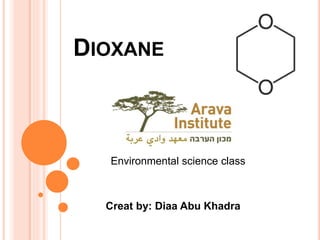
DIOXANE
Creat by: Diaa Abu Khadra
Environmental science class
WHAT IS DIOXANE ?
 Is a heterocyclic organic compound, classified as
an ether.
 Some Properties:
1. Colorless liquid.
2. Sweet odor.
3. Miscible when it mixed with water.
4. Boiling point (101.1 °C).
5. Resistant to naturally occurring biodegradation
processes.
USES FOR DIOXANE ?
 Solvent for a variety of practical applications.
 Stabilizer for the transport of chlorinated
hydrocarbons.
 Used as an internal standard for nuclear magnetic
resonance.
PERMISSION EXPOSURE LIMITS
 Dioxane has an (PEL) 100 ppm (360 mg/m3) skin.
 Dioxane has an LD50 of 5170 mg/kg in rats.
HEALTH & ENVIRONMENTAL HAZARDS
 Cause irritating to the eyes and respiratory tract.
Exposure may cause damage to the central
nervous system, liver and kidneys.
 Has affected groundwater supplies, is highly
soluble in water, does not readily bind to soils, and
readily leaches to groundwater.
 Has low toxicity to aquatic life and can be
biodegraded via a number of pathways.
REFERENCES
 Wisconsin Department of Health Services (2013) 1,4-Dioxane Fact Sheet.
Publication 00514. Accessed on 2016-11-12.
 Surprenant, Kenneth S. (2000). "Dioxane in Ullmann's Encyclopedia of
Industrial Chemistry". doi:10.1002/14356007.a08_545.
 "NIOSH Pocket Guide to Chemical Hazards #0237". National Institute for
Occupational Safety and Health (NIOSH).
 Kinne, Matthias; Poraj-Kobielska, Marzena; Ralph, Sally A.; Ullrich, René;
Hofrichter, Martin; Hammel, Kenneth E. (2009). "Oxidative cleavage of
diverse ethers by an
Thanks for Listening

Dioxane

  • 1.
    DIOXANE Creat by: DiaaAbu Khadra Environmental science class
  • 2.
    WHAT IS DIOXANE?  Is a heterocyclic organic compound, classified as an ether.  Some Properties: 1. Colorless liquid. 2. Sweet odor. 3. Miscible when it mixed with water. 4. Boiling point (101.1 °C). 5. Resistant to naturally occurring biodegradation processes.
  • 3.
    USES FOR DIOXANE?  Solvent for a variety of practical applications.  Stabilizer for the transport of chlorinated hydrocarbons.  Used as an internal standard for nuclear magnetic resonance.
  • 4.
    PERMISSION EXPOSURE LIMITS Dioxane has an (PEL) 100 ppm (360 mg/m3) skin.  Dioxane has an LD50 of 5170 mg/kg in rats.
  • 5.
    HEALTH & ENVIRONMENTALHAZARDS  Cause irritating to the eyes and respiratory tract. Exposure may cause damage to the central nervous system, liver and kidneys.  Has affected groundwater supplies, is highly soluble in water, does not readily bind to soils, and readily leaches to groundwater.  Has low toxicity to aquatic life and can be biodegraded via a number of pathways.
  • 6.
    REFERENCES  Wisconsin Departmentof Health Services (2013) 1,4-Dioxane Fact Sheet. Publication 00514. Accessed on 2016-11-12.  Surprenant, Kenneth S. (2000). "Dioxane in Ullmann's Encyclopedia of Industrial Chemistry". doi:10.1002/14356007.a08_545.  "NIOSH Pocket Guide to Chemical Hazards #0237". National Institute for Occupational Safety and Health (NIOSH).  Kinne, Matthias; Poraj-Kobielska, Marzena; Ralph, Sally A.; Ullrich, René; Hofrichter, Martin; Hammel, Kenneth E. (2009). "Oxidative cleavage of diverse ethers by an
  • 7.