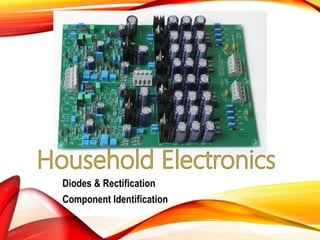
Diodes & Rectification
Component Identification
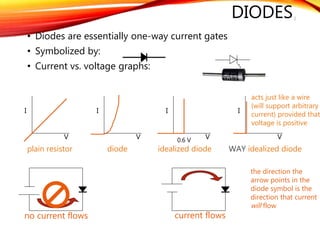
DIODES
• Diodes are essentially one-way current gates
• Symbolized by:
• Current vs. voltage graphs:
2
V
I
V
I
V
I
V
I
0.6 V
plain resistor diode idealized diode WAY idealized diode
no current flows current flows
the direction the
arrow points in the
diode symbol is the
direction that current
will flow
acts just like a wire
(will support arbitrary
current) provided that
voltage is positive
DIODE MAKEUP
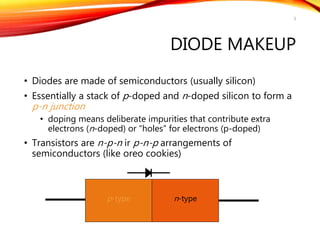
• Diodes are made of semiconductors (usually silicon)
• Essentially a stack of p-doped and n-doped silicon to form a
p-n junction
• doping means deliberate impurities that contribute extra
electrons (n-doped) or “holes” for electrons (p-doped)
• Transistors are n-p-n ir p-n-p arrangements of
semiconductors (like oreo cookies)
3
p-type n-type
LEDS: LIGHT-EMITTING
DIODES
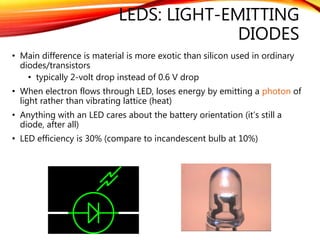
• Main difference is material is more exotic than silicon used in ordinary
diodes/transistors
• typically 2-volt drop instead of 0.6 V drop
• When electron flows through LED, loses energy by emitting a photon of
light rather than vibrating lattice (heat)
• Anything with an LED cares about the battery orientation (it’s still a
diode, after all)
• LED efficiency is 30% (compare to incandescent bulb at 10%)
4
GETTING DC BACK OUT OF
AC
• AC provides a means for us to distribute electrical power, but
most devices actually want DC
• bulbs, toasters, heaters, fans don’t care: plug straight in
• sophisticated devices care because they have diodes and
transistors that require a certain polarity
• rather than oscillating polarity derived from AC
• this is why battery orientation matters in most electronics
• Use diodes to “rectify” AC signal
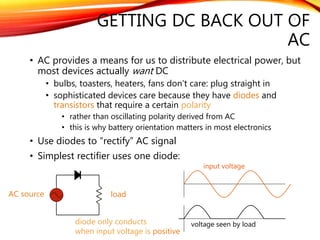
• Simplest rectifier uses one diode:
5
AC source load
input voltage
voltage seen by load
diode only conducts
when input voltage is positive
DOING BETTER: FULL-
WAVE DIODE BRIDGE
• The diode in the rectifying circuit simply prevented the negative
swing of voltage from conducting
• but this wastes half the available cycle
• also very irregular (bumpy): far from a “good” DC source
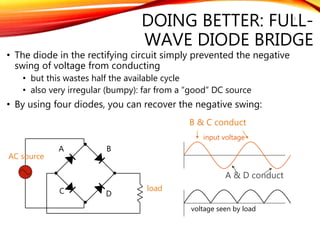
• By using four diodes, you can recover the negative swing:
6
A
C
B
D
AC source
load
input voltage
voltage seen by load
B & C conduct
A & D conduct
SMOOTHING OUT THE BUMPS
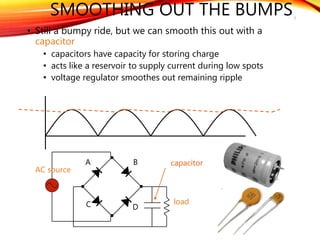
• Still a bumpy ride, but we can smooth this out with a
capacitor
• capacitors have capacity for storing charge
• acts like a reservoir to supply current during low spots
• voltage regulator smoothes out remaining ripple
7
A
C
B
D
AC source
load
capacitor
VOLTAGE REGULATOR: SETTING THE
VOLTAGE
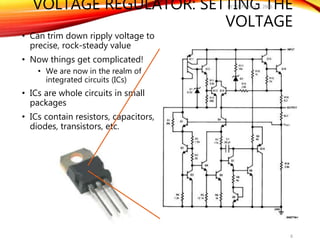
• Can trim down ripply voltage to
precise, rock-steady value
• Now things get complicated!
• We are now in the realm of
integrated circuits (ICs)
• ICs are whole circuits in small
packages
• ICs contain resistors, capacitors,
diodes, transistors, etc.
UCSD: Physics 8; 2006
8
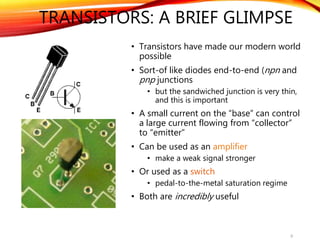
TRANSISTORS: A BRIEF GLIMPSE
• Transistors have made our modern world
possible
• Sort-of like diodes end-to-end (npn and
pnp junctions
• but the sandwiched junction is very thin,
and this is important
• A small current on the “base” can control
a large current flowing from “collector”
to “emitter”
• Can be used as an amplifier
• make a weak signal stronger
• Or used as a switch
• pedal-to-the-metal saturation regime
• Both are incredibly useful
9
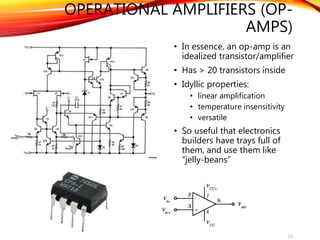
OPERATIONAL AMPLIFIERS (OP-
AMPS)
• In essence, an op-amp is an
idealized transistor/amplifier
• Has > 20 transistors inside
• Idyllic properties:
• linear amplification
• temperature insensitivity
• versatile
• So useful that electronics
builders have trays full of
them, and use them like
“jelly-beans”
10

DIODES.ppt

  • 1.
  • 2.
    DIODES • Diodes areessentially one-way current gates • Symbolized by: • Current vs. voltage graphs: 2 V I V I V I V I 0.6 V plain resistor diode idealized diode WAY idealized diode no current flows current flows the direction the arrow points in the diode symbol is the direction that current will flow acts just like a wire (will support arbitrary current) provided that voltage is positive
  • 3.
    DIODE MAKEUP • Diodesare made of semiconductors (usually silicon) • Essentially a stack of p-doped and n-doped silicon to form a p-n junction • doping means deliberate impurities that contribute extra electrons (n-doped) or “holes” for electrons (p-doped) • Transistors are n-p-n ir p-n-p arrangements of semiconductors (like oreo cookies) 3 p-type n-type
  • 4.
    LEDS: LIGHT-EMITTING DIODES • Maindifference is material is more exotic than silicon used in ordinary diodes/transistors • typically 2-volt drop instead of 0.6 V drop • When electron flows through LED, loses energy by emitting a photon of light rather than vibrating lattice (heat) • Anything with an LED cares about the battery orientation (it’s still a diode, after all) • LED efficiency is 30% (compare to incandescent bulb at 10%) 4
  • 5.
    GETTING DC BACKOUT OF AC • AC provides a means for us to distribute electrical power, but most devices actually want DC • bulbs, toasters, heaters, fans don’t care: plug straight in • sophisticated devices care because they have diodes and transistors that require a certain polarity • rather than oscillating polarity derived from AC • this is why battery orientation matters in most electronics • Use diodes to “rectify” AC signal • Simplest rectifier uses one diode: 5 AC source load input voltage voltage seen by load diode only conducts when input voltage is positive
  • 6.
    DOING BETTER: FULL- WAVEDIODE BRIDGE • The diode in the rectifying circuit simply prevented the negative swing of voltage from conducting • but this wastes half the available cycle • also very irregular (bumpy): far from a “good” DC source • By using four diodes, you can recover the negative swing: 6 A C B D AC source load input voltage voltage seen by load B & C conduct A & D conduct
  • 7.
    SMOOTHING OUT THEBUMPS • Still a bumpy ride, but we can smooth this out with a capacitor • capacitors have capacity for storing charge • acts like a reservoir to supply current during low spots • voltage regulator smoothes out remaining ripple 7 A C B D AC source load capacitor
  • 8.
    VOLTAGE REGULATOR: SETTINGTHE VOLTAGE • Can trim down ripply voltage to precise, rock-steady value • Now things get complicated! • We are now in the realm of integrated circuits (ICs) • ICs are whole circuits in small packages • ICs contain resistors, capacitors, diodes, transistors, etc. UCSD: Physics 8; 2006 8
  • 9.
    TRANSISTORS: A BRIEFGLIMPSE • Transistors have made our modern world possible • Sort-of like diodes end-to-end (npn and pnp junctions • but the sandwiched junction is very thin, and this is important • A small current on the “base” can control a large current flowing from “collector” to “emitter” • Can be used as an amplifier • make a weak signal stronger • Or used as a switch • pedal-to-the-metal saturation regime • Both are incredibly useful 9
  • 10.
    OPERATIONAL AMPLIFIERS (OP- AMPS) •In essence, an op-amp is an idealized transistor/amplifier • Has > 20 transistors inside • Idyllic properties: • linear amplification • temperature insensitivity • versatile • So useful that electronics builders have trays full of them, and use them like “jelly-beans” 10

Editor's Notes