D witiya Agneyastri H erlin Widasiwi s. S yafrizal Fuady CONTENTS: Cover Concept of Hypertext What is Hypertext? Hypertext and Hypermedia Advantages of Hypertext Problems with Hypertext Hypertext Application Hypertext in Education Hypertext in Language Learning ICT
The concept of hypertext is initially pioneered by  Vannevar Bush , who is known as  the “grandfather” of hypertext , in 1945.  H e described  the first hypermedia system, named  memex   ( mem ory  ex tender) .  He wrote about it in his article  “ As We May Think ”. Ted Nelson  (1967), one of the pioneers of hypertext, created a project  called  Xanadu . It was stimulated from the Bush’s idea about the  memex. Anzel ,  et al , (1992:124) state that “the recent interest in hypertext concepts in computer science can be explained by the fact that we can now support non-linearity with computers, thus making it much easier and faster for reader to follow up cross references. Modern computers, furthermore, allow us to expand the notion of text to include not only texts and pictures as in printed texts, but also sound, music, animation and video in a single hypertext system.” CONTENTS: Cover Concept of Hypertext What is Hypertext? Hypertext and Hypermedia Advantages of Hypertext Problems with Hypertext Hypertext Application Hypertext in Education Hypertext in Language Learning
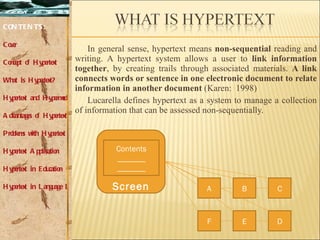
In general sense, hypertext means  non-sequential  reading and writing. A hypertext system allows a user to  link information together , by creating trails through associated materials.  A link connects words or sentence in one electronic document to relate information in another document  (Karen:  1998) Lucarella defines hypertext as a system to manage a collection of information that can be assessed non-sequentially. CONTENTS: Cover Concept of Hypertext What is Hypertext? Hypertext and Hypermedia Advantages of Hypertext Problems with Hypertext Hypertext Application Hypertext in Education Hypertext in Language Learning Screen Contents _______ _______ A B C D E F
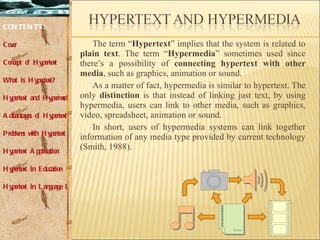
The term “ Hypertext ” implies that the system is related to  plain text . The term “ Hypermedia ” sometimes used since there’s a possibility of  connecting hypertext with other media , such as graphics, animation or sound. As a matter of fact, hypermedia is similar to hypertext. The only  distinction  is that instead of linking just text, by using hypermedia, users can link to other media, such as graphics, video, spreadsheet, animation or sound. In short, users of hypermedia systems can link together information of any media type provided by current technology (Smith, 1988). CONTENTS: Cover Concept of Hypertext What is Hypertext? Hypertext and Hypermedia Advantages of Hypertext Problems with Hypertext Hypertext Application Hypertext in Education Hypertext in Language Learning
Simultaneous Multiple Paths of Inquiry /exploration Individual learning opportunities Reader control Non-Linear information Structure Updating Information Critical Thinking Embedded text Asynchronous communication CONTENTS: Cover Concept of Hypertext What is Hypertext? Hypertext and Hypermedia Advantages of Hypertext Problems with Hypertext Hypertext Application Hypertext in Education Hypertext in Language Learning
Our sentences work best when they have a subject, object, and verb. Our stories work best when they have an ending. As we surf the Internet, we're in danger of forgetting this basic truth.  With hyper-text, endings are irrelevant, because no one ever gets to one. Reading gives way to surfing, a meandering peripatetic journey through a maze of threads. The surfer creates his or her own narrative, opting for the most seductive link immediately available.  As a research technique, this is superb. As a mode of thought however, it has serious deficiencies. Faster is not always better and segmentation is not always smarter.  CONTENTS: Cover Concept of Hypertext What is Hypertext? Hypertext and Hypermedia Advantages of Hypertext Problems with Hypertext Hypertext Application Hypertext in Education Hypertext in Language Learning
Due to the capability of the hypertext system as a  computer medium (this enables users to navigate and  browse information), the application of hypertext is,  now, being developed. Some of hypertext applications  are listed below: Business Information resources  Personal learning CONTENTS: Cover Concept of Hypertext What is Hypertext? Hypertext and Hypermedia Advantages of Hypertext Problems with Hypertext Hypertext Application Hypertext in Education Hypertext in Language Learning
Its interactive capability and flexibility  Its ability to allow the teacher or designer to expand the notion of text including pictures, sounds, music, animation and video  Its ability to give individual attention to a learner or user, at the console and replies to the system  Its ability in enabling students or users to choose and learn any topic of his or her own interest  CONTENTS: Cover Concept of Hypertext What is Hypertext? Hypertext and Hypermedia Advantages of Hypertext Problems with Hypertext Hypertext Application Hypertext in Education Hypertext in Language Learning
The increasing interest to apply hypertext system for  language learning and teaching purposes is due to the  capability of hypertext-interactive capability and flexibility- as a computer medium . As a matter of fact, hypertext system can be implemented in learning of all languages skills – listening, speaking, reading, and writing – and also language aspects (components), such  as vocabulary or grammar. CONTENTS: Cover Concept of Hypertext What is Hypertext? Hypertext and Hypermedia Advantages of Hypertext Problems with Hypertext Hypertext Application Hypertext in Education Hypertext in Language Learning
THANK YOU

Hypertext system new1

  • 1.
    D witiya AgneyastriH erlin Widasiwi s. S yafrizal Fuady CONTENTS: Cover Concept of Hypertext What is Hypertext? Hypertext and Hypermedia Advantages of Hypertext Problems with Hypertext Hypertext Application Hypertext in Education Hypertext in Language Learning ICT
  • 2.
    The concept ofhypertext is initially pioneered by Vannevar Bush , who is known as the “grandfather” of hypertext , in 1945. H e described the first hypermedia system, named memex ( mem ory ex tender) . He wrote about it in his article “ As We May Think ”. Ted Nelson (1967), one of the pioneers of hypertext, created a project called Xanadu . It was stimulated from the Bush’s idea about the memex. Anzel , et al , (1992:124) state that “the recent interest in hypertext concepts in computer science can be explained by the fact that we can now support non-linearity with computers, thus making it much easier and faster for reader to follow up cross references. Modern computers, furthermore, allow us to expand the notion of text to include not only texts and pictures as in printed texts, but also sound, music, animation and video in a single hypertext system.” CONTENTS: Cover Concept of Hypertext What is Hypertext? Hypertext and Hypermedia Advantages of Hypertext Problems with Hypertext Hypertext Application Hypertext in Education Hypertext in Language Learning
  • 3.
    In general sense,hypertext means non-sequential reading and writing. A hypertext system allows a user to link information together , by creating trails through associated materials. A link connects words or sentence in one electronic document to relate information in another document (Karen: 1998) Lucarella defines hypertext as a system to manage a collection of information that can be assessed non-sequentially. CONTENTS: Cover Concept of Hypertext What is Hypertext? Hypertext and Hypermedia Advantages of Hypertext Problems with Hypertext Hypertext Application Hypertext in Education Hypertext in Language Learning Screen Contents _______ _______ A B C D E F
  • 4.
    The term “Hypertext ” implies that the system is related to plain text . The term “ Hypermedia ” sometimes used since there’s a possibility of connecting hypertext with other media , such as graphics, animation or sound. As a matter of fact, hypermedia is similar to hypertext. The only distinction is that instead of linking just text, by using hypermedia, users can link to other media, such as graphics, video, spreadsheet, animation or sound. In short, users of hypermedia systems can link together information of any media type provided by current technology (Smith, 1988). CONTENTS: Cover Concept of Hypertext What is Hypertext? Hypertext and Hypermedia Advantages of Hypertext Problems with Hypertext Hypertext Application Hypertext in Education Hypertext in Language Learning
  • 5.
    Simultaneous Multiple Pathsof Inquiry /exploration Individual learning opportunities Reader control Non-Linear information Structure Updating Information Critical Thinking Embedded text Asynchronous communication CONTENTS: Cover Concept of Hypertext What is Hypertext? Hypertext and Hypermedia Advantages of Hypertext Problems with Hypertext Hypertext Application Hypertext in Education Hypertext in Language Learning
  • 6.
    Our sentences workbest when they have a subject, object, and verb. Our stories work best when they have an ending. As we surf the Internet, we're in danger of forgetting this basic truth. With hyper-text, endings are irrelevant, because no one ever gets to one. Reading gives way to surfing, a meandering peripatetic journey through a maze of threads. The surfer creates his or her own narrative, opting for the most seductive link immediately available. As a research technique, this is superb. As a mode of thought however, it has serious deficiencies. Faster is not always better and segmentation is not always smarter. CONTENTS: Cover Concept of Hypertext What is Hypertext? Hypertext and Hypermedia Advantages of Hypertext Problems with Hypertext Hypertext Application Hypertext in Education Hypertext in Language Learning
  • 7.
    Due to thecapability of the hypertext system as a  computer medium (this enables users to navigate and  browse information), the application of hypertext is,  now, being developed. Some of hypertext applications  are listed below: Business Information resources Personal learning CONTENTS: Cover Concept of Hypertext What is Hypertext? Hypertext and Hypermedia Advantages of Hypertext Problems with Hypertext Hypertext Application Hypertext in Education Hypertext in Language Learning
  • 8.
    Its interactive capabilityand flexibility Its ability to allow the teacher or designer to expand the notion of text including pictures, sounds, music, animation and video Its ability to give individual attention to a learner or user, at the console and replies to the system Its ability in enabling students or users to choose and learn any topic of his or her own interest CONTENTS: Cover Concept of Hypertext What is Hypertext? Hypertext and Hypermedia Advantages of Hypertext Problems with Hypertext Hypertext Application Hypertext in Education Hypertext in Language Learning
  • 9.
    The increasing interestto apply hypertext system for  language learning and teaching purposes is due to the  capability of hypertext-interactive capability and flexibility- as a computer medium . As a matter of fact, hypertext system can be implemented in learning of all languages skills – listening, speaking, reading, and writing – and also language aspects (components), such  as vocabulary or grammar. CONTENTS: Cover Concept of Hypertext What is Hypertext? Hypertext and Hypermedia Advantages of Hypertext Problems with Hypertext Hypertext Application Hypertext in Education Hypertext in Language Learning
  • 10.