Dr. Mohamed SamehSalem
Contact Info:-
Email: ms.salem@mu.edu.sa
Mobile: 0545350311
1
Lecture (12)
Thermodynamics II
ME 252
Dr. Mohamed S. Salem
المجمعة جامعة
الهندسة كلية
الصناعية و الميكانيكية الهندسة قسم
2.
Air Standard PowerCycles
Chapter Three
This chapter studies the basic power cycles using air as a medium for transferring the
energy. It is mixed with fuel, burned, then expanded to generate work. The most common
cycles are:
1. Otto Cycle.
2. Diesel Cycle.
3. Dual Cycle.
4. Brayton (Joule) Cycle.
5
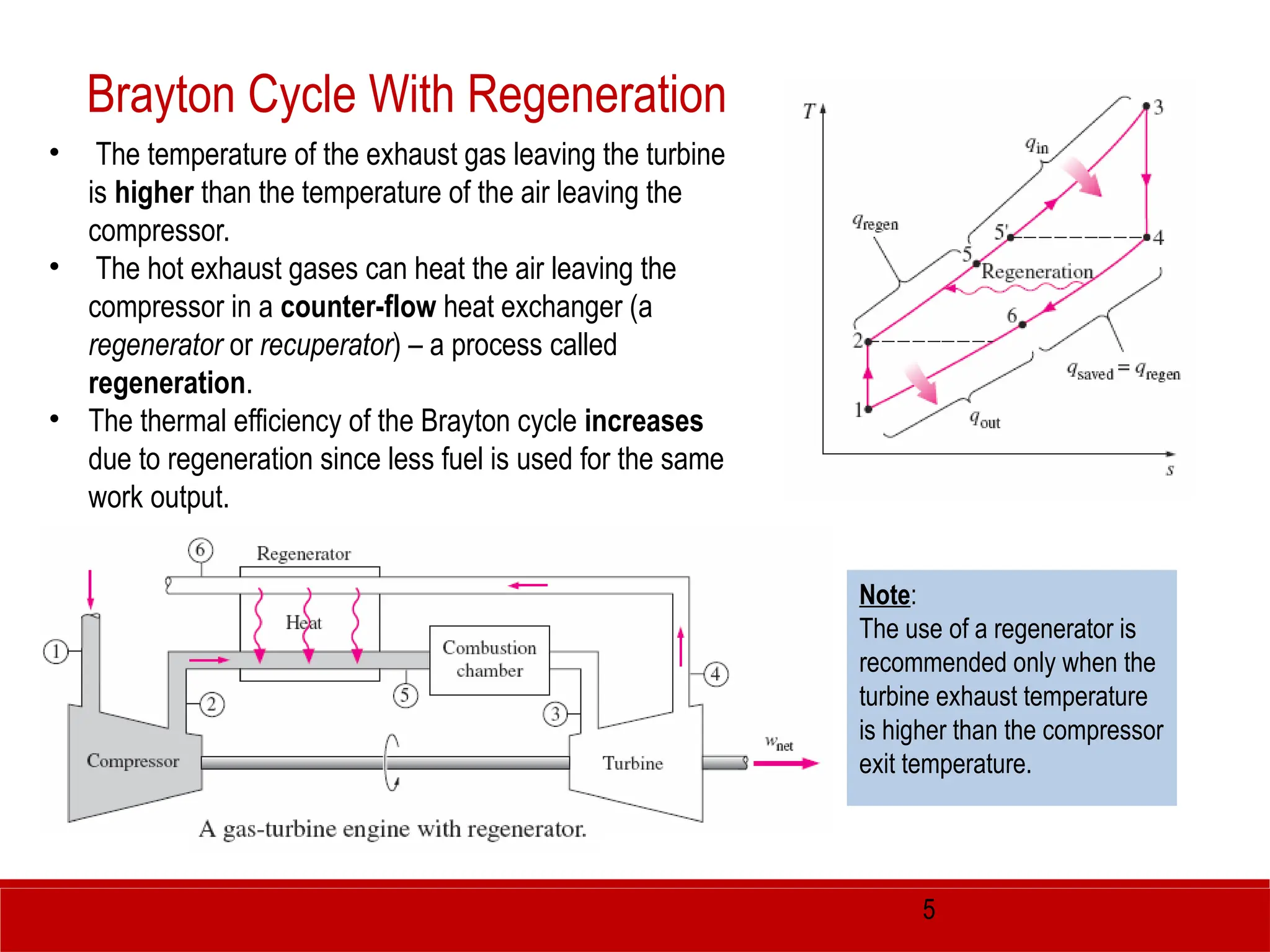
Brayton Cycle WithRegeneration
• The temperature of the exhaust gas leaving the turbine
is higher than the temperature of the air leaving the
compressor.
• The hot exhaust gases can heat the air leaving the
compressor in a counter-flow heat exchanger (a
regenerator or recuperator) – a process called
regeneration.
• The thermal efficiency of the Brayton cycle increases
due to regeneration since less fuel is used for the same
work output.
Note:
The use of a regenerator is
recommended only when the
turbine exhaust temperature
is higher than the compressor
exit temperature.
6.
6
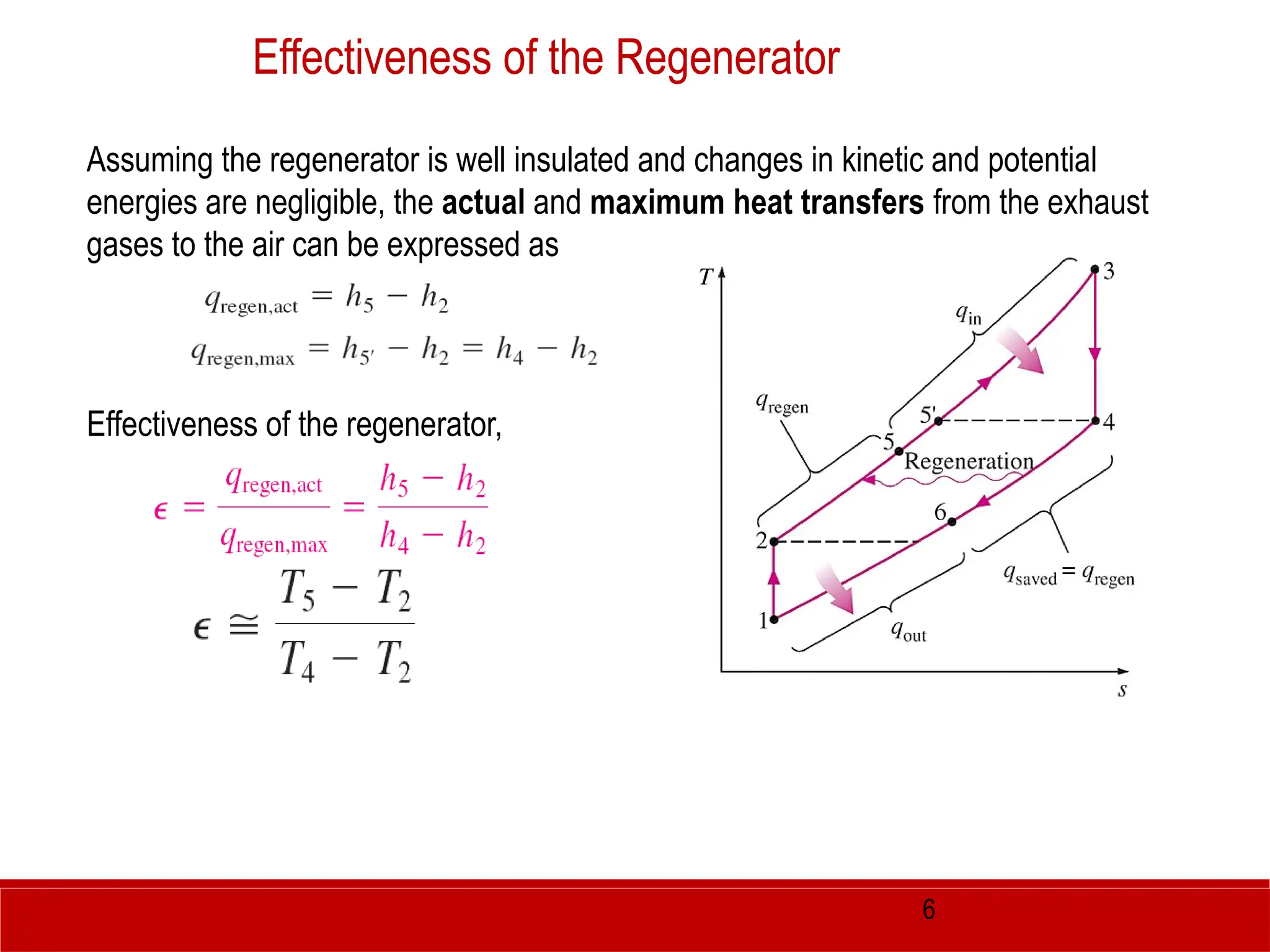
Effectiveness of theregenerator,
Effectiveness of the Regenerator
Assuming the regenerator is well insulated and changes in kinetic and potential
energies are negligible, the actual and maximum heat transfers from the exhaust
gases to the air can be expressed as
7.
7
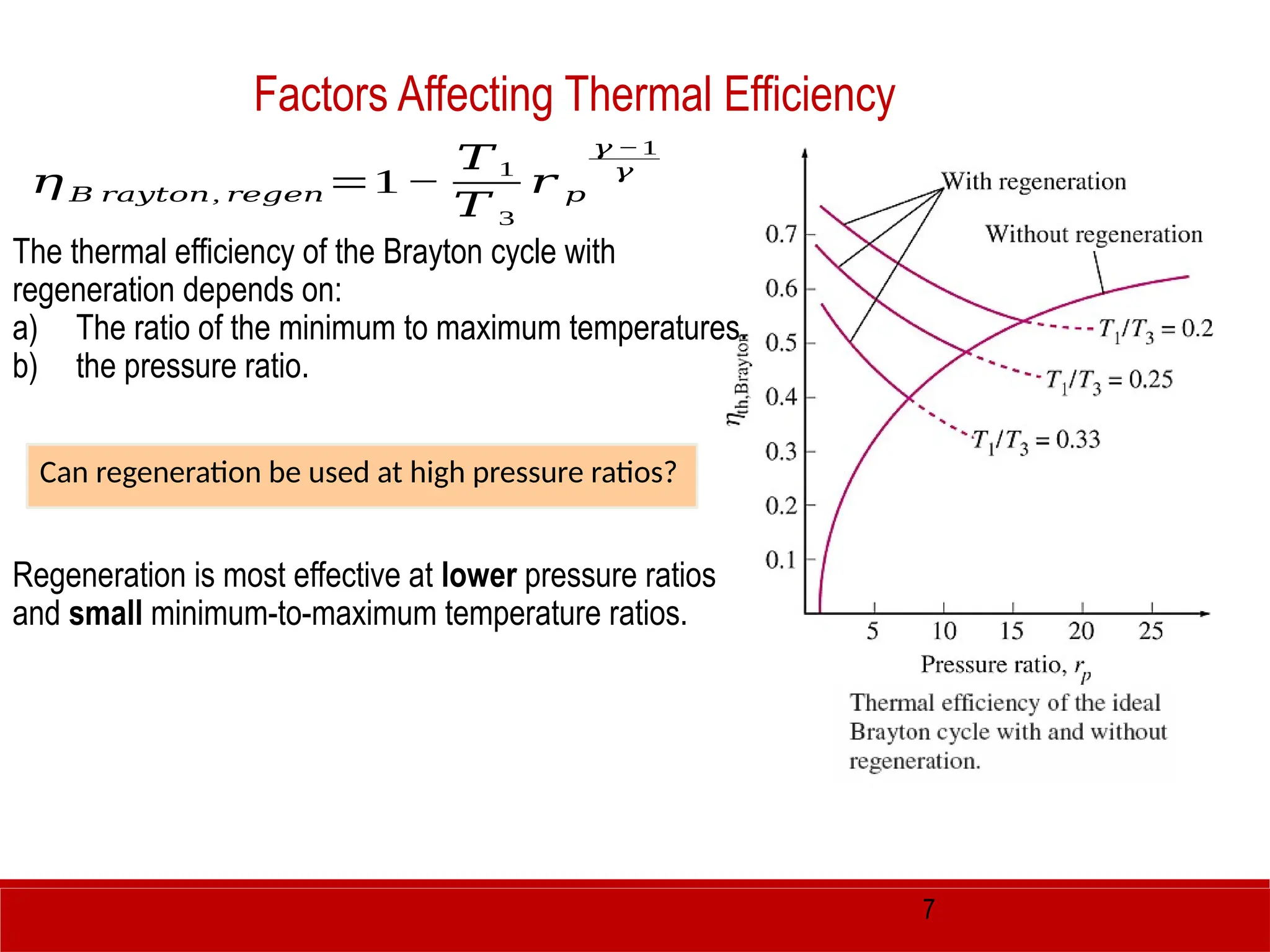
The thermal efficiencyof the Brayton cycle with
regeneration depends on:
a) The ratio of the minimum to maximum temperatures.
b) the pressure ratio.
Regeneration is most effective at lower pressure ratios
and small minimum-to-maximum temperature ratios.
Factors Affecting Thermal Efficiency
Can regeneration be used at high pressure ratios?
𝜂 𝐵 𝑟𝑎𝑦𝑡𝑜𝑛, 𝑟𝑒𝑔𝑒𝑛=1−
𝑇1
𝑇 3
𝑟 𝑝
𝛾 −1
𝛾
8.
8
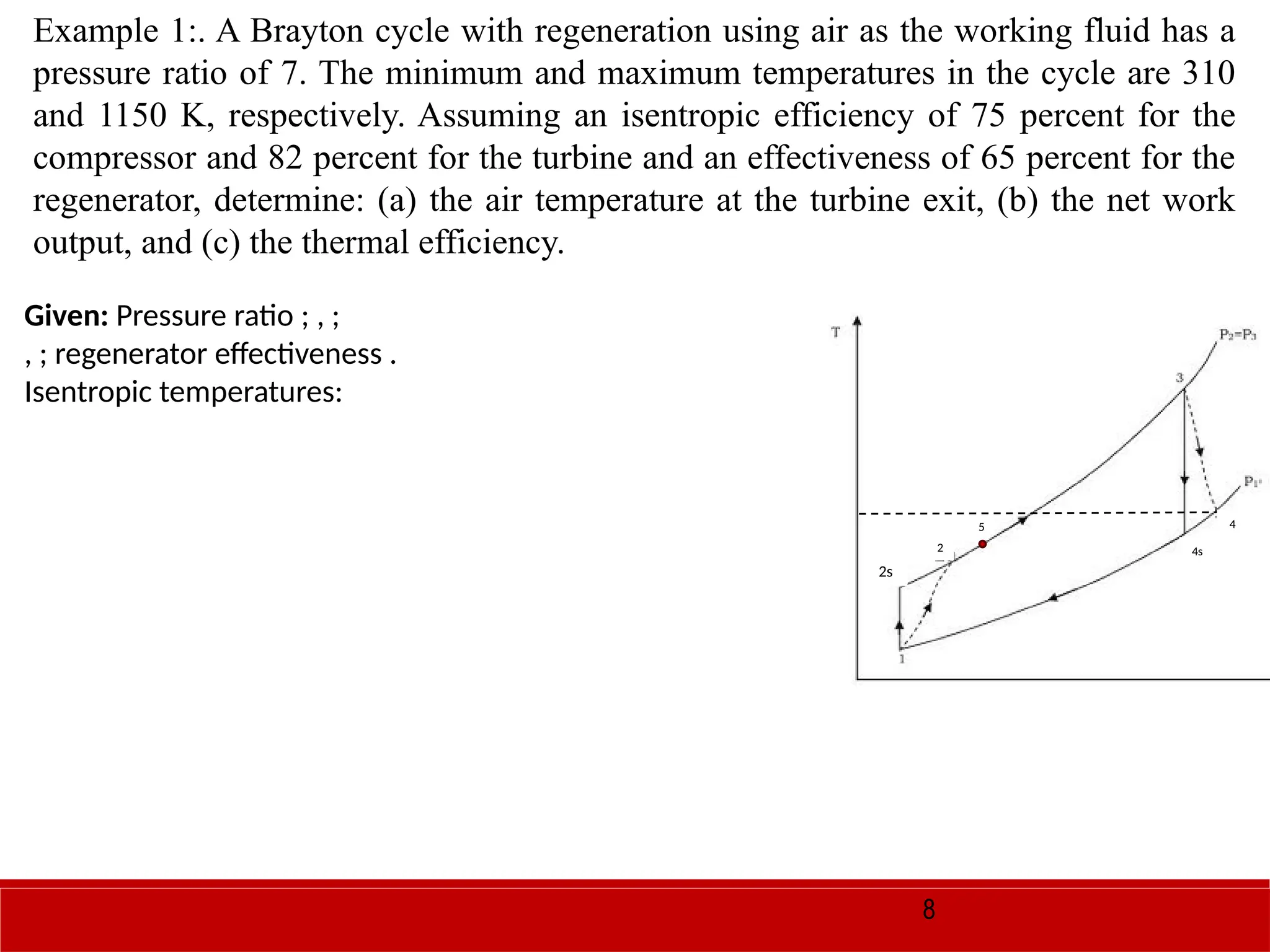
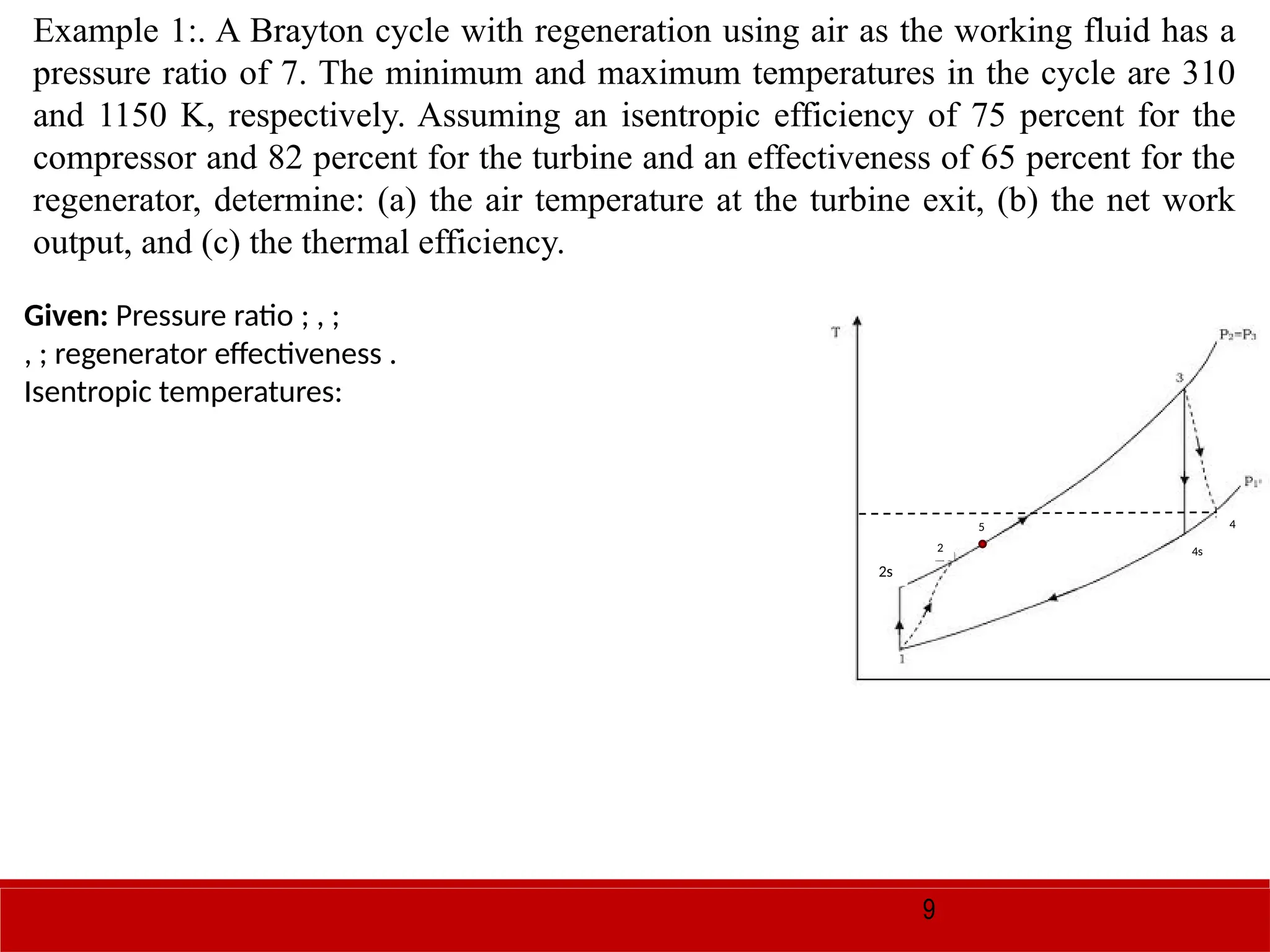
Example 1:. ABrayton cycle with regeneration using air as the working fluid has a
pressure ratio of 7. The minimum and maximum temperatures in the cycle are 310
and 1150 K, respectively. Assuming an isentropic efficiency of 75 percent for the
compressor and 82 percent for the turbine and an effectiveness of 65 percent for the
regenerator, determine: (a) the air temperature at the turbine exit, (b) the net work
output, and (c) the thermal efficiency.
Given: Pressure ratio ; , ;
, ; regenerator effectiveness .
Isentropic temperatures:
4s
4
2s
2
5
9.
9
Example 1:. ABrayton cycle with regeneration using air as the working fluid has a
pressure ratio of 7. The minimum and maximum temperatures in the cycle are 310
and 1150 K, respectively. Assuming an isentropic efficiency of 75 percent for the
compressor and 82 percent for the turbine and an effectiveness of 65 percent for the
regenerator, determine: (a) the air temperature at the turbine exit, (b) the net work
output, and (c) the thermal efficiency.
Given: Pressure ratio ; , ;
, ; regenerator effectiveness .
Isentropic temperatures:
4s
4
2s
2
5
10.
10
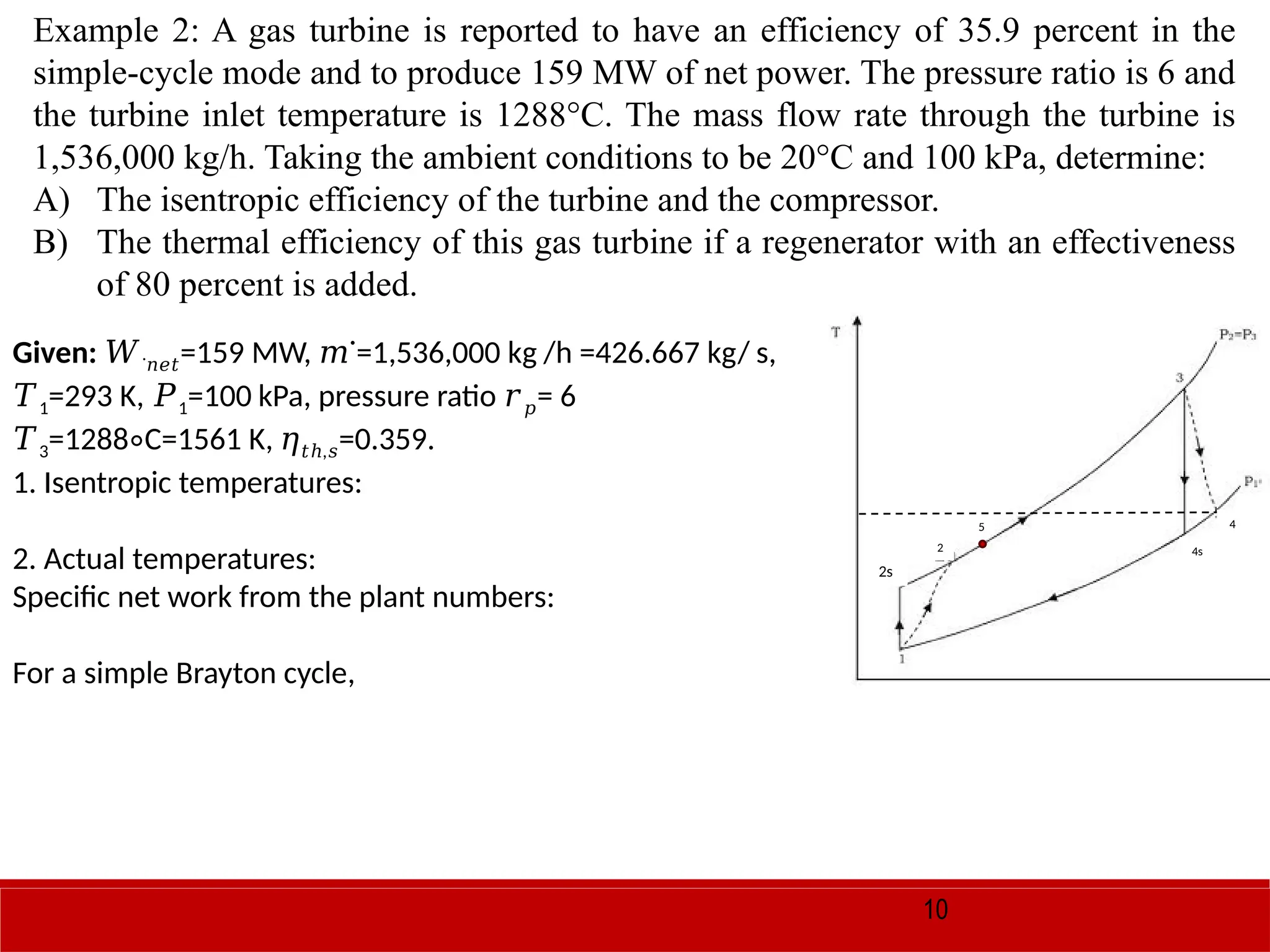
Example 2: Agas turbine is reported to have an efficiency of 35.9 percent in the
simple-cycle mode and to produce 159 MW of net power. The pressure ratio is 6 and
the turbine inlet temperature is 1288°C. The mass flow rate through the turbine is
1,536,000 kg/h. Taking the ambient conditions to be 20°C and 100 kPa, determine:
A) The isentropic efficiency of the turbine and the compressor.
B) The thermal efficiency of this gas turbine if a regenerator with an effectiveness
of 80 percent is added.
Given: 𝑊˙𝑛𝑒𝑡=159 MW, ˙=1,536,000 kg /h =426.667 kg/ s,
𝑚
𝑇1=293 K, 𝑃1=100 kPa, pressure ratio 𝑟𝑝= 6
𝑇3=1288 C=1561 K,
∘ 𝜂 ,
𝑡ℎ 𝑠=0.359.
1. Isentropic temperatures:
2. Actual temperatures:
Specific net work from the plant numbers:
For a simple Brayton cycle,
4s
4
2s
2
5
11.
11
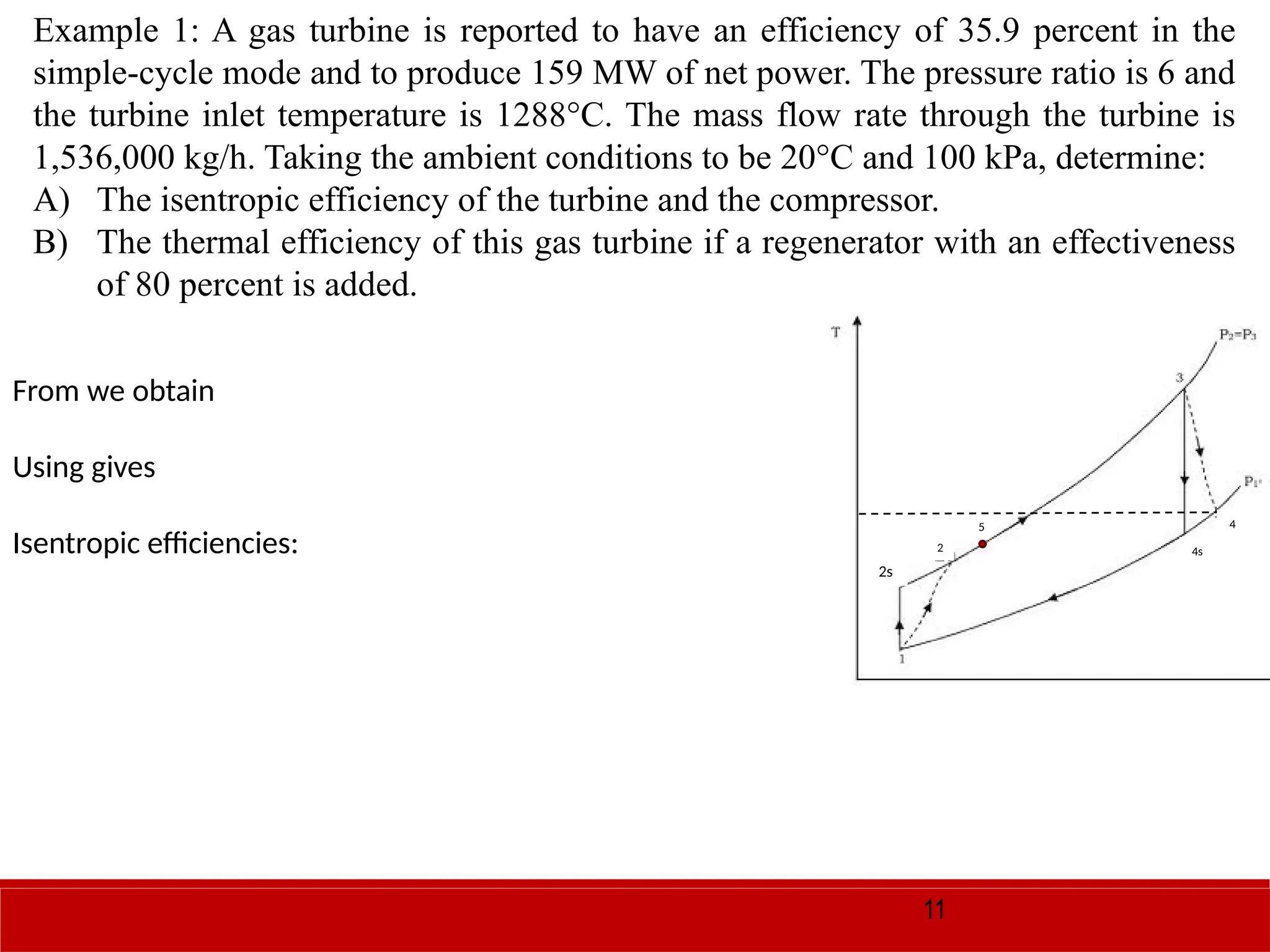
Example 1: Agas turbine is reported to have an efficiency of 35.9 percent in the
simple-cycle mode and to produce 159 MW of net power. The pressure ratio is 6 and
the turbine inlet temperature is 1288°C. The mass flow rate through the turbine is
1,536,000 kg/h. Taking the ambient conditions to be 20°C and 100 kPa, determine:
A) The isentropic efficiency of the turbine and the compressor.
B) The thermal efficiency of this gas turbine if a regenerator with an effectiveness
of 80 percent is added.
From we obtain
Using gives
Isentropic efficiencies: 4s
4
2s
2
5
12.
12
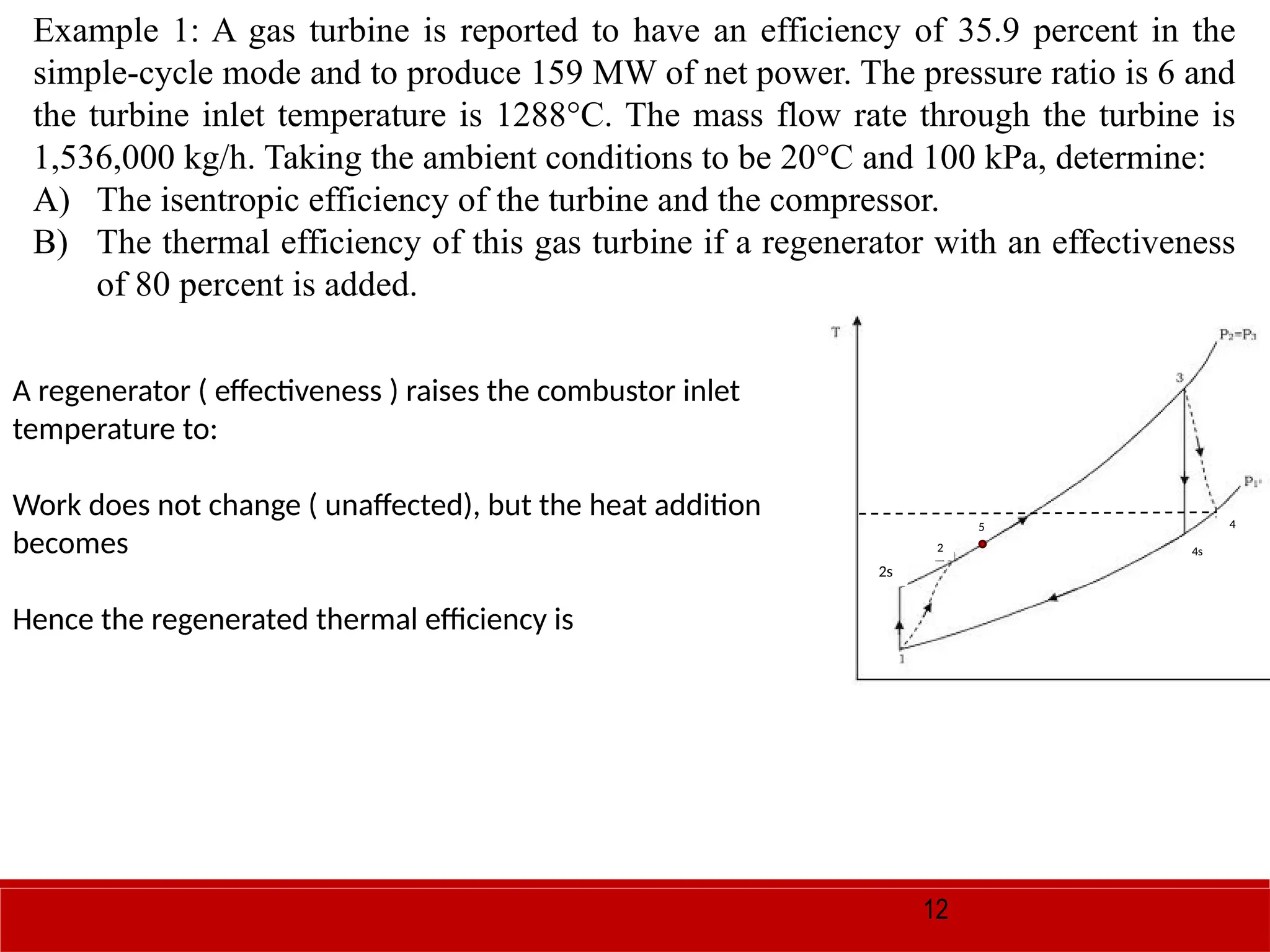
Example 1: Agas turbine is reported to have an efficiency of 35.9 percent in the
simple-cycle mode and to produce 159 MW of net power. The pressure ratio is 6 and
the turbine inlet temperature is 1288°C. The mass flow rate through the turbine is
1,536,000 kg/h. Taking the ambient conditions to be 20°C and 100 kPa, determine:
A) The isentropic efficiency of the turbine and the compressor.
B) The thermal efficiency of this gas turbine if a regenerator with an effectiveness
of 80 percent is added.
A regenerator ( effectiveness ) raises the combustor inlet
temperature to:
Work does not change ( unaffected), but the heat addition
becomes
Hence the regenerated thermal efficiency is
4s
4
2s
2
5
13.
13
Assignment
Air enters thecompressor of a regenerative gas-turbine engine at 300 K and
100 kPa, where it is compressed to 800 kPa and 580 K. The regenerator has an
effectiveness of 72 percent, and the air enters the turbine at 1200 K.
For a turbine efficiency of 86 percent, determine:
a) the amount of heat transfer in the regenerator, and
b) the thermal efficiency.
Answers: (a) 152.5 kJ/kg, (b) 36.0 percent
Brayton Cycles with Regeneration
14.
14
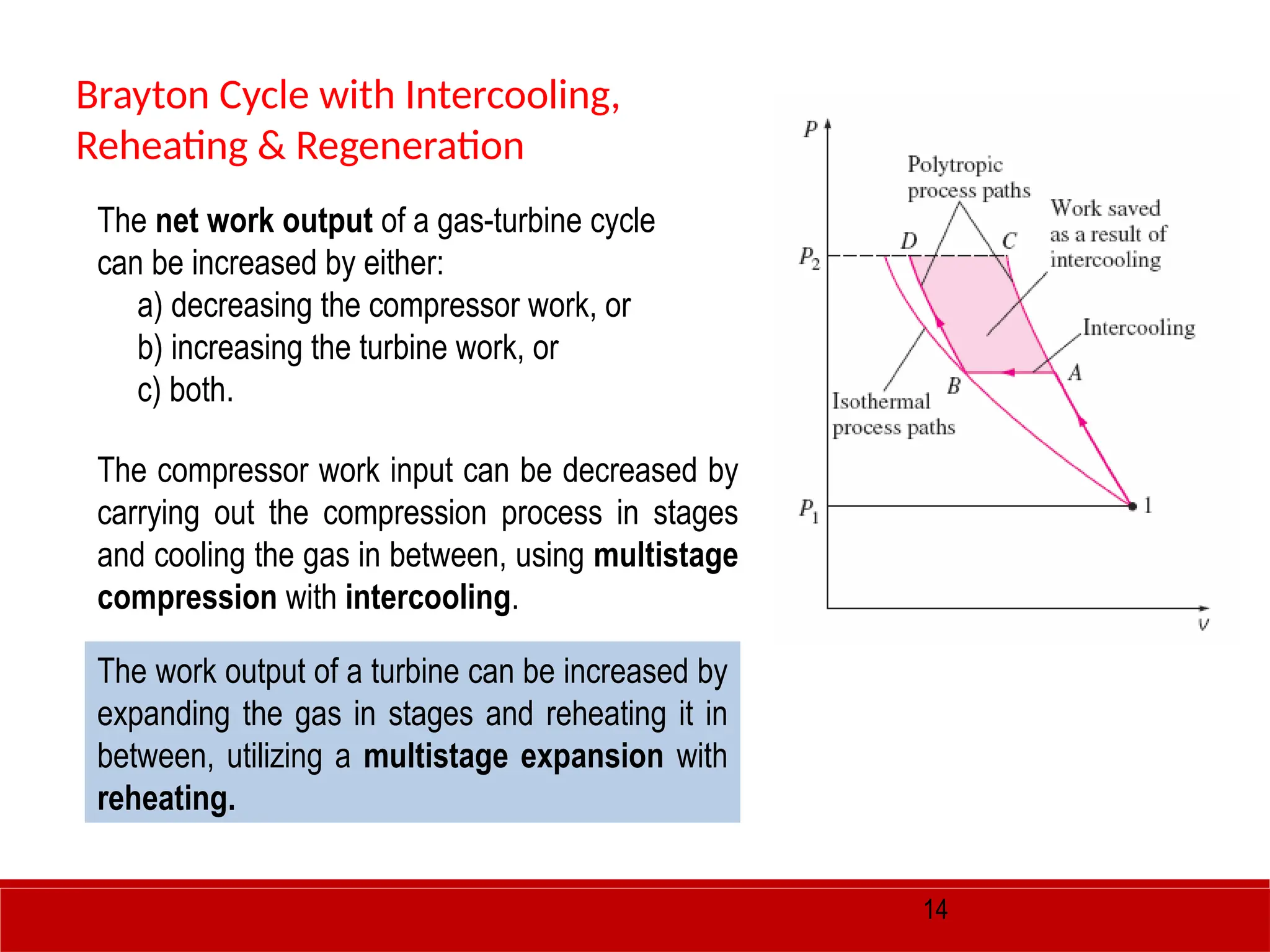
The net workoutput of a gas-turbine cycle
can be increased by either:
a) decreasing the compressor work, or
b) increasing the turbine work, or
c) both.
The compressor work input can be decreased by
carrying out the compression process in stages
and cooling the gas in between, using multistage
compression with intercooling.
The work output of a turbine can be increased by
expanding the gas in stages and reheating it in
between, utilizing a multistage expansion with
reheating.
Brayton Cycle with Intercooling,
Reheating & Regeneration
15.
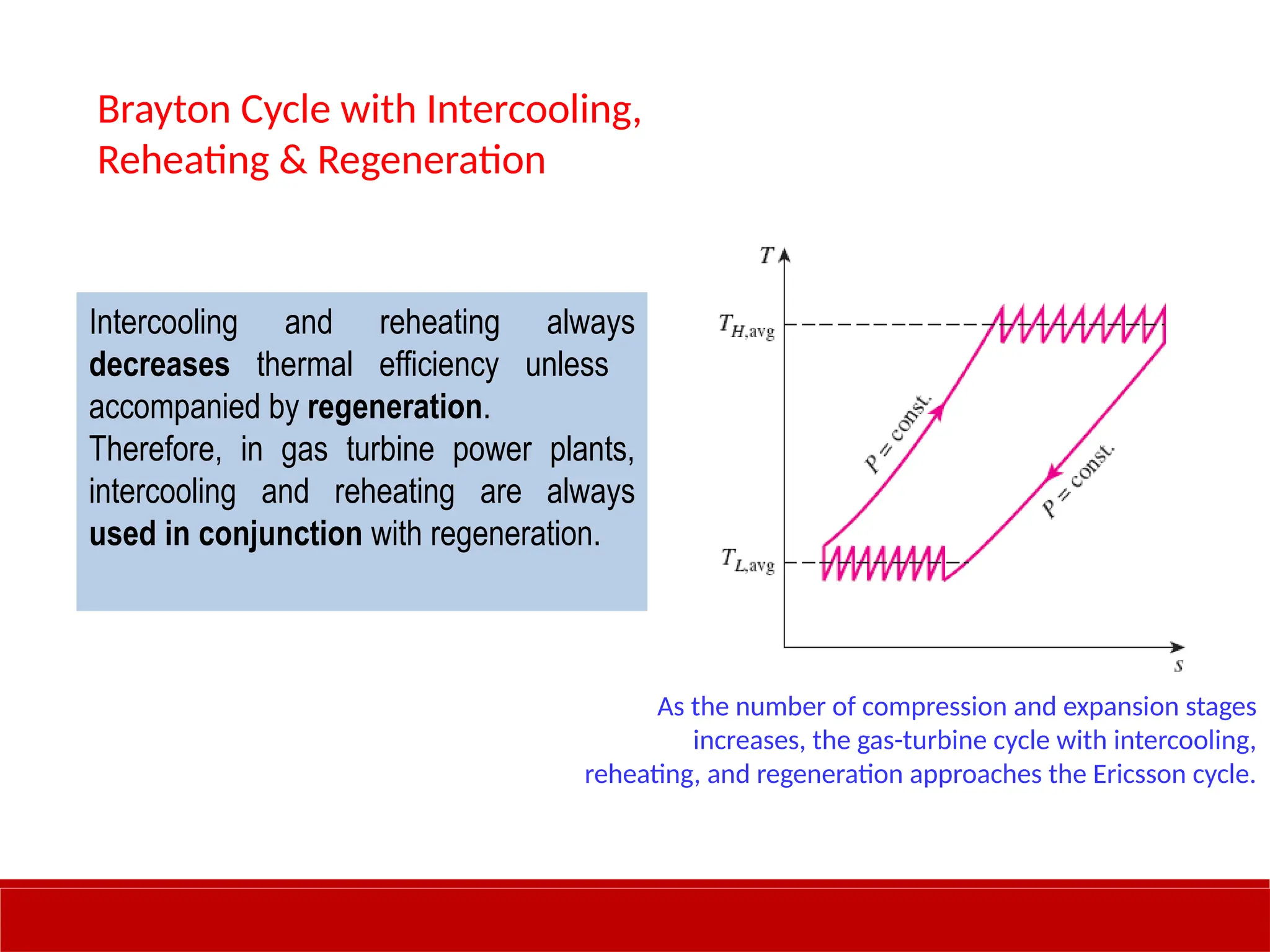
As the numberof compression and expansion stages
increases, the gas-turbine cycle with intercooling,
reheating, and regeneration approaches the Ericsson cycle.
Intercooling and reheating always
decreases thermal efficiency unless
accompanied by regeneration.
Therefore, in gas turbine power plants,
intercooling and reheating are always
used in conjunction with regeneration.
Brayton Cycle with Intercooling,
Reheating & Regeneration
16.
16
THE BRAYTON CYCLEWITH INTERCOOLING,
REHEATING, AND REGENERATION
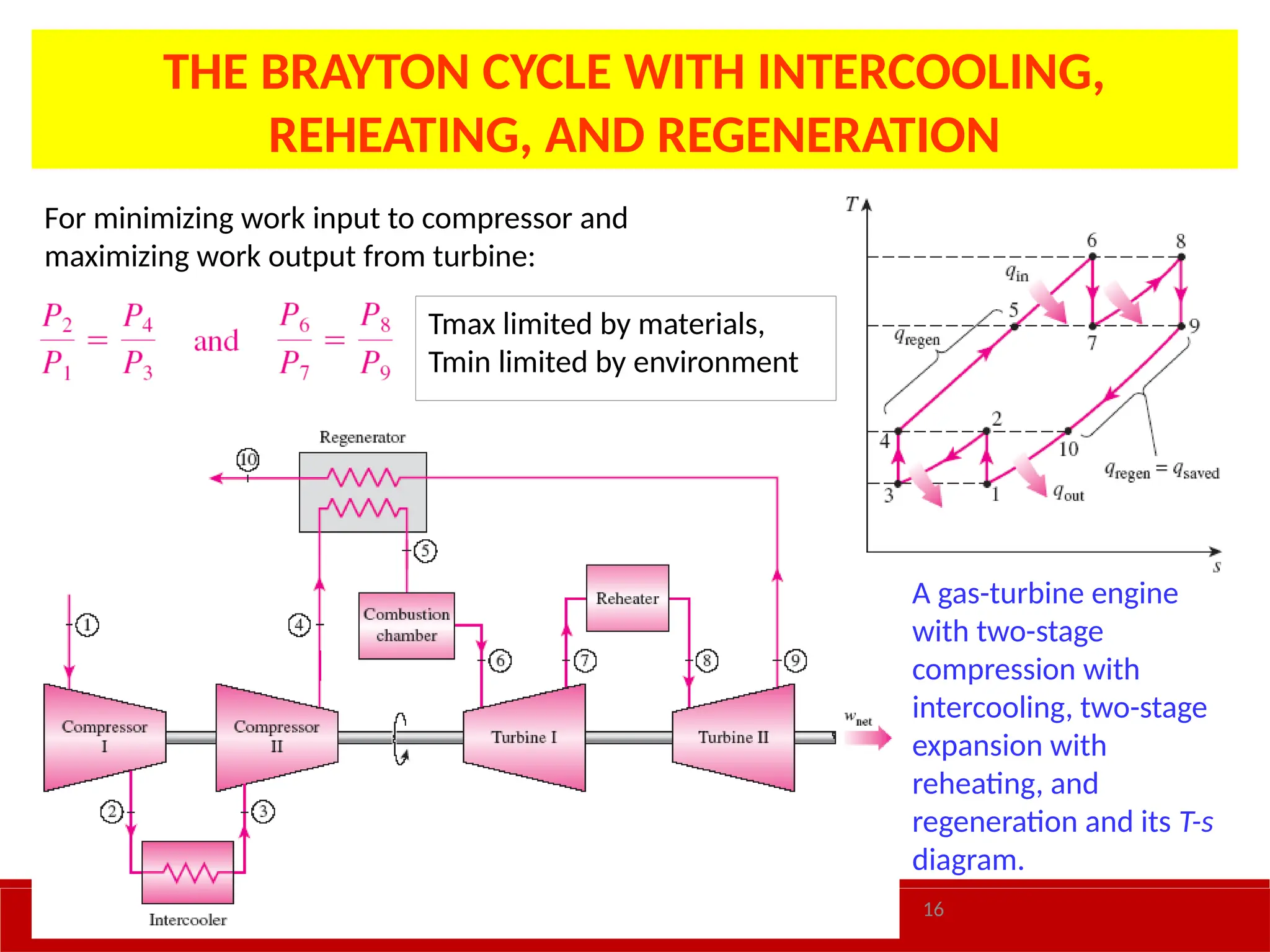
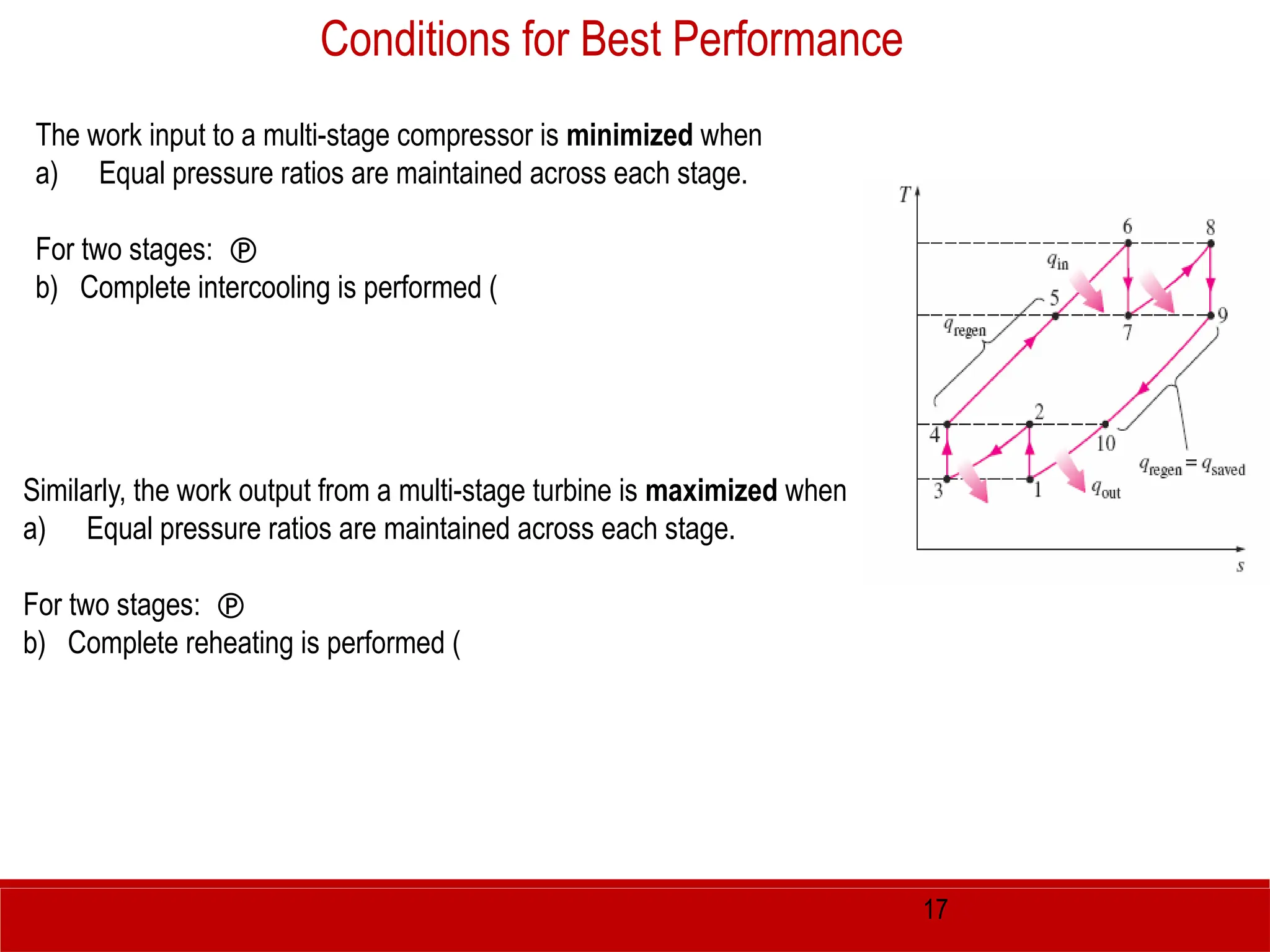
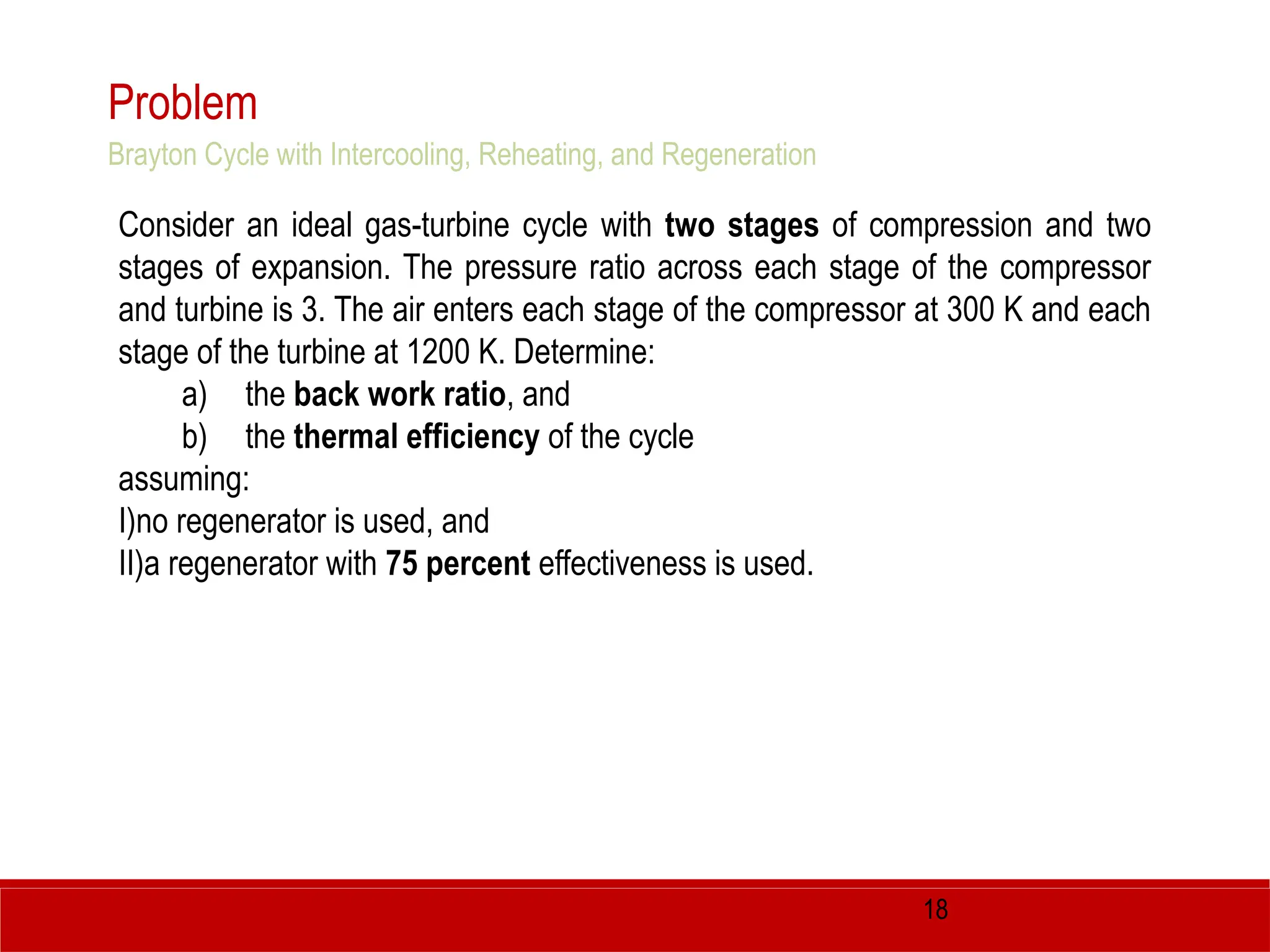
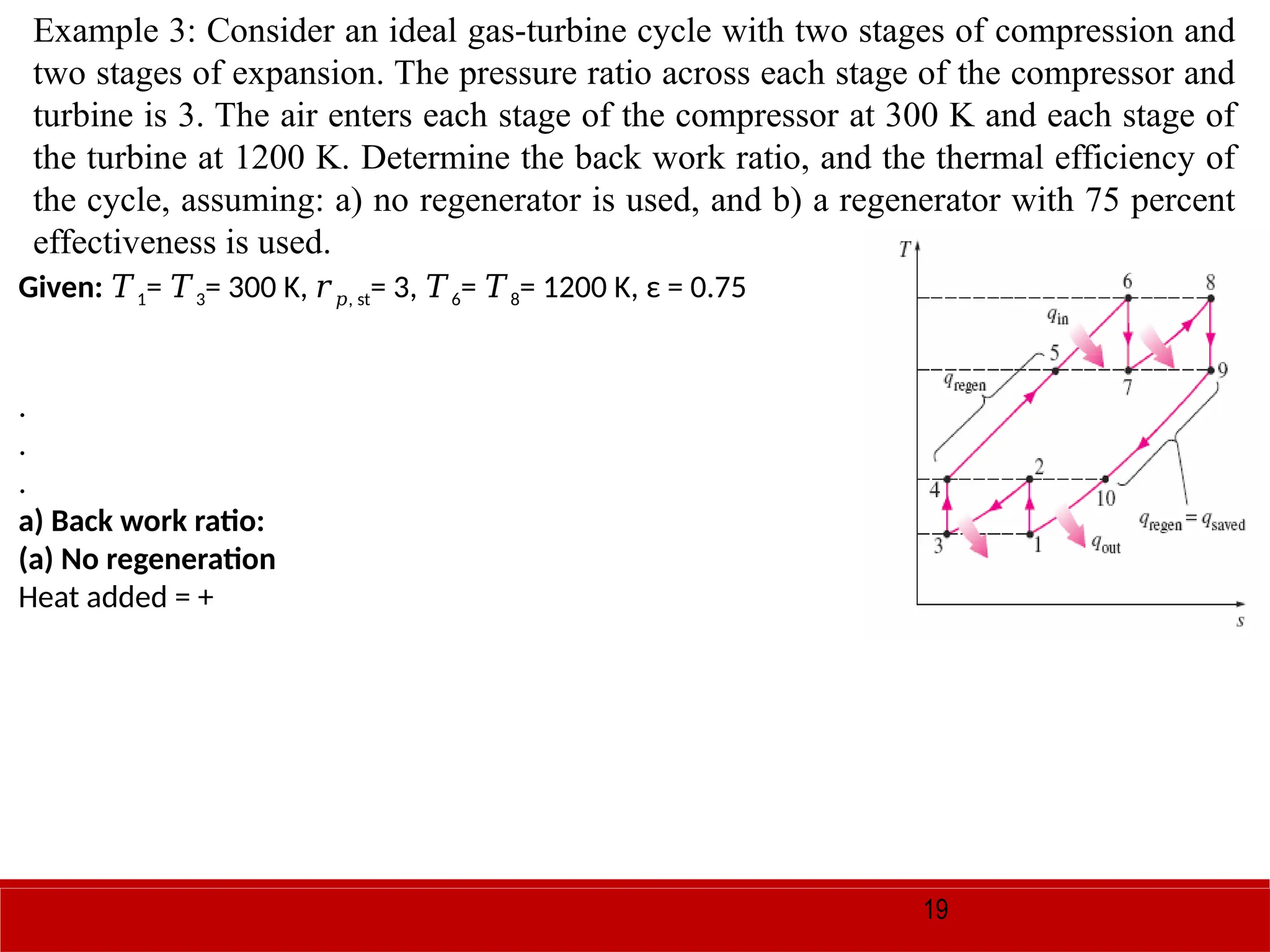
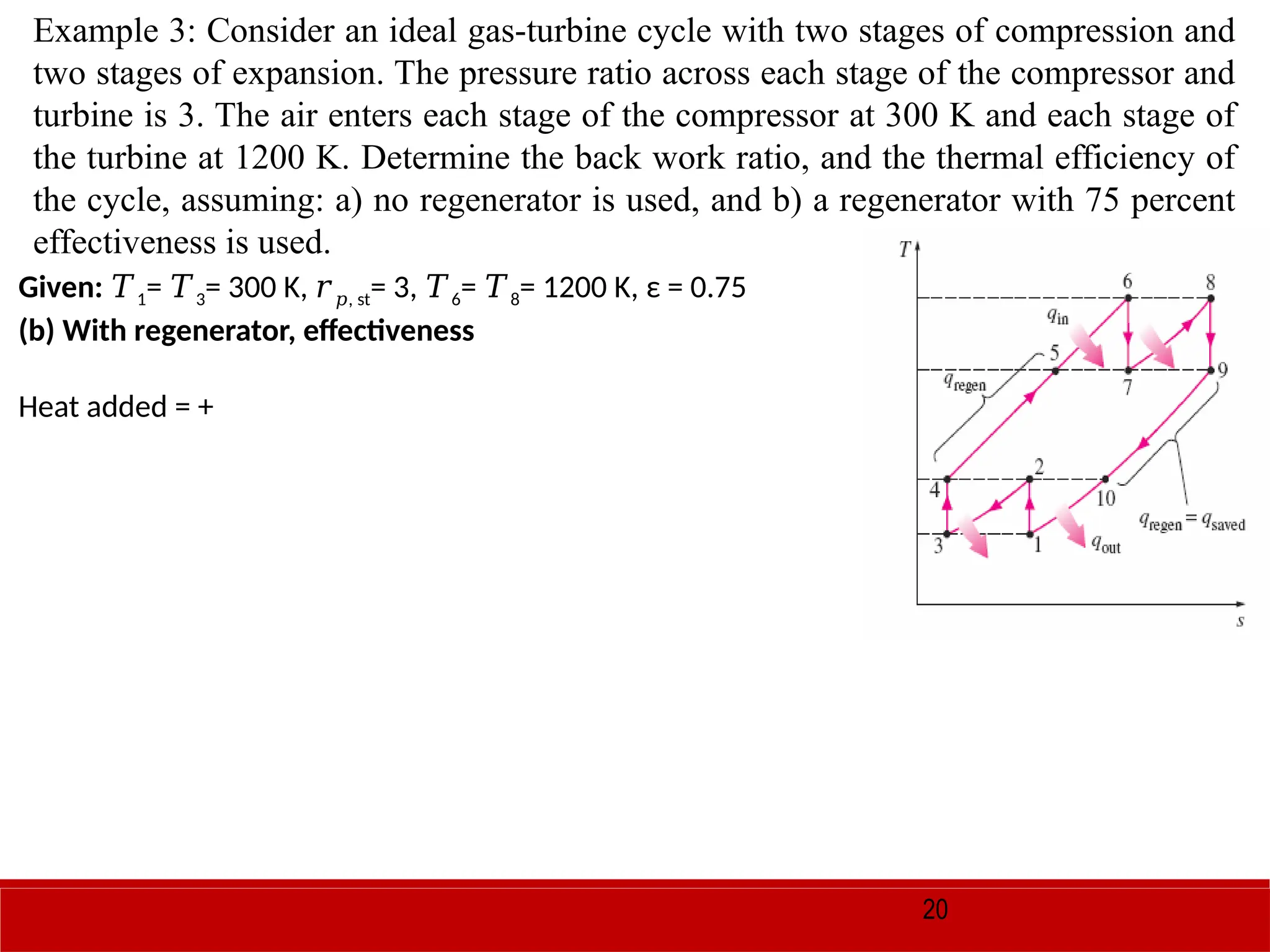
A gas-turbine engine
with two-stage
compression with
intercooling, two-stage
expansion with
reheating, and
regeneration and its T-s
diagram.
For minimizing work input to compressor and
maximizing work output from turbine:
Tmax limited by materials,
Tmin limited by environment
17.
17
The work inputto a multi-stage compressor is minimized when
a) Equal pressure ratios are maintained across each stage.
For two stages:
b) Complete intercooling is performed (
Conditions for Best Performance
Similarly, the work output from a multi-stage turbine is maximized when
a) Equal pressure ratios are maintained across each stage.
For two stages:
b) Complete reheating is performed (
18.
18
Problem
Consider an idealgas-turbine cycle with two stages of compression and two
stages of expansion. The pressure ratio across each stage of the compressor
and turbine is 3. The air enters each stage of the compressor at 300 K and each
stage of the turbine at 1200 K. Determine:
a) the back work ratio, and
b) the thermal efficiency of the cycle
assuming:
I)no regenerator is used, and
II)a regenerator with 75 percent effectiveness is used.
Brayton Cycle with Intercooling, Reheating, and Regeneration
19.
19
Example 3: Consideran ideal gas-turbine cycle with two stages of compression and
two stages of expansion. The pressure ratio across each stage of the compressor and
turbine is 3. The air enters each stage of the compressor at 300 K and each stage of
the turbine at 1200 K. Determine the back work ratio, and the thermal efficiency of
the cycle, assuming: a) no regenerator is used, and b) a regenerator with 75 percent
effectiveness is used.
Given: 𝑇1= 𝑇3= 300 K, 𝑟 , st
𝑝 = 3, 𝑇6= 𝑇8= 1200 K, ε = 0.75
.
.
.
a) Back work ratio:
(a) No regeneration
Heat added = +
20.
20
Example 3: Consideran ideal gas-turbine cycle with two stages of compression and
two stages of expansion. The pressure ratio across each stage of the compressor and
turbine is 3. The air enters each stage of the compressor at 300 K and each stage of
the turbine at 1200 K. Determine the back work ratio, and the thermal efficiency of
the cycle, assuming: a) no regenerator is used, and b) a regenerator with 75 percent
effectiveness is used.
Given: 𝑇1= 𝑇3= 300 K, 𝑟 , st
𝑝 = 3, 𝑇6= 𝑇8= 1200 K, ε = 0.75
(b) With regenerator, effectiveness
Heat added = +
Editor's Notes
#1 Indeed, energy consumption of buildings depends significantly on the used criteria for the indoor environment, which affects the comfort of the occupants


![Examples for Thermodynamic Cycles [Advanced Thermodynamics]](https://cdn.slidesharecdn.com/ss_thumbnails/examplesforthermodynamiccycles-250308051844-0bd4d55e-thumbnail.jpg?width=640&height=640&fit=bounds)


