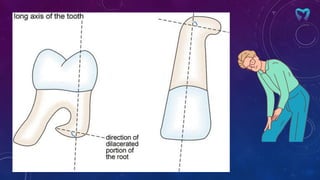
DILACERATION
Dilaceration is an abnormal bend in the root or crown of a tooth
❑The root is affected most frequently
❑most often in the permanent dentition and frequently
affects the maxillary incisors AND maxillary premolars .
CAUSES - ,.
• Trauma during tooth development, such as avulsion or
intrusion of an overlying deciduous tooth.
• An adjacent anatomic structure, cyst, or tumors
• Retained primary tooth.
• the presence of supernumerary tooth or teeth.
• Root dilaceration is not
detected clinically
• •
• Crown dilaceration seen
as angular distortion
○May prevent eruption of tooth
○Those that erupt are often in labial or lingual position
• when the roots are dilacerated buccally (labially) or lingually, the central x ray passes approximately
parallel with the deflected portion of the root, and the apical end of the root may have the appearance of a
circular or oval radiopaque area with a central radiolucency (the apical foramen and root canal), giving the
appearance of a “bull's eye.” The PDL space around this dilacerated portion may be seen as a
radiolucent halo encircling the radiopaque area
Diagnosed radiographically
BUT
SOMETIMES
If the roots dilacerate mesially or distally, the condition is clearly apparent on an X-RAY
Management
• Minor dilaceration requires no treatment.
•Dilacerated root may complicate
extraction, endodontic treatment, orthodontic treatment,
or preclude use as abutment
••
•Dilacerated crown may be restored with full-coverage crown to improve
esthetics and function
••
•Grossly deformed teeth may require extraction
Dilaceration pdf
Dilaceration pdf

Dilaceration pdf

  • 3.
  • 5.
    Dilaceration is anabnormal bend in the root or crown of a tooth ❑The root is affected most frequently ❑most often in the permanent dentition and frequently affects the maxillary incisors AND maxillary premolars . CAUSES - ,. • Trauma during tooth development, such as avulsion or intrusion of an overlying deciduous tooth. • An adjacent anatomic structure, cyst, or tumors • Retained primary tooth. • the presence of supernumerary tooth or teeth.
  • 8.
    • Root dilacerationis not detected clinically • • • Crown dilaceration seen as angular distortion ○May prevent eruption of tooth ○Those that erupt are often in labial or lingual position
  • 9.
    • when theroots are dilacerated buccally (labially) or lingually, the central x ray passes approximately parallel with the deflected portion of the root, and the apical end of the root may have the appearance of a circular or oval radiopaque area with a central radiolucency (the apical foramen and root canal), giving the appearance of a “bull's eye.” The PDL space around this dilacerated portion may be seen as a radiolucent halo encircling the radiopaque area Diagnosed radiographically BUT SOMETIMES If the roots dilacerate mesially or distally, the condition is clearly apparent on an X-RAY
  • 11.
    Management • Minor dilacerationrequires no treatment. •Dilacerated root may complicate extraction, endodontic treatment, orthodontic treatment, or preclude use as abutment •• •Dilacerated crown may be restored with full-coverage crown to improve esthetics and function •• •Grossly deformed teeth may require extraction