‫البحث‬ ‫عنوان‬
‫االسم‬
‫الجامعي‬ ‫الرقم‬
‫المشرف‬
Digoxin
Is a cardiac glycoside used in the
treatment of mild to moderate
heart failure and for ventricular
response rate control in chronic
atrial fibrillation.
Drug Name
• Generic Name : digoxin
• Brand Name: Digitek, Lanoxicaps,
Lanoxin, Toloxin.
• Classification: Cardiac glycoside,
Cardiotonic.
Background
• Digoxin is one of the oldest cardiovascular medications used today.
• It is a common agent used to manage atrial fibrillation and the symptoms of heart
failure.
• Digoxin is classified as a cardiac glycoside.
Therapeutic actions
• Digoxin is a cardiac glycoside which has positive inotropic activity characterized by an
increase in the force of myocardial contraction.
• It also reduces the conductivity of the heart through the atrioventricular (AV) node.
• Digoxin also exerts direct action on vascular smooth muscle and indirect effects mediated
primarily by the autonomic nervous system and an increase in vagal activity.
Indication of digoxin
• Digoxin is indicated in the following conditions:
1) For the treatment of mild to moderate heart failure in adult
patients.
2) To increase myocardial contraction in children diagnosed with heart
failure.
3) To maintain control ventricular rate in adult patients diagnosed with
chronic atrial fibrillation.
Dosage & Route
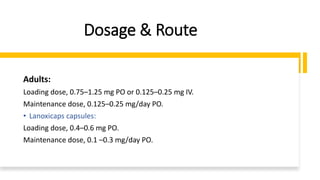
Adults:
Loading dose, 0.75–1.25 mg PO or 0.125–0.25 mg IV.
Maintenance dose, 0.125–0.25 mg/day PO.
• Lanoxicaps capsules:
Loading dose, 0.4–0.6 mg PO.
Maintenance dose, 0.1 –0.3 mg/day PO.
Dosage & Route
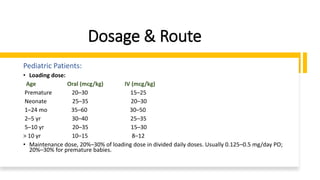
Pediatric Patients:
• Loading dose:
Age Oral (mcg/kg) IV (mcg/kg)
Premature 20–30 15–25
Neonate 25–35 20–30
1–24 mo 35–60 30–50
2–5 yr 30–40 25–35
5–10 yr 20–35 15–30
> 10 yr 10–15 8–12
• Maintenance dose, 20%–30% of loading dose in divided daily doses. Usually 0.125–0.5 mg/day PO;
20%–30% for premature babies.
Mechanism of action
• Digoxin exerts hemodynamic, electrophysiologic, and neurohormonal effects on the
cardiovascular system.
• It reversibly inhibits the Na-K ATPase enzyme, leading to various beneficial effects.
• The Na-K ATPase enzyme functions to maintain the intracellular environment by
regulating the entry and exit of sodium, potassium, and calcium (indirectly).
• Na-K ATPase is also known as the Sodium Pump. The inhibition of the sodium
pump by digoxin increases intracellular sodium and increases the calcium level in
the myocardial cells, causing an increased contractile force of the heart.
Mechanism of action cont.
• This improves the left ventricular ejection fraction (EF), an important measure of
cardiac function.
• Digoxin also stimulates the parasympathetic nervous system via the vagus nerve
leading to sinoatrial (SA) and atrioventricular (AV) node effects, decreasing the heart
rate.
• Part of the pathophysiology of heart failure includes neurohormonal activation,
leading to an increase in norepinephrine.
• Digoxin helps to decrease norepinephrine levels through activation of the
parasympathetic nervous system
Contraindications
• Digitalis toxicity, ventricular tachycardia/fibrillation, obstructive
cardiomyopathy.
• Arrhythmias due to accessory pathways (e.g. Wolff-Parkinson-
White syndrome).
Adverse effects
• Anorexia, nausea and vomiting, diarrhoea in elderly.
• Confusion, dizziness, drowsiness, restlessness,
nervousness, agitation and amnesia, visual disturbances.
• Rapid IV admin may lead to vasocostriction and transient
hypertension.
• Potentially Fatal: Cardiac arrhythmias in combination with
heart block.
Toxicity of Digoxin
• Digoxin toxicity can occur in cases of supratherapeutic dose ingestion or as a result of
chronic overexposure.
• Digoxin toxicity may be manifested by symptoms of nausea, vomiting, visual changes,
in addition to arrhythmia.
• Older age, lower body weight, and decreased renal function or electrolyte
abnormalities lead to an increased risk of digoxin toxicity.
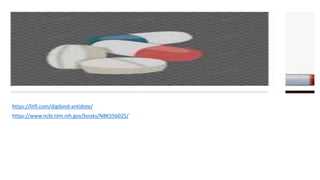
Digibind Antidote
Digibind is the trade name for a digoxin antidote containing Digoxin-
specific antibody Fab fragments
‫ى‬
nn
Nursing
consideration
Assessment
• Take history of:
1. Allergy to digitalis preparations,
2. History of ventricular tachycardia, ventricular fibrillation, heart
block, sick sinus syndrome, IHSS, acute MI, renal insufficiency,
decreased K+, decreased Mg2+ increased Ca2+, pregnancy,
lactation.
▪ Perform Complete physical assessment.
Nursing Interventions
• WARNING: Monitor apical pulse for 1 min before administering; hold dose if pulse < 60 in adult
or < 90 in infant; retake pulse in 1 hr.
• If adult pulse remains < 60 or infant < 90, hold drug and notify prescriber.
• Note any change from baseline rhythm or rate.
• Take care to differentiate Lanoxicaps from Lanoxin; dosage is very different.
• Check dosage and preparation carefully.
Nursing Interventions
• Avoid IM injections, which may be very painful.
• Follow diluting instructions carefully, and use diluted solution promptly.
• Avoid giving with meals; this will delay absorption.
• Have emergency equipment ready; have K+ salts, lidocaine, phenytoin, atropine, and
cardiac monitor readily available in case toxicity develops.
References
https://litfl.com/digibind-antidote/
https://www.ncbi.nlm.nih.gov/books/NBK556025/

Digoxin.pptx

  • 1.
  • 2.
    Digoxin Is a cardiacglycoside used in the treatment of mild to moderate heart failure and for ventricular response rate control in chronic atrial fibrillation.
  • 3.
    Drug Name • GenericName : digoxin • Brand Name: Digitek, Lanoxicaps, Lanoxin, Toloxin. • Classification: Cardiac glycoside, Cardiotonic.
  • 4.
    Background • Digoxin isone of the oldest cardiovascular medications used today. • It is a common agent used to manage atrial fibrillation and the symptoms of heart failure. • Digoxin is classified as a cardiac glycoside.
  • 5.
    Therapeutic actions • Digoxinis a cardiac glycoside which has positive inotropic activity characterized by an increase in the force of myocardial contraction. • It also reduces the conductivity of the heart through the atrioventricular (AV) node. • Digoxin also exerts direct action on vascular smooth muscle and indirect effects mediated primarily by the autonomic nervous system and an increase in vagal activity.
  • 6.
    Indication of digoxin •Digoxin is indicated in the following conditions: 1) For the treatment of mild to moderate heart failure in adult patients. 2) To increase myocardial contraction in children diagnosed with heart failure. 3) To maintain control ventricular rate in adult patients diagnosed with chronic atrial fibrillation.
  • 7.
    Dosage & Route Adults: Loadingdose, 0.75–1.25 mg PO or 0.125–0.25 mg IV. Maintenance dose, 0.125–0.25 mg/day PO. • Lanoxicaps capsules: Loading dose, 0.4–0.6 mg PO. Maintenance dose, 0.1 –0.3 mg/day PO.
  • 8.
    Dosage & Route PediatricPatients: • Loading dose: Age Oral (mcg/kg) IV (mcg/kg) Premature 20–30 15–25 Neonate 25–35 20–30 1–24 mo 35–60 30–50 2–5 yr 30–40 25–35 5–10 yr 20–35 15–30 > 10 yr 10–15 8–12 • Maintenance dose, 20%–30% of loading dose in divided daily doses. Usually 0.125–0.5 mg/day PO; 20%–30% for premature babies.
  • 9.
    Mechanism of action •Digoxin exerts hemodynamic, electrophysiologic, and neurohormonal effects on the cardiovascular system. • It reversibly inhibits the Na-K ATPase enzyme, leading to various beneficial effects. • The Na-K ATPase enzyme functions to maintain the intracellular environment by regulating the entry and exit of sodium, potassium, and calcium (indirectly). • Na-K ATPase is also known as the Sodium Pump. The inhibition of the sodium pump by digoxin increases intracellular sodium and increases the calcium level in the myocardial cells, causing an increased contractile force of the heart.
  • 10.
    Mechanism of actioncont. • This improves the left ventricular ejection fraction (EF), an important measure of cardiac function. • Digoxin also stimulates the parasympathetic nervous system via the vagus nerve leading to sinoatrial (SA) and atrioventricular (AV) node effects, decreasing the heart rate. • Part of the pathophysiology of heart failure includes neurohormonal activation, leading to an increase in norepinephrine. • Digoxin helps to decrease norepinephrine levels through activation of the parasympathetic nervous system
  • 11.
    Contraindications • Digitalis toxicity,ventricular tachycardia/fibrillation, obstructive cardiomyopathy. • Arrhythmias due to accessory pathways (e.g. Wolff-Parkinson- White syndrome).
  • 12.
    Adverse effects • Anorexia,nausea and vomiting, diarrhoea in elderly. • Confusion, dizziness, drowsiness, restlessness, nervousness, agitation and amnesia, visual disturbances. • Rapid IV admin may lead to vasocostriction and transient hypertension. • Potentially Fatal: Cardiac arrhythmias in combination with heart block.
  • 13.
    Toxicity of Digoxin •Digoxin toxicity can occur in cases of supratherapeutic dose ingestion or as a result of chronic overexposure. • Digoxin toxicity may be manifested by symptoms of nausea, vomiting, visual changes, in addition to arrhythmia. • Older age, lower body weight, and decreased renal function or electrolyte abnormalities lead to an increased risk of digoxin toxicity.
  • 14.
    Digibind Antidote Digibind isthe trade name for a digoxin antidote containing Digoxin- specific antibody Fab fragments
  • 15.
  • 16.
    Assessment • Take historyof: 1. Allergy to digitalis preparations, 2. History of ventricular tachycardia, ventricular fibrillation, heart block, sick sinus syndrome, IHSS, acute MI, renal insufficiency, decreased K+, decreased Mg2+ increased Ca2+, pregnancy, lactation. ▪ Perform Complete physical assessment.
  • 17.
    Nursing Interventions • WARNING:Monitor apical pulse for 1 min before administering; hold dose if pulse < 60 in adult or < 90 in infant; retake pulse in 1 hr. • If adult pulse remains < 60 or infant < 90, hold drug and notify prescriber. • Note any change from baseline rhythm or rate. • Take care to differentiate Lanoxicaps from Lanoxin; dosage is very different. • Check dosage and preparation carefully.
  • 18.
    Nursing Interventions • AvoidIM injections, which may be very painful. • Follow diluting instructions carefully, and use diluted solution promptly. • Avoid giving with meals; this will delay absorption. • Have emergency equipment ready; have K+ salts, lidocaine, phenytoin, atropine, and cardiac monitor readily available in case toxicity develops.
  • 19.