CVS drug: Cardiac glycoside (Digoxin)
Cardiac Glycosides: Digoxin
Digoxin is cardiac glycosides extracted from plant Digitalis lanata.
It is used to treat various heart conditions such as atrial fibrillation
(arryhthmias) and heart failure which are not control by other
medication.
It belongs to positive inotropic agents as it increase force of contraction
of heart muscle (increase myocardial contractility).
It is also a chronotropic drugs as it also affect the heart rate and
rhythm
Digoxin
• M.O.A:
• Digoxin binds and inhibits Na-K ATPase and block Na+ pump hence
there is decrease of transport of Na out of myocardial cells (i.e
increased intracellular concentration) ,which in increase calcium entry
and decrease calcium elimination. Hence increased in intracellular
calcium enhance myocardial contractility.
•
Pharmacological action of digoxin in heart
• It Increased myocardial contraction however duration of contraction is just slightly
increased.
• Increases myocardial efficiency due to improve in haemodynamic
• Overall heart rate is decreased while blood pressure is increase due to increase in stroke
volume.
• Other electrical effect arean initial brief increase in action potential, followed by a
decrease as the K+ conductance increases due to an increased intracellular amounts of
Ca2+ ions
• The refractory period of the atria and ventricles is decreased, while it is increases in the
sinoatrial and AV nodes
• Slight indirect vasodilation is seen in heart failure due to improve in haemodynamics
• It also affects the kidney by increased renal blood flow and increased glomerular
filtration rate. A mild diuretic effect is seen only in heart failure
Pharmacokinetics
• Bioavailability: 60-80 % (tablet)
• Onset of action: 0.5-2 hr (PO) and 5-30 min (IV)
• Protein bound: 20-30%
• Metabolized in liver
• Elimination half life: 1-3 days
• Excreted via Urine (57-80%), feces (9-13%
Uses/Indication/Dose
• Heart Failure
• Tachyarrhythmias
• Atrial Fibrillation:
• Atrial Flutter
• Paroximal atrial tachycardia
• Dose: IV: 8-12 mcg/kg loading dose followed by 0.1-0.4 mg daily ,
• PO: 10-15 mcg/kg loading dose followed by 0.125 mg-0.5 mg daily.
Administration
• Drug is severe skin irritant when given IV/IM and may cause severe
local skin reaction.
• Administer slowly by direct IV injection over minimum of 5 minutes
(longer if given undiluted)
• Do not administer if precipitate present
Contraindication and precaution
• Hypersensitivity
• Uncontrolled Ventricular fibrillation
• Avoid in patient with myocarditis
• Very narrow margin between effective therapeutic and toxic dosages.
• Therapeutic range, 0.5-2 ng/mL (target 0.5-1 ng/mL)
• toxic range, >2.5 ng/mL
Hence therapeutic drug monitoring should be performed to titrated the
appropriate dose.
Use cautiously in
Renal & Hepatic impairment
• Electrolyte imbalance
• Myocardial Infarction
• Thyroid Disoder
• Obesity
• Elderly Patient
• Pregnancy
• Breastfeeding infant
Drug interaciton
• Aluminium hydroxide(antacids), PPI, increases toxicity by increasing
aborption.
• Amiodarone increase level or effect of digoxin.
• Erythromycin also increase level of digoxin
Adverse effect
Dizziness (4.9%)
• Mental disturbances (4.1%)
• Diarrhea (3.2%)
• Headache (3.2%)
• Nausea (3.2%)
• Vomiting (1.6%)
• Maculopapular rash (1.6%)
• Anorexia
• Cardiac dysrhythmia
• Arrhythmia in children (consider a toxicity)
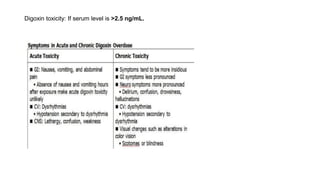
Digoxin toxicity: If serum level is >2.5 ng/mL.

digoxin.pdf

  • 1.
    CVS drug: Cardiacglycoside (Digoxin)
  • 2.
    Cardiac Glycosides: Digoxin Digoxinis cardiac glycosides extracted from plant Digitalis lanata. It is used to treat various heart conditions such as atrial fibrillation (arryhthmias) and heart failure which are not control by other medication. It belongs to positive inotropic agents as it increase force of contraction of heart muscle (increase myocardial contractility). It is also a chronotropic drugs as it also affect the heart rate and rhythm
  • 3.
    Digoxin • M.O.A: • Digoxinbinds and inhibits Na-K ATPase and block Na+ pump hence there is decrease of transport of Na out of myocardial cells (i.e increased intracellular concentration) ,which in increase calcium entry and decrease calcium elimination. Hence increased in intracellular calcium enhance myocardial contractility. •
  • 4.
    Pharmacological action ofdigoxin in heart • It Increased myocardial contraction however duration of contraction is just slightly increased. • Increases myocardial efficiency due to improve in haemodynamic • Overall heart rate is decreased while blood pressure is increase due to increase in stroke volume. • Other electrical effect arean initial brief increase in action potential, followed by a decrease as the K+ conductance increases due to an increased intracellular amounts of Ca2+ ions • The refractory period of the atria and ventricles is decreased, while it is increases in the sinoatrial and AV nodes • Slight indirect vasodilation is seen in heart failure due to improve in haemodynamics • It also affects the kidney by increased renal blood flow and increased glomerular filtration rate. A mild diuretic effect is seen only in heart failure
  • 5.
    Pharmacokinetics • Bioavailability: 60-80% (tablet) • Onset of action: 0.5-2 hr (PO) and 5-30 min (IV) • Protein bound: 20-30% • Metabolized in liver • Elimination half life: 1-3 days • Excreted via Urine (57-80%), feces (9-13%
  • 6.
    Uses/Indication/Dose • Heart Failure •Tachyarrhythmias • Atrial Fibrillation: • Atrial Flutter • Paroximal atrial tachycardia • Dose: IV: 8-12 mcg/kg loading dose followed by 0.1-0.4 mg daily , • PO: 10-15 mcg/kg loading dose followed by 0.125 mg-0.5 mg daily.
  • 7.
    Administration • Drug issevere skin irritant when given IV/IM and may cause severe local skin reaction. • Administer slowly by direct IV injection over minimum of 5 minutes (longer if given undiluted) • Do not administer if precipitate present
  • 8.
    Contraindication and precaution •Hypersensitivity • Uncontrolled Ventricular fibrillation • Avoid in patient with myocarditis • Very narrow margin between effective therapeutic and toxic dosages. • Therapeutic range, 0.5-2 ng/mL (target 0.5-1 ng/mL) • toxic range, >2.5 ng/mL Hence therapeutic drug monitoring should be performed to titrated the appropriate dose.
  • 9.
    Use cautiously in Renal& Hepatic impairment • Electrolyte imbalance • Myocardial Infarction • Thyroid Disoder • Obesity • Elderly Patient • Pregnancy • Breastfeeding infant
  • 10.
    Drug interaciton • Aluminiumhydroxide(antacids), PPI, increases toxicity by increasing aborption. • Amiodarone increase level or effect of digoxin. • Erythromycin also increase level of digoxin
  • 11.
    Adverse effect Dizziness (4.9%) •Mental disturbances (4.1%) • Diarrhea (3.2%) • Headache (3.2%) • Nausea (3.2%) • Vomiting (1.6%) • Maculopapular rash (1.6%) • Anorexia • Cardiac dysrhythmia • Arrhythmia in children (consider a toxicity)
  • 12.
    Digoxin toxicity: Ifserum level is >2.5 ng/mL.