DIGITIZATION AND
DIGITAL PRESERVATION:
AN E-LIBRARY SOLUTION
PRESENTED BY:
OWUAMALAM, CLEMENT C. (20111796213)
SUPERVISED BY: PROF. M. C. NDINECHI
ELECTRICAL/ELECTRONIC ENGINEERING (ECE)
JULY, 2016.
INTRODUCTION
Digitization is rapidly becoming one of the
standard forms of preservation of analog
materials for libraries, archives and
information centres.
Digitization refers to all of the steps involved
in the process of making collections of
historical and other materials available in
digital form.
Digital books can be easily distributed,
reproduced, and read on-screen. Common file
formats are DjVu, Portable Document Format
(PDF), and Tagged Image File Format (TIFF).
2
PROCEDURE FOR DIGITIZATION
AND DIGITAL PRESERVATION
Determination of library materials to be
digitized
Collection of resources
Organizing of collected materials
Describing the resources
Transcriptions and translations of
resources from foreign languages
Meeting with subject librarians for
metadata and cataloguing
3
PREPARING THE RESOURCES FOR
SCANNING
Book scanning is the process of
converting physical books and
magazines into digital media such
as images, or electronic books by
using an image digitizer (scanner).
There are two basic methods of
scanning:
– Non-destructive scanning methods
– Destructive scanning methods
4
PREPARATIONS FOR DESTRUCTIVE
SCANNING
UNBINDING
– Removal of staple pins that hold the book together.
– Unbending and removing nails that hold the books
together.
– Grinding down layers of glue on the spine of a book
and removing the string used to hold the book
together.
EDGE PREPARATION
CUTTING
– Hinged Paper Cutter
– Guillotine Paper Cutter
– Table Saw
5
SCANNING
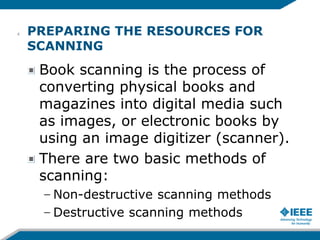
Flatbed Scanners
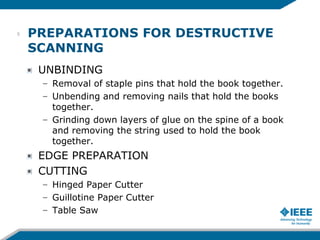
Automatic Document Feed (ADF) Scanners
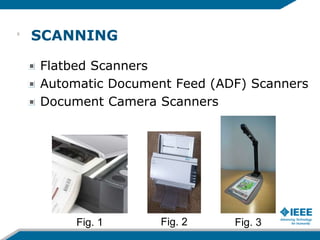
Document Camera Scanners
Fig. 2Fig. 1 Fig. 3
6
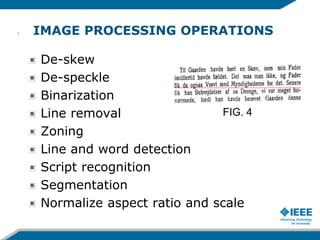
IMAGE PROCESSING OPERATIONS
De-skew
De-speckle
Binarization
Line removal
Zoning
Line and word detection
Script recognition
Segmentation
Normalize aspect ratio and scale
FIG. 4
7
DIGITIZING OF SCANNED PAGES
Turning book pages into a digital text format
such as ASCII or other similar format.
This is done either manually, or using
Character Recognition.
It reduces the file size
It allows the text to be reformatted, searched,
or processed by other applications.
TYPES OF CHARACTER RECOGNITION
– Optical Character Recognition (OCR)
– Optical Word Recognition
– Intelligent Character Recognition (ICR)
– Intelligent Word Recognition (IWR)
8
PROOFREADING
Editing for typographic errors.
Verifying special characters, such as
the left and right quotation marks,
and accent marks such as umlauts
(two dot above a vowel, e.g.: ä)
Checking to locate all footnotes,
diagrams and drawings in order to
place them correctly in the digital
version.
9
DIGITAL PRESERVATION
Metadata attachment
Refreshing
Migration
Replication
Emulation
Encapsulation
10
QUALITY CONTROL
Contents are reviewed occasionally.
Review activities are done to ensure that
the files open properly and that all
materials are working as they should.
The metadata is also reviewed for accuracy
and to ensure that the records are clear
and concise.
Quality assurance ultimately ensures that
the collection continues to work properly
and efficient, over a long period of time.
11
ADVANTAGES OF DIGITIZATION AND
DIGITAL PRESERVATION
Electronic availability
Elimination of theft
Enhancement of image quality
Easy formatting of text
Possibility of in-depth analysis
Extension of shelf life original
resources
12
CHALLENGES AND MITIGATIONS
Changing formats and obsolescence
of technology
Untrained staff and human error
Authenticity and reliability of material
Standardization of metadata
Copyright issues
Infrastructure and cost
Electricity
13
CONCLUSION
The benefits accruable from digitization of
library collections cannot be quantified.
For libraries in developing countries to be
relevant in the digital age, there is an urgent
need for collaboration between national and
international donor agencies as exemplified by
Obafemi Awolowo University, Ile-Ife, Nigeria
and the Carnegie Corporation of New York.
Library management also needs to accord high
priority to computerization and digitization. It is
when this is done that libraries in developing
countries of the world can upload their peculiar
local content to the world information database.
14
THANK YOU15

Digitization and Digital Preservation: An E-Library Solution.

  • 1.
    DIGITIZATION AND DIGITAL PRESERVATION: ANE-LIBRARY SOLUTION PRESENTED BY: OWUAMALAM, CLEMENT C. (20111796213) SUPERVISED BY: PROF. M. C. NDINECHI ELECTRICAL/ELECTRONIC ENGINEERING (ECE) JULY, 2016.
  • 2.
    INTRODUCTION Digitization is rapidlybecoming one of the standard forms of preservation of analog materials for libraries, archives and information centres. Digitization refers to all of the steps involved in the process of making collections of historical and other materials available in digital form. Digital books can be easily distributed, reproduced, and read on-screen. Common file formats are DjVu, Portable Document Format (PDF), and Tagged Image File Format (TIFF). 2
  • 3.
    PROCEDURE FOR DIGITIZATION ANDDIGITAL PRESERVATION Determination of library materials to be digitized Collection of resources Organizing of collected materials Describing the resources Transcriptions and translations of resources from foreign languages Meeting with subject librarians for metadata and cataloguing 3
  • 4.
    PREPARING THE RESOURCESFOR SCANNING Book scanning is the process of converting physical books and magazines into digital media such as images, or electronic books by using an image digitizer (scanner). There are two basic methods of scanning: – Non-destructive scanning methods – Destructive scanning methods 4
  • 5.
    PREPARATIONS FOR DESTRUCTIVE SCANNING UNBINDING –Removal of staple pins that hold the book together. – Unbending and removing nails that hold the books together. – Grinding down layers of glue on the spine of a book and removing the string used to hold the book together. EDGE PREPARATION CUTTING – Hinged Paper Cutter – Guillotine Paper Cutter – Table Saw 5
  • 6.
    SCANNING Flatbed Scanners Automatic DocumentFeed (ADF) Scanners Document Camera Scanners Fig. 2Fig. 1 Fig. 3 6
  • 7.
    IMAGE PROCESSING OPERATIONS De-skew De-speckle Binarization Lineremoval Zoning Line and word detection Script recognition Segmentation Normalize aspect ratio and scale FIG. 4 7
  • 8.
    DIGITIZING OF SCANNEDPAGES Turning book pages into a digital text format such as ASCII or other similar format. This is done either manually, or using Character Recognition. It reduces the file size It allows the text to be reformatted, searched, or processed by other applications. TYPES OF CHARACTER RECOGNITION – Optical Character Recognition (OCR) – Optical Word Recognition – Intelligent Character Recognition (ICR) – Intelligent Word Recognition (IWR) 8
  • 9.
    PROOFREADING Editing for typographicerrors. Verifying special characters, such as the left and right quotation marks, and accent marks such as umlauts (two dot above a vowel, e.g.: ä) Checking to locate all footnotes, diagrams and drawings in order to place them correctly in the digital version. 9
  • 10.
  • 11.
    QUALITY CONTROL Contents arereviewed occasionally. Review activities are done to ensure that the files open properly and that all materials are working as they should. The metadata is also reviewed for accuracy and to ensure that the records are clear and concise. Quality assurance ultimately ensures that the collection continues to work properly and efficient, over a long period of time. 11
  • 12.
    ADVANTAGES OF DIGITIZATIONAND DIGITAL PRESERVATION Electronic availability Elimination of theft Enhancement of image quality Easy formatting of text Possibility of in-depth analysis Extension of shelf life original resources 12
  • 13.
    CHALLENGES AND MITIGATIONS Changingformats and obsolescence of technology Untrained staff and human error Authenticity and reliability of material Standardization of metadata Copyright issues Infrastructure and cost Electricity 13
  • 14.
    CONCLUSION The benefits accruablefrom digitization of library collections cannot be quantified. For libraries in developing countries to be relevant in the digital age, there is an urgent need for collaboration between national and international donor agencies as exemplified by Obafemi Awolowo University, Ile-Ife, Nigeria and the Carnegie Corporation of New York. Library management also needs to accord high priority to computerization and digitization. It is when this is done that libraries in developing countries of the world can upload their peculiar local content to the world information database. 14
  • 15.