DIGITAL SELF
Do not over use the internet!!!
I, Me and Myself and My User ID
online
Digital self is a mask we put on
to draw in the innovative world.
With the digital technologies such
as web pages, online games, virtual
worlds, social media, smart
phones, Internet, self-extension is
extensive.
Objects that one’s possess can truly extend
the self, as when an instrument or weapon enables
us to get things done of which we would somehow
or another be unable. Sartre explained that the
reason we want to have something is to enlarge our
sense of self and that the only way we can know
who we are is by observing what we have. Belk
(1988) presented the concept of the extended self:
(1) Dematerialization, (2) Re-embodiment, (3)
Sharing, (4) Co-construction of Self, and (5)
Distributed memory.
WHAT IS THE
POSITIVE AND
NEGATIVE IMPACT OF
DIGITAL AND
BOUNDARIES?
What not to Post Online?
1. Sexy or revealing pictures- These kinds of photos should
be kept in private for security reasons. Some people may take
advantage of these photos and spread them without the
knowledge of the original owner.
2. Pictures or videos showing private moments with loved
ones- Even if sometimes people are too showy of their feelings
towards their loved ones, kissing and intimate moments and
activities must be kept in private and should not be divulged in
online platforms.
3. Pictures or videos showing bad habits- Some examples
of these are pictures showing a person drinking liquor and being
intoxicated, smoking cigarettes, and gambling.
5. Negative comments on another person’s
attitudes- It is indecent to post negative
comments and announce to the world what you
think of another person’s attitudes. It is unfair
and damaging to another person’s attitudes.
6. Posts announcing conflicts with other
people- As the saying goes, “Do not wash dirty
linen in public.” Conflicts with other people
cannot be resolved by posting about them
online. The best way of resolving these conflict is
to face them without any screens in between.
7. Posts of the results of a particular
competition with the names of defeated
participants -While everyone has the right to brag
about his or her achievement or success, it is
indecent to display and inform the world the
failure of another person. It can be damaging to
people’s reputation and it can also impact their
psychological well-being.
8. Comments showing strong opposition to
certain issues- Any individual is free to express his
or her ideas and opinions on a certain topic or
issue but sometimes it may offend people or
worst, it can even lead to earning an enemy.
Dichotomies of the Self
• There are three crucial domains
where traditional boundaries
between the dichotomies of self
become increasingly blurred. These
domains are producer or consumer,
offline versus online and body
versus technology.
1. Producer or Consumer. Do your material possessions
define who you are? There is a 16 year old young lady
who is very into K-pop culture. At first glance, the girl
may not easily be identified as a Filipino because
from head to toe, she adapts the material culture of
her favorite K-pop stars. To some people, one’s
material possession define one’s identity.
2. Offline versus Online. Will there be a consistency
between what is seen online and what is perceived
offline.
3. Body VS Technology. Technology and consumerism
allow people to easily redefine and recreate
themselves
Are you a Responsible
Netizen?
Here are some of the issues that one needs to
address if one to be seen as responsible netizen:
1. Sharing Fake News-As the famous saying goes,
“Think before you click.”
2. Cyberbullying- People bully other people online
because the feel that they can do so as online
interaction is different from face-to-face or
personal interaction.
3. Sharing Viruses. Some social media share viruses
for fun. Usually, these viruses present themselves
as pornographic content which makes users
interested in opening such malicious links.
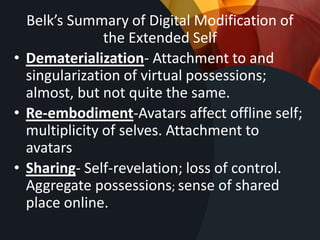
Belk’s Summary of Digital Modification of
the Extended Self
• Dematerialization- Attachment to and
singularization of virtual possessions;
almost, but not quite the same.
• Re-embodiment-Avatars affect offline self;
multiplicity of selves. Attachment to
avatars
• Sharing- Self-revelation; loss of control.
Aggregate possessions; sense of shared
place online.
• Co-construction of self- Affirmation of
self; building aggregate extended self;
“Attachment to Virtual Possessions in
Video games”.
• Distributed memory-Narratives of self.
Digital clutter; digital cues to sense of
past.
Selective Presentation and Impression
Management
Self-presentation is behavior that
attempts to convey some information
about oneself or some image of oneself
to other people. These behaviors are
activated by the evaluative presence of
other people and by others' knowledge of
one's behavior.
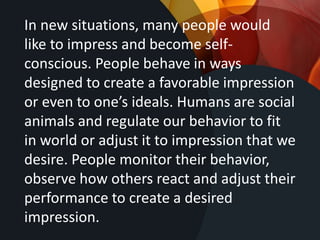
In new situations, many people would
like to impress and become self-
conscious. People behave in ways
designed to create a favorable impression
or even to one’s ideals. Humans are social
animals and regulate our behavior to fit
in world or adjust it to impression that we
desire. People monitor their behavior,
observe how others react and adjust their
performance to create a desired
impression.
y
Two Types of Self-Presentation
1. Pleasing the audience – This type
of self-presentation which try to match
self to the audience's expectations and
preferences.
2. Self-construction – This type of
self-presentation tries to match oneself
to one's own ideal self.
Multiple Aspects of the Self
Higgins (1987) argues that there are three
domains of the self: the actual self, the ideal
self and the ought self.
1. Actual self – this refers to the attributes
an individual possesses.
2. Ideal self – this refers to the attributes an
individual would ideally possess.
3. Ought self – this refers to the attributes
an individual ought to possess.
According to Higgins, the
discrepancies between the
actual self and ideal self leads to
feelings of dejection. Our sense
of self helps organize our
thoughts, feelings and
behaviors. Our overall self-
evaluation influences our
cognitive processes. For
instance, when people with high
self-evaluation fail, they sustain
their self-worth by looking at
others failure.
Impact of Online Interaction on Self
Computer-Mediated Communication
Computer-mediated communication encompasses human communication
involving several exchange through various platforms such as text, audio, and/or
video messages. A CMC interaction occurs through various types of networking
technology and software, including email, Internet Relay Chat (IRC), instant
messaging (IM), Usenet and mailing list servers. An interesting discussion can
stem from a comparison of how we construct our identity in the “real world” versus
how we construct it in the online world. As Dutton (1996) points out, that
technology can work two ways – open or close social choices. Individuals shape
the impact of technology has on their lives by choosing which technology to use
and how to use it.
Boundaries of Self Online
The line between offline and online self has become blurred. Since people
nowadays are becoming more connected digitally, self-identity is becoming more
fashioned in transmedia paradigm. In the present culture of constant connectivity,
the Internet is coordinated into our lives with the end goal that the experience of
being on the web is subjectively not quite the same as before.

understanding the self Digital-self.pptx

  • 1.
    DIGITAL SELF Do notover use the internet!!!
  • 2.
    I, Me andMyself and My User ID online Digital self is a mask we put on to draw in the innovative world. With the digital technologies such as web pages, online games, virtual worlds, social media, smart phones, Internet, self-extension is extensive.
  • 3.
    Objects that one’spossess can truly extend the self, as when an instrument or weapon enables us to get things done of which we would somehow or another be unable. Sartre explained that the reason we want to have something is to enlarge our sense of self and that the only way we can know who we are is by observing what we have. Belk (1988) presented the concept of the extended self: (1) Dematerialization, (2) Re-embodiment, (3) Sharing, (4) Co-construction of Self, and (5) Distributed memory.
  • 4.
    WHAT IS THE POSITIVEAND NEGATIVE IMPACT OF DIGITAL AND BOUNDARIES?
  • 5.
    What not toPost Online? 1. Sexy or revealing pictures- These kinds of photos should be kept in private for security reasons. Some people may take advantage of these photos and spread them without the knowledge of the original owner. 2. Pictures or videos showing private moments with loved ones- Even if sometimes people are too showy of their feelings towards their loved ones, kissing and intimate moments and activities must be kept in private and should not be divulged in online platforms. 3. Pictures or videos showing bad habits- Some examples of these are pictures showing a person drinking liquor and being intoxicated, smoking cigarettes, and gambling.
  • 6.
    5. Negative commentson another person’s attitudes- It is indecent to post negative comments and announce to the world what you think of another person’s attitudes. It is unfair and damaging to another person’s attitudes. 6. Posts announcing conflicts with other people- As the saying goes, “Do not wash dirty linen in public.” Conflicts with other people cannot be resolved by posting about them online. The best way of resolving these conflict is to face them without any screens in between.
  • 7.
    7. Posts ofthe results of a particular competition with the names of defeated participants -While everyone has the right to brag about his or her achievement or success, it is indecent to display and inform the world the failure of another person. It can be damaging to people’s reputation and it can also impact their psychological well-being. 8. Comments showing strong opposition to certain issues- Any individual is free to express his or her ideas and opinions on a certain topic or issue but sometimes it may offend people or worst, it can even lead to earning an enemy.
  • 8.
    Dichotomies of theSelf • There are three crucial domains where traditional boundaries between the dichotomies of self become increasingly blurred. These domains are producer or consumer, offline versus online and body versus technology.
  • 9.
    1. Producer orConsumer. Do your material possessions define who you are? There is a 16 year old young lady who is very into K-pop culture. At first glance, the girl may not easily be identified as a Filipino because from head to toe, she adapts the material culture of her favorite K-pop stars. To some people, one’s material possession define one’s identity. 2. Offline versus Online. Will there be a consistency between what is seen online and what is perceived offline. 3. Body VS Technology. Technology and consumerism allow people to easily redefine and recreate themselves
  • 10.
    Are you aResponsible Netizen?
  • 11.
    Here are someof the issues that one needs to address if one to be seen as responsible netizen: 1. Sharing Fake News-As the famous saying goes, “Think before you click.” 2. Cyberbullying- People bully other people online because the feel that they can do so as online interaction is different from face-to-face or personal interaction. 3. Sharing Viruses. Some social media share viruses for fun. Usually, these viruses present themselves as pornographic content which makes users interested in opening such malicious links.
  • 12.
    Belk’s Summary ofDigital Modification of the Extended Self • Dematerialization- Attachment to and singularization of virtual possessions; almost, but not quite the same. • Re-embodiment-Avatars affect offline self; multiplicity of selves. Attachment to avatars • Sharing- Self-revelation; loss of control. Aggregate possessions; sense of shared place online.
  • 13.
    • Co-construction ofself- Affirmation of self; building aggregate extended self; “Attachment to Virtual Possessions in Video games”. • Distributed memory-Narratives of self. Digital clutter; digital cues to sense of past.
  • 14.
    Selective Presentation andImpression Management Self-presentation is behavior that attempts to convey some information about oneself or some image of oneself to other people. These behaviors are activated by the evaluative presence of other people and by others' knowledge of one's behavior.
  • 15.
    In new situations,many people would like to impress and become self- conscious. People behave in ways designed to create a favorable impression or even to one’s ideals. Humans are social animals and regulate our behavior to fit in world or adjust it to impression that we desire. People monitor their behavior, observe how others react and adjust their performance to create a desired impression.
  • 16.
    y Two Types ofSelf-Presentation 1. Pleasing the audience – This type of self-presentation which try to match self to the audience's expectations and preferences. 2. Self-construction – This type of self-presentation tries to match oneself to one's own ideal self.
  • 17.
    Multiple Aspects ofthe Self Higgins (1987) argues that there are three domains of the self: the actual self, the ideal self and the ought self. 1. Actual self – this refers to the attributes an individual possesses. 2. Ideal self – this refers to the attributes an individual would ideally possess. 3. Ought self – this refers to the attributes an individual ought to possess.
  • 18.
    According to Higgins,the discrepancies between the actual self and ideal self leads to feelings of dejection. Our sense of self helps organize our thoughts, feelings and behaviors. Our overall self- evaluation influences our cognitive processes. For instance, when people with high self-evaluation fail, they sustain their self-worth by looking at others failure.
  • 19.
    Impact of OnlineInteraction on Self Computer-Mediated Communication Computer-mediated communication encompasses human communication involving several exchange through various platforms such as text, audio, and/or video messages. A CMC interaction occurs through various types of networking technology and software, including email, Internet Relay Chat (IRC), instant messaging (IM), Usenet and mailing list servers. An interesting discussion can stem from a comparison of how we construct our identity in the “real world” versus how we construct it in the online world. As Dutton (1996) points out, that technology can work two ways – open or close social choices. Individuals shape the impact of technology has on their lives by choosing which technology to use and how to use it. Boundaries of Self Online The line between offline and online self has become blurred. Since people nowadays are becoming more connected digitally, self-identity is becoming more fashioned in transmedia paradigm. In the present culture of constant connectivity, the Internet is coordinated into our lives with the end goal that the experience of being on the web is subjectively not quite the same as before.