Race & Comedy
Today 
1) Updates 
2) Interlude: Chris Rock on White America 
3) Key & Peele on the nature of humor and race 
(with videos) 
4) So what does that tell us? What CAN and can’t we 
do? 
5) Next time…
Don’t forget 
You have two major projects due today, to 
the Niihka drop-box. You should submit: 
1) Your logo with your memo and your pitch 
letter (three things) 
2) your typography remix with memo (two 
things)
Please… 
… use the drop box. I know some of you have emailed 
me, but unless for some reason your computer 
CANNOT upload to Niihka, please do. It makes my 
grading process 10X smoother if all the projects are 
in one place instead of spread among the battle-field 
of my email box. A happier, efficient Dr. Phill 
means quicker grading and feedback for all of you.
Race and Comedy 
To start us out, I want to offer Dr. Phill’s 5 assertions 
why racial comedy is funny (whether it should or 
shouldn’t be).
One 
Deep down, maybe even in a place 
where we can’t see or feel it on a daily 
basis, humans fear the other, the 
person who is so unlike them. A way to 
subvert that fear is to laugh in the face 
of it.
Two 
Humor is a pathos based (pathetic– 
perhaps?) response. Because of that, it is 
enhanced by other forms of pathos. Fear, 
anxiety, danger, etc. make comedy’s 
impact stronger. And some other emotion 
relates to race for most people.
Three 
Comedians from othered groups, due to 
the culture spawned by political 
correctness, perceive and are perceived 
as having more security to talk about 
their own race. This means that some of 
the most edgy comedy comes from people 
who aren’t like you and can point it out.
Four 
In spite of “political correctness,” many of 
us grow up around bullies, and bullying is 
viewed as cool. Because of PC, as adults 
(unless we’re, you know, jerks) we don’t 
throw racial insults or pick on kids for 
wearing glasses or being fat. But deep 
inside, we still think it’s cool.
Five 
We also want to understand other cultures, 
but we often don’t know how to ask 
certain questions. When we hear a joke 
that explains something, we feel both the 
enjoyment of the comedy and the relief of 
learning something new.
TRANSITION: 
Chris Rock
Key and Peele 
Over the next several slides, I’m going to offer 
you the text of a TIME magazine essay Key 
and Peele wrote in March of this year. 
Interspersed, we’ll stop from time to time to 
watch a piece of their comedy. When we’re 
done, we’ll talk about it.
“When did America get so politically 
correct? It’s when we refuse to mock a 
group that we truly act like bullies. 
Would you make fun of a burn victim? 
Well, we did. Sort of …
“We’re comics. In the most recent season 
of our TV show, in a sketch titled “Insult 
Comic,” a traditional stand-up comedian 
professes that he is “going to get 
everybody” in his set (the guy toward the 
front with big ears, the fat guy, the 
woman with comically large breasts).
“That’s the phrase, isn’t it, when a critic wants 
to praise a comedian for the fearless nature of 
his or her comedy? That he or she ‘gets 
everybody’? That ‘nobody is safe’? One of the 
club patrons in our sketch, however, is a 
wheelchair-bound burn victim. ‘You skipped 
me,’ he calls from the audience, with a robotic-sounding 
artificial larynx. ‘Go for it,’ he says, ‘I 
can take it.’
“But can we, as a society, 
take it anymore?
“Today it seems that we live in a world of 
extremes. On one end of the spectrum, we 
have anonymous Internet trolls looking for 
opportunities to dole out cruelty with 
impunity. But in mainstream culture, it often 
seems we’re drowning in a sea of political 
correctness that lapped up on our shores a 
couple of decades ago and has yet to recede.
“It’s amazing to think how popular 
television shows like All in the Family and 
Good Times might fare today in a 
Hollywood pitch meeting. Films like 
Blazing Saddles and Silver Streak wouldn’t 
make it past the development stage at a 
studio. Too edgy.
“Somewhere along the line, 
we’ve forgotten the true 
purpose of humor: to help 
people cope with the fears and 
horrors of the world.
“Sure, sometimes at Key & Peele, we 
swim in the shallow waters of pratfalls, 
airplane observations and simple old-school 
punnery. But what we strive for– 
and what we think more people should 
strive for–is deeper: to make fun of 
everything.
“At the same time, though, it’s our duty. 
To not make fun of something is, we 
believe, itself a form of bullying. When a 
humorist makes the conscious decision to 
exclude a group from derision, isn’t he or 
she implying that the members of that 
group are not capable of self-reflection?
“Or don’t possess the mental 
faculties to recognize the nuances 
of satire? A group that’s excluded 
never gets the opportunity to join 
in the greater human conversation.
“Luckily, a lot of people get this–at 
least when it comes to their own 
cultures. Like the burn victim in our 
sketch, they plead, ‘You skipped 
me! Do me!’
“There was the half-Hispanic, half– 
Native American man who told 
Keegan recently just how much gold 
there was to be mined from his hybrid 
culture.
“A young Arab man told us how much he 
loves Karim and Jahar (a couple of 
sexually repressed Arab characters we 
play). ‘You gotta do more of them!’ he 
begged. Gay and lesbian couples tell us to 
‘keep going … There’s plenty to make fun 
of … Trust us!’
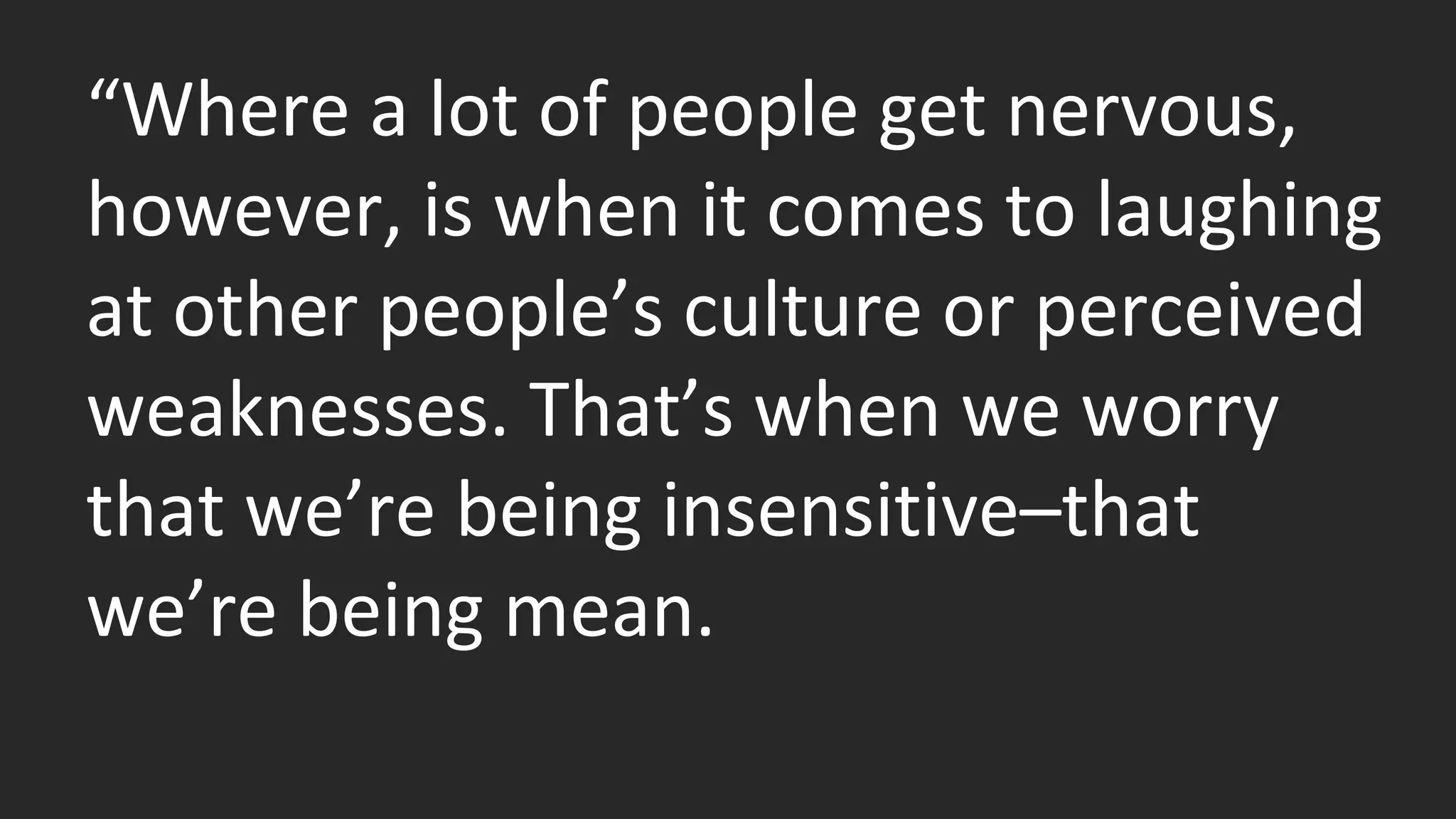
“Where a lot of people get nervous, 
however, is when it comes to laughing 
at other people’s culture or perceived 
weaknesses. That’s when we worry 
that we’re being insensitive–that 
we’re being mean.
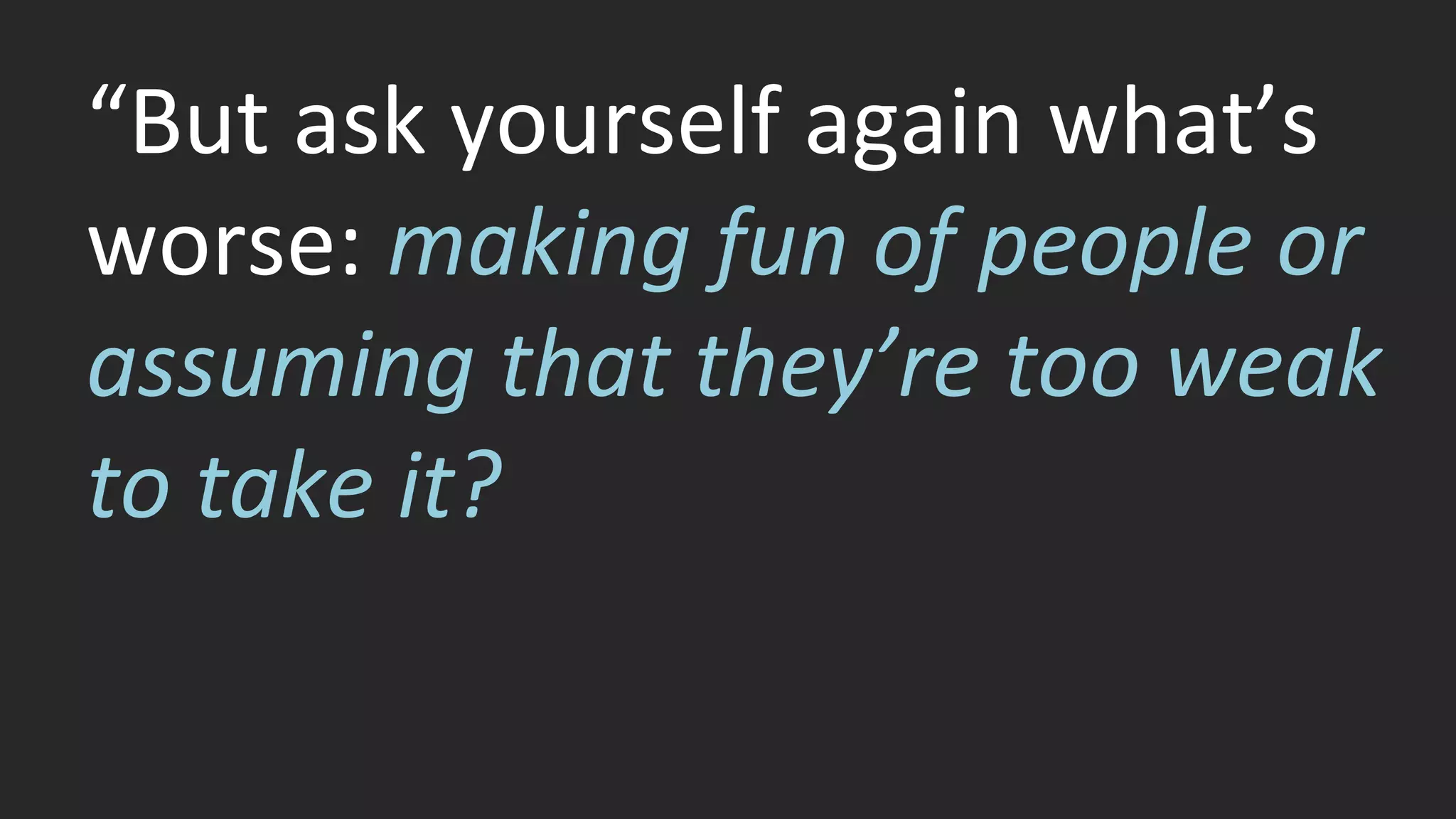
“But ask yourself again what’s 
worse: making fun of people or 
assuming that they’re too weak 
to take it?
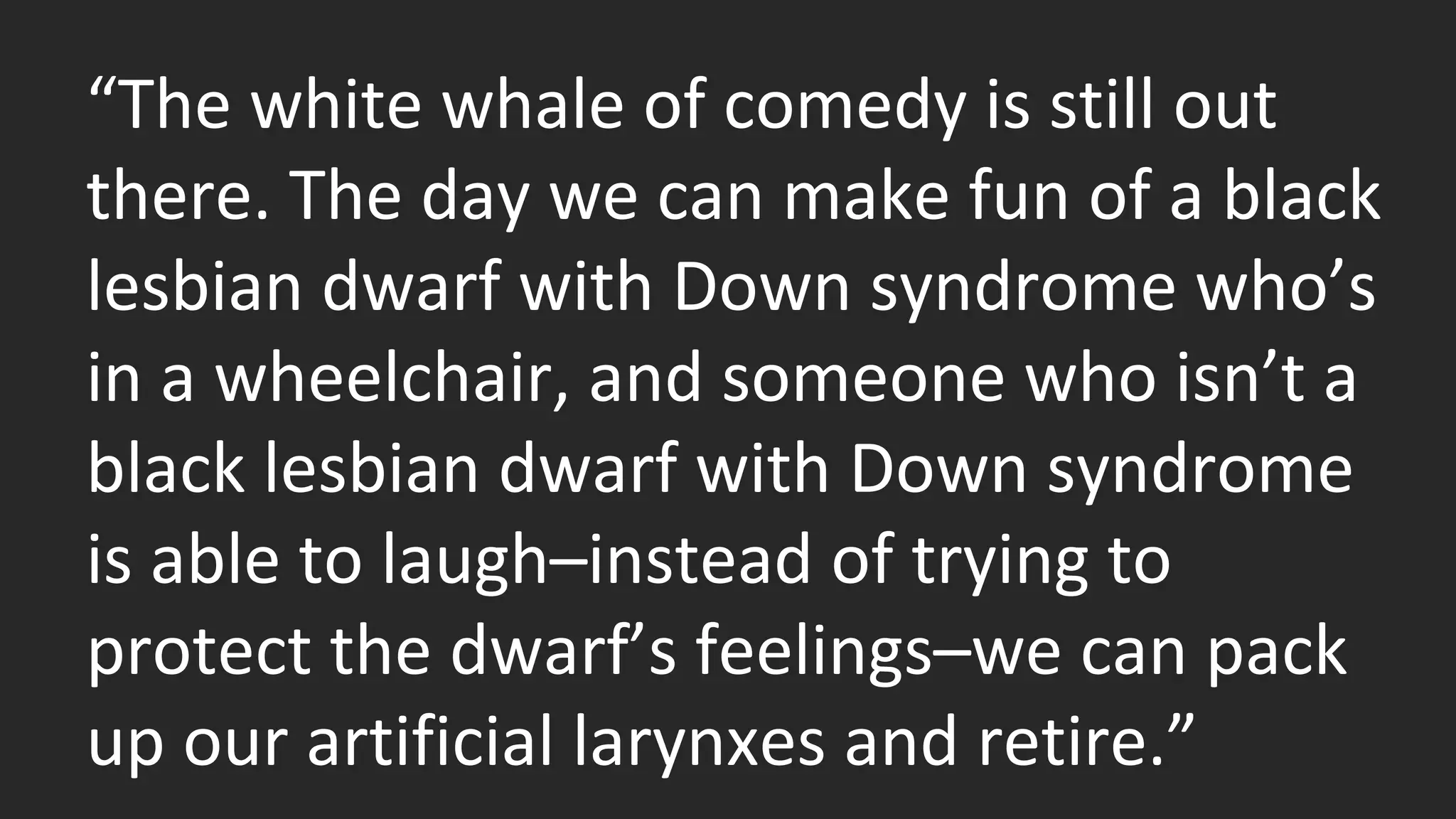
“The white whale of comedy is still out 
there. The day we can make fun of a black 
lesbian dwarf with Down syndrome who’s 
in a wheelchair, and someone who isn’t a 
black lesbian dwarf with Down syndrome 
is able to laugh–instead of trying to 
protect the dwarf’s feelings–we can pack 
up our artificial larynxes and retire.”
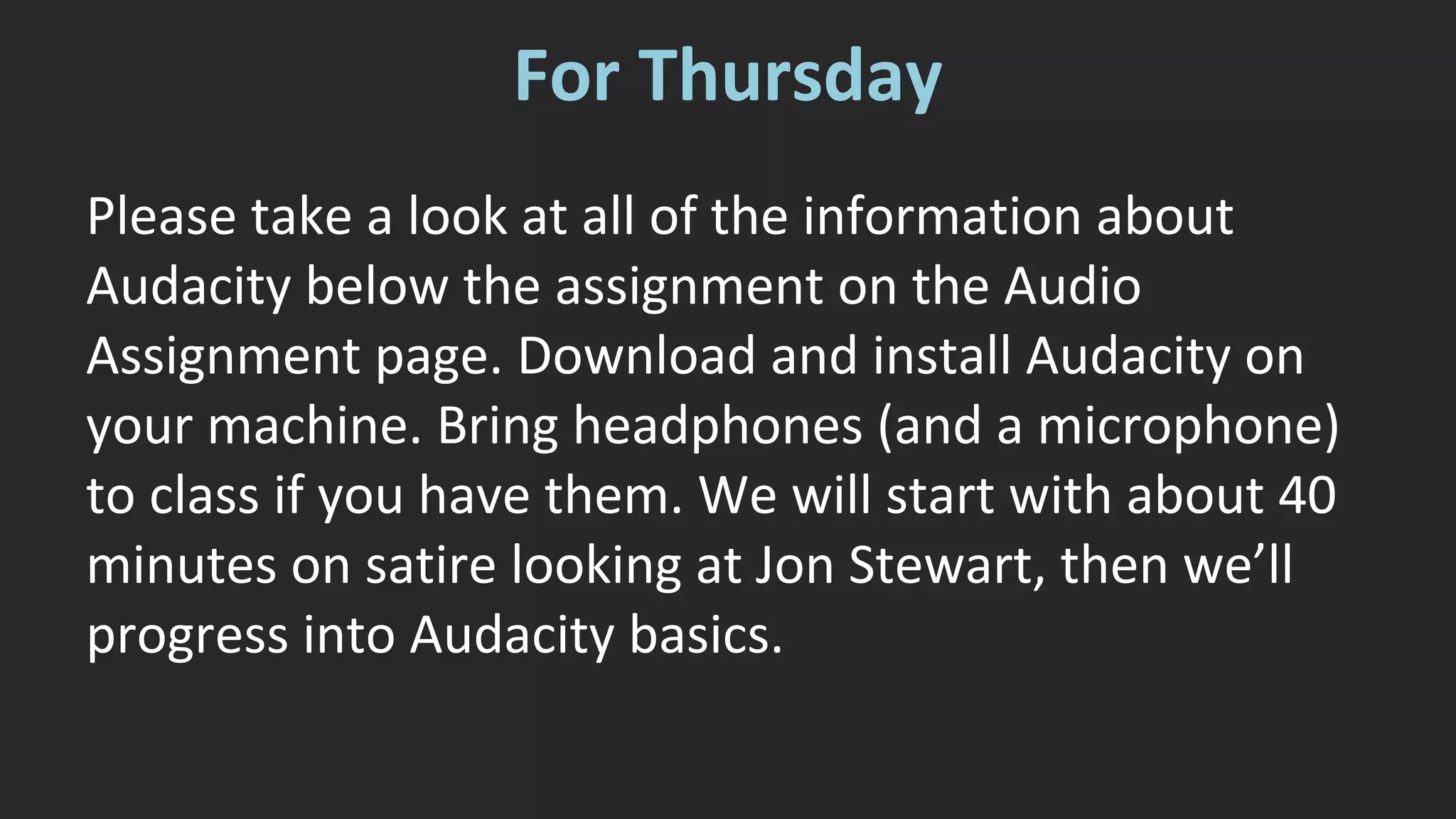
For Thursday 
Please take a look at all of the information about 
Audacity below the assignment on the Audio 
Assignment page. Download and install Audacity on 
your machine. Bring headphones (and a microphone) 
to class if you have them. We will start with about 40 
minutes on satire looking at Jon Stewart, then we’ll 
progress into Audacity basics.

Digital Rhetoric, October 28th, 2014: Race and Humor with YouTube darlings Key and Peele

  • 1.
  • 2.
    Today 1) Updates 2) Interlude: Chris Rock on White America 3) Key & Peele on the nature of humor and race (with videos) 4) So what does that tell us? What CAN and can’t we do? 5) Next time…
  • 3.
    Don’t forget Youhave two major projects due today, to the Niihka drop-box. You should submit: 1) Your logo with your memo and your pitch letter (three things) 2) your typography remix with memo (two things)
  • 4.
    Please… … usethe drop box. I know some of you have emailed me, but unless for some reason your computer CANNOT upload to Niihka, please do. It makes my grading process 10X smoother if all the projects are in one place instead of spread among the battle-field of my email box. A happier, efficient Dr. Phill means quicker grading and feedback for all of you.
  • 5.
    Race and Comedy To start us out, I want to offer Dr. Phill’s 5 assertions why racial comedy is funny (whether it should or shouldn’t be).
  • 6.
    One Deep down,maybe even in a place where we can’t see or feel it on a daily basis, humans fear the other, the person who is so unlike them. A way to subvert that fear is to laugh in the face of it.
  • 7.
    Two Humor isa pathos based (pathetic– perhaps?) response. Because of that, it is enhanced by other forms of pathos. Fear, anxiety, danger, etc. make comedy’s impact stronger. And some other emotion relates to race for most people.
  • 8.
    Three Comedians fromothered groups, due to the culture spawned by political correctness, perceive and are perceived as having more security to talk about their own race. This means that some of the most edgy comedy comes from people who aren’t like you and can point it out.
  • 9.
    Four In spiteof “political correctness,” many of us grow up around bullies, and bullying is viewed as cool. Because of PC, as adults (unless we’re, you know, jerks) we don’t throw racial insults or pick on kids for wearing glasses or being fat. But deep inside, we still think it’s cool.
  • 10.
    Five We alsowant to understand other cultures, but we often don’t know how to ask certain questions. When we hear a joke that explains something, we feel both the enjoyment of the comedy and the relief of learning something new.
  • 11.
  • 12.
    Key and Peele Over the next several slides, I’m going to offer you the text of a TIME magazine essay Key and Peele wrote in March of this year. Interspersed, we’ll stop from time to time to watch a piece of their comedy. When we’re done, we’ll talk about it.
  • 13.
    “When did Americaget so politically correct? It’s when we refuse to mock a group that we truly act like bullies. Would you make fun of a burn victim? Well, we did. Sort of …
  • 14.
    “We’re comics. Inthe most recent season of our TV show, in a sketch titled “Insult Comic,” a traditional stand-up comedian professes that he is “going to get everybody” in his set (the guy toward the front with big ears, the fat guy, the woman with comically large breasts).
  • 15.
    “That’s the phrase,isn’t it, when a critic wants to praise a comedian for the fearless nature of his or her comedy? That he or she ‘gets everybody’? That ‘nobody is safe’? One of the club patrons in our sketch, however, is a wheelchair-bound burn victim. ‘You skipped me,’ he calls from the audience, with a robotic-sounding artificial larynx. ‘Go for it,’ he says, ‘I can take it.’
  • 16.
    “But can we,as a society, take it anymore?
  • 17.
    “Today it seemsthat we live in a world of extremes. On one end of the spectrum, we have anonymous Internet trolls looking for opportunities to dole out cruelty with impunity. But in mainstream culture, it often seems we’re drowning in a sea of political correctness that lapped up on our shores a couple of decades ago and has yet to recede.
  • 18.
    “It’s amazing tothink how popular television shows like All in the Family and Good Times might fare today in a Hollywood pitch meeting. Films like Blazing Saddles and Silver Streak wouldn’t make it past the development stage at a studio. Too edgy.
  • 19.
    “Somewhere along theline, we’ve forgotten the true purpose of humor: to help people cope with the fears and horrors of the world.
  • 20.
    “Sure, sometimes atKey & Peele, we swim in the shallow waters of pratfalls, airplane observations and simple old-school punnery. But what we strive for– and what we think more people should strive for–is deeper: to make fun of everything.
  • 21.
    “At the sametime, though, it’s our duty. To not make fun of something is, we believe, itself a form of bullying. When a humorist makes the conscious decision to exclude a group from derision, isn’t he or she implying that the members of that group are not capable of self-reflection?
  • 22.
    “Or don’t possessthe mental faculties to recognize the nuances of satire? A group that’s excluded never gets the opportunity to join in the greater human conversation.
  • 23.
    “Luckily, a lotof people get this–at least when it comes to their own cultures. Like the burn victim in our sketch, they plead, ‘You skipped me! Do me!’
  • 24.
    “There was thehalf-Hispanic, half– Native American man who told Keegan recently just how much gold there was to be mined from his hybrid culture.
  • 25.
    “A young Arabman told us how much he loves Karim and Jahar (a couple of sexually repressed Arab characters we play). ‘You gotta do more of them!’ he begged. Gay and lesbian couples tell us to ‘keep going … There’s plenty to make fun of … Trust us!’
  • 26.
    “Where a lotof people get nervous, however, is when it comes to laughing at other people’s culture or perceived weaknesses. That’s when we worry that we’re being insensitive–that we’re being mean.
  • 27.
    “But ask yourselfagain what’s worse: making fun of people or assuming that they’re too weak to take it?
  • 28.
    “The white whaleof comedy is still out there. The day we can make fun of a black lesbian dwarf with Down syndrome who’s in a wheelchair, and someone who isn’t a black lesbian dwarf with Down syndrome is able to laugh–instead of trying to protect the dwarf’s feelings–we can pack up our artificial larynxes and retire.”
  • 29.
    For Thursday Pleasetake a look at all of the information about Audacity below the assignment on the Audio Assignment page. Download and install Audacity on your machine. Bring headphones (and a microphone) to class if you have them. We will start with about 40 minutes on satire looking at Jon Stewart, then we’ll progress into Audacity basics.