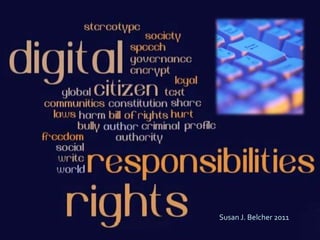
Susan J. Belcher 2011
istenets.t4.  Promote and Model Digital Citizenship and Responsibility
Teachers understand local and global societal issues and responsibilities in an evolving digital culture and exhibit legal and ethical behavior in their professional practices. Teachers:
a. advocate, model, and teach safe, legal, and ethical use of digital information and technology, including respect for copyright, intellectual property, and the appropriate documentation of sources.
b. address the diverse needs of all learners by using learner-centered strategies providing equitable access to appropriate digital tools and resources. c. promote and model digital etiquette and responsible social interactions related to the use of technology and information.
d. develop and model cultural understanding and global awareness by engaging with colleagues and students of      other cultures using digital-age communication and collaboration tools.
Focus QuestionAs teaching professionals are we aware of the rights and responsibilities of a digital citizen in the virtual global world?ObjectivesWe will:Identify  digital citizens;
Understand that rights and responsibilities must addressed;
Evaluate the difficulty of governing the Net.Citizenship is a tough occupation which obliges the citizen to make his own informed opinion and stand by it.       Martha GelhornRights and ResponsibilitiesDigital Citizenship
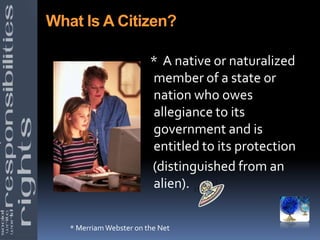
What Is A Citizen?   *  A native or naturalized member of a state or nation who owes allegiance to its government and is entitled to its protection    (distinguished from an alien). * Merriam Webster on the Net
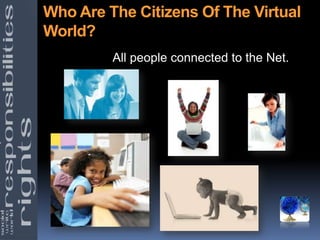
Who Are The Citizens Of The Virtual World?All people connected to the Net.
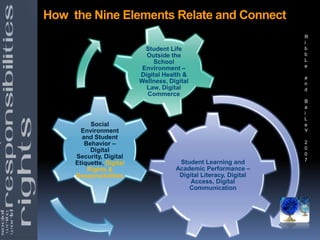
Ribble and Baily: Nine Elements of Digital Citizenship Digital:Literacy
Access
Communication
Security
Communications
Rights and Responsibilities
Health and Wellness
Law
CommerceHow  the Nine Elements Relate and ConnectRibbLe and BaiLeY2007
The Virtual WorldWhere Are Its Boundaries?What Is Its Culture?Who Governs This World?When Are You A Citizen Or Merely A Visitor?Why Did We Think the Virtual World Would Be The “Great Equalizer”?How Do Train And Teach The Citizens Of This World?
Abuse in the Virtual WorldIn complaints to the Internet Crime Complaint Center, consumers reported losing $559.7 million at the hands of cyberthieves, representing a 110 percent increase compared with 2008 figures. (reported in 2010) www.TBO.com
Fewer than one in 10 people who have been victim to cybercrime report it to law enforcement, said John Kane, a research manager at the National White Collar Crime Center. www.TBO.com

Digital r rsjb2011

  • 1.
  • 2.
    istenets.t4. Promoteand Model Digital Citizenship and Responsibility
  • 3.
    Teachers understand localand global societal issues and responsibilities in an evolving digital culture and exhibit legal and ethical behavior in their professional practices. Teachers:
  • 4.
    a. advocate, model,and teach safe, legal, and ethical use of digital information and technology, including respect for copyright, intellectual property, and the appropriate documentation of sources.
  • 5.
    b. address thediverse needs of all learners by using learner-centered strategies providing equitable access to appropriate digital tools and resources. c. promote and model digital etiquette and responsible social interactions related to the use of technology and information.
  • 6.
    d. develop andmodel cultural understanding and global awareness by engaging with colleagues and students of other cultures using digital-age communication and collaboration tools.
  • 7.
    Focus QuestionAs teachingprofessionals are we aware of the rights and responsibilities of a digital citizen in the virtual global world?ObjectivesWe will:Identify digital citizens;
  • 8.
    Understand that rightsand responsibilities must addressed;
  • 9.
    Evaluate the difficultyof governing the Net.Citizenship is a tough occupation which obliges the citizen to make his own informed opinion and stand by it. Martha GelhornRights and ResponsibilitiesDigital Citizenship
  • 10.
    What Is ACitizen? * A native or naturalized member of a state or nation who owes allegiance to its government and is entitled to its protection (distinguished from an alien). * Merriam Webster on the Net
  • 11.
    Who Are TheCitizens Of The Virtual World?All people connected to the Net.
  • 12.
    Ribble and Baily:Nine Elements of Digital Citizenship Digital:Literacy
  • 13.
  • 14.
  • 15.
  • 16.
  • 17.
  • 18.
  • 19.
  • 20.
    CommerceHow theNine Elements Relate and ConnectRibbLe and BaiLeY2007
  • 21.
    The Virtual WorldWhereAre Its Boundaries?What Is Its Culture?Who Governs This World?When Are You A Citizen Or Merely A Visitor?Why Did We Think the Virtual World Would Be The “Great Equalizer”?How Do Train And Teach The Citizens Of This World?
  • 22.
    Abuse in theVirtual WorldIn complaints to the Internet Crime Complaint Center, consumers reported losing $559.7 million at the hands of cyberthieves, representing a 110 percent increase compared with 2008 figures. (reported in 2010) www.TBO.com
  • 23.
    Fewer than onein 10 people who have been victim to cybercrime report it to law enforcement, said John Kane, a research manager at the National White Collar Crime Center. www.TBO.com