DCL 7301A  REGULATION OF INTERNET COMMERCE Professor Tamir Israel Staff Lawyer, CIPPIC Tel: (613) 562-5800 ext. 2914 Email:  [email_address] Office: Brooks 306 Office Hours: By Appointment CLASS I:  Introduction to Legal Concepts and the Internet Landscape September 9, 2010
Administrative Matters Syllabus Readings Evaluation Questions/Office Hours [email_address] M. McInnes, I.R. Kerr, and J.A. VanDuzer, “Managing the Law: The Legal Aspects of Doing Buisness”, 3 rd  Ed, (Toronto: Pearson Canada, 2011) Participation; AND Mid Term Assignment; AND Final Assignment; OR Final Paper
Hillary Clinton – “Internet Freedom” Speech delivered at the Newseum on January 21, 2010, Foreign Policy:  http://www.foreignpolicy.com/articles/2010/01/21/internet_freedom The spread of information networks is forming a new nervous system for our planet. When something happens in Haiti or Hunan the rest of us learn about it in real time - from real people… A connection to global information networks is like an on ramp to modernity…In Kenya…farmers have seen their income grow by as much as 30% since they started using mobile banking technology…One World Bank study found that in a typical developing country, a 10% increase in the penetration rate for mobile phones led to an almost one percent annual increase in per capita GDP… We have every reason to be hopeful about what people can accomplish when they leverage communication networks…But some will use global information networks for darker purposes…Our ability to bank online, use electronic commerce, and safeguard billions of dollars in intellectual property are all at stake if we cannot rely on the security of information networks. Disruptions in these systems demand a coordinated response by governments, the private sector, and the international community. We need more tools to help law enforcement agencies cooperate across jurisdictions when criminal hackers and organized crime syndicates attack networks for financial gain… Ultimately, this issue isn't just about information freedom; it's about what kind of world we're going to inhabit.  It's about whether we live on a planet with one internet, one global community…Or a fragmented planet in which access to information and opportunity is dependent on where you live and the whims of censors…For companies, this issue is about more than claiming the moral high ground; it comes down to the trust between firms and their customers. Consumers everywhere want to have confidence that the internet companies they rely on will…act as responsible stewards of their information.  Firms that earn that confidence will prosper in a global marketplace. Those who lose it will also lose customers. John Perry Barlow – A Declaration of the Independence of Cyberspace, 1996 https://homes.eff.org/~barlow/Declaration-Final.html   [Excerpts] Governments of the Industrial World, you weary giants of flesh and steel, I come from Cyberspace, the new home of Mind. On behalf of the future, I ask you of the past to leave us alone. You are not welcome among us. You have no sovereignty where we gather…I declare the global social space we are building to be naturally independent of the tyrannies you seek to impose on us. You have no moral right to rule us nor do you possess any methods of enforcement we have true reason to fear…Our identities have no bodies, so, unlike you, we cannot obtain order by physical coercion… You claim there are problems among us that you need to solve. You use this claim as an excuse to invade our precincts. Many of these problems don't exist. Where there are real conflicts, where there are wrongs, we will identify them and address them by our means. We are forming our own Social Contract. This governance will arise according to the conditions of our world, not yours. Our world is different…Our identities may be distributed across many of your jurisdictions. The only law that all our constituent cultures would generally recognize is the Golden Rule.   We hope we will be able to build our particular solutions on that basis… Your legal concepts of property, expression, identity, movement, and context do not apply to us. They are all based on matter, and there is no matter here…We believe that from ethics, enlightened self-interest, and the commonweal, our governance will emerge…Your increasingly obsolete information industries would perpetuate themselves by proposing laws, in America and elsewhere, that claim to own speech itself throughout the world. These laws would declare ideas to be another industrial product, no more noble than pig iron. In our world, whatever the human mind may create can be reproduced and distributed infinitely at no cost. The global conveyance of thought no longer requires your factories to accomplish. Clay Shirky – Does the Internet Make You Smarter? Wall Street Journal, June 4, 2010, http://online.wsj.com/article/SB10001424052748704025304575284973472694334.html   Digital media have made creating and disseminating text, sound, and images cheap, easy and global. The bulk of publicly available media is now created by people who understand little of the professional standards and practices for media.  Instead, these amateurs produce endless streams of mediocrity, eroding cultural norms about quality and acceptability, and leading to increasingly alarmed predictions of incipient chaos and intellectual collapse. But of course, that's what always happens… As Gutenberg's press spread through Europe, the Bible was translated into local languages, enabling direct encounters with the text; this was accompanied by a flood of contemporary literature, most of it mediocre. Vulgar versions of the Bible and distracting secular writings fueled religious unrest and civic confusion, leading to claims that the printing press, if not controlled, would lead to chaos and the dismemberment of European intellectual life. These claims were, of course, correct. Print fuelled the Protestant Reformation, which did indeed destroy the Church's pan-European hold on intellectual life. What the 16th-century foes of print didn't imagine—couldn't imagine—was what followed: We built new norms around newly abundant and contemporary literature. Novels, newspapers, scientific journals, the separation of fiction and non-fiction, all of these innovations were created during the collapse of the scribal system, and all had the effect of increasing, rather than decreasing, the intellectual range and output of society.   Basic Course Overview Regulation and the Internet The Internet Graphic: The Opte Project, CC-BY-NC-SA 1.0, 2003 online:  http:// www.opte.org /maps/   Rapid change ‘knows no bounds’ ‘Internet of things’ Smart Phones DPI DRM User generated Content Pipes, Tubes, Connections Key Architectural Principle: End to End Neutrality
J.S. Mill – On Liberty 4 th  ed., (London: Longman, Roberts & Green, 1869) online:  www.bartleby.com/130/   This, then, is the appropriate region of human liberty…Secondly, the principle requires liberty of tastes and pursuits; of…doing as we like, subject to such consequences as may follow: without impediment from our fellow-creatures, so long as what we do does not harm them, even though they should think our conduct foolish, perverse, or wrong… No society in which these liberties are not, on the whole, respected, is free, whatever may be its form of government… The only freedom which deserves the name, is that of pursuing our own good in our own way, so long as we do not attempt to deprive others of theirs, or impede their efforts to obtain it.   Basic Course Overview Regulation and the Internet Regulation –  The Law What is Law? Types of Laws: PRIVATE LAW Governs how private individuals interact with each other Contracts Torts Property Intellectual Property PUBLIC LAW Governs individual interactions against the state Criminal Law Administrative Law Tax Law Constitutional Law Companies and organizations? Common Law Judge Made Law Applies principles to new situations by analogy;  Stare Decisis v. Civil Law C ommon  L aw v. common law Legislation Laws passed by Parliament Responsive to democratic forces Interpreted by judges Constitution/Charter of Rights Enshrines unimpeachable rights v. government Interpreted/Applied by Judges Section 1/Non-withstanding Clause Sources of Law:
Types of Laws: Regulation –  The Law Nature of Obligations: PRIVATE LAW Governs how private individuals interact with each other Contracts Torts Property Intellectual Property PUBLIC LAW Governs individual interactions against the state Criminal Law Administrative Law Tax Law Constitutional Law REMEDIES: Purpose: make a wronged individual whole Compensation: monetary, injunction, expectation Purpose:  Incentives/Rehabilitation/Retribution Penalties:  fines, community service, prison Versus State:  strike down laws, 2 nd  hearing, damages, positive obligations SOURCES: Primarily common law, informed by Charter Aspects are statutory: IP, employment law Primarily statutory, constitutional and ‘regulatory’ Private Law – Substance: Contract Obligations individuals undertake between each other Protects : promises, commercial arrangements Substance Prescriptive/Behaviour guiding Corrective Right v. wrong Procedural Due process/fairness in dealing Right to make & challenge case Right to an objective decision/arbitrariness Can lead to substantive remedies Legitimacy Jurisdiction Administrative bodies have inherent procedural obligations Substantive v. Procedural Rights Torts Obligations individuals owe each other Protects : injury to: bodily integrity, property, privacy, reputation Property Focus on IP: statutory Is it even property? Protects : incentives to innovate, balance, goodwill, labour+

Dcl7301 classi-09092010

  • 1.
    DCL 7301A REGULATION OF INTERNET COMMERCE Professor Tamir Israel Staff Lawyer, CIPPIC Tel: (613) 562-5800 ext. 2914 Email: [email_address] Office: Brooks 306 Office Hours: By Appointment CLASS I: Introduction to Legal Concepts and the Internet Landscape September 9, 2010
  • 2.
    Administrative Matters SyllabusReadings Evaluation Questions/Office Hours [email_address] M. McInnes, I.R. Kerr, and J.A. VanDuzer, “Managing the Law: The Legal Aspects of Doing Buisness”, 3 rd Ed, (Toronto: Pearson Canada, 2011) Participation; AND Mid Term Assignment; AND Final Assignment; OR Final Paper
  • 3.
    Hillary Clinton –“Internet Freedom” Speech delivered at the Newseum on January 21, 2010, Foreign Policy: http://www.foreignpolicy.com/articles/2010/01/21/internet_freedom The spread of information networks is forming a new nervous system for our planet. When something happens in Haiti or Hunan the rest of us learn about it in real time - from real people… A connection to global information networks is like an on ramp to modernity…In Kenya…farmers have seen their income grow by as much as 30% since they started using mobile banking technology…One World Bank study found that in a typical developing country, a 10% increase in the penetration rate for mobile phones led to an almost one percent annual increase in per capita GDP… We have every reason to be hopeful about what people can accomplish when they leverage communication networks…But some will use global information networks for darker purposes…Our ability to bank online, use electronic commerce, and safeguard billions of dollars in intellectual property are all at stake if we cannot rely on the security of information networks. Disruptions in these systems demand a coordinated response by governments, the private sector, and the international community. We need more tools to help law enforcement agencies cooperate across jurisdictions when criminal hackers and organized crime syndicates attack networks for financial gain… Ultimately, this issue isn't just about information freedom; it's about what kind of world we're going to inhabit. It's about whether we live on a planet with one internet, one global community…Or a fragmented planet in which access to information and opportunity is dependent on where you live and the whims of censors…For companies, this issue is about more than claiming the moral high ground; it comes down to the trust between firms and their customers. Consumers everywhere want to have confidence that the internet companies they rely on will…act as responsible stewards of their information. Firms that earn that confidence will prosper in a global marketplace. Those who lose it will also lose customers. John Perry Barlow – A Declaration of the Independence of Cyberspace, 1996 https://homes.eff.org/~barlow/Declaration-Final.html [Excerpts] Governments of the Industrial World, you weary giants of flesh and steel, I come from Cyberspace, the new home of Mind. On behalf of the future, I ask you of the past to leave us alone. You are not welcome among us. You have no sovereignty where we gather…I declare the global social space we are building to be naturally independent of the tyrannies you seek to impose on us. You have no moral right to rule us nor do you possess any methods of enforcement we have true reason to fear…Our identities have no bodies, so, unlike you, we cannot obtain order by physical coercion… You claim there are problems among us that you need to solve. You use this claim as an excuse to invade our precincts. Many of these problems don't exist. Where there are real conflicts, where there are wrongs, we will identify them and address them by our means. We are forming our own Social Contract. This governance will arise according to the conditions of our world, not yours. Our world is different…Our identities may be distributed across many of your jurisdictions. The only law that all our constituent cultures would generally recognize is the Golden Rule. We hope we will be able to build our particular solutions on that basis… Your legal concepts of property, expression, identity, movement, and context do not apply to us. They are all based on matter, and there is no matter here…We believe that from ethics, enlightened self-interest, and the commonweal, our governance will emerge…Your increasingly obsolete information industries would perpetuate themselves by proposing laws, in America and elsewhere, that claim to own speech itself throughout the world. These laws would declare ideas to be another industrial product, no more noble than pig iron. In our world, whatever the human mind may create can be reproduced and distributed infinitely at no cost. The global conveyance of thought no longer requires your factories to accomplish. Clay Shirky – Does the Internet Make You Smarter? Wall Street Journal, June 4, 2010, http://online.wsj.com/article/SB10001424052748704025304575284973472694334.html Digital media have made creating and disseminating text, sound, and images cheap, easy and global. The bulk of publicly available media is now created by people who understand little of the professional standards and practices for media. Instead, these amateurs produce endless streams of mediocrity, eroding cultural norms about quality and acceptability, and leading to increasingly alarmed predictions of incipient chaos and intellectual collapse. But of course, that's what always happens… As Gutenberg's press spread through Europe, the Bible was translated into local languages, enabling direct encounters with the text; this was accompanied by a flood of contemporary literature, most of it mediocre. Vulgar versions of the Bible and distracting secular writings fueled religious unrest and civic confusion, leading to claims that the printing press, if not controlled, would lead to chaos and the dismemberment of European intellectual life. These claims were, of course, correct. Print fuelled the Protestant Reformation, which did indeed destroy the Church's pan-European hold on intellectual life. What the 16th-century foes of print didn't imagine—couldn't imagine—was what followed: We built new norms around newly abundant and contemporary literature. Novels, newspapers, scientific journals, the separation of fiction and non-fiction, all of these innovations were created during the collapse of the scribal system, and all had the effect of increasing, rather than decreasing, the intellectual range and output of society. Basic Course Overview Regulation and the Internet The Internet Graphic: The Opte Project, CC-BY-NC-SA 1.0, 2003 online: http:// www.opte.org /maps/ Rapid change ‘knows no bounds’ ‘Internet of things’ Smart Phones DPI DRM User generated Content Pipes, Tubes, Connections Key Architectural Principle: End to End Neutrality
  • 4.
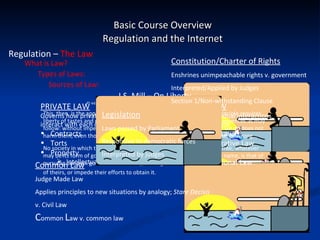
    J.S. Mill –On Liberty 4 th ed., (London: Longman, Roberts & Green, 1869) online: www.bartleby.com/130/ This, then, is the appropriate region of human liberty…Secondly, the principle requires liberty of tastes and pursuits; of…doing as we like, subject to such consequences as may follow: without impediment from our fellow-creatures, so long as what we do does not harm them, even though they should think our conduct foolish, perverse, or wrong… No society in which these liberties are not, on the whole, respected, is free, whatever may be its form of government… The only freedom which deserves the name, is that of pursuing our own good in our own way, so long as we do not attempt to deprive others of theirs, or impede their efforts to obtain it. Basic Course Overview Regulation and the Internet Regulation – The Law What is Law? Types of Laws: PRIVATE LAW Governs how private individuals interact with each other Contracts Torts Property Intellectual Property PUBLIC LAW Governs individual interactions against the state Criminal Law Administrative Law Tax Law Constitutional Law Companies and organizations? Common Law Judge Made Law Applies principles to new situations by analogy; Stare Decisis v. Civil Law C ommon L aw v. common law Legislation Laws passed by Parliament Responsive to democratic forces Interpreted by judges Constitution/Charter of Rights Enshrines unimpeachable rights v. government Interpreted/Applied by Judges Section 1/Non-withstanding Clause Sources of Law:
  • 5.
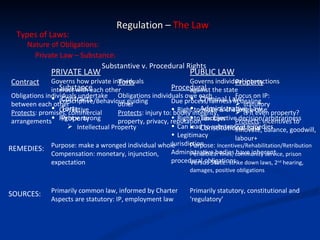
    Types of Laws:Regulation – The Law Nature of Obligations: PRIVATE LAW Governs how private individuals interact with each other Contracts Torts Property Intellectual Property PUBLIC LAW Governs individual interactions against the state Criminal Law Administrative Law Tax Law Constitutional Law REMEDIES: Purpose: make a wronged individual whole Compensation: monetary, injunction, expectation Purpose: Incentives/Rehabilitation/Retribution Penalties: fines, community service, prison Versus State: strike down laws, 2 nd hearing, damages, positive obligations SOURCES: Primarily common law, informed by Charter Aspects are statutory: IP, employment law Primarily statutory, constitutional and ‘regulatory’ Private Law – Substance: Contract Obligations individuals undertake between each other Protects : promises, commercial arrangements Substance Prescriptive/Behaviour guiding Corrective Right v. wrong Procedural Due process/fairness in dealing Right to make & challenge case Right to an objective decision/arbitrariness Can lead to substantive remedies Legitimacy Jurisdiction Administrative bodies have inherent procedural obligations Substantive v. Procedural Rights Torts Obligations individuals owe each other Protects : injury to: bodily integrity, property, privacy, reputation Property Focus on IP: statutory Is it even property? Protects : incentives to innovate, balance, goodwill, labour+